February 28, 2008
CIA Rendition
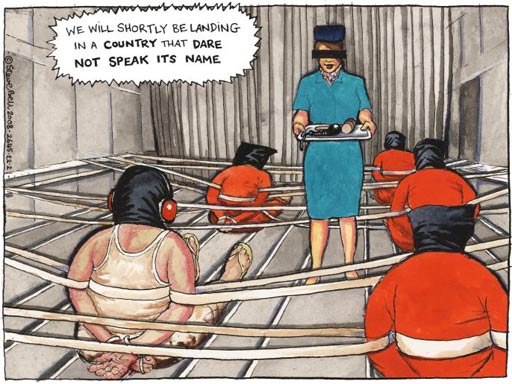
The CIA's rendition of terrorism suspects is linked to the covert prison sites operated with the knowledge of the "host" nation. These secret prisons, known as black sites, are generally outside of the mainland U.S. territory and legal jurisdiction, and with little or no political or public oversight. Black sites refer to the facilities that are controlled by the Central Intelligence Agency (CIA) used by the U.S. in its war on terrorism to detain suspected enemy combatants.
Steve Bell
Rendition and secret prisons refer to situations in which the U.S. has transferred suspected terrorists to countries known to employ harsh interrogation techniques that rise to the level of torture.This is done in order to increase chances of extracting information. The justification for torturing terror suspects, is that it is necessary to help prevent further terrorist attacks, which may only be a matter of hours or days away.
February 26, 2008
William F. Buckley
William F. Buckley Jr., who founded National Review in 1955, can be considered the intellectual father to American conservatism. If Christian piety and anti-communism were Buckley's twin pillars of conservatism, then its other columns were opposition to the New Deal (welfare state) and nativism. Russell Kirk's The Conservative Mind, traced an intellectual bloodline from Edmund Burke to the Old Right in the early 1950s, and it challenged the popular notion that no coherent conservative tradition existed in the United States and showed that liberalism was not the sole intellectual tradition in the United States. William F. Buckley Jr built on this tradition by standing athwart history, yelling Stop, at a time when no other is inclined to do so, or to have much patience with those who so urge it.
Nativism lead to him into the swampland of racism athwarting the history of civil rights through strongly supporting the segregationist South. Consider, for example, this National Review editorial from 1957 (cited in Paul Krugman's recent book The Conscience of a Liberal):
The central question that emerges—and it is not a parliamentary question or a question that is answered by merely consulting a catalog of the rights of American citizens, born Equal—is whether the White community in the South is entitled to take such measures as are necessary to prevail, politically and culturally, in areas in which it does not predominate numerically? The sobering answer is Yes—the White community is so entitled because, for the time being, it is the advanced race. …
National Review believes that the South's premises are correct. If the majority wills what is socially atavistic, then to thwart the majority may be, though undemocratic, enlightened. It is more important for any community, anywhere in the world, to affirm and live by civilized standards, than to bow to the demands of the numerical majority. Sometimes it becomes impossible to assert the will of a minority, in which case it must give way; and the society will regress; sometimes the numerical minority cannot prevail except by violence: then it must determine whether the prevalence of its will is worth the terrible price of violence.
Buckley promoted the idea of fusionism, whereby different schools of conservatives, including libertarians, would work together to combat what were seen as their common opponents.
February 24, 2008
public culture + democracy
If "public culture" is often perceived to be under threat from processes of globalisation, the effects of new technologies and the privatisation of public utilities, then twenty-first century technologies have changed the contours of existing public spheres and produced virtual communities. So how have they changed the public sphere around our democratic institutions?
The standard narrative is one of a crisis of disengagement from politics, a disappointment with politics and a turning away from our political institutions. Canberra or Washington isn't working is the public feeling. There is a disconnect between what we do in our personal lives and in collective lives as citizens. Global warming is a good example.
Liberal democracy looks sickly and this malaise of democracy is often expressed in the decline of
participation and the decline of the public.The centralisation of decision-making at a federal and state level has made government remote from citizens, and the rewards from participation increasingly slim, because theprospect of having any influence on decisions is so small. The effectivenessof representation has been increasingly questioned. The sense ofpowerlessness which citizens have when confronted by the modern state contributes to a mood of fatalism and cynicism where public policy is concerned.
Andrew Gamble says that there has been a marked shrinking of the public domain, in the sense of a weakening of the public ethos and the idea of public service. A public domain:
is not the same as a public sector, and is not to be measured simply by the
services directly controlled and provided by the government, or by the proportion of the national income taxed and spent by the state. The public domain is a political space, overlapping both state and civil society, and sustained by particular institutions among which the universities and the media are particularly important. It is a space where the public interest can be determined through debate and deliberation, a public ethos generated, and a public ethic articulated. Independent, critical intellectual work is essential for it, and those who perform that work are public intellectuals. If the public domain is today in trouble, it is because the kind of intellectual work which public intellectuals have performed in the past is less common than it once was, and increasingly under threat.
The public domain has always been vulnerable to erosion, depending as t does on sustaining a public ethos, a set of norms and values indicating how public affairs should be conducted and how the public interest should be determined.
February 20, 2008
a shift in global power
In an op-ed in The Age Martin Jacques argues that a global power shift is in the making, as the growing economic crisis takes hold:
This crisis, however, threatens to be even more fundamental. While the 1973 gyrations were the result of a temporary shift of power from the industrial world to the Organisation of Petroleum Exporting Countries, the underlying cause this time is permanent and far-reaching — a fundamental shift in power from the developed world to the developing world — above all China and India. There has not been anything like this since the inception of the West as an industrial powerhouse in the 19th century.
This heralds a major reduction in the global economic and political influence of the US and that the political consequences of this shift will be enormous.
February 19, 2008
democracy, blogging, gatekeeping
In the introduction to the forthcoming International Blogging, edited by Adrienne Russell and Nabil Echchaibi Adrienne Russell says that:
To many, the spread of the American blogging model around the world—including its norms and practices and modes of operation—effectively represents the spread of democracy. The rhetoric that surrounds blogging essentially describes the liberating potential of a new (American) cultural product, created and distributed globally through inherently democratizing digital tools and networks. More specifically, a rash of recent works outlines the emergence of a new more horizontal politics and journalism driven by blogs and the networks blogs seem to engender.... These works mostly derive from compelling anecdotal evidence but also mostly overlook or ignore the ways power dynamics offline influence developments online. There remains generally a crucial lack of integration in new-media studies between online and offline realities. The theoretical links scholars have been forging, myself included, between democracy and the internet generally and blogs in particular form the great bulk of popular as well as official thinking, obscuring variable contexts and hemming in larger realities.
Recent writing on the liberatory potential of digital media constitutes the latest chapter in the promotion in the West of media as perhaps the key tool in the spread of democracy.
Russell adds:
Digital communication in general has been touted for its independence relative to mass communication, its lack of gatekeepers, its mostly unmediated network qualities. ...Discussion of blogging takes this thinking to new levels. Blogging is celebrated as extended public journaling, pure multimedia freedom of expression, produced anywhere in the world there is internet access and available for eyeballs the world over to take in. The democratic character of blogging is accepted as inherent, the very essence of both the act and the product, the starting point of any larger discussion.Blogs are seen as part of, even perhaps fueling, a trend toward more outspoken, unruly, and mobilized publics, even if the manner in which these publics are being received is accepted as highly contextual
In the blogosphere, as on the internet more generally, new forms of gatekeeping have arisen and new sets of skills are becoming established practice, the prerequisites for entree into the realm of those with power on the web.
February 18, 2008
The Australian's search for credibility
A recent editorial in The Australian opens with the sentence it's time to restore civility to the national discourse. This must be an attempt by The Australian to retain some credibility and influence in the new political order when its motley bully boy crew of right-wing commentators and editorialists has spent a decade sinking the boot into the left and introducing toxicity into public debate. That was then, this is now:
The culture wars are over, at least in the minds of some prominent ABC commentators and the liberal intelligentsia who claim Kevin Rudd has routed the reactionary forces of the Right. If by culture wars they mean ideological trench warfare in which opponents lob insults, indignation and polemic across a barren, muddy landscape, then we join in the hope that peace has broken out. If on the other hand they mean intelligent, informed and reasoned debate then The Weekend Australian fervently hopes they are mistaken.
Hopes? It was The Australian that engaged in trench warfare in which its attack dog commentators lobbed insults, indignation, polemic and engaged in character assassination across a barren, muddy landscape of the public sphere.
Why is this reversal? Why the sudden concern with civic discourse and democracy? The editorial says that Rudd is Howard-lite:
The truth is that Mr Rudd is more than just a fiscal conservative. He is a church-going, family-values social conservative who in many ways has more in common with former prime minister John Howard than, for example, he has with Phillip Adams. Mr Rudd's economic policy is no doubt distasteful to Professor Manne, who has been an ardent critic of economic rationalism. What the election of Mr Rudd has done is make many conservative policies and values less easy for the Left to attack.
Rudd's election represents another defeat for the left. However, the signs----Kyoto and the apology-- are that Rudd is moving away from his me-too electoral persona of Howard-lite. If The Australian now endorses Kyoto and the apology because these are merely symbolic, then they are swallowing a lot of their own history of entrenched opposition to both. What they are disguising is the extent of shift they had to make in their rewriting of history to gain credibility in a new political order.
The second reason in The Australians call for a new spirit of reconciliation and the restoration of civility to the national discourse:
Lastly, while the internet has democratised access to the public arena, it has also coarsened debate. We admit we have not been above the odd ad hominem attack ourselves. It's time for a little more elegance, a return to the debating conventions of earlier times, to the rules obeyed by men and women of letters. As we prepare for the 2020 summit, let's return civility to the national conversation. We should be able to respect our opponents even when we disagree with their ideas, counter them with argument, not argumentativeness. It would make a welcome change to emulate a little more of the Age of Enlightenment, a little less of the Reign of Terror, a little more of the spirit of the salon, a little less of the barricades. It's time for a battle waged with wit, not brickbats.
The bloggers are to blame for the polemics of tench warfare, with The Australian admitting that it has merely engaged in odd ad hominem attack. So it is positioning itself as the reasoned salon voice of the Enlightenment against the terror wagged by the lefty bloggers. Presumably, the Australian will continue to affirm the values of western civilisation against the romanticisation of the
noble savage.
This revisionism fails to persuade. The blood stains of the culture wars waged by the attack-dog journalists exist because the young conservatives go beyond robust debate in the public sphere on a controversial subject. They deploy tactics of personal denigration that is designed to discredit an opponent and who use the term 'political correctness' to attack universities and whole disciplines whilst lecturing everyone on patriotism. Tenured radicals were said to have imposed a tyranny of political correctness in the academy, victimising dissident colleagues, imposing restrictive speech codes, rooting out all elements of the traditional canon and poisoning young minds with their obscure and nihilistic theory.
February 14, 2008
Hobbes, language, interpretation,
Philip Pettit says of his Made with Words:Hobbes on Language, Mind, and Politic that it is informed by the idea that by nature human beings are more or less as other animals, and that what makes them different, giving them the capacity for thought, is the impact of a cultural development: the invention of speech at some distant time in the past. Language is an invented technology, not a natural inheritance, according to Hobbes, and it is a technology that transformed our kind, introducing a deep cleavage between us and otherwise comparable animals. Pettit says:
The line of argument is straightforward. Human beings are distinguished from other animals by the transformation that occurred as a result of the invention of language. This gave people three positive capacities, associated with ratiocination, personation, and incorporation, but it also had a dark side: it warped their appetites, focusing their attention on the future as well as the present, and on their standing relative to others as well as their private welfare. The dark side means that by nature—by the second nature that they share in the wake of language—human beings are put in a situation of inescapable competition. But their positive capacities show them a way out: that of incorporating under a sovereign to whom they ascribe more or less absolute authority.
In this Pettit follows the approach associated with historians of thought like John Pocock, John Dunn, and Quentin Skinner, which holds that “the history of thought should be viewed not as a series of attempts to answer a canonical set of questions, but as a sequence of episodes in which the questions as well as the answers have frequently changed” (Skinner 1988, 234). So Hobbes was focused on issues and pressures specific to the world in which he lived.
February 13, 2008
that poisoned bag of flour
Jack Waterford observes that few have any real idea just what Labor hopes or intends for Aborigines, just what models of progress and development it plans to adopt or what targets it is setting for itself or for Aborigines. Right now it is simply continuing former programs There have been minor changes in the various programs the ALP has inherited. He says:
There is the Northern Territory intervention, which may or may not be starting to improve some facilities in Aboriginal communities but which openly eschewed any form of consultation with Aborigines in doing so. It has also made no bones about coercion, including sequestering the incomes of all Aborigines in target communities. The rationale for the intervention has put most focus on the urgent task of child protection, including citing (if not following the recommendations of) any number of reports showing terrible rates of abuse and neglect. But not much of the intervention's useful activity has had much to do with this, and many of the big promises (say of extra police in communities) have already been whittled down.As the cartoon by Sharpe indicates the intervention involved a conscious turning away from a rights and welfare payment-oriented system to one focused on responsibilities and economic development.
Its defenders, such as Marcia Langton, argue in Trapped in the Aboriginal reality show that though first Australians are simply seeking relief from poverty and economic exclusion, in the last three decades, rational thinking and sound theory (such as development economics) to address the needs of Indigenous societies have been side‐tracked into the intellectual dead‐end of the ‘culture wars’. This has had very little to do with Aboriginal people, but everything to do with white settlers positioning themselves around the central problem of their country: can a settler nation be honourable?
She adds:
The rhetoric of reconciliation is a powerful drawcard – like the bearded woman at the old sideshow. It is a seductive, pornographic idea, designed for punters accustomed to viewing Aborigines as freaks. It almost allows ‘the native’ some agency and a future. I say ‘almost’ because, in the end, ‘the native’ is not allowed out of the show, forever condemned to perform to attract crowds.
February 10, 2008
Pearson on the Apology
Noel Pearson has an article in The Australian on the forthcoming apology by Prime Minister Kevin Rudd to members of the Stolen Generations and their descendants and families on behalf of the Parliament of Australia. He says that:
there are different angles, some of which are at odds with each other. On the eve of its delivery, I remain convulsed by these contradictions. But the majority of Australians -- black and white, progressive and conservative, Labor and Coalition, young and old -- believe the apology is the right thing to do. Before I yield to this overwhelming view, I will discuss the various fraught angles from which the apology might be assessed.
He then explores the different angles or perspectives--the cultural wars, the philosophical, political, strategic, the psychological, the historical, the emotional or empathetic and the spiritual. Under the historical Pearson writes:
The 1997 report by Ronald Wilson and Mick Dodson [Bringing Them Home] is not a rigorous history of the removal of Aboriginal children and the breaking up of families. It is a report advocating justice. But it does not represent a defensible history. And, given its shortcomings as a work of history, the report was open to the conservative critique that followed. Indigenous activists' decision to adopt historian Peter Read's nomenclature, the Stolen Generations, inspired Quadrant magazine's riposte: the rescued generations.
The Quadrant crowd come close to making cruelty as compassion when they ignore the eugenic policies embodied in the removal of indigenous children.
..
Pearson then indicates why it is not good colonial or postcolonial history. He says:
The truth is the removal of Aboriginal children and the breaking up of Aboriginal families is a history of complexity and great variety. People were stolen, people were rescued; people were brought in chains, people were brought by their parents; mixed-blood children were in danger from their tribal stepfathers, while others were loved and treated as their own; people were in danger from whites, and people were protected by whites. The motivations and actions of those whites involved in this history -- governments and missions -- ranged from cruel to caring, malign to loving, well-intentioned to evil.
Granted. Still there were children were stolen in a literal sense as well as the prospects of Aboriginal people being able to pursue any form of sustainable and decent life being stolen. The kidnapping of children from Aboriginal families and communities played a big role in the social wreckage we see today., since many of the children were mixed race and the policy was about eugenics: the breeding of aboriginality out of our population. That history should never be forgotten or whitewashed.
February 9, 2008
saying sorry
Marcia Langton has a good op-ed in the Sydney Morning Herald on the significance of white Australia saying sorry to indigenous Australians for the suffering of Aboriginal people from the Australian government's policies of child removal.
Then, I realised: there will be people around Australia gathering to listen to the apology; it will be very hard to listen without crying, without thinking about our friends and all of those souls who have left the world without an apology. To do justice to the historical facts and speak above the din of the spiteful people who want to cause more suffering to Aboriginal people, this is what I expect from the Prime Minister and the Parliament next Wednesday. Is it so hard to understand how much an apology means to the thousands of Aboriginal people who were removed from their families? What it would mean for me as an Aboriginal person who has consoled and encouraged friends is simply this: I want to be in a relationship with them without the heartbreaking pain of the past 10 years, knowing that there has been a just acknowledgement of the crimes against them.
Therein lies the significance for indigenous people. It's facing the truth about Australian history instead of denying it, as has been the case for the past ten years of the conservative ascendancy.
February 6, 2008
Simon Critchley's Infinitely Demanding
A review of Simon Critchley's recentInfinitely Demanding: Ethics of Commitment, Politics of Resistance by Peter Gratton. The text explores the best way to conceive of and theorise political action ( a politics of commitment) when radical politics in retreat.
The situation is this. Politics in liberal democ-racies has been reduced to economic self-interest and an obsession with security and many people have reacted by disengaging from traditional processes of government. On the one hand we have demotivated citizens opting out of the political process, on the other we have a disaffected jihadist minority, motivated, but on a religious basis. To remotivate people to act ethically and engage politically we need a politics of commitment, based on a new sense of ethical demands and responsibilities, on conscience. When people recognise that politics is of overwhelming importance not to their self-interest but as something else they will engage.
So how does Critchley argue for this?
February 4, 2008
neo-liberalism
I've never really got a very clear picture of neo-liberalism as a mode of governance. I see the bits--- the influence of financial markets in the disciplining of state governments in Australia to run budget surpluses and reduce welfare expenditure; I saw the turn to the market; I saw the inequalities and exclusions, then the homelessness and the law and order. But the pieces never clicked into a picture for me. The cities were changed, and we changed but without us really being very conscious of the processes at work.
Well, David Harvey in Neoliberalism and the City in Studies in Social Justice (vol.1 no.1) is able to do this. He says:
If there is a conflict between the well being of financial institutions and the well being of the population, the government will choose the wellbeing of the financial institutions; to hell with the well being of the population....What this leads to is the general idea that neoliberalization, from its very inception, was about the restoration of class power and, in particular, the restoration of class power to a very privileged elite, i.e. the investment bankers and top corporate chiefs. The data show that again and again and again....We have to get a grasp of the process, where it’s coming from, who’s doing it and what’s doing it. In order to get a grasp, we have to come back to some simple strategies. If it looks like class struggle, feels like class struggle, then it is class struggle for God’s sake! And the only way you’re going to deal with it is to fight back in class struggle terms. But, I’m told by my academic friends that class is no longer a valid category.
He says that In order to do something about it I think we have to recognize that cities have always been centres of conflict, change and transformation. There are, actually, movements at work in different cities trying to change things. Cities can be crucibles where new politics can be constructed and emerge.
The biggest difficulty right now is that cities are being divided into microstates. So that even now I’m told that “the city” is not a valid concept either. My answer to that is we have to regain some notion of the city, in the way that Park is talking about, as some kind of body politic through which we can reconstruct, not only cities, but can reconstruct human relations and ourselves. We have to think about it in those terms, and we have to understand that this is a political project, a class project.The Park reference is to Robert Park, a sociologist writing in Chicago in the 1920s, who implied that the question “what of kind of cities do we want to live in” cannot be divorced from the question of “what kind of people do we want to be,” “what kind of humanity we wish to create amongst ourselves,” and “how do we want to create it?” It is that mutual constitution of the city, of who we are and what we are. that is something which I think it is very important to reflect upon. Particularly since we look back historically and ask, were we ever conscious of this task? Were we ever conscious that we were doing this? I think the answer is that as the cities changed, we changed without us really being very conscious of it.
February 3, 2008
universities, humanities, liberalism
Anthony T. Kronman's Education’s End: Why Our Colleges and Universities Have Given Up on the Meaning of Life argues that a renewal of secular humanism provides the solution to the crisis in the universities. US conservative intellectuals argue for the decline of the humanities as a respectable field of study, in books such as Allan Bloom’s classic The Closing of the American Mind, Roger Kimball’s Tenured Radicals, and Dinesh D’Souza’s Illiberal Education.
Their critique holds that in an earlier era, the humanities were devoted to studying the highest achievements of Western civilization. But beginning in the 1960s, with the ascent of political radicals to positions of academic prominence, the humanities lost their way. Today, they cast aside the classics of literature, philosophy, and history to dote on the often exaggerated contributions of minorities, women, and Third World cultures. Conservatives say that left-leaning faculty have shown themselves hostile to the conservative charge that the humanities are in crisis. The general argument is that the natural sciences and the 'harder' social sciences, uninfected by relativism have surged ahead to become the dominant practices of the academy while the humanities are no more than a laughingstock. They argue that many humanities programs exist mainly to inculcate students in “political liberalism.
Kronman adds to by this arguing for a restoration of teaching 'the meaning of life'---by which he means the training of character, and nurturing of those intellectual and moral habits that together from the basis for living the best life one can. Kronman identifies science, technology and careerism as impediments to living a life with meaning and argues that a revitalized humanism” based on reading the great texts can contribute to the growth of the self --enoble us-- and would put the conventional pieties of our moral and political world in question. The humanities need to recover their older role as guides to the meaning of life even though this role has lost its credibility in the modern liberal academy.
Peter Berkowitz In this review of Kronman's text says that he understands the contemporary universities and their mission from the perspective of secular humanism, rather than from that of the liberal tradition and liberal education:
Partly as a result, he does not recognize the extent to which our universities and the liberal education to which they ought to be devoted are products of liberal democracy and ought to serve liberal and democratic ends., liberal education serves liberal and democratic ends by remaining true to its highest ideals, which means, among other things, protecting the classroom from politicization. Students must be free to read, discuss, and write without pressure to conform to the party line. Liberal education, however, is not closed to political thought. To the contrary, it welcomes conservative as well as progressive points of view. From such an education students learn lessons in toleration and moderation that will serve them, and the liberal democracies of which they are citizens, well.
Stanley Fish argues that the role of the humanities of acting as guides to the meaning of life has lost its credibility. Students of literature and philosophy don’t learn how to be good and wise from reading the canon: they learn how to analyze literary effects and to distinguish between, and evaluate different arguments, of the foundations of knowledge. These are disciplines, which at their best, teach us to think critically.
So we can be taught to to be able to think for ourselves about the art of living and how we ought to live our lives.That's ethics isn't it. But we can learn to be autonomous in out thinking in other disciplines as well.
Update
What Kronman offers is a sophisticated account of a familiar conservative thesis, namely the decline of standards and erosion of the methods and ideals assumed to underwrite the humanities by their politicization and so they desire to rescue it from the increasingly alien authoritarian domain patrolled by the politically correct or postmodern thought police. "Theory" is the name for this and it refers to T that mélange of deconstruction, post-structuralism, feminism, race theory, postcolonial theory, and queer theory that has animated the conversation about literature, humanities, cultural studies and philosophy for the past 35 years or so.
February 1, 2008
hostility to rights
In the Introduction to his Justice: Rights and Wrongs Nicholas Wolterstorff spells out what I have noticed here in Australia---a deep hostility to rights:
Justice and rights are the most contested part of our moral vocabulary, contested not only, or even mainly, by philosophers, but within society generally. To publish a discourse on justice as rights is to plunge into a hornet’s nest of controversy....Opposition to rights-talk is common. Some of those opposed are also opposed to talking about justice; they connect the two, rights and justice. Others want to pull them apart. Justice is fine; it is talk about rights that is bad.
Why so? I'm wary of rights talk because of the individualism and self-interest in which each person pursues his or her own good in his own way, constrained only by a minimal formal common good--- a working legal apparatus that enforces contracts and protects individuals from undue interference by others. So we have the shift to care or virtue ethics with their st concern for the good of others and for community. Yet I recognize that all the great social protest movements of the twentieth century in the West have employed the language of rights and that the rights of the other place limits on how I treat her.