September 08, 2003
Japanese modernism 2
It has been suggested by Harry Phillips that Isamu Noguchi was more of Japanese modernist than Yasuo Kuniyoshi. So this post is a bit of an exploration.
This color woodblock print by Hashiguchi Goyô is entitled Woman After Bath, (1920) and it can be considered traditional art on first glance:

Presumably a Japanese modernism would react against this and reject it. One would presume, for instance, that traditional Japanese aesthetic values and concepts of pictorial space would be challenged by the Western theory of perspective. Goyô's Woman After Bath shows the influence of Western ideas for though a traditional subject is depicted the representation has undergone a dramatic transformation.
This not traditional Japanese art because the woodblock depicts a nude--a Western convention--using traditional Ukiyo-e techniques. So there is an interaction between east and west here.
But Goyô's woodblock is not particularly modernist.
Consider this work entitled by Isamu Noguchi Kouros, 1944–45
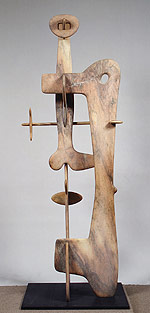
Too European? I find it so. It reminds me of Brancusi----European modernism. It is modernism but it is not particularly Japanese.
What is of interest is the way that Japanese memory and art tradition interacted with the currents of the new and original in European modernism.
From the Australian edge of the Pacific Asian Rim thirty or forty years ago, Japan had all the earmarks of modernity: technical finesse in manufacturing, clean cities, trains that ran on time, technology. It had the winning modernist formula and it needed only to develop on a grander scale along the established lines.
Japan stood for a paradox of ancient tradition and ultramodern sleek. It was both more modern than Australia and more traditional. Yet our knowledge of its history there is sadly lacking. What we know is restricted to only a few works made during the last 40 years or so.
But try this:
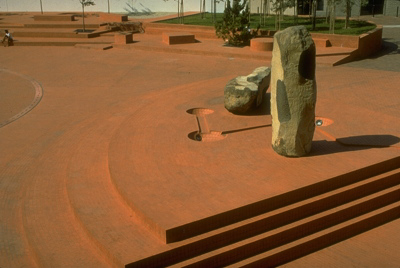
To the Issei. Installed at the Japanese American Cultural Community Center plaza designed by Isamu Noguchi, 1980-83, Los Angeles, California.
Yeah. Now that is something different.
It is another way of looking at gardens.
Now imagine what Isamu Noguchi could do with rock forms of the Australian outback landscape, if someone had been been bold enough to commission him to work in Australia:
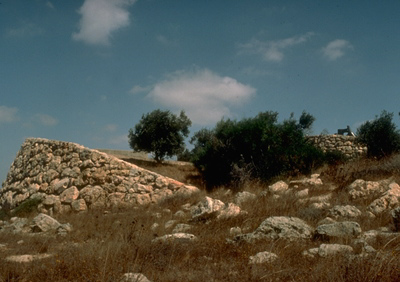
Detail of earthwork wall at the Billy Rose Sculpture Garden, 1960-65, The Israel Museum, Jerusalem. Photo: Isamu Noguchi.
For one thing we would not have got a "Japanese" garden in the Adelaide Parklands that has little to do with Japanese aesthetics.
Posted by Gary Sauer-Thompson at September 8, 2003 02:33 PM | TrackBackInteresting that you chose to show Goyo. There was a small exhibit of his work here in Washington DC several years ago. He tried to incorporate western traditional ideas into the woodblock print medium using more realistic figuration and perspective. They are interesting because of their cross-cultural perspective but not particlulary striking.
I was thinking about Noguchi recently because the Sackler Gallery here in Washington just finished an exhibit of his ceramics and other Japanese ceramic artists he inspired. It is interesting to see some of his work being very European-modernist and some much more in an Asian mode.