May 31, 2013
British photography: Alex Boyd
Alex Boyd is a Scottish photographer based in the West Coast of Scotland. Though he is best known for his conceptual and figurative landscape photography, most notably his series "Sonnets", I find his experimenting with the wet plate collodion process with respect to landscapes very interesting.
I have in mind the body of work known as The Point of the Deliverance, which is the name (translation of a Gaelic name Pointe a' Tárrthaidh) given to a prominent rock which sits in the natural harbour of Portacloy, in the remote North West of Ireland. This is one of the last true wilderness areas in Western Europe.
 Alex Boyd, Dun Briste sea stack, 2012, wet-plate collodion (Digital print), from The Point of the Deliverance series.
It’s part of a much larger project to document the edges of the Gaelic speaking world.
May 28, 2013
Vanessa Winship: she dances on jackson
Vanessa Winship is a British photojournalist who lived for 10 years in the Balkans and Turkey when she won the prestigious 2011 Henri Cartier-Bresson International Award. This funded the long journey around the United States in 2011 to rummage in the rubble of the American dream.
This resulted in a black and white book of photographs of stark landscapes of America’s heartlands—and the isolated figures that reside within them. These were made with a large format camera, and are touched with melancholy:
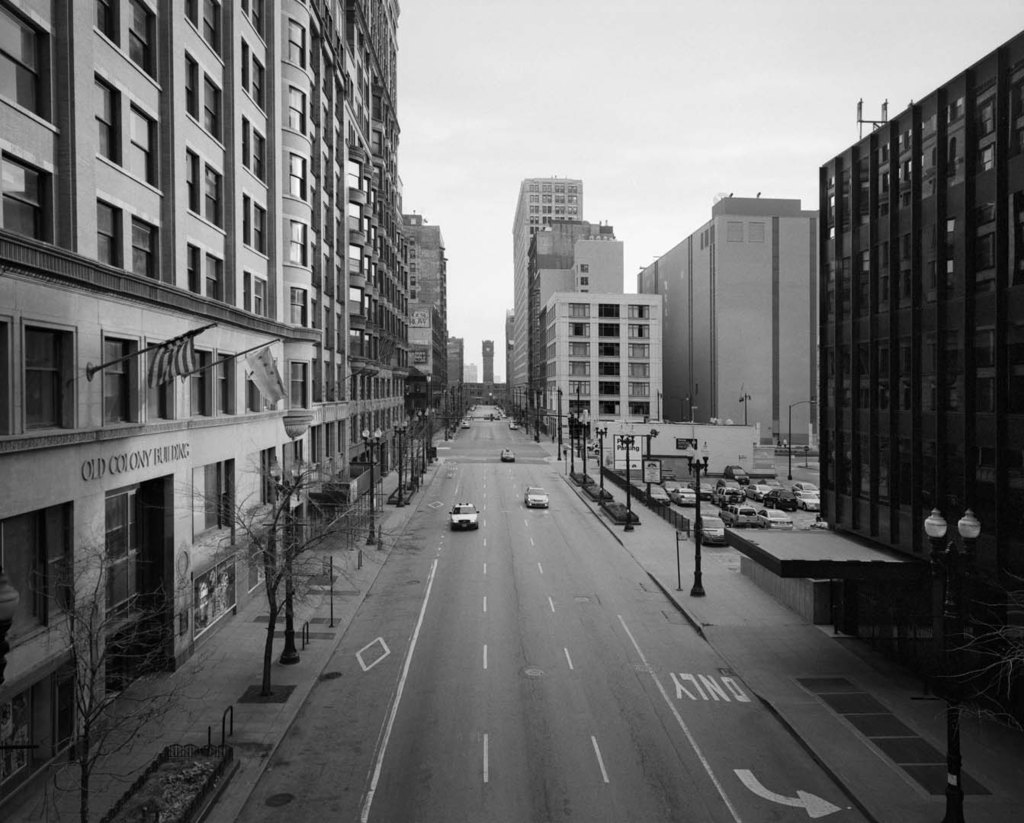 Vanessa Winship, Printers Row, Old Colony Building, Chicago, Illinois, 2012
The work in her book, She Dances on Jackson, consists of portraits of predominantly young people interspersed with the bleak landscapes

Vanessa Winship, James on the bank of the James river, Richmond, Virginia, 2012
The loneliness and melancholy in American life is created by the pursuit of the American dream.
May 21, 2013
after Flickr?
I've just signed up to an account at Ipernity because of the Yahoo recent changes to a functional but unhip Flickr, which are designed to reinvent Flickr as a new “hip” photo site.
I understand that the reason behind the changes is to make money from advertising to keep Flickr going. Flickr is just a business — and not a profitable one at that. The site has remained stagnant, unchanged with the exception of thousands of new members and a few social features. The site looked dated. Change was needed. However, I thought that the new layout design, though glossy, was poor in terms of functionality. The redesign looked rushed and it looks more of a mass photo storage site.

Gary Sauer-Thompson, Lake Pedder, Tasmania, 2011
The retooled Flickr, user interface, which looks more like Instagram, and its new pricing is designed to push out the old Pro community users who had focused on quality and community. It represents a change from the old Flickr as a subscriber-based photography site to a new Flickr as an ad platform for everyone who snaps pictures with its Tumblr-style stream of large-format photos.
The key feature of Flickr has always been the community aspects, and the redesign diminishes or hides those in many ways. What I really liked about the old Flickr is seeing the work being done by my various contacts and then learning from the stream of work. This community of Pro users were interested in photography, art, composition and all the things that made taking photos good. This unhip Flickr gave you information on the camera used, aperture, shutter settings and allowed you to interact with the photographer to learn more.
The new Flickr is tapping into the young social media demographic so as to sell user eyeballs to advertisers to increase revenue. It now looks and feels just like every other photo-stream or sharing service. Yahoo wants free users because they're banking on making most of their profits via the advertising.
Mine is a low key presence on Ipernity because I am not sure how I will use Ipernity, which is a photo sharing site that's very reminiscent of Flickr's old interface. I will continue to use Flickr and post my photographs on my blogs: eg., Rhizomes1, poodlewalks, and Tumblr. I will keep my pro account.
In the short term I will use Ipernity more for the experimental side of my photography, such as pictures that I consider would be worthwhile to go back to and reshoot; or photos from projects that I am working on for exhibitions but didn't make the cut. I currently imagine Ipernity as an out take stream of my work in the first instance, so there won't be many uploads as I wait to see how it Ipernity evolves with respect to both functionality and community. I'm hedging my bets
I understand that there has been a mass migration of film photographers from Flickr to Ipernity since the changes. Flickr has failed to give us set up options from which we can choose how we want our photos displayed. Nor do they care if every Pro user leaves and goes to another site. This groups is not important to their business plan or their bottom line as it is only the 10 or 20 thousand Pro users out of millions of total Flickr users complaining.
May 20, 2013
SA photography: Amy Pfitzner
Amy Pfitzner, an Adelaide based photographer, explores the disconnect in and around identity and culture in her series Identifying Culture at Tandanya--National Aboriginal Cultural Institute.
 Amy Pfitzner, Father, Family Culture, 2012, Giclée print on Metallic Pearl paper
Identifying Culture brings together three discrete series of artworks ----Family Culture, Wood-Air-Bathing and Indigenous Ties--- that question a person’s identity and cultural history; in this case an identity that is slightly obscured, or hidden behind a new urban or ‘white indigenous’ perspective of place and culture.
May 18, 2013
Recent Auckland Photography
The Recent Auckland Photography exhibition is part of the Auckland Festival of Photography. It features 12 photographic artists; a number of New Zealand’s most renowned, alongside those who are mid-career or emerging.
It contains a range of works from the past 15 years, with the emphasis on the recent, and includes important early work, rarely exhibited works, and new, previously unseen works. The show and bookwork features twelve photographers each with a connection to the Auckland region, with the book being an extension of the exhibition with further background, more works, and texts on each artist.
 Mark Adams, Mangungu, Wesleyan Mission, Hokianga, 1997
In the catalogue each artist has a full page of text followed by representative examples of their work, while an introductory essay establishes the case for looking beyond the more easily recognisable aspects of subject matter to the different effects and feelings of the images themselves.
Chris Corson-Scott, who organized the show, says that:
Contemporary photography is to some degree only begrudgingly accepted by the “art world”. The condition seems to be that you have to be an artist who uses photography as an arbitrary means to other ends, without engaging in the medium itself. In practical terms the result is a lot of excruciatingly boring, deadpan, and ironic imagery of people or objects against black, white or grey backgrounds smack-bang in the centre of the frame. This is unfortunate because photographic exhibitions of the kind we are advocating, on the occasions they have been done, have been immensely popular.
The book is called Pictures They Want to Make: Recent Auckland Photography and is published by PhotoForum
May 16, 2013
Freud, photography, the uncanny
This photo of a detail of a landscape by Judith Crispin is an example of Australian Romanticism that has re- surged after modernism came to an end. The gloomy bush looks haunting rather haunted. It is the darkness, the ominous darkness lying behind it, the rocks and tree and the low light of the picture that contributes to this haunting.
The shift away from objective form enables individual subjectivity to be introduced into the landscape. The haunting then refers to individual experience within this kind of landscape. This, in turn, expresses the tension between familiarity and un-familiarity.
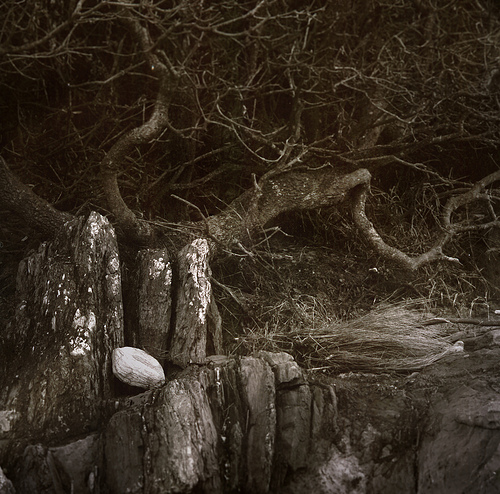 Judith Crispin, Egg, or Tree of the Stone, from the Ness series 2012
'Ness' is the Scottish word for lake. Or it is the Germanic word for promontory in Northern Europe. A promontory is a prominent mass of land that overlooks lower-lying land or a body of water --eg., a lake or seashore. In this case it may also be called a peninsula or headland. Most promontories either are formed from a hard ridge of rock that has resisted the erosive forces that have removed the softer rock to the sides of it, or are the high ground that remains between two river valleys where they form a confluence.
What emerges from Crispin's approach to picture making is a photography that expresses the feeling of the uncanny--an explicitly real emotion that is constituted aesthetically. For Freud the uncanny is a particular form of fear that is derived from the return of something repressed. The original emotion---it could be anger or anxiety--becomes becomes fear by means of repression and return.
photography beyond mimesis
The people behind the Ballarat International Foto Biennale have just produced One Thousand Words [about Photography], which is a journal of critical essays and reviews on photography. It is good to see.
In Issue One Judith Crispin in her essay, A Reflection on Photography, which originally appeared in the 2011 Ballarat International Foto Biennale Core Program Catalogue, questions photography's historical identification with art that reflects or represents reality. She concludes thus:
If we accept the idea that nature is unknowable photography can no longer be evaluated according to the principles of mimesis and must therefore be evaluated by the same criteria as other fine arts.
We do accept that photographic representation is commonly viewed as partial and fragmented and the difficulty of an indexical photographic image to represent the traumatic event; or to represent the radical untimeliness by which the spectres of history disassemble the order of past, present, and future.
Hence we have the idea of the uncanny as the return of the repressed; something that is secret and hidden but has come to light. Once constructed as an otherness to there "here and now" the past returns as a fragment of alterity, often in the form of the disused and obsolete object, the after image of a past trauma, a sensation of deja vu or a ghostly persistence.
May 13, 2013
Australian Photography: Judith Crispin
Judith Crispin, who one of the photographers in the core programme of the Ballarat International Foto Biennale 2011, has a public persona or artistic identity as Hsien -Ku. She is a composer as well as a photographer.
 Judith Crispin, Beltane, 2011
This picture appears to be connected to the Märchen (fairytales) project, which was exhibited in February 2012 at the Brunswick Street Gallery in Melbourne.
This body of work consists of hybrid artworks comprised of digital and analog photographs, digital and hand painting, and original poems. The series combines images from Teutonic fairytales with poetry inspired by the cold-war experiences of Irene, an 80 year old Berlin woman, who was Crispin's neighbour when she lived and worked in Berlin, Germany.
In this work Crispin appears to be reworking classical Teutonic myths and motifs to interpret personal experiences. Beltane is connected because it is the Gaelic May Day festival and represents the peak of Spring and the beginning of Summer. Beltane marks the passage into the growing season and signals a time when the bounty of the earth will once again be had.
Eagle Owl at Grunewald (Green Woods or Green Forest situated in the western side of Berlin was part of the Sleep has her House series, which was exhibited at Photonet Gallery ), Melbourne in 2012.
 Judith Crispin, Owl Sonata, 2011
Unfortunately, there is no information about the Sleep has her House series on the internet, and so I cannot judge whether the series refers to the haunting or the uncanny as in the unconscious as a haunted house. The refers to Freudian tension between familiarity and unfamiliarity, which denotes a strange proximity between the known and the unknown, either as something familiar presenting itself in an extraneous shape, or as something extraneous revealing an element of familiarity in its features.
May 7, 2013
American Photography: George N Barnard
I have started to explore the Library of Congress' important collection of Civil War photographs and the work of George N Barnard
 George N Barnard, Atlanta, Georgia, View on Whitehall Street, Atlanta, 1864
Barnard was summoned to Atlanta, Georgia, in September 1864, immediately after Union forces, commanded by General William T. Sherman, captured the city. Barnard was the official photographer of the Chief Engineer's Office. Much of what he photographed was destroyed in the fire that spread from the military facilities blown up at Sherman's departure from Atlanta.
 George N Barnard, The bombarded graveyard of the Circular Church, Charleston, South Carolina, 1865
Barnard is best known for his 1866 book, Photographic Views of Sherman's Campaign, which contains 61 albumen prints of Civil War sites such as Nashville, the Chattanooga Valley, Atlanta, and Savannah, as well as other sites associated with General Sherman's command.
George Barnard usually worked far behind the front lines photographing bridges, railroads, and other engineering installations; famous battle sites; informal scenes with soldiers; as well as the devastation and ruins left by the war. His views of battlefields taken long after the soldiers had gone are as carefully composed as still lifes; their quietness contrasts with the viewer’s mental image of what must have happened there. Dramatic clouds added from a second negative during printing are characteristic of Barnard’s work
May 6, 2013
Jean-Michel Basquiat
The Neo-Expressionists who had their origins in the New York art scene and hyped art market of the 1980s, were scavengers plundering from a variety of styles and sources including graffiti art, graphic design handbooks, magazines, and the literary and art historical canon.
An example is Jean-Michel Basquiat. He began as a graffiti artist in New York City in the late 1970s and evolved into an acclaimed Neo-expressionist and Primitivist painter by the 1980s. He lived fast and died young.--Within a period of five years he went from being a high school drop-out living on the streets of New York, to an established painter whose work was in high demand. Shortly thereafter, he died of a drug overdose at the age of twenty-seven, ending his short, but prolific career.
 Jean-Michel Basquiat, La Hara, 1981, Acrylic and oil paintstick on canvas
La Hara is Puerto Rican slang for ‘the police’. In this painting. Basquiat depicts the policeman with a disproportionately large chest, his figure filling most of the frame, and with red eyes, representing him as an overpowering, irrational force. However, his puffed chest is also hollow, and the figure lacks limbs, confining his mobility, an idea reinforced by his position behind a fence, painted in the lower left.
Basquiat's art is 'post-modern' in its rich welter of background cultural references or a a kind of consumerist montage picking up images and experiences from everywhere. More specifically much of his work examines the legacy of the colonial enterprise and his relationship to that legacy.
 Jean-Michel Basquiat, In Italian, 1983. Acrylic and oil paintstick on canvas with wooden supports and five smaller canvases painted with ink marker
2 panel
Jean-Michel Basquiat, In Italian, 1983. Acrylic and oil paintstick on canvas with wooden supports and five smaller canvases painted with ink marker
2 panel
Basquiat was also known for scavenging his materials --eg., combining a diverse array of surfaces, like plywood, doors, and make-shift canvases constructed from irregular pieces of linen stapled to wooden shipping pallets. Many works incorporate text, and are drawn in a gestural, expressionistic fashion typical of street art.