June 24, 2013
Murray Fredericks: Greenland project
I watched Murray Fredericks and Michael Angus film about the former's Greenland Ice project on ABC 1 Sunday Arts Uplate. The documentary film is entitled The Nothing on Earth: A study in Isolation.
Very little of this work has been made public, apart from the film, and what has been made public is the time lapse photography.
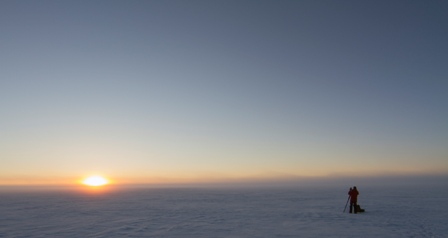 Murray Fredericks On the Greenland Icecap.
The Greenland Ice Project commenced with a month long visit to East Greenland in March 2010. To date there have been five visits and Fredericks has been up on the edge of the Icecap and also explored the fjords. The work slowly shifted from an initial concern with space as nothingness of the Lake Eyre project to the abandoned Cold War radar station Dye-2 and Dye-3 that were built by the Americans at the beginning of the Cold War and abandoned in the early 1990s.
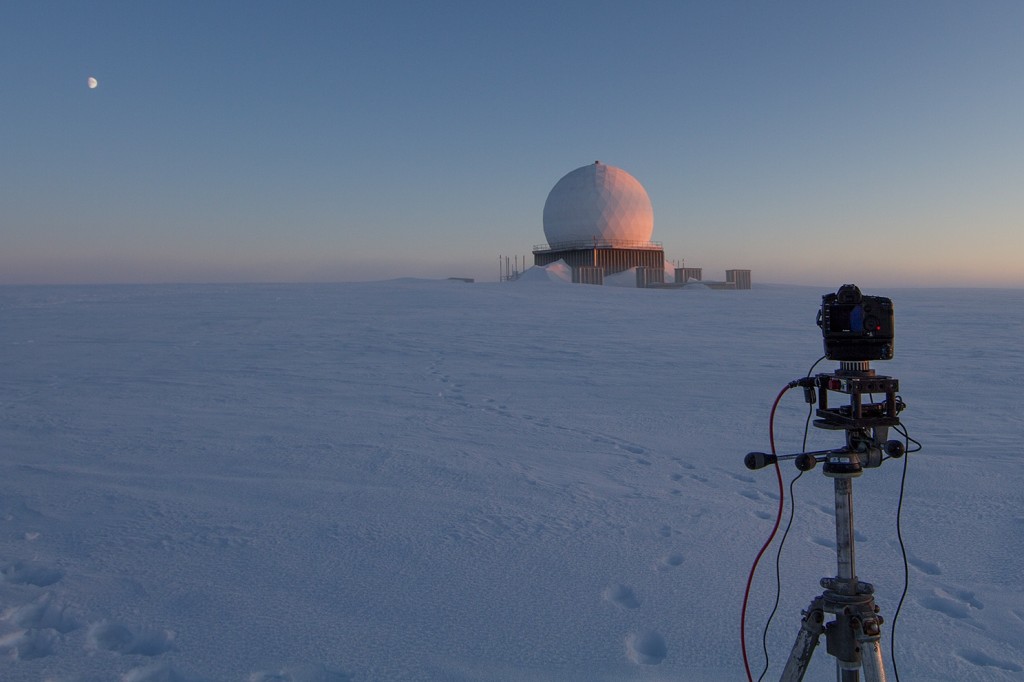
Dye-2 and 3 were among 58 Distance Early Warning (DEW) Line radar stations built by America between 1955-1960 across Alaska, Canada, Greenland and Iceland at a cost of billions of dollars. Their powerful radars monitored the skies constantly in case Russia decided to send bombers towards America. A surprise attack over the North Pole by enemy nuclear bombers and missiles was considered to be a real threat to the security of the United States.
With the advent of satellite monitoring, however, the stations quickly became antiquated. In the mid-'80s, they were briefly recycled for scientific purposes, but the prohibitive maintenance and operational costs, together with limited scientific applications, made these structures obsolete. They were permanently retired by 1991.
Dye 3 was built in 1960. From a distance the structure, with its onion-shaped dome, looks like a Russian orthodox church. Dye-2 was hastily abandoned in 1988, as they believed it started to sink into the ice underneath. Today the site is slowly disappearing into the snow. Its outbuildings are no longer visible. The inside is coated with frost and it has the creepy feeling of a haunted space.
This is concern with Cold War relics is very different to the earlier Lake Eyre work.
June 20, 2013
Jan Kempenaers' Spomeniks
Spomeniks means monuments in Serbo-Croatian.
The ones Jan Kempenaers, a Belgian photographer, photographed are those from the 1960s and 70s. They were commissioned by Tito to commemorate second world war battle sites. They are unlike any war memorials in Australia.
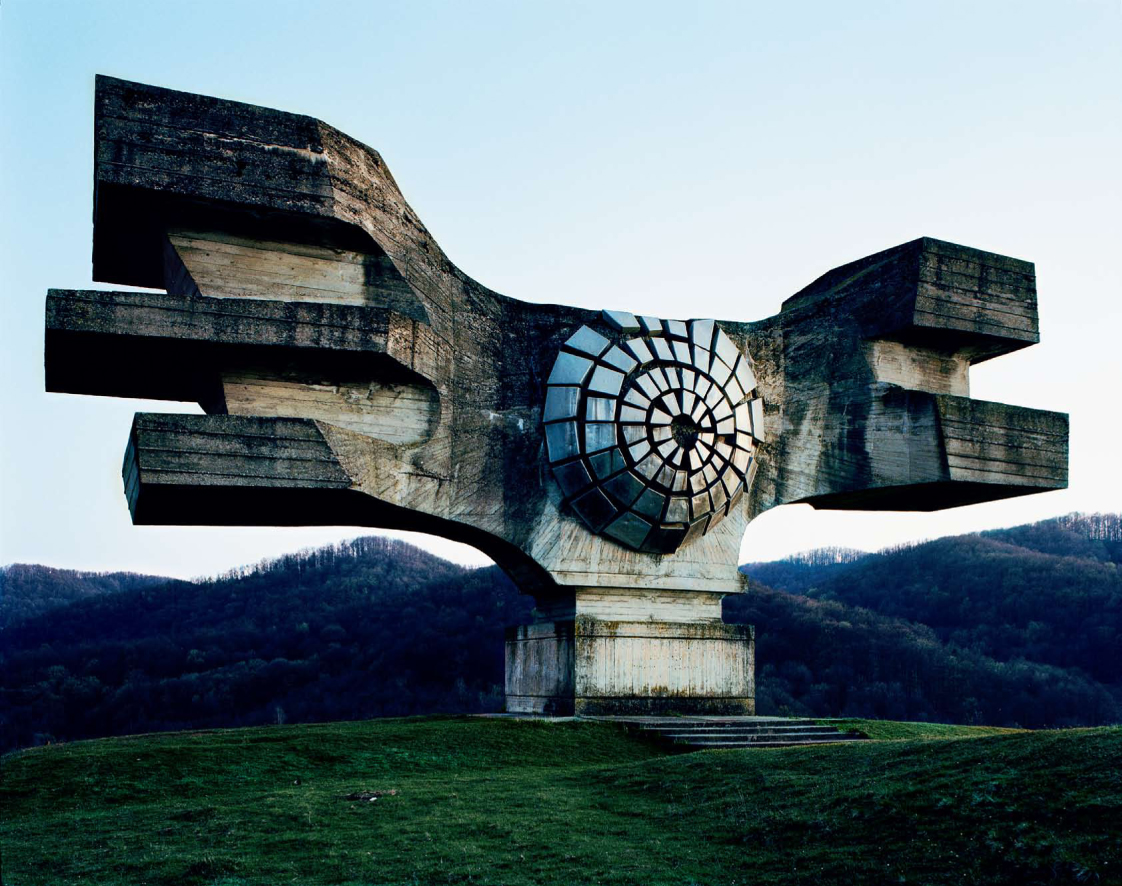 Jan Kempenaers, Spomenik #1, 2006, designed by Dušan Džamonja
They are memorials to the fight for independence of Marshall Tito's partisan army, who led the resistance against the German army. Despite their historic significance and architectural beauty the Spomeniks are crumbling: they are urinated on and scrawled with graffiti. Instead of being preserved as objects of cultural heritage, they are slowly decaying in the countryside.
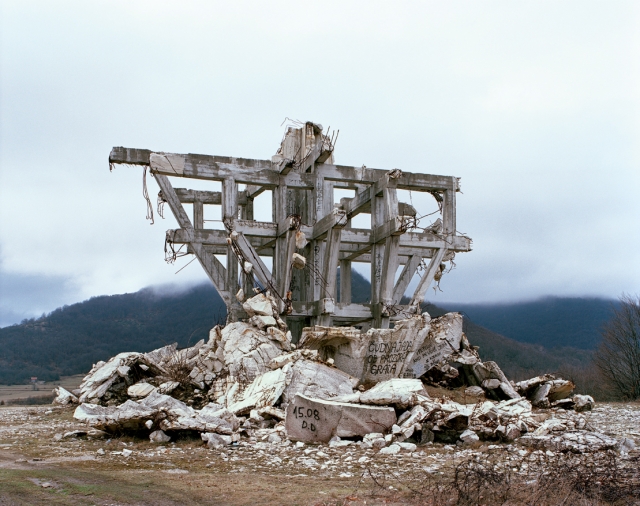 Jan Kempenaers, Spomenik #15 (Makljen), 2007
His staging and imagery refer to the visual elements of the communism: linear perspective, symmetry and geometrical abstract forms. Kempenaer's work reminds me a little bit to the work of Bernd and Hilla Becher and their typologies of industrial buildings and structures but it his approach is less neutral.
June 19, 2013
the "danse macabre"
The time draws nigh for the federal Labor Government. It will be trounced in the September election and the Coalition will have won a substantial majority. That is what the opinion polls say and they have been saying it consistently.
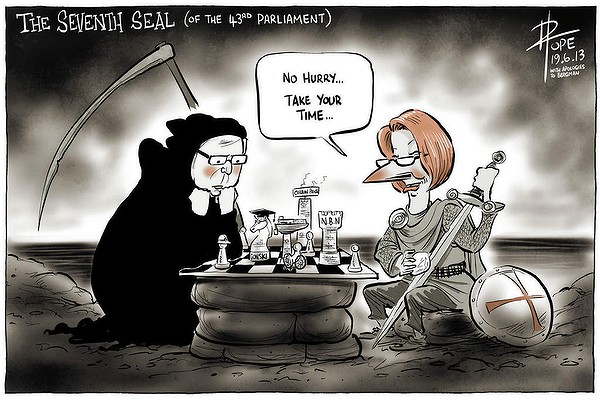 David Pope
Pope gives part of the answer for why this is the case---Labor 's disunity ever since Rudd was disposed by Gillard. This has also been a significant driver. Is it the equivalent of the plague in Ingmar Bergman's Seventh Seal.
The civil was within federal Labor has been a dance macabre No one escapes political death. All are equal in this death.
June 18, 2013
wetplate photography: Denis Roussel
Fuzion Magazine No 3 is devoted to wetplate collodion photography. One of the photographers featured is Denis Roussel, who was born in France and now lives in Denver, USA.
His "A collection of somewhat random specimens” is a series specimens of Nature that are mostly ignored or overlooked, due to our focus on the wilderness landscapes.
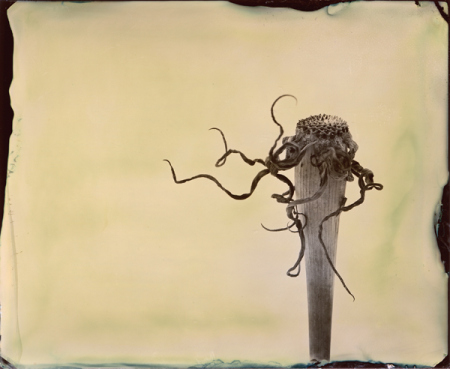 Denis Roussel, Plante, Archival digital print
Roussel says that he was drawn to wet-plate collodion because this method creates marks and artifacts that become an integral part of the photograph. The aesthetic of the collodion process transforms the series from an objective and straightforward documentation of Nature into a lyrical depiction of its beauty.
June 15, 2013
British photography: Mary McIntyre
Mary McIntyre says that her photographs often present spaces and places that have been forgotten and overlooked. The atmosphere of each location resonates from the image. With this in mind she depicts the transformation that occurs to these locations at specific times of day, when for a fleeting moment, the play of light can transform the mundane environment.
When photographed at night and artificially lit, these spaces begin to take on a cinematic quality, imbuing them with a heightened psychological charge.
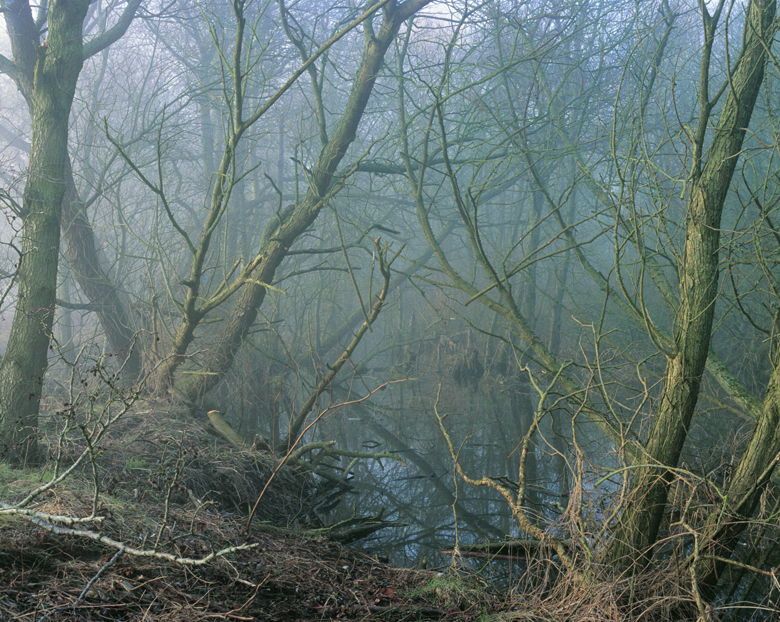 Mary McIntyre, Veil XVII (2008), colour lightjet photographic print
MacIntyre says that the Picturesque and Romantic movements in European landscape painting play an important role in her work. She is interested in making links between painting and photography, adopting the formal qualities of painting long associated with artists such as Jean-Baptiste Camille Corot and Jacob Van Ruisdael, to re-interpret them within a contemporary context.
She says that her work recognises that our ways of ‘seeing’ the landscape are conditioned through our knowledge of its historical depictions in painting and that both painting and photography not only portray but also construct ‘the landscape’. McIntyre’s landscape images do not seek to represent traditional rural idylls, instead they depict vistas that are in themselves constructed and man-made so that each scene is interrupted with evidence of urban activity.
The assumption underpinning this work is that photography has the status paintings have.
June 3, 2013
South Australian photography: Ernest Gall
I've started digging around the work of early 20th century photographers to see what they photographed along the southern Fleurieu Peninsula. One photographer I've started looking at is Ernest Gall, due to stumbling upon his picture of the coastline west of Rosetta Head a month or so ago.
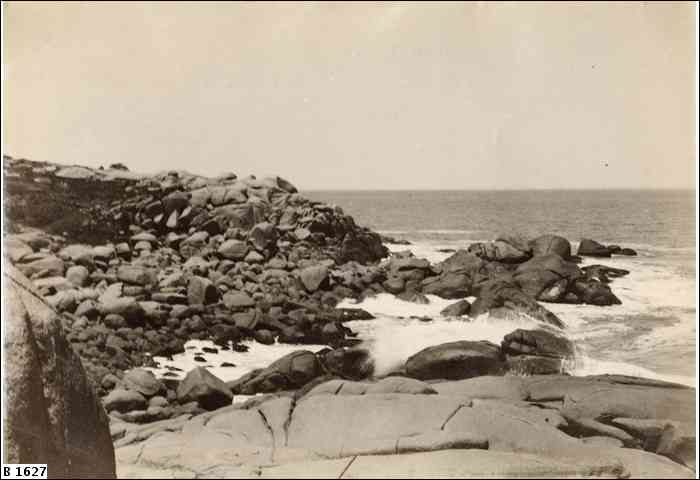 Ernest Gall, Port Elliot, circa 1906
I know very little about Gall, other than he primarily photographed around the city of Adelaide but he did make some photographs in and around Victor Harbor around 1906.
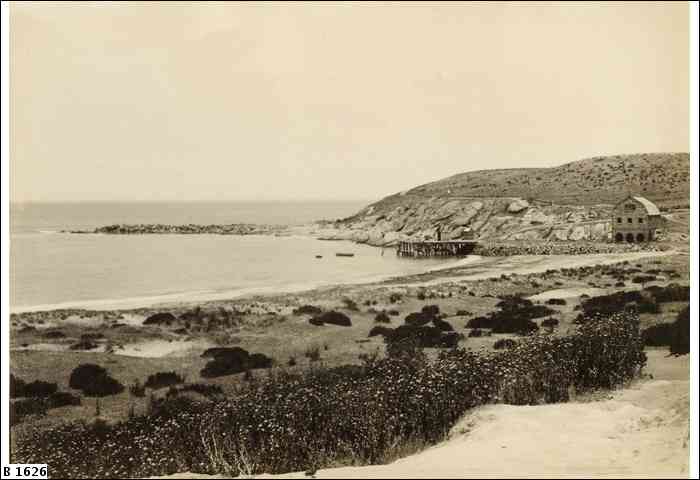 Ernest Gall, breakwater, Port Elliot, 1889
He produced a book entitled Gall’s South Australian Scenes, which was a companion volume to Gall's glimpses of Adelaide and South Australia.
There is an MA thesis by Lauren Renee Sutter entitled Constructing an Adelaide metropolis: the photography of Ernest Gall and Harry Krischock (1860s-1940s) but it is not online.
June 1, 2013
Nicholas Nixon: Boston views
As noted at conversations Nicholas Nixon's early black-and-white photos of Boston cityscapes were included in the 1975 "New Topographics" exhibit at the George Eastman House in Rochester, New York. He photographed the city again from 2001 to '04, drawn in part by all the Big Dig construction.
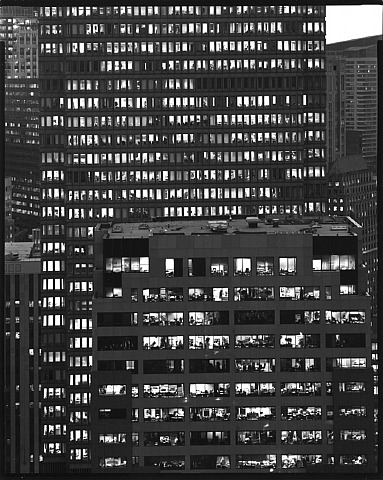 Nicholas Nixon, View of State Street Bank, Boston, 2002, Silver gelatin print
As in the '70s photos, he initially used an 8x10 view camera and prints without enlargement from the negative for rich detail. This time the buildings feel close up and tightly packed together in a way that suggests the snug density of the city. Nixon then switched to an 11x14 camera (again printing without enlargement) and a lower vantage point. Instead of looking out or down from 30 stories up, he's now eight or nine stories up and looking across and straight through.
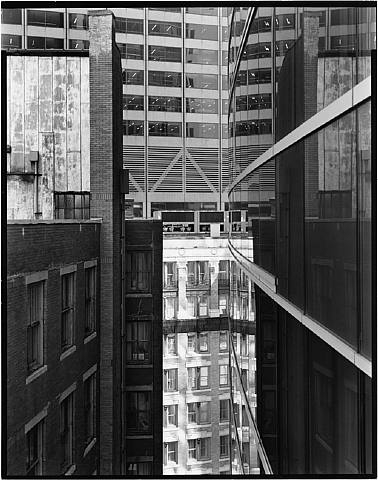 Nicholas Nixon, View of Arch Street, Boston, 2008, gelatin-silver contact print
The pictorial space in these new photographs is completely changed. The frame is now packed with buildings, filled with the grids of windows and curtain walls and reflective glass. The ground on which the buildings stand is not visible in the images and the sky is totally contained by the buildings.