|
June 24, 2013
I watched Murray Fredericks and Michael Angus film about the former's Greenland Ice project on ABC 1 Sunday Arts Uplate. The documentary film is entitled The Nothing on Earth: A study in Isolation.
Very little of this work has been made public, apart from the film, and what has been made public is the time lapse photography.
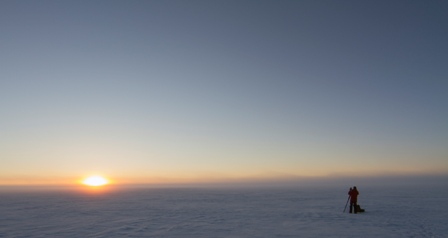 Murray Fredericks On the Greenland Icecap.
The Greenland Ice Project commenced with a month long visit to East Greenland in March 2010. To date there have been five visits and Fredericks has been up on the edge of the Icecap and also explored the fjords. The work slowly shifted from an initial concern with space as nothingness of the Lake Eyre project to the abandoned Cold War radar station Dye-2 and Dye-3 that were built by the Americans at the beginning of the Cold War and abandoned in the early 1990s.
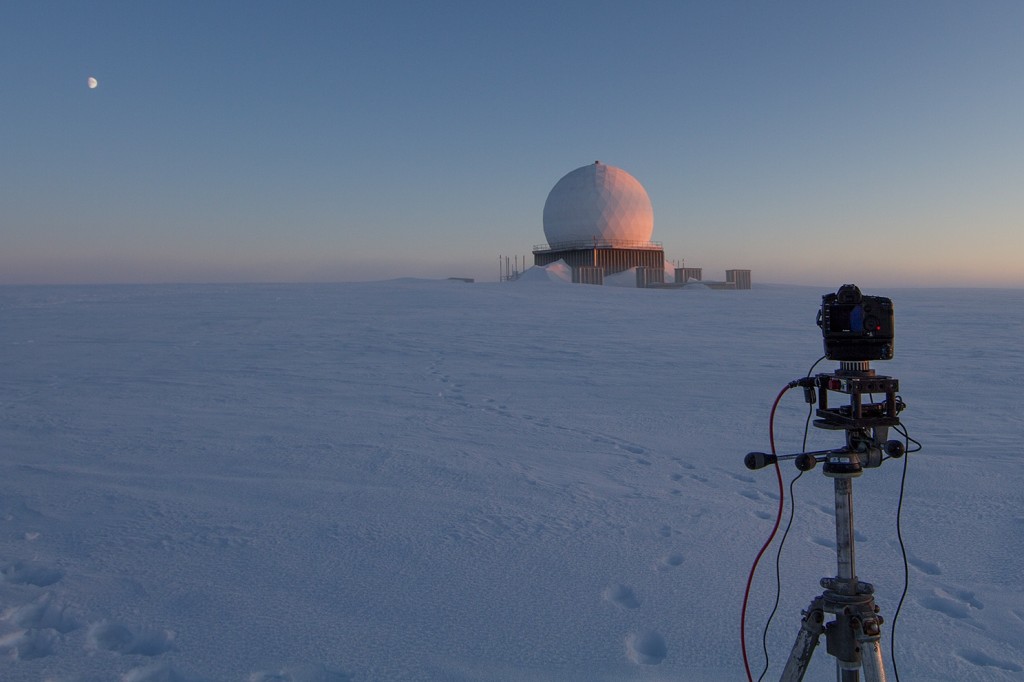
Dye-2 and 3 were among 58 Distance Early Warning (DEW) Line radar stations built by America between 1955-1960 across Alaska, Canada, Greenland and Iceland at a cost of billions of dollars. Their powerful radars monitored the skies constantly in case Russia decided to send bombers towards America. A surprise attack over the North Pole by enemy nuclear bombers and missiles was considered to be a real threat to the security of the United States.
With the advent of satellite monitoring, however, the stations quickly became antiquated. In the mid-'80s, they were briefly recycled for scientific purposes, but the prohibitive maintenance and operational costs, together with limited scientific applications, made these structures obsolete. They were permanently retired by 1991.
Dye 3 was built in 1960. From a distance the structure, with its onion-shaped dome, looks like a Russian orthodox church. Dye-2 was hastily abandoned in 1988, as they believed it started to sink into the ice underneath. Today the site is slowly disappearing into the snow. Its outbuildings are no longer visible. The inside is coated with frost and it has the creepy feeling of a haunted space.
This is concern with Cold War relics is very different to the earlier Lake Eyre work.
|


