January 28, 2013
Australian photography: D. Darian Smith
D. Darian-Smith was a South Australian photographer (1900-1984). The archive of his work is owned by Atkins Technicolour---there are around 40,000 negatives both glass plate and film.
 D. Darian Smith, Capri Cinema, Goodwood, Adelaide 1941
The Capri Theatre, which opened in opened in 1941, is now owned by the Theatre Organ Society of South Australia (TOSA) and is run by volunteers.
Darian Smith was known for his aerial photography. He made them while standing on the wing of a bi-plane. In 1930 he published a book, 'Adelaide, South Australia from the air': a series of exclusive aerial photographs of Adelaide and environs. I have not seen this book.
 D. Darian Smith, Osborne Power Station, ca.1965
The Osborne Power Station, was built in 1923, decommissioned in 1989-90, and demolished from 1998. I made a photo of it before it was dismantled.
There is only minimal information about D.Darian Smith online. It's a pity because Smith's work looks to be quite varied and of good quality. These are certainly not just trade views or corporate publicity shots.
on contemporary art in a digital world
Claire Bishop, in Digital Divide: Contemporary Art and New Media in Art Forum (September 2012), says that she has a sense that:
The appearance and content of contemporary art have been curiously unresponsive to the total upheaval in our labor and leisure inaugurated by the digital revolution? While many artists use digital technology, how many really confront the question of what it means to think, see, and filter affect through the digital? How many thematize this, or reflect deeply on how we experience, and are altered by, the digitization of our existence?
Her answer is that:
The most prevalent trends in contemporary art since the ’90s seem united in their apparent eschewal of the digital and the virtual. Performance art, social practice, assemblage-based sculpture, painting on canvas, the “archival impulse,” analog film, and the fascination with modernist design and architecture: At first glance, none of these formats appear to have anything to do with digital media, and when they are discussed, it is typically in relation to previous artistic practices across the twentieth century.² But when we examine these dominant forms of contemporary art more closely, their operational logic and systems of spectatorship prove intimately connected to the technological revolution we are undergoing.
She refers to the few names from a long roll call of artists attracted to the materiality of predigital film and photography. Analog film seems fashionable, rather than cutting against the grain.
She says that:
My point is that mainstream contemporary art simultaneously disavows and depends on the digital revolution, even—especially—when this art declines to speak overtly about the conditions of living in and through new media. But why is contemporary art so reluctant to describe our experience of digitized life? ....Is there a sense of fear underlying visual art’s disavowal of new media? Faced with the infinite multiplicity of digital files, the uniqueness of the art object needs to be reasserted in the face of its infinite, uncontrollable dissemination via Instagram, Facebook, Tumblr, etc.
In actuality, Bishop says, visual art’s assault on originality only ever goes so far: It is always underpinned by a respect for intellectual property and carefully assigned authorship (Warhol and Levine are hardly anonymous, and their market status is fiercely protected by their galleries).
Summing up we can say that Bishop's article’s core question was why so little mainstream art reflects on what it means to think, see, and filter affect through the digital, even though the digital is, on a deep level, the shaping or condition of our contemporary life.
And so begins the debate.
January 11, 2013
American photography: Jan Groover
Jan Groover, the American modernist photographer, died recently.
 Jan Groover, still life, abstract
Groover was noted for her dramatic still-life photographs of objects in her kitchen sink. Her table-top still-lifes of kitchen utensils, or her displays of colored pots and bottles that refer back to Paul Strand's Cubist-inspired abstractions or László Moholy-Nagy's experiments at the Bauhaus.
For her "form is everything" and these photographs explore the spatial ambiguities possible with a view camera. According to Groover, the meaning of the objects is of no importance; only the shape, texture, and form that falls into a particular space is important.
Even when venturing outdoors, as she did in the late '70s, photographing suburban homes and streets, or storefronts around New York City, she emphasized the spaces between things more than the things themselves.

Jan Groover, untitled, suburbia,
These are precise yet richly colored triptychs of suburban New Jersey lawns and clapboard houses.
January 4, 2013
NZ Photography: Doc Ross
In the 1990s Doc Ross was making seascapes and abstract images, and the photographs he took of buildings and streets in Christchurch CBD were more of an aside. By framing the city through his lens, Ross used his camera to become familiar with, and generate a fondness for, his newly adopted home. The resulting negatives were stored unprinted and unvisited in his archive as the photographs were ‘taken without much intent or thought for how, or even if, they would ever be used.
Until March 2011. With the collapsed and freshly demolished buildings from the earthquake Ross suddenly realised he had a collection of recent images of the city that formed an inadvertent historical record:
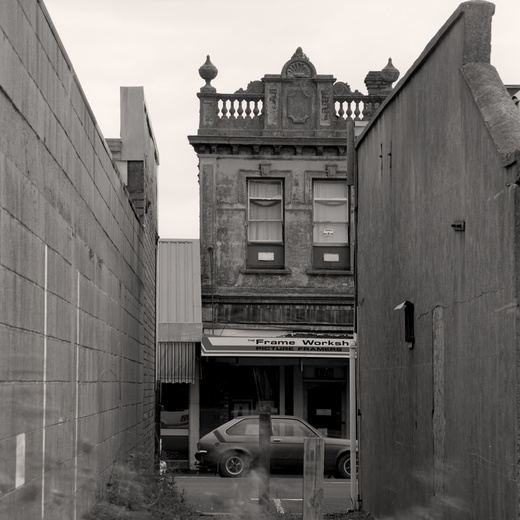 Doc Ross, Gravestons Building, Sydenham, Christchurch
Ross had built up a significant body of work relating to the local architectural heritage and urban spaces. It's old Christchurch, before the quakes – a body of photographs that Doc took in the city between 1998 and 2011, when everything was still (mostly) intact.
January 3, 2013
Jane Campion: In the Cut
This film is not a thriller. It is an exploration of the conflation of sex and violence, where women--still clinging to the stories and myths of their girlhood dreams, the inheritance of their mothers--are relegated to the place of second class citizen, only so many bitches to be gazed at, dismembered, and discarded, in a masculine world.
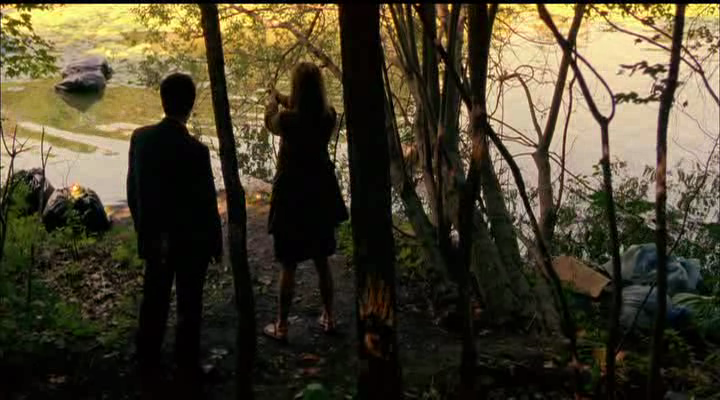
The film that Campion obviously set out to make: a study of female sexual psychology in a world of hypermasculine violence. The narrative is from a female point of view, a similarly disjointed narrative connected only by the protagonist's emotional journey, set in a similarly surreal version of New York City.