February 28, 2013
lost Brisbane
An interesting Facebook site entitled Lost Brisbane. One of the albums in Lost Brisbane is those buildings that have been pulled down in the CBD
 Prudential Building , Brisbane CBD
The archive is the John Oxley Library, State Library Queensland. The 1970s and 1980s were a time when the 19th century and early 20th century buildings in the CBD of the Australia's capital cities were pulled down. In Brisbane there was a lot of destruction and rebuilding. Adelaide, in contrast, cared about protecting the centre.
February 23, 2013
on early modernist abstraction
Hal Foster in At MOMA in the London Review of Books reviews early 20th century modernist abstraction in the For Inventing Abstraction, 1910-25 exhibition curated by Leah Dickerman.
Though the exhibition is strictly European (including Russia and Britain) it does includes sculpture, photography and film, even though it runs heavy on painting. Foster adds that is okay since the modernist project of ‘purity’ – of an art freed from both resemblance to the world and function within it – privileged painting.
Foster says that Dickerman revises Alfred Barr dramatically, but not when it comes to the affirmation of abstraction, understood in the traditional sense of marking the demise of painting in its traditional form and its opening to the practices of the century to come.
Dickerman insists on its fundamental break with the old model of the perspectival picture, with its metaphor of a window onto a world, its sublimation of the materiality of the painting, its assertion of ‘the primacy of the visual’, its assumption of ‘a discarnate gaze’ and so on. This is true enough: for some artists, such as Aleksandr Rodchenko, abstraction did put paid to the project of representation.
However, abstraction might be understood in large part as the sublation of representation, that is, as its simultaneous negation and preservation. Thus, even as abstractionists like Kandinsky, Malevich and Mondrian cancelled any resemblance to reality, they also affirmed an ontology of the real; even as they rejected painting as a picture of the epiphenomenal world, they insisted on painting as an analogue of a noumenal world: appearance was sacrificed at the altar of transcendence. So the demise of painting in its traditional form was not total.
Foster adds that we often think of abstraction as a withdrawal from the modern world, almost a safehouse for art, but the converse is just as true: the modern world of the mass-produced commodity became too abstract to represent in the old ways.
February 22, 2013
UK photography: Paul Kenny
I've just stumbled across the work of Paul Kenny, an English landscape photographer who lives in North Northumberland not far from Holy Island, a tidal island off the north-east coast of England. Kenny has lived and breathed the coastline of the north-east of England for 27 years, and he also regularly works in the western isles of Scotland, and the west coast of Ireland. An early project is the Lonbain wall.
His Sea Works are about the coastline's sands, strand lines, and shells. He arranges the "insignificant things" like dried seawater, plastic fragments, seaweed and beer can bottoms to get his final result. He also regularly works in the western isles of Scotland, and the west coast of Ireland.
 Paul Kenny, flotsam - window - downpatrick head - 2001, Seaworks
Kenny says about using beach-combed flotsam and dried sea-water:
In common with many people, I have always brought home “treasures” from the sea pebbles, shells etc. They act as an “aide – memoir”, bringing the landscape into your home so a mere glimpse or touch might recall the feelings of being alone on a remote beach. Realising that I (naturally) tended to bring back to the studio particularly beautiful objects to photograph, I began to make works out of increasingly insignificant material collected at random rather than highly selected. In 1999 I made a series of works called “A day at the beach” which were studio works made from (literally) a random handful of beach material collected after a walk on a beach, arranged and photographed in the studio.
Out of this work came the idea to find the most trivial and insignificant thing from which to make beautiful and thought provoking work.
He often makes abstract images of the Northumbrian coastline. He doesn’t just represent what is in front of him but collects objects, playing with scale and layout back in his studio to create a negative on a glass plate which he then scans into a computer. As part of this gradual move towards abstraction the camera itself has become less important in Kenny's photography, and he has focused his attention on creating his images through darkroom processes alone.
February 18, 2013
The Photographic Image in Digital Culture
William Mitchell in his "The Reconfigured Eye: Visual Truth in the Post-photographic Era" argued that the physical difference between photographic and digital technology leads to the difference in the logical status of film-based and digital images and also to the difference in their cultural perception.
Mitchell claimed that there is a core difference in that digital images can be reproduced ad infinitum without loss of quality whereas traditional ones cannot. Mitchell also claims that there is a huge difference in the amount of information encoded with a digital image, in comparison to a traditional one. Mitchell’s third distinction is that the digital photograph is manipulable in ways in which the traditional photograph is not – it can be edited, altered, reworked and so on.
From these differences between a photograph and a digital image, Mitchell then deduced differences in how the two are culturally perceived. Because of the difficulty involved in manipulating them, photographs were comfortably regarded as causally generated truthful reports about things in the real world. Digital images, being inherently (and so easily) mutable, call into question our ontological distinctions between the imaginary and the real or between photographs and drawings. Furthermore, in a digital image, the essential relationship between signifier and signified is one of uncertainty.
What Michell does is to identify the pictorial tradition of realism with the essence of photographic technology and the tradition of montage and collage with the essence of digital imaging.
Thus, the photographic work of Edward Weston and Ansel Adams, nineteenth and twentieth century realist painting, century realist painting, and the painting of the Italian Renaissance become the essence of photography; while Robinson's and Reijlander's photo composites, constructivist montage, contemporary advertising imagery (based on constructivist design), and Dutch seventeenth century painting (with its montage-like emphasis on details over the coherent whole) become the essence of digital imaging.
As Lev Manovich in his essay The Paradoxes of Digital Photography in Photography After Photography: Memory and Representation in the Digital Age observes:
what Mitchell takes to be the essence of photographic and digital imaging technology are two traditions of visual culture. Both existed before photography, and both span different visual technologies and mediums. Just as its counterpart, the realistic tradition extends beyond photography per se and at the same time accounts for just one of many photographic practices.
February 16, 2013
Peter MacDonald
Peter MacDonald lives at Parachilna in the heart of the Flinders Ranges and he runs regular 3-day workshops based at the Prairie Hotel at Parachilna.
In 2010 he spent five months on and off photographing the flooding of Lake Eyre in central Australia at heights which ranged from 150 to 760 metres from the rear door of a light aircraft. The results are impressive:
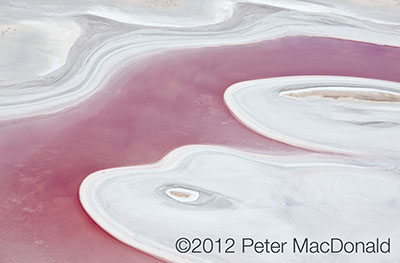 Peter MacDonald, Saltwater Pink - Lake Eyre Lake Eyre, 2010
An online exhibition of the Lake Eyre series can be found here. Other photographs of Lake Eyre are here.
February 12, 2013
Adobe's gouging of consumers
Adobe has long marked up its products for the Australian market--its pricing discrimination between regions. For example, in April 2012, it was revealed that locals would pay up to $1,400 more for the exact same software when they buy the new version 6 of its Creative Suite platform compared to residents of the United States. This meant that some Australian residents can afford to fly to the US to buy a US version of the software and fly back, for the same price they would pay in Australia for the software.
Adobe charges what it thinks the Australian market will bear. Adobe, along with Apple and Microsoft, have been summonsed by the House Committee on Infrastructure and Communications to face questioning at the IT pricing inquiry.
At a brief press conference in Sydney the chief executive of global software vendor Adobe, Shantanu Narayen, refused to directly address questions regarding price markups in which Australians pay far more than US residents for the company’s software:
Instead of directly addressing the question Narayen repeatedly emphasized that the company saw the future of its products as being its leased version of Creative Suite, termed Creative Cloud--the shift to online distribution and the cloud was the new strategy.
Even though Adobe has dropped the Australian prices of its cloud-based design products these are another form of gouging. If you buy Creative Suite, you pay Adobe once and can use the same software for years — products like Photoshop don’t go out of date that quickly and remain functional years after you bought them.
However, if you sign up for Creative Cloud, you’ll be paying Adobe, month in, month out, year in, year out, to use the same software forever, on a subscription basis. And you won’t own the software at the end of that point. You just lease it.
February 11, 2013
Time Machine
Time Machine is an Australian online magazine featuring contemporary photographic projects from both Australia and around the world. The emphasis is on showing new work and longer term projects; and bringing the concerns of photographers and their colleagues to wider attention. They have a Facebook site.
The theme for the latest issue is WILD. Wild is a concept that is fragile, yet strong. It’s meaning is wide-ranging: from untamed; native; living in a state of nature to frantic or crazy; violently excited; lawless; unrestrained by reason; extravagant and disorderly.
 Mathew Newton, untitled,
Matthew Newton is a photographer / cinematographer based in Hobart. He asks: ' will Tasmania remains unique in its natural beauty and inherent wildness.'
 Mathew Newton, untitled,
He says that Tasmania is a place where old growth native forests, which include the mighty Eucalyptus regnans, are reduced to tiny woodchips and sold for questionable profits.
February 10, 2013
NZ photography: Fiona Pardington
The New Zealand photographer Fiona Pardington makes some gorgeous still life images:
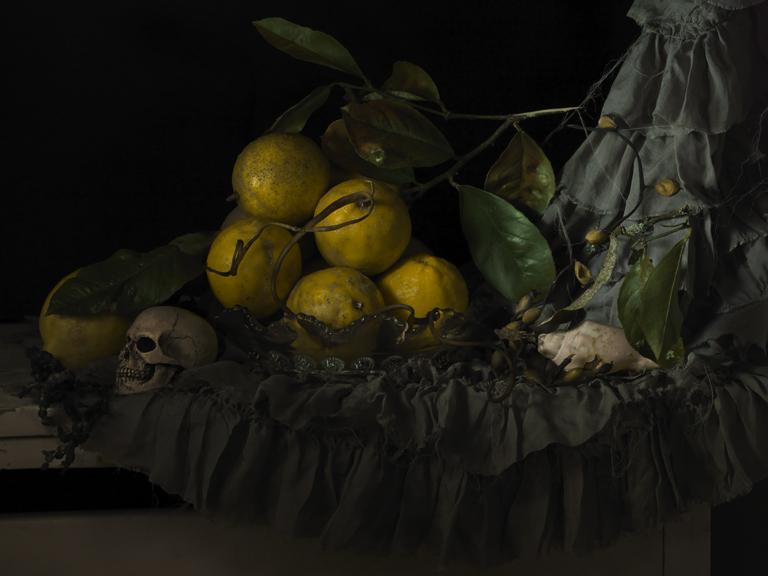 Fiona Pardington, Still Life with Seaweed and Lemons, 2012, Inkjet print on hahnemule cotton rag
You can see more of her series of still life images at {Suite} Gallery in Wellington, or McNamara Gallery in Wanganui. The series, which includes mushrooms, introduces subtle methods of distortion and colour through Photoshop.
February 6, 2013
Australian photography: David Flanagan
David Flanagan is a Canberra based photographer specialising in architectural and abstract aerial landscape photography. After graduating from the Canberra Institute of Technology with a BA Design (Photography) in 2004. He relocated to Sydney and established himself as a successful commercial photographer and exhibiting landscape photographer.
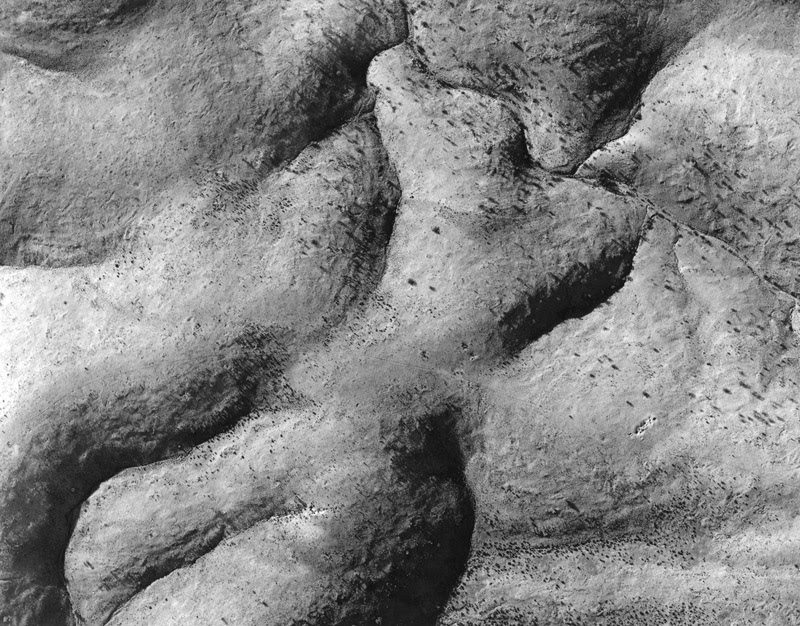 David Flanagan , Davenport Ranges, Aerial, 2010, from the Red Series
This Red series explores the very remote South Australian Desert areas of Lake Eyre, The Painted Hills and the Davenport Ranges, which are approximately 1000kms north of Adelaide.
February 5, 2013
surviving disruptive digital innovation
Chris Sandström gives a clear account of why medium format companies like Hasselblad, Mamiya and others have faced such tough times since the rise of digital imaging technology.
The emergence of digital technology has created turmoil and changed the camera industry. This was particularly the case for Hasselblad:
The manufacturers of the medium format camera, such as Hasselblad, failed to develop their own digital backs. The basic reason is that their competence/knowledge base was primarily related to mechanics and not electronics.
Still niche medium format digital segment of the camera industry survives, despite the expense. These cameras still deliver on the image quality differential. However, Hasseblad achose a closed proprietary system strategy for its medium format digital cameras, when the rest of the medium format world was choosing open-systems.
public pedagogy
Henry A. Giroux mentions the idea of public pedagogy and how it has become a central element of politics itself in this article on public universities. This takes pedagogy beyond being primarily about schools and the role of cultural studies theorists who address pedagogical concerns being largely reduced to teaching cultural studies within the classroom.
Giroux says:
Public pedagogy in this sense refers to the array of different sites and technologies of image-based media and screen culture that are reconfiguring the very nature of politics, cultural production, knowledge, and social relations. Market-driven modes of public pedagogy now dominate major cultural apparatuses such as mainstream electronic and print media and other elements of screen culture, whose one-sided activities, permeated by corporate values, proceed more often than not unchallenged.
In this article he says that culture is recognized as the social field where goods and social practices are not only produced, distributed, and consumed but:
also invested with various meanings and ideologies implicated in the generation of political effects. Culture is partly defined as a circuit of power, ideologies, and values in which diverse images and sounds are produced and circulated, identities are constructed, inhabited, and discarded, agency is manifested in both individualized and social forms, and discourses are created, which make culture itself the object of inquiry and critical analyses.
This suggests that pedagogy implies that learning takes place across a spectrum of social practices and settings. Hence the idea of public pedagogy.