« August 2003 | Main | October 2003 »
September 30, 2003
something different required
I see that Bjorn Lomborg, the sceptical environmentalist, is in the country for a lecture tour of Australia as a guest of the Institute of Public Affairs. He delivers the H.V. McKay lecture in Melbourne tonight. He comes with a background of controversy.
Good luck to him on the tour. I hope the environmental debate in this country is stirred up and is lifted to a level above the polemics. It sure needs it. The conservatives offer us Allan Wood, who wears the mantel of science to dismiss green propaganda; whilst the Quadrant crowd wear the mask of scientific reason to dismiss environmentalism as a religion. Both run explicit anti-environmental agendas. They are engaged in politics not science, have an explicit disregard for ecology and a onesided understanding of the relationship between economics and ecology.
Now Tim Blair says that the Wood piece is a good read and recommends it. So what is Wood saying? Well, he usefully sets up the debate in Australia in neo-liberal terms. He says that:
"A central proposition of Lomborg's that environmental scientists have great difficulty with is that economic growth and rising incomes, once they reach a certain level, are associated with less, not more, environmental degradation -- at least in democratic market economies."
Wood then goes to quote Ian Castles to characterise the other side of the debate:
'"To deny that problems of the environment can be solved by greater wealth and private property rights is dogma, not science," Castles says. An important reason for the association between growth and an improved environment is that growth facilitates new technology which allows higher average incomes and improvements in the environment.'
The description of the issue is okay but judgement is whacky. It is dogma to think otherwise to neo-liberalism. Green dogma vs neo-liberal science. It's cartoon thinking.
Is it dogma to argue that increased economic growth and rising incomes are associated with more environmental degradation in Australia? Not at all. To see this we shift from abstract level to a specific and presssing issue. Only then can we begin to sort through the issues rather than engage in the usual polemics.
So let us take the recent debates about the national electricity market in the Australian Financial Review last week (subscription required, 24th & 25th September, p.63) On the one hand, we have Henry Ergas arguing that the regulated utilities need to be allowed a higher rate of return to finance the new investment that is needed to prevent the lights going out. Regulators, such as the ACCC, should not compromise the incentives for efficient investment.
On the other hand, we have Graeme Samuel from the ACCC that the rate of return is okay, electricity prices are now competitive with other OECD countries, market signals are working effectively to boost investment, and there is greater consumer participation in the energy market through the choice of retailer. The market wilh ensure that the lights will stay on.
I will put to one aside the faith in markets and the spin that the NEM is working competitively. Note the complete absence of any policy concern with the issues of sustainability. It is all all about the market. Yet sustainability sits there under 'new investment needed' It appears in the foreground when we ask: 'new investment in what to ensure the lights stay on?' Up pops investment in coal-fired power stations to generate the extra electricity needed to keep the lights on. Coal fired power stations means increased greenhouse gases. And Australia has a public commitment to reduce its production of greenhouse gases not increase them.
Should we not then make the shift to investment in renewable energy? Should not that be a concern of the national regulator?
So what do the neo-liberals then say? That renewable energy is not cost effective and that it is limiting carbon emissions is not cost-effective. The policy end of sustainbility is effectively excluded by market criteria. So what stands as the policy end is economic growth. That is pushing a political agenda.
As I said above, the debate needs to go up a notch. Maybe Bjorn Lomborg will help the neo-liberal market boys find the courage to throw away their tattered catechism? The line that is learned by rote from the catechism is that those concerned about environmental health have got it wrong because things are pretty okay and they are getting better all the time.
The philosophical assumption of the catechism is the ecology of the continent is only to be considered when it provides benefit or opportunities for economic utility. Somehow I doubt whether Bjorn Lomborg will question that assumption.
Posted by Gary Sauer-Thompson at 12:21 PM | Comments (0) | TrackBack
Water politics
This article is about right. The problem with the overuse and over-allocation of water does lie primarily with the farm (especially in the Murray-Darling Basin) and not the cities.
Yet the cities need to address the way they use water. They waste it on the garden and washing down the car in the driveway. However, we do need to shift from a policy of water restrictions in Sydney, Melbourne and Adelaide to recycling water. That means redesigning our cities to be more sustainable.
I see little impetus for that shift.
Posted by Gary Sauer-Thompson at 11:44 AM | Comments (1) | TrackBack
September 29, 2003
Wagons circle around White House?
I mentioned this story in The Washington Post in passing in the previous post. I failed to click to its significance this morning. It slowly sneaked up on me during the day. So I've gone back to it and had a closer look.
It says that the Director of the CIA, George J. Tenet, has requested the Justice Department to look into an allegation that administration officials leaked the name of an undercover CIA officer to a journalist. The journalist was one Robert D. Novak who then disclosed it on July 14 in a syndicated column.
The Post story then says that a senior administration official said that before Novak's column ran, two top White House officials called at least six Washington journalists and disclosed the identity and occupation of Wilson's wife. Disclosing the name of an undercover CIA agent could violate federal law.
Put it together and you get this. The CIA is requesting the Justice Department to examine the top officals in the White House for leaking an undercover agent who just happened to be the wife of Joseph C. Wilson IV. Wilson had been sent by the CIA to Niger last year to look into the UK claim Iraq had tried to buy "yellowcake" in Niger. Wilson has then publicly challenged President Bush's claim made at the State of the Union that Iraq had tried to buy uranium ore from Africa for possible use in nuclear weapons.
The background is provided by JustOneMinute. Here is Josh Marshall's two part interview with Ambassador Wilson over at Talking Point Memo.
The White House has been caught in engaging in dirty politics. The Justice Department is sitting on the probe into the intelligence leak---as they have been for a couple of months---but I cannot see the CIA going all quiet. And the White House is still playing dumb according to Billmon over at Whiskey Bar.
Then I checked out the American liberal weblogs I usually read. As Brad DeLong observes:
"This is not a single rogue White House official, after all--this is two of his closest advisors, plus whoever they planned it with, plus all the other White House and other administration officials who have been sitting on evidence of a crime rather than phoning the Justice Department for the past several months. Perpetrators. Accessories before the fact. Accessories after the fact."
So what does top officals in the White House mean. Atrios goes through the possibilites and comes up with a list of eight candidatesthat includes some big fish. I quote:
"That leaves eight candidates:
1) Dick Cheney – Vice President
2) Karl Rove Senior -- Advisor to the President
3) Condi Rice -- Assistant to the President for National Security
4) Andy Card – White House Chief of Staff
5) Ari Fleisher -- Press Secretary
6) Dan Bartlett – Assistant to the President for Communication
7) John Gordon -- Assistant to the President and Homeland Security Advisor
8) Scooter Libby – Vice President’s Chief of Staff
I am not sure I would consider Libby and/or Gordon to be top and senior but maybe they are. If any of the first 5 (Cheney, Rove, Rice, Card or Fleischer) is involved, it is a major scandal."
You could say that this is a story that has legs, given that the identity of the six journalists may soon be known. Rodger A. Payne has a lovely image: Karl Rove: "Frog-Marched out of the White House in Handcuffs"? Lovely image, but highly unlikely.
I haven't read the conservative US webloggers to see their reaction.
Posted by Gary Sauer-Thompson at 09:26 PM | Comments (0) | TrackBack
conservative vitriol
Have you notice the increase in the emotional vitriol of the conservative voices in The Australian of late? They go way beyond public debate and political reality to become something else. Two examples.
The first is by Ross Terrill, whom we last meet here. His big concern then was that Australia should take a leadership role in international affairs. In this article the concern is the "Left cultural gatekeepers" and the "isolation of inferiority." Terrill says:
'In Australia, there appears on the Left an isolation of inferiority that thinks Australia is not worthy of a leadership role. Make every Aborigine content, say the gatekeepers, or keep our mouth shut in international affairs. Ditch the British constitutional link, or crawl in shame before Asians... John Howard resisted "inferiority" isolationism.'
The phrase "the left" ignores the diverse voices on the left, since Terrill's Left cultural gatekeepers stands for academics and the ABC----the public broadcaster. Hardly one and the same. Terrill then claims that the Left cultural gatekeepers are caught up in an illusion. He says:
"The Australian not-so-very-intelligentsia is in the grip of an illusion. The Labor Party opposed the Iraq war because it said one more UN resolution was needed to give a green light. The head of the Centre for International and Public Law at a leading university with a straight face equates domestic law (of a democracy) with international law (presumably enforced by the UN). Such people would have Australia march down the impeccably multilateral path of the "no more war" Kellogg-Briand Pact of 1928, whose futility led directly to the failure to deter Japan and Germany and hence to World War II."
Note the easy slide from the Left cultural gatekeepers to the Australian not-so-very-intelligentsia to the Australian Labor Party to create a monolithic enemy. Also note the equation of Iraq with Germany and Japan and the invasion of Iraq with WW11. The "argument" is then rounded off with abuse with phrases like an out-of-date academic Left, the self-righteous Left and the identification of the Australian Left cultural gatekeepers with the New York Times!
This junk is just so bad, in the light of this and this and this. It is the very junkiness of Terrill's text that is need of interpretation. The junkiness that stands out because Terrill is a research associate in East Asian studies at Harvard University. and knows about argument and public debate. His political polemic--- for that's all it is---comes across as if Terrill is being paid to be a political hack doing a hatchet job on the Australian left for the US Republicans. His text is then being used by the Murdoch Press in Australia to attack the popular conception of the Howard Government as a lackey of the imperial presidency in Washington.
The other example is Christopher Pearson, the Adelaide conservative whom we last meet here. Pearson currently suffers from an identity crisis as he cannot make up his mind whether he is a neocon or a paleocon. His vitriol in The Weekend Australian (no link) is directed at Carmen Lawrence who is having a tilt at the ALP Presidency. Lawrence carries political baggage aplenty for the ALP, but Pearson's language is emotionally supercharged. A sample.
Lawrence as the Queen of Labor follies is a potential rat; she is full of shrill cant; has an ungovernable sense of outrage; her posturing is beyond caricature; and by stumbling into a unreconstructed Trotskyte parallel universe --no, I'm not making any of this up, it's that bad----Lawrence is almost (singlehandedly) responsible for Labor's failure to ensure that the Howard Government was a one-term government.
Again it's the junkiness that stands out. It is so over the top in emotional violence---Larewnce deserves to be crucified--- that Pearson comes across as doing a hatchet job on behalf of the bruvvers in the NSW Right. They hate the new middle class grass roots membership of the ALP because of the challenge they present to their power, patronage, authoritarianism and One Nation policies. And Lawrence, as the frontrunner, says she will use the ALP presidency to represent their voice. But why should Pearson care? He should be welcoming the conflict in Labor ranks, as it will insure the re-election of the Howard Government.
Two examples of emotional vitriol from conservatives writing in The Australian. They show the eruption of the conservative political unconscious. It's not a pretty sight and it goes way beyond the standard hocus pocus. It makes a mockery of their appeal to be defending civilised values of liberal democracy. The Australian is becoming more and more like Fox Television.
Posted by Gary Sauer-Thompson at 10:42 AM | Comments (0) | TrackBack
September 28, 2003
Weekend cartoon
I've been laid low all weekend with a savage bout of the flu. So I'm not feeling too good. However, this raised a smile:

It's very dualistic.
But then, so is the good and bad view from the White House and Canberra these days.
Even Thomas L. Friedman is starting to see it the limits of folksy White House cowboy dualism designed to keep Middle America locked into the imperial presidency. Here is Friedman's response to the imperial President at the UN last week:
'President Bush went up there last week, hat in hand, looking for financial and military support for the war he chose to launch in Iraq. I would summarize the collective response of the U.N. to Mr. Bush as follows:
"You talkin' to us? This is your war, pal. We told you before about Iraq: You break it alone, you own it alone. Well, you broke it, now you own it. We've got you over a barrel, because you and your taxpayers have no choice but to see this through, so why should we pay? If you make Iraq a success, we'll all enjoy the security benefits. We'll all get a free ride. And if you make a mess in Iraq, all the wrath will be directed at you and you alone will foot the bill. There is a fine line between being Churchill and being a chump, and we'll let history decide who you are. In the meantime, don't expect us to pay to watch. We were all born at night — but not last night."
Okay, he's got things a bit messed up with free rider stuff. After all, the UN did not okay the Iraq in the first place because it was not convinvced about the security bits. And it is the US that is seeking legitimacy for it's occupation of Iraq.
But you can see a bit of sense breaking through the darkness of the neo-con blinkers.
Posted by Gary Sauer-Thompson at 05:37 PM | Comments (0) | TrackBack
For Edward Said
In memoriam:

Edward Sa'id. The Edward Said Archive
His work was more complex that his enemies make out. They see the pariah. Bargarz has some good links that are worth exploring.
The history wars that are currently raging in Australia do not locate themselves within Sai'ds reinterpretation and re-presentation of histories of formerly colonized peoples of the world; his critical exploration of European-primarily French and British-representations of "the Orient"; or his argument that "Western" "knowledge" of the Orient was less an accurate description of the peoples and culture of that place, and more a preface to, and later reinforcement of, Western imperial rule over the Orient.
Somehow, those involved in the current history wars in Australia do not connect this national debate to Said's work. He did extend his analysis of the "Orient" in his Culture and Imperialism to other formerly colonized peoples in India, the subcontinent generally, a lot of Africa, the Caribbean and Australia.
To his credit Windshuttle does make the link. An evaluation of Windschuttle on Said can be found at philosophy.com
Posted by Gary Sauer-Thompson at 04:50 PM | Comments (0) | TrackBack
September 26, 2003
Water politics
As we have previously seen the claims from the hardline irrigators in the Victoria and NSW to environmentalists has been negative. They claim that the River Murray is good shape, that there is no need to cut allocations to irrigators and that ecological science has not shown the ecological outcomes of environmental flows. This has been their standard response to the Living Murray Project's claim that a minimium of 1500 gigalitres of environmental flows is necessary to restore whole of river benefits. That claim has been supported by ecologocal scientists as Alan over at Southerly Bluster highlights. The background to this political conflict is here
The public policy response has been to use the $500 million from CoAG to improve the health of 4 iconic sites. These are the Coroong/Murray Mouth esturay and Chowilla floodplain (scroll down) near Remark in SA; and the Barmah-Millewa Forest floodplain (near Eucha and Deniliguin) and the Gunbower-Koondrook wetlands/forest near Barham in Victoria/NSW. These iconic sites have the highest environmental priority on the River.
Apparently the rehabilitation plans and go ahead will be given at the CoAG meeting in November. That means the policymakers are thinking in terms of lower environmental flows than 1500 gigalitres; or more accurately have adopted an implementation strategy that allows time for the irrigation industry to adjust. Such a strategy would begin by securing water relatively slowly. Consequently, the environmental benfits are slow in coming and some irreversible ecology losses will occur.
There is the question of where the water is going to come from. The irrigators around Shepparton are saying that they are confident that no water is going to be taken from irrigators and urban consumers for environmental flows. And Murray Irrigation Ltd in southern NSW is helping to lead the irrigator's counterattack by denying that the overallocation of water is a central consideration.
Why are they confident? They have been assured they say. By whom? That woudl be the Minister? Would that be Warren Truss? The National Party have control of water reform in the Murray-Darling Basin. They have got property rights and water trading for irrigators. The next step is to ensure that there will be no major upheavals within the agricultural community from addressing the problem of environmental flows. When they hear this talk about water reform for environmental flows and about plunging agriculture profits, decline in jobs, communities reeling. Why 1500 gigalitres would put half of them out of business. So there is going to be lots of community consultation.
So reform can only move slowly. Very slowly. And that means? If there are to be no cutbacks in irrigator allocations in the short-term, then that leaves us with a series of engineering works and operational changes to improve environmental flows. That means? Dredging the Murray Mouth and pumping water for 30% of the Chowilla floodplain. And the other 70%? Why that would count as an irreversible loss. Tough. But it gives time to the industry to adjust doesn't it.
Posted by Gary Sauer-Thompson at 11:35 AM | Comments (0) | TrackBack
September 25, 2003
US weak dollar
More remarks on governing global markets. Under an imperial presidency the United States has embarked upon an imperialist foreign policy with a large external payments deficit. With the United States pursuing a more unilateralist foreign policy, it will have to absorb all of the costs without help from traditional allies. Under an imperial presidency power is highly centralized at the White House and in the Pentagon and the American Senate is increasingly sidelined. Under the Imperial presidency we have the twin deficits of budget and trade.
The current-account deficit is with China, Japan and other developing Asian countries. These countries are sitting on huge reserves of dollars accumulated through their lopsided trade with the U.S., as exporters get dollars as payment when they sell goods to U.S. And so Japan sold US consumers Toyotas in exchange for owning US real estate or ownership in our corporations.
An alternative to the protectionist strategy of getting (ie., coercing) China and Japan to allow the appreciation of their currency is for the US to run a weak dollar stategy. This strategy is a policy of dollar depreciation that would boost exports whilst eroding the wealth of foreign bondholders.
Such a strategy means that the lower value of the dollar makes U.S. exports more attractive. Hence more jobs in export-oriented manufacturing whilst the growth in exports reduces America's trade deficit (exports up imports down). it will have a negative impact on Europe and Australia. And the Europeans respond thus.
Such a soft dollar strategy also means both less money flowing into the U.S. looking for securities to buy, and the supply of capital flowing through U.S. financial markets falling. Falling supply with constant demand means a rising price. The price of capital flowing through U.S. financial markets jumps--the interest rate. The currency risk of holding depreciating dollars means that foreign investors will demand a higher rate of return, which will likewise create upward pressure on interest rates. Higher interest rates would also hurt the housing market and the present value of future profits.
According this account the US Treasury Secretary, John Snow, has aligned himself firmly with the Texas tradition in U.S. political economy that favours a weak dollar. He has rejected Washington's longstanding policy of supporting a strong dollar.
Posted by Gary Sauer-Thompson at 01:53 PM | Comments (0) | TrackBack
just a tiff
The news in Australia this morning about the UN and the US is all about forgetting the past, looking to the future and working together.
It's make-up time. Everybody is getting behind the US apart from France of course. But they are wilting under pressure. Of course, the UN has to pull its socks up pronto
The New York Times reports it differently. And Juan Cole sees it differently. So does Abu Ardvaark. And billmon sums it up succinctly.
Posted by Gary Sauer-Thompson at 10:51 AM | Comments (0) | TrackBack
September 24, 2003
governing the global economy
My judgement from reading The Australian Financial Review (subscription required) is that the world economy is in poor shape (little growth ) and is need of some therapy. The suggested remedy being suggested is exchange rate flexibility for Asian countries in the Asia-Pacific Rim to promote smooth and widespread adjustments in the international financial system. So said the G7 Finance Ministers meeting in Dubai.
What does that mean? The communique needs interpreting because the G7 see themselves as the centre of global governance. At one level it means that markets rather than governments ought to determine currency values. What does that mean in terms of power politics? It can be interpreted as the US calling on Japan and China to loosen their managed currency regimes.
This feeds into American protectionist sentiment as the 2004 Presidential election approaches,. The protectionists say that Asia's cheap currencies equal US job losses. Hence Asian currencies (eg., China) should be forced to let their currencies appreciate.
After all, their argument goes, the common Asian growth strategy is based on weak exchange rates, and the low cost of capital for a privileged but outward looking manufacturing sector. The traditional resistance to the Asian countries' currency rising against the dollar(eg., Japan) has got to stop, say the protectionists, because the US is suffering from a jobless recovery. China is in their firing line.
Have we got the global currency wars as nation states battle it out?
Posted by Gary Sauer-Thompson at 01:39 PM | Comments (2) | TrackBack
Too clever by half?
I see that Brendan Nelson and Tony Abbott have now tied their reforms (increased funding to universities, deregulation of fees and loan schemes for students) to proposals for university workplace reforms to ensure individual contracts. This neo-liberal strategy has not been received kindly by the Senate or State Labor Premiers.
Everybody should calm down says the editorial in the The Australian. Individually negotiated contracts make it possible for university managements to reward high-performing staff, at all levels of the organisation, on the basis of their individual performance. It is all about merit. The free market is about individual merit and rewards.
The coercive nature of the top-down workplace reforms--if you don't do it then you won't get the funding is the pitch --- undercuts the Howard Government's claim about freeing up the universities. They claim that their reforms are setting the unversities free from regulation so they can become diverse institutions who operate in the marketplace as businesses in accord with their own strategies and tactics. But why not allow give the universities the space and incentives to devise their own labour market arrangements with their staff? Why be coercive? Why force people to be free? Why not encourage people to change custom and habitual practices. Why not offer them incentives to be free?
Or is creating industrial turmoil the point of this political exercise? The policy is one whereby individual workplace agreements must override certified agreements negoitated through the union. It is backed by a threat to make 2.5per cent funding increase conditional on the implementation of the workplace reforms. It also ties the funding to reform to ensure corporate governance. And the reforms are pushing voluntary student unionism. It also seeks to prevent academic staff from assisting union activities. That is a political exercise to break the power of the unions.
The market solution to merit basically means that universites as corporations will all try to hire Foucault for a term. As Academic Girl puts it:
"...universities and colleges in North American have become starry-eyed, wanting to having international reputations and hire the most reknowned, or at least the most fast-tracked, professors they can...."
This is not really practical for many regional universities. They cannot afford to hire Derrida since they will become second tier teaching institutions. They will be cutting wages for their teaching staff instead of seeking some international academic celebrity. So labor market flexibility means creating arrangements that favours the well-off universities and enables poorer regional universities to lower their wage rates through casual labour.
This strand of the Nelson reforms is about cutting benefits to academic staff to improve their productivity and efficiency. "Employment arrangements needing to be linked to the business needs of the institution" means doing more with less.
You can sense the bully boy tactics here behind the public smiles. No doubt there will be fists banging on ministerial desks when the Senate starts its sifting and winnowing of the government's legislation.
Update
The universities are not impressed with being forced to offer individual contracts. They see the heavy hand of Tony Abbott. Universities are being forced to offer individual contracts to staff by a certain a cut-off date to pre-empt funding cuts even though the legislation that has yet to be ratified by parliament.
Posted by Gary Sauer-Thompson at 09:30 AM | Comments (1) | TrackBack
September 23, 2003
Onward to the UN
I heard on Radio National this morning as I was writing about the Constitution and citizenship that President Bush is to go the UN and challenge it to be relevant by giving the US a helping hand in Iraq. Bush wants money and troops since the Empire is overstretched.
Well, that's the gist of his speech according to the publicity coming from the White House. And this report in the Washington Times suggests that the problem has to do with the UN not the US. According to the imperial presidency,
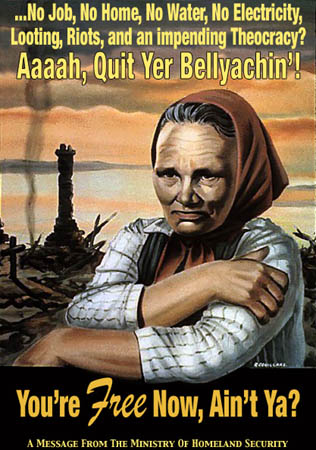 (Link to image courtesy of Three River Tech Review)
(The image is part of the brillant propaganda remix project of one Micah Wright. What a great homepage.)
As these advanced leaks indicate the question mark is over the UN. It is obligated to clean up the mess caused by the imperial presidency.
I concur with abu Aardvark on this. The UN proved its relevance by standing up to US pressure to invade Iraq. It increased its standing and reputation in world opinion that values values international co-operation.
Abu links to this interpretation of those events to justify the relevance of the United Nations.
As Juan Cole reports there was another bombing of the UN headquarters in Baghdad. He says that "the Sunni Arab nationalists just want to get the UN out, and to make the point to the UN that trying to rescue Bush in Iraq would be a very, very bad idea." And just to balance things consider this little snippet found by billmon about the conduct of US troops in Iraq. It does make you wonder about the US occupation doesn't it.
Juan helpfully provides a links to this academic research work on the roots of terrorism by US researchers as they respond to 9/11.
Posted by Gary Sauer-Thompson at 01:41 PM | Comments (0) | TrackBack
Hutton Inquiry
In this piece by Gerard Henderson about the Hutton Inquiry Henderson observes that:
"The Hutton inquiry is regarded as providing a unique insight into the operations of democratic governments - political leaders and their advisers, bureaucrats, the military, even security services. Much of the material which has come before it would not normally become public for 30 years. Some information concerning security would never be released in the normal course of events. Little wonder, then, that Lord Hutton's deliberations have attracted such interest."
Gerard moves onto the light thrown on the media practices of the BBC by the Hutton Inquiry. I want to stay with the murky role of ministerial advisors and how Alastair Campbell, then the Blair Government's director of communications, understands it. He says that his role in the writing of the Blair Government's dossier was concerned with editorial presentation. Campbell says that he was asked by John Scartlett, the Senior intelligence official,

Steve Bell 2003
to provide presentational advice on the draft dossier on Iraq's Weapons of Mass Destruction. Campbell says:
"...what the Prime Minister expected of me in this particular communications exercise, if you like, was to perform my role, which I traditionally would perform, on something which crosses Departments, which is the role of coordination. The second point is that this was a document that was to be presented to Parliament and to the public, not just at home but also overseas. It was a major communications exercise. The other point I would make is that the Joint Intelligence Committee, for very obvious reasons, do not have the expertise or the personnel to do that kind of job."
Campbell then adds in response to some questioning from Lord Hutton that this was a document that Tony Blair:
"...was presenting to Parliament. He was going to have to be answerable to Parliament for every word in it. Equally, those of us whose job it is to help the Prime Minister and other Ministers put the Government's case to the media and, through them, to the public were going to have to be on top of the detail; and I would say that I was making presentational points in accordance with the job that the Prime Minister and Mr Scarlett had asked me to do."
Editorial presentation. That is how Alastair Campbell understands rhetoric, political spin or sexed up. It was devising ways to enable the PM to take all the questions from MP's upon it, and to be answerable to Parliament and the public for its contents.
Campbell disengeniously says that it was not presenting a particular case for a particular policy in relation to Iraq. All that was being doing was setting out the facts on Iraq's WMD as the British Government understood them to be. So there was just facts not rhetoric or interpretation. A director of political communications just presenting the facts? Just being concerned with clarity? Just removing the inconsistencies?
Hardly. Campbell was very consciousof the the expectations surrounding the publication of the dossier were huge and that the media and Parliamentarians were likely to pore over every word. So a lot of effort went into the words and the sense with an eye to persuading a sceptical readership and shift public opinion.
The spin is in the very first line of defence. Spin? Me my lord? As you read through the transcript a lot of emphasis is being given to interpretation----what Campbell calls 'the point is weak and it can be strengthened. Here are some words to do the job.' The editorial presentational devices include rhetoric---presenting the case in order to persuade. The rhetoric and persuasion --the spin---is downplayed. Campbell's political instincts say that it is best to wear the mask of a British empiricist. It is the classic rhetorical appeal to the commonplaces of the culture.
There's the Blair spin machine at work. It never actually expresses what is going on.
Posted by Gary Sauer-Thompson at 10:39 AM | Comments (0) | TrackBack
September 22, 2003
It's political spin
The link to this article by Josh Marshall about the selling of public policy is courtesy of Rodger A Payne. It also describes the political spin of the Howard Government.
Marshall argues that the Bush imperial presidency in the US has a pre-existing policy agenda, which is justified and supported with whatever arguments they deem to be useful to sell their case and shape public opinion in their direction they desire. Josh says:
"The president and his aides...speak untruths because ...their politics and policies demand it....Indeed, the aim of most of Bush's policies has been to overturn what FDR created three generations ago. On the domestic front, that has meant major tax cuts forcing sharp reductions in resources for future government activism, combined with privatization of as many government functions as possible. Abroad, Bush has pursued an expansive and militarized unilateralism aimed at cutting the U.S. free from entangling alliances and international treaty obligations so as to maximize freedom of maneuver for American power in a Hobbesian world.
Yet this is not an agenda that the bulk of the American electorate ever endorsed. Indeed, poll after poll suggest that Bush's policy agenda is not particularly popular. What the public wants is its problems solved: terrorists thwarted, jobs created, prescription drugs made affordable, the environment protected. Almost all of Bush's deceptions have been deployed when he has tried to pass off his preexisting agenda items as solutions to particular problems with which, for the most part, they have no real connection."
Josh shows this to great effect with tax cuts that are waved around like a magic wand to address all sorts of economic problems.
We can see this strategy with John Howard's war with Iraq. The decision to go to war was political and it flowed from the Government's position that the US alliance was absolutely paramount in shaping Australia's military strategy. The public reasons given for going to war (WMD, Iraq's links to al Qaeda, threat to Australia etc) were tacked on as justifications for a pre-exsiting policy. Hence the justifications could and did change (furthering democracy and freedom; the good consequences of a bad guy taken out).
Marshall Marshall then describes the effect of this stratgy. There is a lack of concern with evidence -- and a rejection of expert advice that disagrees with its ideology or pre-set agenda. These are seen as obstacles to be overcome through ignoring the evidence and discrediting experts. The effect created is a strong incentive to delegitimize the experts, who are seen as guardians of the status quo, who seek to block any and all change, no matter how necessary, and whose views are influenced and corrupted by the agendas and mindsets of their agencies.
Update
A core issue in the Hutton Inquiry in the UK is the discrediting of experts (Dr. Kelly) by the Blair Government. Ministers and bureaucrats will then cover their tracks in the strategies used to delegitimize the experts.
Posted by Gary Sauer-Thompson at 01:00 PM | Comments (0) | TrackBack
Free trade?
The WTO free trade talks at Cancum, Mexico, failed. The European Union, Japan and the US failed to deliver on a serious reduction in agricultural subsidies and tarrifs.
Australia, the perennial hopeful, was convinced that the historic goal of the complete elimination of export subsidies was in sight. And limited market access and domestic support? Where were they? Just around the corner?
The history of free trade between nations is one of western nations lowering industrial tariffs but protecting their own agricultural for political purposes. They have no intention of opening up their agricultural markets yet they demand that developing nations embrace the Singapore issues (including open investment and competition policy) to facilitate the penetration of foreign capital and a more open trade in services. Bias and power is built into the very design of the international trading system.
Why should developing nations make concessions without Japan, the European Union and the US making major concessions on farm protection?
Will the failure of Cancum mean shift to regionalism in the form of blocs of open trade?
Posted by Gary Sauer-Thompson at 11:45 AM | Comments (0) | TrackBack
a good step
I meant to mention this story I came across in The Weekend Australian (no link) yesterday, but I got waylaid. The story refers to the Martin Labor Government in the Northern Territory planning to hand over to indigenous traditional owners the title to much of the vast system of national parks, in return for long-term leasebacks and guaranteed free tourist access.
About time.
Aboriginal people do own a large part of the Northern Territory and form more than a quarter of the population. Who better to look after the territory's natural heritage, country, and habitat? The white folk have certainly mismanged the environment, as evidenced by the Murray Darling Basin.
The previous conservative Country Liberal Party regime that had ruled the Northern Territory for decades had always struck me as having all the appearances of a white colonial regime. Under the New Labor regime there is co-operation on native title not hostility.
Returning the national parks is a better way of ensuring aboriginal economic development than an economics based on hunter gathering or welfare. It is a little step in giving the traditional owners control of their affairs and resources.
Maybe the parallel and segregated societies of white and black, which developed in Alice Springs under the Country Liberal Party, are about to change as new links between them are established.
Posted by Gary Sauer-Thompson at 09:20 AM | Comments (0) | TrackBack
September 21, 2003
Weekend Cartoon

After failing to find any weapons of mass destruction in Iraq, the Bush administration is now busy searching for Al-Qaeda cells there to justify the war. (Khalil Abu Arafeh, Alquds, 9/15/03).
The other side of the American occupation in Iraq is this. It shows why the US under an imperial presidency lacks legitimacy in Iraq.
When you turn the eye back to Washington you see the imperial presidency, the decreasign power of the US Senate, the undermining of liberties with the Patriot Act and the slow conversion to a military empire. The American republic is in serious trouble.
And for some looney New York tunes read this column (or here)by Thomas L Friedman about France being the malicious enemy of the US. Why malicious? Because France is in favour of Iraqi sovereignty and democracy at a time when the imperial presidency is saying that the Iraqis aren't ready for democracy.
Posted by Gary Sauer-Thompson at 11:45 PM | Comments (6) | TrackBack
September 20, 2003
beyond silence
This article (link courtesy of Jean over at Creativity Machine) is interesting for its account of the difference between the old world of the mass media and the new world of the Internet.
Clay Shirky says that in relation to the mass media of the 20th century the:
"....historic role of the consumer has been nothing more than a giant maw at the end of the mass media's long conveyer belt, the all-absorbing Yin to mass media's all-producing Yang. Mass media's role has been to package consumers and sell their attention to the advertisers, in bulk. The consumers' appointed role in this system gives them and no way to communicate anything about themselves except their preference between Coke and Pepsi, Bounty and Brawny, Trix and Chex. They have no way to respond to the things they see on television or hear on the radio, and they have no access to any media on their own -- media is something that is done to them, and consuming is how they register their response."
This mass media made us consumers silent. But silence did not mean that the media's message passed unchallenged by us viewers. We did teach ourselves to read the product dished up to us critically. In doing so we became critics of the media. We challenged the media's claim their supply of information the population would enhance its critical consciousness and become a critical public opinin. We became aware that the technological news industry shapes our attention in a special direction and ‘mobilizes’ public opinion in favour of different polices.
What grew out of this was the search for void spaces, holes in the media systems, that would allow alternative story telling to emerge. But we the public as citizens did not become producers of culture because we did not have the media to enable us to do so. Hence there was little by way of public journalism.
Clay Shirkey is pretty upbeat in terms of the new media for alternative narrative to those the technologized news industry. He says that:
"In retrospect, mass media's position in the 20th century was an anomoly and not an inevitability. There have always been both one-way
and two-way media -- pamphlets vs. letters, stock tickers vs. telegraphs -- but in 20th century the TV so outstripped the town square that we came to assume that 'large audience' necessarily meant 'passive audience', even though size and passivity are unrelated."
Clay Shirky then contrasts this passivity of the consumer in a world of mass media with the possibilities opened by the Internet:
"With the Internet, we have the world's first large, active medium, but when it got here no one was ready for it, least of all the people who have learned to rely on the consumer's quiescent attention while the
Lucky Strike boxes tapdance across the screen.... In place of the giant maw are millions of mouths who can all talk back. There are no more consumers, because in a world where an email address constitutes a media channel, we are all producers now."
Clay hangs too much on the email as media. It is too romantic when this form of engaging in a conversation is being killed of by the spam mail that is now choking our email boxes.
Surely it is the weblog that makes the cultural difference as it is this media that enables us as amateurs to become producers of culture. Note that I say culture not news. Saying culture opens up a disturbing phenomenon in cyberspace: the systematic closing of the intellectual commons through the limited public access to online academic journals. The signs read Access Denied even at publicly-funded universities.
Posted by Gary Sauer-Thompson at 02:06 PM | Comments (4) | TrackBack
September 19, 2003
Iraq and Federalism
Abu Ardvaark has linked to an interesting paper by Brendan O'Leary on democratic governance in Iraq. It is interesting in the light of an occupation that is not going well, makes a welcome change from the military side of things and offers an alternative to the growing possibilities of an American-imposed "soft" dictatorship in Iraq. Sooner or latter the US has to leave Iraq.
O'Leary argues for a position that has been advocated by public opinion mark 1: a multi-national federation because the regional reality of Iraq's multinational composition makes a monocultural federation unworkable.
The Ardvaark is not persuaded by what by what he says is O'Leary's enthusiasm for a multi-national federalism. He leans towards, but does not endorse, non-federal options. That nonfederal pathway is towards a centralized liberal democracy with a monocultural nation. The danger on this pathway is the exclusion or repression of different ethnicities that constitute the Iraqi nation (eg., Kurds and Sunnis). That is a recipe for disaster.
Juan Cole has drawn attention to the drawbacks of multinational federalism. He says (in email) that a:
"Multinational loose federation is a recipe for the future break-up of Iraq. ...The alternative is to put in strong safeguards against a tyranny of the majority for the Kurds. Devolve education policy to the local governments, along with local commerce and agriculture. Have provincial legislatures and elected governors. Have a strong bill of rights. Have a bicameral legislature with an upper house that over-represents the Kurds and Sunni Arabs. i.e., use the 1789 US constitution as something of a model; it faced similar dilemmas. That is, I think the Kurds can get a lot of what they want under a fairly strong Federalism, as long as the right safeguards are built into it. And this would be preferable to encouraging sub-nationalisms that provoke civil wars in the future."
Abu concurs. The danger of O'Leary's loose multinational federalism is the Lebanonizing Iraq and so would encourage Iraq's eventual breakup.
Juan on my reading is advocating federalism with his mention of provincial legislatures and elected governors. Presumably these regionally based legislatures would be a political expression of the different regional ethnicities. So we have a federal political structure with a de-facto multicultural nation. Presumably we have one state and a common citizenship.
Hence the debate is about the degree of "looseness" versus centralization.
Posted by Gary Sauer-Thompson at 11:01 AM | Comments (4) | TrackBack
Michael Walzer Interview
In the light of what people call the development of the new anti-Semitism this interview with Michael Walzer, the political philosopher, is an interesting one. I will cut out the bit on the Israel Palestine issue because Walzer makes some good points in terms of just/unjust war. It helps to cut through some of the fog that surrounds this issue and to define a critical response to Israel and Palestine.
Walzer makes the distinction this way:
"These are the four wars: there is a Palestinian war to destroy and replace the state of Israel, which is unjust, and a Palestinian war to establish a state alongside Israel, which is just. And there is an Israeli war to defend the state, which is just, and an Israeli war for Greater Israel, which is unjust. When making particular judgements, you always have to ask who is fighting which war, and what means they have adopted."
How does this distinction apply in practice? We can say that Arafat's war is to destroy and replace the state of Israel whilst Sharon's war is for a Greater Israel.
The distinction can also be applied to tactics and stategies. Walzer is very clear:
"Palestinian terrorism, that is, the deliberate targeting of civilians, should always and everywhere be condemned. And Israeli settlement policy in the occupied territories has been wrong from the very beginning of the occupation. But this second wrongness doesn't mitigate the first: Palestinian attacks on the occupying army or on paramilitary settler groups are justified – at least they are justified whenever there is an Israeli government unwilling to negotiate; but attacks on settler families or schools are terrorist acts, murder exactly....And similarly, Israeli attacks on Hamas or Islamic Jihad fighters are justified; dropping a bomb on an apartment house in Gaza was a criminal act."
Palestinian nationalism, therefore, is a problematic phenomena. It cannot be understood solely as the engine of a progressive movement for national liberation from a powerful country with a large army that is being used to sustain the occupation of another people. And Zionism, which poses as a national liberation movement, has become a colonial settler movement.
Posted by Gary Sauer-Thompson at 09:04 AM | Comments (1) | TrackBack
September 18, 2003
University reform
The Australian Financial Review carries a report that the Howard Government is willing to "make further concessions on its shake-up of higher education as it faces the tough task of pushing the historic reforms through a hostile Senate." The reforms provide new concessions for smaller and regional institutions, disadvantaged students and over-enrolled facilities to counter these institutions being disadvantaged by deregulation. Expect more modest concessions.
But the basic thrust of the reform remains in place despite these sweetners. This is:
"...to provide universities with the ability to reduce their reliance on government money and embark on more commercial ventures to boost revenue. Universities will be encouraged to operate more like businesses, maximising the lucrative benefits offered by the overseas student market and boosting the potential for greater private-sector collaboration because of improved transparency."
Business is all for the Nelson reforms. It says that these will align the universities with the emerging needs of the economy; are the key to innovation; will ensure the survival of high education sector; and enable the higher education sector to have the capacity to compete globally. Big business sees the universities as corporations and education as an industry. Hence the key drivers are competition, efficiency and entrepreneurialship.
Reform is needed. The universities are in poor shape after years of doign more with less. This is especially so in South Australia which can be considered a disadvantaged region.
Though reform is needed the Nelson proposals mean that it is consumers who will have to fill the funding hole left by the unwillingness of either major party to dramatically increase the public funding of universities. The Labor Party's offer of $2.4 billion in public funding will still leave the universities short of cash. Hence the look around for easy money; and allowing the universities the flexibility to raise money themselves so they have the resources to improve their facilities and teaching.
So which consumers are going to provide the easy money? Australians? There is resistance to 30% increase in course fees that can be funded by loans:--apart from courses in medicine, law and business that lead to well paying jobs. It means being saddled with debt for those unable to afford to pay upfront. So consumers largely means international students. They are easy money.
So the key thrust of the reforms is freeing up universities to increase their revenue through increasing student fees. It will work for the big prestige universities, such as Melbourne and Sydney, but not for Flinders in South Australia. Flinders will be unable to charge the 30% increase since its students will be a unable to afford to pay. So it will start a downward slide into a cheap second-rate, publicly funded regional university.
The old divide has been reinvented.
Posted by Gary Sauer-Thompson at 03:13 PM | Comments (4) | TrackBack
on the ropes
The educational legislation to reform the universities has been introduced in House of Representatives by Brendan Nelson The $1.5 billion package is controversial. It would double the number of full-fee paying students, allow universities flexibility to raise fees by 30 per cent and allow students to take out government loans for their courses, to be paid back with interest on completion.
According to Minister Nelson education is now about realizing your potential through the marketplace. Education contra the market is a historical relic.
The Government hopes to push the radical changes through the Parliament before Christmas but the Senate is not playing ball. The ALP says no. The Democrats say no. The Greens say no. That leaves the 4 Independent Senators to negotiate.
That political play is becoming a familar routine in Canberra. I saw it when I watched the Heritage Legislation pass through the Senate. The ALP just said no even though that legislation was an improvement.
So what is up with the ALP these days? Why is it so rigid? So inflexible?
This account of the ALP by Peter Botsam is a a good one. The ALP's divisions are deep and structural, it is tearing itself apart, there are no new policies are coming out of Canberra, it is doing a poor job as an opposition party in putting heat on the Howard Government, and is doing the only thing it knows. Count the numbers.
And no one seems to care that the ALP has lost its way.
I have to admit to admit that I do not know know what is going on with the ALP apart from the dead hand of Labor factionalism.
Bostsman says that solution for the ALP can only be a long-term one:
"The only constructive strategy is to wait for the present group to be pensioned off, build better foundations of participation within the party, create a broader ideological base for party policies and ideas, rework the process of electing representatives, and open up the membership to a new dynamic group of supporters who do not fit the traditional mould of Labor. Only when these reforms are achieved will the discipline, strength and talent come back to Labor."
Has the ALP lost its way?
The culture of the ALP has turned inward. It acts as if it were a government in waiting not as an opposition. It is primarily concerned about the ALP not the good of the country.
Posted by Gary Sauer-Thompson at 09:40 AM | Comments (0) | TrackBack
September 17, 2003
light blogging
Blogging has been light at public opinion today as I have been grinding away on a post on public reason, hermeneutics and the Australian constitution over at philosophy.com
I reckon I've bitten off more than I can chew.
But I did notice this report on a speech given President George Bush. For the political significance of this speech in relation to the American Constitution and freedom, see George Payne.
It represents a direct attack on the 4th Amendment by the National Security state. That Amendment, which is generally interpreted to mean this to mean that the government must apply to the judiciary for a warrant in order to search premises and in order to obtain documents, is now seen as an obstacle. An obstacle to be removed.
The American Republic is not travelling well under the massive domestic "security" apparatus created under President Bush. Read George Payne's anger at what is going on in the rolling back of freedom by the national security state.
What George is writing about there undercuts this old timey cliched dualism: liberal societies are sane, tolerant, stable, pluralistic and therefore well behaved. Totalitarian societies are paranoid, intolerant, coerced into artificial unity and therefore aggressive.
Posted by Gary Sauer-Thompson at 11:59 PM | Comments (0) | TrackBack
oh yeah
So the case for invading Iraq remains rock solid? Yes, says an editorial in The Australian. It says that not even a dent has been made in the case for going to war.
I'm not kidding you:
"Revelations that the peak British intelligence committee warned of risks in disarming Saddam Hussein have generated much ado about very little....The fact their warnings did not sway the British Government does not mean Prime Minister Tony Blair and his colleagues were derelict - they considered this, along with the committee's other advice, and made the decision to attack Iraq on the basis of all the evidence before them, evidence which was overwhelmingly in favour of the case for war."
Funny, I thought the justifications for war were faulty. Iraq was not involved in 9/11; Iraq was not closely to connected al Qaeda; and there is lot of doubt about Iraq's ongoing production of weapons of mass destruction. The weapons of mass destruction that we were told Saddam had stockpiled, could use against the West at short notice or might pass on to Islamic terrorists, have disappeared.
Not to worry. There are no doubts for The Australian:
"As a British parliamentary inquiry into the intelligence provided to the Blair Government put it last week 'there was convincing intelligence that Iraq had active, chemical, biological and nuclear programs'. Which is far more positive than the admission by the BBC's director-general, Greg Dyke, that his subordinates considered the story involving now deceased weapons scientist David Kelly, which alleged the Government had sexed-up the case for war, was 'marred by flawed reporting'".
This is hard to square with this or this. Nothing about a proper accounting of the Howard Government's decision-making. There is nothing murky in domestic politics being hidden at all, and there is no need to build a climate of acountability.
Nor is any case made by The Australian that Iraq was an imminent threat to Australia. So the case for doing right amounts to little more than going along with the US for the sake of the alliance.
Oh, and it was a good outcome. Saddam was removed. There is nothing here about the US occupation of Iraq going badly wrong, the lack of a democrated Iraq, the big failure in nation building in Afghanistan, or the failure of military fix to solve political problems.
Posted by Gary Sauer-Thompson at 12:39 PM | Comments (1) | TrackBack
September 16, 2003
A great read
Here's one for all the closet neocons who love to fight a good war for freedom but run from empire. It is courtesy of Emmanuel Goldstein over at Airstrip One.
Good stuff.
Posted by Gary Sauer-Thompson at 02:11 PM | Comments (0) | TrackBack
I couldn't agree more
I have just come across this paragraph in Scrapbook in The Australian. It is from an article in Arena Magazine by Peter Christoff. The paragraph says:
"That one politician [John Howard] could commit Australian forces in the face of trenchant public opposition and considerable dissent within Australia's military establishment - even before bringing a proposal for military involvement to cabinet, and before debate on the matter in federal parliament - highlights a crucial failure of Westminster-style representative democracy and the alarming range of executive power."
I have to agree. The central flaw with our political system is executive dominance. It is what the federal dimension of the Constitution was designed to overcome.
The solution? Increase the power of the Senate.
The proposal for Australia to go to war by invading a sovereign nation, which is not a substantive threat to our national interest, should have been put to the Parliament to authorize. It is Parliament that should give the okay to go to war, not the executive making a secret deal with the US and pretending otherwise.
It leads to the desire to keep the public in the dark and shows the willingness of politicians to override the central value of Australian democracy.
Posted by Gary Sauer-Thompson at 01:08 PM | Comments (0) | TrackBack
September 15, 2003
its subsidies by another name
Australia has a reputation of being an efficient food exporter. It seeks to reform world trade through getting protectionist nations to open their markets to farm imports, and to eliminate all export subsidies protectionist nation's pay their farmers to help them compete against rivals from other countries. Australia has virtually no tarriff or other trade barriers on farm imports and pays only minimal subsidies to farmers.
That's the virtuous self image presented by Australia at the World Trade Organization talks. Canberra preaches the gospel of free trade as it were some fundamentalist preacher. At the same time Canberra is unwilling to reform the sugar industry, or address that industry's fundamental structural problems. It is only too willing to provide assistance packages and income support measures.
Is not this handing out money to inefficient cane farmers a subsidy?
And why does the Howard Government subsidise inefficient farmers against rivals from other countries?
Because the Coalition (National Party) holds a string of Queensland seats along the Queensland Coast. That is why. It is pork barrelling.
Update
An editorial in The Australian talks about Australia being:
"...the white knight of world trade, leading the charge for global reform as chair of the Cairns Group of 17 agricultural producers, nations that do not subsidise their farm exports."
Image is all.
I guess they have conveniently forgotten that Australia is acting shamelessly in subsidising the cane farmers to prop up a dying National Party in coastal Queensland.
Posted by Gary Sauer-Thompson at 09:20 PM | Comments (0) | TrackBack
circles of violence
This editorial in The Australian on the decision by the Israeli cabinet to force Palestinian President Yasser Arafat into exile is standardly pro Israel. It follows Ariel Sharon's line that Arafat is the central problem. There is very little criticism of Israel here even though the talk is liquidation.
What the editorial ignores is the blindness of the Israeli leadership to the root of Israel's problem: namely, Israel's occupation of Palestinian lands. As Helena Cobban says:
"Since then [1978], the number of Jewish settlers in the occupied territories--including East Jerusalem, which many Israeli tallies of this figure don't even bother to include these days-- has soared to more than 400,000. Four million-plus Palestinian refugees still languish in their forced exile. Three million Palestinians live in the walled-off Bantustanettes that the occupation authority has devised for them..."
Hence the Palestinian suicide bombings are a sympton, not the root cause of the Israeli-Palestinian conflict. Like Israel the Palestinians want peace and security.
What is ignored by The Australian is made explicit by Amin Sokal in today's Australian Financial Review (subscription required, p. 63.) That Ariel Sharon needs to be reigned in by the US. Sharon is effectively undermining the road map as uses targeted assassinations and collective punishment of the Palestinian people to push on with his long-term goal of repressing the Palestinian people to the point of accepting a peace settlement on his terms.
Sokal argues that Sharon justifies this by exploiting America's war on terror n by blurring the differences between the international terrorism practiced by al Qaeda and the violent actions of militant Palestinan groups.
The Australian does not see the circle of Israeli-Palestinian violence.
Posted by Gary Sauer-Thompson at 08:23 PM | Comments (2) | TrackBack
September 14, 2003
Sunday cartoon
I'm down at Victor Harbor. I walked past the pelicans this morning near the boat ramp in Encounter Bay when walking the dogs around Rosetta Head after yesterdays rains.
I was reminded of this:

Nicholson, Beach Cricket: Pelicans get the ball
The tragedy is that the pelicans get ensnarred in the fishing lines and hooks of the recreational fishermen. They die slowly and painfully.
The penguins in the area (Granite Island) have been clubbed to death.
Not even the seals are allowed to be.
Only the Southern Right whales are allowed to be.
Posted by Gary Sauer-Thompson at 04:41 PM | Comments (0) | TrackBack
September 13, 2003
Weekend cartoon

In War We Trust (By Stavro Jabra, 9/9/03).
This is the everyday reality in the Middle East region of Palestine and Israel

Israeli forces blewing up the home of Abdallah Al-Qawasmeh in Hebron.
Some comments on the Israeli strategy here. As Kevin says the "blood will never stop until it is accepted that there can be no military solution to the conflict." As Juan Cole observes:
"...Sharon's iron fist is simply not working as a means of establishing general peace, and the Bush administration will have to finally apply effective pressure on Sharon to stop his outrages in and colonization of the West Bank and Gaza. Sharon's hard line has worked in tandem with Hamas's terrorism to ratchet up tensions further and further, which spill over into the Muslim world and serve as a recruiting tool for al-Qaeda in its search for agents willing to hit the United States."
A political struggle requires a political solution not a military one.
Posted by Gary Sauer-Thompson at 10:19 AM | Comments (0) | TrackBack
September 12, 2003
Washington Beltway
I never really understood what the phrase 'Washington Beltway' meant. I knew that it referred to the Washington bureaucracy but which ones? The gist I got was that they had something to do with foreign policy and that the Republican conservatives had no time for them.
Now I know thanks to following a link from Abu Aardvark to Laurie Mylroie in National Review Online. She says:
'The Beltway is first the bureaucracies, above all the CIA and State Department, which developed a certain perspective on Iraq and on terrorism during the Clinton years — namely that "containment" addressed the danger Iraq posed and that Iraq was not involved in terrorism. The Beltway also includes much of the media, as well as many Democrats.'
Mylroie says that opposed to this group is The Pentagon, which is on Bush's side, along with Congressional Republicans and the conservative media, generally. The American people side with Bush. Her latest book sums it up: Bush vs. the Beltway In terms of that dichotomy Public Opinion sides with the Washington Beltway.
I view Washington through the eyes of the Beltway. Why? Because I find the gap between the Bushies' (neo-con) Wilsonian rhetoric about freedom, democracy, elections (ie., the American ideals) and the self-interested behavior of the US as an imperial nation-state disturbing. As John Mearsheimer observes about the US:
"We behave in the world according to Realistic dictates on almost every occasion. What's affected by the point you're making is that rhetoric. In other words, we act according to the dictates of realpolitik, but we justify our policies in terms of liberal ideologies. So what is going on here is that in many cases, elites speak one language [in public], and act according to a different logic and speak a different language behind closed doors."
Link courtesy of Rodger A. Payne He runs a great blog. Check it out.
So what is the Bushie side saying according to Laurie? We've heard it before:
"Above all, the decision for war with Iraq was right; it was very courageous and it was absolutely necessary. Iraq was involved with al Qaeda in the 9/11 attacks — which is what nearly 70 percent of the American public believes. Iraq's involvement in terrorism, along with its weapons, particularly its biological-weapons program, made war necessary."
Say that again! Iraq was involved in 9/11? I must have misread the text. Intriqued I read on. Then I came across a suggestion that it was more Iraq and less al Queda or the loose networks of Islamic militants. Mylroie then says:
"It's more a matter of not wanting to know, self-deception, rather than clever Iraqi deception. By now a large cottage industry has grown up around militant Islam. If it were understood that Iraqi intelligence was involved in these attacks and that it provided the expertise for them, that might make ideology (militant Islam) seem less significant than capabilities, as represented by terrorist states like Saddam's Iraq. Those who made their reputations (along with a great deal of money) flogging the Islamic threat are joined with others in the Beltway in ferociously fighting this notion."
Did I read that right? It's Iraq, not al Qaeda that was responsible for 9/11? Surely not.
I checked back to Abu Aardvarkwho is more knowledgeable about what happens in Washington than me. He reads the text the same way.
My response was that this is mythmaking. Now this question presents itself. Do the Bushies really believe this myth? Or is this just something being woven by Laurie Mylroie?
I have no idea. The neo-cons (eg., Paul Wolfowitz, Richard Perle etc) do find her provocative, brilliant splendid and wholly convincing.
As for me I will stick with the Washington Beltway.
Posted by Gary Sauer-Thompson at 11:14 AM | Comments (3) | TrackBack
September 11, 2003
your time is up
I noticed this CIS response to the problem of long-term unemployment. The public policy proposal is by Peter Saunders and Kayoko Tsumori, and they say it woudl be a good idea to place time limits on unemployment benefits. The limit mentioned is six months duration. After six months full time participation in a work-for-the-dole program would be compulsory for anyone capable of working after the six months expired. This proposal, they argue, could reduce the incidence of long-term unemployment by 50%.
That proposal means the unemployed enter a low skills job market with low wages. They will be trained to work for Coles or Woolworths on the checkout on a casual basis. That means more working poor. That means more disaavantaged workers with low skills and education and little individual bargaining power in the marketplace. It's more of the same.
That is seen to be acceptable. The embrace of economic liberalism over the last two decades has seen greater use of markets and individual choice to achieve social ends. This neo-liberal mode of governance has witnessed the turning away from egalitarianism. Efficiency and competitiveness has replaced egalitarianism.
Redistribution of income by governments is seen to impose rising efficiency costs, and it is held that redistribution is becoming increasingly less affordable. As the media release for the CIS Report states, their proposal would "save up to $2 billion per year." It is an argument presented in terms of costs and benefits. Sitting inside the utilitarian calculus is the promotion of individualist values----indicated by the words 'self-reliance' and their sense of 'self-worth.
Behind the talk of means sits the end of public policy. Self-reliance is their ethical value and they are willing to sacrifice some market efficiency to foster the policy end of individual self-reliance. The CIS is actively promoting particular social goals and values.
And Australia has become a less egalitarian society as a result of a neo-liberal mode of governance. And a quite aceptance of inequality has settled in. John McVey over at The Usurer writes in response to an earlier post of mine on employment and Whyalla:
"The short answer is that regional centres such as Whyalla wont get far precisely because they are only regional centres and will have little to offer beyond whatever geographically-specific benefits are available - hell, even Adelaide's size has been questioned. Whyalla's chronic unemployment problems wont be fixed by any labour market policy whether Coalition or otherwise (not in a manner that maintains the size of the population anyway)... Some place somewhere has to have the worst figures, and at present Whyalla happens to be it."
The short response is reskilling for the new information economy and new green industries that takes advantage of Whyalla's natural advantage (plenty of sunshine for solar power ) and industrial base (manufacturing windmills for renewable energy) That kind of intervention is premised on egalitarianism (equality of jobs, educational opportunities and the wider distribution of the benefits of economic growth) and the sacrifice of some market efficiency.
Hence the disagreement is not about economic relationships or about how the political/economic system works: it is a conflict about values and the ends of public policy (the weight given to different values) in a liberal democracy.
Posted by Gary Sauer-Thompson at 05:42 PM | Comments (5) | TrackBack
Snowtown: The dark side of Adelaide
This has got them talking in Adelaide. Allan Perry, an Adelaide University criminologist, has said that South Australia's reputation for bizarre killings was not just bad luck or coincidence.
"Adelaide is a stifled and inbred city whose subculture of degeneracy led to atrocities such as the bodies-in-barrels murders. Cities such as Sydney and Melbourne had areas of similar social deprivation to Adelaide, but these were dynamic and social societies with more outlets for people's frustrations. Adelaide is much more of a stifled, inbred community.There is no vibrant social or commercial life (in the city). The question is why do the best and brightest in Adelaide never stay around, and why few in that category come here? The answer is clear - no one with ambition thinks that Adelaide is the place for them."
Adelaide is a large country town, that fancies itself to be a cosmopolitan city. It has large urban areas of social deprivation due to the negative impact of economic globalization on its old manufacturing industries. The Athens of the South in the 1970s became a rust belt town in the 1980s and 1990s and is now trying to reinvent itself.
Dr. Perry then went on to put his finger on what troubled him about Adelaide:
"(I'm referring to) the lifestyle of an increasingly significant subculture of people in the South Australian community, whose lives are totally amoral and parasitic upon society. This culture of degeneracy had built up in some impoverished parts of the city created by welfare dependency and worsened by the breakdown of family units, leaving children growing up in amoral environments."
The remarks are seen to be inflammatory and Dr Perry has been told to go to New York. South Australia is a state where the Rann Labor Government adopts a tough law and order regime to ensure its re-election. Yet the the killings went undetected by the police for the best part of a decade.
The bizarre bodies-in-a-barrel murder case is hard to dismiss lightly. This is dark stuff in a city whose self-image is premised on it beign a child of the liberal Enlightenment. John Justin Bunting and Robert Joe Wagner were engaged in a cold-blooded campaign to kill suspected pedophiles and homosexuals, whom they labelled dirty and wastes. The 11 gruesome murders involved torture, victims bodies being cut in pieces, and then being kept as rotting trophy items in six barrels of hydrochloric acid.
Yet this darkness has been quitely buried--the horror has been brushed aside. An enlightened city has no way of dealing with this stuff. It cannot comprehend that the darkness of 12 vicious murders in six years involving four killers---far more than you seen on Law and Order--- is the other side of the light of reason.
Update
Mark Findlay, a criminologist, writing in The Australian, says that even though Snowtown was an awful, explicable and relentless tragedy involving serial killings the press was relatively disinterested (The Australian being an exception). Press coverage was sporadic. He asks:
"[Snowtown] was the worst serial murder case in Australia's history, and one of the longest and most brutal trials, yet Pauline Hanson's imprisonment seems to have stirred up more heat. Why?"
The 'why' is a good question to ask.The Advertiser has been largely silent on this. Findlay draws attention to what Allan Perry called the the culture of degeneracy:
"In Snowtown, brothers killed brothers, homosexual lovers killed partners as some sick statement over confused sexuality [sic] and vulnerable victims were robbed after death – all in an atmosphere of neglect, abuse, domination and degradation. Most of those involved in the tragedy came from a part of our society that is ignored, avoided or institutionalised. Perhaps it explains how a dozen deaths over half a decade passed seemingly unnoticed. There has been little comment on how, not why, this could happen. The why has exercised little more than some glib generalisations about social outcasts."
Findlay's answer has to do with the outcast bit:
"It is not unfair to suggest that as a lost, socially inadequate, fringe dweller you will not generate the excitement of the viewing public or of criminal justice until it is too late, and even then not much. Snowtown was, in part, the consequence of a lack of social engagement and of rejection at all levels. The apparent apathy surrounding this horror seems a natural extension of this climate of rejection."
Adelaide is trying to expunge the serial killings as having nothing to do with what it is as a civilised liberal and egalitarian society. They are beeing swept under the carpet. It is best to forget. But the sense of shame and embarrasment stays. It reinforces the public feeling that there is something sick/unhealthy about the culture of Adelaide. We are indeed a long way from the 1970's brand of 'Athens of the South.'
Update 2
This article in The Australian describes what Allan Perry called the culture of degeneracy. It is an underclass world of joblessness, dysfunction and welfare dependency in Salisbury North. In this world damaged and often traumatised people (from being sexually abused and beaten as children) are caught up in destructive relationships (friends and lovers). They live a damaged life of tangled relationships, involving de factos, husbands, wives, casual partners, step-children and half-siblings.
Posted by Gary Sauer-Thompson at 04:37 PM | Comments (27) | TrackBack
September 10, 2003
Water politics
According to a story in the Australian Financial Review (subscription required, 08 09 03, p. 6) farmers around Mildura are firming in their opposition to water reform in the Murray-Darling Basin. Theirs is a similar position to that defended by George Warne from Murray Irrigation in Southern NSW in recent months. For an indication of the latter's position see and here.
The argument of the Mildura irrigators is that the River Murray is not dying from overuse. The River Murray is not on life-support. It is in good shape. It is teeming with life. The irrigation infrastructure has ensured that water stayed in the river during the drought.
So there is no need for environmental flows because the river is not being degraded and it is not getting worse. If the River Murray is not getting worse, then there is no need to cut back on allocations to irrigators for environmental flows.
The evidence? Its not science. The River Murray looks okay from where I live and work in Mildura. That is considered enough to refute ecological science.
It's hardly a knockdown argument. It flies in the face of the Federal Governments' own National Action Plan for Salinity and Water Quality.
The second strand of their argument is that the assumptions of the Murray-Darling Basin Commission's Living Murray's Project are flawed. This is advanced by Sussan (that's two 'ss') Levy to contest the broadsheet view that the River Murray is dying. She says that the proper way to view the River Murray is from the perspective of the agricultural production in the Murray-Darling Basin.
The continued viability of agriculture is the primary public policy concern, not environmental flows. Hence the resource needs to be carefully managed and better understood so as to get things under control. That will take care of the River
Why is this the proper way to view the River Murray? Because the River Murray is a resource and not an ecosystem. And that difference is the core bone of contention. When you put that together withe the dismissal of science in favour of personal observation you get the rejection of an ethically informed ecological science.
Posted by Gary Sauer-Thompson at 03:51 PM | Comments (0) | TrackBack
the image of globalization
Globalization is celebrated in most of our national newspapers as bringing benefits and increased prosperity to all and sundry. It is one of those win win win situations that will solve third world problems. Those who protest about corporate style globalization are routinely dismissed by the free traders as Luddities who live the performative contradication of opposing globalization--being anti-globalization---yet they use the Internet to find what is happening in Cancum.
It is best to view such arguments from the representatives of WTO as attempts at humour in the world of public policy. They are trying to express their lighter more feminine side rather than engage in serious debate and dialogue about environmental considerations of free trade. These are just displaced.
After surfacing from philosophical conversations, I read in todays copy of the Australian Financial Review (subscription required, 10 09 03, p.60) that this weeks meeting of the World Trade Organization (WTO) in Cancun will be heavily protected from the direct action of protestors. Cancun is the halfway point in the three year Doha round of negotiations to reduce barriers to free trade.
What struck me is the image WTO at Cancun. It is one of:
"...multiple road blocks and barbed wirefences, 20,000 police and troops, backed by helicopters, warships and patrol boats..."
That's the image corporate globalization presents to the world. Their free trade shuffle walks hand in hand with the military. It's a sort of twostep that does little to give a boost to the much needed confidence in the languishing world economy.
Has anyone told the free traders about semiotics? Or the politics of culture? How they are losing the image war? The semiotics says free trade is backed up warships and troops. That is how Japan and China experienced free trade: it was imposed by force on them by the US and the UK.
Seriously though. The playful semiotics got it right. Free trade is about power. An enemy of free trade is the US. As the Dohra round of negotiations proceeds Washington rails on ad naseum about the bloody-minded French and Japanese protecting their highly inefficient farm sector with restricted market access and subsidies. US free traders do the moral number and say that France and Japan are a disgrace and have little credibility.
There is a big smell here. It's from the corruption in Washington. Corruption that goes by the name of political porkbarrelling.
Washington continues to molly coddle its farm sector with welfare cheques and agricultural protection. Washington is unwilling to reform its agricultural sector and put in place the free and open borders it tries to impose on the rest of the world. So we have over production that is then dumped on (third world) others at reduced prices. That is about power.
What the Americans do is talk up free trade, hide behind the Europeans, resort to short-term political expediency and turn a blind eye to a serious attempt at reform. The US is twofaced on free trade.
Hence the smell at Cancun.
Posted by Gary Sauer-Thompson at 02:23 PM | Comments (0) | TrackBack
this is about right
The circle of violence in Israel and Palestine just gets worse.
Nicholson
As Helena Cobban observes prime minister Abu Mazen was hung out to dry. Arafat has flexed his muscles and has gained the upper hand in the occupied territories.
In Australia
Colin Rubenstein from the Australia/Israel & Jewish Affairs Council attacks those in the ALP who criticize the Israeli Government as extreme anti-Israel sniping. He says that these strident critics engage in the type of moral relativism that plagues many elements of the left. I presume that it is moral relativism to argue that Israeli settlements, most of which Israel agreed to remove in exchange for peace in 2000, were either somehow equivalent to terrorism, or somehow its cause.
With that charge of moral relativism Rubenstein does away with the whole idea of occupation or the colonial/colonized relationship between Israel and the Palestinians. He seems to equate the war there as part of Israel fighting the international war on terrorism. This justifies Sharon's policy of smashing Palestinian infrastructure; sending bulldozers into the occupied territories to uproot olive trees and tanks to raze civilian homes; killing human rights observers who were bearing witness to the attacks, as well as aid workers and journalists and assassinations.
What is lost in this account is the critical Israeli voice that questions Sharon's policies and strategies. This then allows the Daniel Pipes view to hold central stage.This holds that it is the Palestinians who are primarily the problem: they want to exterminate Israel. Consequently the only way forward is to make the Palestinians give up their anti-Zionist fantasy, make acceptance of Israel's existence the primary goal and impress on Palestinians that the sooner they accept Israel, the better off they will be.
This is one sided. For Pipes the Palestinian's pursue their horrid goal of extermination and so they should receive no financial aid, arms or recognition as a state. On the other hand the Israel should have the license to defend itself and to impress on the Palestinians the hopelessness of their cause.
Posted by Gary Sauer-Thompson at 01:51 AM | Comments (0) | TrackBack
September 09, 2003
We are in charge here
It would seem that the neocons in Washington do not like criticism of the US policies in Iraq. I presume the critics include what Bill Safire calls the handwringing failure mongers who have a decade of appeasement. They are the merchants of dismay who try to sap the will of the US. But the resolute Republican US will not bend. It will stand firm. It will not abdicate control of Iraq to feckless U.N. bureaucracy. There are no mistakes.
The impression that comes across from reading this neocon stuff is not that the neocons have their back to the wall. Washington would very much like to see a clamp down on dissent. The neocons see dissent as undermining US efforts in Iraq and aiding the enemy. And the enemy is Arabs who dislike America. They are irrational, consumed by hatred of America and Israel, and incapable of exercising reason. In Anne Coulter's words they are lunatic Islamic terrorists, or a swamp of murderous fanatics seek the death of all Americans. So they need to be taken out by the US.
The inference is clear: there is no exit strategy and dissent is treason.
The reality is otherwise.Things are not going well in Iraq. The US is bogged down in Iraq, it doesn't have the money for the extensive nation building, it needs help to restore basic services and has problems with nurturing democracy through the barrel of a gun. As Paul Krugman observes Bush's speech indicated that the US was going to make few concessions. The Bush administration's invoking al-Qaeda to justify the Iraq war is dishonest since Saddam had nothing to do with September 11.
Abu Aardvark has a good account of Bush's speech. Tim Dunlop's judgements are here, Helen Cobban's are here and here for Juan Cole's. judgement.
This this article in the Los Angeles Times is quite scathing.
And I'd been meaning to link to this speech by Marine Gen. Anthony C. Zinni, who says that the US has "no strategy or mechanism for putting the pieces together and so "we're in danger of failing."
Posted by Gary Sauer-Thompson at 02:31 PM | Comments (2) | TrackBack
September 08, 2003
I just couldn't resist
This makes up for the lack of a post on Sunday when I busy doing my little bit to help nurture our philosophical culture in Adelaide.
The cartoon is a good comment on the previous post.
It is from the Sydney Morning Herald. No credit is given. That is wrong. It is good creative work.
Posted by Gary Sauer-Thompson at 04:02 PM | Comments (0) | TrackBack
repairing bridges?
An article in The Australian Financial Review by Madeline Albright entitled 9/11:Two Years On is of interest over and above the defence of the Clinton administration's foreign policy to counter the Republican disdain for all things Clintonian. (If the AFR links go, then the article can be found here at Foreign Policy.)
A key point in this text is the way the view of the world structures choices in national security policy. The Bush administration has a simple view: it is America versus the international terrorists. In this view other nation-states are either with America or with the terrorists; America can go it alone in the fight against terrorism; the axis of evil has to be confronted; anticipatory self-defence is the cornerstone of national security policy; America would act against threats regardless of international law, the doubts of allies and world opinion. The pre-emptive strike doctrine was a replacement for international law.
This 'Bring them On' view of the world that is highly divisive. Australia may concur, but many nation states, especially those in Europe, do not see international relations the way Washington currently does.
Albright is critical of the French view that that the power of the US endangers the interests of European democracies, and hence there is a need for Europe to counter balance the hegemonic power of the US.
Albright's concern is with the shift by the Bush Administration from fighting al Qaeda in Afghanistan to invading Iraq. She says:
"The problem is that Bush has reframed his initial question. Instead of simply asking others to oppose al-Qaeda, he now asks them to oppose al-Qaeda, support the invasion of an Arab country and endorse the doctrine of pre-emption - all as part of a single package. Faced with this choice, many who staunchly oppose al-Qaeda have nevertheless decided that they do not want to be "with" the US, just as some Iraqis are now making clear their opposition both to Saddam and to those who freed them from him."
Iraq was a war of choice not necessity for the US. There was little to be gained by creating the impression that the US did not care what others think. Albright's concern is to narrow the divisions between the US and Europe.
How so? Albright says drop the demand that others follow where the US leads; focus more on al Qaeda; allow the doctrine of pre-emption to disappear quietly; separate out the problem of al Qaeda from halting the proliferation of WMD; become more serious about nation-building in Afghanistan; work with allies not against them.
Somehow I do not think that Bush will heed this advice judging by what I've heard Condaleeza Rice saying on Radio National this morning. Pacific Views says the speech is all about making sacrifices for freedom, defeating the enemies of freedom making their big stand in Iraq and doing whatever is necessary to achieve victory in the war on terrorism.
Iraq is the new frontier in the Hollywood view of things that is being articulated by President Bush.
A transcript of the Bush speech can be found here. It's about America fighting to defend the freedom of the civilized world with courage and confidence. America accepts the duties of to defend the civilized world. Opposing the terrorists must be the cause of the civilized world. So members of the United Nations have an opportunity and the responsibility to assume a broader role in assuring that Iraq becomes a free and democratic nation.
That is a bit of turn around. Is it genuinely repairing bridges?
Comments on the Bush speech can be at Road to Surfdom.
Posted by Gary Sauer-Thompson at 12:31 PM | Comments (0) | TrackBack
September 06, 2003
Weekend Cartoon

Campbell's resignation (Khaldoun Gharaybeh, Al-Ra'i, 9/3/03).
But Tony Blair is going to soldier on. The Guardian provides a summing up of the Hutton Inquiry so far.
Here's an idea. Why not evaluate Tony Blair Iraq policy in terms of his own criteria about the ethics of intervention (The Blair Doctrine) and see how he fairs? The speech can be found here. The evaluation is done by Stuart Payne. Blair does not come out of the assessment all that well.
Posted by Gary Sauer-Thompson at 08:42 PM | Comments (0) | TrackBack
Israel/Palestine: a good account
This article by Hassan Nafaa in Al Ahram is a very good account of the politics of the Israeli/Palestinian conflict. The link is courtesy of Froz Gobo over at Apostropher. The judgement is that the much heralded Roadmap is unravelling.
Hassan's article is one of the best accounts of the politics around the Israeli-Palestinian Roadmap that I have read. It conceptualizes a lot of what I had been groping towards but could not put in words. It cuts through a lot of fog on this issue in Australia. The reporting on the issue in Australia is terrible. And it is not much better in the US.
Hassan is very clear on what is happening behind the political spin. He says:
"....when the US president presented his vision for the region...the extreme right in both countries, having secured its grip on power, was entertaining schemes for regional and global domination that were not free from racist undertones. In both the US and Israel, politicians blithely contemplated plans for military action, using the "war against terror" as a convenient alibi.Sharon succeeded in convincing Bush that the terror that struck at the heart of the US in September 2001 was of the same sort that had threatened Israel since its creation. The US was in no mood to apply pressure on Israel. Actually, the two countries were never before in such ideological and strategic harmony....
Right from the start, I have maintained that the US vision of the Palestinian state was nothing but a joint US-Israeli attempt to manage, not resolve, the conflict in the region....Nothing that has happened since President Bush visited the region and presented the roadmap has changed my mind... The road towards a settlement, I am sad to say, is still long and winding, and splattered with blood and tears. The US and Israel are using the roadmap as a tool to dismantle Hamas and Jihad, disregarding the possibility that its attempts could trigger a Palestinian civil war."
That is pretty much as I understand the situation. The US and Israel are an alliance that dangles the possibility of a Palestinian as the "reward" to be given to the Palestinian knight who slays the Hamas and Jihad dragon. The current knight is Abu Mazen, the Palestinian prime minister, who is required to arrest all Hamas and Jihad members, confiscate their weapons, and eradicate every trace of their former existence. And the US guarantees about the Palestinian state? That is something for future negotiations.
Hassan goes on to describe the geo-politics of the region very well:
"...the US-Israeli alliance is only interested in a settlement that would redraw the map of the region, turn the Arabs into warring factions, make Israel the region's top honcho, and further US hegemony. If so, the proposed roadmap would usher in more wars and bloody conflicts in the region, not security and stability. With Israel having trouble in Palestine and the US in Iraq, both countries are likely to seek diversion elsewhere. The next shots fired in anger may ring out in Iran, but the real target will remain Hamas, Jihad, and Hizbullah. Israeli and US politicians are convinced that there will be no settlement in the region before Hamas, Jihad, and Hizbullah are terminated. This is enough motive for the US and Israel to seek to change the regimes supporting these groups -- Iran and Syria -- through military action if necessary."
It's bleak. Its tough. But it's on the money in terms of geopolitics.
Posted by Gary Sauer-Thompson at 08:22 PM | Comments (1) | TrackBack
Bush & the American economy
I came across this speech by President (CEO) George Bush on the US economy courtesy of the wonderfully sharpwitted Billmon over at Whiskey Bar.
President Bush says:
"America's economy today is showing signs of promise. We're emerging from a period of national challenge and economic uncertainty. The hard work of our people and the good policies of our government are paying off. Our economy is starting to grow again. Americans are feeling more confident. I am determined to work with the United States Congress to turn these hopeful signs into lasting growth and greater prosperity and more jobs. "
I guess Bush is on the campaign trail for re-election. Those racing in the presidential and congressional elections next year are beginning to warm up. So I guess you ignore that the US economic machine is idling, has been for some time, and is only now beginning to splutter into growth. The splutterings is what matters------as well as those tax cuts that gave everybody so much confidence.
However, I could not help noticing a report in yesterday's Australian Financial Review (subscription required; 05 09 03; p. 24) that the June was the 35 straight month of declining jobs in the manufacturing sector. This was the worst record since World War 11. Around 2.7 million jobs in the manufacturing industry have been lost. Today's AFR carries a free report on the lack of jobs being created by the splutterings of the US economic machine bursting into action.
So how does the US propose to deal with declining jobs in the manufacturing industry? Blame cheap Chinese imports of course. It's the Chinese who are the problem. The problems with the US trade deficit are due to the Chinese. It's a rerun of the Japanese scenario from the 1980s.
The solution? Some manufacturers are suggesting that the Chinese need to drop their fixed exchange rate and float their currency because the current Chinese policies generate large trade surpluses in dealing with the US. In other words, the yuan needs to appreciate and this would make Chinese imports become more expensive in the US. Consequently, the imperial US state should 'compel' the Chinese to change its exchange rate policy and freely float the yuan. By compel the advocates mean impose penalties in the form of trade sanctions on China.
Paul Krugman is in fine form on this one.
I reckon that "compelling" China to do X to proect US manufacturing would have serious boomerang effects on US interests. Does not the Chinese state use the trade surpluses to finance the US current account deficit by buying $US41 billion worth of US Treasury notes? Does not the Bush administration want China's help to manage the nuclear crisis issue on the Korean peninsula?
On the other side of the equation, as EASTWESTNORTHSOUTH Blog points out a consequence of the Chinese government running a large export surplus is the buildup of inflationary pressures inside China. The technique the Chinese state has deployed to release the pent up monetary pressures is to allow Chinese citizens in several large cities in Guangdong as well as Beijing and Shanghai to visit Hong Kong as individuals and spend up bigtime on the variety of better products in Hong Kong that are available at cheaper prices.
Posted by Gary Sauer-Thompson at 01:10 PM | Comments (1) | TrackBack
Iraq & US diplomacy
In the light of comments such as this on flawed US planning in Iraq, this article by James P Rubin in Foreign Affairs is very useful. The link is courtesy of Logjam over at High Desert Skeptic.
The article is a diplomatic postmortem that analyses the failure of US public diplomacy to persuade world opinion about the need to invade Iraq. Instead the neo-cons in the US infuriated world opinion, especially in Europe where France and Germany, were treated with disdain and contempt. Ruben puts it well:
"....most of the same countries that had backed the United States in Afghanistan bluntly opposed the campaign -- as, indeed, did most of the world. Washington's failure to muster international support to depose a despised dictator was a stunning diplomatic defeat -- a failure that has not only made it harder to attract foreign troop contributions to help stabilize post-Saddam Iraq, but will more generally damage U.S. foreign policy for years to come."
And Ruben asks the right questions:
"What went wrong? Why, when the leader of the free world went to war with a brutal and hated dictator, did so many countries refuse to take America's side? How much collateral damage was caused in the process? And what lessons can be learned from this debacle?
And he gives good answers:
"First, the fact that Washington's justification for war seemed to shift as occasion demanded led many outside observers to question the Bush administration's motives and to doubt it would ever accept Iraq's peaceful disarmament. Second, the United States failed to synchronize its military and diplomatic tracks. The deployment of American forces in the Middle East seemed to determine American policy, not the other way around, and diplomatic imperatives were given short shrift. Third, the failure to anticipate Saddam's decision to comply partially with UN demands proved disastrous to Washington's strategy. Fourth, the belated effort to achieve a second Security Council resolution could still have succeeded, had the United States been willing to compromise by extending the deadline by just a few weeks. But such a compromise was not forthcoming, which leads to the last lesson: the Bush administration's rhetoric and style alienated rather than persuaded key officials and foreign constituencies, especially in light of Washington's two-year history of scorn for international institutions and agreements."
The Howard Government in Australia turned a blind eye to all this. Its position was simple. The US was right. The critics were wrong. It says that it is all in the past---just so water under the bridge. The US was all powerful. It would destroy the ememies forces. No matter that the moral case was weak and the invasion failed to win legitimacy in the eyes of world opinion. To hell with world opinion. The Coalition of the Willing could stand alone in following the neo-cons unilateral strategy of hegemony and preemption.
Today things are looking so different. The US has big problems in Iraq. It cannot rebuild Iraq alone. It needs the UN. The Howard Government now supports the US as it seeks help from a UN for a multilateral force in Iraq. Was it not so long ago that both the US and Aust dismissed the UN with contempt? People will not forget that history, even if the Howard Government does.
As James Ruben says:
"...troops operating under a UN mandate are far less likely to be regarded as invaders by the local population. Had Washington considered the diplomatic consequences of war as carefully as the military components, much of the collateral damage could have been avoided."
Oh, and do take some time to read Logjam's High Desert Skeptic. It's a great weblog.
Posted by Gary Sauer-Thompson at 10:50 AM | Comments (0) | TrackBack
September 05, 2003
Iraq: brief update
The Hutton Inquiry keeps on highlighting the way that advisors and bureaucrats----the Blair Spin Machine---- worked hard to distort the terms of the debate about the Iraqi war by putting their own highly political spin on intelligence, suppressing the voices of doubters, and mocking the protests as "marching for Saddam."
Interesting editorial from the Middle East Report. Link courtesy of Abu Ardvaark. Despite the US turn to the UN little progress is being made on Iraqi's running Iraq for Iraqi's.The involvement of the UN will help give the enterprise of nation building much more political legitimacy. That has generally meant a UN resolution authorizing an international force and the different nation states such as India putting their troops under a UN command rather than a US one. The Indians are going further. They are saying that India would only send troops to Iraq if a transfer of political authority took place and Paul Bremer relinquished control of the Iraqi political decision-making to the new Cabinet in Iraq.
Link courtesy of Juan Cole. Juan Cole's insightful comments on recent events in Iraq can be found here .
This article on the unsurgency in Iraq says that the political aim of the resistance is to maintain a guerrilla resistance to the United States until public opinion in the US demands a withdrawal from Iraq. That strategy means that the US maintains its occupation role and that the US efforts to hand over administration, policing, and other duties to indigenous Iraqis would be frustrated. The insurgents political campaign is for the US to be seen as an occupying rather than a liberating power. The Report says:
"The insurgents cannot, and presumably do not particularly want to, defeat US forces force-to-force. They can, however, paint the US into a sort of garrison position, in which armed convoys must move between fortified positions, a stance which has the appearance of isolating the occupier from the local population and also may lead to overreactions on the part of troops on the defensive. In environments in which the insurgents can force the defending troops to overreact — such overreactions, especially if genuinely innocent blood is shed, can win new support for the insurgents among the population. That is, of course, a classic goal of any guerrilla."
From the other side one goal of the US is to prevent various elements opposed to the US from coming together against the US as the common enemy. The Report says:
"...that doubtless means that the US must once again win the battle of perceptions. If it is perceived as an occupying power rather than a temporary administrator in a transitional period, then Iraqi nationalists of many different stripes might find common cause."
So the US needs to persuade the Iraqi people that it is indeed a temporary visitor and not an imperial power. Judging by River's reactions it is the essential things in daily life such as water and electricity that are the key.
Posted by Gary Sauer-Thompson at 09:20 AM | Comments (0) | TrackBack
September 04, 2003
where have all the real jobs gone?
When in Whyalla I came across an old issue of the Australian Financial Review in a cafe with the decor of the 1950s. It was one dated Thursday 28th August. As I had a few moments to myself I glanced through it and came across an article by John Quiggin on long-term unemployment (subscription rquired, p. 62). Since Whyalla is the capital for long-term unemployment in Australia, I read the article with interest.
John mentions the ongoing restructuring of Jobs Network---it has been going on since 1998----and the notable lack of success it has had in actually placing unemployed workers in long-term sustainable jobs. So what happens as is so evident in Whyalla is that unemployed workers withdraw from the workforce and take an early forced retirement.
John comments that neo-liberalism's wage flexibility and labor market deregulation has resulted in full time employers being replaced by causals or contractors. With fewer full time jobs being created the proportion of unemployed who become long-term unemployed is inevitably high. Those jobs that are have been created are often insecure, associated with very low pay or with insufficient hours to generate an income that can sustain basic living standards.
John then observes:
"Almost every aspect of Australian labour market policy destroys human capital rather than build it. Damage is being done at both ends of the age range and, for that matter, in the middle as well....Without a serious commitment to active labour market policies, the natural outcome of long-term unemployment is withdrawal from the labour force."
That is so evident in Whyalla. There is not the acceptance of the long-term unemployed as there is in the rest of the country. Whyalla bleds. It is a classic example of there not being enough jobs to meet the aspirations of those who want work. It exposes the Howard Government's pretense that there are jobs for everyone and that the real problem is a matter of attitudinal modification on behalf of the unemployed.
John then addsa comment about national policy:
'Rather than make a serious effort to reduce long-term unemployment, we have the cheap populism of "work for the dole" and the ideological cost cutting of Jobs Network.'
That means the unemployed in Whyalla are left to rot. John then makes a point about national policy:
"A 6 per cent unemployment rate and declining full-time unemployment rates are pretty miserable outcomes for a country that has experienced both favourable demographics and one of the highest sustained economic expansions in its history."
That history is written in Whyalla. Sydeny booms. Whyalla dies.
It was time to move on. I paid the bill and left the cafe. There was little spring in my step even though the sun was shining.
Posted by Gary Sauer-Thompson at 07:56 PM | Comments (2) | TrackBack
Different pathways to the future
I've been in Whyalla and Port Augusta in the Upper Spence Gulf of South Australia for a couple of days. This is a region of South Australia that is in crisis. It needs to reinvent itself. It is sliding into third-world economy of moribund industries, decaying infrastructure, dwindling populaton and a welfare drip feed. That slide has been happening for a couple of decades. There is no global capital here and little indication of the information ecomnomy.
Unlike places such as Ireland, Bilbao or Finland the rust-belt industrial Upper Spence Gulf region-----and South Australia in general----has not reinvented tself. Unlike Ireland, Bilbao or Finland South Australia is not back in fold of the first world economy with a vibrant role in the global economy. Bilbao was an art led recovery through a Guggenheim Musem; Ireland transformed itself from a low-wage, semi-skilled workforce to a high-skilled value added, high-tech one; Finland got back on its feet through a partnership with Nokia's technological innovation and public funding.
What pathway to the future for South Australia? How does it find its pathway to a better way of living? Regions such as the Upper Spence Gulf of South Australia are on their own. They have been forgotten by the feds in a Canberra dominated by neo-liberal policy makers, and the State Rann Government has no money and little interest. The region has been left to die. They have been told to do so quietly.
Posted by Gary Sauer-Thompson at 07:20 PM | Comments (0) | TrackBack
September 02, 2003
supping with the devil
It is pretty clear that Australia faces a terrorist threat that has its base in Indonesia. Few would disagree with that. Many are worried about the unity of a corrupt Indonesian state and its political capacity to hold the nation together.
Indonesian nationalism is pretty ugly, highly militarized and defensive to the point of paranoia. The military (TNI) has taken it upon itself to defend the national unity of the state and it treats all threats to centralized power in Jakarta with a ferocious destructiveness. Witness East Timor and Aceh. The military assumes that regional political dissent to centralized state power and the desire for greater regional autonomy can be stopped only by military means.
The fear is that if Indonesia becomes a failed state, then it becomes a haven for international terrorism. The Australian national security state sees the spectre of Muslim fundamentalism on the march. Jemaah Islamiah is seen as the tip of the iceberg and almost a Taliban-like military force.The Australian national security state is willing to sup with the devil to defend its borders in the war against international terrorism. The devil is the unreformed Indonesian military that laid waste to East Timor, and is now doing the same in Aceh in the name of national unity. More particularly, the devil is the brutal and ruthless Kopassus anti-terrorist unit of the TNI. Little is said about refoming the military.
So it is good to read this article by Harold Crouch. He says:
"In my view, close relations with the Indonesian military should wait until there are strong indications of the presence of a real will for reform."
The exception is limited cooperation to deal special threats such as a hijacked Quantas plane in Indonesia. Crouch says that what is to be avoided is a return to:
"...the warm military relationship of the past, which included training and exercises that strengthened the military's capacity for internal repression. My concern, however, is that some elements within the Australian defence establishment might, like some of their US counterparts, see this [limited cooperation for a strictly limited purpose] as the thin end of the wedge to expand military relations more generally, without regard to whether the Indonesian military really is committed to reforming itself."
Sensibly said.
Posted by Gary Sauer-Thompson at 01:58 PM | Comments (0) | TrackBack
September 01, 2003
Water wars: its written in the wetlands
The pro-irrigator groups in the Murray-Darling Basin continue to speak up against water reform in the basin. The way they do so indicates that they are anti-environment. This confirms my earlier suspicions that they have decided to oppose government attempts to return water to the River Murray for environmental flows. What we have here is a recycling of the old 'zap the cap'---of the 1990s National Party of Australia.
The latest shot in the water wars is this text by John Cox in The Australian.Cox, a citrus irrigator from the Riverland in South Australia, is responding to the water reforms announced by CoAG last Friday. He confronts the green groups by ignoring CoAG's creation of a national property rights regime and concentrating on CoAG's modest proposals to buy back irrigation water to improve the ecological health of the River Murray.
Cox is concerned because the need for greater environmental flows in the Murray-Darling river system does not sit well with irrigators, whose water allocations and annual income have been cut substantially this year due to drought.
That is true. We did have a drought. And more water for environmental flows for the River Murray does mean less water for irrigators due to the over-allocation of water entitlement by state governments. Hence clawback. Some form of government buy back of irrigator's water entitlements is needed in terms of equity. However, Cox does not question this buyback on compensation or equity grounds. Rather, he argues a case that buyback is not needed at all. It is a say no to environmental flows.
To his credit Cox puts the question openly:
"The Council of Australian Governments agreed to a $500 million fund to help buy back irrigation water from agriculture to increase environmental flows. Not surprisingly, the Wentworth Group, the Australian Conservation Foundation and the Living Murray initiative of the Murray Darling Basin Commission have supported the initiative. The Murray River is in decline, they say, because too much water is being taken out for irrigation.
But is this really true? And is even more money needed to "save" the Murray River...? As a South Australian citrus grower who depends on irrigation water from the Murray, I don't think so."
Okay. The position is clear. The River Murray does not need environmental flows. So why not? What is the argument?
Sadly, it is not much of one. Cox makes the usual gesture to the case made by the Institute of Public Affairs that there is no scientific evidence for declining river health and that the evidence points to decreasing salinity etc. So the River Murray does not need saving. I have dealt with that here.
Cox then refers to the work of John Pigram from The Centre for Ecological Economics and Water Policy Research. According to Cox, Pigram argues that the:
..."link between ecological processes and designated flow regimes is not clear and that there is therefore no guarantee that greater environmental flows will improve environmental outcomes...But there has been no quantitative scientific analysis on the magnitude of environmental flows needed, on ways to minimise these flows and on achieving more cost-effective environmental outcomes by other means than river flows."
Fair enough. The links are not clear and there are no guarantees. Hence the use of the precautionary principle.
However, it doesn't take a lot of science to establish that the red gums on Chowilla wetlands are dying from lack of water and are in need of a good drink. The last flood was a decade ago. Those redgums in the River Murray's floodplain need a flood. Such a flood will have to be created by topping up the winter flows.
Cox would know about Chowilla since the floodplain is in the Riverland. He evades this issue. He says that the information on the Murray-Darling Basin Commission's website is flawed:
"...there is no quantitative economic analysis of the justification for the capping of diversions or for an increase in environmental flows. The economic studies on capping that have been carried out are purely qualitative and quite puerile. There is also no report on how these increased environmental flows will improve environmental outcomes."
This is the old IPA script of 'the greens have no science'. It's a furphy. You do not need to do an economic analysis for Chowilla, a Ramsar wetland of International Importance. Since the construction of Lock 6 in 1930, groundwater under the Chowilla floodplain has risen to within 2-4 metres of the soil surface.
There have been practical experiments done at Chowilla floodplain, which show that giving the wetlands a drink is vital to the ecological health of the floodplain.
The second way Cox evades the issue is to say that environmental flows are wasted water since they amount to stored water evaoporating in Lake Alexandrina. He asks:
" So should environmental flows be increased to satisfy evaporation requirements, given that most of these shallow water storage structures have been man-made? Lake Alexandrina has been changed from a tidal lagoon into a freshwater lake by the barrage at Goolwa."
Lake Alexandrina has become a water storege are for the sake of local irrigators it should be added. That is why the Lake is not managed as it if were a Ramsar wetland by being seasonally raised and lowered.
Cox then makes his position clear. In contrast to the lack of science by the greens we have:
"...the economic costs from reducing water allocations by 35 per cent – as in South Australia – has a direct economic effect on irrigators. After all, they have to modify their irrigation systems and do not have enough water to grow crops properly. In the case of orange orchards, for example, there is not sufficient water allocated to grow the large fruit that is needed for our most profitable export market in the US."
Cox's position is that irrigators cannot have water taken from them because Australia's balance of payments will suffer from reduced agricultural exports. It is the IPA script that there is little evidence to justify a need for drastically curtailing productive agricultural uses of the river to bolster environmental flows. What needs to be protected is the prosperity of farming communities in the Basin.
It's not a plausible argument. Water trading enables irrigators to acquire more water by buying it from low value adding dairy farmers. That is the whole point of CoAG creating a market ---it encourages efficiency in the use of scarce water resources. And water resources are scarce. And the market would work in favour of horticulture since it is a high value added industry.
Posted by Gary Sauer-Thompson at 11:05 AM | Comments (4) | TrackBack