« September 2006 | Main | November 2006 »
October 31, 2006
Stern Review: Stiglitz comments
Joseph Stiglitz comments on the Stern Review
The Stern Review of the Economics of Climate Change provides the most thorough and rigorous analysis to date of the costs and risks of climate change, and the costs and risks of reducing emissions. It makes clear that the question is not whether we can afford to act, but whether we can afford not to act. To be sure, there are uncertainties, but what it makes clear is that the downside uncertainties---aggravated by the complex dynamics of long delays,complex interactions, and strong non-linearities---make a compelling case for action. And it provides a comprehensive agenda---one which is economically and politically feasible---behind which the entire world can unite in addressing this most important threat to our future well being.”
A compelling case for action is what the Howard Government is unable to commit to, even though Australia is one of the most vulnerable countries in the developed world to the economic and social impacts of global warming.
The reason for inaction is that the Howard Government is beholden to, and captured by, the interests of the fossil fuel industry. Consequently, it has backed itself into the corner of coal-fired power and nuclear energy and blocks all criticism. Meanwhile Australia's greenhouse gas emissions continue to increase.
Posted by Gary Sauer-Thompson at 8:05 AM | Comments (0) | TrackBack
Liberal myths
Therein lies the contradiction at the heart of Australian conservatism: traditional Judeo-Christian values + the free market. It is a contradiction because the workings of the latter undermines the values of the former.

Bruce Petty
All that is missing from the cartoon is the big state---statism. This is covered over by all the furious rhetoric about the nanny state, welfare dependency and individual choice.
The myth is that the avowed believers in the free market, deregulation, and small government are in power in Canberra, and have there for ten years ensuring that the commonwealth government is lean and mean after the excesses of the ALP. To the dismay of the libertarians what we have is statism as well as individual respsonsibility.
Posted by Gary Sauer-Thompson at 6:14 AM | Comments (2) | TrackBack
October 30, 2006
economic costs of global warming
The soon to be released Stern Review, which was commissioned by the UK Treasury and carried out by the former World Bank chief economist Sir Nicholas Stern, argues that inaction could cause a damaging economic costs. It argues that on current trends, average global temperatures will rise by 2C to 3C within 50 years; that if emissions continue to grow, the Earth could warm by several more degrees, with severe consequences that would hit poor countries most.
The Review makes the economic case for change. Its analysis warns that stabilising greenhouse gases in the atmosphere will cost about one per cent of annual global output by 2050 .and that doing nothing about climate change will cost the global economy between 5% and 20% of GDP, whilst reducing emissions now would cost 1%, equivalent to £184bn.
This undercuts the arguments of conservative Australians, including the Howard Government, that dealing with climate change will devastate economic prosperity.Christian Kerr over at Crikey is even running the line that many on the Left are using Kyoto as a handy way of advancing an agenda that has little to do with the environment: it is one that seeks always to blame the West, that is hostile to free trade, and that looks instinctively to state intervention! Crikey, the paranoia.
"Two examples of economic costs that represent risks for business which need to be taken into account to protect shareholder value. A picture of Sydney's future due to rising sea levels:

This will submerge or threaten billions of dollars worth of property, both public and private, by 2100.
The CSIRO has predicted that in most Australian wine regions temperatures will increase by between 0.3 to 1.7C by 2030. This is important because the wine industry was particularly vulnerable to climate change because of the special dependence on links between regional climate and wine styles. So growers will need to adapt to the changing temperature by relocate the grapes currently grown to cooler areas would allow growers and breeding new varieties to suit the warmer climate.
Arguments over the costs of reducing emissions are increasingly becoming part of the debate in Australia. What is often ignored is that markets for low-carbon energy products are likely to be worth at least £265 billion per year by 2050. The utilitarian calculus of the Stern Report srtates that the benefits of worldwide steps to tackle climate change would greatly outweigh the costs.
It is not just a case of state regulation and eco-taxes being the answer. Market mechanisms can be highly effective at delivering green goals.
Posted by Gary Sauer-Thompson at 8:22 AM | Comments (0) | TrackBack
October 29, 2006
the tide flows out on the Republican Party
Andrew Sullivan has an op-ed in The Times about the forthcoming congressional elections in the US and the shift in Republican sentiment. He says:
Most critically, it is the rural heartland that is beginning to question Bush and the war. First, they trusted him as a man of God. Then they blamed the media for distorting reality in Iraq. Then their patriotism kicked in as the president urged them to “stay the course”. But now this segment of the population, people who have disproportionately sent their sons and daughters to fight in the bloodsoaked streets of Ramadi and Falluja and Baghdad, show signs of revolt. If Bush loses these voters---or if they are too demoralised to vote at all---the omens are truly dark for the Republicans.
The reason is that the Republican strategy devised by Karl Rove , has long been not to persuade moderate, suburban America, but to register, organise and mobilise millions of rural evangelical voters who had not voted in large numbers since the 1920s.Issues such as abortion and same-sex marriage brought these voters to the polls and made the difference. Without them in Ohio in 2004, John Kerry would now be president. The Republicans also gerrymandered their constituencies to ensure these voters were spread around enough to provide narrow margins of victories across the country. The victories were always close ones, nonetheless.
Sullivan adds:
Until recently the rural evangelicals have stuck with the president, in part to honour the fallen, and out of admirable patriotism and trust. It is hard to believe that your son or daughter died or is permanently crippled for a bungled cause. But if the facade cracks, if these rural voters begin to believe they have been misled, then the rock-solid patriotic support could become something else. It would not, in my judgment, fade into indifference. It could turn into rage.
Sullivan says that this hasn’t happened yet but you can feel it beginning.
Posted by Gary Sauer-Thompson at 12:30 PM | Comments (3) | TrackBack
October 28, 2006
Israel turns right
There has been a shift to the Right in Israel in the wake of the Lebanon war. One indication of this is the inclusion of the racist Avigdor Lieberman in the Israeli government. The Guardian says:
The Israeli prime minister, Ehud Olmert, yesterday finally turned his back on the centrist agenda which brought him to power earlier this year by bringing into his coalition government one of the country's most outspoken rightwing politicians.The return to government of Avigdor Lieberman, who has called for Israel's borders to be redrawn to exclude its Arab citizens, signals a more hawkish policy. He will be made a deputy prime minister with responsibility for "strategic threats", particularly Iran.
Jonathan Cook at Electronic Intifadia says that Lieberman is entirely a creature of the Israeli political establishment and that his policies are reflections of the principles and ideas he learnt in the inner sanctums of the Likud party.
In his op-ed Cook goes on to say that like many of his fellow Israeli politicians Lieberman:
harbours a strong desire to see the Palestinians of the occupied territories expelled, ideally to neighbouring Arab states or Europe. Lieberman, however, is more outspoken than most in publicly advocating for this position.Where he is seen as overstepping the mark is in arguing that the state should strip up to a quarter of a million Palestinians living inside Israel of their citizenship and seal them and their homes into the Palestinian ghettoes being created inside the West Bank (presumably in preparation for the moment when they will all be expelled to Jordan). He believes any remaining Arab citizens should be required to sign a loyalty oath to Israel as a "Jewish and democratic state" -- loyalty to a democratic state alone will not suffice. Any who refuse will be physically expelled from Israel.
No doubt Israel's disengagement from much of the West Bank will be reversed. The move foreshadows the way for Israel to grab more land and tighten its control over Palestinian lives.
Posted by Gary Sauer-Thompson at 5:18 PM | Comments (0) | TrackBack
October 27, 2006
US congessional elections
In the US it is appearing more and more likely that the Democrats will take the House of Representatives after Nov 7th. The tide is flowing against them on Iraq, congressional scandals, budget deficits, Hurricane Katrina, Terri Schiavo, stem-cell research and immigration.
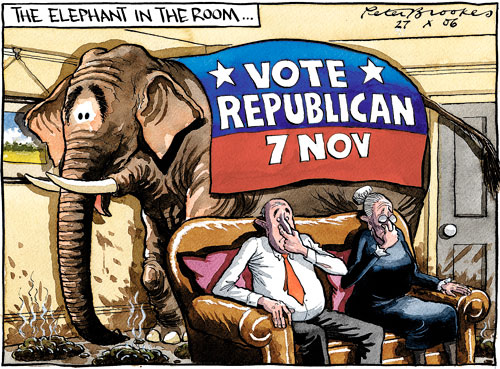
The Cook Political Report says that in 'the House, Republicans are most likely to see a net loss of 20 to 35 seats, and with it their majority. In the Senate, the GOP could lose at least four, but a five- or six-seat loss is more likely. A six-seat change tips the chamber into Democratic hands.' A Democratic win in the House would put a spanner in the works of the Bush presidency, giving the opposition party control of the federal purse strings, and opening the door to all manner of investigations into the Iraq war. A takeover of the more powerful Senate, would push the Bush machine into reverse as the president would be forced onto the defensive on almost every aspect of policy in his last two years in office.
Or will the Rovian machine somehow manage to slash, snarl and bite their way to "victory" (i.e. continued GOP control of Congress) through last minute attack adverts, or engineering a swing by bringing terrorism/national security onto centre stage? The Cook Political Report says that the latter 'would take a major international or domestic crisis -- something powerful enough to shove Iraq and scandals off the front pages and out of the first 10 minutes of TV news broadcasts.'
If they gain power in Congress will the Democrats disappoint themselves yet again? Will Cheney's team be neutralized and set to one side of the policy process? Will Rumsfeld's days be numbered?
What if the Democrats fail to win control of the House or the Senate?
Posted by Gary Sauer-Thompson at 10:32 PM | Comments (0) | TrackBack
The patriarch: Sheik Taj Din al-Hilali
Below are the remarks of Sheik Taj Din al-Hilali as translated by SBS translator Dalia Mattar in The Australian. The defence I heard on the radio this morning is that Sheik Hilali's speech was taken out of context and misinterpreted. This defence doesn't come to grips with what was actually said:|

Sheik Hilali's likened "immodestly" dressed women to meat and suggested that in adultery women were more to blame than men, as they were the temptress. He says:
But when it comes to adultery, it's 90 per cent the women's responsibility. Why? Because a woman possesses the weapon of seduction. It is she who takes off her clothes, shortens them, flirts, puts on make-up and powder and takes to the streets, God protect us, dallying. It's she who shortens, raises and lowers. Then it's a look, then a smile, then a conversation, a greeting, then a conversation, then a date, then a meeting, then a crime, then Long Bay jail. (laughs).Then you get a judge, who has no mercy, and he gives you 65 years.
The mispresentation is that he referred to adultery and not rape as originally reported. Most of the commentators are still talking in terms of rape and suggesting that the Mufti condones rape even though the word rape is not mentioned by Sheik Hilali. That looks to me like anti-Muslim hysteria and a form of Orientalism.
Despite the misrepresentation Sheik Hilali is expressing a core idea of Islamists, that of the woman as temptress.That is objectionable and it suggests that Islamists have a serious problem with women. The mufti quotes a scholar who puts the patriarchal position:
But when it comes to this disaster, who started it? In his literature, scholar al-Rafihi says: 'If I came across a rape crime --- kidnap and violation of honour -- I would discipline the man and order that the woman be arrested and jailed for life.' Why would you do this, Rafihi? He says because if she had not left the meat uncovered, the cat wouldn't have snatched it.
The mufti has the opportunity to critique this view of women as meat and show why it is wrong.
Instead Sheik Hilali endorses women as a lump of meat and therein lies the problem. He says:
If you take a kilo of meat, and you don't put it in the fridge or in the pot or in the kitchen but you leave it on a plate in the backyard, and then you have a fight with the neighbour because his cats eat the meat, you're crazy. Isn't this true? If you take uncovered meat and put it on the street, on the pavement, in a garden, in a park or in the backyard, without a cover and the cats eat it, is it the fault of the cat or the uncovered meat? The uncovered meat is the problem.
The scantily dressed women is the issue for Sheik Hilali. His is a standard moral conservative position about sex outside marriage. It's the equation of women with meat that takes it over the edge into the offensive.
If the meat was covered, the cats wouldn't roam around it. If the meat is inside the fridge, they won't get it. If the meat was in the fridge and it (the cat) smelled it, it can bang its head as much as it wants, but it's no use.If the woman is in her boudoir, in her house and if she's wearing the veil and if she shows modesty, disasters don't happen.That's why he said she owns the weapon of seduction.
The finger is continually pointed at the women and not the man without acknolweding the oppression of women in some Muslim families. That's an expression of patriarchy. I don't see that Sheik Hilali speaking in English would change things much, other than introduce the issue of integration.
Posted by Gary Sauer-Thompson at 8:51 AM | Comments (3) | TrackBack
October 26, 2006
another interest rate hike folks
It would appear that the Australian economy still has inflationary pressures and capacity constraints. Both core and headline inflation continue to increase. As the market speak puts it 'expectations for a rise in interest rates have hardened.' For economists it is now almost certain that the Reserve Bank of Australia (RBA) will continue with its tightening bias and increase interest rates next month by 0.25 percentage point, with a possibility of further increases early next year. The RBA is twitchy because the economy' s running close to capacity, and its econcrats have been banging this drum for over a year.
The RBA responds to growing inflation pressure by raising interest rates because the higher rates would dampen demand. What causes inflation is too much spending relative to production and so higher interest rates bring the two back into line.
The rate increase will hit swinging voters in Australia's mortgage belt who are already paying more to service their mortgages than the bad old days of 17% interest rates under Paul Keating. Inflationary pressures in the economy will restrain the extent to which the Howard government can use its budget surplus to spend up on election handouts. The Government's tax cuts fuel consumer demand whilst the RBA uses monetary policy to suppress demand.
The Federal Government have been always telling us what terrific economic managers they are, whilst doing too little about education and training to address the skill shortages.They've mostly spent their time trying to shift the blame to states (with some justification), rather than accept that its also their responsibility for fixing the problem.
These are not the actions of terrific economic managers are they?
Posted by Gary Sauer-Thompson at 6:14 PM | Comments (2) | TrackBack
crunch time
Climate change is now on the policy agenda and is seen to represent a "critical threat" to Australia's interests over the next decade. During the last decade conservatives have spent a lot of energy trying to dismiss global warming as an elite preoccupation by irrational hemp-wearing eco-warriors and the loathed inner city latte set. It had nothing to do with mainstream Australia.
How times change. There has been buckets of money to subsidize farmers on the bones of their backsides in desert like conditions without any obligation to shift to sustainable farming:

Tandberg
Yesterday, there was money for solar power networked power station and to clean up Victoria's Hazelwood power station from the Low Emmissions Techology Demonstration Fund without any mention of greenhouse targets. The Howard Government is still talking in terms of pilot projects as the renewable industry moves offshore and has refused to increase the Mandatory Renewable Energy Target (MRET) and steadfastly refusing to consider either emissions targets or carbon pricing signals. A demonstration fund cannot drive the development of technologies that wiill be price competitive with those now available. That requires a price on emissions.
Whilst its $2 billion being spent on drought relief its only $125 million being spent on climate change (a solar plant) that can create power for 45,000 homes even as the states are going to face power shortages over the next few years, due to the rising demand for electricity to run the airconditioners to cope with the scorching summers. This will happen in SA in 2007, Victoria in 2008, Queensland in 2009 and NSW in 2010. Australia is going to need 20%more power in 20200 to meet demand. Does that mean more coal-fired power stations to meet base-load power? Do the power companies get a free pass on any future carbon charge?
It is not clear that the Howard Government has a long term plan to reduce greenhouse gas emissions. It is the reductions in land clearing by farmers that has been responsible for the majority of greenhouse gas emission reductions in Australia to date. What now?
Posted by Gary Sauer-Thompson at 8:15 AM | Comments (0) | TrackBack
October 25, 2006
Iraq: the new spin
The rhetoric on Iraq is definitely changing as the reality of a drawn-out and bloody civil conflict is cracking through the neo-con illusions. The lawlessness caused by foreign occupation is all pervasive.The new rhetoric is that the problem lies with the Iraqi government. The Dateline program tonight on SBS indicated that the troops are largely preoccupied with defending their bases with their presence offering target practice for insurgents. American, British and Australian troops may be in occupation but they are not in power. The Australian troops make little difference. They could leave tomorrow.

As Simon Jenkins in The Guardian correctly observes:
US and UK policy in Iraq is now entering its retreat phrase. Where there is no hope of victory, the necessity for victory must be asserted ever more strongly. This was the theme of yesterday's unreal US press conference in Baghdad, identical in substance to one I attended there three years ago. There is talk of staying the course, of sticking by friends and of not cutting and running. Every day some general or diplomat hints at ultimatums, timelines and even failure - as did the British foreign secretary, Margaret Beckett, on Monday. But officially denial is all. For retreat to be tolerable it must be called victory.
Iraq is a living hell that is fracturing into different ethnic regions (Kurd ,Sunni, Shiite) that have incompatible interests. Turkey and Iran will soon move in.
Posted by Gary Sauer-Thompson at 11:13 PM | Comments (0) | TrackBack
Pacific happenings
Canberra now has a muscular foreign policy in the Pacific. It is one of intervening in trouble spots, helping to maintain law and order in troubled and impoverished nations (eg., Solomon Islands) and driving reform across a region composed of tiny Pacific nation-states. In its first six months RAMSI successfully cleaned up the outlawed armed gangs that were terrorising some parts of the islands. With basic law and order re-established, what was then required was nation-building.

Bruce Petty
This reform process in the region will not be easy. This is not just because of the sensitivity in the Pacific towards Australia or regional concerns that the Howard Government has overplayed its hand in the region with Australia's regional assistance mission to the Solomon Islands (RAMSI).
As Scott Burchill points out in The Age the accusations of Canberra's "arrogance", "bullying", and "sovereignty violations" only mask a series of long-term and seemingly insoluble problems:
In economic terms, many states in the south-west Pacific are either marginally viable or technically insolvent. They retain extremely narrow economic bases and are aid dependent. They were inadequately prepared for independence and have few if any prospects for a more affluent future. They remain underdeveloped and are largely excluded from the winds of change that have blown economic globalisation into other parts of the world. Accordingly they are susceptible to organised crime and groups that practise politically motivated violence. If sea levels in the Pacific continue to rise, some states in Micronesia and Polynesia may disappear entirely in the not-too-distant future.
Burchill ends by saying that it is in the interests of both the large players - Australia and New Zealand - and the islands of the South Pacific to make the region stable and viable. True, but the overall trend in the Pacific Islands is low/negative economic growth, low/negative investment flows, limited access to communication and external trade and aid dependence coupled with increasing population growth and pressure on resources.
How is that going to be addressed through regionalism?
Posted by Gary Sauer-Thompson at 8:44 AM | Comments (6) | TrackBack
October 24, 2006
What if?
In the US the Republicans are bracing for House losses in the forthcoming mid-term elections. According to the Washington Post, these losses could go as high as 30 seats whilst the Republican's Senate majority is beginning to look more wobbly. You can see the Republican response in the way that Bush's slogan to "stay the course", used to counter what the White House terms the Democrats' "cut and run" push for withdrawing US forces from Iraq, is being retired. It is still a 'what if' isn't it.
Greg Grandin concludes a post on the mid-term elections at Tom Dispatch exploring the implications of this 'what if' by saying:
If the Democratic Party wants to halt, or even reverse, its long decline and avoid yet again snatching defeat from the jaws of victory, it will need to do more than investigate the six-year reign of corruption, incompetence, and arrogance presided over by Cheney and company. Progressive politicians who protest the war in Iraq will have to do more than criticize the way it has been fought or demand to have more of a say in how it is waged. They must challenge the militarism that justified the invasion and that has made war the option of first resort for too many of our foreign-policy makers. Otherwise, no matter how many tanks they drive or veterans they nominate -- or congressional seats they pick up -- the Democrats will always be dancing to Ollie's [Ollie North] tune.
The Democrats will also need to roll back the gains made by the neoconservative campaign against Congress and in defense of the imperial presidency. Will they?
A the moment it does look as if 2006 midterm elections are becoming a referendum on Iraq, a war in which President Bush and his Republican party have lost the political center and significant chunks of their base. It is crunchtime for the corruption ridden Republicans as the Bush Administration is now unpopular. So it looks as if Bush will be a lameduck President for his last two years. What will he do? Work with their Democrats? Or veto their legislation on increasing the minimium wage, lowering prices for prescription drugs for those ont he Medicare program, and lowering student loan interest rates etc etc.
Posted by Gary Sauer-Thompson at 11:59 PM | Comments (2) | TrackBack
energy pathways
It is well accepted in energy policy circles that compared to the coal option for energy in Australia, nuclear energy is not economically viable. In fact, virtually no alternative source of energy can compete with coal in Australia - whilst coal-fired energy plants are not required either to do anything about global warming themselves, or to pay for someone else to do so. So the Howard Government has a problem:

Pat
The Howard Government has provided little support for renewable energy sources even though Australia could -- should -- have been a world leader in this regard. Australia has the expertise, the climate, the natural resources. The federal government, because of its strong support for the fossil fuel industry, has not been willing to take seriously the need to invest in an alternative route to cleaner energy.The states (SA and Victoria) have picked it as best they can.
What can be done then? Whart pathways of reform are available?
Again there is a consensus. Jim Douglas in an op-ed in the Canberra Times spells it out:
First, it must develop meaningful carbon emission targets for all heavy-emission activities in Australia, via taxes or permits, and then establish a trading system that will allow those industries and technologies which prove themselves best at reducing emissions to be rewarded, and those who perform badly to be penalised. Australians have already indicated, in polling data and otherwise, that they are willing to pay more for energy, and this should be seen as a gift for any government that really wishes to lead effectively on this issue.
However, the Prime Minster, and his economic ministers, Peter Costello and Senator Minchin, continue to rule out carbon taxes, and the associated options of emissions trading that could form around these - even though this is the only immediate route to lowering emissions that we have available.
The Howard Government has been captured by the fossil fuel industry. Douglas says that there is consensus on another pathway:
Second, it needs to sponsor the sort of research and policy work that can answer important questions about the best options to pursue to maximise our greenhouse reductions (and minimise the costs to ourselves of doing so). There are difficult and complex choices to be made here: how much effort should be expended on amelioration of drought and land degradation effects, compared to improving climate change abatement approaches? What sort of policies will work in this new environment?
All the effort and energy currently goes into drought relief, nuclear energy, and geosequestration. Research into renewables is progressively cut so that renewable energy research centres close down.
That is why the Howard Government looks stale and out of touch. Ity is being left behind by events.
Posted by Gary Sauer-Thompson at 8:30 AM | Comments (0) | TrackBack
October 23, 2006
looks like spin
The media reports that the Howard Government is preparing a major change in climate policy and that it will involve spending some more money on current programs---such as low emission technology--- and talking up nuclear power as "clean" and "green." It's a shift because Howard's energy and environment policies since 1996 have been framed through the lens of protecting, at all costs, Australia's fossil fuels sector. The 2004 energy statement reflected this approach, as it pushed renewables into the background.

Kathy Wilcox
Talking up nuclear energy so far avoids mentioning that nuclear power is only a feasible economic option if the greenhouse costs of coal-fired power are taken into consideration. So far the Howard Government has refused to countenance a carbon price signal of any sort. Without such a signal who is going to build the nuclear power stations? It's pie in the sky.
And spending more money on low emission technology to burying greenhouse gases presupposes that industry will take up the technology without being forced to reduce greenhouse emissions and meet targets.Since there is no talk from the Howard Government about introducing price signals in the form of a carbon tax or emissions trading schemes, why would industry turn away from using cheap coal fired power? It is not economically rational to do so.
So the foreshadowed climate change policy shift is about appearing to do something about global warming whilst avoiding doing anything of substance. An election is looming.
Update:24 October In an op-ed in The Age Tim Colebatch says that John Howard can begin to frame his own policy by starting to create:
a financial disincentive to emitting greenhouse gases. Without that, there will be no carbon capture and storage, no clean coal technology, and no nuclear power stations. Without a carbon tax, or European-style emissions trading scheme, dirty coal will remain by far the cheapest source of baseload power, and the only one any firm wanting to stay competitive could use.The arithmetic is simple. Dirty coal (A) plus the cost of cleaning it (B) must cost more than dirty coal (A). A+B must be more than A. The Government has to admit that and bite the bullet. Around the world, emission targets are in, and Kim Beazley and the states have embraced them as Labor's solution. But if Howard wants to differentiate himself, in the long term, he would do better to go for a carbon tax.
Posted by Gary Sauer-Thompson at 3:26 AM | Comments (2) | TrackBack
October 22, 2006
media reforms: survival of the fittest
The media reforms were sold by the Howard Government as benefiting the consumer.The reality is otherwise the battle of ownership that is under way now is about power and wealth as the media companies begin to move onto the world stage:

Pryor
There is nothing about diversity in this kind of 'play.' But then that's the normal workings of capitalism--the concentration of economic power in which on the fittest survive. It's just business as usual in the free market. And yet though the delivery systems are more powerful they still need the content.
Posted by Gary Sauer-Thompson at 8:41 AM | Comments (0) | TrackBack
October 21, 2006
questioning drought relief
Clive Hamilton was right.
The current policy of taxpayer handouts to farmers confronting a lack of rain in semi-desert regions should be questioned. Part of that questioning is do away with the conservative mythology about our national character (Australianness) being forged in the battle of man against Nature and, although the climate (drought) sometimes defeats us, real Aussies doing it tough will find the courage to rise again, stronger than before, to continuing the taming of nature to make deserts bloom. If we do then we can begin to look at what is going on on the land.
If the dry conditions turn out to be the rule and not the exception (ie., the drought is an early sign of global warming on this interpretation), then drought relief needs to be tied to ensuring agricultural sustainability. When drought affected land becomes arid land or desert, then non-viable farmers should be eased off the marginal land (structural reform); or if they continue to stay on the land, then they should be doing remedial environmental work for getting the dole. Mutual obligation applies here.
Why keep farmers on a drip feed of drought relief when the land is a dustbowl? Doesn't that deepen their misery and intensify the land degradation? Aren't many arid parts of Australia not suitable to intensify farming. Why continue the subsidy of cheap water prices for irrigators when a water shortage is looming due to climate change.
This shows that what is needed is a blueprint for tackling climate change that goes beyond the current spruiking of nuclear power as clean and green. Climate change is also about water.
Posted by Gary Sauer-Thompson at 1:30 PM | Comments (6) | TrackBack
October 20, 2006
Little Mr echo man
The Coalition of the Willing is rapidly changing tack in Iraq against the backdrop of a deteriorating situation---see Riverbend President Bush talks in terms of parallels with the Tet offensive in the Vietnam war, whilst the Pentagon admits defeat in its strategy of securing Baghdad. Tony Blair now says his policy is for the UK to leave Iraq within the next 16 months.The implication is that the US and UK military are not defeating the guerrillas militarily and they have not succeeded in bringing stability to Iraq and democracy to the Middle East.
So what does 'stay the course ' mean now?

Suprise suprise. John Howard is saying the form of democracy in Iraq is a matter of the Iraqi's. That means achieving democracy is no longer a goal for staying the course; it is not even a precondition for withdrawing allied troops. Howard's retreat is covered by raving on in Parliament about Beazley's policy of withdrawal from Iraq giving victory and inspiration to Islamist terrorists everywhere, especially those in Indonesia. Howard and Downer are starting to sound very shrill as the Australian public deserts them on Iraq, and they run to keep up with the "cut and run" of the US and the UK.
What then is the strategic and geo-political significance of this retreat?
Richard N Hass in an article entitled The New Middle East in Foreign Affairs says:
The age of U.S. dominance in the Middle East has ended and a new era in the modern history of the region has begun. It will be shaped by new actors and new forces competing for influence, and to master it, Washington will have to rely more on diplomacy than on military might.
Posted by Gary Sauer-Thompson at 3:54 PM | Comments (2) | TrackBack
October 19, 2006
media reform: the fallout begins
So the changes in the media industry are taking place even before the media legislation, which overturns restrictions on cross-media and foreign ownership rules legislation, becomes law. Securing Australian media assets is the new game. It looks as if the pre-emptive manoeuvring by the established media groups is a precursor to real change in the structure and ownership of the sector.
Publishing and Broadcasting Ltd (PBL) is selling half its media assets, including the Nine Network, to a private equity group, CVC Capital Partners. Packer will retain management control of the new vehicle, PBL Media, while pocketing the equivalent of $5.6billion. It is understood that money will go principally towards expanding the family's gambling empire if only because the return on capital invested in casinos is higher than the old media, and investors rate gaming companies at higher price-earnings levels than media.

Bill Leak
WA businessman and majority shareholder in the Seven Network Kerry Stokes spent close to $200million buying some 15 per cent of West Australian Newspapers, publishers of WA's only metropolitan daily paper. Wasn't diversity the justification for the changes to the media rules some years back not entrenching the power of the existing media barons? Won't Stokes move to integrate the paper with his Seven news service in Perth, WA? Didn't Helen Coonan also say that the government’s media ownership laws would not lead to a wave of takeovers?
The Government's proposition that the new media laws will promote greater diversity and there won't be a wave of consolidation is looking untenable. Probably the real intention of the legislation is to allow Australian media groups to develop into globally competitive firms. Since Australia's media and marketing industries need to go global if they are to be really successful Helen Coonan helps them to achieve this by lessening any competitive threats and protecting the existing free-to-air TV regime. That means facilitating the greater consolidation of the industry. Restoring the integrity of the Fourth Estate, consumers or the democratic health of liberal democracy are of little concern in these reforms.
Update: 20 October
Now Rupert Murdoch has confirmed his $360 million, or 7.5%, purchase of John Fairfax Holdings, which is described as a "friendly" investment. Murdoch's acquisition has changed the Australian media landscape further: it now looks as if Fairfax will be bought, broken up and sold. The News raid on Fairfax was predictable.since Murdoch was never going to sit passively on the sidelines while other predators sized up his major competitor. Now any bidder for Fairfax knows they can't get 100 per cent ownership and full access to its cash flows without buying off News.
Greater media concentration looms. Fairfax, with an open register, is in play and the golden prize. It has been the point of conflict between Packer and Murdoch, and Murdoch has now become the gatekeeper to the breakup of Fairfax. Packer is not really interested in Fairfax as a wholeas his corporate growth comes from his global casino business.
Are Packer and Murdoch creating two large or super national media companies with foreign ownership? Is that what is now in formation? If so, how do we ensure that media competition and diversity is preserved, if not increased? Through the limited digitial platforms? Will these be developed? Does that mean de-regulation of free-to air television? If thois does not happen, then Senator Coonan's media reforms are in tatters because the effect of the reforms will be just to entrench the power of Australia's media companies.
Posted by Gary Sauer-Thompson at 5:07 PM | Comments (2) | TrackBack
Iraq: the same old song
I've been watching Question Time in federal parliament to see how the Howard Government has been responding to the bad news about the increasing sectarian violence in Iraq (civil war), the deepening Iraqi resistance to the US/UK/Australian occupation, and the country's steady collapse under three years of occuption.

Alexander Downer, the Foreign Minister, has boxed himself in a corner. He is still talking in terms of the old cliches: staying the course, doing the job, refusing to cut and run, branding his critics as appeasers running up the white flag. etc etc. These are the only alternatives. etc etc.
The mindset is one of an all-fronts war against Islamist extremism, nay terrorism. It's like listening to a DVD on a loop, or watching a parody of Downer as a chickenhawk at a comedy show. What are we staying the course for these days? What is the job that needs to be done now? What does freedom and democracy in Iraq actually mean amidst all the violence and killing?
There is no new thinking here. Why not withdraw the troops in Iraq and let the Iraqis sort things out for themselves?The withdrawal of US troops may force Shiites and Kurds to begin to compromise with Sunni Arabs. Downer, as always, is waiting for Washington to change course. When the Bush administration does---as it must-- then Downer will sing a different tune for the empire.
He sure needs to since the Iraqi parliament has voted for Iraq to become a federation of autonomous regions--- to partition Iraq along ethnic and sectarian lines. Tis time for some Saudi, Iranian and Iraqi regional talks.
Posted by Gary Sauer-Thompson at 8:21 AM | Comments (4) | TrackBack
October 18, 2006
water reform: flaws
Andrew Macintosh, from the Australia Institute, has an op-ed in the Canberra Times entitled 'Water reform doomed to fail' that makes some good points. He says that the water reforms are doomed to fail because they involve setting up a market for water before the biggest problems have been resolved: the over-allocation of water licences and excessive agricultural subsidies. He says:
There are two main problems with the management of water in rural areas: over-allocation and misallocation among water users. That is, too much water is being extracted from rivers and aquifers and the water that is extracted is not being put to the most productive uses. The plan that has been devised to address these problems contains four main elements: provide secure property rights in water, promote water trading, improve water pricing and recover water for the environment. In theory, this strategy is sound. But what governments seem to be overlooking is the need for these reforms to be ordered appropriately and the fact that existing agricultural subsidies must be removed to ensure the desired efficiency gains are achieved.
That is spot on. The 'drought' may be a good time to address this since there is little point in subsidising inefficient and unsustainable farms. Climate change is making many farms unviable. The federal and state governments are much better buying out the water entitlements of those who want to leave the land.
He adds:
The proper ordering of water reforms is essential if water is to be recovered for the environment in a cost-effective manner. If secure property rights in water are created and water trading commences in earnest before water has been recovered for the environment, the price of water will increase, making buy-backs more expensive for governments and the cancellation of licences less politically palatable.
This is just not happening. The emphasis is finding surplus water from water savings from upgraded infrastructure because of the opposition from irrigators. Irrigation is money and, as MacIntosh says, this is:
...why governments have tended to prefer to try to recover water through infrastructure improvements rather than cancelling or buying back licences. Although infrastructure programs are neither effective nor efficient, they are palatable to irrigators because they are generally left with the same amount of water as they started with. The political clout of irrigators also explains why governments have been reluctant to introduce full cost-recovery pricing for water services in rural areas. In contrast, water market reforms that provide irrigators with greater security over their water entitlements are popular, even if there are some reservations about water trading.
So water recovery for the environment lags behind market reforms. As the market reforms gather pace, the price of water will continue to rise and therefore the cost to buy it back, creating greater headaches for governments and placing ecological sustainability further out of reach. MacIntosh says:
Existing agricultural subsidies like drought relief and subsidised water delivery are only exacerbating the problems associated with recovering water. Irrigators are less likely to relinquish their entitlements while they continue to be propped up by governments.
I cannot see either political party biting the bullet on this. So the problem is going to get worse. The Darling River is dying and a dead river means no irrigation. Yet there is still no push to address the overallocation of water and ensure environmental flows. So rural communities based on irrigated agriculture, such as Bourke, are going to slowly die.
Posted by Gary Sauer-Thompson at 5:53 AM | Comments (1) | TrackBack
October 17, 2006
Costello's folly
We have a skills package that has just been put on the table by John Howard. Yet this package addresses a problem that isn't a problem according to Peter Costello, the Treasurer. This indicates that the Treasurer is not keen to admit to any problems in the economy under his watch that suggest poor economic management. Yet the skills shortage and the inflationary pressures it has caused do suggest poor economic management.
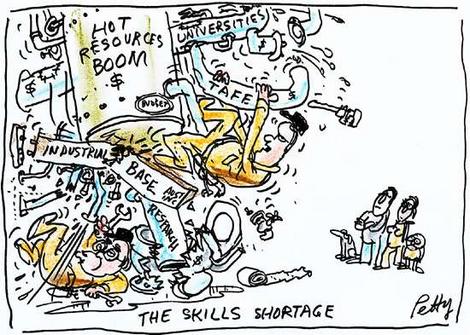
Bruce Petty
Ross Fizgerald's op-ed in The Australian gives us the background. He says that the Reserve Bank of Australia first rang its first alarm bell about the shortage of skilled labour in November 2004 in a low key way. It talked in terms of localised pressures evident in some official wage measures that point to substantial increases in wages for skilled employees. Costello's response was to ackowledge that low unemployment in Australia leads to shortages of skilled labour in some areas. However, he saw that as a positive thing--a sign of success.
And that set the pattern for the next couple of years.
Four months later, the RBA raised interest rates by one-quarter of 1 per cent and it talked in terms of Ithe remaining spare capacity in the labour and goods markets is becoming rather limited causing inflationary pressure. Costello responded by saying that a shortage of labour is a good problem to have as it means that people can find work.
Yes but what about those who have a big mortgage? Increased interest repayments are not a good problem. The Treasurer understands that as he uses high interest rates to bash the ALP.
In its four monetary policy statements in 2005 the RBA continued to warn of the link between the skills crisis and interest rates.It drew attention to labour shortages are becoming increasingly broad-based across industries and skill levels and being most pronounced among skilled workers. In May 2006, with the consumer price index at the top of the target band, the RBA raised interest rates for the sixth consecutive time. Once again, Fitzgerald says, the bank cited labour shortages and once again Costello simply denied that link. He said that skills crisis is totally unrelated to monetary policy.
Totally unrelated? What about upward inflationary pressure due to tight capacity as a link?
Then in a speech last Wednesday night the Glenn Stephens, the new RBA governor, made it clear that there was a very good chance that capacity constraints (eg. the skills crisis) meant that interest rates were going to rise in November. The next day Howard spent $800 million to solve that "positive thing" called the skills crisis, which according to the Treasurer was a "good problem to have".
So where was the ALP's Shadow Treasuer on this flaw in Costello? Missing in action yet again? You would think that they would relish the opportunity to cut Costello down a peg by showing that he is not delivering a more prosperous and safe future.
Posted by Gary Sauer-Thompson at 7:43 AM | Comments (0) | TrackBack
October 16, 2006
Iraq: it's getting worse
I see that the Iraq war was a central issue in Question Time in federal parliament today, and it was even debated as a censure motion initiated by the ALP--that John Howard sent troops to war "on a lie". The Opposition has a whiff of vulnerability and is finally showing some political courage on Iraq as it redraws some lines of difference with the pro-intervention crowd and the war party. Not before time is it? The ALP has been missing in action since Mark Latham's pledge to have the troops home by Christmas pledge in 2004.
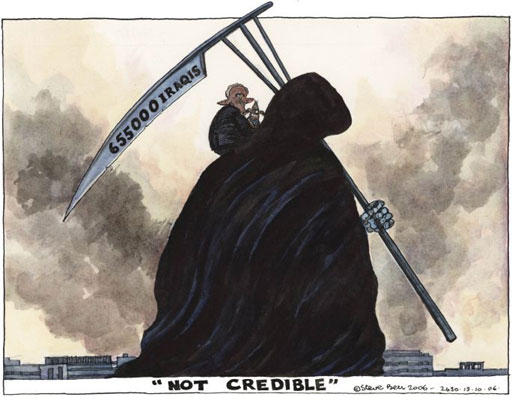
We can question the war party's gloss over the sectarian violence in Iraq by asking: as a result of the invasion, have things got better or worse in Iraq? And if they have got worse, have they got a little bit worse or a lot worse?
Remember the Lancet Report in 2004? That said as many as 100,000 Iraqi civilians - half of them women and children - have died in Iraq since the invasion, in March, 2003 mostly as a result of airstrikes by coalition forces.
The latest Johns Hopkins University study of mortality in Iraq, published in the Lancet is grim news. It reports the 650,000 additional Iraqi casualties since the invasion--around 2.5% of the entire Iraqi population. It is US occupation and the continued US/UK/Australian presence in Iraq that is fuelling this violence. The claim that the terrorist threat was always there is disproven by these findings.
So things have got a lot worse in Iraq. The death rate in Iraq is a political issue asI raqi civilians are currently being harmed by the US/UK presences in Iraq, not helped. We should bring the troops home as "staying the course" in Iraq advances democratic government in Iraq, the war against terrorism and our national interests in the Middle East.
Posted by Gary Sauer-Thompson at 6:03 PM | Comments (0) | TrackBack
nostalgia
A little bit of humour to start the work week off. AWB and its kickbacks to Saddam Hussein all seems so long ago doesn't it? Of course, what is missing is the complicity of the Howard Government in the scandal. Only AWB was ever in the spotlight. Remember, the Howard Government said that it had no knowledge of the kickbacks.

Cathy Wilcox
No doubt AWB will come back into the political spotlight with the publication of Commissioner Cole's findings in late November, and the issue of the single export desk, which the Nationals continue to support.
Posted by Gary Sauer-Thompson at 6:54 AM | Comments (0) | TrackBack
October 15, 2006
Canberra Watch
As John Howard begins to clear the legislative decks for the federal election next year there is a growing unhappiness about the Iraq war, increasing insecurity about the changes to the industrial landscape and a developing anxiety about the effects of climate change in the electorate. There is the growing possibility for a rise in interest rates before Xmas due to inflation risks and pressures, the ALP has been doing well in the polls, and the Howard Government is becoming sensitive to the effects of climate change in Australia.
These are interesting times for Canberra watchers as the Howard Government endeavours to control the political outcomes of pressing issues:

Pryor
So we have a $837m skills package designed to respond to the skills shortage through a packa g of vouchers and wages support for older apprentices combined with extra investment in high level education and training. It is a political document designed to neutralize the persuasive arguments made by Kim Beazley amidst Labor's scare campaign on the importing of foreign workers by Australian firms in order to overcome the skills shortage across the nation.
Beazley argues that importing cheap foreign worker effectively denies opportunity to those who need it most---young Australians and, because foreign workers are being paid less than their local counterparts, it's lowering pay and conditions for everyone else. Jason Koutsoukis, in an op-ed in The Age argues that Beazley has a good targeted campaign:
With voters already anxious about the impact of the Government's industrial relations, Beazley has skilfully weaved in fears about foreign workers taking local jobs as part of the problem. It's a classic wedge between the two policy positions Howard has been able to hold together for so long and upon which he has been able to build such a broad constituency of middle-class voters.On one side is Howard's economic liberalism, which strongly favours globalisation, one of the consequences of which is for local industry to import foreign workers when it wants to. But on the other hand is Howard's social conservatism, which has been inclined towards policies that keep foreigners out and appeals to those who want to preserve Australia as it is.
This scare campaign frightens exactly the same group of voters that Howard won over in 2001 with his tough stance against asylum seekers.
Posted by Gary Sauer-Thompson at 12:12 PM | Comments (2) | TrackBack
October 14, 2006
drought=climate change
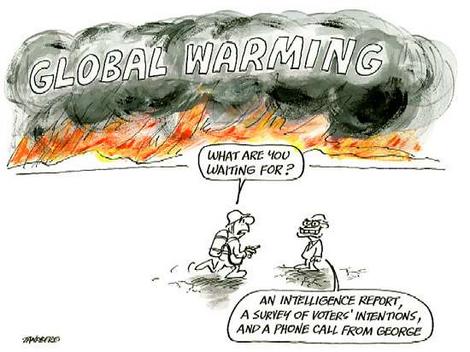
So the dry spell during the winter has become a rural recession and a very bad drought on top of five years of intermittent drought. I heard the Davod Crombie, President of the National Farmers Federation, on Radio National Breakfast saying that drought assistance was need to help farmers over a run of bad seasons. He ducked and weaved on the issue of whether a run of bad seasons could be considered the early signs of global warming in Australia to the point where drought and climate change are one and the same.
Tandberg
The reason for the hesitancy is political: global warrming engages elites and green ideologues not the populace, even though the science is saying that southern Australia is getting hotter and drier, whilst the northern part of Australia is getting wetter.
The over allocation of water in the Murray-Darling Basin has left the river system severely depleted and its water storage could well run dry next August unless there is significant rain. This affects the livelihood of farmers and the water supply of towns and Adelaide.
Posted by Gary Sauer-Thompson at 4:05 PM | Comments (5) | TrackBack
October 13, 2006
media diversity + journalism
When Eric Beecher appeared before the Senate communications committee's review of the planned media legislation on September 28 he made the following remarks about the cross-media rules which prevent individuals controlling both print and broadcasting outlets in a single market:
A lot of people talk about the importance of media diversity. But I don't actually see the core question as media diversity. The diversity people should talk about is the diversity of journalism. It seems to me the diversity of the rest of the media, of music on FM radio stations and of entertainment on television and that kind of thing, is quite irrelevant to a debate about the cross-media rules. I don't think it matters how few people own music stations or run soapies on television. I do think it's critical to democracy that there is diversity in journalism in news and opinions, in political coverage, business coverage.
Beechers must be one of the few voices in Australia that still continues to link journalism to democracy and to distinquish that issue from diversity in media as entertainment.
Beecher went on to say:
This whole debate about diversity gets bogged down in a kind of umbrella that's far too broad. Really, the kind of diversity of journalism I'm talking about, the power that is exercised in journalism, lies in newspapers, some television and radio news and talk programs. And that's about it. I think the focus should be on those aspects of the media. From experience, the cross-media rules are the only mechanism to guarantee diversity in journalism. We are talking about a diversity in this country that is already very fragile .
Journalism is in a pretty poor state in Australia. The op-eds are not that substantive. Beecher goes on to say:
The question I would ask is: 'What is the justification for removing or weakening the cross-media rules in a climate like that?' Is there public demand for it alteration? I certainly haven't noticed any public demand. I have not heard any. Are media companies ailing? Do we have an industry that has economic malfunction? Here are some facts: In the past year profits in the media industry were higher than ever before. This is a booming industry. It's an industry that makes profit margins - that is, the percentage of profits to revenue - that are higher than almost all other industries in Australia.
Posted by Gary Sauer-Thompson at 8:34 AM | Comments (0) | TrackBack
October 12, 2006
educational woes
I've watched the education debate with some concern about the fictions. Apparently the chief obstacle about education is no longer about resources it is about values and the need for a national curriculum. There is a need for national education curriculum.
However, the political message from Julie Bishop however, is that, unlike the private schools, government schools lack values except those acceptable to the teacher unions and those embedded in the curriculum by state bureaucrats.
Lefty ideologues who have hijacked schools' curriculums are experimenting with the education of young people from a comfortable position of unaccountability, safe within the education bureaucracies. And heaven forbid, these ideologues are Maoists are they are training school kids to critical read television programes on commercial television as well as read Shakespeare.
Maoists! There's a beatup aimed at trying to create a moral panic about Australians not being able to read or write. Gee we even have Bishop talking in terms of Marxist centenary conference and the poor writing skills and the dreadful state of many people's written English are due to postmodernist Maoists, not a lack of resources or the effects of commercial television.
What Bishop means is that conservatives use the label 'postmodernism' to defend canonical literature and to deny that knowing about the background and perspective of the author, the historical context in which the work was constructed, or the audience for whom the work was intended in order can help us to understand the meanings of a text.
So we have the commonwealth saying that we should history to one "approved" uplifting version and English to the great canonical works.
Posted by Gary Sauer-Thompson at 6:33 AM | Comments (2) | TrackBack
October 11, 2006
a question
The airwaves are running hot about the North Korea nuclear test. We have pictures of rockets landing on Sydney and dire warnings about the consequences of Japan going nuclear, and US planes taking off with a voice over about them bombing North Korea nuclear facilities. Sudddely Iran slips into the background. Little is said about the proposed US-India nuclear-sharing agreement, which flies in the face of the United States' own non-proliferation commitments, or that North Korea does not possess effective nuclear capability.
What is in the forefront of the news is the US mounting a push in the United Nations for punishing sanctions against North Korea, including a blockade to enforce the inspection of cargo entering and leaving the country. A naval blockade would sure provoke Pyongyang, as it is an attack on its sovereignty. But then the US is about regime change not diplomatic engagement.
How can the Security Council of the UN possibly justify stern action against Iran, which unlike North Korea has neither exited the nuclear Non-Proliferation Treaty regime nor announced any intention to build nuclear weapons. North Korea left the NPT for good in 2002.
Ian Williams says:
Israel has 200-plus nuclear warheads, and gets billions of dollars of free money, with the diplomatic equivalent of a Monopoly game "get out of jail free" card. Pakistan gets lots of support, even as its prime nuclear scientist is proved to have been disseminating bomb kits in the Muslim world. India explodes a bomb, and Washington subsequently rewards it with an offer of civilian nuclear technology. What conclusion is Kim supposed to reach from this?
Gee the Washington neo-cons (eg., John Bolton, the US Ambassador to the UN) do not believe in international treaties that bind the US, or for that matter Israel, and have worked to frustrate any attempts to strengthen the nuclear Non-Proliferation Treaty regime (NPT) regime. The US has also ruled out direct talks, a long-running demand by Pyongyang.
Posted by Gary Sauer-Thompson at 9:03 AM | Comments (1) | TrackBack
October 10, 2006
Washington woes
It is clear that the Bush administration made a decision to invade Iraq, and then started to search for a policy to justify it. It was a decision in search of a policy. As we know they focused on the nonexistent "threat" from Iraq to the US; non-existent because Iraq had nothing to do with the events of 9/11.
Australia signed up to interventionism, war, empire and "creative destruction," in the Middle East because our future depends on being a good ally of the US. Australia then tacitly condoned the systematic use of torture by the Americans and the dumping of the Geneva Convention. Australia echos the Washington neocons war cries at Iran and even talks in terms of "national greatness" achieved through democratizing the world at gunpoint.
Yet Iraq is a debacle; the Taliban is resurgent in Afghanistan; and Osama bin Laden is still at large. It's a record of disaster: muscular unilateralism is a failed foreign policy. What the US is doing is seeking to encompass the "Greater Middle East" with a network of small military bases, each with 1,000 to 3,000 personnel. Does the Bush administration build up the Terror/ al-Qaeda bogeyman to justify the military occupation of strategic countries that have or are near to major oil and gas reserves?
In the United States the presidency, the vice presidency, the cabinet, the House of Representatives, the Senate, the Supreme Court are all, and have for some time, been in the hands of the Republicans. Currently, they are acting to salvage an authoritarian, Big Government GOP from looming electoral disaster---losing big in the mid-term elections in 2007 and then in the Presidential elections in 2008. Since perpetual war and eternal debt are not electoral winners, salvaging means doing something to shore up the Republican's collapsing political base. So the Republican leaders are endeavouring to constrain the Democrats in their critique of the Iraq war: through a bill to legitmate the use of torture and label the Democrats as 'soft on terrorism'.
is the otehr strategy to use the Baker loose federalism proposal to divide Iraq into the Shi’ite, Sunni and Kurdish regions of Iraq. Would that division end up as partition? What happened in Iraq is that the US deposed the formerly ruling Sunni Arabs in favor of the Shiites and the Kurds. So the former ruling group is fighting back against a tripartite alliance of the US/Kurds/Shiites and it is attempting to roll back their new dominance.The failure of the Bush administration in Iraq has been to publicly acknowledge how bad the situation was and that the insurgency has cost thousands of US soldiers' their lives.
Posted by Gary Sauer-Thompson at 7:14 AM | Comments (0) | TrackBack
October 9, 2006
Telstra spins
I watch all the marketing fuss by Telstra over the week inbetween my weekend meetings in Brisbane. It's spin---a a corporate hard sell targeted to a specific audience. It takes the form of an advertising blitz designed to seduce us. An expensive ($42 a month) 3G mobile phone network is being sold as an amazing new achievement, even though it is no substitute for a high speed fibre-to-the-node network, or even the speedy introduction ADSL 2+ which Telstra refuses to build or turn on.
What is offered is not much. As Paul Buddle says the new 3G network:
is probably a bit faster than the existing 3G network, but who is going to spend upwards of $99 per month so they can make video calls over a mobile network? What Australia really needs is a high speed broadband network?
This service is for the 1%-3% top end of the mobile market, mainly in corporate or business applications. The slow broadband speeds in Australia are thanks to Telstra. Telstra's continued dominance and the lack of competition is thanks to the Howard Government. Telstra wants the government to give it regulatory holidays ---effectively sheltering it from the competition. So we are offered another mobile network instead of better fixed broadband services.
Admittedly, 3G indicates the beginings of the transformation of Telstra from a 20th century phone to a 21st century media communications company. What is being spuiked by the euphoric spin around the T3 float is lots of sweetners that cover up the big drop in share price, rising costs, low revenue forecasts, a poor operational culture and a drop in profits. It's not a growth stock---just a yield one. With the board guaranteeing a 28c-a-share annual dividend for 2006-07, buyers will get a 14 per cent return on the first year. But returns for the following six months when the second payment is due, are not assured. It's bait.
3G is the shiny new face of Telstra, which is a business under competitive pressure facing the continuing decline of its core fixed-line telephony and data business. Whether it can deliver on its promise of truly converged network remains to be seen. For the moment , as Paul Buddle says:
By withholding true broadband services from Australians Telstra can limit the traffic over its network and therefore fend off the need for a more rapid upgrade....Again it comes back to competition and the lack of a much stronger implementation regime of the proactive competition legislation that is already in place.
Telstra’s anti-competitive behaviour is the norm.
Posted by Gary Sauer-Thompson at 9:10 AM | Comments (0) | TrackBack
October 8, 2006
a new political culture
From what I can gather conservatives used Quadrant's 50th anniversary dinner to claim victory in Australia's culture wars. The long march of the left (hard and soft) through our institutions in civil society has been rolled back. Gee, I thought that the conservatives considered themselves to be an embattled minority.

Geoff Pryor
What has been manufactured by the conservatives is a "Howard hating" elite which controls our schools, our universities and the ABC, and the strategy has been to generate fear and loathing of these soft Left despicables among the "aspirational" classes in suburbia. Questioning $200,000 degrees and cuts in funding to universities are dismissed as elites! Now that is demonisation. Some conservatives even say that the Left has formed an instinctive alliance with radical Islamism against conservative traditions and values! I guess that is one way to construct another conservative moral panic.
UpDate:9 Oct
As Robert Manne observes in an op-ed in The Age says that a new kind of political culture, even a new kind of Australia, has begun to emerge.
During the past 10 years Australia has undergone a profound conservative-populist transformation. The Howard Government has abandoned the quest for Aboriginal reconciliation. It has ended discussion of the meaning of multiculturalism. It has closed our borders, by the use of military force, to all those seeking refuge by boat. It has adopted a foreign policy of a more uncritically pro-American kind than was seen even in the era of Menzies. And, by its refusal to ratify the Kyoto Protocol, it has turned its back on the international fight against global warming.
Manne says that the most important failure of Labor since 1996, has been its incapacity to construct an attractive, alternative vision of the future of Australia that is capable of undercutting the neo-liberal, neo-conservative, patriotic story. It fails to a target the two incompatible strands in Howard's story: the unrestrained economic individualism, the other social conservatism. Citizens are told simultaneously to devote their lives, on the one hand, to material acquisition and to work, and on the other, to the preservation of family, community and church.Manne says:
For citizens, in the chaos of contemporary society, the incommensurability of these values eventually becomes clear, not, of course, in theory but in the impossible pace and pleasurelessness of daily life. In the acquisitive, individualist, consumerist society of neo-liberal theory, time is short, human relations are short-changed, families fracture, the needs of children are ignored, identity is shaped by consumption, losers are treated with contempt, and levels of insecurity, drug dependency, even mental illness, increase.
That a Beazley ALP cannot construct a story for the electoral middle out of that contradiction indicates the current poverty of the ALP.
Posted by Gary Sauer-Thompson at 11:17 PM | Comments (0) | TrackBack
October 5, 2006
Coonan on media reform
I see that The Nationals are likely to succeed with their amendments to media reform in regional Australia. They will endorse a ban on mergers that give one company control of all three forms of traditional media--print, radio and TV. The Liberal Senators on the Senate review Committee have accepted the merit of a "two out of three' rule and it is expected that Senator Helen Coonan, the Communications Minister, will agree to the proposal. That addresses issue of the the power of media owners to influence the public debate and puts some constraints on the increase concentration of media ownership that will happen once the legislation has passed.
Coonan understands the challenges faced by the old media , the limits to the diversity of ownership on old platforms, needing to adapt to the new and the current media rules being designed for another era. In a speech to the Millennium Forum she quickly outlines how the media landscape has changed so much to justify the need to change the current media settings. It all sounds quite promising doesn't it. So why such limited media reform?
She says:
You only have to look at recent announcements such as those made by Google to see the looming challenges for the media industry. Google Video Australia will draw content from its global video service but it will also distribute short and long-form media from local providers such as the ABC, Network 10 and Fairfax Digital. Google has also formed partnerships with the Australian Film, Television and Radio School, Film Australia and Sony BMG. This is the way of the future - where the focus is on finding new distribution channels for content and harnessing the distribution power of mediums such as the Internet...Innovations such as YouTube are just one of many reasons why technology and time are making a nonsense of the current media rules.
She acknowledges blogs as a source of diversity and says that whilst they are a fringe element lacking the credibility of traditional news outlets, they are a powerful medium as their illegitimacy is their strength.
The key issues still remains though. Despite the growth of new media technology, despite blogs, despite mobile phones, despite YouTube, the power to influence the Australian political agenda still sits where it always has: in the laps of a tiny handful of media owners. The economics of the media are under stress as the spread of the internet and digital technologies means the media industry is undergoing changes to its business model.The media corporations will need to find ways of continuing to earn advertising revenue as the business model newspapers have relied on for more than 150 years diminishes.
Connan then says what she is trying to do with media reform:
I want my legacy to be the new services that emerge for Australian consumers – whether it is new digital channels, digital multi-channels or mobile TV. I want to transition the media industry in Australia from the old industry settings to the new digital world by achieving digital switchover expeditiously and then getting out of the way as new and innovative services reshape the media landscape....the [current media] package as a whole is the most balanced, considered, strategic and sensible way to achieve reform.It is a transitional strategy. It is designed to avoid the wholesale destruction of the current industry and provide an achievable plan to transition Australia to digital switchover.
Hang a mo. Aren't there lots of restrictions on the transition to a digital world; restrictions that protect the old media from competition? Is that what 'wholesale destruction 'refers to? Isn't 'wholesale destruction' a furphy? What we have is the slow decline of free-to air-television rather than their wholesale destruction. Or a code word for the protection of the old media companies.
Coonan talks in terms of 'new services that will emerge for Australian consumers.' What new services?All that is being offered is limited in- the-home datacasting and mobile television, which, more than likely, will be in the hands all into the hands of the existing free to air television providers. 'Diversity' doesn't have much content. It means protection of existing media companies. Coonan has been captured. She speaks on behalf of the established media companies.
A major concern with the proposed media reforms remains. It is the over centralisation of the media market and the lack of capacity of the ACCC to have effective oversight of media mergers and their effect on the democratic process of our nation. It is double speak to say that increasing concentration of ownership (reducing by more than half the number of media groups in a major city) can be considered a contribution to increased media diversity.
Posted by Gary Sauer-Thompson at 8:10 AM | Comments (0) | TrackBack
October 4, 2006
Israeli occupation of Gaza
This representation of the conflict between Hamas and Fatah is just one aspect of the conflict. The result of the divisiveness between Hamas and Fateh means that Gazan society is returning to an era in which the government, headed by Prime Minister Ismail Haniyeh or Palestinian Authority Chairman Mahmoud Abbas (Abu Mazen) does not solve problems.

However, the broader context is the Israeli occupation of the Gaza strip. Gideon Levy in an op-ed in Ha'aretz writes that:
Gaza has been reoccupied. The world must know this and Israelis must know it, too. It is in its worst condition, ever. Since the abduction of Gilad Shalit, and more so since the outbreak of the Lebanon war, the Israel Defense Forces has been rampaging through Gaza - there's no other word to describe it - killing and demolishing, bombing and shelling, indiscriminately.
Gaza is occupied, and with greater brutality than before. More than ever, Gaza is also like a prison. The Palestinians have been sealed shut and starved.
The occupation is four decades old and still going strong in both the West Bank and Gaza. In that time Israel has followed a consistent policy of subjugating the Palestinian population, imprisoning it inside ever-shrinking ghettos, sealing it off from contact with the outside world, and destroying its chances of ever developing an independent economy.
Posted by Gary Sauer-Thompson at 8:43 PM | Comments (0) | TrackBack
The other face of John Howard
John Howard's speech to Quadrant at the Four Seasons hotel in Sydney last night is yet to go online. But the edited extracts and commentary that are circulating indicate the ideological warrior in the culture wars. He targeted the "soft left" who still hold sway in educational and cultural life and treat the teaching of Australian history as an afterthought. He says: 'Nowhere were the fangs of the Left so visibly on display in a campaign based on character assassination and intellectual dishonesty than in their efforts to trash the name and reputation of Blainey'.
Howard celebrated Quadrant for serving as a beacon of free and sceptical thought against fashionable leftist views in the 1960s and 1970s and as Australia's home to all that is worth preserving in the Western cultural tradition. This meant that it has 'upheld the best traditions of free thought and vigorous debate, often as a lonely counterpoint to stultifying orthodoxies and dangerous utopias that at times have gripped the Western intelligentsia'.
The occasion was Quadrant celebrating its fiftieth year of publication about the intersection of politics and literature. There is a confidence amongst the present conservative elite. They say that conservative ideas represent the political mainstream, and are no longer swept aside as being outside the boundaries of serious (and morally respectable) consideration. So what does the conservative's intellectual magazine say about the culture wars of the present?
Sadly it is more of the same old stuff about the nausea-inducing debased intellectual Left. The latest editorial says that:
What is objectionable about the orthodoxies now fashionable amongst the educated middle class (those who can usefully be referred to as the “chattering classes”) is that they have become increasingly oppressive. Moreover with the takeover of the universities by the post-1968 generation these orthodoxies are perpetuated through education, in the indoctrination of both future school teachers and of future generations of all professionals, including the next generation of academics. The rise of “political correctness” has made dissent from the progressivist consensus more difficult, both for students and for rising professionals, and even for those in established positions. The consensus pervades the media to the extent that what outsiders often perceive as bias is seen by insiders as the natural views of good thinking people from which no one can properly dissent. There is even a kind of neo-McCarthyism which encourages the pursuit and the abuse, or ridicule, of any who question the consensus.
The conservative elite don't chatter? Only the soft left engages in neo-McCarthyism? The hard edged cultural warriors at The Australian, and the Murdoch tabloids in Sydeny and Melbourne, do not engage in a form of censorship characterised by bullying? It is only Quadrant that defends the great tradition of free and open debate, to make possible dissent, while at the same time insisting on both civilised discourse and rational argument? Our universities do not protect and care for these values?
To say that only Quadrant stands for cultural freedom is to imply that the leftism in the universities is totalitarian and has such a stranglehold that universities are no longer centres of free and open debate. That is a fiction. The reality is that Australian conservatism has been, and still is, intellectually impoverished. Quadrant continually reminds us of the poverty of that conservatism.
Posted by Gary Sauer-Thompson at 7:49 AM | Comments (4) | TrackBack
October 3, 2006
ALP gears up
It's not a case of metooism as a Beazley-ALP would junk the Work Choices legislation and they would withdraw Australian forces from Iraq.These are substantial differences are they not?

Moir
Does this place the ALP in the centre? Does that imply the centre is progressive? Or Conservative? Or both? What if the High Court upholds WorkChoices? What then?
The Australian Financial Review suggests that Beazley should take a leaf from Blair's book: he should lead from the front and maintain the pace of modernisation.
Posted by Gary Sauer-Thompson at 8:15 AM | Comments (5) | TrackBack
October 1, 2006
passive indigenous welfare
In a recent op.ed. in The Australian Noel Pearson argues that it is not just passive money that kills responsibility; passive service delivery provided by the nanny state also kills responsibility on the part of indigenous parents, individuals and communities. We do need to acknowledge that, despite the best of intentions and lots of money, government policies (eg., CDEP work-for-the-dole program) have not led to any great improvement in Indigenous wellbeing. The social democratic welfare philosophy has failed indigneous people to the extent that it has led to welfare dependency and living on the welfare safety net.
How does Pearson argue his case? He says:
One of the effects of breakfast programs provided to schoolchildren in Cape York Peninsula is that parents are absolved from their responsibility to feed their children with the income they receive from government on their behalf. Hungry children turning up to school is a terrible problem and we must solve the immediate pressing need. But if we are going to have a sustainable solution, we have to be able to at least make parents pay for the breakfast program. Otherwise young mothers and fathers come to think of parenting as something that does not involve providing children with breakfast; there is a program down at the school for that. This abandonment of responsibility then becomes the social norm of that community.
Pearson argument is a a neo-liberal one. The welfare bureaucracy - and the non-government and private sector organisations that are dependent on government contracts - need clients more than the clients need them. An industry premised on passive welfare service delivery has jobs, careers, fiefdoms, budgets, leadership, ambitions, mortgages, promotions, status, grand plans, strategies (and now, with outsourcing, profits) at stake, and it resists the restoration of indigenous responsibility.
We do need to acknowledge that grog, violence and unemployment represent a social disaster for indigenous people, and that this scourge has been the caused by three decades of passive welfare. Life in this safety net for three generations is not a good thing as it doesn't produce good social results for families and individuals.
The problem is lack of jobs and a lack of skills to do those jobs. Though tourism and health care do provide job opportunities, indigenous people need to accquire the skills and education to be able to do those jobs. Indigenous responsibility breaks the ethos of passive welfare and it opens up the option of transforming the passive welfare resource into something constructive. Tourism and health care do provide a way to take responsibility--health care means aboriignal health workers being trained to deliver health care to the own people in the way they see fit.
Posted by Gary Sauer-Thompson at 9:10 PM | Comments (0) | TrackBack
New Labour confronts its future
Tony Blair and his New Labour party had a good Labor Party Conference week with Blair making a memorable final speech that was well received.

Yet Blair is delaying his departure, the speech is only words, the public mood appears to be that Labour has had its day and Labour is still divided, confused and fearful. They are in conflict over the government's use of private contractors in the National Health Service and the Blairite cure for the weaknesses of the NHS: creating more competition between public and private hospitals.
Posted by Gary Sauer-Thompson at 11:59 AM | Comments (0) | TrackBack