« January 2014 | Main | March 2014 »
February 27, 2014
the austerity script is in place
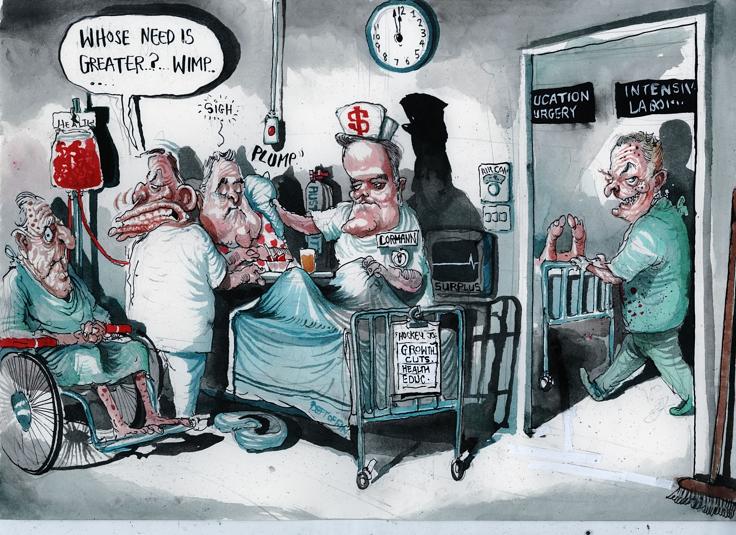
The politics of austerity script is in place. Despite the Abbott Government's rhetoric of growth in the short term to reduce the increasing unemployment before the next election there have been, and increasingly will be, cuts in education, health, pensions, and the ABC in order to ensure long term fiscal self-restraint. But there are to be no cuts in defence to ensure greater fiscal consolidation. It seems as if Defence will get more money.
So we are entering an period of rising insecurity and anxiety about the future and the Abbott Government's strategy is one of austerity as a way to regain economic momentum. That strategy is associated with claims that the social democrats are profligate and that their economic incompetency puts at risk conservative-leaning voters private incomes, which are more important to them than anything they receive from the state.
The ALP'S response to the scenario of inevitable decline and despair is that the greatest threat facing Australia's welfare state is the Abbott Government’s swingeing spending cuts. The ALP opposition has decided to defend and preserve the status quo of a strong welfare states in spite of thirty years of neoliberal ideology and the competitive forces of globalisation and the associated small-state proposals of the right.
 David Rowe
The script is that fiscal consolidation in Australia is required because an ageing population and rising health costs will blow out the budget in spite of economic growth. Hence the "structural deficit" and being “fiscally responsible" framing hat can only be actioned by real men. Ways to increase government revenue have been ruled out in the pre-budget softening-up period-- the tough political choice by the tough guys is that deficit reduction is to be through spending cuts not tax rises. It looks as if the general thrust of the welfare state roll back will protect the benefits for older people at the expense of families and children who are the working poor.
The concerns of younger generations and marginalised groups of people are already being sacrificed at the expense of elders and well off middle-class citizens. So “new ‘clusters’ of long-term social disadvantage and inequality are emerging as the effects of the global economy attenuates polarisation in labour markets and real wages” and mass unemployment.
The welfare state, which was premised on benefit in return for contributions, has been remarkably resilient to attacks from the Right. However, if bringing new money into the system through taxation is deemed to be politically unattractive, how is the welfare state to defended given shrinking budgets?
Simply preserving the status quo is being seen as economically unviable: it is not possible to achieve sustainable public finances; safeguard universalism; and increase ‘social investment’ spending. So something has to change. What was put in motion under the Gillard Govt was transforming the Australian welfare state--- the provision of childcare, welfare-to-work reforms to support more people into work, and the expansion of university places.
Will the Coalition's roll back of the welfare state involve a shift from the traditional (ie., social democratic) welfare state to a service intensive’ welfare state, and where ‘social investment’ such as public childcare, maternity leave and help for people to find work?
The role of the traditional welfare state was to protect citizens from market forces through unemployment benefits, public health and education and pensions. The activities of the welfare state act as insurance to protect us when times are tough and smooth risks and costs over the lifecycle. Universal entitlements both sustain public consent for welfare states and efficiently distribute both ‘hortizontally’ across the lifecycle and ‘vertically’ to low-income groups
In the liberal welfare state the aim is to equip them to contend in the global economy. The emphasis is on investment-style spending that builds prosperity for the long-term.
Posted by Gary Sauer-Thompson at 1:45 PM | Comments (6) | TrackBack
February 25, 2014
hell on earth
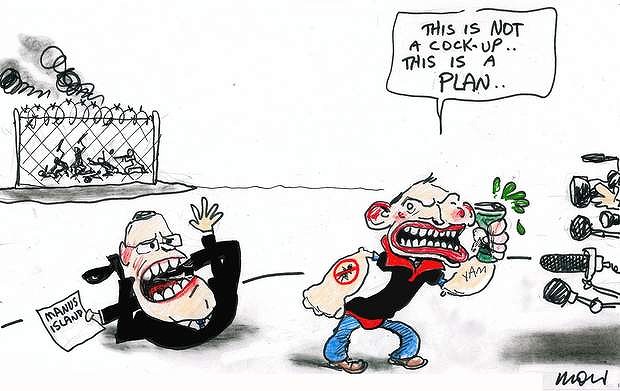
Border Protection Minister "No wimp" Scott Morrison has shifted his ground on the violence at Manus Island under pressure. In doing so he has started to undermine the Abbott Government's attempts at operational secrecy and keeping citizens in the dark to ensure the authority of the state remains unchallenged. This is done by linking national security to asylum seekers (ie., terrorism), and the government being in control. The assumptions are those of undivided authority, ministerial policy management, and parliament reduced to partisan political "debate" (point scoring).
Morrison's initial position with respect to the brawl at the immigration detention facility laid the blame for the violence at the detention centre on rampaging/rioting asylum seekers for pushing through the perimeter fence. He stated that the death of the Iranian man at Manus Island had occurred outside the camp's razor-wire fence. The man had escaped and this had contributed to his death. It was a simple law and order issue in that there was a sudden eruption of violence by detainees.
Order was quickly restored. The minister added that the PNG police did not enter the centre and their activities related only to dealing with transferees who breached the external perimeter fence.
 Alan Moir
Over the week Morrison, who sees himself as the tough cop on the beat, has slowly reversed his position under pressure from eye witness accounts. The deceased man had died in the offshore gulag and had not escaped at all. He then conceded that the rioting and “response” by the PNG police occurred within the centre. What he didn't say was that G4S managers had lost control of the local riot squad.
So why did the minister so quickly impute negative motives and apportion fault to asylum seekers in the immediate aftermath of last week's alleged riots? Presumably, to show that in being tough he was in control of things, and to reassure the conservative base that the state's authority continues to ensure security and order?
Even though the Coalition is vulnerable over its boats policy Labor went easy on Morrison in Question Time. There were no searching questions about the role of G4S, the private contractors running the Manus Island facility, or that of the PNG police. No questions about Australia's responsibility when Morrison claims that the concentration camp is run by the unstable Papua New Guinean state; nor the proposal to send a small group of asylum seekers to Cambodia. Is this because the ALP had set up this hell on earth?
It is now pretty clear that there was little law and order at Manus Island--Rudd's "hell on earth"--- and that G4S security system had lied about the events that took place. G4S had lost control. But who cares? The conservative base doesn't. As far as they are concerned the Abbott Govt, in "stopping the boats" from landing on Australia's territory, and its refusal to allow refugees to settle in Australia, is doing a great job defending Australia's sovereignty and its borders. The base doesn't care that Manus residents, G4S employees and PNG police stormed the facility, attacking the asylum seekers. The latter basically deserved what they got.
Morrison has been forced to set up an inquiry into the events on Manus Island. Will the 'No Wimp' Minister's false account of events be included in the scope of the inquiry?
What the Abbott Government fears is encroachment on the central state's authority and sovereignty from an external source, since it is this authority that is the basis of social cohesion within the nation state. So we can expect that the Abbot Govt's response to this review of this violence event and its management will be used to strengthen the ruthless logic of detention and incarceration.
After all, Manus Island--Rudd's "hell on earth"--- is primarily a deterrence system rather than a facility to process asylum seeker claims.
Posted by Gary Sauer-Thompson at 6:45 AM | Comments (11) | TrackBack
February 24, 2014
sound bytes
Australia's reforms aim to lift economic growth back above 3 per cent according to Joe Hockey, the Australian Treasurer at the G20 meeting in Sydney. The latter's communique called for increasing economic growth by 2%. They plan to do this by getting government out of the way and then hoping that the growth will come from the private sector investing in infrastructure.
Hockey added that only economic growth that is faster than 3 per cent would stop the rise in unemployment in Australia and start reducing unemployment.
 Alan Moir
So where is this kind of economic growth (an aspirational target?) come from, given the downsizing of manufacturing, the decline of mining, the high Australian dollar, and a budget surplus achieved through reducing the welfare state?
It would seem that the spin doctors are busy at work in glossy media management---eg., the ''end of entitlement'', structural reform and the unions as the bogeyman. Structural reform in Australia means labour market reform--- cutting back its employment protection framework ---as well as reducing access to the pension and greater user-charging for healthcare. This is called doing the "heavy lifting", making the "tough choices" and everything is on the table. It's all necessary because Australia faces an economic crisis.
These sound bites make little mention of repairing the global financial system, dealing with the sovereign debt crisis in Europe and the US banking crisis, the recession in Europe and the US, some countries in the eurozone facing the prospect of more than a lost decade of economic growth, the politics of austerity and low productivity growth. The shadow of the financial crisis that began in 2008 is a long one.
It's best to ignore the G20 Its history since its heyday at the London summit in April 2009 has been one of fragmentation and increasing irrelevance. It lacks a political leader to give it impetus, and it lacks an agenda that could put in place measures to tackle unemployment, global warming and the threat of a second financial crash.
How can the Abbott Government promote a big growth target on one hand while simultaneously reducing growth via austerity on the other? An expansionary austerity? The assumption is that unemployment could only arise as a result of problems specific to labor markets, such as minimum wages or recalcitrant unions. Hence the attack on unions.
The austerity economics is not an end in itself. Economics is the means to end the "age of entitlement", by which is meant making the market mediate decisions about our day-to-day lives thereby making us more individualistic; and making us less reliant on the ‘nanny state’ (ie., the welfare state) by withdrawing public subsidies of individual use of health, education, care or policing service. The Conservative's austerity project empowers the central state so that it has the power to expand market relations and create an economic framework that weakens intermediate institutions such as trade unions and local government.
Posted by Gary Sauer-Thompson at 1:11 PM | Comments (9) | TrackBack
February 21, 2014
My Broadband
Communications Minister Malcolm Turnbull has launched MyBroadband, a new website that aims to provide information on the download speeds available across Australia. MyBroadband allows users to put in their address and see what broadband is available in their area, be it ADSL, hybrid fibre-coaxial (HFC), or fibre, as well as 3G or 4G connectivity. It also provides an estimation of the available download speeds on those services.
It's a bit of a joke. It just tells you what you should ideally get, not the service you actually get under local conditions. Nor does it say anything about when the local broadband service will be upgraded or how.
Many--like me in Victor Harbor-- get slow speeds with ADSL because Telstra won't install more DSLAMS or Telstra won't let other ISP's have space in the exchange buildings. If they do upgrade the exchange--as they have finally done at Victor Harbor for ADSL2+---then we are often no better off if Telstra is not also upgrading the local street RIM boxes (ie., the local neighbourhood nodes) between the exchange and premises to provide decent and functional bandwidth.
That means everyone on an exchange with overloaded copper wiring and /or nongraded Rims suffers lousy ADSL speeds. The speeds are even slower --a crawl---when it rains. There is often little hope of an upgrade cos it's not in Telstra's plans. If you want fibre broadband all the way to the premises from the local neighbourhood nodes, then you pay for it under the Coalition policy. User pays means that the Coalition’s “fibre-on-demand” strategy will result in a digital divide between households, businesses and regions that can afford to pay for the upgrade and those that cannot.
This kind of situation with respect to the local neighbourhood nodes cannot be blamed on the ALP. It is your move Mr Turnbull. Where do we go from here to address this? How, for instance, do you plan to upgrade the local neighbourhood nodes so that we can have an ADSL2+service? Wasn't 2016 your target date to provide this low cost option of delivering 25Mbps broadband to all Australian premises? Your 2019 secondary deadline is boosting this to 50Mbps on 90 percent of fixed-line services.
Don't you need to be open about the big and complex problems you need to resolve to deliver on your promise to deliver a functionally limited NBN?
In launching My Broadband Turnbull stated that:
Some people have said that our approach means the NBN is not a national broadband network. Let me be quite clear: People who say that just show how absolutely ignorant they are about how the Internet works.... A lot of the criticism of the Coalition’s plan underlined that the people criticising it mostly from the Labor Party, I’m afraid, either don’t understand the technologies at all or how the Internet works, or, more probably, they do understand how it works and they’re just trying to fool people.
These critics have drunk the ALP's Fibre to the Premises kool-aid. Turnbull adds:
If you talk to people that are not absolutely … that are not geeks or internet afficionados, technologists, and you say to them do you have an Internet connection at home, they’ll probably say yes. What technology is it? Most people won’t know. What is your peak speed? A lot of people won’t know that. The critical thing is getting a service that works.
So the goal posts are now a service that works. With my current speeds driving a hard disk to a pro-lab or a gallery is a normal thing to do. This kind of "service that works" assumes that people are just a passive content consumer rather than someone actually creates things with computers. So much for enhancing digital productivity.
But, says Turnbull, we shouldn't listen to the geeks etc---- ie., those with some knowledge of digital technology--- cos they are critical of the Coalition’s Broadband Multi-technology Network and are aligned with the Labor Party. Turnbull is continuing to play politics,
What he should be doing is addressing the problems--eg.,the state of the copper network, that ADSL is an interim technology whose state of disrepair is held together by plastic bags at the joints. Turnbull needs to address problems such as these given that the copper network represents the cornerstone of the Coalition's $30bn broadband policy.
Posted by Gary Sauer-Thompson at 9:07 AM | Comments (7) | TrackBack
February 19, 2014
the politics of food safety
Yet another example of the Abbott Government being beholden to, or captured by, a section of Big Business can be seen around food politics; namely in the shutting down of a commonwealth government website about the health star rating food labelling system that would help to inform consumers about their healthy food choices.
 Gary Sauer-Thompson
This front-of-pack labelling system, which helped to provide an easy interpretation of a product’s healthiness and nutrition content had been agreed to at CoAG, when the traffic light labelling system, failed to get accepted.
The strategy of Big (junk) Food industry, including the Australian Food and Grocery Council, is to avoid government regulations for improved food labelling. They promise self-regulation in efforts to avoid government regulation, despite the demonstrated failure of self-regulation for improving food environments. Government regulation has come about because of public health concerns that the increased supply of cheap, tasty, energy-dense food has been the main driver of population weight gain over the last three decades.
Big Food is one of the major obstacles that many countries, including Australia face, as they try to reduce obesity and diet-related diseases to increase population health outcomes by informing consumers about 'junk' diets.
Sugary drinks and junk foods are now pressed on unsuspecting parents and children by a cynical industry focused on profit not health”—it's just like the tobacco industry behaves. Big Food is pouring money into fighting labeling, even though people worry about the corporate control of the food supply. That control its rarely discussed, even though consumers want to know what’s in their food.
Clearly the Abbott Government is not interested in prevention. For them obesity is due to lack of self-control---food choice is a matter of personal responsibility--- not the modern food environment. They ignore the way that the food environment greatly influences personal choice.Marketing is the elephant in the room of childhood obesity. It overwhelmingly influences kids to prefer, demand and consume junk foods and sodas.
Labeling would solve lots of problems, but it needs to be mandatory. The rules would establish nutrition standards for foods. Products that exceed the standards will have to say high in sugar, salt, or fat in brightly colored labels (red, green, blue) on the front of the packages.
Posted by Gary Sauer-Thompson at 8:02 AM | Comments (6) | TrackBack
February 18, 2014
it's getting real ugly
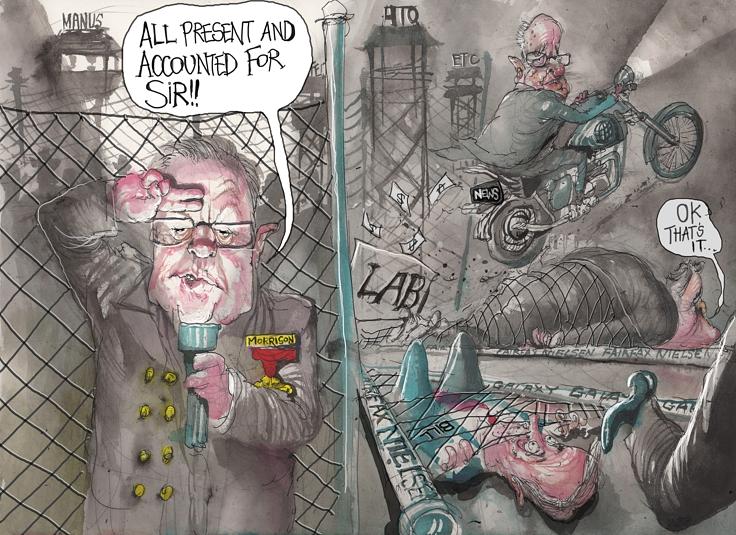
The Abbott Government's media clampdown-- a veil of silence---- on anything to do with asylum seekers and border protection means that it is hard to ascertain what is happening in the concentration camp at Manus Island in Papua New Guinea, a borderline failed state. These are asylum seekers waiting to be processed. If they were not found to be a refugee, neither the Australian nor PNG governments would help them resettle in PNG. We don't know what will happen to them if they are found to be genuine refugees.
What we can gather from reports is that tension has been simmering for weeks in the centre; that there have been consecutive nights of rioting; that asylum seekers rioted, broke down internal fences within the camp between the Mike compound and Foxtrot compounds and breached the fences whilst protesting about the status of their refugee claims and resettlement status. We also know that around 77 people are injured (most with head wounds), one man is dead from a gunshot whilst another had his skull fractured.
 David Rowe
It also appears, from local reports, that the local Manus Islanders are angry enough about the concentration camp in the middle of their home island to go on a violent rampage – breaking into the camp and attacking the inmates with machetes and bats. It also appears that they were aided by the local PNG police. There have been different reports about who was responsible for the alleged attacks: G4S guards, the PNG police or local residents.
The Immigration minister, Scott Morrison, is basically denying that the concentration camp's fences were breached by locals and PNG police, who then carried out “systematic and brutal” attacks on asylum seekers. His account is that the asylum seekers rioted. Morrison's long and successful campaign of dehumanisation and demonisation against asylum seekers continues.
In The Guardian Jeff Sparrow observes that:
Australia has deliberately cloaked its detention centre archipelago in so many layers of secrecy that we know almost nothing about what goes on there. The camps are the equivalent of private businesses remotely located in foreign countries, and everything about them is designed to frustrate journalists seeking to report on them.
We know that the camps in a poverty-stricken foreign country known for chronic law and order problems are designed to be cruel, and that the asylum seekers are going to suffer. The Conservative base demands that the asylum seekers live a bare life--a life exposed to death. Australia wants to frighten further asylum seekers from coming to Australia with the promise that they will be sent to Manus.
Presumably the intensity and extent of the deterrence (and repression) under the Abbott Government will continue to escalate to the point where the inmates are reduced to a state of physical decrepitude and existential disregard that one hesitates to call them living.
Update
It is becoming obvious that injuries to the incarcerated asylum seekers were caused by machetes, knives, rocks and table legs employed by local people, including some employed by [security contractor] G4S. It is also the case that the PNG police fired gunshots.
It appears that the Australian staff, including guards, left the scene and played no part in seeking a resolution to the problem. If so, then the asylum seekers incarcerated in the camp were left to defend themselves. Morrison appears to condone this kind of suffering when he blames the detainees for rioting. Order needed to be restored.
The "locals" appear to be employees of the security firm G4S hired by Australia to run the centre who were at times backed up by the PNG mobile squad. If the mobile squads are responsible for violence at the Manus Island facility, this is not an exceptional event, it is part of pattern in PNG. It is a pattern Australia has ignored, and when inclined, applauded and sponsored.
The logic of the camps is to create inhuman treatment and horror because that acts as a form of deterrence. The conservative base would see the inhuman treatment, deaths and suicides as what the asylum seekers deserve. They latter are bad people and they need to be severely punished by systematic violence of incarceration in a concentration camp. If anything the severity of the sanctioned violence should be made increased.
Posted by Gary Sauer-Thompson at 11:55 AM | Comments (20) | TrackBack
February 14, 2014
making Australia more competitive
It is now clear that the core of the Abbott Govt's reforms is industrial relations in the form of breaking the power of unions.
That is a prerequisite if Australia is to be be open for business. The ground is being prepared through the Royal Commission headed by Dyson Heydon.
 David Rowe
Australia's economy is on a downward trend as companies shed jobs, factories close, domestic demand is flat and economic growth is sluggish. The Abbott Govt's narrative is to lay the blame for the collapsing industries at the feet of the unions. Though job losses continue to increase because of falling Chinese demand, all is not lost say the neo-liberals say that all is not lost. The free market will drive productivity reforms and increase living standards across Australia.
That's their “plan for jobs” -- get-the-economy-moving-and-the-jobs-will-come. It's the traditional ""a rising tide lifts all boats" and it is the global economic forces that will cause the rising tide sometime in the future. This will restructure the economy for enrichment of the few not for the benefit of the many.
Posted by Gary Sauer-Thompson at 6:46 AM | Comments (5) | TrackBack
February 12, 2014
waving the magic wand
The Abbott Government says that it stands for smaller government, lower taxes, and a budget surplus. There is a contradiction here because falling government revenue means ongoing budget deficits not surpluses. The commission of audit points heavily in the direction of austerity and increased social insecurity: downward mobility for the middle class and high joblessness, spreading job precarity for the post-industrial working class and the sharpening of inequality.
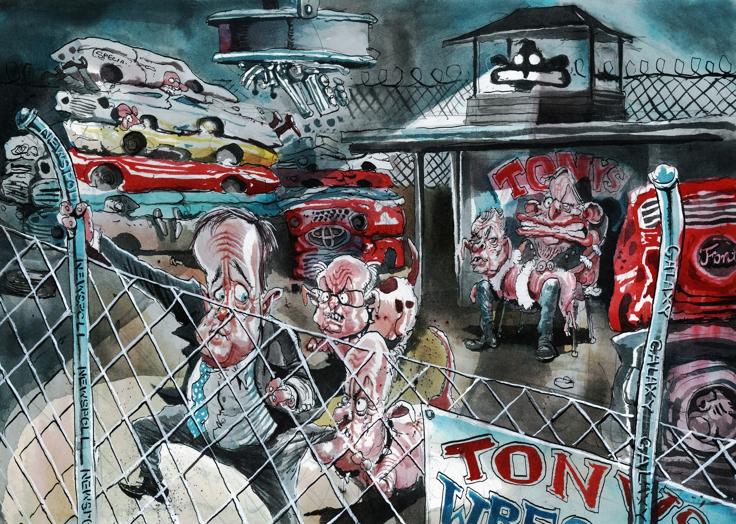
The Abbott Govt's position is that the above contradiction can be resolved by strengthening the economy, which in turn is to achieved by dumping the mining tax, doing away with carbon pricing, removing green tape, and lessening union power to remove unsustainable pay and conditions. The govt has done its job and the freewheeling market will work its magic: private enterprise will start investing and new jobs will be created.
 David Rowe
It all sounds like the waving of the magic wand by the tooth fairy. The wand is called "open for business". The economic theory behind the waving of the ideological wand is that though the dynamic nature of capitalism is at times destructive, it is also vibrant and creative; capital and labour will be reallocated to higher-yielding uses.
An editorial in The Australian spells out the ideology of neo-liberalism:
governments do not create jobs, companies do. The private sector takes risks and workers prosper. The best thing his [Abbott's] government can do to support jobs is to pursue policies that promote economic growth. Getting the correct fiscal settings in the May budget will be a necessary but not sufficient condition to bolster growth. To show that the nation is really open for business, the Abbott government must continue to resist the rentseekers, reduce Canberra’s footprint in the economy and the power of unions, cut taxes and regulation, build the infrastructure the country needs and pursue market-based reforms. Through micro- and macro-economic policies dedicated to growth, displaced workers - in fruit canneries or car factories - will soon find new opportunities beyond the grim view they may now be contemplating.
Neo-liberal ideology is about the economy not society or community and the dismantling of the state in favour of the market. It is "market rules". The inference is that neoliberalism is an explicitly political project for reshaping society.
The neo-liberal mode of governance, as distinct from its ideology, and it requires a strong state with respect to the apparatus of prisons, police, defence and surveillance. Forms of imprisonment, disciplinary workfare, and behavioural modification of the urban outcasts increasingly takes the place of ‘welfare'.
In his keynote at the 2012 TASA (The Australian Sociological Association) Conference, French sociologist Loïc Wacquant argued that the neoliberal mode of governance is the building of a particular kind of state which has the return of the prison at its centre. This institutional machinery is used to manage the consequences of inequality at the bottom, for the life spaces and life chances of the precarious fractions of the postindustrial working class.
Posted by Gary Sauer-Thompson at 8:24 AM | Comments (3) | TrackBack
February 11, 2014
better jobs to replace those dreary assembly line ones?
The Abbott Government reckons that Australia can survive in a global market without an, or a very minimal, industrial base. It's an interesting policy suggestion. Apparently Australia will do okay riding on the back of the super-sized mining truck (ie., exporting gas, coal and iron ore). That implies the miners rule the roost.
 David Rowe
The Abbott Government and its allies are punting on China and India to counterbalance Australia's de-industrialization, even though the mining boom is ending. I guess that is what they mean when Minister's say that for every job lost in manufacturing other openings abound, that workers who'd lost their livelihoods ought to feel liberated "to pursue new opportunities" and that they have one million new jobs planned.
How's that going to happen with the mining boom winding down, the politics of austerity via the Commission of Audit and the destruction of the knowledge based digital economy? It sure ain't going to come from the renewable energy industry cos the Abbott Government is setting about to hollow that industry out.
The Abbott Government has no idea where the other openings abound with better jobs. They don't have an industry policy. Their position is that its not the government's role to intervene since the deregulated market will sort things out. Currently, the market is delivering Australia the “resource” curse experienced by other countries: intense exploitation of natural resources, adverse impacts on other sectors and a lack of investment in education.
Increased research and development dollars, re-skilling programs for workers, industry assistance, or greater educational investments – are not considered to be worthwhile investments.
Abbott has repeated on a number of occasions that he sees Australia’s rich domestic reserves of coal and gas as a source of cheap energy that could support manufacturing. Whose he trying to kid? Gas prices are starting to rise until they become the same as world prices as a result of the LNG export facilities. That just leaves coal.
Posted by Gary Sauer-Thompson at 9:10 AM | Comments (8) | TrackBack
February 10, 2014
Abbott's great big spotlight
The terms of reference for the Abbott Government's royal commission into union governance and corruption is designed to allow a wide-ranging inquiry into union slush funds, malfeasance and the behaviour of corrupt officials. It is designed to be a great big spotlight into the dark corners of our national life.
The dark corner, of course, is the alleged bribery, extortion or criminal behaviour by unions. The Commission 's findings will be used to by the hard faced men in the LNP to tarnish the ALP. Even though union membership is roughly down to about 15 percent of the workforce, the political strategy is to put the boot into the ALP to weaken it politically.
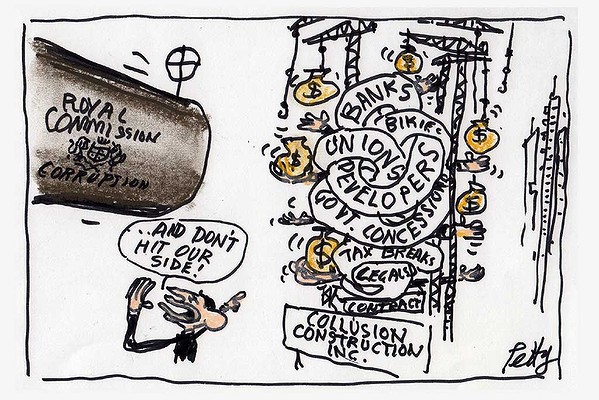 Bruce Petty
Though it takes two to tango, the terms of reference will structured around investigating mostly (only) union wrong-doing not that of the finance industry, for instance; or an inquiry into corruption in the Building Industry in general. To accept a bribe, someone has to offer it so that capitalists can create jobs, grow the economy, and spread prosperity to all and sundry so that everyone is happy, contented and relaxed.
It is pretty clear that the Coalition and the big end of town are spoiling for a new round of industrial relations combat on their terms; even though in those industries where labour is not organised and has little bargaining power, (eg., ie contract cleaners or freelancers in the creative industries) wages are low and conditions are precarious. Presumably the aim of the new round of industrial relations combat is to strip away protections and hold wages down, even if these hurt ordinary Australians.
Update
While Abbott attacks the unions as the bad guys Toyota announces the end of its car manufacturing in Australia in 2017 with the loss of 2,500 jobs. So it is Ford ceasing production in October 2016 and Holden and Toyota in 2017 which means the end of car manufacturing in Australia. 6000 jobs gone. That also means the end of a car components industry that employs more than 30,000-45,000 and all the associated jobs.
This, in turn, means the reduction of Australia's industrial complex and its capabilities, given that the automotive assembly companies have long held key roles in the development and diffusion of technological, process and design-led innovation in Australia.
As the process of de-industralisation continues the Abbott Government says that new jobs will be created to help Victoria and South Australia recover from the job losses. Which industries are these new ones? Where is the investment for these new industries? There is no mention of the knowledge industries, the up-skilling of our workforce, or a knowledge-based economy with 21st Century infrastructure. They continue to talk about the farm, building roads, mining minerals and cutting down forests.,
The neoliberals do say that government needs to create the right conditions--a strong economy--- for new businesses to emerge. This will release skilled labour and other scarce resources for use by industries more suited to the Australian economic environment. According to Alan Mitchell in the AFR that includes innovative start-ups that have been among the invisible victims of past protectionist policies. That creative destruction is one of the Abbott government’s mantras.
Firstly, what creating a strong economy means so far is labour law reform momentum- ie., wage reductions. Industrial Relations Minister Eric Abetz has been laying the blame for the problems of both Holden and Toyota at the feet of the unions and the weak employers who were rolling over to their demands. Yet Toyota's statement made no mention either of industrial relations problems. Nor did it mention anything about the carbon tax.
Secondly, there has not been any stimulation of the rapidly growing technology and digital content industries, which have remained virtually stillborn in Australia due to a lack of anything near the same support which SPC Ardmona and the car industry had virtually taken for granted. There is no suggestion about upskilling the workforce through higher education or increased support for science and research, given the the importance of developing a portfolio of technology and intellectual property and spinning the core ideas off into the private sector.
Instead of an offensive strategy from the Abbott Government, to help ensure that the investment in and development of ‘clever’ industries was accelerated as much as possible to ensure that Australia was not left behind in a race with the rest of the world, we have the slash and burn of the Audit Commission.
Posted by Gary Sauer-Thompson at 1:54 PM | Comments (9) | TrackBack
February 7, 2014
no doubts, its back
It is pretty clear that the Abbott Government is under intense pressure from its Big Business constituency to regain the industrial relations territory it had to surrender with the defeat of Workchoices and the Howard Government. Big Business and its neo-liberal allies want that territory retaken quick smart. This is their path of economic change and reform.
 Alan Moir
So how does the Abbott Government do what's required of them when Workchoices is still electoral poison? Talk about a a wages explosion of the pre-Accord era when unsustainable wage growth simply pushed thousands of Australians out of work".Talk about workers' conditions negotiated collectively with employers that cost jobs.The inference is that the "fat cat"union movement is irresponsible on economic policy.
Abbott chose low-paid factory workers as a target of a wider campaign to persuade companies to cut labour costs when he squeezed Shepparton's troubled SPC Ardmona factory into this IR narrative, even though it makes little sense.
It indicates that Paul Howes' call for a business-union-government “grand compact” to deliver more harmonious industrial relations, isn't going to cut it. It's fanciful.
Bill Harley argues that the Workchoices style of reform of the industrial relations legislation:
is unlikely to generate productivity gains and greater prosperity for Australia. There is little evidence, for instance, that either WorkChoices or the Fair Work Act had any significant impact on any economic outcomes. In my view, a shift away from IR reform as the proposed driver of economic performance is long overdue.A greater focus on encouraging workplace innovation through training, research and development, investment and so on is much more likely to deliver performance gains. Precisely how this would be achieved is open to debate, but there are plenty of useful examples, from around the world, of government policies which have encouraged workplace innovation and delivered performance gains.
It is fantasy to see this happening under an Abbott Government committed to the politics of austerityand blaming most things on greedy workers and unions.
Posted by Gary Sauer-Thompson at 9:08 AM | Comments (7) | TrackBack
February 5, 2014
a more self-reliant culture of enterprise?
Big Business now has its own Government in power to implement its reform agenda.
The rhetoric of that agenda can be found in an editorial in the Australian Financial Review. It refers to Joe Hockey's End of the Age of Entitlement speech which stated that as governments around the world had become dangerously indebted, the idea of spiralling entitlement – endless handouts from money someone else has earned – had to end. The "age of personal responsibility" (private virtue, thrift and self-reliance) has to take its place. The role of government is to get out of the way of change.
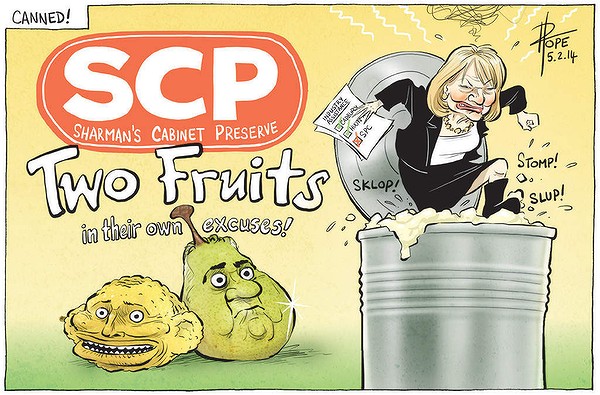 David Pope
What does the above rhetoric mean?
According to the AFR's interpretation it means nothing less than breaking the entrenched political economy of the modern welfare state, including corporate welfare. Their interpretation of Hockey's speech is this:
Australia is not broke. But the spending party is still over because our medium-sized, resource-driven economy is leaving its biggest mining investment boom of all time with a budget deep in the red, just as the budget costs of an ageing population are beginning to bite. Lifting taxes higher and higher to pay for all this was no solution....So rationalising government services that were draining the budget was the only option.
Note how the argument implies that Australia will go broke if the politics of austerity is not embraced to roll back the welfare state. There is no other way.
We've heard that neo-liberal slogan before. The neo-liberals then routinely assert that Australians are addicted to welfare and the welfare lobby is committed to maintaining the "poverty charade".
No mention is made of the economc reality that the budget deficit inherited by the Abbott Government is more about a lack of revenue rather than a blowout in spending. This in turn is a function of the economy growing a little below trend with very low inflation. This lower growth is mostly due to the recession in Europe and the US following the GFC.
The budget deficit inherited by the Abbott Government is more about a lack of revenue rather than a blowout in spending. This in turn was a function of the economy growing a little below trend with very low inflation. The AFR editorial does address corporate welfare:
The second force driving the end of the entitlement age is the reshaping of the Australian economy from a protected domestically focused manufacturing base into a supplier of minerals, energy, services, food, and niche manufacturing to Asia. Among rich nations, this makes Australia is uniquely placed to prosper from the rise of China and the rest of Asia. But that is as long as we do not smother the opportunities by trying to hang onto the past, such as by handing out billions of dollars to prop up an uncompetitive and sub-scale car industry. While the dollar amount is relatively small, refusing $25 million to fruit canner SPC Ardmona is similarly important because it sends a signal to the rest of business that the age of corporate entitlement, as well as social entitlement, is over.
No mention of the subsidies to Big Mining or the fossil fuel energy companies. The later, surely are hanging onto the past.
The reason for the elision is not hard to spot. It's not corporate welfare that is the core issue for Big Business--it is the power of the unions. The AFR continues:
That signal extends to the linkage to Australia’s traditional industrial relations system, based on the defining assumption that the state should intervene to set a “fair” wage. The assumed entitlement of labour, divorced from its contribution to profit, was then attached to the corporate entitlement to protection from foreign competition.These linked entitlements of the welfare state, corporate protection and the “fair” wage are exhausted.
Well not really. Corporate protection is not to be taken seriously. The Big Miners, forestry, private health funds, the fossil fuel industry etc are not expected to be self-reliant. The subsidies for them are really out of bounds. So not everything is on the table. The Canberra Press Gallery turns a blind eye.
The politics? Well, the nation’s workers have to tighten their belts Less pay, worse working conditions, less welfare) and the Abbott government, unlike that of Hawke and Keating, is not going to give them anything in return.
Posted by Gary Sauer-Thompson at 10:56 AM | Comments (3) | TrackBack
February 3, 2014
it doesn't stack up
The Abbott Government says that it stands for economic freedom with minimal constraint (such as profiting from the exploitation of natural resources) and they argue (that their actions are not detrimental to the interests of others and thus do not need responsible constraints (such as green regulation), regardless of any evidence to the contrary. Freedom to exploit should be possible and desirable.
The appeal is to the self-correcting nature of free markets and the rhetoric. The best remedy for the uneven recovery of the work economy, according to Abbott, is a formula of free markets and minimal government intervention. In Australia this means that no industry sector can consider itself an untouchable sacred cow, strategic asset or Aussie icon. The Abbott government says that its reform agenda is premised on it's commitment to removing industry assistance.
So far we have Cadbury's in Tasmania being given corporate welfare by the Abbott Government. The Abbott government also announced a co-investment deal, remarkably similar in design to the SPCA deal they rejected, with Huon Aquaculture – to upgrade machinery just as SPCA had intended to. But corporate welfare for SPC in Victoria, and GM Holden in South Australia and Victoria is denied.
The contradictions are resolved when we realise that it is politics overriding free market economics.
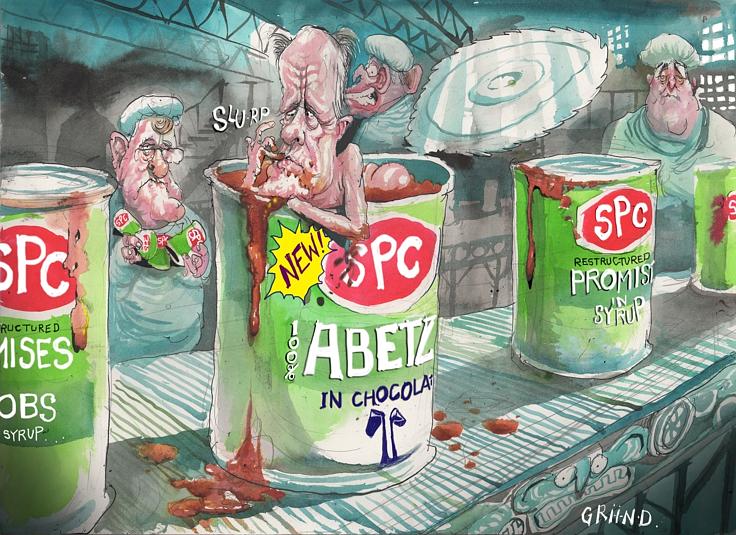 David Rowe
Now we have the Abbott Government asking the World Heritage Committee to delist about 74,000 hectares of 170,000 which was added under Tasmania's historic forest peace deal. The World Heritage Committee's listing includes the Southern Forests, the Styx, the Florentine and the Great Western Tiers. Correcting the boundary errors of the previous listing, and the degraded sites --ie., old coops, landing and loading platforms, established by previous logging activity--- amount to an insignificant area of the total 70,000 hectares that has been proposed for de-listing.
This represents a forest grab to log old growth forests. Thus we have politics as the servant of the market; or to pit it more bluntly as the servant of specific corporate interests--in this case the forest industry.
So the neo-liberal claim that the “invisible hand of the market” will self-regulate a properly free economic market so as to avert any imbalances and problems associated with resource consumption and its waste products (pollution) does not stack up. Miners, property investors, the banks, the construction industry, fossil fuel industry, the private health insurance, agriculture and the resources industry continue to be major recipients of extensive corporate welfare from the Abbott Govt.
So much for the Abbott government's message that businesses needs to stand on their own two feet. For this government making money and profits through mining and burning fossil fuels is the path to economic growth and prosperity. Regulation (to protect biodiversity and our natural heritage) is a form of interference in this noble activity eg., ---the miners should be allowed to dump 3 million tonnes of sediment from the Abbott Point expansion project into the Great Barrier Reef Marine Park so that they can develop the Galilee Basin coal deposits.
The miners just want the freedom to dig up as much of the wealth that currently lies in the ground and to hell with the long consequences such as human-caused climate change. As Paul Rogers observes the fossil-carbon industry position is crystal clear:
If climate change does have to be stopped and carbon-dioxide emissions cut by 80%, then the great majority of the fossil carbon in proved and exploitable reserves of coal, oil and gas cannot be used. This would make the value of these reserves - on which fossil-fuel industry investment is based - essentially worthless: the industry would become a house build not on carbon but on sand. This is simply unacceptable to the industry, which therefore must argue that human-induced climate change simply cannot be happening - end of story.
Hence the continual rejection of the link between a link between the floods, bush fires and heatwaves and human caused climate change/disruption. Anyone who doubts this is an enemy, or a fool, or UnAustralian.
Posted by Gary Sauer-Thompson at 6:48 AM | Comments (12) | TrackBack
February 2, 2014
the spooks are the hackers
Edward Snowden, the former National Security Agency contractor, is seen as a traitor by the conservative Abbott Government. In so doing they take the position of the security hawks.
Security hawks consider any unauthorized disclosure of classified information unacceptable, stressing that cleared employees take an oath not to disclose such information, and that no government can operate without some secret deliberations and covert actions.
So what are these secret deliberations and covert actions?
The spy agencies had hijacked the internet is what Snowden told us. The NSA was hoovering up metadata from millions of Americans. Phone records, email headers, subject lines, seized without acknowledgment or consent. From this you could construct a complete electronic narrative of an individual's life: their friends, lovers, joys, sorrows.
Luke Harding in The Snowden Files: The Inside Story of the World's Most Wanted Man tells us that:
The NSA had secretly attached intercepts to the undersea fibre optic cables that ringed the world. This allowed them to read much of the globe's communications. Secret courts were compelling telecoms providers to hand over data. What's more, pretty much all of Silicon Valley was involved with the NSA, Snowden said – Google, Microsoft, Facebook, [and] Apple. The NSA claimed it had "direct access" to the tech giants' servers. It had even put secret back doors into online encryption software – used to make secure bank payments – weakening the system for everybody.
The secrecy is not being used for legitimate purposes of national security, but to shield illegal or embarrassing activity from public scrutiny. NSA has been cooperating in potentially disturbing ways with its British, Australian, Canadian and New Zealand surveillance counterparts. In this case the benefits from revealing illegal abuses of authority by the national security state outweigh the costs of disclosing those secrets.
Ministers in the Abbott Government are not even bothering to try to make the case for mass surveillance of communications data following the revelations by Edward Snowden. They turn their guns on newspapers and media that covered the leaks. Their stock response is that we have intelligence services because it is a dangerous world, there are people that want to do terrible things and that Snowden is causing damage to our security in the fight against terrorism.
They hold this position even though the mass surveillance spying programmes are much more than 'overstepping their boundaries'. They are probably illegal and have been signed off by ministers in breach of human rights and surveillance laws. The spooks then lied about their activities, then, when exposed, kept on lying. When placed in the context of the current undeclared war on whistleblowers and independent journalism ramping up in the US, the UK and Australia we can see that this is an attack on democracy.
Posted by Gary Sauer-Thompson at 5:27 PM | Comments (2) | TrackBack