|
February 10, 2014
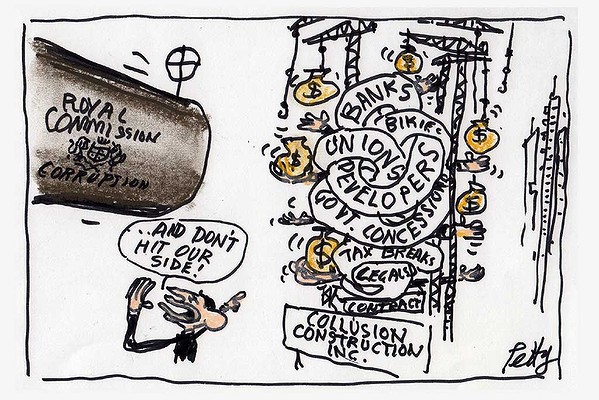
The terms of reference for the Abbott Government's royal commission into union governance and corruption is designed to allow a wide-ranging inquiry into union slush funds, malfeasance and the behaviour of corrupt officials. It is designed to be a great big spotlight into the dark corners of our national life.
The dark corner, of course, is the alleged bribery, extortion or criminal behaviour by unions. The Commission 's findings will be used to by the hard faced men in the LNP to tarnish the ALP. Even though union membership is roughly down to about 15 percent of the workforce, the political strategy is to put the boot into the ALP to weaken it politically.
 Bruce Petty
Though it takes two to tango, the terms of reference will structured around investigating mostly (only) union wrong-doing not that of the finance industry, for instance; or an inquiry into corruption in the Building Industry in general. To accept a bribe, someone has to offer it so that capitalists can create jobs, grow the economy, and spread prosperity to all and sundry so that everyone is happy, contented and relaxed.
It is pretty clear that the Coalition and the big end of town are spoiling for a new round of industrial relations combat on their terms; even though in those industries where labour is not organised and has little bargaining power, (eg., ie contract cleaners or freelancers in the creative industries) wages are low and conditions are precarious. Presumably the aim of the new round of industrial relations combat is to strip away protections and hold wages down, even if these hurt ordinary Australians.
Update
While Abbott attacks the unions as the bad guys Toyota announces the end of its car manufacturing in Australia in 2017 with the loss of 2,500 jobs. So it is Ford ceasing production in October 2016 and Holden and Toyota in 2017 which means the end of car manufacturing in Australia. 6000 jobs gone. That also means the end of a car components industry that employs more than 30,000-45,000 and all the associated jobs.
This, in turn, means the reduction of Australia's industrial complex and its capabilities, given that the automotive assembly companies have long held key roles in the development and diffusion of technological, process and design-led innovation in Australia.
As the process of de-industralisation continues the Abbott Government says that new jobs will be created to help Victoria and South Australia recover from the job losses. Which industries are these new ones? Where is the investment for these new industries? There is no mention of the knowledge industries, the up-skilling of our workforce, or a knowledge-based economy with 21st Century infrastructure. They continue to talk about the farm, building roads, mining minerals and cutting down forests.,
The neoliberals do say that government needs to create the right conditions--a strong economy--- for new businesses to emerge. This will release skilled labour and other scarce resources for use by industries more suited to the Australian economic environment. According to Alan Mitchell in the AFR that includes innovative start-ups that have been among the invisible victims of past protectionist policies. That creative destruction is one of the Abbott government’s mantras.
Firstly, what creating a strong economy means so far is labour law reform momentum- ie., wage reductions. Industrial Relations Minister Eric Abetz has been laying the blame for the problems of both Holden and Toyota at the feet of the unions and the weak employers who were rolling over to their demands. Yet Toyota's statement made no mention either of industrial relations problems. Nor did it mention anything about the carbon tax.
Secondly, there has not been any stimulation of the rapidly growing technology and digital content industries, which have remained virtually stillborn in Australia due to a lack of anything near the same support which SPC Ardmona and the car industry had virtually taken for granted. There is no suggestion about upskilling the workforce through higher education or increased support for science and research, given the the importance of developing a portfolio of technology and intellectual property and spinning the core ideas off into the private sector.
Instead of an offensive strategy from the Abbott Government, to help ensure that the investment in and development of ‘clever’ industries was accelerated as much as possible to ensure that Australia was not left behind in a race with the rest of the world, we have the slash and burn of the Audit Commission.
|





This is the softening up process.