« October 2013 | Main | December 2013 »
November 29, 2013
‘Give us a break’
Laura Tingle's article in the Australian Financial Review (AFR) ---A new government, but no change in politics--- confirms the standard criticism of the Canberra Press Gallery. It's primarily horse race journalism written by those who see themselves as savvy insiders with special connections to important and highly placed sources.
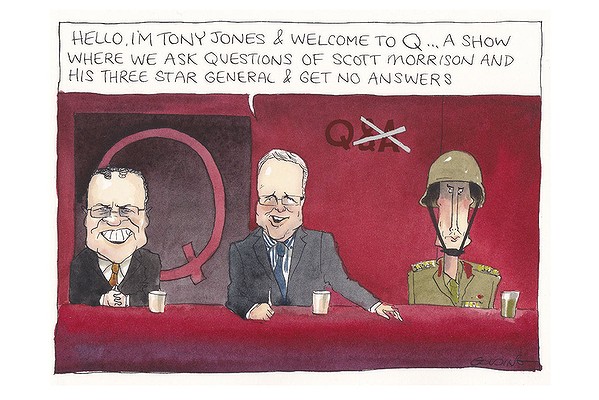 Matt Golding
The AFR is a paper for business, and so it reflects the concerns of Big Business who barracked for, and welcomed, a conservative Abbott Government that was “open for business”. No doubt the alarm bells will start to ring in its pages about the populist, neo-conservative nationalism of the Abbott Government.
Back to Tingle. She writes:
The bloody Canberra press gallery! We are so obsessed with leadership and polls and stuff and not at all interested in policy and the important things.This is a “well-known fact”.
The scare quotes indicate that Tingle rejects the criticism. It is not really true. She then immediately confirms the criticism as the rest of her column is concerned with speculation about leadership in the Coalition.
Tingle implies that she is merely reporting what is going on:
However, the strange thing over the past month or so is having been out talking to different groups of company directors, bank customers, economists and the like about the new government, the same question has inevitably surfaced: when will the Coalition bring Malcolm Turnbull back?....But it seems a little strange that it keeps coming up so regularly after Tony Abbott led the Coalition to victory. After all, it is supposed to be the press gallery that is obsessed with leadership questions and business with serious issues like productivity and tax reform.
She adds that her response has always been the same (apart from the obvious one that a change in leadership is not really front of mind in the Coalition just at the moment): it remains the case that many in the Coalition would rather eat ground glass than go back to Turnbull as leader.
So why write about it? Why not write about the deep dividing line in the Coalition ranks between the small-government people and the big-government people; the neo-liberals versus the populist conservative nationalists?
This kind of source journalism is what Australian journalists would point to as an example of ‘public interest’ journalism – that is, journalism that keeps a watching brief on society’s main institutions--in a liberal democratic society. They then usually argue that it is only the mainstream media institutions that are able to provide the independent scrutiny of those in positions of power and authority.
Tingle's work certainly has a more reasonable tone when compared to the columns full of blatant partisanship written by the idealogues in News Corp who once stalked Julia Gillard with a vengeance, and now act as fawnish courtiers and media boosters for Tony Abbott. Surely business is becoming rather uneasy with the approach of the Abbott Government--- eg., seeing Indonesia as a a strategic threat and not as an economic friend --a prosperous Indonesia presenting big economic opportunities for Australia. Or seeing China is a strategic opponent through the prism of the US conservatives.
Posted by Gary Sauer-Thompson at 2:19 PM | Comments (5) | TrackBack
November 28, 2013
the China-Japan dispute
The disputed islands in the East China Sea, which Japan calls the Senkakus and China knows as the Diaoyutai, are the site of increasing tension between China and Japan.
China's decision to extend its "air defence identification zone" (ADIZ) over this group of uninhabited islands means that if the United States or another country's military flies inside the area without seeking permission first, China could respond with military force. Many countries, including the United States, have the same kind of zone around their borders. China's move essentially puts any non-commercial flight through that area on equal footing with a flight over its own airspace.
Behind Japan stands the US, so China's decisoion is a challenge to the US hegemony in the Asia Pacific region. China has become both markedly stronger and notably more assertive in this region and America under Obama countered with the strategic pivot to Asia which has meant the U.S. military is encircling China with a chain of air bases and military ports. The US now has a regional military power that poses a traditional, symmetric challenge to its dominance.
China is pushing back against Obama's strategic pivot to Asia, whilst Japan, under its conservative government of Shinzo Abe, is becoming increasingly nationalistic.
Australia, under an Abbott Government, sides with Japan and the US, which flew two B-52 bombers on an unannounced flight into the disputed zone to counter China's desire to flex its muscles in its own backyard. Australia says that China's unilateral action to impose an air-defence zone in the East China Sea was provocative.
The military hawks amongst the US Republicans, and those in the Pentagon and elsewhere in Washington, secretly fear that, if nothing is done to contain it, China will within decades be dominant in the Pacific, the overlord of Asia, and perhaps later in the century the -- to steal a phrase -- “sole superpower” of planet Earth.
For them the risk of confrontation increases as both China and Japan place renewed emphasis on military strength and national assertiveness whilst the US continues to implement its policy of the “containment” of China in the Pacific. As the military hawks see it, the situation is black and white: either America provides the necessary role of being the true guarantor of stability in East Asia or the region will again be dominated by belligerence and intimidation.
Shouldn't Australia be acting to help defuse the belligerent and ultra-nationalistic pronouncements now holding sway and trying to get the leaders of China, Japan, and the United States, to begin talking with one another about practical steps to resolve the disputes? Shouldn't Australia be acting to ensure that these minor disputes in the Pacific don't get out of hand?
Posted by Gary Sauer-Thompson at 1:02 PM | Comments (14) | TrackBack
November 27, 2013
no surprises here
It is not surprise that the Abbott Government has dumped the Gonski educational reforms. The LNP was never in favour of need of the students based funding for schools. Pyne has always been of the view that the SES model wasn't broke and so didn't need fixing.
Pyne's claims that their new model will be “flatter, … simpler, … fairer [model] … and it will be equitable for students so that the school funding reaches those who need it the most” and that the funding envelope will remain the same foreshadows a return to the old Howard SES funding model.
 David Pope
Pyne considers the SES model wasn't broke even though this is the model privileged the wealthiest and most elite private schools at the expense of the working class and the poor. The view of education premised on i a return to teaching the basics through “chalk ‘n’ talk”; a rejection of student-centred learning; more significantly, little regard for public schools and their teachers. The consequence is to entrench advantage and disadvantage of a deeply inequitable system.
Posted by Gary Sauer-Thompson at 7:23 AM | Comments (6) | TrackBack
November 26, 2013
Nirvana beckons?
I watched the ABC's Four Corners programme by Marianne Wilkinson on Clive Palmer last night. It was basically about the politics of coal in Queensland, Australia's new coal state.
Palmer was shafted by Newman's LNP with respect to his development of the Galilee Basin. Gina Reinhart's development --- the Alpha Coal Project constructed by Hancock Coal and GVK -- was favoured, with respect to being granted permission to develop the mine, and to build the railway to, and the port facility at, Abbott Point. So he built the Palmer United Party to attack the LNP so that he could get his Galilee Basin Waratah Coal development off the ground.

What surprised me about the programme was the complete lack of economic analysis. The assumption was boom boom boom --- an unshakeable belief that coal can provide the only solution to the rampant energy needs of India and China--- two of the world’s two fastest growing energy markets--- and that Australian coal could be developed on an economically viable basis to sell to China and India. Nirvana beckons and the Queensland government buys the industry view that coal export growth momentum will continue.
This boom boom view was that of five years ago. Today the economics of coal is much, much risker: the international coal market is in the doldrums, the major, established mining such as Xstrata and BHP, scaling back their coal developments, new supply from cheaper overseas competitors, having long-term implications for the value of Australian assets, the investment banks being rather worried about high-cost mines becoming stranded assets in the next decade and the high risk of Queensland coal being priced out of the market.
No matter. What’s good for Queensland is good for Australia and demand from India will help reverse the recent downturn in coal exports. The Newman Government says they will build the port infrastructure if it is uneconomic for private global capital to do so. They are the coal state governed by climate deniers where the coal industry wields considerable influence in state politics.
Posted by Gary Sauer-Thompson at 12:34 PM | Comments (2) | TrackBack
November 25, 2013
anti-democratic tendencies
The Australian Financial Review is celebrating 50 years and its policy record for reforms to create an open competitive economy. The assumption is that the “free” market and political democracy are two sides of the same coin and their narrative about Australian history simply contrasts the conformist and inward-looking Australia of the 1950s with the supposedly cosmopolitan, competitive and outward-looking nation we now live in.

Yet, in looking back from the present, we need to temper the AFR celebration of open markets in a world where international capital is free to move wherever it wished in search of lower costs and therefore higher profits.
We can discern the disturbing trend whereby the forces liberated and empowered by “free-market” doctrines are threatening to override and ignore the safeguards supposedly guaranteed by democratic governments. The central core of liberal representative democracy is that the otherwise overwhelming power of those who would dominate an unregulated “free” market could be restrained and offset by the legitimacy and political power conferred on government through the democratic process.
Examples are the Murdoch media empire, the Big Miners and the fossil fuel industry. The position of these forms of international capital is that environmental sustainability needs to be dumped in the face of the overwhelming priority accorded to the corporate short-term bottom line and the Abbott government is increasingly acting to meet the demands of business.
Posted by Gary Sauer-Thompson at 8:45 AM | Comments (4) | TrackBack
November 22, 2013
the ugly Australian
The Indonesian Government is critical of the Abbott Government's policy to turn the boats back and to buy Indonesian fishing boats, and they are angry about Australia's tapping the phones of Yudhoyono, his wife and other senior figures. They are taking it seriously.
The in-your-face response of the conservative base of LNP is to give the Indonesians the finger. Liberal party pollster Mark Textor then fires of this tweet: “Apology demanded from Australia by a bloke who looks like a 1970’s Pilipino [sic] porn star and has ethics to match”; followed by having a go at President Susilo Bambang Yudhoyono "What sort of head of state communicates with a head of a neighbouring government by twitter FFS? SBY”.
 David Rowe
The snark from the conservative loud mouths, who pride themselves on their strategic grasp of politics, will only deepen the rift. The Indonesians see Australia as demanding that they capitulate to Australian demands. Australia's interests have priority.
The choice is becoming starker for Abbott as he is backed into a corner from adopting the adversarial approach: he can back down, dump the hubris and try to restore co-operation, or continue to risk the rift in the relationship deepening by playing to the conservative base by attacking the Indonesians.
If it is the former, then Abbott is being required by Indonesia to give some assurances about the scope or nature of future Australian surveillance before behind-the-scenes negotiations can succeed.
The ugly Australian is also in evidence with respect to Tamil asylum seekers from Sri Lanka, with his condoning the use of torture and detention camps by the authoritarian regime.
Posted by Gary Sauer-Thompson at 7:44 AM | Comments (7) | TrackBack
November 20, 2013
bad neighbours
The scandal of the US National Security Agency surveillance state and its affiliate "five eyes" agencies spying on everyone has finally arrived in Australia. Though it increasingly appears that the five eyes are out of control angry silence is the official Australian response to the Snowden revelations plus a refusal to speak plainly.
Unfortunately for the Abbott Government, the Indonesians are less than happy with Australia's spying (in collaboration with the US) on Indonesia's president Susilo Bambang Yudhoyono, his wife and eight other members of his inner circle. Australia has crossed the line on surveillance. The old national security line that Australia was looking for terrorist plots to keep Australia safe doesn't persuade anyone.
 David Rowe
The Indonesians are even less happy with Abbott's refusal to apologise to the Indonesian president during a parliamentary address. Instead the Abbott Government is digging in---silence--- even though requires Indonesia's co-operation on people-smuggling information-sharing on Asian asylum seekers who use Indonesia as the jumping point. Abbott is required to eat some humble pie.
It raises questions about the extent of mass surveillance of Australian citizens and t\he extent of the erosion of civil liberties and the extent of the democratic oversight of the spy agencies to ensure that they did not use their powerful capabilities in a way parliament had not intended. To what extent is are the spy agencies continuously" and "systematically" violating the limits placed on the program. Are their any limits?
Of course, for the conservative commentators, the real problem is the media outlets (eg., The Guardian and the ABC) that expose the activities of the spies. The national interest for them requires complete secrecy. And it is the political concerns of the domestic base that continues to drive the Abbott Government's foreign relation responses.
Posted by Gary Sauer-Thompson at 6:39 AM | Comments (21) | TrackBack
November 18, 2013
a gloomy outlook
It increasingly looks as if the Abbott Government's vision of Australia's future prosperity is for Australia to become a nation that pursues economic prosperity from coal, gas and other fossil fuels no matter the social or environmental cost. There's is a country where the economy is dominated by fossil fuel interests, and where the government is both highly dependent on mineral tax revenues and deeply infiltrated by fossil fuel interests.
This is a state where Australian cabinet ministers characterize climate finance as ‘socialism masquerading as environmentalism’ and climate change denial is more or less institutional.
 Bruce Petty
No doubt links are being developed between the LNP and both senior Tea Party Republicans and Tea Party leaders and organisations, including groups that fund anti-climate misinformation campaigns. Australia is becoming like Canada under the Harper Government. So cut business energy costs will be cut to support the economic recover--ie.,sweeping away green "taxes" and regulations in the name of economic growth.
Posted by Gary Sauer-Thompson at 8:44 AM | Comments (6) | TrackBack
November 16, 2013
it's politics not economics
Big Business continually talks about Australia facing a productivity crisis or challenge. In calling for a more business-friendly environment in Australia their standard solution is to call for reduced wages to make Australia more intentionally competitive compared to other countries, such as the United States, the United Kingdom and Canada.
Their rhetoric all about the labour market in that our workplaces need more flexibility because more flexibility equals more productivity. The implication is that those on lower incomes are to bear the brunt of the changes---they need to take a pay cut.
 Alan Moir
The second bow of the Big Business lobbyists, such as The Business Council of Australia (BCA), is usually deregulation and their third is tax reform, by which they usually mean a reduction in the corporate tax rate via extending the GST to cover food, health and education.
Productivity after the mining boom is a pressing issue in the context of an aging population and a high exchange rate that has resulted in the the loss of manufacturing jobs and requires major structural adjustments. This is not being discussed in parliament.
The key is the high exchange rate given the need to find different drives of economic growth, but you really hear Big Business talking about the productivity crisis in terms of increased skills, better knowledge and working smarter now that the mining boom has come to an end. The political culture of corporate power is one that assumes that Australians will have to accept lower growth, productivity and standard of living.
The Abbott Government reckons that reversing Labor's policies will enable a return to the prosperity of the Howard era, even though the world economy has changed and Australia faces completely different economic conditions. Their lack of a positive agenda means they have they have no commitment to make Australia the most digitally skilled nation in the world.
Posted by Gary Sauer-Thompson at 7:54 AM | Comments (7) | TrackBack
November 13, 2013
corporate power
I watched part one of Kerry O'Brien's interview of Paul Keating on ABC TV last night. In it Keating refers to his working class background in Western Sydney and his break with old style Labor with his embrace of the market and private capital as wealth generators.
There was no mention of corporate power or how business corporations belong on the inside of political power. They are part of the nexus of power that creates public policy and their interests have now been woven into the fabric of the main political parties in Australia. Corporate capital increasingly controls almost all our politics and in doing so truncates parliamentary democracy and turns it into a form of show biz.
 David Pope
The conservative politics of corporate power is expressed by Maurice Newman, chairman of Abbott's business advisory council. Newman, a climate science denialist, says that Australia's average weekly wages were too high, that there was a need for workplace reform and reckoned the adoption of the Gonski education reforms and national disability insurance scheme were ''reckless'', given the size of the country's debt.
He also called for a review of Australia's competition laws, suggesting they should be diluted rather than beefed up to enable big companies to merge to get the ''necessary critical mass in a small domestic market without running up against trade practices issues''. This is necessary to avoid Australia becoming a branch economy, and if Australian companies are to become national champions at home then there needs to be a rebalancing the interests of consumers and businesses. To fail to do this is to encourage companies to shift to more friendly domiciles, sell to foreigners, or, if all else fails, to close their doors.
Posted by Gary Sauer-Thompson at 8:03 AM | Comments (10) | TrackBack
November 12, 2013
stop the boats
The Abbott Government's policy of stop the boats just ain't working. Indonesia refuses to play the part implied for it in the slogan--submissive acceptance. They are saying "up yours' in a diplomatic way, and all the spin from the Abbott Government that all is well cannot hide the utter failure of the slogan given Indonesia's “no” to boat returns.
 David Rowe
Shifting the blame to Indonesia whilst trying to impose its will on Indonesia may appeal to the conservative base but it is not going to get the LNP anywhere fast. The Abbott Government will learn the hard way---that regional co-operation is the only way to address the issue of asylum seekers, and that requires Indonesian cooperation.
I doubt if the Coalition is going to be blistering in their public criticism of the Indonesian's proposed people swap arrangement as they once were with the Malaysia people swap arrangement proposed by the Gillard Government.
Posted by Gary Sauer-Thompson at 8:31 AM | Comments (5) | TrackBack
November 10, 2013
that good ole drip feed
The Abbott governments tactic of drip feeding the chooks to control the flow of information in a 24/7 news cycle upsets the Canberra Gallery journalists, but it doesn't prevent negative information from becoming public.
 David Rowe
As Oaks points out it is in Scott Morrison's portfolio, particularly where asylum seekers are concerned, that the tell- 'em-as-little-as-possible trend is most evident.
Implementation of Abbott's "stop the boats" policy is being run as a military operation, with the grand title "Operation Sovereign Borders", under the command of Lieutenant-General Angus Campbell. And it is being used quite blatantly as an excuse to limit media coverage.Once a week Morrison and Campbell brief journalists about boat arrivals and related subjects.Those news conferences - and the occasional press statement or ministerial interview - are supposed to be the sole source of official information.
The bad news is that 'Stop the Boats 'is not playing out as it should. The boats keep arriving and Indonesia is proving to be rather uncooperative.
The Abbott Government rhetoric is that everything is calm and governing the country remains reassuringly methodical. Presumably asylum seeker boats arriving in Australia are still a “national emergency” and a security issue. That makes it a contest of wills' with Indonesia and it requires that Australia prevails. Unfortunately, the Abbott government has just blinked in its asylum seeker stand-off with Indonesia, and did not turn back the boats.
I have little sympathy for the Canberra Press Gallery. They sucked up to, and acted as publicists for Abbott in his campaign to destroy the Gillard Government. Now that he's gained power he no longer needs the Canberra Press Gallery for the Howard Restoration, so they can go get lost and take their toys with them.
Posted by Gary Sauer-Thompson at 9:27 AM | Comments (10) | TrackBack
November 5, 2013
the big silence
The Edward Snowden revelations have shown us that the closely allied electronic spying agencies, the NSA in America and GCHQ in Britain have indicated that Internet and phone traffic has been comprehensively hacked and stored, to be accessed globally by hundreds of thousands of staff. We now know that the National Security Agency, working in conjunction with its British counterpart, GCHQ, have broken into the fibre optic cables that carry the transfer of data around the world for Google and Yahoo.
The surveillance system appears both insecure and out of control with democratic and judicial oversight having broken down, with the giant tech firms such as Google, Facebook and Yahoo, willingly collaborated with the US government's mass surveillance schemes. The world is the American oyster, to pry open and do with as they will.
Yet in Australia, which is part of the Anglo Five Eyes countries' surveillance system, there has been no questioning of the national security state. Parliamentary oversight appears to look puny, ignorant and indifferent even though the essentially authoritarian and secretive arm of government slithers away from democratic oversight. The expansion of the national security state and it illegal abuses is just accepted, even though it is known that the "war on terror" has led to intrusions on civil liberties, intrusions that do not necessarily have a payoff in terms of increased security.
The Snowden revelations are an indication just how far the Anglo countries have slid from democratic principles and that their commitment is to suppressing instead of informing public debate about surveillance. The data surveillance enterprises, public and private, want to know everything about you, but they don’t want you to know much about them. On one hand, they probe into the minutia of our lives — against our will in the case of the NSA — and on the other hand, they want to maintain as much opacity as possible on why and how they do it.
Apparently, too much transparency defeats the purpose of democracy.
Posted by Gary Sauer-Thompson at 8:39 AM | Comments (9) | TrackBack
November 4, 2013
coal boom turning into a bust
More bad news for King Coal and it reinforces the view that the boom in coal is over.
BHP Billiton has scrapped plans to build a major new coal port at terminal two at the Abbot Point port, near the Queensland town of Bowen. It has also scrapped plans for an accompanying rail line that would have taken coal from mines to be exported.
The reasons include the excess of port capacity along the Queensland coast (the ports are operating 65% of capacity, 20% lower than the long-term industry average); the fall in the international coal price dropping 22% since 2010 due to lower demand; and the expensive nature of Queensland’s proposed projects, which require a coal price of $120 a tonne to be viable. The current price is about $77, with the World Bank forecasting a $70-a-tonne average until 2020.
The boom is turning to a bust, given China’s goal to limit coal consumption seriously. The surplus ports may become stranded assets if mines become financially unviable. In an industry-wide downturn, there is a risk port users will walk away from contracts or fail to renew them, with other users unlikely to pick up the surplus capacity.
This news is marked contrast to Queensland's Newman Government's coal rush mentality. Economic growth for them is resource development that basically disregards the environmental consequences, whilst their understanding of Australia's future is that our economic fortune must inevitably be driven by the fluctuating demand for minerals and energy. It's one of Quarry Australia, whose dependence on coal exports makes Queensland particularly vulnerable.
The economic reality is that Queensland is beginning to find that it may well be left with some large holes in the ground and idle ports and railways.
Posted by Gary Sauer-Thompson at 11:42 AM | TrackBack
November 2, 2013
giving 'em hell?
I fully realize that Clive Palmer will use his emerging pivotal Senate role to leverage advantage for his businesses. Aren't the Liberal's doing that for their corporate backers? Or the Nationals? No doubt Palmer will have conflicts of interest with respect to mining and minerals but that's becoming the norm these days.
However, I do hope that he plays a disruptive role, gives the Abbott Government merry hell, and makes life as difficult for them as he possibly can. I sincerely hope that it is not simply play acting and clowning around. Hopefully there is some serious disruptive politics behind the theatrics and nonsense of playing the resident jokester-at-large.
 Alan Moir
Abbott treated the last Parliament with utter disrespect with his guerilla tactics, thereby creating a space for PUP to use its pivotal role to create chaos in the Senate. PUP gives every indication of not being submissive to the standard bully boy tactics employed by the Coalition. PUP could push for electoral reform to make our electoral system more democratic, or if they are serious, help to break the current two party stranglehold. Or help to make the increasingly authoritarian Newman Government in Queensland more accountable for its heavy handed actions.
We need some critical force now that The Australian newspaper has become a cheerleader for the Abbott Government. This suggests the use by the government and the News Corp media to wield power over citizens by controlling control public and private information flows. We no longer have a vibrant media system willing to stand up to governmental power.
These are just hopes that Palmer 's antics will prise open the door that hides the vacuum in our political culture. You can sense the vacuum when Rupert Murdoch's platitudes and waffle are taken seriously when he used his media empire to stunt and cripple Australia's development and its liberal political culture.
The Coalition under Abbott are not going to modernize, make concessions to the liberal consensus, or move towards the political centre. Why should they. They realize that they won government from the right by dumping all that politically correct nonsense of the liberal consensus in the centre left. Theirs is a successful right-wing populism backed by significant parts of the mainstream media.
The only fly in the ointment is Palmer.
Posted by Gary Sauer-Thompson at 8:02 AM | Comments (3) | TrackBack
November 1, 2013
Murdoch's cheek
Rupert Murdoch rolls into town to deliver the Lowy Institute lecture in Sydney. It is entitled "The Global Australian". Most of it is pretty run of the mill rhetoric about global capitalism and a global, competitive Australia seen from the perspective of Murdoch's "unique insight and strategic vision".
What caught my eye is the passage where Murdoch talked about the three factors (a toolkit) that he says will make the global Australian even more competitive in the world ahead. These are Australian values, immigration and disruption. On the latter Murdoch says:
One of the few certainties we can have is that the 21st century will be a century of disruption. Australia must be the economy that thrives on disruption. Primarily we will do this through the key drivers of prosperity: trade, technology, and free markets.If we do these things, I promise you this: Australia will do more than prosper. Australia will lead.
Latter in the lecture he expands on this by referencing Joseph Schumpeter idea of the process of "creative destruction" as essential to capitalism and says that the current fashionable word to capture that sense of creative chaos is "disruption". He then gives News Corp and newspaper industry as an example of the status quo being disrupted by the growth of mobile communications.
This is where Murdoch is two faced. His newspapers have furiously defended the status quo against the disruption caused by renewable energy and broadband: defended old Australia against the shift to a low carbon, digital economy that is premised on being smart and clever. Murdoch's newspapers and columnists furiously campaigned for a conservative Abbott Government deeply opposed to this kind of Australia as a disruptive economy; to an Australia that values people and knowledge.
For these conservatives carbon pricing (the carbon tax) was socialism masquerading as environmentalism even though it was an emissions trading scheme, based on free market principles of pricing carbon. In doing so they hark back to the anti-communism of the Cold War. The conservative's conception of Australia's future in a global world is to lead us back to the past. So we have a strange sort of innovation and creativity.
Murdoch is still posing as "Murdoch the populist revolutionary" berating decadent elites. It's him and his guys against The New York Times, the B.B.C., the ABC and the establishment. As expected, there was no mention of the criminal trial at Old Bailey, London, where several former Murdoch employees in his tabloid press are facing charges over the phone-hacking scandal.
The theme of his Lowy lecture should have been "We won". Murdoch's commercial interest is to ensure that consumers are only able to get News Ltd's programmes through an aerial by paying Foxtel upfront first. He'll fight any regulation by the political class that stands in the way of Foxtel's growth into a monopoly.
What then is Murdoch's pound of flesh for supporting Abbott'? It could well be the abolition of anti-siphoning laws restricting the ability of pay-television operator Foxtel to exclusively broadcast first-run premier sports events. It is the restrictions on sport coverage. that stunt the growth of Foxtel.
Murdoch speaks on behalf of a class which has, in effect, seceded from the nation state. It is a class that:
floats free of tax and the usual bonds of citizenship, jetting from one jurisdiction to another as it seeks the most favourable havens for its wealth. It removes itself so thoroughly from the life of the nation that it scarcely uses even the roads. Yet, through privatisation and outsourcing, it is capturing the public services on which the rest of us depend.
This global class demands that the state stop regulating, stop protecting, stop intervening. When this abandonment causes financial crisis, the remaining taxpayers are forced to bail out the authors of the disaster, who then stash their bonuses offshore.
The Climate Change Authority’s recent draft report on caps and targets report says Australia cannot afford to delay climate action, and if it does so, then it risks becoming a “backwater’ in a global economy. Murdoch's opposition to decarbonisation of the economy means that Australia becomes a backwater.
Posted by Gary Sauer-Thompson at 8:29 AM | Comments (9) | TrackBack