« November 2013 | Main | January 2014 »
December 31, 2013
paying to access to public health care
In a submission by the Australian Centre for Health Research to the federal government's Commission of Audit there was a proposal for a $6 co-payment for visits to your GP and a similar fee to stop patients from both clogging up emergency departments and abandoning GP services. Under the proposal, pensioners and concession card holders would be exempt from the fee, while families would be granted up to 12 bulk-billed visits annually.
This would bring money into the health system, which is facing health costs that are likely to grow rapidly in future. The budget in May, for instance, forecast health spending by the federal government to balloon by more than $5 billion by 2016-17, largely due to the ageing of the population and the rapid improvement in health technology and medicines. Both federal and state government health budgets are under growing stress.
 David Pope
For an Abbott Government desperate to make budget savings, finding ways to offset the cost of health is a clear and obvious strategy. The main driver for this co-payment proposal is to generate budget savings ($750 million over four years) . The assumption is moral hazard - the idea that if healthcare is free (or too inexpensive) people will use it inappropriately. Without further price signals, the costs of healthcare will continue to grow. The argument is that co-payments reduce inappropriate use of medical services.
The ACHR submission was written by Terry Barnes, a former senior health adviser to Tony Abbott, who argues that co-payments would provide a:
simple yet powerful reminder that we have a responsibility to look after our own health and not simply pass on all the costs of and responsibility for caring for ourselves to fellow taxpayers...I think that when you have what to your wallet is a free good you don’t necessarily appreciate the full value, the full cost of what it takes to get that service. This is sending a price signal to people, there’s no question about that... To keep access fair and equitable, but also to ensure that resources are managed properly, the states could charge a matching co-payment for GP-type services in emergency departments.
It is another step in the universality of the Australian healthcare system being severely eroded by out-of-pocket costs which continue to grow. It would provide disincentives for disadvantaged groups, including Indigenous people, pensioners and people with limited access.
It is a piecemeal change to the Medicare system rather than a proposal for a broader examination of the share of costs borne by patients across the entire health system, including on medications and diagnostic tests, to ensure a balance between sustainability, equity and efficiency.
Posted by Gary Sauer-Thompson at 12:32 PM | Comments (12) | TrackBack
December 29, 2013
commercial data mining
The net has effectively been captured.
Government spying agencies on the one hand and Facebook and Google on the other are warehousing our data, mining our lives and minting theirs.Thus Facebook monitors – and stores the stuff that its subscribers post on their Facebook pages, and the core of Facebook's business is "strip-mining human society".
Eben Moglen in Snowden and the Future: Part III; The Union, May It Be Preserved says that the data-mining companies surveil our reading:
If you have a Facebook account which you use, that is you log in from time to time, then not only will Facebook be surveilling every single moment you spend at Facebook—watching what you read, how long you read it, what you do next, where you go to, what you click on from there, etc.—but also every Web page that you touch that has a Facebook “like” button on it, whether you click the “like” button or not, will report your reading of that page to Facebook.
He adds about this commercial surveillance by Facebook, which is premised on he idea of social sharing, in a context in which the service provider reads everything and watches everybody watch:
....if you go from one page with a Facebook “like” button on it to another page with a Facebook “like” button on it, Facebook will calculate how long you spend reading page number one, and so on ad infinitum down the chain. If your newspaper, that you read every day, has Facebook “like” buttons or similar services’ buttons on those pages, then Facebook or the other service watches you read the newspaper: knows which stories you read and how long you spent on them, though you gave Facebook nothing about that at any time.
It’s not our publishing which is being surveilled, it is our reading.
And he says of the complicity between the data mining companies and the US Government that:
Everywhere outside the United States, the United States Government had hacked, tapped, stolen its way inside their charmed circle of encryption between themselves and their customers, in order to get to the data after it had been decrypted inside their own houses, their own internal networks, where they did not keep it adequately secure.
The vast surveillance-industrial state not only had authorization and resources, but also instructions everywhere outside the United States to take anything that it could get. It also ignored the rules regarding the limitations of listening inside the United States under the rule of law had basically been lifted by a US administration full of people who were politicizing fear.
There is no anonymity of reading online in a world of widespread surveillance that has nothing to do with national security and which extends to everyone. Britain and Australia have been more than the US's stooge in this surveillance scandal in that their respective intelligence agencies ( eg., GCHQ in the UK and the Australian Signals Directorate in Australia) play a large and active role.
The spooks of high technology are not held properly accountable by Parliament. Australian democracy sleeps, and shoots the messengers.
Posted by Gary Sauer-Thompson at 9:46 AM | Comments (3) | TrackBack
December 28, 2013
oil peaking
Abundant supplies of cheap natural liquid fuels form the foundation of modern industrial economies, and at present the vast majority of these fuels are obtained from so-called ‘conventional’ oil. Oil accounts for more than one third of global primary energy supply and more than 95% of transport energy use—a critically important sector where there are no easy substitutes.
Concerns about “peak oil” have recurred repeatedly since the resource was first developed, but public concern has recently diminished, partly as a result of shale oil production in the United States. Yet, despite these developments and globally rising reserves, oil prices have almost doubled since 2010 and have tripled in a decade. Oil remains critically important, adequate substitutes have yet to be found and concerns about oil depletion persist.
So the age of cheap oil is long gone and that we are entering a new and very different phase.in which global oil production is declining at about 4.1% per year, despite new discoveries and increasing reliance on unconventional oil and gas. These new fields have not actually increased production by very much, due to the decline of older fields. Conventional oil resources are at an advanced stage of depletion and that liquid fuels will become more expensive and increasingly scarce. The final peak is going to be decided by the price - how much can we afford to pay--and a shortage of oil will affect everything in the economy.
Posted by Gary Sauer-Thompson at 1:14 PM | Comments (1) | TrackBack
December 21, 2013
speaking crudely
We know that corporate money is behind the astroturf groups that are opposed to renewable energy, climate change, science, opposition and to the ALP as well as the demands by various business groups for the politics of austerity in response to the substantial deterioration in the outlook for the domestic economy.
 Alan Moir
Wealthy Australians hold that 47 percent of Australians are bludgers who earn nothing, pay nothing, and deserve nothing. The former have worked extremely hard and they have earned financial success. They are not going to have it taken from them by special interests associated with the Labor-Green left , who assume that the role of government is, and should be, to reduce stark income differences between the rich and poor.
Even to criticize what the super-wealthy get is to wage “class war” --so says the Liberal Party, which acts to oppose to any tax raised on the rich, to defend the interests of big money, and to oppose everything which stands in the way of increased profits.
Posted by Gary Sauer-Thompson at 3:48 PM | TrackBack
December 17, 2013
the politics of vengeful score-setting
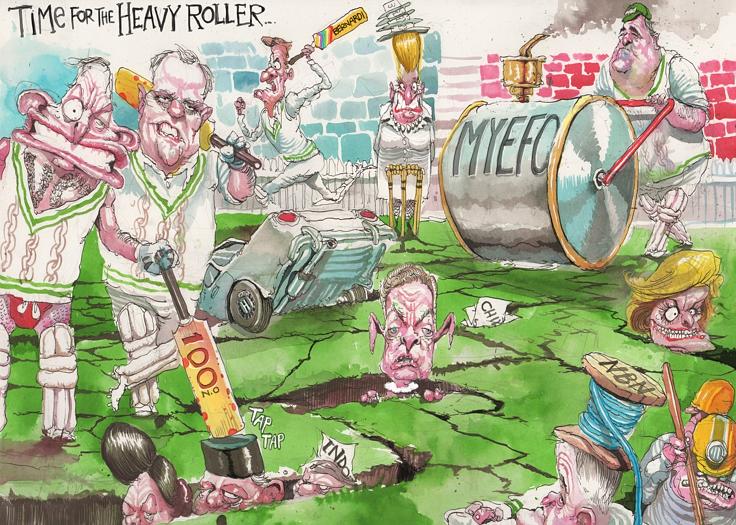
The basic defence of the Abbott Government by its friends is that it is suffering teething problems and that these need to be fixed because they are dogging the government. So Abbott needs to head off negative voter perceptions before they become entrenched and frame how the government is viewed. Various suggestions are then made by the friends of Abbot as to how the Coalition can best do this.
 David Rowe
This form of defence overlooks--ignores?--- the criticism that Abbott's 100 days suggests that the legacy the Abbott Government is currently building is not a visionary betterment of Australia. Rather it's more an ideological score-setting in a thoroughly vengeful vein. A good example of this is disallowing the Labor government's declaration of threatened ecological communities in the Murray Darling basin as endangered under the Environment Protection and Biodiversity Conservation Act.
As John Quiggin points out:
The problems of the basin have dogged state and federal governments since the early 1990s when the over-exploitation of water resources forced the imposition of a cap on extractions. Intended as a temporary measure, the cap is still in place and is not due to be removed until 2019. The [Labor Govts's] water minister Tony Burke managed to put together a management plan which secured the agreement of all the relevant state governments, and the grudging acquiescence of all the key stakeholders. The plan cost more than it should have, with a lot of money wasted on dubious water saving projects like Victoria’s Food Bowl Modernisation project, and returned less water to the environment than the scientific evidence suggested it should have.
Quiggin adds that despite its limitations, though, it seemed that the passage of the plan in 2012 represented that rarest of political achievements in Australia, the permanent solution of a longstanding policy problem:
After a political process which mostly involved concessions to irrigators, the (scientifically justified) declaration of the most sensitive parts of the Murray as endangered provided environmentalists with the security they needed that the plan would be implemented in a way that was consistent with sustainable management of the basin. With the change of government, this prospect has disappeared. As in so many other areas, the Abbott government may not know what it wants, but it knows it wants to tear down anything done by Labor.
The ideological score-setting is due to the Abbott Govt acting in the interests of its corporate backers---in the Murray-Darling case the irrigators, in others Big Mining and the fossil fuel industry. Their rhetoric of ‘green tape’ reduction, and their view of environmental policy as an enemy of economic growth, will result in a form of economic growth that causes substantial environmental damage and marked inequality.
The rhetoric of the politics of the vengeful score-setting results in the blame game. The clearest example of this is that Labor's profligate spending caused this economic crisis of debt and structural deficits, even though most of the budget deterioration was due to a softening economy, rather than Labor spending. No matter, its all Labor's fault---the rhetoric is to blame Labor for everything--- and savage budgets cuts --as suggested by the Commission of Audit--- are now necessary to overcome the crisis.
So big spending cuts are going to start in May to avert the looming disaster caused by Labor's failure to achieve a surplus due to its excessive spending and economic mismanagement.
Posted by Gary Sauer-Thompson at 10:48 AM | Comments (16) | TrackBack
December 14, 2013
digital futures
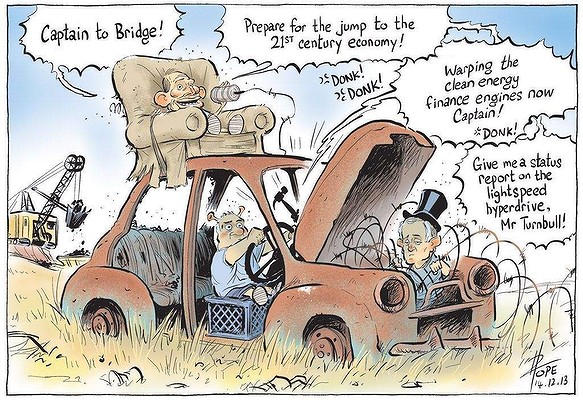
The National Broadband Network is crucial is crucial to Australia's future because without the infrastructure of high capacity symmetric broadband, Australia's future is quite depressing.
It will be, if the new luddite movement of technology-rejectors remain in charge of governing the country, because Australia's economy will remain primarily based on digging and growing things. Their form of a post-Industrial economy is the past and it and they will not prevent the decline of Australia manufacturing or the ongoing slide in middle-class incomes.
 David Pope
The rhetoric of the old cultural conservative strand of the new luddite movement opposing many forms of modern technology is familiar. That rhetoric was centred around the decline in civic values being laid at the door of “privatising” technologies such as the iPod and the mobile phone because they isolate social beings from one another, turning them into atomised consumers who actively withdraw into their own zones of security. These teenagers have become unsociable narcissists who use the internet to download porn and play games etc etc.
This old rhetoric indicates that the conservative opposition to a digital future is premised on a fear of the future unknown effects that new technologies might cause. They “refuse” the lure of “the electronic hive because the new media pose a dire threat to the search for “wisdom” and “depth". As Gertrude Himmelfarb put it:
Like postmodernism the Internet does not distinguish between the true and the false, the important and the trivial, the enduring and the ephemeral. . . . Every source appearing on the screen has the same weight and credibility as every other; no authority is ‘privileged’ over any other.
It’s mostly junk and a comic strip has the same authority as the Bible.
It goes deeper than the politicians and cultural conservatives. Many industrialists recognize the changes that are coming, and are fighting back hard. In order to protect their centralized business models they are trying to block any new advancement in communications technology or business model which threatens their current positions. This group includes those media traditionalists in favour of offshoring of manufacturing and de-industrialization premised on substituting inexpensive labor for capital. Why invest in a machine to assemble products in Australia when Chinese companies could throw half a million workers at the problem? The Internet, telephones, and affordable air travel and sea shipping made it easier than ever to coördinate labor from far away.
At the core of the idea that broadband can enhance economic growth is the belief that the Internet, and broadband in particular, is a General Purpose Technology (GPT). If that is the case, then it does have the potential to fundamentally alter the nature of the economy, just as electrification did. It is the new economic activity made possible by the high speed infrastructure that is the key to our digital futures. It is the basic infrastructure that is needed for work, life and leisure activities.
It will also cause economic disruption and generates winners and losers. If the net economic effect of buying a book from Amazon rather than from your local bookstore is similar, it is Amazon rather than the local bookstore benefits from the transaction. Consequently, the number of workers in the book, periodical, and music stores has decreased markedly. Much of business-to-consumer e-commerce, for example, reflects a shift in economic activity from ―brick and mortar to online retail rather than new economic activity.
It is true that the kind of manufacturing in which labor costs are most important isn’t ever coming back from low-wage countries , but that doesn't preclude Australia focusing its efforts on advances in the technology of manufacturing itself—the set of new ideas, factory innovations, and processes. Australia needs to build on its advantages in many advanced technologies, such as simulation and digital design, the use of “big data,” and nanotechnology. All of these can play a valuable role in creating innovative new manufacturing processes as well as products.
Such an industrial policy for manufacturing involving cutting-edge techniques or products would have policies to boost domestic manufacturing—tax breaks, new R&D spending, and vocational training for workers in areas including advanced technologies like batteries, computing, defence and biotechnology.
Posted by Gary Sauer-Thompson at 2:40 PM | Comments (4) | TrackBack
December 13, 2013
Australia's cheap and nasty "NBN"
The Coalition's alternative NBN policy was based on the core pledge that the party would deliver download speeds of between 25Mbps and 100Mbps by the end of 2016 — effectively the end of its first term in power — and 50Mbps to 100Mbps by the end of 2019, effectively the end of its second term.
According to the Coalition’s statement, the 25Mbps to 100Mbps pledge applied to “all premises”, while the higher pledge by 2019 applies to “90 percent of fixed line users. These speeds would predominantly be delivered over the long-term with fibre to the node technology through upgrading Telstra’s existing copper network, focusing on areas where “the poorest broadband” services are currently suffered by residents and businesses. By the end of 2019, some 71 percent of premises were slated to be covered with fibre to the node infrastructure.
 Alan Moir
Behind this policy was Abbott's initial directive to Turnbull to destroy the NBN, even though the whole NBN idea was created to overcome a clear and demonstrable market failure that had already cost Australia 10 years. Well, the NBN is history. It was the ALP's infrastructure project, and they failed to deliver. We are left with the Coalition's FTP model, which implied that the NBN project would survive in a reasonable form under a Coalition Government, and that it would be built quicker and cheaper.
What we now know after the release of the NBN Strategic Review, is that this is not the case. What we discover is that there is a fundamental gulf between what the Coalition says it is doing, what is technologically achievable and what it is actually doing.
Those areas currently “served” by the HFC cable footprint will get no upgrade at all, only 43 percent of premises will have access to 25Mbps by 2016; many will doubtless still be on ADSL2+ when the Coalition’s “NBN” is completed; and NBN Co is not able to guarantee a 50Mbps connection on an FttN network as that is highly dependent on Telstra’s copper network.
The new strategy, dubbed the optimised multi-technology mix, will see 26% of premises reached by fibre to the premises (FTTP), Labor’s preferred technology.Thirty percent will receive HFC connections, and 44% will get fibre to the node (FTTN) – the slower option which relies on copper wiring to carry data from fibre connections into homes and businesses. So a quarter of Australia will be on the cutting edge, while the rest of us will be lucky to get that 25mbit download figure that Turnbull is so fond of. You can forget 50mbits down or higher.
We currently live in a world where many of us use ADSL2+ technology that is theoretically capable of 24Mbps, but many users are lucky to see one fifth of that speed. The coalition will need to spend $41 billion on its mixed-technology network that is not even delivering super-fast broadband to most Australians.
This is fundamental infrastructure which will underpin the future of the Australian economy and the public sector. Technology is an enabler and driver of innovation and Australia has suffered from poor telecommunications infrastructure for a decade or more. With the Coalition by 2025 the government of the day will be planning the upgrade of our cut-down NBN to be completely based on the same fibre-to-the-premises (FttP) technology that Labor had been implementing now.
Moreover their FttP model won't generate enough revenues to justify the expense of implementing FttN---we are going to be up for another $30 billion in expenditure for an FttP upgrade from 2025.
Posted by Gary Sauer-Thompson at 11:40 AM | Comments (5) | TrackBack
December 12, 2013
how's it going Tony?
How's the Abbott Government traveling? Not well.
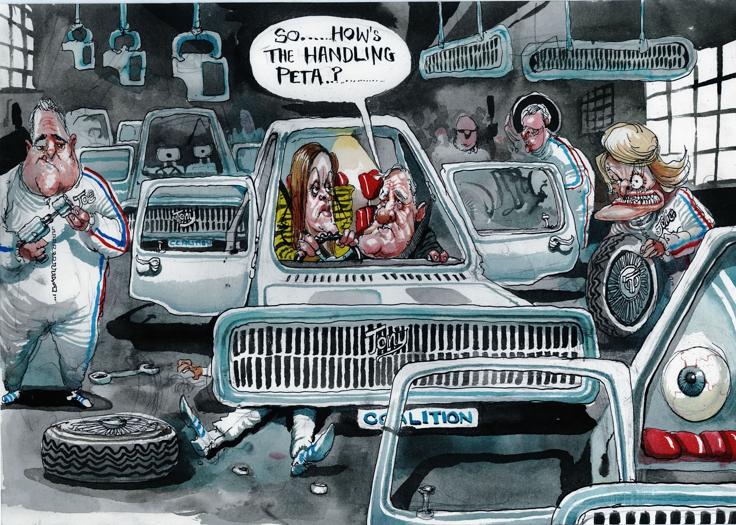
They wanted to drive GMH's auto manufacturing out of Australia. They knew that GMH could only survive with government subsidies---or a co partnership-- but the Abbott Government stated explicitly that GMH would have to do continue by relying on its own resources, not public funds. Given the sustained strength of the Australian dollar, high cost of production, small domestic market and arguably the most competitive and fragmented auto market in the world building cars in Australia is just not sustainable.
The Coalition knew that GM Holden was going to leave Australia as part of GM's global restructuring in the wake of the GFC.
 David Rowe
Many would have expected that the Abbott Government would have a new growth strategy in place given its rhetoric about stable, methodical government; or at the very least, Cabinet would have nutted out some strategy for how it will assist the workers directly affected by the auto shutdowns (Mitsubishi, Ford in 2016, GMH in 2017) the components industry which relies on the car manufacturers, and the state economies in Victoria and South Australia.
The Coalition government are making the industry policy up as they go along. The things that they consistently say is that the flexible market forces will sort things out in the context of a high Australian dollar, that Australia has a high cost base which makes manufacturing uncompetitive, and they are reducing the cost base by removing the carbon tax. Flexible market forces will cut out the dead wood, cause structural change and allow capital to flow to sectors in which Australia have a genuine global competitive advantage.
What does that mean in the context of slow global economic growth, the Coalition’s decision to block the takeover of Graincorp to global capital, and killing off investment in renewable energy?
The Coalition (Abbott + Pyne) basically respond by riffing the Lucky Country meme by saying the resources industry will do the trick for SA. Yet BHP has yet to work out how to mine, treat and transport Olympic Dam material on a larger scale. The old large open pit plan was a boom-time uneconomic idea. The Coalition, in "getting on with the job of governing", are playing with mirrors on this.
The inference of the Coalition's Luck Country rhetoric is that the national economic base narrows when it is in transition from the resources boom, and it locks Australia into resource development as the key economic driver. With slow growth in China and a narrow industrial base this policy means that Australia is facing a slow process of decay and decline. Moreover, a narrowing economic base does not help the regional economies of SA and Victoria transition away from the conventional, low skilled assembly line manufacturing to advanced, high skill manufacturing. That latter requires high quality research and educational facilities if the country is to develop new and innovative industries and jobs.
So where is the future economic growth going to come from, given the absence of a coherent industry policy from the Coalition? All that we currently hear from the Abbott Government is that it will come from reducing red tape and removing anti-jobs taxes (that is, the mining tax and carbon pricing), and from mining, agriculture and tourism. These coupled with proper government decision making, will restore the economic fundamentals. The market will then do the rest, apparently.
Update
Australia is now integrated into the global market and so the government is not really in control of our economy as it has retreated to shifting to accommodating and harnessing the transformative capacity of global capital. As Waleed Aly observes:
we do not call our own shots; no longer is there a hierarchy with the nation-state on top and everyone else - corporations, civil society and citizens - below. Power is shared now. Companies play countries off against each other looking for the best deal, much as we haggle over a shop purchase. Our world isn't exactly borderless - and some countries are more protectionist than others - but those borders now seem to denote zones rather than dominions. The world is a country now, and nations are its cities.
The market has a solution to the workers laid off by the decline of the auto industry: labour mobility. You either acquire new skills or go where your skills will be rewarded. But the social and political reality is more complicated. If there is a continual process of shedding industries and developing new ones, it is not clear that a lot of people harmed in the first process will be rescued by the second.
Posted by Gary Sauer-Thompson at 9:42 AM | Comments (10) | TrackBack
December 10, 2013
the writing on the wall
The signs are pretty clear. The Abbott Govt's position is clear.
There will be no more public subsidies for an unprofitable car industry that requires corporate welfare to survive in Australia. If it was to remain in Australia GMH would have to do so by relying on its own resources, not public funds. The Abbott Government is pulling the plug. So let the domestic car industry close. Hockey's argument is that Australia’s long-term economic prosperity will be best served by the efficient allocation of resources, primarily via flexible market forces.
The economic reality is the high Australian dollar, almost no tariff protection, large car sales have nosedived in the domestic market, and export markets have dried up largely due to the unexpected strength of the Australian dollar that has made imports cheaper and exports tougher.
 David Pope
If Holden goes in 2017, Toyota will follow it out of manufacturing in Australia, since the critical mass in the supply chain is lost. A network of suppliers would then collapse. So we have a declining manufacturing sector that is the unavoidable consequence of the resources boom. Does the decline in local auto manufacturing matter in an open, competitive, flexible economy?
Well, what isn't going to happen from an Abbott Government is a commitment to more specialised, highly skilled and knowledge-intensive Australian manufacturing sector. The future for manufacturing is one driven by high skills, knowledge-led innovation. That presupposes a highly skilled workforce. That isn't going to happen under an Abbott Government.
Update
According to GM in Detroit, Australia was suffering a severe case of ''Dutch disease'' - an economic malaise by which a mining boom had pushed up the local currency and wages for industrial workers.Without government assistance, GM's head office in Detroit had decided that making cars in Australia no longer added up - to the tune of $3750 a car per year.
Devereux, the GMH managing director, told the Productivity Commission he did not have to eliminate the entire $3750 gap, just enough to keep his masters happy. What Holden needed was a further commitment of $150 million a year from the government through to 2020 - roughly $2000 a car built. With that, Mr Devereux could get the numbers to work. In return, Holden would continue making the VF Commodore and Cruze in Australia until 2017, and then commit to build GM's next generation global car in Adelaide until 2020.
GMH needed a public-private partnership over the long term to be able to be relatively competitive. They had brokered an enterprise bargaining agreement with the unions that enshrined a three-year wage freeze and won an extra 16 minutes of work time per employee a shift.
The Abbott Government refused to come to the table. Instead, Acting Prime Minister Warren Truss and Treasurer Joe Hockey launched an attack on GMH in parliament. Detroit pulled the plug. Their political strategy was to ensure that they were not seen as culpable for the decision and not on dealing with its consequences. The Coalition had no alternative plan in place to deal with either the political or policy fallout of the GM Holden decision with respect to the workers, the components industry which relies on the car manufacturers and the state economies in Victoria and South Australia.
Posted by Gary Sauer-Thompson at 3:00 PM | Comments (9) | TrackBack
December 9, 2013
mass snooping
The Snowden disclosures have shown the extent to which the National Security Agency--and its associated including the Australian Signals Directorate (ASD) ---extraordinary surveillance infringes on the privacy of our communications and other vast areas of our lives. It has become readily apparent the extent of their disregard for individual privacy. Their motto seemingly is “If it can be accessed, take it."
 Alan Moir
The politicians offer cheap reassurances--- "if you’re doing nothing wrong, you’ve got nothing to worry about”--- whilst refusing to accept wrongdoing. The political class appear determined to conceal the fact that their monitoring extends to the electronic communications of whole populations. The conservative mainstream media appears to have a structural hostility to both any exposure of mass snooping by the state, and to the realisation of a participatory, deliberative or active public.
The quantities of data that are being collected are vast: so vast that there is no way they can be sifted by hand; instead the NSA analysts have to create algorithms that look for data that stands out and fits certain abnormal patterns.This generates the fear of a powerful and far-reaching security state due to the risk of ever-present risk of being placed under surveillance.
The political class say that the government needs a fairly free rein to act as it sees fit to protect the public because the ultimate human right is the right not to be blown up by a terrorist: in other words, accepting state secrecy in the name of security but at the cost of an end to privacy as we have known it.Their reassurance takes the form of parliamentary oversight of state secrecy and the ever-encroaching surveillance powers of the government.
Posted by Gary Sauer-Thompson at 10:23 AM | Comments (6) | TrackBack
December 6, 2013
living off the fat
The recent Keating interviews on the ABC indicates that it was the economic reforms of the Hawke and Keating Government that opened up Australia to the flows of the global capitalist economy. As Tony Shephard remarks:
We had a fixed exchange rate, tariffs [on imports] were still high, we were frightened of Japanese investment … our financial system was tightly regulated, our industrial relations system was centralised, complex and unproductive, and just about every service was provided by the public sector. State ownership extended to banks, insurance, telecommunications, airlines, ports, shipping, dockyards, electricity, gas etc.
Australia was an ''moribund, inward-looking industrial graveyard''. It was in economic decline. Quality reform was required, not just the empty political rhetoric favoured by the Abbott Coalition Government.
 David Pope
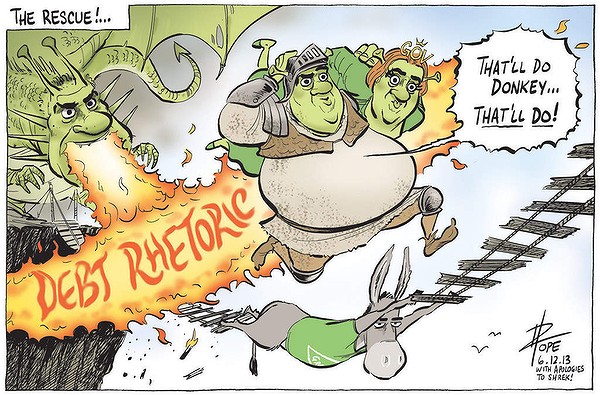
Hawke and Keating floated the dollar, undertook financial deregulation, privatised government enterprises, reduced tariffs and introduced labour market deregulation. They also reduced real wages, providing a social welfare net instead (Medicare, superannuation, tertiary education). This pattern continued under the Howard Coalition government during the China-fuelled Australian resources boom.
Looking back on that period of history from the perspective of the Keating interview we can see that economic globalisation is the game changer. Keating understood that, with global capitalism, the state had to make room for more powerful markets and the flows of international capital.
The state had to undertake an orderly, strategic retreat as an economic unit and shift to accommodating and harnessing the transformative capacity of global capital, rather than trying to fight it. The core policy issue then becomes one of how you globalize not whether you globalize.
It was the China-fuelled Australian resources boom that enabled Australia to enjoy the good times. This veiled the extent to which it is now the power of global markets that are more powerful than the state, which has political authority over society and the economy.
Although Big Mining said the boom would be eternal, Australia is now in the post boom adjustment period. Chinese growth is plateauing and that h means more straightened times of lower terms of trade, lower economic growth, declining revenues and lower living standards for Australia. Such an economic period post-GFC requires innovative ideas and new future industries. So where are the new growth corridors?
So what is the Abbott Government doing to prepare for the period that has emerged in the form of the iron cage of the Dutch disease? So far, it appears that they are pretending that it’s not happening. Are they hoping that something will come along with respect to innovation and entrepreneurship? Or does this denial signify a return to the period of the Great Complacency?:--namely, Big Mining (ie, the resources industry) will see us right once again.
The key concern here is that since world market economy has outgrown the authority of the state, national governments evidently lack both the power and the will to make good the deficiencies of inequality and instability that have always gone with growth and change in market economies. How is the Abbott Government going to address that now that it cannot afford to plough money into the endless trough of middle-class welfare?
Posted by Gary Sauer-Thompson at 7:55 AM | Comments (16) | TrackBack
December 4, 2013
conflicting pressures
In spite of the nimble political footwork and ad hockery the Coalition do look a mess. It's more than a few stumbles in the early days of a anew government. As Jack Waterford observes in the Canberra Times:
In two years down the track, the events of the past week may be remembered not for the Pyne pratfalls or the shifts by Abbott. Rather, they will be remembered as proofs the Coalition did not have its act together on fundamental problems (relations with the states, schools and educational standards and government spending), nor a mechanism of controlling public expenditure - instanced by how Abbott was able to pluck a notional $1.2 billion from the ether after but a brief discussion with the leadership team.
The Coalition's often inept, slapstick performances increasingly suggest that they don't have their act together on the core policy issues. It does look as if the strategic brilliance had always been to aggressively break apart the Labor government, not develop a coherent agenda for reform.
 David Pope
The question is why? What's going on? It's certainly not due to the political pressure from the ALP or the Greens on the Coalition. They appear to be flailing about within their internal contradictions, and it looks as if the pressure on the Abbott Government is coming from within its own splintering ranks.
There is a gap between the governing the country in a stable, prudent manner and satisfying the ideological demands and expectation of the contradictory strands of the conservative base. The foundations on which the Abbott ascendancy has been built are shaky.
Posted by Gary Sauer-Thompson at 3:49 PM | Comments (5) | TrackBack
December 2, 2013
let's tear up the system
I guess it is best to have low expectations of the Abbott Government truth telling; expect the worst with respect to competence; be prepared for public policy in the form of large dollops of ideological revenge and lots of lectures on the evils of political correctness. Oh, and the Rudd-Gillard governments will be blamed for basically everything.
Judging from the record so far we can expect the use funding and economics aggressively to attack public sector institutions; and the use of the power and authority of the state to promote and prescribe forms of social morality – "Australian values" – that are prescriptive and traditional.
 Bruce Petty
We will experience another round of the culture wars: progressive educational policy is little than more highfalutin liberal claptrap; teachers are part of a leftwing conspiracy; since the state cannot cope with, or manage, the demands of modern public education it is time to bring in the private sector.
They will find that their policy of rolling back Labor's reforms will meet with resistance as many of these are publicly popular and represent good public policy. The Gonski reforms are a good example. Abbott and Pyne are ideologically wedded to increasing funding for independent schools as their priority, as part of their “school choice” program, that they fundamentally dislike the Gonski model; and they don’t see any problem in the inequitable school funding model we have at the moment.
Of course, the Coalition will deny the breaking promises made to win the election, or making backflips, or playing their clever word games as they twist and turn in the wind.
Update
The Coalition's backflip on the Gonski reforms for reasons of political expediency has seen them weaken the obligations on the states for the federal money. Michelle Grattan points out that:
It is true the government now has all states in some sort of model. It is a model that is all give by the federal government with no responsibilities imposed on the states. The latest deals do not require undertakings by the states and the government has always planned to remove accountability requirements from the legislation to which the other states signed up.
The states have been pulling money out of public education for years. The removal of the co-contribution requirement on the states will mean more state funding could go, leaving state schools, that have the most disadvantaged students, worse off.
Posted by Gary Sauer-Thompson at 10:51 AM | Comments (9) | TrackBack