|
December 14, 2013
The National Broadband Network is crucial is crucial to Australia's future because without the infrastructure of high capacity symmetric broadband, Australia's future is quite depressing.
It will be, if the new luddite movement of technology-rejectors remain in charge of governing the country, because Australia's economy will remain primarily based on digging and growing things. Their form of a post-Industrial economy is the past and it and they will not prevent the decline of Australia manufacturing or the ongoing slide in middle-class incomes.
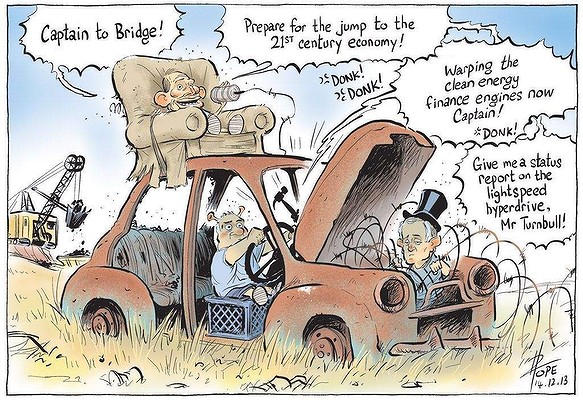 David Pope
The rhetoric of the old cultural conservative strand of the new luddite movement opposing many forms of modern technology is familiar. That rhetoric was centred around the decline in civic values being laid at the door of “privatising” technologies such as the iPod and the mobile phone because they isolate social beings from one another, turning them into atomised consumers who actively withdraw into their own zones of security. These teenagers have become unsociable narcissists who use the internet to download porn and play games etc etc.
This old rhetoric indicates that the conservative opposition to a digital future is premised on a fear of the future unknown effects that new technologies might cause. They “refuse” the lure of “the electronic hive because the new media pose a dire threat to the search for “wisdom” and “depth". As Gertrude Himmelfarb put it:
Like postmodernism the Internet does not distinguish between the true and the false, the important and the trivial, the enduring and the ephemeral. . . . Every source appearing on the screen has the same weight and credibility as every other; no authority is ‘privileged’ over any other.
It’s mostly junk and a comic strip has the same authority as the Bible.
It goes deeper than the politicians and cultural conservatives. Many industrialists recognize the changes that are coming, and are fighting back hard. In order to protect their centralized business models they are trying to block any new advancement in communications technology or business model which threatens their current positions. This group includes those media traditionalists in favour of offshoring of manufacturing and de-industrialization premised on substituting inexpensive labor for capital. Why invest in a machine to assemble products in Australia when Chinese companies could throw half a million workers at the problem? The Internet, telephones, and affordable air travel and sea shipping made it easier than ever to coördinate labor from far away.
At the core of the idea that broadband can enhance economic growth is the belief that the Internet, and broadband in particular, is a General Purpose Technology (GPT). If that is the case, then it does have the potential to fundamentally alter the nature of the economy, just as electrification did. It is the new economic activity made possible by the high speed infrastructure that is the key to our digital futures. It is the basic infrastructure that is needed for work, life and leisure activities.
It will also cause economic disruption and generates winners and losers. If the net economic effect of buying a book from Amazon rather than from your local bookstore is similar, it is Amazon rather than the local bookstore benefits from the transaction. Consequently, the number of workers in the book, periodical, and music stores has decreased markedly. Much of business-to-consumer e-commerce, for example, reflects a shift in economic activity from ―brick and mortar to online retail rather than new economic activity.
It is true that the kind of manufacturing in which labor costs are most important isn’t ever coming back from low-wage countries , but that doesn't preclude Australia focusing its efforts on advances in the technology of manufacturing itself—the set of new ideas, factory innovations, and processes. Australia needs to build on its advantages in many advanced technologies, such as simulation and digital design, the use of “big data,” and nanotechnology. All of these can play a valuable role in creating innovative new manufacturing processes as well as products.
Such an industrial policy for manufacturing involving cutting-edge techniques or products would have policies to boost domestic manufacturing—tax breaks, new R&D spending, and vocational training for workers in areas including advanced technologies like batteries, computing, defence and biotechnology.
|





Of course the religion based on the Bible is now little more than a childish, even infantile comic book religion.