|
December 12, 2013
How's the Abbott Government traveling? Not well.
They wanted to drive GMH's auto manufacturing out of Australia. They knew that GMH could only survive with government subsidies---or a co partnership-- but the Abbott Government stated explicitly that GMH would have to do continue by relying on its own resources, not public funds. Given the sustained strength of the Australian dollar, high cost of production, small domestic market and arguably the most competitive and fragmented auto market in the world building cars in Australia is just not sustainable.
The Coalition knew that GM Holden was going to leave Australia as part of GM's global restructuring in the wake of the GFC.
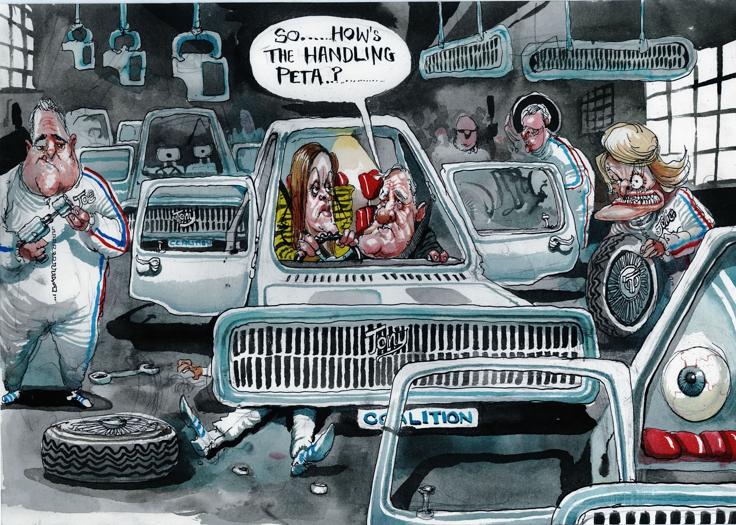 David Rowe
Many would have expected that the Abbott Government would have a new growth strategy in place given its rhetoric about stable, methodical government; or at the very least, Cabinet would have nutted out some strategy for how it will assist the workers directly affected by the auto shutdowns (Mitsubishi, Ford in 2016, GMH in 2017) the components industry which relies on the car manufacturers, and the state economies in Victoria and South Australia.
It hasn't any strategy.
The Coalition government are making the industry policy up as they go along. The things that they consistently say is that the flexible market forces will sort things out in the context of a high Australian dollar, that Australia has a high cost base which makes manufacturing uncompetitive, and they are reducing the cost base by removing the carbon tax. Flexible market forces will cut out the dead wood, cause structural change and allow capital to flow to sectors in which Australia have a genuine global competitive advantage.
What does that mean in the context of slow global economic growth, the Coalition’s decision to block the takeover of Graincorp to global capital, and killing off investment in renewable energy?
The Coalition (Abbott + Pyne) basically respond by riffing the Lucky Country meme by saying the resources industry will do the trick for SA. Yet BHP has yet to work out how to mine, treat and transport Olympic Dam material on a larger scale. The old large open pit plan was a boom-time uneconomic idea. The Coalition, in "getting on with the job of governing", are playing with mirrors on this.
The inference of the Coalition's Luck Country rhetoric is that the national economic base narrows when it is in transition from the resources boom, and it locks Australia into resource development as the key economic driver. With slow growth in China and a narrow industrial base this policy means that Australia is facing a slow process of decay and decline. Moreover, a narrowing economic base does not help the regional economies of SA and Victoria transition away from the conventional, low skilled assembly line manufacturing to advanced, high skill manufacturing. That latter requires high quality research and educational facilities if the country is to develop new and innovative industries and jobs.
So where is the future economic growth going to come from, given the absence of a coherent industry policy from the Coalition? All that we currently hear from the Abbott Government is that it will come from reducing red tape and removing anti-jobs taxes (that is, the mining tax and carbon pricing), and from mining, agriculture and tourism. These coupled with proper government decision making, will restore the economic fundamentals. The market will then do the rest, apparently.
Update
Australia is now integrated into the global market and so the government is not really in control of our economy as it has retreated to shifting to accommodating and harnessing the transformative capacity of global capital. As Waleed Aly observes:
we do not call our own shots; no longer is there a hierarchy with the nation-state on top and everyone else - corporations, civil society and citizens - below. Power is shared now. Companies play countries off against each other looking for the best deal, much as we haggle over a shop purchase. Our world isn't exactly borderless - and some countries are more protectionist than others - but those borders now seem to denote zones rather than dominions. The world is a country now, and nations are its cities.
The market has a solution to the workers laid off by the decline of the auto industry: labour mobility. You either acquire new skills or go where your skills will be rewarded. But the social and political reality is more complicated. If there is a continual process of shedding industries and developing new ones, it is not clear that a lot of people harmed in the first process will be rescued by the second.
|





The Howard government blew the mining boom.
Rather than save the most economic windfall to help manufacturing rebound in the post mining boom period, Howard and Costello spent the proceeds on tax cuts and middle-class welfare.