« August 2013 | Main | October 2013 »
September 30, 2013
GOP hostage-taking
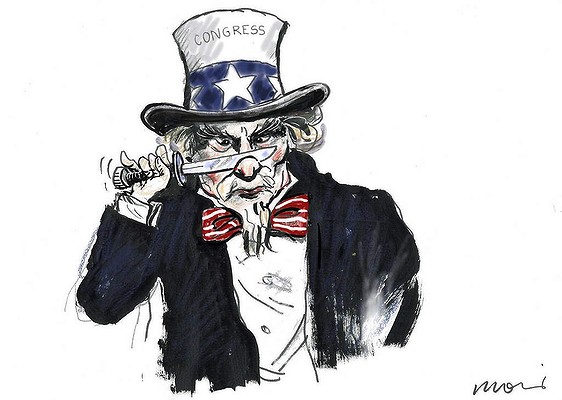
The US Republican Party is at it again--political grandstanding in their gun-to-the-Obama head style and turning brinksmanship into standard operating procedure on the Hill.
House Republicans refused to pass a budget unless it involved a delay to Barack Obama's signature healthcare reforms. The resolution passed by the Republican-controlled House of Representatives makes funding the government until the middle of December contingent upon a one-year delay of the Affordable Health Care Act. It also strips the new healthcare law, which is due to come into force on Tuesday, of a key tax on medical devices.
 Alan Moir
Senate Democrats and the White House have said that they will block any budget resolution that is tied to the healthcare law – the flagship legislative achievement of Obama's presidency – which was passed three years ago and upheld by the US supreme court last year. The Senate is expected to wait until Monday before stripping the Republican motion of its references to healthcare and, for the second time in a week, returning a "clean" bill to the House that would fund federal departments, without also impeding the introduction of mandatory healthcare for Americans who are uninsured. The Republicans may then try one more gambit to chip away at Obamacare, but time is growing short. The deadline is Monday at midnight.
This will be the first government shut down since 1996, when House Speaker Newt Gingrich and President Clinton clashed over spending. That shutdown left a deep political scar, with Clinton's approval rating skyrocketing after the shutdown and Republicans shouldering much of the blame. This shutdown will have far reaching effects.
It's only a small faction of the GOP congressional caucus (30, to be exact) that wants to shut government down. The Republican Party is trying to sure that the working poor don't have access to affordable health care: or that rich people will see their taxes go up slightly in order to help non-rich people get decent access to medical care. The GOP, as a national party, will suffer because of using government shutdown to disrupt the implementation of Obama's healthcare.
The next standoff is raising the debt ceiling, which will have to be done in the next few weeks or the US government will default and possibly trigger a financial crisis that could go international. The GOPers are angling to prevent an expansion of the government's borrowing authority unless Obama agrees to accept deeper spending cuts, defund healthcare and approve the Keystone XL pipeline.
Not raising the debt ceiling means that the US ouldn't borrow more to pay for the spending Congress has already authorized. It would have to pay what we owe out of tax receipts and rolled-over debt instead. But as the Bipartisan Policy Center (BPC) points out, tax receipts and rolled-over debt would only cover 68 percent of our bills. So they'd have to cut the rest--- an immediate 32 percent austerity.
Basically the rightwing Republicans, are threatening that if they don’t get their way they’ll close down the government and cause the nation to default on its debts. Tea Party Republicans are part of a social movement that explicitly defends the interests of the rich and the almost-rich to de-tax themselves. The rhetoric is one of was selling the notion that if the rich bear less of the burden of government, all of us will somehow end up better off. The modern Tea Party demands that a congress and president—elected by the people—lack legitimacy and must reduce taxes, especially on business and owners of capital.
The minority Tea Party Republicans are doing so less than a year after its party lost the presidency, lost the Senate (and lost ground there), and held onto the House in part because of rotten-borough distortions. They are doing so even though the US is exceptional for being a place where 45,000 deaths a year are related to a lack of comprehensive health insurance coverage. That’s about ten 9/11′s worth of death each year because of the US's exceptional position as the only industrialized nation without a universal public health care system. The consequence is that medical bills are the country’s single largest cause of bankruptcy.
Posted by Gary Sauer-Thompson at 2:59 PM | Comments (20) | TrackBack
September 28, 2013
IPCC:--Australia's future
The IPPC report is basically yet more evidence demonstrating the extent of global temperature rises, the melting of ice sheets and sea ice, the retreat of the glaciers, the rising and acidification of the oceans and the changes in weather patterns. It is the first sliver of a vast body of work on climate change that’ll be published this year and in 2014--the so-called fifth assessment report (AR5), which focuses on the scientific evidence behind climate change and the human role in it.

Martin Rowson
The report concludes that there is a 50-50 chance that global temperatures will exceed 4C this century if carbon emissions are not curbed. Without "substantial and sustained" reductions in greenhouse gas emissions we will breach the symbolic threshold of 2C of warming.
To hold warming to 2C, total emissions cannot exceed 1,000 gigatons of carbon. Yet by 2011, more than half of that total "allowance" – 531 gigatons – had already been emitted.To ensure the budget is not exceeded, governments and businesses may have to leave valuable fossil fuel reserves unexploited because there's a finite amount of carbon you can burn if you don't want to go over 2C.
Australia is going to be badly hit according to Oliver Milman, whose summary of what the report says, states:
Australia is expected to experience a 6C average temperature rise on its hottest days and lose many reptile, bird and mammal species as well as the renowned wetlands of Kakadu by the end of the century, the latest Intergovernmental Panel on Climate Change report reveals.IPCC figures show that Australia will experience an average overall increase of 2C by 2065, with that figure slightly lower at the coast. Beyond that, the temperature is expected to rise another 3C-4C by 2100. The number of days that don't fall below 20C is projected to rise to 100 a year, with most of these warmer days in the north and on the east coast.
Rainfall patterns are set to change, with annual precipitation, humidity and cloud cover predicted to decrease over most of Australia. But for north Australia and many agricultural areas, rainfall is predicted to get heavier. Soil moisture will decrease, mostly in the south of the country.
The Coalition government will say that its direct action plan is doing something to avert the scenario the panel foresees, but it will continue to actively promoting the fossil fuel industries industries that cause it.
Posted by Gary Sauer-Thompson at 5:04 PM | Comments (8) | TrackBack
September 27, 2013
media management in Fortress Australia
The Coalition Government is trying to ensure it retains control over information. This is a source of power – in relation to opponents and to the media---and it is an attempt to both keep issues off the table and to only have the government's interpretation of the issue in the public space. This will ensure calm, measured, competent government.
A single unified message with no surprises or controversies requires a military-type discipline to be imposed:
 Alan Moir
It is not going to work on asylum seekers. The boats keep coming--there have been 10 boat arrivals since the federal election. Indonesia has repeatedly warned against the Coalition's policy to turn boats back to Indonesia, which is part of Operation Sovereign Borders. Indonesia's foreign minister has divulged the contents of his private discussions with his Australian counterpart Julie Bishop, which shows him warning the Abbott government against taking any "unilateral steps" which would risk "cooperation and trust" between the two countries.
The Abbott Government will struggle to turn back boats without Indonesian cooperation and unilaterally turning back boats won't resolve the issues.
All this stands in sharp contrast to the conservatives' default tactic in opposition: inculcating a sense of crisis and emergency---by theatrically and effectively deploying the language of crisis, catastrophe, emergency, debacle and disaster--and then convincing the public that they are best suited to manage the recovery from the “disaster”. One consequence of this fear campaign around asylum seekers is that the conservative base in Australia has become more inward looking and insular, and more hostile towards Indonesia. Fortress Australia.
They are angry and inflamed and do not see the issue as a passing irritant. They see it in terms of national sovereignty and border security. The boats are a breach of Australia sovereignty. It's a major issue for the conservative base and they see it in terms of crisis and emergency.
Posted by Gary Sauer-Thompson at 10:11 AM | Comments (14) | TrackBack
September 26, 2013
unwinding higher education reforms
Over the last 30 years, Australia has moved from an elite system of higher education to a mass system.
In the process it has also become a demand- driven system under the Gillard Government, which changed the publicly-funded higher education from being supply-dominated to demand-driven. Andrew Norton says:
Under the old funding system, demand and supply were only weakly linked. Potential students could apply to any course in any university. But the supply of places was constrained by government. Universities rationed places within this supply constraint. Typically, they used prior academic performance to decide who received a place. This created a market in which ATAR was the currency and the cut-off mark the price. Students with low ATARs often received no offers.
Since caps on undergraduate student places at public universities were eased and then largely abolished, student numbers have increased rapidly, by as many as 190,000 extra students. With uncapping, the system is lifting the supply of graduates to Australia‟s economy, increasing student choice, and improving access to higher education for disadvantaged groups. Universities start responding to demand trends in science, health and engineering by providing new student places.
 David Rowe
Norton argues that it would be a policy tragedy to recap university places, as it would make Australia‟s higher education system less fair, less efficient, and less productive.
Notwithstanding this, the Coalition has opened the door to intervening in the demand-driven system of university funding by re-introducing caps on university places. The reason is the link to a perceived slip in university quality---Quality is suffering to achieve quantity according to Christopher Pyne, the new Federal Education Minister.
Standards and quality have been compromised by all these new students. A re-capping of the system would bring these numbers back down again. Universities ration places by prior academic ability. Fewer places mean fewer lower-ATAR students. Capping the system, which would provide more per student funding for those left behind, would be a case of robbing from the academically poor to give to the academically rich.
Posted by Gary Sauer-Thompson at 10:52 AM | Comments (4) | TrackBack
September 25, 2013
making science the enemy
Australia's public culture is becoming one in which a politically motivated, decades-long war on expertise and science has eroded the popular consensus on a wide variety of scientifically validated topics. Everything, from evolution to the origins of climate change, is now mistakenly up for grabs again; whilst scientific certainty is just another thing for two people to "debate" on television.
The 20th century's belief in progress---science drives prosperity and progressive political thought --- should be questioned, and the various models of science debated and evaluated. So should the politicization of science, given the history of totalitarianism (right and left) in the 20th century. That type of questioning however is quite different from it being politically effective, and socially acceptable, to deny scientific fact, reasoning (ie., its open-ended, evidence-based processes) and knowledge.
For example, denying evolution is becoming a litmus test for some conservative politicians along with a rebranding of that denial as “creation science” coupled to a political demand that it be taught in classrooms across the country; even though the "biblical literalism" school of thought, which believes that each and every word and story in the bible is the inerrant word of God and that anything that "conflicts" with it is evil, makes science the enemy.
Another example is the climate deniers' manufactured doubt about fundamental issues in climate science that were decided scientifically decades ago. Denying climate change is now a standard part of Australian conservatism; even though manufacturing doubt is a campaign by corporations to avoid the very real liabilities that should be associated with the environmental and health hazards caused by the products they sell and the ways in which they manufacture and or extract those products.
A lot of this has to do with Australia conservatism increasingly taking its bearings from an American conservatism that has embraced and become part of the counter-enlightenment tradition's attack on enlightening reason. This holds that since the application of critical reason can only divide and disunite, the only rational course of action, at least for the counter revolutionary is to harness the force of irrationality into the service of political authority.
This is a fight in postmodernity against the influence of reason, natural science, liberalism, progressivism, secularism and meliorism. It is an attack on all those who hold that all human beings are born free, only to be shackled by the garlanded chains of socialised injustice and class oppression.
Political authority is to be grounded on the irrational which has the power to sustain itself against the onslaughts of rational critique in perpetual rebellion against divine authority, the family, and social hierarchies . Reason dissolves the rigid bonds of a well-governed ordered society, without which human beings will inevitably destroy each other.
Posted by Gary Sauer-Thompson at 1:13 PM | Comments (14) | TrackBack
September 23, 2013
goodbye NBN
The Coalition's return to power means the end of the National Broadband Network.
The Abbott government has flagged at least three examinations into broadband: an independent audit of NBN Co's books, a review of its commercial progress and a Productivity Commission inquiry into broadband policy.
 David Pope
However, it doesn't mean that Australia's broadband future remains open to interpretation. We know that Labor’s nation-building, wholesale infrastructure model has been dumped in favour of the Coalition’s private sector-friendly, market-driven approach. There are two implications of this.
Firstly, the Coalition's policy is to change the current fibre-to-the-premises to a fibre-to-the-node model. The copper network represents the cornerstone of the Coalition's $30bn policy. So two-thirds of the connections to premises will be copper instead of fibre.
This will make the network cheaper to build the archaic, degraded copper technology will be a lot slower for consumers. The last-mile copper is in a bad state and therefore unsuitable for applications like Telehealth owing to reliability issues.
Secondly, that competition will happen in the provision of the broadband network: Telstra will be allowed to operate its hybrid fibre-coaxial cable in competition with the NBN and TPG Telecom will connect fibre to capital city apartment buildings and office blocks in inner urban areas. The implication is that a cut down NBN Co would take care of the unprofitable regional and remote areas, whilst the telcos would be free to build competing “open access” fibre networks in urban areas.
Admittedly, there will be delays as the current Senate is unlikely to support the government’s plans for change to the current NBN. So the status quo is likely to remain until the new Senate begins sitting in July 2014.
The broader consequence is that the drivers for a broadband-led shift away from an economy reliant on mining and agriculture to one that rests on a mixed commodities market, premised on innovation enabled by technological capabilities have been seriously undermined.
The Coalition does not accept that broadband is a critical utility for the future economic growth and social development of Australia. Their view is that the long-term economic health of the Australian economy is dependent on an unsustainable minerals boom; not on the the transition to a knowledge-based economy based on the nation's ability to become a country of highly-educated knowledge workers.
Posted by Gary Sauer-Thompson at 9:28 AM | Comments (25) | TrackBack
September 20, 2013
a cynical reason
I understand that the climate change deniers in the Liberal Party are flexing their muscles in the name of throwing away the distorting spectacles of ideology.
John Howard, the last Liberal prime minister, is going to deliver the keynote lecture at the annual meeting of the most prominent climate skeptic group in the UK, the Global Warming Policy Foundation. His core argument is that one religion is enough, that is the science around global warming as “a religion”, and those who support action on climate change are “believers” and zealots.
Maurice Newman, another climate change denier who is Abbott’s chief business advisor, goes further. He has declared climate science to be a myth and has accused the CSIRO and the weather bureau in having a vested interest in encouraging extreme weather events and propagating the myth of anthropological climate change:
The new Coalition government is faced with enormous structural issues that have been camouflaged by effective propaganda and supported by well-organised elements in the public service, the media, the universities, trade unions and the climate establishment. With a huge vested interest in the status quo, they will be vocal opponents of change. The CSIRO, for example, has 27 scientists dedicated to climate change. It and the Weather Bureau have become global warming advocates. They continue to propagate the myth of anthropological climate change and are likely to be background critics of the Coalition’s Direct Action policies.
What we have is cynical reason at work. Ideology's dominant mode of functioning is cynical The cynical subject is quite aware of the distance between the ideological mask and the social reality, but he none the less still insists upon the mask. Cynical reason is no longer naïve, the cynical subject knows the falsehood very well, is well aware of a particular interest hidden behind an ideological universality, but still one does not renounce it.
The denier's ideology no longer has pretension to be a lie experienced as truth. These representatives of denialism do not believe in what they are doing anymore, or do not regard their position to be the one and only truth, but they have to act and talk as if they were completely convinced of what they are doing. It is no longer meant, even by its authors, to be taken seriously — its status is just that of a means of manipulation, purely external and instrumental; its rule is secured not by its truth-value but by simple extra-ideological violence and promise of gain.
What is a useful way to respond to the deniers? Turn to the the popular, plebeian rejection of the official culture by means of irony and sarcasm: the classical kynical procedure is to confront the pathetic phrases of the ruling official ideology — its solemn, grave tonality — with everyday banality and to hold them up to ridicule, thus exposing behind the sublime noblesse of the ideological phrases the egotistical interests, the violence, the brutal claims to power.
Posted by Gary Sauer-Thompson at 3:55 PM | Comments (4) | TrackBack
September 19, 2013
Things are different now
The liberal mantra is that the Coalition will provide a calm, measured, steady and purposeful government. Its election campaign was to restore strong, stable and accountable government. That was premised on budget surpluses, small government and low government debt. The rhetoric of balancing budgets appealed to household economics of living within your means.
That was then. Things are different now.
 Alan Moir
Government debt is good now. We don't hear that much about debt and deficits or budget black holes. The fear mongering has been dropped. It's the Liberals standard way of destroying the economic record of a Labor government.
Under the ALP the argument for debt was that continuing Australia's two-decade long run of growth after the mining boom would require building a more diversified economy, based on high-skilled jobs and high-value manufacturing exports. Success will take substantial investment in factories, offices and mines, roads, bridges, ports, railways, broadband and, above all, in education and training.
The Coalition realize they have to get the economy moving by trying to rush resource development projects faster than the private sector wishes and building roads for the high use of private cars--eg., Melbourne's East West Link road project and the WestConnex tunnel in Sydney.
Infrastructure for the Coalition means roads--ie., more freeways-- not public transport. It assumes the universal primacy of the private car even though public transport journeys are becoming the first choice for more people in our car-based capitol cities.
Posted by Gary Sauer-Thompson at 6:00 PM | Comments (7) | TrackBack
September 18, 2013
The natural order has been restored
The conservative's deployment of the culture wars in Australia are well under way and this polarization has been politically successful so far. The polarization of Australia is what we call the “culture wars”.
This polarization has taken the form of Abbott as the champion of traditional gender roles taking on liberal feminism and successfully establishing that anti-sexism is the preoccupation of a tiny elect elites and irrelevant to the problems of the many Australian battlers.
So we have the old conservative meme refrain of the Australian people --the common folk---vs the inner city elite; a reworking of Richard Nixon's rhetoric of two Americas: the quiet, ordinary, patriotic, religious, law-abiding Many, and the noisy, élitist, amoral, disorderly, condescending Few.
 David Rowe
Abbott is a culture warrior and as Tim Dunlop points out this strand of conservatism:
is built on resentment, the resentment that comes from a perceived loss of prestige.The anger of certain men at rising gender equality is this resentment's most obvious manifestation.
The men are back in charge. The women have been put behind the closed door. The natural order has been restored.
This conservatism both builds on , and cultivates anger, anxieties and resentment of right-wing populism. The other strand is the the white Protestant roots of their movement and the resentment towards multiculturalism and nonwhite immigration. This conservatism has little use for other values—the belief in equality before the law, for example, or the defense of each citizen's fair and full participation in democratic life--and it is much more than backlash or reaction to the 1960s'-- a counterculture.
There is its appeal to national unity and familial bonds and its fears about federal bureaucracy and centralized government or centralized political power. This gives it an essentially negative character of an insurgent movement and its ability to understood the art of politics---to controlled the language and move the political parameters to the right. It is a politics that seeks confrontation on every front. . . . the new Abbott government will seek to divide Australians into red and blue, and to divide the people into those who stand with them or against them. This is not a centrist government---it is part of a movement to stop the drift of a democratic country toward social democracy.
The question is whether politics matters more than governing--and hence a failure to adapt to new circumstances and new problems to provide solutions to the problems of today--wage stagnation, inequality, health care, global warming.
Posted by Gary Sauer-Thompson at 9:39 PM | TrackBack
September 17, 2013
Surprise, surprise
So we have the return of stable, prudent government without surprises. Well, not quite ---there is the gender undercurrent of liberal feminism.
Business and consumer confidence has risen but there is a net loss of jobs, a higher jobless rate, the Australia dollar is staying high, manufacturing is in the doldrums and future growth is at risk as the mining investment boom goes into free fall in the next two years. It's capitalism's boom bust scenario. This will create uncertainty and harm the economy when Australia is now "open for business" and its time for the world to invest in Australia.
 David Pope
The Abbott Liberal Government is not going to let the market do its thing. It is planning to intervene into the market to to inject new stimulus into the economy through accelerated infrastructure investment, and to do so through increasing government debt. Well, its not really a surprise. The beat-up about budget emergencies and government debt was just that: a beatup. Surprise, surprise.
These are difficult economic circumstances. As Jeff Sparrow observes in The Guardian:
Abbott could weld together the disparate tendencies of the contemporary right into a formidable campaign – a visceral hatred for the ALP could unite social conservatives with Hayekian free marketeers. But in the lodge, matters become far more complicated, not least because on the stump he explicitly and repeatedly promised not to embark on the austerity and union-busting on which his backers now want him to get cracking.
He adds that during the Howard years, the conservatives perfected a strategy for precisely such circumstances:
you pick a battle that’s relatively trivial in itself (and thus doesn’t commit you to anything as dangerous as, say, taking on the building unions) but that has broader thematic resonance. You stage your provocation on a theme in which there’s at least the potential of public support (nationalism, racism, family values for example) and you use that support to draw progressive pundits and activists into a debate about symbolism that seems to put them at odds with the bulk of the population, along the familiar lines of "arrogant cultural elites" versus "ordinary honest battlers".
The conservatives have been very successful with their culture wars strategy. Abbott’s image as the embodiment of gender conservatism works for him only so long as he can present anti-sexism as the preoccupation of a tiny elect, irrelevant to the problems of the many.r
Abbot appearing in the papers as the champion of traditional gender roles-the men are back in charge---is a part of the culture wars.
Posted by Gary Sauer-Thompson at 11:36 AM | Comments (2) | TrackBack
September 16, 2013
and so it begins
I am not sure that the new Labor leadership, which will be decided over the next month or so, will be up to the task of fighting to defend Western Australia's old growth karri and jarrah forests in the south west from their long destruction
 David Rowe
The background to the above is that WA's current forest management plan (FMP) expires on 31 December 2013. A new FMP is being developed for the period January 2014 to December 2023 and the draft reveals that the Barnett Government is considering huge increases to native forest logging in WA. It has been approved by the Environmental Protection Authority (EPA).
The plan sets aside 62 per cent of forests for conservation while the remaining 38 per cent will be available for timber harvesting. Forest use is currently skewed towards timber getting and the 62 per cent assigned to conservation use includes gravel pits, logging roads and landings and sand dunes. There is very little old growth forest left in the south-west of WA – only 15 per cent of the region’s remaining forests and there has been decades of overcutting and mismanagement
This is not to bash Labor whilst it is down, but I cannot see the new ALP leadership calling for an end to logging in WA's old growth native forests. Yes I know that WA Labor under Gallop was once committed to the full protection of WA's remaining old-growth and high conservation value forests; but they didn't really address the current structure of the logging industry which is having unacceptable environmental impacts and is also uneconomic. The ALP could, for instance, repeal sections 38 to 42 of the Environment Protection and Biodiversity Conservation Act 1999, which exclude RFA forests from protection under the Act.
The effect of logging on old-growth forests could actually increase the level of carbon dioxide in the atmosphere and this could make the effects of climate change more severe than predicted.
Posted by Gary Sauer-Thompson at 9:35 AM | Comments (1) | TrackBack
September 14, 2013
'Wrecking became the order of the day'
Elizabeth Drew's The Stranglehold on Our Politics in the New York Review of Books gives us an insight into what could happen in Australia under an Abbott Government. She says that the US now has the most polarized political system in modern American history. It’s also the least functional and the dysfunction begins in the states.
The reason is that the Republicans have gained control of many of the the states and the overall result of the new Republican domination is that:
these states have cut taxes on the wealthy and corporations and moved toward a more comprehensive sales tax; slashed unemployment benefits; cut money for education and various public services; and sought to break the remaining power of the unions....Abortion clinics in some states have been shut down or eliminated. Funding for other medical services for women, such as mammograms, has also been greatly reduced.
You shrink taxes by shrinking the government. In Australia strategy would be to allow individuals to have more control how they spend their own health dollars to purchase health care and buy health insurance. This gives much greater choice, competition and personal responsibility in health. Maximising patient choice will enable a genuine system of private medical practice to flourish.
 Pat Campbell
The central mechanism that the Republicans have found most effective for rallying their forces and to advance their own political cause is fear: anxiety about Obama's health care and government spending. In Australia the mechanisms were climate change, the pricing of carbon, and budget deficits.
Drews adds that:
As a result of the centrifugal forces that have taken over our politics, we have ended up with warring political blocs, not with the federal system envisioned by the Founders. Instead of cooperative interaction among the states and the federal government, we have a series of struggles between them.
Drews says that in 2009, for the first time, defeat of the incoming president in the next election became the opposition party’s explicit governing principle.
If that meant blocking measures to improve the economy, or preventing the filling of important federal offices to keep the government running, so be it. Wrecking became the order of the day. Confrontation became the goal in itself.
Isn't that a description of what Australia has gone through in the last three years? A description of the Abbott confrontation strategy that wrecks everything to gain power. One consequence of this kind of anything goes oppositionalism is that it has lead to both the rightward trend in Coalition politics feeding on itself and to a style of consequence-free politics.
Behind it sits a politics that will increase the gap between the society’s meritocratic ideology and its increasingly oligarchic reality, which already having a deeply demoralizing effect. There is an increasing anxiety that the claims that inequality of outcomes doesn’t matter as long as there is equality of opportunity ring hollow given the growing concentration of income at the top.
Posted by Gary Sauer-Thompson at 5:07 PM | Comments (3) | TrackBack
September 13, 2013
Russian/U.S. cooperation?
If there is an agreement in Geneva this week on the Russian proposal for Syria’s chemical weapons to be declared, verified, stockpiled and destroyed, then that would be a welcome first step towards a diplomatic solution that would forestall a U.S. military strike.
Diplomacy in the past hasn't worked because of the opposition of Russia and China for two and a half years despite the Assad regime following a clear strategy from day one to do whatever it takes to stay in power. The Assad regime shows no inhibitions of using massive force, even resorting to chemical warfare.

David Rowe
However, a political solution to forestall a U.S. military strike and head off a wider military conflict in the Middle East would be just a starting point. Over 100,000 people have been killed by conventional weapons.
Given the superiority of President Assad’s forces in conventional weapons, the removal of the regime’s chemical weapons, would do nothing to stop the civil war. Addressing the civil war and avoiding and all out regional war is the key.
The US and the UK say that Syria will not be the next Iraq in that intervention can be limited to punitive strikes instead of protracted engagement. This idea of a quick operation that relinquishes them of responsibility to remain engaged in Syria ignores the complexity of the sectarian, ideological and geopolitical divisions in Syria and its region. In the wider Middle East, despite the brutality of the Assad regime, this intervention will be seen as yet one more example of Western interference, following Iraq, Afghanistan, Yemen, Somalia, and Libya.
Syria has managed to take over the U.S. foreign-policy agenda for a time when there really aren't truly vital US interests involved and the effort of public opinion to prevent the slide down the slippery slope to another disastrous war.
Posted by Gary Sauer-Thompson at 8:12 AM | Comments (7) | TrackBack
September 11, 2013
the future is like the past?
The basic assumption of the Coalition's economic policies is that they are geared towards re-fueling a mining boom, particularly in the coal industry. King Coal rules you see, and it is assumed by the Coalition that Australia's future economy will be exactly like the past. The past was premised on the the ever-increasing trajectory of Chinese thermal coal demand resulting in an eternal boom for the Big Miners.
 Bruce Petty
China's future thermal coal consumption is just going to keep on increasing according to the Coalition. Their rose tinted glasses failed to see the following shifts: China was serious about the need to reduce air pollution; its robust growth in non-fossil fuels including renewable energy; its structural shift from industrial-led growth to a more diversified model. the following shifts: These kind of shifts mean a reduction in demand for coal not an increase in one.
The implication? There is simply not enough demand from other countries, and prices are way too low to justify new coal projects in Australia. So it comes as no surprise that the Xstrata Coal Wandoan Project--- a proposed open-cut thermal coal mine--- has just been scrapped, as well as an associated Balaclava Island coal port near Gladstone and rail line.
The "new reality" in coal markets is that prices have slumped on waning demand and abandoned mining projects in Queensland now exceed $10 billion. This indicates that it’s market forces that ultimately determine the profitability of operations and desirability of investment --not red and green tape.
The $150 billion in investment surging after the Coalition returns to government is just a mirage.
Posted by Gary Sauer-Thompson at 3:05 PM | Comments (2) | TrackBack
September 9, 2013
"consensus" politics---Abbott style
Tony Abbott won a decisive political victory. Greens and Labor will no longer hold a blocking majority in the 76-seat Senate after July 2014.
Australia is now "open for business." Big Business cheers the rout of the ALP and says the return of confidence for it and consumers will now surge. Commentators take Abbott at his word that his Coalition government both understands the limits of power as well as its potential, and that it will be a good government that governs for all Australians.
 David Rowe
The junk yard dog, the bomb thrower, the ideological warrior who inflamed the tribal hatred with mass deceptions, the wrecker, is really a position player; a natural conservative--that is a compassionate, measured one focused squarely on economic growth and national prosperity.
What kind of economic growth and what kind of prosperity though? Well, for starters, we know that being “open for business” is certainly not the case for large-scale renewables. The Coalition’s vow that it is open for business – and its promise to cut green tape is pitched almost entirely to the mining industry.
The AFR editorial says it is pro-business interpretation of economic growth and prosperity:
it is crucial that Mr Abbott now clearly sets the direction and tone in his government’s first 100 days through his planned commission of audit, by setting a credible path back to budget surplus, acting to cut red and green tape and advancing the tax review and the Productivity Commission’s review of the Fair Work Act. This would clarify the Abbott agenda and cement expectations within the Coalition, across the new legislature and throughout the land.
Abbott's rhetorical reference to Robert Menzies's desire for a country of "lifters, not leaners" suggests a winding back of the nanny state and the restoration of personal responsibility. Does the Coalition's deregulation zeal imply small government?
The Australian, which claims that is tied to no party, to no state, and has no chains of any kind, thunders away in its editorial:
Despite [thee fall of the Greens' vote of almost a third to 8.4 per cent.]he Greens' support appears to have firmed in some inner-city suburbs, particularly in Victoria. The absolutism that drives it remains a potent and dangerous political force, as Adam Bandt's victory in the seat of Melbourne demonstrates. The cultural pull it exerts cannot but damage Labor. It is impossible to image a Labor platform that will appeal to working families in middle Australia while appeasing the absolutist tendencies of the Greens.
The Greens need to be banished from power in the Senate because they are the enemy within a democracy: the few who sabotage the interests of the many who undermine stable and effective government.
Posted by Gary Sauer-Thompson at 11:10 AM | Comments (8) | TrackBack
September 7, 2013
Election 2013
We now know that under an Abbott Government the majority of the Coalition’s infrastructure spending will be on regional roads, and that this is the Coalition’s idea of infrastructure. In Coalition logic NBN = bad infrastructure, roads = good infrastructure. Improving public transport in the capital cities is also bad. It is an example of government waste that needs to be eliminated.
 David Rowe
So the quality of life in capital cities is going to get worse under a Coalition government, which gained power in a such resounding fashion. Any urban renewal will now be equated with increasing urban sprawl. There will be no support from an Abbott Government for those state governments seeking to infill the brown sites or build around public transport hubs. Infrastructure is all about cars for them, whilst their conception of good, prudent governance does not include sustainability.
If we look back on the Rudd and Gillard governments we can see that they did recognise and engage with key challenges facing Australia in the first two decades of the 21st century – including the global financial crisis, the Asian Century and climate change. As Carol Johnston points out:
The National Broadband Network was seen as essential in ensuring that Australian industries could compete internationally and in ensuring that education and services could be delivered throughout the country, including in the regions. Both the Rudd and Gillard governments also emphasised the need to develop a diverse Australian economy that would prosper beyond the mining boom. Indeed, the mining tax was partly meant to redistribute profits from the miners to those sections of the economy that were more vulnerable.
It's not clear that a badly defeated ALP, with its history of self-destruction, will "stand and fight" and defend its reform legacy. The Labor Right, for instance, would only be too keen to allow an Abbott government to do what it wants on climate change and avoid the prospect of a double dissolution election.
We all know that Abbott has brought the conservatives back to power in Australia by beating up on refugees and global warming. Things are back in their rightful place. The old order of Fortress Australia has been restored.
Posted by Gary Sauer-Thompson at 4:58 PM | Comments (13) | TrackBack
September 6, 2013
Australia's bleak future
It is becoming increasingly clear that a Coalition government will put the profits of high emitting industries before the environment and the global commons. The Coalition’s Direct Action plan appears to be specifically designed to protect the profits of the fossil fuel industry. It was probably written for them by the Greenhouse Mafia.
 Alan Moir
So Australia under a Coalition government will beat a retreat on climate change action even as a leaked draft of the Intergovernmental Panel on Climate Change's latest report ncreases projections of sea level rise by the end of the century to between 29cms and 82cms, compared to 18cms to 59cms in the last report. And it has widened the range of temperature rises by 2100 from less than 1C - based on a scenario of radical government action - to almost 5C.
Under the Coalition Australia's contribution to the global climate change problem is its burgeoning ambition to lead the world in coal and gas exports with the scene of this export boom being the Queensland coast near Gladstone and the imperiled Great Barrier Reef. This involves dredging along the coastline to make way for coal and gas export facilities.
Posted by Gary Sauer-Thompson at 9:36 AM | Comments (1) | TrackBack
September 5, 2013
the hollowness of Australian politics
Focus groups now form the core of modern politics geared at and for the margins and the marginals. As Peter Hartcher points out if the opinion polls tell us who's winning the election (Coalition) and who's losing (ALP), then focus groups tell us why.
The ones Hartcher sat in on in western Sydney, Brisbane and Melbourne had a simple reason---Labor had its chance and it has blown it.
 Alan Moir
Underneath that judgement is a disturbing sense of hollowness of party politics and its diet of simplistic slogans, and a gnawing sense of powerlessness of the voter. The voter has little sense of being a citizen in a democracy. There is deep distrust of the political class, combined with more demanding expectations of it, and a turning inwards.
This sense of powerlessness and disengagement persists even though the suburban lifestyle has increasingly become associated with a certain kind of political subjectivity that was class-prejudiced, exclusionary and racist in the extreme.
Posted by Gary Sauer-Thompson at 7:39 PM | Comments (1) | TrackBack
September 4, 2013
a roadmap of sorts
Apart from rolling back the policies and institutions that support renewable energy what do we know about what a coalmine loving Coalition government would do. Apart from a number of promises on the table to bring the budget back to surplus.
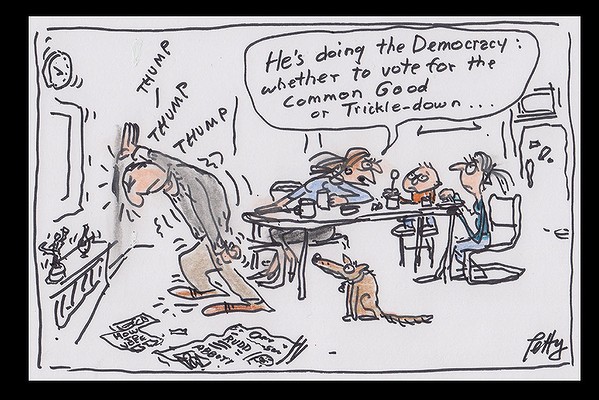
Tim Colebatch in his Labor's problems will soon be Abbott's woes provides an outline of a post election roadmap.
 Bruce Petty
It's not much of a roadmap but it's a start in terms of sketchily outlining the implications of the Coalition's slogan fiscal irresponsibility slogan with respect to austerity rather than how the economy will be much better managed. Colebatch says:
We know that new Coalition governments always tell us the budget is in worse shape than Labor said, and that they will have to make cuts they did not announce in the campaign so we can get back to surplus....We know that Hockey will order a Commission of Audit, which will recommend more spending cuts. They will establish a Productivity Commission inquiry into workplace relations that will propose changes that go well beyond Abbott's official policy. The commission's inquiry into the car industry will recommend an end to industry support. We know all that, because that's what they always do.
This will work because people think that all those tens of billions of dollars in deficits, adding up to hundreds of billions in debt, are putting the country’s future prosperity, perhaps even its viability, at risk. Most voters have bought the Coalition’s “debt and deficits” narrative – that powerful political tool that has buttressed every complaint about the government.
Colebatch's sketch doesn't take us very far. The Coalition's empty rhetoric about trust fills the silence about how best to respond to the slowing of the mining boom, the need to reinvent much of the economy or how to ensure that the sprawling housing developments in the capital cities are accompanied by the necessary infrastructure such as train lines, roads and schools.
The context of the shortfall in government revenue created by the world conditions caused by the global financial crisis. That ongoing shortfall implies a considerable cutting back of government services and that effectively results in greater inequality through more middle class welfare at the expense of the more disadvantaged. Examples that come to mind include removing the means-testing from the private health insurance rebate or abolishing the low-income super contribution rebate.
If you start to unpack the inequality in a prosperous Australia then you begin to realize that the discontent that the expresses itself in complaints about politics and politicians, or the complaints about rising costs and rising public debt, refers to a sense that that people aren't getting a fair share and that things are going backwards. Australia is becoming more unequal, whilst a constantly changing daily life is becoming more complex. The pursuit of happiness feels akin to chasing the gold at the end of the rainbow.
Posted by Gary Sauer-Thompson at 9:44 AM | Comments (12) | TrackBack
September 3, 2013
to hell with science
The arrival of a conservative Abbott Government does mean, as Clive Hamilton points out, the appointment of charlatans to senior advisory positions on the environment, the hollowing out of the federal climate change department, winding back environmental legislation, including the Renewable Energy Target, abolition of carbon pricing and rising emissions as the Direct Action Plan fails.
 David Pope
Less is going to be done to address climate change, or shift the Australian economy to a low carbon one. Australia will not take the necessary steps with respect to structural change to reduce its emissions by 25-40% by 2020, or encourage the new energy industries. Old Australia will rule during the period of an Abbott Government, and it will its political power to to set up extractive economic institutions for its own benefit.
By old Australia will rule I mean Big Coal such as the global mining company barons – BHP Billiton, Rio Tinto, Xstrata, Anglo American and Peabody – who have been joined “by a dozen or so medium-sized players”. To these are added the familiar names of the local nouveau-riche – Gina Rinehart, Clive Palmer etc.
The spell of fossil fuels and the carbon curse (substantial fossil fuel industries that are heavy carbon polluters) will remain as coal mining expansion continues apace in Australia.and the warming climate increasingly shapes our history.
The main hope is that the market will drive the shift to a low carbon economy in that the cost of renewable sources of energy is plummeting while the costs and risks of investing in coal-fired power generation are increasing.
Posted by Gary Sauer-Thompson at 8:50 AM | Comments (13) | TrackBack
September 2, 2013
more of the same
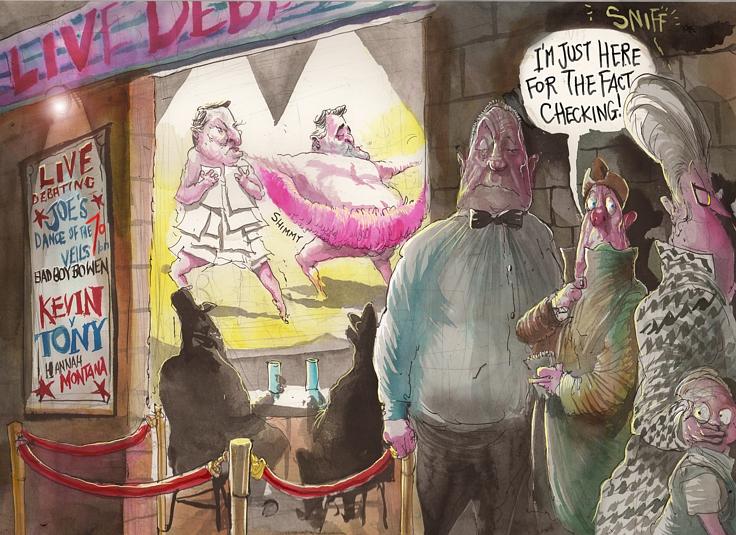
I've returned from a month of being on the road to discover that we are in the last week of the election campaign and that Labor continues to fight to the end, to claw its way back into the campaign, and to minimize the damage. It's a question of the size of the loss.
 David Rowe
Barry Jones has highlighted how the quality of political debate appears to have become increasingly unsophisticated, appealing to the lowest common denominator of understanding and the role of the media:
The Murdoch papers are no longer reporting the news, but shaping it. They no longer claim objectivity but have become players, powerful advocates on policy issues: hostile to the science of climate change, harsh on refugees, indifferent to the environment, protective of the mining industry, trashing the record of the 43rd parliament, and promoting a dichotomy of uncritical praise and contemptuous loathing. Does it affect outcomes? I am sure that it does, and obviously advertisers think so.
The Coalition is still playing to fear and anxiety with its rhetoric about the Australian economy being a smoking ruin due to Labor’s “irresponsible” fiscal policies. So they will inherit the ruins?
It is clear that Labor’s crisis hasn’t gone away just because Rudd is travelling better than Gillard had in the polls. Will time in opposition force an unreformed ALP to address its antipathy to the Greens, or its underlying power structures that allow union leaders and factional bosses to wield power like feudal barons? Or address its abandonment of a moral critique of capitalism as well as any sense that it has a role in promoting social social or sustainability as distinct from its current neo-liberalism of helping individuals to do well out of the system.
Personally, I doubt that the ALP will address or debate the fundamental questions about the direction of Labor thinking towards a renewed social democratic appraisal of political economy as distinct from its politics of redistribution framed as assisting individuals on their way up “the ladder of opportunity.”
This rethinking is important because, as Daron Acemoglu and James A. Robinson point out in their Why Nations Fail:
The political institutions of a society are a key determinant of the outcome of this game. They are the rules that govern incentives in politics. They determine how the government is chosen and which part of the government has the right to do what. Political institutions determine who has power in society and to what ends that power will be used.
Nations fail when they have extractive economic institutions, supported by extractive political institutions that impede economic growth. This means that the choice of institutions – that is, the politics of institutions – is central to our quest for understanding the reasons for the success and failure of nations. Powerful groups often stand against economic progress and against the engines of prosperity and growth is thus sustained only if it is not blocked by the economic losers.
Posted by Gary Sauer-Thompson at 8:25 AM | Comments (9) | TrackBack