|
September 4, 2013
Apart from rolling back the policies and institutions that support renewable energy what do we know about what a coalmine loving Coalition government would do. Apart from a number of promises on the table to bring the budget back to surplus.
Tim Colebatch in his Labor's problems will soon be Abbott's woes provides an outline of a post election roadmap.
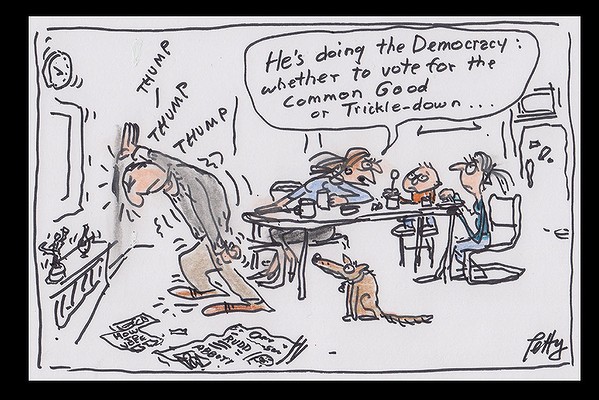 Bruce Petty
It's not much of a roadmap but it's a start in terms of sketchily outlining the implications of the Coalition's slogan fiscal irresponsibility slogan with respect to austerity rather than how the economy will be much better managed. Colebatch says:
We know that new Coalition governments always tell us the budget is in worse shape than Labor said, and that they will have to make cuts they did not announce in the campaign so we can get back to surplus....We know that Hockey will order a Commission of Audit, which will recommend more spending cuts. They will establish a Productivity Commission inquiry into workplace relations that will propose changes that go well beyond Abbott's official policy. The commission's inquiry into the car industry will recommend an end to industry support. We know all that, because that's what they always do.
This will work because people think that all those tens of billions of dollars in deficits, adding up to hundreds of billions in debt, are putting the country’s future prosperity, perhaps even its viability, at risk. Most voters have bought the Coalition’s “debt and deficits” narrative – that powerful political tool that has buttressed every complaint about the government.
Colebatch's sketch doesn't take us very far. The Coalition's empty rhetoric about trust fills the silence about how best to respond to the slowing of the mining boom, the need to reinvent much of the economy or how to ensure that the sprawling housing developments in the capital cities are accompanied by the necessary infrastructure such as train lines, roads and schools.
The context of the shortfall in government revenue created by the world conditions caused by the global financial crisis. That ongoing shortfall implies a considerable cutting back of government services and that effectively results in greater inequality through more middle class welfare at the expense of the more disadvantaged. Examples that come to mind include removing the means-testing from the private health insurance rebate or abolishing the low-income super contribution rebate.
If you start to unpack the inequality in a prosperous Australia then you begin to realize that the discontent that the expresses itself in complaints about politics and politicians, or the complaints about rising costs and rising public debt, refers to a sense that that people aren't getting a fair share and that things are going backwards. Australia is becoming more unequal, whilst a constantly changing daily life is becoming more complex. The pursuit of happiness feels akin to chasing the gold at the end of the rainbow.
|




The Coalition's fear-mongering about debt and deficit will be downplayed as it would face the same struggle to get the budget back to surplus that Labor faced.
Budgget deficits are a real big worry when they'r being incurred by the ALP, but they're not much of a worry under the Coalition.