|
September 2, 2013
I've returned from a month of being on the road to discover that we are in the last week of the election campaign and that Labor continues to fight to the end, to claw its way back into the campaign, and to minimize the damage. It's a question of the size of the loss.
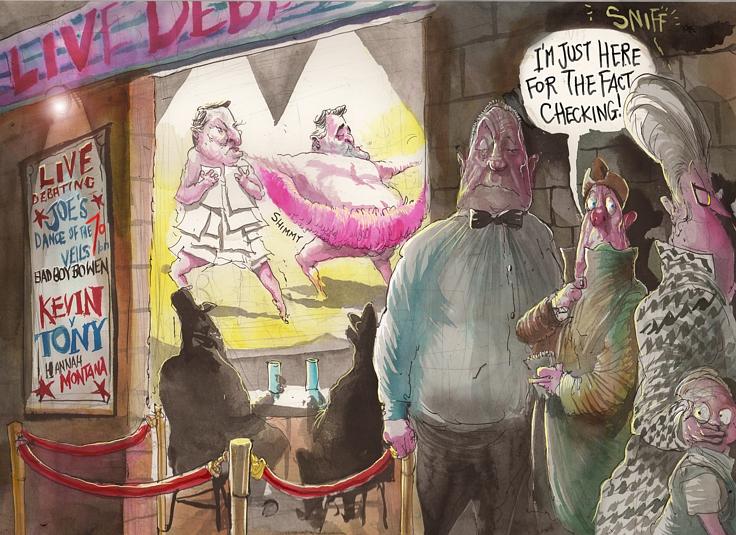 David Rowe
Barry Jones has highlighted how the quality of political debate appears to have become increasingly unsophisticated, appealing to the lowest common denominator of understanding and the role of the media:
The Murdoch papers are no longer reporting the news, but shaping it. They no longer claim objectivity but have become players, powerful advocates on policy issues: hostile to the science of climate change, harsh on refugees, indifferent to the environment, protective of the mining industry, trashing the record of the 43rd parliament, and promoting a dichotomy of uncritical praise and contemptuous loathing. Does it affect outcomes? I am sure that it does, and obviously advertisers think so.
The Coalition is still playing to fear and anxiety with its rhetoric about the Australian economy being a smoking ruin due to Labor’s “irresponsible” fiscal policies. So they will inherit the ruins?
It is clear that Labor’s crisis hasn’t gone away just because Rudd is travelling better than Gillard had in the polls. Will time in opposition force an unreformed ALP to address its antipathy to the Greens, or its underlying power structures that allow union leaders and factional bosses to wield power like feudal barons? Or address its abandonment of a moral critique of capitalism as well as any sense that it has a role in promoting social social or sustainability as distinct from its current neo-liberalism of helping individuals to do well out of the system.
Personally, I doubt that the ALP will address or debate the fundamental questions about the direction of Labor thinking towards a renewed social democratic appraisal of political economy as distinct from its politics of redistribution framed as assisting individuals on their way up “the ladder of opportunity.”
This rethinking is important because, as Daron Acemoglu and James A. Robinson point out in their Why Nations Fail:
The political institutions of a society are a key determinant of the outcome of this game. They are the rules that govern incentives in politics. They determine how the government is chosen and which part of the government has the right to do what. Political institutions determine who has power in society and to what ends that power will be used.
Nations fail when they have extractive economic institutions, supported by extractive political institutions that impede economic growth. This means that the choice of institutions – that is, the politics of institutions – is central to our quest for understanding the reasons for the success and failure of nations. Powerful groups often stand against economic progress and against the engines of prosperity and growth is thus sustained only if it is not blocked by the economic losers.
|





Neither major party has a vision of Australia in 10 years. All we get is debt is bad.