« March 2014 | Main | May 2014 »
April 24, 2014
striking welfare
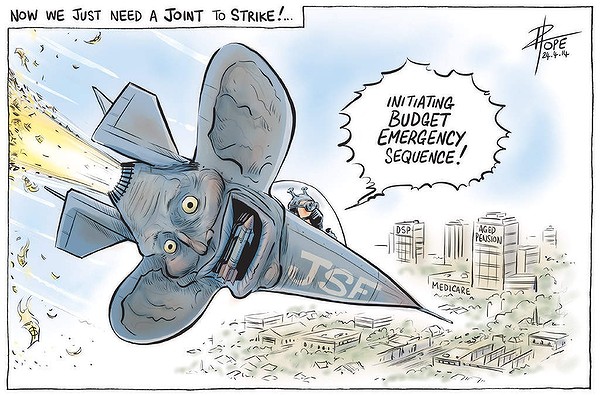
It is pretty clear that the Abbott Government's politics of austerity--known as fixing the budget in order to fix the economy --- is going to target welfare, especially the aged pension, whilst leaving the Coalition’s generous expansion of the paid parental leave scheme untouched. So much for equity. People having to work until 70 whilst already well-off women can get $75,000 for six months at home is the main way the "budget crisis" of an ageing population will be addressed.
 David Pope
The central problem with singling out the A$40 billion age pension scheme by introducing a pension eligibility age of 70 is the existence of age discrimination which results in older workers being pushed out the door or workers retiring because of illhealth. Given the increasing restrictions to accessing the disability support pension, many older workers will end up being on Newstart whilst waiting to access the pension.
Posted by Gary Sauer-Thompson at 12:57 PM | Comments (8) | TrackBack
April 16, 2014
flying high
ICAC's inquiry into the corruption in the NSW political system, which effectively destroyed the NSW Labor Party, is now focused on the NSW Liberal Party. It is examining the influence of lobbyists in the NSW Liberal Party, political donations, corruption, and special deals for mates in the face of the politician's memory loss akin to amnesia. This is a world where a clique of powerbrokers-cum-lobbyists run the state party.
 David Rowe
The fallout from the ICAC inquiry into Australian Water Holdings has begun. More fallout can be expected when ICAC examines whether, certain members of parliament corruptly solicited, received, and concealed payments from various sources in return for certain members of parliament favouring the interests of those responsible for the payments.
The Westminister system of governance has been effectively white anted by the backroom deals behind closed doors ( for casinos, liquor industry, coal and CSG) and the art of the forgettable by the guardians of virtue, integrity, honesty and honour in the face of allegations of fraud, dishonesty, insolvency and extensive donations to a Liberal Party slush fund.
The seedy world of favours-for-mates (fundraising, factional control, and solidarity) characterises New South Wales' squalid politics. Moneyed interests have infiltrated the decision-making forums of the political parties, and they usually seek to broker lucrative private sector deals and skim money from government agencies.
We can expect to hear complaints of ICAC being 'more powerful than elected politicians', and calls to 'reign in their power' or to limit them to 'serious matters' from both the influence peddlers, the vested interests and lobbyists on the make. They will say something like the ICAC exceeds its role and unfairly tarnishes the reputations of political figures for what amounts to momentary lapses of memory.
However, as Mark Latham points out, the powerbroker-parliamentary-lobbyist model is compelling evidence of how public office is being used for private gain. Politics has become just another monetarised commodity.
Will either the Liberal or Labor Party's act to address the 21st century version of Rum Corps to reduce the stranglehold of the factions and the lobbyists, given their reliance on fundraising? It is unlikely to deal with the situation whereby influence can be bought through political parties without having to comply with the guidelines that regulate direct access to governments. The desire to win elections trumps other concerns. And to win parties need to raise money and keep supporters and donors onside.
So I cannot see the Liberals acting decisively to limit the influence of lobbyists and fundraisers in the NSW Liberal party or to begin the reform (disable and disentangle) a corrupted political culture.
Posted by Gary Sauer-Thompson at 12:30 PM | Comments (10) | TrackBack
April 11, 2014
What to make of the NBN chaos
Renai Le May has it about right on the Coaltion's broadband network. Nobody really knows what's going on. It appears that their policy of Fibre to the Node, which Turnbull took to the election, is quietly being dropped.
 David Pope
What we appear to have is "NBN" chaos and confusion. That is what Renai Le May is giving voice to--a sense of growing disquiet. Nobody seems to know what is going on.
So here's a suggestion-- the NBN is being dismantled because it is against the interests of Murdoch, Foxtel and free to air television. Proper Fiber to the Premises network (FFTP) means that anyone with a fibre connection and decent plan (business or otherwise) can become a “TV” broadcaster. It allows new broadcasters to enter the marking without the initial barrier of the enormous cost.
What is being put in place is what is in the interests of Murdoch, Foxtel and free-to -air television. Protecting Foxtel is the key. Making sure Foxtel goes unchallenged as the premium content provider in Australia, while also having the taxpayer pay to complete the Foxtel network, and increase its market two fold. They also want to hand off as much of the NBN infrastructure as possible to the private sector.
This kind of crude thinking is the only way that I can make sense of the chaos. It's deliberate. Abbott's remit to Turnbull was to destroy the NBN. The Coalition do not want the NBN in any form.
The politics of it is that the Coalition are content to blame the ALP for the mess and chaos that Turnbull is creating. The tactic is to kick Labor while they are down, bury any legacy (Gonski, the NDIS, carbon pricing leading to an ETS, the MRRT, SuperClinics (health), TAFEs) and the digital vision of the previous Gillard/Rudd government. The strategy is to destroy Labor as a political force.
Posted by Gary Sauer-Thompson at 10:01 AM | Comments (12) | TrackBack
April 10, 2014
a creeping authoritarianism
Greg Jericho says that the Department of Prime Minister and Cabinet had issued new social media guidelines that included a clause instructing employees that there "is an expectation" to dob in colleagues if they see them do anything on social media that might contravene the code of conduct. Such things include being "critical or highly critical of the Department, the Minister or the Prime Minister".
 David Pope
Such comment goes beyond the employees area of work to anything that might "compromise public confidence in the agency or the APS". Greg Jericho observes:
The vibe from the top is that social media is to be feared, and is now also to be used as a tool of fear. With so few jobs around, and some departments cutting a quarter of their staff, the time is ripe to force harsh restrictions on employees and silence dissent. And PM&C's guidelines will do just that.
This is an example of creeping authoritarianism that seeks to obtain its political end by coercion and sanctions in order to enforce and maintain quietism towards the political order.
This conservatism, which is pulled in two directions at once – towards both authoritarianism and libertarianism---attempted to present itself as the defender of civil liberties against an overly authoritarian and interventionist state. This is usually represented by a desire to protect the individual from an over-powerful state. However, the tradition of authoritarianism remains strong.
This is a conservatism, which is premised on ’’liberty’ in economic processes the market and ’authoritarianism’ in political relations, and is driven by a fear of chaos and absence of order. Political conservatives envision a world without God in which baser human impulses go unchecked, social institutions (marriage, government, family) fall apart and chaos ensues. It uses opposition to "political correctness" to mask the authoritarianism in the desire to silence dissent and their opponents and to keep the populace alarmed by creating an endless series of threats, all of them imaginary (eg., asylum seekers pouring across the northern border of Australia).
Posted by Gary Sauer-Thompson at 8:39 AM | Comments (1) | TrackBack
April 7, 2014
getting mauled
As expected the Palmer United Party is in the box seat in the new Senate and the ALP was mauled. Whilst Clive Palmer has been able used his wealth to buy enough political influence to force the Abbott Government to negotiate with him over their legislation for the next three years, the ALP continues to self-destruct.
Despite the electoral flaws the Senate has the power to continue to act as a force of moderation on political excess. Will it? We know that the micro-parties will support the Abbott Government’s plan to repeal the mining tax and carbon pricing after July 1. What then?
 David Rowe
Given Clive Palmer's extensive mining interests, will PUP use its power in the Senate to moderate the Abbott Government's policy of going all out to maximise economic growth whilst doing unacceptable damage to Australia's ecosystem? Will Palmer do something to address the growing inequality caused by the neo-liberal mode of governance of global capitalism?
Will the new Senate go along with reforms of financial advice industry that are aimed at both boosting bank profits at the financial services companies acting in their clients' best interests and cementing the power of the banks?
We do know that for the key policies that will affect Australia’s renewable energy industry – and the decarbonisation of the Australian economy – the equation is essentially unchanged. The numbers in the new Senate, means that the carbon price is effectively dead and buried; the downgrading of the renewable energy target will pass; whilst the fate of Clean Energy Finance Corporation in the hands of Palmer, who holds that 97 per cent of the world's carbon comes from natural sources and that human-caused climate change is a myth.
It sure looks as if the climate skeptic crowd, and the fossil fuel interests are now in control of climate and renewable energy policy in Australia. Australia is not going to slash its use of high-polluting fossil fuels in order to stay below agreed limits on global warming, This is not good for Australia, and its increasing uncertainty about its position in a rapidly changing and warming region and world.
Posted by Gary Sauer-Thompson at 10:12 AM | Comments (14) | TrackBack
April 5, 2014
it's a no brainer
Though the effects of climate change are beginning to take hold the economic and political forces arrayed against dealing with climate change are very more powerful. Ours is a civilization built on the continuing use of energy that fossil fuels provide; on cheap, accessible carbon-based fuels, notably oil, coal, and natural gas, that cause greenhouse gas emissions.
Though the energy that comes from fossil fuels will decline they will still dominate the global energy marketplace for decades to come. So there can be only one plausible outcome: vastly increased carbon emissions leading to rising temperatures. Climate change is not the product of unfortunate meteorological phenomena; it is the result of burning massive quantities of carbon-based fuels and allowing the resulting gaseous wastes into the atmosphere.
The is only one way to avert the worst effects of climate change: make the consumption of carbon unattractive. carbon must be made expensive -- so costly, in fact, that renewables become the common fuel of choice. Australia, which took hesitant steps towards the pricing of carbon under a Labor Government , is going backwards. Under the Abbott government the energy policy is one of dig, baby dig, frack, baby, frack; a policy premised on denialism, an addiction to fossil fuels, and to self-destructive behaviour.
Self-destructive because severe climate change is coming our way. Self-destructive because the behaviour is pathological. Why else would a government defund public transportation in favour of more roads so that we continue to remain highly reliant on oil-powered vehicles for transport?
The Coalition have no interest in reconstructing our transportation system along climate-friendly lines. Nor in transitioning to a low carbon economy. This is not a progressive conservatism. It's a reactive one that looks back wards to unsustainable resource exploitation and which rejects out of hand market solutions such as cap and trade and carbon pricing. Behind this conservatism are the oil, gas and mining companies that have strained every nerve to head off the threat of effective action to halt the growth of carbon emissions, buying legislators, government ministers, scientists and thinktanks in the process.
A mixed, diverse green energy future, energy efficiency and to growing a green economy is anathema and dismissed as green crap. They justify inaction on the grounds that they''re quite certain the consequences of global warming (the median projection of warming is 4°C with business-as-usual) will be relatively benign, even though they have no way of knowing that this would be the case.
Posted by Gary Sauer-Thompson at 4:39 PM | TrackBack
April 3, 2014
drifting along
Martin Parkinson, the Secretary of the Treasury, delivers a speech to the Sydney Institute that warns that there would be no return to budget surplus in a decade without increasing indirect taxation.
Yet the Abbott Government continues to campaign on reducing taxation (dumping the mining tax and carbon pricing), partisan point scoring and left-baiting. It dumps these sources of income that are used to pay for schools, roads and hospitals and plans to lift defence spending to 2 per cent of GDP.
 David Rowe
The Abbott Government knows that the federal government expenditure on health , education and disability insurance is increasing government expenditure; and that allowing inflation to increase the tax take through allowing so-called bracket creep to push lower and middle income earners into higher tax brackets is not politically sustainable.
Parkinson argues that Australia needs to consider increasing the proportion of government revenue collected from indirect taxes such as the goods and services tax or fuel excise. The alternative is austerity: a program of progressively deeper cuts to public services.
The WA Senate election indicates that conservatives reckon they are on a roll. Their strategy is to divide society into those who think they can cope with globalisation and those who cannot; then shower the former with praise and modest enticements – whilst attacking the latter in the service of political popularity. They use this to appear economically modern, radical and innovative, even though they push to one side greater equality, a public realm as distinct from the private market, keeping capital in check, or welfare security in an insecure world. Government spending on public education, for them, is seen as only a cost, and never a benefit.
The neo-liberals have little in the way of any policy agenda to lift Australia’s productivity performance through increasing our innovation, raising our human capital, or investing in the knowledge economy. Surprisingly, Parkinson says little about increasing the levels of tertiary education, in the skills of our workforce, and invest more in research and development.
Yet he would know that this is crucial, if Australia is to raise its living standards in the global economy, given that, as that the mining boom is moving to its production phase, fewer jobs will be created and investment will begin to decline. He would know that economic globalisation for unskilled workers means competition with low wage countries and that often means stagnant wages and greater job insecurity. It's the skilled workers who are best positioned to thrive in a globalised world, since they can work in different countries.
It's the unskilled workers who feel they are being left behind by Australia's rapid economic and social transformation as their industries go offshore and their neighbourhoods are changed. Parkinson was also silent about what will replace resources investment as the new driver of economic growth.
For the Coalition in Canberra the answer is a bout of fiscal austerity, not encouraging the fragile recovery in the non-mining sectors---eg., housing, retail, transport, and city infrastructure. Nor does Parkinson say anything about Australia needing to improve its energy efficiency and productivity.
Posted by Gary Sauer-Thompson at 7:57 AM | Comments (7) | TrackBack
April 1, 2014
Labor rolls over on mass surveillance
Federal Labor has come out in defence of the surveillance state. Tanya Plibersek indicated her in support of the mandatory data retention regime, which would compel phone companies and internet service providers (ISPs) to retain telecommunications data – "metadata" – for at least two years for the whole Australian population.
The meta data is not the recordings of phone calls or content of emails that is proposed to be retained; it is data around these things. Who you called, and for how long; who you email, and the size and type of the attachments you send. If you carry a mobile phone, metadata can record your location every minute of the day.
Plibersek justifies the roll over on the grounds that metadata collections had been an important tool in safeguarding Australia’s national security, that the spooks have disrupted some very serious terrorist plots in Australia, and that government needs to make it as “easy as we can” for intelligence agencies to protect against established and emerging threats.
Scott Ludlum observes that:
Data retention is not about targeted, evidence-based intelligence gathering. It is the indiscriminate collection of detailed, real-time metadata on everyone. It is not just for people suspected of serious crimes or political violence, and no judicial oversight is required for a proliferation of hundreds of agencies and local government authorities to get their hands on it. Because the access threshold is so low, there were more than 320,000 of these requests made of telecommunications companies in the last financial year, rubber stamped without a single warrant being issue
This allows the spooks to build what they call ‘a pattern of life’, a detailed profile of a target--ie., a full profile of somebody’s interests and habits---and anyone associated with them. The spooks say they need all this data, because, in order to find the needle in the haystack, they need access to the whole haystack.
Labor accepts the argument for 'mass surveillance'.
The Senate Standing Committee on Environment, Communications and the Arts recent report, The adequacy of protections for the privacy of Australians online, indicates that Labor has form on this.The Attorney-General in the Rudd/ Gillard Governments tried to implement a mandatory data retention network in the form of the retention of metadata and not content related to email, telephony and internet access.
Posted by Gary Sauer-Thompson at 1:28 PM | Comments (1) | TrackBack