« June 2014 | Main | August 2014 »
July 29, 2014
coal dreaming
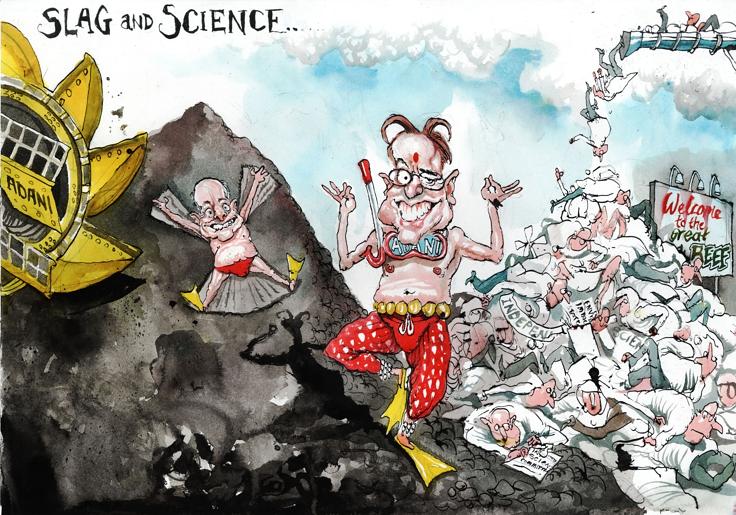
The spin is that coal is the future and that the boom is eternal. The reality is otherwise: low profits, declining demand, collapsed global prices. Despite this the federal government has approved Adani's giant Carmichael Coal Mine in the Galilee Basin in Queensland and associated rail link to the coast that it says will generate as much as $300 billion for the Australian economy and help lift 100 million Indian consumers out of poverty.
 David Rowe
Who are they kidding? The 60 million tonnes of coal a year from the Carmichael Coal Mine will push global coal prices down further, double the price of electricity for Indian consumers and is not financially viable, given the amount of infrastructure that needs to be built to get the coal mine operational. The Carmichael Coal Mine is a potentially stranded fossil fuel asset.
Adani's plans include clearing over 20,000ha of bushland to build the mine, six open cut pits and five underground mines with a total area of 28,000 hectares, a private railway and expanded port facilities, as well as pulling billions of litres of water every year from local rivers and aquifers.
These plans make no financial sense given coal mining is unprofitable in today’s tough market conditions. Adani needs $100 a ton but commodity prices are around $50 a ton due to excess supply, with the outlook for global prices to recover being quite low given declining Chinese demand for coal.
Presumably, Adani is waiting for a big uplift in the market environment for coal. They are dreaming.
Posted by Gary Sauer-Thompson at 8:34 AM | Comments (11) | TrackBack
July 24, 2014
going down the US path
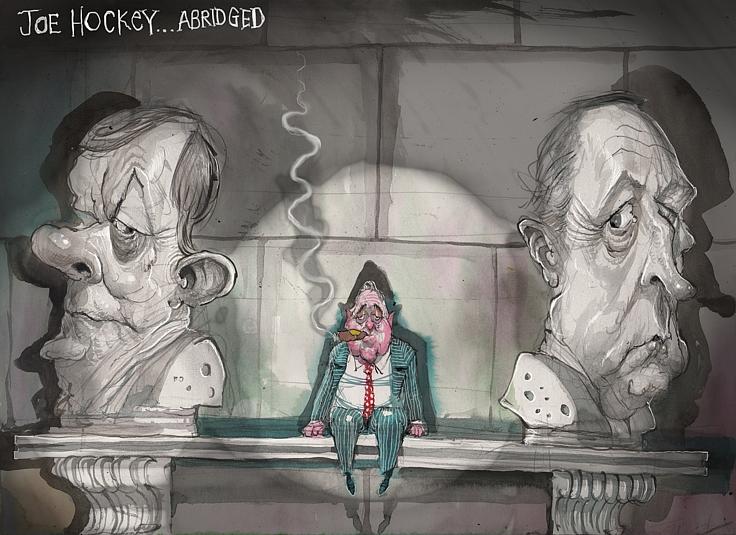
As we know few people buy Hockey’s phoney "budget emergency" and the Abbott Government is facing billions of dollars of lost savings and revenue as a result of the divided Senate due in part to its inability to negotiate with the minor parties controlling the balance of power in the Senate. Belligerence, bluster and revenge is the style of this government.
 David Rowe
This global world we are now living in is one in capitalism and democracy are becoming increasingly incompatible, and where big business wants to completely free itself from democratic regulation. Democracy is increasingly being treated with contempt by the neo-liberals whose mode of governance is structured around reduced taxation, reduced regulation over labour costs, minimal consumer protection and fewer restrictions over services and the marketing of new financial products.
The strategy of the neo-liberal mode of governance is to reshape Australia so that it becomes more like the free market social and economic model of the US, rather than the social democracy model of much of Europe.Those who benefit from a US style free market system where government minimises its involvement are the financial industry, the mining and energy industries, gambling interests and real estate companies.
Posted by Gary Sauer-Thompson at 10:16 AM | Comments (7) | TrackBack
July 18, 2014
dreaming of a lost age
Carbon pricing has gone but it lives on in the form of a battle about decreases in the cost of living and the Coalition's new fear campaign that Labor wants to bring back "the carbon tax" (ie., an emissions trading scheme) at the next election. The conservative cultural warriors claim an iconic victory. Mission Accomplished.
What survives still is the Climate Change Authority, Clean Energy Finance Corporation, the Australian Renewable Energy Agency and the Renewable Energy Target. For how long? The fossil fuel industry wants this architecture gone in order to protect its declining profits. The mining industry and polluters call it "damaging the economy".
 David Rowe
The Coalition appear to think that they have voted climate change away. They and the coal industry is in for a surprise since their massive Galilee Basin mining proposals look set to go the way of Olympic Dam: pipe dreams of another age. The Canberra Press Gallery has yet to figure this out.
The Coalition’s approach to climate change is political management. It seeks to avoid embarrassment on the domestic and world stage by doing the bare minimum and fiddling at the margin to cover its protection of the fossil fuel industry. Black is their future. So they have no need of a credible policy to deal with greenhouse gas emissions or global warming.
Posted by Gary Sauer-Thompson at 9:40 AM | Comments (6) | TrackBack
July 17, 2014
a dead end for the economy
The Coalition has a short term budget problem and its rhetoric is becoming increasingly shrill about needing to fix its fiscal imbalance now. If this doesn't happen then the country will go backwards.
The short term budget problem results from cutting revenue (from carbon pricing and the mining tax) and the possibility of its cuts to government expenditure not getting through the Senate. Well, the Coalition could act to phase out fossil fuel subsidies and slush funds for polluters; or infrastructure builds to facilitate coal export profits. After all China and India, Australia's biggest target customers for export coal, are moving away from coal to renewable energy on an industry scale.
 Alan Moir
At this stage the Senate looks likely to block a number of savings measures, including lowering the tax-free threshold from $19,400; the scrapping of family tax benefits and other welfare changes; the scrapping of the low-income superannuation contribution boost; the axing of the Australian Renewable Energy Agency; and the indexation of the age pension. These saving measures are primarily going after low- and middle-income families in the form of winding back the welfare state.
Posted by Gary Sauer-Thompson at 9:29 AM | TrackBack
July 16, 2014
creating political drama
The Palmer United Party is currently using its balance of power in the Senate moment to frustrate the Abbott Government. The rationale for this strategy, as Jack Waterford points out is:
is to attract the ultimate loyalty of 14 per cent of the vote, not 50 per cent. Every unsuccessful measure or rejection of some Coalition attempt to pander to one of its lobbies, such as the big banks, reinforces the government's unpopularity and increases Palmer's popularity and scrapbook.
I think that Waterford goes too far. Sure, Palmer is creating maximum drama but so far he ends up supporting the Coalition after extracting minimal cobbled-together concessions during chaotic backroom meetings from which all stakeholders are excluded.
 David Rowe
A good example is Palmer's wheeling and dealing over the Coalition's attempts to roll back Labor's financial advice reforms so as to favour the interest of finance capital at the expense of consumers. Palmer sided with the Coalition and the minor amendments make little difference to ensure consumer protection.
In doing so PUP didn't wait to consider the interim report into the financial system in the context of financial scandals, corruption and fraud by the finance industry that caused so much damage to the welfare of millions of Australian households; as well as a Senate inquiry that was highly critical of the financial planning operations of the Commonwealth Bank.
PUP, in other words, rolled over, rather than standing their public ground. They didn't even consider separating banking from distribution or financial planning advice in terms of ownership and control given that 80% of the financial advice industry is now linked with banks; and that the financial advisors are just pushing bank products for a fee. These financial advisers have a substantial conflict of interest – the interests of their employer are at odds with the interests of their clients.
PUP has sided withe Coalition in ensuring that financial advisers work for the interest of their employer --the Big Banks-- not for their clients. The government’s financial advice changes allow incentives for financial planners to push inappropriate investments products on consumers.
Posted by Gary Sauer-Thompson at 9:06 AM | Comments (9) | TrackBack
July 14, 2014
it's not going to be roses
So the Coalition's proposed policy switch from carbon pricing to Direct Action this week amounts to a shift from taking money from polluters and distributing it to taxpayers to taking money from taxpayers and handing it out to polluters. The Coalition is increasing corporate welfare for the big polluters such as the fossil fuel industry.
The significance of the carbon tax fear campaign that was waged by the Coalition and business is to trash tomorrow in order to make profits today. The Coalition calls it 'rescuing the country.'
 David Pope
Now Abbott did claim that grocery prices would go up by $10 a week with a carbon price; that the price of a new home would jump $6000; and that the cost of running a farm would leap $12,000 a year. Yet the carbon tax has played only a small part in the increase in power prices and so getting rid of it won't fix the problem.
What happens when people begin to realize that carbon pricing was not a wrecking a ball for the economy, and that electricity prices will continue to rise after carbon pricing is gone? When it is realized that it is the networks pushing up prices and increasing their profits despite the decrease in consumer demand.
The real problem is that the prices the networks are allowed to charge – whether government or privately owned – are regulated by government authorities. Loopholes in the price regulation regime have made it easy for the network businesses to feather their nest at the expense of consumers.
Will the Coalition push to reform the electricity pricing arrangements?
People's main concern and fear is becoming unemployed. They need to pay the rent or mortgage and put food on the table, and they have cause to worry because the growth in jobs is not keeping up with the growth in people looking for them. There is a growing disconnect between economic growth and increasing employment. Is this going to be a jobless recovery?
Posted by Gary Sauer-Thompson at 11:54 AM | Comments (12) | TrackBack
July 9, 2014
learning the ropes
We have a new Senate in Canberra with an increased number of Independents and the two major parties--Labor and Liberal --- are not happy as they are beginning to realize that they've lost control over their third senate spot. So the attacks on the micro-parties begin.
The Coalition has the biggest problem as it must negotiate with the cross bench Senators to get their roll back legislation into law. So far the Coalition has tried to bludgeon its way through, with little success. The Coalition is going to have to learn to work collaboratively and consultatively with the crossbench senators.
 David Rowe
The majority rule crowd have little time for a Senate that sees itself as an important check on government power. The Senate should support the Coalition's agenda without hesitation. So the Coalition will endeavour to ensure that there is a falling out between Palmer and one or more of his underlings within the next few years.
The Coalition's politics of fear---eg., on IR, a fiscal crisis and carbon pricing--- has limited value in governing the economy and it will probably be counter productive. Thus the repeal of carbon pricing isn't going to make that much difference since energy prices will continue to rise and the Coalition will no longer have its carbon tax bogeyman. It will become ever more difficult to use the age of entitlement rhetoric to cover up the increasing inequality caused by the policies of the market fundamentalists.
What the Coalition doesn't seem to realize is that it is deeply unpopular because people feel that they have been fooled given the extent of the Coalition's broken promises after it came to power.
Their budget was a very different fiscal prescription from the one Abbott had continually promised voters.
There was no mention of increased university fees, a fuel tax rise, a GP co-payment, an extended retirement age, a temporary income tax rise, lower indexation for pensions, an $80 billion haircut in future Commonwealth outlays in health and education, cuts to family tax benefits, cuts to a range of payments and supplements, and so on. In fact, all these things were either expressly ruled out when raised or were covered off by overarching assurances such as the oft-quoted formula of ‘‘no new or increased taxes, no cuts to education or health, no cuts to pensions" etc.
The politics of fear isn't going to help increase the electorates trust of the Abbott Government.
Posted by Gary Sauer-Thompson at 12:52 PM | Comments (8) | TrackBack
July 4, 2014
SA Labor: a political crisis
SA Labor, after its return to government, has adopted a management tone of measured, controlled, rational adminstration. This confidence and competence has been thrown out of kilter with the toxic groundwater beneath Clovelly Park adjacent to the Monroe shock absorbers plant and the old Mitsubishi site; and the need to relocate the housing trust tenants from contaminated homes in order to protect their health, which is at risk due potential airborne carcinogen from the toxic groundwater pollution.
It is a political crisis because the he Government (and the Housing Trust and the council?) knew about the unduly high toxicity levels since May, and they hadn’t yet notified the residents. Presumably because the Weatherill Labor Government is confident residents’ health would not have been, and is unlikely to be adversely affected from exposure to trichloroethylene ((TCE)) at such relatively low levels.
Still government ministers have admitted they knew for weeks about rising levels of TCE in Clovelly Park houses, the need to relocate residents, and the lack of remediation. It's the delay and inaction in informing the housing trust tenants that gives rise to the political crisis.
Posted by Gary Sauer-Thompson at 12:27 PM | Comments (1) | TrackBack