August 31, 2011
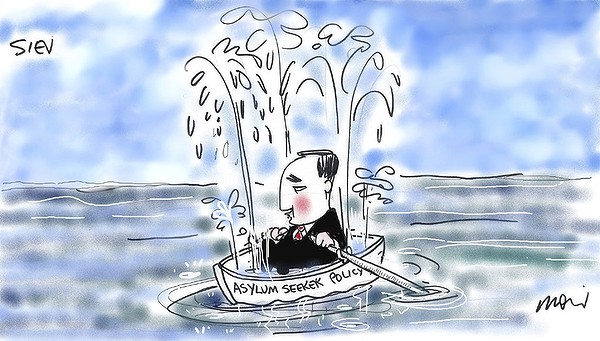
High Court rules on Malaysia asylum deal
Under the Malaysia refugee swap Australia would send 800 asylum seekers to Malaysia and in return, receive 4000 people already assessed to be refugees over the next four years. The Minister for Immigration had declared that Malaysia provides sufficient protection for transferred asylum seekers.
The High Court's decision on the Malaysia refugee swap ruled 6-1 against the Gillard Government's Malaysia solution. The Court has also cast doubt over the legality of Nauru, the opposition’s preferred option, and even Manus Island, the government’s plan B.
One issue was: did Malaysia provide asylum seekers access to ''effective procedures'' for processing their asylum claims, ''protection'' for persons seeking asylum and did it ''meet relevant human rights standards in providing that protection''?
The second issue related to the minister's guardianship duties for unaccompanied asylum-seeker children. Was the government's argument, that the guardianship duty was subject to other powers set out in the Migration Act and was therefore ''trumped'' by the declaration of safety made under s198A of the Migration Act, a reasonable one in a legal sense?
The decision states:
The Court held that, under s 198A of the Migration Act 1958 (Cth), the Minister cannot validly declare a country (as a country to which asylum seekers can be taken for processing) unless that country is legally bound to meet three criteria. The country must be legally bound by international law or its own domestic law to: provide access for asylum seekers to effective procedures for assessing their need for protection; provide protection for asylum seekers pending determination of their refugee status; and provide protection for persons given refugee status pending their voluntary return to their country of origin or their resettlement in another country. In addition to these criteria, the Migration Act requires that the country meet certain human rights standards in providing that protection.
The Court also held that the Minister has no other power under the Migration Act to remove from Australia asylum seekers whose claims for protection have not been determined. They can only be taken to a country validly declared under s 198A to be a country that provides the access and the protections and meets the standards described above.
The High Court adds:
The Court emphasised that, in deciding whether the Minister's declaration of Malaysia was valid, it expressed no view about whether Malaysia in fact meets relevant human rights standards in dealing with asylum seekers or refugees or whether asylum seekers in that country are treated fairly or appropriately. The Court's decision was based upon the criteria which the Minister must apply before he could make a declaration under s 198A.
My understanding is that the Gillard Government thought that the government had a legally sound case and that it would beat the legal challenge to its Malaysian plan.The federal government's entire Malaysian solution is now in doubt.
Update
What the High Court decision affirms is that governments are bound by the rule of law in liberal democratic society. Governments tend to forget this core constitutional principle from time to time; a principle that has two main functions: it seeks to provide a stable and secure basis for the exercise of government power, and also seeks to limit that power.
Posted by Gary Sauer-Thompson at 4:32 PM | Comments (16) | TrackBack
November 5, 2009
US: "state secrets" and executive immunity
I watched Michael Moore's documentary film Fahrenheit 9/11 last night. This is a dystopian view of the United States under the Bush Administration and is controversial because it is deeply critical of the Bush administration and its conduct of the Iraq war and the you're either with us or against us" model of argumentation of the conservatives.
So many conservatives have been willing to give the US government a pass on its awful treatment of prisoners taken during the "war on terror", and were even happy to support such treatment when meted out to American citizens. An example of "awful treatment" is a Canadian software engineer named Maher Arar. Glenn Greenward says that Arar was:
A telecommunications engineer and graduate of Montreal's McGill University, [who] has lived in Canada since he's 17 years old. In 2002, he was returning home to Canada from vacation when, on a stopover at JFK Airport, he was (a) detained by U.S. officials, (b) accused of being a Terrorist, (c) held for two weeks incommunicado and without access to counsel while he was abusively interrogated, and then (d) was "rendered" -- despite his pleas that he would be tortured -- to Syria, to be interrogated and tortured. He remained in Syria for the next 10 months under the most brutal and inhumane conditions imaginable, where he was repeatedly tortured. Everyone acknowledges that Arar was never involved with Terrorism and was guilty of nothing.
After a full investigation by Canadian authorities and the public disclosure of a detailed report the Canadian Prime Minister publicly apologized to Arar for the role Canada played in these events and the Canadian government paid him $9 million in compensation. In contrast, the US under the Bush administration refused to acknowledge ever having made any mistakes and blocked any inquiries in the name of state secrets.
The Second Circuit Court of Appeals in Arar v. Ashcroft concluded that Maher Arar has no right to sue US government officials. It held that even if the government violated Arar's Constitutional rights as well as statutes banning participation in torture, he still has no right to sue for the harm that was done to him.
National security is the justification:---U.S. government officials can torture without worry, because the security of the US might some day depend upon it. The Executive can use secrecy and national security claims to shield itself from the rule of law, even when it's accused of torture and war crimes.
The Court has become the handmaiden of the Executive when it should be defending the constitution and the rule of law and a structural check on the power of the Executive.
Posted by Gary Sauer-Thompson at 6:05 AM | TrackBack
October 9, 2009
the legislative sovereignty of Parliament
There is a good point made in Stephen Sedley's review of Vernon Bogdanor's The New British Constitution in the London Review of Books. Bogdanor argues with respect to Britain that parliamentary democracy in which ultimate power resides in a representative legislature is giving away to a popular democracy based on localised devolution of power, reflecting the individualism which both Thatcher and Blair have validated, fuelled by the participatory potential of information technology.
The point I want to highlight is one about parliamentary democracy, in which ultimate power resides in a representative legislature, as t many consider this the foundation stone of the Australian political system. Sedley says:
It is now widely accepted, and Bogdanor does not dispute, that the doctrine of parliamentary supremacy is itself an artefact of the common law, growing out of the historic compromise between the three limbs of the crown – legislative, judicial and executive – which was reached in the course of the 17th century and has been developed in modern concepts of the rule of law. Off parade, one or two senior judges have in the past considered the consequent possibility that if parliamentary legislation were to violate fundamental constitutional norms it might be the duty of the courts to disapply it.
This implies that parliamentary sovereignty is no longer, if it ever was, absolute. Is the process one of the English principle of the absolute legislative sovereignty of Parliament being qualified step by slow step?
Can we, in Australia, envision a situation in which the judges in the High Court deem a law passed by Parliament to be unconstitutional and to treat it as invalid. That situation would bring into sharp focus the allocation of power between Parliament and the courts in our federation would it not?
Those who argue for the absolute position rely on the views of A.V. Dicey who held that there are no limits to the legislative competence of Parliament:
Each Parliament is absolutely sovereign in its own time and may legislate as it wishes on any topic and for any place. That which has been enacted by Parliament has supreme force and cannot be invalidated or changed by any other domestic or external authority. As so outlined, the doctrine has been the very foundation of the British constitution since at least the latter days of the nineteenth century.
That cannot be the case in Australia since our federalism is abased on a written constitution, and presumably Parliament cannot override, or amend, the constitution on its own. It is written constitution against which the validity of Parliament’s enactments may be tested. So the legislative sovereignty of Parliament is not absolute.
Posted by Gary Sauer-Thompson at 8:58 AM | TrackBack
August 25, 2009
Queensland: Abortion Law
Queensland is an odd place. It is the face of modern Australia as well as that of old Australia. Queensland’s abortion laws are now the most antiquated and repressive in the country. Abortion remains a criminal offence. As Professor Caroline de Costa has pointed out in Crikey:
Both medical and surgical abortion, even by registered medical practitioners, remain crimes in Queensland under legislation that uses wording from 1861...It is true that there have been no prosecutions of doctors since Dr Peter Bayliss was acquitted in 1986 but the law remains in the Criminal Code, and as the case currently before the courts in Cairns shows, the police are prepared to prosecute both a woman making a personal decision for herself, and her supportive partner.
Queensland women are now having to travel to Sydney for a medical abortion since the protection offered to doctors who perform abortions in Queensland, based on the case against Dr Harry Bayliss in 1986, only applies to surgically-induced abortions.
de Costa adds that so far the Bligh Government:
has suggested letters and words of reassurance for doctors, and some tinkering with section 282 of the Criminal Code so that there is a defence for medical as for surgical abortion. The assurances of persons currently in positions of power provides little legal certainty even while those people remain in their posts, and none whatever when they depart.
Premier Bligh did say on Q+ A that her personal view is that abortion should be a matter between a woman and her doctor. However, she quickly added, there shouldn’t be any attempt to change the existing law because there wouldn’t be the numbers in the Queensland Parliament for it to get through.
So there is to be no decriminalisation of abortion in Queensland under a Blight Government. Something needs to be done. As Andrew Bartlett points out the situation for individual women seeking an abortion and for doctors prepared to provide is now totally untenable. Beirne School of Law Associate Professor Heather Douglas at the University of Queensland said:
Studies suggest that around 80 percent of survey respondents agree that a woman should have the right to choose whether she has an abortion. For many women - and for the health budget- abortion using drugs is a safer and cheaper option. As a result of the current legal position, there is virtually no access to abortion through the public hospital system in Queensland. This means that abortion in Queensland is also a class issue. Women with greater access to funds are more able to travel to obtain an abortion and to pay the private medical fees associated with abortion.
The ethical point is that woman should never be prosecuted for undergoing abortion, that the decision about abortion should be between the woman and her practitioner; and the regulations covering abortion should be in the health regulations in the 21st century.
What now? Women should be able to access safe legal abortion and should not have to suffer further indignities and possible penalties because she has sought and had an abortion performed.
Posted by Gary Sauer-Thompson at 2:55 PM | Comments (10) | TrackBack
February 10, 2009
racist laws
The starting point for any attempt to close the gap between indigenous and white Australia is that any intervention to address the poverty, sexual abuse and other problems that afflict Aboriginal people and their children in the Northern Territory cannot be remedied by laws and programs that are themselves racially discriminatory. Australia accepted this principle when it signed the Convention for the Elimination of All Forms of Racial Discrimination.
The problem, as George Williams points out in The Australian, is that the Howard government's intervention laws were passed in August 2007 to exclude the Racial Discrimination Act. The reason was clear. Parts of the intervention are racially discriminatory. For example, it quarantines 50 per cent of welfare income to be used for food and other essentials only for people living in Aboriginal communities. There is no exception even for people who can demonstrate they are responsible spenders of their income.
So these Australian citizens don't have rights.
The Rudd Government has acknowledged the racism in the legislation, as it It has said it will revise aspects of the intervention such as income quarantining and will restore the Racial Discrimination Act. But it has been slow to act, with no sign yet of the laws needed to bring these changes about.
The Rudd Government has failed to report little if anything on actual outcomes on closing the gap between white and black Australians. The Close the Gap campaign is based on the idea that it would take a generation to bring about serious changes in the outcomes, and that a decade of investment would be needed to simply achieve equality of opportunities before the outcomes really started to shift.
Posted by Gary Sauer-Thompson at 6:02 AM | Comments (6) | TrackBack
April 30, 2008
Cardinal Pell on human rights
Cardinal Pell was doing the conservative attack on human rights at the Brisbane Institute, last night. Even though he argues for absolute moral truths against liberals and relativists Pell argued that rights are best determined by common law and parliaments according to the mood and flavour of the time.
This relativist argument was underpinned by an appeal to parliamentary sovereignty, which was justified by the following argument:
The push for a charter of rights springs from a suspicion of majority rule, a preference for judicial decision-making on fundamental questions, the imperatives of the particular social and political agenda that a charter of rights serves, and the elitism of privileged reformers — not all of whom are lawyers. And the problems with such a charter are increased by the inability of contemporary law and philosophy to agree on a secure foundation for human rights, freedom and truth.
A bill or even a charter of rights will help to provoke a culture war says Pell with a straight face.
The rejoinder to this conservative argument is the implication of parliament sovereignty in terms of the power of executive dominance. Jack Waterford states it well in the Canberra Times. He says that he has been sceptical of the need for a charter of rights, but he is changing his mind again, because our politicians are not showing themselves great instinctive protectors of rights, just when they are needed. Certainly not Carr or Hatzistergos. Or previously John Howard and Philip Ruddock, in actions scarcely criticised by those who have now succeeded them He adds:
The risks are being aggravated by the ever-outreaching power of executive government, by the supine position into which legislatures have been put by modern executives, and by the coordination of incumbency and spin to overwhelm popular criticism. It's not parliamentary rule we ought to fear, but increasingly arbitrary and unaccountable rule by executive government.Proponents of a Bill of Rights do not have to put too much faith, or hope, in judges, activist or not. They have only to argue that a Bill might be a desirable further check and balance on government yet another field of tussle between the executive, the parliament and the judiciary.
It a defense against an authoritarian style government favoured by neo-conservatiism
Posted by Gary Sauer-Thompson at 7:40 AM | Comments (2) | TrackBack
March 10, 2007
Scooter Libby + rule of law
I see that Charles Krauthammer in the Washington Post is following the Wall Street Journal's editorial page and calling for a presidential pardon for Scooter Libby. The basic apologist argument is that there was no crime... Therefore, there should have been no investigation. End of story.
The general strategy of the Bush administration apologists is control the media narrative, bury the obvious accountability moment, obscure the "cloud over Cheney," and discredit the legal process and manipulate the eventual outcome. Thus Krauthammer:
This is a case that never should have been brought, originating in the scandal that never was, in search of a crime -- violation of the Intelligence Identities Protection Act -- that even the prosecutor never alleged. That's the basis for a presidential pardon. It should have been granted long before this egregious case came to trial. It should be granted now without any further delay.
Libby's defence rested on Libby's weak memory despite the defense's opening statement that Libby "will not be sacrificed so Karl Rove can be protected". However, Libby refused to flip on Cheney, regularly described as Darth Cheney, and preferred to play the martyr. So Libby is the fire wall to protect Cheney and others, and the apologists and neocons are making sure that he stays the firewall.
As Christine Hardin Smith over at Firedoglake states:
Libby made a series of bad choices: he lied, repeatedly, to the FBI, to the Grand Jury under oath, all to cover up for the Vice President of the United States and for his own poor choices. For those poor choices of his own making, he was convicted by a unanimous vote of a jury of his peers, and he should pay the penalty for this. No one, no matter their station in life, no matter their connections or political affiliation — no one — should be allowed to repeatedly and manipulatively lie to a grand jury under oath or to criminal investigators without consequences. It is wrong, whomever may be doing it, and Libby is no exception to the rule of law.
It was judged that there was proof beyond a reasonable doubt that the individual charged committed the conduct specified in the indictment----that I. Lewis "Scooter" Libby obstructed a grand jury investigation, lied to federal agents, and then lied to a grand jury. Libby threw sand in the face of the umpire so he couldn't see the play. Will Libby’s “protect the Vice President but not the President” strategy persuade Bush into a pardon, as Krauthammer appears to assume.
The political issue is the abuse of power by the highest executive branch officials and their stable of White House .staffers, lobbyists, Republican operatives and other surrogates. As Elizabeth de la Vega over at TomDispatch observes:
The criminal justice system was never intended by the framers of the Constitution to be the sole, or even primary, means of investigating and redressing what the late Congresswoman from Texas Barbara Jordan described during the Watergate investigations as "the misconduct of public men." On the contrary, it is Congress that is both entitled and obligated to oversee the conduct of the Executive Branch.
Does the Libby case open a window on the whole facade of power in the US, to disclose how the Republicans do not care about the rule of law and only care to preserves their own power. Will this disclosure motivate those who witnessed it to begin to look on their own lives and actions differently?
Posted by Gary Sauer-Thompson at 1:29 AM | TrackBack
February 10, 2007
the shifting sands of politics
The critics of Hicks' long incarceration in Guantanamo Bay without charge of terrorism have routinely been dismissed as anti-American, civil libertarian, doomsaying, Muslim-loving leftie pacifists bent on wrecking the ANZUS alliance. No more.

Alan Moir
Unfortunately for Howard,though public opinion has little time for Hicks, there is an understanding that this issue is one of injustice and a negative judgement is being made. Hence Howard's new public face of abrupt "anger" at the Americans and his promise the other day to "harrass" them.
Of course, Howard's political response of blaming the delayed justice on the Americans, doesn't square with Howard confirming that it is him, not the Americans, blocking extradition on the grounds that Hicks' 2001 activities in Afghanistan weren't actually illegal under Australian law.
Posted by Gary Sauer-Thompson at 8:38 AM | Comments (22) | TrackBack
January 1, 2007
Remember David Hicks
It's a cynical take on our federal politicians isn't, highlighting the gap between rhetoric and reality as we move into 2007 and a federal election. The more things change the more they remain the same. Still, 16 seats is all that it takes for the ALP to win the election.

Allan Moir
What is i missing grom the cartoon is the ruthlessness of the politically successful. An example ist the continued detention of David Hicks at Guantanamo Bay in Cuba erodes the very rights and freedoms that the Australian government says it is defending in the war on terrorism.
The accusations against Hicks are based on association, and for this he has been incarcerated for 5 years. Doesn't this undermine a bedrock of our system of justice? --that the evidence against Hicks be presented in a public hearing in a recognized court so that the claims against him can be tested, so that a jury can convict or acquit.
As things currently stand, Hicks has no prospect of being tried in a proper court.
Posted by Gary Sauer-Thompson at 8:43 AM | Comments (6) | TrackBack
December 21, 2006
poor buggar me aborigine
Chloe Hooper has an op-ed in The Australian on the way the law works in relation to indigenous people at Palm Island in the deep north of the state of Queensland. As we know Mulrunji Doomadgee died in 2004 within 45 minutes of his arrest, with a liver almost cleaved in two, four broken ribs, a ruptured portal vein, a haemorrhaging pancreas and a black eye. Queensland Director of Public Prosecutions Leanne Clare SC had stated that she had reviewed all the evidence regarding Mulrunji Doomadgee's 2004 death in a Palm Island police station, finding it the result of a "complicated fall".

'All' the evidence? If so, what does 'review' mean? What is the basis for judging the importance and significance of the evidence? How come we had "fall" not "assault"? Clare explicitly says that the death of Mulrunji Doomadgee was an accident, which is quite different from saying that that there is not sufficient evidence to obtain a conviction, in could be proven beyond reasonable doubt that the fatal blow was struck by Sergeant Hurley.
An editorial in The Australian puts the political context this way:
The extent of dysfunction [in Palm Island] was underlined by yesterday's visit by Queensland Premier Peter Beattie to explain how a local man in custody could die in a scuffle with a policeman, and nothing happen as a result. Two plane-loads of police were flown into Palm Island to safeguard Mr Beattie, while another police boat remained offshore.....Doomadgee was arrested for questioning police authority. He had done nothing wrong and had never been in trouble with the law. His death has highlighted uncomfortable facts about policing in Queensland and the treatment of the state's Aboriginal citizens. The facts of Palm Island and the Doomadgee case are scandalous and Mr Beattie should have more to offer than a brave face backed up by heavy police protection.
Questions arise because something is amiss in Clare's judgement. She came to a conclusion as to the cause of death which is not a prosecutory function, and she did not indicate what evidence proves that the death was an accident. As Chloe Hooper points out:
Clare says she has based her decision not to charge Hurley on "the evidence, not emotion". She can't mean the evidence given by the three forensic pathologists who appeared at the inquest. These doctors, including one commissioned by Hurley's lawyers, were in little doubt Doomadgee's injuries were caused by a good deal more than a fall on to a flat surface...This forensic evidence would all be admissible and compelling were Hurley to be charged.
If we turn to the report of the Queensland Deputy State Coroner Christine Clements we find this account of the medical evidence:
The consensus of expert medical opinion was that a simple fall through the doorway, even in an uncontrolled and accelerated fashion, was unlikely to have caused the particular injuries...[One of the pathologists claimed] This kind of injury is usually associated with an application of very severe force such as in a high-speed motor vehicle trauma.
In a 40-page report, Clements finds Hurley became angry and assaulted Doomadgee. She also claims the subsequent investigation, conducted by Hurley's friends in the police force, was "wilfully blind" and "reprehensible".
So why did Clare say "fall" not "assault"? Can we infer that the police are above the law, as Hooper suggests? It sure looks like there is one law for th epolice and one for indigenous people at this point in time. An independent review of Clare's decision is the minimum that is required. Disciplinary action against Sergeant Hurley is also necessary, as he both failed in his duty to a prisoner to take reasonable care for his or her safety and he compromised the investigation.
Posted by Gary Sauer-Thompson at 9:13 AM | Comments (24) | TrackBack
September 7, 2006
freedom of information
The High Court 's judgement to uphold the decision of the Administrative Appeals Tribunal against the Freedom of Information appeal by The Australian came as a shock. The Australian's editor Michael McKinnon had sought to obtain information on matters including personal taxation bracket creep and the number of wealthy Australians claiming the first home buyer’s grant.The High Court decided that the Howard Government's (ie., Peter Costello's) reasons for issuing conclusive certificates were reasonable and rational.
I had naively expected a ruling in favour of increased freedom of information, as it is a foundation of informed citizenship and deliberative democracy. On the surface it looks as if the High Court's 3 (Hayne, Heydon and Callinan JJ) -2 (Gleeson CJ and Kirby J) decision has given support to the practices of governments to suppress information that is simply embarrassing or politically inconvenient in the name of it being contrary to the public interest. It has effectively killed off FOI applications that seek information on substantive matters of public policy.

Pryor
Governments--both state and federal---have become very skilled at managing the information flow. That means a reform of the 1982 FoI Act is now necessary to place accountibility constraints on the capacity of federal and state government secrecy and information tampering. Previous reform proposals, as well as reports recommending change, to make FOI work have been ignored. What should be removed, in light of the High Court's decision, is the right of ministers to issue conclusive certificates for internal working documents.
Is the federal ALP up to the task? It promises reform but its track record is otherwise.
Posted by Gary Sauer-Thompson at 3:56 PM | Comments (0) | TrackBack
July 2, 2006
a shag on a rock
David Hicks is an Australian/British citizen, at Guantanamo Bay. He has committed no offence against Australian law, yet the United States has held Hicks along with the other 450 prisoners at Guantanamo for over four years ---enough time to gather evidence to prove his guilt – if that evidence exists to convict him.

Ditchburn
The Howard Government has been very determined to ensure the continuation of extreme punishment for Hicks.It does this knowing that Hick's imprisonment and treatment was illegal under international law, that the military commissions deny the basic rights to an independent and impartial trial, and that the interrogation procedures do not exclude evidence obtained by coercion, including the use of cruel, inhuman or degrading treatment.
Michelle Grattan's op ed in The Sunday Age points a finger on a key issue.
Grattan says that:
Hicks' training with al-Qaeda did not break the Australian law at the time. It didn't produce any terrorist act, or plan for one. It [the Howard Government] can't justify the extreme punishment to which he has been subjected.Yet nothing shakes the Howard Government's conviction, or its willingness to go along with what George Bush wants to do about the Guantanamo prisoners. It remains unswayed by the intense and mounting international criticism of Guantanamo Bay. It reacts to legal setbacks by sounding more shrill about the need for legal action.
Astonishingly, the Howard Government is willing to say that Hicks is guilty, it defends this kind of imprisonment (brutalising someone until they confess); says that the commissions were appropriate way to judge their citizens; and that they would provide a fair trial for those imprisoned. The Howard Government, in effect, provides whatever cover it can for the Bush Administration's illegal actions at Guantanamo Bay, and the illegality of the military commissions. The Australian government is unconcerned about the basic rights of one of its citizens.
In Hamdan v Rumsfeld, the Bush administration argued before the Supreme Court that the Geneva conventions did not apply to Hamdan, or to anyone at Guantanamo. Bush lost. The Supreme Court said the Geneva conventions absolutely do apply – and not just to the men in Guantanamo, but to anyone imprisoned through the war on terror. The Bush asdministration also argued that those imprisoned in Guantanamo had no right to challenge their imprisonment or the military commissions in federal court. Bush lost.
The Howard Government has played up the sense of urgency and danger in the war on terrorism and it avoids anything that would send a message that Australia is soft on terrorists. Invoking the war on terrorism plays upon fear and invokes strong meaures to ward off the lief-threatening danger. If national security requires a weaking in democracy or citizenship that is the price that needs to be paid. David Hick's has to be sacrificed for political reasons.
This kind of response to Hicks and Guantanamo expresses a political mindset about the use fo political power. The ALP should call for the closure of Guantanamo Bay as a way to challenge the neocon mindset that it is our duty to defer to the executive's, authority and military and foreign policy judgment.
Posted by Gary Sauer-Thompson at 12:10 PM | Comments (12) | TrackBack
July 1, 2006
US Supreme Court reaffirms the rule of law
By 5-3 the US Supreme Court ruled in Hamdan v. Rumsfeld that the US military commissions, which the US had set up to hear the cases of those inside the US military prison at Guantanamo Bay in Cuba violated, and were illegal, under both military justice law and the Geneva Convention. Some comment here in The Guardian and here in the New York Times.

The Australian Government has steadfastly maintained its trust and faith in the ability of the tribunals to deliver justice to the prisoners, especially David Hicks - the Australian who was due to be the first suspect to face the tribunals. By implication the Howard Government has supported Guantanamo Bay and the sidestepping of the Geneva Convention. Yet evidence has mounted over the years that many of the detainees at Guantánamo were picked up randomly in Afghanistan or turned over for reward in Pakistan, and are being held as "enemy combatants" with essentially no evidence at all.
The Court expressly declared that it was not questioning the government's power to hold Salim Ahmed Hamdan "for the duration of active hostilities" to prevent harm to innocent civilians. But, it said, "in undertaking to try Hamdan and subject him to criminal punishment, the Executive is bound to comply with the Rule of Law that prevails in this jurisdiction."
This indicates that President Bush cannot act unilaterally to create a system of law from thin air. He is bound by the rule of law. As Alan Wolf over at Political Animal observes, this is a challenge to the Bush administration's view of the world. According to this view, Wolfe says:
Americans face unprecedented threats from terrorists that can only be met by granting to the president the authority to respond in any way he determines to be in the national interest. Consultation, negotiation, power-sharing – all of which are part and parcel of ordinary democratic politics – become luxuries we can no longer afford. Only resolute action can stop an attack before it occurs.
The Supreme Court ruling has given Bush Administration a fall-back position - that of going to Congress to seek its imprimatur for a continuation of the tribunal process. This passes power to Congress not to the Court.
As Jack Balkin argues this is democracy forcing, as
...it has limited the President by forcing him to go back to Congress to ask for more authority than he already has, and if Congress gives it to him, then the Court will not stand in his way. It is possible, of course, that with a Congress controlled by the Republicans, the President might get everything he wants.
Balkin adds that nothing in Hamdan means that the President is constitutionally forbidden from doing what he wants to do. What the Court has done, rather is use the democratic process as a lever to discipline and constrain the President's possible overreaching. Balkin says that what the Supreme Court has done by forcing the President to ask for authorization is:
First, it insists that both branches be on board with what the President wants to do. Second, it requires the President to ask for authority when passions have cooled somewhat, as opposed to right after 9/11, when Congress would likely have given him almost anything (except authorization for his NSA surveillance program, but let's not go there!). Third, by requiring the President to go to Congress for authorization, it gives Congress an opportunity and an excuse for oversight, something which it has heretofore been rather loathe to do on its own motion.
Hence the Supreme Court reinforces the checks and balances of democracy.
Posted by Gary Sauer-Thompson at 11:37 AM | Comments (2) | TrackBack
October 8, 2005
flouting the law of the land
Another day and another report critical of the culture of Department of Immigration and Multicultural Indigenous Affairs (DIMA). And another denial of ministerial responsibility by the former and current Immigration Ministers Philip Ruddock and Senator Amanda Vanstone:

Mandatory detention stays despite the wrongful deportation of an Australian citizen (Viven Alvarez Solon was deported to the Philipines) by an Australian government department, which knew what it was doing and attempted to cover its tracks.
A convention of the Westminster system was that, 'in theory, ministers were responsible for the actions of their departments. Even though government departments can be huge bureaucracies with powerful senior staff, the ministers in charge of departments would be held accountable for mistakes of their organizations, even if they were not directly involved.' This convention of ministerial responsibility is now ignored as ministers are now forced to resign only when they become such an embarrassment to their government that they are too much of a political liability to leave in their post.
That means that, though DIMA abuses its power by acting unlawfully, the Minister is not personally liable for the consequences of DIMA officials flouting the law of the land. It is a strange scenario isn't it: government resources have been exploited to sabotage the operation of law. Doesn't that amount to lawlessness in the Canberra buraucracy and the executive?
Posted by Gary Sauer-Thompson at 12:27 PM | Comments (0) | TrackBack
August 4, 2005
no respect for the law
It would appear from various accounts in the media that the Americans have little intention of giving David Hicks, who held at Guantanamo Bay for almost four years, a fair trial. Three former US military prosecutors have expressed their concerns over the trial process for Guantanamo Bay inmate David Hicks, two of them saying it is flawed and that any outcome is inevitably rigged.

Nor does the Howard Government care that an Australian citizen is being judged by an American military justice system. Hicks has been detained for 4 years without charge and he has been subject to punishment without proper access to independent legal advice. It is unclear what law Hicks has been broken, or even what he has been charged with.
Unlike Britain, which insisted that British prisoners be repatriated, the Australian Government supports the way the US is treating Australian citizens.
Posted by Gary Sauer-Thompson at 3:47 PM | Comments (10) | TrackBack
July 21, 2004
Robert Menzies: the rule of law
It is a slow newsday, unless you think that Telstra's new chairman, Donald McGauchie, is a big headline. It is not. He is not going to make that much difference to selling the rest of Telstra. Nor is the full privatisation of Telstra on the Senate agenda before the election, no matter how many conciliatory noises Senator Coonan makes about revising bits of the legislation. Telstra have a long way to go to lift their service game in regional Australia. Will McGauchie try to slip a fast one past his old mates?
After flickering the major dailies I read some of Robert Menzies's essays from his Forgotten People book over morning coffee. These are much more interesting. The essay I read was 'The law and the citizen' where Menzies is talking about the rule of law. He says:
"Of all laws, that of the Constitution is at once the most fundamental and the most sacred. Parliament may tell us from day to day what we are to do or not to do. The Parliaments themselves are controlled by the Constitution, which is not their servant but, on the contrary, their master.The Commonwealth Constitution is the organic law under which the Commonwealth Parliament and the Commonwealth Government are set up and exercise their functions. Neither Parliament not Government can alter it. Only the people can do that. They were its creators forty years ago. They are its master still "
You do not hear that language about the people being the master today from the Coalition. Menzies goes on to say:
"...that to ignore the Constitution, to treat its structure and limitations it imposes upon the powers of the Commonwealth Parliament as of no account, to endeavour by clamour to prevent recourse to the courts for its interpretation, is to violate the whole conception of the rule of law."
The Coalition's attack on the High Court for its interpretation of the Constitution, and their advocacy of Parliament being supreme, do violate the rule of law. They forget what Menzies well knew: that the powers of Parliament are conferred upon it by the supreme law of the land.
Tis a sorry day to see these latter day conservatives trash the heritage of Menzies they proclaim to revere.
Did not Donald McGaughie, when the president of the National Farmers Federation hold that history has been misinterpreted by the High Court, that the the Wik decision should be overturned through legislation because co-existence with Aboriginal people will not work? That was Donald McGaughie was it not? You know, the one wanted the extinguishment of any shred of native title that might have survived the grant of a pastoral lease.The one who helped create fear in the bush that the pastoralists would lose their property to the indigenous people.
Posted by Gary Sauer-Thompson at 6:28 PM | Comments (0) | TrackBack