December 31, 2004
Globalization
The new face of China
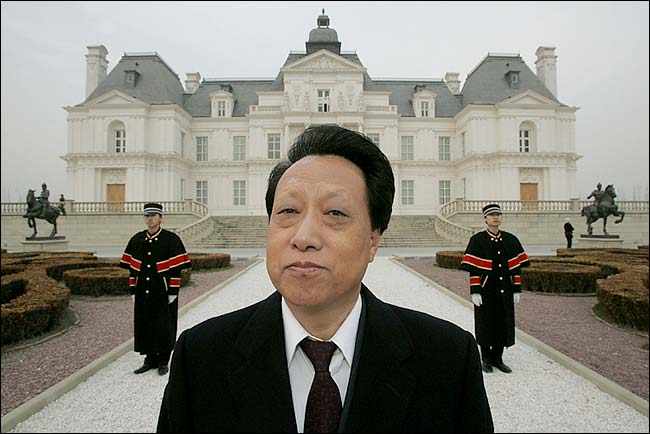
This is no ordinary imitation. It is the oriental twin of Chateau Maisons-Laffitte, the French architect Francois Mansart's 1650 landmark on the Seine.
December 30, 2004
Foucault, medicine, and the gaze
The area of health and medicine is a huge public policy issue. It is always in the news in terms of system failure: hospital waiting lists, lack of public funds, rising costs, cancelled emergency surgery.The focus is usually on the public hospital and the overlapping jurisdictions between states and commonwealth.
Behind this sits a many stranded medical discourse on sickness and medicine which is rarely discussed or mentioned. This discourse involves medical governance, medical science, disease and sickness, technological interventions, political power and medical knowledge, methods of research, biological reductionism etc.
Foucualt is seen to have a lot to say on this in terms of the concept ofdiscourse, the critique of the medicalization thesis, the analysis of the body and the self, bio-power and a governmentality analysis of health policy, health promotion, and the consumption of health. A lot of this discussion in academe takes place within medical sociology.
My initial attraction to Foucault's exploration of the sickness/healing discourse is the way he turns a sceptical or critical eye on the modernist metanarratives of medicine in modernity: doctors as the scientific experts winning the war against disease. The medicos act as bearers of the scientific enlightenment that had awakened modern liberal society from, and thrown off, the yoke of the dark medieval superstitions that kept us in a state of ignorance.
Foucault called this the medical gaze. The gaze of the physicans in modernity could penetrate illusions of sickness and the appearances othe symptons to see through to the underlying reality of disease. The physician had the power of science to see the hidden truth.
In the process the scientific medicos who governed our bodies had developed their own myths. A central one is the all wise and the all knowing doctor who uses science to guard our health, and to keep the "quacks" (the allied health professionals) from becoming a part of public medicine.
comment spam
Due to heavy spamming over Xmas the file mt-comments.cgi has been disabled. So the comments function is turned off. No comments can be made. Trackbacks do not work.
Bear with me. I'm currently in the process of a long overdue upgrade to Movable Type v3.14, plus MT-blacklist as a first step to deal with the pernicious comment spam problem. It would appear that there has been a targeting of MT, by the spammers due to the popularity of its publishing system.
I've been waiting for Movable Type to fix the bugs in their MT-blacklist software that resulted in escalating comment spam that caused extreme server loads. Movable Type has been working on the problem.
I'm not sure whether the spam comment problem has been solved. People are voting with their feet and moving on --to WordPress.
In the meantime--until the upgrade has gone through--comments can be emailed to me and I will incorporate them into the post as an update.
Update
The upgrade has been successful. It is a very different, and a lot more sophisticated, system to the old 2.51 I was using. At the moment I'm having trouble installing the MT blacklist and will need help. So the comments or trackback facilities remain turned off.
December 29, 2004
a seachange
We are on the verge of entering new territory in international relations with the US as the only superpower. This cartoon captures the Middle East aspect of the US as an empire:

Link courtesy of Collective Lounge.
How many observers and experts expected, much less predicted in public, that the United States would invade and occupy Iraq a year before it happened? Few indeed. Now the Bush Administration is talking in terms of a further widening of the war to change regimes in Syria and Iran. How many observers and experts expect that to happen?
In the light of that question a quote from Thomas Powers' article, 'Secret Intelligence and the 'War on Terror' published in the New York Review of Books:
"The toughest challenge for anyone trying to pay attention to the world is to grasp the large shape of events—not the details of warming or cooling relations as routine issues come and go, but the sea change when everything begins to shift. In the world at the moment the big unknown is what America is up to. Following Bush's reelection we must expect the question of American intentions to enter the discussion in the foreign chanceries of the entire world. These intentions are not transparent. The administration first argued that it sought only to disarm Saddam. When that turned out to be unnecessary it was ready with a new argument—replacing Saddam with a free, democratic government would create a beacon of hope and a light unto the nations, persuading terrorists to give up the struggle and changing the political landscape of the Middle East.Maybe that was the real reason all along, and maybe not. Foreign governments may feel that a better guide would be the President's national security strategy issued in late 2001. There the administration argued for a policy of preemption, and a forward policy projecting American military power into the heart of the Middle East. A forward policy requires client states on the ground. What sort of client states? How big a military presence? To remain how long?"
We have been living through a sea change when everything begins to shift. We know that. We have felt the tectonic plates of international relations shifting under our feet. We also know that we on the verge of entering new territory.
However, I'm not sure that we understand what the seachange of projecting American military power into the heart of the Middle East actually means.
Does anyone? One attempt. I use that scenario as a signpost too. What else have we?
December 27, 2004
The CIA as the canary in the coal mine
An interesting article by Thomas Powers in the New York Review of Books on the role of CIA within the US national security state and the newly forming US empire.
Powers says:
"For the broader world watching the unfolding drama of the war on terror.... we might say that the CIA serves in some ways as the canary in the coal mine—when it shows sign of stress, we know something is wrong either with intelligence collection or with the policies it is intended to support. It's always one or the other—the evidence is thin or missing, or it points to conclusions that meet resistance......What brings any student of intelligence to a kind of shocked halt is the fact that CIA analysts did not get anything right—every claim about Saddam's WMD was wrong—completely wrong, flatly wrong, wrong by a country mile."
Powers says that it is unlikely that the United States had ever been more comprehensively and significantly wrong about anything, ever, than it was in identifying the reasons for going to war in Iraq. He then asks why did the director of central intelligence, George Tenet, go on repeating the White House formula for a year as well—insisting that it was too soon to reach conclusions, that the Iraq Survey Group was busy in the field and something might still be found? His answeris that Tenet did this because:
"....the obvious explanation for Tenet's faithful echoing of the President's tactics of delay [is that] Tenet was protecting the President—not from foreign enemies abroad, but from political opponents at home. Why did Tenet do this? Because he was part of the President's team.....This is where we find ourselves now—the CIA under George Tenet gradually abandoned its pretense of objectivity and joined the President's claque for war, but Congress has not yet decided how to describe or recognize this fact, or what to do about it."
What does this tell us about the integrity of American intelligence? That the intelligence services have become part of the operational arm of the national security state.
The working climate of intellignece agencies is now one in which they are expected to produce a stream of "intelligence" handcrafted to support an government's view of the world, or of its progress in the war on terror. As Powers says of the US :
"The CIA is turning by slow degrees into an operational arm of the White House, not only doing or attempting to do what presidents ask, but one increasingly willing to play a team role, to describe the world as the President sees it, and to lend its authority to "intelligence" the President can use to carry along Congress and the public."
He leaves us with a question: "What should Congress and the people do about an intelligence service they cannot trust?" We can ask a similar question in Australia.
December 26, 2004
Critical Theory: 1 & 2
I'm with Fred Dallmayr on the relationship between the first generation of Critical Theoriests (eg., Adorno and Horkheimer) and the second generation (Habermas). The Dallmayr link is courtesy of Ali Rizvi's excellent Habermersian Reflections.
Dallmayr says that:
" While many members of the first generation were sympathetic to religion (though not to any kind of dogmatism) in the form of a subdued Jewish messianism, the basic initial impulse of the School—as an “Institute of Social Research”—was the critical analysis of late capitalism and bourgeois-liberal society. These tendencies were nearly reversed during the second generation. Under the guidance of Jürgen Habermas, “critical theory” showed little or no interest in religious faith, preferring instead to champion a purely rational discourse (inspired in part by neo-Kantianism and linguistic philosophy). At the same time, again under Habermas’s influence, critical theory has steadily moved closer to political liberalism, to the point that the distinction from Rawlsian proceduralism sometimes appears as a mere nuance. Small wonder that many observers have detected a gulf separating the two generations."
The text being reviewed is Eduardo Mendieta (ed.) Jürgen Habermas, Religion and Rationality: Essays on Reason, God, and Modernity. In it Mendieta argues for a smooth, uninterrupted continuity between the two generations of the Frankfurt School, and that the second generation of the Frankfurt School has “without equivocation” continued the agenda of the first. In response:
Dallmayr says:
"My task here is not to arbitrate between Athens and Jerusalem or to judge the respective merits of rational-philosophical and religious-theological arguments. My point here was simply to cast doubt on Mendieta’s claim of a smooth, uninterrupted continuity between the two generations of the Frankfurt School. This doubt is further reinforced by developments in another arena for which Habermas has shown little sympathy: French philosophy, especially in its deconstructive variant. As it seems to me, many of the motifs of the first generation—appeals to eschatology and a “radically Other”—have resurfaced in recent decades in the writings of French Jewish and Christian thinkers, from Levinas to Derrida and Marion. Habermas’s essays make no reference to Levinas, and his comments on Derrida are almost uniformly dismissive. Have motifs of the first generation thus emigrated from Frankfurt into new terrains?"
I accept that Habermas' turn to, and embrace of, a mode of “functionalism” (inspired by Parsons and Luhmann) and his elaboration of evolutionary models of social and individual developmenta was prompted by a “dissatisfaction” with the first generation’s treatment of rationality, and especially its refusal to take seriously Weber’s thesis of progressive societal “rationalization,” secularization and disenchantment. And I accept that Habermas distinctions “system” and “lifeworld” as dimensions of social life were an improvement on the totally administered soceity.
But Habermas has embraced American political liberalism in a way that Adorno and Horkheimer never did.
December 24, 2004
Xmas thought.
It is time to wind down for Xmas.
A thought. Many constitutional liberals see individual freedom threatened by the state. Hence the need for a constitution or a bill of rights to protect individual freedom, autonomy or right in civil society against coercion.
A common understanding of constitutional liberalism is that constitutional liberalism is different and historically distinct from democracy. It represents a doctrine of private individual and institutional rights; a judiciary dedicated to the enforcement of those rights; a system of representation designed to mute the excesses of popular democratic passions; a constitutional framework that impedes the hasty translation of democratic public impulses into sweeping changes of fundamental law, and, above all, a diverse private sphere diverse that is strong enough to provide a strong defense against the encroachment of government.
An alternative view to the duality of state power and provide freedom/On this alternative view the state is the ground without which the needs and free activity of humans in civil society cannot be sustained.
December 23, 2004
liberal tensions
This is an interesting article by Jonathan Freedland on liberalism in The Guardian about liberal tensions.You can find some discussion at Normblog.
There are two passages of note in Freedland's text about the conflict of values within liberalism:
"The conflict played out ... is between two values - one that liberals have cherished for centuries and another acquired much more recently. The ancient, almost defining liberal ideal is freedom: of expression, of movement, of protest. The newer value is an approach to society's minorities that aims to go beyond mere tolerance, and reaches for understanding and sensitivity."
In Australia this conflict is of freedom of expression and respect has been played out in terms of assimilation and multiculturalism, in terms of sameness and difference, in terms of national culture and diversity of values. We interpret understanding and sensitivity as a multiculturalist tolerance for difference.
In a multicultural liberal society we want free speech but are put out when someone uses it to demean Arabs and Muslims. So the law restricts freedom of expression where it becomes incitement to racial hatred and/or murder.
Except for cases of defamation.Then freedom of speech is severely restricted. Though the law of defamation is supposed to protect people's reputations from unfair attack, in practice, its main effect is to hinder free speech and protect powerful people from scrutiny. An exception is for members of Parliament speaking in Parliament.
However, the real conflict in Australia as a multicultural liberal society is the recognition of cultural difference of ethnic differences. After 9/11 this means recognition of Arabs and Muslims within the nation states and Arabs and Muslims coming to our national borders seeking asylum as refugees within Australia.
The second quote from Freedland's text refers to the way this value onflict within liberalism is resolved:
"But just as Isaiah Berlin once forced the left to see that freedom and equality were very often at odds, so it is time for today's liberals to be honest - and admit that the ideals they have clumsily bolted together for three decades often chafe badly. Sometimes one of them is sacrificed for the sake of the other. Better to admit it and to decide consciously which value we are preferring in this case or that, than to pretend there is no conflict. Hard-headed liberalism means hard choices."
Respect of the other (as cultural sensitivity) or recogniton is downplayed. This is especially the case with the increasing political presence of refugees and immigrants in recent years from the Midddle East. The recognition of cultural, racial, and ethnic differences has come to occupy a central place in the national politics of exclusion of asylum seekers. Freedom of citizens is preferred and the alien is excluded.
There is a long history of this kind of governance in Australia. As Kim Rubenstein observes:
"Aliens are subject to Commonwealth control by virtue of s 51(xix) of the Constitution, which refers to ‘naturalization and aliens’. This head of power has been used by the government throughout the 20th century, and has been interpreted by the High Court, to give the Commonwealth almost complete control over laws relating to aliens and, now, ‘non-citizens’. This has been an essential device of exclusion, which existed well before the legal term ‘citizenship’ came about. In fact, the difficulties in the distinction between membership and exclusion were reflected by the High Court’s treatment of the area in the first 50 years before citizenship evolved as a legal term. In a range of important and early High Court decisions, we see the first legal expressions of citizenship as exclusion."
This kind of historical exclusion shows that cultural diversity of minorities is recognized as an "add-ons to the existing national form.
Is there a deep seated conflict?
David t over at Harry's Place thinks not. In a liberal society freedom is a right and recognition is a civility. He says:
"Freedom of expression is a foundational principle which is the hallmark of, and underpins, all liberal pluralist societies. It is a principle which, in its purest form, handicaps the state from banning the expression of views. ...However, only the state has the power to ban: be it by enforcing defamation or breach of confidence judgements or by criminalising various forms of speech. The significance of an exercise of state power of that type goes beyond anything that the private sector can muster."Not offending people" is certainly a political principle of sorts, but it works at quite a different level from the principle of freedom of expression. I would argue that "understanding and sensitivity" is a civic virtue but - unlike freedom of expression - not a right."
Rawls is used to justify this.
I have interpreted "understanding and sensitivity" is recognition of the other. Is recognition a civic virtue. Or a right? if we turn to the work of Charles Taylor on recogniton we see the conflict being played out differntly between right right and particualar difference. Taylor says:
"With the politics of equal dignity, what is established is meant to be universally the same, an identical basket of rights and immunities; with the politics of difference, what we are asked to recognize is the unique identity of this individual or group, their distinctness from everything else. The idea is that it is precisely this distinctness that has been ignored, glossed over, assimilated to a dominant or majority identity. And this assimilation is the cardinal sin against the ideal of authenticity."
So we want to be treated equally as citizens but then recognized differently for being Arab-Australian citizens.
As Taylor notes:
"These two modes of politics, then, both based on the notion of equal respect, come into conflict. For one, the principle of equal respect requires that we treat people in a difference-blind fashion. The fundamental intuition that humans command this respect focuses on what is the same in all. For the other, we have to recognize and even foster particularity. The reproach the first makes to the second is just that it violates the principle of nondiscrimination. The reproach the second makes to the first is that it negates identity by forcing people into a homogeneous mold that is untrue to them."
This captures the conflict within liberalism better.
December 22, 2004
High Court: defending democracy?
In this speech Chief Justice Murray Gleeson addresses the challenges facing the High Court in the 21st century.
Suprisingly, the majority of the speech is devoted to the challenges of administration and procedure. What has happened to the High Court? Once it was concerned with substantive issues.Now it is concerned with administration and procedure.
It was only towards the end of the Chief Justice Gleeson's speech that matters of substance are raised:
"The principal challenge facing the High Court in the 21st century will be the same as the principal challenge of the 20th century. It springs from the role of the Court in the Federation....The acceptance by Federal and State governments, and the public generally, of the principle that the High Court possesses the ultimate power to decide legal issues arising under the Constitution of the Australian Federal Union has always depended, and will continue to depend, upon confidence in the Court's independence and impartiality, and in the legitimacy of its approach to the exercise of judicial power."
And that means what? The court defending its constitutional power:
"Confidence in the [High] Court has never been put to the test in the face of a threat of constitutional disintegration. There is presently no reason to expect that it ever will. But the possibility cannot be ignored. It will always be the first responsibility of the members of the Court to protect the Court's reputation for legitimacy in the exercise of power."
That is pretty defensive it not? The High Court is primarily concerned about defending its legitimacy as the keystone of the arch of federalism.
There is not even a hint of concern about the relationship between federalisim and democracy. I find that very sobering. Why the narrowness? Why the lack of engagement with public issues? Why the inward looking nature of the reflections?
This text by Justice Justice Ronald Sackville makes a worthwhile suggestion:
" Except for sporadic debates on such matters as the republic or a new preamble, ongoing discussion of constitutional principles in Australia tends to be the province of the experts. We should not be surprised that the Australian people are so reluctant to approve change in our constitutional arrangements when the principles underlying those arrangements are so difficult to grasp and so little is done to engage the community in a sustained dialogue about our constitutional development.The inaccessibility of the Australian Constitution is a serious defect in our constitutional arrangements. Whether it is an irremediable defect and in particular whether the High Court has a role to play in creating a dialogue with the Australian community is an issue deserving of close consideration."
Justice Sackville is not very optmistic that this will happen. He concludes:
"...if there is to be a genuine dialogue between the High Court and the Australian people, [then from] the High Court’s perspective, this would require, at the very least, a different style of judgment writing, a conscious effort to encourage community understanding of the issues at stake in constitutional adjudication, more open analysis of policy questions and increased opportunities for other courts to contribute to the development of constitutional doctrine. For the institutional reasons I have given, even assuming a willingness by the High Court to alter course, a dialogue of the kind I envisage will be very difficult to achieve."
We will have to turn to political philosophy instead of the law if we are to begin dialogue about the relaionships between the Constitution, the High Court, democracy and citizensip.
December 21, 2004
universities, neo-liberalism, politics
Rafe Champion over at Catallaxy has a post on the effects of a neo-liberal mode of governance on the liberal university.
His post is a response to an article by Barry Hindess at ANU who argued in the Education Supplement of The Australian (not online) that the rise of neo-liberalism had caused the decline of the traditional model of the universities as centres of broad learning and scholarship.
I'm not sure that this is a plausible intepretation of the Hindess article, since the decline thesis is a conservative discourse not a poststructuralist one. A Focuauldian governmentality account, for instance would talk in terms of a mode of governance as a way to analyse the links between the university, economy and state.
Rafe says he shares Hindess' concern with the "sickness" of the universities.But he argues that the latter's "diagnosis" is radically wrong and is seriously misleading as a basis for policy action. Rafe then takes the heroic stance. The decline of the university, he says, has nothing to do with neo-liberalism. The comments of the post confirm this reading.
Rafe then offers an alternative narrative. He says:
"To condense a long story, the decline [of the universities] came from a combination of too rapid growth and politicisation of the humanities in the course of the Vietnam debate.My take on economic rationalism in economic policy is entirely compatible with the traditional model of the university, at least in its essential elements. Economic rationalism, for me, has nothing to do with putting extra regulations and constraints into a system that was not (administratively) broken in the first place. The system did not need top down bureaucratic regulation, it needed the bottom up regulation of genuine scholarship and civilised exchange of critical discourse in search for the truth."
My comment is that, during the shift to a mass, social democratic university away from the elite liberal one, the universities were increasingly centralised by the liberal state. The humanities were politicized from the 1970s. Both transformed the liberal university into something other. It became a site of conflict about Australian modernity.
I would suggest that Rafe's diagnosis misses the effects of neo-liberalism on the conventions, traditions and operations of the liberal university. There are a diversity of narratives here. We should not forget the utilitarians nor the workings of nihilism.
A neo-liberal mode of governance used market instruments to turn the liberal university into a commercial enterprise to increase the wealth of the nation through applied research. The instrumentalizing effect of that mode of governance on the administration of the university was to make these institutions operate in terms of business logic in a educational marketplace.This liberal state strategy under the ALP government of Hawke and Keating was designed to prevent Australia from becoming a banana republic.
It was this use of market instruments then undermined the genuine scholarship in the run down departments of humanities and social sciences. These were cut down to make way for the more commercially-orientated courses that would keep the universities cash registers ringing. Standards were dropped to ensure that the cash registers from international students kept ringing.
And the civilised exchange of critical discourse in search for the truth? That was never really there judging from my experience in philosophy departments. It was more about gatekeeping to protect Anglo-American philosophy from its competitors. It was more abouthe operations of power than the search for truth through a critical exchange of ideas.
December 20, 2004
Foucauldian critique of romantic democrats
This article on citizenship by Melanie White and Alan Hunt, which is hosted here,can be read as a criticism of Webdiary's internet activism and deliberative democracy pathway suggested in a previous posts.This pathway calls for more active citizenship and more public involvement.
This is a response to a public life in Australia that gives up on the project of freedom as self-government, abandons the aim of calling economic power to democratic account, that fails to form in citizens the qualities of character that equip them for political deliberation and self-rule.
This proposal is seen as romantic nostalgic for the participatory involvement of what is taken to be a small community's face-to face interaction. It's target is civic republicanism, which has re-emerged as an alternative to liberalism. Republicanism stresses the positive values of political participation and the limits of negative freedom of a rights based political culture.
A lot of the article is an explicition of Foucualt based on interpreting Foucault's idea of governance of the self (associated with the ethics of care for self) by linking it to citizenship, thereby going beyond Foucualt's more individualist understanding of care for self. I am sympathetic to this reworking of Foucualt.
The key idea is that relations of government produce particular kinds of citizens. An indication of this can be found here in this post by Mark Bahnisch at Troppo Armadillo. Mark mentions the work of Barry Hindess on governmentality, which suggests that the liberal university of yesteryear helped to produce:
"...reflective citizens through a humanistic education. This is not an innocent programme, and in the past it's been closely linked to broader ideas of governing the state. In neo-liberal governmentality, Hindess suggests, a different elite is interested in producing a different sort of citizen----self-disciplining, responsible and self-interested."
What White and Hunt do is highlight Foucault's understanding of governance as subjects governing themselves through the production of truth: as establishing a domain where the practices of true and false can be ordered and made pertinent. This is what Webdiary has done with respect to the Howard Government.
Many pages latter, after describing two forms of care for self, as public virtues associated with the 19th century understanding of character and the personality one (self-realization and expressive individualism) of the 20th century, White and Hunt connect changes in forms of citizenship to these two forms of care for self. The former is state-centred and public to one involving multiple point of contacts and participation across a variety of sites and institutions.
Let us accept this genealogy and move onto the critique of the contemporary romantic nostalgic around citizenship associated with civic republicanism. This romanticism is linked Rousseau and it understands citizenship to be a revolutionary project. Their argument that citizenship has no necessary content as it is associated with repression as well as egalitarianism.
That is insisted upon not argued. Is not citizenship in a liberal policy such as Australia connected to the broadening of democracy and the sovereignty of the people?
December 19, 2004
executive dominance, rule of law, citizenship
Let me summarize several threads of argument in the recent posts about a dominant executive, constitutional liberalism and the rule of law, and the rethinking of citizenship.
The first thread comes from reading Margo Kingston's Not happy, John! This thread argues the need for citizens to have the power to limit the actions of Government is greater now as it has ever been. Our experience of politics is one that has a House of Representatives dominated by one political party. The power of the Party ensures that the Government (the executive) gets its legislation through the House. For the past 25 years the Senate reviewed and contested this legislation in the name of democratic legitimacy. With control of the Senate passing to the Howard Government after June 30 2005, a browbeaten Senate will pass legislation, and the Crown will automatically give assent.
In this situation the checks and balances placed on the powers of a dominant executive are weak, and not very effective. This leaves citizens out of the picture, and leaves them vulnerable to repressive legislation. Hence we need to empower citizens so they can participate in, and exercise control over government, through a deliberative democracy.
The second strand explores the idea of constitutional liberalism in terms of checks and balances. From reading Hayek I understood constitutional liberalism to mean the use of the rule of law to constrain the powers of the state in a federal democratic system. This article by Kim Rubenstein. She quotes T S Allan to the effect that:
"The idea of the rule of law, in contradistinction to rule by men, is an ancient one. At its core is the conviction that law provides the most secure means of protecting each citizen from the arbitrary will of each other....The law is to constitute a bulwark between governors and governed, shielding the individual from hostile discrimination on the part of those with political power."
Kim goes on to say that this implies a basic principle: that the law is supreme and replaces any arbitrary force. Since executive action is governed by this principle, and therefore executive action is not unfettered or absolute. This is really the starting point for the legitimacy of judicial review and is essential to a democratic system.
Judicial review is the enforcement of the rule of law over executive action. It is the means by which executive action is prevented from exceeding the powers and functions assigned to the executive by law and the interests of the individual are protected accordingly.
Kim then unpacks the implications of the rule of law:
"Feldman states that when looking at the rule of law and government one can identify three meanings of the rule of law. The first is a state of order under law, the second is government under law and the third is substantive restrictions on legislative power such that government in its legislative program is under law as well as governing through law. These principles consist of a number of elements including that government should operate under legal principles, that the principles should be enforced, that there should be an independent judiciary and there should be a commitment to the values of the rule of law."
Though the law of rule is a check on the power of the executive, it does little to empower citizens so they can become more active and particpatory.
The third strand is our understanding of citizenship. This has argued that the Australian Constitution has a big black hole about citizenship in a liberal democracy. The Constitution talks about Australians as people, persons and subjects, but not as citizens. Australians as citizens is largely defined in statutory terms, especially the Nationality and Citizenship Act 1948 and its various amendments under the Hawke Government. What appears to drive these statutory understandings of citizenship is exclusion: excluding aliens (non-whites) from becoming citizens in a liberal democratic polity.
This suggests that we need to rethink the silence around citizenship and to question the liberal understanding of citizenship. This non-constitutional understanding treats political membership in the nation state as the ground for the protection for rights, and understands the virtues of citizenship in a liberal polity in terms of obeying the law, individual freedom and tolerance of diversity.
It is unclear what the rights, responsibilites and duties of the liberal citizen are. Some are clear: political rights such as voting. It is also Australian an obligation as it's compulsory. Then there is jury duty. These are legal rights that say nothing about being a full member of the national community of the nation state and being a certain kind of person capable of being a responsible member in a political community.
December 18, 2004
democracy on the ropes
A quote from Justice Tony Fitzgerald's speech launching Margo Kingston's book, 'Not happy John! Defending our democracy', at Glebebooks in Sydney on June 22:
"My brief remarks will be directed to the damage that mainstream politicians generally are doing to our democracy...Mainstream political parties routinely shirk their duty of maintaining democracy in Australia.This is nowhere more obvious than in what passes for political debate, in which it is regarded as not only legitimate but clever to mislead. Although effective democracy depends on the participation of informed citizens, modern political discourse is corrupted by pervasive deception. It is a measure of the deep cynicism in our party political system that many of the political class deride those who support the evolution of Australia as a fair, tolerant, compassionate society and a good world citizen as an un-Australian, “bleeding-heart” elite, and that the current government inaccurately describes itself as conservative and liberal.
It is neither.
It exhibits a radical disdain for both liberal thought and fundamental institutions and conventions. No institution is beyond stacking and no convention restrains the blatant advancement of ideology. The tit-for-tat attitude each side adopts means that the position will probably change little when the opposition gains power at some future time. A decline in standards will continue if we permit it....In order to perform our democratic function, we need, and are entitled to, the truth. Nothing is more important to the functioning of democracy than informed discussion and debate. Yet a universal aim of the power-hungry is to stifle dissent. Most of us are easily silenced, through a sense of futility if not personal concern."
There lies the argument for deliberative democracy.
What then is the opposing view?
The opposing view ---the political consensus of the two major parties---is that economic growth comes first democracy second because economic growth creates the pre-conditions for democracy. Economic growth requires strong technocratic governance.
Now you can quite easily argue the other way. Strong economic growth has depended on a well functioning democracy and constitutional stability. What would happen to the economy if we decided our political conflicts through civil war? Australia could not have emerged as a succesful capitalist economy without a stable constitutional base, and a functioning democracy that provides for democratically elected federal and state parliaments.
Tony Fitzgerald's words, " our democracy", "if we permit it", "perform our democratic function, we need, and are entitled to the truth", [m]ost of us are easily silenced', imply us Australians speaking as citizens. Yet the word is never mentioned by Fitzgerald, even though we commonly understand citizenship to be relevant to our understanding of democracy. Is not freedom of political communication and discussion a necessary implicvation of of the Constitution's doctrine of representative democracy?
The question of citizenship is fundamental to looking at the relationship between the individual and the State. How do we determine the rights that flow from citizenship?
Is not the centrality of citizenship is the right to participate in, or to be consulted in government. Citizenship is about democratic participation in government. Citizens are those who have the right to vote. Citizens have the right to participate in, and influence our democratic system.
Does not the development of implied rights in the Australian Constitution also raise the question of whose rights? If you have the right to vote, then do you have the right to rely on the Constitutional protection of free speech in trying to invalidate a law. Do non-citizens have the protection of implied constitutional rights?
Key questions. Yet silence from Fitzgerald.
Has our political language decayed that much that we no longer talk about citizenship? Greg Craven's Conversations with the Constitution is strong on federalism and constitional order but does not explore the relationship of citzenship to the Constitution. And though the High Court is the arch of federalism it has has little to say about citizenship. Neither Craven nor the High Court seem much concerned that the Constitution still doesn't refer to citizenship.
Let me conclude with an insight from an early text by Habermas. In his 1962 work The Structural Transformation of the Public Sphere, Habermas argued that the competitive pressures of a free market economy eventually require state intervention and regulation, which in turn produces increased competition and still more regulation. Finally the state becomes a major player in the economic arena and is faced with what he called a "legitimation crisis" -- a set of normative contradictions -- such as the conflict between serving special interests and advancing the common good. A vibrant public sphere is the only safeguard against such a crisis, Habermas insisted. Some form of public discourse about common affairs (dialogue that arises naturally among citizens, rather than the sort orchestrated by the state), as well as an arena in which it can happen, was therefore necessary, he said.
December 17, 2004
political deliberation: looking back & forward
Parliamentary sovereignty means executive dominance after June 30 2005.
If deliberative democracy is to flourish in the new political situation of executive dominance and parliamentary sovereignty, then we citizens require more than the standard constitutional checks and balances. As Margo Kingston points out, we are lose a lot when the control of the Senate passes to the Conservatives after June 2005.
Important issues for deliberative democracy are at stake here. As Ali Rizvi says in his post, 'Towards Theorising Postmodern Activism,' at Foucauldian Reflections:
"One of the main functions of capitalist governance is to normalise the ideas, to neutralise them, take the sting out of them etc. through placing them within the discourse, and then constantly multiplying the discourse rather than repress them through inhibiting the discourse. Repression is not a chosen strategy because it is not effective in the long run among other things." (See papers, work in progress, notes etc. if link does not work).
To counter this we citizens will need a variety of spaces for us to express our views and to engage in political debate on public issues. A lot of work will be required from liberals and radicals to contest the spin and normalizing of what Margo calls an alliance of Big Government, Big Media and Big Industry.
These spaces for genuine political deliberation in a liberal polity by citizens have been few and far between in the past, as indicated by this passage from Tom Fitzgerald's last Nation editorial, when he passed the baton to Nation Review in July 1972:
"The liberal and radical strains in Australian intellectual life, though substantial in number, are always struggling to have a vehicle of communication… whatever the reasons for the difficulties they are persistent and liberals and radicals, without sinking their differences, must love one another or die as an articulate force in this country."
Nation Review eventually expired, sometime in the late 1970s I think.
This lack of public space to engage in political debate means that our oppositional discourses (ie., the shared means we have of making sense of the world embedded in language) become impoverished. Often the assumptions, judgements, contentions, and dispositions lie unquestioned by others, and we become dogmatic and closed in our thinking. We cannot afford to allow that to happen over the next six years.
We need to create new spaces.
Margo Kingston's recent book, Not Happy, John! indicates that she is alive to this, and has been thinking about it off and on for a while. (See my previous posts here and here. ) She argues that the Liberal Party under John Howard has become a party of social conservatism and market fundamentalism, and more closely aligned with the conservative English Tories and American Republicans, than any genuine (social?) liberal party.
Margo explicitly addresses the renewal democracy in her last chapter of Not Happy, John! Entitled, 'Democrazy: Ten Ideas for Change', it starts from this quote by 'Gara LaMarche at the Open Society Institute’ in the US. He says that progressives:
"...have been in the posture of criticism for so long, have had to spend so much time fending off attacks on hard won gains, and on values and institutions we hold dear, that we have virtually lost the capacity for critical imagination. We can't see the forest we would like to dwell in because we are trying to protect tree after tree from the buzz saw."
I've suggested that 'the forest we would like to dwell in' is best described as deliberative democracy. Maybe, just maybe, it is liberalism that depletes our democratic political imagination?
I would argue that constitutional liberalism is thin on creating the diverse spaces that would enable debate and dialogue, as the institutions of the state have been their main focus of political deliberation. They focus on the House of Representatives, the Senate, the judiciary etc. Thus Carmen Lawrence's focus is on strengthing the parliamentary institutions so as to empower parliament against the dominant executive. Lawrence suggests:
"* establishing joint Estimates and Legislation Committees with power to question public servants and Ministers from either House, take submissions and commission independent research;
* giving Parliamentary Committees the power to put up legislation arising from their inquiries - especially if the government has refused to respond to its recommendations;
* allowing private bills with the backing of a set percentage of voters to be brought on for debate by a sponsoring MP;
* commissioning citizens' juries or deliberative polls on contentious and complex policy matters – getting together cross-sections of ‘ordinary Australia’ to hear the arguments and discuss the merits of issues as wide-ranging as water conservation and free trade agreements;
* inviting expert and community representatives to address the chamber in session and engage in debate with members; and
* strengthening freedom of information legislation."
Good ideas. But that kind of reform of Parliament is out of the question for many a long year. Remember the radical centre has been wipped out. The Greens? Not until they obtain the balance of power in the Senate. That is up to a decade away.
Carmen's proposals suggest a benign inclusion into the institutions of the state. The ACF is an example of this inclusion through its linkages to the ALP. As conservatives traditionally act to repel destablizing threats to the established order, so they will be wary of political inclusion. We need to look elsewhere. To active citizenship.
So what do Margo and her social liberal colleagues suggest on how to address the above problem? Do they shift beyond the institutions of the state to civil society? Do they start developing the idea of an oppositional civil society?
The suggestion in this post suggests a new website where journalists and Australian citizens can trust each other and work together. This is what Antony Lowenstein calls internet activism, which is idea 8 in 'Democrazy: Ten Ideas for Change'. Presumably, this is going to something along the lines of the US sites that Antony mentions, such as MoveOn.Org, and Prwatch.org and Adbusters.org
It is at this point that we need to introduce some theory by returning to Ali Rizvi's work on Foucault's understanding of the double character of freedom. Ali says:
"The apparent paradox of capitalism is that in order to increase the utility and productive capacity of individuals and populations it requires to keep expanding the ambit of freedom and diversity, but in order to make individuals and populations docile and hence governable and manageable, it needs to limit this diversity by setting limits so that it remains manageable. ........Capitalism resolves the dilemma through realising the double role freedom can play. Freedom is central for the functioning of a capitalist system not only as the precondition for enhancing utility and diversity, but for its double role as the precondition of enhancing diversity and imposing singularity on multiplicity."
It is here that Foucault makes an important point. On Ali's interpretation:
"Foucault’s claim is that in capitalism the governance of diversity is maintained through freedom itself and not (primarily) through repression. Capitalism’s interests are not fulfilled by curbing and limitations per se. ... Foucault defines "government’ as the structure (ing) of the possible field of action of others" ,....The Capitalist logic is based on a realisation that freedom is the essential element of ‘government’ (management) in the sense that capitalism recognises the ‘double’ character of freedom. To desire freedom is not only to expand the arena of choice (diversity) but it is also to make oneself governable (manageable)."
The net activism being created by Margo is situated itself within the double character of freedom and government rationality.
December 16, 2004
Conversations with the Constitution#4: public reason
In my post thread called conversations with the constitution I have presumed that the Australian Constitution is a legal/political document, and that it is underpinned by, or presupposes, a political philosophy based on an amalgam of democracy (sovereignty of the Australian people) and republicanism (federalism).
So I pretty much interpret this historical document (text) through that lens, or from that hermeneutical perspective through the use of public reason. From this I would say that federalism is constitutionalism.if we understand constitutionalism means respect for the rule of law. As Justice Michael Kirby says, (p.8) if the law is clear and constitutionally valid, then it is the duty of citizens to obey the law and the duty or the courts to apply its terms.
In term of the constitutional underpinnings I'm pretty much in agreement with Justice Michael Kirby's account of the legal bedrock, or Grundnorm, in this speech.
However, I've often wondered that, with the conservatives in power in Canberra and the increasing intervention of conservative Christians into national politics, how the Christians interpret the Constitution. Is is a secular document? Or is Grundnorm, come not from the Australian people united as a nation, but from a "creator", "the laws of nature, or from God. Is God's hand at work in the constitiutional foundations? What if the judges were fundamental Christians? What if they said, We Australians are a religious people whose institutions presuppose God.
I've never taken this any further than that. But a post by Lawrence Solum over at his Legal Theory Blog got me interested. Called 'Natural Law, Public Reason, and the Constitution', it is Lawrence's response to Jack Balkin's Is Belief in Natural Law An "Embarrassment?" Balkin was responding to Kevin Drum, who in turn, was responding to this commentary in the Los Angeles Times about the judicial reasoning of Justice Clarence Thomas.
This is a very American argument shaped by the Declaration of Independence but it raises an interesting question. What if a conservative High Court Judge -say Judge C---started talking about the Australian constitution in terms of God and natural right? Would this be acceptable? Does not liberalism require a separation betwen religion and the state?
Personally I reckon that you cannot put the hand of God into the constitiutional foundations of Australia's constitution, since the Constitution is not based on natural right. If there are deep rights buried in the Constitution then these are not natural rights. They are rights deeply rooted in our federal democratic system of government, and in our tradition of common law. The Americans can say without embarrassment that it is self-evident that all men were endowed by their Creator with liberty as one of the cardinal unalienable rights. I do not think that Australians can say that at all.
However, I accept that interpretation of the principle that our rights are deeply rooted in our federal democratic system of government, and in our tradition of common law, is contested and open to conflict. It is where the battle is joined.
If we return to Lawrence Solum we find him asking the right question:
"The question then, is whether it is proper for a Supreme Court justice to argue that the underlying moral foundation for the constitution is religious in extra-judicial discourse?"
Note that we are talking about the moral foundation of the constitution not the political foundation. I do not think that I have ever heard that kind of talk in Australia.
I'm interested in Lawrence's response as he tackles the question from the perspective of public reason (John Rawls), which I have reframed as a form of democratic deliberation. So we need to get Rawls out of the way by going through him.
Lawrence offers useful summary of Rawl's understanding of public reason which I will cut and paste:
"...the Rawlsian ideal of public reason... has three main features: (1) The ideal of public reason limits the use of reason to (a) the general features of all reason, such as rules of inference and evidence, and (b) generally shared beliefs, common- sense reasoning, and the noncontroversial methods of science. (2) The ideal applies to deliberation and discussion concerning the basic structure and the constitutional essentials. (3) The ideal applies (a) to both citizens and public officials when they engage in public political debate, (b) to citizens when they vote, and (c) to public officials when they engage in official action - so long as the debate, vote or action concerns the subjects specified in (2)."
Now I have my doubts about Rawls' understandinmg of public reason as an integral part of deliberative democracy.
Rawls highlights the ideal of public reason in term of the arguments made by individual citizens or their representatives that are capable of being accepted by all members of the polity. However, I reckon that he downplays the social. By this I mean that he downs public reason as dialogue--as the process of deliberation through dialogic interaction highlighted here. Lawrence seems to imply otherwise with his phrase "engage in public political debate". Or is this an ideal, and public reason is actually more about the reflective individual in public life?
Let us stay with Solum's political dialogic interaction interpretation.
The next problem that I have is that Rawls downplays the political. He presupposes that all the participants in the public political debate reason the same way (an orderly and serious discussion through giving reasons in the form of arguments), reach the same conclusion and come to a consensus. Reason is singular not plural, and it involves setting aside material self-interest, political partisanship and sectarian argument, since argument is about what is in the common interest of all.
That is hardly how political debate operates. Political deliberation involves intelligible arguments that express partial views, often are not about reaching consensus or a unified political will ( it may yield understanding and mutual respect), and often involved deep moral conflicts (abortion). The impression I gain is that the reasoning in public political debate functions like the legal deliberation of the High Court, or rather the US Supreme Court.
Rawls offers is a thin account of deliberative democracy does he not? Would not the debates by those attending the writing and adoption of the Australian constitution be a better model of what engaging in public political debate means; or the debate over federation by Australian citizens?
Okay that is Rawls.
What public reason highlights as important is that the very process of constitution making in Australia presupposes public deliberation amongst citizens. What is also important is what can be derived from public reason embodied in the constitution: eg, the rights to freedom of political expression; some form of understanding the people as citizens; some form of equality as mutual respect and social cooperation, accountability to other citizens and to future generations etc.
I would suggest that there is room for the High Court to interpret the Australian constitution along these lines, as well as importing international law to guide its interpretation of the constitution's legal bedrock. However, as Justice Kirby observes in the forementioned speech the willingness of the High Court of Australia to find rights implied in the language and structure of the Constitution is receding from the high point of the Mason court. There is conservatism at work for you.
Let me come back to the American discussion. The significant point that Solum makes is that that judicial reasoning, for example the reasoning of the US Supreme Court, exemplifies public reason and works within its bounds. Hence we have the distinction between reasons that are public and reasons that are nonpublic without necessarily equating these with reasons that are religious and reasons that are secular.
The implication I draw from that for the Australian context is that it would be very difficult for a High Court judge to talk about the hand of God underpinning the constitution in the form of natural rights. That kind of constitutional interpretation by Judge C would be stepping outside the bounds of public reason in Australia as it is currently contextualized.
However, as Lawrence points out, when Judge C speaks in his private capacity, as participant in public intellectual life, he is, and should be, "free to offer reasons that draw from the comprehensive religious or philosophical conceptions of the good--especially when such reasons are foundation for (or supportive of) public reasons. [He]... may properly discuss the relationship of his comprehensive religious doctrine--Catholicism--to the Constitution in his extrajudicial writings."
December 15, 2004
deliberative democracy, Foucault, mutual obligation
The emergence of deliberative democracy in Australia will come out of the political spheres that consist of political association and interaction separated from and in opposition to the liberal state now controlled by the conservatives. The insight here is the importance of the conversations taking place in civil society in the meeting places such as coffee shops, the debates in the broadsheet newspapers, the deliberation in the blogosphere, and the dialogue in political associations.
An example is the current dialogue about mutual obligation and indigenous people which is being conducted by Meg Lees; by public opinion here and here); by Kick and Scream (here and here and here) and Troppo Armadillo (here and here). A key text in this dialogue in the bloggosphere is this one by Pat Dodson and Noel Pearson.
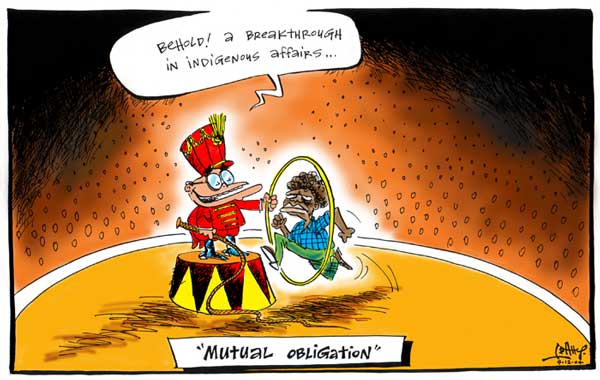
The process of deliberation and opinion formation about what should be done about the third world conditions of indigenous people, and their current welfare dependency, will proceed differently in the diverse public spheres of civil society, due to the political and economic structures. So it is useful to ask the Foucauldian question, 'how is power exercised in liberal society?'
It is an appropriate question because in this debate we are concerned with power, how power works, and to separate out power to improve the health of the children from force exercise against the community's will. A key issue that has arisen in the public debate is this: 'what is the nature relationship between the imposition of mutual obligation by the state and the liberty of the indigenous people to shape their own way of lif?.
At this stage of debate this relationship is currently seen terms of an either or dualism of (negative) freedom and (government) constraint. I suggest that Foucault offers a way to transgress this dualism, in the light of this post on governmentality and the duality of (free) subject and power (as domination).
So what is Foucault saying? How can he help us?
The above mentioned post was part of a series of posts on governmentality that were based on this text. The post said that:
"Governmentality refers to a continuum from techniques of government to technologies of self-regulation. This enables a more complex account of the way neo-liberalism works as a mode of governance, with its strategies of making individuals and families responsible for social risks such as retirement, illness, unemployment, and poverty.This shaping of responsibility as care of self leads to a moral subject who is able to rationally assess the costs and benefts of a particular course action in relation to others."
Mutual obligation is an example of what Foucault means by governmentality. It is a mode of governance of a population that works by shaping the conduct free subjects so that they become responsible parents and members of the community.
As Dodson and Pearson argue, the aim of this mode of governance:
"The aim must be to normalise obligations between Aboriginal parents and their children, between family members, and between individuals and their communities....The obligation to attend to children's hygiene is primarily an obligation owed by parents and adults to their children. It is not an obligation that, in the normal course, is owed to government..."
So the government should be shaping the parents conduct so they become the kind of subject, who as parents, fulfil their familial responsibility to attend to the hygiene of their children to prevent them from getting sick: the blindness caused by trachoma, the kidney failure caused by scabies and the deafness caused by unresolved ear infections.
Ali Rizvi has some useful insights here about how Foucault understands the workings of power. He quotes a passage from Foucault's, 'The Ethic of Care for the Self as a Practice of Freedom”, where Foucault says:
"Relations of power are not something bad in themselves, from which one must free one’s self. I don’t believe there can be a society without relations of power, if you understand them as means by which individuals try to conduct, to determine the behaviour of others. The problem is not of trying to dissolve them in the utopia of a perfectly transparent communication, but to give one’s self the rules of law, the techniques of management, and also the ethics, ethos, the practice of self, which would allow these games of power to be played with a minimum of domination” Michel Foucault (1987) “The Ethic of Care for the Self as a Practice of Freedom” trans. J. D. Gauthier Philosophy and Social Criticism special issue “The Final Foucault” 12 Summer, p. 129).
And in this latter post Ali usefully comments:
" ...practices of subjection are not all pervasive in the sense that there is always room for the constitution of subject as autonomous subject amidst the practices of subjection.This is possible because Foucault does not oppose power to freedom. Power is one kind of relation while freedom is another kind of relation. According to Foucault power “is the mode of action on the action of others” in the sense that its purpose is “to structure the field of possible actions of others”. Hence viewed, power relations must form an integral part of any society and thus “there can be no society without power relations”. Moreover power and freedom far from being contrary concepts are prerequisites for each other. At least Foucault makes it explicit that power can only be exercised “over free subjects and only insofar as they are free”. If power is the structuring of other’s action it can only be possible if there is space (freedom) for such a structuring."
This point is significant.The indigenous people in Mulan in Westeren Australia may be living in third world conditions but they are free subjects in a liberal society. So the techniques and instrumentalities of mutual obligation are concerned to shape the conduct of free indigenous subjects. There actions are to be structured to ensure they take responsibility for their children's health. And the indigenous community has agreed to have their conduct so shaped by the mechanisms of mutual obligation.
The questions are: is there space (freedom) for a structuring of the other’s action in those indigenous communities currently living on the edge of modernity?
Can aboriginal people be shaped to become free liberal subjects?
Are they, as liberal subjects able to, to use the instruments of mutual obligation to impower themselves, become more responsible parents and govern their community so that better health outcomes for their children can be achieved?
December 14, 2004
political public space
Jurgen Habermas on political public space. This Kyoto Prize speech is a sketch of the biographical roots of his concern about public spaces and the political.
He usefully distinquishes between publicity and the self-promotion and presentation of the celebrity for their fans on the one hand; and on the hand, public discourse, which is the process of reaching of an agreement on a particular public issue, or clarifying reasonable dissent. In the latter we have the triad of public space, discourse and reason operating.
Unlike a nomadic Bataille Habermas approaches this in classical Aristotlean terms: we are a zoon politikon, a political animal embedded in a public network of social relationships and a shared public culture. We become educated (bildung) by learning from one another within these relationships and culture and communicating to one another through language.
The political space Habermas experienced from the 1950s to the 1980s was demarcated by conservatism (Junger, Heidegger, Schmitt etc) and the democratic impulse. We face the resurgence of conservatism today; one that is tr reinventing a single, centralized story of human progress called the West. It is a narrative that displaces the global rebellion against European colonialism and imperialism that had rendered the very notion of a single, centralized story of human progress problematic.
The need to contest one nation imperial conservatism highlights the importance of public spaces for citizenship, the process of formation of public opinion, civil solidarity, and will formation. Habermas says:
"....the critical state of a democracy can be measured by the taking the pulse of life of its political public sphere."
On that critieria we citizens should have grave concerns about democracy in Australia as the pulse of life in our political public sphere is weak indeed. Very weak. It lacks a diversity of public spaces; there is a process of dampening down of critique in civil society by a conservative government through withdrawing funding from ngos; and the limiting of public discursive space due to the ongoing concentration of the media.
Habermas finishes his speech by reflecting on public intellectuals:
"Intellectuals should make public use of the knowledge they possess---for example... as a philosopher... and they should do so of their own initiative, in other words without being commissioned to do so by anyone else. They need not be neutral or eschew partisanship..[but] they should endeavour to improve the deplorable discursive level of public debate...they betray their own authority if they do not carefully separate their professional from their public roles. They should not use the influence they have by dint of words as a means to gain power, thus confusing "influence" with "political power", that is authority tied to positions in a party organization or government. Intellectuals cease to be intellectuals when they are in public office."
Well, we do need to confront with the slipshod use of language in the op ed commentary and editorials.
And the rest? Hmm.
An obvious point. Mark Latham was not a public intellectual when he wrote 3 books on politics whilst a backbencher in the ALP? But he would have been one if he wrote these tests from within a corporate university? That is an odd and narrow understanding of a public intellectual. What has happened to all those intellectual workers who perform an intellectual function in postmodern society?
A forum on public intellectuals.
Habermas seems to assume that the professional academic is divorced from politics, because the university is outside of politics and the market. But that was yesteryear, before the liberal university was transformed into a corporate one by the liberal state. Today, public intellectuals inside univeristies would, and should be, seriously address the way that a corporate agenda is now driving the university ansd making them an instrument of wealth creation.
I reckon that we also need to question the ideology of academic professionalism, and to consider whether there was any disjunction between democracy and university, given the privilege of the scholar and critic who inhabit these elite institutions. Do we not need to challenge the "unreconstructed nationalism" that stil grips the Angglo-American academy?
Is there not a need far a radical questioning of the institutional structure of the Australian university, because if its complicity--including that of the humanities--with the more repressive aspects and power structures of Australian society?
December 13, 2004
dumbed down
A friend from Brisbane sent me a copy of Luke Slattery's, "Dumb is the new daggy" from the Weekend Australian of November 27-28 2004. I no longer buy the Weekend Australian, and I gave up reading Slattery's ignorant and ill-informed jibes at postmodernism many a long year ago.
You all know the cultural conservative line. It is so familar. The university is a community of scholars seeking truth for its own sake. The values of this community are knowledge for knowledge sake, art for art's sake, education for its own sake etc. This ethos of the scholars and thinkers, who have retreated to the liberal university, has all been instrumentalised and laid to waste by the deregulated market. Postmodernism has taken over the liberal academy in Australia, especially the humanities' disciplines. It's enfeebled legacy is a paralysis of reason, as it is unable to understand the qualitative difference between reasoned hypothesis and hogwash.
Derrida always comes in for a bashing from these cultural conservatives. For them, Derrida stands for the corrosion in the Enlightenment faith in truth, rationality and reasoned discourse, and he represents a deity in the new secular religion with its own priesthood, acolytes and orthodox beliefs.
And so on and so on. It's all so very familar if you can bother to read the dreary Higher Education Supplement in The Australian.
It is best to ignore the chatter of this kind of junk commentary, given its unwillingness to actually engage with the texts of Nietzsche, Heidegger, Derrida and Foucault, and its penchant for tilting at cultural windmalls. What Slattery and The Australian express is the dumbing down of critical commentary in Australia and the devaluing of knowledge.
Ironically, Slattery makes these kind of remarks whilst reviewing Frank Furedi's 'Where Have All the Intellectuals Gone?' Earlier tracts in this kind of conservative critique include Allan Bloom's, 'The Closing of the American Mind' Russell Jacoby's 'The End of Utopia and The Last Intellectuals' and Richard Posner's, 'Public Intellectuals: A Study of Decline.'
However, there is little irony or self-reflection with Slattery as he gives no indication that he himself is an example, and an expression, of the process of cultural dumbing down.
Furedi's argument is about the decline of the critical universal intellectual, the thinker giving way to the expert, politics yielding to technocracy, and culture and education lapsing into forms of social therapy. In Australia it has been interpreted in terms of anti-intellectualism and the growing philistinism.
From Furedi's cultural conservative perspective capitalism and postmodernism only seem like enemies. They actually work together to promote the idea that knowledge is a mere instrument to other ends. However, it is not the market alone which has caused the dumbing down of culture. It is the lefty movement against elitism, which promotes the greater participation of the masses in education and culture without the maintenance of standards. So cultural populism creates a hollowed-out culture.
Slattery then uses the work of A.C.Grayling to highlight the difference between intellectuals and academics:
'Grayling argues that surprisingly few university academics in the English-speaking world are intellectuals "in the sense of having wide interests of the mind and deep commitments in moral and political terms, often together with a vocation for deploying these in debate about matters of public concern". A university academic is a specialist in a narrow field who publishes, usually in jargon, technical research in journals of interest only to other specialists.'
Slattery supports this distinction. It reflects the way that public intellectuals were becoming somewhat invisible because, in some ways, they had become academics, professors locked in the university. That was Russell Jacoby's argument. He added that the professors disparaged popular work as kind of journalistic --meaning that it is readable and superficial. In contrast, the academics were profund and original.
On this reading as one become more and more public one becomes less and less intellectual.This academic discourse operates in terms of the bad "popularizer" and the good "deeply theorized".
Slattery contests this reading of the decline of the public intellectuals by supporting Grayling's argument that the contemporary public intellectuals:
"....inhabit journalism, the media, publishing, non-government organisations; they are writers or artists, commentators or independent entrepreneurs in forms of business related to the media and arts. While many of these intellectuals contribute substantially to the shaping of cultural life, their academic contemporaries pass their time obscurely multiplying footnotes to unreadable, unread and soon forgotten papers."
Slattery then uses this argument to make one of his own about the current Australian situation.
He says that:
"The mainstream media in Britain and Australia has for some time been taking up the cudgels on behalf of intelligent cultural and social criticism....[They are] part of the rollback of creeping philistinism."
So Slattery and The Australian take the mantle of public intellectual for themselves. They-- as a serious metropolitan paper and cultural leader-- represent the smarting-up of our culture in opposition to the lefty, postmodern academics. Slattery defines himself as part of the cultural counter punch to the fashionable nonsense of the lefty postmodernists. He sees himself as the A.C. Grayling sort of public intellectual sort: a public, popularising, intellectual who explains complex and difficult argument in simple language for the educated Australians who read the serious metropolitan papers.
Neat huh?
Alas, Slattery's popularizing of what postmodernism is, or the texts of Derrida, avoids all the complexity, and evades the difficult arguments.
Nor does Slattery mention the disciplinary public intellectuals, such as the public economists, who apply the ideas from their own discipline to a general topic when they act as quote-suppliers for the televison or newspaper. They bring their disciplinary insights and their skills to bear on the public issue and add something original to the public debate. That, in other words, social scientists and humanists can indeed grapple with the issues and the problems of the real world
Slattery also misses another kind of public intellectual---the critical ones of the small magazines or the new bloggers who continue to sustain the critical spirit of the Enlightenment; and continue to deploy critique in the spirit of democracy, and see themselves as citizens.
This oversight is crucial since bloggers are joining others to create a public space within which such tricky matters as genetic engineering, genetic enhancement, the ideal of human perfection to be achieved through manipulation of the very stuff of life can be articulated publicly and debated critically. On this account the public intellectual works to puncture the myth-makers of our era, whether it's those who promise that utopia is just around the corner because of the free market, genetic enginneering, the managerial therapeutic state, political correctness or economic growth from Australia's integration with US economy. Name your own myth making issue.
The important thing here is the internet not the left right issue. The internet gives rise to the kind of "free-floating" intellectual that had long been rumored to be on his or her last legs. This is a group who are shaped by ideas that have come out of the academy but they not limited to that. The bloggers, the newly forming online magazines and Webdiary are giving birth to a lively new form of public intellectualism that is not academic in tone. Nor is this writing the op-ed journalism of the serious metropolitan paper. The pieces that constitute Webdiary are quite different to the op.ed.
December 12, 2004
Islam and Modernity
I've often wondered where the conservative understanding of the clash of civilizations between the West and Islam comes from. The theoretical coherence of Islam as an enemy of the modern West has puzzled me.
After 9/11 the idea of the West holding the line was just slotted into place through coupling it with the idea that America is a target for Islamic extremism and a focus for rising frustration and anger in much of the Muslim world because of what it is. That is, it is America’s modernity (freedom, success and prosperity) that many Muslims are reacting against, not American policy in the Middle East and elsewhere.
I had thought that the intellectual oomp came from Daniel Pipes. However,
this article says that conservative America's understanding of the Arab world is based on Bernard Lewis' view of a secularized, Westernized Arab democracy that casts off the medieval shackles of Islam and enters modernity. Lewis' model is Kemal Ataturk's Turkey. The Bush/Howard stark clash-of-civilization conflict is fundamentally Lewisian.
Michael Hirsh say that:
"Lewis's basic premise, put forward in a series of articles, talks, and bestselling books, is that the West—what used to be known as Christendom—is now in the last stages of a centuries-old struggle for dominance and prestige with Islamic civilization....[After 9/11] America was taking on a sick civilization, one that it had to beat into submission."
A “show of strength” in Iraq was what was required. Hence the metaphor of 'draining the swamp' and replacing it with the fertile meadows of liberal democracy.
The Ataturk model is one achieving progress (modernity) in the Arab world by secularizing from above. Islam is seen as a barrier to democracy and modern progress. The assumption is that Islam is fundamentally anti-modern. You can't Islamicize democracy, and so Islam is simply standing in the way.
December 11, 2004
Hayek: constitutional liberalism
The basis for legitimacy says Hayek in a constitutional system is the existence of a system of laws that cannot be easily changed. The basis of legitimacy is the rule of law, not popular sovereignty.
A quote:
"The fundamental distinction between a constitution and ordinary laws is similar to that between laws in general and their application by the courts to a particular case: as in deciding concrete cases the judge is bound by general rules, so the legislature in making particular laws is bound by the more general principles of the constitution. The justification for these distinctions is also similar in both cases: as a judicial decision is regarded as just only if it is in conformity with a general law, so particular laws are regarded as just only if they conform to more general principles. And as we want to prevent the judge from infringing the law for some particular reason, so we also want to prevent the legislature from infringing certain general principles for the sake of temporary and immediate aims." F.A. Hayek, The Constitution of Liberty
Does that mean the people cannot change the liberal constitution through a referendum?
I raise the question naively because there is a tension betwen the idea of liberal constitutionalism ( that the powers of government should be exercised within strict limits) and democracy (the will of the people is paramount). Democracy represents a threat to the rule of law.
Update
For Hayek the organization of society is already given, as the market order has evolved spontaneously.The institutions which define the market order and protect liberty and progress are in existence. The rule of law as a set of general rules is constitutive of the market order and has emerged and evolved with it.
So the task of politics is to protect the sphere of liberty from encroachment. Moving beyond this spells disaster and leads to the dark night of totalitarianism.
December 10, 2004
Hayek: sometimes liberal sometimes conservative
The reception of Hayek in Australia understands, and constructs him, to be a liberal. Hayek is seen to provide the intellectual fire power for the economic rationalism of the 1970s 1980s-1990s, sometimes known as the New Right. This economic liberalism endeavoured to roll back the regulation of, and constraints on, the free market, which had been put in place by collectivist social liberals during the 20th century. What was to be challenged and overthrown was the Australian settlement between capital and labour, to set the economy free.
Economic rationalism can be understood as a political movement advocating largely market mechanisms to improve economic growth rates in Australia; as trusting the self-regulating forces of the market to bring about the required adjustments to new conditions; the classical liberal belief that moral and religious values are not proper objects of coercion; limited government; and a market order as the basis of a free society.
Presumably this reception of Hayek is based on The Road to Serfdom (text also here) and Why I am not a Conservative. It is an economic reading of some of Hayek's texts. Their Hayek is the symbol of economic liberalism, liberty, and the spontaneous order. They reworked Hayek's arguments against socialism, central planning and totalitarianism to use them to challenge and roll back the welfare state--that historic social democratic compromise between capitalism and socialism.
The task of the statesman is to remove the obstacles to the spontaneous development of the market order. However, Hayek affirms the need for rules to govern the spontaneous order (cosmos). Liberty is to be constrained.
You rarely hear the economic liberals talk about democracy and citizenship. They do talk about leadership of the executive ongoing economic reform, the wilful Senate blocking reform, and the particular interests of undemocratic minority groups ensnarred by emotion holding the country to ransom. Etc etc. You sense both the anti-democratic ethos and the lurking authoritarianism of running the country as if it were a company(Australia Unlimited) directed by a strong CEO.
However, this pathway of criticism (the understanding of the political in economic rationalism) is not considered in the standard taxonomy of the critics of economic rationalism in Australia.
We can read Hayek in terms of political philosophy and our concerns about deepening democracy, the need for more political deliberation in the context of a dominant executive controlling both the House of Representives and the Senate. You rarely hear about this (latter) Hayek in Australia. This is the Hayek who was no democrat, as he would sacrifice democracy to safeguard (economic) liberty. So what does he say?
The latter Hayek is the Hayek of Law, Legislation and Liberty. He is a constitutional liberal, who understands that the constitution of liberty is intended to safeguard the individual against all arbitrary power by preventing the government in the modern state from becoming unlimited.
Hayek safeguards constitutional liberalism by reviving, and working in, the tradition of Hume and Burke. He places an emphasis on the authority of tradition; relies on a wise elite to govern to preserve, and protect, the basic essentials of the market order; restricts the electoral franchise; has a formal conception of democracy as a mechanism for choosing governments whilst degutting the substantive content (eg., the doctrine of popular sovereignty); and reduces the power of the Senate (the legislative assembly) so that it becomes a conservative body that maintains the market order and the institutions of liberal civilization.
This Hayek devalues participation by individuals in politics whilst valuing the participation of individuals in markets; subordinates the public sphere (taxis) to the spontaneous order of the market (cosmos); limits and restricts the participation of individuals in politics as much as possible; blocks the public deliberation of citizens in the public sphere; sees democracy as having a tendency to demagoguery and totalitarianism; and accepts the idea of an intellectual vanguard.
So democracy is seen as a threat to the market order. Hence it must be constrained and limited so as to protect the spontaneous order of the market.
December 9, 2004
from liberal to deliberative democracy
In the last chapter of her recent Not Happy, John! book, 'Democracy: Ten Ideas for Change', Margo Kingston says that the book's central premise is:
"...that just about every citizen, whatever, their political colouring, can unite on the need for an honest, open, fair, and representative democracy. If we get that then we all will have a chance to have a say, and the representatives of all of us have a chance to debate and decide the policies our society believes to be in its interests."
Democracy does need defending. And the defence of democracy has a core issue for the social liberals gathered around Margo Kingston's Webdiary.
But why representative democracy and not deliberative democracy?
We should raise this question because liberalism has been fairly silent on the issue of democracyas the emphasis is on the protection of freedom against the state (and oppressive democratic majorities) through legal means. Even John Stuart Mill, who sought to promote more expanded and informed public debate, wanted to contain that debate and prevent it from upsetting the rationality of government.
Does not contemporary liberal democracy represent a compromise between liberalism (individual rights) and democracy (popular control)? Is not liberalism premised on an account of politics as the pursuit, interaction and aggregation of private individual interests?
The competent and passionate citizens associated with Webdiary are part of the deliberation on public issues around the power structures operating the smooth constitutional surface of the liberal state in Webdiary. They are engaged in a collective discussions and decision making about Webdiary. In their critical deliberation they are transgressing liberal constitutionalism (limited government, the rule of law, and rights as a "negative" protection against arbitrary governmental interference with one's beliefs and activities). On this account individuals are left largely to their own devices in their pursuit of happiness. In these endeavors, persons rely on the principal engine of social cooperation, the free market. This is the Manchester liberalism' of the mid-nineteenth century, which has resurfaced as libertarianism, or more commonly economic rationalism.
My judgement is that the political grouping around Webdairy stands for social liberalism and the ethical state. Which means what?
Margo puts her understanding of left liberalism this way:
"Small l liberal voters have very strong views about the relationship between the citizen and the State. That was the beginning of liberalism hundreds of years ago when the struggle first started to take power away from the kings and dictators and repose it in the people. So civil liberties, civil rights and personal privacy have always been important to liberals.In a traditional sense the left side has the view that the state is good for you, and the right side has the view that it is wise to keep the State at arms length at all times and have firm structures in place at all times to keep it that way and preserve the right to challenge and have independent adjudication."
Margo tacitly claims that lefty social liberalism is a development of liberal constitutionalism and as an heir of the classical liberals. The left liberal emphasis is on freeing people through the welfare managerial state, centralized government, redistributing income, reforming the public’s social attitudes and values (multiculturalism, reconciliation, the republic etc) and the managerial revolution to entrench the power of the administrative bureaucracy.
You can argue that during the twentieth century the people voted to hand over power to "public administrators" and the judges, who became the agents for practicing democracy on our behalf. Democracy was not equated with meaningful self-rule but with being socialized by administrators.
This social liberalism would be see as a deformation, not a development, of classical liberalism. That would be the argument of Frederich Hayek and Ludwig von Mises, for whom “liberalism” meant an economy free from the burdens of excessive government.That is the debate within liberalism that has been going on for around 30 years or more.
What Margo is arguing is that the whole notion of a centralized state that takes power from the hands of the many and place it in the hands of a detached few is anti-democratic. Hence the shift of emphasis away from liberalism to democracy, deliberation and citizenship in her Not Happy, John! Under the managerial state freedom has been seized by bureaucratic elites who now seeking control over the day-to-day affairs of individuals.
If we make the move to democracy, then we need to talk in terms of different kinds of democracy. Thus mass democracy is a government that rules in the name of the "people" but is highly centralized and operates increasingly with an ethnic-cultural core. It is a bureaucratic empire that distributes political favors and provides a minimal level of physical protection, but is no longer capable of or interested in practicing self-government. It is the democracy of the Whitlamite ALP.
Mass democracy can therefore be contrasted with deliberative democracy.
December 8, 2004
political deliberation
I am reading Margo Kingston's Not Happy, John! The core of the book is about the Howard Government's attack on Australian democracy, a defence of democracy from this attack, and some positive ideas about how we citizens can set about deepening democracy.
I did find some parts of the book naive. In Harry Heidleberg's chapter, called 'Ever More Democratic', Harry writes:
"The [media] moguls need to be reminded that in a democracy the people run the joint. We delegate our power to our political representatives but we don't do so without caveats. We know they can't be trusted with unlimited power so the Senate was designed to mitigate the power of the House of the Representatives. ....That's why a large number of people habitually vote one way in the House of Reps and another in the Senate...John Howard seeks to undermine the balance of power by detoothing the Senate, but he won't get away with it because the framers of the Constitution were smart enough to write us into the equation. Sadly for Howard we need to approve his power grab, and that will never happen."
Alas, the people voted Howard a majority in the House and Senate in 2004. He didn't have to grab power. It is was democratically given to him by the people. So we citizens become passive observers in the theatre of our democracy.
Nor did we, the people, ever run the joint, as Harry claims. The executive did within the constraints of the Senate. We, the people, had little say over the neo-liberal economic reforms of the Hawke/Keating Government in the 1980s and 1990s.
What Harry has put his finger on though is the way Margo Kingston's Webdiary "short circuited a ritualised Canberra-style debate where slogans are tossed back and forth in mindless synchronicity."
Webdiary is a part of deliberative democracy, as it is a place where public reasoning about public issues can, and does, take place. Even though Webdiary is tucked inside the big corporate media, and it is on the edges of Fairfax that the idea of political deliberation is actually being put into practice.
Harry Heidleberg gives the following account of his experience of the Webdiary process:
"The Webdiary trip taught me that ....[if] both sides [of politics] adopt a take-no-prisoners style of debate we end up with a barren sterile discussion in which the language may be strong, but the blows are as meaningful as those we see in World Championship Wrestling. Denunciations become hollow and laughable. I've learnt that meaningful blows are the ones you land against yourself or the ones where you let your guard down and give your opponent a free go."
Another word for Harry's 'process of engagement' is political deliberation. This involves reflection, participation, being amenable to changing judgements, persuasion rather than coercion, and the discussion and debate being run by citizens.
The limitations of Harry's piece is that though he sees democracy is under threat there is no reflection on deliberative democracy. He talks about core democratic values in terms of threat to media diversity, the lack of education to empower citizens and the failure of ethics in government and business. These are road blocks to a better democracy.
Democracy is seen in terms of bringing people back into democracy. And the touchstone of democracy is seen as people running the joint. But there is no reflection on the constitutional liberal understanding of democracy.
December 7, 2004
decline of social liberalism
I have noticed this happening in Australia, though it is nowhere as pronounced as in the US. This is a move way from liberal and liberalism. Liberal is in the process of becoming defined as a political negative, with liberalism becoming something of whipping boy for conservatives.
In the US this process is generally seen as liberalism being in decline. I'm not sure what means. Does it mean New Deal liberalism? Or the liberal values of secular modernity that defined and animated western culture over the last century of social and economic progress? Or is it liberalism in general? Or is it the defend the legacy of the liberal Enlightenment?
In Australia it is social liberalism that is in decline. Social liberalism in Australia meant support for the welfare state. It is contrasted with market liberalism, which by and large means economic individualism, the deregulated market, an emphasis on liberty more than equality, and a reduction and limitation of the powers of government.
It is the social liberals who have their backs up to the wall, and who are fighting the hegemony of conservatism+market liberalism of the Howard Government.
The growing anti-liberalism is a conservatism based on nationalist populism, patriotism and tradition. It is a religious, nationalist conservatism of Australia first. Conservatism in the US? does it mean a religious conservatism that puts America first in the form of empire?
In the article linked above John Lukacs says that:
"We must now understand that the collapse or near collapse of liberalism has not been merely an American phenomenon. Worldwide, we are in the presence of a dual historical development."
His dual historical development is one of the decline of liberalism and the rise of conservatism.
I find this too simplistic.
Lukacs' claim of the 'near collapse of liberalism' is too extreme. Market liberalism is still going strong in the US and in Australia.
Secondly, the 'decline of liberalism and the rise of conservatism' can also mean that the United States is torn about about what America should do and what America should be. Though that tear in the political and cultural fabric is far more pronounced in the US than in Australia, it means a divided nation.
Thirdly, the recoil from liberalism is a recoil from a statist form of liberalism, in which democratic citizenship has come to mean eligibility for social services and welfare benefits. It is not a recoil from liberalism per se. Paul Gottfried offers a good account of this along the lines of new Deal Liberalism as social engineering, the managerial state, and the new regimes of social engineers. This statist liberalism is opposed to the 19th liberalism of distributed powers, bourgeois moral standards, the need to protect civil society from an encroaching state, and the virtues of vigorous self-government.
December 6, 2004
of interest
Republicanism in Australia has generally been seen rather narrowly, as the seperation from the British monarchy and an Australain head of state. It has not been considered in terms of a republican political philosophy as a system of self-government, that is based on active and public-spirited citizenship requiring participation in political life.
According to this review by Inta Allegritti thinking on the nature of republicism has changed. Inta says that McKenna and Hudson point out that ?the Australian republic may need to be conceived in positive terms as a reform of our political system to enhance our commitment to the empowerment of citizens.? This places citizenship at the heart of political reform.
Hence we have two versions of citizenship. On the one hand, a liberal view based on legal status and links to liberal political institutions. Liberal citizenship is usually associated with individual rights such as freedom, equality, privacy, and private property.
The other view, a more republican one, highlights the way citizenship involves membership of a political community with a distinct culture and specific history, which shapes our personal and social development from childhood. This more republican understanding of citizenship stresses the importance of the citizen's shared history.
December 5, 2004
Tom Nairn's response to Timothy Garton Ash's Free World is critical. He says:
"While glad of release from doom, however, one may still have serious doubts about the recipe Free World offers us. A more free, democratic world must be due, beyond the crisis: but on these terms, and argued for in this way?....a grim vein of truth does emerge from his new story — not quite intended, but impressive all the same. What he’s pleading for is, in effect, a globe of “special relationships”, bonding yet non–constraining. And such relations could indeed proliferate along his super–motorway bridge."
This bridge-buiilding in terms of 'special relationships' is happening--eg., Australia and the US and Britain and the US.
So what is the problem? nairn says:
"It is not that I pine in any way for warriors and prophets, who stand reconfirmed in the camp of great–power conviction after Bush’s 2 November 2004 victory. No, my doubts about any re–baptised Free World are far more conservative and mundane. All I’m arguing for is nations, minus the dratted “–ism”: democratic–national independence, diverse, ordinary, even boring rather than 18th century museum–pieces, or dictators, or hustlers like Blair and Berlusconi."
The America of Bush, the Australia of Howard and the Britain of Blair is full of nationalism. The nationalism of the Australian and Britain l disguises the subservience of these nation states to the US.
December 4, 2004
Timothy Garton Ash: imperial reason
The argument of Timothy Garton Ash's Free World is that there should be no "either/or" about Europe and America, because the answer is "both". The interests of the two are very similar and so are their fundamental beliefs. What divides the West is less significant than what unites it.
These two zones of the old cold war West can capitalize on a "historic chance" to work in concert "to go beyond the 'free world' of the old West and lay the foundations of a free world" by advancing the cause of freedom worldwide.
Similarly for the Australia of John Howard, I would add. It is a third zone of western civilization in the Asia Pacific. It is part of the West in that it shares a set of Enlightenment values -- democracy, the free market, and human rights -- that constitute what Ash calls a free world, where people are "more free than ever before.
Ash argues that the superiority enjoyed by the West (as a civilization) for five centuries may finally be on the wane. China and India are rising powers, and along with Japan, "they have the potential to shift the global balance of power from the Atlantic to the Pacific." Consequently the West must ensure that its Enlightenment values take root in Asia before that shift happens.
I have my doubts about Ash's thesis. Another interpretation would stress the differences between Europe & Australia with the US. These differences included a strict adherence to secularism, state intervention to “correct” the market and buffer society from capitalism, the overcoming of national sovereignty, and the replacement of this now-outmoded arrangement of nation states by an international legal order. That is the view of Europe of Derrida and Habermas.
Another critical tack is this one by Tom Nairn.
December 2, 2004
Deliberative democracy
The turn to deliberative democracy makes sense in the light of these examples of the political intimidation of public debate on matters of public importance.
Deliberative democracy highlights the way that democratic legitimacy depends on the ability or opportunity to participate in the effective deliberation on the part of those citizens subject to collective decisions. To participate in deliberation means argument, rhetoric, humor, emotion testimony, story telling or gossip. It implies an emphasis on a strong critical theory of communication, an oppositional civil society and a public sphere as sources of democratic critique and renewal. Deliberative democracy implies changing views and opinions, reasoned agreement through deliberation and and a critical voice.
This is a different conception of democracy to that of rational choice theory, which treats democracy as the strategic pursuit of goals and interests on the part of individuals and other actors. Democratic politics is seen as a contest in which individual actors compete for advantage.
I am going to put the conflict between deliberative democracy and ratinal cholice theory (politics as economics) to one side as my interest is in the way that deliberative democracy is embodied in the everyday work of the Australian or American Senate.
Saying this places me at odds with Hannah Arendt and Jurgen Habermas.They retrieve a deliberative rationality from the reasonable public discourse embodied in Aristotle's phronesis and praxis in the classical polis and rework in opposition to a hegemonic instrumental rationality in modernity.
Arendt's duality is in terms of politics (free relaxed discourse of elite individuals about matters of principle, liberty, particpation etc) and the social, which the world of inequality, crime, poverty, work .unemployment and environmental problems that is dealt with by the expert instrumental rationality of bureaucrats and administrators.
Habermas' duality is the lifeworld of social interaction where individuals construct and interpret their identity of themselves, morality, asethetics and common culture. This is constrated to the system, which is the world of state and economy ruled by instrumental rationality, cost efficiency and technical manipulation.
Arendt locates deliberation in politics not in the social, whilst Habermas locates deliberation (communicative rationality) in the lifeworld not the system and he seeks to defend the lifewold against further colonization from the system. By saying that deliberation (deliberative democracy) operates within the Senate, I am locating it within the world of instrumental rationality.
December 1, 2004
federalism & state rights
In federalism the states are understood to possess a residuary sovereignty that cannot be "invaded" or infringed by the national government. Hence we have a divided sovereignty. Consequently, we have controversies between the states and national government arising over the extent of their respective jurisdictions.
Water is a good example of this in Australia.
This is a nice quote about conservatives and federalism that can equally apply well to Australia:
"These are perilous times for conservative principles. With Republicans controlling all three branches of the federal government, their grip tightened by this month's elections, conservatives will be tempted to forget their scruples about concentrating too much power in one place, as long as their guys are in charge.But someday the other guys will take over. So conservatives had better think hard before they abandon the limits that keep the federal government from assuming power over every aspect of life."
In Australia it used to be the conservatives who were strong on defending "states' rights" whilst the ALP were the centralizers. Today it is the conservatives who are the centralizers whilst the ALP is favours and defends state rights.
Constitutional federalism derives from the divided sovereignty paradigm which envisions a constitutional division of powers, a division of powers that, perforce, can only be altered by constitutional amendment. The Supreme Court is the institution vested with the responsibility of maintaining this division, a function it should perform by impartially applying the "rules" of the Constitution.