January 31, 2005
Carl Schmitt & the faultlines of constitutional liberalism
In Vol.15 No.1 (January 2005, pp.64-67) of the Law and Politics Book Review John E. Finn reviews Ellen Kennedy's Constitutional Failure: Carl Schmitt in Weimer. According to Finn Kennedy reads Schmitt in the context of the faultlines of constitutional liberalism, rather than just the particularity of the Weimer Republic's failed constitution. So Kennedy situates Schmitt into a larger study of the nature and limits of liberal constitutionalism.
Finn says:
"In partial answer to the question of why Schmitt's work continues to garner attention, Kennedy's examination of Schmitt's political thought shows how the troubles of Weimar are the problems of contemporary constitutionalism.The central problem of Weimar, Kennedy argues, and to which most of Schmitt's work was directed, was not a defect found in specific constitutional provisions and practices. Instead, it was a failure of "that substance informing the constitution of political unity; the institutions of the text did not cease to function in a technical fashion---they were evacuated of all meaning and significance." (p.178). To study Schmitt, in other words, is to study and critique the nature and basis of liberal constitutionalism itself. "The fault lines of Weimar's failure are those of all contemporary liberal democracies, fissures traced and sometimes exacerbated by Carl Schmitt."
(p.187).
This is quite a different account to how Australians understand the flaws of liberal constitutionalism. We see it in terms of 1975: the power of the Senate over the House of Representatives and the withdrawal of supply by conservatives to bring down a reformist social democratic government.In contrast, Schmitt gives us a neo-Nietzschean account of the faultlines of liberal constitutionalism in terms of the corrosive effects of the process of nihilism.
Finn goes on to say:
"In chapter six, Kennedy takes up the processes of constitutional failure in Weimar directly....Consequently, Schmit's inquiry into the fault lines of Weimar was an inquiry into liberal democracy more generally. What, then, were the fault lines of Weimar? Legitimacy, Democracy, Representation, and "the general crisis of modern values in a disenchanted world" (p.90).In the end, therefore, the chief fault lay in the failure of liberalism itself. "The weakness of its constitution came from the primacy of individual freedom and private interest, which worked against democratic unity." (p.187).
A key argument in Schmitt is that a written constitution is no guarantee of political or democratic unity, much less a guarantee of constitutional democracy itself. This connects the constitution as a legal document to democratic politics.
The relationship between the two can be explored in terms of the queston: does the constitution provide for a safe, stable democratic government? Australians would say that on this test their constitution is, and has been, an outstanding success. Schmitt contests this in terms of the opposition between the primacy of individual freedom and private interest working against democratic unity.
Do we not have a deeply divided nation in Australia, Britain and the US? Do we not have the hollowing out of the categories of democracy (eg., citizenship) by the market? Does the constitution and rule of law hold the opposition together? Is not the constitution our touchstone and provide the unified framework?
In LEGALITY AND LEGITIMACY Schmitt, stated that 'the law cannot protect itself' (p.20). On Kennedy's interpretation for Schmitt this meant that the formal guarantees of a constitution cannot be independent of the political circumstances. What Schmitt is challenging is the tendency to abstraction in liberal political thought about the state.
This is spelt out in Benjamin Gregg's review of Scnitt's Legality and Legitimacy in Law and Politics Book Review [Vol. 14 No. 8 (August 2004), pp.619-623]:
"Schmitt rejects rationalism in the form of legal formalism (today often called proceduralism). As early as 1912, in ... LAW AND JUDGMENT, he claims that no legal order can form a rationally consistent' closed system of norms generated by a legislature that is separate from the enforcing executive. In any given case something other than legality always remains, something beyond general norms, something deeply particular.LEGALITY AND LEGITIMACY takes this argument further. Fixed, calculable rules and procedures open up the "legal process to all conceivable aspirations, goals, and movements, even the most radical and revolutionary, enabling them to achieve their aim without violence or disruption through a legal process that establishes order while at the same time it functions in a completely 'value-neutral' way." (p.10). Legal procedures cannot adequately secure a political system's legitimacy because a regime of robust legal proceduralism is vulnerable to a perfectly legal means for undermining the very rule of law that proceduralism seeks. Absent a certain substantive norm .... it is defenseless against organized political forces electable to parliament that would abuse or even abolish parliament."
Schmitt appeals to a point outside the logically closed circle of a legal proceduralist system. Only such an extralegal substantive norm can provide the legitimacy wrongheadedly thought to be achieved through legal proceduralism. Only the substantive norms of a metaphysical or theological elite, namely the extralegally acting executive, can "save" the modern legal community from paradoxically undermining itself by its own legality.
Many say this is a justificatin for a Hitler. But do we not get the same emphasis with the President in the US? Or the Prime Minister in Australia? Does not the Iraq war highlight the way these leaders are an extra-legally acting executive?
January 29, 2005
citizenship in the age of terror
Mamdouh Habib is faced with the problem of being a Muslim in a conflict wher ethe enemy is defined as Muslim fundamentalism. Though Habib was an Australian citizen he was abandoned by the Australian state when he was detained by the US at Guantanamo Bay, as an enemy combatant.He was detained for three years without Australians being able to know whether in fact he'd committed any crime.
The significance of this is that Canberra has effectively subordinated citizen's rights to the 'war on terror'.The two Australians (Habib and Hicks) have been deprived of legal rights within Australia, (not entitled to the presumption of innocence for instance); whilst in Guantanamo Bay they are non-citizens.
Is this not a clear case of Australia's subordinated relationship to empire? The concerns of empire are dominate ans Australian citnzenship counts for naught.
Though the Americans, despite their best efforts, could not charge, let alone convict Habib of any terrorist-related crime, the Howard Government is suggesting if he dares to make a dollar out of his story, it might launch civil action over proceeds him. What would be their case under the profits-from-crime legislation?
The incoming president of the Council of Australia, John North, says that the Government's action
"....appears to be a blatant attempt to curb someone's right of free speech. The profits-from-crime legislation in this context was designed to stop convicted terrorists benefiting from their evil acts. Mr Habib has endured over three years of appalling deprivation while the most powerful nation in the world endeavoured to build a terrorist case against him. They failed. If we allow our Government to pursue individuals in this way, then the time will come when everybody's freedom could be compromised."
This is a situation where a citizen has been deprived of their legal rights within Australia.
As Binoy Kampmark points out:
"...it is one thing to assume that Hicks and Habib have been in dereliction of their duties to the state; they owed, at least officially as Australian citizens, none to the United States. This gives further credence to the redundancy of Australian (non-American) citizenship: the sin was against the Empire and the dominion duly forfeited its subjects for their treachery. The Australian who fights against the Coalition in overseas theatres is firstly and foremost, an enemy of the United States. He cannot be an enemy of Australia (he is not allowed to be); his criminality is conferred through the injury he has caused to the United States."
SoHabib becomes a non-Australian, a non-citizen.
January 28, 2005
moral politics and regulation
In this post on the religious right over at public opinion it was argued by some that the family and censorship politics fundamentalist religions (eg. the Family First party) is imported and not a homegrown product.
I'm not convinced by this argument as I reckon that the politics of the moral majority in Australia is a renewal of the traditional polics of moral regulation.
What I have in mind here is the moral politics of the sexual purity, hygiene, temperance and censorship movements in civil society in the early part of the 20th century. This form of moral regulation was increasingly marginalised during the second part of the 20th century, but it rebirthed or renewed in the 1990s. What was was seen as traditional conservative attempts to reinstate the old version of respectability (eg., The Festival of Light, Fred Nile) slowly moved to centre stage in response to the radical politics of neo-liberalism in the form of family values.
This rebirth/renewal is less a return to traditional politics of moral regulation than a new configuration.
January 27, 2005
Torture and the state of exception in the US
First some scene setting.
This drawing by Jonathan Twingley in the New York Review of Books sets the scene. 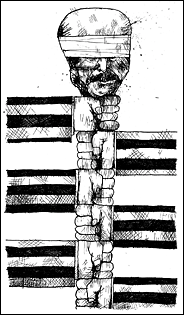
Then we have this recent post over at public opinion. It links to Andrew Sullivan's book review of two books on torture in the New York Times.
Then we have our knowledge that between 70 and 90 percent of the persons deprived of their liberty in Iraq had been arrested by mistake and that 85-90 percent of the detainees were of no intelligence value. And our knowledge know that torture is being routinely used after 9/11 by the Bush Administration.
How does this connect with the state of exception? That state is the exception to the normal.
There is an interesting paragraph in Sullivan's review that illustrates this. Sullivan says:
'But Bush clearly leaned toward toughness. Here's the precise formulation he used: "As a matter of policy, the United States Armed Forces shall continue to treat detainees humanely and, to the extent appropriate and consistent with military necessity, in a manner consistent with the principles of Geneva." (My italics.)Notice the qualifications. The president wants to stay not within the letter of the law, but within its broad principles, and in the last resort, ''military necessity'' can overrule all of it. According to his legal counsel at the time, Alberto R. Gonzales, the president's warmaking powers gave him ultimate constitutional authority to ignore any relevant laws in the conduct of the conflict. Sticking to the Geneva Convention was the exclusive prerogative of one man, George W. Bush; and he could, if he wished, make exceptions. As Assistant Attorney General Jay S. Bybee argues in another memo: "Any effort to apply Section 2340A in a manner that interferes with the president's direction of such core war matters as the detention and interrogation of enemy combatants thus would be unconstitutional." (Section 2340A refers to the United States law that incorporates the international Convention Against Torture)'
Is this not a very clear example of what Carl Schmitt and Giorgio Agamben meant by the state of exception? Bush can decide what constitutes an exception to the rule of law. The emergency becomes the rule.
Mark Danner, in an article entitled 'We Are All Torturers Now' confirms this position.He opens by characterising the normal as a "certain story line of scandal, in which revelation is followed by investigation, adjudication and expiation. Together, Congress and the courts investigate high-level wrongdoing and place it in a carefully constructed narrative, in which crimes are charted, malfeasance is explicated and punishment is apportioned as the final step in the journey back to order, justice and propriety."
Then Mark describes the exception:
When Alberto Gonzales takes his seat before the Senate Judiciary Committee today for hearings to confirm whether he will become attorney general of the United States, Americans will bid farewell to that comforting story line. The senators are likely to give full legitimacy to a path that the Bush administration set the country on more than three years ago, a path that has transformed the United States from a country that condemned torture and forbade its use to one that practices torture routinely. Through a process of redefinition largely overseen by Mr. Gonzales himself, a practice that was once a clear and abhorrent violation of the law has become in effect the law of the land.
The consequences for Australia is that Australian citizens are detained for years without being charged and they can be tortured whilst being detained.
A classic example is Mamdouh Habib, who has been held in detention Guantanamo Bay for more than three years without charge on suspicion of terrorism offences---he was accused of training with al-Qaeda. He claims to have been tortured and presumes that he has been subject to the techniques of "water-boarding," (in which a prisoner is stripped, shackled and submerged in water until he begins to lose consciousness) and other forms of near suffocation; sleep and sensory deprivation; heat and light and dietary manipulation; and "stress positions."
News reports say that Habib will be released in the next day or so. The Australian government is required to promise US officials that Mr Habib would not pose a continuing security threat to the US or its allies. The Howard Government has said that Habib will be under constant surveillance by ASIO, federal and NSW police once he arrives in Australia.
Yet Mick Keelty Australian Federal Police (AFP) Commissioner has said Mr Habib will not be charged when he lands in Australia, since is a free person and had committed no crimes under Australian law.
Presumably Habib is one of those detainees who were of no intelligence value to the US, and he had been arrrested by mistake. Yet the Australian government sees him as a combatant in a conflict with terrorists and so can be rightfully detained and held in detention until the end of the war of terror.
Mark Danner continues:
em>'The system of torture has, after all, survived its disclosure. We have entered a new era; the traditional story line in which scandal leads to investigation and investigation leads to punishment has been supplanted by something else. Wrongdoing is still exposed; we gaze at the photographs and read the documents, and then we listen to the president's spokesman "reiterate," as he did last week, "the president's determination that the United States never engage in torture." And there the story ends.'
Not quite. We need to add that the torture continues.The president denies it and middle America takes the president at his word.
The state of exception has become normal.
January 26, 2005
Leo Strauss in Australia
Leo Strauss does not have a big profile in Australia. He makes an appearance in this Shadia B. Drury text and this text by Norman Madarasz over at the Evatt Foundation. Madarasz links to this text in Le Monde and this Canadian Text published at CounterPunch.
It is a critical reception of Strauss by those social democrats opposed to the Washington neo-cons and their Project for a New American Century. What this political reception of a conservative Strauss misses is the political philosophy; Strauss' philosophical critique of modernity, the concern with nihilism, his conception of a sense of crisis and the relevance of this critique to liberal Australia.
Gone missing from this reception are Strauss's critiques of historicism, relativism, scientism, and nihilism even though many of the modernist social democrats are critical of this kind of thinking.(They call it po mo). This failure to engage is not suprising since Australian culture is notable for the lack of a philosophical engagement with important public issues of social and political in any prominent or sustained way. The political reception of Strauss involves his rejection.
What the rejection does not come to grips with is this scenario. Hegel was the great mediator of the classical world and modernity. The failure of the Hegelian attempt at mediation demonstrates the inability of both Enlightenment reason and revealed religion to submit to any higher authority and establishes the autonomy of their respective epistemological and moral claims. Reason and revelation, in other words, could not be assimilated to each other, so the Enlightenment's claim to have philosophically refuted the 'truth' of revealed religion was, consequently, false. The implication is that Enlightenment is dogmatically grounded on a faith in instrumental reason.
The significance of Strauss is that saw, understood and tenaciously held on to this insight. By elaborating it into a cogent critique of modernity's historicism and relativism Strauss, became a formidable philosophical critics of modernity. Behind Strauss's arguments about the intellectual bankruptcy of contemporary philosophy, his radical doubt about modern rationalism, and his recognition of modernity's spiritual and moral crisis,is a formidable edifice of conservative thought which is still very much alive. It has yet to be appropriated by Australian consevatives.
However, things are changing for the better in the Australian reception of Strauss. Martin Sharpe, a lecturer at the Melbourne School of Continental Philosophy's Summer School gave a paper on Strauss and Washington politics to the Melbourne School's forum. In the talk Martin says:
"...in a Straussian view...'economic rationalism' is exactly the type of 'nihilistic' or 'vulgar way of organising our shared political life that is a symptom of our sorry state. There is nothing 'classical', in a Straussian view, about 'classical economics'. It is all modern. Plato didn't think we were 'rational choosers', motivated by 'utility', which ultimately boils down to what we think we can get pleasure out of. And there's something to this. None of us would want to hear from our partner that we are 'an efficient utility maximising agent. Equally, as a Straussian might rejoin, you just won't find Aristotle saying that what politics should really be about is maximising G.D.P. Tony Blair's idea of 'responsible financial management' would probably turn his stomach. And again, lots of us might agree with him. A 'decreasing trade gap' and an 'improved international credit rating' are hardly the most inspiring public ideals, whatever Mr Costello might say about 'good sets of figures'".
Martin recognizes that Strauss is a critical of the way of life of liberal modernity, and he finds this Straussian line of thinking (returning to the Greeks to critique modernity) eminently sane and even deeply humane. What then?
Martin's interest in the talk is the connection between the noble lie (Tony Blair's 'weapons of mass deception') around the justification for invading Iraq and Strauss’ defence of the political ideas of classical Athens. The real concern lies with the link between Strauss'understanding of classical political philosophy and the neo-con style of policy-making that sees U.S. marines occupying Iraq.
The bridge is constructed from three of Strauss's ideas:
*an irresolvable conflict between the public life of a city or nation, and the pursuits of philosophers and scientists;
*philosophy and science are the highest ways of life. Strauss interprets Plato as advising us that the best achievable political system will be one not led directly by philosophers, but by 'gentlemen' of noble background and education (noble statesmen) who have philosophers helping them to form policy;
*The world is divided into different types of people. A the top are philosophersas they can 'stand the most reality'. One step lower are the 'gentlemen as they are the least swayable by private interests, because they are guided by the pursuit of public honour and religion. The third type is all the rest of us---'the many'- who need a religion to keep our distasteful passions in check.
These ideas provide a bridge to the Washington neo-con world and its effect of undermining modern liberal democracy.
The philosophical critique of Australian modernity has been forgotten.
Martin has also helped to organize The Melbourne School of Continental Philosophy Summer School course on Leo Strauss. This explores Strauss'ideas in more detailand gives us a more sophiticated reading of Strauss. The Summer Course covers Stauss' views that Nazism was an outgrowth of modern ideas and an unpolitical faith in technology; his return to the classical Greeks, his reading of political philosophers,and his response to the crisis of modernity.
Alas none of the lectures are online.
January 25, 2005
Rewriting Marx
Is the spell of modernity breaking?
A quote from Terry Eagleton's After Theory about the juggernaut of modernity:
"There is far too much change around, not too little. Whole ways of life are wiped out almost overnight. Men and women must scramble frantically to acquire new skills or be thrown on the scrapheap. Technology becomes monstrous in its infancy and monstrously swollen corporations threaten to implode. All that is solid - banks, pension schemes, anti-arms treaties, obese newspaper magnates - melts into air. Human identities are shucked off, tried on for size, tilted at a roguish angle and flamboyantly paraded along the catwalks of social life. In the midst of this perpetual agitation, one sound middle-aged reason for being a socialist is to take a breather."(p.8)
This is a rewrite of Marx's all that's sold melts into air passage in the Communist Manifesto, that classic nineteenth century account of the impact of global capitalism on nations and populations.
As contemporary western subjects we experience the globalising world through a modern consciousness. No matter what our history or tradition ours is a modern gaze.
What I find interesting about Eagleton's 'After Theory' is this reviewer's reconstruction of Eagleton's response to this juggernaut and the end of culture theory as a criticsm of modernity in 'After Theory.' William Deresiewicz says:
"Eagleton articulates a set of ideas about the nature of human happiness and of the collective life necessary to achieve it that is often persuasive and beautiful. From Aristotle he takes the notion that happiness is not, as capitalist ideology insists, a matter of achieving wealth or success or indeed any goal but of fulfilling one's nature as a human being, the flourishing of one's innate capacities for excellence and virtue.But if the good life means becoming more fully human by developing the virtues, it takes both strenuous practice (one becomes brave or compassionate by being brave or compassionate) and the social conditions that make such practice possible.
Ethics, in other words, is a subset of politics. "If you want to be good, you need a good society," Eagleton writes; "nobody can thrive when they are starving, miserable or oppressed." A true ethics is thus a materialist one, a morality not of feeling but of acting: feeding the hungry, comforting the sick."
Eagleton is rediscovering the classical philosophical roots of Marx. About time.
Is this not a rebirth of an alternative discourse to that of the modernist, scientific Marxism that Eagleton so eagerly embraced and wielded in the 1970s? Can I presume that Eagleton has dumped the science?
January 23, 2005
Foucault, social medicine, governmentality.
This is a lecture on social medicine given by Foucault in Brazil in 1974. I'm having a look at it because it refers to the crisis in medicine with a reference to Ivan Illich (ed.). Medical Nemesis: the Expropriation of Health. The lecture is now 30 years old and it is part of Foucault's key argument that modern medicine is social medicine, and therefore a social practice that has been developing in capitalist society since the end of the 18th century and the beginning of the 19th century.
Does it have any insights for us with respect to social medicine? We are currently caught up in a debate about federalism, the governance of health (hospitals) and they way that political power can be, and is, used to direct our conduct. How then does Foucault's lecture help is out?
In this lecture Foucault provides a social history of medicine and he goes back to the English Beveridge Plan of the 1940s to explore the way in which the state took charge of the health of a population for the benefit of individuals.
Foucault says that the Beveridge Plan is significant as it meant that:
"...the concept of a healthy individual in the service of the State was replaced by that of the State in the service of the healthy individual. It is not only a question of a reversal of rights, but also of what might be called a morality of the body ... It was no longer a question of an obligation to practise cleanliness and hygiene in order to enjoy good health, but of the right to be sick as one wishes and as is necessary."
Health began to enter the calculations of the macro-economy. The Beveridge Plan gave rise to a new series of rights, a new morality, a new economics, a new politics of the body. Since then the body of the individual has become one of the chief objectives of State intervention, one of the major objects of which the State must take charge.
Foucault then connects this governmentality (concerned with economics and power) with the technological advance of biological medicine through the discovery of antibiotics. This enabled the medical institution to effectively fight infectious diseases in the human boddy for the first time.
Thus we have a new form of social medicine. What then is the crisis of social medicine that Foucault alludes to? Foucault addresses this in terms of several characteristics of modern scientific medicine.
The first characteristic is that scientific medicine kills. Not because of ignorance, errors of diagnosis, but because of the very effects of medication as a therapeutic intervention. The bugs and germs have adapted to our anti-biotics. So the positive effects of an enlightened scientific medicne are now accompanied by negative and harmfu effects.
Medicine has historically functioned on the basis of its own failures and the risks that it has taken. Medical risk becomes greater when medicine shifts to modifying genetic cell structure as every aspect of life now becomes subject to medical intervention.
The second characteristic of modern scientific medicine is undefined 'medicalization" whereby medicine functions outside its traditional field as defined the patient's needs, pain, symptons and malaise. Medicine has shifted from being clinical to being social as it has gone beyond being concerned with diseases to being involved in screening populations, sexuality, health promotion and delinquency.
The third characteristic of modern scientific medicine is its political economy. Medicine and health are now presented as an economic problem. This is more where is the money going to come from, as it involves the health of the body as a consumer object, produced by drug companies and doctors and consumed by patients. Health as a product is marked by inequality, profit making, doctors becoming functionaries of drug companies, self-regulating subjects etc.
How does this medical sociology address the current crisis in medicine? Foucault says that a historical account of the rise, or takeoff, of social medicine indicates that the talk about 'the crisis in medicine'is a false one.
January 22, 2005
fundamentalism #3
'Tis an odd couple, even though some would say that it is a marriage made in heaven.
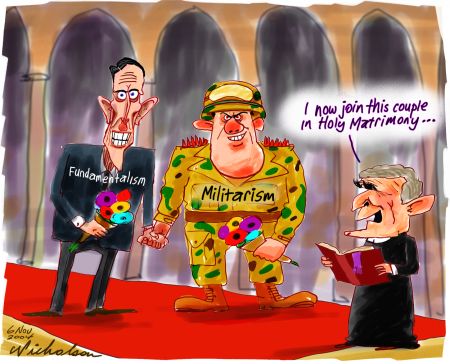
Remember General William G. Boykin, who received brief press coverage when it was revealed that the Deputy Undersecretary of Defense for Intelligence had been regularly appearing at evangelical revivals preaching that the U.S. was in a holy war as a "Christian nation" battling "Satan." General Boykin expressed his insight that his battle with the forces of evil was a crusade between his "true God" and "the false one." Boykin insisted, "I knew that my God was bigger than his. I knew that my God was a real God and his was an idol. So we have a "holy war" against infidels.
The odd couple seem to be getting along well. There is no sign of a divorce. Both couples have a Manichean mentality. That would help them stay united in strenghth against a hostile world. Both see themselves on the side of Good and see their enemies and adversaries as Evil. Both are morally righteous and accept redemptive violence in the struggle for Good.
The couple say that they are on a crusade abroad; a crusade inspired by a Judeo-Christian culture trying to defend itself against the aggression of Islam. At home the marriage gives rise to a creeping authoritarianism of the national security state, which has little time for a culture of critical thinking or civil liberties.
That makes liberals who defend a free society very very anxious.
The cartoon does ignore the other pillar of empire--a free market fundamentalism that makes the market an idol.Is that represented by the figure of the ascetic priest?
January 21, 2005
Giorgio Agamben on the state of exception
This post is courtesy of Matt over at Pas au dela, who advised us to go read Wood s Lot for this quote by Giorgio Agamben on the state of exception. I took Matt's advice. Here is the quote:
"President Bush's decision to refer to himself constantly as the "Commander in Chief of the Army" after September 11, 2001, must be considered in the context of this presidential claim to sovereign powers in emergency situations. If, as we have seen, the assumption of this title entails a direct reference to the state of exception, then Bush is attempting to produce a situation in which the emergency becomes the rule, and the very distinction between peace and war (and between foreign and civil war) becomes impossible."
Yes.
That quote reinforces what I said here in an earlier post on Carl Schmitt. There I suggested that we can use Schmitt's categories (eg., the 'state of exception') to make sense of the political in the historical present. I only suggested. Agamben takes it much further.
The above quote is from this excerpt from Agamben's A Brief History of the State of Exception. In the excerpt Agamben says:
"The place---both logical and pragmatic---of a theory of the state of exception in the American constitution is in the dialectic between the powers of the president and those of Congress. This dialectic has taken shape historically (and in an exemplary way already beginning with the Civil War) as a conflict over supreme authority in an emergency situation; or, in Schmittian terms (and this is surely significant in a country considered to be the cradle of democracy), as a conflict over sovereign decision."
The sovereign power of the president is essentially grounded in the emergency linked to a state of war, over the course of the twentieth century the metaphor of war becomes an integral part of the presidential political vocabulary whenever decisions considered to be of vital importance are being imposed. The exceptional legislation by executive decree (which is now perfectly familiar to us) has became a regular practice in the European democracies, and liberal democratic regimes.
The national security state formalizes this whilst the war on terror normalizes the exception. The Bush administration, in the midst of what it perceived to be a state of emergency, authorized the indefinite detention of noncitizens suspected of terrorist activities and their subsequent trials by a military commission.
Australia quietly goes along with this in relation to its own citizens. Mark Kaplan over at the Charlottte Street says that British citizens were held for years on end without trial by a foreign government.
What Giorgio Agamben argues is that this unusual extension of power, or "state of exception," has historically been an underexamined and powerful strategy that has the potential to transform democracies into totalitarian states.
The most recent issue of Contretemps is devoted to the work of Giorgio Agamben.
January 20, 2005
No friends: reflections on Mark Latham
What happened to Mark Latham, the leader of the ALP, was very strange. On my interpretation Latham was ripped to shreds by the baying hounds of the media and his own party. Few friends came to protect him whilst he was being savaged. Apparently all felt that he had to be sacrificed for the good of the country.
What sense can we make of this bloody sacrifice?
In his text The Concept of the Political, Carl Schmitt conceptualizes the political
"...'within the totality of human thought and action', in terms of the primordial and seminal antithesis between 'friend' and 'enemy': 'just as in the field of morals, the ultimate distinctions are good and evil, in aesthetics, beautiful and ugly, in economics, profitable and unprofitable, so the significantly political distinction is between friend and foe.'"
For Schmitt, then, the political is primordial; it comes before the State and transcends its mundane and routine policies. It reveals itself, historically, at the foundational moment of the polity, and conceptually, in the unwritten metaphysics of the constitution. Indeed, the political in the specifically Schmittian sense incarnates existential totality and determines a choice between being and nothingness.
We understand the enemy side of the political as it is expressed in the media as part of the normal,everyday workings of politics.The enemy is the other, the stranger; and it is sufficient for his nature that he is, in a specially intense way, existentially something different and alien. The enemy is solely the public enemy.
On this account Mark Latham become an enemy: so the party hierarchy wanted him out and quick.
What then of the friendship side of the political? Is it the quiet word and the sympathetic arm on the shoulder? Is there friendship in political life?
A key aspect of the media commentary about Mark Latham, as the former leader of the federal ALP, is that he had few friends. This is attributed to him being a lone wolf by the unknown senior ALP members who offer their comments to the media on the condition that their names are not mentionsed. A senior ALP person said that ....
The tacit assumption is that friendship operates in the ALP and that ALP leader spurned it, more fool him. Latham's choice was to die and leave his friends, thereby remaining true to his real love, his family. He had become a political pariah. The significance of the intervention by the state ALP premiers was that they gave permission for the sharks to move in.
There has been very little reflection about the nature of political friendship in the media commentary. Is there such a thing?
In politics friendship is negated in the very gesture that invokes it. As Aristotle is reputed to have said, "O friends, there are no friends."
Very enigmatic. And yet Latham found out that political friends are just that, not real friends at all. even some of his closest allies started to shun him. Even some of his closest allies started to shun him as his colleagues turned on him. Many of those who will praise Latham's contributions as Labour leader in public would also be privately raising a glass in relief and joy at his departure.
does that say about human sociability in the ALP? Is not political friendship based upon human sociability, which is what makes man human?
And yet, in the Nicomachean Ethics Aristotle also says that one cannot live without friends, he distinquishes between friendship based on utility and virtue where the friend is loved as such, that it is not possible to have many friends, that friendship at a ditance results in oblivion, friendship is linked to community and living together, the pleasure friends take in being together and the good of friendship is in some sort of activity of self-realization.
What then of political friendship? Does it exist? Would friends have ended a sick Mark Latham's leadership in such a brutal way?
According to Aristotle no. He understands that friendship (philia), Aristotle to mean something like affection or love. Though its most form is the love between parents and children, it is friendship, rather than justice, that holds the city together. Friendship is the basis of all human associations that require sharing and mutual responsibilities. To the extent that we have a relationships in political life there is friendship to the same extent—and justice.
Thsi did not happen with the ALP. Latham was not treated as a political friend. The party machine is governed by the ever-present possibility of conflict and annihilation, and it requires a sovereign who, in the face of existential uncertainties, incarnates an authority that is superior to that of the law itself.The sovereign is the machine no the leader.
If, as Schmitt says, 'The sovereign is he who decides on the exception', then this 'realistic' view of the workings of politics in the ALP, subordinates de jure authority to de facto power. The law is made by the one who has authority (i.e. power) and not the one who possesses the office (the legitimate sovereign or leader). There is no room for political friendship.
January 19, 2005
executions and sovereignty
Latham's downfall is really an execution, a ceremonious public execution by the Australian Labor Party, that was conducted through the media He, as sovereign, was taken down by his colleagues and helped along by the media gorging on destruction.
The cartoonists understand the dark side of this:
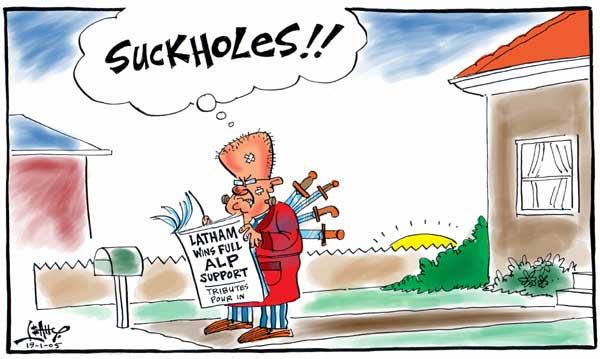
Leahy
The figure is that of Mark Latham, the former federal ALP opposition leader.
What is most suprising is that this killing of a young leader whilst very sick (a life threatening illness?) was seen to be acceptable by both the ALP and the media. The normal sentiments and ethos about sticking knives into people's backs when they are sick did not apply in this case. Where is all the talk about evil, moral revulsion and intellectual distress amidst the political chatter?
Few have questioned the appearance of the demonic in this event. The commononm or consensual understanding in the media's formation of public opinion is that somehow Latham deserved the execution. It was a ritual of cleansing made acceptable by myth and ALP tradition.
Oh yeah. Don't you find this strange? Is sacrifice through political execution now so acceptable that we just accept it as normal? The exceptional has become the normal?
To explore this we need make a distinction between 'politics', which denotes the realm of partisan power struggles and is amenable to empirical research; and 'the political', which refers to alludes to the quasi-metaphysical realm, or the interwoven group of categories used in politics, that assign meaning and symbolic import to the political life; the former translates into policy, electoral and party politics, and the latter into the polity and democracy.
Sovereignty is the category that comes into play in this event. So what is going on here.
In The Accursed Share Part 111 Bataille understands sovereignty as having less to do with the power of states (eg., Jean Bodin's definition of sovereignty as the 'absolute and perpetual power of the republic') than with the power of killing.(p.197)
Bataille says that his understanding of sovereignty is linked to the denial of the sentiments that death controls. "Life beyond utility is the domain of sovereignty" states Bataille. By this he means that sovereign existence is the capacity to live in the present moment beyond the concerns for the needs to sustain life. Sovereignty "requires the strength to violate the prohibition against killing." (The Accursed Share p. 221).
Okay, okay. Taking out Latham is different from actual killing, as with the Aztecs, since Latham still have his life. And our capitalist society is organized around work, whilst Aztec society was organized around sacrfice. But the killing of Latham as leader of the ALP was excessive, beyond the dictates of utility, and it was an expression of the denial of the sentiments that death controls.
This understanding of sovereignty expresses what is not exhausted by law and convention. As Carl Schmitt observes sovereignty allways has the character of being beyond the law, and it can be referred to as danger, or 'extreme peril'; in fact, perhaps anything that confronts, undermines and destroys the rule of law.
January 18, 2005
democracy as governmentality
One interpretation of Foucault's governmentality is the following one advanced by Ali Rizvi over at Foucauldian Reflections.
Working off Foucault's essay 'The Subject and Power',(an afterward to Michel Foucault: Beyond Structuralism and Hermeneutics), Ali says:
"This power of the capitalist state is based on the emergence of a new type of power: bio power and disciplinary power. A new type of state has emerged in the west because the "western state has integrated in a new political shape, an old power technique which originated in Christian institutions. We can call this power technique the pastoral power" [p.213] Bio and disciplinary power is a modern reinterpretation of Christian pastoral power (ibid. p. 214). This reinterpretation has been made possible due to 'profound transformation' in the basic mode of power. Power does not any longer work primarily as negativity, as a deduction. It takes the form of positivity..."
Ali says that modern reinterpretation of Christian pastoral power is salvation oriented but its conception of salvation aims at ensuring salvation in this world (eg., welfarism). This secularized pastoral techniques are incorporated into the mechanisms of the modern capitalist state, and so the state "stretches its reach to the soul and body of individuals on the one hand and to the social body at large on the other hand."
Ali says that:
"By 'bio-power' Foucault wanted to emphasis the form of power which does not only cater for the needs of the individuals but also looks after 'population' as a whole. On the other hand 'discipline' is what is concerned with individual in his specificity and concreteness. What links these two forms of power is the phenomenon of body. While the 'bio power' is 'focused' on the 'species body' the disciplines are 'centered on body as machine.'"
Ali does not mention citizenship in his account. Yet it should be since the capitalist state is a liberal democratic one and the individual is a citizen. If we make this shift then it can be argued that democracy is a disciplining force. The argument is that political institutions construct the identities of subjects as citizens, who then willingly support and participate in democratic processes.
Hence democracy is a form of governmentality that constitutes subjects as democratic citizens to make them amenable to government control within a liberal constitutional order.
Why so?
Because democracy is based on a set of power relations and so we are tangled up in power and knowledge relations that both constrain and enable the possibilities of citizenship.
One can illustrate this in terms of deliberative democracy. In this understanding of democracy reasoned discourse or debate is based on a particular kind of conversation or communication: dispassionate, reasoned and logical. The problem with this is that white middle class male citizens are better than others at articulating their arguments in rational and reasonable terms. Those who cannot do this are excluded. The liberal justification for this austere style is that rhetoric needs to be purged from deliberation to keep the door closed to demagogues, manipulators, deceivers and flatters.
Hence we have the process of constraining the possibilities of citizenship.
The reaction from the right wing of the blogosphere to this liberal demand about deliberation has been an oppositional one. The resistance is described by August Pollack:
"....What matters- the only thing that matters- is that they said something they think was really clever on the comments section of some person they've likely never met.....The right-wing blogosphere has removed itself from any realm of rational discourse and instead established only one principle: win the argument. It doesn't even matter to them what the fucking argument is. If some liberal said something, they're either a hypocrite, a liar, or a traitor. Don't worry, you'll make some shit up to validate that a little later...History will never look back on this time and discuss how changes were made through the art of rational bipartisan discussion."
We have an assertive type of conservative discourse that affirms its difference to the elitist liberal ethos of disspasionate and disembodied writing through confrontation. The alternative form of communication is rhetoric involving jokes, anger, laughter, ridicule flattery and hyperbole.
Though the world of journalism and politics in Australia has yet to be transformed by blogging rhetoric is the favoured discourse of the conservative journalists in the Murdoch press.
This shows that we are both subjected to power and subjects in our own right. So we can about strategies for governing through citizenship.
January 16, 2005
Liberal fundamentalism
The Review section of the Australian Financial Review (subscription required) is marketed as serious intellectual stuff--brain food-- for the economic elite of Australia. It keeps the thinking businessman informed of what's what in the intellectual world. Since you pay a lot for the AFR ($2.50 a copy) you would expect some intellectual grunt that goes beyond appealing to your prejudices, gives you something to chew over and makes some contribution to the public debate within deliberative democracy over what a free society means.
On Friday The AFR published an article by Andrew McIntyre, the assistant editor of the Institute of Public Affairs quarterly Review, entitled 'The Modern Imperative.' This wears the mantle of quality journalism from a think tank, which links back to the libertarian theoreticians of note, from the classical liberals to Ludwig von Mises and Murray Rothbard, and their trenchant critiques of the despotic state in the name of individual liberty. McIntyre's article defends the liberal project of Enlightenment science, irreversible progress and a material triumph for mankind, with its enrichment of quality of life and reduction in pain, suffering and squalor.
This is a fairly standard liberal narrative and this kind of defence of liberal modernity is what you would expect from the IPA's free market liberalism. In the article McIntyre makes a gesture to the dynamic, 'bright young thing' libertarianism of Virgina Postrel and her book The Future and its Enemies: The Growing Conflict over Creativity, Enterprise and Progress. Postrel is deeply opposed to the way many US libertarians (notably Rothbard and those of the Ludwig von Mises Institute) forged a working alliance with the old-style paleo-conservatives, such as Pat Buchanan. So this implies that an IPA liberalism will not hope into bed with one nation conservatives, does it not?
Let us grant that liberal modernity has achieved the above narrative that Andrew has set out. I'm granting the narrative because I want to explore a particular kind of liberal mentalaity.
McIntyre gives us an insight into the liberalism of the financial and business world, as it is the way this kind of serious journalism defends liberal modernity that is interesting. My case is that Andrew, as an IPA publicist, works with a good and bad mentality of a liberal fundamentalism. It is this because it demonizes the opposition to a liberal modernity as the voice of unreason. This is what is usually done to the environmental movement by the IPA,(eg., a green religion) but it is unusual to see all non-liberals tarred in the same way. That's my argument anyhow.
True, McIntyre's rhetorical strategy picks up on a common strand of reasoning in Australia which links the pre-and post-modern critiques of liberal modernity. This link is suggested here:
"Both pre-modernist and the newer-postmodernist of modernism seem to be two sides of the same coin. Both believe that the liberal project has failed: both denounce modernism."
Well that is true if one redescribes 'denounce' with 'critique', or overcoming. But the implication that they---the pre-modern and postmodern critiques of liberal modernity--are the same kind of thing(unreason) is what is questionable. Do both denounce as opposed argue. Do all on both the pre-and post-modern sides denounce modernism as distinct from arguing?
Does Andrew argue that unreason case? Let us have a look.
Most of the article is concerned with the Christian Church's negative reaction to liberal modernity. Hovever, McIntyre does say that:
"Postmodernism's archaic response to modernism is very similar to that of the church, and of most traditional culture, in its recoil from the notion that history embodies no permanent stability."
And this:
"However, many of the elements of the Christian church and the post-modernists and the left not only despise modernity and its successes, they spend their time making tenditious economic analysies to show how inquitious it is."
Despise?
There are the small matters of Auschiwitz, the Gulag, colonialism, the destruction of aboriginal society and environmental devastation to consider when it comes to evaluating liberal modernity. Have not arguments been presented about the negative consequences of liberal modernity? 'Despise' indicates a negative emotional reaction, not the use of an emotionally-informed critical reason concerned with the good life.
Where is the argument for the reduction of a critical reason to raw nasty emotion of despise?
The journalist strategy is pretty clear. Make the pre modern and postmodern critiques the same, and then use rhetoric to show they are both an unreason. It is towards the end of the article that Andrew makes the identity between pre and post-modernism more explicit.
He says:
"It is hard not to feel that pre-modernist thinking is a worringly perverse form of atavism, particularly when it includes attacks on modern science and Enlightenment values. The contemporary Christian church is not exempt.Post-modernists, and the left generally, dispaly a very similar form of atavism, dressed up in trendy post-modern clothes, displaying similarly stubborn forms of non-negotiable fundamentalist attitudes impervious to empirical evidence. To reject modernism and material progress does not, on the evidence, seem to be a realistic option."
So both pre-modern and postmodern are anti-reason. They are not critiques at all. Both are a fundamentalism that is the opposite of the reason of liberal modernity. The stark dualism is very explict.
Why the word 'attack' not 'critique' of science and Enlightenment values (personal and economic liberty)? Attack means smashing up science per se, whilst critique implies a questioning of the pressuppositions of science, such as scientism, mechanism, realism, subject object relation etc. It's a big difference.
What is required is an argument that shows the post-modern critique of science and enlightennment values of liberty and reason are a form of atavism, a fundamentalism and unreason. The critique is a critique of the categories (or metaphysics) of the liberal scientic enlightenment, not refusing to acknowledge the empirical evidence like a biblical fundamentalist who bases everything on faith.
I suggest that what we have here is a liberal fundamentalism that demonizes the opposition, implying that it is reponsible for all the bad things about liberal modernity. This is suggested in Mcintyre's closing paragraph:
"...to not face a world that provides no evidence or utility for a metaphysical reality, which indeed impedes rational decision-making (a mark of secular liberal progress) could mean a return to an infernal new barbarism and primitivism that does not bear thinking about. We simply have no choice."
No choice! Is that not an indication of a closed mentality by those in favour of free markets, instrumental reason and technocracy.
Those working in the premodern and postmodern traditions would deeply disagree about the nature of metaphysics and metaphsyical reality would they not? That should put a question mark under any guilt by association.
The above paragraph says that pre and post-modernism impede rational decision-making, and represent a new barbarism and primitivism. Hence we have no choice but to stick with liberal modernity.
It is a fundamentalist form of consciousness because it does not address the arguments of the criitcs of liberal modernity about the nature of liberal rational decisioning as an instrumental reason; the argument that barbarism (fascism) may have its roots in the Enlightenment; or the arguments of a Heidegger, Foucault or Deleuze.All we have are devil type figures and a contentless criticism.
What Andrew McIntyre does to defend liberal modernity is find similarities and ignore differences, emotionalize the critics, say that only liberalism has reason on its side, construct an unreason (the devil) and then deploy fears about a barbaric future bought about by the devil of unreason. Does that not indicate a fundamentalist mentality?
January 15, 2005
Critical Theory: a strange silence
A comment on Adorno and Horkheimer's Dialectic of Enlightenment by Jeffrey Herf, from his Reactionary Modernism: Technology, Culture, and Politics in Weimar and the Third Reich. It puts a finger on a notable silence in early Critical Theory. Herf says:
"Let us recall its first sentence: 'The fully enlightened world radiates disaster triumphant.'Adorno and Horkheimer went on to argue that implicit in the beginnings of the Enlightenment, in Rousseau, Kant, and Hegel, was the synthesis of reason, domination, and myth that was revealed in all its truth in de Sade's orgies and Nietzsche's aphorisms, and then put into practice in Auschwitz. Auschwitz was the Enlightenment's truth: reason as total domination.
What is striking in rereading this now-classic work is how little, if any, space is allotted to the Enlightenment as a contributor to the liberal political tradition---political pluralism, parliaments, public discussion, the defense of individual liberty against the state---and how much the book focuses on scientific reason undermining universal normative claims to the good life.
The book is also striking in how little it has to say about the fate of the Enlightenment in Germany, discussing it instead as if it were a uniform development throughout Europe and America. Its authors' clear intention was to suggest that Auschwitz presented the possible fate of the modern world as a whole. Modernity in general, not only German modernity, combined myth and reason. Enchantment and disenchantment exist side by side. Auschwitz, not the proletariat, is the specter that haunts the modern world."(London: Cambridge University Press, 1986).
Herf comments that it was not the "fully enlightened world" that radiated disaster. Hitler's Germany was never more than partly and woefully inadequately enlightened. Auschwitz remains a monument to the deficit and not the excess of reason in Hitler's Reich.
That absence of the political and the liberal political tradition--political pluralism, parliaments, public discussion, the defense of individual liberty against the state---in this text has always puzzled me too. In fact there is a suprising silence about that political dimension in the early Critical Theorists.
January 14, 2005
Interpreting the Stoics
A book review of The Cambridge Companion to the Stoics, which sounds to be a very worthy companion. It is the interpretation that I would like to put into question. Here is the relevant passage:
"Inwood's Companion does not only illustrate how different authors working on a number of subject areas deal with a limited amount of sources, but also how what is thought to be an essentially coherent philosophical system can be approached from many different directions. The Stoics conceived of themselves, and were so treated by others, as highly systematic thinkers.The reader of this Companion discovers this systematicity after just two or three chapters, which reliably link to thematically related articles in the same volume, as well as to additional literature. The main Stoic contributions to traditional grammar, for example, were made in the context of their analysis of the properties of rational thought (in the 'dialectical' part of their logic). The resulting grammatical theory thus has strong ties to logic, and connects with wider issues within epistemology, psychology, and even metaphysics (since sounds and words are material objects). Stoic psychology in turn has its point in accounting for the good life and is consequently deeply rooted in moral psychology. Psychology must be understood in the context of Stoic ethics and the task of living a good life. Because the good life is lived not only in accordance with human nature, but also with the cosmos generally, it must be determined in the context of both moral psychology and cosmology. And because the cosmos partly depends on the will of the Gods, we cannot do without theology. Stoicism, as A.A. Long puts it, "is coherent through and through -- a system such that to remove one letter would be to destroy the whole account".
Other reviewers also interpret the Companion in terms of systematicity.
It sounds like the modern understanding philosophy is being imposed on the Stoic texts.
Do they really form such a tight theoretical system? Is Ancient philosophy similar to modern philosophy? Or is this the philosophical discourse of philosophy being imposed on these ancient texts that operate with another kind of philosophy?
You can see these distinctions at work here. This relies on Pierre Hadot's Philosophy as a way of Life, which makes a distinction between the discourse of philosophy taught in the universites as an abstract and theoretical activity and philosophy as a art or form of living ---as a way or mode of life.
Hadot says that Stoic philosophy:
"...was not systematic because it wanted to provide a total systematic explanation of the whole of reality. Rather, it was systematic in order that it might provide the mind with a small number of principles tightly linked together which derived greater persuasive force and mnemonic effectivenes precisely from systemization. Short sayings sumed up, sometimes in striking form, the essential dogmas, so that a student might easily relocate himself within the fundamental disposition in which he was meant to live."(p.269)
The review implies that Stoicism is systematic because it aimed to provide a total systematic explanation of the whole of reality. Consequently, it overlooks the different kind of philosophy in Stoicism--philosophy as a way of life or an art of living.
Hadot discerns in the various ancient traditions, but especially in the Stoics, a distinction between 'philosophy' (philo-sophia conceived of as the formation of the soul; or in Quinton's terms the deep structure of character, with the addition of an orientation towards the good), and discourse about philosophy (understood as the investigation of the nature of things, and to a lesser extent our knowledge of them). This, of course, is related to the more familiar distinction between practical and theoretical philosophy.
But whereas modern, recent and contemporary thought has invested greatest effort and talent in the pursuit of theory building in the form of epistemology, metaphysics and language the Stoics, give priority to thinking about practice, and within that to the cultivation of wisdom and the development of the spiritual life. Epictetus observes that 'the lecture room of the philosopher is a hospital' which is to say that his work is the cure of souls.
Hadot says that:
"I think modern man can practice the spiritual exercises of antiquity, at the same time separating them from the philosophical [metaphysical] or mythic discourse which came along with them. The same spiritual exercises can, in fact, be justified by extremely diverse philosophical discourses. These latter are nothing but clumsy attempts, coming after the fact, to describe and justify inner experiences whose existential security is not, in the last analysis, susceptible of any attempts at theorization or systematisation ... It is therefore not necessary to believe in the Stoic's nature or universal reason. Rather as one lives concretely according to reason"
January 13, 2005
Carl Schmitt: taxonomy of the state
During the holiday season I watched a number of American law and order shows and films on free-to air-television. I was struck by their different (conservative?) understanding of state, civil society and family to that of liberalism. Most of the shows assumed thatthe state is bad (a Leviathan); that civil society is lawless and riddled with crime; and the family (or personal relationships)is the place of love, romance and goodness.
I exaggerate. A lot of crime also takes place in the institution of the family in these shows. However, in this conservative discourse the family is treated both in mythic terms and as the cornerstone of America. (Oh, as an aside the Constitution appears to be a Platonic document).
Now, rest assured, I'm not going to do an Adorno and engage in a critique of the trashy products of the culture industry and celebrate high culture by standing in the academy. It is the politics in these shows that I am interested in; the way that the dualistic liberal understanding of civil society (as good) and state (as bad) is undermined.
I have to admit that the effect of the conservatism of these shows was to create a nostalgic mood. I found myself becoming nostalgic for liberalism. Why? Because it retained some understanding of the opposition between state and society--a relationship of opposition---however crude that understanding of bad state and good society has been. Liberalism retained the idea that more power to the government meant less power to the people.
Sure, liberalism did not have much of a dialectical understanding. It has failed to grasp the way the dualism of state and civil society is an interaction of opposites; the way that this conflict has lead to changes in the character of both the state and society; and the changing historical relationship between state and civil society.
Is not the duality of state and society transformed by parliament. Does not the emergence of parliament as abody of power initially represent the way society sized the state's own legislative power for itself?
What I came back to in liberalism was the way it worked with an opposition between state and society to hold onto the idea that a free life involves living in a community that governs itself. It was heritage that we should hang onto and build on.
How do we do that?
One way is Foucault's governmentality approach.
This combines a microphysics of power with a macropolitical question of the state to look at power relations concentrated in the form of the state in terms of the practice of government. The neo-liberal state itself is a tactic of government that makes possible what is within the competence of the state and what is not.However, Foucualt does not adddress the nature of the state.
Another way is to think historically about the state/society relationship is by exploring the way this historical relationship is involves the nature of the state changing. A core failure of constitutional liberalism has been its inability to grasp the historical development of the diverse institutions of the state.
So we can address this issue by turning to Carl Schmitt's taxonomy of the state as outlined in his Four Articles 1931-1938. Oddly enough I've been reading this text in conjunction with watching the products of the culture industry. In the first article, 'On the Way to the Total State' Schmitt usefully classifies 'the state' into 5 categories based on their sphere of activity.
Thus we have:
*the judicial state, in which the main political activities are to adjudicate in keeping with concrete situations;
*the legislative state, which makes provisions by law for the perpetuation of a certain order based on pre-established norms;
*the administrative state, which is concerned with the objective management of public undertakings by the enactment of purely technical instructions;
*the governing state, which is the venue for the personal and an authoritarian will and commandment of a head of state;
*the state of exception, as an alternative to the judicial and legislative states, in which the effective normative system is challenged and replaced by the temporary replacement by a government of decree and emergency order backed by the authority of the court martial of summary justice.
As I'm reading Schmitt's Four Articles I could not but help notice the emergence of Schmitt into Australian political discourse based on a reading of Mark Lilla's The Reckless Mind: Intellectuals in Politics. So what are these liberals saying about this figure that many find dangerous?
John Quiggin takes the opportunity to repost his earlier review of The Reckless Mind. In the section on Schmitt he states that:
"Lilla is equally good on another Nazi thinker, Carl Schmitt, who remains largely unknown in the English-speaking world, but is hugely influential in some European circles, both on the right and on the post-Marxist left. Schmitt's ideas themselves do not seem all that interesting - a melange of 'realist' international theory and authoritarian critiques of liberalism, with an underlay of religious irrationalism. What is more interesting is how such ideas have remained influential, and have spread from the right to the academic left, despite their obviously poisonous consequences. Lilla shows how the European New Left found Schmitt's critique of liberalism appealing, paving the way for the subsequent capitulation of postmodernism."
Has John read Schmitt I wonder? If not, how can he make that judgement?
Rafe Champion is content to summarize Lilla's account of what Rafe calls an 'alarming body of thought'. Why alarming? Rafe says:
"Schmitt is fundamentally a conflict theorist, with a Hobbesian view of society as a war of all against all, sans the potentially liberal vision of a sovereign role to keep the conflicts under control in a potentially benevolent or at least peaceful order. Enmity is the mainspring of action and identity, 'show me your enemy and you define yourself'. It appears that Schmitt's view is entirely 'essentialist', that is, it is based on an assumption that is held so strongly that it is not open to correction by evidence or argument."
Rafe has not read much Schmitt on the changing nature of the sovereign either as he misses the historical dialectics. Essentialism is used as a weapon.
What is useful about Schmitt's taxonomy of the state is the way he makes use of it. In the article 'Neutrality According to International Law and National Totality' Schmitt reworks the state of exception in terms of totality of state and nation.The total state is:
"...not a separate, distinctive state form. Rather it is a moment in the effective development of every type of state, marked by the moblization of all energies in a certain direction."(p.39)
This a moment is marked by the need to eliminate the executive and legislature distinction in favour of the executive and to restrict individual rights to confront and overcome a dangerous situation.
Is not this moment of totality what we are currently living through with the national security state in a situation of a war on terrorism?
This is why we read Schmitt. Far from being poisonous or dangerous he has good ideas and insights about political life.
January 12, 2005
comment spam again
Here we go again.
We are under a massive comment spam attack. The first wave was this afternoon and it went on for several hours. The 2nd wave is late this evening. It has been going for an hour or so. It looks as if it will continue for another couple of hours.
This time around the spam is nasty violent porn with lots of references to rape and animal sex.
Clearly the anti-comment spam plugins are not working, as this is computer driven spam.
However, MT 3.14 makes it much easier to eliminate the comment spam from the weblog comment boxes. The extra features mean that it is an improvement on MT 2.51 that I had before. Though it took me a while to figure the extra features out.
January 11, 2005
fundamentalism & Hegel revised
An interesting article by Walter Davis. It is a description of the characteristics of Christian fundamentalism analysized as a shape or form of consciousness along the lines of Hegel's Phenomenology of Spirit. This description is done from the perspective of pyschoanalysis rather than philosophy, and it takes us away from viewing fundamentalist evangelicals as backward, ignorant, uneducated, socially marginal, ultraconservative and fanatical.
Davis's account relies heavily on, and revises, Charles Strozier's Apocalypse, a patient study of Christian fundamentalism in New York City. This study was based on extensive interviews over a five year period with members of apocalyptic communities. Strozier says that the four basic beliefs as fundamental to Christian fundamentalism are:
"(1)... biblical literalism, the belief that every word of the Bible is to be taken literally as the word of God; (2) conversion or the experience of being reborn in Christ; (3) evangelicalism or the duty of the saved to spread the gospel; and (4) Apocalypticism or Endism, the belief that The Book of Revelations describes the events that must come to pass for God's plan to be fulfilled. Revelations thus becomes an object of longing as well as the key to understanding contemporary history, to reading the news of the day and keeping a handle on an otherwise overwhelming world."
Strozier adds that each of these categories must be understood not doctrinally but psychologically. A brief review of Strozier's work can be found here.
From a Hegelian perspective fundamentalism is a historical form of consciousness, with a deep ambivalence towards enlightenment science and secular humanism. It is becoming a central part of our culture as it informs, and justifies, the Bush administration’s foreign policy and the invasions of Afghanistan and Iraq. This is seen as a struggle against a violent Islam founded by the "terrorist" Muhammad. Israel is seen as being under attack by the forces of the Antichrist.The Bush admininistration's foreign policy is a messianic militarism constructed around the civilisation/barbarity dichotomy.
Fundamentalism casts a shadow of endism and violent transformation across liberal modernity. This shadow takes the form of a righteous struggle (a cultural war) against evil identified as homosexuals, abortion, the entertainment industry and the imperiled state of a nation bereft of moral values. They see themselves as embattled guardians of right conduct opposing the moral anarchy everywhere around them. As a return of the historically repressed, this once marginalized pre-modern tradition is a pre-modern critique of liberal modernity. It sees the failure of liberal modernity as a nihilistic one: liberal modernity is meaningless, morally bankrupt and an ethical void or blackhole.
Reading fundamentalism this way is a redescription of Strozier, who understands fundamentalism as a world view and self-concept of the individual fundamentalists. Strozier says that the inner core of this form of consciousness is structured around (1) the fundamentalists insecurity, fear, rage, and even violence are assuaged, which is re-directed by their expectations of and hopes in Jesus' return; and (2) the world is hopeless and "culture is rotten" in the sense that "the present is degraded and full of evil. God is furious and is about to end it all." Hence the dynamic of this form of consciousness is a development to endism as transformation can only be accomplished violently. This gives us a form spiritual warfare” to cleanse society of the sinister influence of secular (liberal) humanism.
What the Davis account offers is less an emphasis on Hegel's dialectical movement within the form of consciousness, in which the contradictions leads to a change to a new form consciousness; and more a psychoanalytic emphasis on the dynamics of the fundamentalist subject divided against itself.
Davis says that our concern should not be with fundamentalism as a pathetic phenomena, a halfway house for drug addicts and a panacea for those who find in it the infantalization they seek. Rather we should view it in terms of those who have fashioned in it as a strong valuation. This is a reference to Nietzsche, and Davis describes a strong valuation as an attempt to take up the fundamental problems of the psyche, and then fashioning a will to power out of one's resentment by developing a faith that will make one strong and righteous in that resentment.
Davis takes each core beliefs of fundamentalism in turn. Literalism is:
...the law that assures deliverance from all confusion. There is a single text, the Holy Bible. It contains clear, simple direct messages-proclamations-that establish the Truth once and for all. All of life's questions and contingencies are resolved by statements that are beyond change and interpretation....Every word of it must be the unalterable and unchanging word of God, which of course can contain no contradictions."
Literalism produces binary opposition where all conflicts and confusions is resolved into a sharp, simple, and comprehensive opposition between Good and Evil. This is what gives fundamentalism its moral certitude and certainity that the whole world is either with us or against us and nothing anyone says can have any other meaning.
Davis says that the second core belief, conversion, is best approached through narrative:
"A subject finds itself lost in a world of sin, prey to all the evils that have taken control of one's life. A despair seizes the soul. One is powerless to deal with one's problems or heal oneself because there is nothing within the self that one can draw on to make that project possible. The inner world is a foul and pestilent congregation of sin and sinfulness. And there's no way out. One has hit rock bottom and...teeters on the brink of suicide. And then in darkest night one lets Him into one's life. And all is transformed. Changed utterly. A terrible beauty is born. Before one was a sinner doing the bidding of Satan. Now one is saved and does the work of the Lord. The old self is extinguished. Utterly. One has achieved a new identity, a oneness with Christ that persists as long as one follows one condition: one must let him take over one's life. Totally. All decisions are now in Jesus' hands. He tells one what to do and one's fealty to his plan must be absolute."
Davis says that this gives rise to a psychological splitting between the bad old self and the good new self. This primitive mechanism of defense employed by a psyche terrified of its inner world is raised to the status of a theological pathos.
Evangelicalism refers to the activity whereby the split in the psyche that conversion creates is projected onto the world. Davis says:
"The only way to prevent a return of the projections is through their continued projection. By locating them outside oneself and waging an "attack" on that externalization one is delivered from the fear of what can no longer be within. Everything bad is now outside oneself and one must do everything to keep it there. ...One is well tuned then. The manic drive has been unlocked and sweeps to a revenge upon anything that can be even remotely associated with one's former self; for one has entered a dream state and readies desire for wrathful discharge upon a world drenched in sin. Evangelicalism offers the psyche a chance to be cleansed again of everything that may still fester deep within somewhere, longing to break out."Davis says that conversionism fulfills perhaps the deepest psychological necessity. Without this activity the fundamentalist psyche would implode.
The psychological operation in fundamentalism involves a cleansing of oneself by projecting one's disowned desires unto the world. The resulting split must then be maintained rigorously with nothing allowed to fall outside its scope. The psyche must be voided of everything save the serenities of the saved. For that to happen, however, the world must become the object of an unstinting attack on all that one has externalized there. This act must be endless lest the projections return.
The fourth belief of fundamentalism is endism or 'apocalyptic belief in an approaching confrontation, cataclysmic event, or transformation of epochal proportion, about which a select few have forewarning so they can make appropriate preparations. In Christianity, the Apocalypse refers to a gigantic global battle with Satanic forces that signals the end of time. The apocalyptic tradition also exists in Judaism and Islam. Davis says:
"The end. And a proper end-one that will give sublime expression to the desire that has fed the whole thing. Death. The longing for death transformed into a sublime celebration of death. Life in its complexity demands too much of us. That in a nutshell is the fundamentalist message. Only death can deliver one from the threat life poses. Only when life is done is one safe from a return of the projections and an eruption of the repressed."
He then give us a psychoanalytic account of the hatred and the death-drive associated with'apocalypse:
"In the depths of its psyche fundamentalism is ruled by catastrophic anxiety, a self tottering on the brink of a dissolution in which it will fragment imprisoned in a world that will impose all of its terrors and evils upon it. We will fail to understand fundamentalism as long as we resist seeing how close it is to a psychosis. Fundamentalist rage is the attempt of a subject to hold itself together in the only way it can: by waging war on all that terrifies it. The psyche commits itself to destructiveness to allay a destruction that already threatens it from within...one's salvation corresponds with the arrival of something else-the dawning of the cataclysmic aggressions that must be vented in order to bring destruction upon the earth and usher in the millenium."
What does this amaount to?
It gives us the inner logic of fundamentalism as a historical form of consciousness. Davis develops a psychoanalytic interpretation of Charles Strozier four core beliefs of fundamentalism. (1) Inerrancy as the need to reduce all complexities to the literal in order to confine the mind to its simplest operations; (2) Conversion or the use of the primitive psychological defense known as splitting to establish an absolute separation of the saved psyche from the damned; (3)Evangelicalism or manic activity as the way to sustain and project that split; (4) Apocalypticism or thanatos incarnate as the desire for an event that will satisfy the hatred and the death-drive that has come to define the fundamentalist psyche.
What it does not give us is the overcoming of this historical form of consciousness as a way of resolving its contradictions. And that does happen because not all Christians are fundamentalists.
January 10, 2005
Quotable: Arundhati Roy
A quote from Arundhati Roy from this article (link courtesy of Harry's Place).
"Modern democracies have been around for long enough for neo-liberal capitalists to learn how to subvert them. They have mastered the technique of infiltrating the instruments of democracy - the "independent" judiciary, the "free" press, the parliament - and molding them to their purpose. The project of corporate globalization has cracked the code. Free elections, a free press, and an independent judiciary mean little when the free market has reduced them to commodities on sale to the highest bidder."
I do not know much about Roy. I had heard about her activism against India's massive hydroelectric dam project.
I have not read her literary work, The God of Small Things.
Roy has a fine turn of phrase:
"Empire is on the move, and Democracy is its sly new war cry. Democracy, home-delivered to your doorstep by daisy cutters. Death is a small price for people to pay for the privilege of sampling this new product: Instant-Mix Imperial Democracy (bring to a boil, add oil, then bomb).But then perhaps chinks, negroes, dinks, gooks, and wogs don't really qualify as real people. Perhaps our deaths don't qualify as real deaths. Our histories don't qualify as history. They never have."
I've came to Arundhati Roy through her 2004 Sydney Peace Prize lecture.
January 9, 2005
Constitutional presuppositions
A good article about the way particular constitutional texts assume and form a more comprehensive and unwritten assumptions that imply a particular kind of civilization and a particular kind of human being.Most of the assumptions behind the constitutional preferences are left unstated, because they are taken for granted.
Federalism is one of disclosing this, since federalism expresses a preference for local and regional autonomy and decentralization. Thus way in which the Australian Senate is constituted illustrates the Framers' respect for sectional interests. The Constitution gives all States, regardless of size and population, the same representation in the Senate. Tasmania has the same number of Senators as New South Wales, and this is done in deference to the States as semi-autonomous entities worthy of support and protection. The enormous expansion of Australian central government in the 20th century makes it difficult to remember that the Framers actually expected the States and the people to retain all powers not specifically delegated to the central government.
Hence we have federalism and decentralization.
January 7, 2005
Questioning Zionism
If Zionism is the founding idea of the Jewish nation state, then questioning Zionism tactitly involves questioning the national identity of Israel.
From my experience all hell often breaks loose at this point, and arguments quickly degenerate into polemics. For the religious nationalists it is the primacy of the Jewish-nationalist outlook over all other beliefs that is what needs to be defended. Hence the quetionining has to be blocked.
This is a good review of Idith Zertal's 'Death and the Nation: History, Memory, Politics'. This is an exploration of Israeli history, a history that has largely been constructed by the Zionists, whose central argument is that a Jewish state in Palestine would insure Jewish security and normalize Jewish existence. Zionism invokes the Holocaust as a catastrophe whose repetition had to be avoided by any means.
As a nation state Israel has used the memory of the Holocaust in order to define and legitimise its existence and politics. The centrality of the Holocaust to Jewish identity places an emphasis on death and redemption. This has goiven rise to a political culture that emphases death over life, the past determining the future, and Jewish sacrifice in an eternally hostile gentile world.
To have anti-Zionist opinions, or to question Zionism is to be anti-Semitic. Or anti-Zionism is a camouflage for anti-Semitism.Though there may be good reasons to criticize the policies of the Israeli government these are not the reasons many of them express such criticisms. It is the hatred of Jews--Jews in Israel, Jews in Europe, Jews everywhere and always--that accounts for the virulence of the critique.
This kind of discourse equates being 'against' Israel as being 'against' Jews, and it interprets the rise of anti-Semitism in Europe as a recidivism: as reverting to type, back to the 30s.
This has the effect of deflecting and forbiding any criticism of the conduct and policies of the Israeli state. It makes the critics of Israel vulnerable to moral blackmail from Israel's right wing defenders.
One of the major argument in the current polemics around Israel and Palestinian question is the following: The Arabs do not accept the establishment of a Jewish state in Palestine, therefore they are anti-Semites who want to annihilate all the Jews and to accomplish the Nazi program. This appropriates the Holocaustand transforms it into a powerful instrument of the State of Israel, not only for building the nation but for negating the national aspirations of the Palestinians by comparing them to Nazis.
This argument overlooks the way the confrontation between Arab and Jew in Palestine is a conflict of mutually exclusive interests, much like any other ethno-national conflict. The concentration on the racist undertones and expressions by the Arabs as an expression of historical anti-Semitism overlooks the Arab resistance against the Jewish presence and the gradual conquest of the land through the settlements. So resistors of occupation are equated with Nazis.
Ironically, the Zionist discourse does not just 'Nazify' the Arabs. It sees those Israeli politicians who have tried to make peace with the Arabs,or those who support a negotiated peace with the Palestinian people as appeasers.And concessions to the Arabs is interpreted in terms of the destruction of Israel, the end of Zionism and the end of the Jewish people.
The problem with this kind of reasoning is not that it instrumentalizes the Holocaust for political advantage.It overlooks the way that the recent policies of Israeli governments towards the Palestinians that has provoked widespread anti-Jewish feelings in Europe and elsewhere.
The questioning of Zionism opens up a space called post-Zionist.Post-Zionism is often interpreted by conservatives to mean thatIsrael will at best stop being a Jewish state. Post-Zionisnm is sometimes caricatured in terms of running a simple message: Israel represents the epitome of all that is evil and is the colonialist aggressor that started all the wars with the Arabs who wanted nothing more than to be left in peace. Post-Zionism means that Israel will at best stop being a Jewish state.
However, the post Zionist space discloses a space in which there is a civil and cultural conflict over the character of Israel.
January 6, 2005
science & democracy
The politics of science. I can see the shift away from a realist metaphysics, namely:
"...the metaphysical universe of modernity...[that is]...the concept of nature as an objective entity that obeys its own laws and scientists who claim a privileged authority to represent the facts of this external realm and to interpret their implications for our lives. [This gives us] a world in which facts and values, reality and morality, science and politics, and causal necessity and freedom are seen...as dichotomous."
Latour rejects this realist philosophy of science for a more constructivist one. Well you could say that capitalism requires the subjugation of the entire objective world, which includes nature, to ensure its production. Nature must be made to appear under the instrumental control of the capitalist through the use of science and technology.
And there is a big literature on technocracy: on the way that technology and science could bring about a utopia, a society of harmony, security, abundance, and leisure; in order for these ideals to be realized, society would have to conform to the needs of the machine; with this transformation of society and its superstructure needing to be supervised by an elite group of scientists and engineers. Technocracy is a threat to democracy.
I presume this technocratic figure of modernity is what Latour is arguing against.
But I cannot see the new connection between science and democracy, other than a constructivist philosophy of science being more respectful of the multitude of diverse viewpoints, more egalitarian and more deliberative, and its denizens are ready to resolve conflicts through compromise rather than by appealing to unchallengeable knowledge or final truths.There seems to be nothing about an ethically informed and politically engaged science.
Yet technocracy has returned in the new guise of pro-genetic engineering, that defends progress as a good thing, and tells us to trust institutional science to make the right decisions.
That trust should be questioned given the philosophical background of technicism behind genetic engineering. Egbert Schuurman says:
"Technicism reflects a fundamental attitude which seeks to control reality, to resolve all problems with the use of scientific-technological methods and tools. Technicism entails the pretense of human autonomy to control the whole of reality. Human mastery seeks victory over the future. Humans are to have everything their way. We want to solve all problems, including the new problems caused by technicism; and to guarantee, whenever possible, material progress. Technicism obeys two fundamental norms, as if they are the two main commandments: technical perfection (or effectiveness) and efficiency."
That implies that it cannot make ethical judgements.The manner in which, and the means by which the ends of human mastery are achieved through scientific-technological control are not put into question.Nor are the ends that sanction the instrumental means of scientific-technological control.
January 4, 2005
Tsunami & global security: on gaps and connections
An interview with Thomas P. M Barnett, whose ideas were outlined here
In his book 'The Pentagon's New Map' Barnett's Gap group of countries were understood as the least connected to the global economy (they export one or two raw materials but very little manufactured goods).This group included much of the Caribbean Rim, the Andes portion of South America, virtually all of Africa, the Balkans, Central Asia and the Caucasus, the Middle East, and much of Southeast Asia.
Southeast Asia includes the area hit by the tsunamiin the Indian Ocean. So the Barnett strategy would be to deepen their fragile connections to the global economy ---"to shrink that Gap over time by helping those regions integrate themselves with the global economy in a fair and just manner." Global stability (i.e. U.S. national security) requires a shrinking of the Gap by the Core.
The tsunami disaster provides and opportunity to shrink the gap of those disconnected economically and technologically from the global economy. This is what Barnett says on his weblog:
"There is connectivity to be won in Asia in 2005. There is a future worth creating there, a Core worth expanding, a Gap worth shrinking."
Barnett asks:
"How about an unprecedented "core regional group" made up of the United States, India, Japan, and Australia. Ever heard of that quartet before? Toss in China and you've got a mighty hand ready to sow connectivity where disconnectedness was generated almost instantly by one massive vertical shock followed the world's biggest horizontal wave."
China? That is asking a lot for regional governance when China is still as a big threat and not a regional partner. To his credit Barnett identifies this problem and criticizes the security people in the US Department of Defense.
But Barnett misses something else that goes to the heart of his gap/core thesis and the security aspect of globalization. This is civil war in Aceh? Will connectivity do away with that? He presumes so. Others do not.
Have a look at this article coutresy of
This corporate kind of globalization disconnects Aceh from the global economy. It does because of the connections between U.S. corporate interests and the Indonesian military repression in Aceh. Allan Nairn says that Exxon Mobil's
"....natural gas facility dominates the Acehnese economy, by way of extraction. They also have Indonesian troops garrisoned on their property. The Exxon Mobil company pays protection money to the Indonesian military and the military buries bodies of its victims on Exxon Mobil lands. The revenues from Exxon Mobil are a mainstay of the Jakarta central government. Not much of it finds its way back to Aceh."
And there are two other problems. Allan Nairn says thateven now, after the tsunami disater and international aid is flowing in, the Indonesian military is continuing to attack villages, more than a dozen villages in East Aceh and North Aceh away from the coast.
And the military is also impeding the flow of aid. They’ve commandeered a hanger at the Banda Aceh airport and:
"...the distribution of supplies is being done in some towns and villages only to people who hold the 'red and white,' which is a special ID card issued to Acehnese by the Indonesian police. You have to go to a police station to get one of these ID cards, and it is only issued to people who the police certify as not being opponents of the army, not being critics of the government. Of course many people are afraid to go and apply for such a card."
You can have the tendencies of connectivity and disconnectivity operating at the same time.
Does not Aceh question Barnett's assumption that globalization is beneficial to the Gap? Does it not raise the issue of whether more globalization is good or bad?
January 3, 2005
US as a rogue superpower?
This is a simple article on the US foreign policy in The Age by Gwynne Dyer. It is unusual in that it refers to the geopolitics of war. I want to connect the article to a book review of Thomas P. M. Barnett's The Pentagon's New Map: War and Peace in the Twenty-First Century. Barnett calls into question Dwyer's idea of the US as a rogue superpower.
My reason for spending time on this is twofold. Foreign policy discourse at a geopolitical level (as distinct from the party politicallevel) is very weak in Australia. Secondly, citzenship within the nation-state is increasingly being influenced by global security concerns.
Dyer's account is about a neo-liberal discourse. She says:
"The war in Iraq is not really very important, because Iraq itself is not all that important in the global scheme of things...What matters is the way that this war is shaping America's relations with the rest of the world, and in that sense Iraq has the potential to be a far bigger turning point than Vietnam ever could have been."
Funny, it always struck me that Iraq was very important in a geopolitical sense to the US. But it was unclear why. It was not simply getting its hands on the oil, blocking Russian expanison, or getting revenge for 9/11. It had to do with empire.
But what was that? Some new kind of governance.
Dwyer does not explore such issues. She limits herself to spelling out the conflicting relationships arising from the Iraqi war:
"Two popular perceptions of what is happening dominate the world at the moment. One, held mainly by Americans, sees a world beleaguered by such a huge terrorist threat that all the old rules have to be abandoned. The United States, they believe, is carrying the main burden of this 'war against terror' while other countries shirk their share of the load.Most of the other great powers are coming to see the United States as a rogue superpower. Most people in other countries, and most of their governments, too, see terrorism as a much smaller threat. Certain measures need to be taken to contain it, but it is nowhere near big enough to justify scrapping all the rules of international behaviour we have painfully built up over the past half-century."
The US as a rogue super power? Does that mean empire? Dyer spells out what she means by this discursive formation:
"A lot of the governments also believe (in private) that the Bush Administration is deliberately pumping up the fear of terrorism to justify a unilateral strategy that really aims at establishing American hegemony worldwide. The popular American belief that the United States has the right to go anywhere and attack anybody if it feels itself threatened ...has been greatly strengthened by the rhetoric of the 'war on terror'.Dwyer says that most of the other great powers on the planet are coming to see the United States as a rogue superpower. Yet everybody is deeply reluctant to confront the United States directly, since that would just hasten the collapse of the multilateral order they hope to save."
Are we not dealing with the US as empire here: a neo-con discourse around empire and geopolitics? One that believes in preemptively attacking countries deemed to be potential threats to the United States? One which holds that the recent record of invasions, attacks, and tragedies confirms the truth of the neocon discourse that the world has to be made into a safe haven for the further development of U.S. civilization.
Would not 'empire' be a better word? But what does 'empire' mean in terms of global governance and globalization?
It means that the world will be made safe for America—by making the world American.
That is the argument of Thomas P. M. Barnett in his The Pentagon’s New Map: War and Peace in the Twenty-First Century according to this review in Monthly Review.
Barnett finds a strategic pattern in recent U.S. military intervention along the lines of connected or disconnected, or core and gap. He found that US deployments were concentrated in parts of the world effectively excluded from what he calls globalization’s 'functioning core.' This 'core' is defined by two main characteristics:
"A country or region is functioning if it can handle the content flows (ideas, services, money, and media) that come with integrating the national with the global economy.
A country or region is functioning when it seeks to harmonize its 'internal rule sets' with the emerging global rule of democracy, rule of law, and free markets—for example, by gaining admittance to the WTO.
Countries or regions are within the 'core'are North America, Europe, Russia, Japan, China (less so the interior), India (in a pockmarked sense), Australia, New Zealand, South Africa, and Argentina, Brazil, Chile.Barnett discovers that U.S. forces went almost exclusively to countries outside the 'core', (the "non-integrating gap")where global connectivity is thin or absent. This gap includes the Caribbean Rim, Africa, the Balkans, the Caucasus, Central Asia, the Middle East and Southwest Asia, and much of Southeast Asia.
A country is 'disconnected' when it fails to gain the confidence of multinational corporations, which limits foreign investment. This may be because the country is a theocracy, is spatially isolated, connected to the world via corrupt state-run telecommunications media, pursues illicit gain, treats its women as birth machines and therefore limits its labor force and export potential, or because it has too many raw materials that constitute its main exports.
Disconnectedness is the ultimate enemy. To be disconnected is to be isolated, deprived, repressed, and uneducated. These symptoms of disconnectedness define danger. It is the disconnectedness between the Core and the Gap that is the principal security threat to the US in particular, and the rest of the Core in general.
What does that mean in a geopoltical strategic sense? It means that the primary mission of the US---and therefore the US military--- is to extend connectivity between the Core and Gap as far as possible? That means empire does it not?
Not quite. It means globalization and governance. Barnett puts it this way:
"What does this new approach mean for this nation and the world over the long run? Let me be very clear about this: The boys are never coming home. America is not leaving the Middle East until the Middle East joins the world. It’s that simple. No exit means no exit strategy.....to abandon globalization’s future to those violent forces hell-bent on keeping this world divided between the connected and the disconnected is to admit that we no longer hold these truths to be self-evident: that all are created equal, and that all desire life, liberty, and a chance to pursue happiness. In short, we the people needs to become we the planet."
It is empire understood as a mode of governance American style.
January 2, 2005
social medicine
The quote below is from an article in the latest issue Monthly Review. The article by Anderson, Smith, and Sidel is entitled, What is social medicine?. The authors are connected to the Social Medicine Website.
Social medicine is what arises from the critique of a modernist biomedicine---the workings of power and culture in the biomedicine; illness as disease; the body-cure of biological medicine; and bio-medicine's power to define disease and the self and to manage relationships and lives. We live under this medical gaze, and we resist and rebel against it, even as we are shaped by it's knowledge/power.
In many ways this critique involves us beginning to grasp what is happening when it is almost over,and when it is difficult to change it.Social medicine is best seen a counter discourse to bio-medicine; one that recognizes the way that social and economic conditions profoundly impact health, disease, and the practice of medicine; that the health of the population is a matter of social and political concern concern and that society should promote the health of the population through both individual and social means.
Though the Anderson, Smith, and Sidel article refers to the US, its introductory paragraph gives a good account of the way that medicine is changing in Australia.
It says:
"The past two decades have seen a rapid expansion of the corporate agenda in the field of health and health care. Rather than moving toward a system of universal access to medical care in the United States, the access to and quality of clinical services is being turned over increasingly to the insurance industry. Patients are now "clients" and clinical services are "product lines." More clinical research is now funded by the pharmaceutical industry than the National Institutes of Health; pharmaceutical dollars pay the salaries of top academics and set the national research agenda. Clinicians and patients alike are wooed by sophisticated advertising campaigns (often disguised as education) that promote expensive drugs of dubious efficacy. The insertion of "market rationality" into health care has not brought the hoped for curbing of health care costs. The United States, despite spending more per capita on medical care than any other country in the world, continues to perform poorly on many health indicators, with a life expectancy at birth that ranks twenty-seventh in the world."
The idea that is increasingly gaining hold is one of a neo-liberal mode of governance using market instruments to provide the answer to our current healthcare problems.
Anderson, Smith, and Sidel say that two decades of market reform in U.S. health care have not given all Americans affordable, quality health care nor is it likely to do so. They say that United States’ health problems will not be solved by more of the same—more doctors, more medicines, more quality control initiatives, more computers, more audits, and faster discharge times.
They say a fundamental rethinking of the social role of medicine is required because the neoliberal mode of governing health is orientated to disease-specific understanding of health not social medicine.
What this article does show is the way that medicine, technology, and society, markets and subjects are connected together, thereby highlighting the importance of the governmentality approach.