February 28, 2005
Derrida: democracy after 9/11#2
In the comments to an earlier post Alain mentions John Caputo's "Without Sovereignty, Without Being" in the Journal for Cultural and Religious Theory (August 2003. I tracked it down and it looks interesting as it moves beyond reversing the old dualities.
Caputo writes:
"We modern democrats congratulate ourselves on having revolutionized this schema [one God, on King, one Father] having turned it upside down, and so finally each man (sic) is the lord of his actions. We have shown the king the door (or even handed him his head) and replaced him with a constitutional democracy, according to which all power rises from the bottom up."
This is just a reversal of the old duality:
"But the truth is, while we have inverted the old schema, turning it on its head, by giving power to the people, we have not slipped free from of its most presupposition, that of sovereignty, which goes unchallenged. Modern democracies have considered the revolution complete...if they repopulate the sovereign centre with the people, running the lines of power from the bottom up."
Democracy without sovereignty? Yes:
"While they have shifted the rule...from a sovereign one or few to the people, no mean achievement, our modern democracies have left the space of sovereignty and autonomy undisturbed. So now mighty nation-states stride the earth where once mighuyt kings inspired fear and trembling---and having the power to inspire fear and trembling, to terrorize, is built right into the very idea of sovereignty."
We need to think democracy without sovereignty. Hell, I've never even considered it--deconstructing sovereignty--apart from Foucault's biopolitics and knowledge power. That shift works with autonomy.
February 27, 2005
Australia's economic elites #1
In the light of the previous post about the difficulties Australia will have in making the transition to a high tech nation in postmodernity, we can ask: how good are our economic elites in addressing this problem. I ask this question because the Reserve Bank of Australia (RBA) has recently stepped beyond its controlling inflation brief to address the need for reform.
It is an interesting transgresson as monetary policy authorities have inflation control as their number one priority. What was noticeable was the limited nature of the proposed reforms: improved infrastructure, workforce training as getting more people into the workforce through welfare and tax reform. Nothing about inventing and exploiting new technologies, needing to pour resources into R&D, fostering innovation and entrepreneurship, or using using tax, education, and fiscal policies to create clusters of domestic start-ups.
Why the impoverished view of the big picture? Why is the RBA simply recycling the neo-liberal business establishment's case? That poverty of public policy puzzled me. Evan Jones over at Alert and Alarmed has a suggestion:
"Fortunately Macfarlane [the chairman of the RBA] is not a Greenspan. He is more the technocrat promoted beyond his station than an ideologue or capital markets functionary...For all Macfarlane's positive qualities, Macfarlane remains a technocrat. He is narrowly trained and narrowly informed. He embodies the fetishism of Anglo-American governments and bureaucracies for macroeconomic solutions to economic and industrial problems...Macfarlane presides over the economic pot on the stove and all he does is turn the heat up or down. He has to ensure that it's cooking and not boiling over, but that's it. He isn't responsible for what went into the pot, and he doesn't know the recipes...Let Ian Macfarlane keep the pot simmering...The secrets of economic and industrial dynamism do not lie with any pronouncements that emanate from the Reserve Bank."
A top economic policy bureaucrat does not understand the big picture. That does not bode well for Australia's future. Why the failure?
In an earlier post on this topic Evan Jones says:
"Australia has a set of economic elites that are dumb. Smart dumb, but still dumb. Worse, they are incapable of learning new tricks....The RBA technocrats have a brief for the macroeconomic sphere. This involves juggling a handful of timeworn macroeconomic indicators ---inflation, changes in gross domestic product ('growth'), saving, investment, the balance on current account, etc. There are variations on the margin in posited relationships (and noting of aggregates in key sectors, for example, dwelling investment), but the mentality is set on railway tracks heading into the distance. There is minimal to no lateral thinking."
That is about right. Why this mentality? Because it is assumed markets will do the right thing? But they are not with respect to energy.
February 26, 2005
Globalization and Australia's future: a big worry
The debate over the effects of free trade and international capital flows is a polarized one. Boosters of globalization assert that it is a win-win proposition for the rich and the poor, developed and developing countries alike. Hence all countries should gain from opening their economies. The critics see global corporations lining its pockets at the expense of everyone else and they emphsize the injustices associated with "sweatshop labor". They are anti-globalization. That is level at which the debate has been, and is being, conducted.
This article by Geoffrey Garrett in Foreign Affairs indicates that debate overlooks those in the middle. Garrett says:
"...while globalization has benefited many, it has squeezed the middle class, both within societies and in the international system. In today's global markets, there are only two ways to get ahead. People and countries must be competitive in either the knowledge economy, which rewards skills and institutions that promote cutting-edge technological innovation, or the low-wage economy, which uses widely available technology to do routine tasks at the lowest possible cost. Those who cannot compete in either include not only the erstwhile industrial middle class in wealthy nations, but also most countries in the middle of the worldwide distribution of income, notably in Latin America and eastern and central Europe.
This has certainly been the case in Australia: the middle class has been squeezed, the old industrial working class was thrown onto the scapheap, the regions are left to wither on the vine, and the worrking class kids with low skill levels end up in casual jobs on supermarket counters.
What about Australia as a midle ranking power? Are we like some of those countries Latin America and eastern and central Europe? We are certainly not like Japan and Germany.
Garrett then adds:
"The question is, how can they be helped? Displaced American manufacturing workers would probably rather get jobs at Microsoft or Genentech than at McDonald's or Wal-Mart. But for most of them this just is not a realistic option. On the global stage, countries such as Mexico and Poland would similarly like to compete with Japan and Germany in the U.S. market for high-value-added goods and services. But their work forces are not skilled enough and their economic institutions not sufficiently supportive of investment or innovation to take advantage of the knowledge workers they do have."
The question is: is Australia's future one in which its work force is not skilled enough, and its economic institutions are not sufficiently supportive of investment or innovation to take advantage of the knowledge workers it does have? Is Australia like Mexico and Poland?
What is in doubt is Australia's ability to develop new technologies and industries faster than anyone else. For the last five decades, Australia's scientific innovation and technological entrepreneurship have been poor and, unlike the US, they have not ensured the country's economic prosperity. Australia started late and it is being outpaced by Asia.
Adam Segal, in an article entitled Is America Losing Its Edge? in Foreign Affairs says:
"...the most serious challenge is coming from Asia. Through competitive tax policies, increased investment in research and development (R&D), and preferential policies for science and technology (S&T) personnel, Asian governments are improving the quality of their science and ensuring the exploitation of future innovations. The percentage of patents issued to and science journal articles published by scientists in China, Singapore, South Korea, and Taiwan is rising. Indian companies are quickly becoming the second-largest producers of application services in the world, developing, supplying, and managing database and other types of software for clients around the world. South Korea has rapidly eaten away at the U.S. advantage in the manufacture of computer chips and telecommunications software. And even China has made impressive gains in advanced technologies such as lasers, biotechnology, and advanced materials used in semiconductors, aerospace, and many other types of manufacturing."
Segal for the last 30 years, U.S. companies have led in the invention of new products while Asian firms have played a secondary role, lowering the costs to manufacture U.S. inventions. But Asian firms have begun to challenge that division of labor and are no longer content simply to follow. Australia, in contrast, has been content to import the technology not manufacture it.
The result has been a shift in the locus of innovation from individual corporate labs to networks of technology firms, capital markets, and research universities.
Segal's acount of what is happening is worrying for Australia. He says that:
"Cheaper communications technologies have also allowed U.S. companies to operate more globally, dividing production into discrete functions, contracting out to producers in different countries, and transferring technological know-how to foreign partners. Contrary to conventional wisdom, not just labor-intensive manufacturing is being moved offshore; Microsoft, Intel, Bell Labs, Motorola, and other firms increasingly perform advanced research abroad.The attraction of emerging technology clusters in places such as Shanghai, China, Bangalore, India, and Hsinchu, Taiwan, was at first based on their cheap labor supply. But as local technology companies have developed, new research institutes have been founded, and scientists and engineers from such countries have returned home after training and working in the United States, these hubs have started supporting innovation of their own."
Australia is bypassed. We have so few developing emerging technology clusters here and unklike Asia, the state is not spending 3 percent of GDP on R&D. Australia is drifting back to being a quarry providing the raw materials to fuel the industrial machinery in Asia.
Why? Because, though geography does not matter in a globalised world as technology firms can now locate anywhere, these firm need to be be competitive. As Segal says to remain competitive, technology companies need knowledge-and information-rich regions as suchb firms are likely to be drawn to technology hubs that provide the concentration of ideas, talent, and capital needed for future innovation.
Australia does not provide those kind of hubs, and the emergence of new technology clusters here are way behind thoes in Asia. We do have the leverage of those regions that can successfully assemble the components of innovation for global capital. Does that mean we have to go low tech by driving down our work conditions and pay scales?
Segal says that US firms have the capacity to develop and absorb new technologies as they emerge elsewhere, the ability to make good use of diverse ideas and systems, and the capability to adopt and integrat new technologies more rapidly than their competitors.The US has dynamic innovation systems.
But not Australia. Ours are very rudimentary. So the low tech road may well be forced on us.
February 23, 2005
Derrida: democracy after 9/11
In the comments section of this post a question has been raised about Derrida's concept of autoimmunity disorder that he used remarks to explore the relationship between democracy and terror after 9/11.
There is not much on this. I did find some remarks on this in a review of Giovanna Borradori (ed.), Philosophy in a Time of Terror: Dialogues with Jurgen Habermas and Jacques Derrida (Chicago and London, University of Chicago Press, 2003) by Martti Koskenniemi in the German Law Journal (Vol. 4 No. 10 - 1 October 2003).
The background figure here is Immanuel Kant, who suggested that history may be moving toward the elimination of war, and that we should do everything in our power to aid this progress towards perpetual peace. This meant developing a world federation of republics, tied by international law, but not by a world government, which he saw as a tyrannical threat. Apparently both Habermas and Derrida agree in spirit with Kant; they both see something positive in globalization, despite its many negative aspects, but each sees different challenges as well.
What then was Derrida saying? In Martti Koskenniemi's review we find this paragraph:
"Derrida, too, refuses to focus on "9/11". Far from being an "event" in the philosophical sense that juxtaposes it with (mere) "being"....that signifier has now become part of a political discourse appropriated for varying purposes. Approaching it through deconstruction, Derrida's discussion of the 9/11 "event" is, like that of Habermas, ideology criticism.
This is the case. An example is the Bush campaign's early television ads that offered a glimpse of a dead fireman being carried out of the World Trade Center site. The "visual" of the rubble at the World Trade Center was a powerful reminder of the nation's darkest hour—and Bush's finest, when he climbed on the rock pile with a bullhorn.The event of 9/11 was used to sell Bush as a strong and decisive leader in contrast to flip-flop Kerry.
Martti Koskenniemi goes on to say:
"Terrorism now becomes an "autoimmunity disorder": produced by the United States during the Cold War and after, a kind of "suicide of those who welcomed, armed and trained [the terrorists]" ... a product of that which it rejects, mirror-image of its target....The prognosis is sombre: product of the violence that seeks to suppress it, terrorism created a trauma that cannot be relieved by mourning because the heart of the trauma is not the past event but the fear for the future event whose catastrophic nature can only be guessed. Imagination is here fed by a media without which there would have been no "world-historical event" in the first place. The circle is almost unbreakable: terrorism and that which it is against are locked in a reciprocal game of destruction where causes may no longer be distinguished from consequences."
That is pretty complex. It needs some unpacking. We have some help from this review by Gregory Fried in The Village Voice.
Fried makes several points. He says:
"Derrida's most striking claim is that 9-11 is the result of an autoimmune disorder. For Derrida, there are three aspects to the West's self-destruction. First, in fighting the Cold War, we trained the Islamic militants who later turned against us. Second, we now face a situation even worse than the Cold War; for then, at least, a balance of terror between two superpowers held in check the dangers of modern arms. Now apocalyptic weapons may be dispersed to suicidal enemies. And finally, in our repression of such enemies, we merely replicate and multiply them. 9-11 was a double suicide—of both attackers and their victims. We are suffering from a metaphysical AIDS."
Fried says that Derrida's second point address the nature of technological modernityand its promise that reason and technology would save us from all threats.Fried says:
"The second of Derrida's points is the most disturbing: the specter of terror and trauma lies not in a date in the past, 9-11, but in an incomprehensible future intimated by that event. Every technological advance in weapons systems, in medicine, in informatics--indeed in any field---may turn against us in some unpredictably devastating manner. The optimistic dream of modernity was that reason and technology would save us from all threats, both natural and human."
So how does this apply to 9/11? Fried says that for Derrida:
"9-11 evokes the nightmare of a future in which the promise of salvation has itself become the threat of annihilation. If airplanes can be turned against us, why not biological, chemical, and nuclear weapons, or even more insidiously, the forces of information systems and the emerging nanotechnology, in which machines the size of molecules might be harnessed to destroy living organisms?"
Does that not cut the skids from under the modern Kantian project of perpetual peace? Fried says that Derrida remains an heir to this porject. We may still be able to save ourselves, not by relying on the crutch of science, but by reinvigorating the political universalism of the Enlightenment and by radically rethinking the limits of law, nationality, and international relations.
February 22, 2005
media mangement in liberal democracy
Over at Foucauldian Reflections Ali says that:
"Questioning and permanent questioning is the most important facet of Foucauldian politics. Those who are ruled are entitled to ask how they are being ruled, what are the implications of particular policies for their freedom, well being etc."
In the light of those remarks have a read of Mark Danner's response to Hacker and Cohen's replies to his earlier article How Bush Really Won in The New York Review of Books. It offers an insight into how the media was managed by the Republican campaign team in a presidential campaign. Danner says:
"As so often in journalism, the source offered the reporter access and the scoop; in exchange, the reporter in effect granted the source---in this case, the Bush strategist—the power to shape the storyline. The reporter thus publishes a supposed "inside story" about "scrambling" within the campaign that is in effect a kind of "false bottom" constructed by the campaign itself and intended to "fan the flames" of what is in fact a largely bogus story."
The example mentioned is controversy over the Bush campaign's first television ads, which offered a glimpse of a dead fireman being carried out of the World Trade Center site. In the article the New York Times reporters revealed that the campaign was "scrambling to counter criticism that his first television commercials crassly politicized the tragedy of the Sept. 11 terrorist attacks."
Danner adds that:
"The Bush campaign's "shocking stumble" was, in Daniel Boorstin's term, a "pseudo-event"; indeed, our political campaigns are built largely of such pseudo-events and rely fundamentally on the press and the commentariat to play their necessary part in constructing them and conveying them to the public."
It is also an insight how the media is managed by governments in power so they stay in power. The source offers the journalist access and the scoop and the journalist becomes part of the political campaign.
If we come back to Ali's account of Foucault's understanding of questioning, we find Foucault arguing that he does not question modern institutions and practices because he has some definitive alternative. Foucault questions our political institutions and practices including the state because he thinks we are entitled to ask questions about things that affect our freedom from those who rule us in the name of freedom.
Foucault makes a distinction that is very useful in terms of the media management by governments. He distinquishes between the free speech of those who govern and the free speech of those who are governed. He says that those who are governed are entitled, and they can and must question those who govern them. We can question what those who govern do, of the meaning of their actions, of the decisions they have taken; and we can do so in the name of knowledge, the experience we have by virtue of our being citizens.
February 21, 2005
Neo-conservatism+liberalism
According to Shadia Drury's Leo Strauss and the American Right Irving Kristol holds that neo-conservatism must address the cultural disorder of liberal modernity caused by the triumph of nihilism. Nihilism needed to be defeated and life invested with new meaning. Hence the neoconservative project is bent on undoing the liberal heritage of America because liberalism is the problem.
Why is liberalism the problem? Because of its secular humanism? Because liberalism is based on self-interest? Because ofits New Deal excesses? Is it the liberalism of President Johnson's Great Society and its war on poverty and big government that is targeted, not liberalism per se? Is it the counterculture liberalism of 1968, because of its sex, drugs and rock'n roll? Is the target the militant secular liberalism of the religious conservatives? The targeted enemy keeps changing.
What comes through is the intense dislike for the liberal intellecual elite who have turned against the traditional bourgoeis culture (of the Puritan or the Protestant ethic) and the morality, restraint and deceny of the people. Since these intellectuals and their nihilistic adversary culture are the source of the problem, the neo conservatives turn to the people--the ordinary middle class who are the pillar and backbone of bourgeois capitalist society.
Hence the embrace of populism and its common sense hostility to the liberal revolution of the 1960s. In response it appears to embrace religion and nationalism to affirm one nation based on puritan virtue.
February 19, 2005
humanism as nihilism?
I'm too tired to do a long post. So have a look at this article by John Carroll's, 'Nihilistic consequences of humanism', in The Griffith Review. It is an insight into how an Australian conservative understands nihilism. Humanism is the fall guy.
Carroll says that the various religious fundamentalisms are a reaction against western modernity, by which he means capitalist industrialisation and its humanist culture. He says that this humanist culture has nihilistic consequences because this human centred view of existence fails to answer the questions: where do I come from, what should I do with my life and what happens to me after after death. He then mentions Nietzsche's Death of God thesis and life now becoming absurd or horrible. Carroll understands nihilism to be the belief that there is nothing, which is the inevitable end point of humanism.
Now, I acknowlege that there are a lot of competing interpretations of Nietzsche's understanding of nihlism. However it is commonly accepted that Nietzsche undertood nihilism as the process of devaluing of our highest values that lead to a void of meaning. By our highest values he meant the traditional Christian ones which had provided our moral codes about good and bad.When applied to humanism, nihilism would be the process of the devaluation of the highest values of humanism.
Nietzsceh combats a negative nihilism as a sort of inaction and his philosophy points away from nihilism, not to it. The will to power is nothing if not a doctrine of action. For Nietzsche, a turn from nihilism requires not only that values serve life, but also that we actually believe them.
So let us say that the claim that 'humanism in modernity is nihilism' is Carrolls. He argues that fundamentalism is a pathology of western humanism, as nothingess gives rise to an adherence to a body of doctrine that is deemed to be absolute and universal. Fundamentalism is a reaction to modernity: it provides the certainity that is the antidote to the poison of the nothingness of a humanist modernity.
February 18, 2005
neoconservatism + intellectuals
Neo-conservatives have a different conception of the role of intellectuals to the critical one that we are familar with in modernity. Traditionally, from the Greeks to the present age, intellectuals have been the force to discomfort the comfortable, the gadfly to shock society out of its complacency. Life is to be examined, not simply to be accepted for what it seems to be.
Neo-conservatives think otherwise. For them protest gives way to affirmation:
"Criticism of the bourgeois virtues ultimately undermines society's institutions, meaning that dissent is a threat to society rather than a vehicle for improving it... society is inherently fragile and under constant threat. The neoconservatives thus condemn the New Left intellectuals who challenge the accepted institutions of society.... From American neoconservatives we again see the belief that to contest society is to destabilize it. Instead, neoconservatives pride themselves upon celebrating bourgeois virtues and society's existing institutions. Is this to mean that the intellectual's obligation is to serve merely as a cheerleader for the status quo?"Not necessarily being a cheerleader. It is to further the conservative project against left liberalism.
If, as some neoconservatives realize, capitalism, an inherently amoral system, then it now undermines the Judeo-Christian ethic.The support neoconservatives offer to capitalism is more for moral than economic reasons (they are concerned to defend the bourgeois virtues), then they come to the defense of the Judeo-Christian ethic virtues in order to combat a nihilistic ethic of self-indulgence and avarice.
Instead of speaking the truth to power they align themselves with power.
February 16, 2005
Neo-Conservatism+Irving Kristol
In comments to this post Drury, Leo Strauss and Populism Dominc writes:
"I think the real story of American neo-conservativism is the APPROPRIATION of Strauss by people like Kristol, people who perhaps did not read him with sufficient attention . . . . Or rather, because Strauss' thought is so rich, political conservatives have been able to mine his thought --- but this shouldn't bar the possibility of people on the vaguely defined "left" from also mining his thought."
My response was that I concurred about the significance of Irving Kristol.
I had briefly mentioned Kristol here, but only suggested that he was responsible for adapting a pre modern or classic conservatism to America liberal society, so that it worked in terms fo the American grain. As Shadia Drury writes Kristol transforms conservatism so that it celebrates the bourgeois ethos.
What then is this ethos?
Drury says that Kristol understands it in terms of bourgeois society being:
"...organized for the convenience and comfort of ordinary men and women ...not for the production of heroic memorable figures. Bourgeois civilization understands the common good as security and liberty under the law.It promises a steady increase in material prosperty for those who apply themselves to that end. The virtues of bourgeois society---honesty, sobriety, diligence and thrift--are directly connected to world success."
This is the puritan ethos or Protestant ethic of early capitalism. It is deeply at odds with the spectacle of consumer free market capitalism and its celebration of negative freedom. Would not the neon world of New York's Times Square with its celebration of the marketplace and sexuality and porn make neocons uncomfortable with modern America?
So how does Kristol respond?
According to Drury, Kristol says that the economics of capitalism are okay, he champions contemporary corporate capitalism and defends the achievements of a capitalist civilization. It is the ethos of liberal society that need revitalizing and he defends the traditional moral and cultural bourgeois standards. This would place him offside with the radicalized liberalism of the 1960s and 1970s. He writes:
"What began to concern me more and more were the clear signs of rot and decadence germinating within American society-a rot and decadence that was no longer the consequence of liberalism but was the actual agenda of contemporary liberalism. . . . Sector after sector of American life has been ruthlessly corrupted by the liberal ethos. It is an ethos that aims simultaneously at political and social collectivism on the one hand, and moral anarchy on the other." (My Cold War)
The rot and decadence refers to rising crime rates, the devastation wrought by drugs, rising illegitimacy, the decline of civility, and the increasing vulgarity of popular entertainment. These are seen as manifestations of American cultural decline from the traditional virtues of this culture. These values are now being lost. As the vices multiply and its values degraded the culture itself is seen to be unraveling.
Are we not talking about the process of nihilism here?
February 15, 2005
Foucault and deliberative democracy
Many deliberative democrats would regard the institutions of the liberal state--its constitutional assemblies, legislatures, courts, public hearings--as the most significant venues for deliberation.
The Foucauldian critique of deliberative democracy would highlight the disciplinary function of democracy and its discourse.
The discourse of liberal democracy has its shared set of assumptions and capabilities, which enable its adherents to assemble bits of information about politics into a coherent whole, or organize them around coherent narratives. The discourse of liberal democracy is a hegemonic discourse rather than a partial one.
Focauldians, such as Barry Hindess, would argue that participation in Senate inquiries requires disciplined attendance, putting aside personal convictions, a degree of self-restraint, an ability to talk reasonably. This disciplinary self-control constructs our identities and comportment as willing participants in, and supporters of, liberal democracy.
That has to be conceded. The rules of the game in a Senate inquiry such as this one require the particpants to conduct themselves and to speak in a certain way. The form of communication is restrictive as it is required to be dispassionate, reasoned and logical. It is much more restrictive than this kind of public inquiry, in the public sphere of civil society, which would allow different forms of communication, such as testimony, rhetoric and storytelling. And we have to acknowleddge that some citizens are better than others at articulating their arguments in rational reasonable terms required in a Senate inquiry.
But that does not mean that citzens participating in the Senate's inquiry into different cancer treatments adopt a resigned acceptance of the status quo.
Participation in the proposed cancer inquiry by the Senate requires a citizen to work within the formal institutions of liberal democracy. This is a problem solving context with an emphasis on practical outcomes, as the state is still the political entity for making enforceable collective decisons in response to social problems. The senate inquiry allows citizens the space to question the bio-medical discourse about cancer, and to put a case that some allied health treatments of cancer are worthwhile. It provides a space for citizens to introduce the counter discourse of social medicine.
Does this not allow non oppressive moments?
Secondly, the setting up of the inquiry by Senator Cook was premised on the recognition of difference and the assumption that deliberation is premised on difference. As Senator Cook said:
The health debate is understandably dominated by doctors, heath-care professionals, health bureaucrats and academics, all with the apparent needs of the patient at heart but with transparent self-interests of their own. If this inquiry can stand in the shoes of patients and unambiguously take their point of view, it will be a breath of fresh air.
Not all parties to the disspute about the efficacy of the biomedical and allied health cancer treatments see themselves in competition and are concerned to win the win the argument. Some will operate in terms of this kind of strategic instrumental rationality (the AMA?) but others will operates in terms of dialogue that seeks some form of reasoned agreement though not necessarily a consensus. Agonistic difference is an aspect of the political and so we have deliberation across political difference.
What we will seen in the Senate inquiry is a contestation of discourses--a biomedical one and allied health one-- one that goes beyond the undemocratic contestation controlled by public relations experts, spin doctors and demagogues. And it may well represent a discursive shift in the way we understand cancer.
February 13, 2005
an impoverished left?
I have just come across this review of Slavoj Zizek's "Welcome to the Desert of the Real," by Adam Katz of an essay on the 9/11 attacks in the Journal for Cultural and Religious Theory(Vol. 3, No. 2 April 2002). I can recall reading Zizek's book when working in Canberra, but I got very little from it. Adam Katz has been more successful.
He says that Slavoj Zizek indicts the left for a failure to address the event in an adequate way:
'The predominant reaction of European, but also American Leftists was nothing less than scandalous... all imaginable stupidities were said and written" (10). Among the charges: "the US got what it deserved"; "a failure to fully solidarize with the victims".. [since this] "would mean supporting US imperialism; "in the weeks following the bombing, it reverted to the old mantra 'Give peace a chance! War does not stop violence!--a true case of hysterical precipitation, reacting to something that will not even happen in the expected form. One thing, above all, as Zizek points out, has been missing in left discourses (in The Nation, on Znet, Counter-Punch, In These Times, The Village Voice, etc.)..[is].."a concrete analysis of the new situation after the bombings, of the chances it gives to the left to propose its own interpretation of events."'
I'm a bit suprised by this account. I thought "the Left" was sympathetic with the people who had been killed or the suffering of the wounded, and was shocked by the horror. I did not think that the Taliban or Sadam Hussein ordered 9/11. But hysterics? A pathological response?
Adam says that an exception is Robin Blackburn's Terror and Empire. So what does Blackburn say?
Blacburn says that:
"Given the extent of the destruction wrought by the September 11 attack it is sobering to realise that the effect aimed at is qualitatively larger, namely that of re-ordering world politics around a 'clash of civilisations', allowing the Islamic world to free itself of all infidel trammels. [The strategic aim] from the outset was to provoke the United States into a counter-reaction that would alienate Muslim opinion; to expose the hypocrisy of the hereditary and autocratic rulers of the Muslim world; to create conditions in which the forces of Islamic jihad could seize or manipulate power in one or another of the larger or more significant Muslim states."
Fair enough. But the 'clash of civlizations' thesis was fairly commonplace. Blackburn says that the US president responded to September 11 by proclaiming a global, US-led 'war on terrorism'. Washington sought every conceivable ally or partner but insisted on retaining complete control of its 'war':
<
em>"The secret of [President Bush's] strength--and his fatal flaw--may be the instinctive rapport he enjoys with those gripped by US national messianism, the idea that only the United States can tackle the really big global threats and that whatever the US does is ipso facto favourable to freedom...The imperial role is justified on the grounds that the United States has a special destiny as world leader and champion of freedom. These roles, it is believed, require Washington to meet the threat of rogue states acquiring weapons of mass destruction, to pre-empt 'global competitors', to secure sources of scarce raw materials (especially oil), and to guarantee the personal security of ordinary Americans."
"Blackburn's response is that the empire does not secure these goals, and actually makes 'blowback' more likely. He says that a
healthier US polity could dispense with the cumbersome and expensive apparatus of empire, set the scene for a broader, more pluralistic global capitalism, and promote the competence and authority of supranational agencies in the fields of disarmament, anti-terrorism and peace-keeping. But the vested interests which stand in the way of these goals are those of a bloated military-industrial complex and re-charged presidency."
Well nothing new there either. It was mainstream Beazley ALP discourse in Australia.
And there ends Chapter 1.
So far I reckon the failure of "the left" is a beatup.
February 11, 2005
The rule of law
This is an interesting speech by Chief Justice Murray Gleeson on the rule of law under constitutional liberalism.
Gleeson affirms the principle that it is for the judiciary, with guaranteed security of tenure, and not the government, to declare what the law is. He says that this principle is of basic constitutional significance. His argument is built around the judicial method of reworking the common law:
"Whilst many observers of judicial development of the law concentrate only on outcomes, and either applaud or deplore results, the real test of the legitimacy of this activity lies in the process. So long as judges continue to accept the constraints inherent in the judicial method, working from a base-line of existing principle, and solving new problems, or re-evaluating old solutions, consistently with principle, then they can provide an effective answer to a criticism that they are trespassing into a field which belongs to Parliaments."
The judicial method is the judicial activity of making, refining, and developing the law. Without this familar judicial activity much of our law would be either non-existent or anachronistic.
Gleeson then addresses the constitutional significance in terms of the collison between Parliament, the executive and the judiciary.He says that the judicial function is carried out against a social and political background in which parliament intervenes, by way of legislation, in a wide range of subjects which in previous times were left to lawyers and judges. Moreover:
"...parliaments are now democratically elected, and claim to represent the will of the people. Judges, who have been making and developing the common law for centuries, are categorised as unelected and relatively unaccountable, and the judicial role is seen as undemocratic. What judges are doing has not changed. The change that has taken place is in context in which they are doing it. The legitimacy of judicial law-making is questioned in an age when the public equate legitimacy with democratic election and direct accountability."Hence the constitutional conflict marked by the sign of judicial activism.
Gleeson adds:
"It is not only, or even mainly, the role of judges in developing the common law which is likely to bring them into collision with governments and parliaments. Three other areas of judicial activity require particular mention: constitutional interpretation; the developing importance of human rights law; and judicial review of administrative action."
February 10, 2005
neo-conservative strategies
The neo-con reader that may help us to understand the conservative majority. The review is not that great a help but it does suggest the possibility that Australia is now living with a conservative majority. How did this come to be? What was the strategy to ensure conservative majority?
This article by Dennis Glover in The Age gives us some insight. He helps us to understand how the strategy whereby the convervative majority is being worked into a Coalition majority. Glover refers to Karl Rover's insights on the middle ground in politics:
'Rove has a simple philosophy, which he outlined in an interview in the New Yorker magazine in 2003: "There is no middle! 'Middle' is the wrong word. 'The unattached' is a better way of putting it, because to say 'the middle' implies that they are philosophically centrist in outlook, and they aren't. Some of the people who are unaffiliated are on the left. Some of the people who are unattached are on the right. Some are hard to characterise philosophically at all on the traditional left-right continuum."'
I think that is a good insight.I'd always assumed that the middle between the two major political parties in America, the US and Britain to be an identifiable bloc with a philosophical core. The last election in Australia showed that not be the case as it melted away like snow in the sun.
Glover then asks what does this 'shifting empty middle' mean for the abortion debate now happening in Australia? That debate is being driven by dissident backbenchers from the Coalition's right wing putting questions on notice, attending inter-faith meetings and now cobbling together a private member's bill. Given John Howard's record of crushing dissent within his party, the continuation of the debate has the PM's assent.
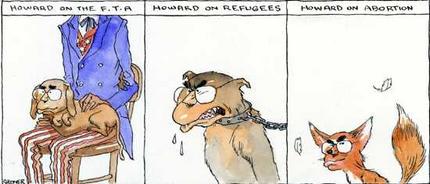
Spooner captures the tactics nicely. The abortion values debate is being played a certain way. What is it? How is it connected to the formtion of the conservative majority?
Glover's answer to the above question about the significance of the empty middle for the abortion debate is interesting. He says that:
"...as traditional political loyalties based on class dissipate, Howard is trying to appeal to people all over the political spectrum who hold strong personal views on often divisive issues connected to religion, nationalism and race. He wants them to put aside their economic interests and vote for conservative values. It usually involves pegging out a position on a topic which intellectuals say involves complex moral and legal issues, but which the man or woman in the street sees as black and white. Abortion is simply the latest issue in this unfinished war of turning the majority against flip-flopping, floundering elites."
Moral issues are seldom resolved. They never go away as they keep on surfacing. So we have an eternal values debate.
So what is the PM's tactics on this abortion issue?
Glover says:
"The real reason the Prime Minister is allowing and encouraging the abortion debate is to send a message. The law won't change, but after a long and costly parliamentary fight - which will monopolise media coverage for weeks and involve senior Liberals appearing on television agreeing with church leaders - morally conservative working-class Australians will know that, secretly, if only those rotten elites would let him, John Howard would love to move against abortion."
Deploying such tactics ensures the support of the conservative populist working class voters against the liberal enemy within the nation state. They become rusted on and the transition away from the ALP is permanent.
February 9, 2005
neo-conservatism
I'd always understood conservatism in classical Burkean terms. This is characterised by aristocratic hierarchy, harmony, order, virtue, reciprocity shared values, tradition, and mutual concern. Since it looked back to an agrarian society ruled by a landed gentry it had little credibility in the new world of America and Australia after the 1850s.
Yet conservatism has adapted to the new world and survives in the present of a liberal capitalist world wearing a populist mask. It actually celebrates the bourgeois present and the capitalist ethos. How did it achieve this transformation? The rethinking of conservatism did not take place in Australia. Political philosophy barely exists in Australia and political ideas with a philosophic or ideological dimension have not been taken very seriously.
Is American neo-conservatism the new conservatism; one freed from nostalgia for the pre-modern past? If it is, then was the transformation undertaken by Irving Kristol?
February 8, 2005
Shadia Drury, Leo Strauss, populism
After dealing with Allan Bloom in the 'American Applications of Straussian Philosophy,' chapter of her book, Leo Strauss and the American Right Shadia Drury turns to Willmore Kendall. He provides the pragmatic, practical and poltical application of Straussian ideas. Drury says:
"The third reaction acknowledges the truth of Bloom's vision, but refuses to despair. Instead, it takes a pragmatic approach and sets out to make the most of a bad situation. Willmoore Kendall is the best example of this approach, although it can be argued that Joseph Cropsey, Martin Diamond, and Thomas Pangle provide variations on this theme. This pragmatic approach lays the foundations of neoconservatism discussed in the next chapter."
This response combines the position of Jaffa and Bloom. Drury explains this in the following way:
"It accepts Jaffa's claim that America's foundations have an ancient lineage and are therefore not altogether modern, as well as Bloom's assertion that America's troubles have their source in her liberal modernity. But in this view, what is critical is the recognition that America's troubles are not totally incurable. They can best be addressed by curbing the excesses of her modernity. The key to nursing America back to health is to undermine her liberal modernity and bring to the fore vestiges of ancient wisdom that are deeply hidden and long forgotten."
This looks to be more promising as populism is deemed to be the cure for America's liberal malaise. This is certainly the main response in Australia to the problems of neo-liberalism.
The argument is that:
"..the populist project is not a betrayal of America's roots or her heritage, and that antiliberal, anti-individualist, and antisecularist ideas have always been a part of America's heritage, even if they have never been part of her official documents. The conservative spirit may not have inspired many American leaders, and as a result, it has been politically overshadowed by the more flamboyant spirit of liberalism."
So what is the Kendall's Straussian strategy?
Drury argues that Kendall launches an assault on liberalism by employing the:
"...classic friend-enemy dichotomy. The enemies are "barbarians" or Communists who threaten America from without, and "heretics" or Communist sympathizers and liberals who undermine America from within. The internal enemy is by far the most dangerous. Kendall is convinced that the liberal enemy may have won many battles, but it has not won the war."
The key is to turn the people against liberalism and foster a new populism in the service of conservative principles. The elite must turn the people against liberal institutions. The idea is to drive a wedge between liberalism and democracy, and to use the popular will to defeat liberalism.
Is this not what has happened in Australia under John Howard? Or in America under George Bush? Do we not have the populist attack on the (left)liberal elite in the name of the sentiments of the people? Do we not have the religious right attacking liberal permissiveness for moral decay of civil society in the name of family of values? Do we not have the cultivation of conservative populism as a working class movement---Thomas Frank's blacklash populism?
February 7, 2005
Shadia Drury's Straussian puzzles#2: Allan Bloom
As I've mentioned before the Australian reception of Shadia Drury's Leo Straus and the American Right basically accepts her critique of Strauss's conservative politics, the noble lie and the Washington neocons.A good example is Mark Bahnisch's post at Troppo Armadillo late last year. What continues to be sidestepped is any account of the Straussian philosophical critique of modernity. There is no probing of the Drury's understanding of the philosophical underpinnings of the Nietzsche, Heidegger, Strauss coupling
We can see this evasion by picking up on where we left off yesterday. After dealing with Jaffa in the 'American Applications of Straussian Philosophy,' chapter of her book, Leo Strauss and the American Right Shadia Drury turns to Allen Bloom's very popular The Closing of the American Mind as the exponent of the reaction of despair.
This view accepts that America is the embodiment of modernity and that this spells the death knell of classical wisdom. On this view, the principles on which America is founded are hopelessly modern and tragically flawed.Hence the reaction is understandably filled with despair and foreboding.
Let's accept that America is a liberal society grounded on Enlightenment values and so the embodiement of liberal modernity.
Drury says:
"Bloom portrays America as a polity grounded in the ill-conceived ideas of modernity, ideas that are engulfing the globe and shattering the glorious heritage of Western civilization.According to Bloom, America's Founding Fathers were the heirs of early modern philosophers such as Hobbes and Locke. These moderns were not privy to the sublime insights of the classics or their recent heirs--Rousseau and Nietzsche. Instead, they looked at man in his brutishness: untamed, uncultivated, and self-centered. And, incredible as it may seem, the early moderns set out to create a society made up of these selfish creatures. The result was a society of individuals whose natural tendencies for self-seeking and self-satisfaction were not suppressed by culture, but simply rechanneled into commerce. In this way, man's natural egoism assumed a form that was not altogether destructive of social life. The result was a bourgeois society that is paradigmatic of American life."
Bloom portrays American society as a collection of solitary individuals with nothing to live or die for. American society is a vehicle for individual self-preservation, self-aggrandizement, and the pursuit of wealth. America is little more than a collection of isolated, alienated, and disoriented individuals lost in a morass of cultural relativism and meaninglessness.
What has disappeared is the unified culture provided by myths and religion. So America is little more than an animal farm. So we have a critique of America society coupled to a critique of liberalism.
What does Drury make of this? She says that:
"One of the pervasive problems with Bloom's critique of American liberalism is that it confuses liberal reality with liberal ideals. In criticizing American liberal society, Bloom is under the mistaken impression that he is also criticizing liberal theories, ideas, and ideals. This confusion has its source in the assumption that American liberal society is the actualization of liberal ideals, or the logical and inescapable consequence of these ideas."Drury defends American liberalism. She argues that liberalism is not itself nihilistic or relativistic in order to show the futility of the Straussian critique of American liberalism. It cannot provide America with a meaningful critique of her liberal tradition.
Bloom gives a onesided reading of US society. Is not the US after 9/11 a most religious nation in which religion is intermingled with nationalism, patriotism and the sacrifice of an eternal war against terror. I interpret this as a onsided response to cultural relativism and meaninglessness of liberalism; a response that arises from within American traditions. So what we have with Bloom is a critique of liberalism in terms of it giving rise to the kind of society that Bloom describes. So the flaw with Bloom's account is that America is not wholly modern. It is deeply conservative and deeply pre-modern.
It is Drury's claim that Straussian school cannot provide America with a meaningful critique of her liberal tradition that is debatable. The Straussian position is basically a Heideggerian one: modernity's nihilism & technological mastery is a lethal combination and it gives rise to the dark night of modernity. This account of modernity is never confronted, for she guns for the anti-democratic response of the Platonic philosopher kings. So how much purchase has the Heideggerian account of modernity? Should it be taken seriously?
Though Drury rejects the conservative response to nihilism of Nietzsche, Heidegger & Strauss she does not say how liberalism can deal with the process nihilism that hollows out liberal vlaues.
February 5, 2005
Straussian puzzles: Shadia Drury
I'm puzzled by a remark that Shadia Drury makes in this chapter of her book, Leo Strauss and the American Right. Drury says that the first reaction to Strauss:
"... is a denial that America is modern; a denial that is predicated on a reinterpretation of the American founding as an ancient polity rooted in the great tradition in general, and the classical ideas of the Greeks and the Romans in particular. Harry V. Jaffa is the leading representative of this view."
This view, that Jaffa says that America is founded as an ancient polity rooted in the classical ideas of the Greeks and the Romans, does not square with what Drury says when she briefly outlines Jaffa's views. She says:
"For all his talk about the classics, Jaffa is first and foremost a Lockean. Like Locke, he believes that consent is the foundation of government; but like Locke, he insists on a natural law and a natural right that antedate all government, including government by consent. In other words, Jaffa follows Locke in championing limited constitutional government."
Is not Locke modern? Is he not a liberal?
My understanding is that Locke works off Hobbes and that Hobbes represents a fundamental rupture with the classical political tradition. Locke is, in fundamental way, a Hobbesian, though Locke did Locke assimilate, reject, and move beyond the Hobbesian political philosophy to launch liberalism. For Jaffa the principles of the Constitution are the principles of the Declaration of Independence. For Jaffa it is the Declaration alone that embodies moral realism and moral rationalism
Drury goes on to say that:
"Jaffa castigates his fellow conservatives for being historicists and relativists without principles. He denounces their unprincipled attachment to the past....He criticizes conservatives such as Russell Kirk, Irving Kristol, Jeanne Kirkpatrick, Martin Diamond, Walter Berns, and Willmoore Kendall for rejecting natural right in favor of rights rooted in history and tradition."
I understood that Locke held that political right derived from the equal natural rights of individual human beings, under the laws of nature and of nature's God.
So what makes Jaffa deny that America is modern?
It cannot be his distinctively Straussian approach to political philosophy that quite taks premodern philosophers seriously, and tries to understand them as they understood themselves. This is, by itself, only a challenge to modern historicism (i.e. historical relativism), which holds that the thoughts of premodern philosophers are outmoded, irrelevant and were mental prisoners of their epoch.
Nor can it be the Straussian claim that premodern philosophy is better than modern philosophy. This does turn the whole "progressive" view of history topsy-turvy, and provide a very distinctive point of view, and line of criticism, about modernity. However, the Straussians are pre-modern and anti-modern, in the name of reason, of philosophy, since there understanding of reason and philosophy different from the Enlightenment's.
But this has nothing to do with America being modern. So what makes Jaffa deny that America is modern?
Is it the turn to natural right in response to world dominated by the modern doctrines of historicism, relativism, nihilism, and positivism that constitute the the crisis of the West?
Or is it because Jaffa says that the proper response to these doctrines must come from the renewal and reaffirmation of the principles of the American Founding, embodied above all in the Declaration of Independence? For it is there that the United States asserted its claim to the individual rights of freedom and independence on the basis of certain "self-evident" truths about the human person and that "all men are created equal". Hence Jaffa makes a distinction between the principles of the Constitution from the compromises of that Constitution.
This is a fundemantal difference between the US and Australian consttutions There is no statement of principles upon which the Australian constitution is based. The political philosophy underpinning the Australian consitution have to be dug out by the High Court through a process of interpretation. It is this way of reading the Constitution that the legal postivists oppose.
This is my puzzle with Drury. Why does Jaffa's affirmation of the constitutional standing of the doctrine of natural rights,as enunciated in the Declaration of Independence, and expounded by Lincoln, constitute a denial that the US is modern?
The puzzle deepens because Drury's criticism of Jaffa's insistence that America is heir to classical ideals is that:
"It seems to me that there is a profound and fundamental difference between the American and classical traditions that Jaffa overlooks, largely because of his Straussian education...Another reason that the American Founders are not heirs to the classics has to do with the question of equality. The classical thinkers were not egalitarians. They did not believe that human beings were born equal.They thought that people had radically different potentialities and this meant that they were not entitled to the same privileges and the same consideration, or even formal equality before the law. Jaffa is quite mistaken in thinking that there is a line that extends directly from Aristotle to Locke."
But Jaffa, whatever his political philosophy, states that the proper understanding of America comes from the Declaration of Independence. He affirms the principles of natural right of all men being created equal and defends this against those conservatives who start from the constitution as a written text.
I reckon Drury is misreading Jaffa. The issue seems to be the emphasize Jaffa places on America's continuity with the classical and Christian sources of Western civilization. What this puts on the table is the questions of Strauss's reading of Locke, how do we assess modernity; and do we to interpret the American regime. With respect to the latter we would ask: 'how Lockean is the US:? Is this a cause for celebration or concern?
Update
There is a post over at John Rowe's blog on Harry V.Jaffa, which argues thatAmerica is founded on its ideal of natural (organic) law, that "all men are created equal". John highlights the conflict between these ideals and compromises of the Constitution.
February 3, 2005
Straussian interpretations: American
This chapter from Shadia B. Drury's Leo Strauss and the American Right is a good, easy read. It is entitled 'American Applications of Straussian Philosophy', and it makes a lot of sense of the different positions, currents, tensions and criticism amongst the American Straussians about the nature of America. I found it very useful as I was having trouble mapping the diverse applications of Strauss in the US.
Shadia identifies and outlines three different American reactions to Strauss's political thought reactions to Strauss with the words denial, despair, and pragmatism.
"The first reaction is a denial that America is modern; a denial that is predicated on a reinterpretation of the American founding as an ancient polity rooted in the great tradition in general, and the classical ideas of the Greeks and the Romans in particular. Harry V. Jaffa is the leading representative of this view. The second reaction begins with an awareness that America is the embodiment of modernity and that her triumph is the death knell of classical wisdom. On this view, the principles on which America is founded are hopelessly modern and tragically flawed. This reaction is understandably filled with despair and foreboding. The gloom of Allan Bloom's The Closing of the American Mind is particularly representative of this view. The third reaction acknowledges the truth of Bloom's vision, but refuses to despair. Instead, it takes a pragmatic approach and sets out to make the most of a bad situation. Willmoore Kendall is the best example of this approach, although it can be argued that Joseph Cropsey, Martin Diamond, and Thomas Pangle provide variations on this theme."
She adds that although these reactions are distinct, they are not mutually exclusive, and may overlap.
In the light of this diversity of Straussian interpretation I reckon we should stopping talking in terms of a monolithic Straussian position vis-a-vis liberal modernity. Jaffa, for instance, interprets the American constitution in terms of a more conventional understanding of classical philosophy and so breaks with the esoteric writings thesis in which the great philosophers of modernity wrote in a sort of code so as to disguise their real meaning.
February 2, 2005
Hayek: some puzzles
A new journal devoted to Hayek. It is good to see, as he is a serious and influential political thinker whose philosophy underpins a neo-liberal market order.
From my perspective the weakness of Hayek is the polemical Road to Serfdom. It is a polemical text that speaks to a moment of history the 1940s and the period of central planning and totalitarianism that has little purchase on social democracy. Social democracy split the tight identity between planning and totalitarianism argued for by Hayek.
In contrast, one strength of Hayek is his critique of scientism in the social sciences, and his critique of a Cartesian deductive mathematical reason that has so dominated neo-classical economics, with its contempt for history, and its tendency to shape reality according to the dictates of utopia as a purely competitive market. With this move Hayek opens up a space for other kinds of rationality.
This was my pathway into Hayek and one that few 'economic rationalists' in Australia appear to have taken. It pushes to one side the view that policy formation and decision making is primarily economic, and that political problems can be solved by economics. This then opens up a space for the political and the philosophical in policy making. So policy making shifts to how does a liberal state govern a population through the dispersed knowledges, economic processes and spontaneous order of the market.
The shift that Hayek makes is to constitutional liberalism based on individual freedom and limited government, and he argued that this is what underpined the American constitution. Does it? Is that an accurate reading?
What is not clear to me is the connection between Hayek's idea of the market as a spontaneous evolutionary order arising from the unentneded consequences of free actions and his constitutional liberalism. Is not constitutional liberalism designed and imposed by political authority as the sovereign? Is that it not a constructive rationalist liberalism--the wrong kind of liberalism? So how does the spontaneous order in civil society relate to constitutional order?
February 1, 2005
Friendship in politics
You rarely hear about political friendship these days. It is not a topic of media writing on politics, it is rarely mentioned by politicians in public and it has all but disappeared in political discourse.
Though friendship was widely discussed in classical political discourse (eg.,Aristotle), it was replaced by the modern turn in philosophy that premised politics on individual self-interest, deadly competition with others for what we desire, cold calculation and the antagonistic relations of self interest being contained by law and regulation.
That is the modern liberal project. It acknowledges the intimate ties of erotic love and the family, but it excludes these from the public sphere. Friendship is based on self-interest and in a utilitarian society friendship is simply utilitarian as one seeks it for the sake of advantage to oneself. Friendship is an instrument: a hedge agaisnt misfortune, or a leg up the ladder of success.