September 30, 2005
emergency as legitimation
A review of some books by Giorgio Agamben. In Means Without End Agamben writes that:
"power no longer has today any form of legitimation other than emergency, and because power everywhere and continuously refers and appeals to emergency as well as labouring secretly to produce it".
So true.
September 29, 2005
White Australia again
I've just seen that Keith Windshuttle has an op.ed in the Murdoch owned Australian on Andrew Fraser's article Windshuttle says that:
The censored article is an extended version of a review of my book The White Australia Policy, which Fraser originally wrote last February for the neo-racist journal American Renaissance. His underlying premise is the now conventional academic interpretation that the White Australia Policy was an expression of British race nationalism. The only major difference between Fraser and the leftist historians who originated this thesis in the 1970s is that whereas they thought racial nationalism a bad thing, Fraser believes it is good.
Not quite 'the only major difference.' We still have the question of Fraser defending the biological determinants of race versus the leftist historians defending the social constructivist ones. As I mention earlier Fraser asks a good question:
But what if Windschuttle is wrong? What if racial differences are, in large part, biologically or genetically grounded? What if even culture is not simply a social construct but, rather, a phenomenon with a substantial biological component?
Windshuttle merely repeats his argument in his book, 'argues that Australian nationalism was defined not by race but by loyalty to Australia's democratic political institutions. It was qualitatively different from the racial nationalism'--presumably Windshuttle is using the distinction between ethnic and civic nationalism. Philosophy is not one of Windshuttle's strong points. He says that 'Fraser's version of the sociobiology of race is yet another of the "just so" stories to which that field is notoriously vulnerable, and which allow writers to deduce any conclusion they fancy. ' There is no argument presented.
Windshuttle is more interested is tracking the left currents in Fraser's thinking.
September 28, 2005
a divided Australia?
In an article published several years ago Stuart Hall asked a good question:
What are the chances that we can construct in our cities shared, diverse, just, and egalitarian forms of common life, guaranteeing the full rights of democratic citizenship and participation to all on the basis of equality, whilst respecting the differences which inevitably come about when peoples of different religions, cultures, histories, languages, and traditions are obliged to live together in the same shared space?
It is very relevant in the light of this. Some commentary on these counter terrorism measures by George Williams can be found here.
Will the 'war on terror' that started after 9/11 undermine the promise of a multicutural Australia in cities such as Melbourne and Sydney? Will that promise give way to a process that is sub-dividing shared urban space into discrete, differentiated warring enclaves? Will that promise by a "country of immigrants" fade with the ascendancy of a new assimilationism?
The regime of assimilation that disciplined newcomers and immigrants to Australia to assimiliate to the norms and conventions of Anglo-Australian society and to blend in with those already there --- has usually been a project of the conservative right. An Anglophone Australia opposed the cosmopoiltian post-nationalist left by talking in terms of the "ideology of multiculturalism", ethnic ghettos and violence. 'Australianness' is defined narrowly to ensure that many of Australia's Muslim communities find themselves defined as the "aliens within".
The cosmopolitan left once held that the future for humanity lies in a global system organised along universal principles, that were imposed through the international rule of law. On this Kantian account the particular cultures, and the political units and institutions created in their name by nation-states are 'only a means to valuable human goods, and never an end in themselves. The particular narratives and myths embodied in the practices of nation states , if allowed to go unchecked, get in the way of realising universal values to do with respecting the freedom and equality of others----in other words, of respecting other's humanity.'
Parts of the left--eg., the ALP--- now favour a strong national identity in response to imigrations flows, Tampa, and the Bali bombings. A stronger national identity is being achieved through a repackaging of older versions of assimilationism, and calling it 'integrationist'. This discourse states that immigrants, especially strangers such as Muslim immigrants, have a duty to adapt to the Australian way of life. Cultural similarity provides for national cohesion, diversity inevitably weakens cohesion.
What this discourse ignores iis that 'racism' is as embedded a part of Australian culture as 'tolerance' and 'consensus.'
September 25, 2005
White Australia, nationalism, Fraser
It wasn't until 1973 that the Whitlam Government finally dismantled the White Australia Policy. The first significant increase of migrants from non-European countries took place under the Fraser Government, after it came into office in 1975. What was rebuilt from the dismantling was Australia as a multicultural society. Until the early 1970s, the labour movement was solidly behind the White Australia Policy: that policy was pretty much the program of the working class and the trade union movement, although it was approved of generally during the first part of the 20th century.
Gwenda Tavan's recent book The Long, Slow Death of White Australia deals with the demise of the White Australia Policy. I have not read this text and so I'm relying on Fraser's interpretation. This holds that this Melbourne historian's account emphases the reasons for the ascendancy of White Australia were racism and xenophobia, and that these were the driving forces in the campaign to restrict non-white immigration. Tavan argues that, though the White Australia policy was abolished by stealth in the 1950s and 1960s, due to a fear of a public backlash if the increasing numbers of non-European migrants became widely known, there was also much evidence of public support for the changes to the White Australia that were taking place.
Tavan argues that the debate still continues" over how many non-whites should be allowed to enter Australia and that whilst " White Australia" is no longer a "dominant worldview;" it persists as a "residual cultural form." Recent events in the last decade ---Pauline Hanson and the Tampa incident---indicate that "the white, Anglo-Celtic racial-cultural ideals" of Australian nationality stil burn as embers. It would appear that Tavan fears that the unexpected resurgence of populism, nationalism and the naturalist, exclusivist portrayal of the nation in the 1990s is the result of the re-emergence of deeply, culturally ingrained ethnic perception of social belonging. This is the ‘return of the repressed' of ancient ethnic hatreds thesis.
On Fraser's interpretation Gavin, like Windshuttle, is a racial egalitarian concerned to drive a stake through the heart of racial realism, once and for all. They resolutely deny that differences between "races" have a biological or genetic foundation and argue that the evident differences between the various races of mankind are the malleable product of their cultures. On this view it is a fundamental category error to slide from the concept of culture to that of race because cultural differences are not inbred, immutable, and biologically grounded.
This is what Andrew Fraser disputes.
Suprisingly, he does so by considering ethnic and civic nationalism and the way that civil nationalism has acted as the ground for Australian identity. The common position is that tribal nationalism' and ‘atavistic ethnocentrism' of White Australia is a populist nationalism that is a reactionary, atavistic and irrational phenomenon. Underpinning this is the ‘modernizationist' argument that revisits classical modernization theory as developed in the 1950s and 60s to understand modernization as the transition from a closed, particularist, undifferentiated, and hierarchical Gemeinschaft to an open, universalist, functionally differentiated, and individualist Gesellschaft.
It is y then held that this ethnic nationalism can be overcome through the adoption of the ‘right' institutional structures (the legal-procedurally based political institutions of liberal democratic states) and, in general, through the adoption of a ‘civic' form of nationalism and by adhering to the ‘constitutionalist' model. This cages the explosive force of the ethnic nationalism underpinning White Australia.
Fraser contests the duality of ethnic and civic nationalism by considering the work of Rodger Scruton and Maragart Canovan:
Neither Canovan nor Scruton believe that a nation can be grounded in an abstract loyalty to a particular political regime or constitutional order. For Scruton, it is axiomatic that citizens belong to an inherited community inhabiting an ancestral homeland. Citizens are members of a pre-political community that includes the living, their ancestors and their unborn offspring. Absent generations are among the strangers to whom the good citizen is bound in "a common web of rights and duties."...Canovan, too, affirms both that, within any particular nation, "many fellow-nationals really will be blood relations" and that "nations depend upon the symbolism of kinship for much of their emotional appeal." But she rejects the claims of ethnic nationalism, pointing out that "much of that kinship is imagined kinship, and a good deal of it is always fictitious..."The problem with Canovan's argument is that she does not give sufficient weight to the "peculiarities of the English." As a consequence, like Windschuttle, in relation to the White Australia Policy, she sets up a false dichotomy between ethnic and civic nationalism.
Fraser argues that in the case of England and the old white dominions settled by people of British stock, including the United States, there is simply no contradiction between ethnic and civic nationalism. He says:
The relative inclusiveness of English national identity was replicated in the settler dominions. In fact, the English, Irish, Scottish, Welsh and even continental European settlers in colonial America, English Canada, Australia and New Zealand fused together to become more British than the British in their new homelands. The creation of those colonial British cultures was an important first step on the road to creating new national identities as Americans, Australians, Canadians and New Zealanders... Civic nationalism was, therefore, a meme replicated best and most easily through the vehicle provided by the Anglo-Saxon genotype.
start http://www.sauer-thompson.com/archives/philosophy/2005/09/white_australia.html">previous
September 24, 2005
Hayek revisited
I find this Hayek quote, which I found on a Brian Tamanaha post over at Balkinization, interesting because it reminded me of the wooden insistance by some market liberals in Australia on the principle of laissez faire.
The fundamental principle that in the ordering of our affairs we should make as much use as possible of the spontaneous forces of society, and resort as little as possible to coercion, is capable of an infinite variety of applications. There is, in particular, all the difference between deliberately creating a system within which competition will work as beneficially as possible and passively accepting institutions as they are. Probably nothing has done so much to harm the liberal cause as the wooden insistence of some [conservatives] on certain rough rules of thumb, above all the principle of laissez faire.
The quote is from Hayek's classic polemical text Road To Serfdom, where he basically argued that central planning is by it's very nature inefficient, that only a free market allows for the exchange of information that can provide efficiency and that central planning inevitably leads to totalitarianism.
I would insist on using 'market liberal' here, as 'conservative' is just the wrong word, as Hayek is probably the most important liberal political economist in the 20th century. In his work economcis, law and politcs overlap around the problematic of coordination. That is what makes him a significiant figure as he explores the way that the coordination of economic activity takes place within institutional legal and political framework.
Brian quotes Hayek, again, and this highlights the classical liberal position on the limited and legimate role of govenment in capitalist modernity:
There can be no doubt that some minimum of food, shelter, and clothing, sufficient to preserve health and the capacity to work, can be assured to everybody...Nor is there any reason why the state should not assist the individuals in providing for those common hazards of life against which, because of their uncertainty, few individuals can make adequate provision. Where, as in the case of sickness and accident, neither the desire to avoid such calamities nor the efforts to overcome their consequences are as a rule weakened by the provision of assistance...the case for the state's helping to organize a comprehensive system of social insurance is very strong....
To the same category belongs also the increase of security through the state's rendering assistance to the victims of such "acts of God" as earthquakes and floods. Wherever communal action can mitigate disasters against which the individual can neither attempt to guard himself nor make provision for the consequences, such communal action should undoubtedly be taken.
Hayek's key idea is that of a spontaneous order" ----the idea that a harmonious, evolving order arises from the interaction of a decentralized, heterogeneous group of self-seeking agents with limited knowledge. This order was not "designed," nor could it be "designed" by a social planner. It has "emerged", or evolved spontaneously, from a seemingly complex network of interactiosn among agents with limited knowledge.
However, Hayek rejected the view that capitalism is a form of Social Darwinism, as he argued that a coherent and impartial legal system is required in order to make free markets function effectively:
It is important not to confuse opposition against...planning with a dogmatic laissez faire attitude. The liberal argument is in favor of making the best possible use of the forces of competition as a means of co-ordinating human efforts, not an argument for leaving things just as they are. It is based on the conviction that, where effective competition can be created, it is a better way of guiding individual efforts than any other. It does not deny, but even emphasizes, that, in order that competition should work beneficially, a carefully thought-out legal framework is required and that neither the existing nor the past legal rules are free from grave defects.
What we are not getting in Australia from the Howard Government's telecommunications and media reform is a carefully thought-out legal framework that would allow effective competition. The rules of the game are being written for the big end of town that uses its market power to prevent competition.
September 23, 2005
White Australia policy: philosophical underpinnings
I notice that OnLine Opinion has published a defence of Andrew Fraser's right to publish his article, and a condemnation of Deakin University for refusing to publish the article in the Deakin Law Review because they received a legal threat. It is good to see classic liberal principles being upheld by National Forum. If Australia is to be open liberal society, then we ought not suppress a discussion and debate of the nature of racial differences. When the managerial administrators of our corporate universities do so, this suggests that the subject of racial differences is a taboo one.
Graham Young at Ambit Gambit says that:
Having read Fraser's piece there're a few points that stand out. First, it is a transparently slight piece that doesn't stand much scrutiny. In terms of public debate, that doesn't matter. Better to point this out in public than to have it go underground. Fortunately, Deakin's refusal to publish has given it more publicity than if it had been published, so there is in a way less, not more, censorship.
Alas, Graham gives us no argument is provided for the judgement Fraser's article is a transparently slight piece that doesn't stand much scrutiny.' All that is offered is the judgement that the article is a polemic. Graham however, does go to question the dubious arguments applied by some of the critics of Fraser. Rightly so, because some of the criticism is polemical, and evades engaging with Fraser's arguments that support the philosophical underpinnings of one nation conservatism.
Is Fraser's article a transparently slight piece that doesn't stand much scrutiny? Is it a polemic? Is it poor quality as most commentators are asserting. One way to assess this is to see how the argument for the biological account of racial differences stacks up.
In the previous entry on Andrew Fraser and the White Australia policy I noted that Fraser said that the time is clearly ripe for a courageous and well-informed reappraisal of the White Australia Policy and the decision to dismantle it. He was going to do this by consider some recent texts on the topic. Fraser adds:
Unfortunately, racial realists, concerned to bring common sense to contemporary Australian debates over race and immigration, will be disappointed with two recent books on the White Australia Policy. Both promise much but deliver little because of their authors' determined refusal to take race seriously.
One of the texts considered by Fraser is Keith Windshuttle's recent text (2005) The White Australia Policy.
Fraser says that in this text Windshuttle:
"... sets out to refute the orthodox leftist charge that the immigration legislation enacted shortly after Federation was "racist". On the formal level that is easily done since the Immigration Restriction Act, 1901 ... did not explicitly prohibit non-white immigration. Instead, prospective immigrants were required to pass a dictation test by writing out 50 words in any European language selected by immigration officials. But, because both the intent and the practical effect of the dictation test were to sharply limit coloured immigration, Australia was open to attack from progressives around the world and, especially during the Cold War, from newly assertive post-colonial regimes in Asia and Africa.
Fraser then points to a flaw in Windshutte's account: He says that Windschuttle's rehabilitation of the White Australia Policy is premised on a familiar, if pernicious, tenet of neo-conservatism:
Supposedly, Australia's national identity is "based on a civic patriotism," thereby fostering "loyalty to Australia's liberal democratic political institutions rather than to race or ethnicity." He contends that the White Australia Policy, far from being the reactionary spawn of an irredeemably racist nation, grew out of a long-established, progressive program aiming "to extend both the freedom and the dignity of labour."...opposition to Asian immigration was not grounded in fears of "racial contamination." Rather, politicians were concerned both to protect the standard of living of Australian workers and to prevent the emergence of "a racially-based political underclass" that would undermine Australia's egalitarian democracy...Windschuttle portrays their leaders as proto-Boasian anthropologists ....convinced that race is a nothing more than a social construct.... Windschuttle insists, mainstream Australians have never subscribed to biological theories of race. Influenced instead by the universalistic principles of both evangelical Christianity and the Scottish Enlightenment, they have refused to treat white Europeans as superior and other races as innately and permanently inferior. This, then, is the crux of Windschuttle's argument...
I haven't read Windschuttle's text, and so I do not know how well Fraser has interpreted him. Let's accept that the interpretation us plausible. Windshuttle's argument downplays the position that racism and xenophobia were driving forces in the campaign to restrict non-white immigration into Australia. As I understand the Australian left has traditionally defended the position that Windshuttle is trying to displace.
Fraser raises a key issue: is racism a social construct or is it biologically determined? Fraser rejects the egalitarian position that race is only skin deep, as he contends that racial differences are real, (ie., biologically grounded) and not just social constructs. This is the standard nature culture issue and it should be raised with respect to race.
One can ask where does the left stand on this? I presume that the Australian Left pretty much stands on the cultural construct side of the issue, rather than on the biological determinist side. Thus Humphrey McQueen, in reviewing Windshuttle's book concurs wiith Windshuttle. He says:
On the key question, he is politically correct, that is to say, scientifically accurate. There are no such divisions in nature as races. Or, more precisely, differences in appearance are so slim in terms of genetic makeup as not to constitute meaningful categories. This much Windschuttle acknowledges as one more plank of his own anti-racism. Having recognised the non-existence of race, he accepts that racism is nonetheless possible.
Is the issue as open and shut as Windshuttle and McQueen assert? Some argument is required, is it not? If the culture versus nature issue is a debate we keep on having around sexuality (eg., masculinity and fenminity), then why not have a debate on this around race, given its historical importance in Australian history?
Raising this issue gives Fraser's article greater weight than 'slight' ie., not standing much scrutiny, as claimed by Graham Young. This article is no polemic. It is a sifting through the White Australia policy issue from an unusual perspective, even though it also utilizes polemical language and deploys rhetorical tropes.
September 21, 2005
White Australia revisited
The Age reports that the Executive director of the Australian Multicultural Foundation Hass Dellal, said there were moral limits to freedom of speech. He added that Dr. Andrew Fraser's views about ethnic homogeneity of the Anglo-Australian people and that a multiracial society forces white Australians to bear "painful social, economic and political costs" disrupted social harmony. Hass Dellal said:
"Most Australians finds these views abhorrent. For a country like Australia that has been so welcoming and has benefited from its diversity, socially politically and economically, most Australians don't accept these views."
So the open society is dumped to preserve social harmony of the nation state in a globalized world. Oh dear. That is a dogmatic conservatism for you isn't it .
This article is what is being banned. The argument is laid out:
Over the past thirty years, Australia, along with just about every other Western society, has been transformed by a revolution engineered from the top down by the leading echelons of the corporate welfare state... New Class cadres of managers, professionals, politicians and academics have dismantled the foundations of Australian nationhood laid down at the time of Federation...The arbitration system, the protective tariff and the White Australia Policy: all have gone in order to facilitate the free flow of capital, technology and labour in a globalist economy.
For sure. I'm a lefty and I concur with that. Fraser continues:
The most revolutionary, by far, of these radical changes has been the decision to open Australia to mass Third World immigration.... Indeed, since the end of the Second World War a strange alliance of Communists, Christian churches, ethnic lobbies and other pressure groups working through the corporate sector and within the centralised apparatus of state power set out deliberately to flood the Anglo-Australian homeland with a polyglot mass of Third World immigrants.Provocative for sure, with words such as 'flood' , 'Anglo-Australian homeland ' and a 'polyglot mass of Third World immigrant'. It is provocative in the light of the mass imgration from Europe after WW2. But hey, this is the political language of the One Nation conservatives. It's not mine. It all depends on whther there is an argument from a clear position that clearly defines the opposition. in a way that is acceptable to the adherents. Fraser does this.
He continues:
Chief among the ideological weapons deployed in that campaign have been the interwoven myths of equality and universal human rights...The official ideology of the globalist regime has been enshrined in the International Convention on the Elimination of All Forms of Racial Discrimination [5]. According to that document, "any doctrine of superiority based on racial differentiation is scientifically false, morally condemnable, socially unjust and dangerous." There can therefore be "no justification for racial discrimination, in theory or in practice, anywhere." Those who subscribed to the doctrine of racial egalitarianism were bound to oppose a colour bar on immigration to Australia as being both immoral and pointless: it was axiomatic that "racial differences are not significant differences that need divide mankind."
Yes that is a justification for a multicultural Australian society. It is stated fairly. I personally have difficulty with the language of rights but that is beside the point on this. The language of human rights is used to defend a culturally pluralistic Australia.
Fraser then states the obvious: that 'racial egalitarianism flies in the face of the more realistic premises of the White Australia Policy... and ethnic homogeneity.' I would challenge 'more realistic' but that is a quibble. The substantive point is that the founding fathers of the Australian nation did regard racial differences as a fact of life; racial conflict as the inevitable consequence of a multiracial society and they did act to preserve ethnic homogeneity as a cornerstone of the Australian nation. Australia was to be a white nation. He's right on this.
Fraser then says that he wants to undertake a well-informed reappraisal of the White Australia Policy and the decision to dismantle it. So he wants to defend a Anglo-Australia, assimilation, and one nation. And he proceeds to argue his case. But he is banned from doing so by the university authorities at Macquarie and Deakin. That is one issue. A key one. We cannot assess Frasers' arguments until the article is published.
Comments can be found at Redrag, at Larvatus Prodeo at Catallaxy The former two are quite negative about Fraser.
September 20, 2005
the big chill in academia
Whilst away in Melbourne I wondered about the approaching chill in academy concerning academic freedom in Australia. Things do seem to be closing down a bit. I had in mind this case about Professor Andrew Fraser, an associate professor in public law at Macquarie University in Sydney, who was banned from teaching at the university earlier this year, after making a series of statements about race, crime and culture.
Banned from teaching? Why? Fraser is a good teacher by all accounts. Are not universities places where academics can raise ideas freely as a means of fostering discourse, engendering debate and enriching the community? What is going on at Macquarie University? You can hear the conservatives ask: 'is this the way the ideological grip of liberals and leftists on the university campus is going to be maintained?' By banning unpopular rightwing views.
The issue I was wondering about was, why did the university not act to protect the ethos of the liberal university? Why is the university so lacking in courage that it cannot publicly defend the ethos of a university. This ethos is described by Amy Gutman as:
"... the freedom of professors and students to read widely and explore topics in all their complexity, to think critically and debate issues where there are grounds for reasonable disagreement, and to imagine and express new ideas and new worlds without fear of reprisal or retribution."
Some comments on this episode can be found over at Catallaxy Suprisingly, these libertarians appear to support the ban. What has happened to their open society?
More background can be found over at Larvatus Prodeo and Catallaxy.
Lo and behold it is reported by the ABC that Deakin University in Melbourne has bowed to legal threats, reversing a decision by its law journal to publish a defence of the White Australia policy by controversial academic Andrew Fraser. Fraser argues that the latest science confirms racial differences and vindicates the founding fathers' attempt to preserve Australia as an Anglo-Saxon bastion. Why not let this be publsihed and pulled to bits by lefty critics? Isn't open public debate, scrutiny and testing claimsd what a university is about?
The Australian says that Sally Walker, Deakin University's vice-chancellor, wrote in a letter to Professor Fraser yesterday that, "On the basis of (legal) advice, I have to inform you that I have directed those responsible for the Deakin Law Review not to publish your article." My my. This is the corporate university. So what were Walker's reasons?
In her letter, Professor Walker says that she has advice that publishing Fraser's article, ''Rethinking the White Australia Policy', would "...breach the federal Racial Discrimination Act, which prohibits racial vilification." In a media statement, Professor Walker added:
"Universities are charged with a responsibility of encouraging open public debate and scrutiny. However, universities are not exempt from the law, nor should they be."
Racial vilification? According to news reports Fraser's 6800-word article, was accepted by two anonymous academic reviewers. What is going on?
There is some commentary by John Quiggin, and Larvatus Prodeo on this.
I have no brief to preserve Australia as an Anglo-Saxon bastion, given my commitment to a multicultural Australia. Nor do I accept Fraser's views that sub-Saharan Africans living in Australia are a crime risk as they have much lower IQ's and "significantly more testosterone" than whites; that Australia is creating an Asian managerial-professional "ruling class", and that the abolition of slavery in the US can be used as example to demonstrate a link between an expanding black population and increases in crime.
If Fraser's article meets the academic standards of the two anonymous academic reviewers of the Deakin Law Review, then it should be published. By censoring the article he Deakin University authorities have placed a constraint on academic freedom and kissed the liberal university goodbye.
My judgement is that the silencing of Associate Professor Fraser is being done because his views are categorised as "unacceptable" by liberals. Yet it is only a short to step to say that the views of a professor of Islamic studies are unacceptable because they are found to be promoting "terrorism"? Or that the views of a professor of international relations are unacceptable because they "encourage" attacks on Australian troops in Iraq? Or that the views of an economics professo rare unacceptable because they "incie" violence against multinational corporations.
I can sense the big chill coming.
September 19, 2005
philosophy defended
Conservatives complain about lefty professors making certain political aims essential to the disciplinarity of humanities and social-science disciplines, and the way they have institutionalized their liberal politics. This has impoverished the intellectual life of the campuses of our universities. The key issue is not acorrecting lefty bias with a conservative one. It is defeding critical thinking.
A quote from Amy Gutman writing in the US Chronicle of Higher Education:
For two decades, I taught a course on ethics and public policy that dealt with the controversial topics of our time, such as terrorism, abortion, affirmative action, and bioethics. My students knew that agreeing with me on a given issue would have no bearing on how I treated or graded them. Those who brought solid evidence and original thinking to bear on their arguments, and who responded effectively to the strongest counterarguments, earned the highest grades.
These are the kind of courses that ought to be taught in Australian universities as part of an education for citizenship. It is the way that they are taught that is the key.
Gutman continues:
For their part, instead of making their case through reasoned arguments in academic forums, some critics of higher education are promoting legislation to regulate professors. In doing so, they are violating the spirit of academic freedom and threatening to poison the collegial atmosphere of robust and respectful debate that has enabled American universities to contribute so much to our democracy. By demonstrating our steadfast commitment to protecting the freedom of faculty members and students to engage in vigorous discourse across the political spectrum without government interference, we can prevent the threat of a chill from becoming a devastating frost.
That is a good defence of philosophy as a form of critical thinking. It is what is fading away in our universities.
September 18, 2005
The Latham Show
I'm back on deck after an absence due to work. The big news on the weekend was this. From what I can gather it is commonly held that the Latham Diaries is that they radiate more heat than light about the ALP or the media. It's nmore about all dark twisted personal emotion in a twilght world of failure. True, Latham's Diaries enable us to peep through the keyhole into the dark political space of our poltical culture. The occasional shaft of light--- of insight--- is disclosed but the hate, revenge and vitriol gets in the way. So the Diaries tell us very little about a journey into the heart of darkness of Australian politics,. That is the conventional interpretation.
However, this event- --the publication of the Latham Diaries-- has given rise to another kind of representation:
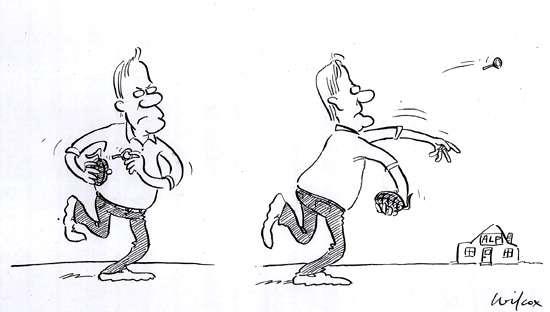
Cathy Wilcox
This image of throwing hand grenades can be interpreted as a representation of politics as performance, can it not? The performance has been called 'The Latham Show' by Crikey.com.au.
However, it goes deeper than entertainment, as it is a performance that contributes to the public's knowledge of politics and media in Australia. It does so through well directed arrows aimed at the heart of the media establishment and the ALP insiders. Thesewell directed arrows elict bitter personal reponses by the media and ALP, and so reinforce the key argument of the Diaries about the corruption of our political culture. Neither the political or media establishment are really trusted by ordinary citizens, and Latham's performance is tapping into the sentiments of those citizens who distrust big media and the cynicism and nastiness of parliamentary politics.
It is a crazy brave performance that is to be admired.
Update: 22nd September
Some journalists are begining to see Lathams insights and step beyond revenge.Thus Mike Steketee over at The Australian says:
Here's a turn-up: among all the madness and the badness of The Latham Diaries lurk many home truths.The book exposes the problems with Kim Beazley's leadership - his lack of reforming zeal, his shunning of confrontation, the absence of fire in his belly. It portrays a sick political and media culture and an endemic factionalism that threatens to suck the life out of the Labor Party. It highlights the toll that rumour-mongering can take on people in public life. It presents a case for opening up the debate on the US alliance beyond its present narrow confines.
Steketee concludes that "The tragedy of The Latham Diaries is that they will poison the climate in which there can be a productive debate about such issues," Maybe not.
Still the journalists have still to respond to Latham's depiction of a sick media culture that they are a part of, and contribute to. Their failure to do so will indicate just how sick the media culture is.
September 13, 2005
the play of perspectives
One aspect of politics as performance as a disclosure of self and a common public world is that it recognizes the plurality of opinion in the political world. This plurality is based on the play of perspectives that the difference of position creates.
This plurality is understood by Arendt's politics as performance in terms of a rejection of the Platonic privileging of (absolute)truth and identifies opinion as the stuff of political life.
September 10, 2005
New Orleans as a state of emergency
New Orleans is dead as a city as contaminated water, toxic chemicals, fire, stench, decomposing bodies, and drenched darkness spread through the city.
A quote from an article in Bad Subjects:
'Floating corpses, dehydrated babies, fires, National Guard soldiers with shoot-to-kill orders. This is a state of emergency.'
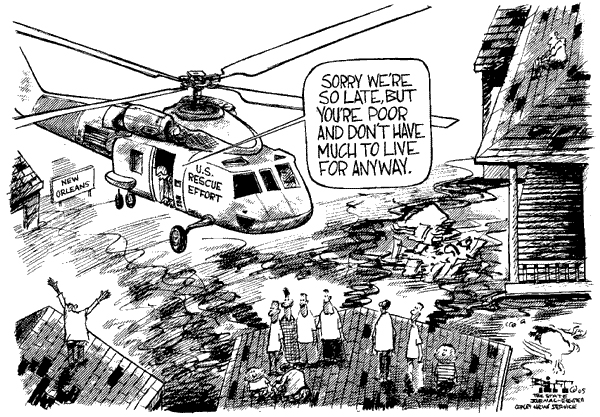
Chris Brett
The quote is from an article entitled 'The Floating Corpse of New Orleans' and it is by Tomasz Kitlinski, Joe Lockard and Stephane Symons. They go to say that:
It is this the state of exception that, according to Giorgio Agamben, characterizes our current political order.The state of exception has become the rule not only in far-off lands and isolated prisons, but even in the center of the American heartland. New Orleans has become a locale where law and human rights are not applicable anymore: the outside has penetrated to the heart of the inside. The Superdome and the Convention Center, with their anarchic interiors, absence of assistance, predatory gang violence, overflowing toilets, and piles of dead bodies, exemplified the materialization of a state of exception.
The people in New Orleans have been reduced to bare life. The people sitting lost in the streets of New Orleans are homines sacri, those who can be left to die or killed with impunity; they have been stripped of any content or quality, their lives have been reduced to mere biological instance.
September 9, 2005
Reading Arendt
I am noting this article on Hannah Arendt entitled 'Between Modern and Postmodern: A Reading of Arendt's Political Theory in the 1990's' by Jiang Yi-huah. Jiang says:
In the 1990's, Arendt continues to be interpreted as a modernist, or a theorist sympathetic with the basic tenets of modernism although critical of certain phenomena of modernity. Following Habermas' reading of Arendt, Seyla Benhabib tells us that Arendt is a "reluctant modernist." Arendt's presentation of the modern age, in terms of the decline of the public sphere and the rising of a social sphere of economic activity and bureaucratic domination, is one of the most severe criticisms that modernity have received from an antimodernist. But Benhabib thinks the story of modernity presented in The Human Condition should be balanced by Arendt's early works, such as Rahel Varnhagen and The Origins of Totalitarianism.
September 7, 2005
Interpreting Arendt
On one interpretation of Hannah Arendt her representation of modernity is characterised by the decline of the public sphere and the rise of a social sphere of economic activity and bureaucratic domination. She is seen as a critic of modernity working from the perspective of being an antimodernist, whose argument is it that an authentic politics (as freedom of action, public deliberation and disclosure) has been decisively lost in the modern era.
I find this interpretation questionable. Why cannot her conception of politics as performance and rhetoric be used today?
In On Revolution, Arendt refers back to the founding revolutionary moments of the American Republic in order to assert her version of a 'positive', participatory politics peopled by skilful, civic-minded political orators.
Ned Curthoys says that Arendt argues that:
It would be a mistake to think of America's political liberalism in negative terms, as freedom of movement or freedom from unjustified restraint in the pursuit of property. In the parlance of Arendt's phenomenological essentialism, such negative freedoms are the result of processes of liberation and emancipation from oppression; they are not the 'actual content of freedom' The positive content of freedom is never simply civil rights or the amelioration of social and economic grievances, but 'participation in public affairs and admission to the public realm'. Political freedom as participation does not so much consolidate as transform the animus of a collective cause. Arendt is enamoured by the American Revolution's transfiguration of its initial civic grievance, the argument for 'no taxation without representation' into a revolutionary possibility, the foundation of a new republican body politic and a declaration of inalienable human rights.
These political leaders, who founded the American republic disclosed the active political virtues---'personal integrity', an enlarged capacity for 'judgment', and 'physical courage'. So Arendt is able to step from classical Greece into modernity: she is not an antimodernist Grecophile theorist of the polis and its lost glory.
September 6, 2005
Arendt: rhetoric and performance
Ned Curthoys in 'The Politics of Holocaust Representation' in Arena Journal locates Hannah Arendt's conception of politics as performance in the classical rhetorical tradition. He says:
The active political language Arendt seeks is, surprisingly enough, rhetorically adept, emanating from a culture whose elites were educated and trained in the persuasive arts, and where a certain degree of formal variety and esprit in speech delivery was demanded. Reversing our usual conceptions of rhetoric as manipulative and/or cliched language, Arendt follows Cicero in valorizing rhetoric as the basis for an acculturated political and legal praxis, a civil science and republican virtue. Rhetoric, in this non-utilitarian sense of the word, provides the necessary social skills for a heady interactive public space such as the democratic assembly, the agora or marketplace. Rhetorical training for participation in these spaces inculcates the art of vigorous argument, sociable persuasion, exercises in perspective, and a delight in controversy between equals, imbuing public spiritedness and a desire for civic participation.
Ned goes on to say that in the culture of the ancient Athenian polis and the Roman republic of the first century AD, the 'who' which energetically disclosed itself was often the political orator whose formal excellence enhanced institutional genealogies of communication skills and continually renewed recognized forms of deliberation and argument. He adds:
Within an Arendtian politics, the rhetor's power of public address, stylistic felicity, personal distinction, and inventive reasoning augmented the body politic, volatile and renewing political and legal thought through the luminosity of public performances. The firmly delimited political sphere of antiquity was, then, a forum for greatness in word and (or as) deed, possessing a 'power' that continually enriched the public realm with new 'appearances' and natal human 'artifacts'. The specific meaning of each deed in a truly public-political realm, argues Arendt, can lie only in the 'performance itself and neither in its motivation or achievement'
The identity of the self is an achievement of the actor in the public world creating a particular style of action.
September 5, 2005
politics as performance
Hannah Arendt is commonly seen as a political philosopher of nostalgia an antimodernist admirer of the Greek polis. She has been charged with an elitist nostalgia for the politics of ancient Greece, engendering a fatal split between the 'political' and the 'social' in her thinking.
Arendt does return to the ancient Greek polis and a public assembly where propertied equals debate issues of moment. Arendt's celebration of heroic, agonistic political action as a form of theatre does capture something that helps us to understand contemporary politics
Arendt's conception of politics as performance places the emphasis on political theatre and the consumate political actor. It is to be contrasted with the instrumental conception of politics as administration and the ethical critieria of everyday life (eg., compassion, honesty, generosity, and sensitivity to suffering.)
The public self for Arendt is constituted exclusively through words and deeds, engaged with others in a novel enterprise whose greatness and distinction are manifest, but whose meaning and destiny is impossible to fix in advance due to lack of control over events or fortuna. The political actor does not have control over what he/she initiates.
Arendt's "space of appearance" marks a site where there is a consciousness between participants of their rights of expression and the acknowledgment that the site of this engagement, the public space, produces an expectation of performance. The space of appearance can be interpreted as a theater, with politicians taking the role of actors and the political moment--a meeting of the Federal parliament in Canberra--as the venue, or political "stage." We citizens and journalists adopt the position of spectator who watch and judge the display and spectacle for its political import
September 4, 2005
aftermath
I'm sick with the flu at the moment and so I'm unable to read Arendt on politics as performance in my attempt to overcome the narrow definitions and understandings of political philosophy.
I will try and do some reading on the plane to Canberra. In the meantime we have two cartoons that view the US from the outside.Tis the best that I can do in my current state.
This cartoon about the rhetoric and reality of empire, is from the social democratic left in Australia:
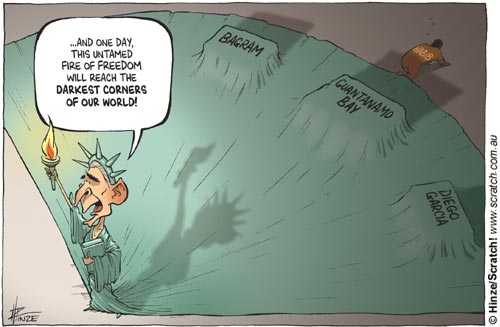
Heinrich Heinz, Outposts of tyranny
This cartoon, which exposes the dark side of America's racial divide, is from Jordan:

The media images of a flooded New Orleans discloses the third world conditions that the poor in New Orleans live in. They were left to fend for themselves as the Republican Bush administration did little to try to save its most vulnerable citizens.
Update:5 September
The commentaries around President Bush's first visit to New Orleans resonant with politics as public performance and theatre. You could that President Bush's performance in New Orleans was pretty poor compared to the heroic one after 9/11. It lacked compassiom and sensitivity to suffering even though the breakdown of society resulted in people driven becoming "barbarians" who had come to live in the "conditions of savages" in the Superdrome and the convention centre.
President Bush's 9/11 perfomance had the mark of greatness. It was fiercely agonal and full of passion. He became the war President protecting the homeland in the war on terror.
September 3, 2005
death of liberalism?
Can we talk about the death of liberalism in Australia?
Some conservatives do when they state that tolerance was brought about liberalism's terminal crisis of confidence. Then they talk about market liberalism in the next breath as they laud the virtues of the free market. So they don't mean liberalism per se; they mean either social and political liberalism.
Other conservatives argue that authentic liberal values have been corupted and all but destroyed by the left. The Left have purported to be liberal themselves, when in fact they have replaced the liberal values by illiberalism--a totalitarian mindset.
We can, however, talk about the rule of law being under seige by the national security state's politics of fear that manifests in a defensive reaction to the threatening terrorist object, person, or movement. Fear tacitly underpins on the "protective-obedience axiom" developed in the mainstream of political theories of Machiavelli, Hobbes and Schmitt.
September 2, 2005
political kitsch?
I'm sick with the flu so this is a post of quotations by necessity.
Remember all the Howard government talk about, if you don't like 'Australian values', then Muslims can 'get out' of Australia? That talk was associated with stripping Australians of their citizenship and rewriting the Citizenship Act.
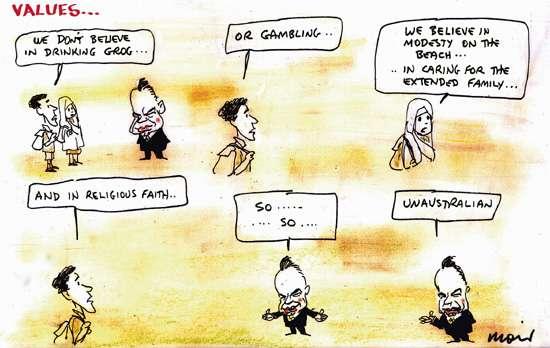
In New Matilda magazine Guy Rundle writes:
It would be futile to point out the manner in which the current shameless spruiking of fear and panic is against the spirit of anything that could remotely be called 'liberalism'. It's probably also of little use to talk about the way in which it plays into a sort of cowardice---a willingness to throw liberal principles overboard at the sound of a bomb 20 000 kilometres away.
Well that throwing away liberal values is what I've pointed out in Multiculturalism under threat post. I thought it a significant point myself. Oh well.
Rundle calls this kind of talk political kitsch, and he does have a point:
Politics is unthinkable without kitsch, and maybe, as Milan Kundera observes, kitsch is the aesthetic ideal of all politicians and all political parties and movements. Kitsch does suggest vulgarity and a desire to please, and the current tabloid "nationalistic" rhetoric and cheap populism is political kitsch. This kind of kitsch is everywhere and it relies on codes and clichés that convert complex and troubled emotions into a pre-digested and trouble-free form—---the form that can be most easily pretended. Political kitsch is pretense.
Rundle then goes onto to ask:
The most important question is, does it mean anything? It would be easy to say, 'no,' and try to ignore the plaster-ducks-flying-up-the-wall talk of Australianness, but it is probably unwise. Political kitsch and opportunism has a way of hardening into something else if it is not contested.
Which is? For Rundle it is racism:
So what is the purpose, or at least the result, of this urging on of a grab-bag of universal social values and particular modern ones as 'Australian'? It is racism pure and simple. It is an attempt to paint the global Islamic community as some sort of de-socialised rabble, who are so barbaric that they have to be told to teach their children the virtues of care and honesty.
I think that kind of response to a conservatism's policy of assimilation that says multiculturalism creates ghettos and allows terrorism to flourish,is too easy as it is too quick and habitual.
It plays off high culture critics to the politicians appeal to the worst instincts in the contemporary public----ie., the economically battered and debilitated mass--- who will gladly hand over the liberal freedoms they have to the strong leader who will ensure law and order. Kitsch is the aesthetics of totalitarianism.
Political kitsch does away with having to think about what is happening to Australian liberalism or Australian conservatism. Could not the constant use of racism by the left as a knock down argument against a totalitarian conservatism be seen as a form of political kitsch?