October 30, 2005
the politics of polarization
I have to catch the red eye special plane from Adelaide to Canberra tomorrow morning , so I can only note this essay entitled The Politics of Polarization by Bill Galston and Elaine Kamarck. I'll return to it tomorrow, as it refers to the situation of the Democrats in the US. How relevant is their account for the social democrats in Australia?
Galston and Elaine Kamarck say that:
Today's crisis of confidence in political leaders and institutions is in large part a crisis of competence, at home and abroad. The American people are learning the hard way that visions are not plans and that hope is not a strategy. Whatever its specific agenda, the leaders of a new majority coalition will have to persuade the people that they can close this gap.
The ALP in Australia is not doing that. It's chance to seize the center and build a stable governing majority is proving hard to achieve. How can it do that?
The ALP is on the defensive on the broad areas of economics, national security and values and it is only travelling well on industrial relations reform. It's scare campaign has made contact with everyday life. However fractures appear because the right fraction which controls the ALP takes a pathway that brings it close to the conservatives.
An example from this report about the state ALP in Victoria:
In a 24-page critique of Mr Bracks' reform blueprint, the Left accuses the Premier of ignoring major problems confronting the Australian economy, failing to consult with his party, lending support to the Howard Government's "attack on public education" and leaving the way open for the Higher Education Contribution Scheme to be extended to TAFE students.The Left's paper, which includes input from members of the state ALP caucus and has been sent to the Premier's office, also labels Mr Bracks' call for a 25 per cent cut in business red tape as "narrow and ideological". It suggests Mr Bracks, who is associated with the dominant Right faction, should be wary of advocating increased policy co-operation with the Coalition "at a time when the Howard Government has launched the biggest attack in more than 100 years on the labour movement and workers' rights".
Brack's has rejected the concerns of the ALP as irrelevant.
So what then distinquishes the right dominated federal ALP from the Coalition when the Coalition has a hold on the centre?
October 29, 2005
The ALP: gone sailing?
This is the ALP, our federal opposition in Australia. Or lack of opposition. At the moment they are judged to have become largely ineffectual as an opposition.

Alan Moir
You can see why people have lots of doubts about them these days as an opposition. On some issues there is more opposition coming from within the Government's own ranks than from federal ALP. The ALP's identity is that it is the party of reform when it gets its hands on the levers of power. Now, however, Labor has no clear reform agenda. It is floundering politicially and the policy reform ideas are not flowing. That is why some are saying that it needs to dev erlop soem policy options on the big issues that will confront all Australian governments over the next 20.
The federal ALP finds itself in a difficult situation. It is squeezed between a vigorous economy and a strong safety net, between individual liberty and national security, between social tolerance and moral tradition, or between military strength and international cooperation. Federal ALP is squeezed by the conservative movement led by that astute politician John Howard who occupies the centre and who has made it is own since 1996.
Update 31 10 05
So what does the ALP leadership do in reponse to the squeeze?
Kim Beazley, the leader, not only supports John Howard's draconian "anti-terror" laws but moves to go even tougher as the ALP becomes ever more divided. Few are impressed, especially the left faction of his party who are deeply concerned about the loss of civil liberties under the proposed anti-terrorism laws. And rightly so.
What is going on? Why did federal Labor let itself be boxed into a corner by the Labor state premiers? Why didn't they form behind Beazely as the leader of their formation which stood together? Why did they shoot one another in the foot? Why did they not work together? Aren't these rightwing premiers guys mean to be astute tactical operators? Why leave their Kim Beazley fighting for his political life?
Gone sailing is one answer.
October 28, 2005
the politics of fear
I'm in a rush today as I am on the road with limited internet access. This image caught my eye. It's a tough one and resonates deep in our psyche.:
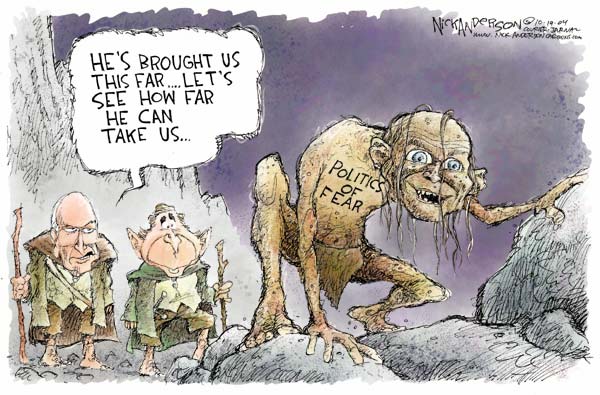
Is that image a reasonable representation of how the conservatives (eg., Bush, Howard and the necons) play the politics of fear?
Update:1 Nov. 2005
In the link above Frank Furedi writes about the politics of fear in a convincing way. He says:
As I argue in my book Culture of Fear: Risk Taking and the Morality of Low Expectation, fear has become a powerful force that dominates the public imagination. This was the case for some time before 9/11, and its ascendancy has not been predicated on the issue of terrorism.
The defining feature is the belief that humanity is confronted by powerful destructive forces that threaten our everyday existence. The line that used to delineate reality from science fiction has become blurred. So government officials have looked into the alleged threat posed by killer asteroids to human survival; some scientists warn that an influenza pandemic is around the corner; others claim that 'time is running out' for the human race unless we do something about global warming. 'The end is nigh' is no longer a warning issued by religious fanatics; rather, scaremongering is represented as the act of a concerned and responsible citizen.
The end is nigh is now prevalent in our culture. We have so many scarry narratives these days and politics has internalised the culture of fear. The conservatives have deployed it--immigration, terrorism, interest rates---to retain their hold on power. The social demmocrats in Australia (the ALP) have been left floundering.
October 27, 2005
Foucault
The following quote is from this paper by Brad Stone about some recently published lectures courses by Foucault.
"Society Must Be Defended" is probably best thought of as a genealogical text dealing with the emergence of modern biopower through the notion of race. In this essay, race is viewed as a discursive concept, and therefore placed within what I believe is the larger archaeological goal of the lectures: the archaeology of historico-political discourse. This discourse is discontinuous with the philosophico-juridical discourse of Machiavelli and Hobbes and the Classical notion of history, whose purpose was to legitimize sovereignty through an "impartial" retelling of past events. Historico-political discourse, however, holds that impartiality is impossible, that truths (especially historical truths) are based on which side of the battle one is on.
Foucault's historico-political discourse is against sovereignity. It is:
"...a discourse that cuts off the king's head, or which at least does without a sovereign and denounces him ..... and serves as a counterhistory of sovereignty. Instead of using history to show the greatness of the sovereign, it would break up the unity of the sovereign law that imposes obligations; it also breaks up the continuity of glory... It will be the discourse of those who have no glory.....who now find themselves, perhaps for a time.....in darkness and silence."
October 26, 2005
enhancing freedoms and building capabilities
The reform agenda of the Cape York Institute for Policy and Leadership (CYI) in the areas
of welfare reform, economic development, governance, health reform, education support and youth development to overcome disadvantage and dysfunction of indigenous people in Cape York is based on the work of Amartya Sen, and seeks to integrate the essential ethical questions of enhancing freedoms and building capabilities of Cape York people. In this paper Noel Pearson says that:
As per expectations, capabilities in the Cape are currentlyin very poor condition. The particular value of using the capabilities framework is that it focuses attention on the fact that the key underlying cause of the poor state of capabilities is a lack of economic and social development, compounded by a system of delivery of services and income support that encourages passivity in its recipients. The Cape York reform agenda therefore needs to focus, at its core, on the issue of developing a real economy in Cape York.
How to do this when most in Cape York are on passive welfare in which the structure of income support payments have set up a poverty trap where perverse incentives encourage people towards welfare and away from real employment?
October 25, 2005
thinking about conservatism
I've always been a bit sceptical of the intellectual grunt of the
The IPA crowd have usually been in a political muddle about this; often failing to connect those moral conservatives against abortion and euthanasia (pro-life social conservatives) with those fighting of global, anti-Western Islamicism in the war on terror ( the foreign-policy neoconservatives); those who uphold the core elements of the Western tradition at home and the isolationist One Nation conservatives. Are these not strands that are part of the conservative movement?
Ken Phillips, the director of the work reform unit at the IPA, has an op. ed. in The Australian, which will soon go behind a paid wall. It is entitled 'Culture of conservatives' fear' and we can use it to gain an insight into how Australians understand conservatism. Phillips says that:
Since the 1950s Australian conservatism has shifted heavily. Now the conservative institutions are largely controlled by the ageing children of the post-war baby boom. What principally defines this conservatism is a longing for the centralised power of the state to protect us from everything and anything. At the core of this conservatism sits the Australian Industrial Relations Commission.
Phillips then says that:
The consequence has been that over generations Australia has institutionalised an industrial, business, political and cultural settlement. The settlement holds that a diverse range of business and community leaders can arrange business affairs and through the AIRC achieve social fairness. The pay-off for some businesses is that the system secures favoured business deals for inside players and protection for those players from potential competitors.The proposed significant downgrading of the AIRC and awards by the Government appears to tear this understanding apart. Most important, it threatens the inside position of the institutions and individuals who have heavy influence over the settlement process. This is radical for Australia and explains why the Government faces well-organised opposition
.
That suggests that conservatism is seen as a resistance to change to the established order of things---' the settlement'--- established by social democracy as a part of a deal between capital and labour in the early 20th century. Fair enough. That is how a market liberal would see the settlement. But conservatism is more than resistance to change through deregulating the market.
Phillips does go further however than the simplistic account of understanding conservatism as resistance to change. He tacitly suggests that conservatism is also a political philosophy as he also characterizes conservatism in terms of power to control change and anti-individualism. On the first he says:
Supporters of the present system want to be the controllers of change through the AIRC and work agreements. They believe emphatically that individuals do not have the capacity, intellect, knowledge and power to control work change. Their message is: Be fearful of individual capacity.
And conservatism stands for a fear of individualism:
In this respect the Howard Government's proposals are truly radical because the stark alternative offered is a belief that individuals do and can have the capacity to control their work futures. This individualism assaults the Australian conservative settlement. We have a cultural battle, between a belief in the self and a cultural fear of the self.
So conservatism is anit-liberalism. Well, we knew that. That suggests Phillips doesn't begin to grapple with the problem.
John Howard, the Australian Prime Minister, also says that he is a conservative as well as being a market liberal. He mixes Adam Smith’ economics and Edmund Burke's ’traditionalism. Conservatism must mean something more than power to control ch'ange and anti-individualism. What about political realism, prudence, community, tradition, localism, etc. associated with Burkean conservatives? For some intellectual grunt on the issue of what conservatism means today, see Russell Arben Fox's post over at In Media Res.
October 23, 2005
beyond left and right
I've just discovered that David MacNight has a weblog entitled Beyond Left and Right that makes the Oz blosphere a more interesting place, as David is concerned with political ideas. The more voices discussing political ideas in Australia the better.
He understands that most sustained political activity is based on political ideas and a deeper philosophical vision. He even argues that sustained political activity can't be carried on successfully without a such a philosophical basis.
Quite right. That knee jerk decayed positivism, which continues to hang on in political life like a bad smell, has found another critic. Consequently, David understands neo-liberalism in terms of a set of philosophical ideas and values, not just as a different policies or a set of slogans.
Though it is important to highlight that neo-liberalism is a set of philosophical ideas and values, it is more than that. Neo-liberalism is also a capitalist governmental rationality. It is also important this political rationality to understand neo-liberalism as a mode or form of governance.
As Ari Rizvi suggests, oppositional struggles can thus be seen as not just struggles against the capitalist state--as understood by Marxists--- but as struggles against the rationality upon which the hegemony of the capitalist state rests.
This emphasis on political rationality reflects a shift in Foucault's understanding of subjectivity from a strictly disciplinary model to a model made up of normalization, governmentality and the care of the self.
October 22, 2005
Thinking about neo-liberalism
In an article referred to in the previous post on the current debate about the renewal of the ALP, David McKnight refers to his book, Beyond Right and Left. He says that this text is:
".. an exploration of what has happened to the Left and how we arrived at the state we are in at the beginning of the 21 st century. The book therefore explores what has happened to the intellectual foundation for the set of ideas which we still broadly conceive as making up what might be called a progressive outlook."
Good. We need such an account. David's account is one that argues against the view that our outdated notion that politics can still be described as a Left-Right conflict. We are in a political space beyond left and right. Though I'm not sure that we can talk about 'the Left' these days.
How does he argue his case? David's argument about neo-liberalism is one that I find to be very plausible. He says that the economic reforms under a neo-liberal mode of governance (my language) during the 1980s were designed:
"...to set the market mechanism in place not just in the economy but in the wider society. When you put the market in charge of an industry, or a university or a community then you begin to transform the values of that industry, university of community, and more importantly you transform the social bonds between people. In the society more generally what you do is to promote the rise of commercial values in place of older social and moral values. The slow but decisive permeation of commercial values into areas far removed from the economy may turn out to be the most insidious and radical consequences of all. Indirectly, and in reaction, this is fuelling a growing desire by many people for a values-based politics, not grounded in commercial values."
Spot on. He is acutely aware that rise of the political ideas associated with economic liberalism are one of the most significant political changes of the last 25 years and these ideas have deep roots because they are deeply appealing notions to many people today -- because are built on a material abundance and consumer choice. The yet to be published but much heralded IR reforms by the Howard Government carry this market process further. I would argue that conservatism is such a value-based politics. Conservatism stands for older social and moral values that are not grounded in market values.
David says that:
".. two very interesting things flow from this radicalization of society through the market mechanism. First, the most effective critique is based not on the growth of economic inequality (in fact the market, by and large, spurs the growth of productivity). The most effective and radial critique is based on the radical and destructive social effects caused by markets. That is, you attack the fundamental logic of the radical Right: the promotion of greater productivity in the economy, based on the destruction of society.Secondly, given that the free market Right is now a radical force, the most effective ground for their opponents is now is as a conservative force -- but conservative in a new and special sense which includes many progressive values."
I concur that a critique based on the destructive social effects caused by markets is an effective one. But how is a progressive critique going to be different from a conservative one? Consider the appeal to the family and family values. David mentions Anglician Archbishop of Sydney Peter Jensen, critical response to the federal government's new IR laws He states that:
Jensen said he was concerned about the 'need for preserving shared time for children, families, relationships for all Australians. That's what life is about, not merely the economy. Without shared time we may as well be robots.' Jensen's way of framing the issue is very instructive. He poses the conflict as one of values -- between the instrumental cold logic of the economy and productivity --and between the human values represented by the personal and social relationships. To put it at its highest, this conflict is between the market and the sacred and between the values inherent in each.
David is aware that most powerful arguments against the neo-liberal, free market ideas represented in the IR. changes are coming from the churches and not from the labour movement and the cultural Left. So where does that leave a lefty critique of the free market? Repeating the conservative arguments?
David does not adress this. Is there not a difference between the conservative and lefty critique of the negative effects of the free market? Is this not an important point to address for those concerned with the renewal of the ALP and the left? Or those who desire to reframe progressive politics as a movement based on values? It is an important point because most of the ALP (ie., the right-wing, union-based bruvvers) are no different from the social conservatives around values.
October 20, 2005
ALP --time for renewal
I cannot find the Barry Jones speech in the Australian Fabian News. You know the one about the need for the ALP to undergo a big culture change. Maybe it is an inhouse document? It is not oneline. Pity. It sure sounded interesting. Poor ole Barry has to continue to carry the intellectual burden for the ALP and,once again, will have to take the flak for talking truth in politics.
In the meantime I have to make do with this summary by Michelle Grattan in The Age. She says that Jones' argument is that the current ALP lacks the common elements when Labor won nationally in 1972 and 1983 ---"charismatic leadership, major party debates on policy, and a serious attempt to engage the community".
Grattan comments that the current situation is one where there is a:
"... comfortable rather than charismatic leader, lacking a compelling cut-through message, facing a formidable Government and operating in an environment where incumbency is a big advantage and national insecurity the backdrop, collectively add up to enormous difficulties for Labor.
Grattan states that Jones is right when he argues that Labor has been too preoccupied with tactics at the expense of strategy. I concur with that. Maybe that short term thinking will change with the resolute opposition to the IR legislation?
Grattan adds that one reason for the ALP's preoccupation with tactics at the expense of strategy may be that 'it's hard to fathom what the effective longer-term strategy should be'.She turns to Jones to say that:
"Labor must tell a story, a grand narrative of where we want Australia to go," he says. Trouble is, Labor doesn't have in its collective head that "grand narrative". It just has some (worthy enough) modest stories, such as about going down the skills road, which it finds near impossible to turn into a political romance.
Do we lefty citizens need a grand narrative as a political romance? Is that Jones? Do we need a grand narrative in postmodernity? Or do we need some good innovative policy on health, education and the environment beyond the worn out cliches of the spin of the media release and the sound bites.
David McKnight suggests one way to adddress this when he asks:'how the values of progressive politics can be reconfigured to provide a more inspiring and modern political vision? '
McKnight says that:
I'd argue that the problems the Labor Party in Australia today is facing –its deep crisis of vision and meaning --- arise from the inability of its ideas and vision to explain a raft of changes in society and to promote an appropriate and inspiring set of values. The idea and vision on which Labor was founded arise from a political tradition which went under various names such as socialism, social democracy etc. What we are witnessing is a historical shift in which the 150 year old tradition of socialism and its offshoots has collapsed. And this the collapse of socialism is not confined to the Labor Party -- it extends to the Left outside the ALP.
I concur with that. It applies to social democracy as well as socialism. The idea that you can say you stand for Left wing ideas and expect people to know what you mean has passed.
As McNight says 'it is no longer clear what the term 'Left' actually means.' Hence all the talk about renewal. McNight argues that the ALP needs a new synthesis, a new set of progressive ideas.
Does the ALP need a new vision? Or is that part of a political romance that Michelle Grattan refers to? It strikes me that the ALP Right has little connection to progressive ideas, other than hostility and antagonism.
October 19, 2005
interpreting Agamben
I've just stumbled across signandsight. I know nothing about the magazine Does anybody?
Feuilletonists sounds much nicer than commentators doen't it? Is there any substance with the feuilletonists? Or do we have the well-written, glib piece akin to that of the Australian media? One difference is that the op. ed. writers in the Australian media have yet to hear about Agamben, let alone read his texts.
An op ed on Giorgio Agamben by Daniel Binswanger is a good test to evaluate the magazine. This is slick writing----'the perfume of the radical' -- and is spends a lot of time describing how fashionable Agamben has become. Okay, but what about his ideas? Eventually we get to them:
The Agambenian critique of democracy could not be more trenchant: today's constitutional states are in essence nothing more than huge concentration camps. This is what he attempts to demonstrate in "Homo Sacer", originally published in 1995, with an eclectic overview of the legal history of the West. The modern state is nothing other than a totalitarian organisation for the efficient administration of bare biological life.Sovereignty today is biopolitics --- the control of bare life. "We live in a concentration camp" is the upshot of Agamben's diagnostic of contemporary life. For him, absolute authority over the inmates' bodies and souls lies in the secret matrix of modern administrative states. Agamben electrifies his audiences with this apocalyptic prophesy
Do we live in a concentration? Is that what Agamben is saying? Or is he saying that the camp has come into the centre of political life in liberal democracies? As Matt over at Pas au-dela observes, this is a
"... popular take-down of Agamben, albeit at some length. Daniel Binswanger has clearly bothered to bone-up enough to produce what is known as journalistic pap, interspersed with the odd correct sentence, if only to lend him what is known as the aura of authority."
What Agamben is saying is that the camp is constitutive of contemporary life in the west. It is not an historical fact, or an anomaly belonging to the past ... 'but in some way [is] the hidden matrix and nomos of the political space in which we are still living.'
October 18, 2005
happiness as a bad idea
A quote from Richard Layard
But when all is said, a happy life is about a lot more than money can buy and, besides adequate income, happiness research points to six main factors affecting happiness: mental health, satisfying and secure work, a secure and loving private life, a secure community, freedom, and moral values.
A happier society is not just about economic growth. We citizens know that. And yet economic growth is the goal of policy makers not the well being of the population.
Don't you find it strange that economic or market liberals find it necessary to defend capitaliism from this line of reasoning, which has its roots in our every day lives? How is such a view constructed as an enemy that needs to be beaten into the ground?
The happiness position is bundled into a mentality called a pessimistic world view that says humanity and the environment are going to hell in a handbasket. So we then have the defence of global capitaliism by market liberals in the enlightenment tradition that says, despite reports to the contrary, we are wealthier and healthier than ever before.
Well we are. Who wants to go back to feudalism? But that is only the first step in the defence.
The argument then goes like this. The pessimistic mind-set--- of marxists, socialists, environmentalists and happiness advocates--- are bad ideas. These bad ideas will disappear as the proof of the benefits of good ideas --market liberalism---become evident. However, because human history suggests we don't learn so easily from our mistakes; so these bad ideas will hang around, change their skin and linger on despite overwhelming rational evidence against them.
Miranda Devine then spells the rationality bit out:
....people who have spent a lifetime defending bad ideas lose the capacity for logical thought and become irrational. When the weight of evidence against their bad idea reaches critical mass, rather than say, "We were wrong", their tactic is to say, "Oh, that debate is over", and to adapt their language so as to appear to have rejected the bad idea, while clinging to it secretly.
Hence we have the duality of reason versus unreason. Neat huh?
What then is being defended by market liberals such as Johan Norberg? The equation of wealth creation and econoimic growth with increasing happiness. Pretty crude huh? It flies in the face of the daily experience of Australian citizens about the lived contradictions between of the demands of work, family life and happiness. Saying that such daily lived experiences are irrational according to economic rationality leads to economic rationality being placed under question. What sort of rationality is this we ask? What sort of rationality would trash our lived experiences because they do not accord with the way it categorizes the social world.
October 15, 2005
Norberg on prosperity and happiness
My judgement was that Johan Norberg did not deal with the environmental objection to capitalism very well in his John Bonython Lecture. I referred to his response to the environmental objection here.
However, Andrew Norton over at Catallaxy is impressed. He sees substance as well as style. Of course, no effort is made to probe for substance, other than to say that Norberg is 'using the subjective well-being and cognitive psychology literature to defend liberal societies in ways that I had not seen before.' The Murdoch Press love Norberg.
Let us continue to probe Norberg's substance in relation to the way that he deals with another objection to capitalism in his defence of liberalism and capitalism lecture at the Centre for Independent Studies. This is the happiness objection. It acknowledges that capitalism has proven its value when it comes to wealth creation and prosperity, but it is then argued that prosperity does not necessarily make us happy nor increase the quality of life.
This objection makes sense to us in our everyday lives----is intuitively plausible. We can and do increase our wealth by working longer and harder and so can spent the money we earn fr our efforts to buy ipods, digital cameras, clothes and holidays. But we do so by working longer hours and under conditions of greater amounts of stress. Consequently we spend less time with family and friends. Our bodies can suffer because we become run down and so we are more likely to become sick. Ill health means unhappiness. So increased wealth does not mean greater happiness. This is an argument that has legs, just like the environmental one.
Norberg says that the happiness argument has been popularised by the British economist Richard Layard. He highlights the paradox here:
There is a paradox at the heart of our civilisation. Individuals want more income. Yet, as society has got richer, people have not become happier. Over the last 50 years we have got better homes, more clothes, longer holidays, and above all better health. Yet surveys show clearly that happiness has not increased in either the US, Japan, continental Europe or Britain.
Layard is advocating a happiness-based approach to public policy, and should form an important part of a social democratic agenda that is based on the new social science.
Norberg says that the happiness argument goes something like this:
Economic growth will not contribute to more happiness, because we are most interested in our relative position. The fact that someone else earns a higher income ---which makes them happy---makes others less happy, which forces them to work harder to retain their relative position. In the end we are all richer, but we are no more happy than before, since we cannot all be richer than other people. In other words, a better future will not result in a better future.
Norberg should say a wealthier future need not result in a happier future or a better quality of life, rather than 'a better future will not result in a better future.' The latter statement is a distortion of the happiness argument. However, he does interpret Layard's point about the rrole of norms in assessing happiness well. Layard says:
Two things are driving up the norm with which people compare their incomes. One is the income which they themselves have experienced ---which habituates them to the higher standard of living. And the other is the income which others get, and which they try to rival or outdo.
We do make these kind of judgements in our everyday lives.
How does Norberg respond to this argument?
He says:
You wouldn't have that sense of joy and happiness in the first place if you didn't have nice things to look forward to, interesting dinners and nice parties, for example. Is't it possible that the same goes for wealth? The fact that growth does not increase happiness much does not mean that it is useless---- it might be the fact that growth continues that makes it possible for us to continue to believe in a better future, and to continue experiencing such high levels of happiness.
It is true that we do need a certain amount of money or income to be able to lead a joyous and happy life. Note how Norberg concedes the main point: that 'that growth does not increase happiness much does not mean...' then pulls the switch by saying that does not mean that growth is useless. But who says that growth is useless? That is a distortion of the happiness argument, is it not? Happiness is not being equated with poverty at all. The key point is that income is earned by the sacrifice of time with your family and friends.
Norberg sidesteps this family work contradiction through turning to hope in progress. The problem with the happiness argument he say is that it undermines hope in progress :
From surveys we know that hope correlates strongly with happiness. If you want to meet a happy European, try someone who thinks that his personal situation will be better in five years from now. And we see the same when we compare Americans to Europeans.... In poor and badly governed countries entire societies suffer from hopelessness. You have few opportunities, no hope that tomorrow will be a better day. Belief in the future grows when poor countries begin to experience growth, when markets open up and incomes increase. That could help explain why happiness reached high levels in the West after the Second World War . With economies growing rapidly, people began to think that their children would enjoy a better life than they had.Raising taxes to discourage work, and reduce economic growth would be a way of cutting off that progress.
Does the happiness argument destroy hope for a better life? A better life today in Australia is generally judged in terms of quality of life--downsizing work to allow more time for family and friends. Norberg reduces better to incomes increasing and economic growqth and so evades the point about quality of life.
Norberg evades as he does not substantively engage with the main point of the happiness argument. He is doing the same as he did with the environmental argument.
October 12, 2005
Johan Norberg on environmentalism
Johan Norberg is making a bit of a splash in Australia at the moment. He was here to give the John Bonython Lecture hosted by the Centre of Independent Studies. Norberg is the author of In Defence of Global Capitalism, which I haven't read.
So what is he arguing in Australia? How does he defend global capitalism and who does he defend it from? The lecture seems to be a defence of economic liberalism as Norberg begins the lecture by locating economic liberalism within the enlightenment tradition:
Enlightenment philosophers created the belief in the future in the 17th and 18th centuries, by letting us know that our rational faculties can understand the world, and that with freedom we can improve it. And economic liberalism proved them right. When Adam Smith explained that it's not from the benevolence of the butcher that we expect our meat, but from his self-interest, it was much more than an economic statement, it was a world view. It was a way of saying that the butcher is not my enemy. By cooperating and exchanging voluntarily, we both gain, and make the world a better place, step by step.Since those days, mankind has made unprecedented progress, but astonishingly most of us don't see that, because of ancient mental mechanisms that were developed in much more dangerous days, when one man's gain was often another man's loss. Tonight I will discuss what they are and how to deal with them, and I think that a good place to start is with an ideology that has made the most of those mental mechanisms: Socialism.
Fair enough. Economic liberalism is a part of the enlightenment tradition. But I see that the objections to the Enlightenment are not dealt with, nor is rationality identified as an instrumental reason. The enlightenment tradition is taken as a given and as a good. Do we gave dogmatism here?
It is true that socialists argued that capitalism would create waste, inefficiency and poverty. Well, by the end of the 20th century socialism lost and capitalism won. Norberg is right there. So where does that leave social democracy? That political tradition does not exactly celebrate free markets and it is not the same as socialism. Norberg does not mention social democracy or the way that it constrained economic liberalismi.
Norberg says that ex-socialists can still oppose capitalism because its efficiency and wealth creation would destroy nature. This objection ought to be taken seriously given its impact in Australia re farming, water shortages in our cities and the destruction of our rivers. How does Norberg deal with this?
He says that:
This argument is as popular as it is false. First of all, the worst environmental problems in the world are not smokestacks. Much worse is that so many people burn wood, coal, crop waste and dung indoors for heating and cooking. Respiratory diseases kill about 1.6 million people every year. Sure, the modern production of energy creates environmental problems, but it doesn't kill someone every 20 th second, as this killer in the kitchen does. And diseases transmitted by water kill another 5 million people every year. Just the number of people who die from these two traditional environmental problems is 300 times the number of dead in war every year. These diseases also happen to be eliminated in every industrialised nation on earth.But furthermore, when we get richer we can also deal with the new environmental problems that new industries create. When we have the resources to both save our children and our forests we begin to care about saving nature, and economic and technological progress gives us the means to do that. The environmental movement is a result of this shift in preferences .... Sure, we have big environmental problems ahead of us. But we have even bigger problems behind us, and we managed to deal with them thanks to more wealth, knowledge and technology, and I see no reason why we wouldn’'t be able to continue doing that.
No worries is the argument. Who says that the environmental objection is based on smokestacks in Australia? It is that in relation to global warming
Norberg strikes me as a bit too swift. Disease and the environment are separeate issues even though they can be intertwined, as in ecological disease. He does not giove any consideration to the argument that the economy depends on ecology--not water in the Murray-Darling Basin means no agricultural production. The economy of the region depends upon our rivers flowing.
Secondly, we may have the resources and technogical means, but we still don't do it. Saving the Murray-Darling Basin is not happening. Nor are we saving the Great Barrier Reef from downstream pollution from coastal sugar farms or global warming.
What about the economic power that prevents environmental reform in the Murray Darlign Basin and in our cities? It's ignored!
Norbery, it seems to me, is talking to the converted --to free market liberals. He is not really engaging with environmentalists or with environemtnal issues that we are forced to confront.
Update: 18th October
A key environmental issue in Australia is water shortage for our cities. A recent example in Victoria. Nowhere does Norberg deal with issues such as this.
October 10, 2005
explorations
Generation online is okay, but we can leave the article Political life in Girogio Agamben to one side as not relevant to our concerns about he way that anxiety over 'national security' has justified, ands legitimated, the cam. On the former site we find "What is a camp' by Suvendrini Pererain in Borderlands. Pererain, paraphrasing Agemben, says that in:
Agamben's thinking the concentration camp is constitutive of contemporary life in the west. Examining the juridical and political structure of the camp 'will lead us to regard the camp, not as an historical fact and an anomaly belonging to the past ... but in some way as the hidden matrix and nomos of the political space in which we are still living'.
Agamben's 'The Camp as Nomos of the Modern' is then quoted:
'The camp is the space which is opened when the state of exception becomes the rule. In the camp, the state of exception ... is now given a permanent spatial arrangement, which as such nevertheless remains outside the normal order' .
Then we have this parphrase:
"...the camp as exceptional space is both inside and outside the nation: it is excluded from and at the same time included in the space of the national by its inscription within the very juridical and political structures that decree its exclusion....The camp's inhabitants are those deemed to have no claim on the nation but, paradoxically, are brought even more firmly under its control by virtue of their exclusion from its laws."
It is a space where the category of 'citizen' is no longer operative. It is also is the space where the claims and limits of the 'human', are disclosed in the figure of the refugee or 'stateless' individual. What is disclosed is 'the human' divested of the rights of a citizen; the human as the bare life.
We can talk about the Australian camp.
October 9, 2005
security
I used to think that economics (prosperity through economic growth) was the basic principle of state politics. Not any more. It is security.
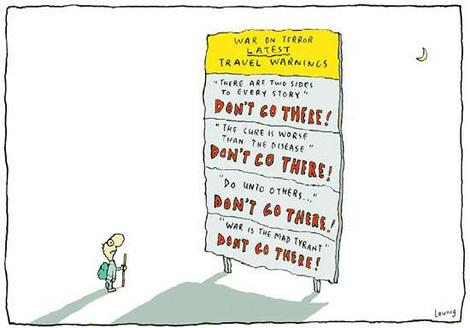
At the dawn of modernity Hobbes mentions security as the opposite of the fear which compels human beings to unite and form a society together. We form a nation state for reasons of security. During modernity, with the rise of the market security was displaced by economic growth and the free market. Today, as Giorgio Agamben observes, security comes to the fore:
In the course of a gradual neutralisation of politics and the progressive surrender of traditional tasks of the state, security imposes itself as the basic principle of state activity. What used to be one among several decisive measures of public administration until the first half of the twentieth century, now becomes the sole criterion of political legitimation.
Maybe not the sole critieria. Certainly a central one though. Agamben adds:
Today, there are plans for all kinds of emergencies (ecological, medical, military), but there is no politics to prevent them. On the contrary, we can say that politics secretly works towards the production of emergencies. It is the task of democratic politics to prevent the development of conditions which lead to hatred, terror, and destruction -- and not to reduce itself to attempts to control them once they occur.
This kind of thinking is not noticeable amongst social democrats considering new agendas. They accept the state of emergency as a given and try to outdo the conservatives in the politics of control.
October 6, 2005
The trials of social democracy
I was attracted to this Alan Moir image because it does capture the dilemma of the federal ALP during a period when the conservative Howard Government skillfully manages the overwhelming forces of economic security and national security.
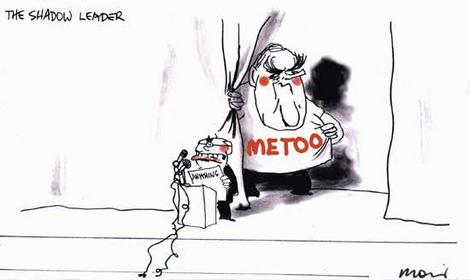
Whenever the ALP tries to angle for support from a progressive liberal left in the inner city then it alienates the blue-collar base in suburban electorates ever more. And visa versa. The ALP needs both sections of the electorate to win elections. At the moment this looks like squaring the circle, despite the little traction that is being gained from the proposed industrial relations reforms.
Labor's crisis is deep and it is real crisis. Are people bothering to listen to what Labout is saying? Are we citizens tuned in?
What seems to be happening is that in this crisis situation the leader's performance becomes a kind of shorthand for the problems of a fractured and splintered party. Beazley's performance---his ability to cut through the media noise---is under scrutiny. The tensions are being played in terms of the jostling for the leadership, and in speeches made about what the ALP needs to do to gain electoral support.
Julia Gillard has given such a speech. How does she address the crisis faced by the ALP? In the speech she acknowledges that:
Labor has lost significant support from the beneficiaries of economic change, the former employees who are now the contractors and small business people of outer suburbs and regional centres. But the hard question for Labor is whether they have deserted Labor or Labor has deserted them.
Probably a bit of both.
Then she adds that:
It is right for Labor to be concerned about poverty, about the plight of those on welfare, about the hardships faced by the sick, the marginalised and the victims of economic change. Labor is the party of compassion but it is not or should not be the party of welfarism.
We are then offered an interpretation of what this means:
The economic agenda needed today differs from the one that was needed in the 1980s and 1990s. In the 1980s and 1990s, the economic challenge was to open our economy and extend the reach of competition. Labor proved we were up to that challenge. We did what needed to be done, at times at our own political expense.However, in the decade ahead, the economic agenda is about participation and productivity. The abilities of our people -- our 'human capital' -- is what the OECD now describes as 'the fundamental building block' of economic policy. This new economic agenda is about opportunity, and opportunity for all.
What does that mean? Is it the 'me tooism' of the cartoon? Do not the conservatives talk this way? What about the concern for the negative social and environmental effects of the deregulated market? Shouldn't that also be the ALP's concern?
Gillard says that the ALP can "...increase participation and productivity by investing in the health and skills of our people, and rewarding their hard work. Health, education and work – these are Labor issues and they should be at the core of our economic policies for the next decade." Maybe they are. But how does the ALP differ from the conservatives on these issues? Gillard says:
Whereas the economic reforms of the 1980s and 1990s -- by their nature--were at times painful, the new agenda presents an opportunity for Labor. But we need to have the courage to claim it as our own. Improving health, education and work outcomes for people---this is one way we make the case to the Australian people for Labor and for change.
What is the case? How is health to be improved?
Gillard says nothing about democracy in terms of helping Australians to imagine a better future. Shared values and bonds are mentioned. Democracy is missing from the ALP's new, and very thin agenda. Lots more strategic thinking is required.
October 4, 2005
the figure of the refugee
From this review by a Dr. Tony Simoes da Silva in the International Journal of Baudrillard Studies.
To this extent Agamben's State of Exception actually builds on the earlier texts, and reveals Agamben's formidable powers in an analysis of politico-juridical frameworks that have allowed successive state governments to create and apply the necessary conditions for the existence of the phenomenon that is Guantanamo in the present moment.States of exception are in this sense hardly anything new. What has changed, as Agamben proposes via Walter Benjamin, is that it is precisely through their ability to persuade their citizens that these conditions are indispensable to the recovery of a golden age when the state of exception truly was the exception that governments such as those of the USA and the UK are able to perpetuate a growing erosion of public liberties.
We in Australia have been so persuaded. The figure of the refugee is now central to a range of concerns with the nation, nationalism and the right of asylum as well as governance. The political right has made some ground towards controlling the inward flow of peoples and expelling those it deems undesirable.
Tony Simoes da Silva says that in his essay "What's a Camp?" in 'Means Without End: Notes on Politics' (1994) Agamben :
'...again epitomises this prophetic quality with disturbing insight; in the context of Guantanamo and Abu Ghraib, Bellmarsh and Woomera, "the camp intended as a dislocating localization is the hidden matrix of the politics in which we still live, and we must learn to recognise it in all its metamorphoses".... Tracing its history to the Spanish-dominated Cuba of 1896 and the Anglo-Boer War, Agamben shows why the camp has become such a crucial political category, and insists that we understand its function as the pre-eminent political categories in the exercise of power today. Once upon a time a place of exclusion only minimally adopted, "The camp, which is now fairly settled inside [the modern city], is the new biopolitical nomos of the planet"... Here as in all of his other essays, Agamben shows how a careful understanding of past political structures neatly proves the point that those who do not understand history are bound to repeat its mistakes.
What is needed is a critical rethinking of the categories of politics within this new sociopolitical and historical context.
October 3, 2005
Robert Fisk: a public lecture
A public lecture It is inaugural lecture, honouring Edward Said. It was given by Robert Fisk, on Saturday 1 October 2005. Fisk's talk is entitled 'Terrorism, Occupation and Human Rights.' Alas the lecture is not online. I will try and look for it.
I understand that Fisk will also give a talk at Sydney University. The media are not that interested in Fisk's Australian tour to launch his book,'The Great War for Civilization: The Conquest of the Middle East'.
I'll keeping looking for stuff online.
October 2, 2005
the information economy
A common thesis about the informatiion economy holds that the process of globalisation is pervasive, impacting on all aspects of social life. It is associated with the decline of the nation state. The overall impact of globalisation has been to de-link financial capital from actual production, and to increase the dependency of national economies across the globe to the dictates of fluctuations in financial markets.
Consequently, the power of nation states to stabilise domestic economic conditions through fiscal and monetary policy has been severely undermined. Financial capitalists can act with speed to shift investments from one ailing industry (or risky country) to another anywhere in the global economy.
That is a good account of the economic shifts taking place arround us. What is debatable is the implication that is often made. Thsi implication is that globalisation has precipitated, and caused, the decline of the nation state.---the nation state is loosing power, is in decline; and is adrift. This happened mainly because globalisation has made all national economies depend upon the performance of their financial markets. And these financial markets are globally integrated. The state has therefore lost control over monetary policies and interest rates - key levers of national economic policy.
Has it?
It is true that big shifts are taking place in the new economy. For instance, we have the undermining of the social safety net including unemployment, health and other social benefits for the poor and sick. We also have changes to protected labour markets, minimum wage legislation, and the national system of industrial relations built around negotiation and consensus with a strongly organised union movement. The changes in the labour market are centred mainly on the rise of 'flexible labour' and the growth of part-time, self-employed, non-formal and other forms of temporary and outsourced employment. We also have changes in class consciousness away from the old collective one assocated with the Fordist economy based on large factories making the same product moving along the same conveyor belt, towards a more individualised one.
But this does not necessarily mean the nation state is adrift in the sense of decline. It can still shape development and it still can choose from a range of strategic objectives.