November 29, 2005
Anti-terrorism legislation: goodbye liberalism?
The House of Representatives is currently debating the anti-terrorism legislation----the Anti-terrorism Bill (no 2) 2005. I heard a duty Minister say that the House of Representatives will vote on the anti-terror bill tonight at about 8pm.That took me back. Another example of the guillotine.
Why? Because the joint partyroom has yet to meet to discuss the terror laws. Yet even the Government senators on the Senate Legal and Constitutional Committee yesterday urged that the sedition provisions in the bill be dumped until a thorough review is completed; and it made 52 amendments in an attempt to temper the almost universal opposition within a legal profession that is deeply concerned the new laws will undermine the fundamental human rights Australians take for granted. The joint partyroom will meet later this week after they have passed the legislation . The talk is about revising the legislation after it has been passed.
So much for the democratic process in the House.
Attorney-General Philip Ruddock said he would not agree to the Senate committee's recommendation to remove sedition offences from the bill. What then will the liberal Members (Petro Georgiou given this speech), and Senators Marise Payne, Brett Mason and Nigel Scullion do? And George Brandis? They will not cross the floor.
The Government members so far are not even bothering to address the Senate's concerns about sedition reflected in Schedule 7 in their speeches, nor those raised by others about preventative detention or control orders. The speeches I've head this afternoon (MP for Patterson and Ryan are all about the evils of Islam, protecting the people from murderous terrorists being quite comfortable with the sedition provisions, and making snide remarks about civil libertarians. They show no concern about civil rights, do not address that Australia faces an increased terrorists threat because of the invasion of Iraq, nor the argument that the invasion of Iraq was meant to reduce the terrorist attack on Australia. There is a great silence about Iraq and their responsibility for the greater terrorist threat to the Australia's caused by Australia becomes a greater terrorist target because of Australia going to war with Iraq.
Silence. Just silence about the rights and freedoms being undermined and wound back. Yet aren't these liberties what distinquish Australia from totalitarian states? Exceptional times justify exception measures says the Attorney General.We have a state of exception as the norm.
These Government members are national security state apologists who use their defence of Australia's democratic values and principles as a fig leaf. They are not liberals. The state is to be all powerful in the face of violient and brutal destruction of global terror of evil men and women. The absolute rejection of terrorism in its totality is all that matters --it reminds me of this.
November 28, 2005
a neo-liberal mode of governance
I've been listening to the Senate debates on the industrial relations legislation during this afternoon and the evening on Sky News television.
If you dig beneath the standard rhetoric Liberal and Labour Party polemics and partionship to what lies underneath then what is disclosed is significant and rarely addressed in the speeches. The legislation, and the accompanying welfare-to-work legislation that will be debated next week, signify a radical break with welfare/social state of the 20th century, a big shift in governance and a new way of thinking about the targets, mechanism and limits of government. It is a shift market by neo-liberalism.
'Neo-liberalism' is used purposefully. This legislation not a return to the liberalism of the nineteenth century as some have claimed: ie a 'freeing' an existing set of market relations from the social shackles and allowing the market as a quasi-natural reality to operate competitvely. It is more an organizing everyday life to enable a market to exist and to provide what the market needs to function efficiently. There is a rethinking of the social and economic where all aspects of social conduct are being reconceptualized along economic lines--as calculative actions undertaken by enterprising agents exercising their choice.
"Choice' is dismissed by many in the ALP as propaganda but they are missing the significance of the shift in governance. The neo-liberal mode of governance reworks our condict as free subjects: we are being shaped as rational and enterprising who are active (not relying on trade unions) in making choices to further our own interests.
November 26, 2005
The Moral Consequences of Economic Growth
A review of Benjamin Friedman's The Moral Consequences of Economic Growth by Joseph Stiglitz.
The general position of Australian economists is one of a strong aversion to advocating government intervention because the basic presumption is often that markets generally work by themselves and that there are just a few limited instances in which government action is needed to correct market failure. Government economic policy, the thinking goes, should include only minimal intervention to ensure economic efficiency through competition. As Friedman observes:
"When we talk about microeconomic issues in economics, the conversation boils down to efficiency: How can we best organize economic activity---production, buying, selling, consuming---in order to keep the economy as close as possible to the frontier that represents the maximum possible production and satisfaction of the desires of all. Maximizing the use of our productive capacity dominates the microeconomic side of what economists do. Then, when we switch to macroeconomics, we are dealing with the use of government policies, in the first instance, to minimize the effect of recessions, in which business falls below the productive capacity of the economy, and then, even more important, to achieve economic growth, expanding that frontier of production over time."
It is true that there is acknowledgement of market failures that go well beyond externalities and some Understanding of the limitations of the market that leads to an understanding of the necessary role of government in promoting growth and making sure that it is the right kind.
However, in this economic discourse one rarely hears a discussion about ethics and economic growth as the political debate is pretty much about polarized around being for growth versus being against growth. What is usually missing is a moral perspective to the ongoing debate on the effects of economic growth and economic globalization and about whether economic growth actually benefits or harms society. As Joseph Stilglitz says:
In short, the debate should not be centered on whether one is in favor of growth or against it. The question should be, are there policies that can promote what might be called moral growth -- growth that is sustainable, that increases living standards not just today but for future generations as well, and that leads to a more tolerant, open society? Also, what can be done to ensure that the benefits of growth are shared equitably, creating a society with more social justice and solidarity rather than one with deep rifts and cleavages of the kind that became so apparent in New Orleans in the aftermath of Hurricane Katrina?
The debate should be about the right kind of economic growth.
November 24, 2005
neo-liberal governance
Neo-liberalism, championed in one or another version by both the Liberal and Labor parties, is now the radical ideology in Australian public life. Howard's Liberals and their Labor rivals tacitly agree about the broad direction of economic strategy. That leaves social issues as the only arena for partisan difference. And it played a big role in terms of the social cosequences of economic globalization in the 1980s and 1990s. Since 2001 Howard's wedge tactics has fractured Labor's core constituency, and it is the Liberals who have celebrated the capacity of ordinary people to conserve their traditional values in the face of the rapid economic and cultural change.
Will the tacit bipartisanship on the economy continue? There is a fracturing of this consensus with the IR laws. Here is Kim Beazley, the leader of the federal opposition ALP, on the IR bill that is before Parliament:
The Labor Party will be clear-cut on this. "Whatever amendments are passed at the end of the day, we're going to vote against this bill. We're going to vote against it at every stage. We will have not a bar of this bill -- no truck with it at all. When we come into office we'll rip it up.
How far will this fracturing of consensus go? It is difficult to say as we have neo-liberal radical change that undercuts the Burkean conception of making moderate reforms that are in line with existing values and institutions.
November 23, 2005
blogging and media events
Glen Fuller has responded to this post on a paper he delivered on weblogging and media events at the Blogtalk Downunder Conference. He says that I misunderstood one of the key points in his argument. I may well have as this weblog roots are in the political world, not the philosophico-cultural studies world within a postmodern academia in Sydney.
So let us have another look and try to sort out the issues.
In the original paper, entitled, 'The Evental Potential of Blogs ', delivered at the conference Glen says:
It is possible to witness that blogs, and other forms of New Media in general, have demonstrated they can play a specific role in the modulation of Old Media's production of a 'media-event'. This paper has two goals. The first argument shall attempt to locate the role of blogs in relation to the emergence of the media-event of the recent 2004 US Presidential Election. It shall be argued that blogging practice interrupts the temporal series of news-media production by Old Media and that it also creates a short-circuit in the feed-back loop between the producers and consumers of the media-event. The second argument is more speculative and stems from the first but places the role of blogging in a much larger and banal context.
The key here is 'media event' which I understand as singular multiplicities that are singular irruptions into the regular flow of media. 9/11 would be an example. Language was very important here, eg., the 'war on terrorism.' Blogging can exist in the intersection of this ‘media event ’ and, presumably, blogging enables a particular mode of communication or discussion.
Glen says that:
Gary's reading of my paper suffers from not fully appreciating what I meant by 'potential'. I certainly did not say that all political events are determined by the media and that bloggers had a hand in such events. This is what Gary assumes I am arguing from selectively quoting my paper. Such an argument would be nonsense. I deliberately selected an event (US presidential election) that could be considered a media event or a composition or manifold of discrete media events (as many scholars have argued), where blogging clearly played a role in the media event. I went to extreme pains to argue that blogging may not have actually affected the outcome of the election (the historical event) and only affected the media reportage (media event). The purpose of my paper was to think of a way whereby blogs could be discussed alongside the mass-media without reducing it to a direct comparison or in terms of 'media effects'. I wanted to understand the relation between the mass media and blogging, the concept of the 'media event' is a very good tool to enable this discussion.
Well no. I addressed the claim that 'what is produced by bloggers is discussion that enables and frames the event.' I questioned this in relation to Australia and argued that bloggers do not frame the media event. I argued that it is the corporate media that do this, or the parliamentary institutions. Mine was a hermeneutical point about the meaning of events not historical events, though I granted that interpretation and event are deeply intertwined.
I wish it were otherwise. It has not happened over the war on terrorism. What is the issue here?
It is probably to do with our understanding of media-event. Glen now turns to McKenzie Wark---his Virtual Geography: Living With Global Media Events--- to explicate his understanding of this category:
Wark's book... takes a properly poststructuralist angle on 'history' and 'media events'. HIs is a second generation mass media studies and properly postmodern work on media events. Instead of 'history' being determined by sedimented symbolic structures of power and having 'media events' simply produce a double of this 'history' in the media, Wark's conception of media events is principally concerned with the newsworthy efficacy of the event. The complicating factor in this is that the newsworthiness can be self-perpetuating and self-emergent (there is an 'internal' feedback loop). There is no 'history' beating down upon a media milieu and forcing the media to pay attention. Attention itself is freed from the symbolic and historical links that once anchored it.
Okay, I accept that. An example is the recent 'media frenzy' about the anti-terrorism raids in Sydney and Melbourne. The media did not report x happening, nor did they represent the state of affairs of 'the enemy within'; they intervened in it and helped to actualize it.
November 22, 2005
Judith Brett on liberalism & conservatism
Judith Brett's paper on the limits of Liberalism is quite interesting on the cross over between liberalism and conservatism in Australia. Some quotes:
"...liberalism is basically the political common sense within which all Australian political thinking takes place, but it is a much richer tradition than that which is carried forward by the Liberal Party. A lot of liberal thinking is actually in the Labor Party."
That is true. And, I would add, a lot of conservatism. There is a very strong current of social conservatism and political authoritarianism running through the ALP Right that detests--has a big hatred for---social liberals of the inner city professional class.
And:
Although Howard now says they are also conservatives, I don't know that they have been such strong conservatives, in an articulated way that would be recognisable as conservative political thinking. They do not back authority for its own sake; they will back it in terms of the rule of law and constitutionalism. They see themselves as the party of the Constitution and of parliament and of the government's rights to do certain things as an elected government. But they do not put forward arguments about other sorts of traditional institutions.
But they--Howard's mob-- do link culture, history and tradition. There is almost has a Burkean feel here, which becomes especially noticeable in the turn against the use of human rights deployed around refugees and aslyum seekers. They--Howard's mob--- have turned against the rule of law with the national security state. The authoirty of the state stands supreme, does it not?
And:
Somehow, in the process of migration all we got was liberalism. I don't think we got any conservatism at all. When people talk about Australian conservatism, it makes sense in the Australian context but it does not bear any relationship to what conservatism means in any other societies. Maybe it is starting to now, with Howard. Maybe now there is something that he can be trying to preserve in terms of the memory of World War I, but I think this is fairly new.
Brett is inching towards see conservatism developing out the traditions of the Liberal Party. Yet the language of Australia's Liberal traditions - and the moral values in which it is imbedded - in her Australian Liberals and the Moral Middle Class: From Alfred Deakin to John Howard book highlights tradition, which is a conservative word.
Maybe it is a case of looking through a different window to the liberal one? Then we may see the shape of an Australian conservatism. Did we not get conservatism with the Catholic Church?
November 21, 2005
Judith Brett on liberalism
We have sometimes suggested the way that liberalism crosses over into conservatism in Australia but never really explored it, other than indicate that the cross over takes place around nationality. This paper by Judith Brett offers us a chance to begin to explore the crossover.
Brett understands liberalism to be a mode of political thinking associated with the broad historical process whereby people:
" ...were driven, prised or attracted away from various traditional group based identities and social formations, and reconstituted as individuals bearing certain rights and obligations, with the capacity to choose various aspects of their life circumstances. Its historic mission, then, was to free individuals from the obligations and superstitious practices of traditional societies, in order that they and their land might participate in the rational markets of capitalist society."
It is a fair enough characterisation. Liberalism is the philosophy of individualism, which if followed through, leads of libertarianism. But as Brett points out, in practice liberalism has been expressed inside bounded nation-states, and so it has been obliged to supplement its commitment to the rights and freedoms of the individuals with commitments to various types of group formation or the nation.
How is supplementation done? Brett says:
First, as a key component in the thinking of national governments, liberalism has been supplemented with various forms of nationalism, which legitimate the application of liberal principles to the people inside the state and make them less relevant to those outside. This is an inherently very unstable process, because liberalism's implicit universalism is always in tension with the particularism of the spheres of its application.
It is also unstable because nationalism often takes a conservative form of social cohesion has has happened with the current Howard Government's embrace of One Nation nationalism. We are not talking liberalism any more.
Underneath this nationalism as a form of social cohesion lies an account of the bonding or linking between individuals pursuiing their individual self-interest within the bounds of a nation-state. So liberalism as a political philosophy needs to reconcile our sense of ourselves as free individuals with our membership of our society, our need for identity and autonomy with our need for an interdependence with others.
Brett says:
Liberalism tackles this problem in two different ways. It relies on the rule of law to provide a basic legal framework to protect individuals' rights from each other and from a potentially invasive and tyrannical state, and it relies on a shared, overarching symbolic structure to hold individuals together in order to maintain and express the unified social order. Isolated individuals become one through shared feelings of loyalty to unifying symbols, such as the race, the monarch or the nation.
The rule of law doesn't really do the job because liberals live within bounded nation-states. It is the nation that now acts as the unifying symbol which holds together the individual citizens with their individual rights and freedoms to choose their lives. As Brett says the:
"...revival of nationalist discourse is in part the result of the intensifying of the language of competitive economic liberalism, which increased the need for a compensating language of social unity, and it is in part the result of the collapse of the previously available unifying discourses of race and monarchy."
So how does liberalism understand and incorporate the nation into liberal discourse and yet still remain a liberalism grounded on free individuals? After all, liberalism has little sympathy for group membership or a national identity that overides the individual. Liberalism does this in terms of rights says Bretts:
"...the Liberal Party has been fairly easily able to accommodate the claims of ethnic communities by talking about cultural rights, which are then reconceptualised as individual rights –---the rights of individuals to maintain or choose their cultural lifestyle. This accommodation it does not seem to me has particularly helped them to respond adequately to Indigenous political demands, but it has increased their own moral conviction that they are neither racist nor ethnocentric, but have in fact embraced a rich racial, ethnic and cultural diversity of contemporary Australia."
This was incorporated into liberalism's historic mission to prise individuals out of their traditional societies and free them to participate in the relationships directed towards future material and technological progress.
This misses the shift to a conservative nationalism during the late 1990s.
November 20, 2005
assimilation & globalization
This image caught my eye, given these events that are well described by Alena Lentin.
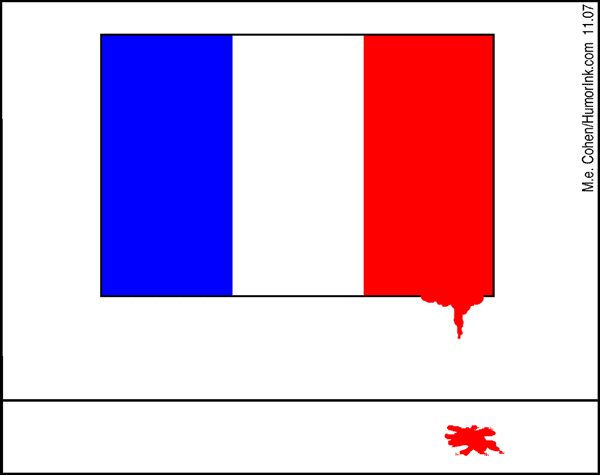
M.e.Cohen, French Riots
The image represents assimilation to a French republican nationalism that is founded on liberty, equality and fraternity in a fractured globalized world. The bleeding in the image suggest that the limits of liberal tolerance have been transgressed by the rioting that took place in the most underprivileged parts of Paris peopled by the colonized of North Africa who came to work in the low-wage jobs in the French factories.
French "integration" meant segregating immigrants into ghettos, where they could be better monitored by security forces specifically created for such purposes. The French model is one in which immigrants have "to forget their identity" to assimilate. As Anna Lentin says:
France's political culture makes it impossible for anyone who does not completely embrace the values of the Republic to access the public sphere: foreign residents were not even legally permitted to establish associations in France until 1981. The problem is that defenders of human rights and anti-racists tend to belong to that very French group of 'intellectuals' whose lives in the affluent centres rarely coincide with those in the distant banlieues. There is a belief, instilled in France through the public education system, that the values of liberty, equality and fraternity are universally accessible through a commonly applied principle of meritocracy. Those who fail to find a place in this system are professing anti-republican values such as the much dreaded communautarisme of which France's religious Muslims (but not Christians or Jews) are accused.
In this interview with Andre Glucksman about the violence in the suburbs the interviewer points outithat in these suburbs:
"... the unemployment rate among youth is between 30 and 40 percent. The schools are kaput. The youth are living in residential ghettos. These ghettos were built in the 1960s and 1970s for people from the former colonies who were returning to France, they were built for settlers and immigrants."
Glucksman understands this as French integration through negation, then adds that the key is hatred, and he goes on to talk in terms of a nihilistic atmosphere prevailing in France.
Multiculturalism is not mentioned once, even though the youth are rebelling precisely because they desire to be accepted as African-French citizens. Nor is the impact of neo-liberal globalization upon post-colonial France mentioned in relation to the social cohesion of France as a nation-state. Mark Levine suggests in this article that the French nation-state is probably not strong enough to provide the protective power that can act as a buffer against the integration of French economy and society into the global economic and cultural order.
Consequently, it is not just the youth of African immigrants transgressing liberal limits. The petite-bourgeois citizens and retired state employees are only a few steps away from embracing Jean-Marie Le Pen's Front National.
What is missing here amidst the ashes of the burnt-out cars is the political insigfht view that integration cannot be one-sided. It must change to a multicultural conception of nationality and recognize African French people as French citizens.
November 19, 2005
Hegel on freedom
Hegel's conception of freedom runs counter to the Kantian conception of freedom that stands in opposition to nature and sensuous inclination, even though Hegel accepts that freedom is the basis for the modern state. He questions the individual conception of freedom and the way that right is reduced to the coexistence of my individual will lwith those of other individuals, as presupposed in social contract theories. This means that the state is reduced to a contract based on the arbitrary will of individuals.
What Hegel does is question negative freedom (abstract freedom) which he sees embodied in the destructive fury (ie., the reign of terror) of the French Revolution; Bentham's conception of freedom that sees law as a fetter or constraint on liberty; or Hobbe's definition of liberty as the absence of external impediments. This conception of freedom holds that law is a constraint on our liberty to pursue our desires without obstruction or intrusion. Hence we have freedom as the arbitrary will of the individual desiring to do as they pleased that runs through the modern philosophical liberal tradition.
True, Locke is more moderate, as instead of opposing freedom to law, he talks in terms of freedom as doing whatever one pleases within the space carved out by the law. So is John Stuart Mill, as he talks of liberty as pursuing our own good in our own way so long as we do not attempt to deprive others of their liberty or impede their efforts to obtain it.
What Hegel argues for is a conception of freedom as radical self-determination that is distinct from the will being determined by its natural inclinations and particular desires; a negative conception of freedom that is presupposed by neo-classical economics or libertarianism. Freedom as self-determination has its object its own freedom.
Yet is this not Kant's idea of freedom of autonomy?
November 17, 2005
considering political liberalism
A new philosophy weblog I've come across---Philosophy Times run by Roberto. It works in terms of essays. One of these is on Rawl's Political Liberalism, and it opens with the key question of this text: 'how is it possible for there to exist over time a just and stable society of free and equal citizens in the face of reasonable pluralism'? It is a good question to ask when pluralism and multiculturalism is currently under threat from the national security state in its war on terrorism.
The answer is clear:
That is, what are the conditions needed to secure political stability within a democratic society consisting of diverse religious, philosophical, and moral outlooks? Rawls gives the following answer: a just and stable society is possible despite the existence of reasonable pluralism if its basic structure is regulated by a "political conception of justice that is the focus of an overlapping consensus of at least the reasonable comprehensive doctrines affirmed by its citizens."
The categories "political conception of justice", "overlapping consensus", and "reasonable comprehensive doctrines" are then unpacked by Rob.
It is "an overlapping consensus of reasonable comprehensive doctrines" that is being put into question in the war on terrorism being waged by liberal democracies. What has gone is the consensus in the sense of:
"... reasonable people not coercing others to adopt their value-system when they recognize others can reasonably disagree. Furthermore, if one happens to be in a group that is in strong disagreement with the political conception of justice, one is still reasonably expected to accept the political conception of justice not simply because one feels forced to but rather because one has a sense of justice and is motivated to act justly. In short, an overlapping consensus is accepted for moral reasons."
What we have today after 9/11 is a modus vivendi that is accepted for non-moral self-interested reasons. In this situation as soon as one party grows more powerful than the other, they will coerce the weaker group to adopt their comprehensive outlook, whatever that may be.
November 16, 2005
us and them
John Howard, the Australian Prime Minister, in an open letter to the Australian people assured us --people or citizens--that the Bali Bombings were committed by 'a murderous group of Islamic fanatics who despise the liberal democratic, open life of Western nations, such as Australia'. (The Australian,26 Nov, 2002). That sentence continues to ring in my ears to this day. Good and evil are seen as clear cut and democracy represents a self-evident good--it embodies freedom that is our way of life.
But who is this 'we' in the good liberal democracy that constitutes our way of life? It is not those arrrested for terrorism. They are bad. It is not the refugees. They too are bad. Nor is it those those who committ sedition. They are opposed to freedom and our democratic way of life. 'They' are aliens who can be taken into custody during a state of exception--the war on terrorism, The 'we ' are the patriots, the good patriots.
The anti-terrorism legislation is what John Howard, the Australian PM, calls exceptional measures for exceptional times. The exceptional can be reinterpreted in terms of the category state of exception
Is the state of exception within the juridical order or is it external to it (ie., political and so extra juridical)? Or does what is internal and external blur and go fuzzy. Those who write about the discourse of terrorism do not link this discourse to a state of exception. But that is what the war on terrrorism is: it is a state of exception, and it is this that justifies the curtailing of individual liberty in our liberal democracy.
November 13, 2005
a condition of peace
The tradition of modern political philosophy ----ie., not Plato's Republic, but Hobbes' Leviathan, Rousseau's Social Contract, Hegel's Philosophy of Right, and Rawl's Theory of Justice etc --- takes its bearing from the idea of freedom and the centrality of freedom in understanding political life in modernity. It subdivides in terms of its understanding of freedom, ie. negative and positive freedom. By this is meant freedom as the pursuit of our desires without obstruction or interference and freedom as self-determination or autonomy in the realm of politics. Rousseau is generally understood as the turning point between the two conceptions of freedom in modernity.
When I read Kant in the light of the modern liberal traditon I was suprised how much like Hobbes and Locke he actually was. The concern is with harmonizing individual wills---just like utilitarianism that defines the political philosophy of the newly born Australian colonial state in the mid to late 19th century.
In the 'Perpetual Peace' essay Kant, working in the social contract tradition, says that the task of of creating the good organization of the liberal state only involves arranging the state in such a way that the:
"... self-seeking energies [of men] are opposed to one another, each thereby neutralizing or eliminating the destructive effects of the rest. And as far as reason is concerned , the result is the same as if man's selfish tendencies were non-existent, so that man, even if he is not morally good in himself, is nevertheless compelled to be a good citizen."
Law does this job of neutralizing. The state's concern is to compel the antagonism of hostile attitudes and drives submit to coercive laws thereby producing a condition of peace within which the laws can be enforced. Kant in short, does not take us very far beyond a Benthamite utilitarianism, which presupposes the security of life and property.
In the Hobbe/Locke understanding of the social contract security is deemed to be a trade off with respect to individual freedom: the prudentially calculating individual gives up a part of their freedom to enjoy the security of life and property. That is the current discourse of the national security state in relation to terrorism. It is our duty to consider the law as just.
So how can it be guaranteed that the national security state will not itself become an arbitrary power; that it will rule in accordance with the rule of law?
The standard liberal answer to despotism is representative government and the division of legislative and executive powers. As we know in the Australian national security state today, legislation is the exercise of executive power( through CoAG). So where is the constitutional check on the executive-legislative power? Where is the power to suspend government if it violates the freedom of the people to ensure national security from the enemy without and within?
Elections is the classic answer. But the national security state now manipulates fear of violate death and ethnic nationalism to ensure national unity under the state and the continual re-election of the Coalition political party.
November 12, 2005
ALP: identity crisis
The Moir cartoon refers to the 'Its Time' Whitlamite ALP of the early 1970s when there was an organic connection between the parliamentary party, the blue collar workers, the unions, the professional middle class and the intellectuals:
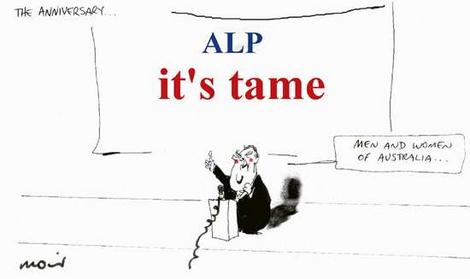
Alan Moir
Today's Beazley -led ALP is confronted by a disconnect. The blue collars workers went over the Coalition conservatives atfer 1996 due to the negative effects of globalization caused by the Hawk/Keating ALP's economic reform that opened up the economy. The blue collar workers were attracted by sound economic managemnt, law and order, bring strong on border protection and tough stance on terrorism. And they have stayed with the conservative side of politics. I cannot see them shifting back no matter how hairy chested the ALP is on national security.
The Beazley-led ALP is fighting to contain its rump blue collar vote by being tough on industrial relations. It's in defensive mode and it sees defending the rule of law, civil rights, sedition laws associated with being hairy chested on terrorism and the enemy within as a sideshow. That implies a right-wing dominated ALP is prepared to dump the progressive middle class and the intellectuals in favour of the commonsense of those blue collar working people living in the suburbs and who have moved to the right. The ALP right seem to think that the key to political success is the increasing conservatism of the electorate.
Shouldn't the ALP try to retain the connect with intellectuals and the progressive middle class as well? Is that a sideshow too? Shouldn't it be reaching out beyond to its core constitutency? Or does the right wing dominanted ALP live with the fiction that it will be returned to powerjust by energizing its core constitutency in a polarized world. Don't they have to capture a lot in the centre as well as the inner city left?
There are large forces of globalization at play here. This is how I understand it.
An important segment of the Australian .economy has been rolling along, as globalization and technology lower the labor costs of producing goods and as intense worldwide competition forces businesses to be more productive. The result has been dramatically higher corporate profits and a level of growth that has driven the forward momentum in the Australian economy in recent years.
Some groups have not enjoyed the prosperity; those who do not have the education or skills to compete in the new knowledge-based economy. In some cases, they do possess the skills but are competing with workers elsewhere in the world who make one-fifth or less of what the U.S. worker makes, while receiving few if any benefits.
The ALP is defending this group in relation to the IR legislation whilst ignoring the new knowledge workers.
November 9, 2005
Protecting Australia
Australia's security is founded upon certain foundations about its place in the world. The notion of the 'Tyranny of Distance'--whether understood as distance from its 'Great and Powerful Friends' or used to describe the vastness of the continent--has been interpreted by successive policymakers since Federation as a cause of fear and insecurity and as making Australia vulnerable to threat and danger Australia has sought to mitigate this dilemma of its insecurity by projecting force abroad.
This notion of a vast and indefensible land so distant from its Anglo-American allies has, at least in part, been the foundation of Forward Defence policies that have seen Australians fight overseas in well over a dozen wars. The argument is that distant overseas conflicts pose direct threats to Australia which are best thwarted by attachment to a powerful ally reflects not so much the search for security as the fear instilled by insecurity, a sense of imminent threat, and a belief in constant danger.
What does this fear of violent death by foreign (Asian) enemy lead to? Katrina Lee Koo has a suggestion---- Statism.
She says that:
From wars in foreign lands to programs of border protection, Australian foreign policy is literally littered with references, narratives and policies about the state's preoccupation with its own security ... While it may be imprudent to generalise about the history of Australian security, the privileged relationship between security and the state is one that has endured under Liberal and Labor Governments alike. As the monopoliser of 'legitimate knowledge' about national security it is often the state that defines what the political is, where it is located, and what it might or should be .... Australia's state-based security project has infused into Australian society an acceptance of the practices of violence, both structural and physical, as an acceptable means of achieving security. In each of the major foreign policy challenges facing Australia since the inception of this 'War on Terror' (the wars in Afghanistan and Iraq, the treatment of Hicks and Habib, the addressing of regional terrorism and the more aggressive refugee policies) we see in both the discourse of security and the development of security policy an acceptance of the violence committed against the Other as a 'necessary evil.'
It is a good suggestion.
November 8, 2005
France: no to multiculturalism
From an editorial in L'Humanite on the French riots:
Whatever the government says, the events of recent days do not reflect an isolated problem of suburban crime, but a terrible failure of the policy of urban and social segregation that has been imposed for years on the people of these districts. The suburbs are not a special case. The suburbs are France, the France that suffers at work, is unemployed ... the France of discrimination, bad housing, poor public services. Unless we give the suburbs hope, the whole country will be unable to develop and the equality that republican principles are founded upon will be nothing more than a piece of paper. The future of the French model of social justice - of all our futures - lies in the suburbs. That is why Nicolas Sarkozy wants to break them... Rather than endless images of burnt cars, we must give a voice to the suburbs. And we must listen to them!"
This is the world of a ghettoised, post-colonial France.
The urabn unrest and violence has been led by young French citizens born into first and second generation immigrant communities from France's former colonies in north Africa. The cycles of violence in the suburbs fragmented by segregation are usually sparked by the deaths of young black men at the hands of the police, and then inflamed by a contemptuous government 's tough law and order response that reaffirms assimilation not multiculturalism. It is contemptuous because the security forces reignited the urban unrest by emptying teargas canisters inside a mosque.
November 7, 2005
Leo Strauss on Hobbes, fear, political power
Fear is fundamental to understanding the workings of political power as Carmen Lawerence and Thomas Hobbes well understand.
I finished that previous post by saying that 'maybe I should re-read Leo Strauss on Thomas Hobbes?' What I had in mind was getting a grasp of political modernity so that I could evaluate these lectures on fear and public policy. So I opened up the section of Strauss's Natural Right and History dealing with Hobbes [Modern Natural Rigjht], skipped all the stuff on Hobbes' mechanistic cosmology, mathematics and nature and turned to the bits of fear, death, self-preservation and the state. Strauss says:
The state has the function, not of producing or promoting a virtuous life [as held by classical political philosophy], but of safeguarding the natural right of each [individual to self-preservation]. And the power of the state finds its absolute limit in that natural right and in no other moral fact. If we may call liberalism that political doctrine which regards as the fundamental political fact the rights, as distinquished from the dutiues, of man and which identifies the function of the state with the protection or the safeguarding of those rights, then we may say that the founder of liberalism was Hobbes.
That brings one up short doesn't it? It does me, as I've been reading Hobbes as a conservative --ie., as an anti-liberal.
November 6, 2005
Judith Brett on Howard's Liberals
I picked up a copy of Judith Brett's Quarterly Essay, 'Relaxed and Comfortable: The Liberal Party's Australia' in Canberra last week. An irreverant but insightful visual representation of Howard's Liberals can be found here.
It needs to be acknowledged that John Howard, like Menzies before him, has a mastery of the political tradition of Australian liberalism and a great ability to adapt that tradition to changing circunmstances. His political career has been marked by quick footedness and firmness in the face of opposition as well as defeat and rejection.
The back cover blub to the Quarterly Essay highlights the importance of nationalism. It says:
What is the Liberal Party's core appeal to Australian voters? Has John Howard made a dramatic break with the past, or has he ingeniously modernised the strategies of his party's founder, Sir Robert Menzies?
For Judith Brett, the government of John Howard has done what successful Liberal governments have always done: it has made its stand firmly at the centre and presented itself as the true guardian of the national interest. In doing this, John Howard has taken over the national traditions of the Australian Legend that Labor once considered its own.
Her big point is that Liberals govern for the nation and not sectional or class interest and they (eg., Alfred Deakin) opposed Labor's picture of Australia as divided between two conflicting classes---bosses and workers --or irreconcilable interests--- capital and labor--as a way of understanding the polity or the nation. So the Liberals (eg., Robert Menzies) appealed to the people left over or forgotten ---the middle middle class, or the small business people and the self-employed. The appealed to the middle class was in terms of individual values--individual moral qualities or virtues, strength of character, respectability and a sense of responsibility.
Howard's response to Keating in the 1996 election was to voice, and rework, Deakin's argument against sectional class interests (he adds the new social movements and cultural elites to the list) and Menzie's argument looking after the powerless forgotten middle people; and then to talk about the whole community and uniting the nation. In doing so Howard stands firmly in the consensual centre with his electoral package of free market economics, social support for ordinary suburban families and an assimilationist nationalism.
But where does liberalism end and conservatism begin in Howard's appeal to family and nation? Howard, after all, does identify himself as a conservative.
Placing the emphasis on the family and nation does displace the individualism that acts as a foundation for liberalism. Brett is aware of this. She says:
The family as an interdependent, mostly biologically based social unit resists dissolution into an association of rights bearing individuals, in particular the relationship between parents and child. This marks the fault-line within contemporary politics between small "l" liberals and those who call themselves conservatives, and it runs through both the Labor and Liberal parties.
Similarly with appeals to nationality, tradition and community--mateship.
But there Brett leaves it. Nationality and family does undercut the argument about Howard appealing to the individual virtues of the middle class, does it not. Brett's thesis is that Howard's Australia is a liberal Australia of virtuous individuals. She does not see the conservatism of kin as family, neighbourhood as community and nationality as one Australia as a traditional response to the decay of the stable world of meaning in the globalized world of late modernity. The meanings and values of of stable liberal world have emptied out and we individuals find ourselves increasingly standing alone in the world struggling to make sense of the changes, the increasing violence and not feeling too good.
Ther Liberal Party's Australia is a conservative Australia as much as it is a liberal Australia.
November 5, 2005
Carmen Lawrence on fear, power, security
At the dawn of modernity Thomas Hobbes argued in his Leviathan that politics was based on the desire of power and the fear of death. The social contract, he argued, was one where a multitude of men gave up their rights to an authorized sovereign authority to act on their behalf. The sovereign, in return, needed to be absolute to overcome the haunting fear of death that man has in a state of nature, and a government's sole reason for existence is for the safety of the people. Hobbes sought to construct a political order on humankind''s most powerful passion---fear of violent death.
Sound familar, as the dusk of modernity falls around us? Tis the disourse of the conservatives and the national security state. Their discourse is one in which the biggest risk to our safety (self-preservation) comes from terrorists who might attack us at any moment. The specter is haunting the late modernist polity is the specter of insecurity.
Our government, political class and media have adopted without question the "War on Terror" slogan as a representation of how we should respond to these threats. The war paradigm does not fit the battle against transnational Islamic terrorism, as involves political violence by nonstate actors, not nation states.
In this conservative discourse fear is --"Fear of Death and Wounds,"---what causes people to seek peace through the use of power. Fear of each other's power is the only antidote to the power struggles inherent in human desire and relations. Unable to know the outcome of actions or foresee the future, people are in constant fear of possible dangers, evil turns of event, or sudden death. In order to preserve life, we must seek peace. What has been dropped is Hobbe's underpinning talk of natural law and the social contract, in which we accept that the price one pays to leave the state of nature is renouncing the natural right to further one's interests by any means necessary. What has been retained is the idea that the sovereign State is the source of order and security in society.
So it is good to see Carmen Lawrence exploring the way fear shapes our condict in our political life. It is important issue, not because it is one way to understand Conservatism, but because Liberalism is itself fearful, in most instances, of popular power, of---for want of a better term---the power of the people. So what is Carmen Lawrence saying?
After giving many instances or examples of fear Lawrence dips into Hobbes:
Fear is arguably the most powerful human emotion. It acts as an alarm to indicate the presence of a threat and stimulates us to respond to save ourselves from damage, destruction, and death. Since fear is one of the primary human emotions, we do not need to learn how to feel fear. But we have to learn what to fear. In his definitive work, Denial of Death, Becker argued that knowledge of our own death is the source of our 'peculiar and greatest anxiety'; it's what makes us human...Fear.... is normally an adaptive response to danger, to the perception that we are not safe. When we are extremely afraid, surviving at any cost may become our top priority and we may, at that moment, be willing to do almost anything just to stay alive. Excessive fear can overwhelm rational thought.
If we are frightened enough, we will even be willing to give up our freedom.
That's Hobbes---the fear of violent death at the hands of others, not nature, is the most powerful of all passions. This fear expresses the most powerful of our desires---the desire for self-preservation. What Hobbes adds to this is that the desire for self-preservation is the sole root of all justice and morality, with all duties being derivative of the fundamental right to self-preservation.
Lawrence then explores the way the threat of fear is a familiar tool for ensuring compliance. Political fear is a political tool, an instrument of elite rule created and sustained by political leaders or activists who stand to gain something from it. She says that:
Such fear can operate in one of two ways: political leaders and elites can define what is or ought to be the principal object(s) of public fear and they can wield fear to threaten those who appear to challenge their power and status. In the first case, the selected object of fear usually does pose some level of threat, but the threat may be exaggerated or given undue emphasis when compared with other potential objects of fear. It is usually politicians who define what is worthy of attention, who mobilise public opinion and who propose methods to deal with that threat. It does not automatically follow that everybody shares the fear, but rather that it dominates the public debate and monopolises resources. Politicians' success as protectors - not so difficult when the threat is exaggerated and the remedies ill-defined - then consolidates their legitimacy and enhances their power.
This is true enough. However, this way of approaching fear undercuts Hobbes' insight. Our fear of violent death is so great that we are willing to give up some of our freedom (to further one's interest) in exchange for security and peace. It's a tacit contract.
Are not the Australian people doing that with John Howard? They are willing to give him extra power to protect them from a violent death caused by home grown terrorists? Fear is a fundamental to political power. But it is not just a tool of political governance used to discipline the governed. That is one side of it, as the other side---the governed---are also free individuals in a liberal democracy who vote for Howard because he stands for the strrong state that will do the job of protecting their right to self-preservation.
Maybe I should re-read Leo Strauss on Thomas Hobbes?
November 3, 2005
discourse of terrroism
The strategy of the conservatives in Australia has been to remind us constantly about the danger of terrorist attacks.Yesterday was a classic example of forwarned danger coupled to legislation to increase the powers of the national security state. They have become authoritarians defeating us from terrorists and happy to be so.
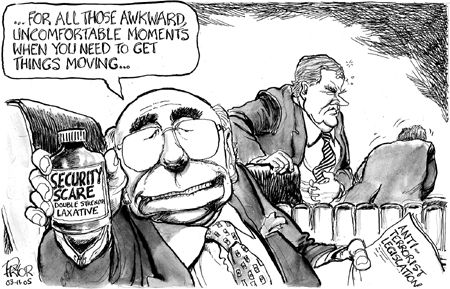
Pryor
There is nothing new about this strategy for gaining and holding power. Writers from the ancient Greek historian Thucydides to Baron de Montesquieu to Herman Goering in the twentieth century have told us that all national leaders need to do to retain power is to focus on an external threat and accuse those who won't go along with their plans of a lack of patriotism and exposing the country to danger.
Though terrorism is a genuine threat, the ceaseless use of the rhetoric of terror, violence and danger has been accompanied by a growing number of false alarms about the enemy within who is destroying our civilised society. In Australia we citizens are not only warned that we should be afraid, but are told exactly how afraid we should be (through different kinds of alerts), and yet, regardless of how afraid we should be, we are given little advice about what to do.
So we become frightened and scared. We are in the process of becoming a frightened and frightening nation, a nation filled not with generosity and humanity and decency and charity, but a nation that seems unable to find any deeper reason for its patriotism than a profound, and cynically manipulated atmosphere of anxiety and fear.
That is my initial interpretation of the discourse of terrroism .In an essay I referred to earlier---Terror Australis: Security, Australia and the 'War on Terror' Discourse in Borderlands Katrina Lee Koo takes this much further. She says:
While we certainly need to critically reflect upon questions such as, 'what constitutes terrorism? who are the terrorists? where do we confront them and how?' we just as urgently need to critically analyse how we think about these questions. In particular, we need to ask: 'What is this discourse of terrorism? Who generates it? How does it enable the kinds of changes we are seeing in our society, and are they consistent with the broader notions of security to which we aspire?'
She tackles the second set of questions about the discourse of terrorism which are concerned about the way we think and talk about terrorism. Katrina Lee Koo says that her essay makes two arguments:
Firstly, John Howard's adoption of Bush's 'War on Terror' discourse
.. reinforces many of the underlying assumptions that have been present throughout Australia's search for security in international relations since Federation. From that time, in one form or another, the dominant Australian security politics has demonstrated four rigid commitments: a belief in its own insecurity, a faith in a statist ethic, a commitment to the practices of violence and, finally, a repetition of certain identity practices.And secondly, her essay argues that:
...the 'War on Terror' discourse not only reinforces and naturalises these foundations of Australian security but also intensifies it in ways that need to be questioned. The familiarity of the 'War on Terror' discourse, and the ease with which it has become assimilated into the Australian security project, has resulted not only in increasingly violent and intrusive security policies both at home and abroad, but also a lack of sustained public debate about them.
November 1, 2005
the politics of fear #2
I ended an earlier post on the politics of fear with the claim that ' politics has internalised the culture of fear.' If we accept this, then the insight of Frank Furedi makes good sense. He says that:
....the politics of fear could not flourish if it did not resonate so powerfully with today's cultural climate. Politicians cannot simply create fear from thin air. Nor do they monopolise the deployment of fear; panics about health or security can just as easily begin on the internet or through the efforts of an advocacy group as from the efforts of government spindoctors. Paradoxically, governments spend as much time trying to contain the effects of spontaneously generated scare stories as they do pursuing their own fear campaigns.
This is the discourse that both conservatives (in the US & UK) and social democrats (UK) are constructing.
That's true. Environmentalists talk in terms of the end is nigh whilst the Howard Government is trying to ease the anxiety it has created with its warnings about a scary world with a flu pandemic.
Furedi takes an interesting twist:
Perhaps the distinct feature of our time is not the cultivation of fear, but the cultivation of vulnerability.... When most forms of human experience come with a health warning, we are continually reminded that we cannot be expected to manage everyday risks. And if vulnerability is the defining feature of the human condition, we are quite entitled to fear everything.
There he leaves it. That doesn't deal with the politics of the national securtity state, which in the name of preventing terrorism, employs a politics of fear to create the most extensive national security apparatus in our nation's history. It doesn't deal with the discourse of terrorism and the way that it has been normalized.
As Katrina Lee Koo observes in her Terror Australis: Security, Australia and the 'War on Terror' Discourse in Borderlands:
Since September 11, 2001 there has been an intense normalising practice in place with regard to Australian security. The result of this practice is an unquestioning acceptance that the changes in lifestyle, the deprivation of certain liberties and the lack of human empathy when dealing with others are necessary to ensure security. From changes in airport security procedures ... to the ASIO home raids that took place across Sydney, Melbourne and Perth in October and November 2002 ...there seemed plausibility in the argument that there must inevitably be, as ASIO Director-General Dennis Richardson argued, 'a further lowering of the risk tolerance threshold' ....Consequently, the threats of terrorism and the practices of counter-terrorism have become normalised into everyday life. Social and political life in Australia has become reconceptualized to include the imminent possibilities of terrorism, the need for eternal vigilance and the acceptance that certain sacrifices need to be made to protect the greater community.
This is the discourse that the conservatives (in the US & Australia) and social democrats (in the UK) are constructing.