December 29, 2005
technology parks
When I drive past Flinders University from Adelaide to Victor Harbor I pass by a group of buildings called a technology park; this is a place where academic science and industry meet and collborate to form the drivers of the newly forming knowledge economy. Does anything happen there I wonder? I doubted it.
Technology park was modelled on Silicon Valley. It tries to emulate it so as to transform South Australia from a rustbelt to a knowledge economy state. That transformation through incubation was designed to solve the crisis that had occured when the set of ideas associated with industrialization ran up against a social reality that it could not explain --the failure of industralization and manufacturing to provide fo rthe state's economic growth during the late 1970s and early 1980s. Technology Park stood for the way that South Australia was going to become high tech--remember all that talk about the clever cocuntry?
Well nothing much has happened because SA is still low tech with little IT or biotechnology industries. Similarly for Australia in general, despite all the talk about bio-tech start ups spinning off from publicly finded research in public universities.
So what went wrong? A clue is provided by this interesting review by Jane Marceau of Margaret Pugh O'Mara's Cities of Knowledge: Cold War Science and the Search for the Next Silicon Valley. In this kind of economic policy about the knowledge economy:
"...it is held that science will kick start new industries and refashion older ones. On this account economies based on steel and 'rust belt' industry will be replaced by IT and biotechnology as the 'clean' and 'knowledge-based' engines that will drive both economies and societies."
Hence all the attempts to set up baby Silicon valleys in the different states around Australia. Marceau says that Cities of Knowledge gets below the spin currently spread by Australia's politicians and universities that they are pioneers in university-industry engagement. What then is disclosed.
Marceau says that O'Mara's text:
"...shows that higher education institutions and their science alone will not automatically produce the wealth, the spatial patterns, and the industrial technologies associated with the Silicon Valley holy grail. Universities and cities might build technology parks and link laboratories to companies and scientists to market forces, but success is not guaranteed. That alone is a useful lesson for us. But the book does more---it links iconic local geographical, research, and industrial development patterns firmly to the defence policies of Washington's Cold War. It also shows how local differences in the relative power of the players and the socio-economic circumstances of city locations have shaped how cities of knowledge do or don’t develop."
December 28, 2005
the arrogation of power
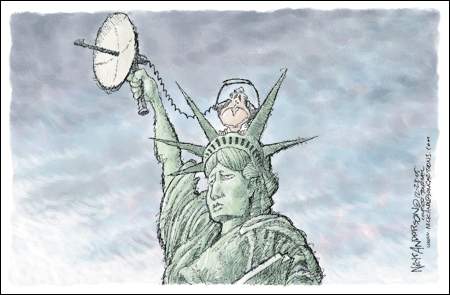
On the US national security state's domestic surveillance by the National Security Agency. What justifies this kind of power over citizens in a liberal democracy? Where is the constitutional legal grounding?
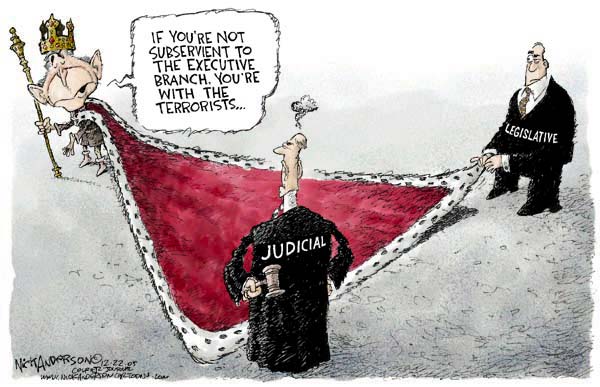
The background is here. It is an attempt to ensure that the head of state is invested with absolute power. George H.W. Bush's attorney general William Barr according to the Washington Post, contends:
"The Constitution's intent when we're under attack from outside is to place maximum power in the president, and the other branches-and especially the courts-don't act as a check on the president's authority against the enemy."
The Bush administration contention is that the president's power as commander in chief during wartime puts him above the law. Wartime is now. The legal reasoning for this is that as the Constitution makes the president the "Commander-in-Chief," so no law can restrict the actions he may take in pursuit of war, including torture or surveillance.
This indicates that power as sovereignty is still important, and that power is not primarily a question of biopolitics as Foucault maintained; sovereignty is the mark of the state of exception. This mark discloses the dialectic between the powers of the President and Congress and the conflict over supreme authority in an emergency situation.
December 27, 2005
Foucault, freedom, social control
A review by Ladelle McWhorter of a book on Foucault and freedom by Johanna Oksala (Cambridge University Press, 2005). It was noted by Ali Rizvi over at Foucault Reflections without comment.
It sounds interesting as McWhorter observes that Oksala rightly argues that Foucault's radical rethinking of both bodies and freedom largely escapes the simplistic criticisms routinely put forward against the Foucault (of Discipline and Punish) in the early 1980. McWhorter says that Oksala also reads Foucault against the background of three major continental philosophers: Edmund Husserl, Maurice Merleau-Ponty and Emmanuel Levinas. That kind of reading is generally not done with Foucault.
Discipline and Punish was about societies and states in the nineteenth century that used a mode of power which worked through the calculated distribution of bodies, spaces, time, and gazes in order to fabricate subjects who were compliant and useful. Hence the emphasis on prisons, schools, hospitals asylums, workhouses and on reforming the delinquent, the criminal, the unemployed, and the mad. Discipline is about shaping the conduct of subjects for certain ends--eg., to reform, educate, exploit or to cure them-- not to produce slaves or automatins.
This disciplinary kind of society and control of conduct broke down, or disintegrated, in the late 20th century with the shift to neo-liberalism the deregulated market, new technological networks and the rise of the entrepreneurial society.
So how is political freedom linked to Oksala's interpretation of Foucault?
McWhorter says that:
Oksala argues that Foucault's genealogies are not merely histories of how bodies have been variously perceived -- as machines, as organisms, etc.....For Foucault, the body is thoroughly historical... For him, subjectivity is not an entity apart from power and constituted by it; in a very important sense it is power. In Foucault's work, "the subject and the constitutive matrix are not understood as external to each other, but are rather regarded as importantly continuous and entangled in complex ways through the idea of a constitutive apparatus" ....The only way to see the subject (and hence the body) as powerless and unfree is to see it as divorced from power and unable to partake of power in any way. And that is decidedly not Foucault's view.
The social world is a dynamic power/knowledge network, and how body-subjectivities are constituted varies with that dynamic and the interests and intentions exercised within and through the technologies deployed by the network of control practices.
McWhorter adds that Oksala argues that this power/knowledge network does not eliminate freedom:
Power relations must repeat in order to maintain themselves; body-subjects are called upon to reiterate social norms as part of their continual constitution. But whenever reiteration occurs, there is always the possibility of difference. The body-subject's constitution is never wholly complete. Freedom, then, is not a characteristic or quality of a subject but is the subject's inherent opening toward newness.
Foucault's conception of bodies and pleasures, which provides a possibility of a counterattack (resistance?) against normalizing power presupposes an experiential understanding of the body. The experiential body can become a locus of resistance because it is the possibility of an unpredictable event.
Is freedom as an 'opening toward newness' within a network of power relations a political conception of freedom? If so, how is the experiential body and the possibility of an unpredictable event connected to citizenship, the exclusion of some bodies from the liberal polity, the vast interlocking networks of biopower, or the shift away from the welfare state?
Does not the Howard Government take the reconstruction fo the welfare recipient as a central problem: to shift them from welfare dependency to work activity; to reform habits as a condition of the receipt of benefits, to use the welfare to work reform to encourage self-reliance?
December 25, 2005
December 24, 2005
out of sorts
I've been struggliing with the changeover from dial up to broadband down at the holiday shack in Victor Harbor these last couple of days. It is not going well and the finger can be pointed at Telstra.
So I've been a little out of sorts.
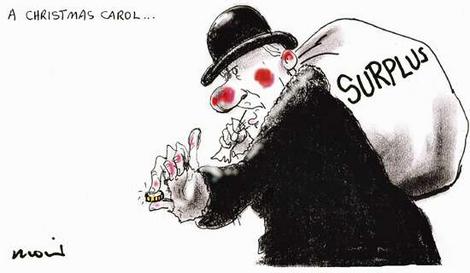
Allan Moir
I noted this in passing. More money could be spend for the public good , not private gain.
December 21, 2005
on multiculturalism
I see that the John Howard, the Prime Minister of Australia is begining to concede that race was involved in the Cronulla riots-there were -racists but there was no racism. He still thinks its okay to drape yourself in the Australian flag when attending a race riot and battering someone.
More concessions are needed by those who link the race riots with Islam and Lebanese Australians:

Sharp
A statement in The Age:
The ugly scenes from Cronulla Beach and their aftermath are symptomatic of deeply disturbing 'us/them' dichotomies that are present in Australian society. They undermine values of fairness, compassion and tolerance, which have been hard won over more than 200 years. During this time Australia has experienced ongoing tension between the forces of exclusion and acceptance, culminating in a unique identity based on cultural diversity and inclusiveness. This has served Australia well and has spared us many of the troubles which have occurred in other parts of the world.
The alarming 'us versus them' attitudes expressed recently have been caused by unnecessary fear of the other. They stand in contrast to the very positive features of our nation. Mutual respect and acceptance of difference, always within the accepted norms of our political institutions and law, are values that should be treasured.
It is incumbent on all of us, especially our political and other community leaders, to continually seek to strengthen the unity of our culturally diverse Australian society. This can only take place against a background of harmony, mutual understanding and the tolerance that gives people space and time to grow into Australia, and Australia to welcome the contribution that they can offer. There needs to be an overriding commitment to Australia. The media also have a responsibility not to exploit and encourage the forces of ignorance and prejudice that we have lately witnessed. Australia has been internationally considered a haven of harmony and tolerance in which people are able to use their personal and cultural resources to develop themselves to the fullest and to make their contribution to the nation. Let us hold strongly to the values that have made us a nation united in diversity and a constructive member of the world community.
Archbishop Dr Philip Aspinall,
Dr Alison Broinowski,
Julian Burnside, QC,
Prof. Michael Clyne, AM,
Hass Dellal, OAM,
Ivan Deveson, AO,
Sir James Gobbo, AC,
Prof. Laksiri Jayasuriya, AM,
Professor Mary Kalantzis,
Professor Stuart Macintyre,
Stefan Romaniw, OAM,
Sir Ninian Stephen, AK.
" a haven of harmony and tolerance '? What space does that allow for conflict and disagreement?
December 19, 2005
the administration of life
A quote from a review by Guillermina Seri of Giogio Agamben's The Open. Man and Animal in Politics and Culture:
One of Agamben's most original contributions arises from his extension and radicalization of the Foucauldian concept of biopolitics and its assimilation to sovereign power..... whereas the late Foucault resorted to the Greeks as inspiration for the possibility of freedom, Agamben exposes Aristotle's Politics as the foundation of Western biopolitics. In that text, Aristotle assimilates human life to the life of the citizen in the polis. Outside the polis, life can only be either godly or animal, that is inhuman. What remains implicit in the Aristotelian work and that Agamben infers is that, if life is human only when a political status is attached to it, then the adscription to humanity relies on a political, contingent decision. Starting from this insight, his work uncovers life as the raw matter over which sovereign power reproduces itself by distinguishing between human and inhuman, and makes clear that there is no humanity outside this decision. These main coordinates define what Agamben refers to in The Open as the "anthropological machine," that is the onto-political grammar of production of the human against a background of life defined as worthless and eliminable.
Whereas Foucault understood biopolitics as a modern phenomenon, Agamben argues that the administration of life has accompanied Western politics since its inception in Ancient Greece.
December 18, 2005
neo-liberal freedom
Neo-liberals see the state as a vehicle or an instrument for pursing their own own self-chosen ends. Freedom is generally coded as the unimpeded purusit of one's desires (negative freedom), as distinct from self-determination or autonomy (positive freedom).
The former traditionally assumes the individual subject as a given and understands freedom spatially: as the presence of external limits to the individual's sphere of action. Freedom lies in between agents and the constraints upon their actions.
December 16, 2005
voices from the past
John Curtin, the Labor Prime Minister of Australia, in a speech in 1944:
I can say that the dominant point of view in Australia--- and I know it to be the dominant point of view here in Britain --- is that we are one people. We are not only kith and kin, we have the same cultural heritage, we speak the same language, we claim that all the struggles for liberty that have been waged in this land, the motherland and cradle of the rights of the people, were just as much the history of the people of Australia as they were the history of the people of Britain.
It sounds like a voice from another time, a long forgotten voice, doesn't it. The link to the United Kingdom is one that recognises Britain as the foundation of Australia's values and traditions. Britishness is a way of thinking that is based on being 'British to the boot-heels', sees Britain as 'home', and understands British history as Australian history.
That tradition is alive and well today.
What this old imperial cultural tradition doesn't recognize is that Australia is a nation independent of Britain. It does not value Australian difference---a distinctive Australian culture. That culture has been defined as multicultural.
December 15, 2005
Three faces of Australian conservatism
This is the ugly face of Australian conservatism that defines Aussie identity and Australian nationality ethnically--- -as Anglo-Australian. It's the face of street violence of the thug and the vigilante. It has nothing to do with defending democracy, and little to do with the Burkean conservative disposition that conserves what is valuable and advocates moderate reforms in line with existing institutions and values.
This Canadian interpretation of the politics of race on a public surf beach:
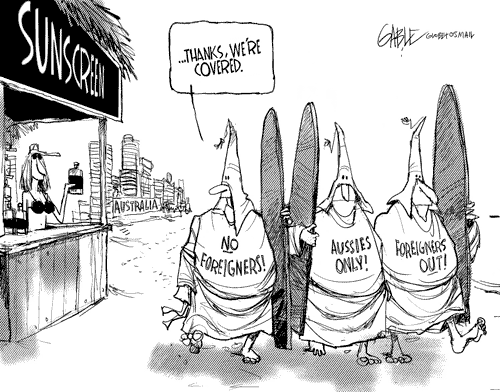
is too American. It jars. Though it captures the violence of the Right, the politics of possession, and the perversion of the commonsense of ordinary people, it misses the traditional Aussie values of mateship and nationalism of populist conservatism. The suburban lads are not Klu Klux Klan, nor do they take their bearing from the KKK in the US. What is missing is the Australian flag the Romper Stompers drapped themselves in as they practised their form of racial exclusion in the name of the nation.
The civilized side of conservatism are articulated by Peter Faris in terms of nationality as assimilation:
Any Muslims who wish to stay in Australia must become Aussies.They must understand and support our Australian culture and traditions. They must assimilate. Every other migrant group has done so.Unfortunately, the Islamic religion prevents this. Sharia is God's Law and is superior to the man-made laws of our democratically elected Parliaments. Islam demands that only God can govern. We have made too many concessions in the name of Multiculturism (a concept that was forced on the Australian people). Muslims living in Australia must learn to speak English, especially at the mosque. They must dress in Western clothes and not mark themselves as different and apart. They must treat their women according to Western values. They must send their children to secular schools where they will learn to be Australian citizens.The sad truth is that the more Muslims we have in Australia the more problems we have, particularly from terrorism.
There is not a liberal concept in that passage. It is authoritarian with no concessions being made for individual freedom at all. It is also unclear what we assimilate to as Australian citizens.
The civilized face tacitly supports the vigilante face in the name of ensuring law and order and the failure of the state to be tough on Arab Australians. It does by saying why they are justifed to act like Romper Stompers due to a series of events: the problem of young Lebanese guys defining their tribal identity against what they see as Anglo Australian identity, being into criminality in a big way (just like some of the southern beaches surfie culture), engaging in sexual harassment, and at times sexual assault, on the beach and their racism against white Australians.
What links the two as Marilyn Lake notes, is the appeal to the military tradition:
"...they redeem their action by locating their campaign in another Australian tradition, the national tradition of military defence, that has in recent years become central to official versions of Australian history. Rioters were heard last Sunday to liken their action to earlier generations' battles to defend Australia from the Japanese and other enemies. Resurgent militant nationalism feeds on celebrated military tradition.
This justification---conserving traditional Anzac values in the face of excesses of the contemporary world, states that as Australia is at war with a militant , extremist Islam so its followers should be interned as were the enemy residents during WW2.
The third face is that of Big Business. Big Business has captured the state to the extent that it ensures, through its intricate webs of cartels and business associations, that the vast bulk of recent federal legislation favors the interests of large commercial enterprises at the expense of the citizen. This legislation also aims to undermine, and cripple, the power of organized labor. Big business in Australia calls for more deregulation and deeper tax cuts, works to gradually erode the little antitrust legislation we have, and encourages consolidation in many sectors of the economy by way of mergers and acquisitions. The Australian economy has become more oligopolistic since the 1970s and this has been at the expense of the free or competitive market.
So we have lots of radical reform to established institutions and regulations to protect the interests of big business. There is no desire for the minimal state here nor any no fear of the big state here. There is only the desire to wield the big state's power in the interests of big business, now that the Howard Government has control of the Senate. a strong state pursuing market liberalization for big business centralizes power in Canberra with little real concern for the rights of individuals.
'Cronulla' opens up a space in which we can put the three faces of conservatism together. What is dsclosed is that Australian conservatism has become a different political tradition to liberalism. It is no longer just neo-liberalism. Those neo-liberals at the Institute of Public Affairs who equate the two as economic liberalism and the free market are mistaken. They talk in terms of the New Right and its agenda of the efficiency of markets, a distrust of government intervention in the economy, freeing the labour market, eliminating tariff protection, privatisation of state-owned assets, applying competition to government services and reducing the size of government. The New Right, or the "economic rationalism" of the 1980s, is not the conservatism of today.
Those who contine to equate the two after 9/11 are misinterpreting what is now happening around them.
December 14, 2005
Conservatism contra liberalism
The conservative interpretation of the Cronulla riots involves a critique of multiculturalism and liberalism.
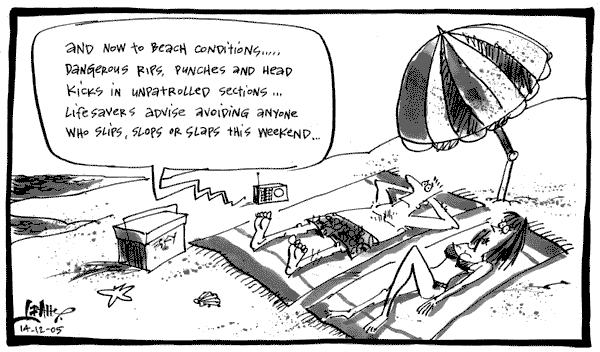
The basic conservative critique of multiculturalism is well known. It says that the failure of some migrants to successfully integrate with Australian society was at the root of racial tension in Sydney. Multiculturalism gives rise to a a nation of tribes. It holds that many of the cultures coming in here are not coming to integrate and be part of the community ... Community is understood as Anglo Australian--Britishiness. As James Jupp, writing in The Australian, observes :
For 30 years, Australia has officially been a multicultural society, a sensible response to mass immigration. This means that there is no single ethnic, racial or religious group that can call itself Australian to the exclusion of others. This has been repeated over and over again, but is obviously not accepted by many Australians of British or Irish descent, including the mob at Cronulla waving their Australian flags.
The One Nation conservative criticism is spelt out by "Evil Pundit:
A large part of the problem is that multiculturalism encourages the development of separate ethnic and religious subcultures that are often hostile to the host society. It also exacerbates these problems by suppressing any criticism of such subcultures, allowing the problems to grow until they erupt in large-scale violence.
This conservatism is deeply opposed to multicultural society, holds that a harmonious multicultural society is a utopian ideal, and regards Australia's multicultural experiment to be a failure. The cultural wars have meant that those who support multiculturalism are denounced as elites, latte drinkers or doctors' wives.
Australian conservatism's critique of liberalism arises out of its nationalism. It understands liberalism as a doctrine of an abstract individual, emphasizes individual freedom of action, condemns excessive bureaucratic involvement by government and values expert knowledge.
Liberalism's defense of individual freedom downplays the conservative emphasis on nationhood and nationalism because it endangers the freedom of the individual. So the conservatives target classical liberalism, libertarianism, and modern internationalist liberalism, as these deny the historical concept of the nation state by rejecting the notion of any common interest between individuals who traditionally shared a common heritage. In the place of nationhood it proposes to generate a new international social pattern centered on the individual's quest for optimal personal and economic interest. Within the context of extreme liberalism, only the interplay of individual interests creates a functional society - a society in which the whole is viewed only as a chance aggregate of anonymous particles.
The essence of modern liberal thought is that order is believed to be able to consolidate itself by means of all-out economic competition, that is, through the battle of all against all, requiring governments to do no more than set certain essential ground rules and provide certain services which the individual alone cannot adequately provide.
Conservatism understands that nationality and society are rooted in biological, cultural and historical heritage. The difference between these two concepts becomes particularly obvious when one compares how they visualize history and the structure of the real. Nationalists are proponents of holism. Nationalists see the individual as a kinsman, sustained by the people and community. which nurtures and protects him, and with which he is proud to identify. The individual's actions represent an act of participation in the life of his people, and freedom of action is very real because, sharing in the values of his associates, the individual will seldom seek to threaten the basic values of the community with which he identifies.
As there is no place for an Aussie nationalism in liberalism we have the fear that Australia's "unique culture" is threatened by multiculturalism and immigration. Hence One Nation conservatism wants to reclaim the cultural agenda to say that Australians have their own culture.
December 12, 2005
Cronulla & the Australian Right
The race riots at Cronulla on the weekend bring the Australian Right into the foreground. The riots can be connected to what recently happened in France. I agree with Andrew Norton over at Catallaxy that the Cronulla violence is similar to the most recent Sydney riots at Macquarie Fields and Redfern. In both the French and Sydney cases the base economic issues are clear: poorly educated young people fuelled by anger, dispossession and booze/drugs, low incomes and poor job prospects, turning tribal.
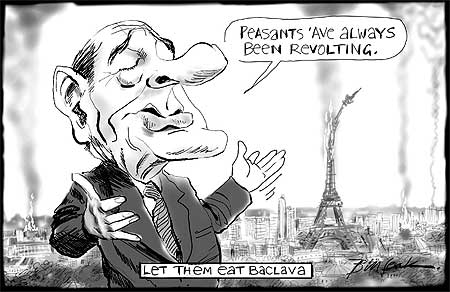
However,what happened Cronulla is also different from the events in France. Cronulla turned tribal and became racist, without the police or the political authorities fueling racism, which is what happened in France.
So how do we understand thie Cronulla riot in terms of the development of the Australian Right and in its own terms? Is it an Old or New Right?
What we can say is that more going on in this event than Tim Blair's account of beach trash, given this report, which suggests a discourse around the dominance of the white race. Glen Fuller has a stab here.
At the moment the Australian Right is a political movement possibly without a think-tank (the IPA?) and a school of thought. My judgement is that it is a political movement that provides a challenge to liberalism at the end of modernity. This political movement is pro-American, Christian, place a higher value on culture and identity than on economics, is anti-multiculturalism and very patriotic.
Can we say more than this rather conventional account of Australian conservatism and its understanding of nationalism?
Andrew Leigh over at Imagining Australia sees the significance of Cronulla in terms of 'Hindu/Muslim violence in India, and perhaps even the treatment of Jews in early-1930s Germany.' This kind of broader context is definitely needed, but it reduces the Right to ethnic racism, which is a traditional liberal response . My interpretation is that Cronulla signifies a 'radical nationalist politics' at odds with the dominant 'Western liberal internationalist ideology'.
If modernity designates the political and philosophical movement of the last three centuries of Western history, then modernity can be characterised primarily by five converging historical processes:
1. individualization, through the destruction of old forms of communal life;
2. standardization, through the adoption of standardized behavior and lifestyles;
3. desacralization, through the displacement of the religious narratives by a scientific interpretation of the world;
4. rationalization, through the domination of instrumental reason, the free market, and technical efficiency;
5. universalization, through a global extension of an (American) liberal model of society postulated implicitly as the only rational possibility and thus as superior to all other forms of life.
The tabloid media short hand of 'political correctness ' mostly refers to the politics of the New Class and so misses the sociology.
The return of a violent nationalism at Cronulla takes place within a crisis in modernity--the historical exhaustion of the great mobilizing n political narratives of right and left--- at the very point when the universalist liberal utopia is poised to become a reality under the form of liberal globalization in the 21st century. The death of the old is also the birth of the new--the beginning of postmodernity that is characterized by a series of new themes: preoccupation with ecology, concern for the quality of life, the role of tribes and of networks, revival of community, the politics of group identities, multiplication of intra- and supra-state conflicts, the return of social violence, the decline of established religions, growing opposition to social elitism, etc etc.
Cronulla signifies the role of tribes and of networks, revival of community, the politics of group identities, nationalism (Australian flags, Eureka Stockade flags, boxing kangaroos, Waltzing Matilda). The Australian Right is an Old Right not a New Right, as it stands for a return to the past, as distinct from a reworking of certain pre-modern values in a decisively postmodern dimension. It talks in terms of race not difference and this racism is the denial of ethnic difference.
Cronulla signifies a process whereby true blue Aussies mutate into One Nation Romper Stompers without becoming a National Front political movement that stills lacks a popular leader such as Le Pen in France. This movement in formation (a simulacrum of fascism?) is currently characterised by a scapegoat logic, which consists in making one group of the population (immigrants and Arab Australians) responsible for the unravelling of the social fabric, for Australia being threatened with a loss of its national identity in a globalised world.
December 11, 2005
The Politics of Fear#4
I've gone back to Carmen Lawrence's lectures on Lectures on Fear and Public Policy. Lawrence was only one of two Labor MPs who gave a critical speech about the anti-terrorism legislation that went through federal Parliament last sitting fortnight. She rightfully concluded that her party should not have countenanced support for Control Orders or Preventative Detention. The other speech was by Daryl Melham, who, with his barrister background, deployed his knowledge of fundamental legal concepts to oppose the central tenets of the anti-terrorist legislation.
What this minimal reponse indicated is that the Howard Government's reliance on a "politics of fear" has stymied a mature national conversation about counterterrorism or evaluating the difficult tradeoffs between national security and civil liberties. Wha the other speeches indicated is that the poltiicans saw religion driving both Islamic culture and politics, and that the motivation for Islamist violence is religious fundamentalism. Islam as "the issue" and so we extensive quotations from the Koran, especially from the Government's side of the House of Representatives. Islam was a discrete entity--a coherent and closed set of beliefs--- that turns Islam an explanatory concept for almost everything involving Muslims.
I presume that is the effect of the texts of Samuel Huntington, Daniel Pipes and Bernard Lewis with the conservative politicians interpreting this by associating reason with "the West" and religion (unreason or fanatical faith ) with the Islamic homelands. The subtext of the conservative discourse around the legislation was that the best way to fight Iraqi terrorists overseas was to persecute the Muslim minority in Australia. You could catch the reonances of a (Christian) theology of hate in some of the more extreme speeches.
If you recall I'm reading the third lecture entitled Fear and Annihilation. In a section entitled Foreign Policy and the "War on Terror" she links fear to terrorism and to the neo-conservative conception of foreign policy.
Lawrence says that:
Another more general consequence of framing the response to terrorism as "war" is that U.S. foreign policy (and ours, in embarrassing imitation) has been upended. It would appear that all the complexity of global affairs and relationships must be redefined as subsidiary to terrorism. Instead of invoking international law and co-operation, we now support the policy of unilateral strikes on those perceived as a threat and the military defeat of brutal dictators so democracy can be implanted. A moment’s thought produces an impossibly long list of potential battlefields and adversaries.Apparently, much as during the "cold war", the U.S. and Australia are prepared to adopt an "anything goes" mentality in the so-called "war against terrorism". Our governments are prepared to embrace as allies, governments with a sordid record of grotesque violations of human rights.
Gareth Evans...reminds us that to wrap everything up in the language of a "war on terrorism" does not contribute to clear operational thinking because it ignores problems which are not readily subsumed under this mantle and misrepresents others which are not at all related – Iraq, Iran, North Korea.
The rise of neoconservatism happened in a conjuncture of US global hegemony and American exceptionalism. It responded to the terrroist attacks on the US with the position thst terrorism was not a state-sponsored activity directed at U.S. interests abroad. The reponse was that whatever the US willed was possible. What was willed in Iraq was the remaking of the world in the image of the US. Al Qaeda was seen as a novel organization.
The subtext in Australia is that it is better to fight the terrorists in Baghdad than in Brisbane with pre-emption and regime change being seen as the magic bullets. Baghdad is now a city in ruins. The TV news has daily reports another suicide bombing in which more innocent civiilain lives are lost.
What is not openly acknowledged in Australia, given its alliance with the Washington neo-conservatives, is that the current war in Iraq will generate a ferocious blowback when the war ends. Australia is vulnerable. American success is looking increasingly unlikely--what is more likely is an American retreat and a symbolic victory for the jihadists. The war is producing a new generation of terrorists.
December 10, 2005
Australian neo-liberalism
An article in the Australian Financial Review by Geoffrey Barker entitled, 'Ideas that rule the world' addresses neo-liberalism in Australia along with neo-conservatism (the use of US power to promote the values of liberal democracy and US imperial interests). I'm only interested in neo-liberalism in this post.
On that idea Baker says:
"...the political philosophy of neo-liberalism, or, perhaps more prejoratively, market fundamentalism...stresses the importance of individualism, personal freedom, limited government, the pursuit of self-interest, and the operation fo unimpeded markets for human economic and even moral progess."
He turns to Greg Lindsay, executive Director for Sydney's Centre for Independent Studies, to voice the policy agenda of neo-liberalism. Lindsay defined this as the free trade idea, by which is meant the deregulation of the Hawke/Keating years and subsequently of Howard. So where to now? Lindsay says:
We live in a competitive world....we have to compete...we have to integrate health, education and welfare provisions into economic reforms. That's where the CIS is taking the reform debate now: trying to foster a culture of self-reliance in economic and social affairs.
Presumably a culture of self-reliance in health and education refers to the transformational power of markets.
Self-reliance in terms of welfare means breaking welfare dependency and getting people back into the work force as cheap labour.
What does that mean in relation to health care? More user pays? Reducing public subsidies to the private health insurance industry? Reducing the population's dependency on public health care? Rolling back Medicare to create more of a health market?
The problem with Baker's approach is that he talks in terms of neo-liberalism as the 'big idea' and does not see it as a mode of governance.
December 8, 2005
disease and fear
In recent years, outbreaks of diseases such as avian flu, severe acute respiratory syndrome (SARS), the Ebola virus, and mad cow disease have crossed the divide between animals and people. None of these illnesses depends on human hosts for its survival; as a result, they all persist today, far beyond the reach of medical intervention.
And, as this article in Foreign Affairs indicates:
"...that no government agency or multilateral organization today focuses on the numerous diseases that threaten people, domestic animals, and wildlife alike. Nor does any one body collect and collate data from across the scientific spectrum, to ensure that health solutions are based on the input of professionals from all the various health fields working with humans, domestic animals, and wildlife."
It goes on to say that:
Yet diseases pay no regard to the divisions among species or academic disciplines, and the failure to recognize this truth is placing humanity in great peril. As a recent outbreak of avian influenza reminded the world, what happens in one part of it -- and to one species -- can have a deadly serious impact on others. The planet clearly needs a new health paradigm that not only integrates the efforts of disparate groups but also balances their respective influences, to help bridge the gaps between them.
The domestic response to species jumping diseases in a gobal world has largely been one of fear.
December 6, 2005
Judiciary & anti-terrorism laws
In commenting on the anti-terrorism legislation that has been passed by the Senate Senator John Faulkner said:
It is chillingly ironic that the antiterrorism bill, with its potential to infringe the freedom of speech of many in our community, is itself the subject of a gag. It was legislation that ought to have been exposed to proper scrutiny.
This legislation have control orders that are designed to make it possible for people to be put under house arrest or in actual detention when no charge has been proved or even brought against them.
This is interesting. An editorial in the Canberra Times discussing a a decsion by a Chief Justice Terry Higgins of the ACT Supreme Court about a domestic violence dispute between two schoolboys.
The fundings in the case address the power of the courts to interfere when governments were interfering with individual liberties, and about their rights to a "competent, independent and impartial tribunal" for a "fair and public hearing" before final coercive orders can be made. The editorial states that Chief Justice Higgins:
"...found a constitutional framework for it in the doctrine of the separation of powers - a doctrine which may not so much bind state supreme courts, but certainly does territory and federal courts. That doctrine poses serious obstacles. Although the Commonwealth's security legislation gives some supervisory power to judges, federal magistrates and retired judges "in their personal capacity", they are clearly not exercising Commonwealth judicial power. They are exercising executive power, and, as the High Court showed in the 1951 Communist Party case, there are walls over which the executive - even in the form of pseudo-judges - cannot jump."
The editorial states that this:
"...broad line of the reasoning is conservative, not radical (as was the High Court's rejection of the Communist Party legislation) and what the judge is saying reflects much of the criticism of the legislation which has come from legal circles since the Government floated its anti-terrorism proposals. "
December 5, 2005
a cartoon narrative of neo-liberalism
A visual representation of the way the unwinding of the welfare state by a neo-liberalism that was developed from the writings of liberals such as Friedrich Hayek and Milton Friedman:
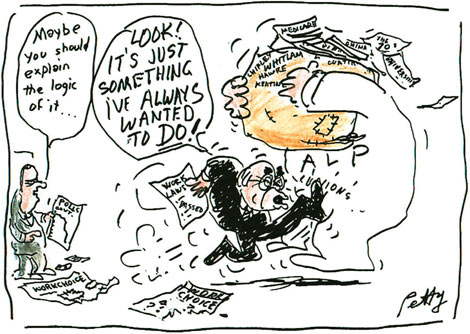
Bruce Petty
Neo-liberalism is a particular type of rationality that came to link up the multiple strands of the critique of the welfare state and Keyensian economics in the 1970s. The archilles heel of this welfare mode of governance was the failure to counter inflation and the way that it gave too much power to governments and bureaucrats.
December 4, 2005
Hegel, abstract right, liberalism.
Hegel understands the abstract right of liberalism as the sphere of the legal personality concerned with the external actions of individuals insofar as they impede on the external freedom of others. It is a formal right that is divorced from morality and ethical considerations.
The legal personality is also abstract and coincides with the natural being of the individual.
Is this not the understanding of freedom of the neo-liberalism of the New Right at the Institute of Public Affairs who define the New Right and its agenda of the efficiency of markets, a distrust of government intervention in the economy? Their policy agenda was one freeing the labour market, eliminating tariff protection, privatisation of state-owned assets, applying competition to government services and reducing the size of government, to create the abstract right of freedom.
December 3, 2005
the politics of fear
I've returned to reading Carmen Lawrence's Lectures on Fear and Public Policy. I'm reading the third lecture entitled Fear and Annihilation.
In this lecture she quotes from Ernest Becker's psychologically-orientated Denial of Death (1973), where it is argued that:
"Ours is an age in which fear appears to be a major driving force; the "logic of our times, as one commentator put it, "never mind the evidence, just focus on the possibility"; there is a general tendency to exaggerate worst-case scenarios....Fear has become the dominant currency of modern public life---fear about security, about obesity, about flu pandemics, about paedophiles about flesh eating viruses and so on and so on. We almost expect some dark new apocalypse every day. While fear might begin with the things we fear, "over time, with enough repetition and expanded use, it becomes a way of looking at life."
That is a fair description of the emotional public mood we now live in. I don't know the work of Becker, but he appears to reworking the Nietzschean/Heidegger thesis that a central concern of culture is to prevent a regular awareness of death.
Becker argues that out of a sense of terror at this self-evident and persistent fact, we have structured our reality so as to deny it. The way in which that is accomplished is through what Becker called heroic projects. Becker called these activities the vital lies (myths for Nietzsche) we live by in order to avoid a continuous, overwhelming terror of our predicament of mortality. We need our illusions because our situation is so terrible that without illusions and myths we must go mad. Becker argues that our heroic projects leave us with a sense that we can live eternally through the belief systems of these heroic projects. Such belief systems function as absolute as well as true because they are not open to question.
Until they are undermined by the process of nihilism Nietzsche and Heidegger would add.
Some do find this kind of hermeneutical or existential philosophy nonsense. But let us stay with this existential psychology, which holds that human beings suffer from a primary death anxiety that is, contra Freud's view, irreducible to infantile fears. It states that that our primary death anxiety necessarily and quite literally drives us to distraction. Repression, if not imposed by civilization, would be self-imposed due to our need to deny the body that, in a variety of ways, especially in its anal functions, is a constant reminder of the mortality we cannot face.
Is this to onesided? Too much concentration on the negative?
Lawrence adopts a critical stance to this. She says that when people talk or write about a "war on terrorism, or more bizarrely about a "war on terror" it's not clear what they're actually talking about. Who is the adversary? When will it be over? How do you measure success? How do you decide you have won?
Well, this negative account holds that the world is a meaningless, chaotic realm of disorder, disintegration and death against which human beings need to be protected by illusions of meaning. As Lawrence points out, it is currently argued by governments that the biggest risk to our safety comes from terrorists who might attack us at any moment. This then leads to a panic to do something and so governments act to look like they are providing security. Hence we have the national security state that provides security, meaning and comforting illusions.
Lawrence adds that:
Fear should not dictate policy. While it is a technique that may be useful for incumbent politicians, it is an irrational basis for devising our domestic and foreign policy. Indeed an obsessive focus on a “War on Terror” and the fearful response which flows from it are already seriously distorting public policy. I think we must start from the premise that, horrific as they are, the terrorist acts cannot, by themselves, change societies or undermine our values. While inflicting terrible casualties, they cannot have a sustained impact, unless we act in ways which undermine the integrity of our own institutions and amplify the impact of the terrorist attacks.
My judgement is that the use of fear is being used by the conservatives to create an undemocratic national security state by winding back a liberal society in favour of Leviathan.
December 2, 2005
goodbye liberalism
Some backgroundto the way the Liberal Party has become a party of fear and reaction.
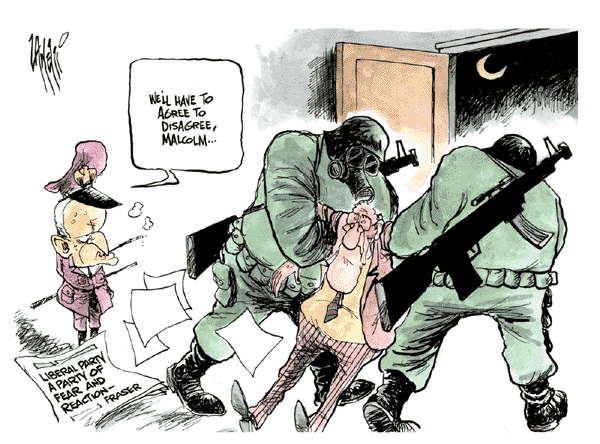
A good illustration of this post.
Will this now be seen as sedition?