January 27, 2006
Australian values
The underside of one nation conservatism that its politicians are turning to when they affirm national values as a cohesive force to unite Australia's multicultural citizens:

Leunig
Australia's national values are liberty, justice and fraternity or mateship are they not? How do these translate into the demand for multicultural Australians to completely integrate (assimilate) into mainstream (Anglo-British) Australian society? Why does ethnicity as fraternity override freedom and justice? Doesn't that mean multiculturalism is out and assimilation is in.
Doesn't this indicate that Australian values are being coded as the values of one nation conservatives?
January 26, 2006
rewriting history
I've been having terrible connectivity problems in the holiday shack at Victor Harbor thanks to a combination of Telstra, wireless modems and old computers running Windows 98. But I'm back online this morning with the old computer chucked and the Toshiba laptop working without wireless.
Sharpe
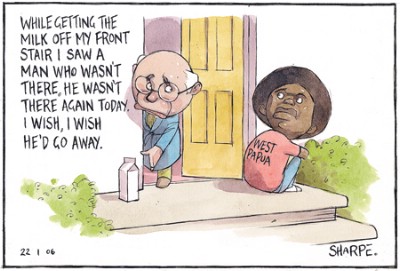
West Papua is a forgotten and marginalised story.The 43 West Papuan refugees are political dissidents. The banner emblazoning their outrigger canoe with the words ---save West Papua people soul from genocide' ---was deliberate. Under Indonesian rule their struggle has become a struggle for survival and they seek independence from an oppressive Indonesian colonialism.
Tis Australia Day in Australia today. A public holiday that celebrates Australian identity that should include an affirmation the value of freedom from political oppression as well as the freedom to live in their own state. Shouldn't we give our neighbours a hand to achieve this? Are we not fighting in Iraq for freedom and democracy. So why the concern for Iraq and not for West Papua?
The PM's speech to the National Press Club is about history:
"Too often it is taught without any sense of structured narrative, replaced by a fragmented stew of themes and issues. And too often history, along with other subjects in the humanities, has succumbed to a postmodern culture of relativism where any objective record of achievement is questioned or repudiated."
Questioning and repudiation are not the same thing are they? One does not necessarily lead to the other, does it? And Howard wants to subordinate difference (the fragmented stew) to identity (structured narrative).
The PM wants a grand narrative historical narrative about the nation stated taught in the schools that is linked to citizenship and grounded on universal western values.
John Howard says:
Part of preparing young Australians to be informed and active citizens is to teach them the central currents of our nation’s development. The subject matter should include indigenous history as part of the whole national inheritance. It should also cover the great and enduring heritage of Western civilisation, those nations that became the major tributaries of European settlement and in turn a sense of the original ways in which Australians from diverse backgrounds have created our own distinct history. It is impossible, for example, to understand the history of this country without an understanding of the evolution of parliamentary democracy or the ideas that galvanised the Enlightenment.
How can you honestly teach all that without, questioning, criticism or critique? The conservative account wants to , dampen down, if not do away with critique to ensure social cohesion and national unity. So who is going to do the critical thinking in the nation if critical thinking is not taught in the schools?
John Howard does not acknowledge diversity, but he subordinates it to the dominant cultural pattern. He says:
Most nations experience some level of cultural diversity while also having a dominant cultural pattern running through them. In Australia’s case, that dominant pattern comprises Judeo-Christian ethics, the progressive spirit of the Enlightenment and the institutions and values of British political culture. Its democratic and egalitarian temper also bears the imprint of distinct Irish and non-conformist traditions.
Note the absence of capitalism in that account and the failure to acknowledge the working class's long struggle for a better and more just Australia.
Wasn't the progressive spirit of Enlightenment based on critique of power, bigotry, prejudice and superstitution? Strikes me the PM's speech has a bit of contradiction running through it.
January 22, 2006
West Papuan refugees fleeing Indonesian oppression?
Late last week 43 Papuans (36 adults and seven children), who reportedly include prominent pro-independence activists and their families, arrived on the coast of Australia's Cape York Peninsula on Wednesday aboard a large outrigger canoe in an apparent bid for asylum.The political nature of their flight from Indonesia was highlighted by a banner strung on their canoe that accused Indonesia of genocide in West Papua, a former Dutch colony that Indonesia took over in the 1960s.
They appear to be political refugees. They claim they were fleeing oppression in Indonesia. What will Australia do with them? The group has been detained on Christmas Island in immigration detention. Will the asylum seekers be granted asylum in Australia? Each case will be assessed on its merits says the Department of Immigration, Multicultural and Aboriginal Affairs (DIMA).
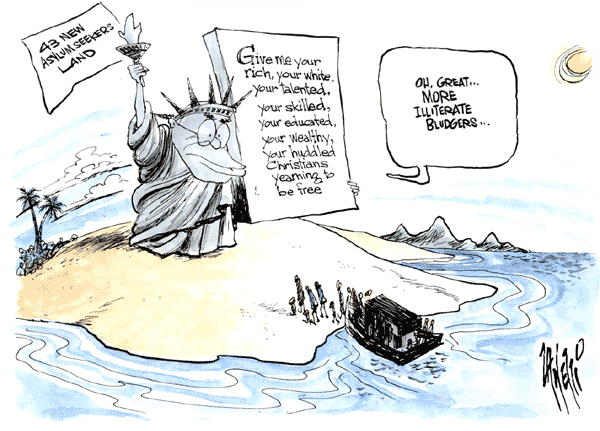
Australia and Indonesia are currently negotiating a new security treaty that is expected to include a pledge by Canberra not to interfere in provinces like West Papua----a clause requires respect for Indonesia's "territorial integrity". This Report gives some background to the oppressive regime Indonesia has installed in West Papua or Iran Jaya.
Over the years, Papuans have sought refugee status over the border in Papua New Guinea, but have that avenue has recently been closed off by the PNG Government. Seeking sanctuary in Australia seems to be a last resort measure by these refugees. Will Australia send them back to Indonesia?
More than Indonesia's 'territorial integrity ''is involved here.
January 20, 2006
political power as holding the fort
Bob Carr, the ex-Premier of New South Wales, on political life as a soldiering on:
It is a work in progress. It's always been the case ... every day as it was for Marcus Aurelius. Years from now I'll think fondly of the days when you get up and there's a bad poll on your leadership leading the news; and your leadership - in opposition or government - is being questioned. As you leave home you look at Helena and groan and think there's got to be a better job than this; and she says just go and sort them out.You come into Parliament and you start dealing with the problems and issues of the day with the staff and the public servants; and you go into the caucus and you give them the homily of the week; and get them ready for Parliament; and you do your press conference rebutting the criticism and putting forward the alternative plan; and at question time, with your armour on, you stand up and you belt them away; you come out at 3.30 - blood and flesh spattered everywhere - and you're still holding the fort."
Soldiering on to hold the fort is about retaining power. Carr was a product and servant of the NSW right-wing Labor machine. What has always mattered in NSW is not the record of achievement but the raw fact of being in power. The achievement of the Carr Government has been to scrimp and save to pay back public debt at the expense of public works and keep the rating agencies on side.
They do not even want to make the state a better place for the citizens of NSW They are not concerned about democracy. If the political ethos of the NSW Labor Right is holding the fort, where then are the citizens of NSW? Outside the fort? Tis a protective conception of liberal democracy.
January 19, 2006
authority
A review in the Washington Post of some books on the US as a superpower that seeks to sidestep restraints on its sovereignty in the post 9/11 landscape. None of the books appear to speak of empire, the grab for executive power by the Bush administration, or the imperial presidency's extensive use of torture and surveillance in the war against terrorism.
This is more interesting----political view of the rule of law as arising from a balance of power between and within the legislative and judicial branches. But no concern is shown for the tense relationship between the state of exception in which we live and the rule of law by the national security state. There appears to be little interest in exploring the foundation and authority to suspend the law.
Who guards the constitution then?
It's as if authority has disappeared from the modern world. It would appear that liberalism opposes authority to freedom and authority to democracy, as it tacitly equates authority with dictatorship. Does not the Senate have authority? An authority grounded on the people? Does not this highlight an empty centre in liberalism?
It is becoming ever more obvious that authority under the Bush administration is increasingly being located within, or as inhering in, the riving person of the President as pater or princeps and not in Congress. This suggests that the authority of the President can never be derivative: it is always originary as it springs from his person and not from a pre-existing legal order. That authority in the state of exception in which we live is founded on the supension, or neutralization of, the juridical order of a liberal polity.
January 17, 2006
a neo-con map of the Middle East
This is a very clear representation of the neo-conservative understanding of the US intervention into Iraq and the Middle East. It is a map of the imperial president's messianic mission to bring liberal democracy to Iraq and the Middle East. I presume that the light of democracy stands for a secular enlightenment in a dark world of Islamic fundamentalism: an Islamism that is anti-Western, anti-capitalist, anti-liberal and anti-Semitic.
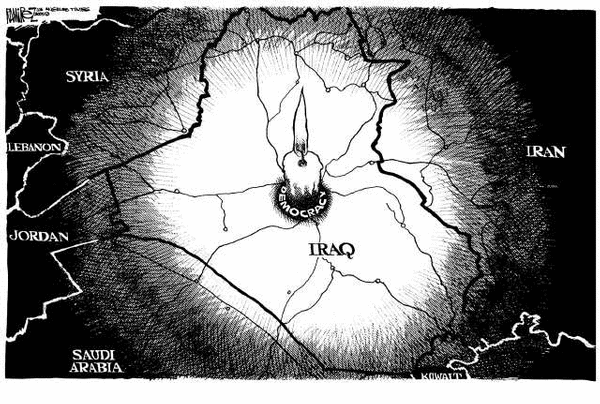
It is a suprising map because the reality on the ground in Iraq is that a majority of Iraqi's want the coalition forces to withdraw. The occupation is the problem for them. If Iraq were to become sovereign and democratic, then the Shia population in the South, where much of Iraq's oil is, would have a predominant influence, and they would prefer friendly relations with Shia Iran. They do not want the Coalition to set up a client regime with military forces that the US can control.
A question: if the US or its client regime cannot rule Iraq, then is Washington's policy to regress the country into an "Afghanistan" of warring clerical and ethnic warlords and tribal chieftains based on min-fiefdoms?
Suprisingly, what is not mentioned in the map is the region's relative importance as a source of petroleum, given the limits of the world's oil supplies and surging growth of the Asian economies causing a huge increase in global demand.
And where is Israel? Is not that Jewish nation-state a key to US geo-political strategy in the Middle East?
Is not the nuclear non-proliferation in the Middle East already been broken by Israel? Are we heading for a situation in which an Islamic Tehran has a nuclear missile pointed at Tel Aviv and a right wing Israeli government has a missile pointing right back at Tehran?
Washington's push for Security Council economic sanctions against Iran will likely fail because of a China/Russia veto. Will the Bush administration's principle of pre emptive strike be invoked to thwart Iran's nuclear aspirations? Or rather Israel will attack Iranian experimental nuclear energy site with the complicity of the Bush Administration in the White House and a Republican Congress. Presumably, Iran will defend itself if it is attacked by Israel.
What I hear is the American media's war drums beginning to beat, as they give space for the neo-con hawks to talk about Iran's "nuclear weapons", it's " nuclear weapons program", and its long-range plan for hostilities against the geo-political interests fof the US or Israel.
I reckon that Iran will get the bomb. And the US will have to live with it. I refuse to accept the way the US media is currently framing the issue.
January 16, 2006
democratizing democracy
A distinction is often drawn between the protective and the developmental versions of liberal democracy. This distinction is useful because it is often argued that a liberal protective democracy does not imply any further democractizing of society, precisely because in this model democracy is instituted to protect other values and political ends that have a higher priority. An example is wealth creation and a strong economy under a neo-liberal mode of governance.
This article by Craig Brown in Contretemps quotes Geoff Stokes as saying that:
The main internal aim and justification of theories of protective democracy is to protect individual citizens from arbitrary rule and oppression by government, as well as from infringements upon individual liberty from other citizens. Democracy is an institutional instrument, based upon actual or implied contracts, for protecting the legal and political rights of individuals. In addition, all are united by their understanding of democracy as a procedure for choosing governments, and a preference for a minimal role for citizen participation.
Democratization is effectively subordinated to the constraints that the capitalist market imposes on social and economic reproduction within a nation state. Hence all state ALP governments in Australia are governed by the need to maintain a triple-A rating. They are fiscally conservative.
It is the kind of liberal democracy that we live with in Australia. democracy as a procedure for choosing which section of of the political class forms government and it ensures a minimal role for citizens.
January 12, 2006
limits of deliberative democracy?
According to the advocates of deliberative democracy, citizens' participation in the democratic process has a rational character. Deliberative democracy explains the process of opinion and will-formation as a public discursive activity where citizens are engaged in argumentation that is aimed at promoting the more generalizable interests by the force of a better argument.
What has happened to freedom? Freedom to shape things? Freedom to decide between different policy options? Isn't discussion and debate a step in the process of arguing for this policy option rather than that? For more money to spent on health care as opposed to tax cuts for the wealthy? And that involves negotiating and deal making.
What has happened to power. It's rarely the case that the better argument wins the debate. People listen to your argument when you hold the balance of power in the Senate.
January 11, 2006
another kind of freedom
Another kind of freedom, as articulated by Wendy Brown in an interview in Contretemps, is outlined below. I'd read her book States of Injury many years ago and thought it to be good. Brown says:
It is the powers that circulate through the social--whether they are for Marx 'capital', or for Foucault 'discipline' or other forms of 'biopower'---that have to be transformed in order to produce something other than freedom from one another, freedom from the state, or freedom from something that makes you miserable. It is Marx's notion of freedom with others that is compelling. Of course, Marx gets this from Aristotle, but he does a lot to it, and Rousseau also develops this in quite beautiful, if finally limited, ways....there is no such thing as individual freedom, that human freedom is finally, always a project of making a world with others. ..... It is also a Spinozist theme. You can, of course, get a limited form of liberty through liberal formulations of freedom, but because of our interdependence and relationality, not only in labour, but in a whole other set of media, we can't find freedom against one another---it finally will be with.
This claim is set up against Hegel's individualist conception of freedom---'Where Hegel has an individual consciousness, making its way through history, making its way toward freedom'. This ignores the role of the corporations as a bridge from the individualism and atomism of civil society to the universal ethical life of the state. For Hegel in the corporations, as in the family, the individual learns to subordinate their self-interest to the whole. The family and corporations are those forms of ethical life by which the atomism of civil society is transcended and individuals begin to orientate themselves to a whole that transcends their private self-interest.
Liberals would now go on about Hegel's totalitarianism at this point but swap 'association' for 'corporation' in civil society and the point remains: the countervailing power to the atomism of civil soceity comes from civil society and is not imposed from without by the totaliatarin state.
So Hegel gives an account of how Brown's shift of 'freedom from others' to 'freedom with others' can take place. Tis a plausible account of how citizenship is formed; and citizenship is a subject on which Marx did not have much to say. Neither does Brown.
She acknowledges the flaw in Marx:
To return again to Marx, I think he made it too simple, since the whole project of freedom with others was allowed to come to rest in labour, rather than in what we have come to understand as a multiplicity of other activities where difference actually has a more persistent rather than resolvable quality. That is the burr under the saddle of the project. On the other hand, I don’t think that difference stymies or overthrows it. Difference complicates it. The project of freedom with others means not only beginning to look to some sort of sharing of power or collective engagement with the powers that condition our lives, but requires reckoning with the unknowable, the enigmatic, the uncomfortable, without then ceding to a radical libertarian 'let us all go off with our
differences' as if they were natural and ahistorical.
The categories of state and citizenship kinda disappear in her account The distinction between civil society and state (and between bourgeois and citoyen) that was so crucial for Hegel, has been forgotten. Nor do they return when Brown discusses liberalism in its social form and its impoverished conception of power. She seems to have become disconnected from the civil republic tradition which reverberates through, and underpins Hegel's distinctions.
January 9, 2006
Ariel Sharon: a man of peace?
How can Ariel Sharon and Israel can be described as the main proponent of peace in the Middle East, given Israel's ongoing removal of the Palestinians from what will soon be a greater Israel, its occupation of the Palestinian territories in the West Bank and Gaza, and Israeli aggression against the Palestinian population in West Bank and Gaza for nearly thirty-eight years? Robert Fisk's judgement.
The peace move is the answer in the Australian media. As Lenin's Tomb states it:
Ariel Sharon has had a stroke, and suddenly the Israeli-Palestine conflict is supposed to be set go aflame again... Sharon had a plan for peace, and now it could all be in ruins, wrecked by a tiny clot of blood, and woe betide the Palestinians, woe betide Israel.
The peace plan--ie., the withdrawal from Gaza--- is described by Dov Weisglass, Sharon's chief political strategist and advisor, as follows:
The disengagement is actually formaldehyde. It supplies the amount of formaldehyde...The political process is the establishment of a Palestinian state with all the security risks that entails. The political process is the evacuation of settlements, it's the return of refugees, it's the partition of Jerusalem. And all that has now been frozen....And when you freeze that process you prevent the establishment of a Palestinian state and you prevent a discussion about the refugees, the borders and Jerusalem. Effectively, this whole package that is called the Palestinian state, with all that it entails, has been removed from our agenda indefinitely. And all this with authority and permission. All with a presidential blessing and the ratification of both houses of Congress. What more could have been anticipated? What more could have been given to the settlers?
This is not a policy to facilitate the establishment of a genuinely independent Palestinian state or Israel's withdrawal to the 1967 borders.
The U.S government provides the ideological, military, and diplomatic cover for Israel's occupation and its steady stream of human rights violations in the occupied territories. The Israeli government's illegal occupation and oppression of the Palestinians in West Bank and Gaza has continued because Israel is militarily and diplomatically supported by its superpower patron, the United States. The strategy is to exempt Israel from the basic requirements of international law and to shield Israel from the condemnation and sanctions its behaviour deserves.
Power politics determines the rules and the discourses through which to apprehend reality. We in Australia view the Palestinian Israeli conflict through a US lens. That discourse, at its crudest, is totalitrarian: it is one that says the Jews are victims not perpetrators; Israel is vulnerable; the Arab world's resistance and anger toward Israel can only be blamed on an inexplicable anti-Semitism; and anyone who disagrees with us is an anti-Semite. So speaks the pro-Israel lobby.
The reality is that the conflict is a straightforward one arising from resistance to occupation : one marked by the disposession of an indigenous people (the uprooting of the Palestinians in 1948 1948), an occupation by military conquest, and exercising control over the Palestinians in the occupied territories through the use of torture, political liquidations, unlawful and deliberate killings, arbitrary detentions (by the tens of thousands), house demolitions, use of civilians as human shields, attacks on ambulances, and what Amnesty calls "reckless shooting, shelling and aerial bombardment of residential areas". Zionist colonisation is the basis for the criticism of Israeli policy; a criticism based on making distinctions between Judaism and Zionism, Jews and Israel, and politics and ethnicity.
Evan Jones has a great post on this over at Alert and Alarmed consisting of extracts from Uri Davis Apartheid Israel (2003)
January 8, 2006
Arendt, praxis, political life
In his "review of Dana Villa's Arendt and Heidegger: The Fate of the Political, Charles Bambach says that on Villa's interpretation of Arendt the distinction between praxis and poiesis, acting and making, is absolutely central to Hannah Arendt's theory of political action, her critique of the philosophical tradition and her analysis of modernity. Bambach says that against the vita contemplativa, the Western tradition's privileging of Socrates' ideal of the bios theoretikos and the Augustinian model of contemplative stillness:
Arendt puts forth the possibility of an active life that reverses the hierarchy of contemplation and steadfastly asserts the value of human activity. In both Marx and Nietzsche, Arendt locates the sources for this reversal even as she questions their effect on genuinely changing what she terms "the conceptual framework" of the Western philosophical tradition... Arendt further complicates her analysis of the action/contemplation split by juxtaposing it with categories derived from Aristotle's Nichomachean Ethics, explicitly the distinction between praxis and poiesis. Praxis for Aristotle designates the realm of human "action," whereas poiesis can be defined as the realm of "productive activity." As Aristotle sees it, production realizes itself as activity only when it achieves some result or product. In this sense, as Aristotle lays it out in Book Six of the Nichomachean Ethics: "praxis (action) and poiesis (production) are generically different . . . . production has an end other than itself, but action does not.... [Rather] action is itself an end" (NE 1140b). Arendt finds in this fundamental Aristotelian distinction between praxis and poiesis the philosophical basis of her own critique of Western contemplation
Arendt's Heideggerian strategy is to dispense with the whole notion of any subject-centered "perspective" and recover not concepts, but a certain way of being-in-the-world.
Following Aristotle, Arendt defines the essence of politics as "action." But where Aristotle comes to understand political activity on the model of poiesis as a kind of "crafting" of political life, thereby privileging of poiesis over praxis as a way of determining human affairs. Arendt breaks with him in order to recover the freedom of political action: vita activa as praxis as an activity that has no end outside of itself. Political life is the public sphere, (as distinct from the family and the economy) and is the arena in which we are uniquely able to express our human capacity to jointly address common concerns.
Arendt uses this understanding of the vita activa as a way of critiquing both the liberalism of a consumerist social ethic as well as the totalitarianism of an instrumentalist bureaucracy in "the modern age", which she equates with the European project of technical-instrumentalist activity since the seventeenth century). In modernity contemporary life winds up being caught within this instrumentalist mode of being, a mode that leads humanity to desire ever more power and control over the world of nature.
This is usually interpreted in the secondary literature as an updated version of Aristotelian praxis with Arendt interpreting praxis as phronessis. Villa argues that Arendt's conception of poliical life needs be interepretated through Heidegger's critique of Cartesian subjectivity and its corresponding instrumentalism. By deconstructing the Cartesian will to mastery (reconfigured as Nietzsche's will to power), Heidegger pointed to a new ontological sense of freedom--not of the self-grounding subject, but of human Dasein as a form of "being-in-the-world." For Arendt, this implied that human freedom was marked by finitude, contingency, and worldliness-properties that reinforced the public character of existence rather than the privatized, interior, and abstract world of the Cartesian subject.
Bambach then says that:
Villa argues that Arendt "politicizes" Heidegger's existential lexicon by inverting the Heideggerian identification of authenticity with interiority and inauthenticity with the public world of the "they-self." In Arendt's view, Heidegger has offered a brilliant critique of modern subjectivity, but he has, nonetheless, fallen victim to the same invidious privileging of the authentically interior vita contemplativa against the inauthentically public vita activa.
Bambach argues that this account is based on Villa interpreting Heideggerian authenticity as a phenomenon of the "private" realm and inauthenticity as something "public." He then argues that Arendt inverts these categories and manages to wrest free the positive, Aristotelian meaning of public discourse from the Heideggerian realm of "idle talk," "publicness," and the "they-self." He says that this account underplays or misses the deeply political nature, of Heidegger's work after 1935.
January 7, 2006
sovereign power & biopower
The point of departure of Gorgio Agamben's little text Homo Sacer: Sovereign Power and Bare Life is the concept of bio power in Foucault's The History of Sexuality. Mika Ojakangas says:
For Foucault biopower is an essentially modern form of power and its purposeis to exert a positive influence on life, to optimise and multiply life by subjecting it to precise controls and comprehensive regulations. In contrast to this power Foucault opposes the classical sovereign power that was exercised mainly as a means of deduction--the seizing of things, time, bodies, and ultimately the seizing of life itself. Although Agamben admits that our societies are biopolitical ones, he nevertheless sees the Foucauldian opposition between biopower and sovereign power as superfluous. According to him, in fact, these models of power essentially intersect, although in a previously concealed manner. Agamben calls "bare life"---the life of homo sacer that is exposed to an unconditional threat of death--the hidden point of intersection between the sovereign and bio-political models of power.
I concur with that argument as I have argued in terms of the national security state, the state of emergency and the war on terror. Not so for Mika Ojakangas.
January 6, 2006
preconditions for technology parks#2
It was around the mid-1980s that the big shift towards business and wealth took place in government strong and in society. Under a neo-liberal mode of governance it became not only reputable to be wealthy, but something close to virtuous. There were "winners" and there were "losers," and the winners were rich and deserved to be. The losers deserved to be poor.
But how to create winners when Australian capitalists were so second rate and the wealth of the nation was at stake? One answer was technology parks which signified the translation of tax-supported basic research into useful new products---a process sometimes referred to as technology transfer." The strategy of technology transfer was to create Australian entrepreneurs, and to nurture the start up technology companies into Australian-owned high-tech businesses that would then compete in world markets.
It worked like this. In public universities, where most public funded research work is carried out, researchers can now patent and license their discoveries, and charge royalties. They could also enter into deals with drug companies that would directly transfer their public discoveries to industry. This gave a boost to the nascent biotechnology industry, as well as to big pharma. This article gives a good description of the process:
Small biotech companies, many of them founded by university researchers to exploit their discoveries, proliferated rapidly. They now ring the major academic research institutions and often carry out the initial phases of drug development, hoping for lucrative deals with big drug companies that can market the new drugs. Usually both academic researchers and their institutions own equity in the biotechnology companies they are involved with. Thus, when a patent held by a university or a small biotech company is eventually licensed to a big drug company, all parties cash in on the public investment in research.
Academic capitalism it is called. The talk was of cities of knowledge and the model to emulate was Silicon Valley as Australia's neo-liberal policymakers endeavoured to push and shape universities into trying to create new Silicon Valleys.
In this review by Jane Marceau of Margaret Pugh O'Mara's Cities of Knowledge: Cold War Science and the Search for the Next Silicon Valley helpfully spells out the preconditions for the flowering of Silicon Valleys:
Lesson One, she says, is that, to be successful, you need a lot of money. And money follows money....Lesson Two is that you need a very powerful university. Successful cities of knowledge in the United States have strong research universities at their centre...Lesson three is that you need control over land in the right location; in short you need control over the development of large parcels of land in locations desirable to middle class professionals...Lesson Four is that you need to make high tech development the end, not the means. This somewhat more complex lesson suggests that it is only universities that focus totally on creating science research and high tech industries for themselves will succeed.
As Marceau says that in Australia it is hard to see how these prerequisites are to be achieved. Our public universities seldom own large parcels of undeveloped land and most state governments have increasingly divested themselves of their own land banks. Our federal governments have not given out large amounts of money for research. The funds they provide for new science is almost derisory in most fields and more general federal funding for universities has fallen consistently in recent years. And industry gives little money for research in universities in Australia.
January 5, 2006
the emergency as the norm
Some remarks by Robert Senator Byrd :
Americans have been stunned at the recent news of the abuses of power by an overzealous President. It has become apparent that this Administration has engaged in a consistent and unrelenting pattern of abuse against our Country's law-abiding citizens, and against our Constitution.We have been stunned to hear reports about the Pentagon gathering information and creating databases to spy on ordinary Americans whose only sin is choose to exercise their First Amendment right to peaceably assemble. Those Americans who choose to question the Administration's flawed policy in Iraq are labeled by this Administration as "domestic terrorists."
Isn't this an indication of the state of exception? One that has become the normal paradigm of government? One indicated by President Bush's claim to sovereign powers in emergency situations. Isn't President Bush attempting to produce a situation in which the emergency becomes the rule and the very definition of the difference between peace and war is blurred.
January 4, 2006
constitutional challenges
A good article by Creg Craven on the forthcoming constitutional challenge to the use of corporation powers in the constitution to underpin and legitimate the recent industrial relations reforms by the Howard Government. Craven highlights the key issue:
In this new constitutional game, all the rules are changed. For a start, incredibly, this has ceased to be a political fight between Liberal and Labor over industrial relations.It is now a highly technical fight between the Commonwealth and the states over the reach of Canberra's corporations power. This is because Howard's legislation is based on the use of the corporations power to regulate the industrial relations envelope of corporations.........The central problem for the Government is that the High Court - usually co-operative towards Canberra - always has nursed a certain nervousness towards the corporations power. The reason is simple. The central expression in the power is "trading corporations". There is no real difficulty in letting the Commonwealth control the trade or trade-related activities of corporations. That obviously goes to the heart of the power.What if the Commonwealth asserted the power went further, and allowed it to control not just those matters loosely affecting the trade of trading corporations, but every one of their activities, however remote from trade? What if it argued the power also allowed it to regulate a wide range of activities of third parties dealing with trading corporations, again in contexts remote from trade?
That signifies a shift in political power from the states to Canberra. As Craven observes, that means a highly corporatised Australia, in which:
"...the Commonwealth [would have] vast power over an enormous range of activity conducted by and around corporations, which now is controlled by the states. This could include control of hospitals, universities, private schools, local government, town planning and environmental regulation.This is the real hot spot in the industrial relations litigation."
Will the High Court be prepared to concede such sweeping powers to the Commonwealth? it goes to the heart of federalism which the High Court says that it has a duty to defend.
January 2, 2006
human beings are made into subjects
Another quote from the Introduction to Johanna Oksala's book Foucault on Freedom. These quotes explore the way that human beings are shaped, and shape themselves, into modern subjects. This does away with the idea of the natural human being standing autonomously outside networks and relations of power.
Oksala says that:
Foucault characterized his work as a genealogy of the modern subject: a history of the different modes by which, in our culture, human beings are made subjects. He further distinguished three modes of objectification that transform human beings into subjects. These modes correspond with three relatively distinct periods in his thought (SP, 208.)
Oksala says that:
The first is the modes of inquiry that give themselves the status of science. Human beings are turned into subjects in processes of scientific study and classification, for example, into speaking subjects in linguistics, subjects who labour in economics, subjects of life in biology. Foucault's archaeology deals with this first mode in analyzing systems of knowledge. In The Order of Things he showed how the discourses of life, labour and language historically developed and structured themselves as sciences, and how human sciences further constituted man as their object of study.
The second mode of shaping to be found in Foucault's work is associated with his genealogies.
Oksala says that the texts of this period studied:
"....what he [Foucault] himself called 'dividing practices' (SP, 208). These are practices of
manipulation and examination that classify, locate and shape bodies in the social field. His books Discipline and Punish and the first volume of The History of Sexuality are inquiries into this second mode of objectification. He shows how modern disciplinary technologies constitute the subject as their object of control: human beings are examined,measured and categorized. This process defines them as modern individuals. The disciplinary mechanisms do not shape subjectivity only by external coercion; they also function through being ‘interiorized’. In The History of Sexuality, for example, Foucault shows how our belief in a true sexual nature is a disciplinary mode of knowledge that makes us objects of control as well as subjects of sexuality.
The third mode of the shaping of the human being into a modern subject is the ethical one. Oksala says that the
third phase of Foucault’s work, represented by volumes 2 and 3 of The History of Sexuality. These texts study:
...the way the human being turns himself or herself into a subject. It is an analysis of the subject's relationship to itself in the domain of sexuality. He asks how human beings recognize and constitute themselves as subjects of sexuality. The subject's self-understanding and relationship to the self are important dimensions in the constitution of forms of subjectivity. The subject is studied now not only as an effect of power/knowledge networks, but also as capable of moral self-reflexivity ---critical reflection on its own constitutive
conditions---and therefore also of resistance to normative practices and ideas. Subjects constitute themselves through different modes of self-understanding and self-formation.
What this does deny is the denies the autonomy of the subject since the subject is always constituted in
the power/knowledge networks of a culture. As Oksala comments the modes of self-knowledge and techniques of the self that we subjects utilize in shaping ourselves as subjects of sexuality or politics are not created or freely chosen.' She adds:
Rather, they are culturally and historically intelligible conceptions and patterns of behaviour
that subjects draw from the surrounding society. Self-understanding is internally tied to historically varying social and discursive practices ---techniques of governmentality. The governing of oneself is tied to the governing of others.
January 1, 2006
re-thinking freedom after poststructuralism
This quote is an extract from the Introduction to Johanna Oksala's book Foucault on Freedom. She says:
The charges against Foucault's thought in contemporary debatesoften focus on the question of the freedom of the subject and the notions that are understood as intrinsically tied to or dependent on it: autonomy, authenticity, responsibility, political agency. According to many of Foucault's critics, the denial of an autonomous subject leads to the denial of any meaningful concept of freedom, which again leads to the impossibility of emancipatory politics. When there is no authentic subjectivity to liberate, and power, as the principle of constitution, has no outside, the idea of freedom becomes meaningless. Since we are always the products of codes and disciplines, the overthrow of constraints will not free us to become natural human beings. Hence, all that we can do is produce new codes and disciplines.
These charges have always puzzled me. Why retain 'the foundational assumption of the 'natural subject'? Are not human beings historical beings or political animals? Why retain the negative conception of liberty (freedom from restraint) as the only conception of freedom. Shouldn't that assumption also be questioned?
It has always puzzled me why the categories of natural human beings and negative liberty are taken as absolutes. It has struck me as liberal dogma of a fundamentalist liberalism. Dsogma's that do not account with the way that a neo-liberal mode of governance shapes us as enterprising market beings.
To her credit, Oksala argues that postructuralism (of Foucault) needs to be taken seriously and engaged with rather than simply dismissed.
She says:
I will argue that, rather than dismissing post-structuralist thinking as politically dangerous and trying to hold on to the autonomous, humanist subject for political or simply conservative reasons, it is more fruitful
to take seriously the major impact post-structuralist thought has had on our ways of thinking about the subject, and also to try to rethink freedom. The post-structuralist understanding of the subject clearly makes problematic many of our traditional and accepted ways of conceiving of freedom. It cannot be understood as an inherent capacity or characteristic of the subject. We cannot say that we are born free. Neither can freedom be linked to emancipation: it does not lie in finding our true or authentic nature and liberating it from the constraints of power or society. For Foucault, freedom is not the freedom of protected rights that must be safeguarded. Neither does there seem to be much point in arguing that it is the ability to choose between different courses of action and to govern oneself autonomously, if our choices themselves are culturally constituted. Freedom cannot be conceived of negatively either: it cannot be linked to the ability to think or act despite external constraints, when the external constraints are understood as the condition of possibility of subjectivity. I will show that Foucault's thought, however, opens up alternative ways of thinking about freedom. It providesus with important tools for trying to answer the question, perhaps more burning than ever: what is freedom?
That sure does open up new ground where we can begin to rethink freedom freed from the dogmas of Berlin's Two concepts of Liberty that are endlessly repeated as if they were some sort of mantra.