February 28, 2006
ALP: rhetoric and reality
Km Beazley, the leader of the federal ALP, on democracy in the ALP, on Virginia Trioli's ABC morning programme:
"What I'm going to do is defend the party's processes, defend the democratic rights of our grassroots members... I am going to give the ordinary party members the right make up their own minds. There will be proper democratic ballots throughout this party."
Is that so? Isn't the reality one in which the ALP right supports rank and file democracy when it threatens those critics on the left but oppose the rights of grassroots members when they threaten the right? Isn't the reality one in which the NSW machine is working to phase out rank and file ballots? How does thatt deliver the much needed development of an innovative policy?
Here's Martin Ferguson, a Labor frontbencher, and former president of the Australian Council of Trade Unions (ACTU). He writes in todays Australian newspaper about the lack of democracy inside the ALP:
Only 19 Labor members elected in 1996 remain in parliament today and they, together with their more recently elected caucus colleagues, are too focused - by necessity - on internal party dynamics that have a lot to do with factional dominance and little to do with a Labor view of how to make Australia a better place.The result is that after a decade in Opposition we have plenty of storytellers but not much of a story to tell. This will not be remedied by rubbing out sitting MPs in safe Labor seats in favour of party hacks with factional numbers on public office selection panels or through branch stacks.They will bring nothing to the caucus except a further choke on the free development of an innovative policy agenda and a further weakening of the elected caucus in favour of the centralisation of power to a few trade union and party officials in Melbourne, Sydney and Brisbane.
Ferguson is confirming the points Mark Latham made in the Latham Diaries.
February 27, 2006
neocon illusions
Three years after the invasion of Iraq, as you have suggested, it looks like the U.S. has created a self-fulfilling prophecy: It went to war to thwart any link between Islamic extremists and weapons of mass destruction, but has ended up creating the "Shiite Crescent" King Abdullah of Jordan worries about with religious-oriented Shiites empowered in Baghdad sympathetic to a radical Iran seeking a nuclear bomb. Now civil war is around the corner.What were the illusions of the American neoconservatives who sought this war that led to such folly?
It is asked of Francis Fukuyama. He answers:
The really big illusion was the idea that Iraq would somehow transition easily out of a totalitarian dictatorship into a peaceful and relatively successful democracy. This was a peculiar illusion for neocons because in the past neoconservative thinkers were known for being skeptical of the prospects of ambitious social engineering in U.S. domestic policy....The other important illusion was their perception of how the world would react to the U.S. invasion of Iraq. There was a belief in the legitimacy of the moral uses of American power, something the neocons share, I think, with most Americans. Unlike Europeans, Americans have a benign view of the use of force by their state from the Revolution to the Civil War to the world wars and the Cold War, in which American force was used for ultimately good, democratic outcomes.The neocons...failed to realize how in the period between the end of the Cold War up to the beginning of the Iraq war the imbalance in the distribution of power around the world created tremendous resentment and fertile ground for anti-Americanism. The neocon promoters of the Iraq war simply failed to anticipate how negatively the rest of the world would react to the use of American power in such a preemptive war.
A good answer, don't you think?
February 26, 2006
ALP: payback
The event. An ex-leader of the ALP is to be rolled at pre-selection with the blessing of the ALP leadership, despite an unequivocal pledge a year ago that Simon Crean shouldn't be nudged aside?
The implication? The federal ALP is a party divided between the factions of right, centre and left:
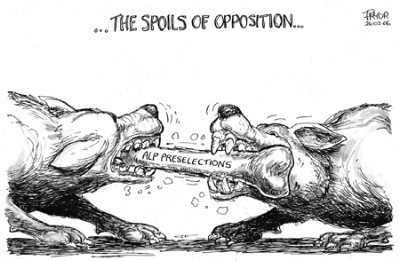
Geoff Pryor
It is a party that has a dysfunctional culture based around smear and innuendo in which the machine men preserve their hierarchy of command and control by ensuring tha the people below them say yes and yes. As Mark Latham says in the Latham Diaries:
It's a dense network of influence, a political mafia full of favours , patronage and, if anyone falls out with them, payback. (p. 399)
We are witnessing payback against Simon Crean now by the Right, because Crean organized Latham for leadership against Kim Beazley after Simon Crean was dumped as leader of the ALP by the Right.
Latham spells out the dysfunction:
Each machine man is determined to run something, and if they can't run a full faction, they have split the groups into their own little fiefdoms. It may involve just two or three people, but they see it as a power base of sorts...This has led to chaos in Caucus, and the institutionalization of conflict: fiefdoms fighting fiefdoms about all sorts of trivial issues. In Opposition, the problem is worse because of the lack of positions and patronage to hold them together as a cohesive federation. (p. 399)
Hence the politics of the lowest common demoninator.
February 24, 2006
The French New Right on the crisis of modernity
I have mentioned previously that the French New Right has some intellectual grunt that is lacking in an Anglo-American conservatism characteristed by traditonalism, national security, a dislike of multiculturalism and the free market.
The compass of the French New Right centres on the crisis of modernity. Modernity is understood as the political and philosophical movement of the last three centuries of Western history. It is
"... characterized primarily by five converging processes: individualization, through the destruction of old forms of communal life; massification, through the adoption of standardized behavior and lifestyles; desacralization, through the displacement of the great religious narratives by a scientific interpretation of the world; rationalization, through the domination of instrumental reason, the free market, and technical efficiency; and universalization, through a planetary extension of a model of society postulated implicitly as the only rational possibility and thus as superior."
The crisis of modernity is understood in the following terms:
The destruction of the lifeworld for the benefit of instrumental reason, economic growth, and material development have resulted in an unprecedented impoverishment of the spirit, and the generalization of anxiety related to living in an always uncertain present, in a world deprived both of the past and the future. Thus, modernity has given birth to the most empty civilization mankind has ever known: the language of advertising has become the paradigm of all social discourse; the primacy of money has imposed the omnipresence of commodities; man has been transformed into an object of exchange in a context of mean hedonism; technology has ensnared the lifeworld in a network of rationalism---a world replete with delinquency, violence, and incivility, in which man is at war with himself and against all, i.e., an unreal world of drugs, virtual reality and media-hyped sports, in which the countryside is abandoned for unlivable suburbs and monstrous megalopolises, and where the solitary individual merges into an anonymous and hostile crowd, while traditional social, political, cultural or religious mediations become increasingly uncertain and undifferentiated.
It is held that this general crisis is a sign that modernity is reaching its end, precisely when the universalist utopia that established it is poised to become a reality under the form of liberal globalization.
More specifically
The end of the 20th century marks both the end of modern times and the beginning of a postmodernity characterized by a series of new themes: preoccupation with ecology, concern for the quality of life, the role of ""ribes" and of "networks," revival of communities, the politics of group identities, multiplication of intra- and supra-state conflicts, the return of social violence, the decline of established religions, growing opposition to social elitism, etc.
Liberalism is a problem because it embodies the dominant ideology of modernity
In the beginning, liberal thought contraposed an autonomous economy to the morality, politics and society in which it had been formerly embedded. Later, it turned commercial value into the essence of all communal life. The advent of the "primacy of quantity" signaled this transition from market economics to market societies, i.e., the extension of the laws of commercial exchange, ruled by the "invisible hand," to all spheres of existence. On the other hand, liberalism also engendered modern individualism, both from a false anthropology and from the descriptive as well as normative view based on a one-dimensional man drawing his "inalienable rights"from his essentially asocial nature continually trying to maximize his best interest by eliminating any non-quantifiable consideration and any value unrelated to rational calculation.This dual individualistic and economic impulse is accompanied by a Darwinian social vision which, in the final analysis, reduces social life to a generalized competition, to a new version of "war of all against all" to select the "best.""Aside from the fact that "pure and perfect" competition is a myth, since there are always power relations, it says absolutely nothing about the value of what is chosen: what is better or worse.
February 23, 2006
Windshuttle attacks the left-yet again
Keith Windshuttle carries the intellectual flag for Australian conservatism these days. His most recent paper is 'The Adversary Culture: The perverse anti-Westernism of the cultural elite', which was given at the Summer Sounds Symposium in Punga Cove in the Marlborough Sounds of New Zealand. It is a theme that the conservatives go on about at great length.
Rafe Champion over at Catallaxy reckons this is an important paper, as it 'highlights the importance of the cultural agenda, in addition to the more obvious political battles that have to be waged to defend western civilisation as we know it. ' Is it important?
Let's see. Windschuttle starts thus:
For the past three decades and more, many of the leading opinion makers in our universities, the media and the arts have regarded Western culture as, at best, something to be ashamed of, or at worst, something to be opposed. Before the 1960s, if Western intellectuals reflected on the long-term achievements of their culture, they explained it in terms of its own evolution: the inheritance of ancient Greece, Rome and Christianity, tempered by the Renaissance, the Reformation, the Enlightenment and the scientific and industrial revolutions. Even a radical critique like Marxism was primarily an internal affair, intent on fulfilling what it imagined to be the destiny of the West, taking its history to what it thought would be a higher level.Today, however, such thinking is dismissed by the prevailing intelligentsia as triumphalist.
Okay. This refers to the postmodern questioning of the grand narratives. So what is wrong with that?
Windschuttle says that the today's overwhelmingly negative critique of Western civilization is based on relativism:
According to this ideology, instead of attempting to globalise its values, the West should stay in its own cultural backyard. Values like universal human rights, individualism and liberalism are regarded merely as ethnocentric products of Western history. The scientific knowledge that the West has produced is simply one of many "ways of knowing". In place of Western universalism, this critique offers cultural relativism, a concept that regards the West not as the pinnacle of human achievement to date, but as simply one of many equally valid cultural systems.
Really? What ever happened to immanent critique that highlights the gap between Enlightenment ideals and practice? Best not to mention that as it would destroy the message.
Shouldn't we try to resolve this conflict between univeralism and particularism in a philosophical way if it is so crucial ? Nay. Universalism is good, relativism is bad. That is all that needs to be said. Windschuttle doesn't even bother to consider the concept of reason in history that has been around since Hegel. Why bother with such philosophical concerns? Best to not introduce Nietzsche's ideas about perspectivism either. It complicates things too much even though the postmodern left relies heavily on it to justify its questioning of western universalism.
Windshuttle is no liberal. The "question of universals," for liberalism is one of nominalism, which supports the position that there is nothing beyond the particular and that human societies are made up only of individuals. So Windschuttle is dumping liberalism whilst supposedly defending universal right.
This indicates the way that Windschuttle's performance is that of a cultural warrior. It makes you hanker for the intellectual grunt of the French New Right doesn't it.
Windshuttle notes a contradiction in the postmodern kind of leftism. He says:
The moral rationale of cultural relativism is a plea for tolerance and respect of other cultures, no matter how uncomfortable we might be with their beliefs and practices. However, there is one culture conspicuous by its absence from all this. The plea for acceptance and open-mindedness does not extend to Western culture itself, whose history is regarded as little more than a crime against the rest of humanity. The West cannot judge other cultures but must condemn its own.
How does the Frankfurt School, Foucault, Derrida or Deleuze square with that claim?
After a catalogue of the various horrible consequences of this decadent adversary culture Windschuttle ends his text thus:
Today, we live in an age of barbarism and decadence. There are barbarians outside the walls who want to destroy us and there is a decadent culture within. We are only getting what we deserve. The relentless critique of the West which has engaged our academic left and cultural elite since the 1960s has emboldened our adversaries and at the same time sapped our will to resist.The consequences of this adversary culture are all around us. The way to oppose it, however, is less clear. The survival of the Western principles of free inquiry and free expression now depend entirely on whether we have the intelligence to understand their true value and the will to face down their enemies.
The left is an enemy within. It has to be stopped. It's undermining our capacity and will to fight the enemy without.
There stands the poverty of Australian conservatism for all to see. Give me the French New Right anyday.
February 22, 2006
Gittens on economic growth and wellbeing
Ross Gittens is normally seen as engaged in a debunking of neo--liberal economics. He questions those who maintain not only that 'those who participate in the economy (and enjoy the consumerist fruits of their labour) are much happier' than the unemployed, but that a higher standard of living leads to happiness.
As Ross Gittens points out:
The dominant view among our politicians, economists and business people is that society's central goal should be economic growth. Keep our material standard of living rising and the rest will look after itself.
For sure. Economic growth is held to be an unqualified good. It is beyond question. You cannot be negative about economic growth and rising living standards. It's a big positive. Being employed is better (leads to more happiness) than being unemployed, does it not ?
However, Gittens observes that it is just not that simple. He asks:
But if ever-rising living standards are the key to our contentment, there are just a few telltale signs that all may not be well. Why, now we're so much wealthier than we were, do we have more trouble, rather than less, with divorce, drugs, crime, depression and suicide?
The reason for this deterioration in the quality of our everyday lives? Gittens turns to Professor Martin Seligman, of the University of Pennsylvania at Philadelphia, and author of Authentic Happiness and The Optimistic Child, for some answers.
Gittens says:
First, the rise of individualism - what he [Seligman] calls "the big I and the small we"...Second, the depredations of the self-esteem movement. This is the notion that the job of parents and teachers is to make children feel well about themselves...Third, the rise of victimology. Increasingly, we're encouraged to blame our problems on someone else - our parents, the government, The System - rather than accepting responsibility and finding ways to overcome them....Fourth, the growth in "short cuts to happiness". We're encouraged to do all manner of things that bring instant pleasure but require almost no effort on our part: junk food, television, drugs, shopping, loveless sex, spectator sport, chocolate and more.
Gitten concludes by saying that he doesn't think it unfair or irrelevant to acknowledge the social problems that accompany our much-trumpeted economic success. Tis a reasonable argument.
The argument would be that in a competitive society a preoccupation with status and wealth drives many of us to become workaholics in order to acquire status objects that soon lose their gloss. We remain dissatisfied with a market solution to happiness. The real rewards of life, relationships and family are unable to be enjoyed because of stress and lack of time. So even if economic growth could go on forever, (and it can't as it's not ecologically sustainable) it still wouldn't make us happy.
This is Mark Latham territory is it not? In the Latham Diaries he says:
While the middle class in Australia has expereienced the assets and wealth of an unprecedented economic boom, its social balance sheet has moved in the opposite direction. The treadmill of work and the endless accummulation of material goods have not necessarily made people happier. In many cases, they have denied them the time and pleasures of family life, replacing strong and loving social relationships with feelings of stress and alienation.(pp.12-13)
Hence the bitter and savage middle class trade off in an increasingly globalised market economy: the greater financial wealth comes at the expense of social capital. Hence social exclusion, Latham argues,
...needs to be understood as more than just financial poverty; it also involves the poverty of soceity, the exclusion of many affluent Australians from strong and trusting personal reltaionships. These changes represent a huge shift in the structure of society. The market economy has expanded, while community life has been downsized.
What is highlighted by this argument is the importance of civil society and its difference from a market economy.
February 21, 2006
French New Right
I introduce this bit of text about the French New Right in order to begin to highlight the narrowness or closedness of Australian conservatism, and the way that it is an adversary culture that thrives on attacking its leftwing enemies rather than engage with ideas about substantive political and social issues.
Bryan Sylvian asks: asks: 'In what sense is the [French] New Right part of the right?'
ALAIN DE BENOIST
I myself having wondered many times about that, but before answering such a legitimate question, it is necessary to give a satisfactory definition of the word "right," which isn't easy. For the "right" differs from country to country and from epoch to epoch. Moreover, the right is never monolithic: There always exist several rights (as there exist several lefts) andsome of these are closer to certain lefts than to the other ones on the right. Finally, many political or ideological themes and ideas have migrated in the course of history from right to left and vice versa. This makes it difficult to identify a common denominator that links all the different rights (as well as all the lefts). Many have tried to define such a denominator, but never with any unanimity, since their criteria were inevitably subjective and the exceptions too numerous.
The 'right' is a fluid concept in Australia, ranging from neo-liberals to social, cultural and politicial conservatives. So we can say that there are several rights whilst excluding liberalism from 'the right. '
Alan de Benoist then makes a good point. He says that:
"...the traditional basis of conventional political affiliations--- whether generational, sociological, or religious---is in the process of disappearing. Today, to know that someone is "on the left" or "on the right" doesn't tell us much about how he or she really thinks on today's concrete problems. The left-right cleavage is consequently losing its operative value in defining an increasingly complex political scene. Other more interesting cleavages, related to issues of federalism, regionalism, communitarianism, secularism, etc., are beginning to replace it."
He's right about that too. I also prefer the cleavages of federalism, civil society, multiculturalism etc. You don't really hear much about those issues being addressed by Australian conservatives apart from multiculturalism, which is held to be a bad thing. Australian conservatives are mostly newspaper commentators who go bash bash.
De Benoist goes on to say that:
As for the NR, [New Right] it has never identified itself with the traditionalist, counterrevolutionary right, nor with the fascist, Jacobin, or racist right, nor with the liberal conservative right. It has certainly drawn some lessons from the critique of Enlightenment philosophy, which has always been more common for the right than for the left. But in the matter of social criticism, it mainly refers to left-wing writers, whether on the mutualist wing of French socialism (Proudhon, Sorel, Pierre Leroux, Benoit Malon, et al.) or among the more modern "leftist" thinkers and writers, such as Ivan Illich, André Gorz, Herbert Marcuse, Cornelius Castoriadis, Noam Chomsky, Jeremy Rifkin, Benjamin Barber, Michael Walzer, or Naomi Klein.
Now that makes things interesting does it not? You don't hear any Australian conservatives talking like that. They spend more time bashing the left in the name of a cultural war, than trying to make sense of the world around them. The left are to be opposed, says Keith Windshuttle, because they supposedly regard Western culture as, at best, something to be ashamed of, or at worst, something to be opposed. So there is no point in engaging with their ideas.
De Benoist then gives some reasons why Anglo American conservatives do not read the French New Right to develop their intellectual grunt:
"...the main reason for this situation is quite possibly the paucity of culture or the lack of interest of most Englishmen and Americans in what is going on in Europe and elsewhere. It suffices to read the publications of the major academic book publishers to see that most of their references are English-language ones. Everything written in another language is more or less considered nonexistent."
Australia is a provincal culture. The continental ideas filter through the odd academic department (eg., philosophy, literature, French) but they remain there. They are mostly blocked by the gatekeeping Enlightenment liberals pouring antibiotics on the 'pomo virus'.
Why this reaction then? De Benoist gives an explanation:
"...there is perhaps a more profound reason for the NR's failure to penetrate the English-speaking world. In the United States and England, intellectuals have rarely had an important public role to play. Moreover, in contrast to German thought, Anglo-Saxon thought lacks a speculative dimension, being basically practical, if not scientistic. It adores quantitative data and "case studies," is marked by positivism and reductionism, and culminates in analytic philosophy, which, in my opinion, is the zero degree of philosophy. In such a view, politics is perceived as a matter of social engineering and "scientific" management."
Tis a utilitarian culture in Australia.
February 17, 2006
political friendship as solidarity?
Adam Thurschwell over at Before the Law makes mention of this paper that builds on the friendship element of Aristotle's political philosophy. In Aristotle the role of friendship is the mediating link between the good for the individual (ethics) and the good for the community (politics). Maybe friendship stands for the solidarity that has been hollowed in the ALP?
The paper's abstract states that:
"... the essay concludes with a sketch of an ethical-political philosophy based on Derrida's work and the work of one of his main influences, Emmanuel Levinas, that incorporates the most important elements of the Aristotelian critique of modernity, without, however, falling back into the elitism and communitarian dangers [of the] traditionalist reconstruction of Aristotle... and without losing the benefit of modernity's real political achievements."
Sounds promising, doesn't it. I cannot download the article to understand how Adams interprets the 'Aristotelian critique of modernity' but I would suggest that it is along the lines of the loss of meaning (due to the process of nihilism) and the loss of purpose and value because of the hegemony of instrumental reason. The benefit of modernity would be subjective political freedom and liberal democracy. It could be argued that a secular liberalism, in its drive to eliminate all discrimination and make more and more of society conform to a single, universalist idea, of freedom and abstract right, progressively thins out the culture until nothing is left. Neo-Aristotleans would argue that liberal individualism can be supplemented by the Aristotlean tradition, which can be restated in a way that restores rationality and intelligibility to our own moral and social attitudes and commitments.
In the above post Adam says that:
The notion that I was trying to articulate [in that paper] was something like .... [a]Derridean/Levinasian political solidarity as an aufhebung of the (very "strong") solidarity of the classical polis and the extremely abstract, denatured and "weak" solidarity of the modern, Kantian political subject with its fellow rational beings.
February 16, 2006
ALP: the end of solidarity?
There is a discussion about solidarity going on between Jodi over at I Cite and Adam at Before the law and various commentators. Most affirm the existence of solidarity. Jodi says, in talking about solidarity in relation to a picket line, that:
"..a solidary group is bound to a cause but not specifically bound to another; in fact, the fidelity to the cause may enable a certain unbinding of relations between persons, substituting each's relation to the Truth. Joining the picket line is an act not of solidarity with an Other but out of fidelity to the Truth of a cause."
In this post I want to talk about the absence of solidarity in the ALP: a political organization that has been built around solidarity, a cause and truth to a cause for over a century; an organization that has played a significant part in the making of Australian history.
John Button, wriitng in New Matilda, strongly argues that:
For the last eight or nine years the ALP has not been a party of ideas. More often it has been reactive and sometimes outflanked by sections of the Coalition (on tax, on asylum seekers and detention centres and on anti-terrorism legislation).And it means that the question has been asked too frequently of the party and at times the leader, 'What does the ALP stand for?'
Mark Lathan in his Latham Diaries gives one answer. He says:
The view provided by the Diaries is frightening. It reveals a poisonous and opportunistic Labor culture in which the politics of personal destruction is commonplace.... 'Brutal' and 'dysfunctional' are apt descriptions of the way in which the Labor caucus operates. Political methods of this kind, however, should be antipathetic to a social democratic organization, a so-called party of compassion. But they have become a way of life inside the ALP. (pp.5-6)
Latham argues that the culture is poisonous because it is a politics of smear and personal destruction that shatters the code of honour and respect (solidarity?) on which a working class organization should be based. There is no need fo solidarity in the modern ALP, as it has become a tightly controlled machine party whose key organizational unity has been the faction with its culture of concentrated power.
Latham goes on to say:
<
em>This is the irony of a so-called labour-based party. Inside the ALP, the trade unions do not operate as a voice for worker's interests and representation. They function as part of a factional system, providing numbers resources and patronage for the dominant grouping in each State. This sishow half a dozen union secretaries can sit around the table with State party officers and map out the preselection of parliamentary candidates for a decade or so. It's a clasic oligarchy, using the tools of patronage and reward for loyalty, and punishment of non-complaince, to control the Party. (pp.6-7)
Goodbye solidarity. You can see why we need to turn to the picket line to understand what solidarity means.
February 15, 2006
The Latham Diaries
Now that all the fuss about Mark Latham's Diaries have died down --the vitriolic payback by the ALP and the Canberra Press Gallery has been vented---I went and bought the book. Latham says:
These diaries are very much politics in the raw....I have no interest in the gravvy train, in placating the Labor movement as a tradeoff for future political patronage. Nor have I been intimidated by the threat of repercussions if I speak my mind and publish my observations as a Labour MP. I keep this diary as an uncut commentary on the culture of Australian politics, especially Labor politics, and I offer it to the reader in that form. It is a very raw document, a record of events, unaffectedby the niceties and party posturing of the day.
That makes it an attractive document doesn't it. An honest personal--a discontinuous narrative--- look at the problems faced by the ALP and social democracy that is told in terms of Latham's story.
February 14, 2006
useful political cartoons
Daryl Cagle makes a distinction between political cartoonists and illustrators in realtion to the 12 cartoons of Muhammad iniitially published in Dansih newspapers:
Political cartoonists are journalists, just like columnists we decide for ourselves what we want to say, and we are responsible for what we say. Editors don't tell political cartoonists what to say (although editors sometimes stop us from saying things that are offensive).The Danish cartoonists are illustrators; they are given assignments by clients who pay them for their work. Illustrators draw what they are hired to draw. No one can look at the work of an illustrator and discern what the illustrator's opinions are. Illustrators usually draw pictures that go with an author's words; they might be creative and inject their own ideas, but still they are working at the direction of a client. The Muhammad cartoons are not political cartoons, they are illustrations drawn to accompany a newspaper article about press limits, an issue that arose because an author couldn't find an illustrator for his book about Muhammad.
The Danish Muhammad cartoons are broadly - and wrongly - described as political cartoons by pundits and politicians who don't understand the difference between one kind of cartoonist and another.
Two examples of political cartoons:
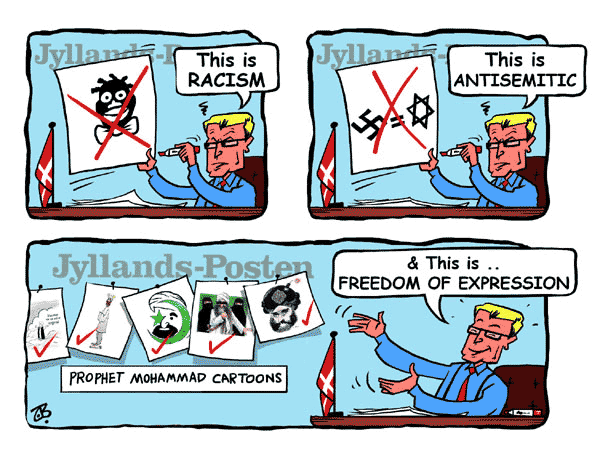
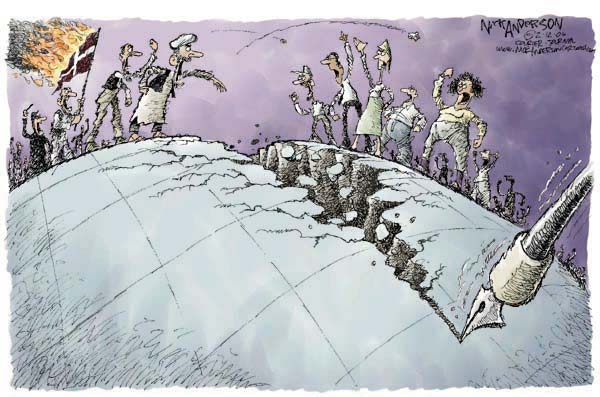
These indicate that the issue is not really about the cartoons, is it? It's more about politics.
February 13, 2006
a divided culture
Conservatives call for social cohesion, unity in culture, immigrants absorbing Australian values, when confronted by various ethnic differences. This is their version of solidarity, which is usually a lefty word meaning collective enterpise, co-operation, fellowship etc. Often it means a bonding, social or emotional. It comes into play for conservatives when society is seen to be atomised, fragmented or divided or a group is being attacked. But solidarity can also mean community.
With solidarity comes difference--it just goes with the territory. Often solidarity is seen as good---community--whilst differences are seen as bad. Though we can say that a multicultural Australia has its internal tensions and oppositions arising from the cultural differences of ethnic communities the emphasis is given to national unity a based on Australian values.
These tensions and oppostions in a national culture are nothing much to worry about. I would argue, with Hegel, that each historical culture suffers from internal strains and oppositions it needs to overcome. Characteristic examples in the Hegelian texts are the classical Greek culture with its internal strife between the individual and society, or between the culture of the family and the state, and the Enlightenment culture with its famous antithesis of reason and faith. In the Phenomeology of Spirit there is an entire section entitled " Self-Alienated Spirit: Culture". In this section Hegel describes a fragmented and incoherent culture suffering from universal perversion of meanings and values. Hegel's point is that any similar culture that glorifies the arbitrary whim of individual expression fails to afford its members with self-recognition. Consequently its members, like those of the decadent 18th century France, are bound to assimilate such an alienated environment and perpetuate its contradictions in their language and activities.
Hegel's argument here that any culture that procures confusion and inversion and thrives on fragmentation, it is an uncertain, disorientated and self-estranged culture. Notwithstanding this Hegel is at ease with differences or the "strife with the negative".
.
wiretapping citizens
Remember how President Bush ordered the National Security Agency (NSA) to spy on US citzens' emails, phones calls, and other electornic communications? By law, the NSA is not allowed to do that without a court order and only in extraordinary circumstances. After 9/11, President Bush abrogated the legal procedures, jumping over the court orders, and instead told the NSA that he has Geoffrey Stone, constitutional professor of law at the University of Chicago Law School, says that the President Bush's secret decision to authorize the National Security Agency to spy on American citizens
....poses at least four central questions: (1) Is the program lawful? (2) Can the government officials who disclosed the program's existence to reporters at the New York Times be criminally punished for this act? (3) Can the reporters be compelled to disclose the identities of their sources to a federal grand jury? (4) What can we expect from the Senate Judiciary Committee hearings, private lawsuits, and Vice-President Gore's call for the appointment of a special counsel?
Stone holds that the the President's authorization of this program was unlawful and probably unconstitutional. Will Congress find it illegal? No, because the Republicans own Congress. So no impeachment. Nor is Bush shown a willingness to seek clear legislative authority for his actions.
As it stands these actions by the national security state have little to do with a threat to the US from outside, but instead further the govt's goal of playing on the public's fears of the unknown other so as to consolidate support for a political regime that the US public would otherwise find unacceptable.
Here is a legal analysis of the legality of the President's authorization of NSA surveillance on American citizens by constitutional scholars. They take issue with the President's rationale for spying on US citizens and the rulings put out by the Justice Department:
In conclusion, the DOJ letter fails to offer a plausible legal defense of the NSA domestic spying program. If the Administration felt that FISA was insufficient, the proper course was to seek legislative amendment, as it did with other aspects of FISA in the Patriot Act, and as Congress expressly contemplated when it enacted the wartime wiretap provision in FISA. One of the crucial features of a constitutional democracy is that it is always open to the President--or anyone else--to seek to change the law. But it is also beyond dispute that, in such a democracy, the President cannot simply violate criminal laws behind closed doors because he deems them obsolete or impracticable.
Given the absence of any external checks on the secret wiretapping the president ordered after the Sept. 11, 2001, attacks why don't the Republicans insist that Bush come back to Congress for authority to continue the wiretaps -- but under court supervision? The Bush administration has shown little interest in accepting seeking a clear statutory authority for their electronic monitoring.
February 12, 2006
law in a time of emergency
This is interesting----Law in a Time of Emergency: States of Exception and the Temptations of 9/11 by Kim Lane Scheppele. it examines the domestic and foreign policy responses of the Bush administration to the events of 9/11, and contrasts them with the primary responses of America's democratic allies in Europe, with both sets of responses being understood through the lens of Carl Schmitt's writing on the nature of the state of exception. Scheppele says that Schmitt's texts provide a blueprint for contemporary American conceptions of emergency powers .
Tha tis how I have understood the conservative reaction to 9/11.
February 11, 2006
ethics and politics
We do not have many cartoons in Australia about the work of lobbyists in Canberra and the political commentary is more about the donations to political parties.
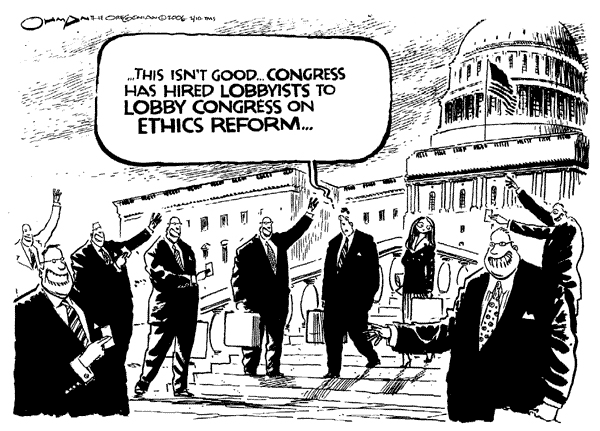
Canberra has been full of ethical talk this week with the conscience vote on the contentious abortion drug RU-486 and a privatemembers bill to to pass responsibility for approval applications of RU-486 from the Health Minister to the Therapeutic Goods Administration.
So I thought that I'd put a different perspective on ethics and politics, just to keep our feet on the ground.
February 10, 2006
governmentality and neo-liberalism
A key characteristic of neo-liberal mode of governence is the consistent expansion of the economic form to apply to the social sphere, and the elision of any difference between the economy and the social. In the process neo-liberals attempt to re-define the social sphere as a form of the economic domain. Consequently, the economy is no longer one social domain among others, with its own intrinsic rationality, laws and instruments. Instead, the area covered by the economy embraces the entirety of human action in society, to the extent that this conduct can be characterized by the allocation of scarce resources for competing goals.
Thomas Lemke says that Foucualt's concept of governmentality has two advantages in theoretical terms for an analysis of the neo-liberalism that we now live within. First:
"... the dividing line the liberals draw between the public and private spheres, that is the distinction between the domain of the state and that of society, itself becomes an object of study. In other words, with reference to the issues of government these differentiations are no longer treated as the basis and the limit of governmental practice, but as its instrument and effect."
And secondly,
"the liberal polarity of subjectivity and power ceases to be plausible. From the perspective of governmentality, government refers to a continuum, which extends from political government right through to forms of self-regulation, namely 'technologies of the self ' as Foucault calls them."
These are important shifts in the way we look at neo-liberalism as they make a break from seeing neo-liberalism as an ideology.
February 9, 2006
another kind of governance
Governance--- Hamas style in Palestine
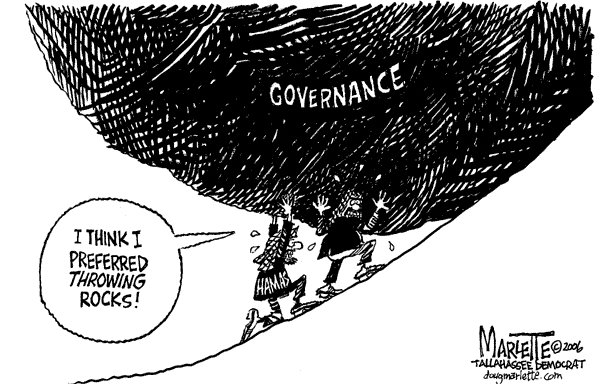
It's sure tough without a state.
You can thank the Israeli's for that.
freedom, bildung, Hegel
As we have noted in the post below Tim Dunlop over at Road to Surfdom raises the issue of competing goods:
Drawing a line between such clashing goods is probably the fundamental test that liberal democracies set themselves. And the current climate of war, invasion, terrorism is constantly throwing up instances where we have to draw lines between competing notions of "the good".... I don't have any pat answers as to how to deal with these issues, but I think it helps to realise that conflicting good ends can be just as problematic as any conflict of opposites.
One pathway opened by the category of intersubjective recognition of others is that of Bildung or the process of cultural education. It is an idea that is rarely mentioned in Australian debates.Vasiliki Karavakou in his paper Hegel on culture and globalization gives a good description of the philosophical ethos associated with Bildung.
Karavakou says that:
Hegel shaped his understanding of culture under the weight of the Kantian legacy. Therefore, he incorporated in it the idea of sharing the clustering of cultural values by which we live. With this step he was also able to avoid the strictly individualistic understanding suggested by German romanticism. The Kantian idea of a struggling human reason enabled him to appreciate the significance of a project in which both individuals and cultures try to come to terms with their internal imperfections and inadequacies. He deviates from the Kantian prescriptions, when he determines to view this struggle not as a predicament of poverty and incorrigible deficiency, but as the richness typical of humanity.
Kant introuduces the idea of freedom as autonomy that can be traced back to Rousseau, which is usually understood as self-determination and is contrasted with the negative freedom of market liberalism; or the the naturalistic understanding of freedom of Hobbes and the utilitariians that understands freedom as the unimpeded pursuit of one's empirically given desires.
Karavakou says
The essence of the Kantian view of culture comes down to the idea of our being able to legislate for ourselves spontaneously. At its best, this idea amounts to the exercise of the capacity to self-compulsion and the subsequent triumph of reason over nature. For Hegel, the problem is that because such an ideal of culture presupposes the endorsement of dualism, it is bound to be unrealistic and impossible to live up to for actual, living human beings. That was precisely the challenge to which Hegel had to respond, i.e. how to steer the middle theoretical way between rational universalism and cultural diversity, between rational abstraction and historical relativity. What the Hegelian notion of Bildung allows us to do is “to settle for a second-rate naturally constrained spontaneity” to use John McDowell’s phrase (1994, p.96).
Bildung is associated with ethical life that initially appears as custom, habit and second nature and is the art of making human beings ethical. Unlike Roussau's conception of education as taking place individualistically (as outlined in Emile), Hegel's ethical education is a living within the ethical order and so its linked to being a citizen of a state.
Karavakou says that Bildung as ethical education means that:
We are not mere transcendental possibilities or members of the Kingdom of Ends, but living organisms sharing a world of language, custom and social norms. In the Hegelian light, the life of somebody capable of achieving the ideals of a cultured way of life, of moral autonomy and political freedom can be represented as a process of training oneself in mental, emotional and volitional terms by sharing the world's most significant objective dimensions. In the Philosophy of Right, the road to culture is the road to reason and anyone who “travels on that high road” must learn to appreciate the universal significance of Geist and avoid being conspicuous (para.15A, p.230; Werke 7, p.67).
Although Hegel's emphasis on ethical life is on the unreflective character of custom and habit, ethical education in modernity gives rise to educated insight, self-awareness, subjective freedom in civil society and the culture of a people.
February 8, 2006
the political recognition of cultural particularity
In the reaction to the publication of the 12 Muhammed cartoons Enlightenment liberals assert the universal principles of free speech. Yet liberalism also presupposes the universal principle of equal dignity of all individuals.
How can these universal principles be reconciled with the realities of a multicultural Australia that recognises and respects cultural difference? Most of the commentary around the 12 cartoons is silent about the struggle for recognition in civil societyas it is framed by orientalism. Tim Dunlop raises the problem at Road to Surfdom.
One approach to reconciling universal principles of human dignity and autonomy with the realities of cultural difference is through the recognition. that has its roots in Fichte and Hegel. Both argued that free indiviudality cannot be achieved alone, but ultimately rests on intersubjective recognition, with Hegel placing the emphasis on the struggle leading to the unequal relationship of mastery and servitude in the Phenomeology of Spirit and the risking of one's life.
In his essay, "The Politics of Recognition" Charles Taylor develops this as he points out that our identity is formed in interchange or dialogue and that it:
"...is partly shaped by recognition or its absence, [...] and so a person or group of people can suffer real damage, real distortion, if the people or society around them mirror back to them a confining or demeaning or contemptible picture of themselves." (Taylor 1994, p. 25).
The assumption is that being recognised in one's cultural particularity is a basic need of every human being. Thus universal dignity leads to the politics of difference, for it demands that we give "due acknowledgement only to what is universally present---everyone has an identity--through recognising what is peculiar or specific to each. Hence the concern is to reconcile liberalism's principle of equal human dignity with cultural differences. Here is the argument from Amy Gutman in her 'Introduction' to Taylo'’s essay on multiculturalism:
“Do most people need a secure cultural context to give meaning and guidance to their choices in life? If so, then a secure cultural context also ranks among the primary goods, basic to most people's prospects for living what they can identify as a good life. And liberal democratic states are obligated to help disadvantaged groups preserve their culture against intrusions by majoritarian or 'mass' cultures. Recognising and treating members of some groups as equals now seems to require public institutions to acknowledge rather than ignore cultural particularities, at least for those people whose self-understanding depends on the vitality of their culture. This requirement of political recognition of cultural particularity---extended to all individuals---is compatible with a form of universalism that counts the culture and cultural context valued by individuals as among their basic interests." (Gutmann 1994, p. 5)
We do need a scultural context to give meaning and guidance to our choices in life? But note the way that Gutman reworks Hegel's master slave dialectic by watering it down into, disadvantaged groups and majoritarian or mass cultures. What is lost is the tough fear of death that is central to Hegel's analysis.
Hegel's master slave dialectic then moves to a consideration of a variety of dualistic strategies adopted by the servant or slave to affirm his/her independence in the face of their wordly dependence. Thus we have the anti-atomistic point that genuine freedom cannot be achieved alone but ultimately rests on intersubjective recognition.
The reconciliation of conflicting goods comes from the underming of the indvidualism of liberalism.
February 5, 2006
on governmentality
A paper on Foucault's notion of governmentality by Thomas Lenke. He says that the term:
"...pin-points a special form of representation;government defines a discursive field in which exercising power is 'rationalized'. This occurs, among other things, by the delineation of concepts,the specification of objects and borders, the provision of arguments and justifications, etc. In this manner, government enables a problem to be addressed and offers certain strategies for solving/handling the problem. On the other hand, it also structures specific forms of intervention . For a political rationality is not pure, neutral knowledge which simply 're-presents' the governing reality; instead, it itself constitutes the intellectual processing of the reality which political technologies can then tackle. This is understood to include agencies, procedures, institutions, legal forms, etc., that are intended to enable us to govern the objects and subjects of a political rationality."
Lenke says that Foucault uses the concept of government in terms of the older meaning of the term that adumbrates the close link between power relations and processes of subjectification:
"While the word government today possesses solely a political meaning, Foucault is able to show that up until well into the eighteenth century the problem of government was placed in a more general context. Government was a term discussed not only in political tracts, but also in philosophical, religious, medical and pedagogic texts. In addition to control/management by the state or the administration, 'government' also signfied problems of self-control, guidance for the family and forchildren, management of the household, directing the soul, etc. For this reason, Foucault defines government as conduct, or, more precisely, as 'the conduct of conduct' and thus as a term which ranges from 'governing the self' to 'governing others'."
So we can think in terms of different forms of governmentality, with neo-liberalism as a form that is different from the governmentality of classical liberalism.
February 4, 2006
liberal multiculturalism?
Of interest. It claims that liberalism has no need of multiculturalism in that liberal multiculturalism is neither a necessary nor a convincing extension of liberalism is the argument.
Anke Schuster says that:
Liberal multiculturalists...advocate multiculturalism on the basis of liberal values. As moderate multiculturalists, liberal proponents of the politics of recognition wish to avoid both the collectivism of radical multiculturalism and the exaggerated individualism associated with liberalism. Liberal multiculturalists retain the liberal emphasis on the individual by claiming that recognising cultural difference is essential for the individual and thus for individual equality. While a liberal perspective is constitutive of these philosophers' self-conception, there are significant differences between the two main strands of liberal multiculturalism.
Most liberal multiculturalists argue along either of the two lines or combine arguments so as to create a broader theoretical foundation.
I have to be suprised by this kind of liberal response to the realities of multiculturalism. I'm not sure of the motivation. Is it a concern that liberal (individual) equality is undermined by multiculturalism, with its concerns about difference, cultural recognition and communal belonging? Multicultural Australia does challenge classical liberalism as Liberal multiculturalism is highlights that there is more to human difference than the notion of differing conceptions of the good is able to capture, and that there is therefore more to social justice than fair distribution of resources and equal chances for individuals.
So why place the block between liberalism and multiculturalism?
February 3, 2006
a good point
I've been away on holidays in the mid-south west of Tasmania for the last week. I've just got back to Adelaide today----this afternoon.
Tasmania is definitely a corporate state run by the interlocking power of a giant corporation and the state government . Previously the corporation was Tasmanian Hydro around electricity that modernized Tasmania; now it is Gunns around the clear felling of old growth native forests and woodchipping. It's all overlaid with the 'pioneering spirit' of conquering and taming nature. That culture was still wrapped around the mining towns of the mid -west (Queenstown Zeehan, Rosebery) The people are proud of the way they and their forebears conquered nature and mined its resources to create wealth. Their pioneerign culture is utterly indifferent to the environmental consequences of conquering nature.
I'm trying to reconnect with the political world and philosophy. It will be slow as my head is elsewhere. This cartoon caught my eye, as I scanned the events of the past week in the media:

Bil Leak
It is the cartoonists who understand the way that the inner core of liberal democracy is now the camp, isn't it?
What they often miss is the way that the camp involves the suspension of the law associated with the state of the exception in which we now live. We cannot go back to pre-9/11. It is a machine with an empty centre that we are now within; one that puts the 'state' and the 'law' into question.