August 31, 2005
conservatism: internally divided
In America Right or Wrong: An Anatomy Of American Nationalism, Anatol Lieven writes:
The clash between cultural and social loyalties and the imperatives of capitalist change is an old dilemma for those social and cultural conservatives who at the same time are dedicated to the preservation of free market economics. As the distinguished U.S. political and ethical thinker Garry Wills has noted, "There is nothing less conservative than capitalism, so itchy for the new."
What we have here is the negative effects that a (global) capitalism has on traditional (national) ways of life.
Conservatism is often see as traditionalist-- traditions are what they are supposed to be conserving, from a free-market capitalism that is anti-tradition. Capitalism does praise tradition when it serves to make a profit. Tradition is useful as a means to some other end and quickly dispensed with if it stands in the way.
The penetration of large discount stores into small towns around Australia does not conserving any local traditions. The market-driven push for discount stores drive locally owned stores out of business and disrupt traditional patterns of life in small towns. And agribusinesses when they push the smaall farmers out of business depopulate the country towns.
So the business interests of the Howard Government conflict directly and immediately with the conservative interests of conservatives--—in both the religious and non-religious sense. So conservatives should be opposed to the market and economic forces that have encouraged the drive toward prepackaged foods and away from traditional domestic life. But they don't.
As Leiven says:
The tragicomic aspect of the situation of politically conservative American religious believers is that the laissez-faire capitalism which they support is not only undermining their economic world, but through the mass media and entertainment industries is also playing a central role in biting away at their moral universe.
This account makes conservatism as traditionalist--as a defender of traditions. But cannot conservatism be more proactive than that? They can be renewed, reshaped and become something new.
August 29, 2005
liberal coercion?
As is well understood, Liberalism's value pluralism thesis implies different ways of life with the legitimacy of the liberal state resting on not imposing any one way of life on its citizens. Disagreement about the best way of life is accepted as an integral part of the liberal polity.
Hence those who seek to impose a particular way of life in the name of Australian values to counter moral relativism are properly seen as conservatives, not liberals. In contrast, liberal pluralism accepts that separate and distinct etthnic cultures are the fundamental constituents of a liberal political society, and that the liberal state has an obligation to show equal respect and concern toward each.
Consider a world in which fundamental values are plural, conflicting, incommensurable in theory, and uncombinable in practice. We would have a cluster of values from different ways of life A, B, and C. A represents a Millian life of civic engagement, political participation, and open-mindedness, in the face of a wide variety of experiments in living; B represents a life of devotion, orthodoxy, and service, in the name of a traditional or fundamental religion; and C represents a life of self-sufficiency, hard work, and independence, in the name of an entrepreneurial life in the free market. The liberal argument is that there could be no valid reason for a state to promote any of these ways of life among its citizens: since A, B, and C are all good, there could be no compelling reason to impose, say, A over B, or C to the exclusion of A. Thus, the argument runs, the state must allow for A, B, and C, remain neutral between A, B, and C and leave it up to citizens to decide which way of life to pursue. The state has no good reason to do more than protect negative liberty.
Such an argument is not accepted by liberals, because in practice they are engaged in something more than protecting negative liberty. They hold that the liberal state has a good reason to promote A rather than B or C. It will promote Millian civic liberty because A, the Millian way of life, is actually good, and is a better or higher good than B or C. So the liberal state imposes a single way of life on its citizens, shapes the character of its citizens so they can participate in the Millian way of life, and protects the liberal way of life from its critics and enemies by enacting those laws that promote liberal virtues and freedoms.
Hence we have the familiar constitutional provisions of a liberal society: freedom of speech, a free press, property rights, individual protections from interference, a state policy that aspires to be neutral among competing viable moral doctrines, and a representative government in which persons are treated as equal citizens.
As William A. Galston argued in 'Liberal Purposes' (1991) every regime--liberal democracy no less than monarchy or aristocracy or, for that matter, the various forms of totalitarianism--inflects the beliefs, practices, and institutions that live under it on its citizens.
Therein lies the idea of liberal coercion or authoritarianism. The liberal state is seen to be unreasonable, because it is engaged in rank ordering of values, and it is committed to some fundamental value or cluster of values that provides the foundation for the legitimacy of the liberal state. An aspiring tyrant--the national security state---can then say that there are distinctive individual goods to be realized by a life of coerced submission imposed by a centralised political authority to to provide a liberal way of life with security from the threat of terrorism.
A question: should not liberalism, properly conceived, be upfront and give an account of the goods of community and purposes of the state that could meet the above criticism, whilst preserving liberalism's core commitments to individual freedom and human equality?
Should not liberalism be upfront about those liberal virtues--tolerance, self-restraint a certain generosity of spirit--that equip liberal citizens to maintain public order, defend liberal institutions, and enjoy freedom? It is fairly obvious that the preservation of a political society that protects individual freedom is an achievement that depends in part on its citizens' character; and that the liberal state is actively involved in shaping character of its citizens(eg., work-to-welfare programs).
August 28, 2005
Berlin, pluralism, liberalism
Isaiah Berlin, in his "Two Concepts of Liberty" endeavoured to derive a liberal politics from pluralist premises.
From memory, Berlin's argument was that, since values conflict and choice among incommensurable goods is inevitable, so the state must provide and maintain a framework within which individuals can freely choose among competing goods. The state can do this only if it restricts itself to the project of protecting individuals from interference.
So pluralism entails liberalism.
But why why should it follow from the fact that humans confront a plurality of values in a modern secular society that the state ought to allow individuals to choose freely among such goods?
Is there not a hidden premise in there? One that implies the introduction of some value, such as autonomy, which then functions as a good of an order higher than the competing values among which we must choose?
This feels right, as liberals do prize the autonomy of the sovereign, independent individual as an end.
However, to privilege autonomy, or any other value (eg., negative liberty)in this way violates pluralism as it implies a rank-ordering of vlaues that that pluralism claims to find impossible. So Berlin's argument from pluralism to liberalism fails.
Why don't liberals just say that they do privilege liberal values because this is what is entailed by liberalism and a liberal way of life. It is more honest than talking about a world where plurality in the ends of humanity is recognized by liberalism as the most precious good, whilst tacitly imposing a liberal way of life on others.
August 27, 2005
Multiculturalism under threat
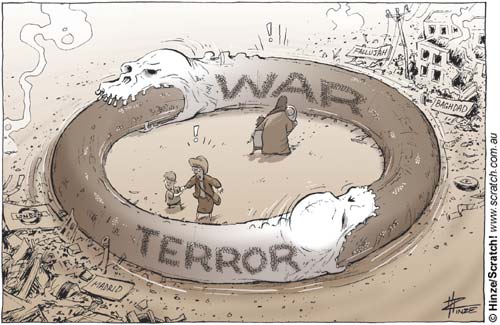
Heinrich Hinze, Caught in the Middle
As part of his ongoing attempt to broaden his appeal to the Australian electorate in his eternal quest to become a future Prime Minister of Australia Peter Costello, the current federal Treasurer of Australia, made this this speech to the Australian American Leadership Dialogue Forum. It is part of a series of speeches tht have received a great deal of respectful airplay.
In this speech he asked: 'What are the sources of anti-American feeling in Australia?' Costello argued that one source of anti-Americanism could be traced to traditional leftism, which Costello said, had changed into anti-globalization. He says that the sentiment of anti-Americanism:
"... hasn't entirely disappeared---the Left in Australian politics is still there but has morphed itself into other names. One of the names you will find it takes today is "anti-globalisation". After all if the world is being subjected to exploitative economic forces where do you think those forces would be based and who do you think would be directing them? You guessed it--- the home of evil. Opponents of globalisation locate evil in the same place that their ideological soulmates from the days of the Cold War did. Left wing politics and its more recent variant---anti-globalisation--- operates in a fever of anti-Americanism.
This is a strange view given that economic globalization is commonly seen to be the view that nation states will virtually disappear under the imperatives of global companies and global institutions such as the World Trade Organization, with a self-organizing global market governing the world. That 1990's fundamentalist liberal utopian view is in tatters as nation-states assert their power to defend their borders and national security. And it is the cultural conservatives + market liberals, such as Treasurer Costello, who have led this charge.
They have done so in the name of the national security state that has undermined individual rights and freedoms, including protections from arbitrary arrest, through ongoing legislation and regulation, such as 2002 Terrorism and Australian Security Intelligence Organization Bill. Tougher legislation has been promised and the search for the enemy within intensifies.
The reassertion of an assimilationalist form of nationalism is associated with the national security state riding roughshod over individual liberty to counter the threat of Jihadist terrorism to a liberal polity.
This identifies itself with Australian values and specifically targets multiculturalism as a divisive diversity that breeds a radical fundamentalism that is at odds with the core values of Australia. The assumptions made are:
---that nations consist of homogenous, self–contained, and largely self–reproducing population groups. After all, what is a nation if it is not born of the like–spirited and like–bodied?
---that nationalism of all kinds is predicated on a monocultural understanding of the nation.
Hence we the conservative response to cultural clash or national crisis as one that highlights patriotism, unity, cohesiveness. Hence all the recent talk about Australian values that deny difference and heterogeneity.
Yet Australia is a multicultural society and there is no turning back from this history of immigration. Does the talk about the limits of multiculturalism (ie stopping imigration of asylum seekers from the Middle East mean a re-thinking multiculturalism?
Multiculturalism places an emphasis on cultural diversity, on a plurality (even relativism) of values at the expense of ideas of national cohesion and unified norms, and puts an "ethnic and identity politics" on the political agenda.
In 'Reframing multiculturalism' in New Matilda Laksiri Jayasuriya says that this is an earlier model of culturalist multiculturalism, which was framed within notions of 'cultural pluralism' following mass migration in the post World War II period. Laksiri sys thattThis model:
"...provided a strategic and highly successful, public policy model for managing diversity. Importantly, this entailed an equality of respect, the need for mutual understanding, and an acceptance or endorsement of cultural differences. This was achieved primarily by catering largely to the symbolic and expressive needs of the culturally different, especially the early waves of European immigrants.But a major shortcoming of this orthodox model was that it led to an 'identity politics' built around ethnic groups conceived of as cultural groups or 'ethnic minorities'. And invariably, this identity politics based on a flawed, static view of culture privileged and celebrated cultural maintenance. The increasing tendency, among some migrant groups, towards diaspora nationalism (linkages back to cultures of the home country), has been viewed with suspicion by a mainstream society, already concerned about cultural ghettoisation and the emergence of a 'them versus us' attitude.
In response the new assimilationists have invoked so-called 'common Australian values' which have served to mirror the 'us and them' attitudes of culturalist multiculturalism.
He says that there has been scant recognition in this culturalist model of the material inequalities and the marginalisation of the 'different', flowing from structural barriers in society. In the light of our experience of multiculturalism over three decades, we need to distance multiculturalism from the sphere of cultural identity, and locate it more within the public institutions and practices of citizenship.
August 25, 2005
liberalism and value pluralism
Public-policy questions are often difficult. The plurality of values on both sides of many public-policy debates creates reasonable bases for many-sided disagreements. In politics, unlike in personal life, we must try to justify hard choices to one another, and we are aften required to both seek a fair consensus and hedge our bets with respect to our own convictions by taking into account the "most cherished values" of people with whom we disagree. We quickly becomne aware that they are are better and worse ways of weighing and combining complex considerations.
Not all values in a liberal polity are commensurable: they may neither be reduced to a single over-arching value nor completely rank-ordered. That is the thesis of value pluralism, which is currently under attack from Australian conservatives. The cultural conservatives give every indication of wanting to reduce the diversity of values in the national culture of the nation-state to what they call 'Australian' values.In doing so they appear to have moved outside the horizons of liberalism.
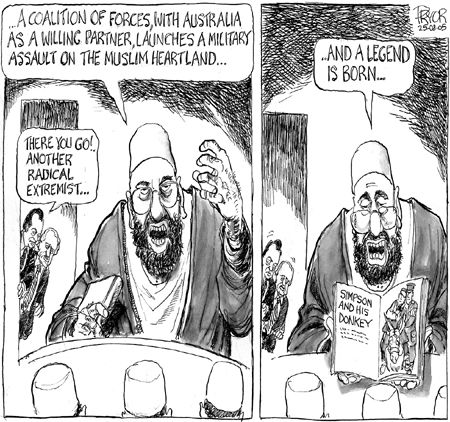
Yet liberal societies such as Australia and the US generate social pluralism because liberalism affirms the individual's liberty to pursue "his/her own good in their own way'. Consequently, the freedoms that liberalism secures for citizens gives rise to a number of distinct visions of the good life, value, obligation, purpose, and human nature. These visions are often incompatible with each other; and since they are visions of the highest good and answers to big questions, the conflicts between them are difficult to resolve in ways that are acceptable to all concerned.
Despite sincere attempts to reach rational consensus, disagreement persists and reconciliation seems unlikely to be forthcoming. So social and value pluralism is here to stay. You cannot send all those citizens you disagree with packing.
Liberalism acknowledges cultural diversity and ethical pluralism in a liberal polity. The chief claim of liberalism, as a political theory whose tradition runs from Locke through Kant and Mill to contemporaries like the early Rawls, Dworkin, and Kymlicka---is that political and social associations exist for the sake of individuals. In a liberal political order, individuals are left free to pursue their aims unimpeded by the state, as long as their pursuits do not unjustly interfere with those of others. It is the job of the state to enforce these constraints; that is, state's primary function is to protect individuals from interference by other individuals and other nation-states.
The implication is that liberalism values social diversity and tolerance, in contrast to the traditional view that liberalism is just about abstract right and or market liberty: hence we have a multicultural liberalism that is about the protection of legitimate diversity. This position holds that value pluralism undergirds a kind of liberal politics, and it gives great weight to the capability of citizens and groups in civil society to live their lives in accordance with their deepest beliefs about what gives meaning and purpose to life.
However liberalism has a problem with value pluralism. Maybe this is why liberals become cultural conservatives.
Traditionally the liberal theorist has aspired to provide a philosophical account that will establish the universal legitimacy of the liberal political order. This has traditionally been done through an appeal to premises that can in principle win the assent of all. However, as social pluralism indicates that that there are no such foundational premises, liberal theory is inconsistent with the social pluralism that is the result of liberal practice. Liberalism generates a politics that renders its own requirements for legitimacy unsatisfiable. Hence the paradox of liberal justification.
Nussbaum, like many liberals, turned to John Rawls's political liberalism to for a justification of liberalism that is "independent of controversial philosophical and religious doctrines." Rawls argues that the stability of a liberal society, then, cannot rest on general agreement on a single comprehensive doctrine, nor can it rest securely a modus vivendi agreement among citizens. Rawls proposes that, if a liberal society is to be stable, then it must formulate its basic commitments in terms that can be the focus of an "overlapping consensus" among the comprehensive doctrines endorsed by its reasonable citizens: Each reasonable citizen sees the basic principles as an appropriate manifestation in the political realm of his own comprehensive doctrine.
So liberals need not become cultural conservatives.
August 24, 2005
Martha Nussbaum's lecture
I've just come back home from attending a public lecture by Martha Nussbaum on 'Disability and Issues About the Social Contract Tradition'. There is some material on this issue here. Going to the lecture was like returning to the world of a conservative academic philosophy after doing a stint in the legislature as a political advisor. I say conservative because many there would approve of this side of Nussbaum because it is critical of 'postmodernism', even though the shots are cheap.
In the lecture Nussbaum argued against the social contract tradition in favour of the Aristotelian account of human life in the form of a capabilities approach. In Nussbaum's view, the core role of governments as well as development actors is to endow citizens with the required conditions for actualizing centrally human functionings, in other words, to provide them with the necessary capacities and opportunities to live flourishing lives. It is the central human functional capabilities that indicate what it is for us to live a good life.
As she puts it:
The basic intuition from which the capability approach begins, in the political arena, is that human abilities exert a moral claim that they should be developed. Human beings are creatures such that, provided with the right educational and material support, they can become fully capable of these human functions. That is, they are creatures with certain lower-level capabilities (which I call "basic capabilities") to perform the functions in question. When these capabilities are deprived of the nourishment that would transform them into the high-level capabilities that figure on my list, they are fruitless, cut off, in some way but a shadow of themselves.
Nussbaum's approach to social justice, with its emphasis on capabilities---the potential to function-- and functionings---the realization of capabilities-- talks in terms of real people, real life, not thin abstractions; talks in terms what is a full human life; real people, real life rather than not thin abstractions; rejects the classic dichotomy between emotions and reason; and holds that a just society aims at well-being.
I was suprised by Nussbaum's embrace or adoption of a Rawlsian political liberalism, given her explict rejection of both the social contract tradition and Rawls' strong version of it; on the grounds that the inner logic of the social contract is unable to incorporate physical and mental disability of citizens.
I guess it was a way for her to lighten the metaphysical burden of her Aristotlean conception of the good life in a liberal polity based on the fact of "reasonable pluralism". She accepted liberal pluralism and the idea of an overlapping consensus---or agreement on justice as fairness between citizens who hold different religious and philosophical views (or conceptions of the good).
Nussbaum reworked Political Liberalism's idea of public reason--the common reason of all citizens--in the light of her capablities approach.
August 23, 2005
philosophy and politics
What of the issues that has concerned me is the relationship between politics and philosophy. It concerned me when I was working as a political advisor in Canberra and also in my blogging public opinion and here at philosophy.com). I was, and am, able to put politics and philosophy together, and make them work with one another.
However, most people see philosophy and politics as hostile to one another and as having little in common. It is assumed that philosophy is about reason and truth whilst politics is about emotion and rhetoric.
My own view is that philosophy (thinking) and politics (acting) need not be divided and in violent opposition to one another. Philosophy could encourage each democratic citizen to speak his/her own opinion coherently; it could help to nurture a give and take in the clash of opinion, and it could encourage talking/debate amongst citizens about the world they have in common. Philosophy could also articulate the language of politics as a world in opposition to the economic language of neo-liberalism.
This suggests a different kind of thinking that is specifically political: the deliberation of the citizen, moving about among her fellows in the public world, paying attention to their points of view and achieving an "enlarged mentality" by considering a given issue from different viewpoints/perspectives.
This view was argued by Hannah Arendt against the Platonist conception of a contemplative philosophy concerned with absolute (one single) truth. As Margaret Canovan says:
Instead of trying to persuade them, [Athenian citizens] Plato opposed to their opinions the absolute truth which appears only in the solitude of philosophical thinking, and which must then be imposed upon others, whether they are coerced by the force of logic or by threats of divine punishment in a life to come.
On Arendt's interpretation the latent conflict and tension between loyalty to the polis and loyalty to the truth (that can be found even in Socrates) is intensified and given theoretical expression by Plato. Arendt then suggests that this represents a conflict within the philosopher himself between two kinds of experience, the life of the citizen and the life of the mind. So we have the duality of the life of the citizen, who moves among plural opinions, and the life of the philosopher, who seeks in solitude for an unchanging truth.
Arendt then adds that the mode of thinking of a system building philosophy concerned knowing, mathematical certainty, and absolute truth, helps to make this kind of philosophy unsympathetic to free political action and inclined to favor tyranny. This represents a deformation of philosophy. Hence the problem of reconciling philosophy and politics.
This could happen only if philosophical thinking were of the right kind--able to live with the diversity of human opinions and views of the common world and in dialogue with others---and so could in principle live in harmony with politics.
Update: 24 August
A good example of Arendt's understanding of this conception of philosophy and politics is her early essays on the founding of Israel and Zionism. Alan Wittman has a good and informative post on these over at Long Sunday. This highlights the emphasis on the diversity of human opinions and the critical stance to those Zionists whose claim access to a single, uniform truth. (As an aside, another example of this mode of of thinking is the American Declaration of Independence which claims that these truths to be self-evident).It shows a political form of thinking that is oriented toward discourse between citizens with different views of the common world.
That then leaves the problem of philosophy demanding a withdrawal of the thinker from the world and so away from the world of public affairs. Political philosophy, therefore, seems still to be a self-contradictory enterprise.In Margaret Canovan's words:
how is the political philosopher to be sufficiently withdrawn to be able to practice philosophy, and yet sufficiently attuned to the public world to understand and appreciate public action?
Through reflective thinking within, and upon, political life. We can have solitude in political life--eg., those moments late at night in parliament when the legislature has finished sitting. This is a kind of thinking---judgement that is intrinsically linked to the world---different kingd fo thinking to academic philosophical thought, which is more solitary and unpolitical.
August 21, 2005
Arendt: philosophy and politics
Politics is usually seen as little more than power relations, competing interests and claims for recognition, conflicting assertions of "simple" truths. This is the modern prejudice against politics. What it offers us is an endorsement of a teleology of progress, a certainity that the past was evil by contrast to the sunny prospects of the present.
If most most politicians are happy apostles of progress, then political philosophy, in other words, has looked at politics from the philosopher's point of view, not from that of the political actor. Margaret Canovon says that Arendt held that this perspective has had a number of unfortunate results. These are:
In the first place, politics has been downgraded and has lost its dignity... [it]cast all aspects of the vita activa into such disrepute that action became confused with other activities. Politics has as a result been misunderstood ever since either as a form of work, the fabrication of objects, or as labor, the business of keeping ourselves alive. From the philosopher's point of view, politics could in any case be only a means to an end, not something good in itself. It was therefore easily misinterpreted as a form of fabrication, best directed by a ruler who understands the end to be achieved. The notion of a single ruler rather than a plurality of actors was naturally congenial to philosophers who were looking for a single truth to override plural opinions. Politically, the great disadvantage of this point of view was that it implied a loss of understanding of human plurality, the fact that (as Arendt never tired of repeating), "men, not Man, live on the earth and inhabit the
world." But philosophers were not much concerned with freedom of action. Possessing the truth, they sought not to persuade the masses but to compel them, either by threatening them with divine punishment or by using deductive reasoning. Meanwhile, they gave the coup de grace to an authentic understanding of politics by capturing the crucial notion of freedom, which they reinterpreted to mean a private or internal condition rather than freedom to move and act in the public world.
Hannah Arendt argued passionately against the prejudice against politics, and in doing so she brings questions of meaning, identity, value, and transcendence to our impoverished public life.
August 20, 2005
do you sense the totalitarianism?
A couple of events. First a Geoff Pryor cartoon published in the Canberra Times:
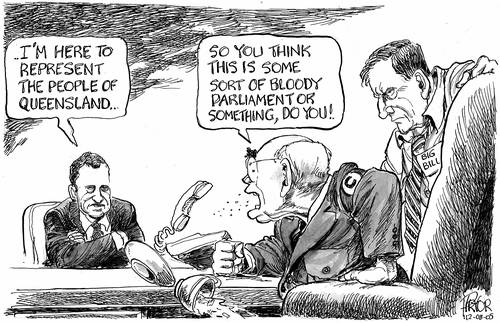
The other event is the Australian Financial Review's response to the negotiations over the sale of Telstra by Barnaby Joyce and his Nationals. The Review talks in terms of reforms passed by the Howard Government's control of the Senate being marred by pork barrelling:
Now control of the Senate has opened up a whole new vista, where pork is measured in billions of dollars.There may well be a need to bring rural communications up to scratch, but the $3.1 billion ransom for Telstra's sale reflects the National's price, rather than any rigorous assessment of need.
What is underling this is a concern about the faction versus the national or public interest with the public interest associated with the sovereign will. Pork is associated with faction and national interest is associated with the neo-liberal's economic plan of privatisation.
My interpretation? The privatisation of Telstra is part of the grand plan of economic reform and faction and debate represents a form of corruption of the sovereign will.
You could say that the Review's position is that reform represents the general will of the nation--the general interest that expresses a single indivisible sovereign power--as opposed to the will of all. Consequently, the Nationals, who represent the particular interests, are the enemy within the body politic.
Do you not sense totalitarianism with the AFR position, with its desire for order? The interests of the whole must automatically and permanently be hostile to the particular regional interests of the Queensland Nationals. Don't you sense the absolutism?
I'm not sure how the AFR gets a Hobbesian conception of a single indivisible sovereign power from its economic uititaritarianism--that puzzles me. But I understand that the AFR radically devalues pluralism, political action and the public sphere.
It is not liberalism that the AFR is expressing---since liberalism affirms pluralism.
August 18, 2005
debating the end of environmentalism
I can only note this continuation of the debate about the end of environmentalism. I have to catch a plane now to Adelaide so I will try and weave the Australian dimension of it tomorrow, if ADSL-2 has been set up whilst I've been in Canberra. My luck will be that I cannot get online.
Recall that 'the end of environmentalism' thesis meant that the basic categorical assumptions that underlie environmentalism have inhibited the movement's ability to consider opportunities outside environmental boundaries that would allow progressives to compete more effectively with conservatives and their narrative of optimism. As Werbach says:
The problem is not that environmentalism and the moral intellectual framework we call liberalism are dead. The problem is that we have been in denial about it for more than 20 years. The sooner we acknowledge these deaths, the sooner we can give birth to something more powerful and relevant.
The something "more powerful and relevant" is a an aspirational ideology as powerful as liberalism once was, and as powerful as fundamentalism is today.
Update: 20th August
I read the responses and I found them not very relevant. The core of the debate is this text. It states that environmentalism has failed to win national legislation that would reduce the threat of global warming. The environmetnal movement is not articulating a vision of the future commensurate with the magnitude of the crisis. It is promoting technical policy fixes (signing Kyoto) instead of a big vision and a core set of values.
August 17, 2005
Environmentalism: losing the plot?
 In these times of conservative moral values, free markets and high technology the environmental movement is increasingly on the defensive and has a tendency to speak in simple slogans.
In Australia the farmers, in the form of the Nationals, have gained control of environmental reform, the old ways of doing things are defended in terms of Australian identity, little progress is being made of restoring water to our rivers, and biodiversity is seen in terms of candyfloss.
So we do we environmentalists stand today? What do we need to do?
A tough quote from 'Environmentalism is dead. What next?' by Adam Werbach posted in In These Times:
"The loss of the Arctic National Wildlife Refuge is yet one more piece of evidence that environmentalism, as a political movement, is exhausted. The signs of environmentalism's death are all around us. Environmentalists speak in terms of technical policies, not vision and values. Environmentalists propose 20th century solutions to 21st century problems. Environmentalists are failing to attract young people, the physical embodiment of the future, to our cause. Environmentalists are failing to attract the disenfranchised, the disempowered, the dispossessed and the disengaged. Environmentalists treat our rigid mental categories of what is "environmental" and what is not as things rather than as social and political tools to organize the public. Most of all, environmentalism is no longer capable of generating the power it needs to deal with the world's most serious ecological problem---namely, global warming."
Werbach says that it is time to go back to the drawing board.By this he means that to step outside the limits of an artificially narrow discourse to articulate a more expansive, more inclusive and more compelling vision for the future. This means that we will cease to be environmentalists and start to become [American] progressives.
I guess it all depends on what we mean by enviomnmentalism. Werbach understands it to mean what Michael Shellenberger and Ted Nordhaus described the process of environmental policy-making in the October 2004 paper, 'The Death of Environmentalism':
The three-part strategic framework for environmental policy-making hasn't changed in 40 years: first, define a problem (e.g. global warming) as "environmental." Second, craft a technical remedy (e.g., cap-and-trade). Third, sell the technical proposal to legislators through a variety of tactics, such as lobbying, third-party allies, research reports, advertising and public relations.
Werbach adds that by the American bicentennial, this kind of environmentalism had triumphed. Sweeping protections had been put in place, and the focus was now as much on implementation through the courts as it was on new legislation in Congress. Similarly in Australia. Presumably this environmentalism speak in terms of technical policies, not vision and values.
back to the past
I'm not sure about this cartoon. What does it mean? It puzzles me. The meaning is not obvious.
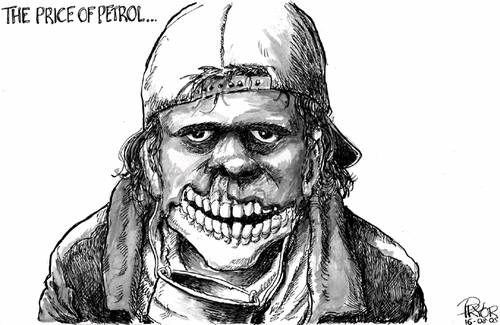
I'm not sure what it signifies. It is a powerful image though, is it not?
Does it mean that our oil-based civilization will collapse and we return to barbarism because the high cost of petrol will stifle the economy? We go back to the dark ages?
Petrol is rising because demand is fast increasing (India and China) and exceeds the supply. That is what the economists tell us. So we cannot afford to rely on petrol any more.
Honestly, I'm not confident of that interpretation. I do not think that it gets it. I do sense that it is a critique. Anyone got any clues?
August 16, 2005
Edward Said & criticism
A question from this review by Matthew Abraham of two books on Edward Said at Logos:
'How does the individual consciousness resist and invent itself within and against the hegemonic and multiple pressures of a dominate culture, pressures that ensures the force of imperial domination and its attendant discourses such as orientalism?'
The main modernist answer focuses on the ability of the individual to break free of tradition and to start anew---as a burgeoning sign of critical consciousness---and that this represents a radical act of freedom, a necessary act of resistance that occurs between culture and system.
Criticism before solidarity in other words. It is necessary so as to remain alert to the seductions and trappings of power; attractions that often reduce the perceptive critic to a state functionary. In his 'Representations of the Intellectual,' Said states this insight thus:
Nothing in my view is more reprehensible than those habits of mind in the intellectual that induce avoidance, that characteristic turning away from a difficult and principled position which you know to be the right one, but which you decide not to take. You do not want to appear too political; you are afraid of seeming controversial; you need the approval of a boss or authority figure; you want to keep a reputation of being balanced, objective, moderate; your hope is to be asked back, to consult, to be on a board or prestigious committee, and so to remain within the responsible mainstream; someday you hope to get a honorary degree, a big prize, perhaps even an ambassadorship.
Abraham says that Said's consistent concern has been to explore the importance of the individual in society, working within and against traditions, large discursive structures, and daunting odds. This represents Said's self construction as a critical intellectual. The Saidian critical corpus represents a form of intellectual resistance, against popular representations and, in turn, misrepresentations of Islam and Muslims in Western culture, particularly the use of hostile and negative stereotypes (e.g. Arab irrationality, Arab intransigence to civilizing processes, and the Arab incapacity for self-government) As Said writes in Covering Islam:
It is only a slight overstatement to say that Muslims and Arabs are essentially covered, discussed, and apprehended either as oil suppliers or as potential terrorists. Very little of the detail, the human density, the passion of Arab-Muslim life, has entered the awareness of even those people whose profession it is to report the Islamic world. What we have instead is a limited series of crude, essentialized caricatures of the Islamic world presented in such a way as, among other things, to make the world vulnerable to military aggression. I do not think it is an accident that talk during the 1970s of United States military intervention in the Arabian Gulf, or the Carter Doctrine, or discussions of Rapid Deployment Forces, or the military and economic "containment" of "political Islam," has often been preceded by a period of "Islam's" rational presentation through the cool medium of television and through "objective" Orientalist study (which, paradoxically, either in its "irrelevance" to modern actualities or in its propagandistic "objective" variety, has a uniformly alienating effect).(p.28)
These words still ring true today, don't they.
August 15, 2005
when is it right to intervene?
I've been off-line since Thursday. I've spent the last few days cruising the Eden Valley in South Australia checking out the riesling and other wines. Hence the lack of posting. I've just got back to Canberra and to dial-up internet access, which is better than nothing.
I would like to post these paragraphs from this review article by Tony Judt in the New York Review of Books because they raise uncomfortable questions. Ones that I'm struggling to answer in relation to an international system governed by the rule of law and backed by military force to ensure global order in a world of individual sovereign States. Judt says:
Those of us who opposed America's invasion of Iraq from the outset can take no comfort from its catastrophic consequences. On the contrary: we should now be asking ourselves some decidedly uncomfortable questions. The first concerns the propriety of "preventive" military intervention. If the Iraq war is wrong—--"the wrong war at the wrong time"---why, then, was the 1999 US-led war on Serbia right? That war, after all, also lacked the imprimatur of UN Security Council approval. It too was an unauthorized and uninvited attack on a sovereign state---undertaken on "preventive" grounds---that caused many civilian casualties and aroused bitter resentment against the Americans who carried it out."
That puts the issue clearly doesn't it. It is an issue I've tended to let slide, probably because I do not know why there is a difference.I do know that it is not a clear cut choice between imperialism or barbarism.
Judt continues:
The apparent difference---and the reason so many of us cheered when the US and its allies went into Kosovo---was that Slobodan Milosevic had begun a campaign against the Albanian majority of Serbia's Kosovo province that had all the hallmarks of a prelude to genocide. So not only was the US on the right side but it was intervening in real time---its actions might actually prevent a major crime. With the shameful memory of Bosnia and Rwanda in the very recent past, the likely consequences of inaction seemed obvious and far outweighed the risks of intervention. Today the Bush administration---lacking "weapons of mass destruction" to justify its rush to arms---offers "bringing freedom to Iraq" almost as an afterthought. But saving the Kosovar Albanians was what the 1999 war was all about from the start.
Yep, I go along with that even though it is an intervention within sovereign states. But then Judt undercuts my comfort zone:
And yet it isn't so simple. Saddam Hussein (like Milosevic) was a standing threat to many of his subjects: not just in the days when he was massacring Kurds and Shiites while we stood by and watched, but to the very end. Those of us who favor humanitarian interventions in principle---not because they flatter our good intentions but because they do good or prevent ill---could not coherently be sorry to see Saddam overthrown. Those of us who object to the unilateral exercise of raw power should recall that ten years ago we would have been delighted to see someone--anyone---intervene unilaterally to save the Rwandan Tutsis. And those of us who, correctly in my view, point to the perverse consequences of even the best---intentioned meddling in other countries' affairs have not always applied that insight in cases where we longed to see the meddling begin.
He's right. Isn't he? I would give East Timor as another example of humanitarian intervention to prevent terror.
August 11, 2005
politics as theatre
I've finally been able to gain access to a laptop and internet access long enough to be able to make a post. Even though I have been lugging my books around with me whilst on the road I have been finding it difficult to post without owning a laptop. And as I'm in the process of switching to ADSL-2 (high speed broadband) at home I have no connection at home for two weeks.
Ive been reading some bits and pieces on Hannah Arendt. I am much taken by her conception of politics as theatre. In the theatre the artist is not making something but is displaying something before an audience. Unlike the artist the politician is not just displaying their skill, despite the importance of skill and judgement in politics.
Rather, political activity is self-revelatory. Those who come out into the bright light of the public realm to engage in public action cannot help revealing themselves as they try to prove themselves on the public stage.
August 5, 2005
gatekeeping and digital democracy
The new gatekeepers in digital democracy---the A list or leading bloggers. They---the influential few---are the hubs of opinion-making about the ongoing revolution in media.
Jon Garfunkel at Civitas says:
"The old gatekeepers (media) and the new gatekeepers [bloggers] are not the same. Both, after all, influence what we watch and read. The difference is that the old gatekeepers do so by restricting information. The new gatekeepers do so by manipulating information cascades."
Does the gatekeeping matter?
Not really. That opinion making within the gated community is just a particular conversation on a public stage. Other people come together in other parts of the stgte to discuss common affairs, interact with one another and lay themselves open to the judgement of others.
It is the public realm, the space within which the civil conversation about public things, that is important, not the gatekeeping.
August 3, 2005
old style blogging
An old fashioned blog post: a linking to other stories with minimal commentary added.
A debate on liberal democracy over at Eurozone.
You can post several times a day doing this, moving from conversation to conversation.
I'm really not sure what the point of this style of blogging is. Is not a conversation more important? Does not a conversation require some participation to keep it going?
August 2, 2005
the salvation of democracy
George Pell, the conservative Australian Cardinal and Roman Catholic Archbishop of Sydney, gave a speech on democracy to the Acton Institute for the Study of Religion and Liberty in late 2004. I found it hard to follow but I got the bit about liberal democracy is a world of 'empty secularism' that is over-focused on 'individual autonomy'. This leads to unquestioned acceptance of abortion, euthanasia and genetic experimentation, and to the claim that opposition to such things is undemocratic.
The problem with democracy is that it is neither a value-free mechanism for regulating interests, nor a good in itself; its value depends on the moral vision that it serves, and a secular democracy is lacking in moral vision. Since individualism coupled to equality and freedom is not a moral vision, he suggests 'democratic personalism'is the best form of 'normative democracy'.
By this he means a vision of human beings as centres of transcendent dignity whose existence and happiness are bound to mutual relationships. Democracy serves the flourishing of human dignity and of mutual relationships. He argues that to implement this vision we would need to change culture through persuasion and not political activism.
What he means by 'transcendent' is that we need to recognize our 'dependence on God' and place this at the centre of our system of governance. But, he asserts, 'placing democracy on this basis does not mean theocracy':
"Placing democracy on this basis does not mean theocracy.To re-found democracy on our need for others, and our need to make a gift of ourselves to them, is to bring a whole new form of democracy into being. Democratic personalism is perhaps the last alternative to secular democracy still possible within Western culture as it is presently configured."
He justifies this conception of normative democracy thus:
"The recrudescence of intolerant religion is not a problem that secular democracy can resolve, but rather a problem that it tends to engender. The past century provided examples enough of how the emptiness within secular democracy can be filled with darkness by political substitutes for religion. Democratic personalism provides another, better possibility; one that does not require democracy to cancel itself out."
August 1, 2005
A quote:
"The thesis, inspired by Jurgen Habermas, that the 'state' has increasingly colonised 'the lifeworld' is misleading, not least because the very nature and meaning of state and lifeworld were transformed in the process. State institutions certainly extend the scope of their operations and the depth of their penetration in the lives of their citizen subjects. But they do so by a complex set of strategies, utilizing and encouraging the new positive knowledges of economy, sociality and moral order, and harnesing already existing micro-fields of power in order to link their governmental objectives with activiities and events far distant in space and time."
It is from Nicolas Rose, Powers of Freedom: Reframing Political Thought, (p.18)