September 29, 2006
questioning the welfare state
Noel Pearson, the Executive Director, Cape York Partnerships, has argued that passive welfare is one of the two issues of the most strategic importance to the wellbeing and future of indigenous people generally. He has been a vigorous opponent of policies aimed at continued passive welfare delivery because the activity and service delivery of the Welfare State has caused and compounded Aboriginal passivity. He says that passive welfare has deprived indigenous people of their right to take responsibility, and that they have paid huge social costs as a people for these policies. In this 2002 SEN Conference Dinner speech he says that his critique of welfare does not involve repudiation of the welfare state:
I should take the opportunity here tonight to highlight some points I have also made about the context in which I have proceeded with my critique of welfare. I have not repudiated the Welfare State and indeed I believe it is a great civilising achievement. My own education I owe to the policies of Prime Minister EG Whitlam, as no doubt do many others who have come from the wrong side of the tracks. Rather than seeking to contribute to the dismantling of welfare provisioning by government to ensure universal access and opportunity, I urge its reform. When the Welfare State operates to keep people in perpetual dependency and engages in relationships with marginalised peoples that compound their passivity---- reform cannot be put off. Aboriginal people cannot remain in the largest proportions at the bottom end of the Australian Welfare State, riddled with social problems and not enjoying a fair place in the economy of their home country. So I urge and pursue social entrepreneurship with a clear eye to reforming welfare and making it stronger---- ensuring that it enables social recovery and uplift, rather than impeding it.
Pearson then distinquished between classical welfare of the welfare state and passive welfare.
The former consists in universally accessible health care and compulsory education. Pearson says:
In most modern industrialised countries the state has assumed an overall responsibility for these domains, even if there is a mixture of state and private enterprise in these sectors of the economy. In the Welfare State the working taxpayers - the “mainstream” - collectively finance facilities aimed at their own wellbeing, development and security. Classical welfare is not just a matter of the more affluent classes supporting the poor and marginalised. Welfare in the wider sense does redistribute resources from richer to poorer citizens, but it also redistributes the resources of the individual over her or his own life cycle. The citizen is assisted during childhood, then works and pays tax, and is finally taken care of during retirement. Her taxes also insure her against disaster like serious illness.
Passive welfare, on the other hand, is welfare in the narrow sense of assistance to needy citizens who may never repay via their taxes what they have received, and of whom nothing further will be required or expected.
September 28, 2006
market populism
In this article on market populism in Australia in the Australian Review of Public Affairs Marian Sawer says that market populists went on the offensive with their solutions of winding back government interference with market mechanisms in the 1980s. She says:
Traditional populism interprets the world through an 'us and them' frame. At the same time, insecurities produced by a global economy helped stir the kind of resentments that encourage traditional populism, manifested in Australia during the 1990s by Pauline Hanson's One Nation. Traditional populism interprets the world through an 'us and them' frame and seeks to mobilise the people (us) against untrustworthy cosmopolitan elites (them). At this time the full brilliance of the market populist strategy was revealed. Market populists ridiculed One Nation for its naive economic nationalism and opposition to free trade and competition policy. However, they appropriated its 'anti-elitism', shorn of its hostility to banks, big business, and international financial elites. The 'great divide' was now between liberal elites and the mainstream.
Sawer says that the sources of such market populism are twofold.: new class theories and public choice theory, as developed in the United States from the 1950s by figures such as James Buchanan and Gordon Tullock. Though new class theory and public choice theory have different intellectual origins, they are drawn together within market populism.
Sawer says that the idea of a ‘new class’ was developed by American neo-conservatives in the 1970s and promoted by influential elements in the Republican Party.
The new class consisted in university graduates who had been radicalised by the social movements of the 1960s and who had moved into positions in the public sector and communication industry. They had a vested interest in the expansion of the public sector that provided them with privileged positions as definers of values.....In March 1989, Quadrant editorialised that the new class with its values of environmentalism, feminism, and multiculturalism had replaced totalitarianism as the major threat to freedom. The idea of the new class fused readily with populist anti-elitism. 'New class elite'’ became the object of attack. Christopher Lasch .... assigned these new class elites an additional key characteristic: they werecontemptuous of the values of ordinary people or of the 'mainstream', as John Howard called them.
The neo-conservatives appropriated the quasi-Marxist idea of a class defined by ownership of cultural capital and with a class-interest in maximising redistribution from wealth producers. In contrast, the public choice school is neo-liberal as it took over the idea of the utility maximising individual from neoclassical economics and applying it systematically to all collective and institutional behaviour. Sawer says:
As Hayek had said, social justice was a mirage, and those who purported to be pursuing the public interest were really 'special interests'. Equality-seekers were rent-seekers, calculating they could do better out of the state than out of the market. They were people who would do well out of equality. Public choice theorists discarded the term 'welfare state' as too positive, replacing it with terms such as the 'overloaded state', the outcome of a cosy conspiracy between budget-maximising bureaucrats and their clients. Similarly, they replaced terms such as non-government organisations, community groups, or public interest groups with the now ubiquitous term 'special interests'.
She says that market populism denies any legitimacy to the central value of the welfare state: equal opportunity and that it is is in direct opposition to the liberalism that inspired the welfare state--'social liberalism' prioritised equal opportunity over freedom of choice, when the latter was at the expense of the former. It had its roots in T. H. Green’s 19th century critique of the oppressive effects of freedom of contract in conditions of inequality. Green regarded ideas of negative liberty as more appropriate to an earlier era, and he argued for positive liberty, which provided the basis for advocated public intervention and social provision to ensure everybody had the means to realise their potential.
September 26, 2006
Foucault on racism
Towards the end of Michel Foucault's text Society Must be Defended --- the 1976 lectures from the College de France ---Foucault brings racism into consideration in the form of the phenomenon of 'State racism' . This is introduced in terms of the biological coming under state control and the old right of sovereignty to take life or let live is reworked to become the power to make live and to let die. This reworking is associated with the emergence of a new technology of power to a disciplinary power directed at man-as-body. The new non-disciplinary technology of power is directed at man-as-living-being, which Foucault calls a biopolitics or a biopower.
In this passage, courtesy of Craig at Theoria, Foucault then introduces racism. He asks:
What in fact is racism? It is primarily a way of introducing a break into the domain of life that is under power's control: the break between what must live and what must die. The appearance within the biological continuum of the human race of races, the distinction among races, the hierarchy of races, the fact that certain races are described as good and that others, in contrast, are described as inferior: all this is a way of fragmenting the field of the biological that power controls. It is a way of separating out the groups that exist within a population. It is, in short, a way of establishing a biological-type caesura within a population that appears to be a biological domain. This will allow power to treat that population as a mixture of races, to be to be more accurate, to treat the species, to subdivide the species it controls, into the subspecies known, precisely, as races. That is the first function of racism: to fragment, to create caesuras within the biological continuum addressed by power. (pp. 254-5)
This ceasura also takes place within the territory of the nation state as racism divides the biological population within a national territory. This leads to an 'us and them' situation.
Foucault then goes on to say that racism has a second function:
Racism also has a second function. Its role is, if you like, to allow the establishment of a positive relation of this type: "The more you kill, the more deaths you will cause" or "The very fact that you let more die will allow you to live more." I would say that this relation ("If you want to live, you must take lives, you must be able to kill") was not invented by either racism or the modern State. It is the relationship of war: "In order to live, you must destroy your enemies." But racism does make the relationship of war --- "If you want to live, others must die" --- function in a way that is completely new and that is quite compatible with the exercise of biopower. On the one hand, racism makes it possible to establish a relationship between my life and the death of the other that is not a military or warlike relationship of confrontation, but a biological-type relationship: "The more inferior species die out, the more abnormal individuals are eliminated, the fewer degenerates there will be in the species as a whole, and the more I ----as species rather than individual--- can live, the stronger I will be, the more vigorous I will be. I will be able to proliferate." The fact that the other dies does not mean simply that I live in the sense that his death guarantees my safety; the death of the other, the death of the bad race, of the inferior race (or the degenerate, or the abnormal) is something that will make life in general healthier: healthier and purer.
Foucault says this new biological relationship can come into play is that the enemiies who have to be done away with are not adversaries in the political sense of the term; they are threats, either external or internal, to the population and for the population. In the biopower system, in other words, killing or the imperative to kill is acceptable only if it results not in a victory over political adversaries, but in the elimination of the biological threat to and the improvement of the species or race.
As Mark Kelly observes in Centretemps biopolitics is the ability to control people by maintaining them in life, not just by using the right to kill but by actually controlling life itself.
September 25, 2006
Clinton v Fox News
This is a transcript of Bill Clinton taking on Chris Wallace at Fox News as Wallace tried to beat Clinton up over not doing enough to take out Bin Laden when he was president in the 1990s. It's worth a read or a listen.
I guess Wallace voices the Republican position that the finger should be pointed at Clinton--he should have done more to stop Osama bin Laden before the September 11 attacks.This is part of the Republican strategy to paint the Democrats as unreliable in the war on terror and to establish a fundamental difference between the Democrat and Republican parties. It's only Bush and the Republicans who know we are in a serious war. It's not the Democrats. The left wing of the party continues to insist on withdrawal now. The center of the party wants withdrawal on a vaguer timetable. And it's not just Iraq: the Democrats are committed to kinder and gentler treatment of terrorists.
Bush, on other hand, understands that the only acceptable exit strategy is victory. Their talking point is that the country will be safer from terrorism if the GOP retains control of Congress.So the Republicans will interpret this interview as Wallace standing up to an aggressive Clinton who lost his temper endeavouring to silence his critics.
Update: 30th September
Then Clinton goes and gives a seductive speech towards the end of the Labour Party Conference:
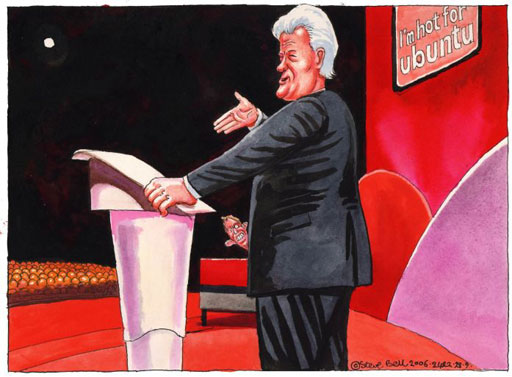
And they loved being urged to remain the change agents and to stay in the future business.
September 24, 2006
Foucault's Society Must Be Defended
I'm continuing to read Foucault's Society Must Be Defended, the lectures he gave in the mid 1970's at the College de France. The College enrolls no students and confers no degrees. Professors are required to deliver lectures to the general public on topics from their ongoing original research. These lectures are reconstructed from tape recordings and Foucault's own notes. In this lecture series Foucault explores the notion that "politics is war by other means" in its relation to race, class struggle, and power and provides us with a new model of political rationality.
In the second lecture Foucault sums up what he has been trying to say in previous years. He talks in terms of abandoning the Leviathan model of power and to study power outside this model of juridical sovereignty and the institution of the state. That means beginning with the techniques and tactics of domination.
A passage from the lecture courtesy of Craig at Theoria:
The juridico-political theory of sovereignty - the theory we have to get away from if we want to analyze power - dates from the Middle Ages. It dates from the reactivation of Roman law and is constituted around the problem of the monarch and the monarchy. And I believe that, in historica terms, this theory of sovereignty - which is the great trap we are in danger of falling into when we try to analyze power - played four roles.
First, it referred to an actual power mechanism: that of the feudal monarchy. Second, it was used as an instrument to constitute and justify the great monarchical administrations. From the sixteenth and especially the seventeenth century onward, or at the time of the Wars of Religion, the theory of sovereignty then became a weapon that was in circulation on both sides, and it was used both to restrict and to strengthen royal power. You find it in the hands of Catholic monarchists and Protestant antimonarchists; you also find it in the hands of more or less liberal Protestant monarchists; you also find it in the hands of Catholics who advocate regicide or a change of dynasty. You find this theory of sovereignty being brought into play by aristocrats and parliamentaires, by the representatives of royal power and by the last feudalists. It was, in a word, the great instrument of the political and theoretical struggles that took place around systems of power in the sixteenth and seventeenth centuries. In the eighteenth century, finally, you find the same theory of sovereignty, the same reactivation of Roman law, in the work of Rousseau and his contemporaries, but it now played a fourth and different role; at this point in time, its role was to construct an alternative model to authoritarian or absolute monarchical administration: that of the parliamentary democracies. And it went on playing that role until the time of the Revolution.
It seems to me that if we look at these four roles, we find that, so long as feudal-type societies survived, the problems dealt with by the theory of sovereignty, or to which it referred, were actually coextensive with the general mechanisms of power, or the way power was exercised from the highest to the lowest levels. In other words, the relationship of sovereignty, understood in both the broad and the narrow sense, was, in short, coextensive with the entire social body. And the way in which power was exercised could indeed be transcribed, at least in its essentials, in terms of the sovereign/subject relationship.
Now, an important phenomenon occurred in the seventeenth and eighteenth centuries: the appearance - one should say the invention - of a new mechanism of power which had very specific procedures, completely new instruments, and very different equipment. It was, I believe, absolutely incompatible with relations of sovereignty. This new mechanism of power applies primarily to bodies and what they do rather than to the land and what it produces. It was a mechanism of power that made it possible to extract time and labour, rather than commodities and wealth, from bodies. It was a type of power that was exercised through constant surveillance and not in discontinuous fashion through chronologically defined systems of taxation and obligation. It was a type of power that presupposed a closely meshed grid of material coercions rather than the physical existence of a sovereign, and it therefore defined a new economy of power based upon the principle that there had to be an increase both in the subjugated forces and in the forces and efficaacy of that which subjugated them.
It seems to me that this type of power is the exact, point-for-point opposite of the mechanics of power that the theory of sovereignty described or tried to transcribe. The theory of sovereignty is bound up with a form of power that is exercised over the land and the produce of the land, much more so than over bodies and what they do. [This theory] concerns power's displacement and appropriation not of time and labor, but of goods and wealth. This makes it possible to transcribe, into juridical terms, discontinuous obligations and tax records, but not to code continuous surveillance; it is a theory that makes it possible to found absolute power around and on the basis of the physical existence of the sovereign, but not on continuous and permanent systems of surveillance. The theory of sovereignty is, if you like, a theory which can found absolute power on the absolute expenditure of power, but which cannot calculate power with minimum expenditure and maximum efficiency. This new type of power, which can therefore no longer be transcribed in terms of sovereignty, is, I believe, one of bourgeois society's great inventions. It was one of the basic tools for the establishment of industrial capitalism and the corresponding type of society. This nonsovereign power, which is foreign to the form of sovereignty, is 'disciplinary' power. This power cannot be described or justified in terms of the theory of sovereignty. It is radically heterogeneous and should logically have led to the complete disappearance of the great juridical edifice of the theory of sovereignty. In fact, the theory of sovereignty not only continued to exist as, if you like, an ideology of right; it also continued to organize the juridical codes that nineteenth-century Europe adopted after the Napoleonic codes. Why did the theory of sovereignty live on in this way as an ideology and the organizing principle behind the great juridical codes?
I think there are two reasons. On the one hand, the theory of sovereignty was, in the seventeenth century and even the nineteenth century, a permanent critical instrument to be used against the monarchy and all the obstacles that stood in the way of the development of the disciplinary society. On the other hand, this theory, and the organization of a juridical code centered on it, made it possible to superimpose on the mechanism of discipline a system of right that concealed its mechanisms and erased the element of domination and the techniques of domination invovled in discipline, and which, finally, guaranteed that everyone could exercise his or her own sovereign rights thanks to the sovereignty of the State. In other words, juridical systems, no matter whether they were theories or codes, allowed the democratization of sovereignty, and the establishment of a public right articulated with collective sovereignty, at the very time when, to the extent that, and because the democratization of sovereignty was heavily ballasted by the mechanisms of disciplinary coercion. To put it more condensed terms, one might say that once disciplinary constraints had to both function as mechanisms of domination and be concealed to the extent that they were the mode in which power was actually exercised, the theory of sovereignty had to find expression in the juridical apparatus and had to be reactivated or complemented by juridical codes.
From the nineteenth century until the present day, we have then in modern societies, on the one hand, a legislation, a discourse, and an organization of public right articulated around the principle of the sovereignty of the social body and the delegation of individual sovereignty to the State; and we also have a tight grid of disciplinary coercions that actually guarantees the cohesion of that social body. Now that grid cannot in any way be transcribed in right, even though the two necessarily go together. A right of sovereignty and a mechanics of discipline. It is, I think, between these two limits that power is exercised. The two limits are, however, of such a kind and so heterogeneous that we can never reduce one to the other. In modern societies, power is exercised through, on the basis of, and in the very play of the heterogeneity between a public right of sovereignty and a polymorphous mechanics of discipline. This is not to say that you have, on the one hand, a garrulous and explicit system of right, and on the other hand, obscure silent disciplines that operate down below, in the shadows, and which constitute the silent basement of the great mechanics of power. Disciplines in fact have their own discourse. They do, for the reasons I was telling you about a moment ago, create apparatuses of knowledge, knowledges and multiple fields of expertise. They are extraordinarily inventive when it comes to creating apparatuses to shape knowledge and expertise, and they do support a discourse, but it is a discourse that cannot be the discourse of right or a juridical discourse. The discourse of discipline is alien to that of the law; it is alien to the discourse that makes rules a product of the will of the sovereign. The discourse of disciplines is about a rule: not a juridical rule derived from sovereignty, but a discourse about a natural rule, or in other words a norm. Disciplines will define not a code of law, but a code of normalization, and they will necessarily refer to a theoretical horizon that is not the edifice of law, but the field of the human sciences. And the jurisprudence of these disciplines will be taht of a clinical knowledge.
In short, what I have been trying to show over the last few years is certainly not how, as the front of the exact sciences advances, the uncertain, difficult, and confused domain of human behavior is gradually annexed by science: the gradual constitution of the human sciences is not the result of an increased rationality on the part of the exact sciences. I think that the process that has made possible the discourse of the human sciences is the juxtaposition of, the confrontation between, two mechanisms and two types of discourse that are absolutely heterogeneous: on the one hand, the organization of right around sovereignty, and on the other, the mechanics of the coercions exercised by disciplines. In our day, it is the fact that power is exercised through both right and disciplines, tha the techniques of discipline and discourses born of disciplines are invading right, and that normalizing procedures are increasingly colonizing the procedures of the law, that might explain the overall workings of what I would call a 'normalizing society.'
To be more specific, what I mean is this: I think that normalization, that disciplinary normalizations, are increasingly in conflict with the juridical system of sovereignty; the incompatibility of the two is increasingly apparent; there is a greater and greater need for a sort of arbitrating discourse, for a sort of power and knowledge that has been rendered neutral because of its scientificity has become sacred. And it is precisely in the expansion of medicine that we are seeing - I wouldn't call it a combination of, a reduction of - but a perpetual exchange or confrontation between the mechanics of discipline and the principle of right. The development of medicine, the general medicalization of behavior, modes of conduct, discourses, desires, and so on, is taking place on the front where the heterogeneous layers of discipline and sovereignty meet. (pp. 34-38)
September 22, 2006
native title claim over metropolitan Perth
The decision of Federal Court judge Murray Wilcox to rule in favour of a native title claim over metropolitan Perth puts the cat amongst the pigeons doesn't it. Justice Wilcox, in his landmark finding for the Nyoongar people, found that on the basis of probabilities the Nyoongar people had proved native title existed over the Perth area by continuing to observe traditional customs despite European settlement in 1829 which resulted in their widespread dispossession; that some members of the Nyoongar community were descendants of one or more Nyoongars who had originally lived in the Perth area.
The WA State government immediately rejected the Wilco's ruling that the Noongar indigenous people are the traditional owners of Perth and its surrounds and their native title continues to exist in the area. The government's reason for not accepting the findings was that the Noongar community had experienced too much disruption for them to have maintained a continuous connection to the Metropolitan Area since sovereignty.
Labor leader Kim Beazley supports an appeal against a Federal Court ruling giving Aboriginals native title over Perth. The federal Attorney-General, Philip Ruddock, said that more title claims over metropolitan areas could be made after Tuesday's Federal Court decision to recognise native land rights over the city of Perth. Ruddock adopts the scaremongering angle that public access to urban open spaces and national parks could be at risk.
Some good comments can b efound at John Quiggin. Judge Wilcox judge was careful to point out that while native title was important, it was largely symbolic. Wilcox specifically discourages litigation and advocates governments and Aboriginal representatives work together to reach pragmatic, practical agreement about the operation of native title.
Update: 23 September
The reality is quite different from the fear scenario being whipped by the media and politicians.
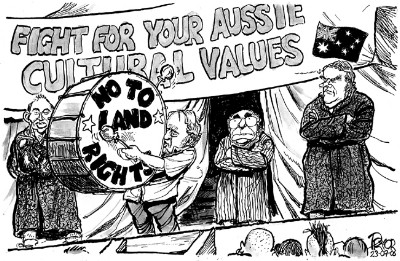
Geoff Pryor
Noel Pearson, writing in todays Australian, says that:
The bombshell in Noongar is moral and psychological. Just when the whitefellas had come to regard native title benignly, as largely a symbolic form of title that would be found only in the remote and desert parts of central and northern Australia, the Noongar people establish native title over the city that was established on their traditional homelands. The Noongar are shadow dwellers in their own country and these urban-dwelling blackfellas were not supposed to get native title. The Federal Court decision will not result in one square centimetre of land held by the whitefellas being lost. In fact the Noongar specifically did not claim any freehold or leasehold land, which everybody knows extinguishes native title, or indeed any other tenure that extinguishes native title.
Wilcox has ruled on the question of traditional connection to the claimed lands and has found in favour of the Noongar. He has not ruled on a second question: in what lands does native title still survive?
September 21, 2006
Dworkin on (deliberative) democracy #3
I want to pick up on this previous post on Ronald Dworkin's Is Democracy Possible Here? Principles for a New Political Debate In this text Dworkin is arguing that his two principles---every human life is of intrinsic potential value and that everyone has a responsibility for realizing that value in his own life---together define the basis and conditions of human dignity; that these the principles are sufficiently deep and general so that they can supply common ground for Americans; and that these principles have enough substance so that we can sensibly distinguish and argue about their interpretation and consequences for political institutions and policies. this is a more sophisticated way to approach the issue of common values in a divided culture than the recent political talk about Australian values.
In the first chapter of Is Democracy Possible Dworkin spells out the argument that the first principle, that every human life is of intrinsic potential value, can supply common ground for Americans --and Australians . He does by endeavouring to persuade us first that 'most people think it is intrinsically and objectively important how their own life is lived and then, second, that most people have no reason to think it is objectively any less important how anyone else's life is lived.'
Dworkin's first step is this.
Start with yourself. Do you not think it important that you live your own life well, that you make something of it? Is it not a matter of satisfaction to you and even pride when you think you are doing a good job of living and a matter of remorse and even shame when you think you are doing badly? You may say that in fact you aim at nothing so pretentious as a good life, that you only want to live a decently long time and have fun so long as you live. But you must decide what you mean by that claim. You might mean, first, that a long life full of pleasure is the best kind of life you can live. In that case you actually do think it important to live well, though you have a peculiarly hedonistic conception of what living well means. Or you might mean, second, that indeed you do not care about the goodness of your life as a whole, that you want only pleasure now and in the future.
This addresss the hedonistic utilitarians in our culture who equate happiness with wanting only pleasure out of life. Dworkin's response is this:
Most people think that enjoyment is central to a good life but not the whole story, that relationships and achievements are also important to living well. But even people who do think that pleasure is the only thing that counts actually accept the first principle of dignity for themselves. They think it important that they lead lives that are successful on the whole, which is why they care about pleasure past as well as pleasure to come. So most of us, from both of our supposedly divided political cultures, accept that it is important not just that we enjoy ourselves minute by minute but that we lead lives that are overall good lives to lead.This won't persuade the die hard hedonists but most people would accept that happiness would involve living good lives. Dworkin then makes a significant move: to an objective understanding of a good life:
Most of us also think that the standard of a good life is objective, not subjective in the following sense. We do not think that someone is doing a good job of living whenever he thinks he is; we believe that people can be mistaken about this transcendently important matter. Some people who think that a good life is just a life full of fun day by day later come to believe that this is an impoverished view of what it is to live well. They are converted to the more common view: that a satisfactory life must have some level of close personal relationships, or of important achievement of some sort, or a religious dimension, or greater variety, or something of that sort....It would be very hard....for most of us to give up the idea that there is an objective standard of success in living, that we can be mistaken about what living well means, and that it is a matter of great importance that we not make that mistake.
Many of us would, and do say this, in terms of living a happy life embodied in the market--ie., one of earning lots of money to enjoy ourselves by consuming lots of goods. A life based on drinking lots of wine and food would be an example of how we can make mistakes about what it is to live well, and that these mistakes are matters for very great regret.
Dworkin adds that most of us also:
... think that the importance of our leading successful rather than wasted lives does not depend on our wanting to do so. We want to live good lives because we recognize the importance of doing so, not the other way around...Most of us think that people who do not care what their lives are like, who are only marking time to their graves, are not just different from us in the unimportant way that people are who happen not to care whether the Red Sox win. We think that people who do not care about the character of their lives are defective in a particular and demeaning way: they lack dignity.
The success or failure of any human life is important in itself: it is an objective value.
September 19, 2006
an imperial presidency
John Yoo, a deputy assistant US attorney general from 2001 to 2003, has an op. ed. in The New York Times entitled How the Presidency Regained Its Balance.The argument is this:
Five years after 9/11, President Bush has taken his counterterrorism case to the American people. That's because he has had to. This summer, a plurality of the Supreme Court found, in Hamdan v. Rumsfeld, that Congress must explicitly approve military commissions to try suspected terrorists. So Mr. Bush has proposed legislation seeking to place the tribunals, and other aggressive antiterrorism measures, on a sounder footing. But the president has broader goals than even fighting terrorism---he has long intended to make reinvigorating the presidency a priority. Vice President Dick Cheney has rightly deplored the "erosion of the powers and the ability of the president of the United States to do his job" and noted that "we are weaker today as an institution because of the unwise compromises that have been made over the last 30 to 35 years."Thus Yoo's op.ed. is a defense of the shift power to the executive. The justification? War shifts power to the branch most responsible for its waging: the executive. The President justifies his authority on the basis of crisis, or as Professor Yoo once put it, on the need for "creative solutions" to the threats we face.
So the imperial presidency is justified in terms of the state of exception. Fore Yoo this is not a power grab---it's simply restoring power of the executive that was unwisely diminished in the past 30 years. That takes us back to the time of Nixon and presidential overreach in the context of the Vietnam war.
September 18, 2006
when interrogation crosses into torture
A standoff is looming between the Bush Adminstration and Senate Republicans over two bills now before Congress.

Banksy, I need someone to protect me from all the measures they take in order to protect me
Marty Lederman in a post at Balkinization says that though the various other statutory proposals now being debated do raise other serious questions the current legislative debate is about the Administration seeking authority to use threats of violence, and the cruel physical techniques akin to classic forms of torture.
He adds:
It's important to be clear about one thing: The question is not simply whether, in the abstract, it would be a good or acceptable idea for the United States to use such techniques in certain extreme circumstances on certain detainees. I happen to think that the moral, pragmatic, diplomatic and other costs of doing so greatly outweigh any speculative and uncertain benefits -- but that is obviously a question on which there is substantial public disagreement, much of it quite sincere and serious. Instead, the question must be placed in its historical and international context -- namely, whether Congress should grant the Executive branch a fairly unbounded discretion to use such techniques where such conduct would place the United States in breach of the Geneva Conventions. And that, of course, changes the calculus considerably. Does Congress really want to make the United States the first nation on earth to specifically provide domestic legal sanction for what would properly and universally be seen as a transparent breach of the minimum, baseline standards for civilized treatment of prisoners established by Common Article 3 -- thereby dealing a grievous blow to the prospect of international adherence to the Geneva Conventions in the future?
The big-ticket item is whether the CIA should be authorized to engage in "cruel treatment" in breach of our obligations under the Geneva Conventions.
September 17, 2006
recovering humanity
In Homo Sacer Giorgio Agamben talks in terms of a bare life ( life reduced to survival) in the camps of modernity where the distinction between the human and the inhuman is collapsed. The ethical response is one of remaining human in the biopolitical situation of the camps. Remaining human takes on a particular cast that eludes and contradicts attempts to sanctify human life through moral categories such as dignity and respect.
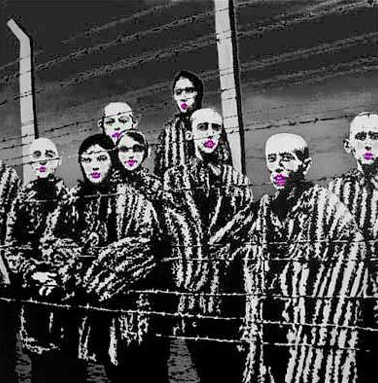
Banksy, Manifesto
Over the leaf is an extract from the diary of Lieutenant Colonel Mervin Willett Gonin DSO who was among the first British soldiers to liberate Bergen-Belsen in 1945. The source is the Imperial War museum
CampRemaining human is a question of bearing witness to the inhuman.To endure the inhuman then is to bear witness to it. The true witness are those who have endured the inhuman, borne more than they should ever have had to bear, and in doing so, remained fundamentally human. The ethics of witnessing that Agamben develops can be understood as an ethics of survival.'I can give no adequate description of the Horror Camp in which my men and myself were to spend the next month of our lives. It was just a barren wilderness, as bare as a chicken run. Corpses lay everywhere, some in huge piles, sometimes they lay singly or in pairs where they had fallen. It took a little time to get used to seeing men women and childen collapse as you walked by them and to restrain oneself from going to their assistance. One had to get used early to the idea that the individual just did not count. One knew that five hundred a day were dying and that five hundred a day were going on dying for weeks before anything we could do would have the slightest effect. It was, however, not easy to watch a child choking to death from diptheria when you knew a tracheotomy and nursing would save it, one saw women drowning in their own vomit because they were too weak to turn over, and men eating worms as they clutched a half loaf of bread purely because they had to eat worms to live and now could scarcely tell the difference. Piles of corpses, naked and obscene, with a woman too weak to stand proping herself against them as she cooked the food we had given her over an open fire; men and women crouching down just anywhere in the open relieving themselves of the dysentary which was scouring their bowels, a woman standing stark naked washing herself with some issue soap in water from a tank in which the remains of a child floated. It was shortly after the British Red Cross arrived, though it may have no connection, that a very large quantity of lipstick arrived. This was not at all what we men wanted, we were screaming for hundreds and thousands of other things and I don't know who asked for lipstick. I wish so much that I could discover who did it, it was the action of genius, sheer unadulterated brilliance. I believe nothing did more for these internees than the lipstick. Women lay in bed with no sheets and no nightie but with scarlet red lips, you saw them wandering about with nothing but a blanket over their shoulders, but with scarlet red lips. I saw a woman dead on the post mortem table and clutched in her hand was a piece of lipstick. At last someone had done something to make them individuals again, they were someone, no longer merely the number tatooed on the arm. At last they could take an interest in their appearance. That lipstick started to give them back their humanity.'
September 16, 2006
governing terrorism
Australia's new counter-terrorism laws (eg., Anti-Terrorism Act (No. 2) 2005) are designed to place Australia in a strong position to prevent new and emerging threats and to stop terrorists carrying out their intended acts. How are they put into practice? How is the terrorist threat governed to ensure national security? Though many would judge the anti-terror laws to be reasonable , since they have come at little cost to them, things are otherwise from the perspective of the Muslim community. They see the terrorism-laws being "100% directed at Muslims"; that there is some underlying assumption that Muslims are not wanted, that they are targeted by these laws, and that they are being used as scapegoats.
Consider two examples from this text by Agnes Chong in Borderlands. The first is a series of raids that happened in November 2002. Here:
The Australian Security Intelligence Organisation (ASIO) raided approximately thirty homes, all Muslim families, some with young children and babies, some with elderly men and women. As many as 30 men would surround a suburban Muslim home, all of them with black balaclavas, black flak jackets, with submachine guns ready to shoot. Sometimes they would knock first, but other times without warning, they would break down the front door of these homes with sledgehammers. They held grown men to the ground by putting their foot on their head, and confiscated those critical elements of terrorist activities: family videos, passports, birth and marriage certificates, scanners, printers, and in one case, the all-important tabloid newspaper. None of these raids led to any terror charges, but Muslims started feeling terrorised.
Such actions---no terrorism charges were even laid-- cause insecurity, of fear, or paranoia amongst Muslim communities. But more than that is involved. The personal impact of the losses of civil liberties, including freedom from arbitrary detention, the right to privacy, due process and freedom of association are very real for many Muslims in Australia.
Consider a second case:
Then there was the first arrest under the anti-terror laws, a 21-year old medical student called Izhar Ul-Haque in April 2004. His case is complex and interesting, but the odd thing was that for someone charged with a terrorist offence, it seemed that his activities were not really directly linked with a terrorist act. In his second bail hearing, the Court said that it was "important to note that it is no part of the Crown case that this young man poses any threat to anyone in this country". So what terror was there to end?.... treating him as a dangerous threat to Australia by putting him in maximum security made other Muslims feel rather insecure.
What we have is a discriminatory use of anti-terrorist powers in that that non- Muslim Anglo member of community person are not tried for terrorism offences but tried under the criminal law whilst Muslim community individual who has been picked up in similar circumstances are tried under terrorism legislation. Secondly, Muslim individuals can be charged with terrorist offences for their involvement in routine criminal activities.
September 15, 2006
the sad state of liberalism
Tony Judt, in an article subtitled the Strange Death of Liberal America in the London Review of Books asks a good question that resonates in Australia:
Why have American liberals acquiesced in President Bush's catastrophic foreign policy? Why have they so little to say about Iraq, about Lebanon, or about reports of a planned attack on Iran? Why has the administration's sustained attack on civil liberties and international law aroused so little opposition or anger from those who used to care most about these things? Why, in short, has the liberal intelligentsia of the United States in recent years kept its head safely below the parapet?
Can't this question also be asked of liberals in Australia? Judt's op. ed. is noted by Anthony Lowenstein but it is not commented upon in his post. We have a state of exception justified by the War on Terror.
What does Judt say about the silence? He suggests that it has to do with:
....the collapse of liberal self-confidence in the contemporary US can be variously explained. In part it is a backwash from the lost illusions of the 1960s generation, a retreat from the radical nostrums of youth into the all-consuming business of material accumulation and personal security.The disappearance of the liberal centre in American politics is also a direct outcome of the deliquescence of the Democratic Party. In domestic politics liberals once believed in the provision of welfare, good government and social justice. In foreign affairs they had a longstanding commitment to international law, negotiation, and the importance of moral example. Today, a spreading me-first consensus has replaced vigorous public debate in both arenas. And like their political counterparts, the critical intelligentsia once so prominent in American cultural life has fallen silent.
This form of liberalism is what we would call social democracy in Australia.
Judt adds that since the Clinton Presidency in the 1990s:
the moral and intellectual arteries of the American body politic have hardened further. Magazines and newspapers of the traditional liberal centre--- the New Yorker, the New Republic, the Washington Post and the New York Times itself---fell over themselves in the hurry to align their editorial stance with that of a Republican president bent on exemplary war. A fearful conformism gripped the mainstream media.
Similarly in Australia: 2001---9/11---was the turning point.
Judt says that in today’s whilst America neo-conservatives generate brutish policies as they engage in the unilateral promotion of empire the liberals provide the ethical fig-leaf. He adds:
So we have the discrepancy between Bush’s proclaimed desire to bring democracy to the Muslim world and his refusal to intervene when the only working instances of fragile democracy in action in the whole Muslim world ---in Palestine and Lebanon---were systematically ignored and then shattered by America’s Israeli ally. But America’s leading liberal intellectuals have kept silent.
So do Australia's, even though the Israeli stategy was to flatten Lebanon to preserve its own deterrent credibility.
September 14, 2006
beyond welfare
Mitchell Sviridoff in a review of Lawrence Mead's Beyond Entitlement The Social Obligations of Citizenship in the New York Times (circa 1985) gives a useful account of the rightwing critique of the welfare state. He says:
The assault on the American welfare state by the intellectual right began 15 years ago with ''The Unheavenly City'' by Edward Banfield. Mr. Banfield argued with considerable cogency that the acute troubles of the urban poor would persist for decades; they were not caused principally by poverty and therefore would not yield to conventional antipoverty measures. Mr. Banfield's seminal idea has been enlarged and reinforced by a succession of articles in the [now defunct] quarterly The Public Interest and by the works of Thomas Sowell, James Q. Wilson, George Gilder and others, and most dramatically by Charles Murray's recent ''Losing Ground.'' Fitting neatly into the conservative political agenda, these views have had a growing impact on public policy
This highlights how the limitations of the left's understanding of neo-liberalism and its policy agenda of privatization and deregulation. This understanding is most commonly seen as primarily economic as it has come from a political economy perspective. The argument is that the nation state has not been subverted but drawn into interconnecting and overlapping global authority structures where it actively participates in the promotion of free market objectives Here in Australia, the pursuit of these objectives by the Federal Government can be seen to have occurred through the adoption of a neoliberal agenda which, amongst other things, has lead to the withdrawal of state subsidies, the demise of trade protectionism, the deregulation of industries and the rise of notions, and practices, of community self-help and active citizenship.
This critique of neoliberalism itself most often falls back on economic models of argumentation, diagnoses neoliberalism as an expansion of economy in politics and takes for granted the separation of state and market. This response is understandable, given Murray's proposal to dismantle the welfare state and let the marketplace, the family, the neighborhood and old-fashioned charity deal with the problem of the poor.
Don Arthur's Alliance against Daddy post over at Club Troppo highlights the politics of the neo-liberal mode of governance by introducing the category of paternalism This highlights the way government increasingly seeks to supervise the lives of poor citizens who are dependent on it.
What we have is emergence of new forms of governance, undertaken by a network of government, private and voluntary actors. This requires new ways of thinking about the state. The concept of governmentality can deepen this turn to the political, as it shows that both the conservative and classical liberal strands are political strategies. The transformation of the relations of economics and politics are investigated from the perspective of a transformation of social power relations. In short, instead of the power of the economy, the analytic of governmentality returns the focus to the "economy of power".
September 13, 2006
Society Must be Defended
I bought a copy of Foucault's 'Society Must Be Defended': Lectures at the College de France, 1975-76 this afternoon in Paperchain Bookstore at Manuka, Canberra. Apparently it is the first in a series of his annual lecture programs to be published in coming years.
The lectures are situated between Discipline and Punish, which traced out the shifts in culture that lead to the prison's dominance and focused on the body and questions of power, and The History of Sexuality Vol 1, where the turn was made to biopolitics and biopower. 'Society Must Be Defended' is a historical examination of the model of war as a grid for analysing politics. Its subject is a Foucault's inversion of Clausewitz's famous dictum: 'Politics is the continuation of war by other means.'
In the first lecture, Foucault distinguishes two schemas for analyzing power - the contract-oppression schema and the war-repression schema - and acknowledges that while his work up to this point has criticized the former schema it has tacitly assumed the latter. His aim in these lectures is to subject the war-repression schema to critical scrutiny. His focus is on the war side of this schema, as his critique of the repressive hypothesis is worked out in detail in The History of Sexuality, Volume 1. Thus, the central question of 'Society Must be Defended' is this: "can we find in bellicose relations, in the model of war, in the schema of struggle or struggles, a principle that can help us understand and analyze political power, to interpret political power in terms of war, struggles, and confrontations?" (p.23)
September 12, 2006
is ideology shaping foreign policy?
The Howard Government and its supporters in The Australian have argued that 9/11 meant that Australia had no choice: 9/11 changed everything, and our national interest and security were best served by our unequivocal support for the US and that the Anzus alliance had to be invoked. So Australia is now fighting on two battlefields, Afghanistan and Iraq because a battle against a small band of clever, fundamentalists terrorists has been turned into a worldwide war of epic scale. The reasoning for the Western strategy is that it is better tof pursue Islamist terrorists into their breeding and training grounds than to fight terrorism in our own countries.
Australia has suffered in terms of terrorist attack on Australian life and property: firstly, the Jakarta embassy bombing of September 9, 2004 by Jemaah Islamiah, (no Australian lives were lost, though 11 Indonesians died in the blast) and secondly, Bali, where 82 people, along with 120 other mainly foreign tourists, were killed. So far Australia has got off likely.
What of Australia's international standing and reputation as a result of the Howard Government's strong support for America's war on terror?
An editorial in the Canberra Times makes an interesting argument. It says:
In the Asia-Pacific region - the area of fundamental importance to our security outlook - many would argue that Australia has paid a very high price. And it's not just perceptions about Australia's willingness to act as a US deputy sheriff in the region, either - as damaging as that is to Asia perceptions about our independence. By openly backing the US Administration's arrogant dismissal of multilateral solutions to the terrorist threat, especially in dealing with Saddam Hussein, by echoing America's unilateralist swagger (especially when Howard said he would favour pre-emptive military strikes on neighbouring countries to thwart a terrorist strike against Australia), this Government has demonstrated an unnerving capacity to let ideology shape foreign policy. This preparedness to abandon principles of non-intervention, sovereignty and multilateralism has hardly wavered...
The principles of non-intervention, sovereignty and multilateralism have been abandoned in favour of national self- interest. Suprisingly, that does not mean a return to realist understanding of international relations for the conservatives---strategic self-reliance and regional engagement. It has meant going along with, and echoing, the Bush Administration's reshaping the US as a super power into an empire.
That echoing even goes so far as to condone strikes on Lebanese civilian infrastructure as an integral part of Israel's military strategy.
political seduction
When its time to go in politics there is often little choice available --you go. Hanging around can be very painful as Margaret Thatcher discovered, and as Tony Blair is currently experiencing. And the media love a good political bustup. So we have simmering Cabinet tensions over Tony Blair's exit from Downing Street, different camps forming around the conflict over the Labour leadership, and lots of shadows of shadows and many seductive whispers:
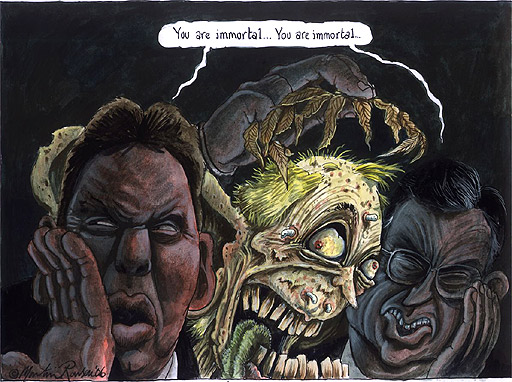
Blair is currently doing a 3 day tour of the Middle East talking peace, even though his unpopularity among world leaders is surpassed only by President Bush and the Israeli premier, Ehud Olmert. So there he was in the Middle East, having lost the trust of the Palestinians and the Shiite Lebanese because of his unequivocal pro-American/pro Israeli line.
The whispers are saying that Blair can restart the Middle East peace process to resolve the Israeli-Palestinian conflict .
September 11, 2006
September 10, 2006
welfare-to-work & governmentality
What the Government calls 'mutual obligation requirements' in relation to welfare-to-work is a group of instruments that are designed to penalise those who fail to fulfil the conditions of their welfare benefits or Newstart. Penalties are incurred when welfare recipients breach their mutual obligation requirements. This is part of the broad neo-liberal reform push to deregulate the labour market and to substantially change the welfare state. Over at Club Troppo Don Arthur says that:
Charles Murray and Peter Saunders both want to dismantle the welfare state--- they just have different strategies for doing it. Murray's plan is to convert current welfare state spending into cash grants for every adult American (except those in prison) while Saunder's plan is to replace unemployment allowances, Medicare and other benefits with privatized savings accounts.
The neo-liberal assumption is that the unemployed need prodding back into work because they have no work ethic, and they are not personally motivated to acquire one. Unemployment is what lazy members of the working class engage in in that they chose this welfare lifestyle option. So they need a bit of regulation and discipline. What this account overlooks is that individuals are acting rationally in turning down low wage work because they suffer from high effective marginal tax rates in the transition from part time to full time employment.
Though the neo-liberal concern with the moral character of the unemployed is a return to the way the nineteenth century understood the unemployed, neo-liberal discourse is different because of the social democratic intervention, and construction of, the welfare state. It adopts a dependency culture perspective on the problems of unemployment and poverty and argues for the need to get back to what is called 'insurance principles' in the name of enhancing freedom.
We can look at the neo-liberal concern with the unemployed as a policy issue in terms of a range or assemblage of mechanisms and instruments devised by neo-liberalism that are bought to bear on welfare subjects to shape their conduct. The aim is to bring them into the market place. Any job is better than no job, as it were. Foucault's concept of 'governmentality', which is concerned with techniques and technologies of discipline, can be deployed to interpret the administrative categorization process that was used to distinguish legitimate from illegitimate unemployment benefit claims. Unemployment is understood as a historically specific site of regulation and the concern is to discover which kind of rationality is being used by the liberal state.
This review of William Walters 'Unemployment and Government: Genealogies of the Social' describes this approach:
Drawing on Foucault’s concept of “governmentality” and employing what may be called a social constructionist perspective, Walters aims to understand how unemployment has been discovered / created as a “conceptual object” (p. 36) and "rendered as a problem for government" (p. 3). This means looking at what sort of problem unemployment is imagined to be, and how this has changed historically. Walters also relates this to the major shifts which have taken place in how governments have responded to this problem. Here he is concerned with both the mundane devices and technologies used to regulate the social life of the unemployed and the broader "technologies" within which these are embedded.
What we have is a form of social governance whose strategy of rendering individual subjects 'responsible' entails shifting the responsibility for social risks such as illness, unemployment, poverty, etc. and for life in society into the domain for which the individual is responsible and transforming it into a problem of "self-care". We are deemed to be good if we engage in self care and bad if we rely on the welfare state.
September 8, 2006
tolerance & governmentality
In this chapter from Regulating Aversion: Tolerance in the Age of Identity and Empire Wendy Brown takes a Foucauldian approach to tolerance. She says that:
The central question of this study is not "What is tolerance?" or even "What has become of the idea of tolerance?" but, What kind of political discourse, with what social and political effects, is contemporary tolerance talk in the United States? What readings of the discourses of liberalism, colonialism, and imperialism circulating through Western democracies can analytical scrutiny of this talk provide?
Tolerance as a political discourse and practice of governmentality, that is historically and geographically variable in purpose, content, agents, and objects., would consider a consortium of para-legal and para-statist practices in modern constitutional liberalism---practices that are associated with the liberal state and liberal legalism but are not precisely codified by it.
She adds:
tolerance is exemplary of Foucault’s account of governmentality as that which organizes "the conduct of conduct" at a variety of sites and through rationalities not limited to those formally countenanced as political. Absent the precise dictates, articulations, and prohibitions associated with the force of law, tolerance nevertheless produces and positions subjects, orchestrates meanings and practices of identity, marks bodies, and conditions political subjectivities. This production, positioning, orchestration, and conditioning is achieved not through a rule or a concentration of power, but rather through the dissemination of tolerance discourse across state institutions; civic venues such as schools, churches, and neighborhood associations; ad hoc social groups and political events; and international institutions or forums.
September 7, 2006
about tolerance
In this chapter from Regulating Aversion: Tolerance in the Age of Identity and Empire Wendy Brown notes that since the mid-1980s there has been something of a global renaissance in tolerance talk. There has also been, we can add, a strong conservative reaction to to the liberal idea of tolerance.
On the first point Brown says that:
Tolerance surged back into use in the late twentieth century as multiculturalism became a central problematic of liberal democratic citizenship; as Third World immigration threatened the ethnicized identities of Europe, North America, and Australia; as indigenous peoples pursued claims of reparation, belonging, and entitlement; as ethnically coded civil conflict became a critical site of international disorder; and as Islamic religious identity intensified and expanded into a transnational political force. Tolerance talk also became prominent as domestic norms of integration and assimilation gave way to concerns with identity and difference on the left and as the rights claims of various minorities were spurned as "special" rather than universal on the right.
Though tolerance is uncritically promoted across a wide range of venues and for a wide range of purposes it has never enjoyed a unified meaning across the nations and cultures that have valued, practiced, or debated it. It has a variety of historical strands, has been provoked or revoked in relation to diverse conflicts, and has been inflected by distinct political traditions and constitutions.
Brown goes on to say that even within the increasingly politically and economically integrated Euro-Atlantic world, tolerance signifies differently and attaches to different objects in different national contexts:
for example, tolerance is related to but not equivalent to laicite in France, as the recent French debate over the hijab made clear. And practices of tolerance in Holland, England, Canada, Australia, and Germany not only draw on distinct intellectual and political lineages but are focused on different contemporary objects---sexuality, immigrants, or indigenous peoples---that themselves call for different modalities of tolerance. That is, modalities of tolerance talk that have issued from postcolonial encounters with indigenous peoples in settler colonies do not follow the same logics as those that have issued from European encounters with immigrants from its former colonies or those that are centered on patriarchal religious anxieties about insubordinate gender and sexual practices. Similarly, an Islamic state seeking to develop codes of tolerance inflects the term differently than does a Euro-Atlantic political imaginary within which the nation-states of the West are presumed always already tolerant.
A lot of the debates about tolerance in Australia do centre around Australia being a post colonial society.
September 5, 2006
uni's prefer the wealthy?
This review of Daniel Golden's The Price of Admission: How America's Ruling Class Buys Its Way into Elite Colleges -- and Who Gets Left Outside the Gates enables us to gain a picture of the future of academia in Australia as the shift to the market continues to deepen. The reviewer---Scott Jaschik --says:
That American higher education is not a pure meritocracy is, of course, hardly news. But Golden’s book has a level of detail about the degree to which he says some colleges favor the privileged that will embarrass many an admissions officer. Golden names names of students — and includes details about their academic records before college and once there that raise questions about the admissions decisions being made.
What is highlighted is the preferences for the rich and famous, or generous alumni donors.The universities those whose families had the potential to become big donors, and that strong academic credentials weren’t a requirement. Uni's need the money ”they get from favoring the wealthy and conservatives want their kids to get in.
It's affirmative action for the wealthy.That's the future of academia in Australia.
September 4, 2006
empire+nationalism
Have you noticed the way that the neocons are invoking World War II, the Cold War, and Fascists, Nazis and Communists to convince us that the war in the Middle East really is something that can be won by conventional military means? The enemy is "Islamofascism" and we are supposedly involved in an ideological struggle of freedom versus a totalitarian ideology---a Manichaean unilateralism of good against evil---says President Bush, prime minister Blair, Israeli spokesmen and John Howard. Anyone who does not support them, they suggest, is soft and permissive of Osama bin Laden, copy-cat gangs of violent fundamentalists and terrorists. The appeal is to a deep nationalism at home, with the rhetoric designed for the domestic polity.
Anatol Lieven, in an extract from his America Right or Wrong: an anatomy of American nationalism suggests that under the George W Bush administration the United States has driven towards empire, but the domestic political rhetoric was a wounded and vengeful nationalism. The Bush administration has been careful to package the shift to empire as something else:
on one hand, as part of a benevolent strategy of spreading American values of democracy and freedom; on the other, as an essential part of the defence not of an American empire, but of the American nation itself.
The nationalism is understood by Americans to be patriotism ---anti-war protestors are called unpatriotic---whilst people outside the U.S. who oppose American policies are labeled as anti-American. American nationalism is based on values rather than ethnicity or race: The first value is universalism, which says that Americans share the same moral ideals as the rest of humanity, including freedom, liberty and democracy. The second value is exceptionalism, which says that Americans have a right to pursue policies to preserve their national sovereignty, but other countries do not have a similar right. American sovereignty is to remain absolute and unqualified.
The rhetoric in Australia is mostly about the implosion of the Australian "civilisation" due to an "overdose of liberal tolerance", and the demands that Muslims integrate, accept Australian values, and treat women with equality.It is only Muslims who are defined as a threat to Australia's values and interests. What does it mean to be Australian? "It means accepting Australian values". Which are?
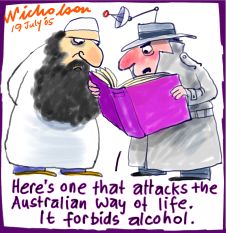 An answer is given by Kevin Donnelly, who says that the cultural warriors of the Left argue for a kind of mushy multiculturalism, which holds that all cultures are equal, and there is nothing unique about the Australian experience. So what is unique about our culture? Australia is an outpost of Western civilisation that is characterised by an open and free society is the standard answer. Instead of celebrating Australia's Western tradition the left says that we have always been multicultural, that all cultures are of equal value, and we should feel guilty about the sins of the past.
There is nothing unique about these Australian values. The very liberal values of tolerance, compassion, openness and civility that are supposed to ensure Australia's continued peace and stability, are culturally specific and based on our Western heritage.They are shared by all modern western nations. When pushed conservatives begin to talk in terms of Australia's development as a nation and its legal, political institutions and language being Anglo-Celtic in origin and deeply influenced by our Judeo-Christian heritage.
That indicates the appeal is to the core population of Protestant Australia’s old conservative religious and cultural communities that are under threat from an unrestrained free-market global capitalism that threatens to dissolve those communities and undermine traditional family structures. Even though it is the workings of unanchored global capitalism that is eroding the world which the religious conservatives wish to defend, the religious right has allied itself solidly with the free-market forces in the Coalition. This contradiction is covered over by the cultural wars and the left supposedly dumping the western heritage.