August 31, 2006
Steyn in Australia: demography & destiny
I noted Mark Steyn lecture at the IPA in an earlier post on public opinion. This followed an appearance at the CIS Big Ideas Forum dealing with challenges confronting the West. This turned out to be a good old bash against multiculturalism (all cultures are equally valid, cultural relativism etc) and the modern multicultural state.
Steyn's task at the IPA lecture was to answer the question, 'Does western civilization have a future in terms of the future of much of the rest of the world'?, in terms of seeing if anything can still be saved. For the West, make no mistake, is dying. Steyn's thesis links demographic decline; the unsustainability of the social democratic state; civilizational exhaustion. He says that none of these is caused by radical Islam. They’re self-inflicted.
Steyn is the guru of the right-wing brigade and he dishes up the old conservative declinist thesis characterised by degeneracy of western civilization---disaster, collapse, corruption, decay--- and the need to recover military virtues to defend the West. The West needs to be qualified as Europe is Steyn's classic example of his thesis that civilizations die from suicide, not murder. His is a trajectory of affluence, softness, decadence, extinction. Europe stands a very good chance of living under Sharia law given the demographic changes that are afoot. It's too late to save Europe. Western Europe is written off.The best Steyn hopes for is to save some parts of the West, by which, based on his previous writings, he presumably means America--- and Australia. I'm not sure about the UK.
Steyn reworks the declinist narrative in terms of demography. The West, as a matter of demographic fact, is dying. Demography is destiny. The implication is that the progressive agenda of the elites in the commanding heights of the culture---lavish social welfare, abortion, secularism, multiculturalism--is collectively the real suicide bomb. Clearly, a liberal civilization that feels guilty for everything it is and does---and full of self-hate---will lack the energy and conviction to defend itself. That points to a civilization suicided from despair; death from want of a reason to live. Civilizational confidence is the key. War brings that about. Lavish social welfare, abortion, secularism, multiculturalism has got to be fixed. It is a re-working of the neoconservatives’ defense of white immigration from the ‘90s: all the problems stemming from immigration are really stemming from liberals leftist policies and culture.
The Anglo-Americans have a future if they continue to breed and stop becoming Islamisfied from increasing immigration to roll back a declining population. Becoming Islamisfied raises the prospect of increased terror and violence as the Muslim population expands. So Australia must start taking serious measures about the Muslims in its midst—stopping their immigration cold, deporting all Muslims who adhere to the Islamic political agenda, restricting their mosques. This would result in the beginning of the decline of the Muslim power and numbers. However, the USA and Australia only have a future if the Mums and Dads continue to breed and grow the population. As Steyn writes, "It's the demography, stupid."
The right wing brigade in Australia love it, by all acounts. It's deep. It's a grand narrative with punch. Stein stands for sanity. Steyn's case is unimpeachable. It's time to be afraid. That seems to the response to his argument: if we stopped being leftist and politically correct and if we increased our birthrates, then the Muslim threat would go away. Alas, underneath this attractive political pacjage sits a simple thesis--- the decline of the west is all due to demographics.
August 30, 2006
Dworkin on (deliberative) democracy #2
In an earlier post we established that our political life is marked by a kind war between two armed camps--conservative and liberal and that this unbridgeable divide --and lack of a common ground--- has resulted in a lack of debate about policy options and different kinds of politics. How does Dworkin address this? He says:
That in spite of the popular opinion [about the unbridgeable divide} we actually can find shared principles of sufficient substance to make a national political debate possible and profitable. These are very abstract, indeed philosophical, principles about the value and the central responsibilities of a human life. I suppose not that every American would immediately accept these principles, but that enough Americans on both sides of the supposedly unbridgeable divide would accept them if they took sufficient care to understand them.
Dworkin says that these principles are sufficiently basic so that a liberal or conservative interpretation of them will ramify across the entire spectrum of political attitudes. What are these deep shared principles?
Dworkin says that:
The first principle--which I shall call the principle of intrinsic value---holds that each human life has a special kind of objective value. It has value as potentiality; once a human life has begun, it matters how it goes. It is good when that life succeeds and its potential is realized and bad when it fails and its potential is wasted. This is a matter of objective, not merely subjective value; I mean that a human life's success or failure is not only important to the person whose life it is or only important if and because that is what he wants.. The success or failure of any human life is important in itself, something we all have reason to want or to deplore.
The second principle is the principle of personal responsibility and it:
...holds that each person has a special responsibility for realizing the success of his own life, a responsibility that includes exercising his judgment about what kind of life would be successful for him. He must not accept that anyone else has the right to dictate those personal values to him or impose them on him without his endorsement. He may defer to the judgments codified in a particular religious tradition or to those of religious leaders or texts or, indeed, of secular moral or ethical instructors. But that deference must be his own decision; it must reflect his own deeper judgment about how to acquit his sovereign responsibility for his own life.
Dworkin says that these two principles together define the basis and conditions of human dignity, and that are individualistic in this formal sense--- they attach value to and impose responsibility on individual people one by one--but not a substantive sense. He adds that he makes two claims for these principles.
I claim, first, that the principles are sufficiently deep and general so that they can supply common ground for Americans from both political cultures into which we now seem divided...I claim, second, that in spite of their depth and generality, these principles have enough substance so that we can sensibly distinguish and argue about their interpretation and consequences for political institutions and policies.
August 29, 2006
sacrificing the rule of law
The National Security State has taken a strong position on national security since 9/11. It's new anti-terrorism laws, which were modelled on those of the UK, were introduced last year. Concerns were expressed at the time that these laws would ride roughshod over the individual liberties of Australian citizens.
Jack Thomas ("Jihad Jack" to some commentators) was the first person to be tried in Australia under the Federal Government's new anti-terror laws. He was freed by the Victorian Court of Appeal a week ago. Thomas had been charged with four terrorism-related offences. At his initial trial, the jury acquitted him of the two most serious charges ---- those relating to his alleged training and planning for terrorism offences. He was convicted of two lesser charges: one count of receiving funds from a terrorist organisation and one of possessing a falsified Australian passport.The evidence against him was based entirely on confessions.
Thomas' convictions were quashed because the Court of Appeal found that his admissions were made under duress. Australian Common Law, holds that a confession made out of court by an accused person is not admissible as evidence unless it is shown to have been made voluntarily. Thomas has since been issued with a control order restricting his movements.
What suprised me was the conservative hostility to the Victorian Court of Appeal decision.
Chris Merritt, the legal affairs editor of The Australian, in an op. ed entitled 'Legal system releases the enemy' said that:
When the legal system allows a mate of Osama bin Laden to walk free in Melbourne, something is terribly wrong...There might be all sorts of nice legal arguments that favour yesterday's decision. But try explaining those to the families of those who died in Bali.
The 'nice legal argument' was that Thomas had been subjected to intimidation, coercion and ill-treatment by Pakistani and American officers, sometimes with ASIO officials present, that were designed to extract intelligence from him. So it could not be said that his confessions had been freely made. Consequently, the record of interview was inadmissible and, because it constituted the entirety of the prosecution evidence, the convictions had to be set aside.The Court summarised its decision as follows:
Put bluntly, there can be little doubt that it was apparent to [Thomas], at the time of the AFP interview, as it would have been to any reasonable person so circumstanced, that, if he was to change his current situation of detention in Pakistan and reduce the risk of indeterminate detention there or in some unidentified location, co-operation was far more important than reliance on his rights under the law. Indeed, it is apparent that he believed ---and we would add, on objectively reasonable grounds ---that insistence on his rights might well antagonise those in control of his life.
Presumably Merritt and The Australian condone confessions extracted by threats and torture and are opposed to those who argue that such evidence should not be admitted because it perverts our law.As The Australian put it in an editorial 'the war on terror is real. And as in previous wars, sacrifices sometimes need to be made, and without the right to life, none of our other rights apply.' If torture of Australian citizens is okay, then the sacrifice involves suspending the rule of law in an emergency. No matter what the law says, Jack Thomas should be locked up. He's the enemy of the national security state. So a fundamental Common Law principle--that admissions must not be procured by duress-- should be dumped because the war on terrorism constitutes a state of emergency.
a paradox of power
As is well known the Liberal Party in states of Australia have been in opposition for a decade, whilst the Liberal Party has been in power in Canberra. The old Liberal tactic of arguing that the state ALP governments have been high taxing and spendthrifts no longer works, as each of the state governments have run balanced budgets for two terms. The Liberal Partry in the states have failed to counterattack in the social policy fields of health, education and law and order. Consequently, the state Liberal Parties wither on the vine whilst the federal Liberal Party blossoms. One reason for why they are out of favour with voters was their market liberal economic agenda and particularly privatisation thrroughout in the 1990s.
The Howard Government's increasing centralization of power in Canberra over the last decade has reduced the states to implementaton agencies. Canberra is even dictating to the states its own view of history and that it should be taught in the state's public schools.
That is how Australian citizens currently ensure a balance of power in a democratic federation these days: the Liberal Party in power in Canberra, the ALP in power in the states. This is so despite the marked failures over health (in Queensland) and transport (in NSW) and energy (in SA). The consequence is that the accident prone state Liberal parties tear themselves apart in factional wars and so take another step to oblivion and thus a step away from winning power.
It's a strange paradox isn't it.
August 28, 2006
Dworkin on (deliberative) democracy
Ronald Dworkin makes a remark on American politics that apply to Australia. He says:
American politics are in an appalling state. We disagree, fiercely, about almost everything. We disagree about terror and security, social justice, religion in politics, who is fit to be a judge, and what democracy is. These are not civil disagreements: each side has no respect for the other. We are no longer partners in self-government; our politics are rather a form of war.
The paragraph is from the first chapter of Dworkin's Is Democracy Possible Here? Principles for a New Political Debate. He says that one explanation for this state of affairs is the cultural wars. According to some commentators Americans --and Australians---are:
... more deeply and viscerally divided even than these political differences suggest; the stark political split emerges, they say, from an even deeper, less articulate contrast between two mutually contemptuous worlds of personality and self-image. Blue-culture Americans, they say, crave sophistication; they cultivate a taste for imported wine and dense newspapers, and their religious convictions, if they have any at all, are philosophical, attenuated, and ecumenical. Red-culture Americans guard a blunter authenticity; they drink beer, watch car racing on television, and prefer their religion simple, evangelical, and militant. Bush won the 2004 election, on this story, in spite of the fact that his first-term performance was unimpressive, because the red culture slightly outnumbers the blue culture at the moment and Bush managed to embrace not only the political preferences of that red culture but its morals and aesthetics as well.
Dworkan is not convinced. He suggest that the two-cultures thesis may not be so much an explanation of our politics as itself the creation of our politics. The political alliance between 'evangelical religion and powerful commercial interests is less the result of an underlying, deep cultural identity than of a political masterstroke: persuading people who hate gay marriage that they should therefore also hate the progressive income tax.'
I reckon he is right on that. So what is the consequence of the hostility between the two political cultures.
Dworkin says:
The most serious consequence of the assumption of a comprehensive and unbridgeable cultural gap is not the stereotyping, however, or even the contempt each side shows for the other. It is the lack of any decent argument in American political life. I mean “argument” in the old-fashioned sense in which people who share some common ground in very basic political principles debate about which concrete policies better reflect these shared principles.
I've noticed this in Australia. There is little debate, little public political conversation over policy issues. Nor is there any desire to have one. Politics appears to have become a kind of war.The common ground is the terrain on which the war is fought, not the principles of liberal democracy.
August 25, 2006
about Lebanon
This is a good judgement about Lebanon by Amir Taheri in an article entitled The proxy war in Prospect:
The mini-duel in Lebanon is the first of many battles likely to be fought in the broader war for reshaping the middle east, in the wake of regime changes in Afghanistan and Iraq. As things stand, Lebanon has an even chance of falling into either of the rival Iranian and American camps. The American camp could still win, provided the US rallies its western, Arab and Lebanese allies in support of the Siniora "project for peace." This would mean shifting the focus in Lebanon from the Arab-Israeli conflict to the task of building a modern and democratic Lebanese state that, while friendly with the west, would understand Lebanon's historical vocation as a buffer between rival powers. But if Lebanon falls to Shia jihadism, other Arab countries, starting with Iraq and Bahrain, could quickly follow. That could spell the end of Bush's dream of a democratic "greater middle east."The Israel-Hizbullah duel, a proxy war between two visions of the middle east, has ended in a draw---at least for now.
Israel is seen as the instrument being used by the US to carry out America's middle-eastern policy with Hizbollah being able to provide a lasting and durable challenge to US-Israeli hegemony in the region. This conflict is not going end soon.
Paul Rogers confirms this when he says at Open Democracy:
...the geopolitical significance of Persian Gulf oil reserves remains a key aspect of US strategy in the middle east. The Persian Gulf simply must be controlled by the United States, and, with the current establishment of permanent US military bases in Iraq, this makes a wholesale withdrawal from Iraq highly improbable in the next few years.Second, it is entirely unacceptable that Afghanistan should become once more a free zone for al-Qaida and other Islamist paramilitaries to train and conserve their resources. The United States will not withdraw from that country, and the insurgency will most likely grow.
This suggests a long drawn-out war.
August 24, 2006
diversity in Australian higher education?
At Curtin University, Julie Bishop, the Minister for Science, Education and Training, gave a speech about diversity in higher education.This gave an indication of how Julie Bishop might seek to reshape Australia's tertiary system. The Minister said Australia had neither the staff nor the population to maintain 37 public and three private universities, and that our higher education system suffers from the relentless pursuit of sameness and the one-size-fits-all mould.
This is not a two-tier system of research-intensive universities on the one hand, and then teaching only universities on the other. According to the Minister in an interview on the ABC's National Interest progam it is:
... more about diversity across a broad range of areas. It can be diversity of course structure, of course offerings, of management structure, it can be a whole range of issues, it's not just a debate about teaching versus research.And I think that we miss out on some of the heights of our international competitors, if we don't start to focus on playing to our strengths.....So we've got to get away from the one-size-fits-all approach and focus on greater diversity. It doesn't mean more universities, but it does mean that the universities that we have differentiate themselves and play to their strengths.
Peter Mares points out a difficulty.
Well no-one would want to become a liberal arts university because then they'd be setting themselves up just to get cuts', you know, they're not going to survive if they specialise in the humanities and the liberal arts.The minister's response was:
Well why would it be that one of the greatest universities in the United States is Wellesley College, an all-female, liberal arts college, which is recognised as one of the great universities, with graduates such as Madeleine Albright and Hilary Clinton. I mean of course there's a range of universities that we could have available in this country. And we've got to get away from this teaching versus research debate, and look at what our universities can best offer a wide range of students.
I cannot see this happening for two reasons. Australian, as a utilitarian society, does not value the humanities. Australia is not the US, which values the humanities. Secondly, the Right see the humanities as bastions of neo-Marxist and radical feminist ideology. Brett Mason, a Liberal senator representing Queensland, says in the Australian that the reason leftist dogmas are so prevalent on campus is because humanities, arts and education faculties are predominantly populated by leftist ideologues. Australian academe has become a partisan echo chamber in which the professoriate is in violent agreement about the ostensible evils of capitalism, Zionism and George W. Bush. He adds
Too many of them [tenured radicals] unashamedly use their power and position to force-feed extremism down the throats of a captive audience of our impressionable young.... Only those who pass ideological muster tend to be granted access to PhD fellowships and teaching positions. Australian universities have become assembly lines for mass political indoctrination and Leftist group think. And this educational perversion must be stopped.
According to Mason, this self-perpetuating class of academic mandarins, which replicates by hiring younger ideological versions of itself, alsos force-feds students the nihilistic doctrines of postmodernism.
August 23, 2006
Criticising the Australian Govt's Middle East policy
According to the ABC's 7.30 Report Ross Burns, who has served as high commissioner to South Africa and ambassador to Syria before serving in Israel from 2001 to 2003, criticised the Australian Govt's Middle East policy in a recent speech on foreign policy in Perth. He said that Australia had been outed for its lack of a Middle East policy during the Lebanon crisis, that the Australian Government was happy to be a mere "stalking horse" for Israeli ambitions, and that the foreign affairs presence in the region had been allowed to run down so much that the department was no longer the Government's eyes and ears in the region.
Well, its about time someone pointed out the obvious. Burns has made this criticism before---on the ABC's Perspective progam. There he said the:
Australian Government chants the mantra of 'Israel's right to defend itself'. Everyone has a right to defend themselves - Israel's right doesn't cancel out anyone else's. Moreover the real issue is - defence through what means? Defensive action has to be proportional and consistent with stated objectives. Massive disruption of infrastructure and endangering civilian life recklessly is against all reasonable codes of war.
Alas for Australia the ALP Opposition has a policy of me too-ism on the Middle East --it also sees the Israel-Palestinian situation purely through "an Israeli optic". Labor's silence on the Lebanon conflict was "thunderous", and in Burn's judgement, Labor doesn't seek to establish any different policy towards Israel from the Coalition. It has a high comfort level with the "peace through strength" vision of spreading pax Americana and an Israel-centric Middle East foreign-policy agenda promoted by the Washington neo-conservative camp.
The implication is that the Middle East policy debate within Australia is pretty thin and is conducted with the horizons of a sparse, simplistic policy on the Middle East---of uncritical defence of Israel and the Bush administrations' grand strategy to create a "new Middle East" through regime change in Syria and Iran. Any questioning of this uncritical defence of Israel ----is seen as appeasement by those who support the neo-conservative-militarist Washington consensus on Israel-Arab/Iran policy. Isn't there room for the ALP to question the drumbeat for a tactical US-Israeli strike on Iranian nuclear facilities given the fighting in south Lebanon, sectarian clashes in Iraq and a resurgent Taliban in Afghanistan.
August 22, 2006
a dearth of conservatives in Australia
In the forthcoming Sydney Institute Quarterly Gerard Henderson argues that the Right is not winning the culture wars due to a lack of conservative intellectuals. The Left still rules. Since it is not online I will spell out his argument. Henderson starts by saying that:
Throughout the 1950s and '60s, the Coalition won successive federal elections. However, this disguised the fact that the Left was winning the debate in its long march through institutions such as universities, schools, trade unions and the media (including the ABC). Today this is reflected in the fact that there are so few home-grown political conservatives born before, say, 1960 who are prominent in the public debate. Many of Australia's most influential contemporary political conservatives, of a certain age, have a background on the Left (Piers Akerman, David Barnett, Tim Blair, Ron Brunton, Jonathan King, P.P. McGuinness, Christopher Pearson, Imre Salusinszky, Max Teichmann, Keith Windschuttle) or within the social democratic tradition (Andrew Bolt, Bob Catley, David Flint, John Hirst, Ross Terrill).
That is true. Australia's conservative tradition has been an instinctive one despite the work of Quadrant.
Henderson goes on to say that this 'seen the light' characteristic of home-grown political conservatives says something about the relative failure of Australian conservatives in the culture wars that there are so few from cradle to grave conservatives in the public debate.
Here the situation in Australia differs significantly from that prevailing in North America and western Europe. Per head of population, there are many more articulate political conservatives in the US and Britain than there are in Australia. Like the Menzies government, the Howard Government has been very successful at elections. Yet the voice of the Howard haters and Bush haters and Blair haters is still heard loudly in the humanities departments at the universities, within some professions, among many journalists and overwhelmingly at the various taxpayer-subsidised literary festivals or so-called festivals of ideas (which are all too frequently festivals of one leftist idea).
Henderson ends thus:
In other words, the Left still prevails within many of Australia's key non-government institutions. No doubt in a decade or so there will be many more natural-born political conservatives prominent in the public debate than there are today ... But there is much more work to be done.
August 21, 2006
Mulitculturalism, integration and separatism
A quote from Racial Culture: A Critique by Richard T. Ford:
The conflict between the norms of minorities and the inconsistent norms of mainstream or white society is assumed to lead, almost inevitably, to the obliteration of the minority group's norms and culture. For instance, Roberts insists that "The assimilationist ideal . . . has only operated in one way While whites have demanded that nonwhites assimilate to an Anglo-American way of life, the possibility that whites should assimilate to nonwhite cultures seems downright un American...9 and Johnson argues that "a white cultural perspective or norm . . . has the effect of stifling or eradicating the consciousness of African-American[s]"...
Then a comment:
Here assimilation is comprehensive and inescapable, an imperative and a legal injunction that gives no quarter and brooks no compromise. This reading is both devastating and perversely attractive: The enemy is monolithic and implacable, the multiculturalists can fancy themselves a heroic resistance, keeping the flame of liberty alive against all odds as they wait for the reinforcements from the Allies (or the courts).
Integration (especially colorblindness and assimilation) became the ideals of the mainstream in the late 1960s and 1970s. To a real extent this must be considered a decisive victory for the radicals. Ford adds that:
The civil rights movement never resolved the conflict within the black community between integration and separatism. Nor could it have. The tug of war arguably reflects not only conflict between committed ideological combatants, but ambivalence as well. Rather than distinctive and coherent options between which one could choose, integrationism (colorblindness and assimilation) and separatism (race consciousness and cultural nationalism) are symbolic and rhetorical oppositions, which one must constantly negotiate and juggle.
Even the most extreme forms of separatism contained elements of integration and assimilation whilst integration assumes racial distinctiveness--or else there would be no reason to care about integration and indeed no meaningful races to integrate.
August 20, 2006
law & norms
Liberalism holds that that public law seeks to regulate behavior when self-interest does not produce the right results as measured by efficiency or fairness. Thus libertarian economists holds that, if people behave well without regulation, law is superfluous and just creates extra costs and inefficiencies. The rule of law matters
primarily to the constrain those self-interested economic agents who only care only about the utilitarian consequences of their actions.
Consequently, if one's life is not the law's business, then it also is nobody else's business. Communitarians argue that this account misses out on norms (shame, stigma, responsibility) conventions, implicit bargains that organize social expectations, regulate everyday behavior, and manage interpersonal conflicts.
August 18, 2006
the language of 'war on terror'
Richard N. Haass suggests that we drop the 'war on terror' metaphor:
The first thing to do is to drop the metaphor of a "war on terrorism." Wars are mostly fought with arms on battlefields between soldiers of opposing countries. Wars have beginnings and ends. None of these characteristics apply here. Terrorism can now be carried out with boxcutters and airplanes as easily as with explosives. Office buildings and commuter trains and coffee shops are today's battlefields. There are no uniforms, and often those doing the killing are acting in the name of causes or movements. There is another reason to jettison the martial vocabulary. Terrorism cannot be defeated by arms alone. Other instruments of policy, including intelligence, police work and diplomacy, are likely to play a larger part in any effective policy.
Good advice.
August 17, 2006
a note on empire
In the New York Review of Books John Gray asks in relation to the US as a hegemonic power: 'How can there be imperialism, when there are no imperialists?' It is a reasonable question.
In an another issue of the New York Review of Books Robert Skidelsky comments on the formation of America as empire:
an academic consensus is developing that by its military interventions in Afghanistan and Iraq, its establishment for the first time of military bases in Eastern Europe and Central Asia, and its threat of an attack on Iran, the United States has moved beyond the forms of "primacy," "hegemony," "leadership," or "ascendancy," by which its role has until recently been described, and aspires to reach a new stage in which the term "empire" might apply. The historian Niall Ferguson has called America an "empire in denial"...
Despite America's anti-imperial traditions, and despite the fact that imperialism is delegitimized in public discourse, an imperial reality already dominates US foreign policy. Many neoconservative present a view of the US as the final guarantor of global security---containing terrorism is supposed to be at the core of America's global military deployment. It is an empire with a difference from previous kinds of empire.
There does seem to be some self-deception amongst Americans about empire. According to John Gray, writing in the New York Review of Books Michael Mandelbaum in The Case for Goliath: How America Acts as the World's Government in the 21st Century says that:
"The American global role differs dramatically from--indeed is the opposite of--imperial rule, since "it is the United States that pays and the rest of the world that benefits without having to pay." As the only power in a position to supply global public goods, such as the military forces used in Bosnia, Kosovo, and Afghanistan, the US, he writes, acts as the world's government.
Gray comments that Mandelbaum does not deny that America uses its power in its own national interests, but seems to see no possibility of conflict between these interests and those of other countries. Gray then makes a good point:
The invasion and occupation of Iraq may not have produced anything resembling a colonial administration, but it has allowed the expropriation of the country's oil reserves. There are many in Iraq and elsewhere who see regime change as a pretext for securing American control over Iraq's natural resources, and while this may be an oversimplified view it identifies a crucial factor in American policies. America remains critically dependent on the depleting oil reserves of the Gulf at a time when demand is rising inexorably in China and India. Faced with this situation the US has reverted to classical geopolitics. Its forces are in central Asia, in such countries as Kyrgyzstan and Uzbekistan, to secure American interests in the current rerun of the Great Game in which it is in competition with other countries for the region's energy resources. American forces serve the same strategy in the Gulf.
The US as the final guarantor of global security acting to containing terrorism is also acting in terms of its national interest.
Historically the United States has tried to enforce stability in the Middle East because the Washington foreign policy elites and American presidents viewed it as inherently in US interests to do so -- to protect the flow of oil, keep the Soviets out of the region, open markets to Western capital, and keep the Arab-Israeli conflict from getting out of hand. Gray adds that the underlying political reality in the Middle East is pervasive hostility to American power. As a result of its oil dependency America has committed itself to a neo-imperial strategy of military intervention that can only aggravate that enmity.The reason is that the neo-imperial strategy policy was not done for the benefit of the people of the Middle East. It was for US benefit, and, secondarily, for the benefit of the colonized elites who transferred their loyalties -- or at least their services -- to America after the old European colonial powers left the region.
Gray then usefully spells out the limits of the US as an imperial power:
The true beneficiary [of the Cold War] is not America but Asia. The Soviet collapse quickened the pace of globalization, which is enabling China and India to become great powers whose interests may conflict with those of the United States. The era of Western primacy is coming to a close. It is this fact more than any other that precludes the formation of an American Empire and rules out any prospect of the United States being accepted as a de facto world government.
Gray thinks in terms of the dissolution of America's global hegemony as an integral part of the process of globalization. Though the United States will continue to be pivotal, it cannot expect its interests or its values to be accepted as paramount.
August 16, 2006
Is the Bush doctrine really dead?
If you recall the Washington neo-conservatives were full of bloodthirsty glory at Israel's successful 'shock and awe ' bombing of Lebanon. They fancied they were seeing the beginning of the complete obliteration of Hezbollah and much of Southern Lebanon, as the start of the "great opportunity" -- "our war" -- in which the US would eventually do the same to Syria and Iran. The American right is arguing whether the war on terror is "World War III" ( Newt Gingrich ) or "World War IV" ( Norman Podhoretz who says WW III is the Cold War).
One of the loudest defenders of the Bush doctrine of pre-emption in the Middle East has been the blogger and columnist Mark Steyn, who's currently visiting Australia. He dismisses suggestions that Israel's war in south Lebanon has been an overreaction, or disproportionate. Indeed, he believes the Israelis should really be attacking, not Hezbollah, but one of the causes of the problem, which he says is Syria. He argues that Iraq has been a success.
Alas things have generally turned out otherwise. to the necon plan for WW IV. The neo-conservative dream for a broader war appears to have collapsed on its shattered foundations. It would also appear that the neocon plan of reshaping the entire Middle East by force is a pipedream. Norman Podhoretz, the editor-at-large of Commentary, asks: Is the Bush doctrine Dead? Podhoretz says no. He argues thus:
Even after 9/11, many pooh-poohed the threat of Islamofascism and, seeing its terrorist weaponry as merely a police matter, denied (and continue to deny) that we were even really at war, much less in a new world war. But Bush understood that Islamofascism was "the heir of all the murderous ideologies of the 20th century"---an aggressive totalitarian force that, like Nazism and Communism before it, could only be defeated through a worldwide struggle. It was a struggle that, in its duration and in its mix of military and non-military means, would bear a greater resemblance to World War III than to World War II. But it also carried novel features with which containment had not been designed to cope. Out of these twin understandings, Bush promulgated his own doctrine, and out of that doctrine came the new military strategy of preemption and the new political strategy of democratization.
Podoratz says that as far as the implementation of this new strategy goes, it is still early days---roughly comparable to 1952 in the history of the Truman Doctrine.
As with the Truman Doctrine then, the Bush Doctrine has thus far acted only in the first few scenes of the first act of a five-act play.
It is my contention that the Bush Doctrine is no more dead today than the Truman Doctrine was cowardly in its own early career...I feel safe in predicting that, like the Truman Doctrine in 1952, the Bush Doctrine will prove irreversible by the time its author leaves the White House in 2008. And encouraged by the precedent of Ronald Reagan, I feel almost as confident in predicting that, three or four decades into the future, and after the inevitable missteps and reversals, there will come a President who, like Reagan in relation to Truman in World War III, will bring World War IV to a victorious end by building on the noble doctrine that George W. Bush promulgated when that war first began.
Terrorism is a problem best handled militarily. Islamic fundamentalism will only be defeated through a long war that involves invading and occupying countries which have not attacked the US.
The alternative in improving our intelligence-gathering capabilities, strengthening law enforcement cooperation with other countries, increasing counter-terrorism resources, and solidifying border security.
August 15, 2006
value pluralism
Modern Anglo-American moral and political theory has experienced the emergence of a value -pluralist movement which accepts that there is a plurality of equally final, equally reasonable goods and moral ends which are incompatible, incomparable, and incommensurable with one another. The modern idea of value pluralism as articulated by Isaiah Berlin restates in more analytical terms an idea that is clearly expressed in Max Weber's work, and earlier by Friedrich Nietzsche, who insisted upon the irreducible plurality of value spheres.
The problem of moral conflict and the fragmentation of moral value is at the centre of the work of contemporary Anglo-American moral philosophers such as Thomas Nagel, Bernard Williams and John Rawls. For Berlin political philosophy arises in a world when value ends collide.
Value pluralism should not be confused with relativism---that in matters of morality there are no universals: ie., no available measure for the ranking of value and that there is no common measure nor summum bonum that is the good for all persons. Value pluralism holds that whilst there are some goods that are basic in the sense that they must form part of any reasonable human life there exists a wide range of a legitimate diversity of goods, purposes, and cultures.
Value pluralism is contrasted with all forms of monism in the sense of theories that reduce all values to either a common measure or attempt to create a comprehensive hierarchy. The clearest example of a monist theory is utilitarianism, which holds that utility, variously understood, is the only thing that is desirable for its own sake, all other goods being either subservient to utility or quantifiable in its terms.
The classical text for the modern Anglo-American value pluralist trend in political and moral philosophy is Isaiah Berlin's 'Two Concepts of Liberty'. In the concluding section of that essay --- entitled 'The One and the Many'---Berlin criticises:
....the belief that somewhere, in the past or in the future, in divine revelation or in the mind of an individual thinker, in the pronouncements of history or science, or in the simple heart of an uncorrupted good man, there is a final solution. This ancient faith rests on the conviction that all the positive values in which men have believed must, in the end, be compatible, and perhaps even entail one another.
According to Berlin this monist thinking is the basis for political authoritarianism. He shows this by highlighting the utopian link between monism and authoritarianism . Monism support the expectation that all genuine moral values must somehow fit together into a single harmonious system. From such a system, supposedly, we can in principle derive a single correct answer to any moral problem. This enables us to iron out all political conflicts and make possible a perfected society in which there will be universal agreement on a single way of life.
Berlin undercut monism with the idea of value pluralism, according to which basic human goods do not fit neatly together but are irreducibly multiple, frequently incompatible and incommensurable with one another. This is a world of moral conflict, disagreement and dilemma.That is pretty close to Weber's 'polytheism of values' such that one person's God is another person's devil. Is it not the case that we we live in a world of incommensurable values with the current war on terror?
Weber's understanding of value pluralism and disenchantment haunts modern political thought in that perfectionism, the assumption that it is good to live a coherent ethical life, that there is a substantive vision of such a life, and hold that both state and society should help people to achieve this---has been largely given up in secular liberal societies. In rejecting any final substantive understanding of the good, liberalism focuses on procedures that would allow free individuals pursue their versions of the good without interfering with the liberty of others. Thus western liberalism sidesteps the encounter with difference by relegating incommensurable values to the "private" realm.
Richard Madsen and Tracy B. Strong in the opening chapter of The Many and the One: Religious and Secular Perspectives on Ethical Pluralism in the Modern World state:
The United States contains the potentially divisive forces of ethical pluralism through a kind of liberal hegemony. Although many Americans are morally multilingual, drawing on a variety of ethical traditions to make major life decisions, their public lingua franca, as it were, is mainly based on some combination of classical and egalitarian liberalism. The major institutions of the United States are based on this liberal understanding and continuously reinforce it. Central to this institutional order are laws that separate church and state and that relegate many contentious ethical disagreements to the private realm, a secular public education system, and an occupational system that primarily rewards technical competence. Though constantly challenged, these arrangements have proven quite robust.
Liberal fundamentalists say that it is not possible, that "they"--the other--- have to become like "us" if they are to be fully modern, stable, and peaceful and live in a liberal democracy. These liberal fundamentalists tolerate only those forms of Islam, Judaism, or Christianity that relegate themselves to a private sphere, and they find a state based on Sharia--even if it was a fairly flexible form of Sharia-- intolerable in principle.
August 14, 2006
liberalism and value pluralism
One strand of liberalism----the dominant one in academia?---stresses universality. Philosophers like Hobbes, Kant, John Rawls and Robert Nozick, purport to deduce the ideal regime from this or that set of a priori premises, are trying to accomplish the impossible --utopia, or a prescription for an ideal regime free of conflict.
Doesn't this kind of liberalism come to grief on the multiple value systems of a multicultural society? And more specificially, on the particularism of various cultures with their ethical plurality and the resulting value conflicts? So argued Isaiah Berlin.
Australia unlike Indonesia and Israel, does not solve its ethnic problems by more or less brutal partition --it favours the device of cultural and ethical pluralism. Does not political life demand that we make radical choices between rival goods and evils? Isn't there a tension or a contradiction between liberalism and value pluralism.
On the one hand, liberals are committed to the universality of basic liberal values---eg., a commitment to a minimum area of negative liberty for any decent human life, and in the hostility towards authoritarian systems of politics.On the other hand 'value pluralism is ' the idea that human goods are irreducibly plural, frequently incompatible, and sometimes incommensurable with one another. The contradiction arises here: when incommensurable goods clash, the choices we must make are problematic because there is no single right way of ranking such values or trading them off against one another. Yet liberalism assumes the universality of liberal values.
Today, amidst the war on terror, we find that this choice is framed in terms of them and us. Islam is the enemy within, a religion that insidiously undermines Western “values” and must be stopped. That implies dumping multiculturalism. Does cultural conservatism imply dumping liberalism?
Family First: 'strong and fair border protection'
I managed to catch the news that, Steve Fielding, the Family First Senator, has decided to oppose the Migration Amendment (Designated Unauthorised Arrivals) Bill in the Senate this week in the name of fairness. I understand that two Liberal Senators--- Marise Payne and Russell Trood-- have concerns whilst Barnaby Joyce has said he will abstain if, as expected, the Government rejected his proposal to override ministerial decisions on sending asylum-seekers to Nauru. That means the Howard Government's asylum seeker bill faces defeat in the Senate.
I was suprised by Senator Fielding's clear opposition, as I thought that Family First supports a strong system of border protection--it supported draconian measures and laws because they are in the national interest and national security interest. This is often linked to international terrorism being the rise by the defenders of the national security state.
Fielding argues thus:
There are rules about the treatment of asylum seekers which are accepted by all countries. Yet suddenly Australia says "not us".How can Australia expect India and Pakistan to accept Afghan boat people yet boot people who reach our country off to a foreign land? It's a case of one rule for Australia and another for everyone else. And that's not on.If every country followed Australia's lead---made up their own rules and booted people off to foreign lands--- there would be absolute chaos.Australia has no control over what happens on Nauru so it would effectively be washing its hands of any boat people and adopting an attitude of "out of sight, out of mind". It's not fair and it's not right.
I misread Fielding. I thought that fairness in relation to asylum seekers was a minor consideration for them. Fielding goes on to talk in terms of the Howard Government's policy being designed to appease Indonesia and that Family First strongly opposes this; rather than spelling out what mean by fairness as 'doing the right thing.'
One of the most troubling aspect of the legislation--as Judy Moylan pointed out-- is that it places people seeking refuge on our shores out of reach Australian domestic law and places them in a country (Nauru) that is not a signatory to international conventions protecting aslyum seekers. So asylum seekers are placed beyond public scrutiny and such checks and balances that operate in Australia.
August 11, 2006
Liberal dissent
Petro Georgiou said that the Migration Amendment (Designated Unauthorised Arrivals) Bill, under which all asylum seekers arriving in Australia by boat would be sent to island detention centres like Nauru for processing, was the most profoundly disturbing legislation he had encountered as an MP. He added that the Bill did not reflect the tradition of providing sanctuary to those in danger and it 'does not uphold the deeply held Australian values of giving people a fair go and of decency and compassion.'
Liberals crossing the floor is very rare these days under the Howard Government, given the iron discipline that has been put in place. The voting against the bill symbolises the survival of the Liberal left--social liberals.
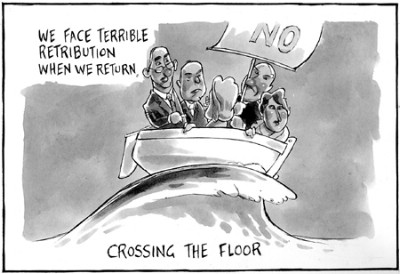
Sharpe
The moderate Liberals rightly say the asylum seeker legislation reverses the hard-won promise by John Howard last year to keep children out of detention by placing them in community-based homes. They also say asylum-seekers will be blocked from access to Australia's legal appeals processes if they are held offshore, and argue that their detention could be indefinite.
The debate on the asylum seeker legislation was gagged and then guillotined through the House of Representatives yesterday by the government. Those who defend the legislation make the national interest in the form of border protection an absolute. In doing so they reject international order with rules that regulates the behaviour of nation states, and turn their back on the freedom of conscience in the Protestant tradition. They do not welcome party differences of opinion, as they stress the rights of the passionate majority, and call former minister Judi Moylan disloyal (and place her pre selection under threat) because of her principled opposition to the Government's hardline policies on asylum-seekers and children in detention.
As Norman Abjorensen observes in the Canberra Times ' the right, which is now preponderant within the Liberal Party, is not prepared to entertain any peaceful co-existence with the Petro Georgious and Judi Moylans and so they will be hounded and purged from its ranks.'
August 10, 2006
democracy in action
The Migration Amendment (Designated Unauthorised Arrivals) Bill, under which all asylum seekers arriving in Australia by boat would be sent to island detention centres like Nauru for processing, is being debated in Parliament this week. The Federal Government's border protection legislation is widely seen as Australia turning away from protecting individual rights to give into Indonesia demands over the West Papuan refugees.
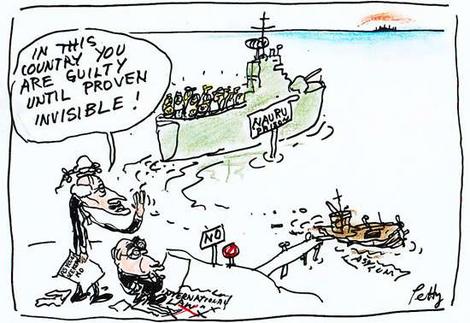
Bruce Petty
Though a Liberal/National Coalition-dominated Senate committee recommended in June that the bill not proceed, there has been a lot of pressure to toe the party line. The quote below is from a speech by dissenting Liberal MP Russell Broadbent, in parliament yesterday, on why he'll cross the house floor to vote with Judi Moylan, Petro Georgiou and Russell Broadbent against the government on the migration bill. Two dissenting MP's -- the Liberals Bruce Baird and the Nationals John Forrrest ---abstained from the vote rather than side with Labor.
In his speech to the House Russell Broadbent says:
The path I take today I did not choose. This path chose me. I cannot simply walk away from the agreement reached and legislated nearly 12 months ago. The founder of the Liberal Party, Sir Robert Menzies, built the party on a foundation of plural traditions of free thought and individual conscience. Free thought and individual conscience are not things to be used frivolously, nor taken lightly, but are freedoms that are embodied in the traditions of our party.
The decision I had taken to oppose this legislation, to follow my conscience and vote for the first time, and I hope the last time, against the Government of which I was elected as a member, is made because it is in the long-term national interest of this great south land to continue to be a compassionate protector of the rights of refugees, irrespective of the importance of the close relationship between Australia and one of our neighbours.
I believe there is a potential for this bill to cause serious harm to the progress we have made on this issue as a nation and to the vulnerable people it would affect. I will be voting against these amendments knowing that there are some in my party who do not agree with the "plural tradition" of the Liberal Party and its principles of free thought and individual conscience. Some warn that any dissent is a form of political death. I am no stranger to death. I have suffered defeat four times, but I have also been elected to this house three times. It is not the office of the federal member that is important; it is what you do in office. I take comfort in the words of Dr Martin Luther King: "The ultimate measure of a man is not where he stands in moments of comfort and convenience but where he stands at times of challenge and controversy." This bill is an issue of challenge and controversy.
If I am to die politically because of my stance on this bill, it is better to die on my feet than to live on my knees.
This is border protection in the form of the Pacific Solution. The bill passed 79-62 in the lower house after two days of emotional debate and now goes to the Senate, where the vote next week will be much tighter. It as expected that Victorian Liberal Judith Troeth will cross the floor.
August 9, 2006
The Australian's op ed trash
Poor commentary is one reason why some newspapers in Australia are in decline in terms of both operating income and influence. Murdoch's Australian is a good example of this. It gets worse in terms of quality as the 'cultural war' mentality bites ever deeper as it broadens the campaign against the left-wing bias in our universities and Australia's high school teachers peddling anti-American sentiment. The quality declines as the op ed's become polemics not debate in a liberal democracy. The Australian is part of the machinery the Right has built in the last decade, a machinery that supports a cadre of politically steeped and tactically honed operatives.
Today we have an op.ed. by Brian Wimborne on the Australian left and Israel, and more specifically on understanding why the Left has done a U-turn on Israel. After World War II, the political Left lent support to the Jewish people and favoured the creation of a homeland for them in Israel. Today the left is critical of Israel. So why the change? Wimborne has an answer--hatred:
Hatred has always been an essential characteristic of leftist ideology, providing the motivating force for its theory of dialectical materialism...Through its support of those it deems less fortunate, the Left assumes a moral high ground from which it feels self-righteously justified in attacking those it designates as oppressors ... Paradoxically, the [Israeli] state's success has been the reason the Left turned against Israel. Within a few years of its foundation, Israel had broken the first commandment of the Left's ideology: "Thou shalt not succeed." Success is anathema to the Left because it puts an end to victimhood; without victims the Left has no reason to exist. In the eyes of the Left's supporters, Israel's great accomplishments meant that the country no longer qualified as a victim. Israel, through being successful, effectively turned its back on the role chosen for it by the Left. From the Left's rigidly dialectical viewpoint, the world is made up solely of victims and oppressors, and if Israel is no longer a victim it has to be an oppressor. The consequence is that the mantle of victimhood once thrust on Israel now cloaks the Palestinians ....
'Hatred ' implies raw passion not reason. I would have thought that the actions of the Israeli state in Lebanon and the occupied territory's would have something to do with the change from supporting Israel to being critical of the Israeli state. Winborne denies this when he says that:
The deep-rooted problems of the Palestinians are not attributable to Israel but to their own corrupt leadership, culture of mendacity, lack of foresight and duplicity of their supporters (originally Egypt, Jordan and Iraq; more recently Syria and Iran). However, Realpolitik cuts no ice with the Left, whose preference for ideology over reality means Israel is judged to be the cause of all the Middle East's problems...the historical evidence [is] that the real subjugation of the Palestinians has occurred in Arab countries and in Gaza and the West Bank, under the tyranny of the Palestine Liberation Organisation.
Nothing is said about the Israeli occupation of Palestinian territory. So we are left with hatred as an explanation for Left's about-face in respect of Israel.
Winborne then develops the content of this hatred in terms of racism:
there is another reason for the The Left has long been permeated with anti-Semitism. It should not be forgotten that the Nazis (an acronym for National Socialist German Workers Party) had strong left-wing antecedents. The Nazis' doppelganger, the Communist Party of the Soviet Union, not only supported traditional Russian anti-Jewish movements but organised pogroms for its own political purposes. Socialist parties in Britain, France, Australia and many other countries, despite having Jewish adherents, had a strong anti-Semitic thread running through them. It is not surprising that as the Left's support for Israel faded, a latent anti-Semitic ideology replaced it, with the result that the centre of world anti-Semitism is now firmly rooted in the Left.
It's drawing a long bow to connect the racism of German fascism with the political left in Australia. Secondly, I would have thought the left-wing politics is framed in terms of morality and the Australian left has often had a firm hold on the moral high ground.
Winborne rejects this account. He ends this:
...where morality is concerned, the Left is value free. It draws no distinction between good and evil, right and wrong, justice and injustice. Hence, in the minds of leftists, the terrorist becomes a freedom fighter and murderers are transformed into heroes. This should surprise no one. In the past century the Left gave rise to national socialism and international socialism; today it continues to function without a semblance of moral rectitude, offering support of any group it designates as victims.
This fails to take account of the view that the Israeli occupation of the Palestinian territories is deemed to be wrong.
The op.ed is pretty poor stuff isn't it? We can only infer that this is the noise machine in action.
August 8, 2006
regional transformation
We can make some sense of what is going in the Middle east. The symmetry of Israeli and American policy has been one of the more noteworthy aspects of the latest Lebanon war--so much so that we can talk in terms of Anglo-Israeli.

We can add the muscular neo-con element---this advocated a "clean break" from the 1990s Oslo peace process, advocating that Israel pursue a combination of roll-back, destabilization and containment in the region, including striking at Syria and removing Saddam Hussein from power. This conception of regime change has an affinity with the old Likud policies of an expansionist Israel and it presents Israel's campaign against Hezbollah as part of the wider global war on terrorism. So Israel's harsh bombing campaign in Lebanon forseveral weeks is part of an ambitious scheme for regional transformation.
August 7, 2006
back on deck
I've just returned from holidays and I'm trying to ease my way back into philosophy, reluctantly. It is a case of post-holiday blues.
Something to sink one' s teeth into whilst I get back into my stride--- an article on German constitutional law and the state of emergency in the German Law Journal. The article is entitled 'German Constitutional Law and Doctrine on "State of Emergency": Paradigms and Dilemmas of a Traditional (Continental) Discourse - Part I/II'.
Andras Jakab, the author, states the problem of the state of emergency and constitutionality succinctly:
Certain situations can so threaten the constitutional(ity of the) state that the binding constitutional provisions cannot, or at least, not with the necessary speed... handle state of emergencies sufficiently... The possibility of such situations, thus, requires the adoption of regulations (laws on state of emergency), which permit circumvention of such binding provisions (effectivity), but which also safeguard against abuse of such circumvention...The fundamental dilemma of law on state of emergency asks where the balance is to be struck between these two needs.... The actual objective of state of emergency law should be to secure the route back to the "normal" constitutional state...
The article is concerned to explore the fundamental dilemma--- a state of emergency triggers a dangerous legal mechanism that is very susceptible to abuse. Hence the concern is to manage an emergency effectively. This gives rise to a balancing of efficacy versus fear of abuse.
August 2, 2006
still on holidays
I'm on holidays in Robe on the Limestone Coast. It is difficult to access the internet. I can only do so from public libraries. So there will be limited posting, if any, until I return to the work world. Somehow philosophy and holidays are incompatible. I've bought some books with me but I have yet to open them. I doubt that I will.