July 29, 2006
conservatism as authoritarianism?
Is conservatism being transformed into authoritarianism based on the anxieties of reactionary populism? Do we have right wing right-wing authoritarians whose character is one of being part of the "paranoid style" of the conservative revolt against liberalism.This authoritarian character or personality is one of being:
...submissive toward authority, fundamentalist in orientation, dogmatic, socially isolated and insular, fearful of people different from themselves, hostile to minorities, uncritical toward dominating authority figures, prone to a constant sense of besiegement and panic, and punitive and self-righteous.
In Australia we have one-party rule in Canberra. In their campaign to retain power the Coalition, like the Republicans in the US, are staking their chips on the fear generated by the war on terror and the culture war, doubling and tripling their bets on the paranoid style. To that end, the memebrs of the Coalition talk in terms of what they increasingly call the "Australia Values Agenda".
July 28, 2006
The new Rome
I presume that most of the Arab states see an American hegemonic hand behind the Israeli war. The US government woudl be seen as being pretty much solely responsible for allowing the Israeli bombing of Lebanon to continue whilst the Rome conference looks give the appearance that the US is "doing something" whilst giving Israel the time it wants to continue its offensive.
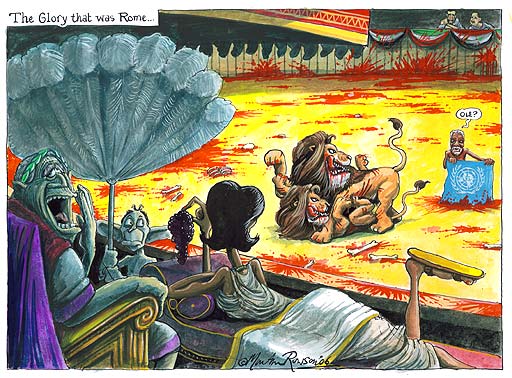
The Middle East needs reform and change but will change through the massacre of innocents help the reform process? How will the violence give birth to a new Middle East? According to Condelezza Rice Rice it goes like this: : Israel's attacks will demolish Hizbullah; the Lebanese will blame Hizbullah and destroy its influence; and the backlash will extend to Hamas, which will collapse. From the administration's point of view, this is a proxy war with Iran (and Syria) that will inexplicably help turn around Iraq.
US historic role is to act as the ultimate guarantor of Israel's security adn not to act as honest broker among all parties.
July 25, 2006
on holidays from philosophy
I'm on holidays in the Clare Valley for the next couple of days. Blogging will be light.
July 22, 2006
Foucault+pastorship
I'm easing into my holidays and so I am winding down. Here is a quote from Foucault's Tanner Lectures on Human Values entitled 'Omnes et Singulatim: Towards a Criticism of 'Political Reason' delivered in 1979 at Standford University.
Foucault says:
Everyone knows that in European societies political power has evolved towards more and more centralised forms. Historians have been studying this organisation of the state, with its administration and bureaucracy, for dozens of years. I'd like to suggest in these two lectures the possibility of analysing another kind of transformation in such power relationships. This transformation is, perhaps, less celebrated. But I think that it is also important, mainly for modern societies. Apparently this evolution seems antagonistic to the evolution towards a centralised state. What I mean in fact is the development of power techniques oriented towards individuals and intended to rule them in a continuous and permanent way. If the state is the political form of a centralised and centralising power, let us call pastorship the individualising power.
July 20, 2006
Foucault, the state, political knowledge, CoAG
The passage below is from a lecture given by Kimon Lycos on Foucault's understanding of truth and power in Parrhesia. Entitled Foucault, Freedom and Truth Emergence it explores Foucault's understanding of the nexus of 'truth' and 'power' work in modernity. Lycos says:
In the work just prior to his death his attention had turned to what he called 'technologies of the self', the ways in which since antiquity people have tried to turn themselves into 'ethical subjects'. At the same time he was also concerned with the 'political technology of individuals', the ways in which political knowledge in the modern state is not concerned with how people might be made happier or free or more virtuous, but with how looking after them as living, acting, productive beings can serve as a condition of the strength and survival of the state itself in comparison to other states. The art of government in the modern state, he thought, does not have the happiness of individuals as a goal (as it did in traditional political philosophy); rather, the happiness of individuals has become a requirement for the survival and development of the state itself. This is why, he thinks, the techniques and practices which give concrete form to the new political rationality seem to be able to bear the central paradox of our political reason: the coexistence in a political structure of large destructive mechanisms and institutions oriented towards the care of individual life in as many aspects as possible.
That's pretty right not only in interpreting Foucault but Foucault's grasp and interpretation of the way the state uses political knowledge.
Take CoAG's the national reform agenda and the wayfocus on human capital is linked to boosting productivity, labour market participation and the quality of life. Enhancing the health, educaion and skiills of Australians is not designed to make them happy or increase their happiness--it is to increase the competiiveness of Australia in the world marketplace. Boost GDP makes Australia wealthier and more able to compete.
July 19, 2006
democracy, rule, Arendt
Although the core idea of democracy is that people rule liberals tend to think in terms of ' citizens versus the state', rather than citizens being powerful or ruling in their own right as held by the classical republican philosophers. They primarily think this way in order to defend a space for the expression of negative liberty--as freedom to do as one pleases without infringing on the liberty of others. Rule is a key category in this account. What then, is meant by 'to rule' in a political sense?
Patchen Markill, in an article entitled 'The Rule of the People: Arendt, Arche and Democracy' that was published in the February 2006 issue of the American Political Science Review, addresses this issue. He says that 'to rule' is generally understood to mean "to have power or command," or to "exercise supreme authority," and "to exercise control" often over others. Rule is about command and obedience. He says that though there are fierce disagreements about what makes rule democratic, these disagreements presuppose (as a taken-for-granted background) that politics is at bottom a matter of ruling, and that ruling consists in the exercise of authoritative control. Many liberals, for instance, especially those of a classical or libertarian bent, see their freedom as the power to exceed, break, subvert, modify, often in the sense of 'to transform the paternalistic rules and laws of the social democratic state.'
Markill says that in The Human Condition Hannah Arendt argues that "the concept of rule" is at the center of the philosophical tradition's long-standing effort to escape from fraility in the uncertain world of politics into the solidity of quiet and order (p. 222) She adds
...that the greater part of political philosophy since Plato could easily be interpreted as various attempts to find theoretical foundations and practical ways for an escape from politics altogether.The hallmark of all such escapes is the concept of rule...
Markill says that these escapes are typically made by substituting the logic of "making" or poiesis, in which a craftsman applies an already-given set of "rules and standards" to his material, for the unruliness of genuine action. The statesman as craftsman makes his city as a sculptor makes a statute through applying his rules and standards upon the raw material. Implicit in this making is 'control over' others since people are seen as the raw material for the statesman as craftsman to shape.
Markill asks a good question. Can we think of 'rule' differently to one that connotes a hierarchy of power of those who rule and those who are ruled? He says that if a word like "rule" refers to something it also involves an interpretation of the world, an explicit or tacit sense of why some phenomena belong together, what they are like, and why they are significant. The category 'rule', Arendt says in The Human Condition is:
... the notion that men can lawfully and politically live together only when some are entitled to command and the others forced to obey. The commonplace notion already to be found in Plato and Aristotle that every political community consists of those who rule and those who are ruled. (p.222)
Markill argues that Arendt aims her critique at the interpretation of the world that the word "rule" carries with it. She highlights the close association the category 'rule' posits between relationships of subordination on the one hand and such phenomena as stability, regularity, and continuity on the other and argues that the category of rule tends to obscure 'beginning'.
I find this a good interpretation of Arendt a good one as it highlights Arendt's critical stance to the tradition of political philosophy--as an overcoming of the tradition--rather than the standard liberal interpretation that states Arendt is an anti-modernist who has an elitist nostalgia for the politics of ancient Greece, engendering a fatal split between the 'political' and the 'social' in her thinking. She may romanticise the political life of the Greek polis but her depiction of the polis is not an exercise in nostalgia since her theory of action was, and can be, deployed to help us understand both the politics of participatory civic engagement in modernity and the meaning of political action.
Does Arendt help us to think differently to the category of 'rule ' as command and obedience in modernity? This is what needs to be placed on the table if, as Arendt argues, the authority of the political tradition has been broken. What pieces can be retrieved through remembrance and rethinking in a world where instrumentalism has converted everything into a means for some subjectively posited end. ?
Markill argues that Arendt can help us to think of 'rule' differently to one that connotes a hierarchy of power of those who rule and those who are ruled. Arendt, he says, thinks of "rule" and "to rule" as also a "beginning" and "to begin". In The Human Condition Arendt says that:
Moreover, since action is political activity par excellence, natality and not mortality, may be the central category of political, as distinquished from metaphysical, thought. (p.9)
Markill helps us here with the categorry 'natality', which we have previously encountered here. He says that natality stands for that which perpetually escapes the most reified order of presence. It is a pervasive initiatory power, one of moments and events, of spontaneous resistance and disobedience. Her recovery of beginning is not to celebrate those phenomena that are conventionally taken to be the opposite of rule as authoritative control as mastery--unruliness or disorder, instability, interruptions of regularity, or radical breaks in continuity. It is about natality, and it refers to the capacity of human beings to engage in action---to give birth, as it were, to new beginnings.
Natality is the category for that aspect of the human condition in virtue of which we possess "the capacity of beginning something anew, that is, of acting". (The Human Condition, p.9) It is the unexpected new, happenings not just as states of affairs but also as meaningful events--- the phenomenon of action as beginning, openness and interruption and attunement to events.
July 18, 2006
Anti-Zionism in Australia's Academia?
In an article in Quadant Ted Lapkin, the Director of Policy Analysis for AIJAC, a member of Australia's pro-Likud Israeli lobby (along with the Executive Council of Australian Jewry) offers a description of the state of Australia's political culture in academia.
Lapkin's article, Anti-Zionism in Australian Academia, is not online, but it can be accessed here. Lapkin says that:
...all the pernicious norms of politicized academy have taken root with a vengenance. When it comes to Marxist dogma, queer theory--and yes, anti-Zionism--Australian campuses are like most other western universities, only more so.
Lapkin's article highlights Australian academics who he considers anti-Zionist --Evan Jones at Sydney University who writes Alert and Alarmed, Amail Saikal from the Centre for Arab and Islamic Studies at ANU, Scott Burchill at Deakin University, Andrew Vincent of the Centre for Middle Eastern and North African Studies at Macquarie University, and Anthony Lowenstein, an independent journalist who runs his own weblog.
The whole exercise reminds me of the pro- Israeli Lobby in action --an early version of campus watch. Campus Watch, in the US, is an organization responsible for repressing academic discussion of Middle East issues at U.S. universities. It compiles profiles on professors who criticize Israel. A major purpose is to identify key faculty who teach and write about contemporary affairs at university Middle East Studies departments in order to analyze and critique the work of these specialists for errors or biases. Why the errors or biases in Lapkins case are Marxism and anti-Zionism is not stated.
What implications does Lapkin draw from his account of 'a rogues gallery of anti-Zionists'? They are emblematic of the monolithic dominance of radical leftist ideology in the Australian academy; an ideology that is hostile to Jewish self-determination. Lapkin then says:
The best and brightest of Australia's youth are exposed to virulent anti-Zionism throughout their university years. It remains to be seen what effect this indoctrination will have on the next generation of Aussie leaders.
Wow. 'Radical leftist ideology in the Australian academy' was an ideology that was supportive, not hostile, to Jewish self-determination, given the nearly-successful genocide of the Jewish people in Germany. It is the expansionist actions of the Israeli state that is being questioned and criticised.
Not the words 'indoctrination' and 'virulent' instead of a critical thinking in the form of a questioning of Zionism. Lapkin's language--of exposing intellectual rot---suggests that the criticism of Israel on university campuses should be prevented.
Anti-Zionism is simply assumed to be bad by Lapkin, rather than the article assessing the questioning Zionism as an ethnocentric nationalism. Isn't it the job of Australian academics to raise questions about, and critically assess, Zionism?
After all, Zionism holds that Israeli as modern democratic state should be defined by an religious and ethnic identity. Should Israel in the 21st century be based on a 19th-century ethno-nationalism, as distinct from a civic nationalism based on the equality of citizens? An Israel based on ethnocentric nationalism would reject secularism, liberalism, and religious tolerance because Israel is for Jews. Promoting a theologically based ethnocentric nationalism as a conservative ideal leads to contradications: religious intolerance is good when Jews do it to Muslims but bad when Catholics do it to Jews.
So there are good reasons to question Zionism openly accepts a national/ethnic conceptualization of Judaism and melds faith and fatherland into one. Why is questioning Zionism, as a form of ethnocentric nationalism, seen as something bad? Isn't the enlightnment ethos of academia opposed to a chauvinistic, ethnocentric nationalism?
A political Zionism, which understands the Jewish situation in terms of an eternal conflict between Jews and non-Jews (gentiles will always be anti-Semitic), advocates the expulsion of Palestinians from the Gaza Strip and the West Bank to Jordan. ForZionism support for Israel demands support for the settlements, that "reclaim" the territory of Israel, by seizing it from the existing non-Jewish population. The agenda of modern Zionism from its inception, is one of Jewish immigration (mostly from Europe) into Israel with large enough numbers to be able to seize the land from the existing, non-Jewish populations, expel these, and to establish a homogeneous Jewish state. Isn't it the task of academia to critically engage with the political ideologies of the present?
Zionism has become the ideology of the Israeli expansionists (the Jabotinskyists, the Likud Party, fundamentalists and West Bank settlers), who have continued to push for territorial expansion for a Greater Israel (a “maximalist” state that would include the entire Palestine Mandate) and advocated military force as a means of obtaining such a Jewish state. The Zionist dream of a Jewish state as it is inherited, exemplifies the worst aspects of nationalism that comes when nationhood is pursued in terms of chauvinism, aggression and xenophobia.
Shouldn't the agenda of political Zionism be questioned as well as its ideology?
The thread that runs through the Lapkin article is the neoconservatism of the Likud pro-Israel lobby; a neoconservatism that represents a fundamentally new version of Australian conservatism. This is one that works in terms of a confrontation with the entire Arab-Muslim world; a confrontation that is understood in terms of existential struggle with an different enemy defined as Arab-Islamic totalitarianism, the enemy that poses a global mortal threat to freedom. Militant Islam is seen to be the greatest threat to the West since the Cold War.
July 17, 2006
On America's 'we don't do empire '
Bernard Porter, in an extract from his Empire and Superempire: Britain, America and the World, says that whether or not the US can be labelled an 'imperialist' power today matters very little, as it is the nature of the latter's imperialism (or whatever) that matters. He that the imperialism with which modern American foreign policy is most often compared is Britain's from the seventeenth to the twentieth centuries: either as a contrast; or a warning; or an example to emulate.
What the present US administration would also have us believe is that America is not 'doing empire' (any more), but that it is 'spreading liberty'. Well, let's accept this, for the sake of argument, only. Is this what makes the Amercian empire different? Porter explores '‘imperialism' more in this context of ideals rather than material power, even though he accepts the theory that behind most modern imperialism lay the perceived need for the new dynamic capitalist economies of the West to expand their commercial and financial markets and sources of raw materials beyond their domestic bases. He says in reference to 'spreading liberty' that:
I was impressed, for example, when Abu Ghraib was revealed, by the close parallels with conditions in British prison camps in 1950s Kenya. Even the sexual humiliations were there.) But that is not the end of it. Firstly: 'spreading liberty', or professing to spread it, is by no means incompatible with 'imperialism'. Imperialism can be a means of spreading liberty ---in theory. Nor, secondly, does it distinguish America clearly from other empires in the past, many of which---the Spanish, Napoleonic and Soviet empires, for example---claimed to be spreading 'liberty' too. So did the British. So it isn't this that makes American 'imperialism' new and distinctive. It is special; but for other reasons.
So what constitutes the difference?
Porter says that for a student of British imperial history, four things stand out about present US foreign policy, and the ideology that seems to lie behind it:
Firstly, of course, there is 9/11, which has no exact equivalent in Britain's case....Secondly, however, there is America's huge military strength, both absolutely and relatively; with which the British Empire--- even counting the Indian Army--- could not begin to compete.....The present-day USA is far more powerful relative to all other nations than Britain ever was; certainly by comparison with the mainly incompetent British Army....Thirdly, America can't rule people like Britain could, because she doesn't have a significant ruling class. Nineteenth-century Britain did. Though she had developed a profoundly capitalist economy (before America), and the middle class to go with it, she also retained a powerful pre-capitalist upper class alongside this, antipathetic to capitalism ('trade') to a large degree, and with some very un-capitalist values attached to it, like 'paternalism'; which turned out to be well suited to governing Britain's new possessions when they needed to be ruled.
Porter says the last reason is is the major reason why Niall Ferguson's plea to America to emulate the British Empire more closely doesn't stand a snowflake’s chance in hell. Her social structure is just not made for it.
The fourth difference Porter says:
American 'imperialism' seems more ideologically driven than Britain's was. This connects with the previous point. Britain's ruling class was not on the whole 'ideological', except for a couple of decades prior to the Indian 'Mutiny', which event put a damper on its reformist zeal somewhat. Thereafter the main objects of its rule were to keep the 'natives' under control, and to 'develop' them slowly, and along 'their own lines'....Present-day America appears to be entirely different. Firstly, as we have seen, she has no desire to 'rule' other peoples in any direct, formal way. Secondly, however, she does want to change them, quite fundamentally. But thirdly: she seems to think that this can be done without 'ruling' them; for one simple reason. The changes she is asking of other peoples are not the kinds of changes that should need to be imposed on them. They are simply 'liberating'; uncontroversial, once people have been introduced to them ----'self-evident', to quote the USA's own Declaration of Independence.
America's values are assumed to be universal, or the idea that modern America exemplifies the 'end' of history ----that is, its final destination. Democracy, for the Americans is usually coupled, if not subordinated to, free markets. Its markets and democracy, as if democracy is dependent on free market capitalism.
Porter concludes by saying that American and British 'imperialisms' are a continuum, but with capitalist 'ideologism'-- one of the main differences between the two 'imperialisms' ---now triumphing; unmoderated by the old British 'paternalism'- which was the other main difference. This is new. That's why the British Empire is no longer a reliable historical precedent.
July 16, 2006
Identity, Immigration, and Liberal Democracy #2
I wan t to pick up on Francis Fukuyama's, Identity, Immigration, and Liberal Democracy, published at the Journal of Democracy, and which I considered in this postThat post indicated Fukuyama's claim of the flaw in liberalism---its hole in relation to political deference that liberal societies owe groups rather than individuals. Liberalism only recognizes individual rights, which can only be secured through a social contract, that prevents one individual's pursuit of self-interest from harming the rights of others. A utilitarian liberalism, we can add, only recognizes individual interests or preferences.
Fukuyama says that:
The radical Islamist ideology that has motivated many of the terror attacks over the past decade must be seen in large measure as a manifestation of modern identity politics rather than as an assertion of traditional Muslim culture. As such, it is something quintessentially modern, and thus familiar to us from earlier extremist political movements...The argument that contemporary radical Islamism is a form of identity politics has been made most forcefully by the French scholar Olivier Roy in his book Globalized Islam ... According to Roy, the root of radical Islamism is not cultural---that is, it is not a byproduct of something inherent in or deeply essential to Islam or the cultural system that this religion has produced. Rather, he argues, radical Islamism has emerged because Islam has become deterritorialized in such a way as to throw open the whole question of Muslim identity.
Australian conservatives, in contrast, argue that radical Islamist ideology is byproduct of something inherent in or deeply essential to Islam. It has nothing to do with identity.
So how has Islam become deterritorialized in such a way as to throw open the whole question of Muslim identity?Fukuyama says that:
The question of identity does not come up at all in traditional Muslim societies, as it did not in traditional Christian societies. In a traditional Muslim society, an individual's identity is given by that person's parents and social environment; everything, from one's tribe and kin to the local imam to the political structure of the state, anchors one's identity in a particular branch of Islamic faith.
He then adds:
According to Roy, identity becomes problematic precisely when Muslims leave traditional Muslim societies by, for example, emigrating to Western Europe. One's identity as a Muslim is no longer supported by the outside society; indeed, there is strong pressure to conform to the Western society's prevailing cultural norms. The question of authenticity arises in a way that it never did in the traditional society, since there is now a gap between one's inner identity as a member of a Muslim cultural community and one's behavior vis-a-vis the surrounding society.
Roy's account is very pertinent to Australia. It is one that is familar, and overlaps, with previous waves of migration. Fukuyama says:
Understanding radical Islamism as a form of identity politics also explains why second- and third-generation European Muslims have turned to it. First-generation immigrants have usually not made a psychological break with the culture of their land of birth and carry traditional practices with them to their new homes. Their children, by contrast, are often contemptuous of their parents' religiosity, and yet have not become integrated into the culture of the surrounding Western society. Stuck between two cultures with which they cannot identify, they find a strong appeal in the universalist ideology offered by contemporary jihadism.
Liberalism doesn't have the bite here. Why not embrace liberalism?
July 14, 2006
Cicero: fear and power
The passage below is from Cicero's late text De Officiis VII. The text was composed in haste shortly before Cicero's death. It was written in the year 44 BC, Cicero's last year alive, when he was 62 years old, and takes the form of a letter to his son with the same name. The essay discusses what is honor and what is expedient, and what to do when they conflict.
In the passage below Cicero is considering the means by which Roman Senators can gain the ability to win and hold the affections of our fellow-men:
But, of all motives, none is better adapted to secure influence and hold it fast than love; nothing is more foreign to that end than fear...But those who keep subjects in check by force would of course have to employ severity---masters, for example, toward their servants, when these cannot be held in control in any other way. But those who in a free state deliberately put themselves in a position to be feared are the maddest of the mad. For let the laws be never so much overborne by some one individual's power, let the spirit of freedom be never so intimidated, still sooner or later they assert themselves either through unvoiced public sentiment, or through secret ballots disposing of some high office of state. Freedom suppressed and again regained bites with keener fangs than freedom never endangered. (V11 23 24)
Cicero was writing in dark times--when the Roman Senate was under threat from dictators such as Julius Caesar and before it became an empire under Augustus.
He describes Roman rule in terms of 'our government could be called more accurately a protectorate of the world than a dominion. This policy and practice we had begun gradually to modify even before Sulla's time; but since his victory we have departed from it altogether.'
Though Cicero's philosophy is conventionally seen as derivative and unoriginal he is once again being taken seriously as a moral and political philosopher. Since he subordinated philosophy to politics his philosophy had a political purpose: the defense, and if possible the improvement, of the Roman Republic. He held that virtuous character that had been the main attribute of Romans in the earlier days of Roman history, and that this loss of virtue was the cause of the Republic's difficulties.
He hoped that the leaders of Rome, especially in the Senate, would listen to his pleas to renew the Republic. This could only happen if the Roman elite chose to improve their characters and place commitments to individual virtue and social stability ahead of their desires for fame, wealth, and power. Having done this, the elite would enact legislation that would force others to adhere to similar standards, and the Republic would flourish once again.
Cicero, for all his defence of the Senate and the Republic was clearly capable of collapsing the distinction between wars of the self-defense of Rome and those of the expansion of Rome.
July 13, 2006
Identity, Immigration, and Liberal Democracy
I've just come across this site -----Continental Philosophy: a Bulletin Board for Continental Philosophy, History of Philosophy and More..... It has a link to Francis Fukuyama's, Identity, Immigration, and Liberal Democracy, which was published at the Journal of Democracy, and is now online. That is a good move as it shows a commitment to the public sphere in liberal democracy. The constellation around identity, immigration and integration have formed a hot problematic after 9/11.
Fukuyama succinctly identifies the problem:
Most Americans have tended to regard the jihadist problem as something that has been bred and nurtured in profoundly dysfunctional areas of the world like Saudi Arabia, Pakistan, Afghanistan, and other parts of the Middle East. Since jihadism is something that is happening "over there" the solution lies either in walling off the United States and other target countries, or else, as the Bush administration would have it, going over there to fix the problem at its root by deposing dictators andpromoting democracy.
However, the other side of this is that liberal democracies have problems concerning the integration of immigrant minorities--particularly those from Muslim countries—as citizens of pluralistic democracies. Thus Europe has become and will continue to be a critical breeding ground and battlefront in the struggle between radical Islamism and liberal democracy. Fukuyama says that:
This is because radical Islamism itself does not come out of traditional Muslim societies, but rather is a manifestation of modern identity politics, a byproduct of the modernization process itself.Most European countries have right-wing populist parties opposed to immigration and increasingly mobilized around the issue of Muslim minorities... Nonetheless, mainstream European academics, journalists, and politicians have been very reluctant to address the problem of Muslim integration openly until very recently.
This issue has been largely addressed by conservatives who have dumped a pluralistic society in the name of assimilation and rage against multiculturalism because it allows, fosters and supports a radical Islamism with a jihadist bent.
So what does Fukuyama have to offer? For one thing, Fukuyama correctly identifies the flaw in liberalism. He says that:
Modern identity politics springs from a hole in the political theory underlying modern liberal democracy. That hole is related to the degree of political deference that liberal societies owe groups rather than individuals. The line of modern political theory that begins in some sense with Machiavelli and continues through Thomas Hobbes, John Locke, Jean-Jacques Rousseau, and the American Founding Fathers, understands the issue of political freedom as one that pits the state against individuals rather than groups.
He then introduces the Charles Taylor's Multiculturalism: Examining the Politics of Recognition into the discussion:
Taylor points out that modern identity is inherently political, because it ultimately demands recognition. One's inner self is not just a matter of inward contemplation; it must be intersubjectively recognized if it is to have value. The idea that modern politics is based on the principle of universal recognition comes from Hegel. Increasingly, however, it appears that universal recognition based on a shared humanity is not enough, particularly on the part of groups that have been discriminated against in the past. Hence modern identity politics revolves around demands for recognition of group identities----that is, public affirmations of the equal dignity of formerly marginalized groups, from the Quebecois to African-Americans to women to indigenous peoples to homosexuals.
Multiculturalism, understood not just as tolerance of cultural diversity in de facto multicultural societies but as the demand for legal recognition of the rights of ethnic, racial, religious, or cultural groups, has now become established in virtually all modern liberal democracies, including Australia. Thus the liberal principle of equal individual rights has been breached.
July 12, 2006
Israeli Lobby #2
Foreign Policy has Roundtable in its July/August issue on the 'Israeli Lobby& US Foreign Policy' text by John J. Mearsheimer and Stephen M. Walt. which I mentioned here. (An edited version of the Mearsheimer and Walt text was published by London Review of Books.)
Presumably Foreign Policy responses would go beyond the polemics of sloppy scholarship and outright bigotry (anti-Semitic) The Australian response has been muted, but there is a polemical response by Michael Park at Club Chaos. He says:
It appears that the idea of the Israeli Lobby as the prime mover behind the foreign policy decisions of Washington is set in stone. There is a significant rump of opinion that the invasion of Iraq --illegal as it was--was at the behest of this supposed nefarious cancer within the body politic of the United States... . The invasion of Iraq had little to do with Israeli interests and much to do with strategic US interests. Those interests being resources, along with economic and political influence. The all powerful "neocon cabal" --with their "Lobby" puppeteers --who had fabricated the reasons for and planned the war itself were "done over" by international oil. The core of this was the fact that these people (the "neocons") had-- amongst other economic articles of faith---planned for the privatisation of the entire Iraqi oil industry and its support structure.
True, the invasion of Iraq had to do with US strategic interests. But Mearsheimer and Walt do not talk in terms of a ' "neocon cabal"--with their "Lobby" puppeteers' They talk about the conflation of US and Israeli national interests.
In their contribution to the Roundtable Mearsheimer and Walt say:
The "special relationship" with Israel, we argue, is due largely to the activities of the Israel lobby--a loose coalition of individuals and organizations who openly work to push U.S. foreign policy in a pro-Israel direction. The lobby is not synonymous with Jewish Americans, because many of them do not support its positions, and some groups that work on Israel's behalf (Christian evangelicals, for example) are not Jewish. The lobby has no central leadership. It is not a cabal or a conspiracy. These organizations are simply engaged in interest-group politics, a legitimate activity in the American political system. These organizations believe their efforts advance both American and Israeli interests. We do not.
They make a distinction between US national interest and Israeli national interest. The U.S. support for Israel has been unwavering, but it is sometimes inconsistent with American interests. They ask : Why has the United States been willing to set aside its own security to advance the interests of another state? Their answer is "the unmatched power of the Israel lobby."An Israeli Lobby, I would add, that seeks to keep Israel strong, the Palestinians weak, and the United States from exerting pressure on Israel. Or more extremely, Israel has the right to pursue whatever policies it chooses-- including expanding its presence on the West Ban--without any interference from the United States.
Mearsheimer and Walt say that in their text:
We described how the Israel lobby fosters support within the U.S. Congress and the executive branch, and how it shapes public discourse so that Israel's actions are perceived sympathetically by the American public. Groups in the lobby direct campaign contributions to encourage politicians to adopt pro-Israel positions. They write articles, letters, and op-eds defending Israel's actions, and they go to great lengths to discredit or marginalize anyone who criticizes U.S. support for Israel.
They give Iraq and Iran as two examples.
The Foreign Policy responses would go avoid the charge of anti-Semitism or attempt to constrain discussion of the US relationship with Israel by imposing a narrow political correctness and consider the arguments on the actual issues involved. Unfortunately, we cannot judge this as the Roundtable articles at Foreign Policy are behind a subscription wall. However, I found the response by Dennis Ross over at the Washington Institute for Near Eastern Policy.How does Dennis Ross respond? He says that:
According to Mearsheimer and Walt, the Israel lobby is governed by its concern for Israel, not America. They say it drove the United States into a disastrous war in Iraq and is now pushing for a similarly dangerous war against Iran. Mearsheimer and Walt discuss other maladies caused by the lobby, but it's their concern about U.S. policies toward Iraq that have principally motivated them to "expose" the lobby.
'Exposed' is a strange word, given that organizations that constitute the Israeli Lobby are openly engaged in interest-group politics in the American political system.Lobbying is quite open in the US as it is a legitmate activity in liberal democracy.
Ross says that Mearsheimer and Walt overstate their case. Take Iran, he says. It is not just the Israeli Lobby that cares about Iran acquiring nuclear weapons. So do the British French and Germans --they want to confront Iran more than the US and the Israeli Lobby isn't driving them to do it. Hence Mearsheimer and Walt overstate their case.
That, however, isn't what Mearsheimer and Walt say. They are talking about the US, the power of the Israel lobby and the negative effect it has had on US policy . They say:
With Saddam Hussein removed from power, the Israel lobby is now focusing on Iran, whose government seems determined to acquire nuclear weapons. Despite its own nuclear arsenal and conventional military might, Israel does not want a nuclear Iran. Yet neither diplomacy nor economic sanctions are likely to curb Tehran's nuclear ambitions. Few world leaders favor using force to deal with the problem, except in Israel and the United States. AIPAC and many of the same neoconservatives who advocated attacking Iraq are now among the chief proponents of using military force against Iran.
It's the use of force that marks the difference here and this is where we have US and Israeli national interests coinciding. So what kind of debate is this? It's not even an engagement. If there is an Israeli Lobby, as Ross seems to accept, then what is its policy agenda? Is it how I've represented it: A LIkud agenda that seeks to keep Israel strong, the Palestinians weak, and the United States from exerting pressure on Israel. Or more extremely, Israel has the right to pursue whatever policies it chooses-- including expanding its presence on the West Ban--without any interference from the United States. Or for a more a more muscular aggressive US presence in the Middle East and beyond.
How does the lobby operate? How does it target Congress? Have there been occassions when the President and Congress have been divided on Israel? If so, how has the Lobby intervened then? Has it successful? Who banked down?
Isn't this the kind of enegagement that is needed? An opening up of the discussion?
July 11, 2006
federalism: revitalising the states?
Julian Leeser, Executive Director of the Menzies Research Centre, recently argued that the states need to lift their game to keep the commonwealth out of their patch. He says the solution to federalism lies with better performing, competitive state governments not the centralism favoured by big business.
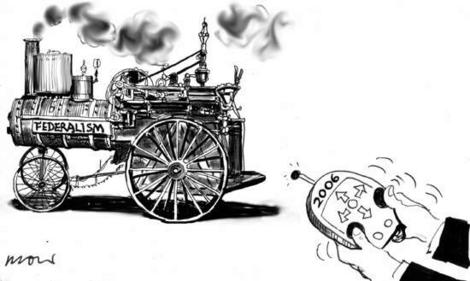
Alan Moir
Leeser says that whilst state finances have improved with the GST their service delivery is weakerand their management often poor, whilst the reform agenda at state level has atrophied. It is hard to disagree. The states have not performed strongly. They continue with their tendency to "blame the feds" when things go wrong. In refusing to take full responsibility for what they do, the states demand federal assistance and the finger of blame is swiftly pointed at Canberra whenever something's missing that money might buy. The states need to make a determined effort to meet their responsibilities and obligations.
In arguing his case Leeser returns to Sir Harry Gibbs co-ordinate model of a federation. This holds that:
...there should be two levels of government, each of which is limited to its own sphere, but neither of which is subordinate to the other. There must be a division of powers, effected by a written Constitution which binds both levels of government, so that neither has absolute sovereignty. Each level of government should be independent and supreme within the area of its powers, and each should have under its control the financial resources necessary to enable it to perform its functions.
This coordinate model of federalism is one where two levels of government each have separate powers and functions. It is generally held that this understanding of the federal system is one that the framers of the Constitution had established----it suggests that each level of government was to be independent of the other and hence it places limits on Commonwealth power.
This coordinate model of federalism is one that has been rejected. Whilst it has been in decline thoughout the 20th century there has been a recent upsurge in cooperative federalism --cooperation between the Commonwealth and the States. Leeser says that:
Those who wish to see a stronger role for the States and a revitalised federalism have tended to suggest three solutions: constitutional amendments to increase the power of the States or retard the power of the Commonwealth, the appointment of federalist judges to the High Court, or encouraging the Commonwealth to keep out of areas which belong to the States. The first is unlikely because under the Constitution the Commonwealth must propose a referendum and a Commonwealth Government is unlikely to propose a referendum to give more power to the States. The second is difficult because most candidates for judicial appointment have never expressed views on this subject and, following the precedent set by WM Hughes and AB Piddington, it is probably unethical to ask. The final suggestion is also unlikely especially if States perform poorly as they have in recent years.
He adds that there is another way to bolster federalism --- from the State side. The better the State governments perform the less the Commonwealth will be inclined to interfere with their powers and responsibilities.
July 10, 2006
economics & individualism
Roy Bhaskar, the philosopher to whom the critical realist project within economics owes much by way of inspiration and initial conception, warns against what he terms 'the epistemic fallacy'. According to Bhaskar western philosophy has been under the spell of this fallacy implying that questions of being (ontology) have been reduced to questions of knowing (epistemology) or to method.
Doesn't this apply to be neo-classical economics? Its axiom of methodogical individualism blocks an understanding of society as made up by intentional actors as well as social structures with emergent powers which enable and facilitate, but also restrict and direct, individual action. Social structures are conceived as pre-existing individual actions, and are thus irreducible to them. However, by employing social structures in planning and performing individual action, the agents contribute to reproducing and transforming these structures.
The critical realist critique of neo-classical economics states that there is a mismatch between the mathematical-deductive methods of mainstream economics and the properties of social ontology as outlined above by the critical realists.
July 9, 2006
about neo-classical economics
It is difficult to come to grips with neo-classical economics because it keeps on changing or evolving. One way to pin it's formal models and number-crunching down is through its key axiomatic assumptions --that constitute its metaphysics or ontology. So argue Christian Arnsperger and Yanis Varoufakis in their paper What Is Neoclassical Economics? One influential strand of criticism is that neo-classical economics is an ideology, associated with the policies of neo-liberalism by which is meant the laissez faire endorsement of the "free market." It highlights the particular conceptions of reality with which economists conduct their work.
Arnsperger and Varoufakis say that the first such presupposition is methodological individualism. Neoclassical theory retains its roots firmly within liberal individualist social science. The method is still unbendingly of the analytic-synthetic type: in that the socio-economic phenomenon under scrutiny is to be analysed by focusing on the individuals whose actions brought it about; understanding fully their 'workings' at the individual level; and, finally, synthesising the knowledge derived at the individual level in order to understand the complex social phenomenon. What is downplayed is the economic agent being a creature of her social context, and that social structure and individual agency are messily intertwined.
The second presupposition is methodological instrumentalism: that all behaviour is preference-driven or, more precisely, it is to be understood as a means for maximising preference-satisfaction. Preference is given, current, fully determining, and strictly separate from both belief (which simply helps the agent predict uncertain future outcomes) and from the means employed. In effect, neoclassical theory is a narrow version of consequentialism in which the only consequence that matters is the extent to which an homogeneous index of preference-satisfaction is maximised.
The third presupposition is the axiomatic imposition of equilibrium. Even after methodological individualism turned into methodological instrumentalism, prediction at the macro (or social) level was seldom forthcoming. Determinacy required something more: it required that agents’ instrumental behaviour is coordinated in a manner that aggregate behaviour becomes sufficiently regular to give rise to solid predictions. Thus, neoclassical theoretical exercises begin by postulating the agents’ utility functions, specifying their constraints, and stating their ‘information’ or ‘belief’. Then, and here is the crux, they pose the standard question: “What behaviour should we expect in equilibrium?”
It is true that Arnsperger and Varoufakis talk in terms of metholodolgy, as opposed to metaphysics or ontolgy, but the use of axioms is appropriate because it is upon these core axioms of individualism, instrumentalism and equilibration that the theoretical structure of neo-classical economics is systematically constructed to explain the allocation of scarce resources among alternative ends. It becomes a perfectly enclosed and self-referential system like mathematics.
As Thomas Kuhn, and other historians and philosophers of science, attest, every paradigm is a selective device, making a particular kind of informational demand on the multi-layered nature of reality, and deliberately excluding other aspects of it.
July 8, 2006
Australian federalism
There are several models of federalism currently on offer---Peter Costello's model is one of greater commonwealth powers that reduces the states to administrative units; John Howard's one is a pragmatic nationalism that has incrementally marginalised states' rights to centralization commonwealth powe;r and Steve Brack's (and former NSW Liberal premier Nick Greiner) model of co-operative federalism and power sharing between Canberra and the states.
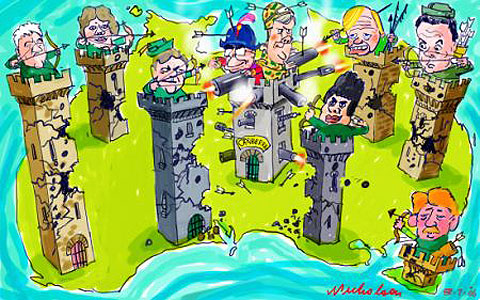
Nicholson
The Brack's co-operative model advocates a "third wave of national reform". This agenda, endorsed in principle at this February's COAG, aims to lock the commonwealth and the states into a new regime of improvements in health, education, training, productivity and work-force participation based on the national competition model: incentive payments to the states for measured results. Extra federal payments would be tied to state delivery of the reform objectives. The fiscal logic is obvious: the dividends from economic reform in terms of stronger tax revenue must be shared.
July 6, 2006
rethinking federalism the Australian way
A new federalism is back on the agenda in the form of Peter Costello, the federal Treasurer, recently calling for greater commonwealth control over areas of national economic significance---ports, electricity, gas and water. The proposal by the Treasurer is for the federal government to take overall control of running the economy whilst the states deliver services.
This has more in common with Whiltam's new federalism in the 1970s, which was about greater centralization of commonwealth state relations, than Malcom Fraser's, which restored the autonomy of the states. Costello's 'new federalism' has little to do with the Hawke/Keating 'new federalism', which was about reforming the economy through consensus-driven CoAG collaboration. Costello has succeeded in antagonising the states with his rhetoric about bad states versus good commonwealth.
The states are quick to point out the inefficiencies in the way the commonwealth regulates interstate gas, telecomunication and electricity assets and markets. The states have shown little interest in handing their powers over nationally important assets to the commonwealth and any referendum designed to wrest such powers from the states would most certainly fail.
CoAG is the place where the changes to, and reform of, the Federal compact is negotiated. If Costello is right that Peter Costello is right, Australian federalism does need an overhaul change will evolve through give and take between the Commonwealth and the states, not just more power for Canberra, which is Costello's position.
In an op ed in The Sydney Morning Herald George Williams argues that change is required and that we need to revisit Australian federalism.:
Our federal system was conceived in the 1890s, the age of the horse and buggy, and it shows. It was thought then by the drafters of our constitution, themselves mainly state politicians, that the new nation would best be served by six strong state governments with some co-ordination by a weaker federal government.This vision has unravelled. Two world wars have demonstrated the need for national leadership and control over many parts of our daily life. Australia's integration into the global economy has also shown that we need national laws that help us compete against other countries, and not just state against state. Instead of holding a referendum to recast our constitution, the real work to adapt our system of government has been undertaken by the High Court. Its interpretation of the constitution has generally favoured the Commonwealth. The states, over a century, have been transformed from dominant players to dependent upon handouts and to exercising control over areas the Commonwealth has thus far left alone.
This has resulted in , buck passing, political conflict rather than clear lines of responsibility, problems in infrastructure, education and health being neglected as being the responsibility of someone else, and expensive solutions.
Williams says that the reform agenda should deal with two big issues.
First, we need to ask again who should have the power, and the responsibility, over major areas of policy. Second, we need to fix the financial arrangements that have left the states so dependent on federal grants.
July 5, 2006
conservative governance
An article by Alan Wolfe entitled Why Conservatives Can't Govern in the Washington Monthly magazine courtesy of Cameron Riley at South Seas Republic. Wolfe says:
Contemporary conservatism is first and foremost about shrinking the size and reach of the federal government. This mission, let us be clear, is an ideological one. It does not emerge out of an attempt to solve real-world problems, such as managing increasing deficits or finding revenue to pay for entitlements built into the structure of federal legislation. It stems, rather, from the libertarian conviction, repeated endlessly by George W. Bush, that the money government collects in order to carry out its business properly belongs to the people themselves. One thought, and one thought only, guided Bush and his Republican allies since they assumed power in the wake of Bush vs. Gore: taxes must be cut, and the more they are cut--especially in ways benefiting the rich--the better.
This strikes me as confused --it equates conservatism with liberalism instead of recognizing that they are two different things. It is classical liberals who argue for small government so as to preserve individual freedom. Conservative are about the authority of the state and the governing class. They stand for a critique of American liberalism since upholding the authority of the state is more important than individual freedom. Hence conservatism is opposed to libertarianism (of a Nozick) that aims to reshape society in line with the requirements of free market forces as it puts the goals determined through the activity of politics itself.
This confusion between conservativsm and liberalism leads Wolfe to say:
But like all politicians, conservatives, once in office, find themselves under constant pressure from constituents to use government to improve their lives. This puts conservatives in the awkward position of managing government agencies whose missions--indeed, whose very existence--they believe to be illegitimate. Contemporary conservatism is a walking contradiction. Unable to shrink government but unwilling to improve it, conservatives attempt to split the difference, expanding government for political gain, but always in ways that validate their disregard for the very thing they are expanding. The end result is not just bigger government, but more incompetent government.
Conservatives are in favour of big government and the competitive capitalist market. They do not disdain the authority of the state and they wish to preserve a certain kind of orderd and stable society--one based on tradition, hierarchy, custom and a common culture.
When Wolfe writes that 'Because liberals have historically welcomed government while conservatives have resisted it' he is arguing between two forms of liberalism is he not? As he says if yesterday's conservative was a liberal mugged by reality, today's is a free-marketer fattened by pork. Yet Wolfe knows the differences between liberals and conservatives as political philosophies:
Historically and philosophically, liberals and conservatives have disagreed with each other, not only over the ends political systems should serve, but over the means chosen to serve those ends. Whether through the ideas of James Madison, Immanuel Kant, or John Stuart Mill, liberals have viewed violent conflict as regrettable and the use of political institutions as the best way to contain it. Conservatives, from the days of Machiavelli to such twentieth-century figures as Germany's Carl Schmitt, have, by contrast, viewed politics as an extension of war, complete with no-holds-barred treatment of the enemy, iron-clad discipline in the ranks, cries of treason against those who do not support the effort with full-throated vigor, and total control over any spoils won. From a conservative point of view, separation of powers is divisive, tolerance a luxury, fairness another word for weakness, and cooperation unnecessary. If conservatives will not use government to tame Hobbes' state of nature, they will use it to strengthen Hobbes' state of nature. Victory is the only thing that matters, and any tactic more likely to produce victory is justified.
You can see the liberal (political philosophy) animus against conservatism (political philsophy). Schmitt's conception of politics as a conflict between friends and enemies is viewed 'as an extension of war, complete with no-holds-barred treatment of the enemy.' But conservatives do not aim strengthen Hobbes' state of nature --they aim to strengthen Leviathen.
July 4, 2006
a receipe for social democratic success?
In a paper entitled 'The social democratic agenda: Is it viable?' published on the Evatt Foundation Mark Buttigieg explores the way federal ALP can return to government in the near future. He does so by considering the dictum that when economic times are good it is governments which loose elections not oppositions that win them, and conversely, the only times Labor has gained government post-World War Two has been against the back-drop of severe conservative government incompetence, long periods in opposition, and economic decline (1972) and severe recession (1983).
Buttigieg says that this phenomenon is becoming even more intractable because, as recessions become less severe and fewer and further between, most Australians feel even less compelled to vote Labor based on economic security issues:
As countries like Australia become more and more developed and less exposed to economic insecurity, the disposable income of their citizenry increases which creates options. Put simply, extra money buys one of two things - extra "material well being" via purchases of holidays, cars, eating out, movies, sporting events, housing renovations, etc, or it can buy extra time, which in turn allows other more socially enlightening pursuits. Unfortunately, the last 30 years has seen Australia choose the former. People have not used their newfound wealth and income to pursue self-improvement via education and culture. Instead, the majority of citizens have taken the American option. They have not elected to become part of a well informed citizenry who have the analytical tools to make informed decisions on who governs them, unlike, for example, many citizens in countries in Europe.
Hence the ALP faces a conundrum: continuing economic security and a conservative government have combined to reduce the likelihood that people from lower socio-economic groups will swing to the ALP because of economic insecurity. In essence these people are saying, "why vote Labor if I can get my economic needs met and my socially conservative views satisfied". That is the ALP's traditional base and it has gone over the Coalition. I do not see the Howard Government getting old, tired and lacking in energy and ideas.
Its a good account of the difficulties the ALP finds iself in. Buttigieg then asks the right question at this point: apart from waiting until the next protracted recession, and in the interim chanting mantra's about what "good economic managers we can be", what is the ALP to do? He says that the approach needs to be two-pronged in order to address the short-term and long-term nature of the political problem.
Buttigieg says:
For the short-term the party needs to implement structural reform of itself, which will enable it to harness a mass movement around the industrial relations debate in order to allow us to be elected in 2007. For the long-term we need to direct our education policy towards creating a society of thinking voters. If done correctly, these two measures have the potential to turn things around for Labor in a permanent way.
That is a big ask, even though the potential is there. It is one made bigger by Buttigieg's suggestion of how this can be done---shifting the Australian people to a more progressive position:
We need to address the shift away from our electoral reliance on economic security, by changing the way people think about politics and society.If we are unable to do this, the conservatives will retain a long-term natural advantage over us via the inherent social conservatism of the electorate. In the current state of the nation, the more and more economically secure people become, the less likely they are to vote ALP in the future because of our liberal attitude to social issues. The answer is not for us to sell our political souls and move further to the right - the answer is to shift the Australian people to a more progressive position.
Buttigieg is very optimistic, given the way that the current Beazely-ALP is moving to the Right and so away from a progressive position; and that it finds easier to say no than to come up with new policies. He says that the IR legislation provides an opportunity for the ALP to both swing the traditional base back whilst the tertiary educated class is coming over to Labor giving a short-term electoral recipe for success.
But I'm not sure that the tertiary educated class is coming over to Labor from the Greens. What I see is a slow drift to the Right by the Beazley-led ALP. This is a very different ALP to the Whitlam-ALP which was able to shift the Australian people to a more progressive position.The global war on terror makes it far more difficult.
Where is the aspirational class in all of this? Don't some of them need to come on board? Or is the Latham-strategy a non-starter these days. Buttigieg's account does presuppose that the Howard Government might overreach itself with its workplace reforms: ie., to go beyond what is electorally palatable either to satisfy an ideological imperative or to reward hard-core supporters. We don't know the answer to that at this stage. There are suggestions that it might. Is a Howard overreach enough for the ALP?
Buttigieg adds that Labor cannot sit back and wait for this recipe to make itself into a victory:
The party must make it happen by reforming the party structures internally to increase democratic ownership by the members, and even more importantly by opening the party up to grass-roots involvement by rank and file union members.
Well, its nice idea, a receipe. I cannot see any substantive reform of the party structures happening.
July 2, 2006
Hamdan v. Rumsfeld: democracy affirming
The US Supreme Court ruled in Hamdan v. Rumsfeld that the US military commissions, which the Bush administration had set up to judge enemy combtants at the US military prison at Guantanamo Bay in Cuba were illegal, under both military justice law and the Geneva Convention. Some comment here at public opnion. Those labelled enemy combatants at Guantanamo Bay faced indefinite detention in isolation, and were subjected to harsh questioning for intelligence purposes, without allowing some kind of a hearing before a neutral body in which the government has to lay its cards on the table and allow the prisoner the right to say.
The Court's decision is about much more than military commissions. The Supreme Court effectively undermines the Administration's strongest claims about Presidential power. As Elizabeth Drew points out in the New York Review of Books:
During the presidency of George W. Bush, the White House has made an unprecedented reach for power. It has systematically attempted to defy, control, or threaten the institutions that could challenge it: Congress, the courts, and the press. It has attempted to upset the balance of power among the three branches of government provided for in the Constitution; but its most aggressive and consistent assaults have been against the legislative branch: Bush has time and again said that he feels free to carry out a law as he sees fit, not as Congress wrote it.
Linda Greenhouse, writing in the New York Times says that the decision represents:
...a defining moment in the ever-shifting balance of power among branches of government that ranked with the court's order to President Richard M. Nixon in 1974 to turn over the Watergate tapes, or with the court's rejection of President Harry S. Truman's seizing of the nation's steel mills, a 1952 landmark decision from which Justice Anthony M. Kennedy quoted at length.
Marty Lederman over at Balkinization argues that the Supreme Court's decision established some broad principles.
These principles he says are:
--- That the President's powers are limited by statute and treaty, and he acts independently at his peril where such statutes and treaties are in the picture....;
-- ...That statutes should be construed, absent evidence to the contrary, to require the Executive branch to comply with the laws of war; and
-- That Common Article 3 applies to all armed conflicts, a holding of enormous implications, not least of which is with respect to the debate about torture and other interrogation techniques.
This is a firm reaffirmation of the Youngstown principle respecting congressional power and against the executive overriding clear congressional will in areas Congress clearly has authority over.
This article in the New York Review of Books says that:
As Justice Jackson famously explained in his influential opinion in Youngstown Sheet & Tube Co. v. Sawyer, 343 U.S. at 635 (Jackson, J., concurring), the Constitution "enjoins upon its branches separateness but interdependence, autonomy but reciprocity. Presidential powers are not fixed but fluctuate, depending upon their disjunction or conjunction with those of Congress." For example, the President in his role as Commander in Chief directs military operations. But the Framers gave Congress the power to prescribe rules for the regulation of the armed and naval forces, Art. I, § 8, cl. 14, and if a duly enacted statute prohibits the military from engaging in torture or cruel, inhuman, and degrading treatment, the President must follow that dictate. As Justice Jackson wrote, when the President acts in defiance of "the expressed or implied will of Congress," his power is "at its lowest ebb." 343 U.S. at 637. In this setting, Jackson wrote, "Presidential power [is] most vulnerable to attack and in the least favorable of all constitutional postures." Id. at 640.
So to say that the US President has inherent authority does not mean that his authority is exclusive, or that his conduct is not subject to statutory regulations enacted.