June 29, 2006
Grand strategy & empire
The idea of "grand strategy", as classically promoted by military strategists and historians, such as Edward Meade Earle and B. H. Liddell Hart, refers to the integration of the war-making potential of a state with its larger political-economic ends.
Grand strategies are geopolitical in orientation, geared to domination of whole geographical regions---including strategic resources such as minerals and waterways, economic assets, populations, and vital military positions. The most successful grand strategies of the past are seen as those of long-standing empires, which have been able to maintain their power over large geographical expanses for extended periods of time. Hence, historians of grand strategy commonly focus on the nineteenth-century British Empire (Pax Britannica) and the ancient Roman Empire (Pax Romana).
Today we have Pax America instead of economic globalisation being accompanied by the emergence of forms of 'global governance' that would overcome the centuries-old struggle for supremacy among the Great Powers. The US operates from 'proceed from the firm ground of the national interest, not from the interests of an illusory international community', as Condelezza Rice puts it.
The US is quite open about Pax America.It arises in talk in the 1990s about how the United States should utilize its current "surplus of power" to reshape the world.
One form of the grand strategy had been presented by the Project for the New American Century, in a report authored by future top Bush-administration figures Donald Rumsfeld, Paul Wolfowitz, and Lewis Libby, among others in the 1990s. Summing up the new imperial thrust in Harvard Magazine, Stephen Peter Rosen, director of the Olin Institute for Strategic Studies at Harvard and a founding member of the Project for the New American Century, wrote:
A political unit that has overwhelming superiority in military power, and uses that power to influence the internal behavior of other states, is called an empire. Because the United States does not seek to control territory or govern the overseas citizens of the empire, we are an indirect empire, to be sure, but an empire nonetheless. If this is correct, our goal is not combating a rival, but maintaining our imperial position, and maintaining imperial order. Planning for imperial wars is different from planning for conventional international wars....Imperial wars to restore order are not so constrained [by deterrence considerations]. The maximum amount of force can and should be used as quickly as possible for psychological impact---to demonstrate that the empire cannot be challenged with impunity....[I]mperial strategy focuses on preventing the emergence of powerful, hostile challengers to the empire: by war if necessary, but by imperial assimilation if possible
What is at issue is the management of the international system by a single hegemon---the United States. The securing of hegemony by the United States by means of preemptive actions was a new grand strategy of transformation.
June 28, 2006
Arendt on power + force
A useful commentary on Hannah Arendt and the concept of power, and the importance of maintaining meaningful distinctions among the concepts of "power", "strength", "force", "violence" and "authority". It states that according to Arendt:
the term "force" should never be used interchangeably with "power" in the study of politics. "Force" refers, instead, to movements in nature, or to other humanly uncontrollable circumstances, whereas "power" is a function of human relations. She thought that confusing these -- as with the concept of "social forces" so popular in the social sciences -- implies the operation of organic laws somehow isolated from the effects of human decisions. She maintained that "power" in social relations results from the human ability to act in concert to persuade or coerce others, while "strength" is the individual capacity to do the same. One can say that certain individuals possess the "strength" of their convictions, or that their charismatic personalities make them effective members of committees, or strong leaders.
It's a nice distinction between force and power as force is a key category in Newtonian physics--it is what moves or acts on objects. Power, in contrast, refers to power relations in political and social life.
Neo-classical economics continues to make a lot of use of 'force'---as in market forces---another indication that it understands itself to be a natural science. This mechanistic economic tradition does not work with power relations in relation to the market place, nor does it have a conception of power.
The economy-as-machine idea is modeled as mechanical and deterministic machines working according to given laws similar to those of mechanical physics. The "forces" of profit maximization and competition, to use the neoclassical terms, are said to inexorably drive business leaders to maximize shareholder value, no matter what the cost to worker well-being or the environment. The course of economies this model implies is thus fundamentally out of the hands of people and the institutions we create. If a capitalist economy is an inexorable machine, then the only options are to submit to it or dismantle it.
Arendt then uses power to place limits around violence:
Arendt parted company with Max Weber on the issue of violence. She was appalled by his premise that all governments -- whether democratic or not -- rest ultimately on the threat of violence against the people. Rightly, I think, she recognized this as an all-too-ready rationalization for totalitarian methods of governing. She pointed out that it is not violence but power that is the essence of government. Arendt concluded that neither Marx nor Weber really understood the difference between power and violence. Violence can destroy the old power, she said, but it can never create the authority that legitimizes the new. Violence is therefore the poorest possible basis on which to build a government. "To substitute violence for power can bring victory, but the price is very high; for it is not only paid by the vanquished but it is also paid by the victor."... She considered this particularly dangerous because "The means ... of destruction now determine the end -- with the consequence that the end will be the destruction of all [legitimate] power." Only terror is left!
June 27, 2006
the rationality of economic rationalism
I 've always wondered why neo-liberal economists--economic rationalists--talk in terms of their rationality and the irrationality of their opponents. I understood that rationality is a category at the heart of both economics --- economists postulate that people behave rationally. As I understand it the tendency in economics is to see rationality as a logical rather than a psychological principle: ie the idea that economics is about the logic of means and ends rather than about the psychology of utility. Given a framework of means and ends, the agent's behaviour reflects the solution to a logical problem of allocation, and it was an easy step to associate this logical problem with the mathematical problem of optimization.
Yet the appeal to rationality struck me as a form of economic fundamentalism and dogmatism because the economic rationalists assumed that you could be rationaliy you approached society just like them. In public debates they came across as ideologues posing as social scientists.
Then it dawned on me. This way of talking has its roots in Hayek and the anti-historicist Austrian school of economics, for all their attempts to underscore the originality of the social sciences and their difference from the natural sciences.Their modernism consisted of assuming that there was only one right way to study society and that was the way of methodological individualism. Other ways to study society --eg., Marxism and collective approaches -- were both wrong and threatened to subvert the whole Western rationalist tradition. Consequently, Marxism was defined as both unscientific and anti-rational. There was only one viable form of modernity and that was a liberal society. Since economics was based on universal principles, the historicist view that history rebuts the universal principles of economics, needed to be critiqued.
Don't we need the category relations between worker and boss to make the social world around us intelligible in terms of human action?
Hayek in his Counter-revolution of Science contended that the function of social science, and by implication economics, is to explain how conscious, purposeful human action can generate unintended consequences through social interaction.The emphasis here is on the unintended consequences of individual human decisions. To explain phenomena that are not the unintended consequences of human decision making is outside the scope of the social sciences in general and economics in particular. That excludes economic, social and power relations by definition.
June 26, 2006
liberal freedoms
In an interview with Johan Norberg ---author of In Defence of Global Capitalism---published in the Winter 2006 issue of Policy, the quarterly magazine run by the points out how utilitarians apprach freedom. He says that as 'a consequentialist utilitarian I believe freedom is only valuable to the extent that it leads to people being on the whole, better off than they would be under alternative systems'. We can add to this in terms of the common thread. Both right and utilitarian traditions oppose freedom to coercion, and both have similarities in their understanding of freedom---both work more with a negative conception of freedom as an absence or lack of impediments, obstacles or coercion.
Personal freedom is the state that is not subject to coercion by the arbitrary will of others. As Hayek said it is a freedom from other people coercing a liberal subject to do their bidding. Libertarians, therefore, are fundamentally concerned with the amount of individual liberty that government permits.
Jason Soon mixes this up with his conception of freedom as 'experiments in living.'The phrase is that of J.S. Mill in his On Liberty (1859):
As it is useful that while mankind are imperfect there should be different opinions, so is it that there should be different experiments of living; that free scope should be given to varieties of character, short of injury to others; and that the worth of different modes of life should be proved practically, when any one thinks fit to try them.
Mill's utilitarian grounds justification is that there could be a public benefit in permitting lifestyle experimentation. His reasoning was that, just as we distinguish truth from falsehood by the clash of opinion, so we might learn how to improve human lives (well-being) by permitting a contest in lifestyles.
Doesn't that imply positive freedom? A freedom to achieve certain ends? A freedom based on capacity an absence or lack of impediments, obstacles or coercion.
Mill regards freedom as important for individuals to form and to develop their "characters", to express themselves both in words and in deeds, to cultivate what he calls 'the free development of individuality'. Positive liberty has to do with the necessity of living in community with others in that I can only realize my desires as mediated and negotiated with the desires of others. Experiments in living implies living with others and individuality. Individuality implies some sort of self-determination. I can constitutively determine my desires only through mediation with the desires of others, such that those other desires must afford me my capacity for self-determination.Self-determination is needed to develop my individuality.
June 25, 2006
cold war liberalism?
Does a cold war liberalism still apply in Australia? Or is it a relic of 20th century history? I supect that it lives under the name of liberal hawk and is firmly entrenched in the Australian Labor Party under the umbrella of little Americans.
Historically cold war liberals were anti-communist.They had a vision of Australian based on self-confidence, containment, restraint, and legitimacy, and they made anti-communism and the containment of communism into a central element of liberalism. They stand for a muscular national liberalism and they understood that the cold war was an ideological struggle waged across much of the world against a range of totalitarian "Communist" opponents.
Have they--liberal hawks? swapped 'containment of Islam '--- a defanging of aggressive Islamism--- for containing communism? Have they swapped the cold war for a hot war? If so, can we speak of a hawkish liberalism (as distinct from conservatism)? A liberal hawk would support the intervention and war in Iraq, as opposed to UN containment in the form of sanctions, would they not? They would not be liberal internationalists would they? Nor in favour of"multilateralism". They would view the war on terrorism as a struggle against totalitarianism just like the war against communism.
I presume the liberal hawks in the ALP share not only the Bush Administration/Howard Government's case for war but most of the neoconservative philosophy and agenda in international relations. Some of these "liberal hawk" intellectuals--would have contributed to building the public case for war. The liberal hawks firmly believed that the Iraq war was both a humanitarian intervention and an important front in the "war on terrorism." In their view, the war with radical Islam is an analogue (an extension?) of the struggle against totalitarian Communism and, before that, Fascism. Just as the United States and its allies prevailed in the cold war by promoting liberal ideas--and not just by direct military intervention and proxy wars--so, they argue, the US government must fight for the hearts and minds of the Muslim world through culture, and not just on the battleground.
Liberal hawks refuse to make a basic distinction between Arab nationalists and Islamists and they reckon that their gospel of muscular liberal democracy represents a radical alternative to the publicly expressed strategy of the neoconservatives, the Bush Administration and the Howard Government. The liberal hawks combine professed belief in democracy with an openly macho nationalist contempt for the opinions of other Arab country and their inhabitants. Australia, say the liberal hawks,support America's efforts to "eliminate" the enemies of liberty.
Maybe they distinquish themselves from imperialists of the neoconservative type in the Howard Coalition and Bush Administration?
drinking from the conservative cup
Australian conservatives drink deeply from the cup of American conservatism these days. They do so because since the 1970s, a variety of American think tanks and policy institutes have nurtured conservative ideas, brought them into the political mainstream, and helped put them into political practice. What then is American conservatism?
This text gives us some indication. It suggests that those of sound conservative political opinions should ask six questions:
whenever their government acts: (1) "Is it the government's business?" (2) "Does this measure promote self-reliance?" (3) "Is it responsible?" (4) "Does it make us more prosperous?" (5) "Does it make us safer?" and (6) "Does it unify us?"
Nothing much about democracy, citizesnhip or equality there is there? Prosperity, security and unity are the ends of statecraft--not the wellbeing of the population.
The text indicates that Austrlaian conservatives need to be careful drinking from the American cup's conception of the practical wisdom to "apply old ideas to new circumstances".This means a :
"return to core principles...grounded in our founding document, the Declaration of Independence." Conservative think tanks and journals have increasingly recognized in recent years that it is not enough for government to be compassionate, or traditionalist, or libertarian. Good policy will become true statesmanship only when it is rooted in the distinctively American political tradition of natural right. Conservative policies planted in that rich American soil will endure.
Australian conservatives have no time for natural right----they bash away away rights with gusto as they are still knee jerk utilitarians. So where are the core principles of Australian conservatism, as distinct from Australian liberalism, to be found?
June 23, 2006
a new form of paternalism
Tony Abbott, Australia's federal Minister of Health, has intervened into the debate about the governance of indigneous communities in Australia. In a speech to the Australian Institute of Health and Welfare one-day conference held in Canberra, Abbott argues for a new paternalism. Here we have the new face of Australian conservatism.
This counters the view that Aboriginal people need to take responsibility for their own lives. This self-determination position is understood in terms Australians' sense of guilt about the past and naive idealisation of communal life may now be the biggest single obstacle to the betterment of Aboriginal people. This is one sided. Did not the aboriginal people desire to return to their country after living in the mission stations?
Abbott says that a:
form of paternalism---based on competence rather than race ---is really unavoidable if these places [remote indigenous communities] are to be well run.The Pitjantjatjara Lands of northern South Australia are home to 2500 people spread across eight significant settlements in an area half the size of France. Almost none of the Aboriginal people has a job other than in various work-for-the-dole schemes. The median age of death is 49. Petrol sniffing and binge drinking are rampant. There is one police station. Attendance at school and at work projects is desultory but attendance records for each settlement are not published, presumably because this might reinforce stereotypes about Aboriginal people.
A fair description. So where to from here? To governance.
Abbottsays that:
Normally, dysfunctional local government would mean sacking the particular council concerned and imposing an administrator to sort out the mess. Something like this was attempted in the lands with the (short-lived) appointment in early 2004 of former senator Bob Collins. Vesting authority in an administrator makes sense but only when combined with the power to make decisions and make them stick. Someone has to be in charge. These days, such authority as exists rests with local "big men" often in conflict with each other and white managers usually dependent on unstable alliances in the local council. Indigenous townships can rarely produce the kind of leadership necessary for modern service delivery needs.
That is true. But not all are in that state. Some work very well.
What Abbott then says is suprising: aboriginal self-determination has failed. He adds that the challenge now faced by all levels of government is to go beyond acknowledging that a decades-old policy has largely failed and to build workable governance structures against the pressure of vested interests and the inevitable cries of racism. His solution is outlined thus:
Obviously, health services have to be sensitive to Aboriginal needs but that doesn’t mean they have to be managed by Aboriginal people. It’s important that Aboriginal people feel that health services are relevant to their lives, not an alien intrusion into them, but it’s equally important that those services are fully professionally run. There are many well-run Aboriginal-controlled community health organisations. Equally, there are some that are consistently poorly managed and others where an Aboriginal governing board seems to have made little impact on local people’s use of the service.
Most would agree that the federal and state government should assume responsibility for delivering essential services to Aboriginal Australians, just like other Australians.But Abbott leaves us with a conception of Aboriginal incompetence---that Aboriginal people are hopeless and incapable. Hence the need for the new white paternalism.
June 22, 2006
redundancy as human waste
The convicts in Australia can be seen as the waste disposal of the UK--the latter's human waste was dealt with through relocation. Britain's waste could be 'dumped' in another other 'premodern' country (Australia) which was seen as the 'natural destinations for the export of "redundant humans" and obvious, ready-made dumping sites for the human waste of modernisation' in the UK
Today, under a neo-liberal mode of governance employment is the key to the resolution of the issues of, simultaneously, socially acceptable personal identity, secure social position, individual and collective survival, social order and systemic reproduction. Work is seen as the sole purpose of life and individuals have worth only as producers.
So what happens to those who are made redundant are distinct from unemployed? 'Unemployment' suggests a temporary ailment for which the simple cure is employment. 'Redundancy', in contrast, suggests permanence. There is no cure for being made redundant--others do not need you, they can do as well, and better, without you. If you have nothing to offer in a neo-liberal world, then redundancy is equivalent to being human waste.
While the unemployed can be recycled back into active employment through discipline the 'destination of the redundant is the waste yard'. So what happens to the human waste? Do they live on welfare in suburban ghettos? End up in prison?
June 21, 2006
the eclipse of the common public world
In the Human Condition Arendt speaks in terms of the loss of the eclipse of the common public world meaning that the public realm has lost its power to gather us together.This eclipse resonates with us today given that a liberal way of life is more interest in consumption than citizenship. There has been a shift away from the political towards the social, and the new politically empty quasi-public realm is complemented by individualised private lives filled with a search for identity through consumption.
The public realm is of utmost importance because it allows individuals to create a common world through appearance and a space where our individual ideas can compete to be seen and heard through speech and
persuasion.
The rise of the social (mass consumer society) and the subsequent demise of the public realm, is symptomatic of the demise of the political more generally, and the wider trend to limit political theory to governance and public policy, ensuring that the contemporary public realm remains confined to a very 'restricted, impersonal sphere of administration'.
June 20, 2006
liberal governmentality
One of the important shifts in our recent understanding of power is Foucault's category of governmentality.This designates a specific modern form of power targeted at 'population', which came to predominate over other types of power in Western Europe between the sixteenth and nineteenth centuries; one that offers a different understanding of power to that of coercion, authority and manipulation.
Foucault explored the way that government, by the end of the eighteenth century, was seen as having not a single but multiple ends, such as the increase of wealth and population. Through new forms of knowledge such as political economy, population itself was rendered visible both as an object and as an end of government. How to manage a population and to maintain its wealth and security becomes an essential part of the art of government and its rationality.
Governmentality is based on the idea that power circulates rather than being imposed from above. The workings of power involves the 'practices of the self' and 'practices of government,' and it weaves them together without a reduction of one to the other. Governmentality encompassed the 'conduct of conduct',and the art and rationality of forms of governance. Power is analysed in its effects rather than its sources and at the margins rather than at the centre.The focus is on techniques of rule, the strategies and practices by which governance was enacted.
Liberal governmentality is a mode of rule whose lynchpin was the liberal subject itself, a self which was at once self-watching and watchful of power. Tthe idea of freedom is integral to the liberal mode of rule; it represented not simply an end of government, an absence of restraint, but also, paradoxically, a technique of rule and thus a form of restraint. In liberal governmentality, Foucault observed, freedom is the condition of security.
So liberalism refers to more than a political party, ideology, or political philosophy. It designates a form of governance that proclaimed its transparency, cultivated the reflexive and vigilant citizen, and sought to govern at a distance from its object. Consequently, liberalism is better understood as a set of practices than of principles.
June 18, 2006
citizenship in motion
From Citizenship in motion by Sandro Mezzadra over at the excellent Generation-online resource site:
The tendency toward decomposing citizenship is far from concerning migrants only: the reintroduction of a principle of tutelage (that is, historically and conceptually, a principle opposed to that of citizenship) has persistently characterised neoliberal policies. It inspired the demise of citizenship in matters of penal law and control and through the attempt to turn welfare into workfare; it gradually reduced the provision of services to citizens whilst subordinating it, for those who cannot acquire these services in the 'market', to paternalist logic. More generally, the principle of flexibility has been affirmed as the new key to labour relations and to the very right to work that was one of the main fields for the expansion of citizenship in the last century. This was done through concrete practices that have laid the groundwork for a reintroduction of devices of subordination and personal command in fields that in the past had been at least juridically protected by collective rights and guarantees.
The condition of both migrants and immigrants constitutes a privileged point from which to observe and investigate the trend towards selectively decomposing the figures of citizenship.
We can see this in terms of immigrants in the US with the the largest demonstration in California’s history in which well over half a million people marched through downtown Los Angeles on Saturday, March 25 this year in defense of immigrant rights and to protest the government attacks on immigrants, especially undocumented workers.
The march comprised in its overwhelming majority Hispanic and Latin American young working men and women---auto mechanics, dry-wall installers, assemblers, construction workers, nurses, garage attendants, street cleaners, waiters, bus boys, parking lot attendants, maids, janitors--- was representatives of Southern California's labor force.
June 17, 2006
the camp as 'the nomos of the modern'
A review essay of B. Diken, and C.B. Laustsen's The Culture of Exception: Sociology Facing the Camp, by Daniel McLoughlin in Borderlands.
McLoughlin says that the departure point of The Culture of Exception is the recent work of Giorgio Agamben's Homo Sacer. For Diken and Laustsen, Agamben's diagnosis of modernity is devastatingly accurate, their work following Homo Sacer's claim that the camp has become the "nomos of the modern". The camp, once constituted at the margins of the city as its exception, has now become the rule.
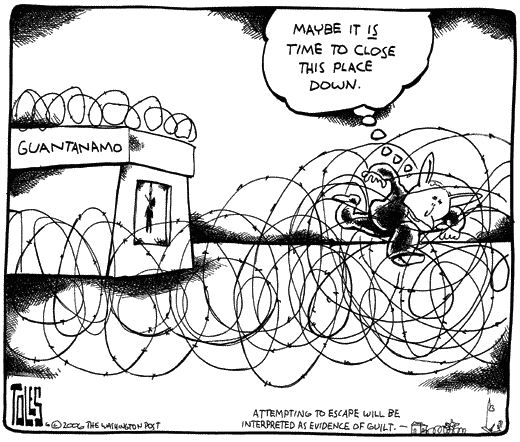
I willing to grant that the logic of the camp trangresses the discourses of Islamist terrorism and the security policy of the War on Terror because of the detention camps for aslyum seekers and illegal immigrants established by Fortress Australia as part of the Pacific Solution.
However, I'm unwilling to go along with Diken and Laustsen argument that camps "come in twins".By this they mean that the 'logic of the camp' is to be found, not only in spaces we traditionally associate with camps, such as concentration or refugee camps, but in spaces understood as 'liberatory'. On this basis they draw what might be seen as controversial analogies between refugee camps and gated communities (Chapter 4), rape camps and party islands such as Ibiza (Chapter 5).
June 16, 2006
the camp as bare life
In Homo Sacer: Sovereignty, Power and Bare Life Agamben treats the concentration camp as spatial evidence of the moment nations declare a state of emergency. In that emergency, nations abandon the rule of law and enter into an exceptional situation in which they are capable of reducing a citizen's presence to "bare life." The concentration camp is concrete evidence of this lawlessness and absolute power.
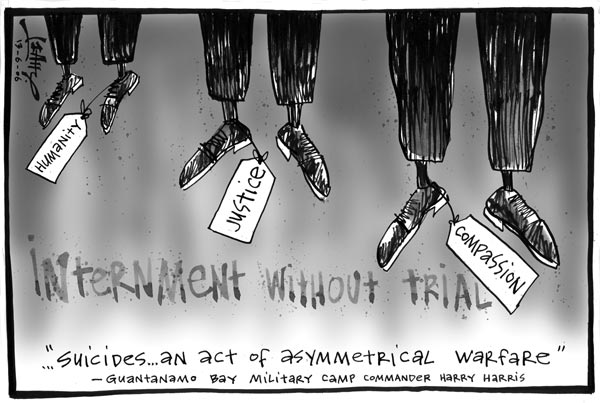
Agamben does not confine himself to World War II camps but extends the principle to assess the United States and its willingness to erode the law in a post-September 11 state of emergency---the U.S. Patriot Act and the suspension of global compacts concerning prisoners of war provide amble evidence. America has declared that the detainees are not legally prisoners of war but that they exist in another exceptional state as on-going combatants. The camps are, significantly, removed from the public eye. Outsourcing interrogation avoids questions about coercive treatment that the U.S. ostensibly prohibits.
This implies that the inmates at Guantanamo Bay have been abandoned by the law and are left facing the violence of sovereign power. The intended purpose of the camp’s location outside the regular territory of the United States is precisely to separate the entire process from normal American legal procedures and constitutional rights. It exists in a state of exception.
The camp produces 'bare' or 'naked life', which Agamben figures in the ancient roman legal category of homo sacer. Someone who was homo sacer could be killed legally, in that the law would offer no sanction against those who took his or her life. At the same time, however, they could not be sacrificed, that is killed according to the rituals of divine law. Homo sacer was thus simultaneously included and excluded from 'the law', and as such they exhibit the same conceptual indistinction that characterises the camp's legal relation to the city.
June 15, 2006
a modern gulag
Is Guantanamo Bay, and the system of prisons (Abu Ghraib and the CIA black sites) that it is a part, the gulag of our times? This is a world of brutal beatings, endless solitary confinement, psychological torture in the form of sensory deprivation, and mock trials; a world where torture is permitted up the point of death. The CIA system of torture is designed to break the will of the prisoner to resist and to extract a confession that they are terrorists who attacked America.
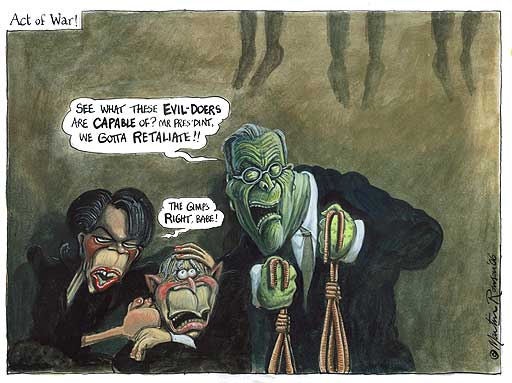
Martin Rowson, Guantanamo Bay Suicides
It is a system in which Presidential power is used to prevent the courts from having any judicial oversight of the administration's actions at Guantanamo.
Australia remains one of the few nations that still accepts the legality of Guantanamo 's conditions, methods and tribunals. It accepts the Bush administration's policy to make torture a weapon in the arsenal of US power and its application to Australian citizens who have been written out of the very status of humanity.
June 14, 2006
compassionate conservatism?
At a time when markets dominate public policy is compassionate conservatism a return to "shrink-the-state" and roll back the welfare state conservatism? An invasive state disrupts the voluntary bonds between people ---it would kills enterprise, it undermines diversity, reduces independence and increases centralisation---whilst its roll back would allow voluntary, faith and not-for-profit sectors to take over from the state. If the welfare state steps back-----though keep cutting what the state spends--- then a better, kinder, charitable self-help would spring up to fill the void. In a competitive enterprise economy the weak link is the state and the public service.
Is that the compassionate conservative scenario? If the policy scenario is cut programmes or increase taxes then neo-liberalism responds with small government. Michael Warby of the Institute of Public Affairs, goes back to the nineteenth century prior to the development of the welfare state:
What is more, by offering 'free' alternatives funded by taxation, the welfare state undermines other forms of provisions of such services---hence the decline of the working-class Friendly Societies of the nineteenth century. More importantly, the steadily increasing nationalisation of the household steadily encroaches on, and undermines, the traditional role of the family in providing social support, pooling risks and intergenerational support.
Thus the self-reliant society.
On this understanding Myron Magnet says that:
Compassionate conservatives ...offer a new way of thinking about the poor. They know that telling the poor that they are mere passive victims, whether of racism or of vast economic forces, is not only false but also destructive, paralyzing the poor with thoughts of their own helplessness and inadequacy. The poor need the larger society's moral support; they need to hear the message of personal responsibility and self-reliance, the optimistic assurance that if they try ---as they must ---they will make it. They need to know, too, that they can't blame "the system" for their own wrongdoing.
Work makes an individual responsible for herself and her family and thereby provides a road to self-respect and equal citizenship . Workfare doesn't solve welfare's biggest problem: the harm it does to children. it is argued that welfare enables the creation of single-parent families in which children fare poorly, while with the other it falsely pretends to secure the welfare of those children by dispensing money.
So if compassionate conservatism assumes that the marketplace is the best way to deliver value, then how does it address the way that the prosperity created by the marketplace has left many Americans behind and that government has a responsibility to reach out to those who are at the bottom rungs of the economic ladder? The argument is that government has a responsibility, not to redistribute the wealth of citizens but to provide the underprivileged with skills and opportunities to create their own wealth.
June 13, 2006
Schmitt: the partisan & the political
Cross posted at Long Sunday
Can Carl Schmitt's theory of the partisan inform us about what is happening today in the war on terror that we are living? More specifically, how does his theory of the partisan change the way we understand the political as a friend/enemy antithesis (understood in an existential, concrete sense)? Is this friend/enemy understanding of the political, often interpreted as a weapon in the battle against liberalism, an historical one?
In highlighting Schmitt's response to this I am building on a previous post, which was more or less a working through Schmitt's text. This working through is based on an understanding of the political as a basic characteristic of human life.
The suggestions of an answer to the above questions can be found in the last section of Schmitt's text entitled, 'From the Real to the Absolute Enemy'. It is here that Schmitt explores the way in which the conception of the political presupposed in his theory of the partisan mutates into something quite different. He explores so by asking a simple question, 'who is the enemy'? Whilst showing how the legimatization of the partisan is given by a third party, Schmitt introduces a bounded concept of the enemy. He says :
... the heart of the political is not enmity per se but the distinction of friend and enemy; it presupposes both friend and enemy. The powerful third party who is interested in the partisan may think and deal in an entirely egoistic way, but with his interest he stands politically on the side of the partisan. This functions as political friendship and is a kind of political recognition, even if it is not expressed in terms of public and formal recognition as a warring party or as a government.
So the theory of the partisan presupposes a bounded concept of enemity. The partisan has a real, but not an absolute enemy. Schmitt reinforces this conception of the political when he says that another boundary of enmity follows from the telluric character of the partisan.The partisan defends a patch of earth to which he has an autochthonic relation. His basic position remains defensive despite his increasing mobility.The real enemy is not declared the absolute enemy, and also is not the ultimate enemy of mankind as such.
Schmitt then argues that a shift has taken place in the bounded concept of the enemy, in that an absolute enemy has been made out of the real enemy. Though Lenin's, professional revolutionary of the world-wide civil war
made the conceptual shift of making an absolute enemy out of the real enemy, the new understanding of the enemy has its roots in the technical-industrial development that has made human weapons into pure means of destruction. Therein lies the danger.
Schmitt says that the weapons of absolute annihilation:
.. require an absolute enemy lest they should be absolutely inhuman. Men who turn these means against others see themselves obliged/forced to annihilate their victims and objects, even morally. They have to consider the other side as entirely criminal and inhuman, as totally worthless. Otherwise they are themselves criminal and inhuman. The logic of value and its obverse, worthlessness, unfolds its annihilating consequence, compelling ever new, ever deeper discriminations, criminalizations, and devaluations to the point of annihilating all of unworthy life.
There in lies the danger. A nuclear world is one in which the partners push each other in this way into the abyss of total devaluation before they annihilate one another physically. Are we not in Heidegger's world of the planetary dominion of the technological mode of being, in which the world becomes totally enframed as a picture, and integrates the world as standing reserve? A technological ordering in which there is a refusal of limits, a rejection of boundaries and concrete difference and a blurring of borders?
Schmitt says that this gives rise to new kinds of absolute enmity, and he understands this darkly. He says that:
enmity will be so terrifying that one perhaps mustn't even speak any longer of the enemy or of enmity, and both words will have to be outlawed and damned fully before the work of annihilation can begin. Annihilation thus becomes entirely abstract and entirely absolute. It is no longer directed .. against an enemy, but serves only another, ostensibly objective attainment of highest values, for which no price is too high to pay. It is the renunciation of real enmity that opens the door for the work of annihilation of an absolute enmity.
Being political now means being orientated to dire emergency; as it is a situation in which two orders of what is right confront each other, without any mediation or neutrality. Is this not what we in the war on terror? A war in which the enemy is both external and internal?
Schmitt by making reference to The Nomos of the Earth since nomos is a way to understand the transformation from one historical epoch to another.
June 12, 2006
Carl Schmitt: the partisan
How does Carl Schmitt's theory of the partisan inform us about what is happening today in the war on terror? It would appear that the conventional, classical concepts of war and peace, which are based on the contained European war of the nineteenth century, with the implication of relative and containable enmity, does not make sense of what is happening in the Middle East. The war on terror is quite different. If this is a different conception of war to the standard one of war between nation states, then what kind of war is it? There is a week long symposium on Schmitt's theory of the partisan going over at Long Sunday, and this post is a contribution to it.
If we interpret the theory of the 'partisan' as a development of Schmitt's theory of the political, can we use the political category of the partisan to make sense of the Islamic resistance to the attempt by the US to establish its hegemony in the Middle East; or the Palestinian resistance to Israel's attempt to expand its borders through settlements in the Occupied Territories. Can Schmitt's work help us deconstruct the standard use of 'terrorist' to describe all these diverse forms of insurgencies? If so how does the theory of the partisan change the way we understand the political as a friend/enemy antithesis (understood in an existential, concrete sense)?
Schmitt's text starts in an interesting place, with the homegrown Spanish resistance to the French occupation of Spain by Napolean at the beginning of the 19th century. The Spanish Guerrilla War of 1808 was the first in which the partisan as guerrillero's dared to wage irregular war against the first regular modern army. The partisan's 'real space of combat is in the rear of the enemy's front line, where he harasses the transportation and supplies, but also because he is more or less protected and concealed by the local people in the occupied zone. ' Hence the historical link to the Vietnamese resistance to the US occupation of Vietnam in the 20th century, which legitimated the partisan in the name of national defense. He says that the theory of the partisan leads into the concept of the political, in the question concerning the real enemy and a new nomos of the
earth.
This history gives us the contrast between two sorts of partisans: namely, 'the defensive-autochthonous defender of home and the aggressive international revolutionary activist' (Lenin). Schmitt says that it was Stalin who successfully linked the strong potential for national and local resistance---the essentially defensive, telluric power of patriotic self-defense against a foreign conqueror---with the aggressive nature of the international communist world-revolution. The connection of these two heterogeneous forces dominates partisan struggle around the world today.
Schmitt argues that, as a result 'new spaces of/for war emerged in the process, and new concepts of warfare were developed along with a new doctrine of war and politics.' The irregular fighters as partisan challenges the classic distinctions of the statist foundation of warfare: those between war and peace, combatants and non-combatants, enemy and criminal presupposed when war is understood to be conducted between states by regular armies of states, between standard-bearers of a jus belli who respect each other at war as enemies and do not treat one another as criminals. On this statist understanding a peace treaty becomes possible and even remains the normal, mutually accepted end of war.
The modern partisan has turned away from the conventional enmity of the contained war and given himself up to an other---the real---enmity that rises through terror and counter-terror, up to annihilation. However, it took a long time before the new concepts of warfare and politics were developed, and a large section of Schmitt's article is devoted to tracing this development. The key figure in terms of developing a partisan theory of the formula of war as the continuation of politics by other means is Mao Tse-tung, not Lenin.
Schmitt says that Mao gives us a conceptual formation that is as simple as it is effective:
War finds its meaning in enmity. Because it is the continuation of politics, politics too always involves an element of enmity, at least potentially; and if peace contains within itself the possibility of war.....peace too contains a moment of potential enmity. [The core of] Mao’s political theory...lies in partisanship, whose essential characteristic today is real enmity. Lenin’s bolshevik theory recognizes and acclaims the partisan. But in comparison to the concrete telluric reality of the Chinese partisan, Lenin has something abstract and intellectual [abstrak-intellektuelles] in his definition of the enemy.
Schmitt says that this geneology of partisan opens up four different aspects: the aspect of space, then the shattering of social structures, further the interconnectedness with the world-political context, and finally the technical-industrial aspect It is these aspects that provide the link to the contemporary Middle East and help disclose the war that the US is fighting.
In a partisan battle a complexly structured new space of action emerges because the partisan does not fight on an open field of battle nor on the same plane of open frontal war. Schmitt says 'Rather, he forces his enemy into another space. From underground, he disturbs the conventional and regular game on the open stage. On the basis of his irregularity, he alters dimensions not only of tactical, but of strategic operations of the regular army.'
The shattering of social structures is illustrated by the French in Indochina from 1946 to 1956 when their colonial regime in this region fell apart. Schmitt says that this 'instance may suffice to remind us that the partisan, suppressed by the military mind of the nineteenth century, quite suddenly moved into the center of a new kind of warfare whose sense and purpose was the destruction of the existing social order.'
The third aspect, the interconnectedness with world-political fronts and contexts, arises Schmitt saysbecause the partisan is always dependent in some way, as an irregular fighter, on a regular power, on an interested third party:
The powerful third party delivers not only weapons and munitions, money, material assistance, and medicines of every description, he offers also the sort of political recognition of which the irregularly fighting partisan is in need, in order to avoid falling like the thief and the pirate into the unpolitical, which means here the criminal sphere.
In the longer view of things the irregular must legitimize itself through the regular, and for this only two possibilities stand open: recognition by an existing regular, or establishment of a new regularity by its own force.
The partisan too participates in the fourth aspect, which is the development of modern technology and its science as both the partisan and his opponents both keep step with the rapid development of modern technology and its form of science. The partisan adapts to the new technical-industrial environment, learning how to make use of the new means, and so develop a new, form of the partisan---the industrial partisan.
It is these four aspects that can be used to understand what is happening in the Middle East.
June 11, 2006
mutations in citizenship
The link below is courtesy of Fadzilah over at Ostrich Looking For Sand.
The Migration and Diaspora Study Group Seminar at the National University of Singapore recently hosted a talk by Prof. Aihwa Ong entitled, 'Mutations in Citizenship'. The abstract states:
Mutations in citizenship are crystallized in an ever-shifting landscape shaped by the flows of markets, technologies, and populations. We are moving beyond the citizenship-versus-statelessness model. First, the elements of citizenship (rights, entitlements, etc.) are becoming disarticulated from each other, and becoming re-articulated with universalizing criteria of neoliberalism and human rights. Such "global assemblages" define zones of political entitlements and claims. Second, the space of the "assemblage," rather than the national terrain, becomes the site for political mobilizations by diverse groups in motion. Three contrasting configurations are presented: the EU zone; Asian zones of hypergrowth, and camps of the disenfranchised. Thus, particular constellations shape specific problems and resolutions to questions of contemporary living, further disarticulating and deterritorializing aspects of citizenship.
This Deleuzian account ( 'flows,' 'assemblages', 'deterritorializing') sounds interesting, and the way it concentrates on the forms of social change taking place alongside or beneath the given form of the state connects with Arendt and Agamben's arguments about rights, refugees, citizenship and the camps of the disenfranchised. Does the process of the deterritorializing' of citizenship and becoming minor constitute the core of a revolutionary politics? Does it mean the invention of new forms of subjectivity and new forms of connection between deterritorized elements of the social and political field?
The back drop to these mutations is Karl Marx's observation in the nineteenth century that capitalism had opened up fractures and fissures in the solid crust of European society:----"Beneath the apparently solid surface, they betray oceans of liquid matter, only needing expansion to rend into fragments continents of hard rock." Marx and Friedrich Engels's famous phrase, "all that is solid melts into air" captures the constant political and cultural upheavals that characterized global modernity. Today, the ruptures and upheavals continue to be associated with contradictory globalizing phenomena. The interplay between them threatens to render modern norms of citizenship and human rights "antiquated before they can ossify".
Fadzilah attended the seminar and she offers some comments here. These highlight the way that Singapore illustrates Ong's argument in relation to the Asian zones of hypergrowth. Fadzilah says that:
Singapore has been affected by a strong sense of economic globalization such that 'talent', foreign and local, has been flowing in and out, the latter better known as a 'brain-drain'. 'Foreign talent' in Singapore are offered the same privileges as Singapore citizens in many areas, thus rendering citizenship less of a sought-after privilege. Similarly highly qualified Singaporeans who leave are granted attractive incentives in the nations they migrate to.
Singapore's mode of governance is not just designed to position Singapore to compete in the global economy, since the amalgam of neoliberal strategies of governing are re-engineering political spaces and populations to position Singapore as a hub of scientific expertise (biotechnology) and flexible labor and knowledge regimes.
Ong develops this in this article entitled, 'Experiments with Freedom: Milieus of the Human', where she says that:
The new norm of belonging to "Asian world cities" is not as a citizen who makes demands on the government but as individuals who take the initiative as mobile, flexible, and reflexive actors responding autonomously to market forces. There is thus a shift in the ethics of citizenship, from a stress on equal access to rights and claims on the state to a focus on individual obligation to maximize self-interest in turbulent economic conditions. Responsible citizenship is to be enacted in autonomous actions of individual self-enterprise and risk taking, without state support. In addition, there is the requirement of self-enterprising citizens to interact with technological systems and to remake themselves as reflexive knowledge workers.
That is also happening in Australia as the welfare state is rolled back and we citizens are required become more self-reliant. But Singapore is much more into advanced in terms of neo-liberal governance:
Despite having a population of four million that is already onequarter expatriate, Singapore has an aggressive headhuntng programthat recruits experts in all fields in order to make it "a fertile ground for breeding creativity" .... Talented expatriates enjoy better salaries, housing allowances, and preferential tax breaks than run-of-the-mill citizens. Consequently, the problems of living, working, and productivity increasingly pivot around individual self-actualizing talent rather than conventional citizenship claims. The influx of exciting, risk-taking, and creative foreigners, it is hoped, will shake up narrowly trained, security conscious citizens constrained by Confucian norms and group thinking. Neoliberal ethics trump Confucian ethics as governing technologies seek to animate self-governing subjects who can make calculated investments in their lives for uncertain times. The moral measures of citizens, expatriates, and habitués of globalized sites are now set spinning by the gyrations in global markets. Residents in such globalized sites are valued and protected not because of their citizenship status but for their powers of self-management and cutting-edge skills that sustain the competitiveness of growth zones.
In her account Fadzilah says nothing about Ong's comments about the camps of the becoming-disenfranchised at the seminar. Are these camps filled with refugees? Aslyum seekers? Illegal immigrants? Is there any link to becoming-revolutionary in the assemblages of the flows of markets, technologies, and populations?
Ong has written a book on the mutations of citizenship which constructs neoliberalism as an malleable technology of governance that is taken up in different ways by different regimes, be they authoritarian, democratic, or communist. I'll hunt around for some reviews.
June 10, 2006
On Hayek: ambiguities
I have to admit that I once saw Hayek as an ideological icon of what was called the New Right, an active publicist of market liberalism who was deeply opposed to socialism and social democracy. He stood on a soapbox to preach the mesage that that civilization was threatened by catastophe from state intervention, and that only a concerted effort by market liberals would ensure that a free society survived.
That is the Hayek of the polemical tract, The Road to Serfdom, is it not? Well, okay a political pamphlet that presented the conflict over the market order as a struggle between good and bad, between the forces of civilization and the forces of darkness. A crusade against Hegelianism (of course) Marx, and Keynes and all those false liberals (Rousseau, Bentham, Jefferson, Goodwin) who stood for state control and social engineering and were against free enterprise, entrepreneurship, the competitive order and the true liberalism that is grounded in the Scottish Enlightenment.
But Hayek is more complex than this is he not? He was no libertarian.
Hayek argued that a strong state was necessary to police the market order, maintain the value of money, protect life and property and enforce contracts and torts. He held that if all citizens were to enjoy their personal freedom, then the natural tendency of individuals to cheat, defraud, coerce and oppress one another must be restrained by a superior coercice power, and that could only be provided by the state. In these moments Hayek sounds like Hobbes, even though he is deeply hostile to Hobbes. And, heaven forbid, Hayek sounds like Hegel when he argues that what is most important for individual freedom is is the institutional framework which guarantees the market order, which has evolved out of the experiences, choices and experiments of many generations.
Hayek, in other words, was as critical of rational choice as he was of collectivism. That is why he is worth reading.
a political paradox
When I was at university in the 1980s I remember reading books that argued that liberalism was not only the dominant but even the sole intellectual tradition, and that the distinctions within liberalism (free market, social)seemed like the only political differences that mattered. Few were prescient enough to foresee the rise of the right, which was at that moment beginning to organize and craft a philosophy of its own; one that went beyond mere instinctive reaction.
Consider Hayek's response in his Constitution of Liberty to asking himself the question of whether there is such a thing as a conservative philosophy. He says that It may be a useful practical maxim, but it does not give us any guiding principles to influence long term developments.(p.411)
If conservatism did not exist as a political philosophy, then things have changed. As US Senator Daniel Patrick Moynihan quips:
"The central conservative truth is that it is culture, not politics, that determines the success of a society. The central liberal truth is that politics can change a culture and save it from itself."
'Tis a nice paradox is it not? Especially for those who are free market liberals and social conservatives?
Liberals have historically understood themselves to be pushing aside the cobwebs of history, ending ideology, freeing society from illusions, overturning outdated power structures, and taking society to a morally superior, more prosperous place. This is the process of Enlightenment, and enlightened liberalism in the second part of the 2oth century took the form of an academic social democratic liberal philosophy of procedural democracy, scientific social improvement, expert knowledge, progress and activist government. It is a kind of utilitarian Fabism.
This form of liberalism has been under assault from both the right and left; but more so from a right wing populism that accepts the liberal case for a market order but not limited government. Once socialism is out of the way then the old 19th century battle lines between conservatism and liberalism reappear---eg., way that liberalism makes individual sovereignty the organizing principle of the economy, polity and society. The conservative argument is that liberalism's concentration on economic liberty makes it blind to what is happening to the polity and culture.
June 9, 2006
Zionism as a nationalism
Let us start with this official account of Zionism by Benyamin Neuberger.He states that:
Political Zionism, the national liberation movement of the Jewish people, emerged in the 19th century within the context of the liberal nationalism then sweeping through Europe. Liberal nationalism usually aspired to two basic goals: liberation from foreign rule, (as in the case of Poland, Greece and Ireland) and national unity in countries which had been partitioned into many political entities (Italy and Germany). Its motto was "A state for every nation, and the entire nation in one state." Zionism synthesized the two goals, liberation and unity, by aiming to free the Jews from hostile and oppressive alien rule and to re-establish Jewish unity by gathering Jewish exiles from the four corners of the world to the Jewish homeland.
Neuberger usefully connects Zionism as a poiltical movement to a critique of the Enlightenment.
The rise of Zionism as a political movement was also a response to the failure of the Haskala, the Jewish Enlightenment, to solve the "Jewish problem." According to Zionist doctrine, the reason for this failure was that personal emancipation and equality were impossible without national emancipation and equality, since national problems require national solutions. The Zionist national solution was the establishment of a Jewish national state with a Jewish majority in the historical homeland, thus realizing the Jewish people's right to self-determination. Zionism did not consider the "normalization" of the Jewish condition contrary to universal aims and values. It advocated the right of every people on earth to its own home, and argued that only a sovereign and autonomous people could become an equal member of the family of nations.Talking in terms of 'Jewish unity through gathering Jewish exiles from the four corners of the world to the Jewish homeland' and 'a Jewish national state with a Jewish majority in the historical homeland, thus realizing the Jewish people's right to self-determination' does point to Israel as Jewish state, does it not? It does suggest that the nationalism underpinning Zionism is less a liberal nationalism and more an ethnocentric nationalism.
The establishment of a Jewish state implies a rejection of a binational state based on social and political parity of Jews and Arabs.
June 8, 2006
An Israel Lobby
Is there a Jewish lobby in Australia, in the sense of the American Israel Public Affairs Committee (AIPAC) "The Israel Lobby and US Foreign Policy," by John J. Mearsheimer and Stephen M. Walt, published in the March 23, 2006, issue of the London Review of Books and posted as a "working paper" on Harvard University's Kennedy School's Web site?
In that text they had argued the centerpiece of US policy in the Middle East has been its unwavering support for Israel, and that this has not been in America's best interest, and this was partially due the unmatched power of the Israel Lobby.Their point is simply that the Lobby's success has redirected U.S. policy in the Middle East away from America's interests, narrowly defined. Arguing that the relationship between the United States and Israel "has no equal in American political history," the authors wrote:
The U.S. national interest should be the primary object of American foreign policy. For the past several decades, however, and especially since the Six Day War in 1967, the centerpiece of U.S. Middle East policy has been its relationship with Israel.
Walt and Mearsheimer's case is that, on balance, the United States' (almost) unconditional support for Israel doesn't serve the interest of American power. Israel -- once a valuable counter to Soviet influence in Syria and Egypt -- is, in the post Cold-war era, a strategic liability. Whilst that Israel Lobby claims that it is fighting for a small, weak country surrounded by belligerents who are bent on her destruction Walt and Mearsheimer argue that Israel -- with military spending higher than all of its neighbors combined, access to the latest U.S. weapons technology and the only nuclear arsenal in the Middle East--- is not exactly fighting for its existence.
Is there an Israeli lobby in Australia. Yes. There is.
The Australian and Jewish Affairs Council (AIJAC) is a Jewish lobby group; one that takes a Likud position on the Israeli-Palestinian conflict and has close ties to the Washington Institute for Near East Policy.
I understand the Likud position to stand for a powerful Israel free to occupy the territory it chooses; enfeebled Palestinians; and unquestioning support for Israel by the United States. It is skeptical of negotiations and peace accords, along with the efforts by Israeli doves, the Palestinians, and Americans to promote them. It is against putting pressure on Israel with regard to settlements, or negotiations or that Israel should cede to the Palestinians enough territory and authority for a workable state. It has hawkish views on the Middle East, proponent of regime change in Iran, of a US confrontation with Tehran over its nuclear program, and the strategic value of Israel to the US.
The key to the ongoing conflict is the Israeli settlements in the ocuppied territories. The expansion of the settlements after 1967, supported by the Israeli state, no matter which political party is in power, is what makes Israel a colonial state. The questioning of this is what is blocked by the Israeli lobby. Walt and Mearsheimerstate that one aspect of the Lobby's efforts is to constrain discussion of Australia's relationship with Israel by imposing a narrow political correctness and it has a strategy of relentless attacks against academics, politicians and journalists who criticize Israeli government policies. The dangerous, unacceptable result of that lobbying, however, is the stifling of public debate.
So we have a situation where the mainstream media know the fiercely negative reactions to accurate, detailed reporting of controversies surrounding Israel and the media fail to cover Israel's violations of every principle for which the United States—and Israel—loudly proclaim they stand. There is only rare, skimpy coverage of the ongoing Israeli mass punishments, house demolitions, illegal settlements, assassinations, settler brutality, curfews and beatings. On the other hand, the blind Palestinian rage generated by decades of receiving humiliating, savage suppression in their homeland is reported in lurid, bloody detail. The media work with an Israeli narrative.
June 7, 2006
beyond laissez -faire
A quote from John Stuart Mill:
Laissez-faire, in short, should be the general practice: every departure from it, unless required by some great good, is a certain evil.
That captures laissez -faire doesn't it. Mill's dim view of government intervention leaves individual self-interest calling the shots, doesn't it. It presupposes the universally beneficent and harmonious operation of self-interest left alone. I guess this forms the core of what is neo-liberalism today. The critics of neo-liberalism, operating from a political perspective, have deemed to be irrational. So I will argue against laissez-faire from within economics.
Henry Sidgwick points out in his The Elements of Politics, even if one grants that individuals are the best judges of their own interests,
...it by no means follows that an aggregate of persons seeking each his private interest intelligently, with the least possible restraint, is therefore certain to realise the greatest attainable happiness for the aggregate ( pp. 144-45).
What this highlights is a divergence between private and social or public interests. Sidgwick highlights those cases where self-interest and laissez are not wealth maximising: Sidgwick cites in support of this
argument the use of natural resources, including the potential depletion of mines, fisheries, and plant species, and the diversion of water ways necessary for irrigation etc. Climate change and global warming would be a contemporary example of this divergence.
In his Principles of Political Economy Sidgwick uses the overuse of natural resources as an example:
Take, for instance, the case of certain fisheries, where it is clearly for the general interest that the fish should not be caught at certain times, or in certain places, or with certain instruments, because the increase of actual supply obtained by such captures is overbalanced by the detriment it causes to the prospective supply. Here---however clear the common interest might be---it would be palpably rash to trust to voluntary association for the observance of the required rules of abstinence; since the larger the number that voluntarily abstain, the stronger becomes the inducement offered to those who remain outside the association to pursue their fishing in the objectionable times, places, and ways, so long as they are not prevented by legal coercion ( p.410).
This example indicates that individual self-interest does not ordinarily take into account the interests of future generations (eg. with climate change) and that soem individuals can cheat,
Hence the divergence between private and social or public interests.
June 6, 2006
Zonism: implications
The material below is part of an interview between Christopher Brown, a grassroots radical journalist, and Prof. Norman Finkelstein. Christopher Brown asks:
Finally, Prof. Finkelstein, could you speak about the formation of the Zionist ideology and how it has been interpreted on the ground as Palestine continues to get chopped up to suit the ethnocentric colonialist system in Israel?
It's a good question, particularly the ethnocentric bit, as it implies that Israeli is more of a Jewish state than a liberal democracy respecting the universal rights of citizenship. Israel is the Jewish national home. This implies that in Israel there is room only for the Jews. So what then happens to the Arabs?
I recall that Zionism once held that Israel was founded on a myth of "land with no people, for a people with no land". That myth leads to a questioning of Zionism as a nationalism associated with the violent beginnings of sovereignty. Since historic Palestine was inhabited prior to Israel being created so the Jews came to Palestine and took the country from the Palestinians. Why should the Palestinians accept that?
Norman Finkelstein responds to Brown's questions as follows:
Israel is a self-declared Jewish State and its ideology is to create a Jewish State. A State for the Jews. And it doesn't want a non-Jewish presence in that State, it's gratuitous, it's superfluous, it's a nuisance, and so, Israel has been trying, since the beginning, to carve out a State, which is overwhelmingly, if not homogeneously Jewish, in an area which was and parts of it still are, overwhelmingly non-Jewish. And that's been Israel's struggle. That's been the struggle of Zionism from the beginning, and the struggle of Israel's since the past fifty or sixty years. How do you create a Jewish State in an area that is overwhelmingly non-Jewish? And in the early years the assumption was sooner or later we can either buy them out and send them off somewhere else, or if we can't buy them out, we can push them out. Since the late 1960s the buy out option is plainly untenable. The Palestinians won't be bought out. And the push out option is less and less tenable because international law and pressures of international public opinion won't allow for a mass expulsion. So given that you can't buy them out, you can't push them out, the only other option is to confine them in smaller and smaller parcels of land, and keep as much of the land as you can for the Jewish State which is what Israel is currently doing.
That's about right. The wall was a part of that process of establishing a Jewsh state. That has meant that the Palestinians, those that were forcefully expelled from their homes in 1948, 1967, and more recently in 2001, have been living in squalid refugee camps throughout the region.
Finkelstein adds:
And I think they're hoping that Palestinians will reach such a state of despair that, quietly, they'll leave. That's pretty much what happened in Lebanon. The Lebanese government banned Palestinian men from a large number of professions, I think it went up to something like 80 if my memory serves, and slowly but surely without any fanfare, Palestinian men left. And the official Palestinian refugee population in Lebanon, I believe it is, supposedly half a million, the actual numbers are close to 200,000. Because, one way or another, by hook or by crook, Palestinian refugees found a way to get to Europe and elsewhere. And I suspect that Israel is hoping that that will happen with the Palestinians who they have confined in these, I hate the word "cantons", conjures up some notion of Switzerland and William Tell. They're not cantons, they're Indian reservations, with the difference being that Indians have US citizenship
My understanding is that the Palestinians who did not flee Israel-proper in 1948 are Israeli citizens, albeit fourth class Israeli citizenship. What happens to them if the Zionist policy of Israel with a Jewish-only population is continued with?
June 5, 2006
Spinoza, marxism & the political
I 've always thought that Marxism was stronger on economics than politics and so I've been interested in the attempts to give the politics something more than the politics as class struggle. It has little to say about pressing cultural issues such as water politics or federalism or refugees and little conception of how the political might be different from the economic.
One attempt to give some substance to marxist conceptions of the poiltical in relation to the tradition of modern European political thought, has been the turn to Spinoza by French marxists (eg., Althusser, Macherey & Negri) to expunge the Hegelianism from Marx's work by replacing Hegel with Spinoza and so as to develop an alternative to Hegelian Marxism. My concern is with the political relevance of Spinoza today, and this very useful survey article by John Holland in Cultural Logic provides me with a way to assess the Spinozian turn.
Consider this passage:
Spinoza wanted to settle the question of the basis of human society, given that its feudal-corporatist basis had been thrown into crisis by the emergence of the market and the ideology of "possessive individualism." But he refused to consider that basis as somehow separate from human society itself -- either in the form of "natural rights" pre-existing, and then supposedly safeguarded by, the foundation of political society, as per the social contract theories of Hobbes and Rousseau; or in the form of transcendent Spirit and the ruse of reason, which merely use human societies to realize their own ends, as per Hegel. In contrast to Rousseau and Hobbes, humankind's natural state for Spinoza is neither un-mitigated war (Hobbes) nor solitary purity (Rousseau) but always already political: human beings always live socially, and that sociality is antagonistic except to the extent that humans realize (i.e. recognize and actualize) the superior force of individuals combined in cooperative groups relative to that of isolated individuals and those combined in uncooperative ones -- that is to say, human society is inherently and, as it were, aboriginally political. ....So for Spinoza, as for Hegel, the political precedes the personal, and thus cannot be conceived on the model of a voluntary contract among pre-existing individuals.
So far so good. This indicates that we have a reworking of the social contract tradition begun by Hobbes. Spinoza may have even opened up a different (continental?) strand within this tradition----Rousseau, Kant, Fichte, Hegel?
But we then get a particular turn which I find so strange about this French marxist reading--it's blindness.
Holland says:
But whereas for Hegel, the political has a history (the History of subjective Spirit realizing itself objectively through peoples and the development of the State), for Spinoza the political exists immanently in history -- which is conceived as the (non-teleological) ensemble of realizations of natural-human powers. And whereas for Hegel, the supra-personal political instance is the transcendental subjectivity of Spirit, for Spinoza, it is simply natural force augmented by the equally natural but historically contingent combination of individuals in groups. Such combination produces a potentially infinite variety of socio-political forms in history, but always stems from the basic nature of human passion to knit interpersonal relations and form groups. Humans thus don't (have to) "give over" their natural rights to sovereign Power in order to safeguard their private interests and found political society: their interpersonal relations were already political to begin with, and their political force depends on how well -- how extensively, intensely, and harmoniously -- those passionate relations are composed. This rejection of social contract eliminates any need for transcendent authority (potestas), and instead grounds politics immanently (non-dialectically) in the force of the group (potentia multitudine).
What I find is the transcendental subjectivity of Spirit, by which is meant subjective Spirit realizing itself objectively through peoples and the development of the State. How is this squared with Hegel's Philosophy of Right and its critique of the social contract tradition.
That critique does not rely on idealism, in that the main actor or agency is Spirit or Mind; a transcendental subjectivism, in which this historical agent, Absolute Spirit, is a subject that transcends any and all concrete subjects and indeed history itself. The Philosophy of Right is a critical working through the categories of modern political philosophy and it places individual freedom at the very centre of the text.
From what I can make out from Holland's text there is no engagement wiith Hegel's Philosophy of Right by the Frenach marxists, even though that text is a classic of modern political philosophy along with Hobbes' Leviathan and Rousseau's Social Contract. They ignore it.
June 4, 2006
liberalism's big problem
The liberal political philosophical tradition (in both its social contract and utilitarian forms) is grounded on a negative conception of liberty as 'a doing as I please.' Hence it is concerned to restrict each person's freedom so that it harmonizes with the freedom of everyone else within the nation-state's system of the rule of law. So each individual pursues their self-interest (or happiness) in whatever way they see fit, so long as he/she does not infringe upon the freedom of others to pursue a similar end within public law.
So the problem of the state is how to harmonize individual wills or interests. How then does the 'harmonizing' happen to ensure the nation-state continues to exist?
The answer that is given is that in the market place it is the invisible hand, is it not. The market is deemed to be self-regulating and so when self-interested human action is constrained to the context of civil law it would tend to promote the harmonization of the actions of all indiivduals in a nation-state.The market, as an allocation mechanism, could only operate satisfactorily---ie., harmonizing actions of self-interested agents with the interests of society as a whole (ie., the public good) ---within a framework of legal, political, and moral restrictions.
That is Adam Smith's legacy is it not?
The most basic function of government was the establishment and enforcement of a system of law that would control, channel, and restrain individual action in such manner that the individual pursuit of self-interest would lead to the greatest happiness. So what we get is the transformation of self-interest from something negative whose effects should be negated by a wide-ranging program of governmental restrictions to a view of self-interest as a driving force toward increased economic welfare for all when channeled through the competitive market process.
This is famously evidenced in Smith's statement that "By pursuing his own interest he frequently promotes that of the society more effectually than when he really intends to promote it." Smith’s "invisible hand" is actually government itself, the hand of the law-giver, the hand which withdraws from the sphere of the
pursuit of self-interest those possibilities which do not harmonize with the public good."
The optimism in the phrases 'it would tend to' or 'promotes' covers up the debate about the means to ensure harmony or coordination of individual interests; a debate between those who argue that the means to coordinate or restrain the negative effects of self-interested behavior in terms of government regulation; those like Adam Smith and the nineteenth-century
classicals who held that the system of natural liberty harmonizing, to a greater or lesser extent, self-interest and social interest, could be harmonized by allowing the market to function with a minimum of direct control by government; or the neoclassical economists who argued that there was a rather extensive set of divergences that the market could not satisfactorily coordinate--ie., market failures and who argued that government could
serve as an efficient coordinating force by correcting market failure.
And in the democratic polity? By compulsion? Or fear? If not how? The polity is not the self-regulating market is it? So how does the polity harmonize individual interests to ensure the public good?
June 3, 2006
instead of words
Hannah Arendt's chapter 5 of her book The Origins of Totalitarianism (1951) is dedicated to the problem of refugees. It is entitled "The Decline of the Nation-State and the End of the Rights of Man" and it is to be found in the volume on imperialism. This formulation inextricably links the fates of the rights of man and the modern national state within a declinist narrative.

Matt Golding
Does Arendt's formulation imply that the end of the latter necessarily implies the obsolescence of the former? Or is it excessive nationalism and imperialism not the notion of nation-states and citizenship, that gives rise the problem of the refugee?
As we have previously seen , Arendt wrote:
"The concept of the Rights of man based on the supposed existence of a human being as such, collapsed in ruins as soon as those who professed it found themselves for the first time before men who had truly lost every other specific quality and connection except for the mere fact of being humans."
Today, as Giorgio Agamben observes in the system of the nation-state the refugee represents a disquieting element: it breaks up the identity between man and citizen and between nativity and nationality.
So the refugee throws into crisis the original fiction of sovereignty. However, I'm not sure what Arendt and Agamben meant by 'the end of the nation state.' That system still seems to be going strong in a globalised world from where I live.
So what did Arendt mean by the ' Decline of the Nation State and the End of the Rights of Man' ? She explored this in terms of the manner in which the First World War destroyed the facade of a civilized structure to the community of nations. The phenomena of statelessness with its 'institutional solution' of the internment camp foreshadows Arendt's account of the later developments of totalitarianism and the horrors of the concentration camp. From this, Arendt observes that what secures the most basic projection of individuals is not legal or political rights, but rather the fundamental belonging to a political community. Consequently, those outside of political community are essentially stripped of their capacity to be political agents.
What Arendt argued is that the European state system, which was a ciivlized legalorder premised on protecting the rights of all the inhabitants in its territory became a national state through making the Jewish people stateless. Only those who could successfully claim membership in the nation could claim rights. Natural rights were empty: escaping from a concentration camp in Germany and fleeing to Holland meant ending up in a Dutch internment camp.
Thus, during and after World War I, thousands of people, considered either ethnic or political minorities in their countries (such as Jews, communists), became undesirable for the states where they were rooted and were consequently expelled. They were forced to take refuge in other countries. As they became classified as "stateless," "refugees," or "displaced persons," their uncertain political status deprived them of human rights, oth within the territory from which they fled, and within the territory where they subsequently resided. So the loss of home and political status become identical with the expulsion from humanity.
June 1, 2006
try this: returning to Aristotle
Unlike today, where politics and ethics are widely seen as contradictory, Aristotle's ethics was always linked to politics in the sense of politics conceived in ethical terms. Instead of a law conception of ethics (eg., legislation to curb excesses of both lobbyists and lawmakers) we have a virtue ethics, in which deliberation on circumstances cannot be assimilated to a deductive pattern of reasoning, and in which the prudent man has a most prominent place.
Ethics (in this classical Aristotlean sense) requires politics as the venue of its implementation; indeed, that ethics in a fundamental sense is politics. Ethics is politics inasmuch as the achievement of human happiness or a flourishing life. So political activity itself, not the policies or institutions it seeks to implement, functions as ethical ground.
And that political activity is the activity of citizens in the polis. Politics is concerned with action and deliberation, and that to be engaged in politics means to exhibit actions. The phrase, "Man is a political animal" is a confirmation of the preeminence of politics and political life. Preeminence for what, ultimately? For ethics.
Politics enhances ethics. Politics opens up the shared field or common space ( res publica) within which an individual can begin to conceive himself (for Aristotle) as fully human.The confrontation of free and equal citizen with free and equal citizen compels the individual to transcend specialism in favor of a generalism that hallmarks public activities and goals. In discovering goals that are no longer particular but universal within the polis the individual discovers eudaimonia/the good life as a living well. It is the formation of character that links Aristotle's ethics and politics ---the main concen of politics is to engender a certain character in the citizen so that citizens act in terms of virtuous action and the common good.
The moderns, in contrast, make freedom in the public sphere the raison d'etre of politics, not the good life. The public realm is a house where freedom can grow, is how Hannah Arendt put it.
Can we rediscover the subject matter of modern political philosophy as "the ethics of the political"? Is this possible? If so how? Haven't others been here before? Isn't this return to Aristotle a familar pathway in the political philosophy of modernity? A well trodden pathway that returns to the praxis poesis distinction? Many have trodden that particular pathway to the classical Greeks to renew the concept of praxis.
But we moderns walk that particular pathway to the Greeks after having read Kant, Hegel, Nietzsche and Heidegger do we not? I tread that pathway to find a different conception of politics to the conventional understanding of politics-as-a-game that devolves into a Clauswitzian strategic encounter between enemies.