May 31, 2006
rethinking rights--Miko Bagaric
Mirko Bagaric, the head of the law school at Deakin University, and author of It's a Matter of Opinion: An Analysis of the Defining Issues of our Time, has a crack at rights in the Canberra Times. It is more sophisticated that the usual attacks launched by The Australian's conservatives, such as Janet Albrechtsen, who view 'the alluring language of right as cementing into the law a radical left-wing political agenda.' Albrechtsen is pmore or less a conservative warrior in the culture wars on behalf of Murdoch.
Bagaric's op.ed: introduces rights in terms of the way that:
...the distorted individualist moral code that pervades our collective thinking. Over the past 60 years there has been a slow but unmistakable change in the manner in which we approach moral issues. Our personal morality is central to our conduct because it impacts, often subconsciously, on all of the important decisions we make in our daily lives. You don't need to be a philosopher to recognise the fundamental shift. We are now wired in a way that the standard currency for dealing with moral issues is that of "rights". Rights claims emerged in response the atrocities during World War II as counter-ideologies to combat tyrannical regimes.
Then we have the critique:
It's easy to invent rights claims because rights are intellectual nonsense. No one has yet been able to provide tenable answers to questions such as: Where do rights come from? How can we distinguish real from fanciful rights? This allows people to make up rights as they "go along".
That ignores the tradition of natural right doesn't it? Or the way that libertarians ground rights on private property.The 'intellectual nonsense' is a reference to Benthamite utilitarianism, isn't it.
Bagaric continues. He says that rights are seductive because they are individualising claims and seem to give us a protective sphere. They appeal to those of us who have a "me, me, me" approach to life.
So what is the problem with this? Self-interest is what liberalism is grounded on. That foundationalism means me, me, me doesn't it?
Bagaric says rhe problem with rights is that:
... they limit our moral horizons to ourselves - the moral compass is suspended in an inward direction. But buried only slightly beneath such an approach are the inescapable realities that as people we live in communities; communities are merely the sum of a number of other individuals; and the actions of one person (exercising his or her rights) can have a (negative) effect on the interests of others.If you want to know what interests we have, the answer is simple. It is a matter of biology and sociology, not misguided social and legal engineering. To attain any degree of flourishing we need the right to life, physical integrity, liberty, food, shelter, property and access to good health care and education.
Bagaric's phrase 'the moral compass is suspended in an inward direction' ignores the external relationship between right-bearing individuals --we can do what we desire (freedom) provided we do not infringe on the rights of others. Note the way that the individual 'interests' is is a matter of biology and sociology and that communites are merely the sum of of a number of other individuals. What surfaces is utilitarianism.; a utilitarianism that sees a Bill of Rights as social engineering. Doesn't the self interest of utilitarianism also mean me , me, me, provided I don't harm others?
Bagaric then says that the:
Talk of rights beyond these interests is destructive of human wellbeing. The most dispiriting aspect of the rights wave is that it has swept from our psyche the most important concept that is central to our wellbeing: the common good, measured in terms of net human flourishing. The common good is a notion that has become a relic of the past. We are paying heavily for the disinterest shown towards others. As with most short-term pursuits, it is self-defeating.
We still talk in terms of public interest:-eg., irrigators taking a reduction in water entitlements to ensure the sustainability of water as a natural resource for a regional community. That indicates that there is not 'the disinterest shown towards others' that Bagaric claims. Therei s a recognition of some form of commonality, albeit one expressed in utilitarian terms.
Bagaric is confused. You cannot get wellbeing-- the common good, measured in terms of net human flourishing--from utilitarianism. What the latter gives you is happness as merely the sum of the happiness of all individual's desires or interests. Human flourishing is an Aristotlean term that refers to a way of living.
May 29, 2006
the social democratic squeeze
This article in The Guardian by David Goodhart makes a lot of sense in his interpretatin of the lived electoral contradictions faced by the left of centre political parties in a globalised world. Goodhart says:
Public opinion has been growing more polarised in recent years between, on the one hand, a cosmopolitan minority with a universalist, rights-based, post-national ideology that is comfortable in today's more fluid, pluralist society; and, on the other, a more traditional group that is sceptical about rapid change and more concerned with roots and reciprocity. In newspaper terms, it is the Guardian v the Sun.
In Australia it is the Fairfax Press v Murdoch's Daily Telegraph or Hearld Sun. It is a fracture that threatens to split the centre-left coalition--- which is what has happened in the US.
Goodhart then adds:
Labour's problem is that both groups are part of its historic coalition. On the cosmopolitan side is much of the liberal middle class, and on the traditional side is a large part of the old working class. To try to accommodate both (as well as Britain's settled minorities, who occupy most points along the value spectrum), Labour rhetoric has swung, sometimes alarmingly, between the two poles - from celebrating mass immigration, "cool Britannia" and the Human Rights Act, to tough talking on crime, managed migration and ID cards.
This applies equally to the ALP in Australia. It too was caught off balance for the rise of the "security and identity" issues in 2001. Labor has found it hard to pull the security and homeland policy strands into an effective national security policy narrative.
May 28, 2006
state of emergency & centralizing power
An interesting account by David Gordon of the state of emergence in the work of the economic historian Robert Higg ---both his Against Leviathan: Government Power and a Free Societyand Resurgence of the Warfare State: The Crisis Since 9/11. The former argues that the state grows during wartime and other "emergencies"; and when peace or normality returns, government does not shrink to its former size. I
In the latter Higg argues that during the Iraq War the Bush Administration has continued to use military emergency to increase the power of the government .The ostensible reasons for the war cannot be taken seriously. Who can really believe that Iraq, a nation long subjected to a devastating blockade and bombing, posed a danger to America? In the months that preceded the invasion, much was made of Saddam Hussein's supposed plans to obtain nuclear weapons. Of course, we now know that the intelligence reports that alleged such plans were false. But even if they had been true, an Iraq with nuclear arms was a minor matter.
Gordon says that:
Higgs thinks that not only the Iraq war, but also the entire "war on terrorism" is a made-up affair, designed to frighten the American public into support for a foreign policy of militant aggression. He uses a simple but telling argument to show that the campaign against terror is bogus. If we really were in danger, isn't the government doing far too little to protect us? "If semi-organized gangs of suicidal maniacs numbering in the thousands are out to kill us all, the government ought not to be fiddling with kindergarten subsidies and the preservation of the slightly spotted screech owl. It ought to get serious."
That right isn't it?
May 26, 2006
Strauss, Hegel, the desire for recognition
In his esay on tyranny in What is Political Philosophy and Other Studies Leo Strauss makes the following remark about Hegel's moral and political philosophy:
...there is no need for having recourse to a miracle in order to understand Hegel's moral and political teaching. Hegel continued, and in certain respects radicalized, the modern tradition that emancipated the passions and hence "competition". That tradition was originated by Machiavelli and perfected by such men as Hobbes and Adam Smith. It came into being through a conscious break withe strict moral demands made by both the BIble and classical philosophy; those demands were explicitly rejected as too strict. Hegel's moral and political teaching is indeed a synthesis: it is a synthesis of Socratic and Machiavellian or Hobbesian politics. Kojeve knows as well as anyone living that Hegel's fundamental reaching regarding Master and Slave is based on Hobbe's doctrine of the state of nature. If Hobbes doctrine of the state of nature is abandoned en pleine connaissance de cause (as indeed it should be abandoned), Hegel's fundamental teaching will lose the evidence which it apparently still possess for Kojeve. Hegel's teaching is much more sophisticated than Hobbes's, but it is as much a construction as the latter. Both doctrines construct human society by starting from the untrue assumption that man is thinkable as a being that lacks awareness of sacred restraints or as a being that guided by nothing but a desire for recognition.
Hegel is a Hobbesian, albeit a radicalized one. Depends on what is meant by radicalized the modern tradition doesn't it.
May 25, 2006
Leo Strauss on tyranny
In an esay on tyranny in What is Political Philosophy and Other Studies Leo Strauss makes a distinction between present day and classical tyranny. He says:
The difference between [the two] has its root in the diffrence between the modern notion of philosophy or science and the classical notion of philosophy or science .Present day tyranny, in contradistinctin to classicla tyranny is based on the unlimited progress in the "conquest of nature" which is made possible by modern sceince, as well as the popualization or diffusion of philosophic or scientific knowledge. Both possiblities...were known to the classics....But the classics rejected them as "unnatural" , ie., as destructive of humanity. They did not dream of present day tyranny because they regarded its basic presupposition as so preposterous that they turned their imagination in entirely different directions. (p.96)
Today we live in a world that regards unlimited technological progress and universal enlightenment as essential for becoming human.
May 24, 2006
teaching happiness
It's pretty standard stuff, isn't it, philosophically speaking. It is teaching ethics. Happiness is a central part of ethics--both classical and modern. Of course, there are different and competing understandings of happiness.

Andrew Joyner
In the article Robert Miller is criticizing the weeked self-help pop pyschology that is a perversion of ethics understood as a philosophical therapy.
So this reaction over at Larvatus Prodeo suprises me:
The problem with this is that it eviscerates philosophy, and strips it of its seriousness. Of its moral as well as its intellectual seriousness. It reduces philosophy to another species of self-help or personal growth training.
Perhaps. It depends whether or not the therapy is connected to a conception of the good life. The Greek conception of ethics was a form of philosophical therapy and reference is made to the classics--- to the Stoic philosopher Epictetus
But this is different:
Socrates died because he had the courage of his convictions. His serenity did not come about because he was unfailingly smiling. The Epicureans, in reaction, turned their back on the world of events and engagement. The Greeks would not recognise this as either philosophy or happiness (a word so banal I doubt there's a classical equivalent). Perhaps this shows that you can still dumb down education while teaching the canon.
Miller makes reference to the Stoics and to Epictetus.
The Stoics (Cicero, Marcus Aurelius, Seneca) were fully engaged in the Roman world as political beings and they criticized the Epicureans for withdrawing from it. However, the Epicureans were a part of Greek philosophy.
Happiness has different meanings depending on whether it coded by the utilitarians (the greatest happiness for the greatest number, with happiness coded as personal desires) or Aristotle and the other Greek schools. The Greek word for happiness is Eudaimonia, or a flourishing life. The Greeks understood moral philosophy as having the practical purpose of guiding people towards leading better lives. The aim was to live well, to secure for oneself eudaimonia ('happiness' or 'a flourishing life'), with the different schools and philosophers of the period offered differing solutions as to how the eudaimon life was to be gained.
As Keith Seddon, over at the Internet Encyclopedia, says the role of the Stoic teacher was to:
...encourage his students to live the philosophic life, whose end was eudaimonia ('happiness' or 'flourishing), to be secured by living the life of reason, which ---for Stoics -- meant living virtuously and living 'according to nature'. The eudaimonia ('happiness') of those who attain this ideal consists of ataraxia (imperturbability), apatheia (freedom from passion), eupatheiai ('good feelings'), and an awareness of, and capacity to attain, what counts as living as a rational being should.
This therapy is about reason ''controlling" the passions to allow us to live the philosophic life, which for a Stoic, consists in, and how to live it oneself. The ills we suffer, says Epictetus, result from mistaken beliefs about what is truly good. We have invested our hope in the wrong things (eg., money or fame), or at least invested it in the wrong way.
May 23, 2006
Agamben on Arendt on refugees
Giorgio Agamben returns to an essay written by Hannah Arendt in 1943 entitled 'We Refugees'. Arendt overturns the condition of refugee and person without a country in order to propose this condition as the paradigm of a new historical consciousness. She says that 'refugees expelled from one country to the next represent the avant-garde of their people.' Her analysis highlights the paradox that precisely the figure that should have incarnated the rights of man par excellence, the refugee, constitutes instead the radical crisis of this concept. She says that the concept of the Rights of man:
...based on the supposed existence of a human being as such, collapsed in ruins as soon as those who professed it found themselves for the first time before men who had truly lost every other specific quality and connection except for the mere fact of being humans.
Agamben responds to this by saying that:
It is worth reflecting on the sense of this analysis, which today, precisely fifty years later, has not lost any of its currency. Not only does the problem arise with the same urgency, both in Europe and elsewhere, but also, in the context of the inexorable decline of the nation-state and the general corrosion of traditional legal-political categories, the refugee is perhaps the only imaginable figure of the people in our day. At least until the process of the dissolution of the nation-state and its sovereignty has come to an end, the refugee is the sole category in which it is possible today to perceive the forms and limits of a political community to come. Indeed, it may be that if we want to be equal to the absolutely novel
Agamben says that though we are accustomed to distinguishing between stateless persons and refugees this distinction is not as simple as it might at first glance appear. From the beginning, many refugees who technically were not stateless preferred to become so rather than to return to their homeland (this is the case of Polish and Romanian Jews who were in France or Germany at the end of the war, or today of victims of political persecution as well as of those for whom returning to their homeland would mean the impossibility of survival). On the other hand, starting with the period of World War I, many European states began to introduce laws which permitted their own citizens to be denaturalized and denationalized. These laws mark a decisive turning point in the life of the modern nation-state and its definitive emancipation from the naive notions of "people" and "citizen." He adds that United Nations, like the League of Nations before, is incapable not only of resolving the problem but also simply of dealing with it adequately and so the entire question was transferred into the hands of the police and of humanitarian organizations.
Agamben says that:
there is no autonomous space within the political order of the nation-state for something like the pure man in himself is evident at least in the fact that, even in the best of cases, the status of the refugee is always considered a temporary condition that should lead either to naturalization or to repatriation. A permanent status of man in himself is inconceivable for the law of the nation-state.
He adds that:
If in the system of the nation-state the refugee represents such a disquieting element, it is above all because by breaking up the identity between man and citizen, between nativity and nationality, the refugee throws into crisis the original fiction of sovereignty. Single exceptions to this principle have always existed, of course; the novelty of our era, which threatens the very foundations of the nation-state, is that growing portions of humanity can no longer be represented within it. For this reason ---that is, inasmuch as the refugee unhinges the old trinity of state/nation/territory --this apparently marginal figure deserves rather to be considered the central figure of our political history.
May 22, 2006
Arendt's republicanism
A quote from this paper about the political tradition Arendt worked within:
The German tradition of republicanism differed insofar from the one that started from Machiavelli and the Scottish Enlightenment as the latter had rejected the agrarian presuppositions of Aristotelian republicanism with the notion 'commercial society' be the basis of modern republics. Arendt (following the German republican tradition that included.... amongst others Kant, Nietzsche and Weber) re-emphasized a distinction which the proponents of the 'commercial republic' had rejected, namely that of politics as the realm of freedom vs. economics as the realm of necessity and un-freedom. Arendt sees the political sphere as 'the stage for individual actions among peers' while 'the social' is the extension of the patriarchal family (oikos) and the realm of public housekeeping (oikonomia). This distinction is Janus-faced: it is, on one hand, apologetic to the extent that it tends to naturalize and legitimize the existence of un-freedom in the social sphere, including slavery; but it is also, on the other hand, critical to the extent that it makes visible that political liberty based on the separation of the political from the social leaves the un-freedom of the latter unchallenged. Arendt believed that the major wrong of the modern world was that the (social) realm of necessity was continually expanding into the (political) realm of freedom: the whole world seemed to turn into a big quasi-family, crushing the fragile realms of freedom with the naturalized inequality typical of the despotism within the oikos.
Politics as the realm of freedom vs. economics as the realm of necessity and un-freedom--there's the distinctive voice of Arendt.
May 21, 2006
Kant, refugees, rights
Back in 1795 Immanual Kant wrote an essay called 'Towards a Perpetual Peace' which articulates certain conditions that nations must respect if there ever will be perpetual peace. Kant say that nobody expects the philosopher to come out and tell generals and kings how to run the world and how to articulate principles. But if there is going to be perpetual peace among nations, then there needs to be certain conditions. He then lays them out.
Kant says that the constitution of every state must be a republican constitution, that is, it must permit representation; that the nations of the world should move towards a cosmopolitan federation where they regulate their relationships with one another according to laws; and that they should increasingly seek a common body of laws. He also says in the third definitive article of Perpetual Peace that there is one right that belongs to a human being, as a human being in the world community, and that is the right to hospitality. That is, if someone comes upon your shores through need, or for commerce or barter, and if their purposes are peaceful, you cannot deny them access. You cannot deny universal hospitality, particularly if it will mean their destruction.
The right to universal hospitality, that is, the right of human beings to seek contact with one another, to seek access to each other's land, to seek access to resources is a fundamental human right, needs to be regulated, and there is a certain margin as to how much, for example, you owe to the stranger who comes up on your land. What kind of obligations do you owe to this stranger?
Kant's own formulation is somewhat more minimal than I would like it to be, because he says you have a right of visitation but not a right of long-term stay. The host can determine that. We can argue that the human right to visitation is more extensive than Kant makes it out to be, and that nations have stronger obligations to exiles and refugees which are different than the obligations to immigrants.
This is done by the Geneva Convention on the Status of Refugees in 1951, and its protocol added in the sixties. All states, who are signatories to the Geneva Convention have the obligation to conduct themselves vis-a-vis refugees and asylum-seekers in a particular way. The most important aspect of this is that if someone reaches your shores and raises a claim to refuge and asylum, you as the state have an obligation to examine the veracity or truthfulness of that claim and reach a decision. You have an obligation here not to send the refugee back without having examined this claim. You ought not to send the refugee back into the point of danger.
Australia evades/violates this obligation by preventing refugees from setting foot on Australia soil in the first place. Australiai's attempts to control refugees and asylees from coming in has seen some harsh measurements being put in place towards refuge- and asylum-seekers.
Border crossings are seen as a quasi-criminal activity unless accompanied by the right kinds of papers.Arendt argued that it was precisely at the point at which we are in fact being a human being and not a citizen that ought to have entitled one to certain rights and to certain protections. But today, at this point--stateless--- it seem as if one has nothing. That to be stateless was basically to become a complete pariah, and that to be a stateless person was also to be rendered in a way rightless. But the whole notion of universal human rights is rights that accrue to us or belong to us in virtue of our humanity, not in virtue of our citizenship or membership of a bounded nation state.
May 20, 2006
Arendt & the political
I've finally got myself a copy of Hannah Arendt's The Human Condition (1958) with its key claim that the philosophical political tradition (including Marx) had misconceived the fundamental nature of political action.
It had (mis) represented political action as a making along the lines of the craftsman model--a shaping raw material to fit a design. That means casting human beings as raw materials in the process of making a new society or history. Human beings as raw material have no say in the process of making.
'Action' --the disinterested and active involvement in public affairs--- is the political activity par excellence whilst 'natality' is the central category of the political--- the capacity of each individual to act and hence to begin something new. The image of the newborn coupled to the Christian idea of the miraculous is what is meant by Arendt's 'natality.'
So we have politics as the activity through which we constitute and experience a world in common with others, political freedom conceptualized in terms of 'natality' and the public realm in terms of a 'space of appearances'. The political is ethical insofar as it is concerned with the constitution of a plural subject of collective action ----the appearance of a plural "we" in the public realm. Political/ethical responsibility is understood in terms of care for the fragile polity that is constituted through action.
May 18, 2006
blogging, little magazines, public sphere
Guy Rundle, an Arena Publications Editor, has returned to the debate about the significance of blogging on Crikey Daily.
His initial reflections, which started the recent round, had explored the possible affinities between the brave new world of blogging, and the old and forgotten one of CB radio. It was an odd affinity to explore, given the way that some blogs situate themselves in terms of the formation of public opinion on public issues, attempt to broaden the public debate beyond the often narrow concerns of the Canberra Press gallery, explore issues traditionally dealt with by the little magazines in the public sphere, the differences between blogging and reportage, and the link between blogging citizenship and public intellectuals.
Rundle's was a deflationary approach. His return to the debate picks up on the response from Australian bloggers:
Mark Bahnisch of LP ---or Larvatus Prodeo---suggested I take another look at the blogosphere, as something which can build an audience and provide alternative running commentary and opinion. John Quiggin suggested that a better analogy---other than the evolution of 17th century pamphlets into newspapers---was with the rise and fall of little magazines, as audiences, readers and preoccupations change, and that the blog was putting the gatekeeper function of the editor into a pretty substantial crisis.
Rundle is not persuaded by these responses from Australian bloggers.
He says his concern is about both form and content of blogs:
I rarely read the brace of key Australian blogs (LP, Quiggin, Catallaxy etc) not because their contributors are not interesting but because their sprawling form makes them a poor investment of scarce time. Some of them are simply groups of friends thinking out loud, which is fine. But those seeking to use the more open form as a new type of media, as Quiggin seems to suggest, seem likely to fail simply because they take the more-is-less principle to its asymptote. The voluminous chains of partial ideas, comments on comments, previous references, etc seems open--- but they're actually insular, since there are few entry points that can be grasped whole.In that respect, I think many collective bloggers are conning themselves a bit, and avoiding the harder task of writing more sustained pieces, for the sake of the easy buzz of a quick upload--- and thus wasting a great deal of their creators' productive time.
I'll accept the more-is-less and the insularity arguments with qualification---sometimes the material is partial and rough because it is a draft or a jotting that is then worked up elsewhere.The analogy is an artist's sketch book. Nietzsche's notebooks also come to mind.
Secondly, many blog posts are engaged in contesting different interpretations of the meaning or significance of political events. However blogs are not little magazines such as Borderlands with their academic articles on public issues. Though the group blogs could evolve into become more like a digitial Arena Magazine, at the moment they are more akin to the op eds in the corporate media, or the talking head shows on television run by journalists. What they enable is more diverse voices to express themselves--voices that are not normally heard in the powerful corporate media or in the magazines based in the academic expert culture. This is something to be welcomed and celebrated.
Rundle's form argument is strange given the greater acessibility of digital achives to the print archives of Arena and the linking capacity of the blogs to good articles and documents on the internet. This opens up access to worthwhile material that is often overlooked in the public sphere and so informs the deliberation on an issue.
What is also odd the way that Rundle's content argument fails to link 'the new type of media' to liberal democracy; and to the rejection by some of the media's watchdog role on behalf of citizens sections of the corporate media (eg. Murdoch's Fox Television). The significance of Quiggin's link to the 17th century pamphlets into newspapers is that these were the first form of the public sphere in liberal democracy. The mass media of an industrial modernity was the second form. Digital media in postmodernity is the third form. There was not even a gesture to the internet and democracy by Rundle. ye the the public sphere is the site in which the struggles that traversed civil society is played out, with opposing forces organizing their own communities.
The tendency of the public sphere is to degenerate from a sphere of rational-critical debate into an arena in which competing interest groups struggle for power. Isn't debate crucial for political life? If debate being the core of political lifeI mean what Hannah Arendt means: that it is only through the exchange, modification, and criticism of opinion that political deliberation proceeds. Blogs live with the diversity of opinon.
Rundle doesn't even bother explore the possiblities of bloggers contributing to deliberation in the public sphere. So his responses can only be considered shallow and partial.
May 17, 2006
ruling through fear
This post picks up on an earlier post about Why Spinoza Today? Or, "A Strategy of Anti-Fear" [Rethinking Marxism Vol 17, No 4, October, 2005]. In this article Hasana Sharp says:
The unprecedented increase in emergency powers since 9/11 is justified, according to an astute analysis by William E. Scheuerman, on the basis that the executive power must be freed from the constraints of the deliberative process in order to respond as quickly as possible to a "physical threat" upon the vulnerable body of the polis ['Rethinking crisis government', Constellations, 9 (4): pp. 492/505, 2002, p.496]. The political body is imagined according to a model of an organic, human body whose penetration must be forestalled and whose injury must be treated. The treatment of the injury to a political body is not as self-evident, however, as the medical treatment of a wound or broken leg. Moreover, the path to healing requires more than an immediate counterattack upon some other physicopolitical entity....The cultivation of fear and anxiety, however, is a much easier way to instill order.
Fear is an economic affect, in the short run. Fear and threats are a highly effective way to constitute political order.,
We have seen that with conservatives, such as Bush and Howard, rule their polities through fear and threats in the context of the war on terror.
Sharp then adds Spinoza argues that a society within the grips of the sad passions means that the social body's power to think and act is weakened, and the actions that spring from them often produce more sadness rather than less, whilst such passions deeply estrange human beings from each other. Insofar as they are assailed by hate and fear, they are enemies. At its limit, such fear provokes a situation of pervasive civil war. People, then, are most fearful to one another when they are themselves most filled with fear. Thus, the "fear of the masses," as out, always refers both to the fear that those in power have of the masses and the fear that the masses themselves exhibit and suffer.
Because the state is always dependent upon its own constituents for its strength and power it has often relied upon threats, violence, and coercion to maintain its citizens in fearful obedience. Thus, the state deploys the strategy of displacing its own fear of the masses onto the masses themselves. Historically, those who came to power motivated the subjects to rebel, precisely by animating their fear and hatred. Once established, the state can then encourage collective fear of external enemies as well as state power in order to overcome the situation of civil war that brought about revolution in the first place. This can, according to Spinoza, achieve temporary order and obedience.
Sharp adds that Spinoza argues that:
What is important to note, then, is that fear poses the greatest threat not to one's external enemies, but to the power structure itself. The government that subjugates its citizens and produces their loyalty through fear creates not a democracy but an aggregate of highly resentful slaves...Ultimately, if a government relies overwhelmingly on the sad passions, it creates wretched conditions and an unbearable affective disposition for its constituents*/yet another way in which power gives birth to its own gravediggers.
Thus, as long as the ruling affects remain overwhelmingly sad, fearful, and productive of superstitious subjectivity,
democracy cannot be said to exist effectively. The conditions that preserve and even require tyranny include an overwhelmingly fearful mass or multitude. In other words, for as long as fear remains the ruling affect, at least one of the major causes for tyranny remains.
May 15, 2006
blogging, public opinion, surveillance
An account of how bloggers in the US are an integral part of the formation of public opinion in the public sphere. There's a market in the US for new voices who are not part of the political elite and the traditional media.
 This account sure doesn't apply here in Australia.
Bloggers here are still largely seen as amateurs and inferior to the professional journalists in the corporate newspapers. TV reporters and other "mainstream media" types are deeply suspicious of bloggers. The latter's deliberations on public issues are not seen as part of the conversation in the public sphere of liberal democracy.
Why is the US different? One reason is tha there is a biting issue for liberals, which has its roots in a constellation of expanding the powers of the President to fight terrorism, Congress being Republican-controlled, polling showing that a large majority of Americans are willing to give up their civil liberties to prevent another terror attack and a USA Patriot Act that passed with overwhelming support, and the National Security Agency's operations that the Bush-Cheney administration says are essential to preventing another domestic terror attack.
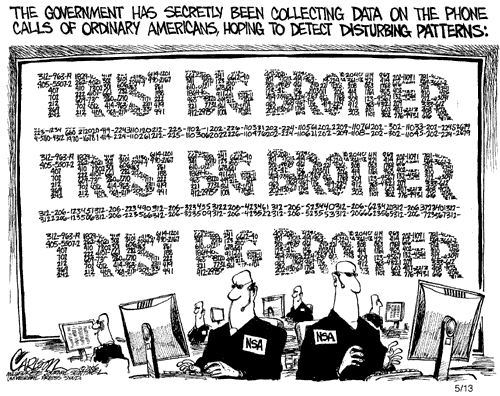
This constellation has a specifiic focus? ,President Bush authorized the National Security Agency (NSA) to spy on Americans without warrants, ignoring the procedures of the Foreign Intelligence Surveillance Act (FISA). First reports indicated that NSA was only monitoring foreign calls, originating either in the USA or abroad, and that no more than 500 calls were being covered at any given time. But later reports have suggested that NSA is "data mining" literally millions of calls---and that it has been given access by the telecommunications companies to "switching" stations through which foreign communications traffic flows.
In sum, this is big-time, Big Brother electronic surveillance that erodes constitutional liberties in the interest of protecting Americans from terrorism. It does so by deploying the instrument of fear-mongering and using "the War" to generate support for everything wanted.
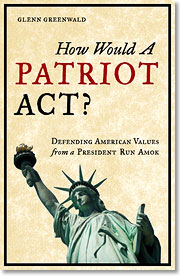
Glenn Greenwald stands firmly on the foundational political views of the US:--that citizens can tolerate all sorts
of political disputes on a range of issues, but we cannot tolerate attacks by the government on the constitutional framework and guaranteed liberties. In his How Would A Patriot Act? Defending American Values From A President Run Amok, makes two arguments about this:
First: "The NSA eavesdropping scandal, at its core, is not an eavesdropping scandal. It is a lawbreaking scandal, and it is unlike anything this country has confronted before," he writes. More importantly, it "is not an isolated act of lawbreaking. It is an outgrowth of an ideology of lawlessness that has been adopted by the Bush administration as its governing doctrine."Second: This fear-based ideology of lawlessness has no place in America, and must be vigorously opposed by the American people in order to preserve our constitutional order based on separation of powers and the Bill of Rights. This ideology is opposed by conservatives as well as moderates and liberals. It is wholly outside of and inimical to the American political tradition.
What lies behind this is the view that the president has absolute, unchecked power in order to defend the country against terrorism. It asserts that neither Congress nor the courts can place any limits on the president's decisions is to say that the president is above the law.
The Bush administration has turned away from the tradition of Jefferson and other founders of the Republic to Enlightenment thinkers like John Locke, which emphasizes checks and balances, and promotes liberty and human rights in theory if not always in practice. This civic republican tradition has been replaced with a justification of arbitrary power based on fear: a position best articulated by the English philosopher Thomas Hobbes and given the name Leviathen.
May 14, 2006
state of exception
The state of exception refers to exceptional events or conditions that fall outside the scope of the law. It is an objective condition of necessity that requires the enactment of emergency powers justified in the name of an emergency.
Lucius Cornelius Sulla: a classic example of the state of exception in Rome: Sulla as dictator of Rome. Sulla stands for a 'Commissarial Dictatorship', or a temporary dictatorship intended to defend the constitution by provisionally suspending it, rather than a 'Sovereign Dictatorship', an (unconstitutional) constituent power intended to bring about something new.
The national security state's surveillance activities (based on the ability to process 10 billion bits of telecommunications data per second) in the US is the modern example: President Bush wiretapping US citizens phone calls and e-mails despite the 4th Amendment. Bush is trying to produce a situation in which the emergency becomes the rule, and the very distinction between peace and war (and between foreign and civil war) becomes impossible. The authoritarian right and the conservative legal scholars have invented the doctrine of the unitary executive to expand presidential power in the state of exception called the decades-long war on terrorism.
Another example is the Guantanamo Bay detention camp, an exemplary site of contemporary exceptionalism, we can easily demonstrate the application of Agamben's ideas. Guantanamo cannot be explained in the regular terms of law or criminal investigation. As is well-known the intended purpose of the camp's location outside the regular territory of the United States is precisely to separate the entire process from normal American legal procedures and constitutional rights.
Agamben explores the terms 'exception', 'state of exception', and 'exceptionalism' through critically engaging with the sovereign declaration and enactment of 'exceptions' to legal, political, social, historical and cultural norms, typically in the name of security imperatives or a 'state of emergency'. He argues that sovereign power does not just affirm its power over life by asserting its dominion, but also by withdrawing its protection, abandoning bare life to a realm of violence and lawlessness. As Agamben explains in Homo Sacer:
He who has been banned is not, in fact, simply set outside the law and made indifferent to it but rather abandoned by it, that is, exposed and threatened on the threshold in which life and law, outside and inside, become indistinguishable. It is literally impossible to say whether the one who has been banned is outside or inside the juridical order. (pp. 28-29)
The state of exception is, therefore, a way of understanding both the operation of canonical Western political discourses/structures at their limits and a positioning of contemporary political practices at those limits. The term 'state of exception' is taken to mean a limit condition.
In his State of Exception Agamben provides an extended note on the empirical history of the state of exception. He illustrates that the exceptional delegation of powers from parliament to the executive - establishing executive rule by decree - became normal practice for all European democracies during, and then frequently after, the First World War. He argues that the passage to executive rule is underway to varying degrees in all the Western democracies, with parliaments becoming only secondary actors in the legislative process. He highlights the tendency in all of the Western democracies where by the declaration of the state of exception has gradually been replaced by an unprecedented generalization of the paradigm of security as the normal technique of government. (p.14)
What Agamben is saying here is that the current norm was once exceptional, and that it developed from an earlier state of exception or is coming to resemble what was once considered exceptional. It may also be that today's exception will become tomorrow's norm.
May 12, 2006
the changing nature of federalism
As we know the Commonwealth Government's legislative attempt totakover industrial relations, now before the High Court. This is the result of the challenge by all the states and territories to the Commonwealth's Workchoices legislation.
I haven't been following the legal action in the High Court, and the commentary in the broadsheet press has been sparse. They mostly report tha the case presented by the states is poorly co-ordinated and unconvincing.
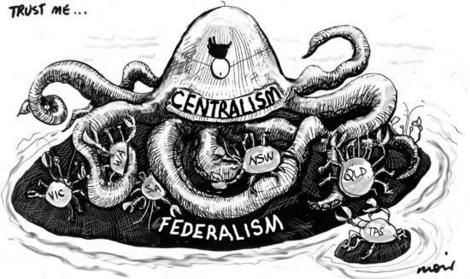
Alan Moir
Moir's stark view holds that a Commonwealth victory will permanently change the constitutional and political face of the nation. Australia will go from being a federation in which power is legally divided between two sets of governments, to one in which the constitutional balance of power is set daily in Canberra and the states operate as branch offices of the Federal Government.
Greg Craven, writing in The Age, spells out what is at issue: this is a battle to the death over whether Canberra owns the constitution itself.
He says:
The reason for this is simple, if not widely understood. The point of the present case is not really control of industrial relations, which merely is a convenient (and important) field of battle. Rather, at the heart of the dispute lies the Commonwealth's trading corporations power. This is being deployed by the Howard Government as the sledgehammer with which to break the lock of the constitution that has for so long denied Canberra untrammelled power.The potential of the corporation power here lies in the fact that Australia is a heavily corporatised society: corporations do everything from produce our newspapers to mind our children. If the Commonwealth can control everything about them, it can control most aspects of our lives.
Craven says that so far, Canberra's problem has been that the core of its power is not simply over "corporations", but "trading corporations".
The logic of this suggests that Capital Hill can control activities inseparable from a corporation's trade, but not essentially distinct spheres of activity. On this basis, for example, industrial relations would be out, as employment is not the "trade" of a corporation, at least outside the slave pen.But in the present case, the Commonwealth is assaulting this position with waves of tanks and Queens counsels. Stripped down, its brutally elegant position is that the corporations power allows it to control anything done by, to or around a trading corporation.
Craven says that the fundamental thing to appreciate about the triumph of such a position is that the collapse of their industrial relations systems is going to be the least of the problems of the states. In constitutional terms, the Commonwealth will possess less a corporations power than a corporations missile, capable of reaching and pulverising the strongest and most remote bastions of state power--education, health, social issues, transport, etc.
He adds that though the Commonwealth claims that it has no further territorial ambitions after industrial relations, the reality is that Canberra is pondering the spoils of its likely victory in the industrial relations case as a burglar drools over an opening safe.
He concludes:
To many, who always have seen the states as mere collectivities of inefficiency, the response will be one of indifference. They should think long and hard. If our constitution rests on a single proposition, it is that power is to be divided because total power is dangerous. Welcome to the world of total power.Ironically, perhaps the greatest long-term casualty of this debate will be Australian liberalism, the political philosophy that has heroically upheld the idea of the division of power - and the federalism based on it - in the face of repeated assaults by Labor and its allies.
Ironically it is Labor who is now defending federalism and opposing centralism.
May 11, 2006
re-reading Leo Strauss
Some passages from an excerpt from Steven B. Smith's Reading Leo Strauss Politics, Philosophy, Judais that highlight what Strauss is trying to do.
The first passage states Strauss's view of modernity:
Strauss offered a deliberately provocative account of what might be called the “modernity problem” that had been widely debated in prewar European circles, but which was still relatively unknown to Americans of that era. Prior to Strauss, the most important current of twentieth-century American political thought was John Dewey's "progressivism." Against the view that the advance of science, especially the modern social sciences, was bringing about the progressive triumph of freedom and democracy, Strauss rang an alarm bell. Strauss argued by contrast that the dynamics of modern philosophy and Vertfrei, or value-free social science, were moving not toward freedom and well-being but to a condition he diagnosed as nihilism. In Strauss's counternarrative of decline, the foundations of constitutional government as understood by the American framers were gradually being sapped and eroded by the emergence of German-style historicism according to which all standards of justice and right are relative to their time and place.
So how does Strauss approach this problematic?
Smith's understanding on this is clear.: Strauss presented a distinctive way of asking questions or posing problems. Smith says that:
There is rather a set of common problems or questions that characterize Strauss's work: for example, the difference between ancients and moderns, the quarrel between philosophy and poetry, and of course the tension between reason and revelation. None of these problems can be said to have a priority over the others nor do they cohere in anything as crude as a system. Whatever may be alleged, there is hardly a single thread that runs throughout these different interests. Strauss did not bequeath a system, doctrine, or an "ism," despite what may be attributed to him. Rather, he presented a distinctive way of asking questions or posing problems that may have been loosely related but that scarcely derived from a single Archimedean point of view. It is questions that motivate all of Strauss’s writings---questions like "Is reason or revelation the ultimate guide to life?" "Has the quarrel between the ancients and the moderns been decided in favor of modernity?" and "Are the philosophers or the poets better educators of civic life?"
Smith then goes on to say that the great theme of Strauss's life work--what he himself referred to as "the theme of my investigations"---is the theologico-political problem, a term he drew from his early studies of Spinoza. What does this mean? Smith says:
At the center of the theologico-political problem is a choice or conflict between two comprehensive and apparently irreconcilable alternatives: revelation and reason, or as he refers to them metaphorically, Jerusalem and Athens. The difference between Jerusalem and Athens is not simply a philosophical or theological problem; it is at heart a political one. It is a matter of authority and who holds ultimate authority. Does final authority rest with the claims of revelation and all that it implies or with one's autonomous human reason as the most fundamental guide to life?
The Enlightenment's answer, of course, is autonomous human reason. By re-thinking the question the end of modernity Strauss can be seen to be questioning one of the key assumptions of modernity.
May 8, 2006
Senator Evans, aboriginal wellbeing, ideological baggage
As it is budget week, with Canberra dominated by the Costello Budget, I want to turn back to this post about a speech entitled The End of Ideology in Indigenous Affairs given by Senator Chris Evans, the Shadow Minister for Indigenous Affairs, on aboriginal wellbeing.
This speech is an important one, as its purpose is to reposition Labor in the debate and to deal the ALP into the central challenges of our time by dumping ideological baggage and embracing the work of Noel Pearson.
Senator Evans says:
In supporting self-determination and attempting to be positive about Indigenous aspirations and achievement, Labor has been guilty of failing to engage sufficiently in the debate over the dysfunction of many Indigenous communities. There are notable exceptions and State Labor Governments have more recently been forced to confront issues of drugs, violence and child abuse. Our desire to be supportive of Indigenous people and not to continually focus on the negative must not lead us to political correctness or a refusal to engage in finding solutions to these difficult problems.
He says that he is not afraid to join the debate about the effects of welfare, violence or grog on Indigenous communities, as these are real problems that ruin Indigenous lives, and so they must be confronted. He adds that he personally struggles:
... to see how removing an individual's welfare benefits helps them to overcome the alcohol, drug or petrol addiction that drives their behaviour. But I am willing to debate these issues. When we have this debate it should be not be in a politically charged atmosphere. Labor has to do better than a knee-jerk response that labels political opponents as racist and paternalistic. Conservatives have to do better than accuse us of excusing violence and abuse.
So how do we move forward?
Evans turns to Tom Calma's 2005 Social Justice Report, which suggested some goals for Indigenous health --- ensuring that equality of health status and life expectancy is achieved within 25 years, and equal "access to primary health care and health infrastructure" is achieved within 10 years. He adds:
To achieve national goals we need to set up programs and measures that are grounded in the evidence of what works and what does not work. Pragmatism should guide our approach...To assess what works and what does not we need agreed benchmarks and performance indicators, and regular, transparent evaluation of programs. One size does not fit all but success can be replicated. ....While coordinated effort by governments seems blindingly obvious, and removal of silos that prevent bureaucracy acting as one seems logical, we need to test these approaches. Claims of success without clear evidence of fulfilled objectives should be treated with caution.
May 7, 2006
Machiavelli
Does Machiavelli rehabilitate the ancient virtues of the classical Greeks and Romans against the Christian critique? Machiavelli is a restorer of something old and forgotten. Do his arguments in favor of republican regimes mean that his republicanism is of a civic humanist variety whose roots are to be found in classical antiquity?
May 5, 2006
turning to Spinoza
I've done little more than quickly read Spinoza's texts as part of my education in the philosophy of modernity. As I really disliked the deductive style of Spinoza's texts, his idea of Substance and his conception of reason based on mathematics, so I have little idea of what Spinoza stood for. I have a vague sense that he rejected traditional political philosophy, wrote a defence of democracy, grounded it on a Stoic conception of an eternal order that underlies and regulates the human order, and assumed that passion is grounded on passion not reason.
I've seen people turn to Spinoza in the last 20-30, and I've often wondered why? I've more or less read it in terms of wanting to bansh teleology from philosophy. What does he have to offer? What is his political philosophy about? Does it have any relevance for today? If so what is that?
One account is offered by Hasana Sharp in an article entitled 'Why Spinoza Today? Or, "A Strategy of Anti-Fear"', which was published in Rethinking Marxism (Vol.17, No. 4, Oct 2005). Sharp says:
...according to these historical arguments, Descartes, Kant, and Hegel are the conscious of our thought that needs to be examined in order to know ourselves, to learn what we have become, and to gain some critical power through reflecting upon what Marx famously refers to as the nightmarish weight of the dead.
Spinoza, on the other hand, is that which was repressed in order for such weight to assert itself. In order to know not only our conscious life but that which operates offstage---what conditions our conscious life like some kind of shadow that reveals thelight---we may turn to Spinoza. In order to ascertain, then, not only the manifest content of our self-consciousness but what is being concealed by such content, we can study Spinoza. Spinoza is often named as the thinker whose "heresy" was so great that he has been relegated to the dark underbelly of our history, while remaining available to those aiming to animate such heresy in our own time. What has come to be known as the Enlightenment, at least one recent book suggests, was built upon the suppression of a far more materialist and emancipatory discourse of "radical Enlightenment," of which Spinoza is the paradigmatic figure (Israel 2001).
That's a bit of a suprise, I have to admit. Modernity and the Enlightenment did not emerge uncontested. Modern liberal Enlightenment principles triumphed not only over the anti-democratic discourses of absolute monarchy and the divine right of kings, but also over a more radically democratic, republican, and materialist tradition. The retrieval of Spinoza, according to his advocates, is the discovery of an alternative that "might have been."
'Tis an interesting reading don't you think? Makes you want to re-read Spinoza to discern the 'might have been'.
This is a Spinoza who is interpreted as is a "savage anomaly" ; one radically discontinuous with his own time, and, because he provoked such horror in then, a voice of protest in our own. Spinoza allows us not only to identify faults with the dominant tradition, but to consider living alternatives that may have always been present, but that remained obscure for various reasons.
I'm happy to accept such an interpretation, even though I'd thought that Spinoza had an aristocratic understanding of democracy based on the classic distinction between the minority of philosophers and the overwhelming majority of the unphilosophical multitude. It is like starting over again isn't it.
May 3, 2006
integration, freedom, rights
Is the Howard Government saying that its policy concerns and disciplines to ensure public security by integration through the acceptance of Australian values by law-abiding Australian-Muslim citizens means that they cannot practice their religion in their own way? Does it mean that constraints should, and will be, placed on their freedom to practice their religion? That is what the recent talk of integration as assimilation implies, does it not?
I want to explore this in terms of freedom within liberal democracy and the role of the High Court. The latter was recently the subject of an article by Andrew Clarke entitled 'Judgment Days' in the Review section of last Fridays Australian Financial Review. Clarke gave an overview of a couple of decades of tumult around the High Court, ranging from the campaigns to remove two Labor appointees (Justices Lionel Murphy and Michael Kirby); the hostility between retired Chief Justice Harry Gibbs and his successor Anthony Mason on the Mabo decision that recognized native title and the virulent attacks on the High Court by Ministers in the Howard Government. Clarke also argued that the High Court was shifting from its historically exclusive reliance on British law and precedent to embrace a more internationalist path.
I'll come back to that shift. First I want to outline how I understand the way liberal democracy in Australia works. On my understanding this polity presupposes that every citizen has an equal right to liberty. The task of the political process in this polity is to delimitate the respective spheres of liberty between individuals in a way that takes them seriously as equals, and that it does so in a way that best furthers the general interest or welfare. It is the task of the courts to assess whether, under the circumstances, the acts of public authorities, even of elected legislatures, can reasonably be justified in constitutional terms.
The primary task of delimitating the respective spheres of liberty is left to the legislatures. Parliament is the author of the laws in liberal constitutional democracies. The High Court in Australia has assumed an important editorial function as veto player. This court acts as guardians and subsidiary enforcers of human and constitutional rights, and in doing so it functions as an institution to povide a forum in which legislatures can be held accountable at the behest of effected individuals claiming that their legitimate interests have not been taken seriously.
The basic idea underlying political liberalism is that when the government acts in a way that detrimentally effects the interests of an individual citizen, those acts have to be justifiable in terms that take that individual seriously. All you need in order to make a rights claim is an interest that is sufficient to establish a duty in public institutions to take account of it.
The point of human and constitutional rights is to focus and structure the court's assessment of whether the actions of public institutions are reasonable under the circumstances. The language of rights has provided the authorization for courts to play a role to protect the legitimate interests of individuals, thereby helping to hold public institutions to standards of good government in our liberal constitutional democracy.
Constitutional rights in Australia are implied not explicit; implied in the sense that the individual freedom of citizens for political expression and religion is presupposed by the Australian constitution. To claim otherwise is to deny that Australia is a constitutional liberal democracy based on the value of freedom. Given this understanding of our liberal democracy I cannot see how integration as assimilation is justified in constitutional terms.
So how we recognize the tacit constitutional rights of freedom? That's the task of the High Court and it may well come from the role of international law in constitutional interpretation. Usually dismissed in terms of "judicial activism" and "black letter"--meaning reliance on British precedent--this account ignores the judicial independence in referring to UN covenants signed by the Australian Government, or a decision of the US Supreme Court. Australia, after all, is an independent nation, and the HIgh Court is quite justified in in making miore reference to international treaties and and decisions by courts in other common-law countries. Andrew Clarke's argument is that globalization will ensure that this shift to referencing internationall aw that recognizes human rights will continue.
May 2, 2006
Habermas, a critical public sphere, Machiavelli
I want to pick up on this earlier post on 'the fear of the masses' in liberal democracy; a fear about the various passions and feelings that condition the thoughts and actions of a people, or a multitude. I'm relying on Warren Montag's 'The Pressure of the Street: Habermas's Fear of the Masses' to explore this political problematic of a politics of fear; one that finds classical expression in the texts of John Stuart Mill, Mathew Arnold and Friedrich Hayek. Do we not live with a politics of fear today in relation to the war on terror: a politics based on "'animating" the anxieties of the people of liberal democracy about the Muslim street?
In the earlier post it was stated that for the Habermas of The Structural Transformation of the Public Sphere it was the great liberals of the nineteenth-century who accurately diagnosed the fatal malady of the liberal public sphere. It was not Hegel, Marx or Nietzsche. Warren Montag says that Habermas' argument for this claim is that the liberal tradition's strength lay in the fact that, for it, the capitalist market and capitalist social relations were an absolute horizon, beyond which it was not merely undesirable, but impossible, to go. Consequently, the liberals in the 19th century were compelled to look within rather than beyond the public sphere for any explanation of its failures. For Habermas, Montag says:
...it was such liberals as Mill and Tocqueville who noted the tendency of the public sphere per se to degenerate from a sphere of rational-critical debate, the model of which depended upon the ability of individuals to abstract themselves from their material circumstances and allow reason alone to decide their controversies, into an arena in which competing interest groups struggled for power. The general good was lost and the tyranny of the majority, bound not by reason but by interest, over minorities became an ever present danger. In the period after World War Two, such a development becomes increasingly likely, even inevitable, with the universalization of mass media, the colonization of thought and imagination by advertising, by "publicity" in the degraded sense. Rational-critical debate is reduced to a distant memory as majorities are shaped by the means of communication. Criticism becomes pseudo-criticism, revolt merely the simulacrum of great challenges to established orders past, more likely than not to produce an even more totally administered world.
The return of force to what was supposed to be a sphere of objectivity, orginates from majorities outside of and opposed to the state, no longer associations of autonomous individuals but unthinking, perhaps manipulated, majorities, unreasoning masses whose violence (threatened or actualized) will provoke even greater state intervention whether against or at the behest of their movements. This then is 'the pressure from the street.'
What does 'the pressure from the street' refer to in late liberal capitalist society? I just code in class conflict and read it as working class, and its use of demonstrations and strikes as political tools to further its class interests.
Montag is much more sophisticated. He reads 'the pressure of the street' in terms of the rhetorical figure of a metonymy to determine the meaning of 'the street' in the Public Sphere text. He says that the street is not an alternative public sphere; it is precisely not a sphere of rational critique or even discussion at all. The street is the sphere of action:
The street moves or produces effects through the force of its weight, its mass.... The street is outside the centers of discussion, exchange and deliberation. In fact, it is the outside of rational exchange in every sense: the exchange of ideas which resembles in so many respects the exchange of commodities (competition, progressive optimalization). Hence we have the opposition between the public sphere and the street, as an opposition between communicative action and corporeal action, reason and force.
The Marxist tradition (eg., Marx, Gramsci, Althusser) had argued against this duality.
The reproduction of capitalism as an economic system depended upon market forces and the force of persuasion in the form of ideology. There can be no genuine competition between arguments and ideas, because between ideas there are relations of force, in that they are embodied in the broader relationship of forces in a society characterized by a perpetual, if latent, civil war that renders some dominant and others subordinate. The effects of effects of coercion and discipline in workplaces and communities can be seen minds and bodies. The force of reason exerts no pressure or has no effect at all, except insofar as it rests on real, physical force.
Is this not a recovery of Machiavelli; the Machiavelli who thinks about politics from the vantage point of crisis and the event. In the texts of this Machiavelli, says Montag, there is no reference to the pre-given natural hierarchy of command and obedience grounded in the family; no notion of the state of nature as an empty stage, a free space where individual actors, originally separate and equal, determined by their will alone, arrive at a binding contract that furnished the principles that regulate social reality. Montag says that this:
Machiavelli turns away from transcendental origins; he is a thinker of the present, of the singular conjuncture in which relations of domination and subordination are determined neither by nature nor contract, but by always temporary configurations of power relations; it is here that the freedom of virtu encounters fortuna. Social prosperity depends on nothing other than the correct balance of forces.
May 1, 2006
getting by without rights?
There is an article by Natasha Cica in The Age on the events of the last post.
She is referring to the proposal in a speech by Andrew Robb, the parliamentary secretary to the Immigration and Multicultural Affairs Minister, for a compulsory citizenship test for prospective migrants to measure their grasp of our language and culture. Speaking to the Sydney Institute Robb said that for 'those seeking to take out citizenship should pass a compulsory test, a test which ensures that applicants have a functional level of English language skill, and a general knowledge of Australian values and customs.'
Cica gives the background to the speech---the pre-eminent contemporary threat to Australia's social cohesion: 'the importation of a fundamentalist streak of Islam and infecting local Muslims with an inability to lead peaceful and productive lives as Australians.' She says that there is still scant empirical proof of that claim and rightly states the vast majority of Muslim Australians are, like non-Muslims, law-abiding citizens.
However, as Robb points out most of the Australian community 'are filled with anxiety and uncertainty about how to deal with the reality of random terrorist acts, ostensibly in the name of Islam.' Robb tied the citizenship test proposal to integration (not assimilation) and to being connected to the mainstream Australian community. He said that Australia has been:
....very effective at integration, as distinct from assimilation, is an approach which has helped us successfully combine people from over 200 countries into one family, with one overriding culture---yet a family made up of a very diverse and rich set of communities drawn together by common values. Values such as our respect for the freedom and dignity of the individual, our commitment to the rule of law, our commitment to the equality of men and women and the spirit of the fair go, of tolerance and compassion to those in need. They're the sort of key values that I think draw people to the Australia to which we are all in one way or another committed.
'Aussie values' keep changing don't they, depending on who is speaking. I note that there is nothing here about liberal democracy or rights. These are not part of our common values? Let's take rights.
It's a good speech. Robb's conception of multiculturalism strikes a balance between "the right" of the individual to religious freedom---eg., to wear the Jilbab, a full length dress which covers the whole body except for the hands and face--- and the policy requirements of social cohesion and social integration. As Cica points out it is to be contrasted with Keith Wiindshuttle's conception of integration as assimmilation, which would refuse the right of Muslims to wear a Jibab because it represents a divisive tribalism.
Robb however, does not use the word 'rights' at all. Citizens are not rights holders. The policy emphasis is on values as integration. The liberal political language of interests protected as rights (such as freedom of speech, association, religion and privacy) is absent; a conception of liberal political rights that is variously conceived as having special weight when competing with policy goals of integration and social cohesion. The idea is expressed, for example, by Ronald Dworkins conception of rights as trumps and the corollary distinction between principles and policies, or by what Rawls calls the 'priority of the right over the good', or by Habermas description of rights as firewalls. Ultimately these ideas can be traced back to a theory historically developed by Immanuel Kant, grounded in the twin ideas of dignity and autonomy as side constraints to the collective imposition of 'the good'.
Even though there are significant differences betweenconceptions of rights in the liberal tradition, they generally share the idea that something protected as a matter of right may not be overridden by ordinary considerations of policy. Circumstantial all-things-considered judgments on what is in the general welfare are generally insufficient grounds to justify infringements of rights. Reasons justifying an infringement of rights have to be of a special strength.
The silence or absence in Andrew Robb's speech is the basic liberal idea that rights protect the individual from strong paternalist impositions relating to how they should live their lives, in particular with regard to dominant religious practices. What we have is the policy emphasis of the collective imposition of the good---integration justified, presumably on utilitarian grounds of the greatest happiness for the greatest number. So we get the imposition of adherence to Australian values of the mainstream community without any protection for those who want to wear a Jibab.
The inference is that law abiding Australian-Muslim citizens would not be able to wear a Jibab.This expression of religious freedom must be sacrificed for the sake of integration to ensure the general welfare of the nation.