October 31, 2006
blurring church and state
The sharp edges that separate church and state in liberal democratic Australia are further undermined with a proposal by the Howard federal government to fund chaplains in private and state schools. It is more than likely the money will flow through to the private schools are they will be more united about the variety of chaplain they want.
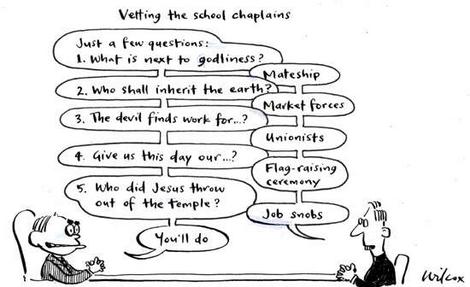
Cathy Wilcox
Presumably state schools are deemed to be value free zones--sites of nihilism--- by conservatives and only religion is about values. Secular humanism has nothing to do with values apparently. What has happened to John Stuart Mill? So are we going to have a return to the 1950s - conservative Catholic priests or fundamentalist Anglican chaplains telling students that women should be modest, they should wear scarves in church, they should not be seen in revealing clothes and they should not provoke men because men were wild animals who strayed easily. Rememberall that stuff about "men will be men" and the role of men was to seduce, the role of women to resist?
Is that what is meant by values---a preoccupation with sexual morality that is not too far removed from the "uncovered meat" sentiment of the widely criticized Sheikh Taj al-Din al-Hilali? It's another plank in the values debate isn't it. The beginnings of state-sanctioned religious intolerance?
Andrew Lynch, in an op-ed in The Age says that:
If the separation of church and state means anything, it is that the Government should not use public money to decide which religious opinions are to be promoted at the expense of others....Talk of insulating religion from the power of the state is not merely a resort to a vague ideal. It has clear constitutional text behind it. The inclusion by the constitution's framers of that text should prompt us to think critically about any proposals that look sure to entangle the Government in issues of faith.
Under the Commonwealth constitution, the Federal Parliament is prohibited from passing a law that confers on any religion the status of a national established church. It also cannot prohibit the free exercise of religion or impose any requirement for religious observance on the community. Additionally, the constitution states that "no religious test shall be required as a qualification for any office or public trust under the Commonwealth".
October 30, 2006
academic freedom
Robert Jensen in an article entitled Academic Freedom on the Rock(s): The Failures of Faculty in Tough Times in Znet says:
While I would like to see U.S. academics, as a class, take a leading role in movements to assert radical humanistic values that have the possibility of transforming society, I don't believe it is likely, or even possible, in the near future. In fact, I assume that in the short term there is very little progressive political change likely in the United States, with or without the assistance of university-based academics. Instead, I will argue we should work to hold onto what protections for academic freedom exist to provide some space for critical thinking in an otherwise paved-over intellectual culture, with an eye on the long term. Toward that goal, I will suggest ways to approach these threats to academic freedom and attempt to assess realistically the conditions under which such defenses go forward.
Jensen adds that the impetus to protecting academic freedom should be seen in the context of a long-term strategy of protecting a saving remnant of intellectual integrity that at some point in the future may provide the core of a politically activated group that can be part of a meaningful shift in values in this society. He adds that we can be reasonably sure that the common faculty reactions today -- (1) duck-and-cover when things get edgy, or (2) whine when there really is little at stake -- guarantee failure.
October 29, 2006
about "Islamo-fascism"
In this article in the News and Notes section of Telos James V Schall explores the word 'Islamo fascism' with regard to the 'war on terrorism". I must admit to being uneasy about the term, as I'm not sure it helps us much to understand what is going on. It may even mislead us in linking us back to the 1930s and thinking that it is the same as German or Italian fascism, which is appropriately understood as 'corporatism' because it is a merger of state and corporate power..
So I am glad that the term is being analysed. Schall says:
The war in which we are currently engaged confuses us, in part because many will not admit it is a war. We do not know what to call it. Nor do we know what to call the self-declared enemy who has been attacking us in one form or another for some twenty-five years, ever more visibly and dangerouslysince September 11, 2001, with subsequent events in Afghanistan, Iraq, Spain, London, Bombay, Bali, Paris, Lebanon, and Israel ..... More recently, the term "Islamo-fascism" has been coined in an effort to describe the source and nature of "terrorism." I want to examine the appropriateness of this term, as I think it serves to get at the core of the problem. Is "Islamo-fascism" really accurate for what the reality is?
Schall says that initially, the term obviously is not a product of Islamic thinkers thinking of themselves, though some more recent Muslim thinkers have studied the Marxists and the fascists. No Imam in Iran or Egypt, however, suddenly wakes up in the middle of the night and shouts, "That's it! I am an Islamo-fascist; why did I not think of that before?" No pious youth in Mecca reads the Collected Works of Benito Mussolini and muses to himself, "Yes, this is what Mohammed was about in the Koran."
Schall says that the term comes from Western politicians and writers. They are desperately seeking a word or expression that they can use, one that avoids suggesting that the war in fact has religious roots, as the people who are doing the attacking claim it does. To say that war has "religious" roots violates a code, a constitutional principle as wars are political not religious.
Update: 30 October
How useful is the term 'Islamofascism' when the political program is to establish an Islamic theocracy? Or more accurately, to describe it in James Weeldon's words, as the programe of the 'Wahhabis, Salafists, and other violent jihadists who would seek to establish, by force if necessary, a utopian system of government based upon sharia law and the values and cultural ethic of seventh century Arabia.'
Schall says that:
My only point in following this question of the use of the word "Islamofascism" is that it does not describe what these men think they are doing. Nor does it help that some thus far ineffective Muslim apologists do not think that the term describes what the religion means. It is what these men think and evidently practice. What has to take place, in response, is some more adequate confrontation with the incoherence of this claim to world-subjection to Allah as an inner-worldly political mission powered by a quasi-mystical devotion to its cause. In this sense, in the minds of the ones carrying out the attacks, it is religious, not ideological, in origin.
James Weeldon says that it is correct to say that there is a totalitarian impulse in radical Salafism and Wahhabism that is akin to fascism. But he adds:
I fear that thinking of radical Islamism as just another form of fascism will lead the West to conclude that what worked to defeat European fascism (namely, superior military force) will also work to defeat so called "Islamofascism". While I agree that the Salafists and Wahhabists would like to see established a system of government that is as intrusive and controlling – as totalitarian – as Nazi government, the symbolism and ideology of the radical Islamists depends on images of victimhood and subjugation to almost as great an extent as the Nazis relied on images of strength and domination.
Weeldon says that the strategies that worked against fascism will not be the strategies that will work against violent Islamist extremism. Fascism was defeated militarily. But as the example of Iraq shows, military defeat does not deflate but rather inspires radical Islamism.
October 27, 2006
religion is the problem
What is problematic about Muslims in Australian society is the Muslim reintroduction of religion into public discourse just as we citizens are still trying to painfully wrested themselves free from the strictures of our own religions---Catholic or Protestant Christianity. We are still confronted by fundamentalist Christians desire to Christian Australia so that it is a Christian nation. What we have is the angry rejection of modern Australian secular culture by Christian and Islam fundamentalists.
Ronald Dworkin, writing in the New York Review of Books, says:
Some religious people find that for them faith trumps science in these [biblical account of the creation of the universe and of human beings] and the other few remaining areas in which faith challenges science. They deny the truth of Darwinian theory in the self-conscious exercise of their personal responsibility to fix the role of faith in their lives. That is their right: it would be a terrible violation of liberty to try to coerce them out of that conviction. But they must not try to impose that faith on others, including children, most of whom attend public schools.
Religion is why we non-Muslim citizens cannot leave the Islam community to the Islam community.This is not to argue for a policy based on the expectation that millions of Muslims will so suddenly abandon the faith of their fathers and mothers is simply not realistic. If the message they hear from us is that the necessary condition for being Australian is to abandon their religion, then they will choose not to be European. For secular Australians to demand that Muslims adopt secular humanism would be almost as intolerant as the Islamist jihadist demand that we should adopt theirs. But, the Enlightenment fundamentalist will protest, our faith is based on reason! Well, they reply, reason can be intolerant and violent.
In the relationship with Islam as a religion, it makes sense to encourage those versions of Islam that are compatible with the fundamentals of a modern, liberal, and democratic Europe.
October 25, 2006
Carmen Lawence on the politics of fear
In the 'Fear of the Other' chapter of her excellent Fear and Politics Carmen Lawrence makes the following remark:
Inflamatory remarks by federal ministers who have demanded that migrants who do not accept Australian values should leave or face deportation have contributed to this climate of fear. At a time when our leaders should be calming fears, they are playing on them. When they should be doing all they can to to help us to see events from the other's perspective, they are inviting us to retreat into our own narrow identities. When they should be assisting us to recognize how our own actions and words can cause fear in others they are giving signals that such sensitivities are unimportant. They are in my view, playing with fire. p.37
Yes the ministers in the Howard Government are playing with fire. But the conservative strategy is not to calm fears. It is designed to divide the nation through activating fears in the electorate. It is divide and rulestrategy that repudiates the notion of a poltical centre. The strategy is designed to ensure the re-election fo the Howard government because the conservative mood of the Australian electorate in an anarchic, globalised world will ensure that the Coalition is continually re-elected by a small majority. Retaining power is the name of the game. Conservatives appeal to the "values voters."
While Australia is safer, we are not yet safe" (and the strategy is to ensure that we never will be.) Hence we have the global war on terrorism/long war/war against violent extremism/war to save civilization from the Islamofascist menace etc etc. It an Australian version of Karl Rove's strategy of one-party rule through building a right-wing dynasty that could dominate American politics for decades; the assertion of a long-term Republican hegemony and the complete dismantling of the Democratic Party to ensure that Republicans control U.S. politics and policy for at least the next 30 years. So we have wedge politics, the use of the Christian right and mega churches as useful idiots; using whatever means necessary to divide the enemy, usurp their message, convince supporters that the enemy was an agent of satanic forces; to manipulate and mobilize "the base," so as to allow a candidate to forget about "the middle."
October 24, 2006
goodbye to Marxism?
Tony Judt has a review in the New York Times of Leszek Kolakowski's 3 volume Main Currents of Marxism: The Founders, the Golden Age, the Breakdown The title of the review is 'Goodbye to all That' and that certainly captures Kolakowski's central argument about Marxism. Judt is not so convinced. The review has been picked up over at Catallaxy without any engagement with the main arguments.
I read the Kolakowski's texts in the early 1990s. From memory Kolakowski's intended analogy is clear: German culture is to Nazism as Marxism is to Stalinism. According to Marx Wartofsky what Kolakowski meant by this is not simply that there were some elements in Marx's work that lent themselves to Stalinist interpretation. What Kolakowski argues is that the Stalinist interpretation of Marxism may, in fact, be derived, as a possible and valid interpretation, from the fundamental premises of Marx's own thought, rather than as an aberration or distortion based on ambiguities. If the monstrous tyranny of Stalin is there in Marx's own formulations, then there is a classical "fatal flaw" internal to the very soul of Marxism: a flaw whose historical working out comes to negate the very premises of the original humanism.So Stalinist dictatorship derives from the central core of Marx's theory, not as an interpretation of some elements of it which are open to different interpretations.
I thought that the first two volumes were of high quality in terms of intellectual history whilst the third, which deals with late Marxism, lacked intellectual rigor and transformed into polemics. As I recall my central concern was that Kolakowski failed to engage with the philosophical arguments of Frankfurt School in a serious way. This philosophical engagement/evaluation was important as their Marxist engagement with modernity---the Enlightenment and the liberal tradition --- had little to do with the standard Marxism of "saving" Marx from his "distortion" at the hands of Stalin and Lenin. It was a defence of philosophical reason (a critical, self-conscious reason) against the ravages of a simplistic modernism (positivism) and instrumental reason (as in utilitarianism). It is a self critical reason because it questions the false claim of reason to universality and disinterestedness when reason has always been demonstrably interested and historical.
Kolakowski called Adorno's magnum opus, Negative Dialectics, a "model of professorial bombast concealing poverty of thought". Kolakowski had run out of intellectual puff and he had little time for either dialectics, Adorno or left-Hegelianism. Judt's only reference to this is that the the last part of third (Breakdown) volume:
deals with assorted twentieth-century theorists in other lands. A few of these, notably Antonio Gramsci and Gyorgy Lukacs, are of continuing interest to students of twentieth-century thought. Some, such as Ernst Bloch and Karl Korsch (Lukacs's German contemporary), have a more antiquarian appeal. Others, notably Lucien Goldmann and Herbert Marcuse, seem even less interesting now than they did in the mid-Seventies when Kolakowski dismissed them in a few pages.
Buried underneath Kolakowski's philosophy becoming polemics is the argument that the Marxist tradition is dead. The Main Currents of Marxism text is a long goodbye.
I agree with Judt in his assessment that Marxism as a socialist political movement ran dry in the later 20th century due to the social democratic creation of the welfare state after 1945. Judt says:
Marxism, as the Polish historian Andrzej Walicki----one of its more acerbic critic----openly acknowledges, was the most influential "reaction to the multiple shortcomings of capitalist societies and the liberal tradition." If Marxism fell from favor in the last third of the twentieth century it was in large measure because the worst shortcomings of capitalism appeared at last to have been overcome. The liberal tradition---thanks to its unexpected success in adapting to the challenge of depression and war and bestowing upon Western democracies the stabilizing institutions of the New Deal and the welfare state---had palpably triumphed over its antidemocratic critics of left and right alike. A political doctrine that had been perfectly positioned to explain and exploit the crises and injustices of another age now appeared beside the point.
Marxism was more than a political movement trying to realize communism, as a society beyond a liberal capitalist one. It was also economics, sociology, philosophy and aesthetics.
October 23, 2006
Noel Pearson on neoconservatism
In an op-ed in The Australian Noel Pearson comes out swinging against neo-conservatism.That is a suprise because he has been seen as a fellow traveller by those on the left, due to his criticism of progressive liberal thinking on idigenous issues. On the latter Pearson says:
The ideas of progressive Australia that most needed to be challenged were: Passive welfare can be an economic foundation for functional communities; choice is possible without capabilities: that indigenous people in remote communities could choose the kind of life they wanted to lead, without education and other capabilities that are necessary for real choice to be exercised; the symptom theory that holds it is mainly dispossession and poverty that causes and maintains addiction and dysfunction.
The qualifiies by saying that the tragedy is that even as many progressives cling to destructive policies, many people of the Right are focused on a cultural war that attempts to reverse the good things that did happen during the progressive reconciliation era, namely the recognition of our rights and our rightful place in this country.
The criticism of neoconservatism starts thus:
During the past decade we have been told that some myths pertaining to the Aboriginal people of Australia have been debunked. The myth of frontier massacres is said to have been debunked by Keith Windschuttle. The myth of the stolen generations is said to have been debunked by Quadrant magazine. The myth of the noble savage is said to have been debunked by Roger Sandall. The myth of terra nullius is said to have been debunked by Michael Connor.Now, an environmentalist, William Lines, has stepped up to debunk the myth of the ecological Aborigine (see Patriots: Defending Australia's Natural Heritage, extracted in Inquirer on October 14). Oh, my poor people! You have been subjected to a relentless and seemingly endless cultural cleansing. And you appear to be utterly defeated in a cultural war in which you have shown a declining and eventually feeble resistance. All that remains is to smooth the dying pillow of our remnant dignity as a people. There is a breathtaking vehemence to this neo-conservatism.
He says that the worst effect of the neo-conservative ascendancy is that opinions that normally would be mean and ungracious in a generous, democratic country become acceptable and indeed de rigueur. The problem with the valid parts of neo-conservative argument is that legitimate insights are interwoven with a farrago of polemic, usually aimed at discrediting indigenous rights to land and recognition as a people. An example is the forementioned article by William Lines.
Lines says that:
The myth of the ecological Aborigine elevated Aborigines to positions of moral and spiritual superiority and disparaged people of non-Aboriginal background. They would never belong in Australia. Their ancestry rendered them incapable of acquiring a sense of connection.....Many prominent conservationists, however, declared that for non-Aborigines, connection was impossible. According to the tenets of racial thinking, non-Aborigines could never and would never feel comfortable living in Australia. If true -- if non-Aborigines were inherently incapable of attachment -- then conservation was doomed.
What we have, says LInes, is race thinking -- a dividing the world into them and us. Lines is onto something here. We do need to undercut the 'ecological aborigine' because it is a romanticised account of Aboriginal occupancy, and some white people who have lived on the land have connected to the land.
Now Lines links the myth of the ecological Aborigine with land rights through national parks. Could aborigines claim land rights over national parks? Could they hunt rare wildlife with modern firearms in national parks? These national parks were protected areas -- wilderness, and flora and fauna sanctuaries -- and they formed the cornerstone of Australian conservation. Some on the left say that only aborigines can because wilderness is a cultural construct and implies terra nullius. Thus we have race thinking says Lines.
Pearson says that the core of Lines's article was his contention that the land rights movement is to a large extent based on "racial thinking" and he adds:
It is depressing to have to explain that Aboriginal people are traditional owners of land who are belatedly having their ownership recognised. This ownership is based on the original, traditional occupation and possession of the land (recognised by the common law of England as a basis for title to land), not race. Race is just an incident of the fact that Aborigines were the people who occupied the land at the advent of the common law. In typical fashion, Lines turns words such as "race thinking" and "discrimination" against my people, who until recently lived in absolute discrimination and oppression because of their race.
Native title, as the law has developed in Australia, is extremely favourable for non-indigenous people. All non-indigenous rights are automatically protected; indigenous people have to go through a difficult process to get what is left over, including some crown land. He then adds:
It is typical that Lines believes the government should have arbitrarily stopped recognition of our ownership of some of that crown land in national parks. This is symptomatic of a political and cultural climate in which indigenous people's rights can be attacked in an unprincipled way: how could Burkeian conservatives and Hayekian liberals countenance government arbitrarily taking away land that is the lawful inheritance of citizens?
October 22, 2006
a tipping point in Iraq
A seismic shift has occurred in support for the war in Iraq in the US. The Amercian campaign to restore democracy to Iraq has failed. That failure haunts the Republicans and undermines their policy of 'staying the course', the designed months ago by Republican strategist Karl Rove.
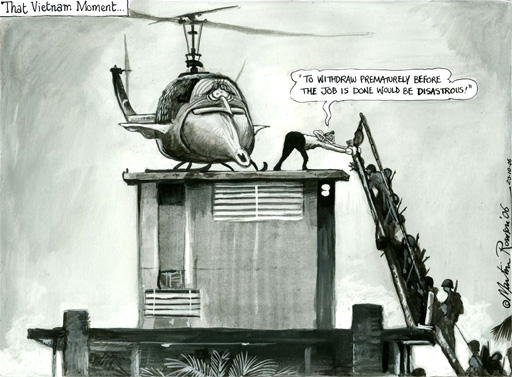
The situation is reaching a 'tipping point' both in Iraq and in US politics.Death squads, militias and insurgents are running rampant, and so bad is the violence that rumors of a coup attempt are gaining credibility. This would install a Saddam-like strongman to rule with a heavy hand, and it adds to the pressure on Bush to set a timetable for withdrawal - even former allies are joining the call.
Even the Weekly Standard is back peddling and taalking in terms of running from Iraq. Reuel Marc Gerecht says:
Nevertheless, a consensus is growing in Washington. There isn't really much difference between left and right: While Democrats Howard Dean, John Kerry, and John Murtha all wish for a rapid departure, former Republican Secretary of State James Baker will soon release his centrist "alternative," reportedly announcing that victory is impossible and our best bet amounts to "cut, pause, talk to the neighbors, and run." Conservative writers like George Will and William F. Buckley long ago gave up on the idea that the United States could help build a democratic government in Iraq. Fewer and fewer among the nation's political and intellectual elites believe that "staying the course" in Iraq advances the war against terrorism and our national interests in the Middle East.
Unlike the state of denial of the Howard Government Gerecht says that it is reasonable to assume that the conflict has helped anti-American Sunni jihadists multiply their numbers.
October 21, 2006
dystopia
For a muliticultural society such as Australia the profound alienation of many Muslims--especially the second and third generations of immigrant families, young men and women themselves born in Australia is a vexing problem facing the continent today. Most of them will be young; far too many will be poor, ill-educated, underemployed, alienated---feeling at home neither in the place they live nor in the lands from which their parents came--and tempted by drugs, crime, or political and religious extremism.
If things continue to go the way they are at the moment, this alienation, and the way it both feeds and is fed by the resentments of mainly white, Christian could eat away at the civic fabric of Australia's democracy. It has already given expression to populist anti-immigration and anti-refugee politics based on fear and loathing and a conservative hysterical oversimplification and representation of the left as spineless, anti-American and increasingly in thrall to Arab/Islamic domination.
The spectre of dystopia that haunts conservatism is one of Sydney becoming Baghdad, unrelenting social dislocation, fragmented social cohesion; an authoritarian government, and a repressive police force unable to contain the chaos etc etc .
October 20, 2006
"All that is solid melts into air?"
He asks: ' What is coming next?' His answer: This is something that we to a large extent can decide for ourselves. Kinda leaves us short doesn't it, especially when democracy and the welfare state are on the ropes.
October 19, 2006
national security and conservative anxiety
Janet Albrechtsen continues to thunder away about the West's cultural surrender. By this she means that multiculturalism has caused the West's cultural timidity:
When it's easier to stay quiet for fear of provoking violence from some Muslims or attracting accusations of racism from Western appeasers, then the West is already living under the shadow of Islamic fascism. We're stuck with silent feminists who prefer cultural rights and the burka over women's rights and the silly noise of some on the so-called progressive side of politics marching to the tune of "We're all Hezbollah now".
There is a lot of unconscious anxiety buried in that paragraph. An anxiety that is then deployed in a politics of fear. It is a politics, as Carmen Lawrence poiints out in her Fear and Politics, that invites us to feel insecure, encourages us to be anxious, manipulates the panic button, and suggests that it is 'them' or 'us.' It is a politics about division to ensure the conservatives and the Coalition remain in power.
Albrechtson's basic thesis is that:
...multiculturalism has become a far bigger and more insidious concept during the past three decades. Its basic proposition is cultural relativism: that all cultures are of equal value, none can be criticised (except for the majority one), and that encouraging integration is racist... Multiculturalism makes the private part of you - your religion - your most valuable public asset. And it's off bounds to criticise any part of it....That powerful multicultural concoction of separateness and victimhood has left the West fractured, neutered of a confident and united identity.
Albrechtson is gunning for the political culture bequeathed to Australia in the 1960s and 1970s when liberals and leftists toppled legalised racial and gender hierarchies, championed an activist judiciaryand increased the rights of dissenters. These reforms they have come to stand for the larger culture of freedom that conservatives have loathed. Hence their general backlash against the loosening of sexual mores and gender roles.
Today conservatives, such as Albrechtson, blame a decadent liberalism for supposedly hampering the government's ability to fight evil-doers at home and abroad. As Corey Robin points out in the London Review of Books conservatives hold that a decadent liberalism has created a devitalised society that lacks the will and wherewithal to face down foreign threats. So we need to affirm the priority of security over freedom and social cohesion or sameness over diversity or difference. National unity is held to be an essential weapon of war, opposition undermines the war effort, and dissenters are either subversive or traitorous.
Corey says that:
When we speak about a balance between freedom and security what we really mean is a balance between power and powerlessness. It makes perfect sense for conservatives to use the metaphor, for it conceals and protects their natural constituency. The real question is: why do liberals oblige them?
After all it was utilitarian liberals who argued that individuals should be free to say and do whatever they wish, as long as they don’t harm anyone else. Liberal democracies should use coercion only to punish acts or attempted acts of harm, including threats to the security of the nation.
Corey adds that one can see variants of this argument in Locke’s account of religious toleration, which could be sacrificed only for 'the safety and security of the commonwealth'; Mill’s theory of liberty, which could be limited only to avert harm; and Oliver Wendell Holmes’s defence of freedom of speech, which could be abridged only to thwart 'a clear and present danger'. He says that:
The problem with these arguments is that it is nearly impossible to define harm----or danger, threat, menace--in a neutral way. Every definition of harm and its national security cognates rests on ideological assumptions about human nature, morality and the good life. And in this regard, liberals are as guilty as conservatives. The only difference is that they have less power to act on their convictions-- and to stop their opponents from acting on theirs.
Albrechtson argues that emphasising difference through diversity causes sharm because it ends up dividing us more. As she says the multicultural concoction of separateness and victimhood has left the West fractured, neutered of a confident and united identity and this has fuelled home-grown terrorism.
October 17, 2006
Foucault & state racism
Mark Kelly in his article in Contretemps entitled Racism, Nationalism and Biopolitics: Foucault's Society Must Be Defended, says that:
When Foucault claims that: "the modern state can scarcely function without becoming involved with racism at some point, within certain lines and subject to certain conditions..."... he is not talking about "ordinary racism," which is to say, the simple hatred of other races....but rather, state racism, biological racism. The kind of racism that emerges in the nineteenth century is for the fi rst time based on new paradigms from biology, on ideas of evolutionary competition and the health of the species... The challenge of this analysis is its application to the contemporary context. Every state does still need to make a distinction between those it keeps alive (and every state does have a welfare system and health service which work towards these ends) and those it kills (foreign enemies in war, executed criminals), together with those it merely allows to be exposed to greater risk of death (the victims of Third World famines, its own poor and elderly citizens). More than in 1976, however, anti-racism is now the prevailing orthodoxy. Racist discourse has become taboo--to identify speech as racist is to deny its validity. The kind of biological discourse which talks about the health of our race has gone by the board. If state racism was the mechanism by which the distinction between the biopolitical population and its outside was made, is it still so today?
The kind of state racism that Foucault is referring to is racism in the broader sense---the way in which the Soviet population was perceived as a pure biological entity, threatened from within by sabotage and deviationism and by remnants of the class enemy, and from without by a world that was full of threats, the conquest of which served to make the Soviet Union stronger. A state with biopolitical aims--the aim of improving the material well-being of the population---but which also in the name of this project eliminates vast numbers of its own people, needs a social-racism.
October 16, 2006
Iraq: a bleak crossroads
Slowly the myths woven around the invasion and occupation of Iraq are being peeled away. Now it is being acknowledged that the occupation of Iraq is making the situation worse. The basic line of the war party is that withdrawal would mean that there would be a messy collapse into open civil war and it would facilitate the spread of international terrorism (jihadists). Hauling down the white flag would represent a massive defeat for the West.
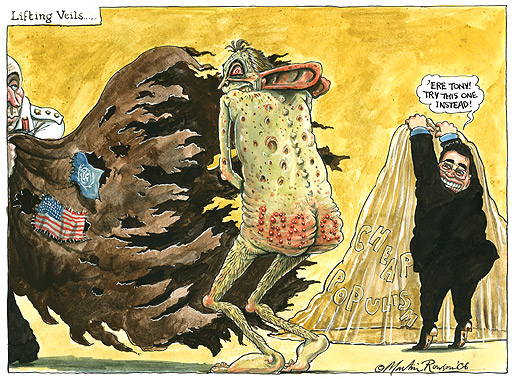
Isn't Iraq already caught up in civil war caused by Shiite death squads and militia and the burgeoning Sunni resistance movement? Isn't the judgement one of there can't be a military solution to what is happening in Iraq? Hasn't the Bush administration all but given up on democracy in Iraq, and was casting about for “alternatives”? Isn't the client regime of Prime Minister Ibrahim al-Jaafari in Iraq on the ropes because it is making no progress in containing sectarian violence? Isn't it a now a case of salvaging the U.S. enterprise in Iraq? If the Bush administration is truly unwilling to consider getting out of Iraq, then what are its options?
There are no more eureka moments left for the Coalition of the Willing. Those days are well and truly gone.
October 15, 2006
UK general speaks a political truth
Iraq is an unpopular war in the US, UK and Australia. Australian troops are not repelling invaders from our borders. They are far overseas waging a 'war on terror'. The national interest case for their doing so depends on the assumption that they pre-empt future terrorist threats.That assumption is questionable. It could be argued that Australia's foreign policy over the last few years has reinforced a sense of insecurity, fear and isolation within some of our own communities.
We increasingly realize that utopian schemes for imposing democracy in Iraq, which would then become a beacon lighting the way for pro-western reform in the region, are a neo-con fantasy. We have developed an awareness that government politicians have glossed over a disaster in which the fate of Iraqis grows ever more hideous.The UN High Commission for Refugees (UNHCR) assessment is bleak: the conflict has displaced 1.5 million people inside Iraq; a tide of refugees swells the 1.6 million living outside the country. The Lancet's estimate is 655,000 deaths since the conflict began.
I see that there has been a critique of the crisis in Iraq from the head of the British army---General Sir Richard Dannatt. He said in a newspaper interview that Britain should aim to withdraw troops from Iraq soon, that their presence in the country was, in some areas, a cause of violence not its remedy, and that the Army could be broken in Iraq. Strong words--'tis the language of politics.
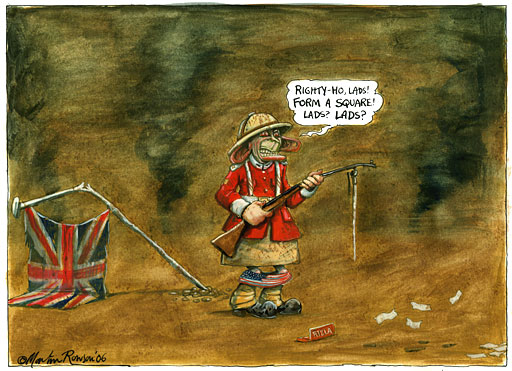
In doing so Dannatt has questioned the strategy laid down by his political masters in Westminister. He actually accused Tony Blair, the Prime Minister, of being 'naive' in thinking the UK could install a liberal democracy in Iraq. It is a significant moemnt when the Chief of the General Staff publicly undermines the authority of the Prime Minister.
Dannatt makes the right call on this---there was a serious strategic failure in Iraq after the original military victory and there is a need for "a change of course" in the Iraq strategy. The US regime in Iraq failed to managed a successful reconstruction programme. That did not happen. All foreign troops are now deeply resented and the sectarian violence is akin to a civil war.
In voicing his views Dannatt is speaking for his own troops, who have been obliged to fight the Afghan and Iraq wars under-resourced in terms of manpower, paypackets or equipment. What we have is an increasingly stretched army and an open-ended troop commitment in Iraq could 'break' the army.
October 14, 2006
paradoxes of democracy
Few argue against democracy these days. Democracy has become the default position. We are unclear what it means and suspect that its radical potential is stifled, its content of the people rule emptied out in the sense that the historical tendency has not been an increase of popular control over government, but rather it is one of increasing governmental control over populations. The state of emergency associated withe war on terrorism is the latest example of this tendency.
In an article entitled Democracy, Authority, Narcissism: From Agamben to Stiegler' in Contretemps Daniel Ross says that:
'Democracy' finds itself today in a paradoxical condition. On the one hand, it remains the unsurpassable horizon of our time. This thought may generally be true if one takes 'democracy' as the system of representative parliamentarism, in its contrast with the declining fortunes of, say, Marxist political practice. It is absolutely true if by 'democracy' one means the thought that the sole ground of sovereignty is 'the people'....On the other hand, if 'democracy' remains the horizon beyond which it seems impossible to think, it is nevertheless and without doubt a concept in crisis. Where is a self-assured 'democracy', content and comfortable with itself, trusting in its own foundation and practice? Where does democracy exist as the assured expression of truths taken to be self-evident?
We don't have democracy per se --we live in a liberal democracy, but few talk about democracy.
October 13, 2006
multiculturalism under the hammer
This op-ed in The Guardian by A Sivanandan captures what is happening aound the political conflict over multiculturalism. He says:
The mounting campaign against multiculturalism by politicians, pundits and the press, in Britain and across Europe, is neither innocent nor innocuous. It is a prelude to a policy that deems there is one dominant culture, one unique set of values, one nativist loyalty - a policy of assimilation. And yet it is passed off as a virtuous attempt at integration, thereby deliberately and dishonestly conflating the two terms. To use "integration" and "assimilation" as synonyms is not just to misuse language and confuse concepts, but to dissimulate practice. Integration provides for the coexistence of minority cultures with the majority culture; assimilation requires the absorption of minority cultures into the majority culture. The aim of assimilation is a monocultural, even a monofaith, society; the aim of integration is a multicultural, pluralist society.
Australia is no different. The conservative attack on multiculturalism is to shift back to assimilation under the guise of integration. "Guise" is important because assimilation was something that Australia consciously rejected 40 years ago in favour of integration.The core of a multiculturalism that respected each other's cultures and religions and celebrated each other's festivals was anti-racism.
October 12, 2006
the right of free speech
There is a classic liberal position that states "I disapprove of what you say, but I will defend to the death your right to say it" that stands for the classic liberal response to book banning and burning. What lies behind that phrase? How does that right square with race hate speech legislation that stops people from denigrate their fellow citizens in bestial terms.
Jeremy Waldron in a review of John Durham Peters' Courting the Abyss says that one interpretation of the right to free speech is:
A more troubling reading ... is that Nazi speech is worth protecting even if a consequence of that protection is that someone gets hurt or killed. "I will defend your right to say it, even if your saying it makes violence more likely against the people attacked in your pamphlets'" Is that what is meant?
This reading of aphorism accepts that free speech has costs;and that if there are costs, then we are the better for bearing them. As we watch the Nazis march by, we are nauseated, we shake inside with rage and our sleep is troubled for days. But it's like physical exercise: no pain, no gain. We can't build the sort of fearless characters that modern democracy requires, unless we have been through and survived this sort of trauma.
Waldon says that Courting the Abyss is about free speech generally, but it focuses on this suggestion that we all become better people through tolerating the most hateful and diabolical speech, by staring at and listening to the Nazis and the racists in our midst. The free-speech position presupposes the Stoic sense of virtue and self-mastery.
October 11, 2006
Zionism's strategies
In the Introduction to the second edition of his Image and Reality of the Israel-Palestine Conflict Norman G. Finkelston says in relation to the creation of Israel:
Basically the Zionist movement could choose between only two strategic options to achieve its goal: what Benny Morris has labeled 'the way of South Africa'--- 'the establishment of an apartheid state, with a settler minority lording it over a large, exploited native majority'---or the 'the way of transfer'--- 'you could create a homogenous Jewish state or at least a state with an overwhelming Jewish majority by moving or transferring all or most of the Arabs out.'
He says that Israel confronted the same dilemma after occupying the West Bank and Gaza as at the dawn of the Zionist movement: it wanted the land but not the people. Expulsion, however, was no longer a viable option. Accordingly, after the June war Israel moved to impose the second of its two options mentioned above---- apartheid. It is this kind of occupation which has proved to be the chief stumbling block to a diplomatic settlement of the Israel-Palestine conflict.
Finkelstone quotes a study undertaken by B’ Tselem (Israeli Information Center for Human Rights in the Occupied Territories) entitled Land Grab, which says that:
Israel has created in the Occupied Territories a regime of separation based on discrimination, applying two different systems of law in the same area and basing the rights of individuals on their nationality.
Finkelstone goes to say that as Jewish settlements expanded Israel has begun corralling West Bank Palestinians into eight fragments of territory, each surrounded by barbed wire with a permit required to move or trade between them (trucks must load and unload on the borders ‘back-to-back’), thereby further devastating an economy in which roughly one-third of the population is unemployed, half the population lives below the poverty line of $2 per day, and one fifth of children under five suffer from malnutrition largely caused ---according to US, UN and European relief agencies--- by Israeli restrictions on transporting food.
October 9, 2006
on the Israeli Lobby
Norman G. Finkelstone, in an article entitled It's Not Either / Or:The Israel Lobby says:
The claim that Israel has become a liability for U.S. "national" interests in the Middle East misses the bigger picture. Sometimes what's most obvious escapes the eye. Israel is the only stable and secure base for projecting U.S. power in this region. Every other country the U.S. relies on might, for all anyone knows, fall out of U.S. control tomorrow. The U.S. discovered this to its horror in 1979, after immense investment in the Shah. On the other hand, Israel was a creation of the West; it's in every respect, culturally, politically, economically in thrall to the West, notably the U.S. This is true not just at the level of a corrupt leadership, as elsewhere in the Middle East but, what's most important, at the popular level. Israel's pro-American orientation exists not just among Israeli elites but also among the whole population. Come what may in Israel, it's inconceivable that this fundamental orientation will change. Combined with its overwhelming military power, this makes Israel a unique and irreplaceable American asset in the Middle East.
Finkelstone says that in the current "either-or" debate on whether the Lobby affects U.S. Middle East policy at the elite level, it's been lost on many of the interlocutors that a crucial dimension of this debate should be the extent to which the Lobby stifles free and open public discussion on the subject.
October 8, 2006
A critique of the Howard years
In a speech entitled Expanded Opportunity or Welfare State, Craig Emerson, Labor MP for Rankin, explored ways to show people how the ALP would make their lives better and how we would make Australia a better country.The speech was delivered to CIS and it was a critique of of the Howard years.
Emerson began by acknowledging that Australia has become a more prosperous country over the last decade:
Average real wages have risen by more than 15 per cent. Unemployment is at a 30-year low. Inflation, too, has reached historic lows. Rising prosperity, low inflation and low unemployment are good for Australia.
He says that the foundations for prosperity were laid by the economic reform program of the previous Labor government and that much, but by no means all of which, was supported by the Liberal and National parties when in opposition. So what is the critique?
Emerson says that:
The last decade will go down in Australia’s history as an unprecedented era of wasted opportunity. Instead of using the proceeds of the productivity boom and the resources boom to expand opportunity for all Australians the Howard government has expanded the welfare state.During a period during which welfare dependency should have plummeted with rising employment and real wages, the Howard government has expanded the welfare state by half in real terms – funded by the highest levels of taxation in Australia’s history.Moreover,
Australia’s education system is entrenching disadvantage. The denial of opportunity to disadvantaged young Australians is at the heart of a reasoned critique of the Howard years. The best, the brightest, the most creative young people do not reside exclusively in more affluent communities. Many highly-intelligent, brilliant young Australians live in poorer communities. Too often they are inculcated with the belief that they aren’t cut out to excel at school; that their highest legitimate aspiration is for a trade and they certainly shouldn’t aspire to a university education.
As a result, social exclusion remains a blight on Australia’s claim to be an egalitarian society. Family breakdown is endemic and financial hardship is especially prevalent in sole parent families.
October 3, 2006
Questioning the welfare state #2
Noel Pearson, the Executive Director, Cape York Partnerships, in his 2002 SEN Conference Dinner speech on the welfare state as safety net and passive welfare highlights the difference between white and black experiences of welfare. He says:
The predicament of my mob is that not only do we face the same uncertainty as all lower class Australians, but we haven't even benefited from the existence of the Welfare State. The Welfare State has meant security and an opportunity for development for many of your mob. It has been enabling. The problem of my people in Cape York Peninsula is that we have only experienced the income support that is payable to the permanently unemployed and marginalised. I call this "passive welfare" to distinguish it from the welfare proper, that is, when the working taxpayers collectively finance systems aimed at the their own and their families' security and development. The immersion of a whole region like Aboriginal Cape York Peninsula into dependence on passive welfare is different from the mainstream experience of welfare. What is the exception among white fellas----almost complete dependence on cash handouts from the government ---is the rule for us. Rather than the income support safety net being a temporary solution for our people (as it was for the whitefellas who were moving between jobs when unemployment support was first devised) this safety net became a permanent destination for our people once we joined the passive welfare rolls.
Life in the safety net for three decades and two generations has produced a social disaster for indigenous people. He adds that though the indigenous experience of the Australian welfare state has been disastrous that does not thereby mean that the Australian welfare state is a bad thing. It is just that indigenous people have experienced a marginal aspect of that welfare state: income provisioning for people dispossessed from the real economy.
This means that indigenous people have largely not experienced the civilizing features of mainstream life in the Australian welfare state - public health, education, infrastructure and other aspects which have underpinned the quality of life and the opportunities of generations of Australians. Though government money has been spent on Aboriginal health and education the people of Pearson's dysfunctional society have struggled to use these resources for our development. As he says ' our life expectancy is decreasing and the young generation is illiterate.' Our relegation to the dependence on perpetual passive income transfers meant that our people's experience of the welfare state has been negative. Indeed, in the final analysis, completely destructive and tragic.
October 1, 2006
Foucault: Society Must be Defended #3
Mark Kelly in his article in Contretemps entitled Racism, Nationalism and Biopolitics: Foucault's Society Must Be Defended, says that :
The success of these discourses of race struggle was such that they became ubiquitous as a way of thinking about society. In the eighteenth century, the state itself started to colonize these discourses, to use them to its own ends, to justify the status quo. Ultimately, the subversive discourse of race struggle, which Foucault 'praises' mutates utterly from the idea that there is a struggle between opposing forces which is basic to society to the idea that society itself is the agent caught in a struggle with its enemies both within and without--from the discourse of race struggle to that of state racism. This involves the idea of the nation as race, of a people as which is racially homogenous, for which internal and external racial others are dangers.
The argument is that co-option of the discourse of race struggle as the discourse of state racism is intimately connected with the emergence of biopolitics.
That makes sense of the first part of the 20th century in Australia where the White Australia policy presupposed state racism.