November 29, 2006
David Harvey on neo-liberal governance #2
This picks up on this post on Neo-liberalism and the Restoration of Class Power---- by David Harvey, written for a workshop on neo-liberalism at Princeton University in 2004. The previous post texplored neo-liberalism as an ideal type. Harvey says that:
This "ideal-typical" account is unduly functionalist. It is important, therefore, to round out the picture through consideration of the fundamental structural contradictions within neo-liberalism. Authoritarianism (embedded in dominant class relations whose reproduction is fundamental to the social order) sits uneasily with ideals of individual freedoms. While it may be crucial to preserve the integrity of the financial system the irresponsible and self-aggrandizing individualism of operators within the financial system produce speculative volatility and chronic instability. While the virtues of competition are placed up front the reality is the increasing consolidation of monopoly power within a few centralized multinational corporations. At the popular level, however, the drive towards freedom of the individual person can all too easily run amok and produce social incoherence. The need to perpetuate dominant power relations necessarily creates, therefore, relations of oppression that thwart the drive towards individualized freedom.
To all of these contradictions we must then add the potentiality for a burgeoning disparity between the declared public aims of neo-liberalism - the well-being of all - and its actual consequences - the restoration of class power.clearly, neo-liberalism must be seen as an unstable and evolving regime of accumulation rather than as a fixed and harmoniously functional configuration of political economic power.
However, neo-liberalism is more than a unstable and evolving regime of accumulation: it is an unstable and evolving regime o f governance.
November 28, 2006
critical Jewish voices
Maybe we are witnessing the start of a rational debate about Israeli and the Palestinian conflict in Australia at long last. In New Matilda there is an article entitled Israel/Palestine: Violence Hasn't Worked by Vivienne Porzsolt from Jews against the Occupation Sydney In the article, which is an edited version of a speech given at Politics in the Pub, Porzsolt says:
The mainstream media in Australia base their reporting on the Middle East on assumptions which favour Israel. The conflict is presented as a legitimate if unequal struggle for land, rather than a struggle against colonial occupation and repression. How often are the words of official Zionist propaganda reported as fact? Israel is fighting for its existence; Israel has a right to defend itself. As if Israeli actions in the recent war had anything to do with rational self-defence.Then there is the lie that Israel has withdrawn from Gaza: 'We gave them Gaza and look how they treat us!' The reality is that not a cabbage or a lettuce, let alone a human being, can get out of or into Gaza without Israel's permission. Gaza is a giant prison with people combing through garbage for scraps of food to survive.... The conditions are reminiscent of the Warsaw Ghetto. And who knows about them? All these suppressions and misrepresentations of information must be exposed.
You rarely hear this kind of alternative Jewish voice in the media Australia ---corporate or small magazines. It is refreshing to hear a distinction being made between being critical of Israel and antisemitism in Australia. More often than note Jewish critics of Israel are are demonised as self-hating and their views are discounted as 'beyond the pale' by the neo-con strand of the Zionist Jewish lobby.
But this voice has a critical edge that is directed at the Left in Australia for its anti-Semitism, which she sees as part of the revival of traditional anti-semitism. Porzsolt warns:
At the same time, we cannot correct this distortion by equally biased narratives from Arab/Palestinian/Muslim perspectives. In parts of the Left, there is a tendency to exaggerate the crimes of the State of Israel. The reality is bad enough. Sometimes, rhetoric is used against Israel with a venom that I don't notice in quite the same way with other Left struggles. Calling the massacres at Sabra and Shatilla in September 1982 'the other Holocaust,' or claiming 'Zionism = Nazism' is not just bad history; it provokes resistance for no purpose. I appreciate that anger at the Zionist hijack of the Holocaust as a justification for Israel's actions, lies behind some of this. However, as a Jew, I find this special hatred anti-semitic.
Fair enough. Zionism = Nazism is over the top and unnecessary. But we can, and should, direct criticisms against Zionism as an ethnic nationalism that is part of the settler colonialist project; a nationalism that is based on the denial of ethnic cleansing of Palestinians in 1948, or the racism of a brutal colonial occupation. What is of concern is the silence by Jews in the Australian diaspora about some of the actions committed by the Israeli state.
Porzsolt is wary of this kind of criticism:
I reject the double standard that denies Jewish/Israeli national aspirations in the same breath as supporting Palestinian nationalism. No nationalism, even if expressed as a struggle against national oppression and dispossession, is without problems. Could the Palestinians be said to have attained national self-determination if they were a minority in their own land? The way out of the inherent violence of nationalist rhetoric and action is to base the struggle on justice, and human and national rights for both Palestinians and Israelis. In other words, a truly bi-national vision. Too often, the very notion of national aspirations for Jews is attacked in parts of the Left as illegitimate and racist. If we want a peaceful, just future, we need to challenge this.
I would have thought that the left in Australia would accept Israel's existence as a given and the Jewish desire for national self-determination as legitimate. Few on the left advocate the destruction of Israel. The concern is the Israeli occupation of the Palestinian territories and the brutality of the oppression.
Suprisingly, Porzsolt wants to replace nationalism with social justice based on universal human rights and international law. So where does that leave Palestinian self-determination and their desire for their own homeland?
November 27, 2006
indigenous development
Anthony Smith in Indigenous development--Without community, without commerce in the Australian Review of Public Affairs sums up a debate about indigneous development:
Most participants in the current debate about Aboriginal development believe that government policy has failed. Indigenous policy is now generally viewed as both permissive and powerless. Government handouts are seen as passive welfare or 'sit down money', which perpetuates Indigenous joblessness--and so permissive. And many Indigenous communities have been unable to combat self-destructive alcohol and substance abuse as well as criminal and violent behaviour--and so powerless.There is much discussion about policy alternatives, but the growing separation between the commercial aspirations of Indigenous business and the need to deal with the negative effects of economic development remains largely unexplored. On one hand is a call for Indigenous business interests to be released from responsibility for solving community problems and administering government welfare and employment programs. In other words, Indigenous business needs to be set on a more equal footing with mainstream business. On the other hand is a call for greater focus on law and order to combat lawlessness. How these divergent policy goals might be reconciled is not clear.
Both the policy pathways to free Indigenous enterprise from the shackles of welfare responsibility, and the demand for draconian law and order, take as a starting point a shift away from the 1970's idea of 'community'; one based on concepts of traditional culture and ethnicity and aborigines agents or trustees for their community's development.
November 26, 2006
America's empire
America's current quest to install a system of international law and order in the 21st century---a pax Americana--can, and should be, understood in terms of the United States essentially being an empire, even if the US has no colonies, and it does not annex foreign territory. As Howard Brasted observes in a review of some books on empire at the Australian Review of Public Affairs the US:
...does preside over a network of client states, seeks to expand its frontiers of global power by means of market forces, corporate capitalism, and international monetary organisation, and it regularly sends in gun-ships and guided missiles to topple recalcitrant regimes or prop up friendly ones. It stations significant troop numbers in Asia, Europe and the Middle-East and maintains military outposts---some 725 of them according to one tally---in more than half the countries of the world. In Ferguson's view this is imperialism 21st century style.
The reference is to Niall Ferguson's Colossus: The Price of America's Empire. Since 1991 the word 'empire' now refers to the maintenance of American supremacy in a world of nations. Regardless of any proclaimed commitment to the concept of a self-governing world, self-aggrandisement and self-interest largely informed American expansionism. In short the United States is more imperialistic than Americans have cared to recognise.
November 25, 2006
David Harvey on neo-liberal governance
This paper---Neo-liberalism and the Restoration of Class Power---- by David Harvey was for a workshop on neo-liberalism at Princeton University in 2004. After giving a history of neo-liberalism under Thatcher and Reagan in the opening section of his paper David Harvey outlines the characteristics of the neo-liberal mode of governance:
Consider the neo-liberal state as an ideal type. While there are well-known dangers of setting up an argument this way, it has the advantage of clarifying the contrasts to the social democratic state that preceded it while allowing a preliminary exploration of the question as to whether or not the neo-conservative state is a radical departure or a mere continuation of the neo-liberal state by other means.The fundamental mission of the neo-liberal state is, at its base, to create a "good business climate" and therefore to optimize conditions for capital accumulation no matter what the consequences for employment or social well-being. This contrasts with the social democratic state that is committed to full employment and the optimization of the well-being of all of its citizens subject to the condition of maintaining adequate and stable rates of capital accumulation.
Harvey says that the neo-liberal state looks to further the cause of and to facilitate and stimulate (by tax breaks and other concessions as well as infrastructural provision at state expense if necessary) all business interests, arguing that this will foster growth and innovation and that this is the only way to eradicate poverty and to deliver, in the long run, higher living standards to the mass of the population.
He adds that:
Internally, the neo-liberal state is hostile to (and in some instances overtly repressive of) all forms of social solidarity (such as the trade unions or other social movements that acquired considerable power in the social democratic state) that put restraints on capital accumulation. It withdraws from welfare provision and diminishes its role as far as possible in the arenas of health care, public education and social services that had been so central to the operations of the social democratic state. The social safety net is reduced to a bare minimum.
Externally, Harvey adds, neo-liberal states seek the reduction of barriers to movement of capital across borders and the opening of markets (for both commodities and money capital) to global forces of capital accumulation, sometimes competitive but more often monopolistic (though always with the opt-out provision to refuse anything "against the national interest").
And finally the neo-liberal state is profoundly anti-democratic, even as it frequently seeks to disguise this fact.
Governance by elites is favored and a strong preference for government by executive order and by judicial decision arises at the expense of the former centrality of democratic and parliamentary decision-making. What remains of representative democracy is overwhelmed if not, as in the US, totally though legally corrupted by money power.... In the neo-liberal view, mass democracy is equated with "mob rule" and this typically produces all of the barriers to capital accumulation that so threatened the power of the upper classes in the 1970s. The preferred form of governance is that of the "public-private partnership" in which state and key business interests collaborate closely together to coordinate their activities around the aim of enhancing capital accumulation. The result is that the regulated get to write the rules of regulation while “public” decision-making becomes ever more opaque.
November 24, 2006
neoconservatism & American exceptionalism
In the article entitled Neoconservatism's Liberal Legacy in Policy Review mentioned below Todd Lindberg says that neoconservatism generally shared American exceptionalism. He says:
They were unabashed partisans of the American side, because they thought the United States best embodied (did embody) the ideals for which they stood: liberty, equality of opportunity, and so on. Moreover, they believed the United States had a unique role to play in the protection of and (to the extent possible) the spread of freedom on account of its position as a global power.
So what was specifically American about this "exceptionalism", which on the surface appears to be just liberalism that favours individual freedom above equality? What needs to be factored in is the manifest destiny of the US and its nationalism.
Lindberg does spell out American exceptionalism when he says:
the Americanness of the exceptionalism, it was clearly rooted in the strong attachment in the United States to liberal democratic principles and the market economy, as well as the ability of the United States to defend those principles against all comers ---- and more broadly, to defend the security of the free world. This Americanness stood in contrast not only to the communist world but also, in certain respects, to the rest of the free world. The perceived deficiencies abroad were various, from socialist economic policies said to have brought on stagnation, to the tenuousness of democracy, to the very fact that the rest of the free world could not (and perhaps would not try to) defend itself in the absence of the United States. One could say that this exceptionalism pitted an idealized vision of the United States against (sometimes somewhat tendentiously described) realities elsewhere in order to declare reality abroad deficient by comparison.
So a social democratic Australia is deficient because it does not come up to the ideals of free market capitalism. Therein lies American nationalism: one based on the belief in the supremacy of U.S. democratic institutions and free market capitalism rather than ethnicity.
November 23, 2006
exploring liberal citizenship
In Aristotle and the Rediscovery of Citizenship Susan D. Collins is concerned with the way that liberal political theory has failed to reckon with the fact that the human good has an unavoidable political dimension. Liberal theorists often flee from the fact that every political community requires specific virtues, molds characters, and shapes its citizens' vision of the good.
In this review Thomas W. Smith says that in the first part of the book Collins shows the problematic character of various liberal conceptions of citizenship. Collins points out, that liberalism has called into question its own principles of justice and morality:
For example, critics sympathetic to liberalism have picked apart the Rawlsian emphasis on procedural liberalism and justice as fairness. They have eviscerated the liberal pretension to neutrality. They have criticized the hard distinction between a public realm informed by liberal principles and a private realm unaffected by the social and political forces liberalism generates. Collins thinks that these sorts of arguments have brought clarity about the need to confront the question of the human good in our regime. Yet this clarity challenges liberalism at its core. Increasingly liberal theorists recognize that liberalism requires civic education in certain virtues. However, with certain prominent exceptions, they are unwilling to argue that liberalism ought to try to transform their citizens' comprehensive views or cultivate a way of life.
Liberals, by and large, are uncomfortable with the view that regimes form citizens. Neo-liberals are different. The whole point of neo-liberalism is that the market mechanism should be allowed to direct the fate of human beings. The economy should dictate its rules to society, not the other way around. On this account neoliberalism is a series of market oriented reforms aimed at global economic integration, free trade, privatization, and deregulation, has been presented by some scholars as an being an opposition to social democracy.
Neo-liberalism is also a mode of governance one that organizes people--and distributes rights and benefits to them---according to their marketable skills rather than according to their membership within nation-states. Those whose knowledge and skills are not assigned significant market value---such as migrant women working as domestic maids in many Asian cities---are denied citizenship.
November 22, 2006
the neoconservative critique of capitalism
Two main currents in neoconservatism are the neoconservative critique of capitalism and the neoconservative revitalization of anticommunism during the Cold War. The latter is explored at public opinion Though the former is not mentioned much in Australia it is there in the policies of the Howard Government and in policy proposals of the free market think tanks---the IPA and CIS.
The neoconservative critique of capitalism is briefly explored by Todd Lindberg in an article entitled Neoconservatism's Liberal Legacy in Policy Review. He says:
The neoconservative critique of capitalism11 drew heavily on Max Weber's The Protestant Ethic and the Spirit of Capitalism. In the neoconservative view, capitalism ----salutary though it was with respect to the efficient allocation of goods and services and accordingly unparalleled as a means for the advancement of people's material prosperity ---was in crisis. The source of this crisis was the deficiency of self-propulsion of capitalism itself. Capitalism, in this view, required something neither contained within nor perpetuated by its system of market economics. This "something" was, in effect, Weber's Protestant ethic: a set of virtues or habits of character ----including thrift, industry, temperance, patience, persistence, and so forth----whose origin and sustenance came from religious faith and the expectation of salvation as a reward for right earthly conduct. In the absence of these virtues, capitalism could not flourish. Yet capitalism itself did nothing to encourage the virtues upon which it depended. On the contrary, in certain respects, capitalist consumer society worked to undermine those virtues.The example he gives is that whereas once Americans thought it morally praiseworthy and necessary to save money for future consumption, with the arrival of installment credit in the early twentieth century, the habit of deferred gratification gave way to a demand for instant gratification. Consequently, in the long run, the demand for instant gratification would subvert properly functioning markets and the long-term time horizon required for the success of capitalism.
The response by American neo-conservatives, such as Irving Kristol, ,to this contradiction was to celebrate bourgeois values. The bourgeois, after all, were the living repository of the "values" or virtues that enabled the capitalist system to persist. The bourgeois type needed to be defended so as to allow for the "moral capital" of capitalism to remain sufficient for the operation of the system. One way to address the decline of moral capital was to prevent able-bodied people relying on the state for sustenance---hence the polcies associated with welfare to work.
It was limited response as the new "bourgeois ethic" was less and less Protestant in character and more and more entrepreneurial, ie., one involving the acceptance of risk in exchange for the prospect of reward.
November 20, 2006
Zionism as a nationalism
As is well known in Australia there is little split between the identity and heritage of Jewish people in the diasporia and Zionism. They are still one and the same.
Zionism holds that Jewish people are a wandering "tribe" who must have a "homeland", in the form of a nation-state, because of the historical injustices they have suffered. What was established was a state that elevates Jewish rights over those of non-Jews. This is the logic of ethnic nationalism (constructing a "nation"-state with the idea of elevating the rights of a particular ethnic community).The birth of the Israeli state in 1948 was a violent one: it was based on the mass expulsion and exodus of around 1 million non-Jewish Palestinians following numerous massacres and demolitions of over 400 Palestinian communities in order to form the Zionist state of Israel.
The reasoning was this: in order to create a Jewish demographic majority, around one million non-Jewish Palestinians in 1948 had to be "transfered", i.e. forcefully expelled or coerced to leave. While any Jew regardless of their birthplace is granted automatic citizenship and allowed to settle in Israel under the "Law of Return", Palestinians are denied their right to return to their homes, which is a basic right enshrined in the UN Universal Declaration of Human Rights, Geneva Conventions and other international law treaties.
What we have here is the workings of an exclusivist-colonial modernity of Zionism nationalism of an ethnic Jewish state) that was imported under British rule, and which works in terms of the triumph of Jewish culture (ethnic purity) over Palestinian nature. The (Zionist) Israeli Lobby endeavours to portray Zionism as both 'modern' and something other than colonialism.
Zionists (Jewish nationalists) justify the way that Israel practices institutionalized discrimination against its non-Jewish citizens whereby Israel pursues various means of getting rid of its non-Jewish population altogether. All Israeli politicians are committed to preserving Israel's Jewishness. They have to be. It's the law. Israel expressly claims not to be the state of its actual citizens (who include a million non-Jews), let alone that of the people whom it actually governs (half of whom are Palestinian Arabs). Non-Jews are, an impediment to Israel's Jewishness. Though non-Jews are second or third class citizens, Avigdor Lieberman, the deputy Prime Minister, wants them out altogether.
November 18, 2006
wish fulfilment
Ehud Olmert, the Israeli Prime Minister, was in Washington recently, and made the following remark:
"We in the Middle East have followed the American policy in Iraq for a long time, and we are very much impressed and encouraged by the stability which the great operation of America in Iraq brought to the Middle East. We pray and hope that this policy will be fully successful so that this stability which was created for all the moderate countries in the Middle East will continue."
The Americans have bought greater stability to the Middle East through the war in Iraq? What kind of fantasy is that? The war is seen to be successful? Even the Washington neocons are jumping ship!
The Israeli hawks are hawkish around Iran. Israel has no doubt about Iran's nuclear intentions and has begun a new, public relations offensive against Iran, which it brands as "Islamo-fascist" and bent on the "existential destruction" of the State of Israel and that "the whole world has to join forces in order to stop it". They frame the conflict in terms of "war on terror", with Israel as America's staunch ally against the rogue states of Iran and Syria. Though they accept US global supremacy -but they seem to have little grasp of the actual limits of US power
The dominant tendency within the Zionist movement always regarded itself as a branch of Western civilization, and strategically exploited this sense to gain support, first from Britain, and subsequently from the United States, and indeed, Europe as a whole. And Western imperial powers, beginning with Britain and now especially, the United States, have used Israel as a cats paw in their expansive strategies in the Middle East.
November 17, 2006
a strange conservatism
Iraq is now increasingly seen as having nothing to do with combating terrorism. Or, more precisely, the war is seen as actually increasing the threat of terrorism. Well not the neocons in Weshington, Canberra and London. Even if they are running to the exits and pointing the finger elsewhere they still see Iraq as central to the war on terrorism.
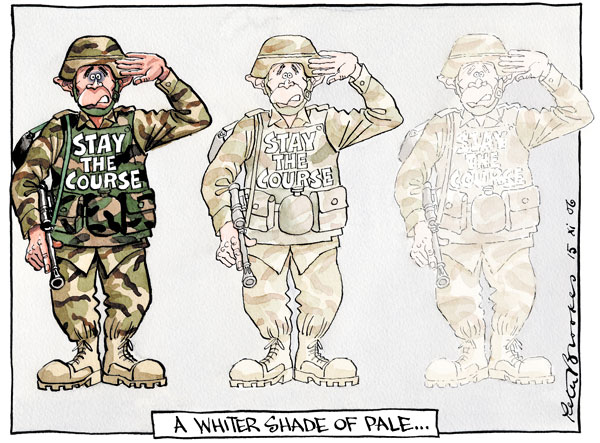
The heritage of the neocons is heavy one for modern conservatism as it now celebrates uses war. It is only too willing to let loose the dogs of war. War is a good prism to understand modern conservatism. It is not just a mixture of libertarianism and traditionalism that we see at the Institute of Public Affairs.
Lowenstein's 'My Israel Question'
I'm reading Anthony Lowenstein's My Israel Question which reframes the Israel-Palestinian question from a personal perspective. He asks: why are dissenting view points on the conflict are shunned and ridiculed amongst the Jewish community in Australia. It's a good question. He also asks: 'How could a democratic state maintain a brutal occupation over another people for nearly 40 years? Another good question. Lowenstein says:
I support the state of Israel and believe in its existence. This book examines how much Zionism---the ideology of Jewish nationalism---is to blame for this intractable conflict. There must be a way for Israel to exist securely while allowing justice for the Palestinian people.
Asking these questions in Australia means being accused of being anti-Israel (hating Israel) and being hostile towards the Jewish people by the Zionist lobby---the Australian Jewish News (AJN) and the Australia/ Israel and Jewish Affairs Council (AIJAC). The latter defines Lowenstein as anti-Zionist without bothering to address the criticisms of Jewish nationalism.
In Australia the debate is still framed in terms of Israel's security, which justifies erecting walls, checkpoints and barriers. It implies that Palestinians should accept peace only on Israel's terms. "Jews" are equated with "Israel." This erroneous equation leads to the equally flawed conflation of "criticism of Israel" with a "dislike of Jews"----anti-Semitism.This means that in Australia there is little willingness by the Jewish community to listen to, or understand, the Palestinian narrative, as this community works within the narrative of Israel and is Likud governments.The Zionist lobby still endeavours to control the debate through phrases like Israel-phobia and Israel-phobic paranoia. For Zionists criticism of Israel is a part of the definition of anti-Semitism. No allowance is made for any behavior of Israel that might stir up hostility; rather, everything done by Israel becomes an automatic and justifiable defense against the essential hatred evinced by the critics for Jews.
What is not included in this Zionist frame is Israel acknowledgment of its role in Palestinian dispossession. What is in the frame is Palestinians being blamed for the region's conflicts. Palestinians are just terrorists. What is ignored is the pain and suffering by the people on both sides of the conflict. What cannot be accepted is the legitimacy of the Palestinian narrative of occupation and oppression.
The Palestinian question is the most inflammatory and the most profoundly misunderstood of all the issues of the Middle East, and rarely do we hear from Palestinian voices expressing their experiences of loss, exile, and longing for home. No other culture is so often spoken for by others, or denied a public forum to express itself. This silencing in the hegemonic media means that Australian democracy suffers.
November 16, 2006
federalism gutted
The basic idea of the Workplace Relations Act, which the states challenged, is to strip away many of the constraints and conditions associated with the independent processes of conciliation and arbitration and narrow the focus on the economics of the employer-employee relationship. The High Court's 5-2 decision on the state's challenge the Howard Government's industrial relations regime has in fact greatly expanded the scope of the constitution's corporations power, section 51(xx) to be exact. As I noted at public opinion the High Court's interpretation of the commonwealth's corporations power in the Work Choices case is opposed to any notion of a federal balance of power. It has given the commonwealth the power to intervene in almost areas of state power including higher and private education, through every aspect of health, to such matters as town planning and the environment. This expansive reading has prevailed since the Engineers case in 1920, and throughout the 20th century the court has consistently interpreted the powers expressly granted to the Commonwealth in the Constitution broadly.
Greg Craven gives a strong interpretation of centralism as obliterating powers of the states in The Australian. He says:
The court has given Canberra the key to the Constitution...All in all, the High Court has delivered what liberal conservatives have long feared: an omnicompetent national government effectively unrestrained by a constitutional division of powers. The Business Council of Australia and its allies, who have yearned for this position, had better hope that this battery of power is never controlled by their enemies...The real question for the states is the direction in which they should swim. This is an occasion for brutal realism. As of this week, the time of the states as semi-independent constitutional entities is, sadly, over. They will have to adapt to a world in which the commonwealth unequivocally is master, while striving to preserve their individuality and local policy capacity. Inevitably, this will mean gritting their teeth and abandoning co-ordinated and even co-operative federalism in favour a model of leadership federalism.
So how does Justice Ian Callinan in his minority judgement read the constitution differently? What is the basis for his different interpretation?
Callinan holds that maintaining a federal balance to be an important consideration:
I do not suggest that the Constitution can, or should be construed in a vacuum, that is, in disregard of statements of Justices of this Court in earlier cases, and, of course, history[698]. Although the relevant history here is important and instructive, the dicta from other cases are, with a few exceptions, not. The sum of the matters which should inform the proper construction are: the techniques employed from time to time by Justices of this Court in construing the Constitution; the constitutional imperative of the maintenance of the federal balance; the fundamental canon of construction, the need to construe the Constitution as a whole; the reach, impact and meaning of the industrial affairs power conferred by s 51(xxxv) of the Constitution[699]; the reach, impact and meaning of the corporations power; and, the relationship between the two powers.
November 15, 2006
neo-liberal governance
Zhizomes has a special issue on neo-liberal governmentality that may have some insights into the previous Third Way post.
In the editorial Hai Ren says that this material is intended to contribute to the scholarly debate over neo-liberalism under contemporary conditions of globalization, and:
It asks: How are liberal and neo-liberal logics of governance developed on the basis of governmental discourses that address the lived experiences of ordinary people, industrial masses, subalterns, minorities, and other marginalized populations? How are neo-liberal subjects constructed in multiple ways? And what are some of the conditions under which neo-liberal capitalism becomes a dominant trend in this new century?
The editorial say it will address these questions by organizing the articles according to three themes: liberal logic and governmental discourses, construction of neo-liberal subjects, and conditions of neo-liberal capitalism.
Hai Ren states that:
Historically, neo-liberalism reflects the changing relationship between institutions of power (especially the state and the market) and the governance of political subjects (people and multitude). Contemporary neo-liberal capitalism operates not merely through neo-liberal modes of governance but also through other modes, including police (coercive) and liberal modes.... The development of neo-liberal capitalism has been based on certain historical and structural conditions such as the end of the Cold War, the reflexive mode of accumulation, and the domination of the United States as the only super power in the world. Next, both liberal and neo-liberal modes of governmentality are based on the development of governmental discourses on the lived experiences of ordinary people, industrial masses, subalterns, minorities, and other marginalized populations. That is, liberal and neo-liberal modes of governance operate alongside coercive or police modes of governance. Finally, neo-liberal subjects are more than just economic subjects since the economic order tends to operate in connection with many others: for example, through uses of multimedia and digital technologies, lifetime education, active participation in consumption, and engagement in conducting life as an enterprise.
November 14, 2006
evaluating the Third Way
In a paper entitled Dancing with Wolves: The untenable tenets of the Third Way Professor Hugh Emy from Monash University discusses the Third Way and economic neoliberal policy. He states his position clearly:
....the Third Way must be seen as a transitional response to the complete dominance of neo-liberal ideas and policies. It is, perhaps, a way of resurrecting, of keeping alive, a belief in non-market, social values which hard or dogmatic economic liberalism threatens to extinguish. But, ultimately, the Third Way is based on the illusion that is possible to strike a sustainable balance between free market and non-market approaches to social organisation. Third Way thinking may - and ideally, should - lead back to social democracy but cannot provide a satisfactory substitute for it.
He adds that what one thinks of the Third Way will depend on what one makes of the forces at work in economic globalisation, or the expansion of global capitalism: whether one see them as progressive or threatening. It will depend also on whether or how far one sympathises with the main historical objective of social democratic parties, which is to civilise capitalism by addressing the inequities it creates in power and income, and by trying to control the impact of free markets in society. Emy holds that that '(global) capitalism, for all its productive energy, is ultimately an unstable and self-destructive system which, left to its own devices, erodes and destroys the social, institutional and environmental life-support systems on which it rests.'
Emy says that the Third Way:
emerged as the left-of-centre's strategy for carrying on the modernisation processes begun by the neo-liberals on terms which acknowledged the case for free markets and fiscal rectitude, the constraints imposed by globalisation, as well as trying to place a greater value on social cohesion. Third Way advocates may have wanted a balance between free markets and social values, but realities - the strength of the dominant paradigm, the impact of accelerating globalisation and the continuing need to shore up the productive base - were always likely to tip the balance towards the former. (Just as the re-structuring process in Australia in the 1980s was driven increasingly by rapidly changing global economic pressures.)
He adds that in Britain rather than America, the Third Way centered on the belief that it was possible to balance neo-liberalism and communitarian values, wealth creation via free markets with social cohesion. By the end of the decade, it was fairly clear in Britain and America that the balance had tilted decisively towards neo-liberalism, just as had occurred in Australia. Clinton and Blair, and Keating, found it harder and harder to deliver on social policy despite increasing evidence of social stresses.
Emy says that though the Third Way attempts to strike a balance between free markets and society, it is unlikely that it can deliver on this balance because the neo-liberal mode of governance actively resists policies and spending which conflict with its own emphasis on growth, continuous modernisation and active support for globalisation as a beneficial process. The market rules.
November 13, 2006
its a Hobbesian world
Though the battle against the Sunni minority never went all that well, the U.S. occupiers managed to keep a lid on the chaos with the help of their Shi'ite allies. However, the terms of the conflict have shifted with the Shi'ite majoirty now increasingly at odds with the Americans. That makes life difficult for the US occupiers.
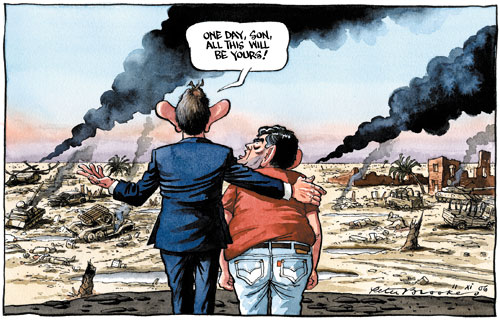
Peter Brookes
Does that imply that the war is simply unwinnable? It sure looks so since the U.S. occupation is basically being defeated by the near-complete absence of support from the Iraqi people. The chaos that exists is one of a Hobbesian world. It will worsen until the occupiers leave. Iraq is a no-win situation.
The US has unleashed mayhem and strife that has now assumed it's own momentum. As Mathew Yglesias observes:
As Kurds and Shiites both have, in the very recent past, been subjected to incredibly brutal repression by a Sunni-dominated central government. They, not unreasonably, fear the return of such repression. Sunni Arabs, meanwhile, have an also-not-unreasonable fear that Kurds and Shiites will, in their desire to avoid a return to repression, engage in similar repression.
In Australia John Howard has ceded his exit strategy to Bush, and so effectively surrendered it to the Democrats who will now largely determine America's eventual departure from Iraq. The Howard Government, unlike the U.S. political establishment, has yet to come to the realization that the war, as it is presently being fought, cannot be won. At least they have dropped the talk about transforming the Middle East being as simple as "taking out Saddam and watching a thousand flowers bloom."
There has been one Liberal voice that has addressed this chaos issue. The concerns about Iraq led Russell Trood, a Queensland senator and a respected foreign policy academi before he entered politics, to make this judgement:
There is some danger that we might end up in a long war of attrition that could intensify divisions within Iraqi society, sap America's strategic energy and not lead to a resolution that will stabilise Iraq...It may well be that a solution to the situation will not be found just within Iraq itself but will involve participation from the key regional players and perhaps the wider international community. As yet there is no strategy to achieve this, but it may be something that the US President's Iraq study group will recommend.
This was voiced during an interview with The Bulletin: about a month ago. It is currently being suggested by Tony Blair.
Well it's either that or Leviathan--- in the form of a strong man. The endgame in Iraq approaches.
November 12, 2006
privatising probation services.
I see that New Labour in the UK is saying that the probation service has its historic roots in the 19th century Church of England temperance movement, and that it is time to bring "bring the voluntary sector back to centre stage" as an "equally professional partner" in supervising offenders.
I'm not sure what it means. It seems to mean that the private sector provides community support to give ex-offenders some options in life other than crime. What sort of options would they be? Keeping on the straight and narrow by zealous fundamentalists who believed in ceaseless hard work, the sinfulness of human nature and an avenging, wrathful God?

The temperance movement in Australia was an abstinence-oriented movement. They failed to bring about prohibition in spite of a long campaign for local option. The movement's major success was in prohibiting the sale of alcoholic beverages after 6:00 in the afternoon, laws which led to the notorious six o'clock swill.
The faith based temperance movement was about saving alcoholics ---today that means conquering the bottle with the help of Jesus. Prohibition is touted as the almost magical solution to the nation's poverty, crime, violence, and other ills.
Gee I hope this doesn't catch on for indigenous people coming out of jail in Australia? Faith based social services caring for petrol sniffing indigenous youth who have no jobs? Gee, we would have abstinence-only forms of sex education, politics based on those who "share our [Christian] values" ; a refusal to counsel women on the subject of abortion etc etc.
It is an open invitation for the religious right.
November 9, 2006
a weakened Congress
The 2002 National Security Strategy of the United States of America was premised on a massive increases in defense spending, the assertion of lone superpower status, the prevention of the emergence of any regional competitors, the use of preventive -- or preemptive -- force, and the idea of forsaking multilateralism if it didn't suit U.S. interests. This underpinned the neo-con conception of Pax Americana.
Pax Americana was linked to the domestic dominance of the Republican Party against all challengers for a generation or more. This was to be a domestic version of "full spectrum dominance." Hence we had -- the global Pax Americana and the domestic Pax Republicana. Isn't that unwinding now with the recent Congressional elections.
This is a good thing as the making of sound U.S. foreign policy depends on a vigorous, deliberative, and often combative process that involves both the executive and the legislative branches, as each branch has both exclusive and overlapping powers in the realm of foreign policy. The Bush administration has aggressively asserted executive prerogatives whilst congressional oversight of the executive on foreign and national security policy had virtually collapsed.
Norman J. Ornstein and Thomas E. Man, in an article entitled When Congress Checks Out in Foreign Affairs says that one of Congress' key roles is oversight: making sure that the laws it writes are faithfully executed and vetting the military and diplomatic activities of the executive. Congressional oversight is meant to keep mistakes from happening or from spiraling out of control; it helps draw out lessons from catastrophes in order to prevent them, or others like them, from recurring. Good oversight cuts waste, punishes fraud or scandal, and keeps policymakers on their toes.
Yet the Bush administration has reserved the right simply to ignore congressional dictates that it has decided intrude too much on executive branch power.The Bush administration has aggressively asserted its executive power and displayed a strong aversion to sharing information with Congress and the public. But why did Congress allow this to happen?
Ornstein and Man say that the most logical explanation for why has Congress abandoned oversight when it is most needed:
is that the body now lacks a strong institutional identity. Members of the majority party, including congressional leaders, act as field lieutenants in the president's army rather than as members of an independent branch of government. Serious oversight almost inevitably means criticism of performance, and this Republican Congress has shied away from criticizing its own White House.
Will this change with the Democratic control of Congress?
November 8, 2006
passive welfare
This image of the effects of passive welfare brings the idea of pomoting self-reliance and greater personal responsibility into play:
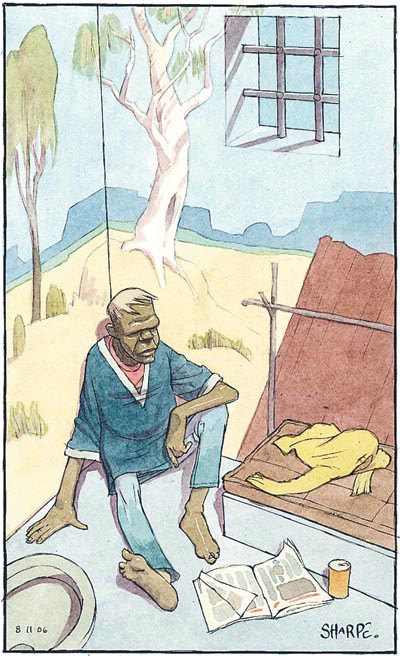
Sharpe
As Jack Waterford observes in The Canberra Times the main victims of violence are
within their own families and communities rather than in the wider world. The people being assaulted, abused, and stolen from are overwhelmingly their own. And, as some point out, the incidence of the crime, and victimhood involved, is probably far higher than is ever recorded in the statistics, because of the pressures on victims not to dob. Proponents of some of the new theories of improving the lot of Aborigines believe fervently that the cycle of welfare dependency, hopelessness and despair must be attacked, if need be with sharp shocks which force Aborigines not only into the broader economy but into a broader citizenship. In particular, they believe that more welfare, more dependency, and more sitting around will only perpetuate the present horrors and make the ultimate outcomes worse. Only Aborigines can liberate themselves from the prisons of our making and theirs.
November 7, 2006
Pearson on indigenous health care
The federal government is planning to gut the Community Development Employment Projects (CDEP) program which was designed to move indigneous into mainstream employment. CDEP in remote areas. It failed to move Aboriginal people into mainstream employment because there was (and is) no mainstream employment to move into. Decades of government neglect and zero government investment in communities like Wadeye and Palm Island have seen to that.
Is there another approach government's actually investing in regional indigenous communities and participating in the creation of employment and wealth?
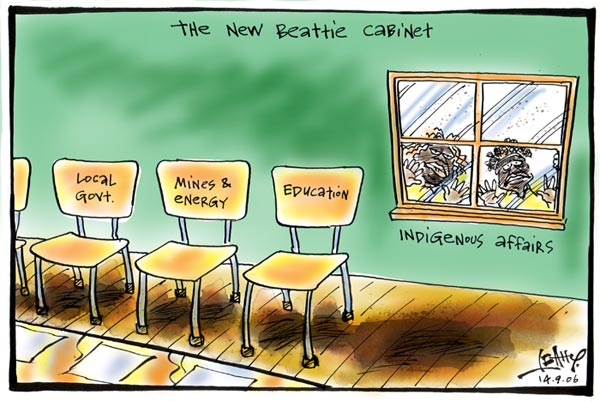
In his 2004 AMA Oration In honour of the late Professor Ross Webster Noel Pearson says that:
The health care services to our people are exclusively provided by the Queensland Government though its networks of clinics in indigenous communities and small hospitals in the towns. There are no indigenous medical services or GP services.There is a longstanding and unfulfilled need for doctors in Cape York Peninsula and myself and my colleagues in the leadership of our community.
He added that he is putting a proposal to the Commonwealth to provide funding through the cashing out of Medicare and the Pharmaceutical Benefits Scheme to communities that simply do not have access to GP services so as to employ doctors through a community-controlled health service organisation for the region.
Pearson argues that the exclusion of our people from this federal funding must end, and we must have the means to control the provisioning of the services which are desperately needed: those of doctors and indigenous health workers. Pearson says that community control means:
community responsibility, where our people do not just concern ourselves with the provisioning of the primary health care services, but we take responsibility for the upstream public health issues which underpin the poor health of our people: substance abuse, tobacco smoking, poor environmental health and poor nutrition. In Cape York Peninsula our whole agenda is based on the notion of responsibility: we have to take charge of our problems. If we can add the best health care services provided by doctors and health care workers with the kind of concerted and comprehensive public health strategies which we in Cape York Peninsula have developed (and are still developing) – then we will see real improvement in the health of our people.
November 5, 2006
Bad Subjects
Computers are shaping and transforming our creative and intellectual culture. As internet search engines get faster and information networks grow larger computers are not the only things changing-we are too, as we become ever more reliant on computers.
Some compare the internet to an Adam Smith-style marketplace, where ideas, knowledge and information are being produced and exchanged with unparalleled efficiency and accuracy. Others hold that the internet is doing the opposite by deadening and weakening the population's creativity.
It's a ' do it your self style' that is developing in the digital media and one that rejects the hackneyed routines of traditional academic discourse that presents a closed face to the world outside academia. Bad Subjects, political and cultural journal, is an example of the new style of an electronic periodical that is more than a periodical.
November 4, 2006
law & the humanities
A quote from Jack M. Balkin and Sanford V Levinson's "Law and the Humanities: An Uneasy Relationship" in the Yale Journal of Law and the Humanities, Vol. 18, p. 155,:
Ironically, law's thoroughly rhetorical nature, which strongly connects it to the traditions of the humanities, places the contemporary disciplines of the humanities at a relative disadvantage. Law uses rhetoric to establish its authority and to legitimate particular acts of political and legal power. Law's professional orientation pushes legal scholars toward prescriptivism - the demand that scholars cash out their arguments in terms of specific legal interpretations and policy proposals. These tasks push legal scholars toward technocratic forms of discourse that use the social and natural sciences more than the humanities. Whether justly or unjustly, the humanities tend to rise or fall in comparison to other disciplines to the extent that the humanities are able to help lawyers and legal scholars perform these familiar rhetorical tasks of legitimation and prescription.
November 3, 2006
truth telling
In this speech to the 2006 Economic and Social Outlook Conference Dr Ken Henry, Secretary to the Treasury, speaks very forthrightly about the plight of our indigenous people. He says:
Far from the mainstream, indigenous disadvantage is a dull glow on the periphery, capturing our attention only fleetingly, usually when presented to us as salacious. Most Australians know there is something wrong because they see images of substance abuse and domestic violence in indigenous communities. But that is about all they see. And it might be all they want to see; for the most part preferring the mental image of the indigenous community as a sheltered workshop for the permanently handicapped.Well, indigenous communities are not sheltered workshops. They are a constituent component of mainstream Australia. But it has to be said that the life experience in that part of the mainstream is rather unusual...Indigenous Australians have a dramatically lower life expectancy ---17 years less than the Australian average, dramatically lower rates of year 12 completion, substantially higher unemployment rates and substantially higher rates of imprisonment. Indigenous disadvantage diminishes all of Australia, not only the dysfunctional and disintegrating communities in which it is most apparent. Its persistence has not been for want of policy action. Yet it has to be admitted that decades of policy action have failed.
The good news is that there is a growing level of support---significantly, including among indigenous community leaders---for innovative approaches. Many of these new approaches are being targeted to local circumstances, with high rates of indigenous participation in design and implementation. Some of the indigenous development initiatives being undertaken by mining ventures in the West and the North are producing impressive results. And the work undertaken at the Cape York Institute under Noel Pearson's leadership, which has led to the development of several pilot projects that take a fresh approach to welfare and service delivery, is equally impressive. There is reason for hope.
You don't often hear that kind of truth telling from the Canberrra bureaucracy do you.
November 2, 2006
liberty and order
In the light of this recent post over at public opinion about contradictions between the liberal and conservative strands of the Liberal Party we have these comments about the Liberal Party by John Howard in this speech, where he says that being both an economic liberal and a social conservative involves no incompatability. Howard argues thus:
The Liberal Party is a broad church... and we should never as members of the Liberal Party of Australia lose sight of the fact that we are the trustees of two great political traditions. We are, of course, the custodian of the classical liberal tradition within our society, Australian Liberals should revere the contribution of John Stuart Mill to political thought. We are also the custodians of the conservative tradition in our community. And if you look at the history of the Liberal Party it is at its best when it balances and blends those two traditions. Mill and Burke are interwoven into the history and the practice and the experience of our political party.
Howard adds that this means that liberty in our community is bound up with a sense of order. By personal liberty he also means a sense of individual and personal responsibility. If we are to enjoy personal liberty we must have an ordered society. So how does this work in practice?
Howard spells it out in terms of recent Australian history:
Contemporary Australian society understands that we do live in a world of change, they understand that globalism is with us forever, they may not like some aspects of it but they know they can't change it and they therefore want a government that delivers the benefits of globalisation and not one that foolishly pretends Canute-like it can hold back the tide. They accept and they understand that. But they also want within that change, sometimes that maelstrom of economic change, they want reassurance and they want to protect and defend those institutions that have given them a sense of security and a sense of purpose over the years. And that of course where our conservative tradition comes in. .... We believe that if institutions have demonstrably failed they ought to be changed or reformed. But we don't believe in getting rid of institutions just for the sake of change. We need to be persuaded that they are failed institutions. We shouldn't rise to the clarion call of radical change just for its own sake.
Doesn't the economic change through economic reform create the anxiety and the need for reassurance?
Update:
What is interesting about these excerpts is that Howard does not resolve the tension between liberty and order in terms of rights, or more philosophically negative rights. Rights are not even mentioned. Nor is Hobbes re order which is what underpins the national securtity state.
By negative rights is meant that there are things that none has a right to do, such as depriving another of the free exercise of his faculties. If we are to maximize freedom, people can only be free to the extent that they do not impede the freedom of others. Here, we would not consider something as "free" if its consequence were to reduce the freedom of others. Thus, (as with Locke) one is free to own the fruits of his/her labor, for this does not deprive anyone else. (Similarly, there can be equality before the law.) However, one cannot be free to steal, for this reduces the freedom of others. (Similarly, there cannot be freedom to redistribute wealth, which is inequality before the law.) Consequently, freedom is absolute once one precludes activities which remove it from others.
November 1, 2006
a supine parliament
Though the Westminster crowd say that parliament is sovereign I hadn't realized that the British parliament had so little power against the dominant executive. Consider what Simon Jenkins has written in an op-ed in The Guardian. He says:
Last night Britons were offered the spectacle of their MPs pleading with the government to be allowed an inquiry into the Iraq war. For all the vigour of the debate, they were still humiliated by the government's supporters. While British soldiers ram democracy down others' throats at the point of a gun, their representatives seem incapable of performing democracy's simplest ritual, challenging the executive.
Well the House of Representatives in Australia doesn't either. And the Senate has been captured. Jenkins goes on to say that:
Britain has seen no indictment of the pre-invasion mendacity or the lack of post-invasion planning. The Commons has not cross-examined returning generals or diplomats with anything but cringing deference. Occasional hearings by the defence and foreign affairs committees have yielded only pat repetitions of the official line. British MPs enjoy themselves in Basra palace, where they congratulate the army on behaving better than the US. But frank military assessment must be gleaned from gossip, seminars, websites and the occasional general cutting loose on television.
Gee 'cringing deference' really does sound like Australia.
Jenkins adds:
Britain's debate on the Iraq war is taking place in the media. It should be in parliament. Parliament's mission is to "legislate, deliberate and scrutinise". Since it no longer legislates independent of government (except on such trivial matters as hunting) and its debates are worse attended than a pub game of Trivial Pursuit, it is left with scrutiny. Of that there is none. The Commons has become little more than an electoral college for the prime minister.