December 31, 2006
Deaths in Custody: Mulrunji Doomadgee
The letter below is from The Weekend Australian, Saturday, December 30, 2006. It is entitled DPP and Beattie have brought discredit to their offices. It refers to the death in custody of Mulrunji Doomadgee, the background of which can be found here and here over at public opinion. The letter is written by Scott McDougall, Director of the Caxton Legal Centre in New Farm, Queensland. It is a good letter. It will disappear from the public sphere and go behind News Corps paid wall tomorrow.
Before considering the appropriateness of the respective actions of the Director of Public Prosecutions, Leanne Clare, and the Queensland Government, it’s important to first consider the evidence that would be admissible against Senior Sergeant Chris Hurley in a criminal trial over the death in custody of Mulrunji Doomadgee.
The following published summary of the evidence by Peter Callaghan, senior counsel for Mulrunji’s family at the coroner’s inquest, has not received challenge from any quarter:
Senior Sergeant Hurley arrested and incarcerated Mulrunji (the triviality of his “offence” and any unlawfulness attaching to the arrest need not be debated). As Mulrunji was removed from the police van he struck Senior Sergeant Hurley a blow to the face. Hurley immediately punched him back. This evidence would be given by a sober and respected elder of the Palm Island community. The fact that she described Mulrunji striking the first blow establishes her objectivity. A scuffle ensued and both men did fall on to a flat, hard floor at the same time. No one else saw exactly how the bodies were positioned at the moment of impact with the ground; Hurley was then heard, by another police officer, yelling abusively at Mulrunji; Mulrunji was placed in a cell where he bled to death, internally. He had suffered a ruptured liver and four broken ribs. Severe force was required to cause these injuries – the sort of force conventionally associated with a high speed motor vehicle trauma. The medical evidence established conclusively that these injuries could not have occurred in the course of a simple fall to a flat surface. The only way they could have been sustained in a fall is if someone had fallen on top of Mulrunji in a particular fashion. In a conversation with a close friend and colleague, Hurley said that he had fallen next to Mulrunji. Such a fall could not have caused the death. Photos of the corpse also revealed an injury to Mulrunji’s eye. This injury was not present when he was taken into police custody. It was unlikely to have been caused in the same action which damaged the liver.
Leanne Clare not only decided that there was insufficient evidence to prosecute a criminal offence, she publicly exonerated Hurley by offering her conclusion that the death was a “terrible accident”. In the face of the admissible evidence, such a decision would require clear evidence that the “particular fashion” of the fall was accidental and did not involve any element of voluntariness or recklessness on Hurley’s part. As the admissible evidence stands, the direct evidence of Hurley punching Mulrunji outside the station, combined with the forensic evidence of the injury to Mulrunji’s eye and evidence from a police officer about Hurley’s verbal abuse, might convince a jury that the manner in which Hurley fell on Mulrunji was not accidental.
Clare says that in making her decision she sought and received further evidence. However Clare has been unprepared to disclose the nature or source of the evidence and the public has been left to speculate as to what the further evidence is. Given the overwhelming public interest in this case, Clare’s naivety in thinking that such a situation would be tenable suggests that she lacks the nous necessary to hold the office of the DPP.
Therefore, Clare’s error has not been limited to the making of the decision not to prosecute. She has discredited the office of the DPP by failing to disclose adequate reasons for her decision, for failing to seek an interstate opinion (as she had done previously in recent cases), by refusing to disclose the further evidence she acted upon and by offering gratuitous and inflammatory remarks such as that she is required to act upon “evidence” rather than “emotion”.
For his part, Premier Peter Beattie has needlessly brought himself undone by trying to finesse a safe political position rather than allowing the Attorney-General, Kerry Shine, to act decisively to maintain public confidence in Queensland’s justice system. It’s the primary responsibility of the Attorney-General, as the state’s chief legal representative, to oversee the administration of justice in Queensland. Mr Shine has already demonstrated a capacity and willingness to protect the integrity of the justice system by initiating contempt charges against the president of the Queensland Police Union following an attack upon the Acting State Coroner.
Given Clare’s refusal to seek an interstate counterpart’s opinion, it was entirely appropriate for Mr Shine to take action to initiate his own independent review. Should that review find that charges should be laid against Hurley, it is open for the Attorney-General to present and prosecute an indictment on his behalf and he should not hesitate to do so.
December 30, 2006
Derrida on Schmitt
It is in Chapter 4 The Politics of Friendship entitled The Phantom Friend Returning (in the Name of Democracy) that Derrida engages with Schmitt. Derrida says that for Schmitt the political arises in its possibility with the figure of the enemy:
It would be unfair... to reduce Schmitt's though to this axiom, as is often done, but it nevertheles be indispensable to this thought, and also to his decionism, his theory of the exception and sovereignty. The disappearance of the enemy would be the death knell of the political as such. It would mark the beginning of depoliticization ... the beginning of the end of the political.....Schmitt claims that he awakened a tradition that was begnning to lull. Whether we can substantiate them or not, some of his remarks must claim our attention here. We should underscore two of them. They deal on the one hand with the opposition between public/private, and on the other with a certain concept of ethics.
On the public/private opposition Derrida says that Schmitt consider the enemy to be a public enemy as the concept of a private enemy would be meaningless. Derrida then loosens up the public/private duality.
He says that according to Schmitt the antithesis of friendship in the political sphere is not enemity but hostility:
....the friend (amicus) can be an enemy (hostis); I can be hostile towards my friend, I can be hostile towards him publicly and conversley I can, in privacy, love my enemy..From this everything woudl follow, in orderly, regular fashion, from the distinction between private and public. Another way of saying that at every point when this border is threatened, fragile porous, constestable...the Schmittian discourse collapses.
December 29, 2006
talking sense on democracy
The quote below is from this review by J. Angelo Corlett, of David R. Hiley's Doubt and the Demands of Democratic Citizenship.In this text Hiley responds to the public cynicism in the United States concerning the current state of politics and the widespread distrust of governments within the U.S by arguing that the answer lies in citizenship that includes a certain kind of skepticism by citizens of a truly democratic society. It is the kind of skepticism that entails citizens' doubting in the midst of decisions that must be made in the context of disagreements between citizens. Corlett says:
In a time when the U.S. empire seeks to continue to spread its form of alleged democracy around the globe through a morally unjustified use of deadly violence, it is imperative that books written on democracy carefully explain precisely why democracy is a good thing, and what distinguishes good forms of it from impostors. In a certain way, the author attempts this in articulating a version of deliberative democratic citizenship. But his glibly and repeatedly implying that violence is something that is not appropriate in democracy promotes confusion and ignorance of the particular ways in which long-standing traditions in philosophy have argued meticulously about when violence might be morally justified. This is particularly true in the case of the U.S., a country the government and a majority of the citizens of which recently approved and permitted an institutionally and morally unjust regime to rise to power in recent years, only to then approve and permit it to invade two countries on false and unjust pretenses, killing thousands of innocent citizens. One would think that, under precisely such conditions, political violence is quite morally justified against such an evil regime.
Democracy is in need of serious philosophical defense rather than assume that a deliberative or liberal democratic kind of society is the benchmark of justice.
Democracy is paid lip service to these days even as it is being undermined. We do need to distinquish between liberalism and democracy in modernity, which came together in the 19th century (eg., John Stuart Mill) but which are not necessarily related.
Neo-liberalism, for instance, is about competitive markets not democracy, and it has very little to say about the project of a radical and plural democracy. I would argue that neo-liberalism in its utilitarian form of economic liberalism disconnects the idea of liberty from democracy as it critiques both the redistribution of the welfare state and the increasing intervention of the state in the economy. Utilitarianism is still hegemonic in liberal economic and political philosophy in Australia, but it has little to say about the democratic project of modernity or the nature of the political.
December 28, 2006
utilitarianism and the political
The main thrust of Utilitarianism is to increase the overall utility for a society. Utility is similar to happiness, so a decision or distributive scheme that would increase the societal level of happiness is better than a scheme that wouldn't--simple enough. Utilitarianism is political economy translated into the language of ethics.
I guess we can interpret the utilitarian tradition in Australia supporting democracy as a way of making the interest of government coincide with the general interest; they have argued for the greatest individual liberty compatible with an equal liberty for others on the ground that each individual is generally the best judge of his own welfare; and they have believed in the possibility and the desirability of progressive social change through peaceful political processes.
So how is the political understood in utilitarianism? As the harmony of individual interests? Is the political based on the consensus based on individual self-interest.Does utilitarianism as a public philosophy have a conception of the political as distinct from the ethical or the economic? If so, is it the convergence of individual and public interests? How does it view conflicts, antagonisms and relations of power? By reducing these to a rational process of assessing utility from the actions of private interests? Doesn't utilitarianism move between ethics and economics? Isn't the political absent in utilitarianism? Isn't the language of citizenship missing?
In modern democratic society division is constitutive and an integral part of the political culture of democracy.
December 27, 2006
philosophy.com: things not working as they should
Sadly, philosophy.com isn’t working as well as it should. We cannot turn the folder and it is impossible to make comments on posts. The problem is a result of the recent makeover just before Xmas. Tech support is on holidays, so we have to be patient. Hopefully, the bugs will be sorted next week, after the New Year.
In the meantime if you have any comments on recent posts you can send them to me via email and I will post them as a weblog post.
December 26, 2006
reading Schmitt with Derrida
We are now in a position to return to Mark Banisch's Derrida, Schmitt and the essence of the political, which I had mentioned in an earlier post here. Banisch talks in terms of depoliticisation of the political and the narrowing of the political field of debate at the commencement of the new millennium. He quotes Chantal Mouffe's introduction to a collection of essays on Schmitt--- The Challenge of
Carl Schmitt--- where she asks some pertinent questions:
Why should we read Schmitt today? Does his friend-enemy conception of politics retain some pertinence in our ‘post-political’ age? Do liberal democrats have something to learn from his critique of liberalism? Is his theory of sovereignty still relevant in a globalised world?
As we have seen Mouffe interprets Schmitt is an adversary who must be dealt with, thereby placing herself places herself in the liberal camp. Her strategy is definitely not to read Schmitt to attack liberal democracy, but to ask how it could be improved. To think both with and against Schmitt- so as to 'rethink liberal democracy with a view to strengthening its institutions' is the thrust of her strategy in The Return of the Political.
So what does Banisch do? He says that:
In order.... to use Schmitt as the basis of a theory and analytics of the political in these “new” times, it is necessary to refine his theory such that it recognises that antagonism and agonism are in fact separable concepts each with its own proper moment and praxis. Before drawing of the work of these theorists (and others) to suggest how this could be done, it is necessary to review Derrida’s reading of Schmitt in the Politics of Friendship (1997). This is a more urgent task particularly as Derrida’s own theory of the specificity of the political as an undecideability inherent in the moment of just decision has many resonances with Schmitt’s decisionism.
I'm unclear why a distinction needs to be made between antagonism and agonism. Banisch suggests this could be done by reviewing Derrida’s reading of Schmitt in the Politics of Friendship (1997) which deconstructs Schmitt’s friend-enemy distinction. He says:
However, it may nevertheless be true that even with the impurities that Derrida so insightfullydeconstructs, Schmitt’s concept of the political can still be pressed into service --- even domore useful work, if it is understood to be a reflection of the instability of thepublic/private opposition. In this sense as well, Derrida’s insight that Schmitt is trying to stabilise tradition against flux reflects Schmitt’s complex sociological engagement with modernity and differentiation (noting Schmitt’s debt to Weber) and therefore it is likely that Schmitt’s failures will themselves be productive for an analysis of postmodern politics.
December 24, 2006
Mouffe on liberalism, democracy & Schmitt #2
In The Return of the Political Chantal Mouffe's engagement with Schmitt acknowledges that he was right to point out the deficiencies of liberal individualism with respect to the political, despite the real gain made in individual freedom. In the chapter on Liberalism and Democracy Mouffe says:
Many of the problems facing liberal democracies today stem from the fact that politics has been reduced to an instrumental activity, to the selfish pursuit of private interests. The limiting of democracy to a mere set of neutral procedures, the transformation of citizens into political consumers, and the liberal insistence on the supposed 'neutrality' of the state, have emptied politics of all substance. It has been reduced to economics and stripped of all ethical components.(p.111)
She says that though there is an increasing awareness of the need to revive political philosophy amongst political theorists, the contributions made by Kantian rights-based liberals, such as John Rawls, amount to an evasion of the political Mouffe states that:
..by failing to distinquish properly between moral discourse and political discourse and by using a mode of reasoning specific to moral discourse, he [Rawls] is unable to recognize the nature of the political. Conflicts, antagonisms, relations of power disappear and the field fo politics is reduced to a rational process of negotiation amongst private interests under the constraints of morality. (p.113)
Mouffe says that this is a typical liberal vision of a plurality of interests that can be regulated without the need for a superior level of political decision-making. Hence the question of sovereignty is evaded. This is why Mouffe needs to engage with Schmitt--- he recognized that the defining feature of politics is struggle and antagonism, and he also has an uncompromising critique of liberal rationalism and universalism and its lack of understanding of the political.
Mouffe states that under modern conditions, where the individual and the citizens do not coincide because private and public have separated, a reflection on the autonomous values of the political is required. Therefore:
the elaboration of a liberal democratic political philosophy should deal with the specific values of the liberal democratic regime, it's principles of legitimacy or, to use Montesquieu's term, its 'political principles.' Those are the principles of equality and liberty for all; they constitute the political common good which is distinctive of such a regime.
Mouffe says that there are competing interpretations of the principles of equality and freedom but then says that the common good can never be actualized. It has to forever remain a foyer virtuel to which we must constantly refer but which cannot have a real existence. Why so? Why cannot we speak of the common good of the public sphere? What is the argument?
Mouffe says that while politics in a liberal democracy aims at:
...creating a 'we' , at constructing a political community, a fully inclusive political community can never be achieved since, as Schmitt tells us, in order to construct a 'we' it must be distinquished from a 'them' , and that means establishing a frontier, defining an 'enemy'. There will therefore exist a permanent 'constitutive outside', as Derrida has shown us, an exterior to the community that makes its existence possible.
Though this can be granted, the common good need not be a 'we' as Mouffe claims: --it can be national interest, national security, the democratic rule of citizens, or a good life. Why cannot 'the good life' cannot have a real existence? Why cannot we say that some modes of life are better than others?
December 23, 2006
Arendt, imperialism, the political
One of the fundamental concerns of Hannah Arendt's political theory is the question how to preserve the realm of the political, which is the only place that allows people to act as free citizens Hannah Arendt's understanding of politics is decisively influenced by her study of totalitarianism. . Having identified Nazism and Stalinism as radically new types of political regimes that aimed at the total destruction of liberty and the elimination of any political space, Arendt sought to recover the notion of freedom by studying its emergence in ancient Greece. For Greeks, it was self-evident that to be free is not just to be free from constraints (the negative freedom of modern liberalism), but to be able to initiate something new.
This is interesting article on Hannah Arendt in the London Review of Books Arendt’s claims in The Origins of Totalitarianism that totalitarianism is a new form of government, ushered onto the stage of history with the regimes of Josef Stalin and Adolph Hitler. It is not just another form of tyranny, although there are similarities, but a unique and novel development. She claimed that theories of race, notions of racial and cultural superiority, and the right of ‘superior races’ to expand territorially were themes that connected the white settler colonies, the other imperial possessions, and the fascist ideologies of post-Great War Europe.
Totalitarianism lives on, with all the references to Munich and fascism by the neo-cons to justify and legitimate their 'war against terrorism' after 9/1.This event for many marked the beginning of a new kind of war: the ambiguously labelled "war on terror" was conceived of as a war against a "new kind of totalitarianism" anchored in the ideology of Islamic fundamentalism.
The second part of The Origins of Totalitarianism is concerned with imperialism. Can this material help us to understand the US empire today? It is not obvious that it can. The book deals with the European colonial imperialism whose end came with the liquidation of British rule in India after WW2, and the decline of the European nation state, rather than the ascendency of the American empire.
Arendt argues that imperialism’s animating impulse is expansion for expansion’s sake. The imperialist sees every conquest as a way station to the next. Does that mean Afghanistan leads to Iraq leads to Iran leads? ‘ Expansion is no longer part of our political vocabularly----it's now 'overreach.'
December 22, 2006
Derrida, friendship, politics
Derrida's The Politics of Friendship opens thus:
Oh my friends, there is no friend
How apt. My friends, no friend. The words are from Montaigne and they are attributed to Aristotle according to Diogenes Laertius based on a faulty translation. No matter, the remark has given rise to a tradition of texts and interpretations that connect friendship with the political.
The canonical interpretation speaks to friends: it addresses friends whilst telling them there are no friends. It opens up the possibility of another kind of friendship.
December 21, 2006
Mouffe on liberalism, democracy & Schmitt
It is only in the seventh chapter of The Return of the Political that Chantal Mouffe begins to engage with Schmitt. That chapter is entitled 'On the Articulation Between Liberalism and Democracy', and in it Mouffe confronts Rousseau by arguing that democracy must come to terms with pluralism on the grounds that:
under modern conditions, where one can no longer speak of the 'the people' as a unified and homogeneous entity with a single general will, the democratic logic of government and governed cannot alone guarantee respect for human rights. It is only by virtue of its articulation with political liberalism that the logic of popular sovereignty can avoid descending into tyranny.
It is at this point that Mouffe turns to the critiques of liberal democracy coming from the right and to Schmitt's challenge to parliamentary democracy. This is the beginnings of t thinking differently about the political, class, or revolution.
She turns to Schmitt's The Crisis of Parliamentary Democracy where he argues that liberalism amd democracy need to be distinquished from one another. She says that we can learn a great deal from Schmitt's critique of parliamentary democracy without having to follow him in his rejection of liberal democracy. She says:
We do not have to accept Schmitt's thesis that there is an inescapable contradiction between liberalism and democracy; such a contradiction is only the result of his inability to grasp the specificity of modern democracy, between its two constitutive principles of liberty and equality. They can never be perfectly reconciled, but this is precisely what constitutes for me the principal value of liberal democracy. It is this aspect of nonachievement, incompleteness and openness that makes such a regime particularly suited to modern democratic politics. Unfortunately, this aspect has never been properly theorized, and liberal democracy lacks the political philosophy that could provide it with adequate principles of legitimacy Schmitt is certainly right to argue that those principles are quite unsatisfactory and in need of reformulation.
December 20, 2006
Derrida: the Politics of Friendship
The reception of Derrida’s thought in the 1970s in Anglo-Saxon literature and philosophy departments highlighted its rhetorical side, reducing deconstruction to a practice of literary criticism, the political orientation of which was easily advertised, but poorly elaborated. In Anglo-American philosophy departments in Australia deconstruction, as an art of analysis was criticized as esoteric and irrational. What was refused was the argument was that there is a radical alliance between philosophy and literature---a friendship; albeit an alliance that separates the two in that literature and the other arts can critically decenter the field of university philosophy. This privileging of literature--- something that Derrida shares with Nietzsche, Adorno, Heidegger, Blanchot, and others---was what was explicitly refused. One of Derrida’s abiding concerns is the deconstruction of the opposition between philosophy and literature that was trenchantly reaffirmed in the Angl;o-American academy that traditionally allied philosophy with natural science.
The Heidegger and de Man affairs in the 1980s drew out Derrida’s critics, and his reputation suffered by association. Upstaged then by historicism and multiculturalism, deconstruction came to be perceived as incapable of articulating historical making and unmaking of subjectivities.
What was underplayed in the 1980s was Derrida’s political thinking. Derrida was not recognized as a politically engaged thinker, and his political commitments remained obscure. I was vaguely aware of the suggestion of Derrida's ethico-political project around the irreducible violence of discourse and the need for an open, aporetic, and agonal democracy from Derrida's encounter with Gadamer in the early 1980s. That encounter between hermeneutics and deconstruction seemed to go nowhere. I had read Derrida Specters of Marx, and interpreted it as an invitation to rethink "the concept of the political" at "the end of history" in the time of "the last man." However, I became more interested in reaching back to understand Heidegger, forward to read Adorno, and back to Nietzsche to find away to respond to darkened times.
I've only just returned to Derrida as I became aware of his political writings and the way that he linked the responsibility of a philosopher to the general responsibility of the political citizen and a duty to test the concepts we use to talk about politics--eg., the 'war on terror' ; 'friend/enemy, 'globalization', 'security'. The inventive response is to create a space to thinking differently; a space from which an other, better future might arise. This is a politics of awakening as opposed to a politics of dreaming. Was this a rethinking of "the concept of the political" that Schmitt had analysed?
I picked up the Politics of Friendship yesterday. The text ranges over Aristotle, Montaigne, Nietzsche, Schmitt, Heidegger, Levinas, Blanchot, etc. But I see that Mark Banisch has been there before me with his Derrida, Schmitt and the essence of the political. This is from Banisch's abstract:
This paper seeks to suggest that while many theorists over the past decade or so have turned to Carl Schmitt’s concept of the political, its utility for analysing the contemporary postmodern (anti) political fieldrequires supplementation by an engagement with the critique of Jacques Derrida in The Politics of Friendship. The paper reads Schmitt and Derrida together and argues that in some senses, Derrida’s deconstructive reading of the Concept of the Political is already prefigured within Schmitt’s text. The paper concludes by proposing a theoretical analytic based on the Schmittian Derrida which also engages with the work of theorists of the agonistic political such as Chantal Mouffe. This contributes to an exploration of the utility of a post-structuralist political analytic that comes to grip with the multiplicity of political antagonisms constructed agonistically through rhetoric.
That's interesting---this is the path that I'm starting to walk down in the last few posts. So we will see where it leads.
December 19, 2006
Owen Harries, US hegemony, Iraq
Over at public opinion it was argued that the "grave and deteriorating" situation in Iraq----the words of the Report of James A. Baker's Iraq Study Group---has not yet deteriorated enough to convince establishment (realist) American policymakers to follow the lead of the public and abandon the neo-con's ambitions of the US being the dominant power in the Middle East. The US is to remain an empire even though it has limited power to shape events in Iraq.
In an interesting op-ed in The Australian, which can be accessed at the Lowy Institute as 'After Iraq', Owen Harries asks:
As we near the end game in Iraq, the question arises: what will be the future of the Bush doctrine? Does failure on its first outing spell an early grave for it? Does it mean that it will have been but a passing episode in the history of US foreign policy? As 9/11 recedes into history, and as George W. Bush's period in office draws to an end, are we witnessing the end of what the Bush doctrine stood for? Not necessarily. For the doctrine represents two enduring and fundamental features of the situation - one structural, the other cultural - that will not disappear when the Iraq venture ends: the global hegemony of the US and American exceptionalism.
Harries' answer confirms the opening paragraph of the post: empire stays despite the quagmire in Iraq. How then does Harries understand the global hegemony of the US and its significance for the Middle East? How will empire change to the new circumstances in the Middle East?
Harries says:
The US went into Iraq a confident hegemon, the "indispensable nation" without which nothing important could be done, as Madeleine Albright used to lecture the world. It will come out of it a damaged hegemon, but still a hegemon, still far and away the strongest state on earth. It will remain such for at least a couple of decades.When the weak fail, they have no option but to accept the fact and usually there are no second chances. When the very strong fail, they tend to find excuses, regroup and try again, changing their methods and their timetable but maintaining their goals. As hegemon, the US will still want to impose its will on the world, and that will still represents American values as well as American interests.
That doesn't infirm us about the strategy of the US as a global hegemon in the Middle East.I gies s that harries answers is in terms of American exceptionalism, namely:
the profound belief widely held by Americans since their beginning as a nation that it is their historical - indeed their divinely ordained - destiny to be, in the words of Reinhold Niebuhr, "tutors of mankind in its pilgrimage to perfection", or in the words of president Woodrow Wilson, that Americans are divinely "chosen to show the nations of the world how they shall walk in the paths of liberty". However condescending and presumptuous others may find this conviction, it is deeply held and as natural to Americans as apple pie.
Harries implies that nothing much will change. So what is likely to happen to US foreign policy post-Iraq?There will be nothing like a 180-degree or even a 90-degree change ; but there will be significant adjustments and alterations as certain lessons of recent experience and the validity of the realist critique of that experience are acknowledged.
Harries does not take this any further than the US learning the lesons about bringing hubris under control and trust ing other states through doing a bit of trim and tuck. So Harries accepts the US as empire and its goal of domination in the Middle East.
December 18, 2006
liberal nationalism
Many continue to treat nationalism as an anachronistic or dangerous relic of a previous age. Nationalism, they say, should end up in the dustbin of history. Many (rights-based) liberals identify nationalism with chauvinism, violence, xenophobia, and ethnic warfare that tears neighbor from neighbor (eg. as in the former Yugoslavia) and divides countries long united along sectarian lines. Totalitarian tyrannies such as Nazism and Fascism are simply nationalism carried to extremes.
However, the promotion of a common Australian identity is what nationalist sentiments crucially depend on. What then is the core nationalist symbol for Australians? Is it mateshsip? Or solidarity? Or the law of a particular place? Or the idea of constitutionally-protected liberties-- what can be called a liberal nationalism?
If nationalism in Australia has been co-opted by conservatives in terms of their 'war on terror' can we continue to talk in terms of a liberal nationalism? Are nationalist values hidden in the liberal agenda?
Theoretically yes. Liberalism has respect for personal autonomy, equality (of opportunity), reflection, and choice whilst nationalism, emphasises belonging, loyalty, and solidarity. The two sets of values need not be irreconcilable as people generally do exhibit such attachments and allegiances given the need for importance of cultural belonging. The assumption here is that identity matters--people need roots in some cultural soil or other.
So the possibility of a liberal nationalism looks to be an attractive one for some, including J.S. Mill insofar as that, in certain circumstances, nationality supports the achievement of the liberal values of autonomy, reflection and choice. How might this happen?
In his essay 'On nationality’ in Considerations on Representative Government, J.S.Mill argues that democracy can only flourish where 'the boundaries of government coincide in the main with those of nationality’ . His argument in support of this contention is based on an analysis of the necessary conditions for a flourishing democracy: 'Among a people without fellow-feeling, especially if they read and speak different languages, the united public opinion necessary to the workings of representative institutions cannot exist’ . A shared national identity based on fellow-feeling is important to a well-functioning liberal democracy. Mill says:
A portion of mankind may be said to constitute a Nationality, if they are united among themselves by common sympathies, which do not exist between them and any others--which make them cooperate with each other more willingly than with other people, desire to be under the same government, and desire that it should be government by themselves, or a portion of themselves, exclusively. This feeling of nationality may have been generated by various causes. Sometimes it is the effect of identity of race and descent. Community of language and community of religion contribute greatly to it. Geographical limits are one of its causes. But the strongest of all is identity of political antecedents; the possession of a national history, and consequent community of recollections; collective pride and humiliation, pleasure and regret, connected with the same incidents in the past.
Thus we have liberal nationalism---one often invoked in Australia in terms of a given national cultures giving rise to 'national character', based on the causes of the sympathy members of a given nation feel for one another.
The liberalism of the academy is entirely different in that it holds that each person should be recognized as free and equal in respect of her rights, regardless of her attachment to a particular culture or of other attributes such as race, religious conviction, sexuality and nationality. Political philosophers, such as John Rawls and Jürgen Habermas, have been engaged in a project of justifying these constitutional arrangements on the basis of claims concerning the universal characteristics of human beings as such.This rights based liberalism derive ultimately from Kantian ethics. This social contract liberalism rejects a too "thick" description of human nature; neo-Kantian forms of universalistic liberalism, for instance, rely on a notion of the self as "prior to its ends," that is, a self that affirms no particular values and can be conceived of as outside of any existing social relations. It presupposes a person in the abstract. Such a liberalism is hostile to nationalism.
December 16, 2006
liberalism, the political, Schmitt
I've started reading Chantal Mouffe's The Return of the Political---or re-reading it as I read it about ten years ago when I first became interested in the work of Carl Schmitt. Mouffe's text is a reflection on the political, on the ineradicable character of power and antagonism, the incapacity of liberalism to grasp the nature and character of antagonism and the evasion of the political. What Mouffe is doing is taking issue with liberalism because it is blind to the specificity of the political in its antagonistic dimension. Hence her turn to Schmitt. She says:
Schmitt's critique of liberalism constitues, in my view, a challenge that we cannot ignore....My objective is to think with Schmitt against Schmitt , and to use his insights to stengthen liberal democracy against his critiques. By drawing our attention to the centrality of the friend/enemy relation in politics, Schmitt makes us aware of the dimension of the political that is linked to the existence of the element of hostility among human beings.
She is right about this. 'Us' (freedom loving peoples) and 'them' (Islamofascists or Muslims in general) is a key part of our political discourse in the context of the 'war on terror'. 'Us' and 'them' is very much a friend/enemy relation and it highlights how our identity (eg., as members of Western civilization) is relational. 'We' are what 'they' are not. They hate us for what we are etc, as the conservatives continually say, as they point to the enemy within--the Muslim immigrants who represent a threat Australia's cultural identity and social cohesion.
Mouffe puts it this way:
In the domain of collective identification , where what is in querstion is the creation of a 'we' by the definition of a 'them', the possibility always exists that this we/them relation will turn into a relation of the friend/enemy type; in other words, it can always become political in Schmitt's understanding of the term.
Such a view, she says, is profoundly at odds with liberalism, which is the reason for the bewilderment of liberalism when confronted by the phenomenon of hostility in its multiple forms.
December 14, 2006
religion and public reason
Does the Australian tradition of democracy entail the exclusion of religion from political life? Do we conflate democracy with secularism? If so should this conflation be contested? Could we say that democracy does not necessarily equal securalism? Do we we have Athens and Jerusalem, as Leo Strauss would put it? Is it a case of Athens or Jerusalem?
Though a democratic culture has undergone a "secularization" of political discourse, in which liberalism has separated church and state and made religion a private matter, religion has increasingly entered into public discourse in the last decade or so in the name of values. It has done so from both the right and left. The Right are even talking in terms of Australia being a Christian nation ---implying that Christianty underpins the constitution.
So what are we to make of this? What is its significance? Should we be concerned? Is the public reason of a liberal political culture under threat?
Jeffrey Stout addresses these issues in his Democracy and Tradition.
Stout says that modern democratic societies appear to lack any ethical unifying framework:
In the eyes of many observers they seem to be inherently at odds with the substantive, comprehensive visions of the religious traditions. The perception of modern democratic societies as morally and spiritually empty is hardly confined to the Amish and similarly isolated sects. It is the common link among the various types of antimodern traditionalism that have appeared in countless times and places throughout the modern era. Edmund Burke, Pope Pius IX, Rabbi Ovadia Yosef, René Guénon, Seyyed Hossein Nasr, Ananda Coomaraswamy, and many others have voiced the same complaint. Since 1980, that complaint has made new gains among religious intellectuals in America, primarily under the influence of Stanley Hauerwas, a Methodist theologian, Alasdair MacIntyre, a Roman Catholic philosopher, and John Milbank, an Anglican theologian. I will call the movement they represent the "new traditionalism.
This lack of ethical substance--nihilism--- is a common theme amongst conservatives in Australia. Religion gives us ethical values is the argument.It is then added that religion is the foundation without which democratic discourse is bound to collapse.
Stout adds that Liberal philosophers--he has in mind John Rawls--- have often reinforced the traditionalist critique of modern democracy in two ways:
First, they have endorsed a theory of the modern nation-state as ideally neutral with respect to comprehensive conceptions of the good. Second, they have proposed to establish political deliberation on a common basis of free public reason, independent of reliance on tradition. Not all liberal philosophers have committed themselves to these doctrines, but traditionalists have been quick to take them as definitive of modern democracy--and then to denounce modern democratic societies as embodiments of doctrinal error and secularism.
Stout 's response to this is the right one. He argues that democracy is a tradition in that it inculcates certain habits of reasoning, certain attitudes toward deference and authority in political discussion, and love for certain goods and virtues, as well as a disposition to respond to certain types of actions, events, or persons with admiration, pity, or horror.
This tradition is anything but empty. Its ethical substance, however, is more a matter of enduring attitudes, concerns, dispositions, and patterns of conduct than it is a matter of agreement on a conception of justice in Rawls's sense. The notion of state neutrality and the reason-tradition dichotomy should not be seen as its defining marks. Rawlsian liberalism should not be seen as its official mouthpiece.
Stout focuses on the activities held in common as constitutive of the political community--- activities in which normative commitments are embedded as well as discussed. The commitments are substantive. They guide the discussion, but they are also constantly in dispute, subject to revision, and not fully determinate.
December 13, 2006
Australian conservatism & Carl Schmitt
What kind of conservatism (understood as non-liberalism) is emerging in Australia? I have mostly tracked this in terms of a hostility to multiculturalism, the national security state, the war on terror and hostility to Islam. I have taken it no further than this apart from gestures to Burke and Schmitt. AlI I've done is introduce Schmitt's idea of state of exception into the discussion as this is what the war on terror stands for.
Matthew Sharpe, in an article entitled A Coincidentia Oppositorium? On Carl Schmitt and New Australian Conservatism in Borderlands, argues that the new conservatism emerging in Australia has its roots in a different political paradigm to the Burkean one that is usually invoked by Tony Abbott and John Howard. Sharpe says that:
...my contention in what follows is that the recent revival within Western academe of the thought of authoritarian political theorist Carl Schmitt - already one more very interesting sign of the times - becomes only more interesting. For Schmitt's radical conservatism did not draw its inspiration from Burke. His conservative heritage instead came principally from Cattholic counter-revolutionaries Joseph de Maistre, Archibald de Bonald, and Donoso Cortes. This essay will read Schmitt's political theory as it were from within today's Australia, in the light or the quickly-changing shadows of our political times.
I concur with this insight that the new political conservatism that is emerging in Australia is much closer to Schmitt's than to Burke's and the Anglo-American conservative tradition that developed out of Burke. The deep roots are in Hobbes not Burke.
Sharpe's reasoning for this is as follows:
Schmitt's thought can be differentiated from that of Burke and the anglophone conservative tradition, because it is above all a post-traditional conservatism. Schmitt is under no illusions about the sufficiency of a solely conservative appeal to tradition in the face of political liberalism, and the emerging social democracy of the twentieth century. Although Schmitt recognises the value of tradition or myth in generating cultural unity, that is, his fear that liberalism might collapse the "friend-enemy" distinction push him towards actively advocating the construction of new conflicts - for the sake of generating some post-traditional simulacra of the traditions uniting pre-modern societies. This move is carried out by him through the construction of an authoritarian theory of a decisionist sovereign defended for His existential "decisiveness" in the face of enemies and emergency alone, rather than by reference to any higher or inherited notion of the political good.
That is what happening in the construction of the war on global terrorism since 9/11: the people's existential way of life is under threat, the state of emergency, and the construction of enemies in terms of the friend-enemy distinction by the state.
I agree with Sharpe when he says that the emergent trajectory of this Australian conservatism will involve offseting anxieties created by its sponsorship of economic liberalism by outspoken enmity towards discursive "liberal elites" aligned internally with the university and the welfare state, and internationally with the cosmopolitanism promised by the United Nations. It will advocate exceptional political powers concentrated in the hands of the executive justified by a rhetoric of both strong leadership defended simply as resolute or decisive in the face of an enemy, and the need for sociall cohesion and unity.
December 12, 2006
Manne on Rudd on neo-liberalism
Robert Manne has an op- ed on Kevin Rudd's willingness to engage in a battle of ideas in The Age. In this battle of ideas Rudd is begining the difficult process of counteracting the way that the ALP has ceded the Australian traditions of informal mateship, nationality and family to John Howard in the last decade.
Manne describes the conflict of ideas, as seen from Rudd's perspective, thusly:
Rudd's vision outlined last week can, then, best be summarised like this. Because we are now balanced between Howard's neo-liberal and his own social-democratic future, where the value of freedom is balanced against equality, and the animal energy of the market is tempered by the virtue of compassion, Rudd believes we have reached what he famously called a "fork in the road". Because for him the ugliness of the neo-liberal future is symbolised by the Howard Government's new anti-family workplace laws, he believes we have already crossed what he called "a bridge too far". Because he has married the ideas of social justice and the idea of the defence of family and community with the old Australian idea of an intelligent, activist state and the more recent commitment to fiscal conservatism, he has begun to fashion what he thinks of as an unfamiliar centre ground of politics, potentially taking his party and his country to a new territory, beyond both left and right.
This accurate account leaves out the national security state, the protection of our borders from terrorists and Muslim immigration. Wouldn't these be a core part of the centre? This is not reduciible to the mishandling of the Iraq war--it is more the war on terror and the poltics of fear of the other. In this arena some conservatives cannot accept the possibility of plurality of values and cultures in a society. Isn't this an issue for the ALP?
Rudd downplays conservatism, for all his referencing of Edmund Burke and the conservative critique of the free market. Manne says that 'for those who long to see Australia change direction, Rudd deserves, in my opinion, not the customary carping of the intelligentsia but our wholehearted support.Yet there is a flaw here.' Manne is aware of the contradiction between neo-liberalism and conservatism as he says that for Rudd:
Howard's market fundamentalism is flawed by a fatal contradiction at its heart. As a neo-liberal, John Howard is a believer in the pre-eminence of the individual and in the power of the market. Unlike his mentor, however, he is also a social conservative, who believes in tradition, family and community. What Howard cannot, or will not, see is that the two halves of his political identity cannot be reconciled. There is no greater revolutionary force than the brutal power of the unrestrained market when it is finally unleashed.
Sure Rudd is setting up Howard's market fundamentalism -- in which he reduces employees to the status of just another tradeable commodity--- as the antithesis of family-values conservatism as a wedge. More broadly, the argument being made is that neo-liberal market economy is incompatible with Australia's way of life. This is designed to appeal to the older ex-Labor socially conservative voters who yearn for a bygone age, and those parents who are willing to trade money for more family time; and to wean both away from the Coalition.
However, in concentrating on neo-liberalism Rudd ignores a conservatism that is more than family values; ignores it even though Howard's strategy is to retain power by exploiting tensions in the national community to create a fundamental divide within the community. This is a conservatism premised on partisan difference even as it speaks the language of homogeneity integration or assimilation), unity and social cohesion. By concentrating on neo-liberalism Rudd concedes the terrain to one nation conservatism---ie., protecting Australia from terrorism with gratuitous encroachments on civil liberties and extensions of executive power. I suspect that Rudd has conceded this national-security ground by design, not default. It is a ground signposted not by Burkean conservatism, but by the names of Thomas Hobbes and Carl Schmitt.
December 7, 2006
economists, irrationality, democracy
Here's a nice quote about the gap or differences in the understandings of markets between economists and ordinary citizens. It is from Bryan Caplan's The Myth of the Rational Voter over at Cato Unbound. Caplan says that compared to the economic experts:
laymen are much more skeptical of markets, especially international and labor markets, and much more pessimistic about the past, present, and future of the economy. When laymen see business conspiracies, economists see supply-and-demand. When laymen see ruinous competition from foreigners, economists see the wonder of comparative advantage. When laymen see dangerous downsizing, economists see wealth-enhancing reallocation of labor. When laymen see decline, economists see progress.
When we citizens speak on important matters of public policy, we show themselves to be clueless. So how do we explain the differences in knowledge or understanding--interpreted as mistaken beliefs about economists by citizens? Caplan argues:
that rational ignorance has been oversold. Rational ignorance cannot explain why people gravitate toward false beliefs, rather than simply being agnostic. Neither can it explain why people who have barely scratched the surface of a subject are so confident in their judgments--- and even get angry when you contradict them.....My view is that these are symptoms not of ignorance, but of irrationality. In politics as in religion, some beliefs are more emotionally appealing than others. For example, it feels a lot better to blame sneaky foreigners for our economic problems
There you have the rationality/irrationality duality of economics that is often used like a hammer against the criticisms of economic policies that harm people.
What then is the solution to voter irrationality in relation to democracy and markets? Caplan says:
So what remedies for voter irrationality would I propose? Above all, relying less on democracy and more on private choice and free markets...Another way to deal with voter irrationality is institutional reform. Imagine, for example, if the Council of Economic Advisers, in the spirit of the Supreme Court, had the power to invalidate legislation as "uneconomical." Similarly, since the data show that well-educated voters hold more sensible policy views... we could emulate pre-1949 Great Britain by giving college graduates an extra vote.
Instead of the alternative to markets, in a democratic country, being democracy we have the old Platonic rule of economic experts. Political decision-making is beyond citizens.
What is odd is that there is no mention by Caplan of representative democracy and the work of legislatures in this account. Isn't that where knowledge and judgement is bought to bear on economic problems?
December 6, 2006
limits of Empire
What I found odd about Antonio Negri and Michael Hardt's Empire (1999) was that it argued the death of imperialism, in that the old logic of warring nation-states had been replaced by a de-territorialised Empire, functioning according to a new global logic of rule. This new logic was based on large transnational corporations have effectively surpassed the jurisdiction and authority of nation-states and the corporations rule the earth. So what was the US's unilateral response to ink to the events of 11 September 2001 and the new cycle of wars in Iraq and Afghanistan? There in lies the oddness.
Hardt and Negri saw the emergence of Empire as the terrain for the struggles of a radical new counterpower, the multitude, which both sustains and can potentially overcome the new order. They attacked any nostalgia for previous movements and forms of struggle---seeing them as irrelevant in today's 'postmodern' world. The multitude ----a series of heterogeneous, isolated subjects, coming together to fleetingly act in common----has been widely identified with the forces that took to the streets against the World Trade Organisation meeting in Seattle in 1999 and at other anti-corporate globalization mobilisations since.
And yet what the events after 9/11 showed was a coalition of nation states invading and occupying Iraq.
December 5, 2006
conservative populism
I've always had a soft spot for Christopher Lasch and the Revolt of the Elites as I thought that he tapped something significant. He articulated a theme that was taken up by social conservatives in response to economic globalization. In this reconsideration of Lasch Jeremy Beer states that:
In The Revolt of the Elites Lasch foretold the political divide that would preoccupy political commentators a decade later. "The new elites are in revolt against "Middle America", he warned, "imagined by them to be technologically backward, politically reactionary, repressive in its sexual morality, middlebrow in its tastes,smug and complacent, dull and dowdy."
This account led Lasch to support a conservative populism the unenlightened, traditional values and preferences of the petit bourgeois---family, hard work, loyalty, craftsmanship, voluntary association, ethnicity, sport, moral clarity, and faith---- and traditional communities against the values of the New Class.
Lasch explored the best way to transcend the Left-Right impasse in American life was through the reinvigoration of the populist tradition. Beer says that:
...the populist tradition he hoped to rejuvenate as the natural home of cultural conservatives, so long as they truly wished to be associated with "a respect for limits, localism, a work ethic as opposed to a consumerist ethic, a rejection of unlimited economic growth, and a certain skepticism about the ideology of progress."....Lasch denied, furthermore, that conservatism necessarily implied a defense of social hierarchy and existing distributions of power. Economically, he was a leveler, convinced that cultural conservatism was "quite compatible...with a commitment to radical democracy."
Hence this culturally conservative populism is different from old fashioned conservatism based on hierarchy and authority.
December 4, 2006
re-thinking the welfare state
The welfare state is a key issue around which political conflict swirls between conservatives, liberals and social democrats. The welfare system has been criticized for encouraging welfare dependency and dysfunction. Since welfare supported families where the adults had children without marrying or working, it was bound to create more of such families. The conclusion that is then drawn, usually in the US, is that welfare should be abolished.
In his critique of neoliberalism Kevin Rudd never tackled this thrust of neo-liberalism. Rudd was content to stay with defending social capital, the family and the complex set of social relationships based on reciprocity, trust and civic commitment. He did not address the classical liberal--what is now called libertarian--- desire for small or limited government
What is sometimes proposed is a guaranteed income replacing the entire welfare state. It is argued that all public and means-tested benefits--would be replaced by a single grant to be given annually to all adults, from age twenty-one to the end of their lives. The amount would be indexed to rise with inflation. The grant would guarantee support for those who are unable to succeed even if they work. For those who worked, the benefit would be reduced. This feature aligns the plan with the "negative income tax," first proposed by Milton Friedman and adopted by US liberal welfare reformers in the 1960s and 1970s. The negative income tax gives the poor a grant and then deducted from it half of any earnings, to preserve some incentive to work.
This neo-liberal attack on the welfare state expresses the libertarians desire for smaller government. The thrust is less to overcome the dysfunctions behind poverty, and more to restore the small-government society of the nineteenth century. Then there were no government social programs. The poor were taken care of by churches and other voluntary bodies. It is presupposed that voluntary effort would once again arise to minister to the poor, because government agencies would no longer do so. A much more individualist and dynamic society would emerge than exists today, where politicians like Kevin Rudd find that social capital is withering.
Conservatives, in contrast, have accepted that, at least in antipoverty policy, promoting good behavior must come ahead of smaller government.Thus in the welfare to work reforms the state is used to promote individual responsibility to re-enter the market.
December 2, 2006
Kevin Rudd on neo-liberalism
In an article in the November issue of The Monthly Kevin Rudd says that Howard's political offensive against the Left known as the culture wars--one based on fear, anxiety and uncertainity---is a cover for the real battle of ideas in Australian politics. Rudd argues that the real battle of ideas in Australia is:
...the battle between free market fundamentalism and the social democratic belief that individual reward can be balanced with social responsibility...Howard's culture war, however, masks a deeper more unsettling reality: that socially conservative values at the core of Howard's cultural attack on the Left are in fact under seige from the forces of economic neo-liberalism that he himself has unreleashed from the Right. Whether it is "family values", the notion of "community service" or the emphasis on "tradition" in the history wars, "traditional conservative values" as being demolished by an unrestrained market capitalism that sweeps all before it.
Though I reject Rudd's dismissal of the culture wars as just a cover for the real battle of ideas, I do subscribe to Rudd's argument about the contradictions within the Right. He is right about this. The contradiction between conservatism and neo-liberalism is pretty obvious and it results in a movement away from liberalism. What's left is a market liberalism that celebrates a deregulated market. However, I do not accept that 'an unrestrained market capitalism that sweeps all before it' as Rudd claims. Another contradiction arises ---the Right's statist commitment to a big and centralized national security state. So what is on show is the movement away from classical liberalism.
Rudd acknowledges John Howard's account of these two strands but he says that Howard gives no analysis of how traditional social values of family, community and country are comptaible with the economic utlitarianism of the dereguated market whose ethos is one of unrestrained individualism. Consequently, Howard provides no philosophical framework for the Right's competing neo-liberal and conservative tendencies. Rudd then proceeds to explore such a framework. Responses by Andrew Norton here and here. As far as I know there have been few in the Australian bloggosphere who have engaged with Rudd's critique of neo-liberalism.
Rudd argues that Burkean (old style) conservatism, which sought to temper the excesses of market capitalism, capitulated to Hayek's critique of the 1950s (ie., Road to Serfdom) and the resurgence of neo-liberalism that was propounded by Centre for Independent Studies (CIS) and the Institute of Public Affairs (IPA) as part of their critique of socialism and social democracy. Though these think tanks see themselves as working within the classic lliberal tradition---promoting values of free enterprise, minimal government and an open society of free individuals-- they have been deeply, both as a form of social insurance and an institutional corrective, against the inequalities caused by the free market.
As Rudd puts in his November lecture to the CIS Hayek's broader critique of socialism was directed at the idea of social justice, which he judged to be akin to:
the former "universal belief in witches or the philosopher's stone". Hayek's polemic against the left was an axiomatic component of his advocacy of a radical, neo-liberal alternative---one which argued the absolute centrality of the market; a role for the state as a protector of that market but little else besides; and apocalyptic warnings that any political interference with the integrity (even 'sanctity') of the market would place the entire national project on the "slippery slope" to totalitarianism.
Rudd relies on the work of David McKnight's Beyond Left and Right to argue that Hayek understands market morality in terms of evolutionary rules about private property, contract, exchange, comeptition etc; that we live in two the two moral spheres or orders of the market and the family and that the market order is based on self-interest whilst the obligations of the family order are based on love and altruism.
Rudd's critique is that 'the impact of neo-liberalism cannot be effectively quarantined from its effect on the family--and beyond the family to other sub-economic recipriocal relationships within communities and other social and spiritual organizations. ' Consequently, the bonds of respect, civility and trust between people are being weakened and relations based on competition self-interest and suspicion are growing. This is illustrated with the reforms to industrial relations in the form of the Workchoices legislation. Rudd says that as a result:
breadwinners are now at risk of working less predictible shifts, spread over a seven day week, not sensitive to weekends and possibly for take-home pay. The pressures on relationships, parenting and the cost and quality of childcare are without precedent.
This is how the market encroaches on the non-market life-world of families.
December 1, 2006
questioning that special relationship with the US
The UK, like Australia, talks about the special relationship it has with the US imperial power ----Washington in shorthand. The UK is the "bridge" between the US and Europe ---the London bridge so to speak.
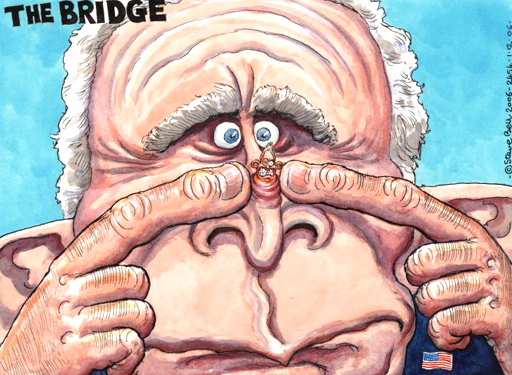
In Australia's case of the "special relationship" there is little independence in foreign policy within that special relationship. It's pretty much all the way with Bush in that Australia Australia is the deputy sherrif of the USA in its own region. The idea of the special relationship remains all but uncontested. The political class in Canberra unanimously accepts the alleged benefits of close ties: privileged access to high-end intelligence, the vital role of the US in the upkeep of Anzus and the fact that the special relationship allows a medium-sized post-colony to punch above its weight.
Both Britain and Australia have been the staunchest allies of the Bush administration and its doctrine of pre-emptive war to protect and defend its empire. Though the Bush adminstration is battered and isolated, and with little credibility, in Australia there has been little consideration given to working out what sort of "special relationship " would be appropriate with the next US administration. The conservative political class is still locked into marching with the Washington neo-cons; those at the Weekly Standard and Fox News who are calling for increasing the size of the U.S. force in Iraq. That is their response to the main recommendation of the Baker- Hamilton "Iraq Study Group"--withdrawal by early 2008, covered by negotiations with Iran and Syria.
The brute reality, which is never spoken in Australia, is expressed by John Bolton, America's UN ambassador. He states that America will always remorselessly pursue its interests and other nations must follow simply in deference to American power. So America's relationship with Australia is totally one-sided. What has Australia got to show for it?
If closeness to America is “the only game in town” as the political class says, then it need one of Australia being on its knees.