January 31, 2007
beyond rights
This guest post by John C. Halasz picks up on, and criticizes, the recent explorations between Montesquieu and Madsion in relation to the state of exception. Montesquieu, in his revision of the social contract tradition of Hobbes and Locke, had argued that the chief and proper aim of political life is the security of rights, best achieved through guaranteeing the rule of law.
Well, the primary "function" of politics is not the securement and protection of rights, but the enablement of (the capacity for) action all around, which is to say, the coordination of action and the establishment of the framework for its regulation. ("Rights" are more a legal institution than a moral foundation. In fact, an exclusive preoccupation with "human rights" is curiously de-politicizing, though perhaps with a different intention, and in a different way, than the neo-liberal streamlining of politics in the name of "efficiency").
Hence, the basic problem here is not how to perfect a mechanism of checks and balances that would guarantee rights over against the usurpations of power, however attractive such rhetoric may be, but rather how to render the "actions" and operations of the state responsive to its public, when the state might be subject to conflicting steering imperatives and the public might be conflicted amongst itself, which is to say, both limit excessive state power and balance public interests. This is a matter of the collective generation and distribution of the "power" that underlies both state and public, conserving and enhancing the capacity for "action", for initiative and response in the political society all round and as a whole, under ever changing historical circumstances and conditioning "forces".
Rights, which are always collective institutions, conventional and variable rather than intrinsic in "nature", are, after all, just as much capable of coming into conflict as agents, and no appeal to a "disinterested" juridical procedure can per se guarantee the preservation of a system of political rights, but, to the contrary, aside from threatening a disabling encumberance of action with over-juridification, judicial decisions can be quite simply politically disasterous, (e.g. the Dred Scott case). (To re-enforce this point, just consider the way in which right-libertarians absolutize "property rights", promoting legal doctrines such as "takings", which effectively destroy any collective right for deliberation over the common good).
But that's precisely the point that Schmitt was making, in however repugnant a fashion, with his definition of the sovereign as the one who has the capacity to decide the exception, which up to a point is purely formal, not specifying who or what that "one" is: no legal system is autonmously self-subsistent and self-regulating, but rather all legal systems will contain areas of indeterminacy, unpredictable and depending on historical circumstances and conditions, which must be "supplemented" by political decisions.
At this point it doesn't much matter whether the sovereign is declared rhetorically to be "the people" or an inbred idiot, what matters is that sovereignty is a political reality that lies at once within and outside of a legal-constitutional system, as the constituting power that decides the constituted power of legal and governmental "authority", that conserves the possibility of collective action. Only with this realization does the question of the "nature" of the sovereign, its who and what, come to the fore amidst political conflict and struggles for consensual "legitimation" under shifting historical conditions.
But the further point that Schmitt then makes, in his preoccupation with the predicament of the Weimar Republic, is that, under modern conditions, sovereignty itself becomes increasingly de-stabilized by the increasing interpenetration of national and international "politics", given rise to conditioning "forces" that are outside of any possible sovereign legal-constitutional order.
With that point, it's possible to see the Bushevik "unitary executive" not so much as a tyrannical usurpation of individual or societal rights on the part of a constituted executive power, but rather a a transmission point of "external" conditioning forces, namely the whole "machinery" of corporate globalization and geo-political militarism, whose requirements for streamlined "decisions" attempts to impose itself on "forces" it ultimately does not and can not control, in the process destroying rather than conserving public power, in the relevant sense.
"Tyranny" might, indeed, be an apt description of what has and is happening, but less as a violation of a constituted order of rights by an overweening constituted executive power than as an expression of organized forces of societal reification that have grown up within the constituted order, breeching its constitutive power. And that's a matter for political struggle within the gathering catastrophe, (since Bush's primary political talent is his ability to kick the can down the road), rather than simply a matter of remediation of legal controls.
January 30, 2007
Montesquieu + the role of independent judicial branch
Montesquieu's influence on Madison and the American founders, particularly evident in the theory of separation of powers that informs the United States Constitution, is well noted. In Federalist Papers, No. 10 Madison's key question is how to eliminate the negative effects of faction or interest. His answer is the general application of the checks and balances principle, which is now central to the American constitutional system. Madison emphasizes that the greater size of the federated Union will allow for more effective governments than were the states to remain more independent. So we have a republic of diverse interests, which was contested by the Anti-Federalists who opposed the union. Secondly, Montesquieu was the first theorist to propose an important judicial branch and function institutionally discrete from the legislative and executive powers. Locke, in contrast to Montesquieu, considered judicial power to be a mere sub-set and institutional sub-division of legislative power. The Framers of the U.S. Constitution followed Montesquieu, rather than Locke, in structuring the branches of the federal government; and the door is opened to the rival conceptions of the separation of powers in constitutional interpretation.
What then of Montesquieu? How does he fit into the Hobbes/Locke trajectory in modernity? Does Montesquieu reject the social contract theory of politics most often associated like Leo Strauss? Or does Montesquieu rework it? If so, then how does Montesquieu address the Lockean attempt to found the state upon the securement pre-given natural rights to the pursuit of individual interests and happiness?
Montesquieu most agrees with Hobbes in a critique of natural law as understood in the tradition. Montesquieu, like Hobbes, rejects the tradition as containing an inadequate understanding of nature, a rejection in both thinkers clearly associated with the rejection of teleology within the new science and philosophy of the seventeenth century.
Montesquieu argues that Hobbes misunderstands human nature as much as the ancients, for he fails to appreciate the "flexible" or, the "historical" character of humanity. Montesquieu also disagrees with Hobbes, and follows Locke on the true normative foundation--natural right. He does not see natural right as Hobbes does, as "a right of every man to everything, including one another's body," or as a simple liberty. He rather follows Locke in grasping natural rights as self-ownership and thus as containing within it limitations such that no one has a natural right to "another's body," or goods.
In Locke, self-ownership flowers into the rights of life, liberty and estate, and the proper or legitimate end of government is preservation of the objects of these rights. In Montesquieu self-ownership more simply leads to the standard of liberty: the rational or good order is the one that is free. Montequieu differs somewhat from Locke in the emphasis on liberty (rather than rights-securing) and on liberty as security, or the opinion of security. Montesquieu on the whole subjectivizes the criteria of political right. The good order is not so much a certain kind of order per se, but the order that produces a certain subjective state in the citizens.
Montesquieu's conception of the function of courts was as promoters of moderation and liberty under the separation of powers. His central notion is that an independent judicial branch, as a part of the separation of powers, is the primary institutional means of promoting a complex of values, including moderation, gradual reform, liberty, and individual tranquility, within the constitutional design. An independent judiciary is specially suited to perform this incrementalist “moderating” or “liberalizing” role.a properly structured government will contain an independent judicial branch designed to exercise a moderating power for incremental liberal legal reform via humane interpretation of the law. Indeed, given the traditionalist and aristocratic character of the judiciary, this authority can be exercised in a subtle and unobtrusive or “cloaked” fashion, allowing the courts to “imperceptibly mitigate the severity of the law,” accomplishing reforms while causing minimal political disruption and without provoking a political backlash
January 29, 2007
natural right
As is well known Leo Strauss had argued in terms of a break between ancients and moderns. He argued that this break, or discontinuity, was begun by Machiavelli and Thomas Hobbes took the Machiavellian intellectual reorientation and applied it to the natural law tradition. With Hobbes and his later followers like John Locke, traditional natural law was replaced by a modern doctrine of natural rights, namely the concept of subjective right. Subjective right is pure liberty without a correlative duty and the entire political realm must be construed in terms of, and for the sake of, this kind of right.
Over at the Claremont Institute Thomas G. West, in a review of Michael Zuckert's Launching Liberalism, says that for Hobbes no less than Locke:
the ultimate touchstone for determining what is right is what promotes human happiness. That is why Hobbes's famous chapter 13 of Leviathan is entitled "Of the Natural Condition of Mankind as Concerning Their Felicity and Misery." That title implies that the state of nature is bad not just because it threatens our life, but because it is inimical to human happiness. In the natural state, life is "short," to be sure; violent death is a constant menace. But life there is also "solitary, poor, nasty, brutish"—defects that contribute to human unhappiness but not necessarily violent death. These defects are not remedied by the security of mere life, but only by civilization, morality, education, the sciences, and friendship, all of which presuppose civil society.
I've always understood that Locke's ground for individual natural rights and limited government is self-ownership: the idea that all human beings own themselves. I've interpreted Locke, less as a Christian natural law thinker, and more as a Hobbesian; human rights do not reflect God's dictates but arise from the struggle for self-preservation. What Locke did was accept the social contract framework and challenge Hobbes' statism.
I guess this interpretation is important because Locke was an important philosophic source for the founding generation Americans. I've generally interpreted Madison as developing the theory of federalism, which made possible a a new kind of union, and developing a theory of republicanism, which made possible an altogether new kind of republican government. Republicanism here means democratic government (not hereditary ruling groups) and that such government must govern with respect for the human rights of its citizens. The Americans were the first to commit themselves to liberal (rights respecting and securing) democracy as solely legitimate.
On the Lockean interpretation the founding documents of the US state that all power is originally vested in, and consequently derived from, the people. That government is instituted and ought to be exercised for the benefit of the people; which consists in the enjoyment of life and liberty, with the right of acquiring and using property, and generally of pursuing and obtaining happiness and safety. That the people have an indubitable, unalienable, and indefeasible right to reform or change their government, whenever it be found adverse or inadequate to the purposes of its institution.
Political power, according to this theory, traces back to the people and nowhere else. Thus the people are sovereign. Rulers possess what are, in effect, delegated powers. The people empower government for the sake of
their own good, not the good of the rulers. Thus the exercise of political power is to be judged according to whether it serves that good. This understands the good for the sake of which government is created as the security of preexisting (i.e., natural) rights, or the objects of preexisting rights--“the enjoyment of life and liberty, with the right of acquiring and using property; and generally of pursuing and obtaining happiness and safety.”
January 28, 2007
Few Against Few
Defense Secretary Robert M. Gates warned that a proposed Senate resolution criticizing the deployment of additional troops would embolden the enemy. "Any indication of flagging will in the United States gives encouragement to those folks," Gates told reporters at the Pentagon. "I'm sure that that's not the intent behind the resolutions, but I think it may be the effect."
From Carl Schmitt's The Concept of the Political:
A people which exists in the sphere of the political cannot in case of need renounce the right to determine by itself the friend and enemy distinction. ... The solemn declaration of outlawing war does not abolish the friend-enemy distinction, but, on the contrary, opens new possibilities by giving an international hostis declaration new content and vigour.Were this distinction to vanish then political life would vanish altogether. A people who exists in the political sphere cannot, despite entreating declarations to the contrary, escape from making this fateful distinction. If a part of the population declares that it no longer recognizes enemies, then, depending on the circumstance, it joins their side and aids them.
The last sentence is arguing similarly to Gates, those that do not recognize the enemy, and the imperative to unify against the enemy, are ultimately traitors. Liberalism seeks positive outcomes through equality, so hard antagonistic lines are replaced with debate and competition, not violence. In Schmitt's philosophy, those that advocate liberalism become traitors to the 'political'.
It is interesting to see Schmitt and Agamben's different definition of political. To Schmitt the political is the final, singular and absolute arena of authority. Law does not come into it. Agamben defines political action in State of Exception as:
The only truly political action, however, is that which severs the nexus between violence and law.
Schmitt has extended the Hobbesian all against all to be many against few in the friend-enemy distinction. But that is not true, it is the appearance of friend-enemy, as the friend and enemy is defined by the executive, especially in a state of exception. Consequently Schmitt's friend-enemy distinction, rather than being many against few, is really few against few where the first few is the executive, and the latter few is those that have been given the appearance of law but suffer at executive whim.
I still cannot disconnect the state of exception from executive tyranny. The exception exists as a political arena where there is the appearance of law but due to the executive adopting executive, legislative and judicial powers outside of the reach of constitutionalism, there is, as Agamben argues, no force of law. The executive chooses not to enforce the law, and the other branches are either willingly surrendered their responsibilities, or cannot reach into that area by constitutional restrictions.
This is executive tyranny. Tyranny does not have to be absolute to be destructive. It can be insidious such as in arbitrary government, or in the case of a state of exception, it can exist despite the restrictions on government action by a constitution.
So how to redress it?
One: Any individual under the jurisdiction of the government must be able to sue that government through the judicial for their full political rights. This means constitutions, and consequently the branches of government, must define the citizen as an individual under the jurisdiction of the government. No longer must citizen be defined by accidents of birth, or swearing to the tribe. Full political rights must be extended to any individual under the jurisdiction of any branch of government. This is completely consistent with liberalism and republicanism.
Two: There must be no action of the executive which is outside of legislative or judicial scrutiny. Australia is always going to suffer in this area as the political technologies it has chosen for government are not republican. The federal and state governments combine their executive and legislative into the one parliamentary body. Australia does also not have a history of rigourous political rights - our history has been full of government overreach and arbitrary action against the politically and electorally weak.
January 27, 2007
Schmitt and Benjamin
In his review of Giorgio Agamben's State of Exception Brett Neilson argues that Agamben develops a criticizism of Carl Schmitt by turning to a debate on the role of violence between Schmitt and Walter Benjamin. For Agamben the task of a radical politics is to break the link between violence and the law.
Neilson interprets one strand of Agamben's countermovement to Schmitt in terms of Agamben's reading of the debate on the state of emergency between Carl Schmitt and Walter Benjamin from 1928 to 1940. Neilson says that Schmitt's theory of sovereignty must be read as response to Benjamin's essay 'Critique of Violence.'
Neilson summarizes the debate between the two thus:
In this 1921 essay, Benjamin posits the existence of a 'pure' or 'revolutionary' violence--that is, violence outside the law, a violence that ruptures the dialectic between the violence that institutes the law (constituent power) and the violence that upholds the law (constituted power). Agamben argues that the state of emergency is the means invented by Schmitt to respond to this postulation of a pure violence. For Schmitt, there can be no violence absolutely exterior to the nomos, because revolutionary violence, once the state of emergency is established, always finds itself to be included in the law. Benjamin's definitive response to Schmitt is the famous passage in 'Theses on the Philosophy of History' where he surmises that 'the "state of emergency" in which we live is not the exception but the rule.'
For Benjamin, the state of exception leads not to the restoration of legal order but to a generalized catastrophe in which the the transcendental claims of sovereign power are vanquished.
Neilson finishes there, with out evaluating the debate. The contemporary states of emergency in the war on terrorism support Schmitt's thesis that the sovereign who proclaims the state of emergency (ie., President Bush in the US) remains anchored in the legal order. Schmitt's insight is that the peculiar status of the exception allowed for by law derives from the condition that it is a factual situation that cannot be normatively predicted. When an exception to a rule is declared, this is not outside of rules as something altogether exterior to the juridico-political order. Instead, the act of suspension itself creates a relation between the rule and its exception, declaring what lies outside the rule to be an exception and thus, and only thus, giving the rule a coherence and validity. The exception proves, or rather constitutes, the rule.
January 26, 2007
a new federalism
A new federalism dawns in Australia:
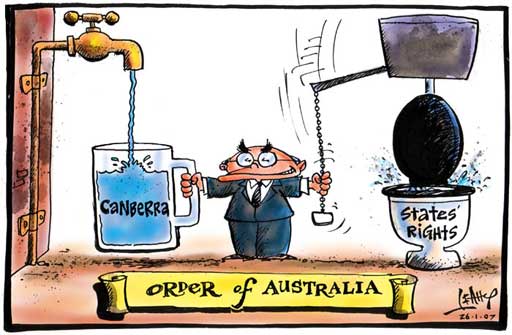
The commonwealth takeover is understandable as the states, for all their talk of co-operative federalism, have really made a mess of water. They were responsible for the over-allocation of water in the Murray-Darling Basin,and they have been too concerned to protect the irrigated agriculture interests within their borders to claw back the over-allocations to ensure environmental flows in the Basin's rivers. The states, in short, have botched it.
Mike Steketee, writing in The Australian says that the pace of co-operative federalism is not suited to a crisis, which is what the water situation has become. Last November's projections by the Murray-Darling Basin Commission of a continuation of present conditions showed dams running dry by April or May this year. Inflows into the Murray last year were 40 per cent of the previous record low, putting at risk cities, towns and communities dependent on irrigation. He adds that:
Howard is asking the states to refer powers to the commonwealth because he would be on shaky constitutional grounds in forcing a wholesale takeover. The Murray-Darling Basin Commission is not set up as a company, so he cannot use the corporations power of the Constitution, as he did with industrial relations. He intends reconstituting the commission as a commonwealth agency reporting to Malcolm Turnbull as the new Minister for the Environment and Water Resources. Given Turnbull's energy and drive, that will overcome a few of the previous problems of slow decision making.
January 25, 2007
a counter-moverment to a state of exception?
Brett Neilson, from the Centre for Cultural Research at the University of Western Sydney, has a very interesting review of Giorgio Agamben's important text State of Exception (2005), which he reads as a critique of Schmitt's understanding of the state of exception as dictatorship.
Nielsen highlights Agamben's argument about the inextricable link between the state of exception and the normal functioning of the liberal democratic state. Far from being a hallmark of totalitarian rule, the state of exception, which 'presents itself as a zone of indetermination between democracy and absolutism' , is becoming a normality in the sense that 'the constitutional use of emergency powers is becoming the rule and not the exception.'
Neilson says:
To deepen his case against Schmitt, Agamben offers an analysis of the Roman republican convention of the iustitium--an ancient precedent for the state of exception. When the Roman senate was alerted to a situation that seemed to threaten or compromise the republic, they pronounced a senatus consultum ultimum. This involved the declaration of a tumultus or a state of emergency whose consequence was the proclamation of the iustitium. The iustitium involved not a suspension of the framework of justice but a suspension of the law itself....Agamben distinguishes the legal void of the iustitium from the paradigm of dictatorship. Under the Roman constitution, a dictator was a special type of magistrate selected by the consuls, whose wide powers were conferred by means of a lex curiata that defined their scope. In the iustitium, by contrast, there was no creation of a new magistrate. The powers enjoyed by the magistrates under the iustitium resulted not from the conferment of a dictatorial imperium but from the suspension of laws that limited their actions.
Neilson says that Agamben points out that the same is true for modern emergency powers in liberal democratic regimes---it is a mistake to confuse the state of exception with dictatorship.
Schmitt and Australian Republicanism
One of the hard parts of Carl Schmitt's writing is determining what he calls the 'political'. Tracy Strong writes in the introduction to The Concept of the Political that to Schmitt it is "the arena of authority rather then general law and requires decisions which are singular, absolute and final". Since that is his definition of the political it is easy to see how Schmitt made the leap to believing that the only determinant of true sovereignty is a governor who operates under a state of exception.
The executive is the only presidential or parliamentary position that has any constitutional allowance for singular or absolute action. Unsurprisingly the executive is a position that republicans distrust the most and seek to place the greatest restrictions on through constitutionalism, bills of rights, separation of powers and check and balances. Not to mention popular elections and term limiting.
When state of exceptions do occur under constitutional system they are usually done so with the legislative and judicial willingly surrendering their authority into the executive so that the president or prime minister becomes the sole governing authority. Under republican doctrine this is tyranny and unacceptable. At this point liberal republican government collapses and is replaced with the arbitrary whim of the executive.
Schmitt believed that the crisis in liberalism was that it had no political. Liberalism and democracy supposedly finds temporal truths through compromise, horse-trading, bartering and all the messiness of a system comprised of free individuals acting in their self-interest. This is repugnant to Schmitt as the temporal nature of democratic truths lack the absolute truth of authority - which must be final (according to Schmitt).
He writes:
The specific political distinction to which political actions and motives can be reduced is that between friend and enemy.
Schmitt's complaint is that liberalism reduces the enemy to a competitor in the economic sphere and a debater in the political sphere - which by Schmitt's definition of the 'political' removes the absolute nature of authority. To Schmitt, this is a crisis of political legitimacy that liberalism suffers.
Schmitt is actually arguing that liberalism denies absolute tyranny - which is what singular authority is, and is what a state of exception is. Tyranny is political violence, even in its insidious form, which we know as arbitrary government.
Schmitt is concerned that liberalisms temporal nature of friend and enemy denies the capability of an absolute political - which is only achieved if there is a permanently morally, ethically and aesthetically repugnant enemy for the 'political' to wield its final authority on.
Like most supporters of tyrants, the enemy target is usually a domestic politically weak minority. Unsurprisingly Schmitt wrote anti-Semitic texts in support of the Nazis. His political philosophy underpins many of the exceptions and emergency political decisions of the Third Reich.
Liberalism extends from the enlightenment and was a response to the absolute rule of monarchs who derived their power to rule through divine right and hereditary lineage. The rationalism from writers such as Locke, Hume, Smith, etc took the irrational out of the political power, enabling the individual to have a political life of religious and economic freedom.
Political institutions that appealed to irrational legitimacy, such as the church and monarchs, could not survive in such a system. With this change in worldview came the elevation of the individual above mysticism such that political rights were subject to reason as well.
It is irrational for an individual to willingly place themselves in a political system that enables them to suffer from tyranny. Schmitt's analysis will always suffer from this, it asks for the irrational elevation of a state of exception so the 'political' can retain absolute authority. This is in complete opposition to republicanism which reasons political equality as the end result of individuals expressing their political freedom.
Marxism was once the opponent to liberalism but is now being replaced with Schmittian Conservatism . If there is a binary friend-enemy descriptor in republicanism it is liberty-tyranny. Tyranny is repugnant to republicanism - thus the Schmittian 'political' has to be as well.
January 24, 2007
reconsidering imperialism
This review of David Harvey's The New Imperialism, (Oxford, Oxford University Press, 2003) There is an interview with David Harvey by Harry Kreisler here.
The reviewers say that Harvey's position is that this new imperialism is based on two pillars:
The first concerns the use, on behalf of the State, of a set of political, military and diplomatic strategies and the second the development of economic power within an open space. Capital exports take place in space as well as in time, via huge investments marked by long- range profitability and via the creation of new products, new markets and news systems of production. It is also the combination of the two pillars that creates different forms of accumulation.The originality of Harvey’s analysis is that he succeeds, on the one hand, to highlight the correlation between American hegemony and neo-liberal strategy and, on the other hand, to underline the correlation between different historical phases of imperialist development and different accumulation regimes.
Harvey has a twofolded explaination for the war against Iraq. First of all, there is the need to access the most oil fields located in the Middle East. Secondly, the defeat of the Democratic ticket in the 2000 presidential election and the events of 9/11 resulted in a remarkable change in the policy-making of the White House: neo-conservatism displaced neo-liberalism and coercion replaced consent.
The neo-liberal strategy was that of the Washington consensus: a worldwide effort to open up markets and international institutions, such as the International Monetary Fund and the World Bank, strengthen the position of American finance capital, impose policies of austerity on less developed countries and policies of privatization (telecommunications, transportation, social housing etc.) that created new spaces of profitability for the over-accumulated US capital. Harvey argues that there was an inner contradiction to neo-liberal imperialism:
the decline in American manufacturing meant that this whole emphasis on a violent form of finance capitalism was in fact some sort of recycling of finance capitalism that could not keep generating income for too long. Not only was neo-liberal imperialism inherently volatile — Harvey describes it as a way to orchestrate volatility and credit and liquidity crises ...but also it was based on the actual decline of American manufacturing and the emergence of sub-imperialist competitors.
So the neo-conservative stress on military power and interventionism was a sort of reaction to the economic competition from rival capitalist countries, an effort to counterbalance the economic advancement of the other developed capitalist economies (Western Europe, Japan and South-east Asian economies), through the use of military and political force.
This means a new balance between the territorial and capitalist logic of power. It is also important that neo-conservatism is not only a foreign policy agenda; it is also a turn towards more authoritarian rule at home, and a more conservative ideological agenda
Finally, we have a consideration of the political by a Marxist that does not reduce it to the economic.
January 23, 2007
liberalism v democracy
This post is based on comments I made to a post by Don Arthur entitled Martin Amis and the agonies of ‘wet’ liberalism over at Club Troppo. Though that post was concerned with relativism, it also referred to earlier debate on a post by Don entitled Mad, bad or just plain stupid?, which explored the tensions between liberalism and democracy.
These tensions had been explored by Schmitt in terms of different logics. Schmitt argued that the pluralist logic of liberalism refers to each individual having the freedom to pursue their own happiness as they see fit, to set their own goals and to achieve them in their own way. What is abandoned is the substantive conception of the common good and that of eudaemonia. The logic of identity of democracy refers to the logic of identity between governors and governed, between the law and popular will, that has its basis in the sovereignty of the people.
The two logics joined in the 19th century and they can separate again. When they joined liberalism wasn’t all that keen on democracy and some strands still aren’t. Witness Hayek, or the reduction of democracy to procedures to elect political elites, or market liberals who think that political governance should be constructed on corporate lines with the PM as CEO. The ‘restrict democracy’ is the heritage of liberalism, whether it be the strands represented by J.S. Mill, T.H. Green, F.A. Hayek, or R. Rorty.
Liberals like Ludwig von Mises and Max Weber argued that the social and economic institutions of liberal capitalism were the essence of modernity, could not be transcended, and that there was only one viable form of modernity. that leaves us with Weber’s iron cage , which includes the structures of liberal democratic regime, as in our current political system. which is not really designed to function in a directly democratic way. The combination of representative democracy, the party system, cabinet government, prime ministerial power and the permanent ‘impartial or neutral’ public bureaucracy gives us a curious oligarchic-democratic hybrid, which is specifically intended not to open up ‘genuine substantial power’ to the sovereignty of the people.
Currently liberalism is under attack from conservatives from within the liberal democratic regime, so then we place the emphasis on democracy—its got more potential. The place to begin is to make the liberal democratic institutions more democratic by addressing executive dominance. Don Arthur, in contrast, places the emphasis on liberalism, as do classical liberals and libertarians. Both of the latter, unlike social liberals, want to limit what any democracy can do. As Jason Soon says in the comments to the Mad, bad or just plain stupid?:
Politics is ...the sphere which disproportionately attracts the mediocre and the banal, it is a necessary evil and something everyone should hold their nose doing. Libertarians only enter politics in the hope of eradicating as much of it as possible by substituting voluntarist institutions like markets.
Hence their emphasis on negative liberty to limit the state, the division of liberalism into two camps (classical and social), and the rejection of social liberalism as an authentic or true liberalism .
Introducing morality---individual conscience, autonomy, equality–---into the liberal democratic equation does put into question the libertarian claim that liberalism is based on negative liberty. Once individual freedom becomes an end in itself --as many liberals accept, then the principles of self-determination and self-realization become central, and are used to modify the self-interest foundation of classical liberalism based on the interests (and or rights) of property owners. Individuals as responsible agents and equals lies at the heart of the project of modernity that has developed (evolved?) within Western civilization.
January 22, 2007
the failings of the modern left?
Observer columnist Nick Cohen asks, 'Why is it that apologies for a militant Islam which stands for everything the liberal left is against come from the liberal left? The question refers to the neo-conservative claim that those who opposed the Iraq war opposed the overthrow of a fascist regime of Saddam Hussein. This 'you are with us or against us' ---if you did not support the Iraq war, you were for the other side' ---was the talking point of the Bush Administration and dutifully followed by the Howard Government.
The extract below is from Nick Cohen's book about the failings of the modern left entitled What's Left: How Liberals Lost Their Way. Nick Cohen is an author, columnist and signatory of the Euston Manifesto and publishes in the New Statesman. In the extract Cohn argues that anti-Americanism has left it blind to the evils of militant Islam. In the extract published in the Guardian he asks, 'why is the world upside down? ' He spells out what he means:
In the past conservatives made excuses for fascism because they mistakenly saw it as a continuation of their democratic rightwing ideas. Now, overwhelmingly and every where, liberals and leftists are far more likely than conservatives to excuse fascistic governments and movements, with the exception of their native far-right parties. As long as local racists are white, they have no difficulty in opposing them in a manner that would have been recognisable to the traditional left. But give them a foreign far-right movement that is anti-Western and they treat it as at best a distraction and at worst an ally.
Few on the Australian left supported the regime of Sadam Hussein. It was recognized as a form of totalitarianism that oppressed the Iraqi people. Nor does the main currents of the Australian Left within the liberal tradition support the current Iranian theocracy; it is the democracy movement within Iran that is supported, not theocracy.
The answer Cohen gives to his question about why the liberal left supports militant Islm is that there is a confusion on the left following the collapse of socialism and the poverty of social democracy as to what the left stands for or means:
A part of the answer is that it isn't at all clear what it means to be on the left at the moment. I doubt if anyone can tell you what a society significantly more left wing than ours would look like and how its economy and government would work (let alone whether a majority of their fellow citizens would want to live there). Socialism, which provided the definition of what it meant to be on the left from the 1880s to the 1980s, is gone. Disgraced by the communists' atrocities and floored by the success of market-based economies, it no longer exists as a coherent programme for government. Even the modest and humane social democratic systems of Europe are under strain and look dreadfully vulnerable.
Surely socialism in the Soviet Union and social democracy in the UK or Australia are different kinds of regimes and resulted in a conflict and antagonism between these differnt strands of the Left Secondly, it is difficult to see how the rethinking of social democracy and the welfare state after the intervention of neo-liberalism leads to Anti-Americanism, support for fascist regimes, or siding with militant Islam. Cohen says:
My argument is that its failure has brought a dark liberation to people who consider themselves to be on the liberal left. It has freed them to go along with any movement however far to the right it may be, as long as it is against the status quo in general and, specifically, America. I hate to repeat the overused quote that 'when a man stops believing in God he doesn't then believe in nothing, he believes anything', but there is no escaping it. Because it is very hard to imagine a radical leftwing alternative, or even mildly radical alternative, intellectuals in particular are ready to excuse the movements of the far right as long as they are anti-Western.
So the left is anti-American, anti-western and, by implication, anti Enlightenment, even it is still a part of the liberal tradition. It's a strange thesis given that many of the left are critical of American foreign policy-- as they have been since the 1970s. One can be critical of American foreign policy in the Middle East and critical of Iran, Syria and fundamentalist Islam. One does not necessarily follow from the other. Differences are being collapsed all over the place in this text.
One can accept the collapse of socialism at the end of the twentieth century without accepting Cohen's thesis of a dark night of moral nothingness. Four options come to mind: oblivion and transvaluation that entail a historical break with socialism; mutation in the sense of historical continuity in the form of memory and tradition that is handed down to latter generations; or redemption in the sense that at the nadir of its existence socialism is reborn, purged of its flaws and enriched by borrowings from other traditions.
Nor do I accept Cohen's claim that 'intellectuals in particular are ready to excuse the movements of the far right as long as they are anti-Western'. The Bali bombings by Jemiah Islamiyah were condemned in Australia not condoned or excused.
January 20, 2007
facing cultural breakdown
A quote from Jonathan Lear's Radical Hope: Ethics in the Face of Cultural Devastation (2006).This is a text that addresses the vulnerability in pur way of life. The text argues that humans, are by nature cultural animals, in that we necessarily inhabit a way of life that is expressed in a culture. But our way of life --whatever it is-- is vulnerable in various ways. And we, as participants in that way of life, thereby inherit a vulnerability. Lear says:
We live at a time of a heightened sense that civilizations are themselves vulnerable (to destruction, devastation and extinction). Events around the world --terrorist attacks, violent social upheavals, and even natural catastrophes--have left us with an uncanny sense of menace. We seem to be aware of a shared vulnerability that we cannot quite name. I suspect that this feeling has provoked the widespread intolerance that we see around us today --from all points on the political spectrum. It is as though, without insistence that our outlook is correct, the outlook itself might collapse. Perhaps if we could give a name to our shared sense of vulnerability, we could find better ways to live with it
Should our way of life break down, that is our problem. Such vulnerability has to do with the possibility of losing the core concepts in terms of which we understand ourselves, the world in which we live, and which give meaning to our lives individually and collectively, and finding ourselves subsequently confronted with the radical possibility of 'happenings' breaking down and becoming meaningless.
Don't we already have a name for that kind of cultural breakdown--the one Nietzsche gave to it. Nihilism? So how should we face the possibility that one's culture might collapse in this sense?
January 19, 2007
a note on the Israeli Lobby
Alexander Cockburn makes an interesting observation over at CounterPunch about the Israeli Lobby's attempts to discredit Jimmy Carter’s book Palestine Peace Not Apartheid, by labeling him an "anti-semite." Cockburn says:
The Israel lobby retains its grip inside the Beltway, but it’s starting to lose its hold on the broader public debate. Why? You can’t brutalize the Palestinian people in the full light of day, decade after decade, without claims that Israel is a light among the nations getting more than a few serious dents. In the old days, Mearsheimer and Walt’s tract would have been deep-sixed by the University of Chicago and the Kennedy School long before it reached its final draft, and Farrar, Straus and Giroux wouldn’t have considered offering a six-figure advance for it. Simon & Schuster would have told President Carter that his manuscript had run into insurmountable objections from a distinguished board of internal reviewers. But once a book by a former president with weighty humanitarian credentials makes it into bookstores, it’s hard to shoot it down with volleys of wild abuse.
Carter challenges the Israeli Lobby's central claim that what is holding peace back is primarily the perpetuation of Arab/lslamist rejectionism of Israel period. It holds that rejectionism---is the position of the Iran-Syria-Hezbollah-Hamas axis, that is bidding for regional hegemony. It argues that by essentially agreeing with them that all the region's problems are connected to Israel, well intentioned outsiders are strengthening rejectionism, thereby compounding the obstacles to peace and weakening the region's moderates intimidated by this resurgent rejectionism.
Cockburn adds:
The trouble with the lobby and the Christian zealots who act as its echo chamber is that they believe their own propaganda about Israel’s equitable social arrangements and immaculate political and legal record in its relations with the Palestinians. Use the word apartheid and they howl with indignation. The shock is about thirty years out of date. Israeli writers have used the word apartheid to describe arrangements in the occupied territories for years. Hundreds of prominent South African Jews issued a statement six years ago making the same link.
January 18, 2007
Adam Smith: ethics and markets
Adam Smith is more interesting than his neo-liberal or free marketeer interpreters have made out. Their Smith is the theoriest of free markets. However, as Edward W. Younkins argues, Smith links morality and markets in his two books, the Theory of Moral Sentiments (TMS,1759) and the Wealth of Nations (WN,1776). Younkins says:
There is no discontinuity between the Smith of TMS and the Smith of WN – there are not two Adam Smiths. WN fits into the moral framework of TMS. There is a logical flow from Smith's moral philosophy to his jurisprudence and political economy. Exchange is shown to occur within the moral framework of his first book. TMS provides the foundational concepts of human nature and morality upon which the ideas of WN rest. Smith's two books provide a systematic and essentially unified whole in which moral and economic ideas are coordinated and integrated. Both are integral parts of his vision of man and society. The commercial man of WN and the benevolent man of TMS are not two different men.
The neoliberals are concerned with the Wealth of Nations and ignore the Theory of Moral Sentiments as their concern is about the economy and not civil society. They are not concerned with Smith's account of the process by which individuals adopt moral standards through which they judge actions by others and themselves; a process whereby individuals can overcome the selfish impulses of the commercial realm by recognizing that there is more to life than economics and politics and that men possess more than self-regarding sentiments. So how do we understand Smith's ethics?
Over at Club Troppo Don Arthur says that Smith bases his ethics on empathy and emotion:
In The Theory of Moral Sentiments he argued that moral judgment relied on our ability to imagine ourselves in another person’s place. As Eamonn Butler puts it, "morality is the product of our nature, not our reason". Of course Smith acknowledged that reason had a place in generating general rules of conduct– but the ability to empathise came first. Without empathy we wouldn’t know which rules were right and which were wrong.
Though Smith does start from innate sentiments (feelings or emotions) as the basis of moral judgment he makes the shift to virtue. Younkins says:
Smith delineates two levels of virtues. His lower or commercial virtues are self-interested ones and include prudence, justice, industry, frugality, constancy, and so on. Another set of virtues, the primary or nobler virtues, includes benevolence, generosity, gratitude, compassion, kindness, pity, friendship, love, etc. According to Smith, the four principal virtues in a person's life are justice, prudence, benevolence, and self-command. It is through the exercise of self-command, Smith's cardinal virtue, that a man can rein in his selfish impulses, regulate his conduct, and indulge benevolence. Self-command involves the ability to control one's feelings, to restrain one's passion for his own interests, and to enhance his feelings for others.
Virtue links us back to classical Greek ethics whilst his view that the most virtuous of men govern themselves by self-command, connects with Stoicism.
January 17, 2007
Mouffe & Schmitt on liberal democracy #2
I want to return to, and pick up on, this earlier post. This was based on Chantal Mouffe's text The Return of the Political, and it explored the tension between the pluralist logic of liberalism and the logic of identity of democracy in liberal democratic regimes.
Mouffe relies on Schmitt to explore the tensions between the two logics. She says that the pluralist logic of liberalism refers to each individual having the freedom to pursue their own happiness as they see fit, to set their own goals and to achive them in their own way. What is abandoned is the substantive conception of the common good and that of eudaemonia. The logic of identity of democracy, on her account, refers to the logic of identity between governors and governed, between the law and popular will, that has its basis in the sovereignty of the people.
Mouffe rightly argues that how we understand democracy today is in its modern liberal form. She says that:
we now have to examine the liberal problematic in order to determine which of its different elements must be defended and which rejected if the aim is to provide the liberal democratic regime with an ethical and philosophical content .....To defend liberalism whilst at the same time accepting the criticisms Schmitt makes of individuals and rationalism, we must separate what constitutes liberal thinking's fundamental contribution to democratic modernity--namely pluralism and the whole range of institutions characteristic of poltiical liberalism---from the other discourses that are often presented as forming an integral part of liberal doctrine. (p.123)
This gives us a cutdown liberalism. For instance, Mouffe argues that rationalism---understood as the dictates of universal (foundational) reason--- needs to be prised away (revised) and replaced by reason understood as argument, persuasion and rhetoric.
Another strand of liberalism that needs to be cut away is the liberal doctrine of the neutrality of the state. The neutrality thesis holds that in order to respect pluralism and not to intefere with the freedom of individuals to chose their own goals it is necessary to deny any authority to the state re it promoting or facilitating a particular conception of the good life. It needs to be dropped because the liberal state does promote some forms of life and forbids others in that it promotes the liberal way of life based on personal freedom or autonomy.
Another strand is the liberal conception of democracy as a set of procedures rather than being based on principles such as equality, freedom or political unity or homogeneity. Though procedures are required they are not enough to create the political unity of democracy.
January 15, 2007
Why Zizek for Political Theory?
I know next to nothing about Slavoj Zizek in relation to political theory. I see him as a psychoanalytically orientated cultural critic whose central concept is enjoyment (jouissance). So I was interested in this article by Jodi Dean entitled Why Žižek for Political Theory? Why indeed was my response. Dean says that Slavoj Zizek’s work is indispensable to any effort to break out of the present political impasse, an impasse in which not only English speaking and European countries are caught but which threatens the entire world. She says that the current emphasis on emphasize diversity and tolerance does not provide an adequate response to right wing fundamentalists, nationalist ideologues, and neoliberal capitalist globalizers.
This motley crew of bad guys eschews debate and respect. It throws generosity back up against the generous, forever accusing them of not being respectful and generous enough. Its capitalist wing finds ever more creative and ingenious ways to profit. Diversity becomes multiculturalism: parents can buy colorful multilingual dolls; producers can make action films with global appeal; educators can buy multicultural teaching kits designed to insure that their students are well-prepared to compete in a global economy. Likewise, democratic debate is easily capitalized: citizens seeking information are ready eyeballs for advertisers; politicians can champion the role of the Internet in keeping their constituencies connected, while telecoms, ISPs, chip, hardware, and software providers wisely nod their heads and pocket their vastly increased revenues.Against, this motley crew, generosity and tolerance won’t work.
The problem of Left political thought, then, is trying to theorize a politics that includes everything and everyone. But this isn’t politics. Politics involves division, saying “yes” to some options and “no” to others. Zizek can provide an a response.
One way Dean argues this is in terms of fantasy. Fantasy keeps our desire alive, unfulfilled, intact as desire. It explains why our enjoyment is missing, how we would have, could have, really enjoyed if only. She adds that the fantasy organization of desire underpins the ideological formation of a community.
An ideological formation is more than a set of meanings or images and more than the accumulated effects of dispersed practices. Rather, ideology takes hold of the subject at the point of the irrational excess outside the meaning or significance the ideological formation provides. This excess, nugget, or remainder marks the incompleteness of the formation and of the interpellated subject. It’s that extra sticking point, a point of fixation and enjoyment (objet petit a). Fantasies organize and explain these sticking points. They cover over the gaps in the ideological formation as they promise enjoyment (the enjoyment that has been stolen, sacrificed, or barred to the subject) and in so doing attach the subject to the group or community supposed by the ideology.
January 13, 2007
Zizek, nationalism, pyschoanalysis
Adam Kostko has a review of Slavoj Zizek's The Parallax View. I'd read the earlier Interrogating the Real and thought it pretty thin as an ideology critique that deployed of Lacanian concepts, which had been established in Tarrying With the Negative .
I was interested in Zizek because he was known for an interesting contemporary theory of nationalism, but Adam doesn't give us much on this as it belongs to the earlier work, which traces the gradual retreat of the liberal-democratic tendency in the face of the growth of corporate national populism. From memory Zizek explains this shift by way of rethinking the notion of national identification from a psychoanalytic perspective, more precisely a Lacanian standpoint, which argued that identities always remain incomplete and that ideologies of nationalism and populism only can operate if they succeed in convincing us otherwise. I was unclear how this account was different from the psychoanalytic work of Theodor Adomo.
Jodi Dean says ina paper entitled 'Zizek against Democracy' that Zizek's interest in nationalism arises from what happened in Eastern Europe after the collapse of communism. She says that Zizek notes in For They Know Not What They Do that:
...in the initial days of communism’s disintegration in Eastern Europe, the democratic project breathed with new life. Democracy held out promises of hope and freedom, of arrangements that would enable people to determine collectively the rules and practices through which they would live their lives. But instead of collective governance in the common interest, people in the new democracies got rule by capital. Their political choices became constrained within and determined by the neoliberal market logics of globalized capitalism already dominating Western Europe, Great Britain, and the United States. What emerged after the communists were gone was the combination of neoliberal capitalism and nationalist fundamentalism, a “scoundrel time”
In this interview Zizek says that:
nationalism is the most cogent language used by many communities in understanding the difficulties thrown up by a destablished world. It seems more realistic than socialism and it also seems to offer more immediate solutions than capitalist liberalism. It is strong, because it psychologically recapitulates the structure of the family. Nationalism represents authority, ensuring guardianship, offering the option of identification and warmth. As such it is here to stay and the post-imperialistic world is an equally fertile breeding ground for nationalism to bloom.
January 12, 2007
another kind of liberalism?
Can, or should a liberal government, worry about the virtue of its citizens and see public life as a kind of exercise in civic and even moral education? If so, how can this be done in a way that isn't coercive and doesn't simply look for already existing overlap among people's different views? Is this the way to create the basis for something public so that we enjoy a good in common that we can't enjoy alone?
Is this a way to rescue morality out of just being identified with the Judeo-Christian tradition and so place our everyday debate about morality and politics within an Enlightenment tradition? Those in the Judeo-Christian tradition often assume that the irreligious have no ethical system, no values or morals that act to "temper" our "base" instincts. Or they say that secular values are "relative" and only Christianity can justifying fundamental values. Or even more extremely, that our secular value system gives rise to totaitiarianism.
January 10, 2007
Quiggin + Farrell on social democracy
To counter the tendency of Australian Libertarians and classical liberals to downplay the political and democracy in favour of economics and the market, we can pick up on an article in the Australian Financial Review (5th January) by John Quiggin and Henry Farrell. The article is built around a review of Sheri Berman's The Primacy of Politics: Social Democracy and the Making of Europe's Twentieth Century.
Berman's text, which works in the tradition of Karl Polanyi's The Great Transformation, looks at the history of social democracy from its origins in the late nineteenth century to today. It argues that soical democracy how it beat out competitors such as classical liberalism, orthodox Marxism, and its cousins, Fascism and National Socialism by solving the central challenge of modern politics - reconciling the competing needs of capitalism and democracy. The review is not online as far as I know, but it has its genesis in a seminar on the Primacy of Politics in 2006, and which has been usefully documented by Henry Farrell.
In his contribution to the seminar Heny Farrell interprets Polanyi's argument to be one:
...on how “society” reacts defensively to the depredations of the free market and its relentless commodification of social relationships. Thus, Polanyi’s famous account of the ‘double movement’ in which the excesses of the market inspire a counter-reaction from society. Under this account, socialism and fascism are related; they are different ways in which society has sought to protect itself from the market. The one is a benign effort to restrain the excesses of the market, the other a malign tendency to protect society at the expense of human freedom.
He adds that Polanyi's causal account of how market excesses provoke a response from society is at best a little hazy, and at worst a theory that doesn’t explain the real choices made by human agents. He traces how Berman both deepens and revises Polanyi’s account by emphasizing how ideas shaped how different individuals, and the political parties that those individuals worked through responded to capitalism’s internal crisis. Berman suggests that social democracy was more than a set of policies, or a compromise between Marxism and liberalism; it was an ideology all on its own. Farrell adds that:
While she doesn’t say it explicitly, her argument suggests that social democrats are really closet Polanyians, concerned to prevent society from being gutted by the market, and imposing the necessary constraints to prevent this from happening. This also makes Berman believe that social democracy is newly relevant today. As in the 1920’s, markets are regarded as all-powerful, and people don’t seem to like it very much. There’s a clear opportunity for social democrats to come to the fore again, by stressing the need to protect community, using markets for their clear economic benefits, while protecting citizens from their worst depredations. Markets should be expanded, but they also should be managed.
Isn't this what the Rudd ALP beginning to address in Australia? Rudd is talking in terms of the battle of ideas, utilizes David McKnight's book Beyond Left and Right. Rudd places himself within the social democratic tradition of the ALP in Australia rather than Europe; one, as John Quiggin rightly points out, has its roots in the Great Depression. He says that Berman’s argument is that:
Marxist dogmatism prevented most European socialist parties from providing any policy response to the Depression, the big exception being the Swedish Social Democrats. A look at the experience of the English-speaking countries suggests some grounds for scepticism....A possible alternative analysis, then, is that the Depression created conditions under which a social-democratic response could be put forward, but that this was not a real political possibility until the bankruptcy of orthodox finance had become fully evident.
It is one challenged by the Communist Party on the Left about subordinating markets to politics and the anti-communist Christians from the Right trying to protect the fabric of society (community).
Rudd's argument is that social democracy is relevant today as a counter response to neo-liberalism's emphasis on free markets::
Neo-liberals speak of the self-regarding values of security, liberty and property. To these, social democrats would add the other-regarding values of equity, solidarity and sustainability. For social democrats, these additional values are seen as mutually reinforcing because the allocation of resources in pursuit of equity (particularly through education), solidarity and sustainability assist in creating the human, social and environmental capital necessary to make a market economy function effectively.Working within a comprehensive social-democratic framework of self-regarding and other-regarding values gives social democrats a rich policy terrain in which to define a role for the state. This concept of the state had its origins in the view that markets are designed for human beings, not vice versa, and this remains the fundamental premise that separates social democrats from neo-liberals.
Rudd's social democratic response to neo-liberalism and the laissez-faire economists is from with liberalism--it is a social liberalism--and, as Mark Bahnisch has pointed out over at Larvatus Prodeo, Rudd has made a start in making the case for a revivified social democracy.
January 8, 2007
political conversations
I've often mentioned the conversation as an intergral part of political life, deliberative democracy and how bloggers help to keep the conversation going. As Mark Bahnisch over at Larvatus Prodeo says, a conversation as a public deliberation can be seen as an anti-foundationalist Enlightenment rationality.
Here is Kenneth Burke's description of this kind of conversation from back in 1941:
Imagine that you enter a parlor. You come late. When you arrive, others have long preceded you, and they are engaged in a heated discussion, a discussion too heated for them to pause and tell you exactly what it is about. In fact, the discussion had already begun long before any of them got there, so that no one present is qualified to retrace for you all the steps that had gone before. You listen for a while, until you decide that you have caught the tenor of the argument; then you put in your oar. Someone answers; you answer him; another comes to your defense; another aligns himself against you, to either the embarrassment or gratification of your opponent, depending upon the quality of your ally’s assistance. However, the discussion is interminable. The hour grows late, you must depart. And you do depart, with the discussion still vigorously in progress.”
The internet brings in many more participants into the conversation that is already well underway, headed in a particular direction, with a few topics dominant. It is hard to get a say and to be heard by the others, in this conversation because of the gatekeeping media.
Bloggers broaden the possiblity of different indiivduals, promoting and participating in rational and public deliberation in our political life.
January 7, 2007
Nussbaum, libertarianism, social democracy
An interview with Martha Nussbaum, who is noted for her views on linking liberalism to Aristotlean ideas of human functioning and human flourishing. In the interview she affirms the liberal ideas of choice and freedom as being very important, adds that we don't have choice if people are just left to their own devices, and that the state has to act positively to create the conditions for choice.
She argues that the libertarian position (as held by Richard Eptsein her Chicago Law School colleague?) is actually quite incoherent. Nussbaum's argument is that there is no such thing as absence of state action. Even to defend contract and property rights, and the rule of law itself, the state must take positive action:
If you go out into the rural areas of Bihar in India, then you see what "negative liberty" comes to. Total chaos, where nothing is being done, where there no roads, no clean water supply, no electricity, and therefore where no one can do anything, no one has anything. I am sure my colleague Richard Epstein will agree, up to a point, that a state that's going to create liberty has got to act, has at least got to protect property rights and contracts and have a police force and a fire department. But then why draw the line at that? Why not also say that the State has to create public education, has to create the systems of social welfare that makes it possible for people to access health care, unemployment benefits, and so on? So I don't see any principled way of dividing those different spheres of state action.
She adds that she is happy for the State to sometimes delegate part of its function to the private sphere when it judges that that's sufficient, but her position is that the State is the one that bears the final responsibility.
The State is a system for the allocation of human basic entitlements. Its job is to promote justice and wellbeing for human beings; if it's simply delegated to private industry and that doesn't work, then the State hasn't done its job. Hence the linking of liberalism to Aristotlean ideas Aristotlean ideas of human functioning and human flourishing gives a philosophical underpinning for social democracy. Sociall democracy provides conditions for choice and freedom.
January 6, 2007
philosophy in Australia
It is a cynical, humorous l view, but an accurate one:
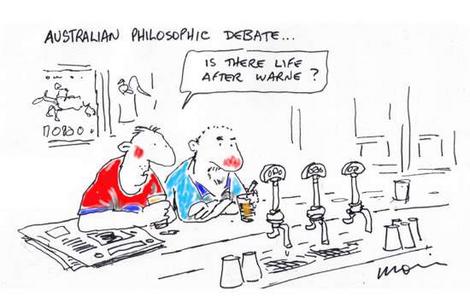
Alan Moir
This is especially so with respect to political philosophy. Few are the debates in the public sphere about political philosophy. There is little understanding of the way that political philosophy--primarily liberalism---underpins current political debates. There is not much interest is the way that the flaws of liberalism as a political philosophy have given rise to conservatism, as Marxism faded away in the 1980s to be replaced by poststructuralism in the liberal academy.
Most of the debates in Australia take place within liberalism. The current form of liberalism places an emphasis on the sovereignty of the individual, private property rights are seen as essential to individual liberty and an unfettered market is held to be the most efficient mechanism for satisfying human needs. This classical liberalism challenges social liberalism, which embraced central planning of the economy by the state, social welfare and social democracy. The classical (or laissez faire economic) liberals considered such measures to be an unjust imposition upon liberty, as well as a hindrance to economic development and prosperity:
Political debate in Australia largely takes place within that liberal horizon. Conservatism transgresses that liberal limit, but it remains fairly crude, as it blames all of Australia's woes and problems on the Left of 1968. Keith Windschuttle, in the 2006 Sir John Latham Memorial Lecture, stated:
The reasons why so many Australians today want to think so badly of their own country are hard to pin down. I don’t pretend to understand them all. But it is clear that, for the past thirty years, the Evangelical Left has bloated itself on such a diet of myth, propaganda and atrocity stories about Australian history, about our role in the contemporary world, and especially about our chief ally and best friend, the United States, that it no longer believes in or cares about objective truth.The result is that the critics have seriously deceived themselves about Australian values and the Australian people. Some of their most articulate and influential members have reached the stage where they now openly despise Australia and the majority of Australians. If enough of their opponents do not stand up to argue how wrong they are, this national self-hatred could eventually infect the entire body politic.
What Windshuttle doesn't say is that the Left in Australia is mostly social liberal and firmly withinthe Australian political tradition.
January 5, 2007
Hayek, tradition, market
John Gray in his F. A Hayek and the Rebirth of Classical Liberalism asks a very pertinent and contemporary question:
if free markets have corrosive effects in respect of the moral traditions which support them, so that capitalism institutions contain cultural contradictions which make them over the long run self-destroying, what is to be done?
It is pertinent given the conflict between a freemarket economy that rewards the values of competitiveness, individualism and personal advancement and a family life that depends on opposite values in families and communities. Gray says that an answer given by Hayek addresses this work/family conflict:
There is in Hayek's work an argument for voluntaristic traditionalism which goes some way toward answering this question. Hayek sees that the principal cause of the erosion of definitive moral traditions in advanced societies is not so much the market itself, but rather interventionist policies sponsored by governments. Often with the support of business, governments have contributed to the erosion of moral traditions by their educational, housing, and welfare policies. Hayek's argument for a voluntaristic traditionalism distinguishes him from neo-conservatives, firstly in that he would argue that it is government interventionism which causes much of the contemporary moral malaise and because he would not seek to use government power to prop up faltering traditions...
Gray adds that Hayek seeks to establish something like a market in traditions, in the hope that the traditions which would emerge from an unhampered social life would be most congenial to the stability of the market order itself.
I"m not persuaded by Hayek's response. It is does not recognize the differences between the family and market spheres of social life --it just wishes them away on the basis of hope in an evolutionary process towards liberal institutions.
What Gray means is that Hayek presupposes that the evolutionary natural selection of moral traditions will filter out those unfriendly to the market process. What then happens to the family and its values of care and obligation? Is it to be remodelled in market terms so that the principles of efficiency, fast turnaround and cost effectiveness, which are the principles of mass industrial production are applied to families, caring for children and the aged, and love? Does that mean a future of entrepreneurial childcare corporations (eg., ABC Learning Centres ) with the attention primarily fixed on making a profit from child care?
Does this not indicate that there are unresolved difficulties, tensions and conflicts in Hayek's writings?
January 4, 2007
classical liberalism: some puzzles
I've always puzzled about what classical liberalism stands for these days. How is classical liberalism different from libertarianism or neo-liberalism? It often strikes me that classical liberalism is based on John Locke, whilst neo-liberalism is grounded in utilitarianism. Or is that the American version of classical liberalism? If so, what then does the term 'classical liberalism'--as distinct from libertarianism refer to in Australia? Is classical liberalism and libertarianism synonymous?
At the first cut, classical liberalism holds that the self-regulating tendencies of the market process be accorded unhampered freedom, and secondly, that governmental intervention be recognized as the major disruptive factor in the market process. It is a defense of the priority of individual liberty. Presumably, classical liberalism so understood, differentiates itself from welfare and/ or social liberalism. If classical liberalism means that a market-based society can deliver individual wellbeing through economic growth and personal liberty, then it also means limited government. So what does limited government mean these days when the so-called free market liberals in Canberra stand for big government? Self-reliant Individuals who do not need the welfare net?
Does limited government that mean non-governmental ways (charities) to remedy problems such as poverty, which arise from the inequalities produced by the market? Or does it mean a minimal welfare state in the form of safety net? How far is the welfare state to be rolled back? Presuambly, this is the reason why classical liberalism understands itself to be right of centre.
Classical liberal also means that the freedom of each person should matter to everyone else. Does 'freedom' mean negative freedom (freedom from the coercive actions of others) as distinct from positive freedom (as self-realization)? Is that individual freedom based on rights or utility? If the former, is it based negative rights----rights that require that other individuals (and governments) refrain from interfering with individual liberty--as opposed to the positive rights of social liberalism-- individuals have a right to be provided with certain benefits or services by others? Or can we talk in terms of American classical liberals who appeal to Lock and British classical liberals who appeal to Hume, his principles of justice and his tacit utilitarianism?
My understanding is that classical liberalism is prior to social liberalism in that it is a laissez-faire liberalism. Though the word 'classical' connotes a backward-looking philosophy" the current advocates of classical liberalism base themselves on a rebirth of the values of limited government and the market order of classical liberalism as undertaken by Hayek and Friedman.
As John Gray observes Hayek is the central figure in modern liberalism :
Hayek must be regarded as among the foremost contemporary exponents of theliberal tradition. Thus it has been justly observed that "Hayek constructs acoherent and powerful case for liberty the equal of which in our present century it is difficult to find." Again, there is much in Hayek's defense of a regime of liberty which answers to the spirit of our age. His skepticism about the ability of governments to promote the public good, his sense of the dangers inherent in unlimited democracy, his critique of current conceptions of distributive or social justice and his demonstration of the vanity of large-scale social engineering-these are themes in his writings which elicit a ready response in a wide constituency of readers.
What resonates is Hayek's conception of practical, tacit knowledge and a spontaneous social order. The latter refers to the claim that in the market process itself there is a constant tendency to self-regulation by spontaneous order in that, when it is unhampered, the process of exchange between competitive firms itself yields a coordination of human activities. The implication is that any large-scale disequilibrium is impossible in a catallaxy of wholly unhampered markets and that there is an evolutionary tendency for the development of habitual practices and conventions in the historical process to converge on liberal institutions.
The social order is not a purposive construction in that the order is not the product of conscious direction as in the order of a management hierarchy in a business corporation. So the demand world of human exchange should be subject to purposive planning is therefore is a demand that social life be reconstructed in the character of a factory, an army, or a business corporation—reconstructed in the character of an authoritarian organization. So the most destabilizing factor in the market process is provided by government intervention. It then appears that spontaneous order functions as a code for invisible hand explanations.
However, if classical (utilitarian) liberalism presupposes individual liberty under the rule of law (as a system of rules), then how do classical liberals see political power as a public power: is it to be exercised for the common good or the public interest? Or is political power based in a network of private contracts, as Nozick held? Do we not lessen government welfare to promote human welfare? Is not justice a primary condition needed to promote general welfare? Yet, on the one hand , it is held that the most destabilizing factor in the market process is provided by governmental intervention, yet the government is required to reform the legal framework reformed to maximize individual liberty. Does not this kind of reform---reforming social institutions so as to make best use of society's spontaneous forces--- invoke a theoretical model of social structure and social process which gives some assurance as to the outcome of our reforms? Are not these reforms a kind of social engineering?
January 3, 2007
Seneca: On the Happy Life
This is a quote from Seneca's essay On the Happy Life, where he is arguing for virtue against pleasure:
Let virtue go first, let her bear the standard. We shall none the less have pleasure, but we shall be the master and control her; at times we shall yield to her entreaty, never to her constraint. But those who surrender the leadership to pleasure, lack both; for they lose virtue, and yet do not possess pleasure, but are possessed by it, and they are either tortured by the lack of it or strangled by its excess - wretched if it deserts them, more wretched if it overwhelms them - they are like sailors who have been caught in the waters around the Syrtes, and now are left on the dry shore, and again are tossed by the seething waves. But this results from a complete lack of self- control and blind love for an object; for, if one seeks evils instead of goods, success becomes dangerous. As the hunt for wild beasts is fraught with hardship and danger, and even those that are captured are an anxious possession - for many a time they rend their masters - so it is as regards great pleasures; for they turn out to be a great misfortune, and captured pleasures become now the captors. And the more and the greater the pleasures are, the more inferior will that man be whom the crowd calls happy, and the more masters will he have to serve.
It is a passage that has relevance today. It can be interpreted as directed at those utilitarian hedonists (Epicureans) who maintain that the pleasures of the market give us a happy and fulfilled life. The happy life, for them, is the most pleasant or pleasurable life. Seneca is concerned with how we should live.
Seneca's classical Stoic response is that happineness is secured by the good, virtue is what is good, and virtue is the human excellences. It is within the Socratic tradition's concern with the importance of improving one's character to make possible the living of a happy life. This requires a lot of work for ordinary human beings as distinct from sages. As Dr. K. H. Seddon says Seneca offers guidance and techiques for self-improvement to help:
find new and improved perspectives on one’s specific concerns, to arrive eventually at a point where our worries are defeated, or our fears abolished, and our passions tempered. The endeavour to do this, and to live abiding by the insights attained constituted living as a philosopher.
This involves a transformation.
January 2, 2007
Mouffe & Schmitt on Liberal democracy
In the eighth chapter in her The Return of the Political, which is entitled 'Pluralism and Modern Democracy', Chantal Mouffe addresses a question raised by Noberto Bobbio: do the liberal democracies, after the fall of Communism, have the reources and ideals to confront those problems (poverty and justice) that gave rise to the Communist challenge? It is a good question and one not often raised in public discourse in Australia, even though the defects of liberal democracy are widely known.---eg., executive dominance, the decline of parliamentary, the hegemony of corporate interests, etc
I recall Michael Sandel published a book entitled Democracy’s Discontent a decade or so ago in which he had argued that American politics were in a bad way. Citizens were anxious and fearful, and felt helpless in the face of the seemingly irresistible unravelling of the “moral fabric of community” and American politicians were incapable of making sense of this condition of popular discontent. Sandel traced this political predicament to a defect in the public philosophy by which Americans live. Political liberalism he argued produced a “procedural republic”, in which the procedures for public decision-making, which are based on values of fairness and openness, made no reference to more substantive ethical, moral or religious premises.
Since reasonable people cannot agree on the best way to live, government should be neutral on the question of the good life. So in politics people’s most fundamental convictions needed to be set aside. The challenge for political philosophy was to figure out how political discourse might “engage rather than avoid the moral and religious convictions people bring to the public realm.” Well, that is happening now with the rebirth of the religious Right.
Mouffe's response is that:
The point is no longer to provide an apologia for democracy but to analyze its principles, examine its operation, discover its limitations and bring out its potentalities.To do this we must grasp the specificity of pluralist liberal democracy as a political form of society , as a new regime (politeia), the nature of which, far from consisting in the articulation of democracy and capitalism, as some claim, is to be sought exclusively on the level of the political. (p.117)
It is here that Mouffe turns to Carl Schmitt, a conservative opponent of liberal democracy, to engage with his account of the weak points of liberal democracy so that these may be remedied.
Schmitt had argued that the key to parliamentary democracy was liberalism, which held that the truth can be arrived at through the unfettered conflict of opinions. The raison d'etre of Parliament is the public deliberation of argument, public debate and discussion. However, the Parliament of mass democracy replaces the public discussion through the dialectical interplay of opinion with partisan negotiation and the calculation of interests, as the parties have become pressure groups calculating their rmutual interests and opportunities for power, and they actually agree on compromisies and coalitions on this basis.
Mouffe says that Schmitt has to be taken seriously when he points to the deficiencies of liberal parliamentary democracy. Liberal democracy has become an instrument for choosing and empowering governments, it has been reduced to a competition between political elites and citizens are treated as consumers in the political marketplace. Mouffe asks: How then is liberal democracy to be given those intellectual foundations without which it is unable to command solid suport?
This, says Mouffe, is the challenge Schmitt poses for those who wish to defend a liberal democratic regime.