February 28, 2007
rhetoric +public sphere.
A quote from Larval Subjects on rhetoric as a public reason:
Rhetoricians sometimes like to claim that we need to return to the rhetorical tradition preceding the Enlightenment. This, for instance, is one of Sharon Crowley’s theses in a book that I highly recommend. However, in my view Crowley fails to examine the Enlightenment thinkers in context or to analyze the relationship between these thinkers and the great Greek and Toward a Civil Discourse: Rhetoric and Fundamentalism, Roman rhetoricians. Figures such as Cicero and Seneca were almost deified by thinkers like Hume and Diderot because of their great commitment to civic life and engagement with the public sphere. Indeed, Hume was extremely euridite where ancient philosophy was concerned, having encyclopedic familiarity with the Greek and Roman rhetoricians, and the Enlightenment thinkers modelled their own conception of philosophy on the Romans. Their philosophy was a very public practice, premised on social engagement, combatting superstition, and devotion to civic life. Each of the texts written by the Enlightenment thinkers was a rhetorical grenade designed to draw lines and open a space where new social formations might be possible.
An interesting interpretation of the Enlightenment thinkers.They adapted ancient rhetorical categories to address their contemporary rhetorical situations.
In Toward a Civil Discourse: Rhetoric and Fundamentalism Crowley urges us to revisit and revise established interpretations of the concepts of classical rhetorical theory for a conceptual language which will “restore” emotion and affect to modern rhetorical practices.For instance, Crowley argues that “doxa,” reduced since the nineteenth-century to a synonym for “opinion,” has lost the rich meaning it had in ancient Greece. A recovered definition of doxa, which would “designate current and local beliefs that circulate communally,” would, Crowley argues, give postmodern rhetoric a powerful way to conceptualize civic discourse. She hopes, further, to revive appeals to pathos, which she claims have been shed in liberal rhetorical argumentation.
February 27, 2007
biopower and sovereignty
Sergei Prozorov in this article in Foucault Studies states:
Despite evident differences, Agamben’s and Hardt and Negri’s approaches are both marked by the conflation of sovereign and biopolitical modalities of power. While Agamben’s Homo Sacer presents an ontological thesis on the originary indistinction between sovereignty and biopolitics that are linked in the figure of ‘bare life’ as their product, Hardt and Negri’s argument posits a quasi‐empirical indistinction of the two forms of power as a result of the ‘epochal transformation’ of late modernity, whereby the sovereignty of the nation‐state gives way to the ‘biopolitical sovereignty’ of the decentred Empire....Ultimately, biopower becomes little more than a new, fancier term for sovereign power or, alternatively, sovereignty becomes generalised to embrace additional objects of rule.
Prozorov argues for the irreducible difference between biopower and sovereignty.
February 26, 2007
Arendt: interpreting the political in modernity
Is the modern interpretation of the political an impoverished one because it eschews deliberation? Is the modern interpretation of the political further impoverished in that it restricts the scope of the political to an exclusively technological, social, and economic framework? Has politics become the administration of the population, understood as a totality of “human resources” to be preserved, enhanced, and optimized in which the language is one of security, organization, and efficiency?
The issues are explored by Frederick M. Dolan in The Paradoxical Liberty of Bio-Power:Hannah Arendt and Michel Foucault on Modern Politics I will deal with Arendt.She says yes to the above questions as I would. But I'm not clear on what her argument is in The Human Condition. So let us have a look.
Dolan says that Arendt argues that:
Modernity, then, signifies a change in the object of Platonic rulership. In the modern context, politics-as-rulership applies to the society as a whole, and suppresses plurality, not in order to realize a contemplatively established Good, but rather to optimize biological life. Indeed, it is not even individual life that is targeted, but that of the species as a whole: in the final stages of this development, Arendt says, “individual life” is “submerged into the over-all life process of the species.”...The result is “socialized mankind,” a regime in which cooperation grounded in bare biological existence overwhelms “the human condition of plurality” that issues in spontaneous action. This post-political world, “in which the fact of mutual dependence for the sake of life and nothing else assumes public significance,” is sustained by an endless number of rules, imperatives, habits, prohibitions, and customs, all designed to ensure that the individual conforms to the group. (p.322)
The decisive result, Arendt concludes, is that “society, on all its levels,excludes the possibility of action.... Instead, society expects from its members a certain kind of behavior, imposing innumerable and various rules, all of which tend to normalize” its members, to make them behave, to exclude spontaneous or outstanding achievement."
February 25, 2007
Condoleezza Rice defends empire
Since 1989, the end of the cold war left has seen the United States become the "sole superpower" in th world of nations. This is usually interpreted in terms of a benevolent American world hegemony or empire—a Pax Americana, and this understanding is assumed, in one or another form, in policy and political circles.The professional foreign policy community assumes that the international system is "naturally" headed toward an eventual American-led consolidation of democratic authority over international affairs.
William Pfaff in Manifest Destiny: A New Direction for America in the New York Review of Books says that he most coherent and plausible official articulation of such reasoning was offered in the summer of 2003 by Condoleezza Rice, then President Bush's national security adviser, speaking in London at the annual meeting of the International Institute for Strategic Studies.
Pfaff say that Rice argued that:
...the time had come to discard the system of balance of power among sovereign states established by the Treaty of Westphalia in 1648. The Westphalian settlement ended the wars of religion by establishing the principles of religious tolerance and absolute state sovereignty. The UN is a faulty embodiment of international authority because it is an indiscriminate assembly of all the governments of the world, and should, she argued, be replaced as the ultimate world authority by an alliance or coalition of the democracies.
Is the Coalition of the Willing in Iraq one such alliance? As Pfaff points out the system of a power balance was a response to the rise of nation-states of varying weight and ambition, and was motivated by the need to preserve their independence and protect their national interests.They "balanced" their relations and alliances with others in order to contain rival interests and conflicting ambitions.
Pfaff says that Rice also told the institute's members that the time had come to reject ideas of multipolarity and balance of power in international relations:
This was a reference to French and other arguments in favor of an international system in which a number of states or groups of states (like the EU) act autonomously, serving as counterweights to American power. It followed the controversy earlier that year over the UN Security Council's failure to authorize the US invasion of Iraq. In the past, she said, balance of power may have "sustained the absence of war" but did not promote an enduring peace. "Multipolarity," she continued, "is a theory of rivalry; of competing interests—and at its worst, competing values. We have tried this before. It led to the Great War...."
If you reject balance of power then the only apparent alternative is submission of all to a dominant power--that of the US.
February 23, 2007
Guantánamo Bay: No Exit
The New York Review of Books has an article on Guantánamo Bay entitled 'No Exit' by Joseph Lelyveld. This was republished by the Australian Financial Review in today's 'Friday Review' section but it is not online.
Lelyveld says that the US Supreme Court has also cautiously asserted its jurisdiction on detention issues, picking apart arguments made on behalf of an executive branch that hubristically called on the Court to stand aside and, essentially, let the President reign. He adds:
But—as the remaining 395 captives at Guantánamo enter the sixth year of their imprisonment without a single one of them having been put on trial—the question of whether we're prepared to hold terrorist suspects without charge for the rest of their natural lives has yet to be squarely addressed by either Congress or the courts. Decisions on detention issues have been handed down and laws have been passed. Some of these may now be revisited by the incoming Democratic Congress—in particular, the recent Military Commissions Act, which, among other things, denies non-US citizens who have been arrested and held in prison recourse to the writ of habeas corpus. But the question of indefinite detention itself —which might be construed as a core issue—hangs over our discussions like a far-off thundercloud, darkening a little with each passing year and each report of another suicide attempt at Guantánamo.
Would-be combatants who have merely been trained as well as those picked up in the vicinity of a battlefield—can be held in wartime until the end of hostilities isn't in itself novel or controversial. What's new in the current conflict, as it pertains to al-Qaeda and those detainees who are alleged to be its followers, is that no one can imagine the armistice or surrender that would signify an end to this war. In these circumstances, or so it now seems, indefinite could prove to be synonymous with endless; in effect, it could signify a life sentence.
Lelyveld. says that so far there has been no sign that the new Democrat Congress cares to wrestle with the premise that it's legitimate to hold prisoners indefinitely without charge and to leave them to await the end of a war that shows no sign of ending.
The Military Commissions Act, which was a direct Republican response to Hamdi v. Rumsfeld case, barred access to federal courts on habeas petitions by foreigners who had been designated as "illegal alien combatants." A Democratic-led Congress can only succeed in removing that bar by overriding a presidential veto. Is there enough votes for that?
February 22, 2007
Legal Morality and Australian Republicanism
Charles Harpur and Dan Deniehy both saw human progress in moral terms. Their view of the end of human development was moral perfection where violence, war, unethical behaviour etc all became morally impossible. They connected moral progress to republicanism through the removal of tyranny from government with republican technologies - such as constitutionalism, democracy, universal rights etc. Their insight was that increasing liberty enabled a greater and purer expression of morality. This can be taken to its conclusion where a morally perfect humanity does not require governance. For a religious 19thC, that result can also be described as a return to Eden.
Cesare Beccaria wrote:
Whoever reads, which a philosophic eye, the history of nations, and their laws, will generally find, that the ideas of virtue and vice, of a good or a bad citizen, change with the revolution of the ages: not in proportion to the alteration of circumstances, and consequently conformable to the common good: but in proportion to the passions and errors by which the different law givers were successively influenced.He will frequently observe, that the passions and vices of one age, are the foundation of the morality of the following: that violent passion, the offspring of fanaticism and enthusiasm, being weakened by time, which reduces all the phenomena of the natural and moral world to an equality, become, by degrees, the prudence of the age, and a useful instrument in the hands of the powerful or artful politician.
Hence the uncertainty of our notions of honor and virtue; an uncertainty which will ever remain, because they change with the revolutions of time, and names survive the things they originally signified: they change with the boundaries of states, which are often the same both physical and moral.
Harpur and Deniehy would argue that this reading of legal morality need not be true, and it is republicanism which frees the people from the tyranny of their executive and legislative. We have seen in the last decade, the United States weaken as a moral force due to the tyranny of its executive and legislative who now condone torture as part of their legal system.
The loss of morality in American jurisprudence, and by implication Australia as well, is not because of the decreasing morality of the American people, but because of the tyranny of the US Executive. This restricts the full moral expression of the American people. Harpur and Deniehy are right.
The increasing morality in human progress has seen the decrease in violence, both organised and arbitrary. The legal systems and jurisprudence of nations become an expression of that increasing morality.
A good example is the Eoran and English legal systems when the first fleet landed at Port Jackson. Much of the conflict was over the differing structures of accepted justice. For instance the British, under Arthur Phillip, reduced capital punishment to property crimes. The Eoran legal system included blood debts which could only be satisfied with ritualised spearing.
This was a particularly violent legal form but which stopped greater violence between Eoran groups. Arthur Phillip was speared by Willemering as part of this legal system as a blood debt for creating a colony on Sydney Harbour and taking food such as fish from the Eoran territories without asking first. Phillip was entirely reasonable about it, and surprisingly, accepted it, though later he did not accept the murdering of John McEntyre in the same manner.
One incident that stands out, and which Thomas Kenneally relates is that of Noorooing:
A woman named Noorooing came into town to tell the whites of the ritual killing of a south Botany Bay native, Yellaway, who had abducted her. She was clearly not an unwilling abductee, since she threw ashes on herself in sadness and refused all food, and other Aboriginals explained she was go-lahng, in a state of ritual mourning and fasting. Soon after, Noorooing, travelling in the bush near Sydney Cove, met and attacked a little girl related to the murderer of Yellaway. She beat the little girl so cruelly that the child was brought into town almost dead, with six or seven deep gashes in her throat and on ear cut to the bone. She died a few days later.The English were not sympathetic to Noorooing, but other Aboriginals explained to them "That she had done no more than what custom obliged her to ... The little victim of revenge was, from her quiet tractable manners, much beloved in the town; and what is a singular trait of the inhumanity of this proceeding, she had every day since Yellaway's death requested that Noorooing should be fed at the officer's hut, where she herself resided." The native who had committed the murder for which his little kinswoman suffered escaped apparently unpunished. In some way that the Europeans could not understand, the blood debt had been fully settled with the girl's death.
The other important thing to note, is that when the legal system under goes a moral change, it also undergoes a rationality change. The incident with Noorooing appeared irrational, inhumane and immoral to the English. Yet for us in Australia today, the idea of capital punishment for a property crime, transportation to Australia for stealing bread or five hundred lashes for sedition seem irrational, inhumane and immoral.
The morality and rationality of modern jurisprudence has progressed so far that the two competing legal systems in Sydney during the 1790s - the English and Eoran systems - are impossible to fully understand, even though the English system seemed perfectly logical, rational and moral to the English settlers; and the Eoran legal system made perfect sense to the Eora.
Where this moral improvement and rationality change can be adversely affected, and even pushed backward, is through government. When the executive and legislative act in a tyrannical manner, and outside of the moral boundaries of the current rationality, they not only halt moral progress, but turn the clock back. These are the 'passions and errors' that Beccaria writes as negatively influencing future laws and jurisprudence.
The purpose of republicanism's use of political technology is such that these 'passions and errors' cannot be expressed by the executive, legislative or judicature in a republican system. This means Australian Republicanism is not a static movement, it must be constantly aware of the dangers and loopholes that new executives will find in any republican system by which they can express their immoral and tyrannical passions.
February 21, 2007
inside Guantanamo Bay
President Bush has said, “I’d like to end Guantánamo. I’d like it to be over with.” Yet he refuses to close it because, he says, it holds detainees who “will murder somebody if they are let out on the street.” Guantánamo is the single most potent symbol in the misguided war on terror. In the wake of 9/11, the United States’ pledge to do everything in its power to protect its people from further harm led to a policy of overreaction.

H. Candace Gorman, a civil rights attorney in Chicago who blogs at The Guantanamo Blog is able to visit a client of hers at Guantanamo.
Her observation:
I was a little nervous going into that first meeting. I knew little about Al Ghizzawi and it seemed plausible to me that he might be the “worst of the worst”—which is what our government claims Guantánamo is holding. However, when I entered the tiny windowless room, I met a frail, bearded, jaundiced man of about 45, wearing a khaki jump suit and flip flops with his feet shackled to a ring on the floor. In time, I learned this member of the “worst of the worst” had been the owner of a spice shop and bakery in Jalalabad when, in December 2002, he was turned in to the Americans for a bounty—typically $5,000. He was initially held at Bagram Airforce Base before being sent to Guantánamo in March 2002. Initially our military determined he was a non-enemy combatant but this determination was mysteriously overturned by a second tribunal in Washington (five weeks after the first tribunal) because the military claimed it had new evidence against him. My security clearance allowed me to see the top secret “new evidence” and although I cannot disclose the contents, I can assure the readers of In These Times that there was nothing new presented to the second tribunal—nothing whatsoever.
As Gorman "points out on her blog Al Ghizzawi is not an enemy combatant and that there was no evidence tying him to al-Qaeda, the Taliban or any other terrorist organization. Mr. Al-Ghizzawi’s capture was a mistake, like so many other “mistakes” at Guantánamo. Yet he has been held more than five years now.
February 20, 2007
questioning Zionism
The American Jewish Committee, is a well known defender of Israel, and it has a high public profile of speaking out against anti-Semitism in the US. This is a key institution of the Israeli Lobby, and it has recently published a paper entitled Progressive’ Jewish Thought and the New Anti-Semitism by Alvin H. Rosenfeld. This targets liberal Jews who are wrestling, or are uncomfortable, with Zionist ideology. The latter critique Zionism due to it being a religious nationalist ideology that has helped foster violence and to justify a brutal occupation of the Palestinian territories.
The New York Times reports that the Rosenfeld essay has created controversy in the US.
Rosenfeld's essay starts thus:
“German fascism came and went. Soviet Communism came and.. went. Anti-Semitism came and stayed.” Rabbi Jonathan Sacks, the chief rabbi of the United Kingdom, offered these discerning words in response to a speech by Mahmoud Ahmadinejad, in which the president of Iran denounced Israel as “a disgraceful blot” that should be “wiped off the map.”... Shocked by. such unabashed outpouring of anti-Jewish venom and by numerous parallels to it, Rabbi Sacks confessed that the reemergence of anti-Semitism “is one of the most frightening phenomena in [my] lifetime–because it’s happened after sixty years of Holocaust education,.anti-racist legislation, and interfaith dialogue.” In light of this disturbing trend, this paper will reflect upon two. questions: (1) What, if anything, is new about the “new” anti-Semitism? (2) In what ways might Jews themselves, especially so-called “progressive” Jews, be contributing to the intellectual and political climate that helps to foster such hostility, especially in its anti-Zionist forms?
The context for this is the blurred point at which legitimate criticism of Israel and its defenders ends and anti-Semitism statements begin and the determination by the Israeli Lobby to squelch criticism of Israel or opposition to the longstanding pro-Israeli slant in US foreign policy. As Michael Desch recently pointed out in The Australian the members of the lobby play the traditional (and legitimate) game of interest group politics, channelling money and other forms of support to politicians who support their agenda. They also engage in what Israelis refer to as hasbra: telling Israel's story in the most favourable light. But some of them also hit below the belt, employing character assassination and other illegitimate tactics....Jews who deviate from the pro-Israel line are dismissed as self-hating.
Rosenfeld says that one of the most distressing features of the new anti-Semitism” is “the participation of Jews alongside it. His argument characterizes liberal or leftist Jews, who are critical of Zionism and the occupation policies of the Israeli Government, as anti-Zionist Jews, say that it is "illegitimate" for Jews to question the nature of the founding of Israel, that such inquiries represent a "betrayal" of Israel, and they are based on "tangled psychological" motives.
Rosenfeld goes through the texts of anti-Zionists , including Jacqueline Rose and Tony Judt and the 'ideological fellow travelers—Jews who mouth the standard negative clichés about Zionism and Israel to establish their leftist credentials.' He then says:
Such thinking is also harmful in its likely effects, for in calling into question Israel’s legitimacy and moral standing, it abets the views of those who demand an end to Jewish national existence altogether and lends a coveted aura of Jewish support to the advancement of this eliminationist goal.
His judgement about those Jews who identify with these Leftist political tendencies is that it:
is more than just a pity—it is a betrayal. Over the decades, elements within the left stood as principled opponents of anti-Semitism and fought against it. To witness some of their heirs today contributing to a newly resurgent anti- Zionism that, in many ways, recalls older versions of anti-Semitism is dismaying as well as disheartening.
It reads as a conservative Jewish or Israel hawk attack on liberal Jews and Jews on the Left side of the politics. The argument is suss: it identifies anti-semitism - hatred of Jewish people - with anti-Zionism-- anti a nationalist ideology--and then with the belief that Israel should not exist as a Jewish state. The implication is that Jewish criticism of Israel poses a threat to the taboo on non-Jews criticising Israel. If Jews are saying it, surely a non-Jew can say it, too - and do so without being accused of anti-Semitism.
However, as Richard Silverstein says in The Guardian things are changing. Different, diverse and independent Jewish voices are increasingly being heard in the public sphere and make a welcome change to the usual strident nationalist one.
February 19, 2007
arguing for republicanism
A review by Daniel Weinstock of Alain Renaut's Qu'est-ce qu'un peuple libre?: Libéralisme ou républicanisme; a text that recognizes French form of republicanism is a particular expression of a theoretical tradition, whose core normative commitment is a commitment to government aimed at the common good, rather than at the conjunction of individual goods. The other core commitment of this French Republican tradition is:
the notion of citizen virtue.
The guiding idea here is that if one wants politics to be governed by the common good, then citizens themselves must be educated in such a way as to be motivated by the common good, rather than by their own contingent good. Closely associated with this is a commitment to positive freedom....according to which freedom consists in overcoming one's enslavement to one's passions and contingent interests. Finally, French republicanism is wary of the institution of political representation, as it is of any political mechanism that stands in the way of citizens being able to bring their republican virtue directly to bear upon political decision-making.
Renaut connects this expression of the republican tradition with The Federalist Papers, which is also integral to the republican tradition.
The authors of the Federalist, and in particular James Madison, were quite convinced that human passions had to be taken as they are, and that the hope of reforming human nature through education is doomed. Recognizing the plurality of political factions Republican institutional design replaces republican virtue being exercised in an unmediated fashion with various "checks and balances" famously described in Federalist are other instances of mechanisms that attempt to realize the common good as a "system effect" of well-designed institutions.
Renaut argues that republicanism must be liberalized by integrating what is, from the French point of view, the "lost" federal republican tradition of Madisonianism. So where to then?
Renaut argues for democratic deliberation to be included in the republican tradition on the grounds that citizens need to are somehow actively involved in the deliberation and debate surrounding the laws that govern them, rather than seeing these laws simply as instruments externally provided to protect individual pursuits. The strategy is to address the conditions that will prevent liberal societies from degenerating into a morally unattractive form of solipsistic individualism.
This can provide citizens with a "stake" in political institutions that will make society less likely to lapse into individualism, and has merits connected to the value of collective self-determination. The problem here, as Weinstock points out in the review, is that for many deliberation theorists:
democratic talk only counts as deliberation if a number of fairly exigent requirements are satisfied both by democratic interlocutors and by the deliberative setting itself. What results is a highly artificial and stilted conception of democratic talk, one that is even less likely to perform the sociological, "Tocquevillean" functions that Renaut identifies as necessary correctives to standard liberalism than a more unfettered democracy might be, since citizens are called upon to contribute to deliberation not on the basis of what really matters to them (such things being ruled out of court by deliberativists as making the identification of democratic consensus more difficult), but rather on the basis of a rarified conception of political identity poles apart from their real, everyday, "encumbered" identities.
February 18, 2007
American democracy in Action
The image of President of the US as 'Commander-in-Chief' riding roughshod over American voters evokes Napoleon. Some take the image of 'Napoleon in the White House' seriously. The President as Commander-in-Chief stands for civilian control of the military on the grounds that “war is too important to be left to the generals.” I guess the image evokes a quasi-dictatorial authority.
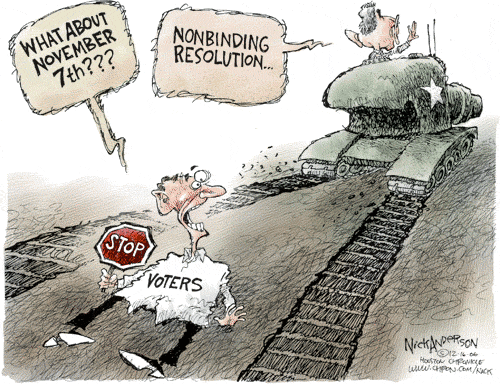
I presume the Americans do not have the power to fire the Commander-in-Chief. However, I though that the US Constitution gave the war making power to Congress. The Bush Administration has been so insistent on maximizing executive authority that the other branches must now check the President.
February 17, 2007
Noel Pearson: from village to hellhole
This post is an op-ed by Noel Pearson in The Australian It will disappear behind a subscription wall in a couple of days so I am reposting it here for the public record and to foster debate in the public sphere. Pearson comes from Hopevale in Cape York and it is a party to Shared Responsibility Agreement, which is part of the Council of Australian Governments (COAG) trial in the Cape York Region. Under the agreement, nine community priorities have been established including health, housing, crime reduction, governance, employment and school attendance. The op-ed is an account of Pearson's return visit to his hometown of Hope Vale in Queensland.
I've briefly commented at the end.
-------------------------------------------------
On a recent Friday night I walked out on to the lawn of my mother's house in my home town. It was after 2am and though my family lives a kilometre away, I could hear loud music booming from several stereos in various parts of what I would have called a village in my youth, but which more accurately answers to the description of an outback ghetto today.
The music emanated from houses known as party houses, where numbers of men and women congregate to binge drink, share marijuana, often out of what are called bucket bongs, laughing, shouting, singing and dancing and seeking sexual partners - consensual and otherwise.
By midnight the bonhomie of the early evening descends into tension, as various bingers develop dark moods, vent anger, resentment and suspicions at those to whom they earlier professed love. Arguments and fights ensue, over the smallest slights and often over ownership of and access to the dwindling supplies of alcohol.
While parties rage at a number of notorious locations throughout the town, with erstwhile hosts boosting their stereos with specially bought amplifiers, often placed at windows facing outwards as if for the benefit of the rest of the inmates of this sad place, it is hard to maintain the fiction that this place is a community.
It is a hellhole where whirring fans and airconditioners in the concrete block houses drown out the noise, including the screams.
This Friday night was the third night in a row of parties, beginning on Wednesday evening following the receipt of Family Tax Benefit payments, which continued at a lower gear over the next day and got back into top gear on Thursday night following the receipt of CDEP work-for-the-dole payments. The number of people missing from work has led almost every community to declare Fridays as the unofficial start of the weekend. School attendance collapses from already low levels earlier in the week. This has led to many proposals over the years from educators to reduce school days in Cape York Peninsula schools to four days, as if that would be a solution.
As I drove around the streets at 3am, I passed by drunks stumbling from one party house to another. I passed groups of young teenage girls walking around or sitting on the kerbside. For too many of them, sexual activity begins young at Hope Vale, very young. Who knows the circumstances of their first experience, but the incidences of abuse that come to light are only the tip of the iceberg of sexual assault, unlawful intercourse with minors, and incest.
That older men should be able to have sexual relations with the young girls I pass in the street in exchange for alcohol, marijuana or esteem, is water off the moral backs of our people. Young men may jump through windows to rendezvous with their paramours, but it is as likely they do so to interfere with women and children.
My home town looks and feels like a ghetto. The mango trees, frangipanis and old wooden church still evoke the mission of my early youth, but the fibro and weatherboard cottages built by the hands of our own local carpenters have been replaced by welfare housing, increasingly built by outside contractors. The uniform rows of kit homes and Besser Block houses are of course much more expensive and have better amenities (at least at first, because they do not last for long), but they look squalid. The once lovingly tended gardens with topiary, gardenias and fruit trees are scarce today, and the plastic bags, VB cans, old motor cars and general rubbish spill out of the homes and on to the streets.
With the eyes of someone who returns to his home town for holidays and occasional weekends, I marvel that the people who live here do not see the shit in front of their eyes. Despite vastly improved levels of funding and infrastructure the place is a mess compared with the village of my childhood.
I drove past the place where my parents brought up our family in a small fibro cottage with no hot water and a pit toilet out the back. We got electricity when I was in Year 4 but I did not see television until I went to college. Now they have Austar and adults carelessly expose children and young people to their pornographic videos and DVDs.
Earlier in the afternoon at the roundabout I saw the shocking sight of a beautiful puppy that had been run over by a vehicle, in a pool of blood on the bitumen. As we say in the language of this place, Ngathu wawu baathi, my soul cried for this lost life.
In my nocturnal drive I passed the puppy in the same place. The binge drinking will continue to daybreak, and on through Saturday. Bingers pass out and catch some sleep, before waking again to resume the fray.
The parties change gear during the course of the four days as participants come and go, supplies run out and fresh supplies are brought in from Cooktown.
The beauty of electronic banking is that welfare and CDEP income is dropped into keycard accounts automatically, and Centrelink will assist recipients to stage the time at which payments are made to members of a household. So Jimmy can get his on Wednesday and Sally can get hers on Friday. There is money for drinking and drugs over a longer stretch of the week.
Centrelink's intention of course with flexible payment plans is to assist people to manage their income to purchase food and pay their bills, but the reality is that it makes more money available for binge drinking over a longer period of time.
As I drive down to the beach early on Saturday morning I see the young children emerging out of the houses, as if from a war zone. Yes, there are children and young girls in the homes of the hosts of the binge drinking parties. How they fare through these weekly episodes depends on whether their often inebriated parent is nevertheless able to keep an eye on their welfare, because the chance that molesters are among the party people is very high. Older children may run off and stay with sober relatives, particularly grandparents, but what happens to the ones left behind? Some of the young people sitting on the kerbside at 3am are simply scared to go back home.
On Sunday things will be quiet. "They run out of grog," people explain to me. The town will be mostly quiet for the next two, and if you are lucky, three days. The bureaucrats from Peter Beattie's Government will do their business with the people and organisations of Hope Vale in the sane part of the week. Certainly the communities of Cape York Peninsula during the quiet days can give the impression of being pleasant if untidy "communities". You can excuse the rubbish and the ubiquitous high barbed wire fences and iron cages that have to be constructed around almost every public facility, because after all this is an Aboriginal community.
But the public servants and politicians only visit for the day and never sleep in the town. They never have anything other than the official conversations down in the administration offices, so they too easily have the view that "this place is not too bad", "we just need to co-ordinate the programs" and "we have a demand reduction plan" for the alcohol problem. The underbelly of these so-called communities is not intriguing like a David Lynch movie, it is Hobbesian.
Meanwhile in public policy land three relevant events take place. First, journalist Margaret Wenham reported in The Courier-Mail on February 8 as follows: "Hundreds of impoverished indigenous people in remote communities have been hit with fines totalling nearly $600,000 for breaking Queensland's controversial alcohol management laws. Figures, released this week by the Justice Department, also show that seven people have been jailed and six vehicles confiscated since December 2002 when AMPs were phased into the state's 19 discrete indigenous communities. Reports of the penalty tally were greeted with dismay by Aboriginal leaders who said most people could not pay the fines and the AMPs were not working to curb violence."
The problem with Wenham's argument and that of any Aboriginal leader to whom she refers, is that if you divide $600,000 worth of fines between 19 communities over 3 1/2 years, the average fine for each community is about $9000 per annum, or less than $200 per week.
The liquor licensing authorities in Queensland do not release liquor sales figures from each community, and no one tracks alcohol purchases from outside of the communities, but if you make a rough estimate of alcohol expenditure per week I would say an average of $10,000 per week would be extremely conservative.
So if an average community spends $520,000 on alcohol, how can you say that $9000 worth of fines is causing or even compounding impoverishment? Is it not the spending on alcohol that is causing poverty?
Second, on Monday this week the National Drug Research Institute at Curtin University released a study which showed that in the period from 2000 to 2004, an estimated 1145 indigenous Australians died from injury, disease or suicide caused by drinking.
The study found that many indigenous people died very young from diseases that do not exist among young non-indigenous people. A third of the deaths investigated were female. The second biggest alcohol-related killer of indigenous women was haemorrhagic stroke, and the average age of the deceased was only 25 years. Among non-indigenous people, stroke is a disease of the elderly.
The worst alcohol-related killer of indigenous people, alcohol liver cirrhosis, on average shortens indigenous sufferers' lives to 54 years. The other major causes of death - suicide, road traffic injury, assault injury, stroke - mainly kill indigenous people in their 20s and 30s.
Third, Premier Peter Beattie met the mayors of Queensland's indigenous shire councils to discuss the problems besetting indigenous communities.
The Premier emerged saying his Government would be making various investments in the communities and he expected the community leaders to take greater responsibility for alcohol.
One problem with the Premier's hopes is that these councils are still the owners and operators of the canteens which sell alcohol to their people. The councils are as addicted to the profits from the canteens as the Queensland Government is to gambling revenues. Tony Fitzgerald recommended in his Justice Study report to Beattie in 2002 that the nexus between alcohol profits and councils be broken, but the nexus remains.
Typically it is the justice groups that want to maintain AMPs while shire councils want them to be watered down. In fact the Government is considering proposals from councils to allow weekend trading and takeaways, against the opposition of local justice groups.
Beattie's minister responsible for the issue, Warren Pitt, has already weakened restrictions in some communities. Beattie and Pitt need to spend an anonymous night or two in at least one, preferably a couple, of these communities. They need to be in the town on the binge-drinking nights, and they need to take a quiet drive or walk around the town and hear and see the nightmare that the sober people and children have to endure.
Last year Hope Vale's Mayor Greg Mclean invited a delegation of children from the local primary school to present their views to a large roundtable of assembled bureaucrats and community leaders. In plain English the children pleaded to these black and white adults that they wanted the drinking and violence in their community to stop.
As I drove through my home town on the Sunday evening on my way back to Cairns, I saw the dead puppy still in the street. I thought about the distance between being inured to the fate of a puppy that didn't see the car coming, and being inured to the fate of our own children.
--------------------------------------------------------
What is interesting about Pearson's account is that there is no mention of the commonwealth government. Not a word about the Howard Government even though overcrowding of public housing is a massive problem in Hope Vale and the Minister for Indigenous Affairs, Mal Brough has argued about how communally-owned Aboriginal land is really communism in disguise and that there' an urgent need for legislation to enable jobless blackfellas to buy or lease their own plot of dirt. Mal Brough has also promised increased policing in remote communities to restore and order, and yet the money allocated for this policing is unspent.
February 16, 2007
Nietzsche + friendship
Brian Leiter in the Standford Encyclopedia 's entry on Nietzsche's Moral and Political Philosophy says:
Nietzsche, then, has no political philosophy. He occasionally expresses views about political matters, but, read in context, they do not add up to a theoretical account of any of the questions of political philosophy. He is more accurately read, in the end, as a kind of esoteric moralist, i.e., someone who has views about human flourishing,
He concludes by saying that Nietzsche offers us a severe regime for the realization of individual potential — at least for the select few.
Though Nietzsche certainly was not a systematic philosopher, I find Leiter's claim that there is no political dimension to Nietzsche's text suprising, given that Nietzsche aimed to revolutionize society and culture and that Nietzsche is an aristocratic political thinker who dams democracy as an expression of modern nihilism. For Nietzsche, as well as for the ancients, philosophy was always more than the discourses of philosophers; such discourses had to reflect and be integrated into a practice of living. Nietzsche’s therapeutic project, if you like, is to “heal” nihilistic-modernity.
Secondly, maybe Nietzsche addressed specific issues in political philosophy such as friendship. The intimacy of friendship and philosophy is deep in classical philosophy and the consubstantiality of the friend and the philosopher was taken for granted. Aristotle, for instance, eighth and ninth books of the Nicomachean Ethics. argued that one cannot live without friends, that it is necessary to distinguish between friendship founded on utility and on the pleasure of virtuous friendship (in which the friend is loved as such), that it is not possible to have many friends, that friendship at a distance tends to result in oblivion, etc.
Today the relation between friendship and philosophy has actually fallen into disrepute. So how did Nietzsche address this issue?
Nietzsche was more ambivalent: the necessity of friendship and, at the same time, a certain distrust towards friends was a key of Nietzscheʼs strategy. In Beyond Good and Evil political “friendship” is understood in terms of solitude (hermits) and references to the cultivation of agonistic friendships abound. In the "Our Virtues" section of this text Nietzsche writes:
Beware of those who attach great value to being credited with moral tact and subtley in making moral distinctions. They never forgive us once they have made a mistake in front of us (or, worse, against us); inevitably they become our instinctive slanders and detractors, even if they should still remain our "friends". (para 217)
In a latter section entitled 'What is Noble', where Nietzsche is discussing master and slave morality, he links friends and enemies within a value creating master morality. He says that this morality is alien and embarrasing to present tastes as it is beyond good and evil and the adds:
The capacity for, and the duty of long gratitude and long revenge---both only among one's peers---refinement in repaying, the sophisticated concept of friendship, a certain necesssity for having enemies (as it were, as drainage ditches for the effects of envy, quarrelsomeness, exuberance--at bottom in order to be capable of good friends): all these are typical characteristics of noble morality which, as suggested, is not the morality of "modern ideas" and therefore is hard to empathize with today, also hard to dig up and uncover. (para. 260)
Presumably, the sophisticated concept of friendship is an agonistic one. It is not one based on utility as that is a part of slave morality.
February 15, 2007
Friendship and politics
There is a common view that citizens of a polis or a nation-state are friends. The traditional accounts, valorize male friendship and downplay the conflicts between citizens. The tradition starts with Aristotle who takes up the subject of friendship in chapters eight and nine of the Nicomachean Ethics in which he argues that the basis of human political nature in their shared rationality and mutual friendship.
Aristotle's discussion in Nicomachean Ethics, Cicero's dialogue Laelius, and Montaigne in his essay Of Friendship, viewed friendship as more important than marriage and family.From what I can make out one account of friendship and politics, primarily associated with Aristotle holds that the two are positively related and no real tension could exist between them. Another tradition (primarily associated with Montaigne) holds friendship to be irreconcilable with politics. Elements of both traditions can be recognised in Nietzsche who, finding the radical deceptive nature of friendship unacceptable, moves to a solitude which is equally unbearable.
So let us look at Montaigne's Of Friendship (or "On Affectionate Relationships"), who uses his friendship with Etienne de La Boetie --his best friend---to launch an interesting discussion on different kinds of friendships, their utility and their limitations. In political terms, friendship offered Montaigne a dignified humanist alternative to the rebellion of civil war and the subservience of courtiership.
Montaigne distinquishes between friendship and the sexual passion or love between and women:
As soone as it creepeth into the termes of friendship, that is to say, in the agreement of wits, it languisheth and vanisheth away: enjoying doth lose it, as having a corporall end, and subject to satietie. On the other side, friendship is enioyed according as it is desired, it is neither bred, nor nourished, nor increaseth but in jovissance, as being spirituall, and the minde being refined by use custome.
February 14, 2007
innovative blogging
I've just come across an innovative way of blogging. It's 'blogging the Scooter Libby trial' based on the team assembled by Jane Hamsher and FireDogLake. Hamsher built FDLwith her blogging partner, former prosecutor Christy Hardin Smith).This kind of work partially supplants, or at least supplements, that produced by the national media, as it develops an independent means of reporting on and analyzing key political events. It shows the potential of political blogging.
Glenn Greenward over at Salon (scroll down) describes what has been produced by the assembled FireDogLake team:
The reporting produced by the FDL team has been, as one would expect, intense, comprehensive and superb. In addition to daily live-blogging of every single witness, which entails almost every question asked and answer given, as well as close-to-verbatim accounts of legal arguments between the Fitzgerald's team and Libby's lawyers, the FDL Plame experts have been providing day-by-day analysis of the legal, political and journalistic issues raised by this trial. In short, they have produced coverage of this clearly significant event -- one which has provided rare insight into the inner workings of the Beltway political and journalistic elite -- that simply never is, and perhaps cannot be, matched by even our largest national media outlets.
A lot of it is live blogging from the court room--the team works along side the corporate media types in the media room throughout the trial coverage. Would Australian courts allow legal bloggers to work in the court room.
Christy Hardin Smith in this post says that:
According to prosecutor Patrick Fitzgerald, Libby's case amounts to an attempt at "jury nullification." Libby is charged with five counts of perjury and obstruction of justice for lying about where he learned the identity of CIA undercover operative Valerie Plame (Wilson's wife) and to whom he spread that information.... Fitzgerald's prosecution was well honed, unadorned and a straight arrow.....Libby's defense was the legal equivalent of the fog of war. He sought to obfuscate the clarity of the prosecution's case by raising irrelevant issues, turning the jury's attention away from the charges themselves and creating doubt by getting witnesses to admit small lapses of memory, thereby underlining Libby's memory defense
This kind of work is at the forefront of the new media. In this earlier post at FireDogLake TRex at says that:
originally blogging was a mostly Right Wing creature. It began as an extension of talk radio and for years the field was kind of like a wet t-shirt contest at an old folks' home. You had to give them credit for trying...Now, Righty bloggers are finding themselves in a bit of a pickle. Their audience is shrinking and whatever tissue-thin veneer of credibility they may have gained since 2003 has been squandered like a pallet of shrink-wrapped cash in Iraq as they have gone chasing around and around Big Media's coverage of the Middle East in an increasingly embarrassing quest for signs of "liberal bias".
I'm not sure whether that judgement can apply in Australia.
February 12, 2007
Arendt+responsibility
In Hannah Arendt's Concept of Responsibility Annabel Herzog says that:
Hannah Arendt defined responsibility in terms of political presence, not in legal or moral terms .... Arendt identified responsibility with the forming of opinions, that is, with the simultaneity of belonging or suffering and acting or doing. I will show that, for her, responsibility is ‘radical’ and stands in opposition to the ‘banality of evil’; and that, as a result, her concept of responsibility links her political theory to her conception of the world
Arendt links responsibility with the political sphere as does the republican political tradition. Arendt’s use of the word 'responsibility' is connected to the sphere of human plurality.This ‘s not simply an extension of the dual “I-and-myself ” to a plural “We”’ as she contends Rather, and somewhat paradoxically, she contends that responsibility pertains to the individual belonging to a community and, therefore, to the subject and not to the community.
Arendt links this to the refugees’ answer to their enemy’s denial of their political presence was ‘selfishness,’ that is, the acceptance of this denial. Being denied a presence within the political space led some of them to suicide - an enactment, as it was, of the fact that the refugees had nowhere to be. Most of them refused to consider their personal fate as a general, political fate.The refugees tried to escape their identity in that they refused to act and have opinions even before they were denied a political presence: For Arendt, the refugees’ relinquishing of their identity was a form of collaboration with the excluding forces.
She contends that the refugees’ fate represented a political problem that required a political response; a response in which one can no longer be just a bystander’ and become responsible in terms of doing something. So Arendt argues that one is responsible not because one acts under a predetermined law but only because one belongs to a group that acts, or has acted, independently of him/herself.
February 11, 2007
politics+immanent critique
This is a report of an LSE conference, whose aim was assess ‘the enduring values of the twentieth century radical tradition’ in the face of today’s ‘technocratic management of a society whose basic foundations now go almost unquestioned’. Or, in another formulation, the aim is to undertake a reformulation of the project of radical politics in the face of contemporary administered technocratic capitalism, based on an engagement which requires more than the politics of the barricade.
Will Legget says that Michael Rustin grappled with the question of how to both engage with and challenge Blair’s coalition. He captured the ambivalence of sensing that much of the ‘modernizing project’ may be beneficial, and yet simultaneously damaging to the intrinsic value of its object. Take higher education: yes, we want graduates to be ‘employable’; to develop ‘transferable skills’; to be equipped’. But what effect does this encroachment of the market have on the aim of education for its own sake? Ultimately, this discussion reached an impasse. How can we challenge the logic of modernisation whilst being bound up with it?
Immanent critique is one answer. However, this kind of response was generally met with cynicism or confusion at the conference.
February 9, 2007
drawing the line
In an article in the Atlantic entitled Where Congress Can Draw the Line James Fallows expresses his worries that the Bush Administration may soon find an excuse to attack Iran. He offers this analysis:
If we could trust the Administration’s ability to judge America’s rational self-interest, there would be no need to constrain its threatening gestures toward Iran. Everyone would understand that this was part of the negotiation process; no one would worry that the Administration would finally take a step as self-destructive as beginning or inviting a war.
Unfortunately, this is not the case:
But no one can any longer trust the Administration to recognize and defend America’s rational self-interest — not when the President says he will carry out a policy even if opposed by everyone except his wife and dog, not when the Vice President refuses to concede any mistake or misjudgment in the handling of Iraq. According to the constitutional chain of command, those two men literally have the power to order a strike that would be disastrous for their nation. The Congress has no official way to prevent them from doing so — it is interesting, and alarming, to think that in practice the safety valve might be the professional military, trained to revere the chain of command but faced with what its members would recognize as ruinous instructions.
As Fallows recognizes, the US constitutional system cannot afford this particular safety valve. The military must follow civilian orders. The way out of the danger is not to look to the military to discipline the President. Congress must reassert civilian control over over the Presidency through its Article I, section 8 powers.
February 8, 2007
rethinking political concepts
If we compare our core political and legal concepts and ideas (democracy, the separation of powers, rights) with the actual structure and actions of government we find a starkly evident mismatch between our concepts and the actual form and functioning of our governmental apparatus.
Edward Rubin’s Beyond Camelot: Rethinking Politics and Law for the Modern State explains these mismatches and identifies their harmful consequences. Rubin’s thesis is that many of our most fundamental political and legal theories and concepts are medieval inheritances which no longer serve our interests.
The contention in this book is that our continued use of pre-modern concepts for modern government embodies the thought processes of a prior era, its way of conceiving the world, of creating categories, and of determining the relative significance of different issues. As such, these concepts are an impediment to understanding, and control our current thinking in ways that are genuinely counterproductive”
In this review of the book Brian Z. Tamanaha says that Rubin asks the reader to “bracket” or “hold in abeyance” our existing concepts (p.8). With respect to each political or legal concept he addresses, Rubin attempts to persuade the reader that such bracketing is appropriate and necessary by exposing its pre-modern origins, showing that it took root or acquired its meaning in circumstances significantly different from today. Rubin then articulates and applies an entirely different conceptual scheme – an “alternative imagery” – with which to frame, describe, and understand a particular aspect of the political-legal arena.
Tamanaha says that Rubin’s bracketing analysis effectively dissolves one standard concept after another, to the extent that one may wonder how the standard understanding has remained so resilient in the face of such contrary facts. His alternative conceptual schemes time-and-again create a novel perspective that produces new angles and insights.
To offer just one example, Rubin details a number of ways in which the routine notions that the President is the titular head of the administrative branch of government and that the legislature passes laws and delegates tasks to administrative agencies are misleading. Network analysis instead portrays the President as merely a single individual with a small number of selective relationships through which communication occurs, which then wends its way through agencies via other strings of relationships, often losing something or meeting resistance in the process; Congress consists of individuals and their staffs who send various signals – from laws to letters to statements at hearings – to administrative agencies, constituting complex lines of continuous interaction at multiple levels. The network approach generates a number of policy implications that Rubin identifies.
To supplant the notion of three separate branches of government, for example, Rubin offers the model of a “network;” he suggests that “legal rights” are better understood in terms of “causes of action;” “human rights” are better understood as “moral demands on government;” “property” is better understood in terms of “market allocations.
February 7, 2007
Hegel: property & right
A guest post by John C. Halasz in response to this earlier post on Hegel's remarks about the legal personality, natural right and property as he begins his engagement with the social contract condition in The Philosophy of Right.
The Hegel paraphrase bears traces of idealism in that property is the external embodiment of the free will and the only way in which it can know itself as embodied. It might be reasonable to claim that the possession of property provides for a "place" for agency which stabilizes it. Equally, an object can be an "objectification" of agency, if the agent produced it in the manner of a craftsman. But to say that property is based on sheer appropriation ignores that property is a claim to exclusive use of or disposition over an object, which is not the projection of a mind, but depends on the recognition of that claim by others. Property then is itself based on "right", which is to say that recognition between embodied agents/selves must already precede the existence of property.
Hegel, of course, does want to say that the "system of needs", that is, the market system of the production, exchange and consumption of objects/property, emerges and derives from a prior historical development in which the recognitions of "abstract right" that it depends upon and "embodies" are embedded, such that there are antecedent forms of the organization and anchoring of social recognitions. That's very reason is why "abstract right" based on the "system of needs" "dialectically" transcends itself into a more "universal" and collective form of public recognition as citizens forming a polity, a state, which, in turn, modifies and relativizes "abstract right". But individualistic morality does not simply derive from property rights, but rather must be sustained by differentiations within the public recognitions of the state.
More generally, Hegel's critique of "natural right" begins at the beginning with the so-called "master-slave dialectic", in which self-consciousness exists only through the recognition of an other self-consciousness, which is first achieved through a struggle unto death as a relation of domination and submission. The point that Hegel is making with this "primal scene" against contract theories of "natural right" is that the latter must presuppose a mythic state-of-nature, in which already constituted self-conscious individuals enter into a mutual understanding/agreement, the "contract", based on perceived mutual advantages, such that those maintaining the contract must be essentially the same as those who made the contract.
Hegel's counter-argument is that in entering into a socio-cultural form of life, the "individuals" take on a different "nature" than they could have had before, indeed, for the first time become potentially "individuals", in the relavent sense, and that the "individuals" develop in the course of the development of that socio-cultural form of life, such that the "individuals" at the "end" are not the same as at the beginning.
Hence the only basis for any "social contract" is what is actualized in social recognitions and struggles for recognition in a given polity/society. The "end" of that process would be when the "master-slave" relation is fully "internalized" such that each and every "individual" is equally and reciprocally recognized by each and every "individual", which is the state of "abstract right" and private, self-determining morality. But because such a "social contract" is derived from antecedent and underlying struggles for recognition between agents/selves, because of the problems of coordinating and balancing the pursuit of individual interests and moral aims, because the "subjects" of such a system must be formed and educated to sustain its "contract", and because such a system must be sustained and steered in a broader world including other societies, the level of "abstract right" must be dialectically transcended in the more "universal" public form of a politiy, a state, through which, in turn, its citizens attain a "higher", fuller form of realization through participation in a common public world.
The interest nowadays of Hegel's extended theory of the state, as the state + civil society, in this day and age of corporate-led globalization, in which the steering capacities of nation-states are constricted and diminished, is that it seems to anticipate the rationale of the social democratic "welfare" state, not just as a means of subsistence or of muting social conflict, but as a locus for realizing public "power". But Hegel, because of his idealism and because of his traditional cognitivist/theoretical standpoint, stops at considering the state as the embodiment of idealistically conceived "freedom", and does not address how the "freedom" of social agents inevitably leads on to the collective generation of power, which constrains and imposes itself on those agents. That is what I was trying to get at in my first comment to the Strauss/Locke post below: the way in which rights and conflicts over rights must be seen not merely as a protection of "freedom" against abuses of power, but as a means of engendering, distributing, balancing and enabling participation in public power.
And how any realistic, effective political/constitutional system of "checks and balances" should be evaluated not as an automatic means of protecting "freedom", agency, inevitably and constitutively constrained by the imposition of power relations, from any undue interference, but as a regulated means of transmitting and dividing power so as to put in check and counterbalance any undue concentration of power.
February 5, 2007
interpreting constitutions
This review of a book on Justice Scalia---The Political Thought of Justice Antonin Scalia: A Hamiltonian on the Supreme Court by James B. Staab---- helps me to get a grip on constitutional interpretation. There are diverse strands of constitutional interpretation that provide the reasons for why we disagree – reasonably – about the way to interpret the constitution. Certainly the constitution is not what the courts say it is.
Firstly, I do not understand what 'a Hamiltonian on the Supreme Court' means. I understand that Hamilton was part of the founding debate over federalism that has in many ways defined the United States throughout its two-hundred-year history. As I understand the debates ended with the promoting strong national power in certain spheres, yet recognizing that the states are sovereign in other spheres.
Secondly, translating the founding debate between nationalism and states’ rights to the current Supreme Court and America is difficult. But I understood that the Court’s conservatives – and particularly Justice Scalia – are usually in the Jeffersonian, states’ rights, dual federalism camp. So how do we understand the interpretation of Hamilton as the cooperative-federalist, or nationalist, view of the Constitution and nation. Does than mean centralist? Seeking to implement an expansive interpretation of national powers at the states' expense, in constrast to Madison and Thomas Jefferson who sought to bolster state powers? That would imply that a subtitle more like A Hamiltonian on the Supreme Court?
Ward says that according to Staab, Hamilton’s political principles consisted of a formalistic view of separation of powers, an energetic executive, a political conception of public administration, a strong and independent federal judiciary, and a political process approach toward federalism. The first a strict dedication to separation of powers--is coupled to a suspicion of legislatures and considerable deference to executive prerogative. Scalia is also willing to diminish judicial powers and advantage the executive.
However, the review by Artemus Ward, says something I can understand:
In general, Scalia is most closely identified with a formal textualist and originalist jurisprudence. He argues that the plain meaning and the original understanding of the Constitution or statute in question should guide judges in making decisions. He uses history and tradition to determine original meaning. He is critical of his colleagues who espouse the idea of a living Constitution, in which the document’s broad principles are to be reinterpreted as society evolves. Scalia sees the living Constitution theory in conspiratorial terms. He rails against those who use it, seeing the theory as a smokescreen for judicial activism with judges illegitimately enacting their preferred policies in the name of the Constitution. Scalia points to the formal amendment process as the only legitimate way to change the document.
I've never really understood the formal textualist and originalist jurisprudence position. I presume textualism and original intent acts as a constraint on judging in that it holds the role of a judge is to interpret text and not make policy. I understand the politics:---the primary threat to democracy is unelected judges creating rights for minorities that trample on the rights of a democratic majority is how this is argued for in Australia. Liberal activism means that liberal judges write their own subjective opinions into constitutional law. They attribute to the Constitution rights that are the judges' own invention, and then devise remedies on the ground that the Constitution requires them. The expansion of constitutional liberties by liberal, rights-based activism ---unelected judges"usurping legislative powers---is what is blocked by conservative constitutionalism. This is a conservatism that reacts against the liberal welfare state, criticizes the expansion of bureaucracy and bureaucratic power in terms of untrammeled discretion; criticizes expanded pluralism as it threatens vested interests; and criticizes the moral discord of contemporary society because of its challenge to the political order and stability of the regime.
What what is blocked is liberal “social engineering” not judicial activism per se, because we have conservative activism. I understand that originalism holds that a Constitution (or statute) has a fixed and knowable meaning which is established at the time of passage or ratification. This draws a sharp, categorical distinction between those contexts in which the original constitutional text declares limits that the courts should actively enforce, on the one hand, and those contexts in which the text is ‘silent’ and thus calls for restraint, on the other. This means using judicial power to protect property rights and limit governmental efforts to regulate business or to impose social or economic equality.
Texualism is part of the conservative effort to change the liberal direction of constitutional law. Textualism means that the judge reads the Constitution and law as narrowly and specifically as possible and that the judge is not to treat language as the basis for broad declarations of rights or legislative purposes. Formal means without context and a rejection of the use of information that might shed light on the objectives of a text, such as legislative history, and a refusal to use resources extraneous to American constitutionalism, such as foreign and international law.
So what happens when the text is ambiguous? Is that when original intent comes into play? 'Original intent” means that the Constitution must be interpreted according to what it meant when it was originally adopted. How do we interpret the intent of the founding consitutional fathers? Does that mean turning back to original documents, such as The Federalist? But diverse political traditions (liberal and republican) run through that text. Isn't that re-introducing context, and the use of tradition? Which tradition? Or do we ignore the intent of the founding fathers and look for original intent in the principles of the Constitution of the United States, which are to be found in the Declaration of Independence?
If so, then we have The Declaration of Independence enunciating truths of natural law; the principles of the Declaration inform the Constitution; and, for that reason, the Constitution must be interpreted as if those principles had been written into it. What are those principles? It is the Framers commitment to the natural rights and natural law doctrine of the Declaration of Independence. So the salvation of the conservative movement must come from the renewal and reaffirmation of the principles of the American Founding, embodied above all in the Declaration of Independence.
February 4, 2007
democracy v empire
In a trilogy of books---Blowback: The Costs and Consequences of American Empire (2000), The Sorrows of Empire, (2003) and Nemesis: the Last Days of the American Republic (2007) ---Chalmers Johnson has been exploring the way that the United States today tries to be a domestic democracy and a foreign imperialist. He sees this tension in terms of a strak contradiction as he says 'a country can be democratic or it can be imperialistic, but it cannot be both.' The reason is that imperialism does not seek or require the consent of the governed. It is a pure form of tyranny.
In this article at TomDispatch Johnson gives a quick overview of this trilogy.It forms a part of what is called The American Empire Project, and Johnson argues that the US is on the 'brink of losing our democracy for the sake of keeping our empire.' He says:
By the time I came to write Nemesis, I no longer doubted that maintaining our empire abroad required resources and commitments that would inevitably undercut, or simply skirt, what was left of our domestic democracy and that might, in the end, produce a military dictatorship or -- far more likely -- its civilian equivalent. The combination of huge standing armies, almost continuous wars, an ever growing economic dependence on the military-industrial complex and the making of weaponry, and ruinous military expenses as well as a vast, bloated "defense" budget, not to speak of the creation of a whole second Defense Department (known as the Department of Homeland Security) has been destroying our republican structure of governing in favor of an imperial presidency. By republican structure, of course, I mean the separation of powers and the elaborate checks and balances that the founders of our country wrote into the Constitution as the main bulwarks against dictatorship and tyranny, which they greatly feared.
He says that the evidence strongly suggests that the legislative and judicial branches of the American government have become so servile in the presence of the imperial Presidency that they have largely lost the ability to respond in a principled and independent manner.
Congress had almost completely abdicated its responsibilities to balance the power of the executive branch. He adds that, despite the Democratic sweep in the 2006 election, it remains to be seen whether these tendencies can, in the long run, be controlled, let alone reversed. He comments that even in the present moment of congressional stirring, there seems to be a deep sense of helplessness. Various members of Congress have already attempted to explain how the one clear power they retain -- to cut off funds for a disastrous program -- is not one they are currently prepared to use.
Johnson says that his best guess is that the U.S. will continue to maintain a façade of Constitutional government and drift along until financial bankruptcy overtakes it. He adds:
Of course, bankruptcy will not mean the literal end of the U.S ..... such a bankruptcy would mean a drastic lowering of our standard of living, a further loss of control over international affairs, a sudden need to adjust to the rise of other powers, including China and India, and a further discrediting of the notion that the United States is somehow exceptional compared to other nations. We will have to learn what it means to be a far poorer country -- and the attitudes and manners that go with it.....So my own hope is that -- if the American people do not find a way to choose democracy over empire -- at least our imperial venture will end not with a nuclear bang but a financial whimper.
Maybe he's right on this.The Pentagon's budget out of control (over 5% of the gross domestic product) and it is spending that the Chinese government is financing by buying US debt.
February 1, 2007
Hegel, natural rights, recognition
In the Philosophy of Right Hegel tackles the social contract tradition of Hobbes, Lock, Rousseau and Kant. I'm following Strauss and Macpherson, among others, who argue for Hobbes and the 17th century, as the begining of the tradition of subjective, individualized natural rights. In this tradition the social or political order is held to derive its legitimacy from its ability to uphold and protect the rights of autonomous, sovereign individuals, and the social is the outcome of a contract between autonomous individuals to respect each other’s rights. I understand that the tradition of rights talk was one of escaping from the objective norms of natural law, (ie.,moral/juridical natural law, embodying universal norms of right and wrong and accessible to natural human reason) to become identified with a modern version of moral conventionalism.
Rights are important, for as Strauss had argued, Strauss suggests that the superiority of liberal democracy to its twentieth century alternatives, fascism and communism, is intelligible only as a reflection of the superiority of the political thought underlying liberal democracy, the natural rights doctrine. What makes the American regime, for instance, is the doctrine of natural rights.This is its constituting thought; one that appears to be grounded in natural law.
Hegel argues that the subject of abstract right (Recht) is the person as the bearer or holder of individual rights, and he claims that this focus on the personality is significant in distinguishing persons from mere things.The personality, or the subject, is what underlies this tradition and Hegel characterizes it in terms of freedom and the natural being of the individual in the form of natural drives, needs and desires. The individual it implies is a universal individual without particular traits and without reference to social or cultural environment.
A person must translate his or her freedom into the external world and thus abstract right manifests itself in the absolute right of appropriation over all things. Property is the category through which one becomes an object to oneself in that one actualizes the will through possession of something external. Property is the embodiment of personality and of freedom. The basis of individual rights lies in property.
The system of private property establishes individuality and personality through contract and exchange. Contract establishes ownership through institutionalized norms of mutual respect of individual rights and obligations. Economic life governed by free exchange of commodities is based on an institutionalized notion of the individual as having some claim to recognition as a right-bearing person. If an exchange market is to function efficiently, economic actors must recognize universal standards by which a person can claim to own property. Established norms of reciprocal recognition in the modern economic sphere (civil society) are internalized in economic actors and represent a “common will.”
The system of mutual recognition and abstract right is the basis of what Hegel calls morality.