March 30, 2007
immigation, nationality, disavowal
I was interested in this review by Ayse Deniz Temiz of Ali Behdad's A Forgetful Nation: On Immigration and Cultural Identity in the United States (Duke University Press, 2005) in Borderlands after being pounded by the anti-immigration discourse on Fox News.
Temiz says that the the core argument around which Behdad's analysis is structured is the following:
pro-immigration policies and multi-culturalist discourses in the US have been historically associated with economic-political conjunctures that demanded an inflow of migrant labor; moreover the particular type of labor that is in demand at a given time has had a determining effect on which specific idiom of multi-culturalism will prevail--ranging from a discourse on selective immigration providing for the nation's need for professionals, through the nation's hospitality toward the politically persecuted (during the cold war), to the need for mass unskilled labor for "jobs Americans won't do". While it is important to notice the co-determination between the cultural and the economic-political planes, this is not to suggest that the pro-immigration discourse alternates with the nativist sentiment from one period to another as a result of economic dictates. Behdad opposes this cyclical view, arguing instead that the relation between the discursive and the economic-political instances is more complicated, and that the anti-immigration discourses do not disappear but exist alongside pro-migrant pluralism even at periods when an influx of migrant labor is the economically expedient policy.
The co-existence of the contradictory pro and anti-immigration discourses within the Republican Party is what is suppressed (forgotten?) by Fox News, as it deploys the anti-immigration discourss in its mobilization in the current public debate on migration in the US.
Behdad uses Freud’s concept of a particular mode of negation—“disavowal”, which results in what he calls a “splitting of the ego”, to explain what is suppressed or forgotten. Disavowa means rejecting the reality of a perception on account of its potentially traumatic associations. Disavowal, as opposed to negation, is a narcissistic expedient whereby the individual seeks to avoid acknowledging absences or shortcomings of key parental figures (castration of the mother, death of the father). It is a mechanisms to leave the responsibility of thinking what is for them unthinkable, of integrating what they cannot integrate, up to others. This occurs primarily through the mechanism of projective identification, which requires considerable psychic expenditure on the part of that other person, often within a very painful experiential realm.
March 29, 2007
Oakeshott +conservatism
In this review of Andrew Sullivan's The Conservative Soul: How We Lost It, How to Get It Backin the New York Review of Books. Jonathan Raban shows that Sullivan is acutely aware that the different strands of the Republican Party---eg., the worldviews of the Christian fundamentalist, the project-driven neoconservative theorist, and the small-government free-marketeer----are dramatically incompatible on both religious and philosophical grounds. So, despite Fox Television, the strands are more defined by their differences than by what they hold in common.
Raban links Sullivan back to Michael Oakeshott. Oakeshott, for all his emphasis on tradition stands for a conservatism that is different from a conservative traditionalism. Raban gives a brief account of Oakeshott:
Central to Oakeshott's thought was his conviction that reality consists in the unending swarm and confluence of intractable particulars and contingencies. So historians, reading the past backward from the present, impose on it illicit patterns dictated by their contemporary concerns, while politicians project on the future equally vain patterns in the form of grand schemes for the improvement of humankind. Oakeshott's great abomination was what he called Rationalism (always with a capital R and with the emphasis on the ism), the dominant force, as he saw it, in Western politics since the Enlightenment, and the source of every collectivist attempt to build utopia by reasoning on the basis of "felt needs."
The framers of the American Constitution, Marx, Engels, and Hitler were all Rationalists, and Oakeshott's catch-all list of dangerous Rationalist projects included the "so-called Re-Union of the Chris-tian churches," "the destruction of the Austro-Hungarian Empire," "the World State (of H.G. Wells or anyone else)," the Beveridge Report (blueprint for Britain's postwar welfare state), the 1944 Education Act, and "the revival of Gaelic as the official language of Eire." it would also include the neoconservatives of the Project for the New American Century? "
So why did Sullivan, whose roots are in Oakeshott, sign up to that project, and become a cheerleader for this Rationalist project and the imperialist conquest of Iraq, whilst shrilling about nihilists and traitors and the decadent left being a fifth column? By rejecting Oakeshott---the soul of conservatism for Sullivan.
There is a similarity between Oakeshott and Friedrich Hayek who labelled the welfare policies of Western European governments ‘the road to serfdom’. Oakeshott’s main concern was not to argue about the best way to achieve economic efficiency or even free constitutional government. His critique was part of the general critique of the entire style of modern politics and moral life, labelling it as ‘rationalist’.
However, in his Rationalism in Politics, Michael Oakeshott refers to Hayek by name, describing Hayek's rejection of ideologies as an ideology itself. While being admittedly better than other ideologies, its philosophical origins deny it admission into the conservative camp. 'A plan to resist all planning may be better than its opposite,' observes Oakeshott, 'but it belongs to the same style of politics.'
March 28, 2007
globalisation: fair trade+social justice
The critics of globalization are usually seen as headed even though globalization has a diversity of meanings. Jagdish N. Bhagwati, is very very much pro-free trade, but is much more chary about free capital flows (especially of short-term capital). He argues in his In Defense of Globalization that the benefits of globalization clearly outweigh the costs. He says that fair trade and social justice are used to critique what I call the corporate form of globalization and that free trade is the way to go.
Bhagwati usefully distinguishes between two different meanings of fair trade:
In the US, it is a protectionist’s handmaiden to argue that we cannot have free trade with partner countries whose competition we fear because it would be tantamount to “unfair trade”: their democracy is defective (just think of ours, perhaps of Chicago for us Democrats and Florida for the Republicans), their labour standards are low (Human Rights Watch with which I work on the Advisory Committee on Asia, has a salutary pamphlet on the question of our own appalling respect for labour rights), their environmental policies are inadequate (this coming from a country which has not signed on to Kyoto, which I admit is ill-designed as I have argued last month in a major center page op ed in The Financial Times which has received much attention from environmentalists and others), and so on. In the US, it is a protectionist’s handmaiden to argue that we cannot have free trade with partner countries whose competition we fear because it would be tantamount to “unfair trade”: their democracy is defective (just think of ours, perhaps of Chicago for us Democrats and Florida for the Republicans), their labour standards are low (Human Rights Watch with which I work on the Advisory Committee on Asia, has a salutary pamphlet on the question of our own appalling respect for labour rights), their environmental policies are inadequate (this coming from a country which has not signed on to Kyoto, which I admit is ill-designed as I have argued last month in a major center page op ed in The Financial Times which has received much attention from environmentalists and others), and so on.
In the US, where fairness (equality of access) is more important in public policy debates than social justice (equality of success), resort to the language of “unfair trade” goes a long way for protectionists who are motivated by self-interest (i.e. by fear, of competition). Bhagwati says the other meaning of fair trade is the altruistic sense (the content varying in a confusing way), as an argument following from empathy.
Bhagwati realizes that the main criticism of corporate globalization comes from social justice---the social implications of economic globalization: the impact on women’s rights and welfare; on the environment, on democracy, on indigenous culture...or mainstream culture, child labour in the poor countries, and the effect on poverty amelioration.
Bhagwati is willing to acknowledge that there are certain sectors where, under the cover of the ideal of free trade, policies that aren't necessarily desirable or positive for poorer countries have been pushed on them -- intellectual property property and copyright protection , eg., the strength of, specifically, pharmaceutical multi-nationals has threatened to impose untenable conditions on poorer nations. Current intellectual property and copyright protection is most vulnerable to the argument that it is bad for all nations, not just poor nations, but as we have seen with Australia, those with vested interests have proven very capable at parrying all reasonable efforts to impose a more sensible protection regime.
March 27, 2007
panopticism
I've always been puzzled by Foucault's panopticism thesis in Discipline and Punish seeing it as too overreaching in terms of a new political anatomy that shifts away from sovereignty--the prince or King. I appreciated that it was less about an enclosed institution turned inwards--the Panopticon or prison as a mechanisms of punishment -- and more about an exercise of power that enables a subtle coercion, discipline and generalized surveillance.
Foucault addresses this difference explicitly when he says:
The Panopticon.... must be understood as a generalizable model of functioning; a way of defining power relations in terms of the everyday life of men. No doubt Bentham presents it as a particular institution, closed in upon itself. Utopias, perfectly closed in upon themselves, are common enough. As opposed to the ruined prisons, littered with mechanisms of torture, to be seen in Piranese's engravings, the Panopticon presents a cruel, ingenious cage. The fact that it should have given rise, even in our own time, to so many variations, projected or realized, is evidence of the imaginary intensity that it has possessed for almost two hundred years. But the Panopticon must not be understood as a dream building: it is the diagram of a mechanism of l power reduced to its ideal form; its functioning, abstracted from any obstacle, resistance or friction, must be represented as a pure architectural and optical system: it is in fact a figure of political technology that may and must be detached from any specific use. (D+P, p.205).
It is about the technologies of power that work of the docile body of the modern liberal subject and explores the relationship between space and power.
What has caused me to start rethinking this panopticism is the policing of urban space though the use of surveillance cameras. Space is fundamental to the exercise of power. Power relations are in and through space. This is a very different account to the Marxist account of power relations through economic or productive relations and quite different to a political economy of space.
war conditions#2
Another indication of war conditions:
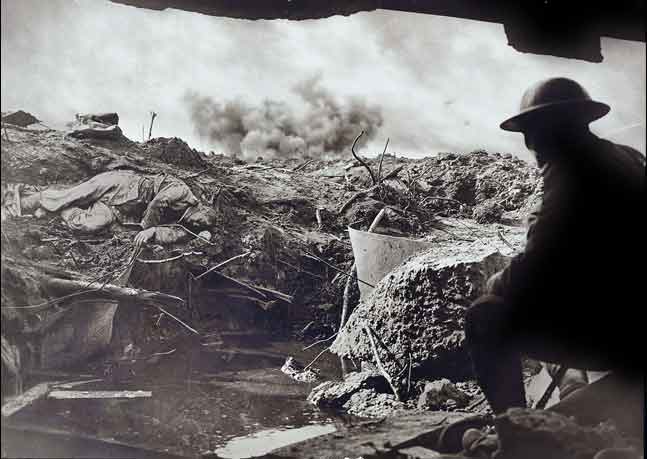
Frank Hurley, Looking out from the entrance of a captured Pill-Box on to the shell ravaged battlefield, 1917/18
March 25, 2007
war conditions
A picture of life under war conditions:
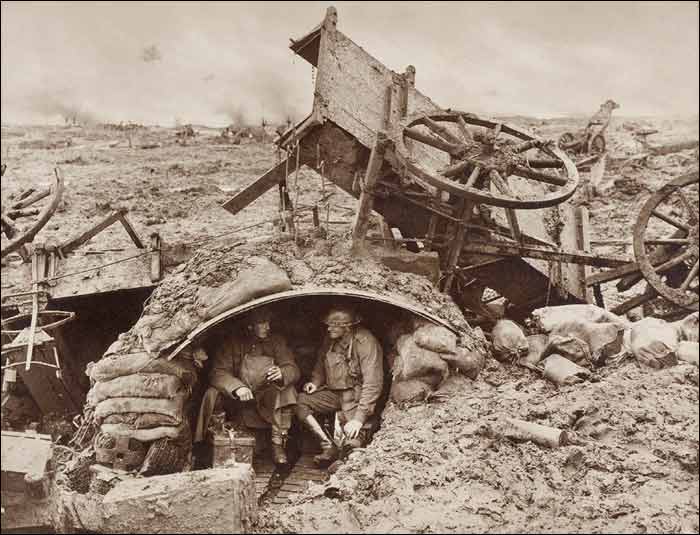
Frank Hurley, Westhoek Ridge (Flanders, Belgium) , 1917
The ground during winter became a series of horrendous mud pools, often knee deep, full of deep slime, due to the incessant rain
March 23, 2007
public opinion, ignorance, democracy
The depth of public ignorance on political issues is a well honed topic of political discourse. Jeffrey Friedman in Public Ignorance and Democracy over at the Cato Institute says:
The public’s reliance on distorted, simplistic stereotypes for its political views was noticed as long ago as the 1920s by Walter Lippmann and was given a definitive treatment in Philip Converse’s 1964 paper, “The Nature of Belief Systems in Mass Publics.” Converse found that more than 86 percent of the American people based their political decisions on criteria ranging from blind party loyalty and a candidate’s perceived personal traits (is he smart? does he “care about people like us”?) to such vague and dubious criteria as the “nature of the times” (if there is prosperity and peace, the incumbent party must be responsible) and primitive judgments about the attitudes of political parties toward social groups such as races and classes. Even most members of the small segment of the public that relied for political guidance on “liberal” or “conservative” ideas had only a rather feeble grasp of the meaning and policy significance of those ideas. That left only 2.5 percent of the public that judged politics against some sort of “abstract and far-reaching conceptual” yardstick, such as a firm grasp of the meaning of liberalism or conservatism.
You would get a similar result if you asked people about markets. Yet markets work in terms of allocation of scarce resources even if most of us don't know how they work, and that one of the assumptions of conventional neoclassical economics---capitalism works by approximating the equilibrium model of “perfect markets”--- is that market participants have complete knowledge of supply and demand conditions.
The classic conservative response, since Plato, is that since the public doesn’t know what it’s doing politically, it should not have political power. Hence we need rule by elites who have knowledge of public policy and political action. It is an anti-democratic argument; one that ignores ideology and the mass media.
What citizens do is interpret politics through the their mental models of it—their ideologies which simplify the world by screening most of it out. It is the media that stands between citizens and politicians with journalists providing the only contact most people have with political affairs.This relationship between politician and journalist is managed. In Talk is cheap and newspeak beckons in the Sydney Morning Herald Julianne Schultz decribes what this 'manage' means:
Behind the scenes a retinue of advisers tests the words and the messages to find the ones that are the most persuasive, that carry the desired meaning, before releasing them into the echo chamber of the press gallery and then onto talkback radio to bounce around and maybe even "corrupt thought". The combination of charm and threat, the blink-and-you'll-miss-it speed of the news cycle, has its own routines. Most of the time these are not visible, there are no heavy-handed "Big Brother is Watching" posters on display, but the ubiquitous, persuasive attention to detail and the words that are used to frame issues are just as effective.
This is how ideology works--- its a mechanism to assimilate self-confirming data, to dismiss conflicting data and to condemn their purveyors as stupid or evil.
March 22, 2007
Libertarian strands+ contradictions
Over at Cato Unbound Virginia Postrel says that the American libertarian movement is an uneasy amalgam of four distinctive yet complementary traditions, two cultural and two intellectual. Reading it I wonder how come libertarians have got into bed with big-government conservatism that pandering to populist prejudices and distributing patronage to well-off cronies.
Postrel's two cultural strands of libertarianism are:
Culturally, the “leave us alone coalition” encompasses two different traditions, outlined by historian David Hackett Fischer in his mammoth 2004 book Liberty and Freedom....The first and more politically prominent is the get-out-of-my-face-and-off-my-land attitude Fischer calls “natural liberty,” a visceral, sometimes violent defense of self and clan. Think “Don’t Tread on Me” and gun rights. The second is the live-and-let-live ideal expressed by the biblical prophecy “they shall sit every man under his vine and under his fig tree; and none shall make them afraid.” Think “Follow Your Bliss” and gay marriage.
Mix the two and you get Ronald Reagan’s California, the land of property-tax rebellions and New Age seekers. These two traditions make American libertarianism distinctively American. Is this cultural strand of libertarianism here in Australia? I've encountered the natural liberty strand but I don't know how extensive it is.
Postrel says that two intellectual traditions---the deductive and the empiricist tradition are seemingly incompatible. The former is the schools of Rand and Rothbard. Everything you need to know follows from the nature of man and the definition of freedom. A libertarian society is not relative but absolute, and is utopian. The empiricist tradition
the Hayek-Friedman tradition...The tradition has produced great theorists, including Hayek, Coase, James Buchanan, Armen Alchian, and Richard Epstein, to name just a few. But their theories are informed, tested, and revised by empirical observation, just as Adam Smith’s were. Most of the libertarian movement’s persuasive and policy triumphs have come from this non-utopian, empiricist approach.
This is the dominant strand in Australia--eg., the free-market think tanks CIS and IPA. But these are allied with cultural and political conservatism. So how does that alliance or fusion square with the principles of libertarianism? Is it a pragmatic compromise for living in an unlibertarian world? I do not see how libertarian policies and traditional values are complementary.
As I see it Australian libertarians are in a state of dependency on the traditionalist political right (conservatism) that has no commitment to the small-government roots of classical liberalism. Conservatism's desire is to protect traditional values from the intrusion of big government; the new one seeks to promote traditional '50s values through the intrusion of big government.
March 21, 2007
Zimbabwe+totalitarianism
Robert Mugabe's regime in Zimbabwe just seems to get worse as it transforms itself into a repressive totalitarian state under the cover of nationalism. Zimbabwe is a country ravaged by inflation, the farms hare wasted, poverty is endemic, people can no longer afford to buy basic commodities, and there is a steady deterioration in the infrastructure — in standards of health care and education.
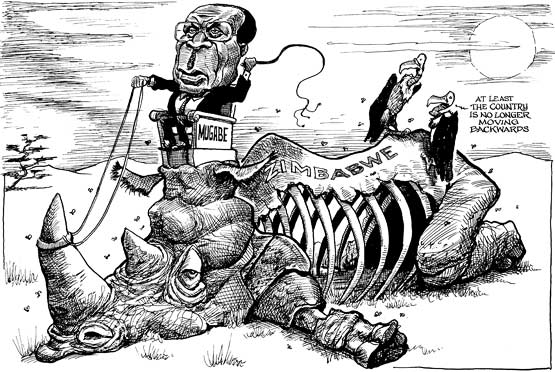
Kevin Kallaugher
Three million or so have left the country, which was once the breadbasket of southern Africa. Elections are rigged, food is used as a political weapon, and opposition leaders routinely arrested and beaten up.
March 19, 2007
progressivism + liberalism
Progressivism is not a term with clear associations. In the late 19th/early 20th century Britain it describes a kind of Lib-Lab political orientation; in early 20th. century United States to refer to a somewhat managerialist philosophy of the state; in the mid/late 20th century by Communists to refer to movements and parties that while not socialist were nevertheless considered to be part of a broader coalition for change; and in the past few years in Australia to refer to what used to be called ‘The Third Way’.
Progressivism is popular in Australia and is often used in place of social liberal, which is conventionally seen as a decayed strand of liberalism. Liberalism has become associated with free markets + small government + personal freedom ----classical liberalism. A key problem is small government--a refusal to accept the reality of big government that does not involve central planning.
Today progressivism appears to mean having a commitment to social justice (fairness) at its heart. Broadly speaking, a socially just society is one where each has equal opportunity to fulfill his or her potential, in which the distribution of social and economic goods is fair and in which a fair distribution is understood to require high, though not necessarily complete equality.
Contemporary progressives see a flexible, open market economy supported by strong public services as the best means to achieving social justice, And, in common with the liberal tradition, modern progressivism aspires to a society that is also open – economically, intellectual and culturally – in which (aspirational) individuals and their families can progress on the basis of their aspirations and hard work, and are not held back by family background or circumstance. Open societies are confident, dynamic and liberal.
Is that a reasonable interpretation of progressivism? So is there such a beast as progressive liberalism with all that libertarian alliance with traditionalist conservatism (the CIS and IPA, which are broadly Hayekian institutions) around? I've never understood that alliance.
March 18, 2007
Remembering Edmund Burke
I was reminded of Edmund Burke's Reflections on the Revolution in France this evening when I caught a bit of tv. I recalled this well known passage:
It is now sixteen or seventeen years since I saw the queen of France, then the dauphiness, at Versailles, and surely never lighted on this orb, which she hardly seemed to touch, a more delightful vision. I saw her just above the horizon, decorating and cheering the elevated sphere she just began to move in — glittering like the morning star, full of life and splendor and joy. Oh! what a revolution! and what a heart must I have to contemplate without emotion that elevation and that fall! Little did I dream when she added titles of veneration to those of enthusiastic, distant, respectful love, that she should ever be obliged to carry the sharp antidote against disgrace concealed in that bosom; little did I dream that I should have lived to see such disasters fallen upon her in a nation of gallant men, in a nation of men of honor and of cavaliers. I thought ten thousand swords must have leaped from their scabbards to avenge even a look that threatened her with insult. But the age of chivalry is gone. That of sophisters, economists; and calculators has succeeded; and the glory of Europe is extinguished forever.
I'm was reminded by the ABC 's Constructing Australia: The Bridge and the fascist- orientated New Guard who opposed Jack Lang, the then Premier of NSW, in the name of empire and monarch.
Burke can see the changes:
But now all is to be changed. All the pleasing illusions which made power gentle and obedience liberal, which harmonized the different shades of life, and which, by a bland assimilation, incorporated into politics the sentiments which beautify and soften private society, are to be dissolved by this new conquering empire of light and reason. All the decent drapery of life is to be rudely torn off. All the super-added ideas, furnished from the wardrobe of a moral imagination, which the heart owns and the understanding ratifies as necessary to cover the defects of our naked, shivering nature, and to raise it to dignity in our own estimation, are to be exploded as a ridiculous, absurd, and antiquated fashion.
March 16, 2007
containing China
A comment on this post on the China Japanese agreement---the Japan-Australia Joint Declaration on Security Cooperation:
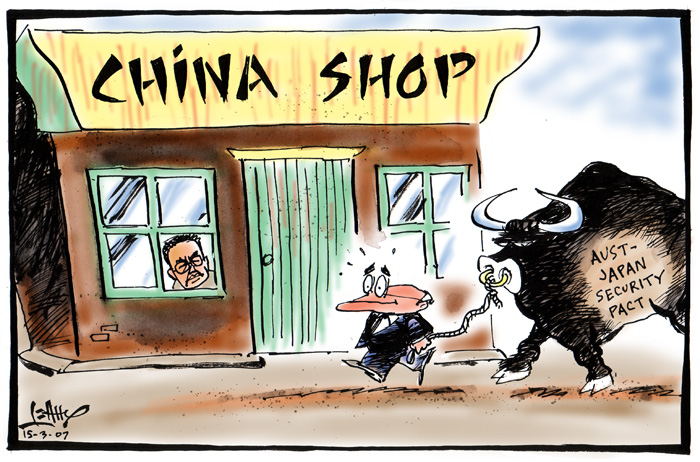
It's a crude security containment strategy whose main target is China and it aims to constrain China's rising power.The United States has made it clear that it wants a more assertive Japan to keep China in check and the neo-cons in Washington have been pursuing for some time an approach to containing China.Washington wants to make it a neat quadrilateral by bringing in India.
Let's hope that India is reluctant to join the Australia-Japan-US Trilateral Strategic Dialogue or be seen as too close to the United States for fear of undermining its relations with China.
March 15, 2007
sovereignty +governmentality
This paper on sovereignty entitled “The Sovereign Disappears in the Election Box” Carl Schmitt and Martin Heidegger on Sovereignty and (Perhaps) Governmentality by Thomas Crombez makes use of Foucault's distinction between between the logic of sovereignty and the logic of governmentality. Crombez says:
Michel Foucault, in his 1976 lectures at the Collège de France entitled “Il faut défendre la société” (”Society must be defended”), defined sovereignty as relating to territory. Its chief objective is how to maintain and expand this territory, in relation to which it occupies a position that may be marked as singular, external and transcendent. It is a power that is not primarily interested in the land itself or the people inhabiting it. This other kind of power, which Foucault terms ‘governmental’, develops only during the early modern period. The logic of governmentality is concerned with the governance of the bodies of those who inhabit the territory. Foucault identified this as the rise of biopolitics.
Crombez argues that both Schmitt and Heidegger are caught up in the logic of sovereignty and only have a limited understanding of governmentality.
March 14, 2007
paranoia in the world of nations
In the American press, and in the rhetoric of neo-conservatives China is often portrayed as a giant rogue state, out to lead a global axis against the US. This simple-minded vision provides the American right with a narrative in which thge US ands its allies---including Australia and Japan-- will be fighting the third world war against an axis of evil. America's hawks are forever looking for new enemies, and at the moment they constructing an imagined axis of China, Russia and Iran.
The Howard Government’s initiative informalizing security and military ties with a a more nationalist Japan--a Japan moving to abandon its post-war pacifist constitution---looks to cut China out. The security agreement---- covers bilateral security links and is the platform for their expansion. It encompasses peacekeeping, counter-terrorism, maritime and aviation security, regional co-operation and a closer relationship between the Australian and Japanese militaries.
At one level, this is a version of the Westphalian state system.
Behind Japan and Australia of course, stands the US. We have their common involvement of Japan and Australia in US-led coalitions in the war on terror, counter-proliferation initiatives and peacekeeping operations. Isn't a more nationalist assertive Japan responding to the rise of China in terms of China being a threat? Isn't Australia's whole military commitment to Iraq nothing more than a symbol of political support for the policies of the Bush Administration. Aren't Tokyo and Washington increasingly concerned about China's rapid military buildup and modernization?
If Australia wants Japan to play a bigger role in Asia’s economic and security architecture, then why exclude China from this architecture? Is this a way to ensure that US can continue with its international dominance--hegemony--- in the Pacific Rim? Australia and Japan are the stalking horse for the US? The reality is that we have a three -way security arrangement. The Japan-Australia pact is seen by many observers as underscoring a looming US-Australia-Japan axis of democracy, primarily aimed at keeping in check China, a rapidly ascending military as well as economic power in the Asia-Pacific region.
The proposals to include India in a four-way security agreement that would encircle China. That encircling is the strategic aim of the new axis.
March 11, 2007
a "concert "of power
Michael Lind in an article at Democracy Now entitled What next? US foreign policy after Bush argues that the goal of American intervention in the two world wars, according to presidents Theodore Roosevelt, Woodrow Wilson and Franklin D Roosevelt, among others, had been to replace a dangerous global balance-of-power system with a "concert" of power, in which the great powers collaborated to preserve international peace. However,
When the cold war ended, however, the concert-of-power strategy was hardly discussed. Centrist liberals as well as conservatives, over-impressed by American military power, sincerely believed that the US could and should be the world's policeman indefinitely. In this vision, shared in different ways by the administrations of Bill Clinton and George W Bush, there was no room for the two most powerful states of Europe (Germany and Russia) or the two most powerful states of Asia (Japan and China), except as American satellites. Germany and Japan would continue to be economic but not military great powers, dependent on the US for protection. And under both Clinton and Bush, Russia and China were frozen out of the US-centred international system.
What then is meant by a "concert of power" as opposed to a hegemony strategy?
Lind says that his argument in his The American Way of Strategy, is to abandon our ill-conceived post-cold-war policy of unilateral world domination.
The world is, or soon will be, fully multipolar, thanks to the rise of China and other power centres, including India and the EU. We have a choice between competitive multipolarity (in the form of endless arms races and balance-of-power struggles among the US, China and other great powers) and cooperative multipolarity (in the form of a concert uniting the US, China, Japan, India, Russia and the major European powers). A concert-of-power strategy need not depend on the Security Council. Nor need there be a single global great-power concert. There can be regional concerts, in which the US participates along with local great powers.
He adds that the leadership in either US political part is unlikely to abandon the hegemony strategy for a more enlightened concert-of-power one in the near future. Many liberal Democrats, as well as Republicans, are committed to the idea that the US has both the power and the obligation to police the world without consulting the other great powers.
March 10, 2007
Walzer + war
In his Just and Unjust Wars (1977), Michael Walzer argues that we must make two separate evaluations of the morality of war: the justice of the cause or purpose for which war is fought and the morality or justice of the methods of warfare. Just cause is usually understood in terms of a self-defense against physical aggression is putatively the only sufficient reason for just cause. The consensus is that an initiation of physical force is wrong and may justly be resisted. Just methods is conventionally understood in terms of the rule that military responses must be proportional to the military provocation, and the rule that civilians must never be intentionally attacked. The inference is that even a just war must be waged justly.
Thus Israel is entitled to defend itself, but is not entitled to do so disproportionately or to wage war on civilians. Israel was judged to Israel to have engaged in unjust, because disproportionate, military activity in Lebanon for the kidnapping of three of its soldiers, the scale of death and destruction. The damage Israel inflicted on so much of Lebanon’s infrastructure through the use of air and sea-power in response to these kidnappings, especially on the civilian population of Lebanon, was deemed to be out of all proportion to these kidnappings.
Was the second Lebanese war a just war?
March 8, 2007
Iraq syndrome?
Ira Chernus has an article at TomDispatch that talks about the Iraq syndrome in terms of the victory culture that motivates the desire for empire as a way to address domestic security. Chernus says:
Victory culture assumes that the United States is bound to win in the end -- that, in fact, we deserve to win because our motives are less self-interested than those of other nations. We may sometimes fight a war ineptly or incompetently, but we always mean well at heart. We want democracy, prosperity, peace, and stability -- not just for ourselves but for everyone.
And:
And in victory culture, we kill only because others are out to ambush and kill us. We are by definition the victims, the innocents, never the perpetrators. That whitewashes our motives, whatever they may actually be...To go on believing that we are virtuous, we must go on seeing ourselves as profoundly insecure, as beset by enemies, as invariably simply defending ourselves out there on the planetary frontiers of an aggressive, dangerous world...
Will the desire to "cure" the Vietnam syndrome became a springboard to an unabashed, militant nationalism and a broad rightward turn in the nation's life, as it did with the Vietnam syndrome? On that would push US politics and culture back to a glorification of military power and imperial intervention as instruments of choice for seeking "security? This would mean that an aggressive war is the royal path to domestic security.
Chernus links the Iraq syndrome to American identity:
It would, however, be hard to avoid seeing any kind of withdrawal from Iraq as a retreat under fire, as a quitting of the field of battle, as an admission that the U.S. cannot always save faraway people in faraway places. That, too, would call into question all the traditional stories that are still so widely seen as the bulwark of American identity... When a whole nation has to cope with an identity crisis, when it has to struggle to believe in narratives that were once self-evidently meaningful, there is no telling what might happen.
The neoconservative mantra is "peace and security through strength."
March 7, 2007
Indigneous communities: violence +sexual abuse
Louis Nowra has an article in the Australian Literary Review about male violence and sexual abuse in Indigenous communities. He says:
In 2005 I spent several days in the Alice Springs hospital after falling ill while attending a friend's wedding ..... What disturbed me...was that the most common sight in the hospital was Aboriginal women and girls with severe injuries suffered during domestic violence. Some of their faces looked as though an incompetent butcher had conducted plastic surgery with a hammer and saw. The fear in their eyes reminded me of dogs whipped into cringing submission. The confronting evidence of what men had done to the women was almost unbearable.
He adds that:
The Alice Springs hospital provides a clear example: about 800 Aboriginal women were treated for domestic assault last year, up from 351 in 1999. The rate of domestic assault in indigenous communities is eight to 10 times that of non-indigenous communities and the sexual abuse of girls is so widespread that one-third of 13-year-old girls in the NT are infected with chlamydia and gonorrhoea. In fact, the situation has become a calamity.
Customary law has been used to justify this violence and sexual abuse in the courts. In May last year, Marcia Langton, an indigenous professor at the University of Melbourne, spoke for many women when she asked: "Are the Aboriginal legal services which supposedly work for us ever going to stop arguing that rape is traditional law?"
March 6, 2007
religious fundamentalism + enlightenment
Anne Applebaum's op-ed in the Washington Post entitled The Gall To Speak Her Mind is about Ayaan Hirsi Ali, her journey from tribal Somalia, through fundamentalism, and into Western liberalism and about reason, faith, multiculturalism and the integration of millions of Muslim immigrants into European culture in Infidel.
She argues there is no place for tolerance of religious fundamentalism within a nation based on enlightenment principles. The implication is that Muslims need to abandon the faith of their fathers and mothers and that a necessary condition for being European is to abandon their religion. What is rejected is a large tolerance for cultural diversity in favour of a "liberal monoculture," in which Muslims adopt Western values.
Taken up by Pascal Bruckner in Sign and Sight, wit has sparked a debate about the Enlightenment and multiculturalism that has relevance to debates in Australia over arguments that Muslim migration is more problematic than previous groups of migration because a group of Muslims are intent on annihilating the West, and because many Muslim leaders who have been embraced as moderates are anything but moderate. The implication of this conservative argument is that it is only Islam and only Muslims who are dangerously fundamentalist, who oppress their own and who must be kept in check. Little is said about Christian fundamentalism. So the causes of unrest amongst Muslims is their religious background.
The religious background of Muslims is enough to label them as anti-social, fanatical or even terrorist. In other words, a whole group of people are labelled as undesirable because of their religion.This conservative discourse cast both Muslims and the faith to which they are notionally linked as being, at worst, inherently evil, and, at best, completely unable to integrate into modern western society. Interfaith initiatives and multiculturalism are misguided because we are dealing with an inherently irreconcilable group of people who would abuse the system for their evil objectives.
March 4, 2007
globalization and global cities
The social and spatial configurations of Sydney and other global cities (such as London) have been significantly re–shaped in recent years by three forces: – post–industrialisation, globalization and migration. The first is the uneven transition from an industrial to a post–industrial economy--- a shift towards the service and information economy. Globalization refers the new forms of the ‘global’ economy, based on the multi–national capitalist corporation and augmented financial flows, which began to emerge in the mid–1970s. The third force is migration, which is a consequence of the other two. The ethnic, social, and cultural diversity that results necessarily from migration is changing the face of the modern urban landscape and reconfiguring the social divisions and conflicts characteristic of so–called ‘global’ cities.
In Divided city: the crisis of London at New Democracy Stuart Hall asks:
The question is how the cartography of the contemporary city is being re–configured under the impact of globalization and migration. In significant ways, the old, hierarchical ordering of urban space seems to have disappeared for good.
Global cities are not whole cities: what we have are bits of cities that are highly globalized – and bits juxtaposed that are completely cut out[from the globalizing process.
Hall says that on the one hand we have global economic networks whose characteristic new skyline is now increasingly dominated by the corporate headquarters of globally–dispersed transnational companies, surrounded by their ancillary and supportive out–sourced dependencies in financial services, marketing, banking, investment, advertising, design, and information technologies. On the other hand, the decline of manufacturing areas has given rise urban areas of extensive social deprivation and economic dislocation, endemic unemployment, and environmental degradation as well as sites of a widespread social despair leading to the defensive mobilization of difference – and thus of ethnic tension, intra–class hostility, racial conflict, social alienation, and civil unrest.
March 3, 2007
Londistan: Melanie Philips in Australia
Melanie Philips, a journalist at the British Daily Mail and author of the book Londonistan, was recently in Australia to give the Quadrant lecture at a Quadrant dinner in Sydney, Australia, 1 March 2007. Philips argues that London is a Londonistan in that "mass immigration, multiculturalism and the onslaught mounted by secular nihilists against the country's Judeo-Christian values" are destroying British nationhood. The greatest danger to the west lies in the way it has been attacked and undermined from within, a process that is continuing and which threatens to hand liberal democracy over to its Islamic enemies who are laying siege to it from without.
She claims that ordinary folk in Britain and Australia feel that they are betrayed and let down by the media and intellectual and political class who try to shut down this debate. Multiculturalism is to blame for this state of affairs---multiculturalism has failed; even worse, it can be blamed for the London bombings. Since strong multicultural identities are intrinsically divisive, reactionary or “fifth columns” , so multiculturalism needs to be replaced with integration (as assimilation). Conservatives hold that cultural separatism and self-segregation of Muslim migrants represented a challenge to Britishness and Australianness and that a “politically-correct” multiculturalism had fostered fragmentation rather than integration.
This is how the crowd at Quadrant understand the issue.
Londonistan developed as a result of the collapse of Australian self-confidence and national identity and its resulting paralysis by multiculturalism and appeasement. The result is an ugly climate in Australia of irrationality and defeatism, which now threatens to undermine the alliance with America and imperil the defence of the free world.
March 1, 2007
media +politics
An article by Manual Castells on communication, power and counterpower in the networked society. It argues that the media have become the social space where power is decided, and that with the rise of a new form of communication, mass self-communication over the Internet and wireless communication networks, insurgent politics and social movements are able to intervene more decisively in the new communication space.
Castells says:
So, in sum: the media are not the holders of power, but they constitute by and large the space where power is decided. In our society, politics is dependent on media politics. The language of media has its rules. It is largely built around images, not necessarily visual, but images. The most powerful message is a simple message attached to an image. The simplest message in politics is a human face. Media politics leads to the personalization of politics around leaders that can be adequately sold in the political market. This should not be trivialized as the color of the tie or the looks of a face. It is the symbolic embodiment of a message of trust around a person, around the character of the person, and then in terms of the image projection of this character.