April 29, 2007
liberalism in a broken form
Some good questions posed by Wendy Brown in her Politics Out of History:
What is the effect on liberalism of these transformations in its historical and global location and historical self-understanding? What happens to liberalism's organizing terms and legitimacy when its boundary terms change--when its constitutive past and future, as well as its constitutive others, lose their definitive difference from liberalism's present and identity? What is (nineteenth-century) liberal justice without a narrative of progress that situates it between an inegalitarian and unemancipated ancien régime and the fulfilled promise of universal personhood and rights-based freedom and equality? What is (twentieth-century) liberal democracy without communism as its dark opposite? What is liberalism out of these histories, indeed out of history as we have known it, which is to say, out of a history marked by the periodicity of this particular past-present-future and by the temporality of progressivism?
If liberalism's narratives are destabilized or broken and its foundations are cracked and eroded, then what kinds of politics results? Well we have the return of righteous moralism and the anti-intellectualism of the religious Right into contemporary political discourse. Presumably, after modernity, we have a postfoundational liberalism that is just another western political tradition.
Redemption and politics
I have never understood what a redemptive politics is. Doesn't redemption belong to religion or theology, not to politics? Isn't the religious/theological demarcated from the political in modernity? Hasn't God been banished from the political?
I can see that the language of chosenness and manifest destiny of the US offers a kind of redemptive politics, as its inherent goodness is used to overcome hardships and adversity and make the harsh world a better place. In this sense the public narrative in American history is one about redemption; often in the personal form of a religious move from sin to salvation; or stories of upward social mobility in moving from rags to respectability and riches; or stories about recovery from sick or addicted protagonists regaining their health or sobriety.
Then we have a grand neo-liberal narrative about a good and innocent protagonist who takes charge of his own life, stays focused through adversity, and ultimately triumphs in the end.
As Dan P. McAdams says in the Chronicle Review 9/11 plays into this kind of narrative:
The attacks of September 11 and the "war on terrorism," furthermore, play perfectly into the story of the redemptive self. Terrorism and war show us that the world is a dangerous, unredeemed place. In times of crisis, the good American protagonist must call upon the deepest reservoir of unwavering conviction and hope.A dangerous world is indeed the kind of world that the good and strong hero of the redemptive self seems unconsciously to expect. Under conditions of adversity, he will fight the good fight. He will keep the faith. In the end, his suffering will give way to redemption. And along the way, he may even help to redeem others.
April 27, 2007
Hegel on the state revisited
For liberals the embodiment of the Hegelian state was not Wilhelmine Germany but the Third Reich and the Soviet Union. It is the state reified.The liberal rejection of the Hegelian theory of political agency sought to emphasize spontaneous order at the expense of the unified will.
Hegel's theory of the state consciously worked with a double inheritance. On one hand, a conception of the state as the united will of the multitude, on the other, an account of civil society in which society is governed not by the will, but the rationality of the invisible hand. On Hegel’s account, the limitation inherent in the rationality of the invisible hand is its unintended, unwilled emergence, while the problem with the unity of the will is its arbitrary nature and potentially destructive consequences. Both are overcome in the fusion of the two in the state.
Hegel’s theory of the state acknowledges that there is frequently a disjunction between the aggregated outcomes of our individual actions, and the objectives for which we collectively strive. The collective product of civil society, brought about through ‘the complex interdependence of each on all’ is not the same as the general will, as expressed in a social contract. So, instead of wills being united by their own volition, the invisible hand creates a unity which is then consciously willed. In effect, the state is the ‘general intellect’ become conscious of itself as the general will.
So the arbitrariness of the general will is steadied by the rationality of the invisible hand, and the spontaneous order of society is infused with the patriotism of the state.
The conservative response to Hegel has been to try to preserve the integrity of the state from the contamination of individual action in civil society. Civil society only generates consumer interest groups—‘customers purchasing gas from the same utility company, or passengers travelling on the same bus’
April 26, 2007
Parrhesia + democracy
Michel Foucault's lecture course, "Discourse and Truth: the Problematization of Parrhesia, given at the University of California at Berkeley, Oct-Nov. 1983 has a lecture on parrhesia (free speech as truth telling) and democratic institutions.
It briefly explores the antinomy between parrhesia as freedom of speech and democracy, which inaugurated a long impassioned debate amongst the classical Greeks concerning the precise nature of the dangerous relations which seemed to exist between democracy, logos, freedom, and truth. He says that what we know of the discussion is limited. Most of the texts which have been preserved from this period come from writers who were either more or less directly affiliated with the aristocratic party, or at least distrustful of democratic or radically democratic institutions.
This is what Foucault says about Plato' s argument in The Republic:
What is interesting about this text is that Plato does not blame parrhesia for endowing everyone with the possibility of influencing the city, including the worst citizens. For Plato, the primary danger of parrhesia is not that it leads to bad decisions in government, or provides the means for some ignorant or corrupt leader to gain power, to become a tyrant. The primary danger of liberty and free speech in a democracy is what results when everyone has his own manner of life, his own style of life. For then there can be no common logos, no possible unity, for the city. Following the Platonic principle that there is an analogous relation between the way a human being behaves and the way a city is ruled, between the hierarchical organization of the faculties of a human being and the constitutional make-up of the polis, you can see very well that if everyone in the city behaves just as he or she wishes, with each person following his own opinion, his own will or desire, then there are in the city as many constitutions, as many small autonomous cities, as there are citizens doing whatever they please. And you can see that Plato also considers parrhesia not only as the freedom to say whatever one wishes, but as linked with the freedom to do whatever one wants. It is a kind of anarchy involving the freedom to choose one's own style of life without limit.
This conservative argument about no common logos, no possible unity, for the polis resonates today, as conservatives talk in terms of social cohesion, order and the political integrity of the state that is threatened by liberal self-expression of the 1960s.
April 25, 2007
a note on historical agency
Greg Sheridan is the Foreign Editor of The Australian newspaper and the author of The Partnership: The inside story of the US-Australian alliance under Bush and Howard. He writes:
One of the reasons I always hated Marxism, which was fashionable when I was an undergraduate, was because of its determinism: its view that history had an inevitable course that it must follow. I don’t believe anything is inevitable, and think that history is enacted, unpredictably, by independent human beings who made unpredictable judgments.For all its sins, the United States has stressed in its founding and defining documents, in its highest public leadership, and in most of the life of the nation, qualities which accord with the deepest nature of human beings —liberty, self-determination, democracy, hard work, the rule of law, civic equality, religious equality.
How does Sheridan square his assertion about the Marxist understanding of historical agency as determinism-- the view that history had an inevitable course that it must follow--with Marx's statement in The Eighteenth Brumaire of Louis Napoleon that "Men make history, but they do not make it just as they please"?
Presumably, scholarship is not Sheridan's strong card. He needs a straw man to assert his individualist view of historical change; an ontology which he asserts is grounded in human nature.
Marx's quote implies a view of human agency that exists within tight constraints, but is free within those constraints. Human beings do not choose the circumstances for themselves, but have to work upon circumstances as they find them, have to fashion the material handed down by the past’. That is to say, we make our own history, but not under circumstances of our own choosing.
April 24, 2007
Democracy + religion
In his review of two books on the entry of religious reason into the political realm in liberal democracy in Borderlands, Brian Goldstone says that principle task of Jeffrey Stout's Democracy and Tradition is to reconsider the terms of interaction between religion and democracy. Goldstone says that:
Stout summarizes in the query "What role, if any, should religious premises play in the reasoning citizens engage in when they make and defend political decisions" (p.63)? In answering this question, Stout seeks to counter the depiction - promulgated mostly by the aforementioned new traditionalists - that democratic culture remains inherently bereft of moral and spiritual virtues. Moreover, he challenges the assumption that democracy depends on the establishment of political deliberation on the common ground of free public reason, independent of comprehensive doctrines or tradition.
In other words, he argues against the idea that democracy is somehow intrinsically inhospitable to substantive religious reasoning. As we have seen in the previous post Stout argues that democracy is itself a tradition, and so" Rawlsian liberalism should not be seen as its official mouthpiece.
Stout's understanding of democratic culture entails neither the denial of theological assumptions nor the expulsion of theological expression from the public sphere. These attributes Stout argues correspond to the quite particular ideology of "secularism" put forth by political liberalism.
April 19, 2007
democracy, religion, tradition
Blogging will be light for the next few days, as I am off on a five day holiday to Kangaroo Island. So I've linked to this review of two books about the entry of religious reason into the political realm in liberal democracy in Borderlands, and the questioning of whether secularism is the only acceptable form of political belonging.
The books are William Connolly's Why I Am Not a Secularist and Jeffrey Stout's Democracy and Tradition. In the Introduction to his text Stout makes comments that resonate with Hegel's Philosophy of Right. Stout says:
Democracy, I shall argue, is a tradition. It inculcates certain habits of reasoning, certain attitudes toward deference and authority in political discussion, and love for certain goods and virtues, as well as a disposition to respond to certain types of actions, events, or persons with admiration, pity, or horror. This tradition is anything but empty. Its ethical substance, however, is more a matter of enduring attitudes, concerns, dispositions, and patterns of conduct than it is a matter of agreement on a conception of justice in Rawls’s sense. The notion of state neutrality and the reason-tradition dichotomy should not be seen as its defining marks. Rawlsian liberalism should not be seen as its official mouthpiece.
What is interesting about Stout is that he adopts the point of view of a citizen, that is one who 'accepts some measure of responsibility for the condition of society and, in particular, for the political arrangements it makes for itself.' Adopting this point of view presupposes participating in the living moral tradition of one’s people (ethical life?) understood as a civic nation.
This tradition, Stout says, holds that it is the task of public philosophy, to articulate the ethical inheritance of the people for the people while subjecting it to critical scrutiny. Consequently, it is presupposed that citizens reflect philosophically on their common political life.
April 18, 2007
legal reasoning
In his Oliver Wendell Holmes, Jr., Legal Theory, and Judicial Restraint, Frederic R. Kellogg gives an account of Holmes's theory of common law interpretation and showing its parallels to the pragmatic view of knowledge development. Again, that is the strength of the book. Kellogg summarized Holmes's view:
Holmes called this process "successive approximation." Legal rules are viewed historically, and Holmes here proposes that they be understood as emerging from classes of activity, or more precisely from classes of disputes within discrete activities. As new cases arise within a given class, for example, vehicular accidents or communications among people forming contractual arrangements, they are initially decided on their facts, a case at a time. Eventually, a body of decided cases can be "reconciled," with the laying down of a general rule, after time has permitted sufficient case-specific analysis, probing the relevant varieties and conditions of accidents or contractual communications. (p.28)
Through this gradual process of the accretion of a multitude of decisions, by juries and judges (Holmes's emphasis over time shifted from the former to the latter), rules begin to emerge, rules which reflect community values and practices. This description matches the pragmatist account of knowledge as the product of a community of inquirers pursuing projects in the world, refining what they know and do in accordance with successes and failures.
what drive this process is dealing with common problems thrown up by society, which is in a constant state of change.
April 16, 2007
Foucault, unreason, governmentality
I've always wondered how modernist cultural conservatives would engage with Foucault's texts rather dismiss them. In Australia we usually we get something along the lines of a defence of the [positivist] Enlightenment by attacking the moral relativism and nihilism of "po mo", with little recognition of a history of the Enlightenment in the plural---as a series of multiple, conflicted enlightenments. Little more than that is offered. I would presume that, as empiricists who start from facts, the cultural conservatives would have an animus against rationalism, discourses and knowledge power. They hold that theories are build up from, and checked by facts. You do not start with a discourse. But this epistemology is rarely argued for. So, more often than not we have the cultural conservative dismissal of poststructuralism as a nasty foreign body that will infect the common sense of empiricism.
Well, here is an engagement, of sorts. A review by Andrew Scull of Foucault's History of Madness in The Times Online. This early text, which had been published in an abridged form as Madness and Civilisation in 1965 examines the ideas, practices, institutions, art and literature relating to madness in Western history. Foucault argues that in the modern period unreason is pushed further beneath the surface of society, and is understandable only through certain artists; madness on the other hand, becomes mental illness, and is treated and controlled by medical and psychiatric practices.Various cultural, intellectual and economic structures determine how madness is known and experienced within a given society. In this way, society constructs its experience of madness.
Thus madness in the Renaissance was an experience that was integrated into the rest of the world, whereas by the nineteenth century it had become known as a moral and mental disease. In a sense, they are two very different types of madness. Ultimately, Foucault sees madness as being located in a certain cultural "space" within society; the shape of this space, and its effects on the madman, depend on society itself. The' history of madness is the counterpart of the history of reason'. Hence the linkage between the self-affirmation of early modern philosophical reason and the social repression of unreason as identified in the form of disordered conduct.
Sculls' review is entitled The fictions of Foucault's scholarship. Scull says that the early abridged text:
.
.. could be read in a few hours, and if extraordinarily large claims rested on a shaky empirical foundation, this was perhaps not immediately evident. The pleasures of a radical reinterpretation of the place of "psychiatry in the modern world (and, by implication, of the whole Enlightenment project to glorify reason) could be absorbed in very little time...Here... is a world turned upside down. Foucault rejects psychiatry’s vaunted connections with progress; he rejects the received wisdom about madness and the modern world. Generation after generation had sung paeans to the twin movement that took mad people from our midst and consigned them to the new world of the asylum, capturing madness itself for the science of medical men; Foucault advanced the reverse interpretation. The “liberation” of the insane from the shackles of superstition and neglect was, he proclaimed, something quite other – “a gigantic moral imprisonment”. The phrase still echoes. If the highly sceptical, not to say hostile, stance it encapsulates came to dominate four decades of revisionist historiography of psychiatry...
Well, Foucault was analysing the cultural, intellectual and economic structures that dictate how madness is constructed. He is concerned with changing patterns or structures of knowledge, sets of relations, and broad themes. His central argument is that modern medicine and psychiatry fail to listen to the voice of the mad, or to unreason. According to Foucault, neither medicine nor psychoanalysis offers a chance of understanding unreason.
Scull is reviewing the new Routledge translation of Foucault's History of Madness. In Scull's terms Foucault was questioning psychiatry's legitimacy, which he reads in terms of Foucault's "anti-Enlightenment project." His objection is that:
Foucault’s isolation from the world of facts and scholarship is evident throughout History of Madness. It is as though nearly a century of scholarly work had produced nothing of interest or value for Foucault’s project. What interested him, or shielded him, was selectively mined nineteenth-century sources of dubious provenance. Inevitably, this means that elaborate intellectual constructions are built on the shakiest of empirical foundations, and, not surprisingly, many turn out to be wrong.
He says that Foucault argues that the Age of Reason was the age of a Great Confinement:
Foucault tells us that “a social sensibility, common to European culture . . . suddenly began to manifest itself in the second half of the seventeenth century; it was this sensibility that suddenly isolated the category destined to populate the places of confinement . . . the signs of [confinement] are to be found massively across Europe throughout the seventeenth century”. “Confinement”, moreover, “had the same meaning throughout Europe, in these early years at least.” ....But the notion of a Europe-wide Great Confinement in these years is purely mythical. Such massive incarceration simply never occurred in England in the seventeenth and eighteenth centuries, whether one focuses one’s attention on the mad, who were still mostly left at large, or on the broader category of the poor, the idle and the morally disreputable.
Scull is concerned with historical facts, Foucault with a historical sensibility or discourse without the category of power. More accurately, as Michael Gordon points out in his review, Foucault's account of the Great Internment' under the ancient regime, administered by the King's lieutenant de police, can be interpreted in the light of Foucault's later analysis of 'police' as a governmental rationality for the regulation of conduct.
Update: 18 April
Over at Catallaxy Rafe Champion has a short piece that says the triumph of pomo was an effect (not a cause) of an earlier triumph of politicisation and trivialisation of the social sciences and humanities:
And so POMO infected an organism that was already debilitated by other factors. The process of debilitation occurred in the period between 1965 and 1973, massively stimulated by events of 1968. Certainly by 1973 the lunatics were pretty well in charge of the asylum in soft faculties like Sociology. The timetable of publication of works by the major pomos indicates that they could not be indicted for events pre 1973.
Champion gives a list, which he says indicates the dates of publication of English translations of the early works of the authors (not a complete list) that lead to pomo as sympton of intellectual decline in the 1980s:
Foucault: Madness and Civilisation 1965, The Archeology of Knowledge 1972, The Birth of the Clinic 1973, The Order of Things 1973.
Derrida: “Speech and Phenomena” and Other Essays, 1973, Of Grammatology, 1976, Writing and Difference 1978, Spurs: Nietzsche’s Styles, 1979.
Lacan: The Language of the Self: The Function of Language in Psychoanalysis, 1977.
Gadamer: Hegel’s Dialectic: Five Hermeneutical Studies, 1976, Philosophical Hermeneutics, 1976.
de Man: Allegories of Reading 1979, Blindness and Insight, 1983.
Lyotard: The Postmodern Condition 1979.
Its an odd list---eg.,Gadamer: Hegel’s Dialectic: Five Hermeneutical Studies, 1976, Philosophical Hermeneutics, 1976--but it includes Foucault's Madness and Civilisation
April 15, 2007
from liberal to neo-liberal political rationality
Mark Beeson and Ann Firth in Neoliberalism as a Political Rationality: Australian Public Policy Since the 1980s give a useful overview of the way that liberalism historically governed the national economy and its modification by neo-liberalism from a governmentality perspective. They say:
In early nineteenth century liberalism the economy as an object of government is conceived of as a self-regulating and relatively self-contained national system.... The notion of a self-regulating system separates economic activity from the sphere of governmental activity. The economy, thus conceived, is driven by the self-interest of individuals and exhibits a natural tendency to growth.
I've always understood this in terms of the economy as a clockwork mechanism. All traditional schools of economics are based on the concepts of classical physics of the universe as a perfectly predictable clockwork mechanism. We still hear orthodox economists describing the "economy as a machine", talking about "fine-tuning" the "economic engine, " or the "economy losing steam" or that the government needs to repair a failed "market mechanism."
Beeson and Firth's argument is that the emergence of a neoliberal political rationality involves a transformation in the image of the economy as an object of government from one seen as essentially national and self-contained to one that is seemingly transnationalised and locked in relentless international competition. Successful competition
is now perceived to depend upon the promotion of economic efficiency, not only in the production of goods and services, but in all areas of national life. They say that economic security:
requires the prioritising of competition and economic
efficiency in areas as diverse as welfare, health or education, because policymakers have come to feel that they may impact upon the overall economic performance of nation as a whole. Thus, the priority accorded to economic efficiency in order to create or maintain international competitiveness initiates a new relationship between economy, state and society in which their distinctive identities as separate spheres of national life are increasingly blurred.
S we have a shift in a liberal rationality of government, which conceive of the economy as a self-regulating system with a natural tendency to growth, economic activity provides the resources for education, health services and welfare, to a neoliberal political rationality in which society and the state must be transformed to make them contribute to the drive for economic efficiency. in drive for economic efficiency.
April 14, 2007
liberalism as a political rationality
The ideas of neo-liberalism have had a profound influence on Australian public policy since the 1980s. In Neoliberalism as a Political Rationality: Australian Public Policy Since the 1980s Mark Beeson and Ann Firth say that neo-liberalism may best be thought of as representing a distinctive ‘political rationality' and that the emergence of a neo-liberal political rationality in Australia is a manifestation of new ways of thinking about national economies and their possible management.
They say that political rationalities are particular and historically specific instances of what Michel Foucault calls ‘governmentality’. Foucault used the term ‘governmentality’ to refer to a particular way of thinking about government which emerged in Western Europe in the eighteenth century and which has its object the economic security and prosperity of the state itself.
They add:
....government is a complex activity, which cannot be viewed simply as the implementation of any particular political or economic theory. The incorporation of economic doctrines or political philosophies into governmental practice is always partial and necessitates connection with administrative techniques and forms of
calculation which modify, if not transform, the theories and their objectives. Rather than the realisations of political or economic philosophies, political rationalities are more accurately viewed as amalgams of political expediency, policies, ‘commonsense’, responses to public opinion, economic doctrines and notions of human rights
liberalism as a political rationality makes individual freedom an artifact of particular strategies and modes of regulation, rather than the absence of government intervention. So analyses, which conceive of liberalism as a political rationality, focus upon the ways in which a variety of governing authorities, both state and non-state, seek to promote a form of life characterised by personal autonomy and rational choice.
The emphasis is upon the ways in which liberalism proposes to govern through the self-regulation of individuals who are at once the object and partner of those technologies of government through which political reason becomes practical.
April 11, 2007
neo-liberalism + families
My interpretation of neo-liberal's political rationality is that it is opposed to the trend towards higher government spending and increasing dependency on government benefits and services, and that we would choose to (prefer) to live in an affluent country where most people manage their own affairs without having to rely heavily on government to provide them with what they need. Social democratic policies are deemed to be backward-looking.
This implies that instead of depending on the welfare state the family is an autonomous social unity or group responsible for its own maintenance and care. Consequently, the neo-liberal mode of governance creates a moral imperative upon the families of the sick to adopt a caring role, while conversely, allowing for increasing regulation of the family by professional carers through the creation of formal mechanisms for carer involvement in provision of health services and the codification of carers' rights and responsibilities.
One side of the mode of governance is individualistic, and based upon policies of personal responsibility, self-advancement and entrepreneurship; the other side is imbued with the language of community and social capital. The existence of individualism and community within the same policy agenda may appear contradictory yet they coexist.
April 10, 2007
Saunders contra the welfare state
The CIS is one of Australia's neo-liberal think tanks that has its roots in the work of Hayek. So it has a problem with the centralized state, by which it is meant the welfare state of social democracy that was put in place in the 2Oth century. It is argued that the main driver of big government has been the inexorable increase in spending on the welfare state (not just cash benefits, but also services like health and education). Even though the population is getting more affluent, and should therefore be more capable of looking after itself without government assistance, the welfare state keeps getting bigger.
In his Families under Capitalism article in the current issues of the CIS Policy magazine Peter Saunders points the finger at the welfare state in relation to the decline of the traditional family and face-to-face communities.
CIS contests the social democratic view that government are needed to protect public health, provide welfare and to advance the general welfare. CIS holds that governmental respect for individual freedom and the autonomy of nongovernmental spheres of authority is a requirement of political morality. Government must not try to run people's lives or usurp the roles and responsibilities of families, religious bodies, and other character- and culture-forming authoritative communities. Saunders says:
Many factors contributed to the disruption of family life and the erosion of social responsibility that occurred from the 1960s onwards, but one was almost certainly the growth of big government and the remorseless expansion of the welfare state. Why marry the father of your child if government benefits will provide you with a secure and regular income if you don’t? Why ask the grandparents to help with looking after the baby if the government is willing to give you money to buy child care? Why join a mutual health fund if the government is willing to make free health treatment available through Medicare? Why volunteer your time building up and running community facilities if the government can supply them with a wave of its cheque book? In modern Australia, it sometimes seems the only compelling reason for getting together with other people is to demand that the government do more for you.
This is the nanny state thesis. The state looks after you from the cradle to the grave. So we Australians have no self-reliance and cannot stand on our own two feet. We have lost the rugged individualism prized by classical liberalism. We suck the tit of the welfare state as mommy. Hence we--Saunders means the working class-- are regressive. What is required is limited government.
What is not considered by Saunders is that many Australians in a neo-liberal world may need to use both grandparents and childcare; that single mothers may not marry the father of their child because he is a bastard; that many Australians continue to run community facilities in their own time; and many people use both a health fund and Medicare. 'Many Australians' includes the moral middle class and not just the regressive working class.
April 9, 2007
Saunders on family life + community
In his article in the current issues of the CIS Policy entitled Families under Capitalism that I mentioned in this earlier post Peter Saunders contests the Marxist argument that economic forces drive social and cultural change. His argument is not very good.
Saunders says:
We now know he was wrong, but Rudd is still making much the same assumption, for his argument that free market capitalism necessarily undermines families and communities is a clear example of the sort of ‘materialist’ and ‘determinist’ thinking that Marxism popularised.
How do we know that Marx is wrong? Because it is materialism? Or because it is determinist? How then is Marx a determinist? Wasn't he meant to be dialectical? Wasn't it the dialectics that was the problem for the Popperian empiricists? What we have is an assertion by Saunders, not an argument. Saunders hasn't shown that Rudd's assumption is wrong.
Saunders' counter argument is that it is the welfare state of social democracy that is the problem, not free market capitalism:
Rudd wants to use the power of government to limit the market and to protect family and community life against ‘unrestrained market capitalism’, but historically, it is the expansion in the powers of government that has been a major factor undermining family and community resilience.
The issue is posed. Social democracy's understanding of civilizing capitalism does involve restraining free market capitalism and creating the welfare state. So what is Saunder's argument for the claim that is the expansion in the powers of government that has been a major factor undermining family and community resilience?
Saunders explains:
The rise of the centralised state directly challenged and undermined the traditional authority of church, family, guild and local community, for it offered an alternative source of identity and social unity. It destroyed the ties binding people to their traditional social groups by assimilating them into a new, monolithic political community of ‘citizens’. Old collective identities were supplanted by new individual rights and duties, and the State increasingly assumed responsibility for most of the things people used to get from their family, church and local community memberships. The result today is that families and other small-scale primary groups have been left with very little to do. They are ‘increasingly functionless, almost irrelevant’, and because of this, they no longer command our enduring allegiance. As Nisbet warns: ‘No social group will long survive the disappearance of its chief reasons for being.
Some quick points. First, citizens are not the state. Citizens are introduced to step beyond the sphere of civil society to the political sphere of the liberal democratic state. Secondly, it wasn't the state that was responsible for the new individual rights and duties, it was liberalism. Thirdly, there was not a new, monolithic political community of ‘citizens’ in Australia in the 20th century as Australia was a federation of different states and a commonwealth government. Australia of the 20th century was not a centralized state. It has increasingly become so under the Howard conservatives.
It is unclear how did the (presumably liberal) state destroy the ties binding people to their traditional social groups by assimilating them into a new, monolithic political community of ‘citizens’? Surely, the Australian people were continuing to live in families, participating in the market and acting as citizens? And they are living in families because the family is seen as important and crucial form of ethical life.
April 8, 2007
markets + morality
The paper entitled Moral Views of Market Society by Marion Fourcad and Kieran Healy, recently a Research Fellow in Social and Political Theory at the Australian National University, is an interesting exploration of the relationship between markets and the moral order. The text argues that Albert Hirschman's classical typology of three rival views of the market--- as civilizing, destructive or feeble in its effects on society--- is insufficient. They argue for a fourth view, which they call “moralized markets,” They say that the latter view, that markets are explicitly moral projects, saturated with normativity, has become increasingly prominent in economic sociology.
The traditional approach to markets + morality is that the moral underpinnings of the market is grounded on the concept of self-interest. In this debate defenders of markets generally follow in the footsteps of Adam Smith, and claim that good results can arise from complex systems of human interaction even when the individuals are not intending to generate those good outcomes. Egoism and greed no doubt exist, but through the mediation of markets, self-interest can work for the good. If defenders of the market point to its role in promoting virtues such as hard work, initiative and creativity, then critics point out that the utilitarian habit of basing actions on self-interest tends to spread into all areas of life, eventually undermining the moral standards on which the market itself depends.
I accept the view that that markets are culture as they are the products of human practice and sense-making and because markets are saturated with normativity---in that market exchange--insurance-- is embodied with moral meaning.--it is good to be insured, bad not to be. Economic values---such as efficiency, transparency, productivity, profit-making-- are also moral values as these economic values are seen to be, and understood as, good and not bad by various economic agents and economists. It provides the basis for a specific kind of moral order.
April 6, 2007
Saunders on capitalism+ family life
Peter Saunders has an article in the current issues of the CIS Policy magazine on the issue of capitalism and families entitled Families under Capitalism. Saunders is responding to criticisms of free market fundamentalism, Hayek, and the Howard Government recently made by Kevin Rudd, the leader of the federal Labor opposition. It can be seen as part of the ongoing debate about morality and markets that has its roots in the 19th century.
Rudd, says Saunders had criticised Howard for unleashing ‘unrestrained market capitalism’, which has encouraged ‘individual greed and self-interest’ and eroded the bonds that hold our society together. Saunders interprets Rudd to have acknowledged that Hayek understood the importance of family life, but that Rudd argued that Hayek's philosophy precluded him from protecting families from the profit-maximising logic of the marketplace. Rudd then extended this critique to the Howard government which he thought had pursued hard-line, Hayekian economic policies without regard for their impact on the quality of family and community life.
Saunders says that though Rudd's essays attracted considerable comment there was little serious discussion of what was arguably Rudd’s core claim—that free market capitalism is responsible for weakening family and community life.
Saunders spells this core claim out:
The core of Rudd’s argument in both of these essays is that capitalism will ‘tear itself apart’ unless it is regulated. This is because the self-interested pursuit of profit fatally undermines family and community life, which has therefore to be protected by government. He then applies this argument to the Howard government’s recent workplace reforms which he believes are dismantling a civliising framework of regulation that has kept free market capitalism in check for a hundred years. As a result of these reforms, families have been exposed to an ‘unconstrained market’ and are now being prevented from ‘spending sufficient time together’ as profit-maximising employers use the new laws to increase exploitation. ‘Market fundamentalism,’ he says, is making ‘ultimate inroads’ into family life
Saunders acknowledges that Rudd’s argument, that market capitalism undermines family and community life, is not original. He says that over the years, many social theorists have maintained that capitalism destroys intimacy and a sense of belonging, and many of them have been socialists seeking to make an ethical case for more state control or regulation of the economy. However, like many gloomy commentators before him, what Rudd is offering is not fresh analytical insights but tired and largely discredited sociological clichés.
It is a common view that capitalism actually undermines traditional moral foundations of a society. The argument is that the greater anonymity and mobility in society reduces the impact of pre-modern morality on people. As people pursue more self-interest, collective interest loses out. Some--Karl Marx, for instance, have argued that capitalism would ultimately erode the values needed for capitalism itself, leading to it's own self-destruction. Saunders does acknowledge the truth content of market capitalism undermining family and community life, as he says:
There is, of course, some truth in the claim that free market capitalism undermines traditional ways of life. Given the unprecedented economic growth and technological innovation that it unleashes, capitalism could hardly avoid destroying, uprooting and replacing long-settled patterns of social existence.... Doom merchants invariably... see only the decay, never the re-growth. Ever since Tönnies, they have over-emphasised the strength of family and community life in the past while under-estimating the persistence of family and community cohesion in the present.
What then is this regrowth in relationships family and community life? Saunders says:
We have more choice today over whom we interact with (traditional, small, settled communities could be extremely limited and suffocating), so we can build strong relationships with those we want to be with while avoiding those we don’t. It could even be argued that, far from being destroyed, ‘community’ has been extended and strengthened by the development of capitalism, for evolutions in transportation and communications allow us to sustain meaningful personal relationships over much wider geographical areas nowadays than we could in the past. When settlers left Europe for Australia or America in the nineteenth century, they often bade farewell forever to their families and friends.Today, they can text, email, phone and ‘Skype’ each other daily at minimal cost..
This is very much a free market view: modern associations allow for participation without absorption in traditional morality as they make it possible for the individual to develop a variety of interests and to become involved in a wider range of activities than would otherwise be possible, yet to do so without surrendering the totality of his time, income, or identity to any particular association, from the family to the state.
There is a slight of hand here by Saunders: we have different modes of exchange and association in terms of culture, society and markets; or to put it more classical terms different modes of ethical life. All Saunders is doing is reprising an old liberal riff: closed communities versus open societies without evaluating the strengths and weaknesses of the different historical modes of ethical life. What we have is the conventional argument that capitalism creates ever wider forms of association, without an acknowledgement that he market has only one mode of valuing things — price— whereas in reality goods may be valued (and valuable) in ways that price cannot
capture.
April 5, 2007
neo-liberalism as governance
In Neo-liberalism: Policy, Ideology, Governmentality, published in Studies in Political Economy (2000), Wendy Larner states:
The most influential post-structuralist theorisation of neo-liberalism is that associated with the neo-Foucauldian literature on governmentality. This literature makes a useful distinction..... between government and governance, and argues that while neo-liberalism may mean less government, it does not follow that there is less governance. While on one hand neo-liberalism problematises the state and is concerned to specify its limits through the invocation of individual choice, on the other hand it involves forms of governance that encourage both institutions and individuals to conform to the norms of the market.
That makes a break with the big government thesis by classical liberals associated with the Centre of Independent Studies.
Larner says:
The governmentality literature has inspired innovative analyses of welfare state restructuring, which show that social policy reform is linked to a new specification of the object of governance. .....Neo-liberal strategies of rule, found in diverse realms including workplaces, educational institutions and health and welfare agencies, encourage people to see themselves as individualised and active subjects responsible for enhancing their own well being. This conception of the ‘active society’ can also be linked to a particular politics of self in which we are all encouraged to ‘work on ourselves’ in a range of domains, including the ‘counter cultural movements’ outside the purview of traditional conceptions of the political.
Once again this account breaks with the classical liberal and libertarian accounts that endlessly riff the individual freedom versus government.
One criticism of the governmentality approach to neo-liberalism made by Larner is that the governmentality literature:
....has not paid a great deal of attention to the politics surrounding specific programmes and policies.This is particularly the case vis-a-vis theorisations of neo-liberalism in that the emphasis has been on broad governmental themes rather than specific neo-liberal projects...Yet it is obvious that without analyses of the ‘messy actualities’ of particular neo-liberal projects, those working within this analytic run the risk of precisely the problem they wish to avoid-- that of producing generalised accounts of historical epochs.
April 4, 2007
freedom in the war against terrrorism
George Bush, Tony Blair and John Howard have made the 'war against terrorism' into a powerful political weapon. Theirs is a war without end against shifting terrorist groups, states of emergency, repressive laws that promise greater security and sacrificing rights to wage the war against terrorism. Writing in the London Review of Books Bruce Ackerman says, in response to the above scenario, that:
To avoid a repeated cycle of repression, defenders of freedom must consider a more hard-headed doctrine, one that allows short-term emergency measures, but draws the line against permanent restrictions. Above all else, we must prevent politicians from exploiting momentary panic to impose long-lasting limitations on liberty. Designing a constitutional regime for a limited state of emergency is a tricky business. Unless careful precautions are taken, emergency measures have a habit of continuing well beyond their necessity. And governments shouldn't be permitted to run wild even during the emergency - many extreme measures should remain off-limits. Nevertheless, the self-conscious design of an emergency regime may well be the best available defence against a panic-driven cycle of permanent destruction.
He suggests that the The overriding aim should be to enact a statute that not only contains tight temporal limits but requires increasing legislative supermajorities for further extensions.
April 3, 2007
Blair's Ghosts
Well might he be haunted by the past. Blair's war on terrorism represents authoritarian measures being implemented within a political structure that is democratic. In the War on Terror the normalisation of crisis produces a situation in which democratic rights and freedoms (habeas corpus, free speech and assembly) are being suspended while democracy is being proclaimed.
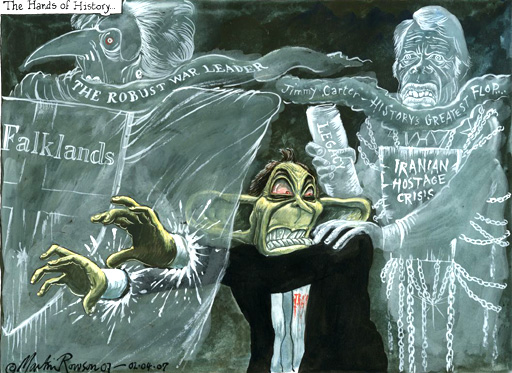
Too harsh a judgment?
Though neo-liberalism and neo-conservatism are two distinct political rationalities that are inconsistent, if not directly contradictory, they are converging in contemporary society. How they are converging is what needs to be sorted out. It's what puzzles me. For they are sutured together in odd sorts of ways that I cannot put my finger on.
Neo-liberalism is about deregulated markets. It has a business ontology in which politics is like a firm. Hence it is statist. It requires the big state to turn society into a market. Neo-conservatism hates the other, has a horror of intellectuals and artists, and is about religion. Its ontology is the church. It is authoritarian and populist.
April 1, 2007
Private troubles public issues
We live increasingly under conditions of globally and systemically engendered insecurity and uncertainty within the neo-liberal mode of governance that places the emphasis on consumer freedom and individual responsibility in a world of fluid and fragmentary social bonds and individual identity. These global flows, with their underlying insecurity and uncertainty from perpetual downsizing and restructuring belie the promise of assertive individuality not only for the 'excluded' in the global city but for many of the 'included'.
Under this mode of governance freedom is modelled on freedom to choose how one satisfies individual desires and constructs one's identity via the medium of the consumer market. As a consequence freedom and individual fate have increasingly become 'privatised': we live with out private troubles and problems. An 'increasingly privatised life modelled on consumer freedom and 'individual empowerment' promotes 'biographical solutions to socially produced afflictions'.
So how do we translate private problems into public issues when the policies of state and commonwealth governments presuppose that economic growth, labour flexibility and enterprise are the answers to problems of social exclusion and wellbeing?
In this interview with Zygmunt Bauman says:
In the world of consumers, the poor who are currently un-performing consumer duties are, purely and simply, 'flawed consumers' and flawed beyond redemption (and vice versa: those who cannot behave as the right and proper consumer should consider themselves, and are viewed by others, as poor). Affairs may hum up in the future, but by no stretch of imagination will the poor be called then to active consumer service. Investing in their survival means money wasted; it may be called for by charitable impulses or for the sake of peace and quiet - but 'economic sense' it most certainly makes not. Such investing will only prolong, with little prospect of ever stopping, the frownedupon procedure of withdrawing money from the commodity market - the only site where spending money does make economic sense