October 31, 2003
fear and loathing
Politics in Australia is going to get ugly after these events. So we should not be too suprised to see moderate politicians transform themselves into this:

M. Davies
It is what they are required to do by their leader to ensure that the Government retains power.
First cab of the rank can be found here. Expect to see more of the same.
At its existential core politics is a conflict between enemies.
October 30, 2003
More Helmut Newton
Nothing unusual here in this photograph by Helmut Newton:
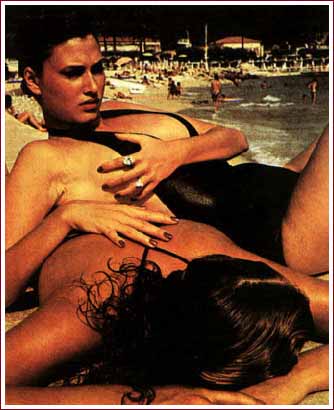
Saint Tropez
But when placed in relation to the offense it may cause to some sensibilities, then it gives us somthing to think about. Sexual identity is touchy.
Consider this argument by Laura Kipnis
"Preserving an enclave for fantasy is an important political project for the following reason: pornography provides a forum to engage with a realm of contents and materials exiled from public view and from the dominant culture, and this may indeed encompass unacceptable, improper, transgressive contents, including, at times, violence, misogyny, and racism. But at the same time, within this realm of transgression, there's the freedom to indulge in a range of longings and desires without regard to the appropriateness and propriety of those desires, and without regard to social limits on resources, object-choices, perversity, or on the anarchy of the imagination."
Is this an example of the realm of transgression?
The way we understand our sexuality still is a realm of transgression because it foregrounds our culture's system of taboos and myths that enables us to deal with our anxieties and contradictions. Transgressing a culture's borders of what is allowable or premissable in terms of taboos and myths is a political engagement.
As Laura Kipnis says:
"Pornography may indeed be the sexuality of a consumer society. It may have a certain emptiness, a lack of interior, a disconnectedness -- as does so much of our popular culture. And our high culture. (As does much of what passes for political discourse these days, too.) But that doesn't mean that pornography isn't thoroughly astute about its audience and who we are underneath the social veneer, astute about the costs of cultural conformity, and the discontent at the core of routinized and civilized lives. Its audience is drawn to it because it provides opportunities -- perhaps in coded, sexualized forms, but opportunities nonetheless -- for a range of affects, pleasures, and desires: for the experience of transgression, utopian aspirations, sadness, optimism, loss, and even the most primary longings for love and plenitude."
Pornography is a business -- as is all our popular entertainment--- but it is also a culture consisting of layers of historical meanings and interpretations.
October 29, 2003
porn goes mainstream?
I was glancing through a back copy of The Australian Financial Review (24 10, 2003, subscription required) and I noticed a few remarks on porn. Porn and the Financial Review? What's going on here?
The article contained a paragraph that said porn is cool. Porn is heading for the mainstream. Ordinary old-fashioned sex (whatever that is) is uncool. Those puzzled by this (anyone over 40 apparently) are uncool. Porn is postmodern as it says no to limits, to restraint, to taboo, to authority. This is the libertarian position.
What we have here is a review of a book by Martin Amis called Yellow Dog. Amis is over 40 and he is reflecting on the significance of porn in liberal society. He says that porn is just about the body. Everything is the body in the world of porn. Amis is also reflecting on the obscenification of everyday life in which porn uses the image as a blunt, functional image of desire. It is a literal image.
So what do we make of this interpretation of the porn image of desire?
Porn is certainly part of the mainstream. Academics study porn. Porn is a big industry that is able to turn a profit on the internet and this industry porn shapes the way we understand and represent our sexuality. There is a porn photogaphic style that informs the work of fashion photographers. Thus soft porn. Helmut Newton comes to mind:
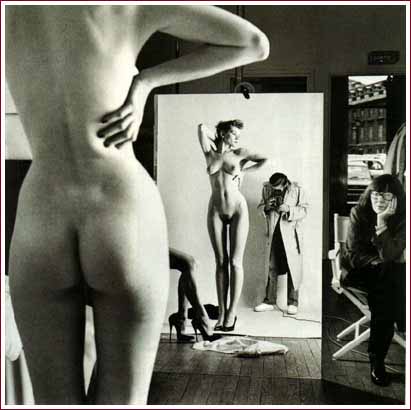
Self-Portrait with June and models.
Samples of Newton's work can be found here.
What the above image shows is the construction of a photo of female sexuality. We normally see the finished image:
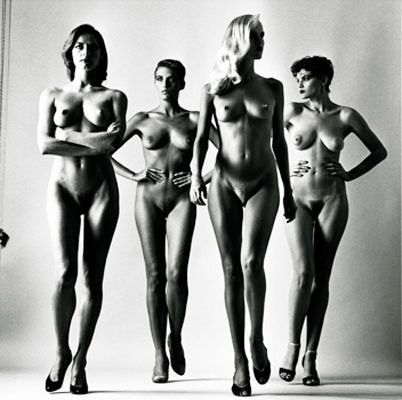
Newton, Naked and Dressed
Newton's photo's are an intervention into the way our culture understands female sexuality.
Newton's work suggests that porn is far from the literal image that Amis assumes it to be. It is constructed in that way. Porn has a certain style that is then reworked by those in the fashion world. We have this mixing of porn and fashion in advertising for Calvin Klein by Bruce Weber:

It's not porn. It's gay sexuality. But it's gesture to the erotic world of porn introduces gay sexuality into the mainstream of everyday life---advertising.
Then we have art engaging with pornography. The soft porn of Helmut Newton refers back to art:
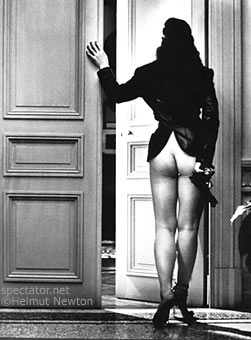
With Newton porn has ideas and layers of meaning. It is saying something:
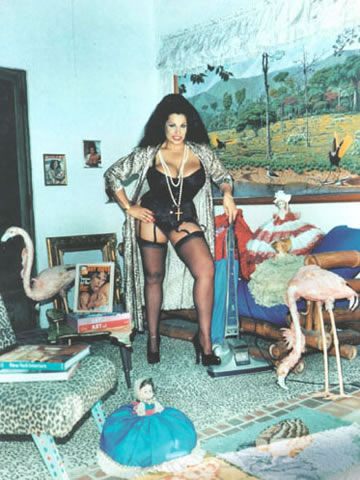
This representation of sexuality is a long way from the natural and innocent sexuality of Woodstock. On that hippie intrepretation you just strip off your clothes and you have an innocent sexuality. Natural, free flowing sexual desire was held to be the basis to launch a critique of a repressive industrial civilization. It is naive conception of sexuality, given that sex was used by the advertising industry to sell cars, rockets, coffee or anything.
What is rarely considered is whether porn itself is a form of cultural critique:
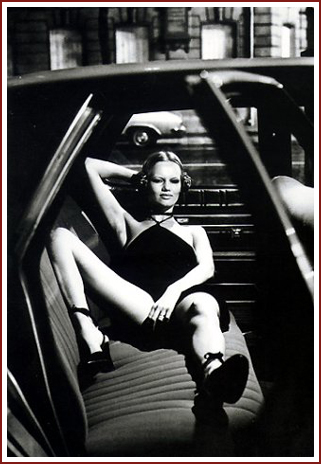
Helmut Newton, Untitled.
That image still shocks. Does it not? Do we have a cultural critique here?
October 28, 2003
dwelling in the metroplis
What would dwelling in the metropolis be?
A metropolis in late modernity sunders the old values of familial relationships once embodied in the holiday shacks of yesteryear, with their unity between inner and outer and self and world.
Does not dwelling in the metropolis mean taking up residence somewhere? It is finding one's own place, once the organic conception with place, community and nation has been severed by the utilitarian logic and dynamics of the economy and politics.
"Finding one's own place." What does that mean in the metropolis?
Does not that appear to be limited to choosing a house or apartment from which one explores one's surroundings? There is no longer a harmonious relationship to place to any more; We are homeless and lacerated from the cuts from urban living damaged lives. We regret what has once has been, and we have a deep utopian longing to restore the lost harmony of self and place whilst searching for freedom and play in our everyday surroundings.
Homelessness is the basic condition of life in the metropolis where all is fleeting and transient. There is no new wholeness in formation to heal the pain of living with the fragments of yesteryear. We are left with trying to write a history of how we got to be here, without knowing how to go about writing a history of our lived experience. Somehow we have to become social critics of our modernist mode of urban life and subjectivity.
In choosing a house or apartment we seem to be left with good design and high quality in preference to the commercialized junk produced by the speedy and efficient production of a large number of buildings.
next previous
October 27, 2003
Strange fruit?
My last post on Brian Wilson's abandoned Smile album lead me to thinking about rock criticism in Australia. Whilst doing the evening walk with Agtet in the Adelaide Parklands yesterday, I wondered if there is a culture of rock criticism in Australia. Is is this mode of criticism alive and well in Australia? Or has it become the consumer-guide approach that we now see in our broadsheet newspapers.
There seems to be a lack of criticism judging by the vacuity of the ABC's Love is in the Air.
That documentary celebrates Australia's pop music and its role in our culture and it understands that pop music is the soundtrack of daily life.
But the content of its replay of the soundtrack to Australian life is lightly sketched on the cliched duality's of rock v. pop; high culture versus popular culture; a provincal Australia versus comopolitan overseas.
What is absent is the art versus commerce duality.
I missed the Strange Fruit episode last night. From what I can gather from the transcript it traces the pop television show Countdown to its roots in vaudeville, variety, comedy, music theatre and travelling tent shows. The Countdown of the 1970s was colour, movement and appearance it was a pop variety show with lots of media hype and payola. Countdown was show biz on a public broadcaster concerned about national identity and Australian culture. That pop culture has been re-branded the seventies with an ironic nineties celebration of camp as in Priscilla Queen Of The Desert.
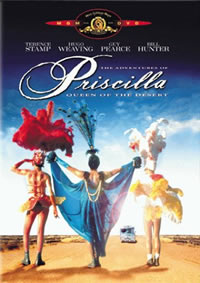
Okay, so that account establishes backward and forward links and the cultural connections and that takes it one step away from celebrating showbiz.
So where is the rock criticism that explores and interprets the meanings of the "replay of the soundtrack to Australian life"?
Rock criticism does not have a voice in this program.
Why?
Is it not mentioned because Australia did not nurture a Lester Bangs, or a Greil Marcus, (more here) or a Dave Marsh? Is there an Australian equivalent?
We need a rock criticism to explore the way that popular music is a soundtrack to our daily life rather than entertainment. Thus the Beach Boys, as an American band, created a mythology of teenage surf culture. So what did Skyhooks do? I mean they did entitle their debut album Living in the Seventies, which was sprinkled with Melbourne place names and Australian themes. That means Skyhooks saw themselves as more than strange theatrical fruit creating novelty numbers:
"Yeah I'm living in the seventies
Eatin' fake food under plastic trees
My face gets dirty just walkin' around
and I need another pill to calm me down"
Living in the 70's (G.Macainsh. Mushroom Music Aust.)
October 25, 2003
indulgences or a postmodern text?
Just by chance I caught a celebratory program on Joni Mitchell on SBS television last night. I watched with interest as I've decided to build a CS collection of classic albums of popular music. Whatching the program I was reminded of Blue, which I once owned and thought highly of.
I tried to access Joni Mitchell's website to look at her paintings, but no luck. The site was down. (It still is. This and thisis the best I can do.)
Then I spend some time in the small hours of the morning exploring the Beach Boys Smile sessions that happened just after Pet Sounds album in from the mid 1960s.
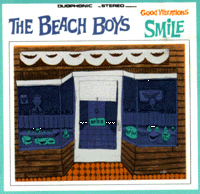
There is more on the Smile album here. It's a musically humerous jigsaw puzzle with half of the pieces missing.
What is widely known is that the aborted Smile album includes Good Vibrations, Heroes and Villains, Cabin Essence, Wind Chimes & Surfs Up.
I had purchased the Pet Sounds CD early in the day. It is a lush, textured album, melancholy and introspective, and full of insecurity, joy and love. All of this is polyphonically tied together by the innovative use of alternately sighing/thundering dynamics and multi-layered instrumental and vocal tracks. The songs appear to have been built up musical fragment by fragment. It is a record that makes you think in terms of lyrics, harmony, melody, the layers of sound, the time or moment when the song is produced and the historical cultural time. A landmark album that was a commercial failure.
Brian Wilson has recently been performing Pet Sounds live.
It is the brilliance of Pet Sounds that arouses my interest in the Smile album, even if it is described as a teenage symphony to God. That's a long way from teenagers having fun fun fun till Daddy takes the T-Bird away. It's more about musical meditation on the Californian Dream. Surf's Up now means the dream is over. This was art not commerce, and so it opens up way to talk about aesthetics and popular music beyond the rock musician as a romantic genius.
Since Smile is an unfinished album people have lots of fun putting the jigsaw together. Bootlegs of the master tapes of Smile now exist. The music lacks cohesiveness. Hence the jigsaw puzzle.
Novels have been constructed around the idea of finished uncompleted albums. The 1967 Smile album that never was actually opens up possiblities for people to construct their own Smile.
This news looks promising. Brian Wilson is going to perform Smile live in February 2004 in London. Clearly he still has the masterplan or blueprint in his backpocket amost 40 years on. Going back to that pivotal period is such a contrast to the cheap, cash-in nostalgia outfit the latter Beach Boys became.
October 24, 2003
after the painting
After I finished painting the "master bedroom" in the seaside shack late this morning I took a quick spin along the cliff tops before returning to the city. I lingered for a moment in the seaspray, light and wind allowing the flow of the wilderness sweep through me.
Unity between the subjectivity and nature (inner and outer) is what I longed for.
I was full of anger. Or was it anguish. I couldn't really tell. I was out of contact with my emotions. But this old image came to mind, whilst I watched the rolling surf crash of the southern ocean into the rocks at the base of the cliffs:

E. Munch, The Scream, 1910
Seagulls swirled overhead, the sun burst through the cloud cover, the wind cut me to the bone anger surged within me.
And I wondered. How can I turn those deep dark emotions into a negative thinking, rather than rejecting them as Seneca once advised.
The turbulent passions have to become the impetus for negative thinking I reasoned: a kind of thinking that registers the leaps, ruptures in the historical flow of life. Why was I angry?
It had something to do with life in the metropolis:

Paul Citroen, Metropolis, 1923
The money economy of the metropolis in modernity swallows up the old values of familial relationships that were once embodied in the holiday shacks of yesteryear. Then there was a unity between inner and outer, between self and world.
In the metropolis the patterns of our conduct are now informed by a dulling, calculating, instrumental rationality. It is a different mode of experience in the metropolis: one that destroys the old humanist values of holiday life at the beach and leaves us with nihilism fulfilled.
As this American story puts it, "vacation is true freedom. It's as close as we get to the "life, liberty and the pursuit of happiness" ideal of the Declaration of Independence...With robots doing the work, we should all be on perpetual vacation." (Link courtesy of Ashley over at Notes from Somewhere Bizarre.
One can dream about such a future. The economic reality that governs the metropolis is that robots means massive unemployment. Robots will take many jobs and so millions of unemployed humans will end up in government welfare dormitories (eg. lie on the pension in Whyalla); or we will being doing mundane casual jobs to replace the old ones. Either way we will not afford the holidays of yesteryear.
That holiday mode of dwelling is gone. It is now part of the ruins of our history. All we can do is remember that unbroken harmony between inner and outer as we live its rupture.
I turned away from the wilderness, drove to town, took Agtet to the vet , and returned to the apartment in the inner city. Was it home? A shelter in a dar world where I can reside?

P Booth, Untitled, 1978.
Home resides in the past and its image is cherished in my memory.
I tried to lift my spirits by shopping for lunch at the Central Market and seeking out the people I knew who worked in the stalls. I needed a friendly smile and a warm hello to help me accept that my life was a continuous existence of journeying and migration.
It was the nomadic nature of existence in the metropolis that made me so churned up emotionally.

P. Booth, Untitled, 1978
next previous
October 23, 2003
seaside dwelling
I took a walk along the beach front early this morning with the poodles. As there were few people around at 6am I had time to look at the beach architecture.
Many of the 1940s shacks on the esplanade facing Encounter Bay along the southern coast of the Fleurieu Pensinsula in South Australia are being modernized or pulled down and replaced by the glassy modern. Economics is driving the transformation of the beach house as property prices have skyrocketed. They cost a cool million plus and they stand empty for approximately 46 weeks of the year.
The new beach house style reminds of Le Corbusier's Savoya Villa without the silts.

Villa Savoye, Poissy-sur-Seine, 1929-30.
I should emphasis 'reminds'. 'Reminds' refers to the purity of Le Corbusier's machines for living. The new beachside holiday homes are more of a rectangular box, rather than layered with larger rectangle above a smaller one. And they have lots more glass. 'Reminds' also refers to a cold and ascetic architecture with its hard surfaces and plethora of technological devices.
The new beach villas along the coast from Victor Harbour to Goolwa and Hindmarsh Island all look the same. Their coolness involves a rejection of the old secluded and private interior dwelling of a haven in a heartless world. They are designed as living in an airconditioned glass house---all inside is on show in a transit space for those cruising past on the outside. We want you to look and admire us the design says.
The show of style and wealth of the transitory nomads is what is important. The transparency and openness of the display of wealth is seen as "avant garde." the architecture says we are modern, stylish and wealthy whilst the interior on display says we live the dream of being a success. The nomads in the transit lounge only see the dream as they live their life of hurried contemporaneity.
The new beachside holiday homes strike me as empty shells where life behind the glassy facade is much hollowed out. Then, maybe, this architectural beach form is appropriate to the poverty of experience in late modernity, which results from a hurried, machine-like processing of information, the destruction of tradition, and the lack of collective form of life. Transience and instability are the new conditions of life.
In the denatured city my experience is a series of sensations caused by disconnected isolated moments that are not related to one another. These sensations are not integrated into a stock of experience. The stock of experience is but dimly remembered as a mode of inhabituation.
Living in the beach glasshouse. An expression of postmodern life? It was not so long ago that the modest beach houses of yesteryear---the shacks---were overflowing with carefree family life full of fantasy, play and sharing. That holiday mode of dwelling stood in opposition to the rationalised public world (the market+politics) of instrumental reason.
Should we not mourn what is passing?
October 22, 2003
a moment in 'wilderness'
I wasn't able to post an entry yesterday from the holiday shack. In the morning the dial-up-internet kept dropping out every few minutes. Frustrated I went and painted the master bedroom in the holiday shack. I returned about 2.00 pm only to discover the local server was down. I kept on checking until about midnight. It was still down. So I gave up in disgust and went to bed.
Things were back to normal about 6.30am this morning.
On the South Coast of the Fleurieu Peninsula, south of Adelaide, I'm on the cusp of civilization and wilderness. After the days painting I walked the dogs along the cusp this afternoon. I sat on the cliff tops in the last rays of the sun. I could sense summer approaching.
I looked across the southern ocean and imagined the Antarctic just over the horizon:
 Even there, in the large tract of wilderness, the effects of human activity could be discerned.
The ice shelves were breaking up from global warming. The Larsen B shelf on the eastern side of the Antarctic Peninsula has fragmented into small icebergs.
The region has experienced a 2.5-degree-Celsius rise in average temperatures -an increase greater than for any location in the Southern Hemisphere.
Then I thought about civilization. About the modern architecture of the city, my mode of live in a post industrial city and my desire for a new kind of regional green architecture based on eco-dwelling. That desire creates a dissonance with, and a rupture from the harmonious view of modernity that pervades Australia.
The harmonious view denies the contradictions, dissonances and tensions of modernity due to politics, economics and culture all being united by progress. Progress is seen to harmonious and continuous. It is built into the very architecture of the modernist office tower: their glassy facades reflect the mirror of linear progress in the metropolis. It is a mode of modern life that is rootless, transitory and fragmented.
And then I thought of the new apartments that are being built in the inner city. They function to shield the home from the outside world of money and finance. The outard walls form a mask. The home represents dwelling that is based on familarity, intimacy, personal history and memories. A radical disjunction btween public and private, exterior and interior.
Of course, many of those living in the apartments have their interiors decorated by professional desigers who freeze an outward show of fashion. This stylish freeeze obliterates the last traces of dwelling robbing the interior of individuality and life. Life really does become rootless and fragmented.
It is the coffee shops on the streets of the metropolis where we seek to relate the fragments of the old connections that have been sundered.
Along the south coast the rigid private public of the private dwelling so favoured by Alfred Loos is eased. The links between exterior and interior provided by decks and courtyardsas can seen from this photo  by J. Meyerowitz, from his Cape Light book.
The beach shack breaks with the modernist conception of the house as a refuge from the outside world.
The bredroom is painted pale gray/blue and white cap white to link the light filled inside to the sky and sea outside. Space and time are linked by the movement of light.
The beach shack discloses another mode of dwelling. A more poetic one: one that is between earth and sky, between nature and civilization.
October 20, 2003
wilderness #2
It's a long way from the south coast of South Australia.
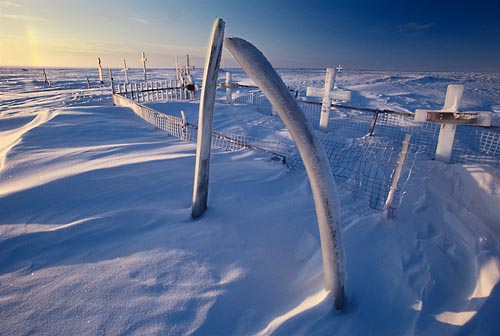
S. Banerjee
Banerjee's work is motivated by a deep love and concern for the wilderness and to prevent the disappearance of indigenous cultures.
YET NOT THAT FAR.
There is a strong desire to protect wilderness in Australia, and to prevent the disappearance of indigeneous Australian culture.
October 19, 2003
Hyper-realism
In the comments to my Blue Velvet post Philip from Eye-Image introduced hyper realism as a counter to my mumblings about a postmodernist aesthetic.
More here on a postmodern aesthetic.
I'm not sure what Philip meant. In the comment box he says that visual reality is mirrored to an immense degree of believability. He adds 'How close to the truth can we get without actually being there?'
I remember that hyper realism was an art style of the last quarter of the 20th century, which came after a pop art that used popular images and ideas as raw material. With modernism buried realism is making a return. As an art style hyper realism refers to painters who made their paintings look just like photographs, with the painting exaggerating the photographic medium.
I thought that was a dead end myself. Why bother mimicking photography?
I suspect that Philip means more than a particular art style that developed after the collapse of an abstract modernism.
So how do we open up the issue?
Since I am going down to the coast for a week to paint the holiday shack, let me begin with some seaside imagery.
Is this what Philip is getting at:

Marc Appleton & Associates
as opposed to this from Joel Meyerowitz's book entitled At the Water's Edge:

More images from the Cape Light book can be found over at the wonderful pretty serendipities.
There is also some commentary with the photos.
The question these images pose is: Do you get closer to the truth by doing away with romanticism and its emphasis on subjectivity?
Do you get closer to the truth by returning to traditional realist conventions?
How then would you tackle Ground Zero in New York and what it means for Americans?
Does hyper refer to reworking those realist conventions?
October 18, 2003
too much for one night
The Blue Velvet DVD I mentioned here was a part of a package of 4 DVD's I had taken out as a part of a new experience from moving into home theatre. However, I'd neglected to view the other three films during the week. They were due back to the video shop this morning. So I was obliged to look at them last night.
3 films in one night. Just like the old days of going to film festivals. So I sat down with a good bottle of wine and plunged into the home cinematic experience in a postindustrial world.
The first was Krzysztof Kieslowski's film Three Colours White

I had seen Three Colours Blue in the mid 1990s when I was still going to films at the cinema looking for solutions to my life's problems. My memory was that Blue was an excellent European film and that it had been part of a trilogy.
I watched Three Colours White for 45 minutes or so and then took it off. It was facile---a black comedy? It was very much part of the film as literature school, with its unfolding narrative and realist conventions.
I realised, as the narrative was unfolding through time, that it was films such as this that caused me to give up going to the cinema. They were marketed as art, but I found them so boring and tedious---just like reading novels.
Three Colours White was barely cinematic: a filmed moral tale about a particular Polish character who had been jilted that we observe thrrough a camera that pretends to be a window. I was so bored despite the use of colour. It was a thoroughly unremarkable form of cinema. The film as literature people would love it. It is a form of cinema dependent on movement and action; characters in the movement-image are placed in narrative positions where they routinely perceive things, react, and take action in a direct fashion to the events around them.
Three Colours White did not do much in the way of cinematic difference. Nor did its affects and intensities scramble my faculties not disrupt or short circuit the normal way I pattern meanings in my everyday life of stable objects and relationships.
Give me David Lynch any day. He understands that cinema is different to literature.
The second film was one by Curtis Hanson called LA Confidential. Very stylistic.
 This was a film of a James Ellroy novel of the same name.
Yet it was closer to cinema than the tedious Three Colours White, even though it was period film of the sleazy and corrupt Fifties LA, killings crooked cops. the allure of Hollywood and the mass media as represented in the American crime novel.
It was much more visual and self-conscious with its references to the black and white images of film noir.
Such a far cry from the costume and setting of the standard BBC naturalism of English novels, that is much loved by ABC audiences on Sunday nights.
The third DVD was Michael Mann's low budget film Manhunter, the first in the Hannibal Lector series. I had not clicked to Mann's Miami Vice series on television in the 1980s. It was all surface gloss but I do remember that its look-- the music, the clothes and attitude---captured the ethos of Reaganite/Republican America.
My companions had violently rejected watching it because of Silence of the Lambs. It deeply offended their humanist sensibility. Their humanism could not be questioned. Their subjectivity did not have pathological roots and so human monsters are definitely the other. Only mad and crazy people or criminals are like that----eg. the bodies-in the-barrels case.
My companions understand themselves to be nice, caring understanding people living in a comfortable suburban world grounded in the flow of time. Hence the denial followed by shutdown to the Snowtown murders. There is no discussion about the callous depravity. Adelaide is an easy going and pleasant place. I recall there was a bit of sociological discussion of unemployment and depravity in causing alienation, isolation, indifference to social norms, and dysfunctional and disastrous behavior in post-industrial society.
But little it was all very careful. It did not move onto confronting the sort of practical and moral world that we are creating or the way that our resentments our effecting our subjectivity. That was all too dark---best to move on. Who wants to look at the beast in the face and see themselves reflected?
It is best to move quickly. The judgement is that psychoanalysis is shit. And as for Nietzsche, Bataille and the French postmodernists; well, the less said about them the better. Who cares about that stuff?
I started watching Manhunter in the early hours of the morning. I was tired and was barely able to stay with the flow of images. I remember it was far more visual than the other films:a film rather than literature, even though it was based on Thomas Harris's novel Red Dragon. I recall that I responded strongly to the visual aesthetic--eg., the clean white modernist lines of hospital/prison where Lecktor is incarcerated.

It was the visual language that stayed in my mind. This was a director who understood the effect of images and was breaking with film conventions of say Law and Order or Dragnet or Stingers.
An interview with Michael Mann is here.
The film's movement image made it the most impressive of the three films I watched. I sensed the effect of the images as disrupting my conception of the self and the way that I lived time as a series of "nows". Our living time (what Deleuze calls durations) is more a movement backwards and forwards through the flow of time. I vaguely remember the movement image of Manhunter being connected to this different flow of time. The time image is different because it breaks with the conception of time determined by movement in Three Colours White.
I will have to return to Manhunter.
October 17, 2003
another way of looking

We often think of images in terms of a visual language signifying a world. We assume an outside world that is then re-presented through through a separate system of signs. The images in our urban visualscape that form our language then represent, construct, or organize some of the outside world.
Consider the above image as being about Australia as the new sheriff of Southeast Asia.
It is unclear that this image represents some underlying reality. Australia is not the sheriff of Southeast Asia in the war on terror just because the imperial president in Washington said so in a news conference.
Can we not see this in terms of intensity and effect? Does it possess a power of its own? Does it not create the affect of surveillance? Of fear? Does it not convey the menacing affect of being watched by a powerful and wrathful authority?
Does it not disrupt the everyday and habitual links that we make between our words and experience of Australia's role in the war on terror?
October 16, 2003
once upon a time....
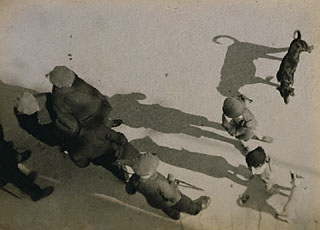
Andre Keretesz
Link courtesy of Boynton
The scene despicted by Keretesz is becoming less and less so in Australia. Two free dogs mixing easily with humans in the city. That is no longer acceptable today.
Dogs are now seen as the wolves of the city. The city is torn and frayed. Terror stalks the streets.
Draconian meaures are needed to deal with the threat. So say the law and order politicians and the tabloid journalists as they joyously paint a picture of the city red in tooth and claw from the violence wrought by a vicious nature.
wilderness
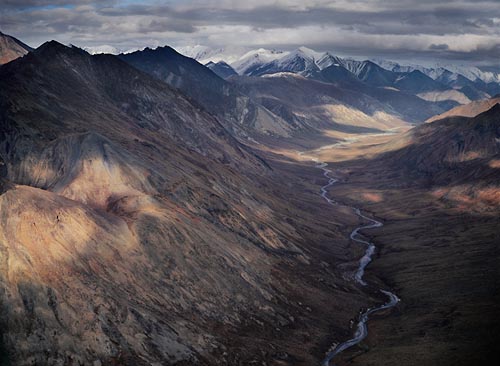
Link courtesy of Boynton and penny dreadful
Subhankar Banerjee works closely with conservation organizations and policy makers to help preserve the fast-disappearing wild areas of our planet, and the wildlife and native cultures that depend on them for their survival.
His Arctic National Wildlife Refuge images were used extensively by members of the U.S. Senate and House of Representatives and environmental organizations in preventing legislation that would allow oil drilling on the Arctic coastal plain.
This kind of work is closely connected to Tasmanian wilderness photography. These photographers established a tradition of landscape photography when they used their work to help save the Franklin River from being dammed to generate electric power.
Standing in the opposite corner is Andrew Bolt, who would see all of this as Lost in a green daze. For the Andrew Bolt's of the world we have a right to exploit nature and build. This is based on our faith in reason Bolt sees these noble values crumbling all around him.
He says that in today's world green feelings count for more than jobs. Reason, good science and jobs counting for less than mysticism. It is a world where irrational green values swamp good science and good business.
October 15, 2003
new world dawning
Last night I wandered through the almost empty streets of Adelaide. It was a glorious warm night. But there were so few people out having fun. Those I saw were were wearily making their way home from work. Where was the fun crowd? Spring was in the air. It was a balmy night.
I was on on my way to the philosophy jammm to hear Peter Poiana from the Department of French Studies at the University of Adelaide give a talk on Marcel Proust's monumental Remembrance of Things Past.
When I came home from the jammm I had planned to do lots of online research, write a big post on this literary work, and explore the idea being in search for lost time. But then I chanced upon this experimental online visual work tokidoki.it courtesy of notes from somewhere bizarre. It is very, very classy graphic design and illustration that is full of games. Try this game. The website is made in Italy by a media designer at vianet.it who loves Japanese culture.
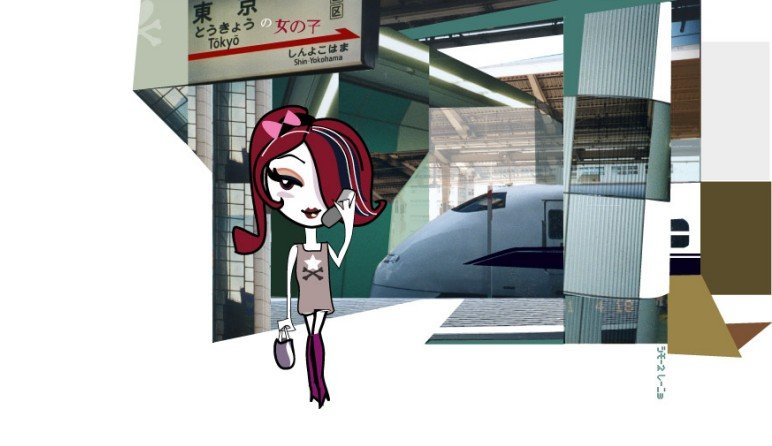
Italian design and Japanese imagery. Now that's globalization for you.
The juxtaposition of Proust and tokidoki.it got me thinking. I realized that last night I had stepped back to the beginning of the 20th century when France was the centre of the avant-garde, literature ruled, the novel was king and print culture was the centre of our world.
Today it is a visual culture that rules. We are surrounded by images in our visually saturated culture to the extent that our daily life is lived with an ever shifting visualscape. Few people read poetry, the novel is pretty much dead and who goes to the theatre regularly? And experimental work will increasingly be online. tokidoki.it is more visually interesting than a lot of work being produced for the walls and floors of art galleries.
It is a huge shift from a print to a visual culture. It is a fault line that demarcates the 21st century from the 20th.
That shift is not really reflected in Australian weblogs. Visual semiotics and design literacy are fairly low key whilst critical commentary on our visual culture, as a place where meanings are created and contested, being almost non-existent. The webloggers have yet to take the visual turn that everyday life has already gone through.
Then I chanced upon some remarks made by Brendon Nelson----our trendy Minister of Education. He wants Parliament to grant him the power to to cut funding to controversial tertiary courses and PhD research topics, such as subjectivity, textuality, ethics and pleasure.
Subjectivity, textuality, ethics and pleasure, you ask. What does that mean? Try this:

Our groovey Minister does not like us acquiring visual 'literacy', or learning how to critique those advertising images that manipulate our unconscious emotions to leave us worse off. He says that we are far better off putting the taxpayers money into more lawyers, teaching and veterinarians.
Notice the big silence about Proust.
Now Minister Nelson spends a lot of energy circulating pictures of himself hanging out with kids who are full of spontaneity and joyousness. These show that Brendan Nelson has lots of street credibility. It's called spin and it's message is designed to silently slip into our subjectivity so that we feel warm and cuddly towards Minister Nelson. The minister is playing the same game as the advertising industry.
The Minister's dismissal of PhD research into subjectivity, textuality, ethics and pleasure indicates that he is living in yesterday's world. He reads yesterday's papers, is surrounded by yesterday's people and has yesterday's ideas.
Subjectivity, textuality, ethics and pleasure. We need lots more research and courses on that in relation to our visual culture.
Update
A brief account of the Proust talk at the Philosophy Jammm mentioned above can be found here. Scroll down.
October 13, 2003
image and text
David Farrell
 Great image.
It is from an exhibition at the Photography Centre of Athens.
The link is courtesy of saint in a strait jacket over at DogfightAtBankstown.
Human legs?
Raw knees?
Knees cut through to the bone?
Well, that is how I interpret the image.
This text goes with the image:
"Photographers such as David Farrell from Ireland - his nationality is not unrelated to his goals - give a picture of religion in terms of its most intimate, personal expression. Calm and spirituality dominate these images. The people whom he immortalises in his portraits are believers in every fibre of their being. Serenely, without ostentation. His vision of people and objects converges. His goal is, through a documentary work of modern inspiration, to enhance daily worship in terms of whatever is non-eventful, non spectacular, given over to an evident plastic sense and in a relationship of great proximity with his subjects. Only the feeling of devotion adorns the picture."
I don't see the connection myself.
Calm and spirituality dominates this image of raw knees?
How do you get that?
The image enhances daily worship in terms of whatever is non-eventful, non spectacular?
I would have called image of raw knees spectacular. We are talking sacrifice here are we not?
October 12, 2003
suburbia again: Blue Velvet


We had a quiet dinner last night with some friends and then watched a DVD of David Lynch's 1980's film Blue Velvet.
This was my first look at Lynch. I have not seen Eraserhead. nor Mulholland Drive. All I had seen were some of late episodes of the innovative Twin Peaks on television. At the time I thought Twin Peaks looked pretty interesting in terms of deconstructing the naturalist conventions of television.
The others had seen Sam Mendes's American Beauty. From the conversation I presume that this film had little connection with the Grateful Dead album of the same name.

I knew nothing about their American Beauty and they knew nothing about mine. They could see no reason why the film they loved should connect to an obscure album from the 1970s. What has the Grateful Dead got to with anything outside the acid-drenched world of Ken Kesey?
The others see the cinema through the eyes of literature, and so they are most comfortable with the way Hollywood cinema synthesises the diversity of images to narratives, naturalism and characters. They presuppose that the narrative is what is seen from from a particular interested perspective, and this is then connected to their particular world. What is avoided in this assumption, that cinema is pretty much a rewriting nineteenth century novels, is what disturbs. They do not think in terms of what Deleuze calls the movement image.
Suprisingly, no one had seen Blue Velvet. Made in the 1980s, the film is an exposure of American suburbia. It is the cinematic aspect that is so striking; the very organization of the flow of images (the movement image) precludes viewing the film as a single, coherent narrative. This was not film as literature. It was a film that played with the ideas and conventions of cinematic representation. Time is determined by movment.
What I found impressive about Blue Velvet was the different levels or layers. The most noticeable of these was the ironic, deadpan "portrait" of small-town Lumberton, which encourages us to think that the film is some sort of satire. Yet what lies behind this white picket facade is a horror story. So we live in two worlds at the same time, one of which is pleasant, the other terrifying. Underneath the images of everyday suburban life we have the bizarre, surrealistic world underneath the superfical images of everyday life.
Both worlds are expressed in terms of references to old B-grade movies. Yet Blue Velvet was not just horror. The cinematic look was saturated in the stylistics of film noir:---- gloomy grays, blacks and whites, expressionistic lighting, disorienting visual schemes, skewed camera angles and interiors with low-key lighting and dark and gloomy appearances. I marvelled at the film noir intertexutality and the mixing of the genres of horror and film noir.
Another layer is the strong postmodern aesthetic with its self-referential inter-textuality. We have recycling of pre-fabricated images from the past, assembled together in the form of bricolage. The images of small town life, coffee shops and bars were familar. even though I did not recognize the particular films. The film is full of parodied cliches of small town suburban family life: perfect little houses with white picket fences and impeccably manicured yards and teenage romances. It was the clean, conforming, pastoral America of Norman Rockwell. Even though I did not recognize the particular films that were quoted, I understood that Lynch was locating the film in a long cinema tradition. And I realised that the conventional closure of classical narrative was mocked. At one level suburban order is restored, with the father re-established as patriarchal hierarchy, Dorothy is 'cured' of her sadomasochism and the heterosexual couple of Sandy and Jeffrey is in place.
Yet the mechanical robin signifies that is a just representation of reality: it is a film we are watching and it is a simulacrum of reality. Blue Velvet is self-referential since it questioning its own ability, and hence the ability of cinema to represent life and reality and concepts such as good and evil.
My companions, who love to see a lot of contemporary films in the various cinema complexes, said the look of Blue Velvet was very 1980s. It looked so dated now, even though it wouldl have been seen as 'groundbreaking' or innovative in the 1980s. Lynch, they said, was now a star persona, part of the mainstream with a marketable brand as an auteur.
Goya
I've been looking for an excuse to post this image for some time. Francisco Goya surfaced in The Australian's Weekend Magazine (no link) this weekend. The article was concerned about the authorship of the 14 images known as the Black Paintings.

Goya, The Dog, The Black Paintings
Some comments on Goya's work by Robert Hughes.
There is some scholarly dispute as to whether Goya painted the Black Paintings. Goya put the "Black Paintings" directly on the wall of his private home. The term "black painting" was spawned by art historians wanting to classify the images in some nomencultural way. The individual titles were derived from what Goya's children called the images after Goya's death.
The Dog is a great image regardless of authorship.
Goya was of the Enlightenment but he disclosed its reverse.
October 10, 2003
Urban renewal?Japanese modernism?
This is urban reconstruction on a grand scale.
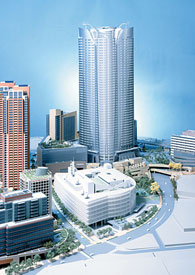
Some visuals and corporate descriptions can be found here.
Some comments can be found here and here.
The development rejects the sprawling low-rise density typical of the city of Tokyo. Development such as this is going to change Tokyo from a horizontal city to a vertical one.
Roppongi Hills promises to be an efficient, well-designed future--like that envisioned by the modernist American developers in the 1950s.
Update
Is this an example of Japanese modernist architecture? It does contain a vision of modernity with its rejection of the old. Does it gesture back to the early modernist avant garde programme that modern architecture contains the potential for building a new world?
Or does it work with a new sense of space and time? One in which buildings are no longer rooted in the ground but float above it? A conception of space time in which the social and political connotations have been purged along with all reference to social experiments and the revolutionary aims of modernist architecture? A conception of a synthesis of space time in which developments in architecture correspond to a deeper level of reality behind the chaotic appearances.
It is an integrating architecture that is dislodged from the old modernist European avant garde, with its manifesto of negation and destruction.
October 08, 2003
F. Williams
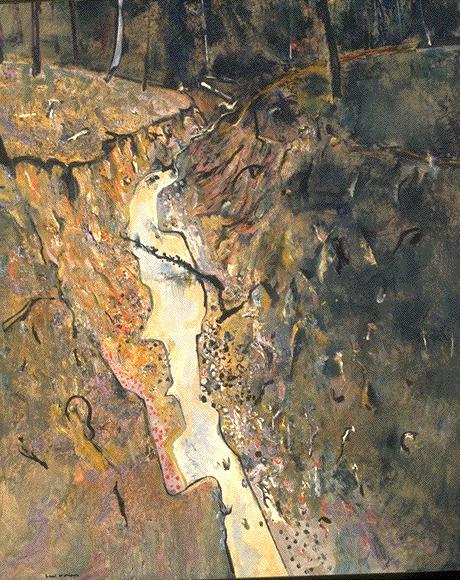
F.Williams, Wild Dog Creek, 1977.
Everybody seems to love the work of Fred Williams. The landscapes are seen to be iconic and they have become an inescapable part of our national visual culture.
But we did not always see the Australian landscape in this abstract way:
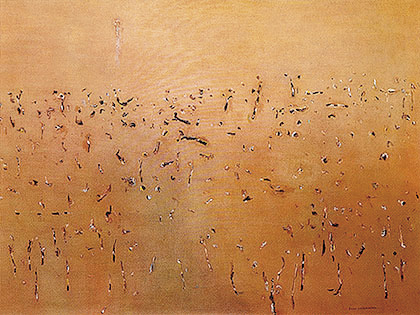
F. Williams, Yellow Landscape, 1968-69
We used to see the landscape very differently. Recall Hans Heysen and his gum trees from early in the twentieth century:
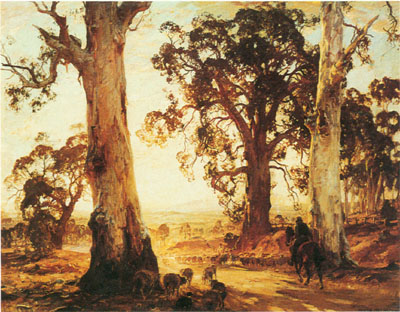
Hans Heysen, Droving into the light,
That is how we once saw the Australian landscape. Our enculturaled perceptual system took it to be the adequate representation of reality. Many in country and coastal towns still see the landscape in that traditional way as visual truth. That mimetic representation of reality became a particular style with the advent of modernism. It was once a defining style; the way of making better pictures though matching them to an external reality. Heyson dd it better than his predecessors.
Or so the story went.
So the way we see our landscape has a particular kind of history. We live and produce within the horizon of a particular closed historical period.
We can understand Fred Williams in terms of modernist abstraction and form meeting the old Australian landscape tradition. Something new is created:
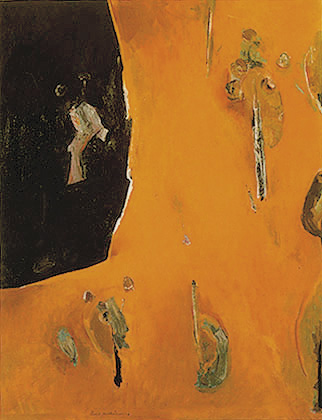
F. Williams, Waterpond in a Landscape 111, 1966
Williams has become a narrative template for us. A modernist one. Remember that one? Modernist aesthetics structured our visual culture in terms of utopianism, formalist aesthetic values, the artist as autonomous entity, and the transcendent character of art. It saw itself as universal not regional; asserted an essential connection between the visual arts and social reconstruction, and presupposed a revolutionary unfolding of history through visual culture.
Well, it too is eroding.
From the viewpoint of philosophical aesthetics we do not really talk about how we have learned to see. Yet the way we see has a history. Our visual culture is marked by different modes of viewing our world, and these modes of visuality are composed of technology, materials and cultural frameworks.
Just think of how different the cinema is to easel painting praticed by Fred Williams. Different historical modes of pictorial representation.
Silence & forgetting
Our high visual culture has been silent about this aspect of our history:
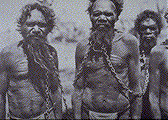
It's an untimely image.
How has this been forgotten?
The silence is an indictment on our culture. The deaf ears indicates just how conservative our culture has been. It has evaded the dark side of our colonial history, preferring to live with myth:
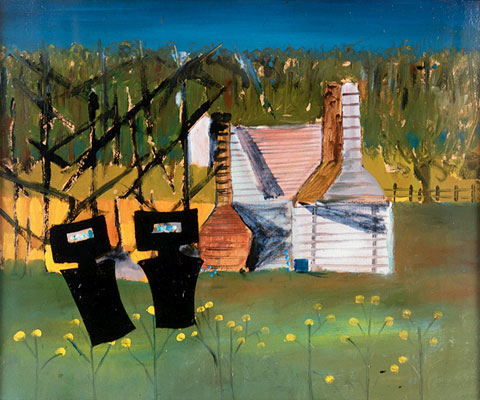
Sidney Nolan, GLENROWAN, 1945
Nolan is much praised and much admired by the defenders of beauty. But his work is much over-rated. It's time for a reassessmentthat disturbs its iconic staus, unset the aesthetic tradition, and embrace difference. Tis time to let go of terra nullis
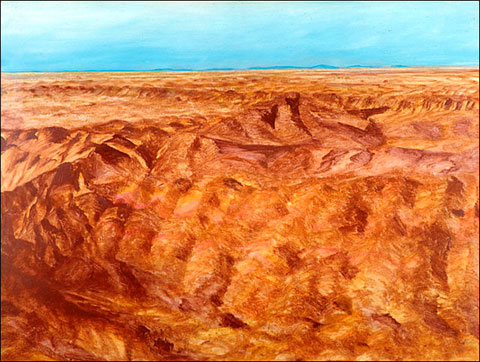
S. Nolan, CENTRAL AUSTRALIA, 1950
The naive abdication here to thinking difference and change in the landscape leads to the deconstructing of a particularly modern form of representation so that we can constitute a new relation between the past and an as yet unknowable future. We need a new kind of representational space to the mythic one of Nolan.
A philosophy that disturbs is both an effort at recollection what has been forgotten and focused on the present. Rather than evade our history we need to plunge more deeply into it, and become aware of the possibilities opened up by the future.
This remembering is one way to bring Heidegger into the discussion over contemporary Australian concerns whilst remaining off-side to those who are comfortable within the humanist tradition that has defined the humanities in the academy. Many of the scholars who continue to re-inscribe and rehash the old cultural elitism conflate humanism with beauty and culture.
Recollecting what has been forgotten--images of aborigines in chains--- disclose or open up the historical sublime.
surrealism in Australia
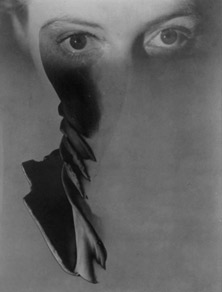 I've just noticed. There is an exhibition on surrealism at the Art Gallery of South Australia.
It is fairly extensive with films and lectures on European surrealism.
I've missed the lot.
I only came across the exhibition today courtesy of the ever delightful and interesting DogfightAtBankstown.
The image on the left is Max Dupain, Surreal Face of a Woman, 1938
The educational material in the exhibition doesn't tell us all that much about the homegrown surrealist movement in Australia, or its significance. Art history rarely does. It's pretty much a mixture of biography, influence and formal analysis.
My understanding is that surrealism in Australia was understood to be a means of reuniting the conscious and unconscious realms of experience so that the world of dream and fantasy would be joined to the everyday rational world.
The surrealists understood the unconscious to be the wellspring of the imagination and poets and painters could tap into this normally untapped realm. Thus J. Gleeson, Composition, 1938, on the lower right
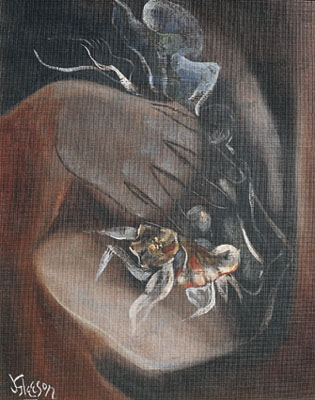 Gleeson became the most well-known of the Australian surrealist visual artists and he continued to explore the world of dreams.
Do we have a vindication of the role of the artist as a critic of society?
Though Gleeson expresses a faith in the subconscious processes of artistic production, it is not clear that this form of Australian surrealism ever broke away from the old idea of aestheticism (art for its own sake), or art being primarily about beauty.
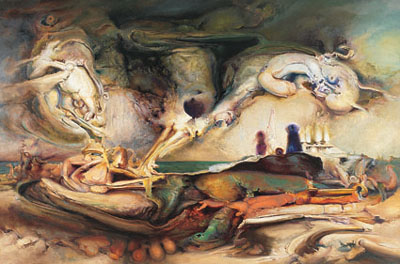
J Gleeson, Evening Ceremonies, 1986
Was there a critical edge to surrealism as a modernist avant garde movenment in Australia?
Or was it about finding the forms to express a new romantic national mythology?
Did it have anything to say that was otherwise to the Enlightenment rationality that had decayed into development, economic growth and raising standards of living in the new suburbs?
Does it say anything about the monstrous horrors of modern civilization? Were there monstrous horrors in the establishment of a liberal civilization on the Australian continent?
Did the moment of surrealism help us to understand our history?
If there was a critical edge then it was due to the effect of the crisis of the Depression and the barbarism of World War II:
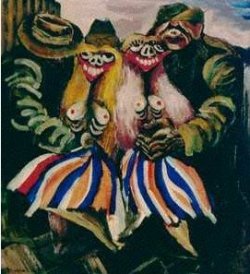 Victory Girls by Albert Tucker is part of the series called Images of Modern Evil.
It is an expression of shock and moral outrage at the decay or collapse of [Christian?] moral codes in wartime Melbourne. It sounds as if there was a rebellion against the repressive puritan moral code of the 1930s and the privations of the war (a decade of bleak times) in the name of individual freedom.
Tucker's images of evil series expressed his outrage and disgust at the living for the moment and women selling sexual favours for silk stockings, chocolates and money during WW2. The life of "the mass" in a modern city is reduced the underside of the city--criminals, prostitutes, clowns and psychotics. This urban life in the wartime city of Melbourne becomes an allegory of evil.
However, surrealism never really caught on amongst the visual arts in Australia. The art history books tell us that it was primarily continued by James Gleeson, who continued painting until the 1980s.
So this work by T. Gengenbach,The First Days of Spring at the Strait of Hormusz, (1980)
 comes as a suprise. It indicates that surrealism was, and has been, far more widespread and deeper than the Australian art history books have told us.
The history of surrealism in Australia yet to be written. It did not die out in the 1940s, squeezed by social realism and abstract expressionism. It continued on as part of the underground.
The art history books, (eg., Bernard Smith's Australian Painting) rarely make a connection is ever made to European surrealism other than the obligatory reference to Salvador Dali. Art lives in a self-enclosed world of its own.
So why is there no mention made of Andre Breton? Or Georges Bataille? Did the writings of these European thinkers resonate in Australia? If so in what way?
Did the conflicts and fallout between them have an impact in Australia? Did we have two kinds of surrealism in Australia? One about beauty and one about filth?
I do not know the answers to these questions. I wish I did. It seems as if we need to recover a history that has been lost.
What I do know is that the art history books are silent. Smith's academic/scholarly tome does not even mention Breton or Bataille in the index.
October 07, 2003
catches the eye

Martin Davies, Sweet as!
He is an artist associated with Margo Kingston's Web Diary.
at the beach
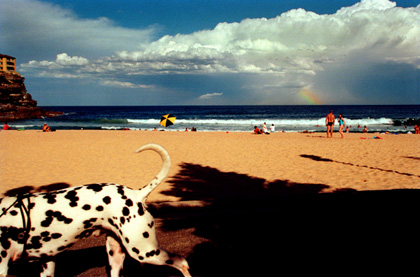
Narelle Autio, Untitled, from Coastal Dwellers 2002
Apart from the rainbow this image expesses the coastal mood on my evening walk after I'd finished the days painting.
I had forgotten to take my camera.
October 06, 2003
Max Dupain
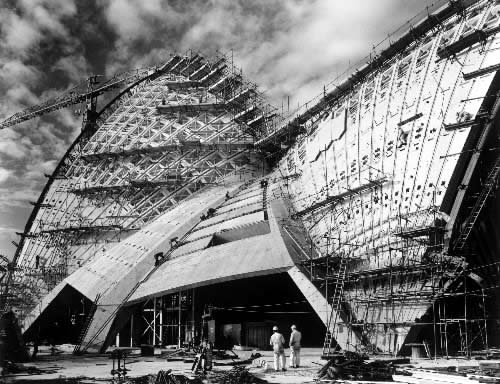
Max Dupain, Sydney Opera House, circa 1973
Article
More Photos
The images swing from celebrating the heroic, the formal and the iconic. Dupain is trying to express the meanings of iconic symbol of Australian modernity from within modernism.
1973 was a time of the resurgence of Australian nationalism. Australia had come of age in a cultural sense. Hence the two signs of modernity:

Max Dupain, Opera House and Harbour Bridge, circa 1973.
Sydney was modern. The rest of the country lived--languished---in the stulifying conventions of the nineteenth century.
What we do not have here with these works by Dupain is a critical artistic practice performed within and upon the institution of art itself. It is naive modernism; a modernism that was unaware that it was just another art style and aesthetic based on formal beauty, presence, subjectivity and aura.
1973 was before the pop artists and postmodernists appropriated the imagery of the mass media and advertising to decode its conventions and those of the art institution.
Yet the organic form of the Sydney Opera House can be seen as the repudiation of the conventions of modernist architecture.
October 05, 2003
High-popular culture divide
I was interested in Jean Burgess's master's thesis that she mentioned here. The ideas Jean is exploring through a sociology of art relate to how particular musical forms are used, what they mean to those who produce and consume them, and how they relate to changes in contemporary life. A summary can be found in this paper called
'Beyond the High-Popular Divide: Cultural Studies and "Art Music"'. Jean explores these ideas through Topology, a contemporary classical music group that is based in Brisbane and is associated with the Brisbane Powerhouse.
The concerns in this paper overlap with those of junk for code, such as the elitism and arrogance of the European avant-garde; the stuffiness of the traditional artworld; the legitimate place of art in contemporary popular culture; the critical edge of the aesthetic in a postmodern world; the particularity of place and everyday life and the cultural branding of cities in a global marketplace.
Whilst exploring the links I came across this article on contemporary British youth music culture. It reminds me of the talk to reinvent Adelaide as a postmodern, postindustrial economy based largely on entertainment. It's a nice idea; more or less a development of what Don Dunstan did in the 1970s with craft and design and the Jam Factory and with cuisine at the Regency Institute of TAFE.
But not under the current Rann Government. It considers the pathway to the future is slash and burn, budget surplus and dancing to the tune of the international money markets. Depite conferences such as this the idea of facilitating a thriving music/artistic community and industry is beyond them or their economic advisors. The do not see the potential value of a thriving nightlife to the local economy.They cannot see beyond industrial Adelaide of the car plants.
Adelaide has become the 'other' Australia to creative, dynamic Brisbane. It is the old rust belt industrial city with long-term unemployment, some of the worst urban poverty in Australia and poverty-level wages. Little is emerging from the decay of an urbanism where homeless people wander the streets, street life is tinged with violence and the rising crime is burglaries, shoplifting, bashings, burning down school buildings and car thefts. No jobs means that there is a continual exodus of family, friends, and neighbors to other places in eastern Australia. Many in Adelaide just wallow in the decay, and accept a life of misery, deprivation and inequality as their lot in life. Crime and professional sports seem to offer a way out from the poverty of everyday life, not music.
Unlike Brisbane Adelaide does not feel alive. The sullen defiance is there but it is not given cultural expression. It is the silence that is unnerving. Adelaide is no Manchester.
Great song
I have just heard Dylan's Just Like Tom Thumb's Blues performed live by Dylan and The Band in the UK in 1966.
Gee it was good. It crackled with energy.
Great white middle class blues.
David Plowden#3
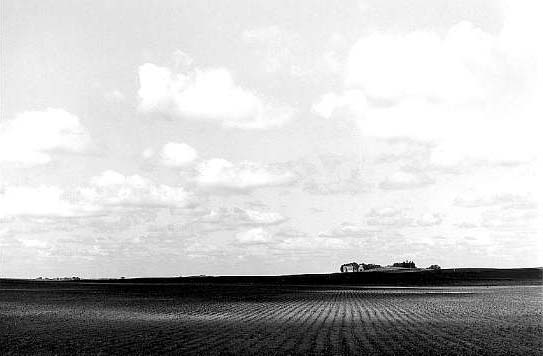
That could be regional Australia.
And this:

Apart from the fire hydrant, of course.
But work similar to that of David Plowden is not being done in Australia----as far as I know.
October 03, 2003
Nobel Prize
I see that the Nobel Prize for literature was announced this morning. It was won by John Maxwell Coetzee.

It appears that Coetzee happens to reside here in Adelaide.
He is attached to, or associated with, the Discipline of English at the University of Adelaide. He is an Honorary Visiting Research Fellow. He provides mentoring and support to Creative Writing postgraduate students and staff.
Adelaide University says Dr Coetzee is currently in Chicago, where he is a member of the Committee on Social Thought at the University of Chicago.
The Committe on Social Thought looks to be an interesting place. Much more innovative than anything I ever came across in an Australian university. Their intellectual life was fragmented by disciplines that existed as if they were silos.
I have not read Coetzee's works. I gave up reading literature many years ago.
Good time to start again?
October 02, 2003
Question for tomorrow
How do we think architecture differently?
How do we think of architecture without conforming to the standard assumptions and opinions about being and buildings.
about bodies and built form.
One pathway is this way:
"Poetry does not fly above and surmount the earth in order to escape it and hover over it. Poetry is what first brings man onto the earth, making him belong to it, and thus brings him into dwelling."
Martin Heidegger
is there another pathway?
The energy guzzling office buildings in our capital cities---those big glass boxes--- have had their day.
Is Melbourne City Council House by DesignInc the beginning of a green architecture in sustainable cities?:
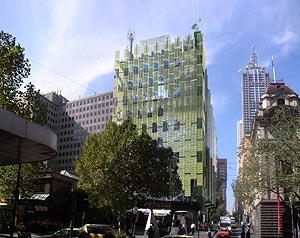
View from Swanston and Little Collins Streets showing wooden louvres on western facade
The green tower, known as CH2, also looks like this:
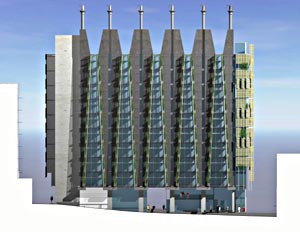
Northern facade showing root top wind turbines and tapering windows
And this:
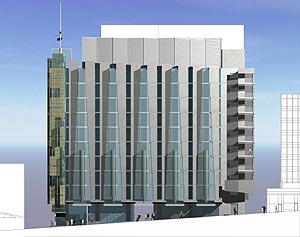
Southern facade showing three-storey-high shower towers facing Little Collins Street
Such a building allows Melbourne to brand itself as a leading city in innovation, creativity and sustainability.
October 01, 2003
David Plowden #2

David Plowden, Street near Bethlehem Steel blast funaces, Johnstown, PA, 1975.
It reminds me of BHP and Whyalla in South Australia. Economic growth at the expense of people's health.
