November 30, 2003
have a look
This is a lovely weblog. (Link courtesy of She sells Sanctuary)
It is from Tasmania, of course.
They understand themselves to be ecological selves.
This is what those who live in the big cities in Australia seem to have forgotten. Those who run our cities are more preoccupied with branding than ecology. Thus
"Branding is about attitude, perception and awareness. It is about linking thoughts and feelings in the minds of people with the image of the city. In the global economy, Burlington competes with cities around the world for business development and tourist dollars."
The promise is that with the new city brand or logo produced at great expense small cities like Hobart can steal a lead and powerfully communicate the Hobart advantage within the nation and across the world stage.
Yeah. The genius of marketing. How much more sensible it is seeing oneself as living within a ecosystem.
November 29, 2003
applying the emergency brake
Here is a suggestion from reading this and this.
The 1990's was a decade saying whoa; one in which Australians pulled the emergency brake against the rapid social and economic changes in our everyday lives. We applied the emergency brake because we felt that these changes from global flows were wrecking havoc on our urbanscapes, neighbourhoods and wellbeing.
The changes were leading to a corporate urbanscape that was placeless and impersonal. The walking city was deterritorialized. Instead of the city air making us free, the polluted air was making us sick. Were were being rendered senseless by the noise and bombardment of our senses. We suffered abuse in the city as machine and developed a defensive comportment.
The economic changes, which that was justified in terms of progress through the mastery over nature, were at our expense. The effect was a nostalgic sense of a world we have lost and this gave rise to a sense of urbanity---- reclaiming the city as a liveable, meaningful public place.
Environmentalism was not very successful in this. As a grass roots movement turned away from the city to small self-sufficient communities, and it promoted community and rural living of Nimbin.
November 28, 2003
surrealism: Hans Bellmer's mutilated bodies
Whilst searching for material on Bataille I chanced upon Hans Bellmer and his dolls. This surrealist worked during a time when Nazism was on the rise, Bellmer created several dolls with fragmented bodies that could be dismantled and arranged in various configurations. He created sexualized images of the female body--distorted, dismembered, or menaced in sinister scenarios. Using a narrative format, he then photographed the dolls in a range of grotesque-often sexual-positions. The images he conveyed were of death and decay, abuse and longing

What we have are fragmented bodies or doll pieces; broken up and contorted sexual forms that represent the body of young girls:
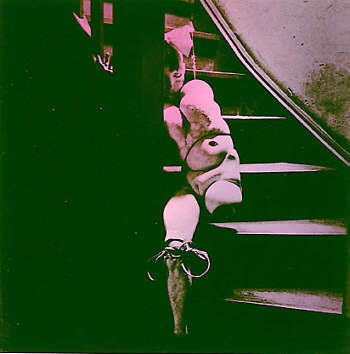
Hans Bellmer. Plate 12 of Les Jeux de la poupée (The Games of the Doll). Paris, Les Editions premières, 1949. Hand-colored black-and-white photograph.
In this image the doll is a tragic amputee, armless and tied on a shadowy stairway with frayed twine. The description of the image says:
"With a second (reversed) pelvis substituting for its chest, the doll is given buttocks for breasts, and these seem incongruously large, considering the undeveloped pudenda and the juvenile hair-bow. The doll's left leg is bound at the knee, while the right thigh ends abruptly in midair, exposing a hollow core. All is passive, inert: one hand lies limply against the banister, and a blank, unseeing eye suggests a loss of consciousness.
Who, one wonders, is responsible for the naked and abject condition of the doll?"

Surrealist women are headless, footless and armless . . . they are dismembered, punctured and severed:

Bellmer 's concerns are with the fetishising of body parts and fragmentation of
the sexual form. This comment highlights the Bataillian concerns:
"The fetishising of body parts and fragmentation of the sexual form ignored the constraints of physical actuality. ...Bellmer's sense of taboo lay not in what convention condemned but what was hidden in the darkness of the psyche (where it is far from safe). Bellmer's psychological confrontation and violence may constitute a spiritual jolt that liberates from habit and known codings. He dragged terrible desires out of the darkness and into cognition so that we could assimilate the full reality of our passions and the content of evil in them. How else were we to transcend them (in whatever way we ought) if not by first knowing them?"
This is the Bataillan moment of surrealism, its darker side. An art given over to the uncanny, to the compulsion to repeat and the drive toward death. The uncanny or the return of familar things (dolls) made strange by social, sexual and historical repression. Bellmer's collection of dolls constitute a traumatic tableaux with connections between sadism and masochism butal and between surrealism and fascism.
We should find this disturbing familar.

Consider the violence and repression wrought upon assylum seekers (including women and children) in Australia.
Is not the way we treat children made strange by the political repression by the state.
Are there not connections between sadism of the security guards in the Detention centres and the liberal state?
Are not these mutilated bodies the bodies of children living in detention centres that are run as prisons by private enterprise?
These images of the constructed female body are far more disturbing than the routine pornographic work on the Internet.
On Bataille's account the violence and desire in the mutilated bodies opens up a way of thinking which breaks the patterns of liberal thought, opens the possibilities of new ideas and bypasses instrumental reason and utility, and explores the body's potential capacity to imagine, dream and invent. This is otherwise to the current glorification of the pornographic that is everywhere and which is anything but emancipatory.
November 27, 2003
modern life

This condition is often celebrated as nomadism. The nomads leave the habitual domains of place, with their traditions and habits, professional standards and hierarchies, fixed social arrangements, lifestyles, relationships), domestical patterns, psychological conditions and institutional organisations.
They become travellers who connect with many singular experiences, perspectives and ideas, as they operate on a small scale in the margins everywhere in our society. The nomad strives for connections of differences beyond the realm of representation and meaning.
The nomad is the netsurfer. Here today, gone tomorrow. They understand themselves to forever moving in between territories, identities and dominant meanings; as courageously navigating the codes, representations and institutions that are imposed on us in our everyday life. Nomadism expresses a sensibility and practical logic to mutate and escape these boundaries. To be forever free beyond the limits that constrain our possibilities.
displacing myths
This is the image of urban life what we in Adelaide need to shrug off, if we want to think about the possibilities of Adelaide becoming a people-orientated city.

Of course, everyone with a bit of commonsense knows that Adelaide can never be like New York.They know in their bones that their place is other to New York.
They also realize that New York is the commercial heart of the American empire. It is the engine room of US capitalism.
And yet, they still hold that New York is what Adelaide should aspire to be. Being modern means a CDB full of skyscrapers.
Why just the other day some developer fellow was talking about a minor development in Waymouth Street representing the 21st century What is the image of the 21st Century in Adelaide?
Waymouth St. will become Adelaide's Wall Street! Is American financial capital moving here to springboard into China or continue to strangle Japan? Nothing doing. It is just another boring high rise apartment block tucked behind the new retro glass and steel 1960s Advertiser Building.
So you see its only by having skyscrapers that we can be truely modern and move beyond being simply provincal.
So the image inside their heads of what a modern city is, and should be, is this:
 (The link to the online Art & Architecture resource bank of the Courtauld Institute is courtesy of things magazine. )
This image contructs the place we live in. The image is part of a whole set of cultural preconceptions that shape the way we respond to the place.
The effect of this representation of urban life is that it blinkers people. It blocks them from thinking otherwise: a city designed for people rather than for commerce. They hang onto the idea that the whole point of a city is commerce and use this construct of the city as commerce to reshape the space to fit those preconceptions of modern live.
Commerce means making money and allowing the market to shape the design and structure of the city.
Commerce today means economic globalization. With the new market fundamentalism of the global economy comes a global culture based on consumerism, cultural superficiality, bad food and coffee. It's media elites (in newspapers, television and radio) want us as consumers to live our lives consuming more and more.
You can see the effect of economic globalization here:

If you read the Australian Financial Review you discover that Coca-Cola Amital has designs on the corner store.
You can see it in the advertising on the shop front. The Corner Store is really a shell or a space with a fridge to stack product of the carbonated drink market.
Coke controls about half of that market with only about half of that sold in Coles and Woolworth's supermarkets. Coca-Cola Amital has the market power to stand up to that supermarket duopoly and it has the corner store under its thumb.
That is one way economic globalization in its corporate form currently works its way through the local communities in our inner cities.
Coke is now trying to take control of the fruit juice market in Australia.
November 26, 2003
returning home
This is courtesy of Rick over at Artrift

Boryana Dragovea
It's been a while since I visited the Artrift. I'm too tired to struggle with the 3rd part of the Stephen David Ross interview. I had intended to pick up where I'd left off here. The aesthetic as shock.
Heidegger is attractive because he argued that people do not exist apart from the world but, rather, are intimately caught up in and immersed. There is, in other words, an "undissolvable unity" between people and world This situation‑-always given, never escapable‑-is what Heidegger called Dasein, or being-in-the-world.
What is also attractive is the way being-in-the-world is conected to place. Place is a central ontological structure of being-in-the world partly because of our existence as embodied beings. We are "bound by body to be in place"; thus, for example, the very physical form of the human body immediately regularizes our world in terms of here-there, near-far, up-down, above-below, and right-left.
What I don't accept in Heidegger is his animal human divide which presupposes that mammals and birds, everything nonhuman, are language to exclude language. Animals do have a language. They do communicate.
Heidegger's failure to acknowledge this means that he remains a prisoner of the very Cartesianism he had overturned with his category of being-in-the world.
That's enough philosophy for tonight.
November 25, 2003
milk bars & electronic scholarship
An interesting new online resource site without a weblog has been started up by Craig Bellamy. It is called Milkbar.com.au and is the product of humanities research by an independent postgraduate student at RMIT University. It fits into the ethos of the critical regionalism espoused by junk for code. Link courtesy of Creativity machine.
Craig works out of Melbourne and the milkbar is located in a virtual Fitzroy. The stories told in the milk bar will be about the history of the place, the effects of the post-industrialisation of the Australian economy, and the benefits and problems associated with globalization.
I know the place Craig lives in. In the early 1980s, when I worked as a conductor on the Melbourne trams, I lived just around the corner from the old Fitzroy town hall and the modernist housing estate.


The two story Victorian Terrace house I lived in was in Gore Street up next to Gertrude Street.
I loved Fitzroy. It was far more attractive than Collingwood or Richmond and had more soul than Carlton. Fitzroy was the gritty heart of Melbourne for me. From my perspective of working on the trams I pretty much constructed Melbourne as the Chicago of Australia. I loved the pub architecture  and the back lanes.
Fitzroy, especially Brunswick Street, has become a lot more colourful since the 1980s. There is a vibrant street life, but it is stunted by the dominance of the car. Melbourne, like Sydney and Brisbane, has done very little about rolling back the car to make spaces for people to play.
I was sad to leave Fitzroy in the 1980s for Adelaide to study philosophy. In some ways my heart still belongs in Fitzroy. I always go back there and walk around the streets when I visit. It is the colour of the street that I see when I return to Fitzroy Melbourne:

It was never so colourful in the early 1980s.
When living there as a Melburnite, I enjoyed walking the streets taking photos. I used to walk and play in Smith and Brunswick Streets and walked daily into the CBD past the state Parliament and Collins Street.
Milkbar.com.au is a research site whose theoretical concerns overlap with Philosophy.com Craig says he will use the weblog engage in electronic scholarship that would:
"...undertake a particular historical investigation. This investigation concerns the objectification and then the communication of the considerable historical changes occurring within an inner-city Australian community. As I will argue, these changes are in fact focussed local manifestations of larger and more distant globalisation processes...The analysis circulates around the ideas of the local and the global and the people–centred speculative encounters between the cause-and-effect of the two opposing discourses. Concisely, this project is an attempt to historically objectify the process known as globalisation in an inner urban community (in the developed world) using online interactive tools."
I would question the category "manifestation" in the sentence, "these changes are in fact focussed local manifestations of larger and more distant globalisation processes", but that debate is for another day. Globalization did have a negative impact on the old industrial suburbs of Melbourne and Adelaide in terms of unemployment and poverty. But citizens also responded to the forces of globalization on their place by modifying the impact, reshaping their lives, and experimenting with their situation.
I thought that milkbars were a part of the architecture of pre-1940s Australia? They became delis in the 1950s with the mass immigation from Southern Europe. As I remember it, working class Fitzroy was seen as an urban slum by suburban Melbourne and it was peopled by the immigrants who worked in the factories. The process of gentrification was under way by the 1980s.
November 24, 2003
funky architecture #2
Yesterday I was working on a post before I lost access to the Internet. It was linked to this post about livable urban places. The post was along the lines of our past 20th century pattern of suburban development being no longer sustainable.
I was going to argue that building another freeway to reach new suburban housing tracts along the coastline for cities like Adelaide, Brisbane or Sydney is not the answer. And we have not yet adopted a new, smarter way of growing our cities apart from gestures towards increasing density of the inner city. The car remains unquestioned. Pandering to car usage means more roads, more parking spaces, more fumes more noise and so more unliveable cities.
As part of the research I came across some more funky architecture. Then everything froze up and I lost Internet access for 18 hours.
I have forgotten the links I explored to get to the funkyu architecture here. I remember starting from Digital Media Tree found a section of an architectural magazine and then a black hole. What I saw was this image with an interview in a magazine somewhere in cyberspace:

M.Jantsen, M-environment house
It's modular, can be assembled and disassembled in different ways to accommodate a wide range of changing needs and is designed to be self sufficient, as it can be powered by alternative energy sources such as the sun and the wind.
It is far more innovative than the portables being dumped on blocks along the coastline of the Fleurieu Peninsula in and around Victor Harbor.
Or it could configured to become a high-tech retreat in the desert:

M.Jantzen, Retreat
It is a more innovative design than the shack I holidayed in Andamooka. a year or so ago.
previous
November 23, 2003
looking after cultural heritage
I came across this quote about William Morris courtesy of Schwarz over at Digital Media Tree.
"At the core of Morris' philosophy which was heavily influenced by his friend and mentor, John Ruskin, is the belief that old buildings should look old, and that historic fabrics should be respected and preserved, even where it survives in a weak or damaged state. For Ruskin and Morris, the essence of historic fabric lay in the wear and tear displayed by its antiquity and the spirit of the craftsman who created it, and not in its original perfection."
It is another world to the modernist one of concrete and glass that negates the past as tradition. Yet that old (nineteenth century) world is Adelaide.
The old nineteenth century buildings are what people who work in the visual culture notice as they drive into the city from the airport. Suzanne's sister, Barbara Heath, (on the left of this photo)

remarked as much when I picked her up early on Friday afternoon from her flight from Sydney.
Unlike Barbara, there are still many people in Adelaide who do not want their old buildings to look old; do not care about respecting and preserving their historic fabrics; nor do they appreciate the fine craftsmanship of these buildings.
after the game
Everyone is talking about the Rugby World Cup. But they never mention sexuality when they spin their hype about "the game played in heaven." Not even the gal who writes Dirty Whore Diary.
I saw the World Cup as another media spectacle in the metropolis. A bit like the Melbourne Cup.
This is what I imagined in the English team party afterwards:
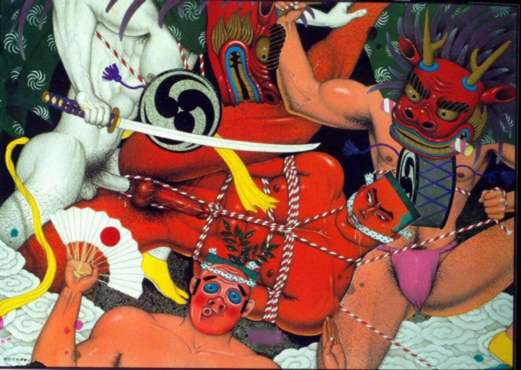
I wanted Tonga or Samoa to win. But it was not to be.
The ad-man's "game played in heaven" refers to the sacral and its intensities has religious connotations of mystical ecstasy. I see Rugby as a sexual ritual based around lots of rules and sexual prohibitions. The game is the foreplay. Then the celebration:
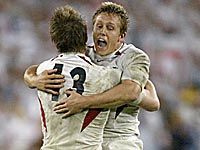
Does not the celebration transgress the prohibition of the erotic during the game that contains the sexual anxiety and fear?
Does not the dizzy excess of winning hint at ecstasy?
Of course, I'm reading it through the eyes of Bataille.
Then we have the party afterwards with its touch of sacrifice.
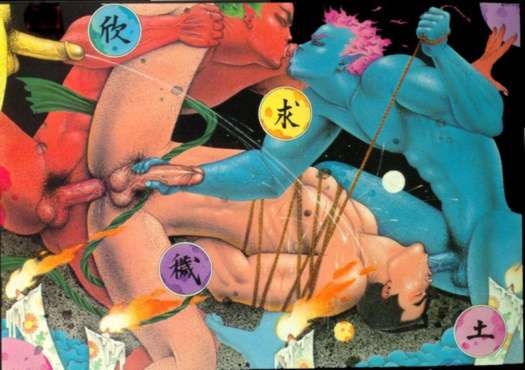
How else can you can make sense of all the media hype about the "game plasyed" in heaven.
Flesh and sexuality is all around us in the urban mediascape. Why should sport be exempt?
Not for the French though:
But then Bataille was one of their countrymen.
November 22, 2003
Grid blogging
I should have mentioned this before.
Junk for code has been invited to participate in an experiment called grid blogging organized by Ashley over at notes from somewhere strange. The theme will be 'branding', or more specifically 'the brand'. Ashely writes:
"Temporary in nature, the first grid blog is set to happen on December 1. The topic is the "brand". Interpret it as you like, from the comfort of your own blog. As critique, as recollection, as original content, as link-fest or visual interpretation. Whatever. Join in and help us discover where we can lead this dance."
Grid blogging shifts the emphasis away from the blogger as a proto journalist---the model of many get-it-down-fast writing favoured by Australian bloggers--- and more towards the online magazine devoted to a special issue. It is a shift away from the lecture mode — here’s the news, my considered opinions and you buy it or you don’t — and move towards the interactivity of a conversation.
It is a online conversation structured around an issue with many diverse voices coming from different perspectives in a visual culture.
Ashley says that the contributors to the conversation about the concept of the brand will be:
Abe from Abstract Dynamics
Anne from purse lip square jaw
Christine from Glowlab
Fabio from freegoriferio
Jonathon of things magazine
Nicolas Nova
Adam of V-2
Tomo of Electricspace
Dr. Menlo
Ifyou have time check these very sophisticated visual blogs out as they constitute a very diverse visual field.
The ethos of the flowing grid-blogging conversation will be on becoming, and so challenge the stereotypical repetitions in our visual culture.
November 21, 2003
urban life

M.Davies Urban folk.
Look at the image. No cars. It's all people. True, it's urban life of yesteryear. It is what has gone. An urban mode of life that has been lost.
Why so? The low suburban densities now common in Australian cities have developed since the automobile initiated the process of suburban sprawl. Suburbia is a seen to the solution to the disadvantages (noise, squalor congestion etc) of city life. It is premised on a love affair with the car.
Can the people city be recovered in a new form? Can we re-envision an urban life that is no longer dominated by the car? An urban life that gives some space to people to play.
Now a few ideas taken from Gilles Deleuze.
As an urban people our desires are to enhance and preserve an urban form of life and it does so by connecting to other desires. Power can be seen as the expansion of desire rather than the repression of desire. Hence we have our desires for a people-orientated city producing interests, which are coded----as a people-orientated city----and so regular, collective and organized forms of social desire.
A bit of imagination leads to Carfree cities A dense urban core is now developing in Australian cities buth the congestion is due to all the trucks and cars.from the modern city. In urban streets dedicated to human uses the perception of congestion is considerably reduced.
The burgeoning popularity of the New Urbanism signifies that urbanites realize that something about urban life was lost when urban planners, engineers and politicians allowed the car to dominate the urban landscape. We now realize that it is time to try something else, without necessarily returning to the urban patterns that were common before the automobile's arrival. The New Urbanism:
"....is the revival of our lost art of place-making, and is essentially a re-ordering of the built environment into the form of complete cities, towns, villages, and neighborhoods - the way communities have been built for centuries around the world. New Urbanism involves fixing and infilling cities, as well as the creation of compact new towns and villages."
November 19, 2003
its funky#1
Now this would give dreary, provincal Adelaide a bit of a design boost would it not? It would put it on the map in a different and more way than the sponsored major events, such as publicly subsidised car races (eg., Formula 1) that lose heaps of money every year.

Thomas Mayer, Der Neue Zollhoff, Düsseldorf, Germany 1999 2000
From Architecture in Photography Review here
What is outside architecture is not the facade or exterior of the buildings: it is the outside of the field of architecture and the inside of history, culture, politics and nature.
It is from the outside of architecture that we can ask how can we organize our urban spaces differently so that we can organize and structure our living arrangements in different ways.
Why not think of architecture and urban planning in terms of time, temporal flow or becoming rather than the usual measurable and calculable space?
Space is a part of historical time and it bears the mark of that time--the coastal playgrounds of the big cities were once accessed only by trains. Now they are primarily connected by, and accessed through, freeways. Space is produced through matter and movement. The landscape between coast and city changes and is transformed: scrubland gives way to then bare hills of dairy farmers then the vinyards of wineries and tourist towns.
It is still too hot. The rain has come and gone. The cooling winds have yet to arrive. I cannot concentrate anymore on this.
November 18, 2003
engaging with Federation Square
Federation Square folks.
It was not built when I was last in Melbourne. I have not experienced it as a public space. So I am opening up a discussion about it with those who have experienced it, formed some judgements about it, or know of published evaluations and concerns. This series, In the Mind of the Architect, may help to start the discussion.
My own interest here is in public spaces. There are not many in our cities, due to the space being commodified by the freewheeling market. Consequently, most of our architecture is for private clients who think in terms of economics. This corporate architecture is foisted on the public whether we like it or not. We have to live with them, good or bad. Even though they shape our cities and our movements we do not have a say.
I remembered Melbourne's failed squares of the past. They were dead bleak spaces. And Adelaide's public space around the Festival Centre was just a deck of concrete with a few sculptures and pot plants on it. A disaster.
This was another go at creating a genuine public space:

I'm aware that the Square is marketed as the centre of the metropolis of Melbourne and is seen as the heart of the nation.
I realize that Melbourne is at the cutting edge of architecture in Australia and that RMIT university is the incubator for the new architecture in Melbourne. through trying to get one major building from every top architect in the city.
And that the background to the construction was that the Kennett Liberal Government had a vision to create one of the great civic spaces of the 21st century right on top of the railway yards which had divided the city from the river.

Now it does have a monumental quality that is mean to impress and awe:

On the other hand, these forms break with the modernist big black boxes of steel and glass, with their sleek elegance. They became the businessman’s vernacular. They are not boring. We do have pluralism, variety and complexity here. they are like public sculptures which we have to live with for a long time.
So I look at the Square as a public space that is one of our sacred sites that transgress the rights of the property owner, which are the heart of our political system. I look and this image Julian Hill immediately comes to mind:
 It's called Remember Me?
Where are the local architectural codes of the local tradition? It seems to refer back to the pre-modern city square ringed by great civic buildings.
Does it give us a sense of gravitas, the sense of solid civic public space that you get from cities that we all like to think of as being good public cities.
Yeah I know, it's fractal architecture; and that what we have here are the primitives of a new sensibility.
The beginning of something that’s going to grow and grow and grow.
Something that will be nurtured in our computers by young architects pushing the boundaries.
Did the designers listen to the wind? Did they feel the sun? We sould ask these questions because it is not just about innovative design:
 Public buildings and squares are important becuase they help us to define ourselves as a nation.
They facilitate our understanding of who we are as public beings and who we might be.
Is the Square postmodernism?
It appears that postmodernism in architecture has been and gone----didn't it have something to with Learning From Las Vegas?---- The judgement is that some of the buildings are bad, horrible kitsch. We should pause a moment as there is still alive in philosophy. There it stands for movements influenced by Nietzsche and Heidegger's attack on the presuppositions of western metaphysics of instrumental reason.
That attack can be linked to modernist architecture. That movement had a number of presuppositions: its rational forms and technological purism, search for unity and harmony, prohibition on historical references, the universal language of pure form, and the ethos of progress.
Where to now? Changing the modern' no against tradition and history' to the postmodern letting it all in and then being ironic? Or stepping along the pathway toward an Australian architecture?
November 17, 2003
just exploring
Tonight I've just been exploring around after reading Barista & Bonyton, quickly skimming things magazine and following the links to a brutalist architecture that is about being noticed:

Owen Luder, The Tricon Centre, Portsmouth, 1964
One of the junked spaces of late modernism. There are so many, especially thsoe that deny the contradictions, dissonances and tensions of modernity and dump politics, economics and culture under the label of a harmonious and unifying progress.
I am too tired, and its too hot in Adelaide tonight, to work on mega architecture or Federation Square.
Suzanne was really impressed with Federation Square. Alas she could not describe how the built form represented or expressed Federation. Would it be layers and layers of history, rather than an expression of the idea of federation (becoming a nation or one people?) Federation for me is the interpreted history from 1901 to 2001.
Whilst exploring I came across Photojunkie, a collaborative site based around photoblogs.
I'm looking for design ideas for a photoblog with a gallery attached that would be an outgrowth of, and linked to, junk for code. As Jean over at her newly designed Creativity/Machine though content is king, design is still queen on the web.
Design is the key.
Came across Shutterfly by Amanda Gilligan, who lives and works out of Sydney.
This image caught my eye:

It's called Rust.
Amanda is connected to Jarod Pulo who ran the now closed Nuke.net, and now runs Vanilla Shots. The latter uses both movabletype and phpgallery to create the news page and photo gallery respectively. A photoblog is attached
H'mm. I've been toying with that kind of assemblage myself. But it requires techno knowledge as creative design to swing it.
But I reckon Typepad is a goer. It's easier.
My thinking is muddled. I need to find a designer to help me cut through the thicket I'm entangled in.
November 16, 2003
inside and outside architecture
I tried to write a post yesterday about place & modernity in response to David Tiley's comments on this post I could not.
I wanted to explore the idea of an Australian architecture; one that was critical of the traditional appropriation and reproduction of an architectural language that’s coming from a different climate. 19th century English (Victorian) architecture does not work well in our cities, let alone in our coastal scapes. I was interested in a regional beach architecture that was part of the earth, the buildings would come out of the particular site, the materials would be local the skin of the building would be an ecotone. Something that flew in the face of modernism, the Bauhaus, Harry Seidler and the high rise housing block.
I got bogged down in how current discussions about place pit modernity against the tradition of a small seaside/country town (eg., Victor Harbor) as a local place filled with its own unique character. Modernity stood for mass consumption, the dominance of exchange-value over use-value, and standardized forms with difference reduced to surface decoration. In terms of beach architecture modernity is giving us arrogant souless containers that betray the spirit of the modernist avant garde.
I just came up with an environmentally sensitive architecture that is sensitive to the particularities of place:
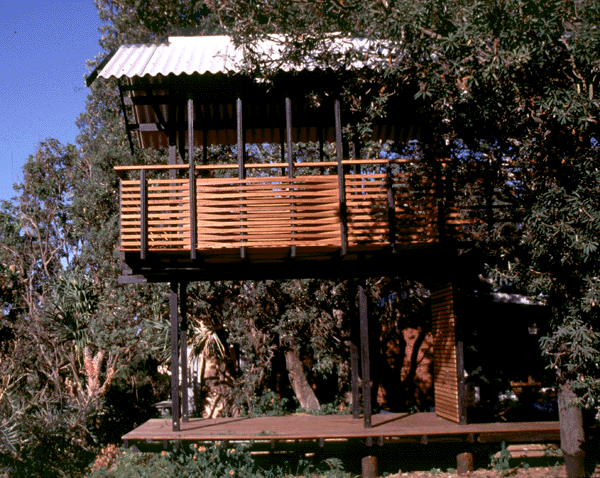
Brit Andresen, Mooloomba House
Brit says that one’s home should be the place where you can most fully be yourself. That is should be a space in postmodernity where you can shed all the obligations of being in the social world, and come home to things that are yielding in some way.
Today, I decided on a different tack. I had another look at Gabriel Poole's lightweight architecture in a beachplace here. We can shift from the beach as place or the architecture as poetic dwelling that opens up a world to the built form as space. A space that is a radical rupture from the dark Victorian houses that are miserable spaces. They're either cold or dank in winter or hot saunas in summer. Our beach shack in Victor Harbor is an improvement: it is your typical brick and tile house that is out of character with the beachscape.
That perspective on Poole's beach architecture is thinking about architecture in terms of its environment.
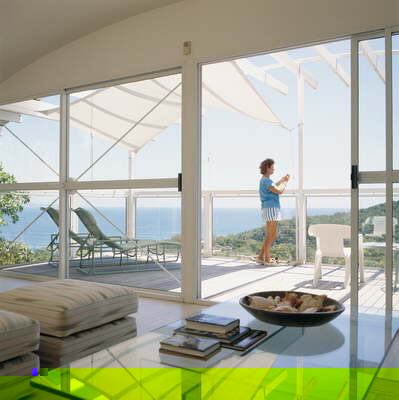
G. Poole, Noble House
Can we not think differently to this kind of poetic dwelling? Could we not think of this beach architecture as an architectural space, and this space as chora or receptacle? Is it not this built form a space of bodily dwelling? A container that shapes our subjectivity and affirms our identity?
We look at these simple built forms nod, make a comment or two about the lightness of the architecture and then move on.
But could we not use these simple architectural forms to think architecturally differently: to break with architecture as technological innovation, or the latest(Tuscany) fashion fad, or the They desperately hold on to the English model of housing for example, and this heavy handed tradition of Federation, or neo-Federation housing moving long the coast, even though it is inappropriate environmentally, climatically and culturally.
Why not think of producing built form differently?
To think differently so as to keep architecture open to its outside. What does that mean. I had a look at an article by post. noted above he says:
"Place for many cultures is about time and history, and maybe cultural forms. Or it can be about family. For us, in a space which is truncated in all these ways (leave your past, leave your family, go to this homogenised southern world) it is about landscape.I reckon two amazing things happened with this. On the one hand this is a landscape which is unique and distinctive, requiring its visitors to develop new ways of being to live in it. And on the other it has been inhabited for a very long time by a culture still in connection to it.
Hence, I reckon our great cultural project is about landscape. How do we live here? How do we share it with the original inhabitants? how does our current appreciation of the place (partly through satellites) combine with perceptual systems learnt from "our" indigenous heritage to explode the western experience of the world..."
How would we introduce the outside that is aboriginality into architecture? Do we have a glimmer of what that would like?
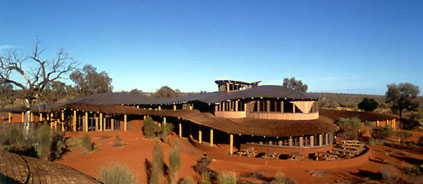
Uluru-Kata Tjuta Cultural Centre
Is that a first step?
November 14, 2003
this is no shakedown street
It is hot in Adelaide tonight. It is still well over 35 degrees, has been for most the day and is likely to be so for another week. It's summer in South Australia folks. I'm suprised that more people do not die.
It's definitely airconditioner living. It is the only way we can survive. Bodies sweat. They don't sleep. They feel tired. They suffer from debilitating heat headaches. It is impossible to think or move freely. It is hard to concentrate to write anything on place, or space as chora or receptacle when home is a sauna.
Records are probably being broken all over the place. You know ---hottest November in 100 years etc. That sort of stuff.
And people continue to deny the phenomena of global warming in the name of reason. That reason seems to be a cynical reason.
We have jump started summer. Leaped right over spring. Spring never happened in South Australia. How can whole seasons just disappear into a void?
Few people walked their dogs in the Adelaide parklands before 6pm. Those that did hugged the deepest shadows, as did the dogs. The joggers are always an exception. Nothing less than the full sun will do.
Suzanne is junketing in Melbourne and I'm off to the cool climes of the South Coast early tomorrow morning. I feel alienated, estranged and alone in the city. It's a night like this that you imagine the urban animals (dingoes) roam the city as their ordinary habitat no longer supports them any more. So they find a new urban habitat to support them, and they adapt to ths empty spaces and become alien to a particular place.
My body is yearning for the cool sea breezes. Maybe the city is too hot for even urban animals.
The city is very unpleasant. It is inhuman. Shakedown street, as the heart of the town where the women are smarter than the men in every way, becomes a vacuum. Nobody wants to walk around. It is hard to look cool in 36-40+ heat. It is like living in a blast furnance when the hot north winds from the desert blow through Adelaide, burning the plants. We think in terms of the days the plants died.
Is this not bodies-in-places, rather than the yawning emptiness of atoms in the void (space as vacuum, or placeless void). Adelaide is somewhere not nowhere. It is more than pure position or point. As place it has real power; it has its own dynamism.
Place exists in the order of things as the ancient philosophers (Aristotle) would say. Place situates and it does richly.
The airconditioner is barely making a difference and there are no cooling breezes. My body cannot cope with the debilitating heat.
November 13, 2003
funky Oz architecture

Gabriel Poole folks. More shots here. Poole designs houses in which the soul can play.
In that little word 'play' you can hear echoes of the Situationist International.
And he designs funky beach shacks that are site specific:

Beach shacks in a world of process and becoming. Does this point to poetic dwelling?
It discloses a way of dwelling on the ground of the earth. One in which we tread lightly because of the fragility of the earth. Poole's architecture understands that the earth matters.

It allows us to become the light ones attuned to the song of the beach. It becomes our poetry; a poetry that shows the primacy of place.
November 12, 2003
you can make it happen Adelaide
As I have mentioned before at junk for code Adelaide is in the process of reinventing itself. It is doing so through its Thinkers in Residence programe.
This reinvention is held to be about adapting a 19th century city to the 21st century. What happened to the 20th century? Surburban Adelaide has slipped off the radar screen of the town planners and urban designers. How come the 20th century has fallen into a black hole?
The problem the thinkers pose is:' How do you adapt a 19th century city to the 21st century? It's a good question.
Soem suggestions were made by Charles Landry, the current thinker in Residence, at a public lecture in the Adelaide Town Hall last night. The lecture was entitled, 'Re-thinking Adelaide: A walk on the wild side',
I missed it. I was too too busy.
But I know the theme of the talk or the argument. Adelaide must change from being a place to leave to being a destination to come to. It can do this by unlocking and marshalling the energy and talent of the entire community so that it becomes a connected city, a vibrant city, an exciting city.
You can here the traces of the Situationist International here in a sort of decayed way. Okay, I'm being a bit rough here> Landry is connected to Comedia, a site or think tank that explores those 'points of energy and debate in the modern world where economics, culture, creativity and sense of place converge and interact.'
Sounds good huh. The blurb sounds okay too:
"The task for cities is to rethink their problems and opportunities afresh and to create a vision for themselves that inspires citizens and increases their aspirations. Cities need to think:
how they can harness the talents of their citizens to help solve their own problems;
how they can generate pride and commitment to their city and so strengthen its identity;
how to deeply incorporate sustainability issues in housing, office or retail development, whilst enhancing the quality of urban design.
In so doing cities need to learn from the best, but most importantly create a learning environment so that they can come to know themselves better."
It sounds okay until you ask what does sense of place mean? The answer is that it is about marketing---place marketing it is called.
November 11, 2003
a note on place
These remarks are occasioned by the reference to Jane Jacobs over at City Comforts Blog. Jacobs made a big impression on me with her conception of cities based around vibrant, inner city street life.

Helen Levitt, New York, 1940
My other memory of The Death and Life of Great American Cities is that it is about particular places and so different to the modernist city of a series of engineered traffic flows and the grid of office towers.

Levitt, New York, 1940
'Place' stayed with me all through the long years of a philosophical education. My desire there was to get back into place. But I could find no way out of the modern maze of time and space structured around atoms in a void.
An emphasis on place runs through junk for code. It is informed by a critical regionalism within a bounded Australia on the edge of the Asia Pacific Rim. The emphasis on place is also a response to the abstract universalism of the global market that makes every commodified space the same (identical).
The philosophy behind the idea of place as an opposition to the global market is simple though complex. It holds that objects do not go into their concepts without leaving a remainder; the remainder is the non-identical; the remainder is the untruth of identity; and contradiction’ means non-identity. There is so much identity about with the economic categories of the market (they supposedly mirror reality) that we need lots of digging up remainder as excess, negativity and contradiction.
For those interested that's the first few pages of Adorno's Negative Dialectics. (It's a real tough read)
Place emphasizes the particular and the substantive as opposed to the universal and conceptual of the global market. That turns philosophy on its ahead and hits the univeralism of Western culture full on. 'Place' is dismissed as parochical and provincal and so 'place' as a meaningful category is shunned. But the categories of universalism----eg., those of the virtual reality of the internet ---are place blind and obscure the place we inhabit. Virtual reality is everywhere and and a particular somewhere--the inner city of Adelaide---is deemed to be irrelevant. All that matters is the weblog in cyberspace and the links to other weblogs, newspapers, sites etc.
It is in postmodern architecture and ecology that we find an interest and concern for place----eg., the idea of regionalism, both critical and bio. But place is more or less concealed--veiled?---and rarely discussed, even though our bodies have a place we call home. So it is hard to get a grip on it.

Helen Levitt, New York, 1939
Why not go back to the Greeks? Everybody (Hegel, Nietzsche, Heidegger) does it when they are in need of a sign post and some help to unconceal what is veiled.
Some Aristotle then.
Where something is constitutes a very basic category since anyway we go we find place waiting for us. Place is primary for us. We are in a place; we live within places. Places----the inner city or beachscape ---surround our bodies just as a glass surrounds water.
The analogy is imperfect:----a glass can be moved or carried around as in a party but a city or beachscape cannot. But it will do as a first cut at coming to grips with what place is. It foregrounds limit as part of place.
With Aristotle we get the idea of the world is already fully implaced. The limits of place circumlocate particular things and sensible bodies within their immediate environment.

Gary Winogrand, American Legion Convention, Dallas, Texas, 1964
Aristotle is our boy.
Let us forget about the geometry and mathematics and focus on our world's inherent shapeful ordering.
November 10, 2003
a suggestion
I'm still thinking about "geometries of living" that are other to the modernist geometry of living. The latter inserts human beings into a machine and constructs the axiomatic system of geometry of rectangles and squares viewed as a sculptural form from a fixed point of the calm external eye.

Coop Himmelblau
This igloo form makes a break from the old beachside shack, the rectangular brick suburban home, or the Tuscany villa. What appeals is that the building does not possess a façade, since the front side of the house is completely open, revealing the interior. But it is still private.
If the façade of a building is equivalent to the face of a human being, then does not a building without a façade arouse feeling of the uncanny. Feelings of the uncanny are aroused when we are confronted with a faceless body. We find it very disturbing.
Or does the equivalence of building and body not work here?
If it does, is this architecture a step towards an antihumanism? An example of re-emphasising the bodily experiential aspect of architecture in which the built form emphasises fragmentation, disruption and disintegration. The building's architectural body appears to be injured and threatens the physical integrity we assume it should possess.
previous
November 09, 2003
creating places
I'm down at the holiday shack at Victor Harbor this weekend. I'm puzzling about a phrase I came across--"geometries of living" in relation to lines of different kinds in a building on a site.
I'm working on the large garden, the conservatory, and planting drooping sheoaks (Allocasurina Verticallata) in the reserve to create a habitat for the critically endangered Glossy Black Cockatoo.

The Glossy Black Cockatoo was once widespread through South Australia, but now only around 260 birds survive on Kangaroo Island. The Island is just across the water from the holiday shack and the birds occasionally visit the mainland looking for the seed pods of the drooping sheoak. They feed almost exclusively on these seedpods. Most of the sheoaks were cleared by farmers to run their cattle and sheepfarms. They stripped the landscape and left it denuded. No strands of dropping sheoaks, no Glossy Black Cockatoos
Whilst doing these mundane tasks I was very conscious how I'm grappling with the problems of rootedness, continuity and place. The surrounding seaside environment cannot be wished away, nor can the way that we live be arbitrarily changed. Materials and plants must be chosen that can cope with the salt blown by the winds. These conditions need to be taken into account when we build our conservatories, verandas or decks. They are the ecological limits we live within.
That was the problem with modernism. It recognized no limits as it looked at things from above. It held that we work within an infinite field of creative possibilities.
The reality is otherwise. The site is a layered with history. History in the sense of inheriting a regional tradition of building or architecture that expresses the character of this particular place shaped by the forces of nature. This building creates a place--the seaside town with its historical style that owes very little to modernist architecture. This regional architecture can be continually renewed in spite of the fashionable turn to the debased Tuscany look as the assertion of the modern by those who still want to repudiate the past and liberate themselves from the dead weight of traditional styles.
History is in the sense of ecology of the place that requires us to extend the range of architectural vocabularies within which we work. One needed is a simple and funky beachside architecture full of coastal character; an architecture whose geometry of living would throw odd features together that would release movment and figure allowing them to go off on unexpected paths or relate to one another in diverse ways.
This colourful funky beachside architecture would work with an eco-vocabulary that harvests stormwater, sewerage and solar energy whist protecting the sensitive coastal strip with board walks and walking trails. Green architecture should be a requirement-----eg., regenerating the habitat for our Glossy Black Cockatoos----not a sales pitch.
The argument is twofold. The site at which a building is to be constructed is never a tabula rasa, since it has a history that haunts the spot, like a spectre. This spectrality of the site manifests itself in the traces, the relics of a certain past that stays alive on any site. So the architect would acknowledge these traces in a place and integrate them into the architectural whole.
We should dump a utopian modernism that wanted to leave the past behind, construct buildings like signs on a blank page and do so through ideal forms based on geometric purity, perfection, and order as in the villa Savoye. We should develop an architecture that draws attention to impurity, imperfection, and disorder---the uncanny or disturbing --- because the human history on this coast is one marred by violence of the destruction of aborigines, landscape and whales.
November 08, 2003
Beachscape
I'm down at the beachshack in Victor Harbor, Fleurieu Peninsula, S.A this weekend. I've been gardening all day. No time for big posts on architecture, modernity, the uncanny and the landscape.
This image from the Bureau of Meteorology website reminds of spring time on the beaches at the foot of the cliff tops that we walk in the morning and evening.

Brett Hadden, Sunrise & crepuscular rays shine as rain falls at Coila Beach, NSW.
This kind of landscape is pretty much our play ground. The public policy concerns and political preoccupations of Canberra just evaporate into the seaspray.
The poodles chase themselves to a standstill in this beachscape.
But this is the southern ocean not the rolling long waves of the Pacific. A little bit of carelessness and you are swept away from the rocks into the sea.
Alas, there are too many deaths along the south coast. There are not many warning signs and people (tourists) tend to ignore the ones that are there. So they are swept away by the surging seas.
November 07, 2003
Lake Eyre
I saw some great images in The Australian from the website of the federal Bureau of Meteorology this morning.
One that caught my eye. It was of a place in South Australia that I've never been to, but I've always wanted to visit:

Peter Dobre, Lake Eyre, SA.
It rarely looks like that. Lake Eyre is located in arid central Australia. It is an immense dry salt lake that drains an area equal to that of France, Spain and Portugal, sits 15 meters below sea level and is the largest salt pan in the world.

Almost half the basin receives as little as 150 mm per year or less. The northern and eastern margins experience higher rainfall of the order of 400 mm per year, influenced by the southern of the summer monsoon. The Lake is fed mainly by its eastern tributaries (Diamantina and Georgina rivers and Cooper creek).
It sometimes fills up from floods that are connected to El Nino.

Lake Eyre was considered to be permanently dry, but the last fifty years have witnessed over twenty flood events. When rivers come down in flood there is a transformation of the desert: the lake and its surroundings become alive. It teems with bird life andthe landscape ibecomes one of ever-changing colours and patterns.
Lake Eyre Basin has fired the pioneer explorer imagination as the great inland sea, and then as the man-made inland sea. It is white man dreaming about the centre of Australia flourishing supporting millions of people on the present immense plains of sandy and stony deserts.
It is protected as a National Park, as it should be since this wilderness sits on top of the Great Artesian Basin. The Great Artesian Basin is the largest artesian groundwater basin in the world. It underlies approximately one-fifth of Australia andextends beneath the arid and semi-arid parts of Queensland, New South Wales, South Australia and the Northern Territory, stretching from the Great Dividing Range to the Lake Eyre depression.
November 06, 2003
love the sexy payola
 I saw bits and pieces if the I Should be so Lucky episode of the ABC's Love is in the Air last Sunday night, whilst cooking a Middle Eastern rice dish.
It was all about global domination, making money, pop success and Mushroom Records finally making it. Nothing about the craft of musicianship, good music, the meaning of the songs. It was about dreams of global success in joyous world, especially the dreams of a suburban girl called Kylie Minoque. This was the Melbourne pleasure machine of the 1980s and it was full of cultural optimism.
Was this going to be a good old fashioned morality tale about artists not doing business with the world of commerce without being exploited or losing their soul? Would it be a narrative about how to bridge the modernist divide between bohemia and business in a way that would yield a profit? Would it be about the pop machine appropriating the idea of continually fashion itself anew from the modernist avant garde? Or would it be about how suburban sex becomes urbane porn?
I had watched the brilliant Win Wender's film Buena Vista Social Club on the same night. This highly visual film was full of passion for music and the musicians, it treated the Cuban musicians with respect and dignity, and it foregrounded them as people and the music they played with Ry Cooder.
Love in the Air, in contrast, was all surface. There was no exploration of the meaning of the image of Kylie Minogue as pop princess in terms of the development of Australian culture, or the significance of celebrity for pop culture.

The message? Australian pop culture came of age because of monetary success. It was possible because of television--Countdown--and the suburban cultural world of the 1980s. The suburban fans love for Melbourne Pop was tempered by their anxiety about high culture and the European avant garde. It was pop culture celebrating itself in terms of its froth and bubble.
There was a story of sorts. Kylie outgrew suburban Melbourne. She opened up to a global culture by becoming a part of the London pop production machine of Stock Aitken Waterman (SAW). The machine produced glossy banality, happy sounding records and young, clean, stylish singers who loved being pop stars. Kylie as a success pop princess was created by the pleasure machine with its manufactured sound.
These are her roots: pop from the pop factory, music by numbers. She becomes a pop creation; a pure sign; a pure mutable image that could serve as a metonymy for so many meanings. But there was nothing here about market and politics, and no exploration of the society of the spectacle.
These were images of celebrity but ones in constant reinvention:

The other messages? Seduction that perpetuates itself through the alluring appearances of bodies. The transformation meant that she no longer appealed to suburban teenage girls. Kylie was female desire on the way to becoming a sex siren/vamp and a gay icon in the 1990s:

She bends pop into erotica without it even being noticed by suburbia and without it being authorized by the name of Culture.
More success! Kylie shifts from being a pop creation to a pop creator of the pleasure machine (her image and story) after falling in love with a rock god (Michael Hutchinson) who was the reigning presence in the Sydney rock scene. Australian Pop and Rock embodied in two cosmopolitan bodies celebrating sexual desire with a touch of sacredness. As international celebrities they were out of reach and could not be touched.
What was not discussed was Kylie's desire, and search for, artistic credibility collaborated, as with her collaboration with Manic Street Preachers. The programme was about success in the form of "global domination" not pop as art or the independent music scene.
Where were the blackclad ugly beasts from the swamp? The punk & Nietzsche that was other to pop and rock and whose representations were about inchoate experience of violence, death, eros, decay and chaos?
Then celebrity becomes all mixed up as the images and styles blend into one another in the media flows and become parodies and cliches. in which pop flows into erotica without ever being tainted by the smell of pornography
Melbourne was all so different to New York. Such contrasts to highlight cultural particularity can enable us to come to know the past of our visual culture through making histories of it. The nation is constructed in language, we live in a world of visual images and various narratives are buried within them.
November 05, 2003
The Situationist's new Bablyon
"Town planning is not industrial design, the city is not a functional object, aesthetically sound or otherwise; the city is an artificial landscape built by human beings in which the adventure of our life unfolds.” Constant Nieuwenhuys, 1960
The Situationist response to the city of the commodity and spectacle is a dreaming of the city of tomorrow. The ludic or recreational city is premised on the socialisation of the ground and the complete automation of the production. In this utopia we don't have to work, can lead a nomadic existence and one can live fully as creative beings. Only then can we become a homo ludens.
That is utopian rupture from the old modernist form follows function ethos. The Situationist vision is called the New Babylon. It is a utopian scheme for a new mode of dwelling and new society by Constant A. Nieuwenhuis. It exists in the form of a series of maquettes, charts, sketches and paintings. It is hard to get a sense of an urban life of play in the recreational city from images such as this:

or even this:

Constant attained a prominent position in the world of experimental architecture in the 1960s', but this influence faded and New Bablyon as a situationist city has been forgotten by urban designers. Constant stopped working on the project in 1974 and turned to painting.
These images are from the first large presentation of the New Babylon project since 1974 at Witte de With, (21 November 1998 to 10 January 1999). A monograph associated with the exhibition was produced. A symposium on Contant's New Bablyon was held in 2000. The forementioned exhibition contains images such as these:


It is hard to make out what this city of play would be like from such images.
The exhibition notes, however, give us some pathways that allow us to get into the project. They say that :
"New Babylon envisages a society of total automation in which the need to work is replaced with a nomadic life of creative play, in which traditional architecture has disintegrated along with the social institutions that it propped up. A vast network of enormous multilevel interior spaces propagates to eventually cover the planet. These interconnected "sectors" float above the ground on tall columns. While vehicular traffic rushes underneath and air traffic lands on the roof, the inhabitants drift by foot through the huge labyrinthine interiors, endlessly reconstructing the atmospheres of the spaces. Every aspect of the environment can be be controlled and reconfigured spontaneously. Social life becomes architectural play. Architecture becomes a flickering display of interacting desires."
New Babylon is now a historical artifact. As an artifact, New Babylon is less a practical, useful, ‘real’ piece of architecture and more a series of texts of a philosopher/artist designed to stimulate our thinking about urban form and life; a work of art about architecture and about architects. It's open ended overlapping texts breaks with the modernist iconoclast architect who is hailed as hero while the trend-followers are summarily dismissed.
It's conception of urban levels is an interesting way deal with the polluting mechanized traffic/inhabitiant conflict that lies at the heart of the modernist city. It opens up critical perspectives on our urban present as we tried to free themselves from the ideological trappings of the modernist sixties and early seventies. It introduces the ‘recreational’ aspect of urban life, the changing nature of leisure in our cities and their relation to the public domain.

It is hard to place play at the centre of urban life because the legacy of the twilight years of heroic modernism still haunt us. We struggle to keep alive the ideas of the European avant garde as we come to understand how intrinsically political and covertly ideological is even today's architectural production and discourse.
Maybe there is critical architectural work (postmodern architecture) that borrows from New Babylon and the Situationist International.
Contant's representations about space may connect with current concerns with electronic space, can act as a stimulating reference point for our ongoing conversation about the strategic role of space in urban social life and connect with some strands of postmodern architecture that loosen up the tight form and function coupling in modernist architecture.
Why not develop plans, ideas, concepts, spaces and buildings for large left-over waste land for a counter city? Why not foster an urban revival that redefines the position and identity of a city in a wider regional, national and international contests that transgress the old barren functional schema (more carparks, office towers and shopping malls) of contemporary urban design?
November 04, 2003
walking the city
My exploration of the city have been done on foot and so I'm very much at odds with a city structured around the movement of the car. My heart is with the Situationist International that worked within the Parisian flaneur tradition.
"The ordinary practitioners of the city live "down below", below the thresholds at which visibility begins. They walk - an elementary form of this experience of the city; they are walkers…"
Michel de Certeau, The Practice of Everyday Life, (1988, p. 93)
For me the pedestrian is the key figure of urban mobility which I contrast to the mechanised modes of transport (train, bus, car) and its commuters. I hold the effects of these modes of transport responsible for the poor state of city living.
In Adelaide the City Council is complicit in allowing the car to dominate the city. The current council resists any attempt to roll back the flow of the car to make space for walkers. The car has to be dominant because the city is a commercial site: a space to make money. The city is not a place to stroll. Hence the future of the city is all about carparks, shops and commece. They still see the central region as a redevelopment site for commercial and industrial construction and for new commuter roads.
So the grid or plan of the ordered city is based on the flow of mechanized transport to and from the inner city, not on the play of residents. Our play and spontaniety is constrained by the grid, buildings, traffic flows and the noise of mechanized transport. There is little redevelopment in the guise of urban renewal taking place in Adelaide.
According to material on the Incite site (via Anne Galloway at Purse Lip Square Draw), there is a long history of intellectual and artistic investment in the practice of walking in the city. It says
"I am thinking, of course, of the tradition of the flâneur in French writing. From Baudelaire, to Breton, Aragon, Benjamin, Debord, Perec and Réda, writers have self-consciously centred themselves, and the ordinary residents of the city, in the act of aimless strolling through Parisian streets. This deliberate idleness is thought to open subjectivity, by walking without intent the writer makes 'himself' receptive to chance and unseen possibilities .... Unpredictable encounters with others: persons and buildings, are said to allow the impact of the external world on self to be gauged."
I have spend many hours walking Melbourne and Sydney in the early 1980s and then Adelaide, initially with a Leica camera, then with a white standard French poodle who always strolled out in front.

I'd gone back to Melbourne several times in the last year. I noticed how much both the old layers of 19th century Marvellous Melbourne (the cultural capital of Australia) and new one of the late 20th century suburban Melbourne were being radically transformed. It was not just Southgate. Redevelopment was happening in the inner city area and there was redevelopment around Spencer Street Station:

 The city was becoming something glitzy and blue glassed.
What I could see was that Melbourne's lovely nineteenth century heritage was going. The old had to make way for the new.
In place of the old there were all the high rise apartments in the Docklands.

It's all function and form in this designer city of developers and planners who see the remaking of the city as urban renewal and deem it to be a good thing.
A lot of it looked like a good old 'spatial fix' to keep capital going to me, rather than a concern for a living city of people.
The power of property and finance capital is paramount in Melbourne and the planners have failed to control either the content or the form of the city centre. It had become a commodified space.
Money was pouring into the inner city not culture. The old new in an expanding CBD is branded in international imagery, but a lot of it looks so homogenous. The dead hand of the modernist brutalism and contempt for context and earth weighed heavily on the urban fabric.

I half suspected that a 'Disneyland Melbourne', built around nostalgia for the heritage that is disappearing, would soon be proclaimed as the latest fashion in built form.
The old bohemian Melbourne, which was part of the city of the British Empire, with its back lanes in the city block that functioned as pedestrian pathways is disappearing. What was lacking in the urban renewal was a distinctive cultural fabric of a living city of people walking, playing and having fun.
Do I sense a renewed conflict between the dynamic cosmopolitan CBD and the defensive, protective suburbs? A metropolis with unequal access to the luxuries of the inner city?
What then of the flaneur tradition that walks the city? It holds that the aimless wanderings
"also transform the city itself. To the flâneur urban surroundings suddenly become both familiar and alien (1996: 100), inscribed with a subjective resonance, strange associations and the depth of myth. By making themselves travellers in their own city, these writers believe that they are capable of subverting the dominant image of Paris as grid, plan or spectacle. The walker is held to invite an alternative city to express itself, one that cannot be separated from the pedestrian body."
Further,
"...walking in the city also involves a vital act of temporal dislocation. Wandering purposelessly across Paris is said to allow these writers to tap into buried layers of history, memories both personal and collective. Their footsteps mark an infusion of the past in the present, triggering parallel journeys that cut back and forth against the more conventional progression of time....despite the solitary tradition of the flâneur, the ambulatory writers of Paris regarded their city as a place of connection....Indeed, their wanderings were intended to highlight the multiplicity of relations that the reductive activity of capitalist planning was perceived to deny."
Do we have a similar tradition of the flaneur in Australia? If there is----and I have no idea if there is one----did this process of personifying a city give rise radical representations that challenged or resisted dominant representations of the developers, urban planners and politicians?
November 03, 2003
the spectacle
Its arrived. The excitement of the carnival that stops a nation.

The spectacle that is called the Melbourne Cup. This is not just a horse race. It is an example of the spectacle in the Situationist Internantional sense.
They held that that capitalism had turned all relationships transactional, and that life had been reduced to a "spectacle". Two points are made. First, they reworked Marx's view of alienation, as developed in his early writings. The worker is alienated from his product and from his fellow workers and finds himself living in an alien world The increasing division of labor and specialization have transformed work into meaningless drudgery. Where is the creativity in working on aa conveyor belt?
Secondly, they added to Marx. They argued that in order to ensure continued economic growth, capitalism has created "pseudo-needs" to increase consumption. Modern capitalist society is a consumer society, a society of "spectacular" commodity consumption. Having long been treated with the utmost contempt as a producer, the worker is now lavishly courted and seduced as a consumer.

Hence we have a society of the spectacle. As Guy Debord says:
"The spectacle is the moment when the commodity has attained the total occupation of social life. Not only is the relation to the commodity visible but it is all one sees: the world one sees is its world. Modern economic production extends its dictatorship extensively and intensively..... In the advanced regions, social space is invaded by a continuous superimposition of geological layers of commodities."
In a society of the spectacle, everything is image and all we seem to have left are references to other references. Just think of al the marketing and advertising associated with this spectacle.
November 02, 2003
photos and visual language
Folks. James Natchtwey, war photographer.

Link courtesy of Tao of Pauly
Great work:

Quite a contrast to the massive decampment of photographers from reportage on the world into studio tableaux and artifice in the 1980s. That was a period of postmodern art photography.
Photos become evidence for historical occurrences and they acquire a hidden political significance in our cultural history. From this trace perspective there is no single canonical history of the medium as once held by the modernist art institution; only a diversity of photographic histories. But we know that anyway.
What disappoints is the failure of photography to represent our historical lived experience of modern metropolis.

M. Dupain State Office Block, 1967
Where are the photographic histories of this mode of experience governed by shocks caused by the money economy and instrumental politics? Where are the photographic representations of this new structure of experience, with its destruction of the old values has affected us in our deepest core? It would seem that photography has failed to give us an adequate understanding of the reality of the metropolis.
So a gap opens up between our photographic language, the structure of our lived experience and social reality in a nihilistic modernity. What becomes significant is the difference between sign and thing, the difference between language and reality and the difference between meaning and experience.
November 01, 2003
A different city for a different life
Modernist architecture was all about re-creating the modern city, which in turn was suppose to create a better society. Architecture as a "high" art had a goal of building the utopian city through an abstract formalism devoid of any past references. Architects must erase the past to make way for the future.
The question that arises is: how can mere organization and built forms make people's life more free? Removing decorative clutter, introducing straight lines, right angles and bare white walls may improve living arrangments. So too good design and quality production.

Le Corbusier, Savoye Villa
But how can the cubes & rectangles, concrete and glass, freeways and skyscrapers of machine aesthetics make an individual more free?
Basically they can't. More than architectural form is needed. Aesthetics alone cannot change or revolutionize our society.
The response by the European Situationist International to the functional and utilitarian modernist urbanism, which still rules our cites, was to encourage experimentation and diversity in relation to the emotions and feelings of the city's inhabitants. Form was subordinated to the "situation."
The city was to be a city of play and the free creation of everyday life, rather than a city of work and commerce that structured our lives in terms of commute, work, commute, sleep. That modernist conception means that we navigate the city in the the car and not on foot.
The Declaration of Amsterdam talked in terms of unitary urbanism that creates an urban environment in which playfulness, spontaneity and freedom are the prime features.
A different city for a different life.
An initial step to a life based on eros would be to loosen up the codes of behaviour of work and commerce contolled by men in suits. These codes and beaviours imprison us, isolate us from one another, send messages that we are passive workers and consumers, and discourage us from thinking that we can contribute to making the metropolis more human.
The metropolis is certainly not a human place. it is about cars, work, pollution, work and shopping. Only the parks offer a respite from this commercial urbanism. And they are hostile places avoided at night because of psycho's drunks, agro street kids. And it is not just the inner city. Teenage gangs cruse the suburbs striking terror into the very heart of suburbia so that little kiddies care to afraid to go to birthday parties.
Do not the strict zoning laws and rigid compartmentalization, based on Cartesian grids and spaces, create desert-like urban spaces and desert-like minds?
The Situationist strategy for breaking this commute, work, commute sleep routine down is through art creating situations, which liberate energy that will permit people to make their own history. The situationists stand in opposition to the pop artists, who celebrate the consumerism of the time, mass producing much of their art and thus adapt and resign themselves to the capitalist system of the 1960s.
The capitalist system was what the Situationists wanted to destroy. Capitalism created the spectacle and the show business in the city.
Playfulness and freedom? That requires a lot of free time. It means that work becomws obsolete through automation and that eventually the entire society could free itself to drift about the city.
It is all so 1968, isn't it. But the 1968 became the no future of the punks.
Free time? That is something that is increasingly dominated by the career demands and pressures of work, unless you are unemployed, excluded from consumer society, living in poverty and abused as welfare cheats. Even the unemployed have to work for the dole.
Today, in Adelaide, these ideas of the situationists are recycled in terms of the art industry creating an exciting and vibrant sector in the inner city, thereby making Adelaide a less boring and complacent place.
Yet the situationist city is worth remembering. It is full of people walking in the neighourhoods enjoying themselves; parks full of old timers on benchers; others aimless strolling; doing philosophy and music on the footpaths; plenty of festivals that broke the old patterns of commute, work, commute; and plenty of surrealism in the streets and in-your-face politics. This city is a negotiable, plastic, ever changing carnival of celebration.
You can see traces of the situationist city in the carvinalesque ambience of the anti-globalization protestors. Maybe there are other traces.