December 31, 2003
consumer freedom?
I've just entered the CD market as a consumer buying the odd CD here and there to start a bit of a library. I've started by slowly working my way through the 60s and 70s.
I've been taken back by the cost of the CD's of the old albums. They are around $20 for a replica of the old vinyl records, and $32 for them remastered plus a view alternative takes or mixes of the songs. Many of the CD's I want are out of stock and must be imported from the US at great expense. There is a cosy little cartel going here that is at the consumers expense. In Australia it is illegal to make a back-up copy of legally obtained copyrighted material for personal use. The Copyright Act 1968 should be changed so that making a copy of legally purchased copyright material for personal use does not infringe that copyright.
THe current price for CD's is a rip off. That has been my gut reaction. The music companies are gouging us, even when the product has a couple of good tracks and the rest is filler. I'm angry.
My judgement from this Xmas experience is that the big recorded music companies are getting all the benefits of globalisation (cheaper manufacturing costs by taking grunt work to developing countries) without passing on the benefits of globalisation in the form of lower prices.
Nothing has shifted since I the 1970s other than CD's replacing vinyl. Where is the cheap digital download? Where is the the Internet as a distribution medium,Where is the licensing of content to enable legitimate online music services? Why cannot I legitimately select my own material from the back catalogues of recorded music and so avoid all the filler? Why aren't the labels in the process of digitizing their entire back catalog and uploading it as downloadable, high-quality MP3s for a small fee?
So I welcome people making their own CD's on a home computer through what the music companies call unauthorised copying. Of course the companies claim that each of the CDs made on a home computer is created at the expense of one sold in a store, and so the entire industry is being faced with wipe out. That is why Napster had to be taken out. Instead of putting their cataloguies online by the record companies have seen the Internet (eg.,online music services) as the anti-Christ.
Who cares about the corporate recorded music companies? They've been crying wolf for years. I do not see the global market rhetoric of ‘free’ flow and ‘greater’ access” with CD's leading to increased access to music greater democracy, a more diverse civil society and increased freedom. What I see is the neoliberal agenda that sweetens American corporate expansion by dusting it with the sugar coating of enlightenment principles. The result is that huge corporate conglomerations control the global music business. It is one that ignores that consumers have a right to copy legally-purchased CDs for their private purposes.
The artists now have the technology to make and sell their own CD's. Why not move away from the oligarchic recorded music companies to peer-to-peer sharing?
December 30, 2003
"Gorging" on porn?
The debate on pornography continues to splutter along in Australia. It is still between the between conservatives who talk about censorship and the libertarians who talk about free speech. Around and around in the conservative/libertarian maze we go.

Helmut Newton, Work, 2000
The conservative interpretation sees sexual desire in a negative fashion (they engender deception and manipulation) and that sexual desire can only be morally redeemed through love or marriage. The conservative readings of pornography emphasize the worst examples of the pornographic genre; read pornographic images too literally and ignore reading sexual images in multiple and flexible ways; and read the images from the various perspectives of male viewers. This conservative interpretation of porn culture is then counterposed to an assumption that all sexual relations are, and should be, carried out in a context of trust, love, commitment, intimacy, and mutual respect.
What is displaced by this interpretation is the casual sex of both men and women. Sexual liberals presuppose that sexuality(eros) is a wholesome bodily activity that involves pleasing the self and the other at the same time.
 . A libertarian sexual ethics is described by Alan Sobel in the Routledge Encyclopedia of Philosophy (1998). He says that:
"If oral and anal sex, gay and lesbian sex, bisexual and group sex, contraceptive coitus, wearing lingerie and cosmetics, adultery, prostitution, making or viewing pornography, and the paraphilias--the things often condemned by conservative sexual ethics--can be carried out without harm befalling the participants or others, by consenting adults who know what they want, how could they be morally wrong? According to libertarian sexual ethics, as long as the persons involved are participating voluntarily, they are not merely using each other for their own purposes; the free and informed consent of each to the acts that occur is sufficient to eliminate mere use and thus to make sexual activity, of whatever flavor, morally permissible. The paradigmatically wrong sexual act is not buggery, but rape, in which the absence of consent makes the mere use obvious. Consensual participation in sexual activity implies that each person is respecting the other as an autonomous agent capable of making up his or her mind about the value of the activity."
Recently, there have been attempts to move out of the conservative libertarian discourse and find other ways of talking about sexuality and pornography. In the latest intervention
Tim Ferguson has responded to an article in The Age by Simon Castles.
What did Castles say? He said that:
"...ours is a culture gorged to the max on pornography. It is everywhere. Yet we don't particularly like to talk about it. The silence is almost total - like for an office worker downloading an image they shouldn't, hours after everyone's gone home."
My comments on the "everywhere" of porn culture can be found at philosophical conversations and Public opinion.

Elle McPherson Intimates
You can also see the 'everywhere' in Confessions of a Webcam Girl, which is sold as living in the porn underground as a Webcam whore. It is all so exciting, enticing and avant garde. In offering titillating images of their bodies online Webcam girls gesture to the celebration of sexual openness of contemporary urban life in Sex in the City. Here the sexual practices of autonomous urban professional women are fluid and experimental and challenge the traditional boundaries and conventions.
Today, Livian, plays at constructing herself as the discreet, voyeuristic object of masculine desire with her online web-cam. The dressing up to the black frock, naked shoulder and blackbra strap is for the male audience coming in from The Age. When linked to Sex in the City this dressing up signifies glamour, being cool and full of fun. Such a girl is more than a lifestyle girl: she has the right to choose her own sexual experiences and to talk about them.
Many of the webcam whores expose lots more flesh than a naked shoulder. They need to because behind the webcam live fed sits a porn industry hustle. The webcam girls are an enticement, as they are part of a media fed to seduce you into paying a monthly fee to webcam.com to become a member. Then you can both access porn and chat with real cam-girls while watching them live. Web-cam girl is another new face of porn culture.
So what did Castles say about all this porn culture in everyday life? He connects it to loneliness of men and porn chic and says that:
"Whatever our feelings about porn culture, I think we kid ourselves if we believe it doesn't exact a toll. Porn takes its pound of flesh just as it gives it. We are all diminished, deadened, by the constant barrage of sexual imagery - not just from hardcore sources, but from the advertising and media industries, which become more porno every day. Sexual imagery chips away at us, as transitory thrills give way to something more depressingly permanent. Something that really should have a name - perversion fatigue, perhaps."
He concludes by saying that I think it's time we at least started talking about the issue.
So we should. Porn culture takes many different forms:

Helmut Newton Cyberwomen 2, 2000
and our readings of the images are diverse and full of slippages.
So what are others saying?
In response to Castles' suggestion to talk about porn culture Tim Ferguson says that:
"Pornography is now beyond the control of its friends or foes. Freedom of speech is a side issue here. In Western society, it is the freedom of the market and the power of the consumer that govern all. Most of the 8 million porn sites exist because there is a vast, insatiable market for them."
That is pretty right. But "porn" is not just the porn industry. We also need to talk about the porn culture, given the way that Elle McPherson is appropriating "porn" imagery to sell her Intimates range of women's lingerie:

That image of a women masturbating can hardly be called perversion.
Tim rightly questions Castle's term of 'perversion fatique.' Tim says that:
..."the term perversion fatigue is inappropriate. Perversion relates to the abnormal means of obtaining sexual gratification...The majority of porn sites are heterosexual, pedestrian and even mundane. "Sex fatigue" is a better term, although the acceptance of such a term begins a new stage in the pornography debate. Liberal-minded psychologists have identified gambling and drinking (both legal) as addictive. Is "porn addiction" to become the next Western disease?... Seriously, there may come a day when free speech advocates agree to restrictions on porn for the sake of our mental health."
Tim reduces the issue of porn to consumers choosing in a global market culture:
"Pornography makes money because people like watching other people having sex. If people wish to "gorge" on porn, do we care? If too much exposure to it decreases their enjoyment of the real thing, doesn't it serve them right? Isn't it their business? And if it is our business, what can we possibly do about it? We may be embarrassed, offended or made to feel inadequate by the increasing sexualisation of the internet, the media, advertising and emails offering a gorilla's arm holding a pumpkin in the pants of every male.... But the process will not stop as long as consumers consume. In the meantime, it's only sex. And sex is where the money is. Just deal with it."
If we are shopping for sex, then sex is a commodity and women are shopping for sex as well as men. What Tim misses is 'talking about the culture' bit associated with the pornographic imagination, sexual taboos and the historical attempts to regulate the sexuality of single women in the urban jungle.
Thus we have women film makers and writers casting a critical eye over a debased cultural form that has historically been associated with men.
December 29, 2003
Towards an Australian Cinema: The Tracker
I saw Rolf De Heer's 2002 film The Tracker last night on DVD.
The only other film of De Heer's that I'd previously seen was his 1993 film Bad Boy Bubby. I recall that I was deeply taken with the first 20 minutes of that film, where Bubby, the man-child, is trapped within a domestic hell-hole with only his abusive mother and a dead cat wrapped in plastic for company. From memory, the rest of the flim did not shock and disturb, as it was conventional in its handling of the narrative.
I was deeply impressed with The Tracker's painterly representation of the Arkaroola landscape. This was informed by the colour of Peter Coad's paintings:
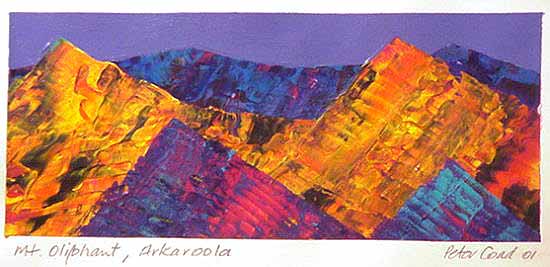
P.Coady, Mt Oliphant, Arkaroola, 2002
The colours were red earth, blue sky green trees and blue water:
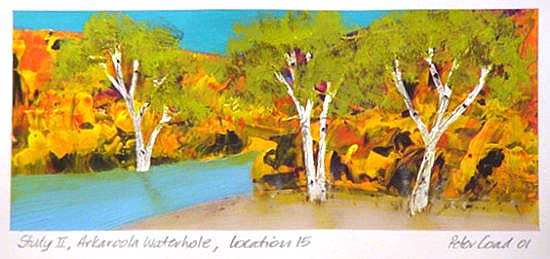
P. Coad, Arkaroola Waterhole, 2002
What I also noticed three innovative techniques. The Tracker made extensive use of Peter Coad's paintings in the film to depict the white violence toward indigneous people, thereby incorporating indigenous story telling from. Secondly, we have the use of song by Archie Roach instead of script to comment on the characters and actions in the landscape. Graham Tardiff’s music (with lyrics written by De Heer) is reminiscent of Neil Young’s evocative score in Jim Jarmusch’s Dead Man. Then we have the use of the narrative to represent the intersection between white and black cultures in the early days of post-colonial Australia (1922). And the camera draws us into the landscape so that we walk the valley's within a slow 'desert' time.
The significance of these techniques?
The film enables we Australians to cross the traditional line in which we viewed the landscape and indigenous people through the white colonial eyes as a terra nullius. We traditionally pictured indigenous people through Social Darwinism and viewed them as stone age savages. The techniques enabled indigenous Australians to speak in their own voices opened up a space in which to we can begin to see the country from the perspective of indigenous people. That is the innovation of this film, when compared to Rabbit-Proof Fence.
This visual poetics is a big step to an Australian cinema.
December 28, 2003
Summertime in Australia
The modern day therapy:
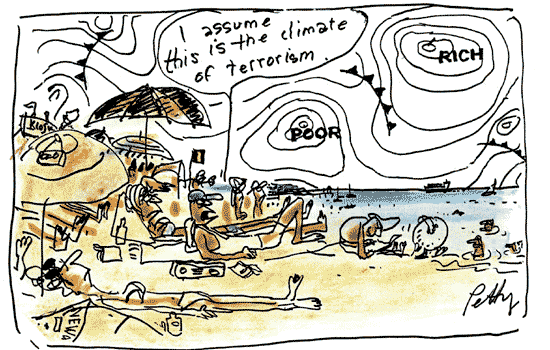
Bruce Petty
Whilst at the seaside I went looking for Greil Marcus's Lipstick Traces (1989)-- a history of punk?--- but I couldn't find it in the second hand stores. I had Greil Marcus' Mystery Train in my back pocket. I showed them that, but they looked at me anxiously when I mentioned Lester Bang's Psychotic Reactions and Carburetor Dung. Maybe it was the title.
We came back to the city from the endless summer at the beach on Friday I searched for an image of Australia, as I sensed that my world is drifting into the past. An image, such as Lipstick Traces or Mystery Train, but a whole better than Strange Fruit It was an image because I'd long given up the romantic notion that rock and roll offered a fairly clear and consistent critique of Western capitalist society, and so continued the negation of the 20th Century avant garde art from dada to the situationists. It is more about myth making than situationist critique.
Were the images of Australia to be found in the deserted streets walked by people from boarding houses looking for an early morning coffee.
Australia is no longer in the bush other than as myth. Perhaps in the open spaces of the landscape? Maybe it is to be found on the roads that pass through our modern nation.
I thought that I might find some clues as to what Australia stood for in the summer sales, shopping and a consumer culture. After all this is what Australians are supposed to do once Xmas Day with the family is out of the way.
I searched amongst the CD's in strange music stores filled with red and black rock and roll imagery; fragmented gothic conversations about the brass tacks of life being about birth, sex and death, and guys with love and hate tattooed on their knuckles and needle marks on their arms.
I was looking for the expression of my hopes, dreams, and doubts about the good life in the music. But I did not know much about Australian music even though most of what I'd heard had little to do with being true to your school. Most of it seemed to be young guys with screaming guitars playing the same riff whilst singers yelling into a microphone. Or snarling aging punk rockers. I did not know where to begin to look for Australian music that expressed the magic feel of our history and my yearning for a place I could called home.
I ended up buying some CD's of US music (the Velvet Underground with Nico & The Band) and UK music (Richard and Linda Thompson.) Says a lot doesn't it.
Maybe the music is the wrong place to look for the Australian images of sexual and romantic tragedy. Maybe it is film that searches for the way to be Australian? So I got a whole bunch of DVD's to explore.
I need some arresting images to help me find my way through Australian popular culture. Something better than carburetor sex.
December 27, 2003
Melbourne beachscape
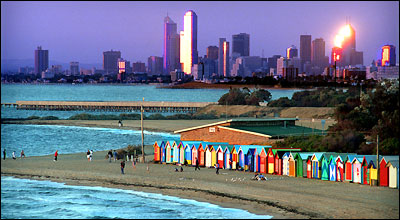
Micheal Rayner
I reckon that the Victorians have made a big mess of the Mornington Peninsula, with all that coastal development from Port Melbourne down to Portsea. Seaside suburbs blend into one another all the way along the coastal strip to Frankston and beyond. Too much development. Everything, and everybody, is piled ontop of one another.
I much prefer the Geelong side and along the Great Ocean Road. You can reach for the stars there.

Paul Harris, Lorne,
The southern end of the Mornington Peninsula is impossible to access quickly from Melbourne along the old coastal road. So the new inland freeway was built. Then the holiday homes/shacks appear all piled on top of another. It is so congested at this time of the year. Makes you wonder about the point of "getting away" from the city for a break.
Thankfully, at the last minute, Neapan Point was saved from development and allowed to remain a "wilderness."
I guess the Mornington Peninsula wasn't planned that way: it just grew that way according to the dictates of the market. That meant selling off public for profit and doing little in the way of ensuring green zones between the seaside suburbs to keep them separate or distinctive. That process continues with the proposal by Melbourne Water's plan to sell off 400 hectares of land surrounding Devilbend Reservoir on the Mornington Peninsula.
When I revisited Mornington Peninsula last year I saw the future of Adelaide's Fleurieu Peninsula and wept.
Update
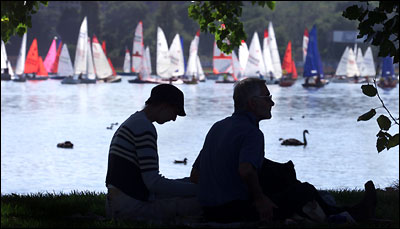
Vince Caligiuri
What is even more tragic is the selling off Albert Park in Melbourne for the loss making Formula I Grand Prix; a loss that is subsidised by Victorian taxpayers.
December 26, 2003
Towards a national cinema
It is often said by some that in a globalized world a national cinema is a thing of the past. It belonged to the days when the ladies talked about cultural nationalism at the local coffee shop before discussing their problems with men. These days I'm hearing celebrations of cosmpolitanism by those who live, work and think within the universal culture of the global economy. And the sneers about cultural nationalism from today's free traders.
Certainly, Fox Studies in Sydney, as a cheap production site for Hollywood, closes down the space for a national cinema to work within.
But what of an Australian film that deals with making blacks whites:

Ken Merfeld
And a film that does so in terms of the historical context of governing the indigenous population through assimilation and forcibly taking the half castes away from their country, family and community? A time---the 1930s---when those who governed the country saw the dark aborigines in the bush as the real aborigines and the half castes as potential whites.
A film that shows the desire by indigneous people not to be white, to escape from their confinement as coerced cheap labor for whites and to return home to their country:

Artist: Helicopter Tjungurrai, Title: Wunkartu Waterhole, Region: Desert - Balgo community
Their country is where they belong. It is the place they call home. It is from their home that they now produce contemporary Australian art.
A film such as Philip Noyce's recent (2001) Rabbit Proof Fence, which I watched on video on Tuesday night, would be a recent example of national cinema in Australia. I have not seen the earlier (1977) documentary informed Backroads so I cannot connect the two. The narrative is simple. Three young half-caste children (Aborigines of 'mixed-blood') are forcibly removed from their families in "primitive" society and placed in a correctional institution run by white nuns so as to prepare them for integration into the "civilized" white society as cheap labor. They escape and make the 1500 mile journey back to their homeland. 2 of the girls return home. One is captured and she never sees her homeland again.
This is a form of historical remembering of what governance through the instruments of assimilation meant for indigneous people in their everyday life.
December 25, 2003
Xmas day
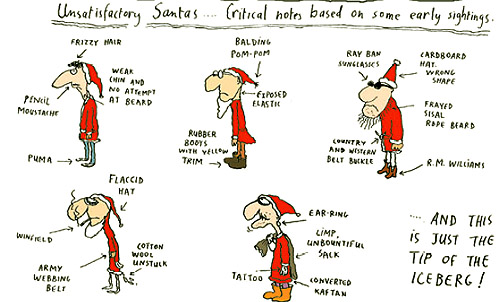
Some offbeat/black humor about what appears:
Leunig
Or is it about not-seeing.
Or a turning away from the (dark) false reflections in the commercial media culture to the light of the truth.
Well, we used to think that. Before we read Derrida on logocentrism and the metaphysics of presence that is.
Have a lovely, relaxing day everyone.
December 24, 2003
After Fox: scrambled thoughts
These are not just dark days for a critical film culture in Australia. The Australian film industry appears to be on the ropes as well. The academic enclaves of film studies continue to remain inward looking, enclosed and disconnected from the public culture. Film culture policy in Canberra is concerned with commercial film industry, money and a lack of concern with the inward flow of American culture.
Sorry days indeed.
Maybe it is an opportune time to tease apart the buried strand of a marginalized film culture from its 1980s incorporation into the concerns of a commercial film industry, that is now increasingly concerned with its place in the global film/media economy.
Certainly the old talk about cultural uniqueness (ie., more than local shading and inflexion) has been blown apart by Fox Studios in Sydney. Even if there is still an ongoing concern about Australian identity in the light of the proposed Free Trade Agreement with the US, the old critical edge of film culture has been well and truly blunted. The contours of this culture have been flattened, as it is commercial imperatives that govern film production and distribution in Australia. Consequently, many people now difficulty in picturing the existence of a viable critical film culture or even a non-commercial public sphere in spite of the Howard Government's attempts to the undermine the ABC).
We need to remember what has been forgotten about our film culture and an active forgetting" ---a willfull abandonment of some of the film industry's past. As Nietzsche says:
'We don't know ourselves, we knowledgeable people—we are personally ignorant about ourselves. And there's good reason for that. We've never tried to find out who we are. How could it ever happen that one day we'd discover our own selves? With justice it's been said that "where your treasure is, there shall your heart be also." Our treasure lies where the beehives of our knowledge stand. We are always busy with our knowledge, as if we were born winged creatures—collectors of intellectual honey. In our hearts we are basically concerned with only one thing, to "bring something home." As far as the rest of life is concerned, what people call "experience"—which of us is serious enough for that? Who has enough time? In these matters, I fear, we've been "missing the point."Our hearts have not even been engaged—nor, for that matter, have our ears! We've been much more like someone divinely distracted and self-absorbed into whose ear the clock has just pealed the twelve strokes of noon with all its force and who all at once wakes up and asks himself "What exactly did that clock strike?"—so we rub ourselves behind the ears afterwards and ask, totally surprised and embarrassed "What have we really just experienced? And more: "Who are we really?" Then, as I've mentioned, we count—after the fact—all the twelve trembling strokes of the clock of our experience, our lives, our being—alas! in the process we keep losing the count. So we remain necessarily strangers to ourselves, we do not understand ourselves, we have to keep ourselves confused. For us this law holds for all eternity: "Each man is furthest from himself." Where we ourselves are concerned, we are not "knowledgeable people.'
We need to become knowlegeable about our film culture to overcome our being strangers to ourselves. We need to understand ourselves as a people or nation.
I decided to do that whilst we are down at the side shack over Xmas. We are doing the big clean for guests after Xmas, and we are taking the opportunity to watch some film videos. They are our break from cleaning as well as our becoming a part of formation of the video-educated cinephile. So far we have watched Scott Hicks' Hearts in Atlantis and Gillian Armstrong's Oscar and Lucinda. Two films that did little more than tell a story with an emphasis on character. I was so bored.
 Despite it being about historical remembering, I walked out of the Armstrong film, even though it was a contribution to our national cinema.
Lucinda and Oscar was a film of a book by Peter Carey, whom I've never bothered to read. The film was so old-fashioned literary, as it was all about narrative and character. I guess it was an attempt at an Australian tragedy. But the disturbing was reduced to the quirky. Sexuality, sexual expression and desire was muted.
And where was the critical reflection on our film culture? Or the role of film culture in our public culture? Or the references back to earlier films on Australian identity?
I was less bored with the Hick's film as I managed to stay the distance. It too was a film of a story, this time a story in a Stephen King book about personal remembering.
 As I sat through it I kept on thinking that it was such a contrast to the brillant Snow Falling on Cedars.
Hearts in Atlantis was favourably reviewed. As I sat through the video I became ever more restless. It was a superficial and nostalgic account of late 1950s/early 1960s suburban working class America. There were gestures to the disturbing---to a patriarchal, liberal society whose anxieties, instabilities and conflicts were bubbling to the surface in unpredictable ways. But the gestures to the disturbing undercurrents---the security apparatus of the state---remained gestures.
It was nostalgia in the form of a remembering of a childhood. What was forgotten was the disturbing social undercurrents. Little or nothing was done with photography in US society --the central character remembering was photographer. Nor were there any references to the seminal images of US photographers such as Rober Frank to locate the film within the visual culture of the US:

Robert Frank, Parade, 1956
Frank abandoned conventional beauty and photographed mundane scenes of America's urban and roadside life:

Robert Frank, Butte Montana, 1956
I turned to David Lynch's Mulholland Drive with relief, even if it turned in on itself and was hard to make sense of. In this tragic love story in the city of dreams the disturbing undercurrents under the surface of everyday life are in the forefront. It plays havoc with the narrative, plays around with realities and dream states, and takes a big swipe at the Hollywood industry and its role as a ‘Dream Factory" along the way. A cinematic film with a critical edge.
December 23, 2003
a virtual life
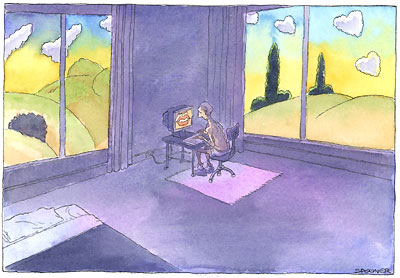
Suzanne says this is me.
Crazy huh?
Especially when I have a something like this at my back at the holiday shack. 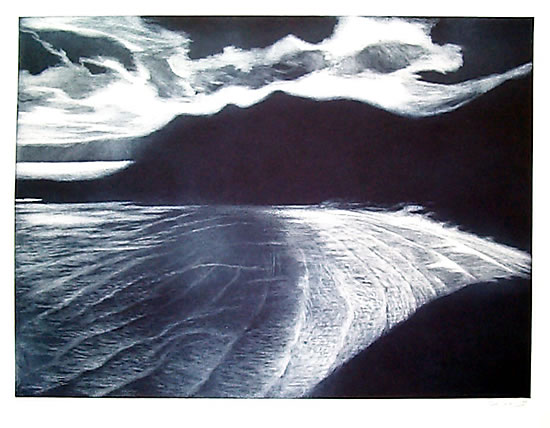
J.Spooner Towards Squeaky Beach
But I'm not the only one who doesn't respond to the sounds of Surf's Up.
aaah Surf's Up --an outake from the unfinished/abandoned work called Smile.
Surf's Up
Aboard a tidal wave
Come about hard and join
The young and often spring you gave
I heard the word
Wonderful thing
A children's song
Full Lyrics
December 21, 2003
Photography and surrealism

Ken Merfeld (Link courtesy of Zone Zero)
We have met Ken before. From Zone Zero
In an earlier post on Lisette Model I mentioned the connection between photography and surrealism.
I post this as another example of that connection.
Surrealism is more than being about our dream fragments. It is also what comes up from the unconscious----the content that we would like to forget, and which psychoanalysis probes.
I am reading Bataille. An article he wrote called The Solar Anus, which is about repulsive matter. It is an all out assault on the dignified world constructed by instrumental reason. In one section of this text Bataille writes:
"Beings only die to be born, in the manner of phalluses that leave bodies in
order to enter them.Plants rise in the direction of the sun and then collapse in the direction of
the ground.Trees bristle the ground with a vast quantity of flowered shafts raised up to
the sun.The trees that forcefully soar end up burned by lightning, chopped down, or
uprooted. Returned to the ground, they come back up in another form."
Life is interpenetrated by death.
We are reminded of this everyday, when we walk along the southern coast line of the Fleurieu Peninsula. For instance, on our walk this morning along one of the beaches of the southern ocean, the poodles came across a dead seagull, a dead seal, a fish skeleton and a rabitt carcass. It is much an everyday part of the beachscape as the seaweed.
Of course Bataille's assault on dignity and beauty goes much further than this. There is a lot of violence and obsession in The Solar Anus.
December 20, 2003
Film culture in Australia
Earlier posts (here and here ) circulated around the idea of film culture in Australia. Extended comments made by James Russell (here, and here and here) about some brief remarks of mine on video-educated cinephile in formation got me thinking a bit more. And remarks by Jean from Creativity Machine on this post pushed me into starting this post.
Thsi is an exercise in remembrance.
Film culture? What does that mean in an environment where a commercial production ethos is hegemonic? My immediate reaction is that film culture in Australia (not the national film industry) died in the 1990s. Film culture is different from the cultural nationalism of the 1970s associated with the Australian film revival.
My initial understanding of film culture is that it has its roots in the independent film makers, film societies and film festivals of the 1960s; cultural organizations such as The National Film Theatre of Australia (NFTA) with its imported screenings and the Australian Film Institute (AFI); and the radical and avant garde film making of the 1960's and 1970's. The film culture of the cinephile was the independent axis that negated the film industry as the culture industry.
From memory in the 1960s it was a culture fascinated with the Cahiers/French new wave model of cinema. This linked criticism and film practice (critics becoming fimmakers), assumed film makers to be bearers and modifiers of filmic traditions, held film makers to be auteurs and a love of Hollwood cinema (Alfred Hitchcock, John Ford etc).
I've sketched this account of film culture as high art because that is my background. As an account of film culture it is pretty constrictive, since it boils down to independent avant garde cinema as art, which is oppositional to the commercial Australian films as the culture industry. It is pretty much the view of the old Sydney Filmmakers Co-operative (SFC) and the Media Resource Centre (MRC) in Adelaide.
It was constrictive because I found the formalism of the underground avant garde films (as show cased in Cantrill's FilmNotes) deadly boring, and quite enjoyed the mainstream kitch films, such as Murials Wedding. The avant garde (eg., Screen. This inwood looking theory, where Christian Metz was all the rage, had little connection to the practically-orientated national film training school in Sydney.
Then film studies became a satellite of Cultural Studies in academia.
December 19, 2003
walking the city with...
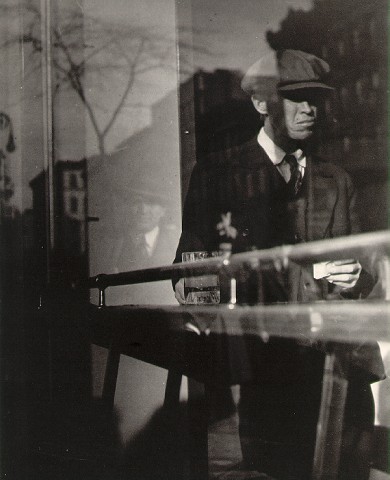
Lisette Model
She says that "The camera is an instrument of detection. We photograph not only what we know, but also what we don’t know".
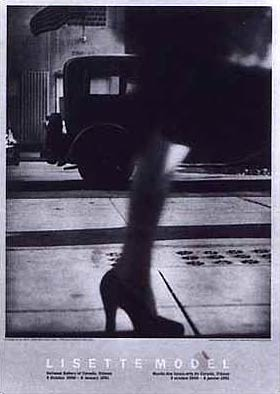
It's a photographic surrealism. What we don't know is the landscape of our minds.
December 17, 2003
sexuality and consumer culture
I read this article on Australian national identity, femininity and cosmopolitanism by Melissa Campbell on the weekend. It's a good cultural studies piece and I've been puzzling about it ever since, especially in the light of Jean's comments questioning my remarks about a unified Australian national identity in this post. Some comments on it can be over at Back Pages in a play on an old text called 'From Deserts Prophets Come.'
Melissa's text resonates with some themes explored at junk for code----- here and there and here.
The core of the argument is the shift in feminine identity from the old rural Australian nationalist tradition to the cosmopolitan one. Melissa says:
"In this unstintingly blokey tradition of Australian identity, women's roles were limited and peripheral. As writer Anne Summers has famously outlined, they were put in two pigeonholes: damned whores or God's police. In the first category, women were Jezebels who led men astray. In the second, women's moral scrupulousness made them guardians of British colonial patriarchy."
If women's morality supported Australian colonial nationalism, then so did their underwear:

Corset Gallery
Corsets controlled women's bodies and also contained and controlled their sexuality. As Melissa succintly puts it "the corset attempted to maintain moral health - to prevent God's police from slipping into whoredom."
Things did not change much with the surfie culture or suburbia:
'In the early 1970s, Australian identity was led in a new intellectual direction - towards the ocker. "Ocker" was a playful, deliberately shocking sensibility that no longer romanticised the bush, but looked for Australianness on the beach and in the suburbs......Ocker was profoundly misogynist. Women - or, rather, sheilas - still had only two roles: sexpots and doormats. Tim Burstall's 1973 film Alvin Purple narrates the male fantasy of being irresistibly attractive to women. But the sheila's compliance wasn't only sexual. In 1975, historian Miriam Dixson described Australian women as "the doormats of the Western world". While suburban ockers revelled in their new-found liberties, their wives took Valium and cleaned up after them. While surfies frolicked in the waves, their girlfriends sat on the beach and fetched them meat pies and Chiko rolls.'
What did change was women's underwear: from concealing the female body's flaws to enhancing its sexual attributes. Women's underwear was used to make the female body an object of male desire. Brightly coloured and printed underwear moved from markers of whoredom to markers of sexual freedom. Thus we have:


Elle McPherson Intimate
Thus we have a shift in feminine identity. McPherson is selling a representation of what it means to be a sexy, cosmopolitan Australian woman: vigour, health and natural beauty infused with continental style. In the process Macpherson recasts Australia as a sophisticated, creative country.
That's the core argument. A feminine Australian identity has successfully created a space for itself through a critique of the old masculist one. I accept the argument.
What Mellissa then adds is a postmodern thesis that there are different representations of what it is to be a sexy, cosmopolitan Australian woman to play around with. Mcpherson, for instance, pushes the limits
 with her voyeuristic images of the French Maid range that tread a fine line between advertising and porn. Once again I accept that there are many differences within Australian feminine identity---eg., Kylie Minogue as the pop princess and her range of lingerie.
I have several areas of unease with what sits behind the Melissa's argument
First, Elle McPherson signifies cosmopolitanism not Australian. The two are opposed to one another since cosmpolitanism signifies of the world whereas Australia signifies of the nation state. Unlike Mcpherson in Australia most women would belong to Australia rather than to the world. What we can say is that Australian women are more than international consumers who using Mcpherson's underwear to construct their feminine identity.
Secondly, Melissa says that the text is empty when she says that:
"Importantly, these three international Australians don't trade explicitly on their Australianness in the way of, say, a Russell Crowe - indeed, none of them lives here. Instead, inserting themselves ironically into pre-existing ideas of lingerie-clad women, they offer themselves as clean slates on which international consumers can inscribe their own meanings."
The images of lingerie and bodies are not clean slates:

They are a form of advertising that seek to persuade and entice women to buy the product. The image has a particular form and style. They can only persuade and entice if they have cultural meaning that resonates with what women are seeking.
Mellissa describes this process very well with Sara O'Hare's modelling Bond's Chesty underwear:

Mellissa says:
"...O'Hare has also presided over Bonds' emphatic move towards man-style underwear for women. In a television commercial last year, she aped male slobbiness in a singlet and Y-front-style underpants, kicking back on the couch, watching sport. And, this year, she and a bevy of women companions could be seen cracking rocks in a quarry in boxer-style hotpants, wiping their foreheads with their shirt tails and wolf whistling at roadside service men.This commercial, which used the tag line "For hard-working girls", was so successful that it was pulled from the air because shops sold out of the boxer shorts she was modelling."
So much for the lingereie-clad models clean slates on which international consumers can inscribe their own meanings.
Thirdly, Melissa continues the cultural studies recoil from nature as the landscape country. Nature is cucure. The way it has been cconstructed. henc she say that "only now are we disentangling ourselves from the land we call home." TWe do not disconnect in the place we call home. We continue to reside in particular places on the continent even as we question, critique and reshape the cultural traditions that encode our place.
to be continued.
I kinda like it
Leunig's cartoon is not very visual. It's more or less image as text.
It reminds me of conceptual art in the 1970s. In a good way not a negative way. Cartoons are normally not included as conceptual art.
They can be, since conceptual art means that artistic production should serve artistic knowledge and that the art object is not an end in itself. This is what this cartoon is doing:

Leunig
The cartoon captures the black and white mentality of foreign policy. You need the bad guy---a Hitler, a Stalin or a Saddam Hussein---to demonize. Its evil versus good.
Hussein has gone from being the Butcher of Baghdad to a cornered rat in a hole. The media flows of the last two days have been devoted to the hole, the beard and dirt.
Leunig operates in the critical mode.
What is being played in the media these last few days? An old fashioned morality play? Or a tragedy with the media acting as the chorus?
December 16, 2003
waterhole dreaming
Good heavens. I have only just discovered Soul Food Cafe. (Thanks to Bonyton) What a fine site. What an innovative use of the internet to developing the historical becoming of Australian culture.
Finding such sites is like following trails through the desert of cyberspace with other weblogs providing a series of maps of the country:

John TjapaltjarriThe Tingari at Pantjantjanya, 1993
Then perchance, coming across soakages in the sand hill country, or a waterhole along a trail:

Barney Ellega, Waterhole Dreaming
Soul Food cafe is one such waterhole. Do take time out to replenish there. That is what waterholes are for---soul food. Many a time I've wandered the trails at night looking for a watering hole that pointed the way to the promised land.
Around the waterhole we sit under the night sky and reflect about the country, express our feelings about what is happening on this earth, and start telling our stories.
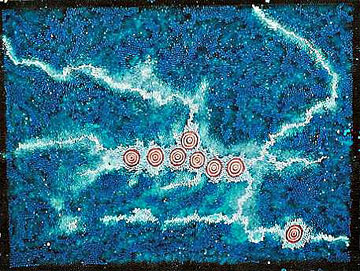
Gabriella Possum Nungurrayi, Milky Way Dreaming, 2000
What we find is that a big story of colonial conquest criss crosses many of the trails we walk. We whites in postcolonial Australia are still haunted by the ghosts of our past:
 Many Australians are still caught up in, and are currently reflecting on, the significance of our misguided assimilation policy that attempted to govern Australia's indigenous people by merging one of the world's oldest living cultures into the 200 year old mainstream Australian society. It was a policy underpinned by Social Darwinism, white supremacy and primitivism.
The national narrative says that Aboriginal people were not consulted in this process, as it was only the 1960s that they won rights as citizens. So Australia's history was one of nearly 200 years of western (British) occupation of the traditional homelands of indigenous people. It was a very unhappy time, a time of wrenching social turmoil and intense suffering.
So Aboriginal people decided that they needed a means of defining themselves to the seemingly hostile and ignorant white society that threatened their cultural survival. So they started telling their stories:
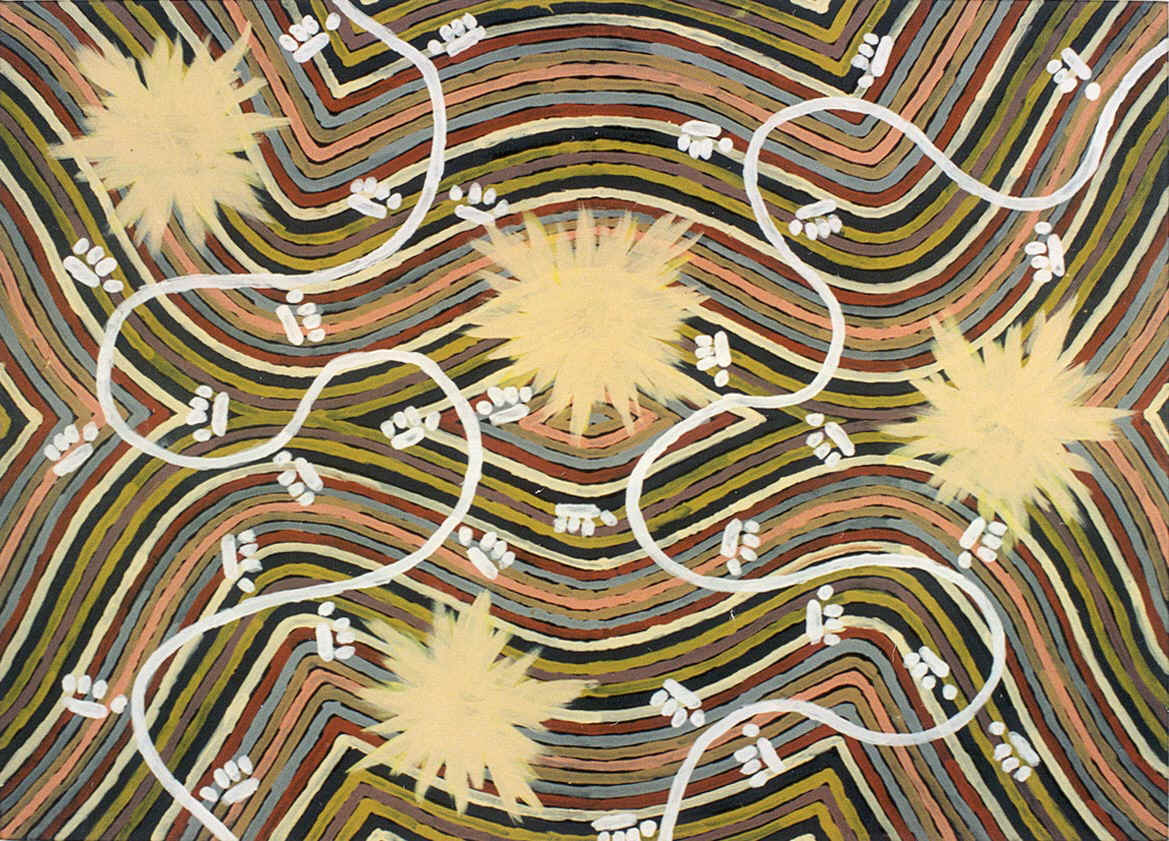
Clifford Possum, Possum Dreaming, 1995
By the 1980s paintings from Papunya Tula in the western desert were seen by the art institution as the archetypal Australian Aboriginal contemporary art. Aboriginal art from the desert became increasingly accepted as mainstream Australian contemporary art.After this kind of artwork from the western desert no longer could the primitive be separated from the civilized.
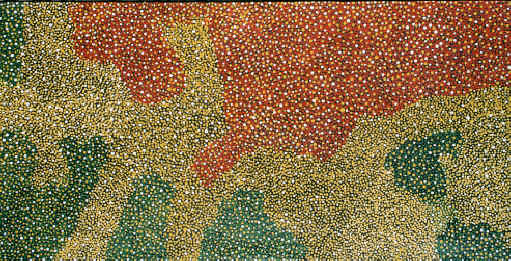
Josie Petrick KemarreBush Tucker Bush Berry, 1999.
As we engage with, and consume this "bush tucker" at a watering hole on a lightly marked cybertrail, we need to remember that this art arose from the violent colonial encounter, and is produced by a culture resolutely opposed to the grand narrative of White Australia that lauds European civilization. Our white culture has all but forgotten how the romantic European avant garde once celebrated the primitive; they believed in the supremacy and purity of archaic art. What white Australian culture once rejected, it now celebrates and markets overseas as "the [authentic] primitive" in Australian culture.
Alas, what once was "primitive" in Australian culture has now become "modern". The dot, which once applied as a background to symbols representing specific stories of the Dreamtime, becomes dot abstraction.
And me? I've lost my way in the trails of the sand country in the Corrong. I left my view camera there by a soak, along with my imagination. I'm trying to find my way back there via a detour though the arid lands of philosophy. I feel that I've lost my way in a foreign country that many call the bad lands; meaning a landscape with little in the way of nourishment. Few philosophers know how to tell stories around water holes. Most have no idea of country.
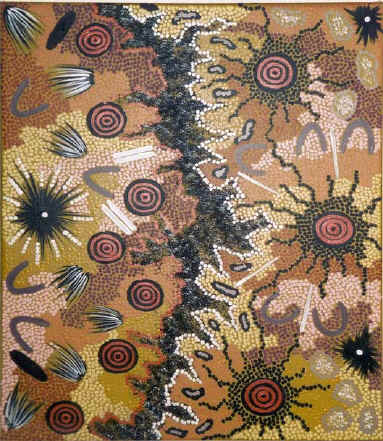
Gabriella Possum Nungurrayi, Grandmothers Country, 2002.
I'm in need some maps to guide my way back to the water holes on the trail that lead to my river country.
December 15, 2003
Another way of seeing
This posting has two parts. The first part was produced on dial-up Internet at Victor Harbor. The material is courtesy of Geisha asobi blog.

From the series Amorous Nature
Amorous nature. It's a different way of viewing nature to the 'how can we make money from nature' of instrumental economic reason. This reason despoils you beaut country through landclearing and deforestation.
It overlooks natural beauty:

Helen Firth
Sex and nature. The foresters and farmers would walk by these rock formations and not see their sensuality.
Sensual rocks! They'd mock you for the very suggestion.
We all know the toughness of economic reason. Sacred sites do not exist. Only resources and development exists.
I came back to Adelaide to finish the second part of the post on broadband, as it is quicker to explore the images in a gallery with broadband. My ISP was having minor difficulties with ADSL and I was disconnected. So the second part of the post is truncated.

Helen Firth
There is more to desire than making a dollar.
The other point I was going to make was that aesthetics has shown an exclusive concern with the beauty of works of art, which it connected with human freedom and the dignity of the human subject in an instrumentalized and mutilated world. At the same time aesthetics has repressed natural beauty.
The repressed---natural beauty----needs to be redeemed.
December 14, 2003
Peter Weir's The Truman Show
We're finally getting our act together entertainment act together down at the holiday shack in Victor Harbor. We used to collapse in front of free-to-air television on Saturday night, and watch crap. Suzanne was more comfortable with this than I was.
I'd drifted into a televisual culture after I stopped following American mainstream releases many years ago. I've stopped going to see movies in the cinema apart from the occassional big night out every couple of years. I saw Lucas’ Star Wars and its followups on free-to-air television, and I never bother to read the film reviews in the mainstream media anymore. The aesthetic judgments therein are along the lines of 'it's delicious', or 'it's a breakthrough', or 'it's a must see', or it's 'great acting.' Most writing about film in the mainstream commercial media amounts to unpaid advertising for dodgy product by glib hacks recycling industry press paskets. There is little space there for those lost cinephiles, nostalgic for the good old days of the art house cinema and the film societies, to run their death-of-cinema polemic.
Since I've been surfing the web, I've noticed that everyone (middle-class) has an opinion about particular movies. Everyone is now a critic, even if most of them are content to write plot summaries. Most accept film as a form of light-hearted entertainment, which helps to ease the stresses and strains of the daily work world. I notice there is not much discussion of films on the weblogs. Are people still going to the cinema? I wonder if there is not a new video-educated cinephile in formation?
Me? My opinion? I'm just angry, emotionally twisted and all tied up in a rage.
The commodified junk on television fills me with so much disgust and revulsion that I often choke----- from both the 'gratification for passivity' of our televisual consumer culture and its downward spiral into glossy trash. You don't need to read the old existentialists to learn about nausea. It's the daily experience of watching trashy lightweight, disposable entertainment on free-to-air television.
In response we bought a second hand video player and connected it up to the baby television. We embrace home video just as the VCR. technology is being deleted. Since the video stores in Victor Harbor stock the lowest common demoninator Hollywood, we bought some rented videos down from Adelaide. It's a belated attempt to avoid the passivity engendered by the functioning of the culture industry and us consumers escaping from daily life into the current glossy American entertainment.
Last night we watched Peter Weir's The Truman Show. It has been well received. I'd enjoyed the maniac quality of Weir's earlier The Cars that Ate Paris, though I'd recoiled from the literary romanticism of The Dead Poet's Society, avoided Gallipoli, and have been puzzled by all the fuss about Picnic at Hanging Rock. It lacked depth.
I'm uneasy with our national cinema. The Australian film industry is often too localized and provincal (eg., Strictly Ballroom and Priscilla) and it is too keen and willing to play a dumbed-down uncultured Australia vis-a-vis the cosmopolitan UK or the US. I'm deeply disturbed by this aspect of our film culture and its failure to engage with our mediascape.
Weir makes good on this lack in The Truman Show.
Weir's The Truman Show is nice reworking of an old idea with a light touch. The appearance of reality of suburban life in Seahaven
 is that of a loving wife, a loyal friend and a town full of happy folk who love to talk to Truman and who are happy with their lives. This suburban life is a fictional one.
Reality is the world represented by consumer culture in the form of a soapie television show in which Mr Suburban Guy unwittingly stars. The plot can be described thus:
"The movie is about a man, named Truman, who is the star of a 24 hour soap series called The Truman Show. Truman is adopted as a baby by a company who did build an artificial town around him. Everyone in the town is an actor, but Truman is unaware of this fact. His everyday life is broadcasted continuously."
Another description says:
"The town is enclosed in a giant dome decked out with high-tech simulations of sun and sky, in which the rain and wind are courtesy of the special effects department. Truman alone has no idea he is in a giant TV studio, as the rest of humanity watches him go from one staged situation to another in a nonstop telethon of reality programming that lets audiences enjoy a little pathos and vicarious emotion."
At the age of 30, Truman begins to finds out about the real nature of his environment from a series of events and a struggle for a free life begins.
The Truman Show explore the same illusion/reality theme of The Matrix and Dark City. We do not know the truth behind our own heritage and identity in world where the media and corporations have begun to surround us with a universe of illusions. Hence:
"The fake landscape Truman lives in is our own media landscape in which news, politics, advertising and public affairs are increasingly made up of theatrical illusions. Like our media landscape, it is convincing in its realism, with lifelike simulations and story lines."
The Truman Show is reality TV without Truman the star knowing that he is living in Plato's cave. He slowly gains consciousness of the reality as illusion, that he is living amidst the shadows of the sunlight world of the ideal forms outside the cave. Truman walks out of the cave into the sunlight world of reality.
In this mixing of the European art film style with Hollywood genre conventions, Hollywood critiques the illusions of the corporate media where the reality show incorporates selling the product within the show---- a noticeable feature in some of the renovation blitz programes that are everywhere. It's the arty side of Hollywood that accepts the consumers in a postmodern society are media literate enough to have a working awareness of our own manipulation.
December 13, 2003
Eugene Atget: walking the city
Eugene Atget walked the streets of old Paris with his large glass plate camera before and after WW1:

Cour, 28 rue Bonaparte, 1910
This is not pictorialism as the poor cousin of painting. This photography was not concerned with photography as art, as it expressed a concern with the urban environment in the language of the picturesque.
He photographed Paris for 30 years. What caught his eye in the sprawling city were the vanishing remnants of the city's past as preserved in its architecture, neighborhood streets, storefront displays, shop signs, popular pastimes, and common outdoor occupations.
This urban wanderer had an eye for detail:
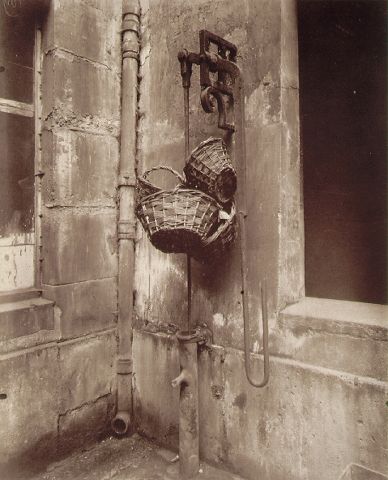
Fontaine du passage, 6 rue des Guillemites, 1911
His was a very different city to those of the planners and the branders.
Walter Benjamin's reaction to Atget photo's were that they were "empty ... empty ... empty." Benjamin missed the history in the culturalscape:
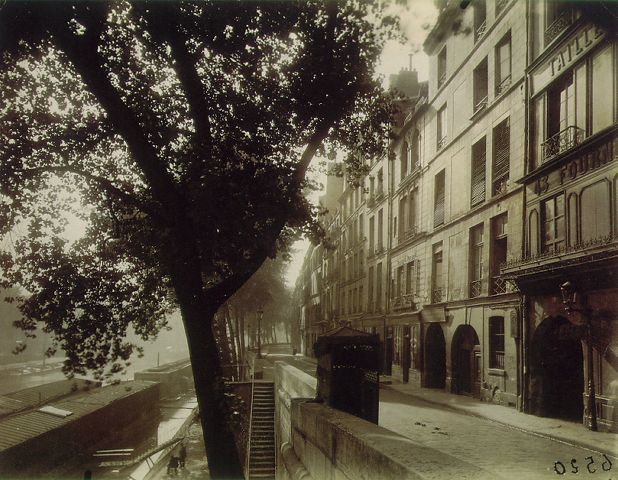
Quai d'Anjou, 6 a.m. 1924
It's a strange reading even with the decay of romanticism since Benjamin was so very sensitive to history, and the imprint of history on the culturalscape.
What we have with Atget's photos is a genuine culturescape; one that has yet to be ravished by an ahistorical utilitarian pseudo-progress, which brushes the past into the gutter as so much rubbish.
Atget reminds us that there is no beauty without historical remembrance.
December 12, 2003
[grid:city branding]: Comments#3
Now this site on walking the city is really interesting. Thanks to David over at Barista for the link.
In my own fashion I have been doing psychogeography without knowing that I have. However, instead of using alogorithms, I have used poodles. My first poodle Fichte walked the city as leader of the pack and I would follow with a camera. We used to do around two hours a day several days a week. I never much thought about it. It was just something we did.
Looking back it is clear that both us were situationists in our creative exploration of the inner cityof Adelaide. Our emphasis was less on the shape and design of the city than the city as a process: a shift from anatomy of the urban designer to the interaction between people and animals. Fichte made the urban his place: he had his favourite spots, the particular smells, the trails between the favourite spots, the people he disliked and avoided, the people he trusted and interacted with, his haunts etc etc.
Over the period of time I noticed how the urban atmosphere changed to become increasingly hostile to a dog walking free with his owner. Dogs kill (they're wild wolves) not cars, was the mentality that was developing. that mentality now requires law and order legislation for dogs whilst the cars are free to pollute the atmosphere and poison us.
The people over at the social fiction blog say that psychogeography:
"...psychogeographical walks are not meant to reinforce your ideas for places you haven’t been; it’s about trying to find uses (including design strategies) as they are suggested by the area itself."
In contrast the Rann Labor Government is branding the city to create a sharper more assured definition of Adelaide: a centre of excellence; Adelaide as a Google ideal; Adelaide as a place of innovation etc etc. As the people over at socialfiction.org say:
"Branding a city is trying to make people believe in what Le Corbusier tried to design: something from a postcard: a snapshot featuring some architecture, a dancing girl & sunlight half June. Truth is the building is a prison: the girl is a robot & the sun gave you skincancer: welcome to the real world."
Instead of this topdown urban design we need more probing of the streets through walking them.
December 11, 2003
landscape as natural resource
Despite recent talk about the end of nature, rare, pristine wilderness stilll means something in Tasmania. People there are deeply disturbed about the way their landscape is being so fundamentally altered by commerce that it now reflects economics.
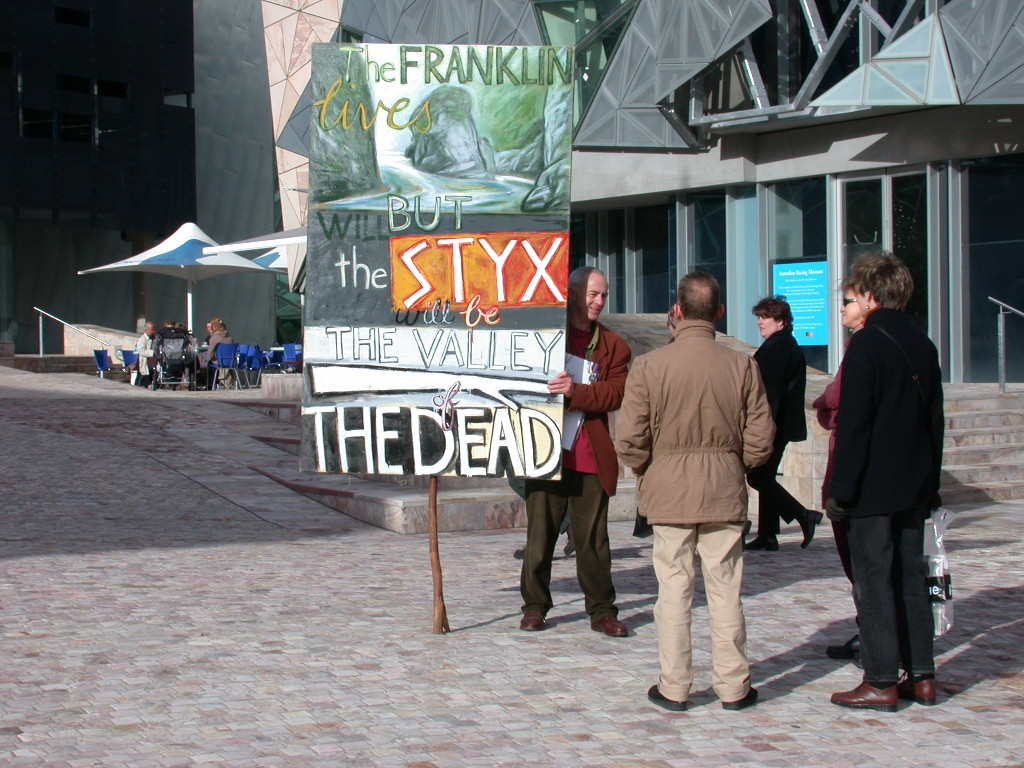
The photo is of artist Ron Brooks' solo protest against old-growth forest logging in Federation Square, Melbourne. Link courtesy of Tasmanian Times.
Wilderness becomes a resource. What is outside the market has no value as the worth of wilderness is not recognized by use and exchange value. What is not so recognized by the domination of nature is remandered as junk.
In Greek mythology, the Styx was the river of Hades that the souls of the dead had to cross on their journey from the realm of the living. It was a sacred river, and by its name even the gods took their most solemn oaths.
Not so Tasmanian politicians.
More on the clearfelling logging issue in Tasmania can be found at Public Opinion The Tasmanian forestry industry is exempt from laws that might check its excesses. The industry is not only systematically destroying Tasmania's temperate forest ecosystems, it is also poisoning the very fabric of Tasmania's democratic politics and life.
So we can talk about about the self-destruction of the (economic) Enlightenment. Since the economic enlighteners in Tasmania do not accomodate reflection on this recidivist element, so Enlightenment seals its own fate.
Just thought I'd throw a bit of Adorno and Horkheimer's Dialectic of Enlightenment into the mix.
regionalism
Courtesy of Boynton
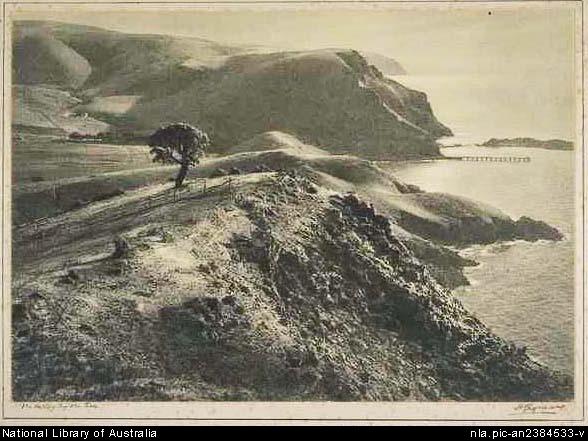
Harold Cazneaux, Second Valley, South Australia, 1937.
Cazneaux was a pictorialist who became a (reluctant) modernist. The latter embraced the modernist photographic aesthetic of sharply focused, "straight" photographs that made a virtue of the optical clarity and precision of the camera, and emphasised the beauty of pure form:
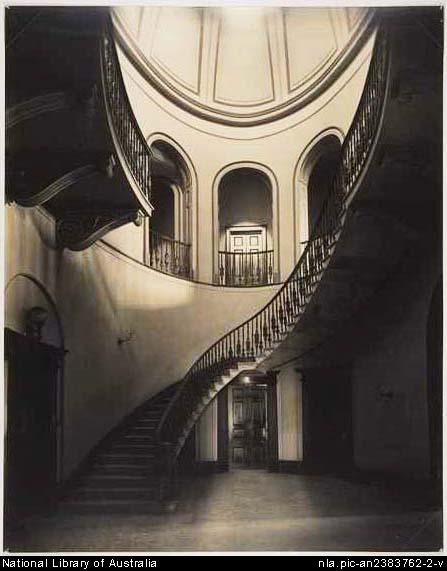
H. CazneauxStaircase, Elizabeth Bay House, 1930.
Pictorialism was an aesthetically motivated photography that defended photography as art, when the medium was not accepted as an art form. It rejected the ethos of documentary photography in favor of the taste and feeling that expressed the photographer's personal artistic vision, usually through a soft-focus.
Second Valley is on the western side of the Fleurieu Peninsula, which lies south of Adelaide. We often go sea kayaking around Second Valley. I've often photographed there. Victor Harbor, where our holiday shack is, lies on the southern coast of the Peninsula.
A lot of artists have painted the Peninsula. The difficulty in finding the many art works representing the Peninsula since the 1840s has led me to start moves to set up an online regional gallery.
December 10, 2003
Gerhard Richter
Richter has appeared before in junk for code. Then I was a bit dismissive talking about art "not saying anything significant about life anymore. Art is just about the slabs of paint on a canvas---the medium."
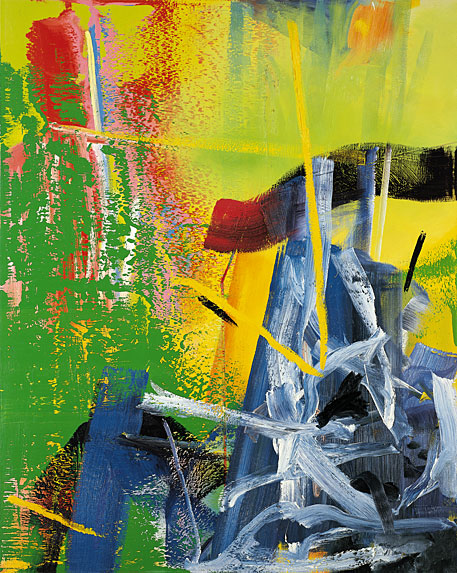
Gerhard Richter, Korn, 1982, Oil on canvas, Guggenheim Museum.
There is an article on Richter at Headlight magazine. Richter has its roots in a 1960s critique of consumer culture. So it is probably not an expressive paintings in the shadow of Abstract Expressionism. Still it looks like exploring color and form abstractly. Then again, I have a soft spot for this style of painting.
Now, after dippping into Bataille I'm interpreting these abstractions more along the lines of expressions of controlled frenzy.
December 09, 2003
Stephen Ross Interview: The Gift#4
In the grid post on branding I introduced some ideas from Stephen David Rose from the third part of the interview conducted by Rick over at Artrift. In that post the idea of 'the gift' was introduced as a way of thinking against the market, instrumental reason and utility. It showed that the distinctive mode of thinking and feeling of the aesthetic is alive and well.
In the fourth part of the interview the idea of intensity of experience is mentioned and Rick asks:
"You mentioned that for several years you avoided aesthetics, that there seemed to be a hiatus between what you were reading in aesthetics and what you were experiencing in art. Can you say more about what was missing in your reading in aesthetics and philosophy of art and what you thought the main task(s) of ‘reconstruction’ would need to be?"
This connects backs to the second part of the interview. My comments on this, with some images of sexuality by Balthus, can be found here.
David Ross' answers are interesting as he introduce some ideas of Bataille with his two kinds of experiences, the 'transfigurative' and the avant gardes 'displacement'. The former is the:
"...the sense of a deep, intense, and transfigurative experience that touched the full range of human possibilities and put them into question, filled with feeling, intensity, reflection, depth; the other, the sense of new, unfamiliar, strange, remarkable, unexpected encounters. Clearly these are in some way the same, yet one is more a consummatory, fulfilling experience, grand, powerful, and deep. Here, a great work of art and for me of philosophy as well----is an achievement, accomplishes and builds something magnificent and unprecedented. The other is much more disturbing, unsettling, displacing, transforming. Much of this displacement is the result of the last century in Western art and aesthetics and in new understandings of the role of art in cultural practices around the world."
There is some discussion of the related experiences to the transfigurative over at philosophical conversations. The one's mentioned are Klossowski's phantasms and Bataille's notion of sovereignty (also here) and intensity
Ross is quite right to connect the intensity and transfigurative experiences of art that are not only disturbing but threatening, to Nietzsche's concept of the Dionysian, which identified suffering with existence. Suffering was expressed by tragedy (tragic drama). The catharsis of tragedy gave rise to culture through the bonds between human being reasserted.
Nietzsche contrasted this 'saying yes to life' with the Appollian, which he identified with Socratic reason. Ross is also right to say that Nietzsche accused philosophy and later natural science of attempting to exercise authority and control over human life by means of an authoritative rationality. He says that though art has a tendency to become authoritative (eg., museums, galleries, concert halls, state councils exercising authority in the name of art, art has always called authority into question. Ross says:
"There is a rebellious, disruptive, unorthodox side to art; it allows for unexpected transfigurations; its most orthodox achievements come with a sense of alternative possibilities....art must play the role of rebel."
Is this reading the history of art through the eyes of the modernist avant garde?
Or is it the transfigurative moment that enables art to play a challenging role to authority.
Or is it because art identifies human existence with suffering? My own preference is the Nietzschean Dionysian one.
Ross then goes on to make an interesting point about philosophy in relation to authority, reason and displacement. He says:
"...my own sense of philosophy was that it too was disruptive, transformative, disturbing, always seeking new questions and alternatives, but that in the academy, and even in relation to art and religion, its need to be authoritative won out over its admiration for what is unfamiliar and strange."
That need to be authoritative was clearly associated with an analytic philosophy that aligned itself with, and became a part of a mechanistic science. But what of an aesthetic philosophy, a philosophy that aligned with art and not science. Ross is critical and his remarks link back to ones he made earlier.
"What it had to say of art always passed through what it had to say of itself. It could not take art and artists on their own terms. And of course much of this is true of science. Yet science and technology are the most transformative of human activities. If only they would allow themselves to experience this inwardly."
Ross wants to break down the boundaries between art, philosophy and science. In the light of the transformative character of techno-sciences genetic engineering, which would enable the rich to buy success through an expensive genetic endowment. I prefer to keep philosophy and art in opposition to science. They continue to speak the moment of suffering and the intensity of inner experience as we move towards a genetically engineered future shaped by those technoscientists who offer us progress, sneer at superstition and talk in terms of freedom for liberation from nature.
There can be no appeal to nature here. Nature, including its climate, has been too throughly transformed for the sake of utility. Nature now reflects the ethos of our free market economics. In the new world dawning from germline manipulation, the children will have been genetically engineered by their parents so they have beautiful bodies and enhanced reasoning abilities.
December 07, 2003
[grid::brand] Brand: Comments#2
New York, 1930s:

New York is of a global city that branded itself as the cutting edge of modernity.
It was what every city aspired to be. But they could never could be.
There is only one New York. There can only be one New York.
It was modernity. It was the new. The new that arose out of the old.
The new become the transitory. The old becomes that which is the self-same.
This is another kind of birds eye view:

Walker Evans, Manhattan, New York City, 1930.
It shows that New York had to reinvent itself with skyscrapers to be modern. In contrast, Paris stood for the past --the nineteenth century. It was what needed to be demolished to make way for the new:

Eugene Atget,Rue de l'Hotel de Ville, Paris, 1921.
But Paris could never be as modern as New York. It was not the new and constantly changing.
What these photos do not show is the way the various networks of power shape our subjectivity within the city. One kind of network is mentioned here by Elizabeth Albrycht over at Corporate PR. Elizabeth says:
"In the recent past, the marketing director had at his or her fingertips an array of powerful tools to develop and support a company's brand. Television and print advertising, billboards, product packaging, even entire stores. Public relations acted in support of the brand, disseminating stories about happy customers, keeping executives "on message", creating glitzy press conferences, and so on. Consumers were the passive audience, sucking up these messages and, hopefully, emptying their wallets in the pursuit of relationships (no dandruff = beautiful date), family harmony (our "meal in a bag" will ensure family table togetherness"), health (take our drug = stay at work, keep the boss happy), etc."
This is the culture industry at work at a micro level. It is what made us modern.
It sold us dreams of happiness through ever more consumption whose messages reached into our minds. These did not just cause us to buy the products being advertised: the casual nexus is far more complex than that. It was also more about us accepting the culture of consumer capitalism, andthe culture industry's shopping pathway to happiness and a better life.
That is the micro level of Foucault's disciplinary power. Some call it retail therapy: we indulge ourselves by maxing the credit credit. We do not need to feel guilty because we deserve to pamper ourselves. Guilt free consumers who forget about the future as they embrace the new and the transitory.
But it is not just the mind that has been branded. Today, in postmodernity, we are altering and shaping our bodies through the germline genetic engineering of human genes to "improve" human beings.
We can imagine More Dvanced Cell Technologies Inc. doing this through adding or deleting genes, and then implanting one that is likely to turn out the best. their scientists say that we have the program for the code of life (ie., DNA sequence).

It is now just a process of editing the DAN sequence the way you would edit a document on a word processor.
A whole new world beckons.
The brand is perfection and it embodies an age old dream of being super human. That dream is now being expressed in a techno-eugenic vision of designer babies that fits comfortably with our consumer culture. It promises a different (and better) future withe techno-science means to achieve it.
The taboo on human germline engineering is now lifting and a new mode of control over our bodies and individuality begins to take shape.
December 06, 2003
urban poetics?
More Walker Evans
This time it is a modernist monument to what used to be called the Machine Age; not a torn movie poster.

Chrysler Building Construction, New York City, 1930.
This is America as a nation that is less a place and more a process of becoming.
A becoming that allows us to see a historical time and a place. That historical time was when a progressive liberalism assumed that the application of science, technology and art to social problems would create a better society.
What was startign to be glossed over was the gap between American rhetoric and American reality due to liberalism's accommodation to corporate capitalism.
America had started its march to becoming an empire that ruled through the specific rules of the international economy that universalized capitalism.
December 05, 2003
It's such wonderful news
I'm depressed after watching the Senate pass the Howard Government's higher education legislation yesterday.

Leunig
As Adorno wrote somewhere in their Dialectic of Enlightenment the culture industry promises us freedom but it delivers unfreedom.
As the chapter heading says The Culture Industry: Enlightenment as Mass Deception. That argument is now relevant as the transformations of the liberal university reinvent the university as a comercial enterprise.
December 04, 2003
poetics of the city
I've always admired the visual language of Walker Evans:

As Evans put it, photography is the most literary of the graphic arts.
Looking at American Photographs I'm continually reminded of the economic style of Ernest Hemingway or William Carlos Williams.
It has that sparse expressive pictorial style.
Rather than recording or documenting a historical aspect of American life American photographs make American life speak.
In doing so the book helped to define 1940s America as a particular culture in the process of change.
Evans posed the issue of language in one of his books, Amercian Photographs. What then is an American photograph? Therein is posed a problem of interpretation.
This more than the question: 'what is an American photograph?
Why so?
Because our experiences are within language.
"We are, then, within language and with language before all else." Heidegger.
So the question is: 'In what relation do we live the language we speak, write and shoot?
That is one way to read American Photographs.
something quirky
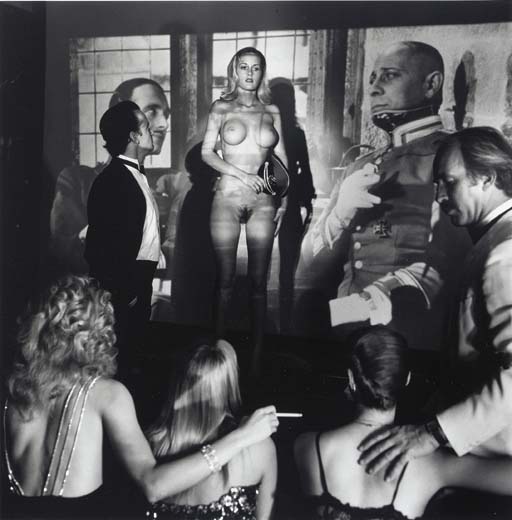
HELMUT NEWTON, Hugh Hefner's Projection Room, Beverly Hills, 1986. gelatin silver print
This is a photograph of Christine Richters and Erich von Stroheim in German uniform, taken in Hugh Hefner's screening room at his Hollywood mansion. The photo is set against a projection of the Jean Renoir's classic, 1937 film, La Grande Illusion.
It was found here at Christies. A lot of Hefner's Playboy memorabilia and art work is being sold. I was amazed at how tame it all was. The collection did not shock.
Newton was featured in the Weekend Magazine of The Australian recently. Porno chic has gone mainstream under the guise of discussing Newton's autiobiography. What is once called porn is now a part of the everyday discourse in the mediascape, where sex is used to sell everything.
Another quirky Newton image of a sexual fetish that plays around with virtual reality or the simulcra.

HELMUT NEWTON, Closed T.V. Circuit, Beverly Hills, 1989, gelatin silver print
I mention this since the Newton/Hefner/Australian kind of eroticism is quirky in a reifed way. The gaze is about possession, ownership and control. Women's bodies are there for the pleasure of man.
This is a long way from Bataille's understanding of erotic desire. For Bataille, erotic desire presupposes a partial dissolution of the self-possessive person as they are in their everyday life. Physical eroticism involves the fusion of lover's bodies.
A destructive element is involved in physical eroticism since it always involves the breaking down of established patterns and codes. Hence the dissolute life.
For Bataille, erotic dissolution is link to religious eroticism, which is concerned with the fusion of beings with a world beyond everyday reality.
December 02, 2003
[grid::brand] Comments on Others#1
After I finished my grid blog on 'the brand' I began exploring the work of others in the network . I found some of the grid blogging to be of great interest to my obsesssions.
I will comment on some of them---pretty much doing what Jean over at Creativity Machine is doing. I will highlight those in the network that overlap with the thematic concerns of junk for code.
The material on Glowlab by Heidi Cody caught my interest. It was about Times Square. She says:
"The ultimate American example of brand mania capitalizing on urban space, for better or worse, is Times Square in Manhattan...Times Square is the spectacular, mega-watt collision of real estate and corporate branding....Starting from the second story and extending up sometimes eight or more floors, Times Square's signs effectively dazzle in a collective sensory overload."
You can say that again! It is sensory overload in the society of the spectacle. It is a mediascape that enframes us. It is neither Le Corbusier's dream city, nor Jane Jacob's urban street life of the neighbourhood. That was yesterday. This is today.

How in the hell do you come to grips with that spectacle?
You dump all concepts about language representing a world that's what you do. You can hang onto language representing the reality with natural or social science, but not with the mediascape of Times Square.
Do we have the tools to make sense of it? Or is it--the image-forces of the deregulated market--- senseless?
Even Derrida's concerns about language seem tame. You know, the early writings on the philosophy of language, presence, and difference. The work in which he deconstructed the discussing the tradition that speech is somehow more basic than writing; undoes the binary opposition in which speech and writing are opposed to one another and speech is then valorized over writing.
I was much taken with this deconstruction of the privileging of speech over writing. I accepted that it presupposed a metaphysics of presence; whether in the form of the rationalists presence of meaning to the mind (as with Descartes' clear and distinct ideas) or the empiricist's presence of objects to the senses (so the mind can transparently mirror the world).
There is no metaphysics of presence in Times Square. Nor even the pretence of one. That metaphysics is old hat. The stuff for old scholars when you are walking Times Square at night with a digital camera. It's a dazzling heap of pulsating visual signs that "point" to other signs.

There is no real behind these images. This urbanscape is just layers and layers and layers of images. A jumble. This is the postmodern world of flattened out multiplicity, mixture, without a unifying theme or centre other than mulitplicity.
Do the meanings of these "texts" only arise through the articulation of the difference among images and other "texts"? Can we say that meaning is continually being deferred as it plays itself in relation to other absent texts; absent texts that are present in the traces registered by their absence?
I don't know. Derrida was talking about words and written texts not signs as images in a mediascape.
Digging deeper into Glowlab I discovered this walking Times Square project. One of the walking projects:
"....mapped Times Square from the perspective of alien anthropologists. Pretending they knew no terrestrial languages, they read the architecture. They found the landscape to be bleak, filled with symbols of authority and punishment. If they had arrived as aliens, they imagined, they might have thought the bars, grills and grids covering the building facades and windows indicated jails or courts. The giant head in a store window could be the Panopticon, and Madame Tussaud's Wax Museum a kind of holding cell or torture chamber. On a more optimistic note, they considered that the various towers of lights and glowing signs could represent luminous transporters they could use to escape this place."
This walking Times Square is part of the PDPAL public art project that encourages individuals to stake a personal claim on urban experience. The detached ironic subjectivity of the modernists can only be adopted for an art project. It is not liveable comportment because the data flow of the mediascape are too overwhelming.
Even the trace of history in the jumble of signs is gone.
Should we learn to love Times Square? Just go along with the data flow?
Nicolas over at Nicolas Nova suggests a technique from the Situationists called psychogeography:
'According to Guy Debord, “Psychogeography is the study of the effects of geographical settings, consciously managed or not, acting directly on the mood and behaviour of the individual". That is to say, "a rather pleasing vagueness" bounded with so-called derive (i.e. drift). The dérive is an example of a situation-creating technique in which one navigate among cities and places. In addition, navigation is just based on our feelings.Lots of drifting games or scenarios have been invented, like cruising around in Paris with a map of London.'
I 'm not sure that aimless drifting through Times Square, trying to record the emotions given by a particular space, would be enough to resolve the sensory overload. Or do we just soak up the sensory overload and lose all sense of self?
December 01, 2003
[grid: :brand] Beyond branding: the gift
This is a post on aesthetics that steps into the grid blog on, and about, 'brand'. It is a thinking otherwise to the category of 'the brand', and it does so by pulling together themes that have run through my earlier posts.
Branding is about the specific look, feel and personality of a city. It is about identifying the cities' unique traits so that it can more effectively market itsef on and off-line. It is about establishing a logo that will help the city position itself, and become more easily recognized by those whom you are really trying to reach.
Branding is very noticeable in the pop world. For instance, you can see it in the way the pleasure machine creates different Kylie Minogues. The gold hot pants Kylie is a raunchy object of sexual desire. Wild and glamourous
 But that is just a particular brand.
Kylie was originally packaged as a bubble-gum pop product, then the unattainable sex kitten. She is body language as coded desire.
Kylie is a brand name that is marketed differently with each hit song or album that is designed to sell the record.
It is just the image that matters in this smart marketing. It is selling us consumers images. The brand is all: a product with an image.
Images and copies.
Kylie is what the effect of the ever changing images.
Identity is what emerges from the processes of copying, doubling, imaging and simulation. The image presents other worlds, possibilities and identities:

The branding of a city or region is primarily concerned with establishing a marketing presence of the city in a global world. This means that a city, such as Adelaide, reinvents itself as a place for the 21st century, by establishing a brand that distinguishes it from other cities in Australia, such as Brisbane or Melbourne. The designers, town planners and movers and shakers rethink the problems and opportunities of the city afresh; and they create a vision for themselves that inspires citizens and increases their aspirations about their place.
The South Australian Rann Government has developed a thinkers in residence program to guide the application of creativity, the development of cultural vitality, and the celebration of diversity and distinctiveness to promote their 'place.' 'Promote' means branding.
Branding means that place becomes place marketing, or the selling of the city as a commodity to attract others to come and spend time and money in this space. It means New Directions, being more clever and smarter, growing the city, marketing the city better, having a marketing plan.
Place talk quickly slides into market talk with few noticing. Can we resist it bythinking otherwise to this market ethos of selling the city as a commodity?
Here is a suggestion from an earlier post that had bounced off the third part of the Stephen David Ross interview conducted by the redoubtable Rick over at Artrift. Thinking otherwise is suggested by the idea of the gift. In the 3rd part of the interview Stephen David Ross refers to the gift; the gift of language the gift of reason, which excludes, divides, and cuts, demanding that we choose; and the gift of poiesis, which in its madness, knows nothing of exclusion and so cuts nothing off from the gift of the good. Stephen then says:
"Certainly we wish to escape injustice, to avoid evil, to tell the good from bad, to choose beauty rather than ugliness. Yet in art’s poiesis, beauty resists exclusion, resists being cut off from ugliness, evil, repulsiveness, or what disgusts us…art does not exclude the ugly, painful, or bad. Art includes everything in nature, under the good. In art we take joy in everything around us, given as the gift of beauty from the good, in art."
(Ross, GB, pp.27-28)."
The references to 'the gift' caught my eye because of my interest with Bataille. My understanding of 'the gift', as gleaned from Bataille's texts, is that 'the gift' stands in opposition to utility and the instrumental reason of the market economy. It resonates with what Smith is saying.
How does the gift stand in opposition to utility?
The romantic culture and society tradition held that the capitalist system lacked a personal sense of humanity. The dehumanization resulted from the relations of production. Moreover, value in a market economy was reduced to price. Consequently, there was little allowance or space for the truly human, for emotion, passion and the truly sacred outside the scope of capitalistic calculation. Art (Culture) was the realm of the human, passion, the body and the sacred when the market economy was the prime determinant of human history and society.
This material locates Bataille and the gift within this culture and society tradition. It says
"....some thinkers sought alternatives to capitalist production and exchange, for the re-introduction of the truly human and non-economic element into modern society. Within this discourse, discussions on the economic nature of the gift have played a central role in attempting to expose the cracks in theories that place economic necessity as the prime mover of history. There was one promising hope that emerged from Anthropology. Marcel Mauss proposed the notion of the gift as an alternative to the rationalist calculation of capitalist exchange. Mauss' unique perspective inspired many philosophers and social scientists seeking to find a more humanistic basis for human relations and the movement of goods.........[For Bataille], reflection on the nature of the gift was a point of departure for his overall conception of general economy. Bataille's revolutionary perspective on economic structure used the Maussian conception of the gift to support his affirmation of the possibility of human sovereignty within economic systems, to break the stanglehold of economic predetermination."
The material on Bataille's understanding of economics over at philosophical conversations indicates that Bataille broke away from the classical notion of efficiency in the allocation of scarce resources driving economic activity. He thought of economics in terms of surplus and how to use that surplus. The way a given society chooses to use the surplus it produces is of the utmost importance since it is around this expenditure that a culture is defined. Whether a society is aggressive, imperialistic, or non-violent all depends on the form the society gives to expenditure of surplus energy.
In a liberal capitalist society the expenditure of excess is through the shopping and strip malls in the cities that allow a small and directed release of desire within the machine of endless consumption. In the society of the spectacle the sports and talk shows on television marginalize the individual as spectator who shares symbolically in the expulsion of excess. The spectacle steals every experience and sells it back to us, but only symbolically, so that we are never satisfied. So we are left living within the eternal recurrence of endless consumption.
How does the gift work on Bataille's account?
The surplus expenditure removes goods from the production process geared towards utility and economc growth. These goods are no longer seen as objects directed towards the use of the overall cultural system, but are seen in and of themselves, free of utilitarian domination.
By association the giver of the surplus (one who makes the sacrifice) escapes the demands of utility and is no longer completely dominated by the needs of the system or the process. Rather the subject can transgress the utilitarian constraints in the moment of the sacrifice. The excess of the gift embodies a basic subjecthood that allows for an intimacy antithetical to the appropriation of the individual as an object of production. The gift as an expenditure of excess enables a transgression of the world of utility.
For Bataille the ethos of the gift, is at the basis of sexual activity. It is an expression of the kind of sacred intimacy that is engendered from the escape from, and, indeed, the blatant disregard for rational necessity and utility.