September 30, 2003
untitled
Whilst I've been sick with the flu I've been puzzling about Susan Norrie's Notes from the Underground that I had mentioned in an earlier post. That art work referenced back to, or interlinked, with Dostoevsky's literary text of the same name.
We have interrelated texts from a visual and literary culture that signify an aesthetic critique of modernity that is rooted in romanticism. Is there a substantial discourse on romanticism in twentieth century Australia that was counterposed to liberal utilitarianism beyond the usual autonomy of the imagination and the transcendent character of art?
This questioning implies that romanticism lives on way after the Romantic Era of 1760 and 1830 of academic studies. Romanticism is no longer a simple era. It can no longer be inscribed as a moment or a stage placeable within the trajectory of a history. It has trangressed its old literary sensibility of an entrenched literary elite hostile to popular visual forms. We continue to live within the Romantic heritage and to feel its effects. We shoudl understand that romanticism in modernity appears, disappears and reappears in different, and similar, forms and guises. This gives rise to multiple narratives and agendas.
It seems to me that what Susan Norrie is doing in an urban culture saturated with images is something along the lines of what Edward Said said intellectuals should be doing: presenting "alternative narratives and other perspectives on history than those provided by the combatants on behalf of official memory and national identity."
(Link courtesy of Jean over at Creativity Machine and Laura over at Net.narrative environments.)
Could we, as cultural critics, not link these two 'Notes from the Underground' texts to the work and concerns of Bataille, which are starting to be explored over at philosophical conversations? What that would do is to introduce the spontaneous outlawed drives that erupt through the rationalized world of utility-driven politics and economics.
The romantic critique of modernity in the 1850s centred around the Crystal Palace. This signifed modernity for Dostoevsky:
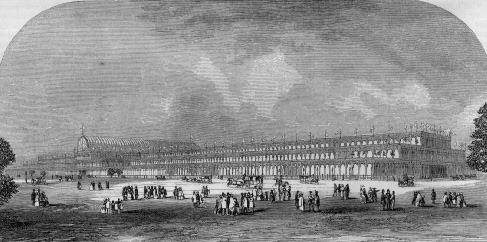
George Paxton, Industry of All Nations, 1851
and here:

The Crystal Palace did not just celebrate the technology that made modern liberal civilization run. It celebrated reason that had freed humanity from superstition, and celebrated the capacity of technoscientific reason to improve the wellbeing of human beings, increase the wealth of nations, civilize society and make liberal civilization the high point of history.
Dostoevsky's Notes From the Underground stand for the break out from the Crystal Palace. It's a philosophical text, in that it holds that the Christian belief in God declining; human beings lost their moral bearings, and waft directionless in the tempest that is life. Instead of liberating human beings for the better, the scientific Enlightenment had renounced the spiritual connection.
So there stands Nietzsche and his thesis of nihilism.
This initial romantic critique of reason/technology/utility was then taken up by the French surrealists, and more particularly by Bataille. This is the crucial link between then (1851) and now, and it is focused on finding an expressive realm that trangresses the everyday routines of a rationalised society
So we could read Norris through Bataille and the surrealist interpretation of Nietzsche. We had surrealism as an art movement in Australia in the 1940s, but did we have its philosophical interpretation?
Is postmodernism a repetition of Romanticism in viewing knowledge as a local, poetic and narrative construct? Is it the appearance of the missing philosophical expression of romanticism in Australia?
I would suggest that both Romanticism, surrealism and postmodernism are reactions to, and critiques of, an instrumental Enlightenment reason.
September 29, 2003
just a visual
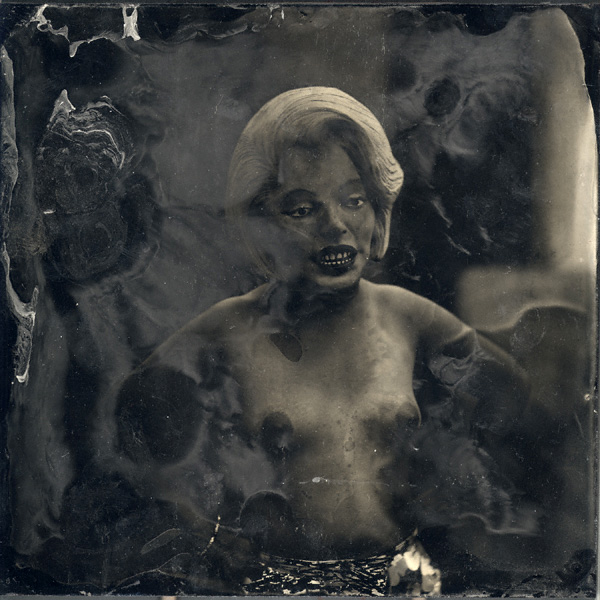
The image is made on glass plates through using the wet collodion technology of the 19th century. Check out Ken Merfeld's exhibition when you have mo. It's excellent craft work.
From Zone Zero. They have a good perspective on digital photography by the way. It represents the future for photography.
I'm inclined to agree. Good digital cameras are expensive in Australia.
September 28, 2003
a hint of something other
S.Norrie still from video installation Undertow

The blurb from the ACCA does not say much. It says the work depicts a "world in a state of both beauty and terror, shuddering with natural and unnatural events which verge on the catastrophic" with the "range and scale of images [having] a vertiginous and unsettling effect that pulls at the viewer's unconscious."
That could mean anything. This description helps a bit. But not much.
Let us speak plainly. The image is of a dust storm over Melbourne. It is the topsoil from the Murray-Darling bas in being blown to the sea. It signifies a looming environmental catastrophe.
Something more complex than this is going on here, as can be seen by this image:

But what?
Some indication is given by another exhibition of Susan Norrie's works at the Museum of Contemporary in Sydney called Notes from the Underground

Yet, once again, little is offered by way of images or text even though this exhibition a historical overview of the artist. It is simply assumed by the MCA that you live in Sydney, or that Sydney is Australia.
Notes from the Underground refers back to Dostoevsky's text, which is definitely offside to the principles of instrumental reason, enlightened self-interest and the hegemony of the rational Enlightenment. Dostoevsky's text, is usually dismissed as irrationalist celebration of the chaos of dark forces. That dismissal means we don't have to think about what is seen as excessive.
Is the interplay of texts here suggesting a repressed presence in fantastic and often grotesque images in which consciousness begins to slide out of control? How does the latent sublime terror caused by the slippage from conscious to unconcious connect up to the social or domestic environment we inhabit in our daily lives.
I sense a critique of modernity with a different kind of history. The only confirmation of this 'sense' is this review of Undertow
We cannot assess what is going with Norrie's work here because there is not enough imagery online by these galleries. What we have seen indicates a transgression of the modernist concerns about making art, the conceptual concerns of painting; the relationship between work and the viewer; or the connections between the contemplative space of the art gallery and the history and conditions of art.
Here is my stab. There is an unconscious of vision. In our period a regime of vision lets some things seen and not others. Hence some texts are condemned or displaced by the regime of vision. What is also displaced by the art institution is the philosophical interpretation of these romantic images from the underground.
wish it were so
"There is Hollywood and there are national cinemas."
Is there? I wish it were that simple.
I guess I tacitly accept this on one level, given my desire to see a national Australian cinema that gives expression to the questions that trouble us about our contemporary form of life.
Since I looked at Australian film in terms of it being nationalistically-minded, so I supported government financing of film production and the development of a small network of domestically owned and run distribution companies.
I gave up on Australian cinema to the extent it became equated with film industry rather than film texts. In national cinema as film industry the emphasis is on origin: where films find their financing, production and exhibition. My tacit emphasis was on Australian cinema as film text, which foregrounded issues of subject matter, style, representation.
So I was more interested in mid-budget films with socially relevant features (Bad Boy Bubby and Death in Brunswick); or more experimental films by independent film makers, such as Paul Cox, that were critically accepted. Then I sort of lost interest.
On the other hand, we have the internationalising culture as the mainstream US film industry shifted from a national cinema into the business of making international movies with simplistic uncontroversial stories, star names, emerging technologies, high-profile marketing and saturation booking. And then
Hollywood sets up production facilities in Australia because the low dollar and tax credits afforded them meant that the big studios could shoot their films at a fraction of U.S. budgets. That had the politicians falling over themselves in delight. What they could see was economic growth and jobs.
This cannot be called an Australian cinema.
What happened was that I found myself relating to films, such as those of Jim Jarmusch. I have in mind this director's films such as Stranger Than Paradise or Mystery Train and Dead Man. It was the imagery in Stranger than Paradise that seduced me:
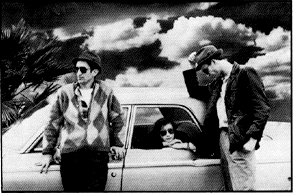 Yet this body of work is seen, and celebrated as being part of an American cinema in terms of story, characters and performances. It rejects the goal-oriented classical narrative and naturalistic acting styles of Hollywood and much Australian cinema, and it embraces formal minimalism and iconographic post-industrial landscapes.
I felt far more at ease with this cinema that I did with the work of Paul Cox or Australian films such as Muriel's Wedding or Strictly Ballroom or Sweetie and Adventures of Priscilla Queen of the Desert. These worked in a space that celebrated 'quirkiness', 'eccentricity' and 'individuality'. They criticising the banality of everyday life, opened up its richness of contemporary, usually urban settings and culture, and broke away from the realist social problem filmmaking. Yet the filmic language was thin.
As I said, I wish it were as simple as there is Hollywood and there are national cinemas.
It is not that simple is it?
September 25, 2003
postmodern architecture
As I've noted before the built form of the city of Adelaide is a mixture of heritage nineteenth century and boring modernist. Our city fathers are into carparks, or more imaginatively, car parks sitting on top of shops and apartments. We need cars to shop. For them function is everything, design nothing.
There's is a world of system and regulated production; a world of exchange, use and expenditure. They live utility in a restricted economy. They are about controlling the space through commodifying it to make a profit. They desire to colonize or territorialize space.
Hell, we need an architecture of excess; one that takes us beyond mere functionality.
Here is a suggestion for a regional architecture:
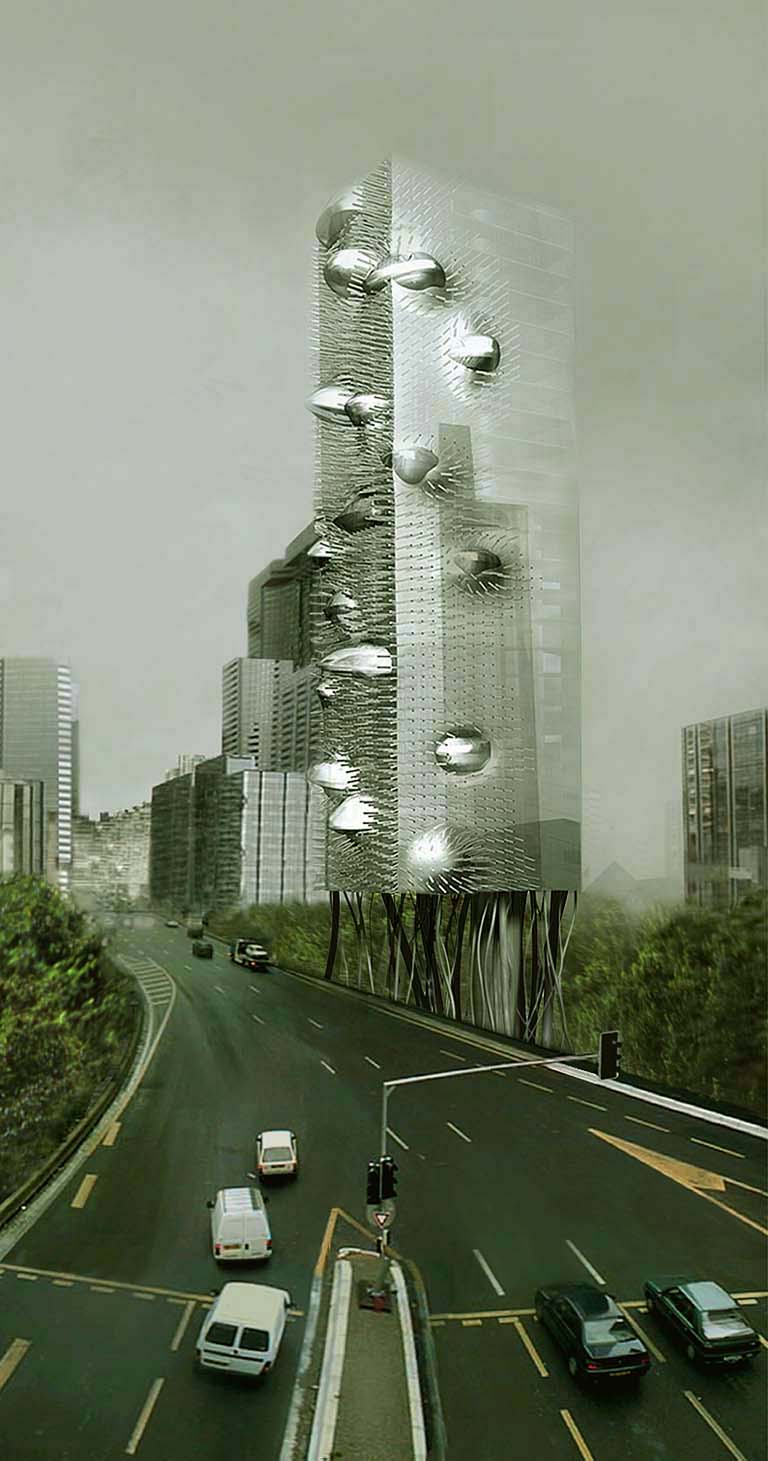
(Un)plug
Now that would stir things up. You can imagine the city fathers saying, it's excremental!
How about architectural excess instead?
Excess does not have to be as Bataille imagined it: the remainder as dirt, disorder, contagion, filth, shit-----the accursed share.
The commission brief for the above building was to develop a building that gains its energy from the sun. The architecture of R&Sie...François Roche/Stephanie Lavaux.
An architecture that is positively connected to its environment is just right for Adelaide.
Link courtesy of BeverlyTang (check out the cool weblog design) via Abstract Dynamics
The gift of architecture, if you like, is to go beyond the functional: to be in excess of functionality.
cool and sexy
Don't you just love it.

link courtesy of abstract dynamics
The European response to this?
notes for a future post
I walked through the deserted streets of Adelaide last Saturday in the late afternoon. I went scouring the few bookshops that exist in this strange oversized country town whose repressed violence and meanness of spirit scares me.
I walked quickly. Did I hear the dogs howl in the distance?

image courtesy of Boynton
A sense of belonging? Adelaide was a place where community had broken down and dreams shattered. The inner city was scarred with holes in the ground now filled with water from the winter rains. Signs of failed developments in the 1980s.
The inner city was now the place of the destitute, the homeless and the dying-----the social outsiders marked by law and order.
I was on the hunt for a book on (postmodern) philosophy, architecture and place. I was tired of the hidden place of utopia of modernism. I yearned for rupture as that utopia as a freezing of time was no place. It was an ideal.
Adelaide as a place is full of a desire for order and perfectionism. It sees itself as better than all the other Australian cities: it is more caring, more ethical, more reasonable, more cultured and so on. That is the dead weight of the utopian Enlightenment heritage in this place.
I had no specific text in mind as a crusied the bookshops, apart from this, which I then forget about.
Place is the inbetween that links (mediates) the two indifferents---philosophy and architecture.
Well, that's where I'm at. It feels like being in a mudpool as the stormy night comes learning how to celebrate achievement. Those who passed n me by commented that I was really yearning for an inside position.
I felt lonely there. The outside of one space is the inside of another.
I have come to architecture from the outside-----from the philosophy institution-----and I felt that I needed a text or two that could act as my companion. I'm an interested outsider, as the stranger who is outside the disciplines of architecture and philosophy who wants to get them exploring each other. I was looking for something like this. Or this.
Bataille had whetted my appetite. But I wanted something other than being against architecture.
I found a couple of texts. They cost an arm and a leg. So one was put on layby.
I bought the other. It is Architecture from the Outside by Elizabeth Grosz, an Australian feninist philosopher now working in the US.
Here are some comments. An interesting site.
It seems as if I have stumbled into a world.
Walking back home with the dogs was pleasant in the late afternoon sun. But the city was empty. No one around. Was everyone at the beach? At the barbecue?
It was eerie:---a city of no people. You can see why Adelaide promotes itself as exciting and sensational. It is currently promoting itself as the space where you can sip a latte and access the Net (via thecitilan network) without needing a phone line.
I hate lattes. And to access the citilan network you neeed to within 200 metres of of a WLAN access point. In the boosting of Adelaide's wireless technology is utopia yet again.
What I need is a space where can examine architecture philosophically and philosophy architectually.
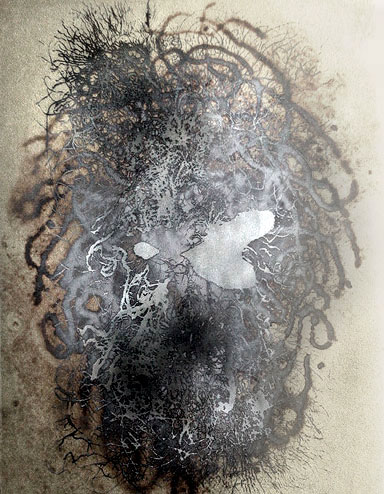
classy
From this silver toned gelatin print:
to this iris print.
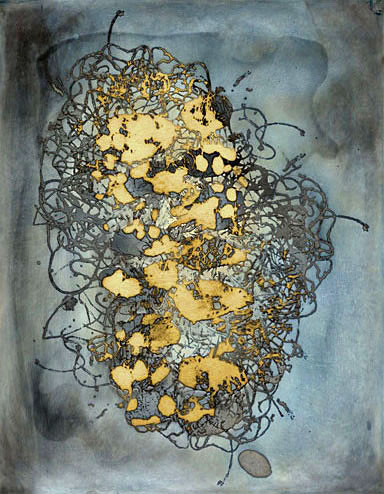
neat huh?
Anne Banard photographer folks. Take a closer look. Great work.
Link courtesy of Philip over at Eye-Imagine
September 24, 2003
a light moment
I saw this image at an exhibition last year on Mathew Flinders. I was very impressed. I'd never seen the southern coast from the sea. I'd walked along the cliffs and stood looking out to the southern ocean; I'd seen them from the air; and I'd driven along parts of them.
The topographical images looked so modern. That is what struck me at the exhibition.

W.Westall Views on the South Coast of Australia 1801–1802
Just over a hundered years latter we get this:

Frank Hurley Atlas Cove Antarctic Research Expedition 1929–1931
Both images are from National Library of Australia's Travellers Art.
September 23, 2003
oh my goodness
This link is courtesy of the delightful and very informative Eye-Imagine. Philip is a very fine exponent of the text-image weblog.
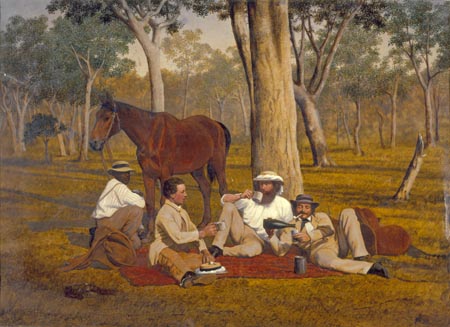
Richard Daintree (1832–1878) Bush Travellers, Queensland [between 1864–1870, painted in London by unknown artist c.1870]oil on albumen photograph on canvas (44.0 x 60.7 cm) National Library of Australia
Now why would you do that to this Manet:
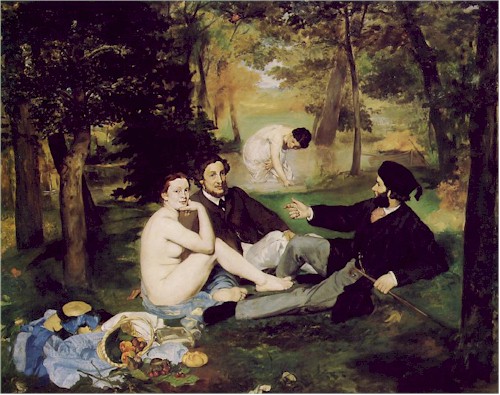
Why, that was before postmodernism. So what is the point? A joke? It is more than a perfect example of the pictorial exchanges that took place around the world. That is just art historical talk for influence.
Australia was seen as downunder an upsidedown world to Europe in the nineteenth century. Is this a reverse? Culture as parody?
Or was Australia always postmodern? A pastiche culture with no centre?
September 22, 2003
Sontag: Regarding the Pain of Others#20
Rick's twentieth post on Susan Sontag's book, Regarding the Pain of Others winds up his Sontag project. It started here. A very critical review of the Sontag book can be found here.
In this post Sontag makes the turn to media other than photography. The step to film (not the novel) is the path away from the sense of the end of art that I gestured to in the previous post. The text from Sontag's book that Rick quotes says:
"No photograph or portfolio of photographs can unfold, go further, and further still, as do The Ascent (1977), by the Ukrainian director Larisa Shepitko, and the most affecting film about the sadness of war I know, and an astounding Japanese documentary, Kazuo Hara’s The Emperor’s Naked Army Marches On (1987), the portrait of a “deranged” veteran of the Pacific war, whose life’s work is denouncing Japanese war crimes from a sound truck he drives through the streets of Tokyo and paying most unwelcome visits to his former superior officers, demanding that they apologize for crimes, such as the murder of American prisoners in the Philippines, which they either ordered or condoned.” (Sontag, pp. 122-123.)
Unlike Sontag I have seen neither film. Yet I can understand the shift and its significance. The shift is from single photo to narrative to capture the relativity of truth, the ethical complexities and the horrors of war. If the grand narrative of art history has come to an end then another narrative has risen to take its place.
And we do have complexities. Kazuo Hara’s interventionist documentary tackles cannibalism, the abuse of Japanese soldiers by their officers, desertion in the Imperial Army during the war in the Pacific, mad obsession with the war, the memory of the war and the resonance of the war years in the present. These cannot be captured by a single photo no matter how complex.
Kazuo Hara’s documentary film The Emperor’s Naked Army Marches On retains the aesthetic capacity to provoke. It provokes in its depiction of Japanese militarism because it challenges the historical image of Japan. What the image of militarism and the atomic bomb victim image silence is the brutality of Japan's military aggression throughout Asia in the 1930s and 1940s. The Emperor’s Naked Army Marches On, in chronicling the activities of a half-crazed protester who challenges the status quo, becomes a critical voice that begins to break up the Japanese silence on the war years.
Film has replaced the narrative template of art---both representational and modernist (abstract). We know that old story. But it needs retelling because it provides a background context for Sontag's book.
Representational art had been marginalised and defensive during the hegemony of modernism in the art institution. Modernism was narrowly understood in terms of abstraction and representional art was seen as heretical (doing the figure); but both are now just a few of the possibilities of artistic practices. There are no directions anymore. You can do whatever you like.

Sigmar Polke Fastest Gun in the West 2002
Nothing---no style--- is more right than anything else. The history of art constructed narratively in terms of historical development towards purity had collapsed.
But in that story there is another one about representational art: painting was replaced by film because moving pictures could, and did, represent reality better than painting. In the light of that displacement, painting went abstractionist. Painters started talking about the essence of art, writing manifestos about what art really was and thinking they were shamans in touch with the primordial forces of the universe. This romanticism was connected to the modernist ethos of the purity of the medium: that painting is about painting and photography is about photography.
That narrative collapsed along with the modernist aesthetic in the 1980s, pluralism emerged from its ruins, and artistic practice was liberated from a modernism that said art progressively strives to achieve identity with its own material base. It is now possible for artist to appropropiate the forms of past art and use them for their own expressive ends.
However, it is film that has come to the foreground in our form of life.
If art considered in its highest vocation is, and remains a thing of the past and has lost for us genuine truth and life, then does film now replace art? Is it film that raises the deepest questions of what it means for us to live in contemporary society?
But modernism hangs on. I guess we will hear about symposium on themes such as Cinema:is it dead?; or lectures along the lines that Film is itself a form of philosophizing, of reflection, reasoning and argument.
Sontag: Regarding the Pain of Others#19
Rick's nineteenth post on Susan Sontag's book, Regarding the Pain of Others, can be found here. We are coming to the end of Rick's wonderful and innovative project that started here.
The text is from Sontag and it says :
"Among single antiwar images, the huge photograph that Jeff Wall made in 1992 titled, "Dead Troops Talk (A Vision After an Ambush of a Red Army Patrol near Moqor, Afghanistan, Winter 1986)" seems to me exemplary in its thoughtfulness and power. The antithesis of a document, the picture, a Cibachrome transparency seven and a half feet high and more than thirteen feet wide and mounted on a light box, shows figures posed in a landscape, a blasted hillside, that was constructed in the artist's studio." Sontag, p. 123
The image is this:
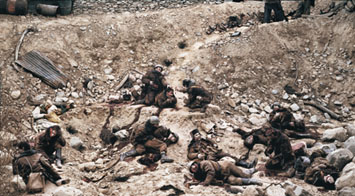
Jeff Wall, Dead Troops Talk.
Sontag uses it to close her book and argument---though I'm still not sure what her argument actually is.
We have come full circle to an earlier post: the documentary work of Mathew Brady in the American Civil War.
Of course, I do not accept the position that the work of Mathew Brady was a document. Brady constructed his images and organized the bodies. This time around we have the construction of the image upfront as we have proper studio and gallery-based based work that plays with artistic language. We do not have the black and white documentary realist style of Brady that spoke "the Truth" about the horrors of American Civil War. The art blurb describes the way the work is produced:
"Wall creates his works using actors and actresses on location, as in a movie production, and uses a computer to construct elaborate scenes. Just as painters of past ages composed and depicted historic scenes, landscapes and fashions, Wall portrays our present age fully applying his knowledge of art history and photography."
With Jeff Wall's work we are firmly within the acommodating space of the art institution. He has studied art history and has a good working knowledge of that history:
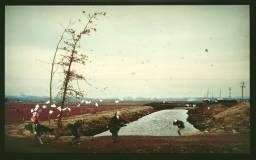
Jeff Wall A Sudden Gust of Wind (after Hokusai) 1993
Wall uses an 8x10 view camera, has a myriad of assistants, takes multiple photographs of the same subject under a variety of lighting conditions, and then assembles the resultant photograph digitally from many negatives. He often lights different areas of the photographs separately, and uses many large studio strobe-units. Consequently, it often takes weeks for him to take the photograph, not counting the digital work. The art space in which we now stand is also the vanishing point of documentary practice of photojournalism.
Another art blurb describes the media Jeff Wall uses:
'Wall's enormous photos (some over 16 feet) aren't really photos at all. They are large transparencies displayed on fluorescent light-boxes - much like how X-rays are viewed by physicians.[Wall] continually posed himself the question of how an artist could create an intense impression in the fashion of Goya or Manet, by depicting the current age. He also asked himself what kind of work would be significant for our modern society. One answer to these questions was his idea of using fluorescent light boxes with photographs, thus hitting on a new form of expression. As he put it, "It is not photography, cinema, painting, or propaganda -- though it has strong associations with them all."'
What is produced is something that has been staged for us. It is a tableau created by “a painter of modern life.”

Jeff Wall The Flooded Grave 1998-2000
And the content? What is being said with all this sophisticated technological apparatus.
And yet what is missing from the thoughtfulness and power of this artwork is the raw violence and menace of a Bataille who deals with the repulsive.
Sontag does make contact with this. She says about the Red Army soldiers in Afghanistan who went through hell:
"We - everyone who has never experienced anything like what they went through - don't understand. We don't get it. We truly can't imagine what it was like. We can't imagine how dreadful, how terrifying war is; and how normal it becomes. Can't understand, can't imagine. That's what every soldier and every journalist and aid worker and independent observer who has put in time under fire, and had the luck to elude the death that struck down others nearby stubbornly feels. And they are right."
Is not war and dead bodies repulsive? Is it not difficult to make sense of the killing of human lives. Do not the justifications and rationalisations of imperial nation-states ring hollow, as with Iraq? Is there not something that is left that is senseless and it cannot be jsutified. It just is. It is so repulsive about death and perversion that it resists the attempts of theory to incorporate it.
Is not the repulsive and horror the end point of the human? Is there not dissolution there? What happens then? People start eating one another to survive? Solders go on a beserk rampage killing civilians?
I raise this Bataillian voice because my sense is that art --including sophisticated photography such as Jeff Wall ---cannot, is not capable, of expressing the horrors of human life any more. There is a sense that we are standing at the end of art history. What is decisive in our historical experience is no longer being expressed by art. That belongs to the past. Art today no longer has this character.
Yeah I know. I'm recycling Hegel's classic thesis of the withering away of art--- art has entered the phrase of its demise. But it makes sense and it is difficult to shake off easily. Some aesthetic forms have died. And so have some contents. The progressive narrative of style is dead. So aesthetics makes graveside speeches as the art that became philosophically conscious transforms itself into theory. Much art today gives us immediate enjoyment and it does little more than aim to be aesthetically pleasing. And a lot of art that was made in the twentieth century confirmed Hegel's additional point that art was made in order to know what art philosophically is.
September 20, 2003
aesthetic shock?
One of the arguments running through the recent postings of Junk for Code is that the aesthetic has a critical edge in relation to the world of utility through its connection to the body, sexuality and passion. I have used French high culture to illustrate this shock, violence and menace with Catherine Breillat's Romance, the work of Bataille, and Balthus. I would also include Catherine Breillat's latter film A ma soeur, (For My Sister). Breillat disturbs.
Trevor over at philosophical conversations has some comments on Catherine Breillat's films.
Apart from the films of Catherine Breillat I have been using the French work of the 1930s as illustrations of aesthetic shock.
Is the aesthetic still shocking and violent today? Or has it been domesticated? Literature has pretty much died, with novel now a dead narrative form. People with faith in literature keep on looking for the buzz and excitement in contemporary fiction and fail to find it. Narrative fiction has become an aid to going to sleep at night. Better than counting sheep apparently.
Something is happening in fim though. In Australian films, such as Teesh and Trude, we have an exploration of the emotional wasteland of our damaged lives that transgress the squalid domesticity of kitchen-sink drama.
What shocks even more are films, such as Thirteen. This depicts the lives of teenage girls in a world where their minds and emotions are shaped by modern consumerism: — MTV, teen magazines, fashion and the need to fit into the brutal and exclusively teenage world around them. The shock can be seen in the reactions expressed in this review.
The review interprets Thirteen to be an antidote to two other forms of representation of teen life in popular culture. These are Hollywood and rap music.
"Thirteen is a sobering antidote to the glossy, vacuous visions of female teen life that are coming from the major Hollywood studios at the moment ... which show that you can be empowered as a woman as long as you’re as thin and as beautiful or that being a successful young woman today means being able to look good in Gucci....Contrast these almost criminally unrealistic images of the path to womanhood coming from Hollywood with those coming from rap music, pervasive on MTV, where young women are routinely depicted as sexualised “bitches” who deserve to be abused and prostituted."
Much online ponography is also along the lines of women deserving to be abused, harmed and brutalized.
As this review notes numbers of young affluent suburban girls in the States are endangering themselves with aberrant and self-destructive behaviour, eating disorders, alcohol and drug abuse, self-mutilation and sexual acting-out. Many young teenage girls from wealthy middle-class homes are turning to prostitution for affirmation, excitement and money. Their anger, meanness and wildness transgresses teen angst or rebellion.
There is a difference between the 1930s and now. Then it was mean (Balthus and Klossowski) representing women's sexuality and sexual desires for other men. Today it is women expressing women's sexual life and desires. And it is disturbing.
The aesthetic can still shock.
September 18, 2003
Pierre Klossowski
This is a development of this post on Balthus. As mentioned there the brother of Balthus is Pierre Klossowski, who had an interest as a writer and intellectual in the writings of de Sade and Nietzsche.
This interest is translated in his paintings. I have found few Klossowski images on the net.

The art historians say that Klossowski's paintings depict a "perverse" eroticism between men and women (sometimes accompanied by geese) in a style that parodies eighteenth-century French classicism devoted to pastoral and rural delights.
The images are at once humorous, mysterious, provocative, and simply odd. From what I am able to gather Klossowski interprets Sade's work to be using the moral and rational language of the Enlightenment not only to annihilate the moral categories of Christianity but to undermine the assumptions of Enlightenment materialism as well.
Here are some drawings some reissued novels and some connections to film
September 16, 2003
Stephen D Ross Interview#2
The second part of Rick's interview with Stephen David Ross circles back to the relationship between philosophy and art mentioned in the beginning.
Stephen Ross mentions the extreme separation of art and philosophy. In Australia, under the hegemony of a scientific analytic philosophy, this relationship was a divorce. As Ross says it seemed that philosophy knew nothing about art and aesthetics, and that art pretended to knowledge. Ross then says that this historical seperation was a crime and that it was philosophy's crime, not art's. Philosophy spurned and scorned art.
And yet they both have something in common. A great work of art and philosophy are achievements that accomplishe and build something magnificent and unprecedented. Despite the easily recognized authoritative academic institutional side of art and philosophy both art and philosophy can be disturbing, unsettling, displacing, transforming. Nietzsche called this disruptive tendency Dionysian, and he contrasted it with the Appollinian side of an authoritative reason that he associated with Socrates.
Ross then says that in the academy philosophy's need to be authoritative won out over its admiration for what is unfamiliar and strange. And what an academic aesthetics had to say of art always passed through what philosophy had to say of itself. It could not take art and artists on their own terms.
All this is very true and to the point in relation to Anglo-American philosophy. But as we saw in exploring Rick's Susan Sontag project the disruptive unsettling, displacing, transforming side of philosophy in modernity can be found in Bataille. In the 1930s the French understood and read Nietzsche this way: in terms of those elements that resist assimilation to bourgeois life, refuse to be domesticated to the routines of everyday life and continue to evade the grasp of science. For Bataille that which resisted was the erotic. We can see this in this provocative painting:

Balthus, The White Skirt, 1937
The erotic is what can be unbounded and is understood in terms of spontaneity. Balthus thinks of this in terms of archetypes of purity.
But it is also about outlawed drives that disrupt our evereyday conventions through shock. An example of the outlawed and the shocking is a Balthus painting that is rarely shown in public, and would not be shown in an Australian newspaper today:

Balthus, The Guitar Lesson 1934
That shocks us today. It's violence and menace is a long way from the domesticated cheesecake of Unablogger. You can understand why Balthus has been charged with producing pornography.
But the disturbing quality of the Guitar Lesson is more than high art being seen to be pornographic. For those who know the figure of Christ in European art history the Guitar Lesson also blasphemes:

Dead Christ in the 15th-century Avignon Pieta
Hence a double shock that erupts through the conventions of everyday life. For the French in the 1930s the erotic is what is disturbing, unsettling, displacing, transforming.
The disruptive transgressive tendency is an attempt to escape the prison of an authoritarian modernity, which transforms the world into resources and instrumentally manipulates them for the sake of utility.
This disruptive tendency is barely known or rarely expressed in Australia. It was expressed with the Sydney libertarians in the 1950s known as the Sydney Push. But that libertarianism is pretty tame stuff. It rarely embraced the free play of the passions.
As is the current libertarianism that rejects political authority in the name of the free market, but which also embraces traditional customs and conservative conventions. Even the more consistent libertarians who oppose sexual censorship would recoil and reject the disruptive, transgressive Bataille in the name of reason.
Series First post previous post
September 15, 2003
a photo
It has been a long and hectic day. I have no energy to do much. I'm too tired to work on the interview with the David Ross conducted by Rick over at Artrift. I'm just good for a bit of surfing on the net before I collapse.
September 14, 2003
Balthus
Over at philosophical conversations Trevor has introduced Pierre Klossowski into the conversation. He has done so in relation to a book Klossowski wrote on Friedrich Nietzsche.
I want to make a loose link here. Klossowski had a brother who was a painter called Balthus (nee Balthazar Klossowski de Rola). He died recently.

This is called The Studio. It was painted in 1934.
That was a time painting was the centre of the art world if not culture.
Today that is no longer so. Painting is just another kind of media.
Balthus was a figurative artist who was opposed to all forms of abstraction. He resisted the fashion of the day and remained true to traditional techniques and subjects.
His draughtsmanship is incisive and of great precision.
Despite this traditionalism an element of menace haunts many of Balthus's paintings and his work has always presented something of an enigma.

Balthus, The Street
Balthus is better known for his disturbing and erotic works of girls on the verge of womanhood. He shocks, and he does so with a simple and personal vocabulary.
But that is another post.
September 13, 2003
Stephen David Ross Interview#2: The Gift
In the second part of the interview with Stephen David Ross conducted by Rick Visser over at Artrift we have reference to the gift. The first part of the interview is here and my comments are here
The second part of the interview has two parts. One is concerned with the idea of art as a gift and the other with beauty and ugliness. I have dealt wth the (Hegelian) conception of aesthetics as concerned only with the beautiful here by arguing with Adorno that ugliness is a part of the aesthetic. So I want to concentrate on the gift in this post.
The gift involves Bataille and Marcel Mauss. exchange, receiving reciprocity and is a form of human interaction governed by particular norms and obligations.
It is counterposed to utility and the economy. It is a thinking otherwise to an economics based of the efficient allocation of scarce resources rather than the gathering and hoarding necessitated by conventional analyses based on the assumption of scarcity and the desire for gain and profit. It is opens uop a moral economy residing along side the capitalist market.
For Bataille the gift is one of the primary means of expending excess resources or the expenditure of surplus energy. Thus the excess wealth of contemporary capitalism is expended in commodity aesthetics: the excessive packaging on supermarket shelves, or computer software, show rooms for expensive cars and spectacles. This is a vision of cultural surplus rather than of economic scarcity.
The gift is an escape from the circle of economic necessity; of rather it is one of the primary means of the expenditure of that surplus. Bataille in The Accursed Share, (Volume I) then develops this insight by arguing that in the giving of the gift, givers affirms their power as sovereign subjects, the ability to give, to expend in excess, to enjoy in luxury and leisure their wealth. This takes them beyond the domination of rational economic necessity that would make them objects. Subject-hood is lost in an economic system of production and consumption since a market economy does not allow for the kind of expression of personal power and subjecthood found in the gift.
What does subject-hood is lost in an economic system mean?
For Bataille subjecthood being lost is connected to a restrictive economic system that based on scarcity and aquisition and it means servility. In the restrictive economy we labor to earn money so that we can buy goods and consume them. We need these goods for consumption, otherwise we would have no reason to labor for them. So because of scarcity and necessity we, as servile beings, labor for the future. As good little chipmunks we attempt to achieve sovereignty in the later consumption of our wages or earnings, but we are really only consuming to survive to labor more. So even in our consumption we are servile.
In contrast, Bataille’s general economy is based on the idea of consumption of luxurious expenditure. Sovereignty comes by consuming without producing. In human societies, the expenditure of excess energy/surplus is what defines a culture and it is only those individuals who do the expending that are sovereign. As this text makes clear:
"The sovereign individual consumes only, and is not concerned with scarcity, necessity, or utility. He has at his disposal the results of the servile man’s labor, he can consume what he wants, and he is not concerned with profit, for it is his job to waste. The sovereign is completely free of concerns about the future and lives only to consume in the present."
As an example Bataille mentions the tendency for the sovereign to give gifts. In the example of the potlatch among the Northwest Coast Indians, the gift-giving is entirely wasteful, the giver does not necessarily give to those in need, he gives according to custom. The recipient is then obliged to give a greater gift, continuing the process of useless expenditure.Does art perform this role in our society? Is it a form of gift giving? The artist as sovereign, who has at their disposal the results of the servile man’s labor, is free of the concerns of the future and lives only to consume in the present? It is a very aristocratic idea based on a rank ordering of society.
But it can also be developed in terms of the moral economy in that the social and ethical complexities of gift-giving challenge the market rhetoric and exchange theory that dominate the social sciences. Gift exchange as a form of intersubjective interaction opens up a way to think how art can continue to have a critical edge after corporate capitalism embraced modernist architectural forms and paintings to line its office walls.
Signposts
First post previous post next post
Housekeeping
A few changes have taken place at junk for code.
It has been given a bit of a facelift with much appreciated tech help from Scott Wickstein and Boynton.
The Australian blogroll is being trimmed from listing all Australian weblogs to those that are relevant to the concerns of this cultural criticism weblog. Many of those who were listed never visited junk for code, which has a very low profile in the Australian bloggosphere. The clean out will continue with the other parts of the blogroll to create space for some new additions.
One of these is The Library. This will archive online texts that bear upon the concerns of junk for code but which are hard to obtain. Thus the work of Bataille has figured prominently in my comments to Rick Visser's Susan Sontag Regarding the Pain of Others project. Bataille is largely unknown in Australia. So some of his texts have been placed online for readers to download and read, if they so desire.
Who is next to be included in the Library? I do not know at this stage. We will wait and see.
Foreshadowed is a photoblog and a gallery.
September 11, 2003
Sontag: Regarding the Pain of Others#18
Rick's eighteenth post on Susan Sontag's Regarding the Pain of Others addresses the issue I raised in my previous post. about making sense of the haunting. Sontag argues that we need a special space to make sense of the haunting in us from the horrific images that we cannot, or should not, forget.
What has been quietly forgotten by Sontag is key idea of the left aesthetic tradition that has its roots in Schiller, Marx and Morris. The idea here is that in a disorderly, chaotic and contradictory world art holds out to us an image of how a better world might be. That is a core part of the German aesthetic tradition: it is reaffirmed by Adorno when he argues that modern art's cognition can keep alive the hope for a better life in a les damaged world by saying no to the present.
Sontag does not go as far as that, nor does she connect that tradition to our aesthetic experience of being haunted. Her argument is about the need for space to contemplate the searing images:
"Certain photographs – emblems of suffering…can be used like memento mori, as objects of contemplation to deepen one’s sense of reality; as secular icons, if you will. But that would seem to demand the equivalent of a sacred or meditative space in which to look at them. Space reserved for being serious is hard to come by in a modern society, whose chief model of a public space is a mega-store…It seems exploitative to look at harrowing photographs of other people’s pain in an art gallery….A museum or gallery visit is a social situation, riddled with distractions, in the course of which art is seen and commented on.” (Sontag, pp. 119 – 121)
So we need some sacred space away the art gallery or the megastore to give meaning to the images of the pain of others through making our aesthetic judgments.
I think more is needed than a space, however crucial that space is. What is been presupposed in this is the 'I', the humanist subject who morally responds to the searing images. Somehow the humanist subject has not been ravaged by the horrors. But look at the untitled image that Rick juxtaposes to this text:
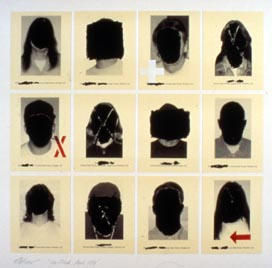
Rick Visser, Untitled
The subject has been ravaged. Our individuality has gone. We are faceless.
What stands over against us is a self-regulatory economic and political system that appears to be thoroughly rationalised. This system is pretty indifferent to the suffering of human beings caused by the frequent busts and depressions . It appears to be a second nature, divorced from human practice and self-evidently given.
We are damaged by this system ---eg., the effects of poverty caused by people being thrown out of work. See here and here.The subject may be so damaged that they are not capable of morally responding to the searing images of the pain and suffering of others. Some of us may be haunted and even enjoy the suffering of others, such as the Iraqi's.
September 10, 2003
Sontag: Regarding the Pain of Others#17
Rick's seventeenth post on Susan Sontag's Regarding the Pain of the Others is concerned with historical amnesia My comments on Rick's sixteenth post can be found here.
Sontag is looking back on the archive of images of human cruelty. Reflecting on these she says:
"Someone who is perennially surprised that depravity exists, who continues to feel disillusioned (even incredulous) when confronted with evidence of what humans are capable of inflicting in the way of gruesome, hands-on cruelties upon other humans, has not reached moral or psychological adulthood. No one after a certain age has the right to this kind of innocence, of superficiality, to this degree of ignorance, or amnesia."
There is no amnesia at one level. We know about depravity:
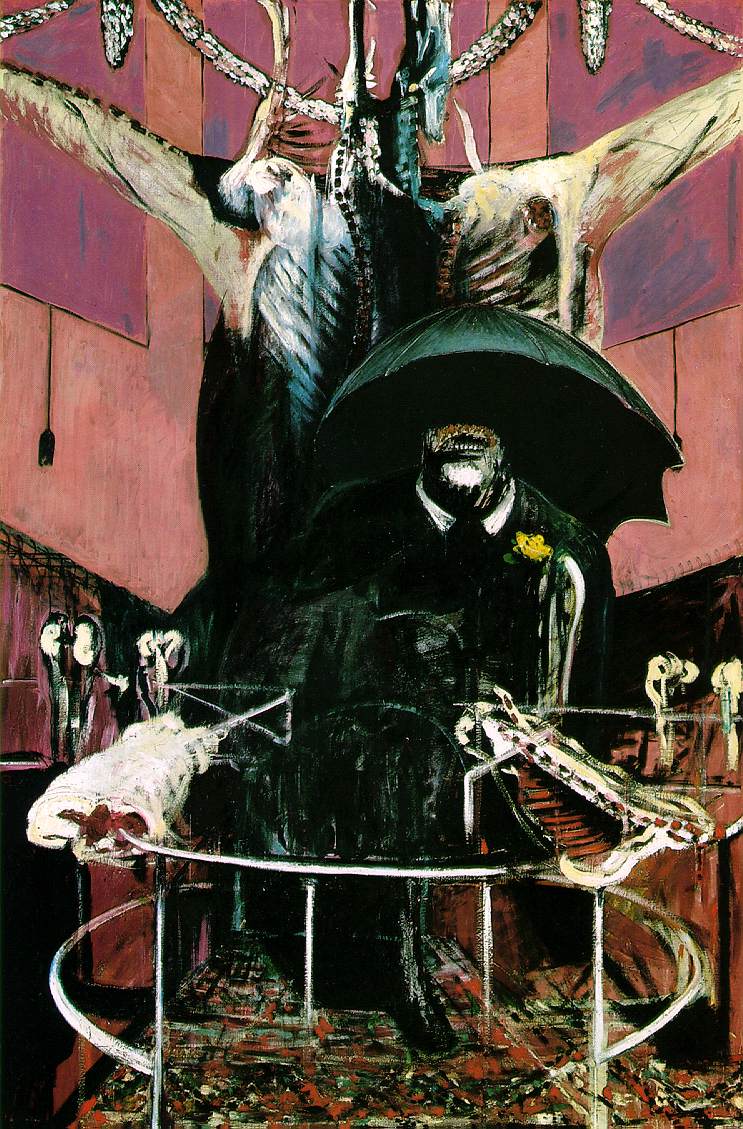
F. Bacon, Painting, 1946
Sontag then goes to make a point that sums the journey we have been on:
"There now exists a vast repository of images that make it harder to maintain this kind of defectiveness. Let the atrocious images haunt us. Even if they are only tokens, and cannot possibly encompass most of the reality to which they refer; they still perform a vital function. The images say: This is what human beings are capable of doing; may volunteer to do, enthusiastically, self-righteously. Don't forget." (Sontag, pp. 114-115)
We do forget. Australians, for instance, did forget what happened to the Aborigines during the early part of the 20th century. The forgetting is associated with the attack on the black armband view of Australian history . . .by which is meant an excessive emphasis in recent historical writing on past wrongs. This mournful view of Australian history needed to be displaced by a view of Australian history as overwhelmingly a more positive and patriotic history.
Thus the discourse of Australian conservatism. The historical forgetting is a consequence of the conservative political campaign to discredit Aboriginal land claimants, deny that the stolen generations were taken from their families, and insist that the European occupation of Australia was remarkably peaceful. The forgetting of the suffering of the indigenous others is part and parcel of the attempt to rewrite Australian history in the service of a partisan political cause.
So we are left with pile of fragments as suggested by Rick Visser Melian debate (fragment):
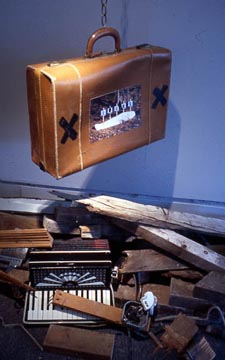
We have blank petrified signs that have undergone a draining of meaning. We have dead letters, lifeless scripts, and empty signs in a world of naturalizing mythology.
We grub amongst these ruins of meaning for fragments that say something to us.
We hunger for a sign that we can interpret in some way to break open a frozen mythic world that we live within.
Is there a fragment that can be retrieved and then reconfigured?
So what do we do in the face of this forgetting? How we stop the forgetting once we have remembered the horrors that still shape us.
Sontag is clear. As Rick reminds us in the comments to this post Sontag says:
"There now exists a vast repository of images that make it harder to maintain this kind of defectiveness. Let the atrocious images haunt us."
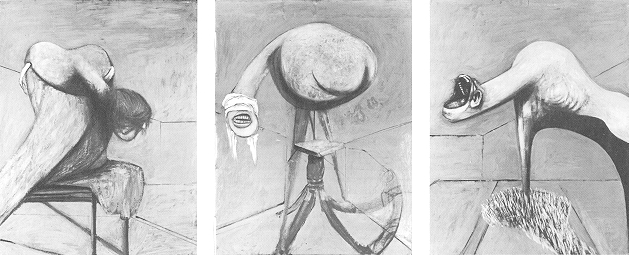
F.Bacon Three Studies for Figures at the base of a Crucifixion (1944)
There is an archive of images that can and do haunt us.
The images do haunt us that is for sure:

F. Bacon, Head Surrounded by Sides of Beef, 1954
But what do we do with the haunting inside us as we live in a world of naturalizing mythology?
Are we not fractured? Is not our ego dismantled?
We do need to break up that frozen mythic world that insists that the European occupation of Australia was remarkably peaceful. How do we do so? Sontag gives us little help. All she says is that the images say to say this is what human beings are capable of doing.
September 09, 2003
pop glamour
I managed to catch Blondie when they guested on the ABC's Rage last Saturday night. It was an attempt to get back to the forgotten years of popular music when I no longer listened to the radio or watched TV. Blondie are currently on tour in Australia.
It was very late before the Blondie segment came on and I was able to hear their catalogue of songs. Some of the finely crafted pop songs I knew, such as Heart of Glass from Parallel Lines album and Union City Blues. Suprisingly, I enjoyed the latter songs Maria and Shakedown. But I thought the solo work by Harry was musically flat. The music produced by the band was far more interesting.
From New York New Wave Punk to successful New York pop band. It was a move away from the 1960's rock and roll based on the blues and extended macho guitar solos to punchy, catchy tunes, thoughtful (and/or humorous) lyrics, good keyboards and ironic sensibility. A good 70's pop band with a postmodern style.
It was the visuals that I found to be more interesting with all the early gestures back to Marlene Dietrich and New York glam.

The visuals around the figure of Deborah Harry wrapped Blondie up in glamour, beauty and fashion a la the platinum Harlow and Marilyn Monroe. Lots of urban desire. Harry defined pop beauty and became a pop icon and a celebrity.
Blondie are also art pop that links back to pop art that opened up into popular culture.
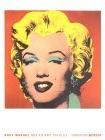 With Andy Warhol's silkscreen painting of Marilyn Monroe we have a self-referentiality to the everyday imagery that is part of contemporary consumer culture. It leads to a mixing of culture with play that gave us this New York art scene and this awareness of a media saturated culture. Thus we have the cultural background to Blondie who were part of the New Wave mixing of music and visual culture.
Whilst listening to the songs and watchign the video-clips I was looking forward to seeing what the visual culture produced.
But it was the visuals that disappointed me the most with the Rage episode. The promise was there with the Heart of Glass video clip that built on David Bowie's video clip for Ashes to Ashes. But little was then done with the video as an art form. It was the usual rock/pop stuff of the band. The video clip from the new single Good Boys had a few ideas.
Was it the limits of Rage I was encountering?
No clips were shown from the films Deborah Harry was in. A pity because the loss, death, oppression and desire -- the darkness at the core of everyday life---was left untouched.
Rick's flying into the David Ross interview
Rick Visser over at Artrift has started a new project entitled The Gift as Art. It looks to be very very good.
The project is an interview with Stephen David Ross who is Professor of Philosophy and Comparative Literature at State University of New York at Binghamton. Stephen is also a Director of PIC, a program of interdisciplinary studies in Philosophy, Interpretation, and Culture, that addresses the ways in which cultural forms of knowledge and expression shape and are shaped by human practices and experience. Alas the philosophy journal is not online. Another example of the closed world of academia.
And I have not even finished commenting on Rick's Susan Sontag project Regarding the Pain of Others. I'm just going to have pull my socks up on junk for code.
So what is being said by Stephen David Ross. The interview proper starts here. Ross talks about the disjuncture between the practice of art and aesthetics.
Stephen Ross says that:
"I was particularly interested in the ways in which philosophy was able to reinvent itself, to find new and deep questions that had never been asked before.Yet when I took courses and read philosophical works in aesthetics and philosophy of art they seemed to me to have nothing to do with my own artistic experiences, which seemed to me as far reaching as philosophy, yet far more intense. That was both a loss and a silencing. For several years I avoided aesthetics. I did not avoid art. I found something similar in art and philosophy, intense and profound encounters with the world and with possibilities of expression. Yet they did not speak to me effectively of each other."
My experiences exactly. I practiced photography, studied philosophy and art history. Threads were there but there were lots of holes. I kept on falling into the holes and clinging to the threads.
Stephen Ross then charts his pathway. And what you know. I walked the same pathway:
"I later found my way into Continental philosophy through Foucault, Heidegger, and Derrida, for whom questions of art, aesthetics, and literature were both deeply important for philosophy itself and of fundamental importance for new forms of life and practice. At this point aesthetics and ethics joined in my thinking as part of the project Nietzsche described as the revaluation of all values."
This is what I am begining to explore on philosophical conversations with Trevor Maddock.
September 08, 2003
Japanese modernism 2
It has been suggested by Harry Phillips that Isamu Noguchi was more of Japanese modernist than Yasuo Kuniyoshi. So this post is a bit of an exploration.
This color woodblock print by Hashiguchi Goyô is entitled Woman After Bath, (1920) and it can be considered traditional art on first glance:

Presumably a Japanese modernism would react against this and reject it. One would presume, for instance, that traditional Japanese aesthetic values and concepts of pictorial space would be challenged by the Western theory of perspective. Goyô's Woman After Bath shows the influence of Western ideas for though a traditional subject is depicted the representation has undergone a dramatic transformation.
This not traditional Japanese art because the woodblock depicts a nude--a Western convention--using traditional Ukiyo-e techniques. So there is an interaction between east and west here.
But Goyô's woodblock is not particularly modernist.
Consider this work entitled by Isamu Noguchi Kouros, 1944–45
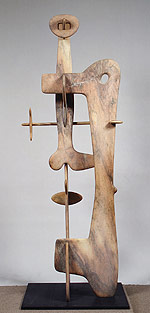
Too European? I find it so. It reminds me of Brancusi----European modernism. It is modernism but it is not particularly Japanese.
What is of interest is the way that Japanese memory and art tradition interacted with the currents of the new and original in European modernism.
From the Australian edge of the Pacific Asian Rim thirty or forty years ago, Japan had all the earmarks of modernity: technical finesse in manufacturing, clean cities, trains that ran on time, technology. It had the winning modernist formula and it needed only to develop on a grander scale along the established lines.
Japan stood for a paradox of ancient tradition and ultramodern sleek. It was both more modern than Australia and more traditional. Yet our knowledge of its history there is sadly lacking. What we know is restricted to only a few works made during the last 40 years or so.
But try this:
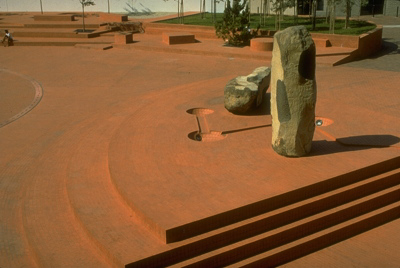
To the Issei. Installed at the Japanese American Cultural Community Center plaza designed by Isamu Noguchi, 1980-83, Los Angeles, California.
Yeah. Now that is something different.
It is another way of looking at gardens.
Now imagine what Isamu Noguchi could do with rock forms of the Australian outback landscape, if someone had been been bold enough to commission him to work in Australia:

Detail of earthwork wall at the Billy Rose Sculpture Garden, 1960-65, The Israel Museum, Jerusalem. Photo: Isamu Noguchi.
For one thing we would not have got a "Japanese" garden in the Adelaide Parklands that has little to do with Japanese aesthetics.
September 07, 2003
Sontag: Regarding the Pain of Others#16
Rick's sixteenth post on Susan Sontag's Regarding the Pain of Others takes the ethical turn to compassion in relation to the suffering of others.
My previous response to Rick's fifteenth post can be found here.That response took us to the threshold of the world of becoming behind the veil of a suburban world of stable objects and to the repression of everyday suffering behind the secure mode of life.
The paragraph from Sontag's text that has been selected by Rick says: “Compassion is an unstable emotion. It needs to be translated into action, or it withers.” (Sontag, p. 101)
And we have these comments by Rick:
"Art can be, among other things, compassionate action. Is it not an act of compassion to look without blinking at the suffering of others? To face it directly without mixing it with one’s own psychological motivations? Might this not be the first step toward transfiguration?
“But soon my fingers fail’d me, my face droop’d and I resign’d myself,/ To sit by the wounded and soothe them, or silently watch the dead;"
Walt Whitman, The Wound-Dresser, from Leaves of Grass
Hence we have the embrace of a key concern in Adorno's Aesthetic Theory of the aesthetic as the language of suffering. Adorno says:
"Reason can subsume suffering under concepts; it can furnish means to alleviate suffering; but it can never express suffering in the medium of experience, for to do so would be irrational by reason's own standards. ...What recommends itself, then, is the idea that art may be the only remaining medium of truth in an age of incomprehensible terror and suffering. As the real world becomes dark, the irrationality of art is becoming rational, expecially at a time when art is radically tenebrous itself."
Adorno then ties this conception of the aesthetic to a defence of modern art:
"What the enemies of modern art, endowed with a greater sensitivity than its timid apologists, call the negativity of modern art is the epitome of all that has been repressed by the established culture. That is indeed the direction in which modern art is moving. By cathecting the repressed, art internalizes the repressing principle , i.e. the unredeemed conditon of the world (Unheil), instead of merely airing futile protests against art...It is this , and not the photographic renditon of the unredeemed state or a false sense of beatitude, that defines the position of modern art towards a gloomy objectivity. Everything else is worthless mawkishness."
(Adorno, pp. 27-28)
Art is the remembrance of accummulated historical agony. It lends a voice to suffering in an attempt to express unmet needs and unfilfilled desires in a damaged life. That is the ethical core of art and the aesthetic (the concepts we deploy to talk about art and to interpret what art expresses). It is also the core of Adorno's Aethetic Theory. This core is put up front at the end of Adorno's text:
"Surely it would be better for art to vanish altogether than to forget suffering, which is art's expression and which gives substance to its form. Suffering, not positivity, is the humane content of art...It is difficult to imagine what would become of art as historiography if it wiped out the memory of accummulated suffering."
Expressing the pain of others is the core impulse of art in a damaged life that we live amidst the glitzy seductive culture of consumer capitalism that veils the way our liberal society is socially unjust, economically dysfunctional, culturally divided, politically fractured and ecologically unsustainable.
September 05, 2003
the first hesitant step
This is an image from Kangaroo Island. The place is called Remarkable Rocks and it is on the south west corner of the island. The island is just south of Adelaide. It is a key tourist destination.
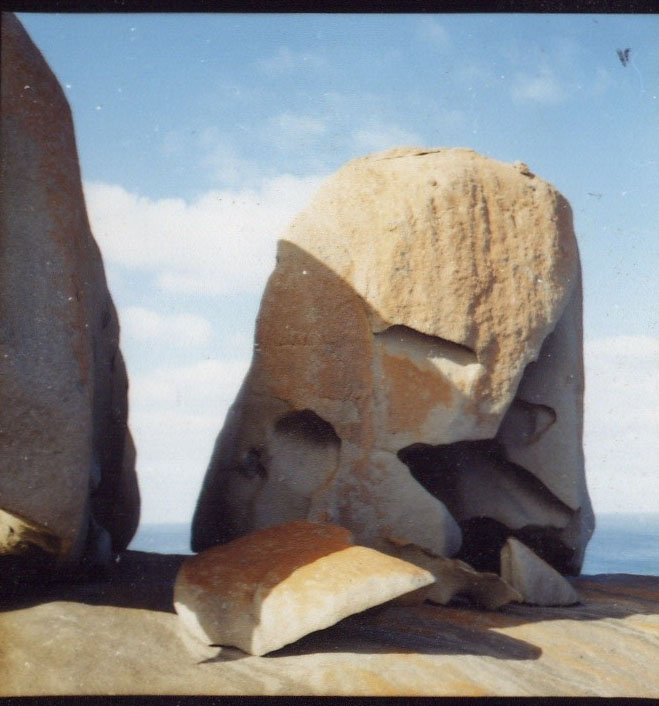
That trip was in 2000 and it was my first step in beginning photography again after a break of a decade or so.
It has only taken me several hours to scan the contact sheet and upload the image!
September 04, 2003
reviving downtown
Adelaide is historically similar to Los Angeles. Both have inferiority complexes in terms of creativity, and to their identity in relation to global cities such as Sydney or New York, or beyond that London and Paris.
Both cities have not seen their uniqueness as strengths to draw strength from and to build on.
Both had turned away from a civic culture through abandoning what the Americans call downtown (the inner city) and beginming the long flight/dispersal into suburbia. That meant the end of public space. Downtown was no longer the centre. It lost its reason to exist. Both cities became suburbian. Their culture was suburban, which meant it was primarily about private spaces.
In the 21st century both have reacted to this embrace of suburbia in the second half to the 20th century by turning back to an urban culture. Suburbia is reaching its limit. If it spreads out any more it isn't going to be able to function. People cannot get to work because the freeways and the arterial roads
are clogged.
For LA this promises to be the way to revive downtown through a flowering of LA culture.
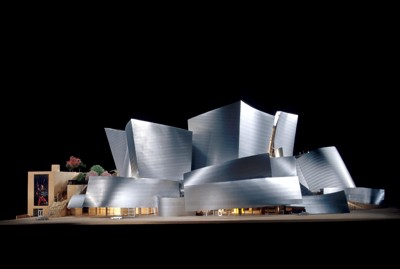
Frank Gehry Disney Hall.
More here and here.
This architectural form is not about Hollywood. It's about public space and public functions.
Unlike LA where nobody lives in the "centre", Adelaide is enticing people back to the inner city. People are going to be the heart of the inner city.
However, it is unclear what either strategies to revive downtown have to democracy.
September 02, 2003
Cultural studies:
As much as I admire, and welcome, the shift in culture studies away from the old modernist concern with high art to popular culture, I am uneasy with some of what passes for culture studies.
From what I can make out social democrats and greens pretty much defend what is left of the old capitalism/liberalism/nation-building welfare state project. They do so in order to rescue civil society and the experiencing subject from a revolutionizing neo-liberalism. What we have here is the changing material configuration of power and reality in the twentieth century: a reshaping of society.
Those in cultural studies joyously deconstruct tradition, convention, nationality, politics and culture. They are enthusiast cosmopolitians in the global village, and have an ironic perspective on things. They are about a historical cleansing, a getting out of the modern and new beginnings. That is how some understand cultural critique.
Yet it seems to me that in doing this cleansing those working in cultural studies are giving neoliberalism a helping hand. Is not a neo-liberal mode of governance deconstructing Australia's social democratic modernity in very radical ways as it endeavours to make it historically irrelevant and forgotten? Where does cultural studies stand in relation to the materiality of power as a mode of governaning a country?
Where is the critical edge of cultural studies to a neo-liberal mode of governance? Where is the critical voice to the way it is reshaping the nature we inhabit.
The core of my reservation is this. Cultural studies celebrates the culturalization of nature--natuer is a cultural construct. Fair enough. We see the Murray-Darling Basin through historical eyes and undderstand they way humans have produced it. Yet we also have an environmental disaster in the basin and the looming spectre of biotechnology. Yet cultural studies' concern with the text----the environmental crisis on television---is - at the expense of the natural (ecological) processes and tendencies in the basin (eg. dry land salinity).
I do not see much rethinking of the culturalization of nature amongst those working in cultural studies. Should they not be doing so?
Japanese modernism?
Courtesy of wood s lot
Yasuo Kuniyoshi:
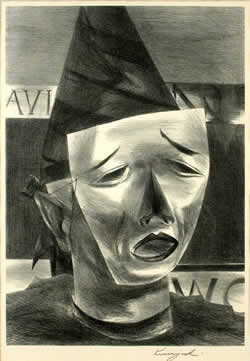
A Japanese modernist?
By that I mean a modernism that was genuinely Asian: both a culture that was truly modern by virtue of its being universal, and a culture that would overcome the West by subsuming it under a larger synthesis of Western and Asian values.
Japan in the early 20th century was situated uncomfortably on the cusp between Western modernity and its Asian identity. Modern Japan was nation-build state and it represented itself as a nation-state with fixed national borders and deep nationalism. Yet it became an empire, an empire that confronted, and became a part of western modernity which had universal terms.
We in Australia regard Japan as being an Eastern country with Western characteristics. Our pespective is a Western universalism that is tacitly opposed to Japanese exceptionalism. However, Asian countries such as Indonesia view Japan as being Western but with a vague memory of something Eastern.
Somewhere in the 19th century the arts from the East and the West got interwoven. In the late nineteenth century and in the early decades of the twentieth century, Japan firmly embraced the modernist art styles from the West. But at the end of the twentieth century it appears that Japan has, once again, turned to Asia.
Today, Japan is a economic superpower within Asia. It appears to the odd man out in Asia, even to the point of being regarded as 'the Other'. From the perspective of Australia Japan is considered the trend-setter of a radical high tech modernity. It also leads the West in areas such as fashion, architecture, technology, design, computer graphics, popular visual culture, photography, and the new media.
Japan is postmodernity from the perspective of someone living in Adelaide with their back to the southern ocean; shaking of the deep nostalgia for double fronted bluestone cottages of nineteenth architecture; trapped by the twentieth centurys obssession with the car as the core of modernity, and unable to am apparently attempting to escape from history in which all tradition and time are equated with the logics of North Atlantic modernity. If you like, Japan makes history while Adelaide is but a footnote in the endless elaboration of North Atlantic modernity.
I get gloomy at this point.
Americanization is coming through the front door of a radical neoliberalism that pushes tradition and authority aside, and leaving it as a pile of rubble on the margins of the freewheeling market. We are left with have the fragments to pick over as the wind blows hot and dry from the north, the sun bakes the earth, and our skin shrivels from the heat.