August 31, 2003
Adelaide: the thinking person's capital?
The Australian is running a series on Australian cities in its Weekend Magazine. I haven't been reading them because they are generally puff lifestyle pieces for a Sunday morning. But I read this one by Terry Plane (with photos by Wendy Lear). It is about the city I inhabit, I'm interested in urban design and Plane says that Adelaide is the thinking person's city.
Adelaide as a thriving place of ideas contributes to Adelaide's enviable lifestyle.

That's the favourite image of the city.
So what are the thinking people in Adelaide saying about their city?
Eleanor Ramsay, an adjunct professor at the Hawke Research Institute (scroll down page) at the University of South Australia, is identified as a thinking person. She is given some space in relation to an inadequate public transport system. This is a linear north/south city of a million people squeezed between the hills in the east and the sea in the west. It iecame dependant on the car ever since the tram and electric bus networks were dismantled in the 1950s and 1960s. Transport is a problem.
Ramsay's solution? She says:
"You can't rebuild the city. But there are aspects of other cities that we could take. A fleet of bicylces, for example, all painted the same colour, available in a pool for anyone to just hop on and ride around the city. And more people living in the city...In Adelaide you can think more. Thinking time---that's the creative advantage."
In case you are wondering about the quality of the ideas being developed in Adelaide, you do need to understand that Ramsay is into lifestyle and glam. Adelaide city and its women, she says, are elegant and sophisticated without being flashy with a consistency of taste and an extraordinary depth of aesthetics. That is how she understands activism and policy intervention.
Ramsay's glam image of stylish sophisticates on bicycles hopping around the city does ignore the northern suburbs of Elizabeth,with its low rates of educational participation, high rates of domestic and community violence, long term unemployment and poverty. Elizabeth is the darkness to the power dressing of the glam lifestyle. Glam middle class innercity lifestyle ignores homelessness, lack of public housing, drugs, youth unemployment:-----the classic social justice issues are hidden.
Ramsay's glam lifestyle image ignores the existence of lots of dam ugly buildings in downtown Adelaide, such as the Hyatt and Hilton. Same standard buildings that are everywhere. It also ignores key questions such as those put on the table by Peter Sellars:
"Can we make public space for a public? Who is the public? What are we trying to say by democracy?.... there is so much that needs to be done and needs to be said and so few people are willing to stand up in public and say it and do it. So what happens is we get public work that says nothing and does not do much more. This sense of absence, this sense of blankness..."
Sellars asks some good questions. They have a good grounding in the vision of a green belt surrounding the City of Adelaide and North Adelaide that would be wide open spaces dedicated to public uses.
But Adelaide was not impressed with Sellars.
Plane's article then proceeds to knock the stuffing out of the image of the thinking persons capital by introducing the ideas of two thinkers in residence whom we have meet before: Charles Landry (also here) and Herbert Girardet.
So what do they add that is new? What can they add to enable South Australia to become a key place where the alternatives to the old modern industrial order are going to be developed and where the leadership can be nurtured? As Peter Sellars puts it, can Adelaide be the first place in the industrialised world that will go green, that really is based on the idea that you do not have to damage the planet to live here; can South Australia be the first place to demonstrate that and that people will in South Australia connect quality of life to social justice, living well and sustainably.
Landry says that Adelaide is too comfortable and settled in its identity:

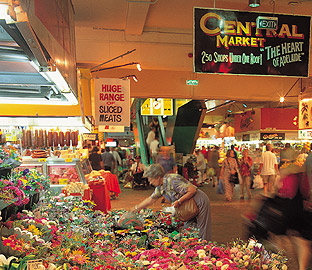
It is too unquestioning about Adelaide's urban plan designed by Colonel Light, the first Surveyor-General of South Australia, of a city in parklands with squares at its four corners and its centre. And the complexity of the layers of government stifles economic growth. Nor is Adelaide an exciting city, apart from the Central Market and its environs which is the closest thing to an Italian pizza:
All in all Adelaide is a good place to bring up the kids but they have to leave to find work.
Change is not to be entered into lightly. Light and his vision are a part of our civic culture. We should be conservative in protecting the Adelaide Parklands is radical, given the continual economic pressure to erode these public spaces and to use them as public assets to make money through special corporate events for corporations. Light got it pretty right. The Square at the centre --Victoria Square---should be restored.
However, the consensus is that boring Adelaide needs a shot in the arm to shake it out of its complacency. Lifestyle is all very well says The Australian. Adelaide may be a very good recreational city
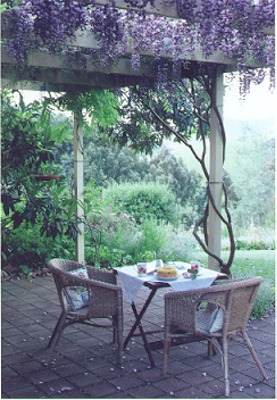
but South Australia also needs to get some economic growth going:
"Somehow Adelaide has to become better at generating wealth if it is to avoid sliding into genteel decline compared with the rest of the country. Its government, industry and citizenry face the challenge of how to produce the wealth required to fulfil the city's aspirations in a globalised information-age economy."
The answer of course is green development. If the abundance of sunshine is a problem because it causes complacency, then Adelaide can become a solar city and make solar power a major export industry.
The economic policy suggested by The Australian is not green development: it is a neo-liberal one with its trickle down effect and increasing inequalities. It is the one being followed by the Rann Government.
August 30, 2003
For the cheesecake boys
For the Unablogger boys. who happen to wander over to junk for code in a curious frame of mind to have a look see.
This post on cheescake as subversion was an early response to Unablogger.
Then this image by Edward Hopper is another response:

The erotic can be isolation. It is also about the disorder of the body. Nakedness also wrecks the decency, style and glam conferred by our clothes.
Another response is by Bataille who argued that the erotic challenges utility. Bataille says:
"Beside nudity there is the strangeness of half-clothed bodies; what garments there are serve to emphasize the disorder of the body and show it to be all the more naked, all the more disordered. Brutality and miurder are further steps in the same direction. Similarly prostitution, coarse language an everything to do with eroticisn and infamy play their part in turning the world of sensual pleasure into one of ruin and degradation. Our only real purpose is to squander our resource to no purpose, just as if a wound were bleeding away inside us; we always want to be sure of the uselessness or the ruinousness of our extravagence. We want to feel as remote from the world where thrift is the rule as we can." (Georges Bataille, Eroticism, p. 170)
Excess. That's how to subvert the world ruled by utility. That's Bataille.
Nay, that's not strong enough. The desire behind excess is one of wanting to turn the world upside down and inside out. The truth of eroticism is treason again utility. All the brakes are off. since treason involves transgressing those taboos that normally surround our lives.
Now that's sexual subversion.
Sontag: Regarding the Pain of Others#15
Rick's fifteenth post on Susan Sontag's Regarding the Pain of Others is concerned with architecture, photography and security.
Gregory Crewdson's finely crafted and elaborate 'cinematic' photos of the dream suburban house
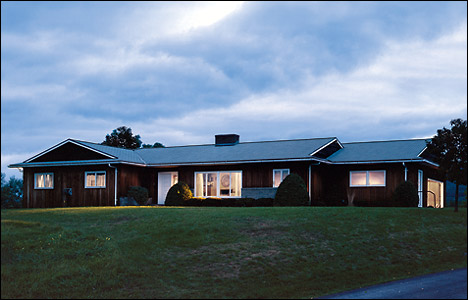
have a surface that appears to be ordinary or routine activity (in suburbia); yet they also express an atmosphere that is obsessive, inappropriate or disturbing:

We have isolated moments of sexual estrangement; relationships fraught with tension and ambivalence, memories of situations of alienation:
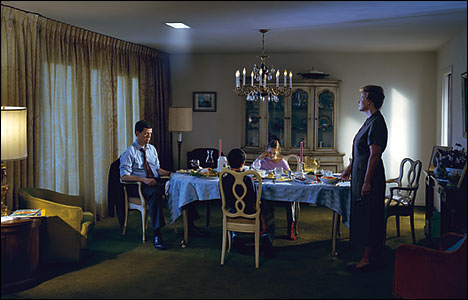
a world haunted by demons and things that have gone wrong in the past. Gestures towards broken lives behind the appearance of the suburban dream.
These photos disclose a suburban world that was initially opened up by Edward Hopper in the early twentieth century. What is opened up is a world where people have hurt one another, are still together, but are estranged and closed off to one another:
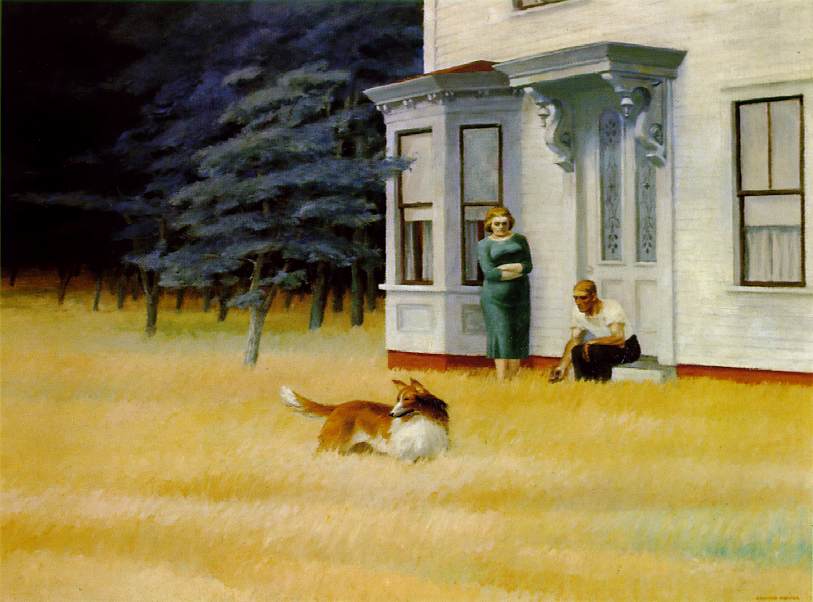
or it is a world where people are alone with their inner conflicts and eroticism. It is not a happy world of joyful free flowing sexual exuberance with others. The sexual pleasure comes from masturbation:
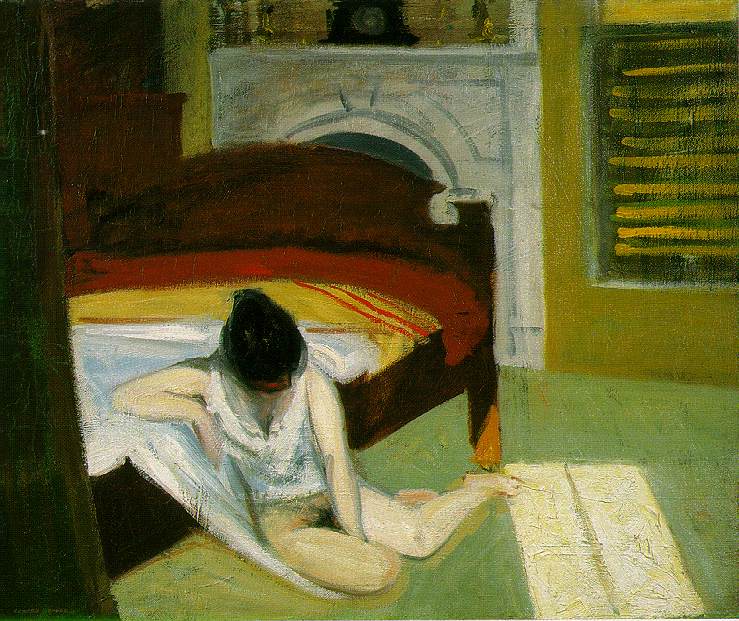
There is a profound sense self-isolation in Hopper. Community has gone. We have few companions. Our life is being alone in a room somewhere with our bodies:
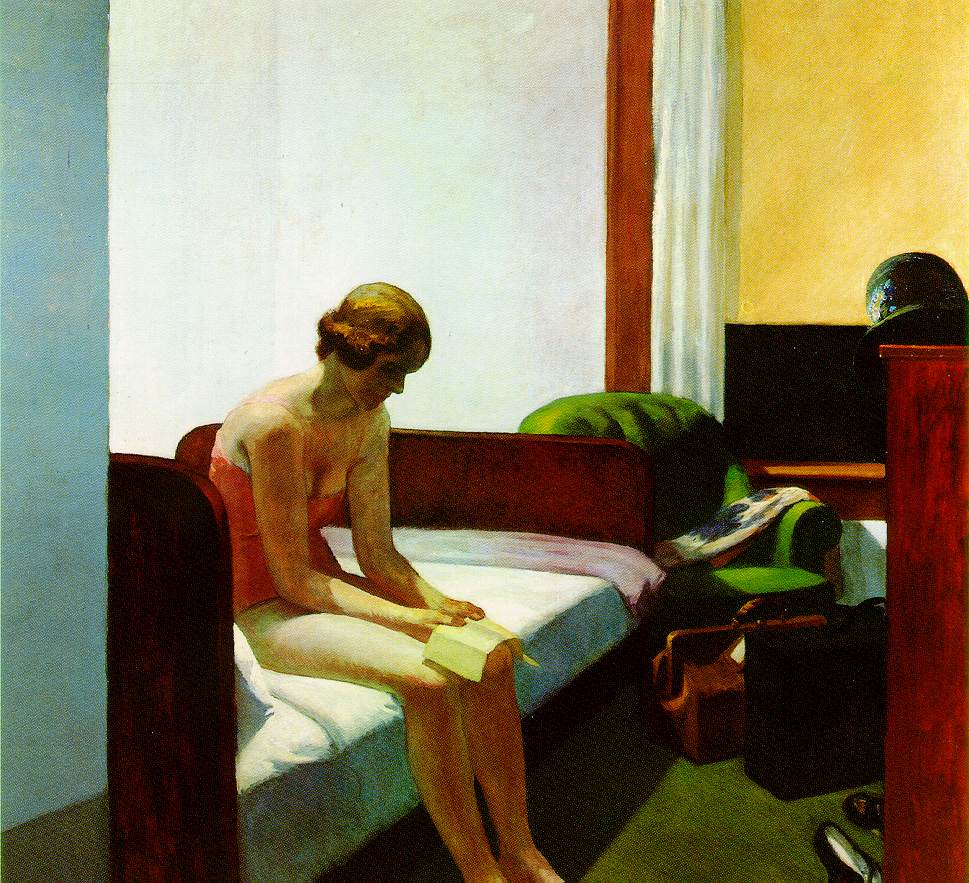
This self-isolation and subjective solitude leads into a sense of temporal homelessness--a nomadic self cut off from meaningful rapport with others:
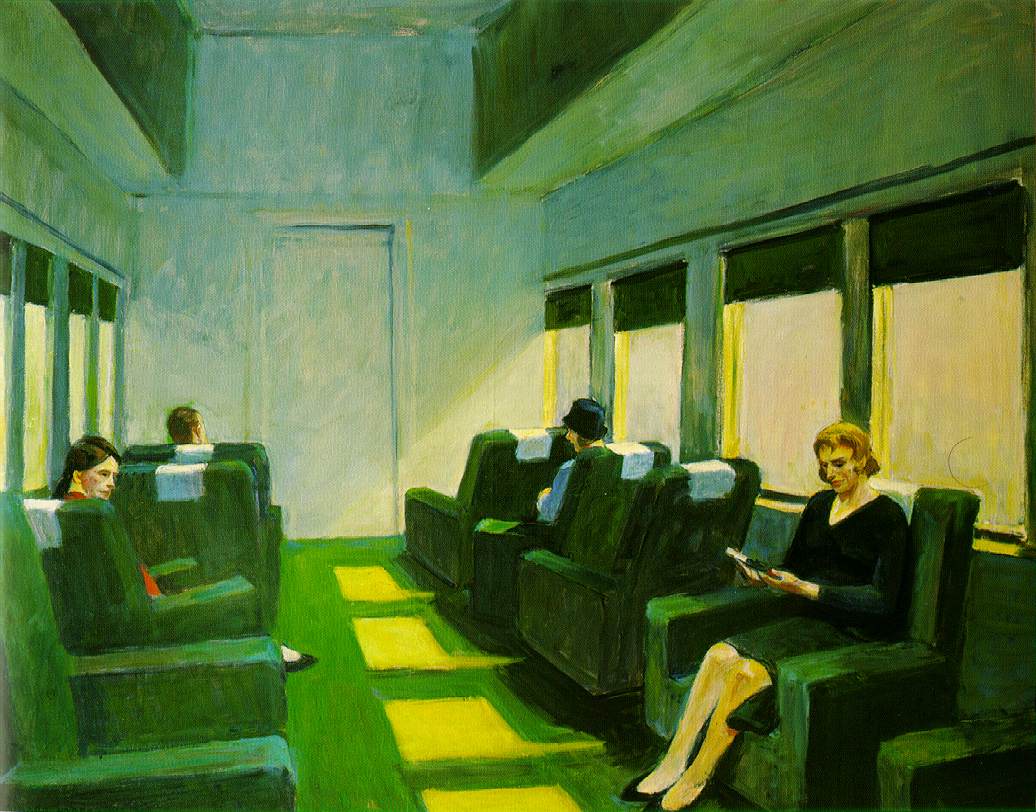
It's a world of repressed sexual desire.
Crewdson's photos can be interpreted in terms of what Heidgger calls setting up a world. What is lighted up in its unconcealedness more than the odd and the uncanny: it is more a disclosing the pain of estrangement of relationships in suburban life that border on a loveless life.
There is a sense of living the ruins of modernity coupled to a deeply embittered experience of modernity. Things have gone wrong as there is not much joy, happiness, or eroticism in our daily suburban life. Suburbia promised to be the path of happiness ---fleeing the evil, dirty city that was blighted by crime and poverty. It was a place behind the white picket fence where our social and moral habits are most comfortable and consoling.
But it does not approach the raw violent sense of a Nietszche, where being is involves rubbing oneself raw on the bars of "civilized" culture; a malice of rage that is the true malignancy of a technological culture.
Rick's juxtaposed comments include a comment by Sontag:
" Whereever people feel safe…they will be indifferent.” ( p. 100)
Rick then adds some remarks from the early twentieth century anti-modernist Spanish philosopher Ortega y Gasset:
“Life is our reaction to the basic insecurity which constitutes its substance. Hence it is extremely serious matter for a man to find himself too much surrounded by apparent securities. A consciousness of security kills life.”(From ‘In Search of Goethe from Within’, in The Dehumanization of Art.)
The Dehumanization of Art referred both to the emergence of the modern painting, which has eliminated the human figure and human metaphors, and the notion that the quality of art is not based primarily on its content but on its form.
Ortega y Gasset characterized the 20th-century society as dominated by masses of mediocre and indistinguishable individuals. For mass soceity theoriests the "revolt of the masses" (ie., the industrial working class) was responsible for the alienation and degradation of modern culture, prepared indirectly way for fascism. Politically Ortega favored a form of aristocracy - culture is maintained by an intellectual aristocracy because the revolutions of the masses threaten to destroy high culture.
Rick then asks:
"Can one be an artist, an engaged artist, if one feels too much security?"
Linking insecurity, life and the suburbia we get a context of a lived everyday life, rather than than the human condition per se. We have historicised the context of Rick's question to the pain experienced in the form of life that many of us live. The pain of others is our pain as well.
What Gregory Crewdson's photos show is something other to the stable suburban world. There is a sense that suburban really is modern life: it is a world of stable and extended things. The appearance of suburbia is that it is the stable foundation of modern life.
Crewdson's photos showing something else. Behind the security of suburban family life there is a deep gnawing insecurity in the form of anxiety, unease and despair:
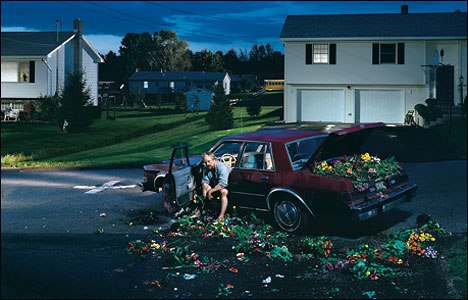
This is an anxiety here that tears away the habitual dispositions and conventions that facilitate our daily coping with life to disclose suffering:
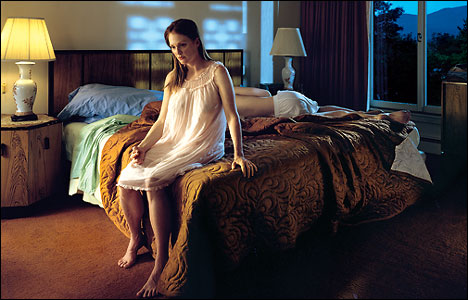
Pain and anguish is the norm. Attempts at reconcilation that don't quite make it. This an anxiety that tears at our very being-in-the-world:

This anxiety is an awareness of foreboding.
So what do we do? Do we laugh as we are impaled on the stake? Do we learn not to take ourselves seriously? Is laughter the only ethic available to us? Should we watch a Marx Brothers movie? Or Woodie Allen? Should we accept that the world is a stage, the stage is entertainment, and there is no business like show business? Is this the way to release our frozen suburban emotions that have developed from our turning inwards?
The phrase frozen emotions refers to a psychonalytic world of emotional pain resulting from people unintentionally hurting one another within families. Many of us carry the scars of this from growing up in families and these wounds shape the way we currently respond to one another within the family. We carry our own emotional baggage with us into our relationships as adults and this often inflicts pain on those we love.
Even in the comfort and security of suburbia there is deep insecurity. It is not a matter of the creative modernist avant garde throwing off the cage of convention and tradition to feel the pain of existence of a chaotic world versus the suburban mass grazing in the fields of a stable, unchanging world.
What is disclosed by Crewdson photo's is an opening up to becoming--the formation of our life in a world of flux behind the appearance of the stable suburban world. What we do not do is conceptualize our world as one of becoming; nor do we see ourselves living in the flow of becoming even though we experience the impact of globalization on our everyday lives as now living in a world of constant and complex change. It is the flux of becoming--- the flow of historical life --- that loosens up our frozen emotions containing our accummulated pain, anxiety and suffering.
August 28, 2003
It looks good
I missed it last night. I looked for it outside the window of my study just after I'd finished walking the dogs betwen 6.30 and 7.00pm But it was too overcast to see much. It is winter in Adelaide and it has been cold and wet.

Mars made its closest pass of Earth in over 59,000 years last night. Of couse it did not look like that in Adelaide. It would have looked more like a bright light on an aircraft flying across the city.
I cannot help thinking of Heidegger's reaction when he first saw a photo of the earth taken by astronauts in space. It shocked him. He realized that a new possibility had opened up. Human beings could colonize space. They could pollute, lay waste to, and destroy the earth that was their home, then desert it for residing on other planets in the solar system.
There was no need to develop a dwelling ethos to counter a technocratic mode of being that treats the earth less as place of dwelling and more a quarry from which resources have to be extracted and refused dumped.
You can find more about Mars at NASA. It's a technocratic world that is being created and you can see space exploration less as Christopher Columbus, Captain Cook or Charles Darwin and more an attempt to recreate the world anew. There is sense here of a technological will preparing Mars for human habitation through massive terraforming techniques.
August 27, 2003
searching for a good urbanism."
This interview is courtesy of David over at CityComforts Blog. The person interviewed is James Howard Kunstler, who is the author The Geography of Nowhere, and Home From Nowhere and The City in Mind. These texts are critiques of modern urban and suburban design in that argue that cities "relinquished their authority in the 60s and gave it to the developers, and highway engineers, who then made decisions about things they didn't understand. And they made a mess of things."
I do not know any of the texts or even the author. But I love what he has to sdy on his website :---"the 20th century is over! We don't have to be Modern anymore!" Oh I wish that we had this kind of writing in Australia about liberal modernity and the mass exodus from our urban centers since the 1950s that has left our cities gutted and strangled. It would open up a dialogue on the development and effects of modern urban construction that now enframes and disciplines our everyday lives.
That is what being modern meant in Australia: being suburban: bargain shopping, fast food and auto slums. I drive through the southern part of Adelaide each weekend to go to Victor Harbor, and it is depressing. The whole surburban part of the city of the linear Adelaide is sleepwalking on cheap oil. And the public places in the inner city are not worth being in because of the cars. So we have a mutilated urbanism.
I just love this:
"Because I believe a lot of people share my feelings about the tragic landscape of highway strips, parking lots, housing tracts, mega-malls, junked cities, and ravaged countryside that makes up the everyday environment where most Americans live and work. A land full of places that are not worth caring about will soon be a nation and a way of life that is not worth defending."
The urban design and the architectural makeup of Australian cities have resulted in junk landscapes. In trying to be modern we got lost in suburbia and are only now begining to think about a civic revival. In Adelaide the suburban sprawl is not really being addressed in a radical way, other than getting people to return to the inner city.
The civic revival has been driven by the New Urbanism, which is described thus:
"They re-discovered all this stuff. Information about typology. Why different types of buildings are appropriate in specific kinds of places. Why it's not a good idea to put a bank building, which looks like a southern plantation, in the most important part of your downtown. It's a rural building, and putting it into an urban setting doesn't behave right.The New Urbanists are applying this knowledge in a hybrid way, understanding that they're working within a market with certain expectations. Bankers have to be retrained to make loans for real estate ventures that don't fit into templates that they understand - strip malls and subdivisions. Home builders have to be retrained to put out a product different from packing crates with vinyl siding. Planning officials have to be retrained to recognize that the suburban development pattern is tremendously destructive, and that there's a better way of doing things. We don't know how to do it. "
Here is an example of New Urbanism. It reminds me of Mawson Lakes in Adelaide.--if you cut away the high tech hype that is a leftover from the Multifunction Polis days of the 1980s. But see here for New Urbanism in Perth and here for St Marys in Sydney. (Click 'all projects' under 'international').
August 25, 2003
excursus from daily life
This is something I've always puzzled about but I had given up considering when I stopped going to the movies and started watching television instead.
There is a common position---an habitual lived one----that assumes an antagonism between a cinema that might be thought as part of the culture industry (Hollywood) and a cinema that might be thought to be art (modernist European cinema--eg., Eisenstein) centred on the figure of the auteur. It is a lived one usually to be found on the left. Well, that is where I have encountered it.
I guess this division of splitting art from industry came about because few people want to hold that all of the products of cinema belongs to the culture industry and none belong to art. Some films---the good ones--should be considered to be works of art.
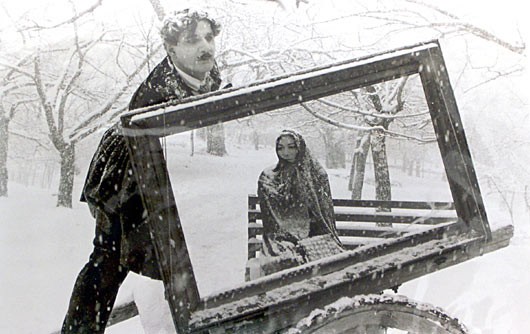
Makhmalbaf
I guess its reasonable position. Both Citizen Kane and Ivan the Terrible are much better films than Rocky IV.
This division between industrial and art cinema has been institutionalized. Consider the mass cimema complexes and chains of the market and and the anti-market of the festival circuit, 'alternative' distribution, cinemathèques clustered around independent film making. It is almost an antagonistic relationship.
It's a division that I live in my daily practice. About once a year I go to the art house to watch this film
by a director that many people consider to have consistently produced quality work. Or I watch this
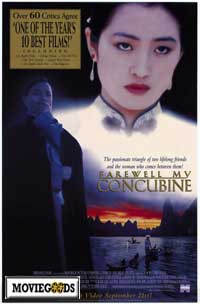 "
"
film by Chen Kaige.
I see a lot of trash movies on free-to-air television. I now visit the DVD stores for films by artist directors who are marketed in terms of a romantic conception of the auteur. I translate that into 'expressive creative artist' as I flick through the DVD's.
The reason I gave up going to see arthouse films and film festivals is not because I live in the provinces (Adelaide) rather than a global city (Sydney). It is because I thought that many films that appeared to be art were actually the products of industry. They were a part of the culture industry and only shown as art because they were European. Art was a con. I got bored and found the art cinema culture to be too precious. There was not much pleasure.
I found it much better to watch trashy Hollywood narrative movies on the television and to enjoy them and allow my body to respond to the desiring images with pleasure. They are trash but pleasurable.
The other reason for turning away from film as art, at a time when many in the humanities abandoned literature and embraced film studies, was that I had little sympathy for the avant garde Screen Studies structuralist Theory (semiotics and psychoanalysis). Reading phenomeology turned me away from high theory and back to 'the things themselves' and to human experience as a kind of becoming.
So that is what I lived for the last decade. It is probably what most people have lived.
Now that I have a DVD player I'm back looking for the

contemporary masterpieces.
And revisiting

old favourites.
I'm thinking about philosophy and film from a phenomenological perspective.
taking note
I will return to the previous post about art disclosing a world from left field.
We have this link to this book is courtesy of Jean Genie who runs the very interesting Creativity Machine weblog.
The book is by Scott McQuire. It sure looks interesting in the way that it explores our visual culture that has been shaped by the camera. Some references are here. It comes out of this academic department. Scott's description of the book is that it explores:
"...the ways in which the development of media technologies such as photography, cinema and television have been implicated in the emergence of modern and postmodern social formations. The book explores themes including changing notions of realism, the ways in which the construction of history has been altered by the development of audio-visual archives, and the impact that the space-time compression characteristic of electronic media has on the nation-state and the formation of national identity."
There is little material on the web about this text. Too academic? It seems to have disappeared into a black hole. I have found a review of Scott's Visions of Modernity here and Scott's response is here
Scott's text opens up a space to thinking otherwise to the current modes of thinking and feeling about culture. How so? By highlighting the importance of the visual over the written word. Admitedly, that visual photographic culture was deeply positivist (mirroring the facts) whilst other strands of photography embraced modernism and the autonomy of the image.
However, we can dig further. Instead of this try this line of thought.
Camera technology, especially the cinema, has altered the possibilities for thinking and imagining. Opening ourselves up to that possibility, especially to those possibilities opened by the cinema, transforms philosophy; away from the old connection to the literary or art institution; away from that old kind of understanding that presupposes cinema is a filmic rewriting of nineteenth century novels. It takes us into a world of Senses of Cinema.
This takes us away from the boring The Movie Show, which views cinema primarily through the eyes of the theatre and actors. You know the line: cinematic meaning is all about character and narrative. It makes cinema throughly unremarkable since on their interpretation cinema represents the world we already have--they construct stereotypes. On their literary understanding of cinema, the camera reinforces everyday opinions.
This covers up the way that the machinic images produced by cameras using cuts and multiple viewpoints provides us with the capacity to view the world differently to our situated perspective. We see the world differently to our everyday interested and embodied perspective.
So cinema discloses a world. How So. Well it is not about representing a form of life we already have. It discloses, or opens up, new worlds. This can be done with Jonathan Demme's Silence of the Lambs, (1991) a film about the mutilatation of bodies----eating and skinning victims. You can see a Heidggerian exploration of this film here. (The text is heavygoing).
Cinema gives us a way to understand what Heidegger was getting at with art opening up a clearing in the everyday exchanges of existence.
August 23, 2003
Sontag: Regarding the Pain of Others#14+
Rick's project on Susan Sontag's Regarding the Pain of Others takes a sharp turn away from mutilated bodies, suffering, redemption and ecstasy. Rick does not cross the threshold into the world of Bataille that I opened up with the writings of Dirty Whore Online on sexuality, pain and redemption.
Instead we have this image:
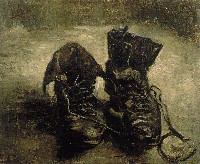
Van Gogh, Still Life with Shoes
What to make of the turn in the face of the horrors?
Well Rick asks: Transfiguration: A change that glorifies or exalts. Is there suffering and exaltation in Van Gogh's shoes?
Maybe is the short answer. Suffering but not necessarily exaltation.
What we have is an art work in an institutional space where objects are given a certain status of art, that means little more than 'located in the art world.' This painting of the shoes of peasants is one of the works that the art institution happens to talk about.
Now that response leaves us empty, shortchanged and cheated. Surely we can say more than that, apart from talking about the paint, the technique or art history? That has the feeling of 'the end of art' scenario about it. A closure. Art is not saying anything significant about life anymore. Art is just about the slabs of paint on a canvas---the medium:
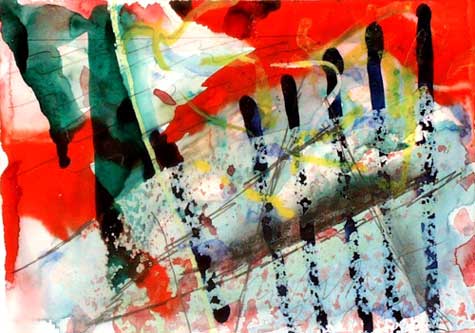
Gerhard Richter G. A. 4
Someone who thinks otherwise to this is Martin Heidegger. In an essay called The Origin of the Work of Art he sees the work of art in its material form and as connected to the earth. He argues that an art work has an ability to force a clearing in the everyday exchanges and happenings of existence. It has the capacity to open up a world. and to arrest our attention. it is also a slab of existence.
A slab of existence. That connects us to suffering and exaltation. What does that mean? That means reading Heidegger's The Origin of the Work of Art-----no easy task. But it is a crucial essay because Heidegger discusses this very painting by Van Gogh.
This essay basically says that art discloses a clearing. People often interpret this in terms of the wonder of art, the mysterious of art, if they can ever get beyond the Nazi politics.
The painting of shoes discloses the world of the peasant woman is more mundane. How so? Here is a paragraph from the essay that connects the materiality of the painting to the earth:
"From the dark opening of the worn insides of the shoes the toilsome tread of the worker stares forth. In the stiffly rugged heaviness of the shoes there is accumulated tenacity of her slow ytrudge through the far-spread and ever-uniform furrows of the field swept by a raw wind. On the leather lie the dampness and richnes of soil. Under the soles slides the loneliness of the field path as evening falls. In the shoes vibrates the silent call of the earth, its quiet gift of the ripening grain and its unexplained self-refusal in the fallow desolation of the wintry field."
And so on. What Heidgger does is show that this equipment (the shoes) belong to the earth and it is protected in the world of the peasant women.
Art discloses---not represents---- a world. As Heidegger puts it:
" Van Gogh's painting is the disclosure of what the equipment, the pair of peasant shoes, is in truth."
So do Mapplethorpe's S&M photos discloses a world.
That disclosure or unconcealedness is a disclosure (aletheia) of a particular being, a disclosing what and how it is. That disclosure is a happening of truth at world in the work of art.
There is certainly noble suffering the shoes ----it part of a world that is opened up--- but little by way of exaltation on Heidgger's account. The suffering and exaltation is more a Bataille theme.
architectural regionalism
There is a bit of a debate in Adelaide about South Australia developing a regional architecture. It is quite a different concern to the one of a global city, which is more concerned with how to inhabit the megapolis rather than just lodging there?.
A regional architecture, says Francesco Bonato, State President of the Royal Australian Institute of Architects, is one that is appropriate and sustainable for our climate, time and place.
Regionalism is tied to our identity as it involves a vision of a sustainable future. I am sympathetic to this given the airconditioned disasters currently being built by the market in the name of fashionable innercity living. Profit rules sustianability hands down. The SA government talks about sustainability but it does little to fostering a regional architecture in terms of encouraging sustainable design.
Such a regional design involves a considered style. Which is what? Here is a suggestion from Ecopolis. They have adopted and modified the 10 principles of Prince Charles.
Basically, regionalism is a call for a break away from the mishmash of neo-Tuscan, neo-Georgian, neo-Federation suburban houses that continue spring up all over the place in new housing estates. The suburban houses themselves are a problem. Expensive to run they require an ever expanding amount of new land, provision of new services and the development of new infrastructure. They imply that Adelaide can keep extending further north and south and say no to consolidation and different ways of living.
Regional architecture involves a rejection of the old nostalgia that says the Edwardian and Victorian bluestone cottages are a genuine and authentic regional architecture. Well, they once may been but not now. They are dark and gloomy, cold in winter and hot in summer. They are an important part of our history, not a model for a new regional architecture. We need to break away from the old industrial culture in modernity.
In the light of my concern about regionalism I am trying to read a book about Georges Bataille's writings on architecture. The book is by Denis Hollier and it is called Against Architecture. It is hard going indeed and has little to do with regionalism. But it is explosive. It is all about blood. and sacrifice. Bataille takes an aggressive stance towards architectural form that takes us past the worn-out humanist appeal to the good will in everyone.
In a text called 'Architecture' (about three dense paragraphs) Bataille sees architecture as a kind of prison warden, given its complicity with authoritarian hierarchies. Bataille is thinking of Church and State (cathedrals and palaces)--but I think of the corporate skyscrapers in the CBD's of our cities. These monumental forms, which are designed to be seen, express a society's being in terms of order, authority and power. Their repressive forms silence us and inspire in us good behaviour.
This is pretty apt. We enter these repressive architectural forms at 7am and escape them at 6pm to nonwork time, and we are on our best behaviour whilst inside them working for others. And some only see a city at work. There is nothing so beautiful as an industrious metropolis humming away like some well functioning machine. And idle city is bad.
One of Bataille's other architextual texts was about Abattors. He sees the slaughterhouse in terms of sacrifice which he connects to the old temples that served for prayers and for slaughter. The old temples represent sacred horror and religious revulsion before the killing of an animal. Today, the slaughterhouse is a deserted unconscious religion since no one ever attends the sacrifice of the animals. They are sites of revulsion, cursed and quarantined because few can bear the ugliness of sacrificial butchery.
Another Bataille text is about the Art Gallery/Museum. Their beauty attracts those who would flee the unredeeming ugliness of the slaughterhouse. We enter the Art Galley to be purified and refreshed.
Hence we have negative repulsion pole of the slaughterhouse and positive attracting pole of the Art Gallery that define a sacred nucleus. They are linked to one another. One pole is dirty the other is clean. One repels the other attracts.
What to make of all this? I enjoy the way he sees the archaic in the modern. Recall the the old Greek myth about Theseus killing the Minotaur in the labyrinth.

This is usually represented as a humanizing exploit in which the hero frees the city from whatever is archaic and monstrous. For Bataille the sacrifice opens up the labyrinth again. So we have the labyrinth tradition, sacredness and sacrifice around the slaughterhouse.
From my perspective Bataille's conception of architectual form is too polarized. The Art Galley is also a site of sacrifice; the avant garde sacrificed itself on its altar as the price to pay for obtaining mastery over the future. It is the fate of the avant garde to be slaughtered so that others have the opportunity to build anew. And the bloody slaughterhouse eventually become a site of cultural heritage. It is retained as heritage or it become a Luna park for those relaxing from working the corporate prison tower.
But I would go further than Bataille. He talks of a particular site of the city of Paris being marked by the sacrifice of the guillotine Yet the very ground upon Adelaide city sits has the bood of the indigenous people. They were sacrificed in the name of terra nullius and rationality to build a liberal civilization upon what was once a seen as sacred country.
August 22, 2003
defending high culture?
I have just come across this interview with Allan----ooops Harold---Bloom called Ranting against Cant in The Atlantic online.
It begins with Bloom being asked a question about which school of literary criticism he now belongs to. It is a good question. Bloom, if you recall, was once was a deconstructionist who hung out with Derrida. Then he saw the light and no longer speaks to Derrida. Bloom answers:
"Well, it's such a complex thing. I left the English department twenty-six years ago. I just divorced them and became, as I like to put it, Professor of Absolutely Nothing. To a rather considerable extent, literary studies have been replaced by that incredible absurdity called cultural studies which, as far as I can tell, are neither cultural nor are they studies. But there has always been an arrogance, I think, of the semi-learned......And, of course, we have this nonsense called Theory with a capital T, mostly imported from the French and now having evilly taken root in the English-speaking world. And that, I suppose, also has encouraged absurd attitudes toward what we used to call imaginative literature."
So speaks the cultural gatekeeper. Note the use of 'evilly taken root'. It implies a cancer in the Anglo-American body; a cancer that has come from a foreign body, namely French Theory (meaning Derrida, Deleuze, Foucault, Bataille etc.).
But deconstruction, as a school of literary criticism that came after New Criticism, was not the end of the matter. Nope. Things got worse, much worse. The foreign bodies connected with unhappy resentful lefties and mutated into cultural studies. Bloom says:
"...we are now in the grip of this dreadful third phase. I've so talked myself to exhaustion with a sort of rant against cant that I'm reluctant to say much about it. Throughout the English-speaking world, the wave of French theory was replaced by the terrible mélange that I increasingly have come to call the School of Resentment—the so-called multiculturalists and feminists who tell us we are to value a literary work because of the ethnic background or the gender of the author."
Dear me. Poor dear. It must be so hard standing on the border of high culture fighting the mutants.
So what does the School of Resentment do that is wrong, according to the conservative view from the heights of high culture? Take feminism. Bloom says:
"Feminism as a stance calling for equal rights, equal education, equal pay—no rational, halfway decent human being could possibly disagree with this. But what is called feminism in the academies seems to be a very different phenomenon indeed. I have sometimes characterized these people as a Rabblement of Lemmings, dashing off the cliff and carrying their supposed subject down to destruction with them."
Oh dear. This is beginning to look like the end of culture as we know it. No more Shakespeare.
Why so? Well, it has to do with connecting political and social concerns to a literary text. We are are dealing with ideologues who have no love of literature. The multiculturalists, for instance, balknize literature. And all the idealogues see is that Walt Whitman is a racist. As Bloom puts it:
"These are ideologues, dear. They don't care about poetry, they don't care about Walt Whitman."
For this disciple of Strauss the School of Resentment (variously, feminists, Marxists, Lacanians, new historians, multiculturalists and semioticians) does not care about poetry, literature or art. Thus the defence of high culture--the Western canon--- in a postmodern age overwhelmed by nihilism, which is exemplifed in the trash or muck of popular culture. The academic leftists have led the liberal academia into barbarism. No doubt about it. Hence the canon wars.
You hear this stuff all the time. I nearly fell of when my chair when I heard a Marxist professor of philosophy utter it with a straight face--he dam well meant it. Someone had to defend high culture from the postmodern barbarians. So this is one way to open up the closure in the academy from within the academy. But that merely loosens things up.
Another way to displace this conservatism is to replace a literary culture with a visual culture. After all, in our everyday lives we live within a visualscape that shapes how we see and understand things. Hence the move to culture studies that interprets what is happening in everyday life, such as shopping malls or our bodies.
Photography is a link between everyday life and high culture since it is part of both. Can we then talk about a canon of Australian photography as part of high culture? I think we can. And making the construction of the canon opens up a way to deconstruct the canon.
The canon of Australian photography was constructed from a modernist perspective by the art institution during the 1970s. Here are two iconic images of the canon:
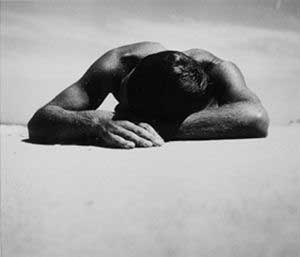
Max Dupain. The sunbaker.
And here is another:
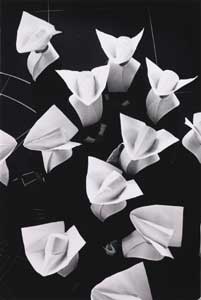
David Moore. Sisters of Charity. Interview here
The canon was put in place by the Australian National Gallery. This was done to make photography a part of high culture through constructing it as a fine art . This art was produced by the expressive heoric artist working in a craft guild studio. It involved sharp focus, strong light and unusual perspectives to capture the modern era. By being placed in the art institution it became art.
Of course, we know that photography is much more than modernist art. It is also a part of postmodernism:

A postmodernism that is takes many of its cues from popular culture.
Photography is also an integral part of popular culture ---part of the muck and shit. As an example we have this personal snapshot of our two poodles in Mallacoota:
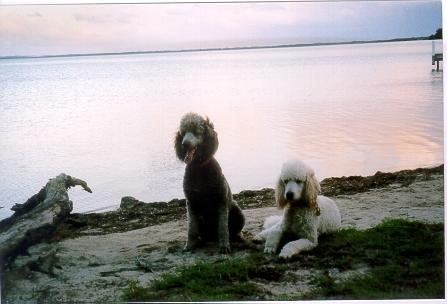
Even though anything can be art that snapshot is not art. It remains a lowly snapshot. Nor will it picked up by art curators and placed in the art gallery as part of the canon of art photgraphy. Not even by a postmodernist art curator.
We should remember that many of the modernist images that became part of the canon were actually selected from commerical practices: Thus:
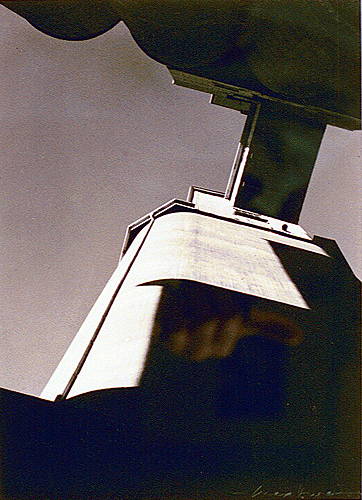
Dupain,Wheat Silos, Pyrmont
A classic modernist image. But it was appropriated from the commercial practices of the studio. So ou canot really look at the photo and discern the quality or feature that sets it off from every other photo that isn't art. It does look pretty much that art is whatever the art institution is talking about.
So why is one photo selected by the art instuitution rather than another? Consider the images of sexual beauty/fetish. This is a part of the world of sexual fetish:

and here is art. Thus:

Spot the difference between the two photos. Why is one non-art and the other art?
And we end up here. It's as good a place as any.
So we have different kinds of popular photography----snapshots, commercial, sexuality---that open up spaces from which we can begin to deconstruct art and the constructed canon. The assumptions underpining what Bloom is defending look to be very shaky indeed. What we get is little more than old-school outrage since there is little in the way of a long narrative of movement from lesser art forms to greater ones.
We can begin to do so by asking naive questions: what is photography for? What do people actually do with their photographs?
August 21, 2003
frustrating
I've been out of touch with what is happening in Australian photography for some time and I'm just begining to reconnect. I came across this issue of Photofile. It looked interesting given my interests in the urban suburban divide.
But nothing from this text is online. Frustrating.
So here is an image by an photographic artist whose work I have seen and whom I think is very good.

It's photographic work in the art institution that is informed by television. Dolls instead of people.

Why dolls?
Is it because white Australia did not, and still does not, see black Australians as people?
Do you remember the golliwogs that used to be be inside the houses with white picket fences. Those stereotypes become ingrained over time and cannot be easily thrown off.

And then it starts getting tricky when white dolls appear and it is photograph of a photograph:

These are works of art, defined as such by the institution of art.
So how come these are not simple fiats of individual will by lefty curators into reconcilation, land rights, public subsidies for minorties and harmony?
Does the art institution have reasons for constituting these images as works of art? Can they be considered good reasons?
Recall these.
The questions about the reasons of the art institution a constituting these as art works need to be posed because these images would not been accorded the status of art work in the 1930s or the 1890s. They would have lain outside the pale of history to use a phrase from Hegel.
The historical dimension of art is very important.
If only because pictorial representation has a history.
It's late. Time for bed.
August 19, 2003
Sontag: Regarding the Pain of Others#14
Rick's fourteenth post on Sontag's Regarding the Pain of Others continues the concern with Bataille. Rick links to a Van Gogh's painting of old peasant boots, but I will leave that to another post, since I want this use this one to bring Bataille into play since he provides another, and more interesting, way to talk about mutilated bodies.
In this particular post Rick gives us Sontag's comments on this photo that looks to be akin to human sacrfice:

Sontag says:
“Bataille is not saying that he takes pleasure at the sight of this excruciation (the photo of 'death by one hundred cuts'). But he is saying that he can imagine extreme suffering as something more than just suffering, as a kind of transfiguration. It is a view of suffering, of the pain of others, that is rooted in religious thinking, which links pain to sacrifice, sacrifice to exaltation – a view that could not be more alien to a modern sensibility, which regards suffering as something that is a mistake or an accident or a crime. Something to be fixed. Something to be refused. Something that makes one feel powerless.” (pp. 98–99)
Sontag's interpretation of Bataille concurs with my own on this photo made when I commented on Rick's thirteenth post here. As I mentioned there, the eroticism associated with the sexually submissive (not the sex slave) approaches this sense of suffering as something more than just suffering, as it is also a kind of transfiguration.
The experiences of Dirty Whore are more than a breaking taboos of bourgeois society. They involve something to be refused---(denied an organism by the man as master;) suffering (through the pain), being powerless (though being bound and a fucktoy for men) and a sense of pain linked to sacrifice and exaltation. The writing of the experiences of sex and violence over at Dirty Whore Diary are by someone who enjoys rough sex and dominant men. This is very different to the modern sensibility that regards suffering as something that is a mistake or an accident or a crime as in the Law and Order sex crime shows on free-to-television.
Dirty Whore's experience is closer to Bataille's understanding of pain connected to ecstasy: being sexually turned on from being humiliated and used. Consider this post:
"Because I spend my days as an aggressive, dominant, slightly bitchy, straight-laced professional, it turns me on to be treated as a filthy gutter whore sometimes. In the right mood, pain excites me. Bondage always does; the feeling of helplessness makes me wet and sets my hips churning every time. Humiliation, if followed by redemption, is an emotional rollercoaster that I'll ride on now and then."
This sexual exuberance for Bataille is what prevents us from being reduced to things that are used bureaucratic systems and corporations. It is an other world. For Dirty Whore the dominant /submissive world is where she can be antithesis of the in-control feminist she is when at work.
The emphasis in this other world is on the experience of being pushed to the physical limits. It indicates a violence of the disturbance; or a crack in the system. Bataille writes in his book, Eroticism:
"The violence of death and sexual violence, when they are linked together, have this dual significance. On the one hand the convulsions of the flesh are more acute when they are near to a black-out, and on the other a black-out, as long as there is enough time, makes physical pleasure more exquisite. Mortal anguish does not necessarily make for sensual pleasure, but that pleasure is more deeply felt during mortal anguish."
And what of transfiguration? Well Dirty Whore in the above paragraph speaks of the pain associated with humiliation, when followed by redemption, leading to emotional rollorcoaster. The religious language is there in the use of 'redemption', meaning something like deliverance from an ' X' through suffering. I write 'X' as a placeholder since Dirty Whore is not referring to a Christian understanding of redemption as a deliverance from sin through suffering, or as an atonement for guilt. I'm not sure what she means. It may mean feeling possessed, appreciated, safe.
In another post she speaks of "liking the pain as a man slowly enters me [in the arse] then I slip into a strange animalistic trance as he starts to move. I'll beg for him to fuck me harder." Animalistic trance refers back to the mystics. In other postings she refers to atonement in the sense of reparation given for an injury or wrong. God is dead here a religious language is beign used to express the expriences of sex and violence.
That then is the world Bataille inhabits and writes about. His world was the Parisian brothels of pre-1940. He wrote at a time when eroticism was considered a sin by Christianity. His texts are written by a man about his experiences with women as objects of desire and as a prey to men's desire. Bataille's writings represent the beginning of the sexual revolution that took off in the 1960s abnd have an historical feel to them.
In contrast, Dirty Whore is living after the sexual revolution. She lives outside the brothel world and she is writing about her desires. She says that "I don't really see myself as a whore, and except for a handful of times that I'll tell you about someday, I haven't been one in fact." She says that "I've worked as a stripper, a phone sex girl, and have done some web cam sessions, but those were diversions for me, not definitions." She talks in terms of "the relaxation of societal standards on the Internet that makes people engaged in any alternative lifestyle more likely to speak up." The 'filthy slut' is an identity that she reinvents, creates and enjoys. It is a shaping of her subjectivity.
Bataille reconnects transgression, sacrifice, the sacred, violence and sexuality. in this erotic world we are outside the control of reason; a world based around an experience of something bursting, of the violence accompanying an explosion. He say that the "final aim of eroticism is fusion, all barriers gone." Christianity, in contrast, created a sacred world in which everything horrible or impure had been excluded from.
the 'wow' factor in architecture
Instead of boring sustainablity for Adelaide our cosmopolitan dynamic free marketeers with a penchant for aesthetics reckon spectacle is the way to go:

Frank O. Gehry, proposed new Guggenheim on the lower east side of Manhattan.
It's bold. Its exuberant. It's dazzling. Its wow. it advertises itself. It's excess. Its dominating. Its world beating.
To hell with sustainability.
Gehry has the 'wow' signature:

Guggenheim. Bilbao, Spain
What can I say? It's sooooo 1990s.
Link courtesy of David at City Comforts.
This is the kind of architecture that the City of Geelong in Victoria lusted after. It too angled for a Guggenheim. It was a way to kick start regional development after deindustrialization of the 1980s. It was to be architecturally significant, and a huge money-spinner as it would be a tourist attraction in its own right.
In Adelaide there is strong public support and interest in shaping environmental policy through a redesign of built environmentand the quality of built form.
Sustainable Adelaide
I have mentioned in previous posts the possibility of a linear Adelaide reinventing itself to become a sustainable city. It is on the public policy agenda.
Three possibilities quickly spring to mind: water proofing Adelaide by recycling storm and waste water. Running Adelaide on solar energy as we have the sunlight to do it. Using wind power to generate electricity rather importing it half way across the continent through a national electricity market still dependent on brown coal-fired generators.
These are not difficult concepts to grasp. They require thinking of a city within, and dependent on, ecosystems. It means a shaking of the old ways of thinking about cities as machines; bringing nature back into the city; reducing the ecological footprint by more efficient use of resources; planning for greenery.
It is a pathway of urban design that I fear is not being taken. Adelaide has deep seated problems concerning sustainability as it has a heavy ecological footprint: it burns lots of fossil fuels; consumes more energy per capita than most cities; is profligate with water; has little in the way of innovative green industries and little government will to redesign the city or foster sustainablity practices in households and businesses.
I have to give credit where credit is due. Herbert Girardet, an urban consultant, has just finished his stint as a thinker in residence. His brief was to develop a strategy for Adelaide to become a Green city. He has the track record.
Here is an executive summary of his report.
August 18, 2003


August 17, 2003
cheesecake as subversion
Yesterday I wandered down through the central market to the city. I was in search of some second books on Cicero, Seneca and Montaigne. I had little luck. So I moved onto the avant garde and alternative bookshop Dark Horsey to pick up, and order, some books by Bataille.
The streets were more or less deserted even though it was a glorious sunny day. A few souls walking aimlesssly. Lots of people in the Internet cafe. The bookshops were empty. No singles looking for causal sexual encounters.
Everybody is reading Georges Bataille. That is the word on the avant garde circuit. Not in Anglo-American philosophy departments in regional universities in South Australia I might add. Of course Sydney, being the global city, would say that they are post-Bataille.
On the way home I had planned to have a coffee and glance through The Australian. I wanted to do the urban thing as well as search for hot cultural tips about the intellectual fashions. I wanted to bring junk for code up to speed as an avant garde site. A weblog that continually reinvents itself through constant negation. I was looking for suggestion on how to do this.
But the coffee shop wanted to charge me 50c to read Rupert Murdoch's rag. I gave the coffee a miss and returned home thinking about experimental writing and the academy. I had a glass of wine on the terrace in the late afternoon. Suzanne was down at Victor Harbor.
When I returned to the virtual world I discovered this had came floating through public opinion. I discovered that there are a lot of these kind of Babe sexblogs
UnaBlogger is different. It is beauty as subversion by a warblogger who once desired to be Editor-in-Chief of Slate, and is now everywhere and nowhere.
Cheescake as subversion? I had heard of women politicians being elected to the Italian Parliament through the simple electoral strategy of showing their breasts. Simple and effective. A brothel madam tried to get elected to the SA parliament (the upper house) here in Adelaide in 2002. She played it straight but failed. Pity. The Legislative Council could do with some real life.
For the record I voted for her. I did so on the grounds of decriminalisation of prostititution and occupational health and safety for sex workers). I had a romantic relationship with a Catholic sex worker in Toorak, Melbourne sometime ago. It was after I'd done a stint as conductor on the Melbourne trams to counterbalance being an economist in search of utility. Unlike the acceptance shown here, playing the role of dirty whore in sleazy situations undermined my friends identity, made her feel dirty and a slut and it lead to a fragmentation of her subjectivity. She felt she was becoming schizo. Instead of unblocked free-flowing desire there was a subjectivity in turmoil due to an emotional and sexual degradation from being an erotic plaything of men who abused her.
So can I understand sex as subversion that opens up into
So what to make of the Unablogger? Can the gesture to the trace of the Unabomber be sustained? Or is it a cheap postmodern play?
We are dealing Blogger here so the archives do not work well. But they work enough to see that there is no deconstruction of public opinion. But I did like this reworking of suburban guerilla. And this one of Tim Blair. Poor junk for code. It does not make the list. What kind of deconstruction can be made of junk for code I wonder. Perhaps something along these lines?
In the end UnaBlogger is all too surfacy and glossy. It does not step into the experiental world of sex and violence. It the lacks the rawness of human experience that blows up the conventions we surround ourselves with to feel safe and secure.
Bataille holds that pain shapes our character. Without pain you are nothing! Pain filled with jouissance that pushes reason, utility, law and language to the limit.
Subversion keeps circulating around with those desiring subjects who often thrive on sexual perversity. I cannot help but think of Bataille and his conception of bourgeois society drowning in sexual secrets and prohibitions and the sacrament being found in the brothels. The sacrament? It is the moment of orgasm rendering the separate and unified self into a physicality that is no longer located in one body.
Bataille transgresses that old sexual duality that still shapes our culture: the Victorian repressive sex interpretation of sexuality and its mirror liberationism that had lingered in the shadows of sexual repression for so long. It opens up sexuality as a fissure in which the experiences are difficult to express in language, and whose excess throws up violent images.
Hence we have a new form of seductive romantic contestation through the drive of sexual desire. That brings us into contact with Bataille.
A friend of mine with a PhD tried to teach Bataille in relation to Catherine Breillat's film Romance at a university in Adelaide. Some students complained. He was an casual teacher. He was fired on the spot for teaching pornography and corrupting the young.
Bataille is explosive.
August 15, 2003
Sontag: Regarding the Pain of Others#13
It was a pleasant suprise to arrive at Rick's thirteenth post on Sontag's Regarding the Pain of Others to discover that he too had encountered difficulties as I had done.
There is no photo juxtaposed to the Sontag text. What had troubled Rick?
He had reached the point of Sontag's book (p.98) where Sontag discusses Georges Bataille and his legendary photograph (1910) of a Chinese prisoner undergoing “the death of a hundred cuts”. As with me, the 'I' comes into the foreground. The 'I' was no longer in the background.
Rick says:
"Something has changed now, for me: something important in my understanding and relation with the material Sontag surveys in her small book...For the first time in this process, I imagined all of the photos and works of art I had posted to this point as a kind of gallery, and realized that I had begun to create an exhibition, a very difficult and horrible exhibition, something Sontag had chosen not to do in her book."
Rick reflects on the fact that Sontag had no images in her book other than this Goya that was on the cover:

Rick then says:
"And now another of her questions resurfaces, one I included in an earlier post:What is the point of exhibiting these pictures? But, this time, the question is to myself, an artist whose work often connects with similar issues, one who now finds himself, in this effort, a slightly bemused curator of an on-line weblog exhibition, yet incomplete, of images depicting human suffering, pain or torture."
So Rick elects not to post the Bataille photograph of a Chinese prisoner undergoing “the death of a hundred cuts".
The text by Sontag that Rick includes refers to her judgement that Goya's The Disasters of War are notable exception to her general rule that:
“most depictions of tormented, mutilated bodies do arouse a prurient interest…Goya’s images cannot be looked at in the spirit of prurience. They don’t dwell on the beauty of the human body; bodies are heavy, and thickly clothed.”
It seems we that had reached a tacit taboo. Where to now? We can do a negative dialectic of beauty to grasp the dynamic life inherent in the category of the beautiful; or step through the doors of horror into a world where art has an affinity with death.
Let us choose transgression and step through the doors. But before we do though, we can redescribe Sontag's 'the beauty of the human body' as the erotic. And in this world what seems strange from the outside is normal inside. Yet the insight we gain from this as we stand on the threshold is that the erotic--human sexuality, the world of the body----is constituted by taboos that surround it so as to allow the world of work, family and reason to be constructed. When artists begin to explore it, as Catherine Breillat did with

it activates a recoil that does not step through the door. The door signifies taboo. Hence the ambivalence. Beyond that door lies the world of death and sex, terrifying pleasures, and sacrifice to affirm the continuity of existence. It is a world where reason founders.
To step through the doors of horror we need to break the tacit taboo that keeps the horrible at a distance from us. Here is the photo:
Slow Death by Leng-Tch'e (cutting into pieces):There is true ecstasy in this expression.
Agony and ecstasy. This is a religious way of speaking that mediates on the fundamental contradictions of human existence and engages us at a very personal level. God may be dead as Nietzsche proclaimed but that does not entail the death of religion.
Stepping through the doors of horror is looking at the historical abyss. It is having one foot in the flesh of the orgy and one in the bones of the grave. Should we not try and get a hold on the cruel and schizophrenic nature of late 20th century techno-culture? Looking back we can see that the twentieth was a very cruel century. Why turn away from it? Why not critically confront it?
Many take the easy option here--and say the Soviet gulag was the work of the left; or that the Nazi holocaust was the work of fascists. It was them not us who did all those horrible, evil things. Denial is the option and the horrible is wrapped up in taboo. The 'I' is not involved.
Bataille is the metaphysician of evil specializing in blasphemy, profanation, and horror. I say breaking the taboos because Bataille's philosophy is about what is repudiated by civil society: shit, blood, sacrifice, deviance, violence. With Bataille we are inside the world of horror where the centrality of the erotic to human life is derived from the relation of the erotic to death.
Death is central to human life. Is this not the space of religion?
It is also the space that is explored by film makers confronting their nation's past; or exploring horror as in Ridley Scott's Hannibal.
August 14, 2003
landscapes
A break from the horrors of war:

Spring Brilliance at Kuaiji, 1977-79By Mu Xin (b. 1927)Ink and Gouache on paper
More on Mu Xin here in these notes for an exhibition held at the Asia Society in Sydney.
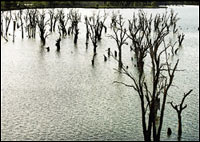
The landscape for me, living in the river country in Australia, is this:
unknown
A lament for a once mighty river that has now become little more than an irrigation canal.
The ancient river gums in the Chowilla floodplains that form part of the Murray-Darling river system are dying. They have not had a drink from a natural flood in 11 years.
More here
And this image won the inaugral Waterhouse natural history art prize hosted by the South Australian Museum.

James King “Winter Foliage 12 Oil on Canvas.
August 12, 2003
Sontag: between#12 & #13
My reading of the fragments of Rick's project on Susan Sontag's Regarding the Pain of Others has hit a flat spot. I really struggled with my comments on Rick's twelve post. I wrestled with Sontag's claim that:
"Most depictions of tormented, mutilated bodies do arouse a prurient interest….All images that display the violation of an attractive body are, to a certain degree, pornographic.”
I felt a closure here and I tried to open it up. But I felt that I never got to prise it open.
I sort of played around with the images of S/M to loosen up the pornography bit. I opened up a cutting away the closure but I could not do anything with it. I needed to say that not all depictions of mutilated bodies lead to a prurient response and that not all displays of attractive bodies are pornographic to a certain degree. Hence the appeal to Mapplethorpe ---for the display of attractive bodies.
But I lost it. This inbetween post picks up the thread. Here is something to help turn the cutting into a pathway:

It is by Peter Turnley
That is mutilation----charred bodies. There is no sense of prurience. It is horror. That sort of photography (or graphic representation) is what Sontag closes off. So what happens if we follow this pathway?
Well we can reinforce that it is pathway by contrasting it with the following photograph of rape in war:
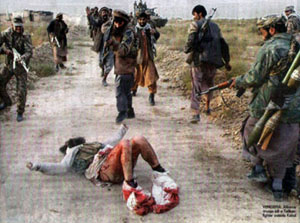
It's an execution by the Northern Alliance in Afghanistan.
That is an interpretation of what Sontag's could mean by her claim that "depictions of tormented, mutilated bodies do arouse a prurient interest." That image is shot from the viewpoint of the photographer embedded with the Northern Alliance. This is an illustration of the way the military uses rape as a weapon of war.
That reading can be reinforced when it is juxtaposed to this text:
"[Sergeant Bruce F. Anello] describes the grotesque pranks played upon corpses, the rapes, and the way platoons were 'willing to kill any body' simply in order to beat another platoon's 'kill record.'"
—from An Intimate History of Killing, p 205
Then, perchance, I happened to see a Robert Hughes doco on Goya, on ABC on Sunday night called Goya: Crazy Like a Genius. Boynton's comments on the early part of the doco and Hughes' sleazy remarks about Goya's nude (Naked Maja) can be found here.The doco had lots of very grim dark images:

Francisco Goya, From the Disasters of War
But there was little by way of sexual prurience or pornography being combined with horrific images on the doco. I guess Hughes would know if there were any. Or did he avoid combing the two? But Goya does seem to be another exception to Sontag's claim.
And it does depend on the sort of bodies we are talking about:

That is beautiful but it is not prurient.
So we have a pathway out of the Sontag closure. That's sufficient for now.
August 11, 2003
kissing in public places
If we live in postmodern times and the texture of our everyday lives is being reshaped lives, then in what we are our cities being shaped?
We can begin to get a handle on this in two different ways.
There is the relationship between competitive markets and our attachment to places. The competitive market overides places and this overriding shapes our urban form through the constant rebuilding of our cities. For developers buildings are a product, equivalent to Scotch Tap, since it is all about selling and renting space to be financially successful. The postmodern bit comes in with the signature building designed by superstar or celebrity architects to clearly separate the signature building out from the standardized and monotonous international package (eg., of a MacDonalds).
Secondly, we have the relationship between public and private. Here the hard oppositions of the past are easing and there is a blurring between private and public. A great illustration of this blurring is provided by David over at City Comforts Blog: kissing in public spaces.
Kissing in public spaces. Romance helps to make a public spaces our own place. As Harriet Festing says:
"The point is that people like places that they can make their own; places that they can shape, mold and influence. And most public spaces are heavily controlled; by designers who create paths where no-one wants to go; managers who won't let you touch the water; and by the lack of imagination of the people who put the space there in the first place."
A successful city is one that has popular public places where people gather and interact. It is not just about building more and more car parks so that people can shop in the CBD rather than in the suburbs.
Let's have more kissing in public spaces to keep them safe as non-market urban forms. This counters the transformation of public spaces along a waterfront or beach into an emporia of mass consumption and luxury residences as exemplifed in Holdfast Shores Development in Glenelg, Adelaide below:



That coupled with this is the form of pleasurable life of the postmodern market. It represents the encroachment of private institutions on public spaces.
What we have here is a city in full renewal mode. It ain't all that good. Not enough public spaces for kissing.
August 10, 2003
Sunday's photo
My scanner has arrived at long last. I pick it up early next week. So I will soon be able to start developing the photographic side of this weblog.
In the meantime a landscape:

It is by Frank Grisdale
Link courtesy of wood s lot
the spirit of instrumental detachment
I've come down to Victor Harbor for a break this weekend. It is mid-winter on the mid-southern coast of Australia.
Since I found the previous post on Sontag's Regarding the Pain of Others difficult to write. I struggled with it and I had a couple of goes rewriting it. This post is more personal and easier.
I wanted a break from being caught up in a free-floating postmodern world of urban life. It's a change. Down here on the edge of the southern ocean it is all wind, surf and sunshine; walking the dogs along the clifftops and being woken up at 5-6am by the standard poodles to go and hunt rabbits before the sun is up.
Yesterday was a delightful winters day; so still and sunny. Today it is bitterly cold. The wind is from the south and it has an Antarctic chill that cuts into, and freezes, the body. There is very little sun. So a holiday shack that is warm in winter, due to the winter sun warming up the rooms, is now very cold.
Such a physical experience gives a different perspective on, and a space away from, aconsumer capitalism that is re-shaping the fabric of what some still call our private life----identity, gender, sexuality and family life--through digital communications, market institutions and mass media. It is re-shaping that is creating a new subjectivity ----one of instrumental detachment based on the emotional contours of isolation, a sense of being adrift, being anxious and feeling empty.
I do not like that urban experience. I experience it as a form of damaged life. Hence my going and standing on the cliffs tops, feeling the wind and surf on my face, and then the chilling of the body. That touchstone experience is so different from the global images about modern identity on the television:----I'm thinking about the damaged postmodern life in New York as represented by the culturally cool Sex in the City.
A damaged everyday life because it is a life divorced from tradition; is freefloating, perfectly packaged gloss, narcissitic and structured around spiralling insecurities and endless self creating. It's pretty much a stylish life of unhappiness in a world of transient relationships with undecent men, that is presented as cutesy and loveable glam characters who consume fashionable luxury goods on credit.
This is the new global postmodern culture of individualism structured aroung being a celebrity. It is packaged to us as what we should desire; no, as what we are since it is a self-driven emergent culture of self-designed narratives and do it yourself identities. It is who we (well, mostly middle class women living in a global city) should become. What is being packaged here is the postmodern good life of the liberal market order.
juk. I'm no longer a fan of the show. Suzanne has guilty pleasures.
Michael over at Two Blowhards is no fan either. He says that he doesn't enjoy watching the Sex in the City show:
"I've watched a few episodes of Absolutely Fabulous and a few episodes of Sex in the City. Good stuff! Clever, funny, well-turned, exuberantly performed. Yet I didn't enjoy them and will probably never watch them again simply because the women portrayed in the shows are too much like many of the women I work with in my mediabiz job."
He says:
"I have an easier time watching "Ab Fab" than "Sex in the City" because the Ab-Fab gals are portrayed unapologetically as raging, unhappy, self-centered monsters, while the "Sex in the City" gals are presented as high-strung, maybe, but also cute and lovable. (Ah, American audiences and their difficulties with satire.) I watch the show thinking, "Cute? Lovable? How about selfish, hysterical and vain????!!!" (Then I pull myself together and change the channel.)"
I'm uneasy because of the unhappiness underneath the froth and bubble of the glamourous surfaces of this mode of individuality;and off side to the way the media package of the beautiful lives secrets an utopianism of the future good life in a global world. This may be the global texture of everyday life in the West but it ain't for me.
August 07, 2003
Sontag: Regarding the Pain of Others #12
The twelve part of Rick's project on Susan Sontag's Regarding the Pain of Others links the mutilation of bodies to pornography. The Sontag text says:
"Most depictions of tormented, mutilated bodies do arouse a prurient interest. All images that display the violation of an attractive body are, to a certain degree, pornographic" -- (Sontag, p. 95)
The image that Rick juxtaposes to this text is Andrea Mantegna's St. Sebastian:
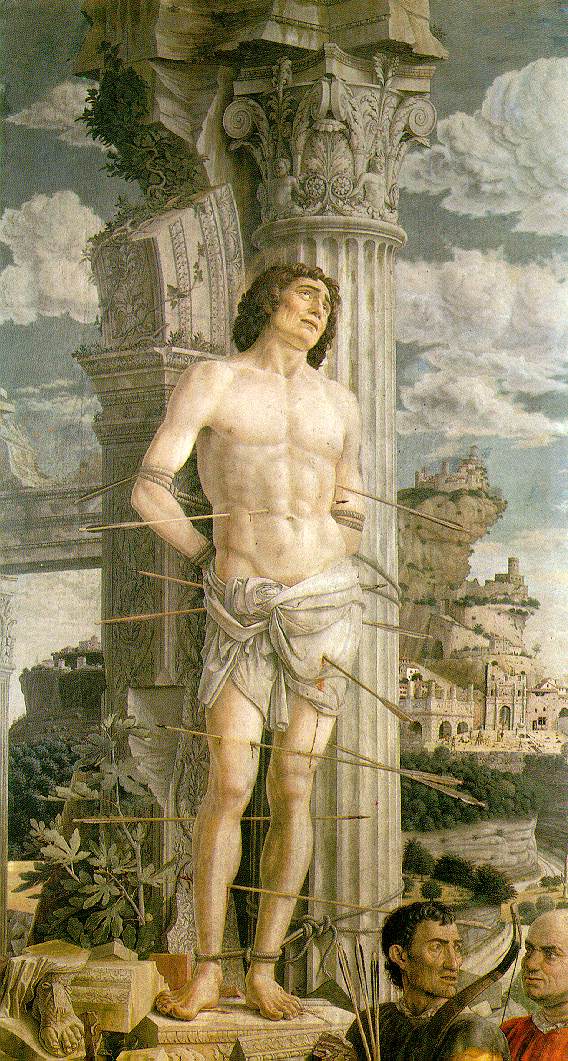
This is the biography of St Sebastian. He was a guardsman in the Roman army, a Christian martyr in the Rome of Diocletian, who survived, and then recovered from, being riddled with arrows. He was then stoned/clubbed to death on Diocletian, orders and his battered body was thrown into a sewer.
Rick asks whether this an example of an image that rouses a prurient interest in us and so is then partly pornographic. My first reaction is I don't know. My second response is that there is more going on here than depiction. We also have the process of reading and the interpretation of meaning.
St Sebastian is an image that is overlaid with a diversity of historical interpretation.
For instance, in the Renaissance image St Sebastian signified Christian courage. Yet he is in writhing in the ecstasy of the arrows that pierce his body. And he also represents Hellenic loveliness. St Sebastian has been contested through history. He becomes the patron-protector from disease. I
In our time--the twentieth century---St Sebastian's mutilated, attractive masculine body is given a gay reading that appropriates the image from the Catholics and then subverts it. The image is now interpreted as expressing homosexual desire, the isolationalism of the rejected homosexual and a prototypical portrait of tortured closet case: eg., this photograph by F. Holland Day
of trapped, doomed homosexual existence.
But there are other gay readings. St Sebastian has become a central but a central, albeit sadomasochistic, gay icon. This film by Derek Jarman is about faith, desire and power, raw lust and genuine love. Saint Sebastian has significance in this time of AIDS, due to his role as both an icon of tortured male beauty and as the patron saint of sufferers of the plague.
So it is about both the depiction and the interpretation of the image within a particular situation.
Let us come back to Sontag's ethical cultural criticism and her remarks that
"Most depictions of tormented, mutilated bodies do arouse a prurient interest. All images that display the violation of an attractive body are, to a certain degree, pornographic."
Sontag is saying that the representation of tormented mutilation of the attractive masculine body gives rise to a morbid fascination with sexuality, arouses lust or desire and gives rise to experiencing pleasure from pain. Well this response has be contextualised---and on way this can be done is with a Museum of Sex. (link courtesy of Michael over at Two Blowhards
My third response is that Sontag's cultural criticism is a particular and negative reading from a range of diverse, historical ones. Let us consider the pathway that takes us into pornographyby picking up on the trail that set in motion the culture wars of the 1990s in the US.
The contemporary example is the gay S/M world opened up by Robert Mapplethorpe's images of sado-masochism In 1990 Mapplethorpe's work in The Perfect Moment exhibition shown at the Contemporary Arts Center in Cincinnati, was seen as appealing to a prurient interest in sex and the images deemed offensive (ie., pornographic). The museum and its director, Dennis Barrie, were indicted for pandering to obscenity with respect to some of the gay sadomasochistic photos:
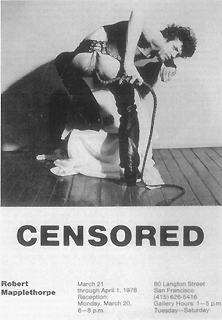
That is a tough and provocative image.
Now the ethics of this is not as cut and dried as that conservative reading makes out. That interpretation was contested. You can argue that Mapplethorpe's photography did recover gay sadomasochism from the sites of its subcultural practice, and bring it back to the avante-garde space of the alternative art gallery. Most of the images from Mapplethorpe's S/M project theatrically frame the modelling of the erotic costume and sadomasochistic equipment of the gay men. What is on display is an erotic theater whose players determine their own props and costumes, their own pleasures and script:

Mapplethorpe's critical image making shows that it is possible to avoid producing images of mutilated attractive bodies that arouse a prurient interest; and that it is possible to contest those images that display the violation of an attractive body as pornographic:
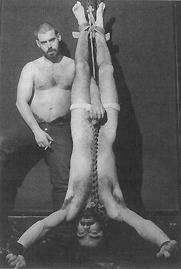
Mapplethorpe's S/M work is on the boundary between art and the pornographic. How do we negotiate the multilayers of this pushing the boundary and make them more fluid? How do we avoid tripping over and falling into the unethical?
Here is a suggestion. If the ethical in the aesthetic is a response to human suffering from our living a damaged life, then the ethical would avoid absorption and identification with the very objects that are fundamentally damaged. Such an identification would not allow the subject to recognize this damage as a damaged life.
To identify uncritically with a damaged life does not bode well for a making good on the damage inflicted us under existing conditions. A making good on the damage would involve a conceptual invocation of the emphatic possibilities of a better life that glimmers faintly in the damaged reality we currently live.
Update
I've really struggled with this post. I felt that I have not really been able to work the material so as to prise out what Sontag was getting at. I have started becoming troubled by Sontag----I sense a closure on Sontag's part.
But I cannot put my finger on it.
I've had another go here
August 05, 2003
the pleasure machine
This is the way our culture produces new images of celebrity.

She is a pop celebrity. We are being constructed as her fans even though are unimpressed.
Don't believe me? Look They're fans of this artist of Republican celebrity.
From the archives. That was before I released that I could come to know my own modest qualities through the differences with celebrity.
That's how the pleasure machine that creates celebrity works.
It's early days yet. The republicans have yet to connect to the pleasure machine; that the large network of skills and technologies that produce and distribute images of desire that seduces us into a world where we can belong.
It is through images of celebrities that I experience my feelings and perceptions as belonging to a common world--what Kant in his Critique of Judgement called sensus communis.
Disco nation
The big architectural post of yesterday wore me out.
Something lighter now. Some deconstructive political satire:

It's Pauline Pantsdown. She is a drag queen version of Pauline Hanson who once had many fans.
Pauline Pantsdown started life in disco nation singing I'm a Backdoor Man.
That is where the politics of culture once meet the culture of politics.
The New Urbanism
The aim of the new urbanism is to create livable cities.
This means the creation and restoration of diverse, walkable, compact, vibrant, mixed-use communities composed of the same components as conventional development, but assembled in a more integrated fashion, in the form of complete communities.
Adelaide is ideally placed to transform itself along these lines. Just look at the benefits for people:

An old idea being reinvented:
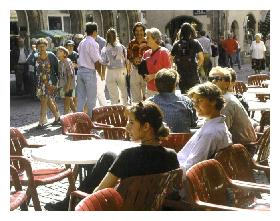
Alas, under the present pro-business City Council Adelaide is going to become more of an asphalt wasteland.
August 04, 2003
oppositions
I've been meaning to mention this for some time. It is an article by Roger Kimball called Architecture & ideology published in THE NEW CRITERION.
The link is courtesy of David over at City Comforts. David runs a great weblog. Have a read of it sometime. I have to admit that I do not read, let alone browse The New Criterion. Though David says that it is an interesting and learned journal of a conservative bent I have been put off with cultural conservatism of defending an embattled culture based on universal values in a post modern or virtual age. It all smacks too much of T.S. Elliot for me with too many sneers and snide remarks about postmodernism.
Kimball's text is a talk opens an exhibition. The is an exhibition of the architecture and urban design of Leon Krier. Krier is seen as the father of the New Urbanism movement in America. He designed the English model town of Poundbury for the Prince of Wales. The other architect included in the exhibition is the postmodernist Peter Eisenman His is a negative architecture: one that is radical and critical in that it confronts our experience of alienation and fragmentation in late modernity on its own architectural terms.
So we have two quite different responses to architectural modernism, eg.,

(Seagram Building, Mies Van der Rohe)
I have a deep dislike of corporate modernist architecture: I found its corporate form anti-democratic and totalitarian. My philosophical sympathies lie with the neo-Nietzschean Eisenman, but my heart lies with the new urbanism. That movement is about reforming the design of the built environment, and raising our quality of life and standard of living by creating better places to live. It is concerned with the revival of our lost art of place-making through a re-ordering of our urban built environments so they are more sustainable and people friendly.
This then is an exhibition of polar opposites. So what does Kimball make of it?
Kimball says:
"...the subtitle of this symposium—“Two Ideologies”—may have a useful clue to at least part of the answer. It is, I think, a spectacularly apt subtitle. For with these two architects we really are dealing not simply with radically different approaches to architecture but with two opposing ideologies."
Kimball plays around with 'ideology' before settling on understanding it terms of the two architects making
"... efforts to recast architecture on the basis of a specialized program or agenda that takes its cue as much from extra-architectural considerations as from architectural ones."
That's understandable. If you are going to dig your way out of modernism, then you need to do more than talk about architectural form since modernsim was deeply interwined with social, economic, and political processes of contemporary life.
Eisenman represents deconstructivist architecture plays with form, he deconstructs function, he dislocates the way we live in space, he digs away at the metaphysics of architecture, or what architecture should be, so that the process of dislocation can allow new possibilities of occupiable form.
It looks like revivifed modernism to me---the pure pursuit of form:

Frank House
It is an autonomous architecture that is removed from reductive functionalism and the displacement of architecture from any sense of context:

Columbus Convention Centre
Kimball has less to say about Krier. This work is equally sweeping and explicitly anti-modernist. It appears to be a traditional urbanism:

Poundbury
It aims to avoid suburban sprawl to create a healthy urban life centred viable communities. Architecture help us find a place in the world, and in history too: ----Windsor Village Hall, Windsor, Florida:
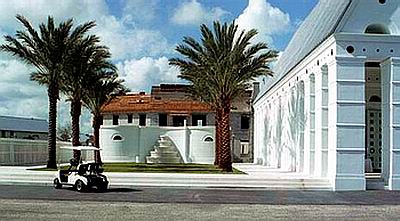
This urban design is based on local vernacular as the basic architecture. Rather than economics and industrial production dictating the form of the city; the cities' form, organic nature and moral order qualifies and shapes the forms and of production and of exchange. Architecture is bought back into the realm of dwelling.
Having outlined both sides of the opposition Kimball then tries to make sense of the opposition by giving it some sort of context. He says:
"I believe that if we are to get a fruitful perspective on the opposition named in the title “Eisenman/Krier: Two Ideologies,” we need to put that opposition in a wider context. One way of doing that allows me to introduce... the English architect and architectural historian Geoffrey Scott."
Why Scott? According to Kimball he makes the body the indispensable measure in architecture and enlists humanist values for architecture. Consequently, architecture can never be judged by aesthetic criteria (he means beauty) alone since space is shaped for people to live with and in.
And that's it. Apart from some admonitions. It ends all a bit flat really.
August 03, 2003
looking horror in the face
Whilst working on my comments on Susan Sontag's Regarding The Pain of Others I recalled the work of the German expressionists, expecially Max Beckmann.
This is a self portrait:
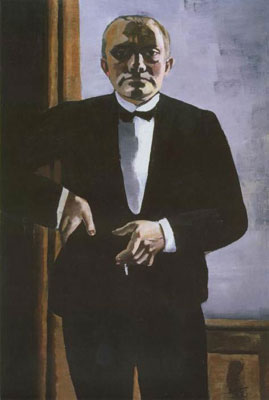
An analysis of Beckmann's faces can be found here
I recalled Beckmann because I remembered the painting from studying art history at university called The Night:

It depicts urban horror.
Lo and behold there is a current exhibition of Beckmann's paintings at MOMA You can view more of Beckmann's paintings here
I will come back to Beckmann and the Australian expressionist Albert Tucker with future comments on Susan Sontag's Regarding the Pain of Others.
affirmation
This may be of interest. It is an exhibition entitled Women of Our Time at the National Portrait Gallery. Link courtesy of Ariana French at Artnotes
I generally find national portrait galleries overly stuffy and avoid them. But this exhibition is very affirmative. Rightly so. The achievements of these women should be celebrated.
Here is a site that explores the work of women photographers.
One women photographer who should be celebrated is Imogen Cunningham, who made a living doing portraits:

She was an early Modernist in the West Coast American style, and did close up studies of plant forms in the 1920's and 1930s:

Most of this work was about beauty as form. This school of photographic modernists saw themselves as artists and understood art in terms of beauty.
More of Cunningham's work can be found here
You can find more about Imogen Cunningham here and here.
I admired the work entitled After Ninety. where she photographed people in their nineties. A book was published posthumously in 1977.
After ninety. That is what I call affirmation.
And today? Courtesy of Rick over at Artrift we have the work of Sally Mann. She has has integrated the camera into her everyday life:

We then get portraits of her family such as this:

In aesthetic terms it is beauty and ugliness linked dialectically. We have moved a long way from the early photographic modernists.
The avant garde dream of art being integrated with life has been realised by photography in a way that affirms everyday life.
August 02, 2003
places
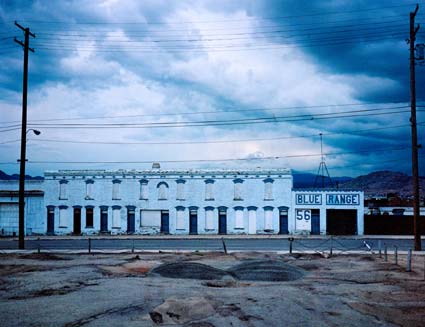
Butt, Montana,
From an exhibition of Wim Wender's photographs of places at the Museum of Contemporary Art, Sydney. The exhibition is called Pictures From the Surface of the Earth.
Both the Museum and Wenders have fallen foul of the regulations governing photography at Uluru-Kata Tjuta National Park aimed to protect the sacred sites of the traditional owners.
One of the disputed images is called Valley of the Winds, Northern Territory, which is a photograph of a a sacred site in the range of mountains known as Kata Tjuta.

wish it were otherwise
It is old news I know.
This is the building that has been selected for the World Trade Centre site:

It is by Daniel Libeskind
I preferred this one by Think Design:
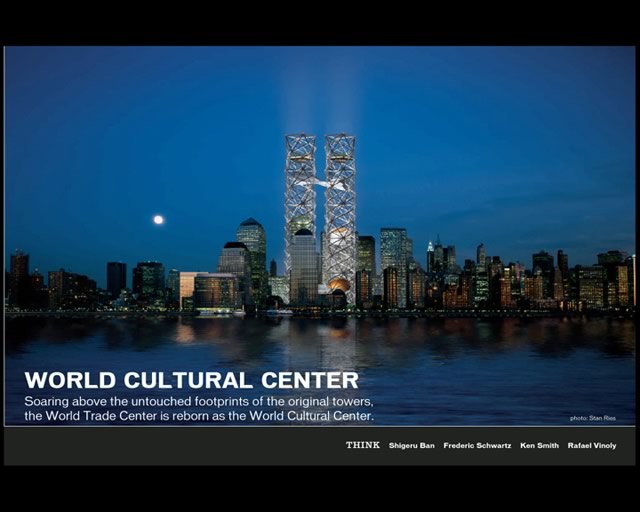
It is more iconic in terms of the New York skyline.
But read the variety of views of the original designs from the design public. The concentration has been on iconic architecture form. What were the forms for? They are not about how people live on the sidewalk, or how they live their lives in urban spaces. They are not about making a shift to sustainability.
Money rules celebrity iconic architecture. As Libeskind is going to find out in more ways than one. It looks as if the visionary architect has been sidelined into an advisory role. I wish it were otherwise.
Brian thinks its good news. But these are good questions.
But Daniel Libeskind does design great architectural forms. Just look at his extension to the Denver Art Museum:

(Link courtesy of Rick over at Artrift)
You do not see architectural forms like this in Adelaide. I wish it were otherwise.
the workings of the art institution
Consider this painting:
It is by Magritte. It is entitled, 'This is not a pipe.' It is not. It is a painting of a pipe.
The implication?
Art is not a mirror of the world. You can see this with this piece by Duchamp:
An ordinary urinal is placed inside the art institution. It becomes art.
Duchamp did the same with this bicycle.

Such is the power of the art institution.
Sontag: Regarding the pain of Others # 11
The eleventh part of Rick's project on Susan Sontag's Regarding the Pain of the Others deals with the ethics of photography. My comments on the tenth part can be found here
The relationship between ethics and photography is usually discussed in terms of the ethics of manipulating the image; even more so with the digital turn.
But the topic of ethics and photography is much broader than this. For instance, as photographs of certain areas of the cultural landscape of Kata Tjuta:

(photo by
Quang-Tuan Luong/terragalleria.com)
and Uluru:

(photo by
Quang-Tuan Luong/terragalleria.com)
in Central Australia are not permitted by the park's traditional owners. Thus the Valley of the Winds at Kata Tjuta is off limits to photography, as it is a sacred site. Taking photos of this area is considered to be wrong and immoral.
We can broaden the discussion on the ethics of photography by taking these considerations by Grazia Neri on board:
'The 20th Century is the century of photographs. ... Joy, pain, birth, death ... everything is visible and photographers themselves no longer recognize the limits of the permissible, beyond which their eyes, their cameras, the final product may wound the people photographed or the public...
..... feel strong perplexities about news items. I do not agree with the publication of photographs that celebrate private pain, such as those showing a crowd of people in an airport who know that they have lost their loved ones in an accident, or people who have been arrested. I cannot bear, either, photographs taken in courtrooms, and I appreciate the law that exists in some American states banning the use of cameras in courtrooms. For children in difficulty, I believe that the law on privacy has made some proper corrections to the excesses of past years, but care is needed. Obscuring the face of the child is not sufficient, since even a coat can make a person recognizable and therefore vulnerable. I felt sorry for the life and death of Lady Diana, but I was indignant about the unfair accusation of photographers in contributing to her death. It is possible to escape the flashes of the cameras. All one has to do is to avoid the St. Tropez - Emerald Coast - Paris Ritz "paparazzi tour.'
Now with all that on the table we can turn to what Sontag says on ethics and photography. Once again we deal with the issues through the juxtaposition of photograph and text. The photograph selected by Rick is this one:

It is of the lynching of Thomas Shipp and Abram Smith and a large gathering of lynchers. (August 7, 1930, Marion, Indiana) – The photo is from the collection of lynching photos at “Without Sanctuary” (it can be found as no.27) and the additional information refers to the mob breaking into a jail, beating the African Americans senseless, mutilating their bodies stringing them up, then posed for their photos under the tree.
And the text? What does Sontag make of this? She begins by saying:
“The lynching pictures tell us about human wickedness. About inhumanity. They force us to think about the extent of the evil unleashed specifically by racism." (Sontag, p.91)
That is fair enough. However, Sontag avoids the politics of lynching in the US, since her words---'Wickedness', 'inhumanity' and 'evil'---- are the categories of ethics. This ethical language is entirely appropriate when dealing with the suffering caused by racism.
What does Sontag say about this photograph? She points the finger at the photographer, the spectators and us. She says:
"Intrinsic to the perpetration of this evil is the shamelessness of photographing it. The pictures were taken as souvenirs and made, some of them, into postcards; more than a few show grinning spectators, good churchgoing citizens as most of them had to be, posing for a camera with the backdrop of a naked, charred, mutilated body hanging from tree. The display of these pictures makes us spectators, too."
We are spectators as readers of the image. We are reading an historical image looking at the past practices. For some of us readers we are looking at history of a foreign culture. From the perspective of someone in living in Australia, where capital punishment is banned, our initial response is that we are looking at a barbaric custom of the US.

It is very difficult for us in Australia to understand this custom with its roots in slavery based on a master slave relationship. Difficult until we think of the way that aborigines in Australia have been treated by whites that I referred to when commenting on the fitfh part of Rick's project.
Sontag then poses a question. She asks, "What is the point of exhibiting these pictures?" It is a good question because the cultural politics of these photo postcards are quite different from the popular song, Strange Fruit.
We can interpret 'exhibiting the photos'in two ways: then or now.
If now, then the first response is that the exhibition of the photos now [in a book (see more backlist) and online] is an uncovering a forgotten history. In Australia the exhibiting such photos would be a counter history to what has been buried in pioneer texts such as this.
The phrases "when local aboriginal attacks became fierce" a fourth reserve "became an area for the benefit of Aboriginal people; "the recorded history of the reserve [can be gleaned] from the additional information in Police Archives in Brisbane"; "the term 'dispersed' in the literature and police dispatches when made in reference to dealing with Aboriginal people was in fact a code for code for killing Aboriginal people in the early days.
Another history can be told about the killing of indigenous Australians. On such history is here
'Exhibiting the photos then refers to exhibiting the photos as postcards in the early twentieth century. Now these photos are not simply historical documents:

This is more than a visual report. Postcards such as these are political statements in a campaign waged against African Americans. The images are being used as a political weapon in a campaign of terrorism in the American South.
The text to the above photo postcard (taken around 1900) says that it is the "bludgeoned body of an African American male, propped in a rocking chair, blood splattered clothes, white and dark paint applied to the face and head, shadow of man using rod to prop up the victims head." (location unknown)
The additional information refers to the mob taking 5 African Americans from civil authorities, torturing them with knives, before hanging them and riddling the bodies with bullets. It was one of the largest multiple lynchings in the 20th century and it is about power. The leaders of the mob were caught and imprisoned by the state government of Carolina in an attempt to restore law and order.
The local photographers were a part of the mob. They sided with the mob.These are not critical images. They affirm what is going on. As can be seen here with the uses made of the postcard. For instance,

The hair in the frame is that of one of the victims.