« October 2004 | Main | December 2004 »
November 30, 2004
first indications
 Here it is. Australia's 2 billion current account deficit last month takes the yearly shortfall to a record $20 billion.
Export growth has been lacklustre (with a decline in manfacturing exports) whilst imports are booming. Hence the current account deficit.
What to make of it?
Josh Gordon in The Age points out, the latest current account deficit is larger, as a percentage of the economy, (7 per cent?) than when former treasurer Paul Keating warned 18 years ago that Australia was in danger of becoming a banana republic.
Gordon says:
"Australia's current account deficit as a proportion of the economy is now higher than in the United States, where investors are offloading US dollars on concerns that the situation is not sustainable."
Should that not undermine the Coalition's sound economic creditionals? Is that not a sign of bad economic management? Do not record trade deficits coming in trend terms virtually every month say that there is something of a crisis here?
Bu there is so little criticism. It's all optimism.
The Australian Financial Review has no comment. Alan Woods in The Australian says no worries. Foreigners will happily keep on funding the deficit and the banana republic days are well and truely behind us. And the Reserve Bank does not think that monetary policy can do anything about the current account deficit.
That leaves the responsibility with the Treasury. Peter Costello, the federal Treasurer, is relaxed and comfortable. He suggests that it is a function of the drought and the $US adjustment. He supports the US pressure on China to revalue its currency. Little is said about the 29 trade deficits in a row.
The Australian is also relaxed. The international market will do its magic:
"In the 1980s this would all have been the trigger for "banana republic" talk, but times have changed. Australia's product and labour markets are flexible enough to make the necessary adjustments, and a flexible exchange rate can always adjust to make imports more expensive and exports more attractive."
'Tis the invisible hand at work again? Not quite. We still need to get the fundamentals right:
"What yesterday's worrying numbers show is the need to plough ahead with a reform program that will improve productivity and make our exports more competitive. For starters, a new round of workplace reform can hedge against looming skilled labour shortages in export-oriented industries. Last month, the Productivity Commission identified infrastructure and service delivery as the next competition battlegrounds and, with many of our ports straining past capacity, the relevance for exports is clear."
Little is said about the dangers to the international economy posed by the twin deficits of the US economy, or its structural weaknesses.
John Quiggin has a different story to tell. It is entitled 'Looking over the edge'.
Posted by Gary Sauer-Thompson at 9:49 AM | Comments (5) | TrackBack
November 29, 2004
Janine Haines: in memoriam
Federal Parliament paid its respects and tributes to Janine Haines, the former Democrat leader, who died last week.
I'm currently reading her book Sufferage to Sufferance: 100 years of women in politics. In it she remarks that she once commented to a forum in 1990 that:
"...it has been my misfortunate lot over the last 25 years of my life to belong three of the most reviled, underrated and overworked professions in the world. In that time I had been, occassionally simultaneously, a mother, a teacher and a politician. If one of me wasn't being blamed for the problems of the world one of the others was."
She said that the response that greeted these throwaway lines indicated that she wasn't the only one in the room who occassionally felt put upon.
Haine's book is written within the enlightened liberal feminist tradition, and is primarily concerned with the discrimination, prejudice and hurdles women had to confront and fight to make their career in politics. It is concerned to vindicate the rights of woman.It's criticism is that Western society does not guarantee to women all the rights that it considers appropriate to the status of being human. So the argument is that the liberal principles of equality, freedom and equality of opportunity must be fully extended to women.
Hence Haine's encouragement and support for such measures as anti-discrimination and equal pay legislation in the hope that they will help to end the discrimination against women.
From I understand from listening to the various parliamentary tributes in the Senate Janine Haines was a social liberal, which is to be distinguished from the laissez-faire liberalism that re-emerged since the 1970s and 1980s as ‘market liberalism’ or ‘neo-liberalism’ or ‘economic rationalism’. Social liberalism works with the idea of the ethical state committed to the common good and equal opportunity. This is sthe tradtion of the 'fair go', which gave rise to the distinctively Australian institution of wage arbitration, and to other aspects of the welfare state such as public education and health, parks, unemployment benefits and pensions.
Posted by Gary Sauer-Thompson at 5:31 PM | Comments (0) | TrackBack
November 28, 2004
Greenhouse sceptics
 This is a good article on the Greenhouse sceptics by Melissa Fyfe in The Age. Our climate has changed. What has caused it?
The sceptic's position, as outlined by William Kininmonth, former head of the National Climate Centre, part of the Bureau of Meteorology, in his book Climate Change: A Natural Hazard, is that global warming is a natural process.
The implication is that a drier, hotter world represented in Jason South's photograph is not caused by humans burning fossil fuels.
Their politics is pretty clear and upfront. It is about the continuation of cheap energy for the energy intensive industry, and that industry avoiding any payment for the costs of the environmental consequences (increased carbon dioxide emissions) of using cheap energy produced by coal-fired power stations.
The Lavoisier Group says that the context of them asking their questions about science of climate change undertaken by the Intergovernmental Panel on Climate Change (IPCC) is:
"...one of concern for the future of Australia as a free prosperous and independent nation; a nation whose economy has developed over the last fifty years on the basis of cheap energy and an abundance of mineral and agricultural resources. More recently Australia's manufacturing industries have increasingly become globally competitive, but more often than not, that competitiveness has been based on the abundance of cheap energy which we have taken for granted. Our economy is now at risk from the imposition of a carbon tax (a tax on burning fossil fuels) which will turn our cheap energy into expensive energy, with serious consequences for every Australian."
These free marketeers have no concern for, and are in fact opposed to, shifting the policy compass to a sustainable economy.
They assume that business and economic economic progress is a snug fit. It is a category mistake to ask businesses to achieve broader social goals. Doing so risks undermining the very competitive free market economic system in which business activity leads to opportunity and prosperity.
From what I can gather Kininmonth's book is directed at the IPCC's Third Assessment Report.
It is one thing to raising justifiable concerns about the limitations of current global climate models and their ability to indicate future regional patterns of climate change. It is another thing to say that the limitations of the models imply that the observed global warming over the past century is entirely natural in origin. That is a big claim.
Bridging the justifiable concern about the global climate models and the claim that global warming is entirely natural is the politics. That bridge is signified by the use of 'nonsense', 'bizarre', 'beggaring belief' or 'alarmist' to describe those who say that the observed global warming of the last hundred years has natural and human causes. When you hear those words it is reasonable to think in terms of science aligned with the fossil fuel lobby.
Posted by Gary Sauer-Thompson at 7:49 AM | Comments (0) | TrackBack
November 27, 2004
Israel, settlements, research institutes
The pro Likud Israeli supporters in Australia are generally silent about the continuing expansion of Israeli settlements, let alone acknowledging that they should and can, be halted and reversed.
Does not Israel's two-state solution mean getting the settlers out of the occupied territories?
Tony Judt asks:
"What are the chances of an American president in the foreseeable future forcing Israel not just to stop colonizing the Occupied Territories but to dismantle its holdings there and retreat to the 1967 frontiers? I don't mean the US saying that this would be a nice idea, or tut-tutting when it doesn't happen; I mean forcing Israel to comply right down the line (and, yes, exerting the same pressure on Palestinians, which is a lot easier to imagine)."
I would say that under the current Bush administration the chances are zilch.
More on the settlements problem here and here.
As for the research side of things I've already made mention of the bias of the Australia/Israel & Jewish Affairs Council (AIJAC). This says that it is the:
".... premier public affairs organisation for the Australian Jewish community. Through research, commentary, analysis and advocacy, AIJAC represents the interests of the Australian Jewish community to government, media and other community groups and organisations. It has professionals dedicated to analysis and monitoring developments in the Middle East, Asia and Australia."
I have questioned the AIJAC claim that it "represents the interests of the Australian Jewish community" by suggesting that it's bias is pro-Likud Israel.
A similar situation can be found in the US with the Middle East Media Research Institute. It says:
"The Middle East Media Research Institute (MEMRI) explores the Middle East through the region's media. MEMRI bridges the language gap which exists between the West and the Middle East, providing timely translations of Arabic, Farsi, and Hebrew media, as well as original analysis of political, ideological, intellectual, social, cultural, and religious trends in the Middle East."
However, its selections are onesided in the sense that it has both a tendency to select anti-Israel content, and has a tendency to depict the Arab world by highlighting the more negative aspects of Arab societies.
Juan Cole highlighted MEMRI's bias: more specifically funding of $60 million a year, its clever cherry-picking of the vast Arabic press to make them look bad, and itis part of a public relation campaign on behalf of the far right-wing Likud Party in Israel. The response was intimidation of Cole through being threatened with a SLAPP. We know this legal instrument well from their use against environmentalists in Australia. They are designed to attack the critic's bank account, close down the cut and thrust of public debate, and to prevent political speech.
I'm with Cole on this attempt by research institutes to dampen down critique, because critique is the lifeblood of democracy.
You can find more on MEMRI seeking to use the legal system to silence people who disagree with its politics at: Abu Aardvard; at the Agonist; by Atrios; at American Amnesia; by Henry Farrell at Crooked Timber; by Brad DeLong; and Kurt Nimmo over at Another day in the Empire.
Posted by Gary Sauer-Thompson at 5:02 AM | Comments (0) | TrackBack
November 26, 2004
ALP: bloodletting
The bloodletting in the ALP sure is going on for a long time. Too long.
The media flows are saying that everybody wants a piece of everyone: the feds want some blood from the state, the states are only willing to bite some flesh not give blood; the right wants to blow things up; Latham's friends are miffed by the positions being given to his enemies; those with positions and influence in the party are annoyed with the leader's autocratic style, caucus is divided etc etc.
A light moment:

Leunig
For the intertextuality of the Leunig image, see this image.
No-one, it seems, is willing to cut anyone any slack in the ALP these days. Forgiveness is out. Payback is in. They're even back to talking about leadership changes, disunity being death and dead parrots. What is not being talked about is caring for disadvantaged Australians. Equality has long been forgotten.
Meanwhile the wine will continue to flow freely amidst the jubilant laughter of staffers of the Liberals and Nationals, who will be dining on the pavement tables in Manuka and Kingston next week. At some point they will need to remind themselves about heeding John Howard’s warnings about the dangers of hubris and triumphalism.
Labor's electoral loss was not really an issue of leadership. Mark Latham as leader is not responsible for the failures of the past three elections. Would it not be more fruitful for the ALP to have a debate about the relevance of the Third Way adopted by the ALP? There should be such a debate given that the ALP had largely opted out of the economic debate in favour of social policy.
There is one happening. The debate has moved on from the 1990s concerns of civil society versus a statist bureaucracy to the one about values and the suburbs. As Christopher Scanlon argues:
"Latham is essentially following the [Third Way] script in courting the "army of contractors, consultants, franchisees and entrepreneurs. He is attempting to appeal to groupings who traditionally vote conservative and have regarded the labour movement with suspicion, which has been returned in kind. That's thoroughly consistent with the third way."
The ALP lost the last federal election in the suburbs, and it will not be able to return to government without winning back the lost suburban voters.
The ALP did try this to do this. Remember its talk about the aspirational new middle class in the outer metropolitan seats? It had forgetten about the suburban PAYE section of the middle class who once formed Labor's base? The danger with this strategy, as Scanlon points out, is that the ALP may alienate its traditional supporter base, while becoming indistinguishable from the conservatives. The electorate is left with a choice between a pale imitation of the right, or the Real McCoy.
In the last election Australia voters opted for the Real McCoy observes Scanlon. Scanlon says that it is time for something new. "As a strategy for winning government, the third way in Australia is a dead dog."
Is it? What is the something new? That is what the ALP should be discussing instead of tearing itself to bits.
Posted by Gary Sauer-Thompson at 9:14 AM | Comments (1) | TrackBack
November 25, 2004
China puts US in its place
 This report in the Financial Times says that China's central bank has offered blunt advice to Washington about its ballooning trade deficit and unemployment. Li Ruogu, the deputy governor of the People's Bank of China, warned the US not to blame other countries for its economic difficulties.
The US has been putting a lot of pressure on the Chinese to revalue their currency. In response Li says that America's trade deficit of 6 per cent of GDP is not sustainable. Then he adds:
"The appreciation of the RMB (Chinese currency) will not solve the problems of unemployment in the US because the cost of labour in China is only three per cent that of US labour. They should give up textiles, shoe-making and even agriculture probably.They should concentrate on sectors like aerospace and then sell those things to us and we would spend billions on this. We could easily balance the trade.”
No doubt the US Treasury will thank the Chinese for this insight and advice.
Maybe our federal Treasurer, as a good IMF man, should enter the international economic debate and start tell his American friends a few truths about prudent economic management.
John Snow, who runs the US Treasury, would listen to a loyal servant, would he not?
Meanwhile the $US continues to slide. The Russian central bank is now hinting that Moscow would step up its ongoing policy of shifting more of its $113.1bn of foreign exchange reserves from dollars into euros. Will the Japanese diversify their reserve holdings to protect against a dollar fall? How long can the Bretton Woods system depend on the dollar reserve accumulation game?
General Glut's Globbog has more. So does Rob over at Blogorrhoea
Update
There has been a relative silence in place about the policy implications of the $US dollar fall. Does this reflect a faith in orderly market adjustment? Or an agreement being reached at the G20 that Asia would allow its currencies to appreciate against the dollar? We know so little about the governance of international currency markets.
I would suspect that the recent slide in the dollar would also provoke widespread discussion in China about the possible losses being suffered, due to the country’s enormous foreign exchange reserves. (China has a $50 billion or so current account surplus and its reserves rose from US$496.2bn to US$514.5bn.) Are the Chinese quietly reducing their holdings in $US to encompass a greater euro weighting ? When will China break its current dollar peg?
The other policy consideration, as Brad Setser observes, is the need to intervene to prevent the siphoning away of growth by the undermining exports from currency revaluation. According to Brad DeLong European leaders have begun worrying openly that the dollars fall and the rise of the euro might damage their export-driven economic recovery.
The same situation applies in Australia.
Posted by Gary Sauer-Thompson at 7:28 AM | Comments (1) | TrackBack
November 24, 2004
Stiglitz on the US economy
I have begun an argument that America's twin deficits mean that the US needs to get its economic house in order. Support for this position comes from Joseph Stiglitz, the Nobel prize-winning economist, in his recently outlined views of what is wrong with the U.S. economy in a speech to the Wharton Investment Management Conference last month.
This post is a paraphrase of The Big Picture's summary of Stiglitz's criticisms of President Bush's economic policies. These are:
President Bush's economic policies have failed to spur growth, while exacerbating rising household indebtedness;
In the last four years, the US has failed the challenge of increased productivity and lost the opportunity it affords to raise living standards. Instead US companies took the path of fewer workers and less hiring;
That meant the US economy limped along losing jobs (net one million new jobs) for the first four-year period of the Bush administration instead of creating something like six million or seven million new jobs. The only part of employment that's growing is the public sector;
The unemployment rate (around 5.4% ) understates job problems as it doesn't include people who have dropped out of the job market and it fails to account for underemployment (that is, people who work part-time, often without benefits, but want full-time work);
The Bush tax cuts failed to stimulate the economy, thereby forcing the Federal Reserve to lower interest rates to historically low levels. Despite this there is still too little business investment;
Companies don't want to borrow -- even at low rates of interest -- because there is still too much excess capacity;
Reducing taxes for wealthy Americans didn't help the economy whilst cutting the corporate dividends tax rate was merely a tax cut for the rich. Some corporations don't pay tax. If these firms pay dividends and those payments are tax exempt for shareholders, then the government never taxes this money;
Instead of lowering the tax on dividends Bush should have provided investment tax credits for companies;
A rather devastating critique don't you think? Gives you cause to worry about the economic policies of the Bush administration does it not? John Quiggin's post about empty containers and the trade deficit provides more support for the argument that the US needs to get its economic house in order.
More reasons to worry. The US spin is that responsibility for the US economic problems lies with others. As Stiglitz shows US policy makers should bear primary responsibility for the US trade deficit.
Posted by Gary Sauer-Thompson at 7:29 PM | Comments (0) | TrackBack
November 23, 2004
mix 'n shake
Let us put three things into the mixer.
First, this news account of Colin Powell's resignation. According to this report Powell thought he could use the credit he had banked as the President's 'good cop' in foreign policy to rein in Ariel Sharon (Israel's Prime Minister) and get the peace process going. He was wrong:
"Colin Powell, the outgoing US Secretary of State, was given his marching orders after telling President George Bush that he wanted greater power to confront Israel over the stalled Middle East peace process...Vice-President Dick Cheney and his fellow hardliner, John Bolton, an Under-Secretary of State to Mr Powell....wanted to make Iran's alleged nuclear bomb aspirations and support for Islamic terror groups the foreign policy priority and believed that Mr Powell would back away from a confrontational approach...Prominent neo-conservatives in Washington make no secret of their desire for regime change in Tehran, although few believe that a full-scale military operation is a viable strategy. Instead, the emphasis is on establishing economic sanctions as a means to squeeze the ruling mullahs."
This probably means that the US may tacitly back some Israeli air strikes on Iranian nuclear plants.
Then we can put this ingredient into the mix:

Tandberg
And then put this opinion piece by Amin Saikal into the mix:
"American voters, by re-electing George Bush with a clear mandate to pursue his first-term policies, have potentially set the scene for more confrontation between the United States and its close allies, and the forces of radical political Islam. The outcome will be critical in determining the future of world order....many ordinary Muslims around the world are now bound to become more wary of US policy behaviour than ever before.They are likely to take extreme exception to Bush's now well-known personal identification with Christian evangelism, his faith-based domestic and foreign policy priorities, his division of the world in terms of "good" and "evil", and his uncritical support of Israel...."
Saikal says that Bush's agenda of building bridges to moderate Muslims has failed, because moderate Muslims do not want to be seen in his company.
If we mix the three ingredients up, shake gently, then we get a sense of US foreign policy over the next 4 years: a unilateral go-it-alone strategy that will polarise the world. This is justified by a carefully targeted ideological campaign of a clash of civilisations between Islam and the West. As President George Bush put it, civilisation is at war with barbarism. The barbarians hate us for who we are (our roots are Judaeo-Christian) and they reject our ideas of liberty and democracy etc etc.
Now read the burden of war if you have time.
Posted by Gary Sauer-Thompson at 5:52 AM | Comments (1) | TrackBack
November 22, 2004
ALP: turn right
As readers of public opinion are well aware, I am a fellow traveller of the inner city, apartment dwelling, caffe-latte Left, who are deeply concerned about post-Whitlam progressive policies relating to the environment, refugees and multiculturalism. You know the political grouping that is much despised by the right wing grouping of mates within the ALP.
I say fellow traveller because I do not live the Christian life and I am not a member of the ALP. Never have been.
Now that party politics does not matter to people, such as Bill Shorten, national secretary of the Australian Workers Union. He says that party affiliation is not really relevant here. What is relevant is the world view of the innercity intelligentsia which Shorten attributes to "us". He describes this cultural mentality in terms of:
"....a 'top-down' divide, between highly educated, urban intelligentsia [who despite party differences share similar liberal social values and an economically rationalist acceptance of globalisation] and so-called 'ordinary Australians' in the suburbs and regions [who are risk averse to economic restructuring and suspicious of liberal social values]."
Anti-populism+liberal social values+economic rationalist acceptance of globalization sounds like a description of the views of Paul Keating to me. I'm not that kind of guy. I detest Keating, am opposed to economic rationalism (neo-liberalism) and I critique the corporate form of globalization. That only leaves liberal social values. As I said I'm a fellow traveller.
Shorten has lots of strategic advice for the ALP in his leaked speech that he will deliver to the Fabian Society next month. Basically, the advice is that the ALP must distance itself from the Left intelligentsia if it is to win back the suburban Australian heartland now owned by John Howard.
It should move to the centre, establish its superiority in economic management credentials, reconnect with its blue collar base and "middle Australia", and accept that people want more public services and more tax cuts.
Shorten is a little coy here as he interprets moving to the centre in terms of "the everyday experience of working for the economic interests of people in the real economy is a valuable policy anchor." Now moving to the centre---ie., back into Howard's suburbs and towns---- also means accepting a conservative populism structured around an old-fashioned or nationalistic conservatism and cultivating support among socially conservative or religious Australians. This is required to counter wedge politics, where people vote to support certain values even against their own economic interests.
That is the voice of conservative populism in the ALP.
Where is its difference from the conservative populism of John Howard? The only difference I see is looking out for the economic interests of trade unions rather than the bosses. That union boss talk would not resonate all that well with the do-it-yourself enterprise culture of the new middle class of contractors, franchisees, people working from home and fledgling suburban entrepreneurs. Does not the union movement have a problematic relationship with this new middle class?
If I may say so, me tooism does not sound like a sure fire way back to the Treasury benches. I presume that Shorten's understanding of democracy is that if you haven't got the numbers, mate, you're stuffed.
Posted by Gary Sauer-Thompson at 11:41 AM | Comments (3) | TrackBack
November 21, 2004
Greenspan on global economy
News reports are saying that US Federal Reserve Chairman Alan Greenspan has warned that the U.S. must deal with the causes of the weak dollar -- the U.S. trade deficit and the federal budget deficit -- or the country could run into economic problems down the line. Greenspan is saying that the twin deficits need to be reduced by cutting the U.S. budget deficit.
It would appear that the US is talking the dollar down, despite the spin about defending a strong dollar.
Does that also mean big cuts to federal government spending, given the recent Republican tax cuts?
In the light of the above news this account by Stephen Roach over at Morgan Stanley's global forum is well worth reading. Roach says:
"A $40 trillion world economy is dangerously out of balance and seriously in need of a fix. A decline in the dollar is not a cure-all for all that ails the world, but it should go a long way in sparking a sorely needed rebalancing. That adjustment may now be under way."
It's a very downbeat diagnosis.
Roach goes onto say that instead of America’s consumption binge being supported by internally-generated income growth, US consumers have borrowed against the future by squeezing saving to rock-bottom levels. Moreover, large federal budget deficits have taken the government’s saving rate sharply into negative territory.
Stephen then says that:
"The day will come when foreign investors simply say “no” to this arrangement — refusing to fund America’s consumption binge without getting a meaningful concession on the terms of financing. That’s when the dollar collapses, US interest rates soar, and the stock market plunges. Under such a crisis scenario, a US recession would be all but inevitable. And a US-centric global economy would undoubtedly be quick to follow. Unfortunately, with America’s current-account deficit now in the danger zone, that day of reckoning could well come sooner rather than later."
Stephen the says that the only way to avoid this endgame is for the world’s major central banks to move preemptively on the dollar, carefully managing a gradual but significant depreciation over the next several years.
For comments on Greenspan, see the remarks on Brad de-Long's webjournal. For an analysis of Stephen Roach's diagnosis see General Gluts Globblog. He says more than a depreciation of the $US is required: "the US is going to have to start saving a hell of a lot more to get out from under this weight."
For comments on the relationship between productivity growth, deficits and servicing debt, see John Quiggin.
Posted by Gary Sauer-Thompson at 11:25 AM | Comments (0) | TrackBack
November 20, 2004
Iraq: photos +
Iraqi page over at EastSouthWestNorth. It is the best collection of stuff I've come across. Lots of photos from Fallujah that indicate the chaos of daily life and the suffering of Iraqi civilians.

Bell's conception of Iraq needs to be questioned, as it is not a black and white situation any more. (A very odd lefty anti-war conception of good and bad.)
We should not ignore this kind of report by Hannah Allam from Knight Ridder Newspapers, who is working and living in Baghdad. From the looks of that account the Western news corps will have to move on. It is simply too dangerous for them to stay in the civil war.
We do need to remember that the Coalition of the Willing did remove a hated murderous regime. And we also need to remind ourselves that this is also a war where many of the Islamic terrorists are beheading hostages (eg., CARE worker Margaret Hassan) and deliberately killing innocent Iraqi civilians so as to throw Iraq into chaos.
Go read Juan Cole.
Posted by Gary Sauer-Thompson at 5:13 PM | Comments (0) | TrackBack
political secrets
This is what we know about political corruption:

Pryor
Read Alan Ramsay on the Tony Windsor bribery allegations.
It would appear the AFP is running dead on this because it is a ‘politically sensitive’ matter.
The Canberra Times highlights that we also know something else about political corruption. It goes by the name of political patronage:
".. the whole [Windsor] affair underlines a murky and dirty little secret in politics, a secret that Labor probably has as little interest in revealing as does the present Government. It is true that the parties in government control a wide array of patronage positions - indeed 500 would not be the half of it.
The positions are on boards, committees, and tribunals, in diplomatic and sometimes consular and trades positions abroad, and can extend even to judgeships. Many of them are inordinately well paid. Many of them give those who hold them considerable power, or, in some cases, highly privileged access to information capable of being turned to private profit. And a considerable proportion of such positions go to men and women whose primary qualification is their political affiliation with, and in many cases, personal friendships with figures in the government that has appointed them."
As the editorial points out, if it is scandalous at federal government level, then it is even more blatantly partisan and corrupt at state government level.
The problem this presents for democracy is that the patronage system is not l subject to checks and balances of Parliament. The Canberra Times says:
"What Australia needs at both Commonwealth and state level is a system of checks and balances, even - horrors - some sort of independent body to vet appointments and monitor performance. Many other Westminster systems have such commissions."
I suggest that the Senate should be involved. Most appointees should be subject to the "advice and consent" of the Senate. A standing committee of the Senate could also monitor and question performance through the work done by the independent commission.
Posted by Gary Sauer-Thompson at 10:56 AM | Comments (0) | TrackBack
November 19, 2004
ALP: torn 'n frayed
From what I saw in Federal Parliament this week the ALP is in a bad way.
It is in a political cage, is badly wounded, and hurting badly. Its body is sundered and bleeding, whilst its spirit is one of depression and despair. The ALP is facing a future of 3-6 years of triumphant, arrogant Coalition members taunting it, and jabbing its wounded body with sharp sticks through the political cage. At the moment a humiliated ALP does not have the energy or will to howl with rage and rattle its cage with fury.
It was worse, far worse, than I'd expected.
During the week the ALP went through the motions of political theatre, but the performance was tired and cliched. It left me wondering whether the ALP knew any other tricks than the old one of political personal attack. Or whether it realized that that it needed some new tactics other than living off the political oxygen generated by the political bribery allegations made by Tony Windsor.
(More on the scandal at Palmer's Oz Politics, Completely Biased and Margo's Webdiary. I expect the Howard Government to tough this out without suffering any great damage. Greg Maguire is the weak link).
It was more difficult for me to go behind the smiling mask presented by the ALP in the theatre of Parliament to see the disunity, conflict and frustration within the ALP's body politic about the way the ALP had conducted itself in the election. Nor was I able to see into the inner sanctum of the ALP to discern the public mood in the leadership group. What I did see was the body language of those from the inner sanctum when they were in public on Tuesday. Their body language was one of being wounded, in shock and in pain. The wound was still raw and bleeding.
The press (eg., Pamela Williams in todays Australian Financial Review) are reporting on the recriminations circulating about the nature and style of Latham's leadership and character, the disagreements within the campaign team, and the incompetence of the party machine etc etc. The crew on board the ALP are not happy.
My judgement is that the implications of the election defeat have yet to fully sink in. The soul searching has yet to begin. Many are still in denial.
The key political point is that it is a long way back to the Treasury benches for the ALP. Howard and his arrogant crew will repel any attack on their citadel with ruthless determination.
Update
John Quiggin is more optimistic. He suggests that it would not take much to shift things: a couple of percentage points increase in interest rates would cause a 3% percentage shift to the ALP. Maybe. Remember the Government's majority in the Senate is for 6 years. That means the ALP and the minor parties (Greens & Democrats) will be sidelined and public debate marginalized.
What is required in the long run (3-6 years) is a new political narrative and some good environmental and social policy. The social policy needs to be based on the fair and equitable distribution of both goods and services, wealth and income, and to take into account the current resources, opportunities and needs of citizens.
My guess is that today's policy review in Canberra will see the ALP gut both Medicare Gold and the Tasmanian Forests policy. They have.
One positive is this Latham speech.
Posted by Gary Sauer-Thompson at 2:00 PM | Comments (0) | TrackBack
November 18, 2004
hard policies--Iran?
The press reports indicate that Condolezza Rice role is to present a more assertive and a more unilateral US foreign policy to the rest of the world. Her appointment is interpreted as consolidating the control over US foreign policy by the coalition of hawks that promoted the war in Iraq.

Wilcox
This means global US military dominance, preemption against possible enemies, the aggressive promotion of democracy overseas and the rejection of multilateral mechanisms or treaties that might constrain the exercise of US power. It also means that the international community is "illusory" and that US national interest comes first.
I presume that this Bush doctine means that the current containment and mulitalteral negotiations with Iran, which aim to constrain Iran's nuclear ambitions, will soon be replaced by the US push for tougher sanctions, and then regime change. Condoleezza Rice has previously said that the US will not tolerate a nuclear-armed Iran.
Mathew Yglesias asks: "Is a nuclear Iran such a bad thing that it is worth preventing by any means necessary?
The US reckons that it is okay for Israel to be a nuclear power. Would not a nuclear Israel be a threat to Iran? Is it not the case that Israel would not want to lose its nuclear monopoly over the other Middle Eastern states?
So I presume that the United States perceives Iran's quest for nuclear energy as a threat to its interests in the Middle East. I also presume that this means the security of Israel is the most important issue in the Middle East for the US.
Iran's security interests, how Iran views its regional strategic environment, and Iran's genuine fears regarding its security, have little traction with the Bush administration. Does it not have a legitimate claim to deterrence?
Despite deep internal divisions in Iran over its future (Western or Islamic), nearly all of Iran's significant political forces are nationalist; and so they are united on the premise that any US attempts to change the Iranian regime and its revolutionary heritage are unwelcome and to be firmly resisted.
Update 20/11
Colin Powell has gone public on the issue. U.S. credibility is at stake on this, given that the information about Iran's nuclear program was classified and based on an unvetted, single source.
For some good background comments on this proliferation issue read Roger A. Payne's blog
Posted by Gary Sauer-Thompson at 1:32 PM | Comments (2) | TrackBack
November 17, 2004
collateral damage?
John Quiggin comments on the Fallujah assault by the Americans.They call their attack Operation Phantom Fury, which they describe as a battle of good against evil to root out "terrorists" in the "militant stronghold" of Fallujah.
It is hard to know what is going on there in terms of the impact of the fury on civilian deaths, due to the American imposed media blackout. For the moment we have to rely on few embedded journalists.The only alternative information of what's happening on the ground in Fallujah can comes from civilians who have left and gone to Baghdad.
We do know other things. The CIA has to bear the brunt of the Bush administration's dislike of dissent. And we know that the loyal soldier Colin Powell resigned from being Secretary of State in the Bush Administration to be replaced by the more hawkish cold war, state-orientated Condolezza Rice. With that change I guess we can expect the Iraqi government and the US to push towards a real civil war in Iraq.

Leunig
Fallujah is a tragedy. How do you make friends in Fallujah after you have flattened parts of the city and filled with the stench of tons of explosives and decomposing bodies? What has happened to the refugees who fled the city?Are they living in the desert? What has happened to the civilians (50,000 to 100,000?) still living (trapped?) in the city? How many civilians have died as a result of the American fury?
The rubble of Fallujah is a contrast to the neo-con's rosy scenarios for a peaceful and democratic Iraq under U.S. rule. Fallujah had to be devastated in order to be liberated. Baghdad Burrning responds.
For a more detailed account For Fallejah in pictures
Update
The U.S. commander in Iraq said on Thursday that the retaking of Fallujah had "broken the back of the insurgency." Oh, what has being going in with the insurgent attacks in other cities in recent days? Did these not include the takeover by insurgents of police stations in Mosul, which then required a counterattack by U.S. troops? Do we not have a guerrilla war in Iraq?
What about the possibility that the insurgents had lost militarily but won a political victory at Fallujah? Consider this possibility. The Fallujah offensive has alienated the Sunni Arab populace of Iraq (around 4 million) to the extent that they may well boycott the polls for the forthcoming American-sponsored election. If the political point of the Fallujah offensive was to make Iraq safe and secure for the American-sponsored elections, then the US has failed politically.
Posted by Gary Sauer-Thompson at 3:48 PM | Comments (0) | TrackBack
November 16, 2004
ALP: economic creditionals
A key reason advanced for Labor's loss at the recent federal election was its failure to address its economic credibility in the electorate, in spite of its attempt to balance its outer-suburban aspirationals and the professional urbanites constituencies.
In the Weekend Financial Review there is a good article by Brian Toohey (subscription required) entitled, 'ALP must admit Keating errors.' It is a response to the ALP's post election promise that it would improve its economic creditionals in the post 2004 period. Toohey says:
"Labor won't get very far until it stops whingeing about Howard's dishonest campaign and confronts the reality that Keating made disastrous mistakes on monetary policy.These mistakes should be distinquished from the structural reforms during the Hawke-Keating era which Labor can rightly claim helped improve flexibility in the economy and allowed interest rates and unemployment to fall under the coalition."
The current ALP has really failed to lay claim to that legacy. That has suprised me.
So what were Keating's mistakes on monetary policy, which continue to haunt the ALP like ghosts from the past? Toohey is on the mark:
"It was Keating who claimed to have the Reserve Bank in his pocket, when it came to monetary policy. With his hands on the levers, Keating was much too slow to raise interest rates in response to the mad excesses of the late-1980s boom and then much too slow to cut them."
That is the legacy that haunts the ALP. It is certainly one that I am very aware
of. I lived through that horror period trying desperately to hang onto my innercity cottage. It was the aftermath of a boom fuelled by a frenzy of bank lending following financial deregulation and a property price bubble. Keating never really apologized for the pain and suffering he caused by failing to deflate the property bubble. And I never forgave Keating for that.
So what needs to be done by the ALP in the present? As you would expect Toohey has a number of suggestions.The ALP has to do more than candidly admit it got it wrong on interest rates when last in government. Toohey suggests three things.
The ALP needs to develop an economic policy that moves beyond the defensive policy of running a budget surplus in any circumstances. It needs to avoid confusing economic reform with the changes advocated by big business. And it needs to adopt a more pro-competition policy than the government and to trump the government claims in wanting a more entrepreneurial market culture. Suprisingly Toohey says nothing about welfare-to-work reform.
However, his suggestions do indicate a way that the ALP could pick up and continue the legacy of the structural reforms of the Hawke-Keating era. But it requires political courage to do this.
Posted by Gary Sauer-Thompson at 2:20 PM | Comments (1) | TrackBack
November 15, 2004
approaching the tipping point
Well now.
People are beginning to think through the implications of climate change now that it is widely accepted that global warming has both natural and human causes.
Here is one kind of thinking through.
Hotter temperatures, less rain, and less water for the Murray-Darling Basin and cities, such as Perth, is another kind of thinking through.
The evidence is mounting that Australia is facing a drier, hotter, windier future. The latest modelling by the CSIRO shows that by 2030 Australia could warm by up to 2 degrees.
Update
I managed to catch a bit of Bob Carr on Lateline after coming back from having a drink in Manuka. Carr has become a national ALP spokesperson on Greenhouse and global warming. He is the one making the running on it-----far more so than the Federal Labor Party. It is the NSW Government that is playing host to the international climate change task force in an effort to find a new formula acceptable to the countries who've refused to sign the Kyoto Protocol.
This is part of what he said on Lateline:
"....a 40 per cent drop in rainfall in parts of Australia is going to create severe problems.It strikes at the very habitability of the Australian continen....A rise in the world's temperature of 0.7 degrees Celsius over the industrial era and scientists believe that there is another 0.6 per cent or 0.7 per cent already locked in, the effects of which we haven't yet seen....[That is] totally irreversible.Can't claw it back.And that brings us to a total of 1.3 or 1.4 degrees rise in average temperatures.
This is getting us close to that awful tipping point of 2 degrees where the polar ice caps just melt away, the oceans rise, the rain forests around the globe dry out, Bangladesh floods and a lot of other extreme things happen.Now, that would have us living at temperatures that recognisable human beings have never lived at.We've produced a situation where the planet has been cooked up, been heated up, and no other culture or civilisation, no recognisable humans have lived under such conditions."
Where is federal Labor on this? All you hear about is Australia should sign Kyoto. Australia should sign Kyoto. Where is the thinking about post-Kyoto?
Where are there attempts at informing Australian citizens about the significance of global warming for Australia? At the moment they seem to be more interested iin consulting with big business in the form of dining out with the big end of town.
Where is the advocacy about needing to change our sources of energy? Where is the public persuasion about Australia needing to shift from electricity generated by polluting, coal-fired power stations to clean, renewable energy like solar, wind, biomass and micro-hydro power?
If Carr is so hot on global warming and green energy then why is he planning to build more coal-fired power stations to meet the state's future energy needs?
Posted by Gary Sauer-Thompson at 2:31 PM | Comments (0) | TrackBack
November 14, 2004
squeezing Falluja
Contrast this:
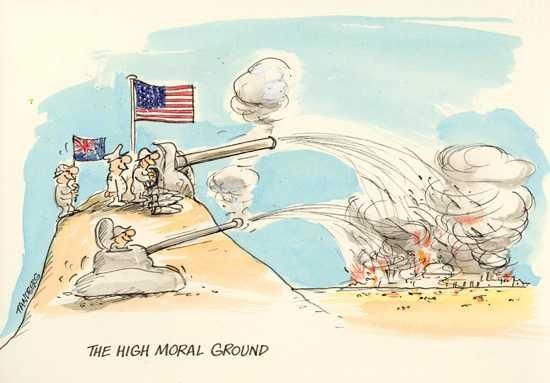
Tandberg
with this account by Scott Ritter.
Makes you wonder. After all, the Americans have been here before.
Posted by Gary Sauer-Thompson at 7:00 PM | Comments (2) | TrackBack
November 13, 2004
political blues
Federal parliament sits next week, the first of three weeks of parliamentary sittings before the Xmas. These November sittings are the first sittings since the convincing Coalition victory at the Federal election. I expect the ALP's bloodied nose to be rubbed raw, with legislation (eg., unfair dismissal, workplace relations and terrorism) being introduced to deepen its misery and despair. The ALP is going to have a rough trot.
The economy is chugging along, unemployment is dropping, inflation is under control, and higher interest rates are still around the corner. Nothing much flowing for the ALP on that front in the short term.
The Howard government is going to introduce supply side measures to loosen up the economy--eg., small businesss exemption from unfair-dismissal laws and establish individual contracts as the primary means for regulating employment --and then take great pleasure in watching the ALP squirm, as it is caught between its desire to be economic responsible and looking after the interests of workers.
One presumes that in Parliament's three pre-Christmas sitting weeks, the Government will busy itself implementing election commitments and tidying up some the legislation left over from before the election. The political theatre will be all about making its political play against Labor.
After June 2005 it will be a whole new ball game. Pressure will be placed on Howard by big business to be far more radical in its industrial realtions reforms.
Update 15 Nov.
In the meantime we are revisiting the abortion debate. It has been running for three weeks, stirred along by Tony Abbott, Christopher Pyne, Alan Cadman and Eric Abetz. They have been calling for late term abortions to be banned and a review of Medicare funding of the procedure. Is this just a foot in the door for a wider move against abortion by the moral conservatives? I presume private conversations are going on in the Liberal Party. Why haven't the liberal women told the conservative men to cool it?
Update 16 Nov
A particular example of a Canberra move:

Pyror
It's good huh?
Posted by Gary Sauer-Thompson at 9:57 PM | Comments (5) | TrackBack
November 12, 2004
in memorian
No doubt Yasser Arafat's death will activate talk about the need to reignite and reinvigorate the peace process by London and Washington. But don't hold your breath about new pressure from the United States being put on the Israelis to do more as far as the West Bank is concerned, such as dismantling settlements or the wall.
So let us pause:

His official military funeral had to be conducted in Egypt, so that world leaders could attend without seeking Israel's permission.
From the other side in Australia.
The news reports in Australia implied that Yasser Arafat was all that stood between peace in the Middle East and ongoing warfare. Arafat was deemed to be responsible for the collapse of the peace process. In the political campaign to discredit Arafat, Arafat was deemed a terrorist and he carried the blame for the breakdown of peace talks from 2000 on. It is argued that Arafat forfeited the opportunities offered to achieve statehood for his people and most, if not all, of their demands.
This ignores the other side. The way that Arafat embodied the Palestinian struggle for freedom and independence, which is larger than the late President Yasser Arafat. So the national struggle for Palestinian freedom and independence, which Arafat symbolized, will not be buried with him.
What Arafat was not able to achieve was a political solution resulting in two independent states living side by side, Palestine and Israel. Hopefully, this will be the political goal of the Palestinian people, collectively, whether in the Occupied Territories, scattered in squalid refugee camps around the Middle East, or living in exile. Their future is one of democratic nation building.
Most put the two faces together in terms of Arafat being a dreamer who failed to deliver. Or the old revolutionary who lead his people into a dead end.
Update 17 Nov
From an article After his death, still the occupation in the Israeli newspaper Haaretz:
"Now, without Arafat, will there be a reversal of the policy of the accelerated annexation of extensive parts of the West Bank? Will Israel stop the process of turning the West Bank into a jigsaw puzzle of Palestinian enclaves that are cut off from one another by blocs of Jewish settlements? Will it stop setting up roadblocks that are like border crossings, on roads like in the Third World? And at the same time, will Israel continue building for itself prestigious suburbs and roads of Californian width and quality? Clearly it will not."
The occupation will continue.
Posted by Gary Sauer-Thompson at 6:16 PM | Comments (0) | TrackBack
November 11, 2004
ghost of the 1960s
This is polemics. A polemic responding to another polemic.
The Australian waxes lyrical over the death of the 1968ers.

Leak
The polemical editorial in The Australian reckons the 1968er's imagination has withered and their dreams have died. They're all washed up and are little more than the walking dead. The Australian says:
"The ghost of the 1960s is being exorcised from Australian public life. The assumption that proper politics should focus on minority interests and that people interested in the economic and social stability of the traditional family unit were ignorant and irrelevant to a just Australia took root when Gough Whitlam was prime minister. But while the political winds are shifting in a way we have not seen for a generation, the intellectual ideologues who have assumed the right to chart the course of the national conscience for 30 years do not understand where they are taking us."
It smirks at the self-appointed keepers of political morality, orators with easy access to the opinion pages of [presumably liberal] newspapers and microphones at the ABC. Then it says that this:
"...does mean the days when community values were dismissed by opinion leaders in the public sector and media as an imposition on the oppressed are ending. What Francis Fukuyama calls the "great disruption" of the 1960s and 1970s, when radical social reformers sought to erode community consensus around traditional social values, is now being renounced in favour of traditional ideals of family life. It seems the only people who do not now see it are the ageing radicals of that distant age. Bourbon-like, they have forgotten nothing and learned nothing."
Well I've got news for this limp organ of the international capitalist press, which reckons that the path to the new Jerusalem leds back to the ordered days of yesteryear. The social consensus around the traditional social values it professes to idolize are being trashed by the entertainment (culture) industry. It is the logic of free market capitalism, and its nihilisitic consumer culture, that is the source of the moral decay the hypocritical Australian bemoans with crocodile tears.
Yes, we old 68ers, who celebrate Paris 68 each year with champaigne then read Deleuze and Guattari about schizophrenics going for a walk in the shopping malls with master cards, have learned nothing. Just like that ole boy General Glut, ( link courtesy of John Quiggin) I too continue to maintain along with:
"... Marx and Keynes that capitalism's tendencies are toward crises of overaccumulation and underconsumption. Globalization performs this sorry old tale through debt, deflation and depression on the stage of the whole world."
Incurable romantic! That is a desiring 68er who celebrates the body. Our bodily impulses resist the dull rhythms of the call centres as we re-value the old rotten values.
We see our role as soaring, free spirits to philosophize with hammer, so as to sound out the idols of the corpulent bourgeoisie who have allied themselves with the counter enlightenment.
We philosophical eagles, harded by the discipline of critique and dialectical severity, swoop with gay abandon through a nihilistic world of naked capitalism, because we love to dine out on the weakly bourgeoisie's bloated entrails.
Ghosts? What ghost? Our will to power has no room for pity for bourgeoisie's sickly state or their need to eternally suck the tit of the corrupt corporate state. We free spirits, who are by necessity the people of tomorrow, love to knife vivesectionally the counter enlightenment's faith-based values of good and evil.
Do you know the secret unearthed by a postmodern schizonalysis? The schizophrenics are in charge of corporate governance. The results are all round us and are daily reported in the financial press in loving detail.
Posted by Gary Sauer-Thompson at 7:02 PM | Comments (4) | TrackBack
November 10, 2004
economics & politics
This post is courtesy of Brad deLong. The original article by Adam Posen in the Financial Times, whichBrad linked to, is subcription only. I introduce it here to highlight the way that politics commands economics these days and to dispel the myth put about by free market ecomomists that economics rules.
Posen says:
"Ideological and partisan politicians know that elections are... about... taking the reins of power and using them to realign the balance of interests in society in their favour.... The "Bush II" agenda will not be constrained by bipartisanship, fiscal discipline or even economic reality, because the ultimate motivation is not economic but ideological - to shrink government and weaken Democratic opposition. The three big economic initiatives promised by Mr Bush [privatisation of social security, tax cuts and tort reform] should therefore be seen for the political thrusts they are."
I doubt if it is to shrink government. We are talking about big government conservatism here.
I would argue that the ultimate movitivation is to realign the balance of interests in society so that the Republicans will stay in power after Bush has left the scene. The leaders come and go whilst the Republicans stay for the next decade.
Posen goes onto say:
"If Mr Bush's planned economic initiatives also promoted the general welfare, their dual use of locking in supporters would be welcome. However, the Bush administration is putting its political staying power ahead of economic responsibility.... Markets tend to assume that the US political system will prevent lasting extremist policies so, even now, observers discount the likelihood of the Bush administration fully pursuing - let alone passing - this economic agenda. If the thin blue line of Democrats and the responsible Republican moderates in the Senate bravely fulfil their constitutional role, perhaps the damage will be limited. If not, we can foresee the US economy following the path to extended decline of the British economy in the 1960s and 1970s and of Japan in the 1990s..."
Dire words. You can sense the economic crisis looming just around the corner.
Neo-liberalism is well and truely dead. But then that too was also a case of politics commanding economics. Economics is a tool of governance. That is the case in Australia under John Howard as in the US under President Bush.
Posted by Gary Sauer-Thompson at 8:57 AM | Comments (0) | TrackBack
November 9, 2004
Israel: shouting match
There is a post over at Crooked Timber by Henry Farrell that addresses the difficulty of having a debate as opposed to a shouting match on the Israeli-Palestinian question.
Despite the commonality of position ---a two-state solution, a fudging of the Jerusalem issue, and some compensation for the taking of land--a civil argument is virtually impossible. That has been my experience.
What I have found from my postings on the issue is that the major strategy that the pro-Israel groups use is one that equates criticism of Israel with anti-Semitism. Often the charge is that the left equates Israel with Nazi Germany.
It is anti-Israel criticism that offends the pro-Israel groups, not anti-Semitism. This is clear from the way the distinctions routinely made between Jews, Israelis, and Zionists are ignored; the campaign against Hanan Ashrawi to prevent her from giving the 2003 Sydney Peace lecture; the campaign in US campuses to force universities (eg., the Joseph Massad case at Columbia University) to abandon proper academic procedure in evaluating scholarship and to clamp down on critical opinions about Israel in the classroom; and the lack of Israeli criticism of Christian fundamentalist anti-Semites who seek to convert Jews but who support Israel.
Consequently, the pro-Israeli charge is that criticism of a Likud Government is equivalent to a criticism of Israel, because a Likud Israel is the Jewish people.
After Arafat? What then? Will new spaces open up? Should the Israeli Prime Minister, Ariel Sharon, show political courage and say that he recognizes the Palestinian right to statehood, and that he will negotiate with any successor to Arafat who shows equal recognition of Israel?
In the US it is the Christian fundamentalists who are going to pose a significant but not insurmountable challenge to achieving a fair, just and lasting solution to the Arab-Israeli conflict.
Update:10 November
A paper by Joseph Massad, entitled 'The legacy of Jean-Paul Sartre', can be found here. The legacy is Sartre's failure to see how European Jews who left Europe as holocaust refugees arrived in Palestine as armed colonisers. The article then tackles French intellectuals Michel Foucault, Jacques Derrida, Pierre Bourdieu, Etienne Balibar, and Slavoj Zizek for their failure to acknowledge a change in the status of European Jews.
Massad, wearing the hat of a public intellectual, argues that these intellectuals still represented the Jews as holocaust survivors in Europe. He says:
"The status of the European Jew as a coloniser who has used racist colonial violence for the last century against the Palestinian people is a status they [the Parisian intellectuals] refuse to recognise and continue to resist vehemently. Although some of these intellectuals have clearly recognised Israeli Jewish violence in, and occupation of, the West Bank and Gaza, they continue to hold on to a pristine image of a Jewish State founded by holocaust survivors rather than by armed colonial settlers."
That argument is hardly a reason to be fired from Columbia, or denied tenure. The issue here is not what Massod is arguing--he very well may be wrong.
I for one do not understand what Massad means by an 'anti-Semitic Israel.' But academic freedom means that Massad has the right to make these critical arguments.
From my experience in these debates it is Massad's claim that Israeli is a colonizing power, which uses racist violence against the Palestinians, that offends the pro-Israeli groups. They view Israel as a democracy--the only one in the Middle East.
Academic freedom means that Massad's view that Israel is a racist Jewish state founded on colonial violence can be stated and should be debated and contested. That is what liberalism stands for.
Another paper by Massad. The Campus Watch Report is here.
Posted by Gary Sauer-Thompson at 7:31 AM | Comments (12) | TrackBack
Iraq: more bombs
Iraq has lost about 100,000 people during the American invasion and occupation. Almost all were killed by coalition air strikes. More deaths are on the way now that the US assault on the Sunni city of Fallujah has begun. Early reports indicate that two bridges spanning the Euphrates River plus two hospitals have been captured.

Wilcox
Why raze the hospitals to the ground? To play down Iraqi civilian deaths and to pretend that the military strike is surgical, efficient and clean? Jean at Body and Soul thinks this is a real possibility.
The Guardian captures the US spin on the US assault on the Sunni city of Fallujah that seems to accepted by the American media:
"...a city the size of Brighton is now only ever referred to as a "militants' stronghold" or "insurgents' redoubt". The city is being "softened up" with precision attacks from the air. Pacifying Falluja has become the key to stabilising the country ahead of the January elections. The "final assault" is imminent, in which the foreigners who have infiltrated the almost deserted Iraqi city with their extremist Islam will be "cleared", "rooted out" or "crushed". Or, as one marine put it: "We will win the hearts and minds of Falluja by ridding the city of insurgents. We're doing that by patrolling the streets and killing the enemy."
We can expect ever more carnage since the US message is resist us and we will destroy you. Fallujah has to be destroyed in order to save it. Australia is a party to this laying waste to a city.
The standard defence by the Australian Government is that as Iraqis are better off without Saddam Hussein, so the killing of Iraqi civilians is justified. Does that mean the 'Coalition of the Willing' can kill as many Iraqi's as Saddam and still claim legitimacy?
The kind of military overkill in Fallujah is part of the geo-political strategy of 'staying the course.' The US is doing this in the same way as France stayed the course in Algeria in the 1950s, as the US stayed the course in Vietnam in the 1960s, and as the Israelis are staying the course in occupied Palestine. Staying the course in these cases means adopting a military solution to political problem. That strategy does not achieve peace or security in a situation of a war of national self-determination.
So argues Richard Polk over at Juan Cole's Informed Comment. The other option is Vietnamization involving creating and train the army of the client regime, equip it and then turn the war over to it. Polk says that the best best the US might gain from this option "is a fig leaf to hide defeat; the worst, in a rapid collapse, would be humiliating evacuation, as in Vietnam."
The best option says Falk is for the US to choose to get out rather than being forced. His arguments are compelling. Have a read when you have a moment.
Posted by Gary Sauer-Thompson at 7:30 AM | Comments (5) | TrackBack
November 8, 2004
watching the media
I have rephrased this question from one asked by Jay Rosen at PressThink on November 3 post entitled, 'Are We Headed for an Opposition Press'? I do so in the light of the forthcoming changes in media ownership that will soon pass through the Senate.
"Will we see the fuller emergence of an opposition press, given that John Howard and the conservative Coalition are to remain in office another three years? Will we find instead that an intimidation factor, already apparent before the election, will intensify as a result of Howard's victory?"
One scenario is that the cultural divide that is increasingly defining Australian politics will also begin to define Australia media. We can see this with the conservative Murdoch Press, the Packers and the liberal Fairfax Press.
I do not see the other alternative mentioned by Rosen---Big Media successfully holding itself back from politics with the major news sources remaining non-aligned, officially neutral--as a realistic possibility in Australia. The way politics is done today is to attack and defend the media, or to mount a claim that the media is the opposition.
You can see that with the Howard Government's attacks on the ABC. You can see that with the cultural right's struggle with the liberal media and a growing feels that the cultural right is now the ascendant party. You can see it in the way the division of the political universe between the good conservative guys and the bad liberals ----the political--- intrudes into the realm of "news" and commentary. You can see it in the way that the old media as the Fourth Estate, and the watchdog's for democracy is becoming increasingly irrelevant. You can see it in the way that the Canberra Press Gallery increasingly relies on access to the drip feed, rather than being an adversarial press.
There is little doubt that political discourse has moved dramatically rightward—visible in the TV networks, talk radio, the print media, even the Internet—to the point where “liberalism” has become something of a terrible stigma avoided by all but the most bold-spirited of politicians.
After the changes in media ownership laws we can expect the rise of a political media empire with television stations that is built to prosper in the conditions of the great political divide, is steeped in the culture war and has a self-conscious political identity.
Posted by Gary Sauer-Thompson at 6:07 PM | Comments (2) | TrackBack
November 7, 2004
democratic matters
Democracy and citizenship are words that rarely mentioned in these conservative times in Australia, other than the celebration of webloggers as embodying the new democratic watchdog spirit vis-a-vis the corrupt corporate media.
So I thought that I'd drop in a few quotes from Cornell West's new book. They are from the book's Preface, which can be found here in the Summer edition of Logos. he says his book will look unflinchingly:
"...at the waning of democratic energies and practices in our present age of the American empire. There is a deeply troubling deterioration of democratic powers in America today. The rise of an ugly imperialism has been aided by an unholy alliance of the plutocratic elites and the Christian Right, and also by a massive disaffection of so many voters who see too little difference between two corrupted parties, with blacks being taken for granted by the Democrats, and with the deep disaffection of youth."
Like public opinion West sees the American empire under the current Bush administration as devouring American democracy and republic. West says the problems plaguing our democracy are not only ones of disaffection and disillusionment. The greatest threats come in the form of the rise of three dominating, antidemocratic dogmas. These three dogmas, promoted by the most powerful forces in our world, are rendering American democracy vacuous.
"The first dogma of free-market fundamentalism posits the unregulated and unfettered market as idol and fetish...Free-market fundamentalism—just as dangerous as the religious fundamentalisms of our day—trivializes the concern for public interest."
West says that the second prevailing dogma of our time is aggressive militarism, of which the new policy of preemptive strike against potential enemies is but an extension. This new doctrine of U.S. foreign policy goes far beyond our former doctrine of preventive war.
"This dogma posits military might as salvific in a world in which he who has the most and biggest weapons is the most moral and masculine, hence worthy of policing others. In practice, this dogma takes the form of unilateral intervention, colonial invasion, and armed occupation abroad. It has fueled a foreign policy that shuns multilateral cooperation of nations and undermines international structures of deliberation. Fashioned out of the cowboy mythology of the American frontier fantasy, the dogma of aggressive militarism is a lone-ranger strategy that employs “spare-no-enemies” tactics."
West says that the third prevailing dogma in this historic moment is an escalating authoritarianism. This dogma is:
"...rooted in our understandable paranoia toward potential terrorists, our traditional fear of too many liberties, and our deep distrust of one another. The Patriot Act is but the peak of an iceberg that has widened the scope of the repression of our hard-earned rights and hard-fought liberties...The cowardly terrorist attacks of 9/11 have been cannon fodder for the tightening of surveillance. The loosening of legal protection and slow closing of meaningful access to the oversight of governmental activities—measures deemed necessary in the myopic view of many—are justified by the notion that safety trumps liberty and security dictates the perimeters of freedom."
West says that these three dominant dogmas are snuffing out the democratic impulses that are so vital for the deepening and spread of democracy in the world. In short, Americans are experiencing the sad American imperial devouring of American democracy.
I would add that American empire is also devouring Australian democracy.
Posted by Gary Sauer-Thompson at 6:20 PM | Comments (0) | TrackBack
November 6, 2004
in la la land

Of course we all know that going to heaven is the work of the nasty Islamist terrorists in Iraq, don't we. We know this because the experts have told us that the adherents of extremist Islam, or Islamism, are consumed by a raging hatred of Western culture, a fanatical belief in their mission, and the unshakeable conviction that they will ultimately triumph. That is why this evil force must be combated.
George Bush is the man for the job. This master of war has what it takes. He knows how to use his political capital. And he has God on his side.
British soldiers being killed has nothing to do with an imperial occupation of Iraq by the US, UK and Australia. Nothing at all. That empire talk is just lefty stuff, the kind of nonsense that circulates amongst the elitist arts luvvies lobby, the tenured academics, and innercity cafe latte drinkers.
Oh, and while we are on this, we all know in our gut that the left are just a bunch of wowsers. Piers says so. That is all that needs to be said.
Posted by Gary Sauer-Thompson at 2:12 PM | Comments (1) | TrackBack
$U.S. in a tailspin?
The US dollar has continued to decline in global currency markets. I presume that it has been caused by fears about the mounting U.S. budget and trade deficits.
The rising budget deficit and ballooning trade imbalance of the United States means that it is running up a foreign debt of record-breaking proportions. The US already requires a daily infusion of $1.2 billion in foreign investment just to keep the greenback's decline under control.
The Bush Republican policy agenda of tax less and spend more will make things worse.
Could these deficits threaten the financial stability of the global economy? They could. There is a tipping where the East Asian banks, who have been trying to prop up the dollar and maintaining their exports (to the US), decide that placing large amounts of business in US dollars is a poor investment.
The IMF reckons these deficits threaten the stability of the global economy.
Go read, if you have a mo.
Posted by Gary Sauer-Thompson at 1:18 PM | Comments (0) | TrackBack
November 5, 2004
US: the counter enlightenment
The liberal citizens in the US are not feeling too good the morning after the US election. Nor should they.

Leunig
We can forget the US doing anything about climate change. More forests will be depleted. Alaska's Arctic National Wildlife Refuge will be opened up to oil drilling. So why not revive nuclear power as well? And why not introduce liability shields for corporate polluters? And more subsidies for energy corporations. The whole package will be called an energy conservation bill?
This was an election about God and terror.
The evangelical base of the Bush Republicans sees a liberal (pinko) Kerry as unAmerican---as a cultural deviant, a cosmopolitan, flag-burning, and treason-coddling. So the 'people' have to fight and destroy the haughty liberal 'elites' and their evil ideology:
"The left bewitches with its potions and elixirs, served daily in its strongholds of academe, Hollywood and old media. It vomits upon the morals, values and traditions we hold sacred: God, family and country. As we learned Tuesday, it is clear the left holds the majority of Americans, the majority of us, in contempt."
That is the discourse of neo-conservative religious populism in the US.
The US is a nation divided with each side alienated from the other. For what changed from 2000? New Hampshire (four electoral votes) went from red to blue, whilst New Mexico (five electoral votes) went from blue to red. Apart from that the boundaries between blue (liberal) and red (conservative) America remain fixed. They deepened.
That means that America is two nations that loathe and fear each other. Their contempt and hate for each other means warfare, not forgiveness, reconciliation or unity. The fault line between the two halves of America is clear and the chasm between its two cultures so starkly unbridgeable. The Republican war strategy has been to tear the country apart, grab the bigger half and continue with the dismantling of public health and social security through privatisation.
Liberalism is the loser, as a culturally conservative Republicanism tightens its grip on Congress. The liberal separation of religion and state is under now attack from the Red America of the right-wing populist revolt.
Bush can now impose his conservative stamp on the third arm of the federal government, the supreme court, and use this most powerful federal weapon in America's continuing cultural war to attack the liberals. He has the opportunity to fill three or four vacancies in the court over the next four years could create a solid conservative majority which could lead to a ban on abortion, among other potentially dramatic changes.
That means the Republicans control the White House, the Senate and the House of Representatives, and will soon have a majority of the supreme court. All the checks and balances that the founding fathers constructed to restrain a dictatorial presidential power are broken instruments.
Now for the terror bit.
In terms of international relations we can expect more wingnut sabre-rattling towards Iran. Fallujah will be flattened. More support for Israeli expansionism.
William Kristol is now quoting Danton!
Danton. That means a vigorous and concentrated exertion of national power. It means using the fury of popular passion as an instrument in the work of deliverance. It means the powers of the government should be those of a dictator. "In order to conquer, what we need is to dare, still to dare, and always to dare." It means a reign of terror, however moderated. This is no ordinary Burkean conservatism folks.
How should the Democrats respond?
This electoral map of the voting tempers the Repubklican triumphalism as it shows the city folk favouring the Dems and the rural folk favouring the Republicans:

This is even more revealing. It shows how the 'red v. blue' states graphic of the big networks is misleading, considering the slim margins that the candidates won some of those states by.
The Democrats should als stand firm against the moral crusaders now on the march. Conservative Christians and their 'values voters' (anti-abortion & fag hating) say they won the election for George W Bush and Republicans in congress. Godly America wants payback big time. What we have in the US is the resurgence of the counter-enlightenment.
The Democrat response should be clear. No surrender. After all, this is the counter-Enlightenment.
Posted by Gary Sauer-Thompson at 6:03 PM | Comments (0) | TrackBack
November 4, 2004
biopolitics
I reckon that if Australian citizens had realised that there was a real possibility of a Coalition Senate majority, then they would have probably have changed their Senate votes, whilst continuing to vote for a Liberal government in the House. Andrew Norton over at Catallaxy concurs with this judgement.
But no-one was aware of that possibility, least of all the ALP. I had naively assumed that the Australian Greens would pick up the Democrat pieces and then hoped that the Greens would gain the balance of power in the Senate.
Charles Richardson says that "because of six-year terms, the Coalition will retain its majority until 2011, unless it does exceptionally badly at the next election, since it only needs to hold three seats in each state."
For some conservatives that means power with responsibility in contrast to 'responsibility without power', which they say, has been the scourge of the Australian political system. Now that Howard has control of the Senate so he has the power to exercise the responsibility he's been given.
What for? To achieve what, apart from a backlog of bills? And a rollback of environmental legislation to satisfy the Van Diesel diehards in the National Party?
A suggestion. The new conservatism means a Senate being used as an instrument of government to promote conservative values. It means using government departments to promote a conservative biopolitics.

Richardson says that the independence of the Senate may come from people voting Labor next time around, thereby reintroducing the dynamic of a government with an opposition-controlled Senate.
I reckon the best strategy is to increase the presence of the Greens in the Senate. Initially, it is to enable the Greens to obtain 5 senators and so obtain party status; then to help them to obtain the balance of power. A green Senate.
My reason?
The ALP is not enough as an opposition. They wilt too easily when it comes to confronting conservative biopolitics. They can toss liberalism away, just like that. Or their liberalism is pretty reactive and reconciled to conservatism these days. Many conservatives in the party are already calling for the ALP to blur the differences between themselves and the Coalition. They desire to close the cultural gap by opposing abortion and gay rights. They want to cave in on the moral issues and ease up on the criticism of Israel.
Let's call them on the buckling because they can't stand the heat.
In the meantime we have to rely on the High Court to defend constitutional liberalism, safeguard democracy, ensure the responsible use of political power by an overweening executive, and to keep the checks and balances in play against the trigger happy cowboys who desire to remodel society.
Posted by Gary Sauer-Thompson at 9:59 AM | Comments (2) | TrackBack
November 3, 2004
it's Bush?
Even with a big turn out that was meant to favour the Democrats, the election looks to be flowing the way of George Bush. John Quiggin concurs. The informed predictions of a solid Kerry victory of 311 electoral college votes look way off.
The Republicans have control of both the Senate and the House. Congress is theirs. The Republicans have won the popular vote. Have they won the Presidency?
Not yet. Ohio is the current electoral battleground. The key, as it is a must win for John Kerry, says Roger Payne. Kerry needs to win it just to stay in the race. Did the Democrats get enough of the urban vote out in Cleveland and Cincinati to counter the rural republican vote?

What suprises me, as an Australian, is that American citizens in Ohio have been standing 8-9 hours in line to vote. Thousands of people were still in line waiting to vote more than two hours after the polls closed in Ohio. Some were still voting at 2:30 a.m. How come? The wait is 20-30 minutes max in Australia. Is the huge wait in Ohio because they have so few polling stations? Or is it the result of the law suits by the Republicans?
Looking on from afar I reckon the American democratic system is in need of reform. It looks corrupt to me. Ohio has been marked by republican efforts to challenge voters in polling places, resulting in a series of back-and-forth rulings from federal courts.
Why the silence on this? Nothing is being said on this issue by the major US networks. Their coverage is graphic and glittzy but superficial. You have no idea what is happening on the ground in Ohio from watching them. Are they too in love with their own projections to see the corruption and legal wrangling?
It would appear that Kerry is leading in Michigan, Minnesota, Wisconsin. Can Kerry take the upper midwest?
Update: 9.30pm
The ABC's 7.30 Report gave it to Bush. Kerry was wiped out by the Bush juggernaut. It was no contest.
Yet Kerry has taken New Hampshire off Bush and has a fighting chance to take Ohio off Bush. It is a fight. Bush has 249 and Kerry has 242 electoral college voters. Kerry has clawed his way back into contention even though the Bush camp is talking of victory.
Iowa, New Mexico, Nevada, Ohio and Wisconsin are still being sorted. Nevada will go to Bush (254 votes) whilst Wisconsin will go to Kerry (252 votes). Will Iowa and New Mexico be pick upped by Bush. Ohio remains the key battleground. Will the presidential election be headed toward legal wrangling?
Updated: 6am
Kerry has conceded The battle for Ohio was shortlived.
The possibility that there might be enough provisional ballots in Ohio -- ballots cast by voters not on the official registration rolls -- to win that state turned out otherwise. The estimated 150,000 provisional ballots were not enough to overcome Bush's margin of 136,000 votes in Ohio, even if he were to win the lion's share of them.
Posted by Gary Sauer-Thompson at 2:47 PM | Comments (0) | TrackBack
US Election: a divided nation
For what it is worth the exit polls were favourable to Kerry. However, the election is about the electoral college votes not the popular vote as measured by exit polls.
Yesterday's projected electoral college votes show a different story to the exit polls. Moreover, in the 2000 election, though George W. Bush polled half a million votes less than his opponent Al Gore, he polled a majority of votes in a majority of states. In other words he won in terms of the electoral college votes. The popular vote is not what matters in terms of the presidency.

Leak
The New York Times has a good interactive graphic of the election results. CNN is pretty good as well. On free-to-air television in Australia Nine is presenting CBS coverage and Seven has NBC coverage.
In a deeply divided nation Kerry is painted as a weak, indecisive traitor by the Republican machine. This machine demonizes Democrats, stokes populist resentment, tosses in legal challenges to balloting, and puts into play byzantine legal maneuverings. That is what Florida stood for in 2000. Karl Rove, the primary Republican political strategist, has been playing this game for some time. The lawyers will be in action in this election for sure.
In reading about the US presidential election I'm suprised at the absence of proper international safeguards for a free and fair election in the USA. Some of the electoral processes seem to be designed by partisan figures to actually prevent people from voting. Then they use lawyers to cut off as many opportunities to vote as possible.
Update 10.30
Polls have closed in the states that are mostly favourable to Bush:
*Georgia (traditionally strong Bush), Indiana (strongly Bush), Kentucky (strongly Bush), South Carolina (strongly Bush) Virginia (barely Bush); North Carolina (weakly Bush), West Virginia (weak Bush) and Ohio (barely Bush).
*Michigan (weakly Kerry), Vermont (strongly Kerry).
Ohio is a key battleground state for Kerry in this bunch. He needs to win it (plus one other of either Florida or Pennsylvania), if he is to gain the presidency. Kerry needs a high turnout in the urban areas in Ohio to win Ohio.
What stands out in the voting maps is the deep division of the US into Bush vs Kerry. The nation's political divisions are also geographical ones.
update midday
A huge bunch of states including the eastern seaboard, which are more favourable to Kerry, have closed:
*Connecticut (strong Kerry), Delaware (weak Kerry), the District of Columbia (strong Kerry), Florida (weak Kerry), Illinois (strong Kerry), Maine (weak Kerry), Maryland (strong Kerry), Massachusetts (strong Kerry), New Hampshire (barely Kerry), New Hampshire (barely Kerry), Pennsylvania (barely Kerry)
*Alabama (strong Bush), Kansas (strong Bush), Mississippi (weak Bush), Missouri (weak Bush), Oklahoma (strong Bush) and Tennessee (strong Bush).
*New Jersey (tied).
I would have thought Florida was more line ball than weak Kerry. Why not weak Bush? Pennsylvania is the other battleground state in this bunch.
It is looking as if the election break the same way as it did in 2000. Will the red republican states become redder and the blue Democrat states becomer bluer, with the nation becoming ever more divided? America is not a united nation at all.
Update: 1.30pm.
At this stage Bush is leading the electoral college votes as the middle America states come rolling in overwhelming Kerry. Will Kerry overtake Bush and recapture the White House for the Democrats with the Pacific seaboard (California, Oregon, Washington)?
Bush has won Alabama, Arizona, Arkansas, Florida, Georgia, Indiana, Kansas, Kentucky, Louisiana, Mississippi, Missourri, Nebraska North Carolina, North Dakota, Oklahoma, South Carolina, South Dakota, Tennessee, Texas, Utah, Virginia, West Virginia,Wyoming
Kerry has won Connecticut, Delaware, District of Columbia, Illinois, Maine, Maryland, Massashusetts, New Jersey, New York, Oregon, Pennsylvania, Rhode Island, Vermont
The question is: will Kerry pick up any Southern states? He is not looking too good in Florida. And Kerry is struggling in Ohio. The US networks call of who wins the individual state is based on their projections. They have Bush well in front---196 to 133--with the massive Republican middle America--then 219 to 199 with the Pacific coastal seaboard factored in for Kerry. Some are willing to project Ohio, even before some of booths in Ohio close.
The electoral college tide is flowing against Kerry. He's lost Florida. He didn't even go close to taking it off Bush. That means Kerry has to gain Ohio, and retain the Gore states around the bottom of the Great Lakes.
Maybe Bush will get stuck in the 250-260 range while Kerry claws his way back by winning the states around the Great Lakes.
It's the deep repetition of the 2000 political divisions that impresses me. This is a divided nation.
Posted by Gary Sauer-Thompson at 9:02 AM | Comments (0) | TrackBack
November 2, 2004
US Election: notes
I guess the US is voting as I write this after returning from being offline in the wilderness. So I've had little chance to browse US blogs.
The Washington Post reports that a flurry of national polls completed over the weekend showed Bush and Kerry in a statistical tie, with neither candidate being able to establish clear momentum. Pew says Bush still just ahead?. Gallop says dead heat. They don't know, in other words.
With the race remaining too-close-to-call the outcome is dependent on several key swing (battleground) states. Two of the biggest battlegrounds, Florida and Ohio -- both in Bush's camp in 2000 -- were too close to call. A call on Ohio
Paul Krugman says that:
"Florida's early polling was designed to make voting easier, but enormous voter turnout swamped the limited number of early polling sites. Over the weekend, people in some polling places had to stand in line for four, five, even six hours, often in the hot sun. Some of them - African-Americans in particular - surely suspected that those lines were so long because officials wanted to make it hard for them to vote. Yet they refused to be discouraged or intimidated."
Is it that bad in Florida? Well, my image of Florida is that this state under a Republican Governor has corrupted the democratic process. I expect the Republicans will try to find a way to steal Florida no matter whom the voters attempt to cast their ballots for. Florida is crucial because George W. Bush emerged victorious as President by a margin of 537 votes in Florida
An erosion of support for the Republicans in the early polling? Check this this out. And this.
Even conservatives are uneasy with Bush.


And so they should. Bush is a big government conservative who inherited a $US 5 trillion budget surplus from President Clinton and turned it into a $US 2.3 trillion deficit.
Posted by Gary Sauer-Thompson at 5:33 PM | Comments (1) | TrackBack