« September 2009 | Main | November 2009 »
October 31, 2009
the road to recovery
So housing prices are rising again in Sydney, Melbourne and Canberra:
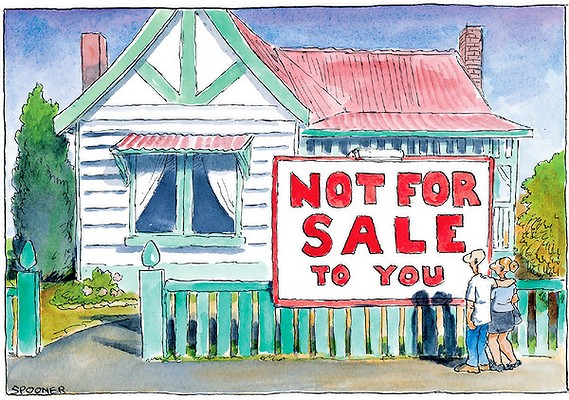 John Spooner,
The recession never happened, the stock market is booming and interest rates are rising. All is well in the world. The global financial crisis " What is that? That is so yesterday. Optimism rules. So does the finance industry. The narrative is now about efficient markets, animals spirits and China’s emergence as the world’s biggest creditor country. So let us praise inequality because that is the pathway to prosperity, opportunity for all and happiness. Australia is the lucky country.
So what happened to the reform? To financial re-regulation and reform of the global monetary system? The finance industry has grabbed the government's money and told it to go away. So it is back to business as normal--to the cycles of confidence and panic in our world of debt, be that debt public or private, domestic or foreign, in which credit is extended freely and then withdrawn brutally.
Posted by Gary Sauer-Thompson at 9:28 AM | Comments (4) | TrackBack
October 30, 2009
Cubbie Station: farewell
So Cubbie Station, which sits on the Culgoa River in Queensland, near Dirranbandi, south-west Queensland, (on the border of New South Wales and Queensland) is to be placed in voluntary administration. The National Australia Bank is seeking the urgent repayment of a $320 million mortgage and Cubbie Station cannot pay off its debt. It is not a going concern without decent rains. its liabilities exceeded its assets a year ago, and it had breached its banking covenants.
It is hard to feel sorry for this icon of the way that the states have messed up the management of water in the name of development. The water-guzzling cotton farm has become a sign of all that was, and is, wrong in the way the Murray-Darling Basin has been managed. So there is no mourning for what might have been, as this kind of irrigated agriculture is unsustainable.
It is not Cubbie Station per se that is the problem:---if there was no Cubbie Station the irrigators in NSW would have grabbed all the water flowing down the Darling River (it would activate dormant water licences) from the Culgoa River, leaving nothing for the Basin's rivers and wetlands. That kind of regime is how the states managed water for over a century, and the history that culminates in Cubbie Station shows that you cannot trust the states---any basin state--when it comes to water and development.
The Nationals can jump up and down about the regional communities of Dirranbandi and St George, pray for rain to end the drought, and dream on about irrigated agriculture all they wont. But that won't alter the stark reality that climate change is now impacting on the Murray-Darling Basin, and that the old water development regime is a historical relic in a heated up world. That is what the Nationals and irrigated agriculture industry continue to deny with their talking point about the drought, it breaking, and drought is a normal, natural, cyclic factor of our environment natural cycles.
The reality is that there isn't nearly as much water available as once expected. Relying on, and talking up hope, won't change that. It just shows they out of touch with the real issues in the climate crisis.
The end result of that old water development regime is what you'd expect from examples elsewhere: rivers that no longer flow, dried out wetlands, and lakes that become dustbowls. The states, of course, simple blame one another, and continue to evade all responsibility for the destruction they have individually and collectively wrought in the name of development.
Cubbie Station's bankruptcy still leaves us with the states resisting water reform to ensure that reducing the over allocated water licences that are the cause of the problem. It is not just the Nationals who refuse to accept the need to address the overallocation by reducing water licences--it is the states as well. They are going to retain their command and control water regime and slow down the implementation of a water market which they signed up at CoAG. The Queensland government still plans to transform Cubbie's water allocations into a secure, tradeable licence.
The states have very dirty hands on water management.
Posted by Gary Sauer-Thompson at 8:53 AM | Comments (5) | TrackBack
October 29, 2009
the 'Indonesia' solution
Question Time is still dominated by what to do with the Oceanic Viking's 78 asylum seekers (ethnic Tamils) from Sri Lanka, anchored near Bintan Island on the eastern coast of Sumatra and close to Singapore. It's a charade that is becoming turning into a political hot potato.
We know that a deal has been struck behind the cloak of diplomacy in which Indonesia has been given money for their detention centres so they take the people Australia doesn't want. The asylum seekers do not want to leave the Oceanic Viking and step ashore to enter a detention centre and disappear into nobody's land for ten years.

What now? Send in the troops? Jakarta said it was not prepared to use force to get 78 Sri Lankan asylum seekers to leave the Australian customs vessel Oceanic Viking. That was not part of the deal and the Oceanic Viking is an Australian flagged vessel. Australia has said that it would not allow the asylum seekers to go to Christmas Island, which is what they want. What now?
The ''Indonesian solution'' to the flow of boats is now tarnishing the Government's claim to be humane in its refugee policy. In The Age Michelle Grattan spells out the quandary of the Rudd Government:
Australian officials will try to persuade the people to leave voluntarily. It would be a bad look to have them taken off the ship by force, although Rudd and Smith don't rule that out. But who would do it? The Indonesians insist they won't and the idea of Australians carrying them off is preposterous.
So what is the future of the Indonesia solution, when the Indonesians do not want to be a dumping ground for asylum seekers? And it is still such a paltry flow of asylum seekers.
Rudd continues to duck and weave for domestic reasons: to avoid antagonising the anti-immigrant sentiment in the outer suburbs whilst talking up bigger population for Australia. How is the latter to occur? Mostly, through immigration. Rather than address that nexus politicians in both the Labor and Liberal parties are going in mock hysteria and exploiting the issue of race to whip up fear in the suburbs. We don't want coloured Asian immigrants is the subtext. We don't want ethnic enclaves in our capital cities. They harbor terrorists.
Posted by Gary Sauer-Thompson at 10:58 AM | Comments (13) | TrackBack
October 28, 2009
Northern Territory: a failed jurisdiction?
My image of the Northern Territory is that it is the frontier land, the land of eco-tourism, crocodiles everywhere, big resource development, entrenched racism, failed dreams, a tabloid Murdoch press, and an callous indifference to the wellbeing of its large indigenous population.

ochre cave painting, Kakadu National Park
I also have a vague sense from my Canberra days of structural flaws in governance-- the bureaucrats systematically channel federal funding to improve indigenous disadvantage to the white electorates in Darwin. In The Australian's Inquirer Nicolas Rothwell makes explicit the corruption inherent in the governance of the Northern Territory.
He says:
the Territory is best understood as an interlocking set of interest groups. It is heavily dependent on outside funding, the bureaucracy is shot through with politics, almost all medium-sized business relies on public sector contracts and the entire system is founded on the administration of an Aboriginal underclass.The original act of dispossession is echoed today by a permanent process of pillage, in which the Territory helps itself to special-purpose federal funding meant to alleviate remote area disadvantage, then delivers grossly inadequate services to the indigenous societies of the bush.
He adds that governance in the NT is steered by the prevailing ideology of its first political generations, an ideology of development, based on the idea that an advanced society can be built in the tropical north, founded on large-scale resources projects, increased settlement and rapid population growth.
The Territory government aims at development, and its desire is for Darwin to become a regional centre and resources industry service town, buoyed by sectoral growth and linked to Asian neighbours. The political logic of the state dictates that the administration lavishly funds the needs of the white majority whilst ensuring that the indigenous minority lives in poor conditions. Consequently,
Darwin is full of facades rather than real structures: an Environmental Protection Authority without powers, an indigenous advisory panel without input, a climate change portfolio without policies, a museum with insufficient funds. Such facade institutions, and the philosophy behind them, infect the air. They create a fantasy approach to administration, where Canberra always lurks, saviour-like, in the wings, and the declaration of a policy is sufficient to change the world.
The Territory's raft of newly proclaimed indigenous policies, on homelands, on education, on the formation of 20 bush towns, are all just more facades, worthless pieces of paper, unfunded expressions of good intent, reliant on yet more federal money for their realisation.
The reality is a dispersed and devastated indigenous culture, which is still reeling from the effects of colonial settlement and a generation's worth of harmful welfare policies, struggling to survive, while constantly subjected to strange shifts in direction and control from Darwin.
Posted by Gary Sauer-Thompson at 8:51 AM | Comments (2) | TrackBack
October 27, 2009
coastal Australia + rising sea levels
Yesterday a new report was tabled in Federal Parliament by the all-party House of Representatives Climate Change, Environment, Water and the Arts Committee entitled Managing our Coastal Zone in a Changing Climate: the Time to Act is Now. It urges the Federal Government to take greater charge of protecting the nation's coastline in co-operation with state and local governments.
The report articulates a deep sense of foreboding that many of us have. There is going to be a lot of suffering in spite of strategies to 'mitigate the effects of rising temperatures, wild and unpredictable weather events, increasing drought and rising sea levels; and the development of 'adaptation' strategies to enhance the resilience of coastal communities to climate change impacts.
From the Northern Territory, Queensland, NSW, Victoria, SA to WA coastal regions and communities are at risk from rising sea levels and there will have to be a retreat from some areas of the coast. Eighty per cent of Australians live in the coastal zone facing major pressures, and that concentration of people and infrastructure makes Australia particularly vulnerable to the coastal erosion and inundation that will accompany increases in sea level'.
In South Australia the report states that:
More than 60,000 buildings along the State’s coast are likely to be at risk from sea-level rise, coastal flooding and erosion. A subsiding coastline across Lefevre Peninsula and Barker Inlet will exacerbate the impacts of rising sea levels.
The extent of rising sea levels--it depends on how much the Greenland icesheet and western Antarctica melt--- is unclear. A consensus based on our best knowledge at the moment is emerging that coastal communities work on a judgment that they we will be lucky to get away with 0.5 of a metre and it is more likely to be somewhere around 0.8 to 0.9 metres by 2100.That means around 80-90 metres of shoreline recession---bad news for many coastal communities.
There are difficulties of moving from global sea level rise projections to regional and local projections and we don't have the knowledge yet to map the regional variations in sea level rise. We do know that coastal towns and cities (such as Cairns, the Gold Coast, Melbourne and Adelaide) will need to to adapt to the impact of sea level rise. If they cannot adapt they need to retreat.
Hence the emerging public sense of foreboding. Trouble is looming.
Posted by Gary Sauer-Thompson at 8:33 AM | Comments (17) | TrackBack
October 26, 2009
it needed to be said
In the 2009 Alfred Deakin Lecture Senator George Brandis defends the Deakinite Liberal tradition and its relevance to the Liberal Party. What does that tradition mean when many economic liberals are raging against what they see as the new green industrial state and arguing against health paternalism.
Brandis states that the liberal tradition is about individual liberty and he argues that the role of the Liberal Party is that of the custodian of Australian liberalism. He says:
Opposition is about re-engineering a party’s thinking to address old problems with a fresh mind, as well as addressing new challenges unencumbered by the weight of old prejudices and certitudes. But essential to that is maintaining fidelity to our fundamental beliefs. As we go through that period of introspection, we must never forget one of the most important lessons of political history: that every Australian government is fundamentally different from those of its own political persuasion which went before...So if we are to be faithful to our legacy then what we should be defending is not merely the achievements of the most recent Liberal government – though defend them, of course, we should - but the entire legacy transmitted to us through the whole of the Australian liberal tradition, from its inception to its most recent expression.
Brandis makes it clear that the most important single thing the Liberal Party must do is to renew:
our commitment to the freedom of the individual, and restore that commitment to the very centre of our political value system: not one among several competing values, but the core value, from which our world view ultimately derives.
In doing so he argues against Howard's two traditions theory --that the Liberal Party was as much a conservative party as a liberal party---which blends two different political value systems with different philosophical antecedents.
Brandis is quite explicit, as he says:
The “two traditions” theory was a specific contribution of John Howard’s. In diminishing the centrality of liberalism to the Liberal Party’s belief system, and balancing it against conservatism; in qualifying the Liberal Party’s commitment to the freedom of the individual as its core value, and weighing it against what he often called social cohesion, Howard made a profound departure from the tradition of Deakin and Menzies. Not only did he formalize the Liberal Party’s adoption of conservatism as a philosophical source, he even allocated areas of public policy between conservatism and liberalism: he was an “economic liberal” but a “social conservative”...
The highlights that points of tension occur when the rights of individuals or minorities come into conflict with existing laws and prevailing social customs. Brandis rightly says that when this occurs the task for liberals is to stand between the individual and society and to assert the rights of the individual whenever the pressures, demands or prejudices of the social mainstream would diminish them. That is liberalism’s historic role.
Three questions. What is meant by personal freedom here--is it negative (freedom from regulation ) or positive (freedom for self-realization). Secondly, the ALP is also informed by liberalism, in that its economic reforms to free up the Australian economy by Hawke and Keating were the product of the liberal economic tradition, whilst the progressive cultural reforms of the 1970s were based on positive freedom. Thirdly, what is Australian liberalism, when it is broader than the Liberal Party, liberals differ on the proper scope of government vis-vis individual liberty, and there are differences within economic liberalism?
Posted by Gary Sauer-Thompson at 8:04 AM | Comments (5) | TrackBack
October 25, 2009
Australia: a polluter's paradise
Melissa Fyfe's article in The Age-- Show of Power--- indicates that the coal lobby still isn't happy with the handouts they've won from the taxpayer with respect to the cap and trade scheme.
The political context for this is that cap-and-trade has been met with harsh resistance--from the Coalition, business groups, and conservative activists. The scientific context is that we are nearing—if we haven't already passed—the tipping point at which the concentration of carbon in the atmosphere becomes so high that feedback loops will cause it to keep increasing on its own even if humans never emit another CO2 molecule again. However, many Australian's still think otherwise--they are in denial:
 As part of its strategy to block reform the coal lobby have so captured the Victorian State Government that it is now the greatest defender of the coal fired stations attempts to secure ever more compensation for Victoria's old brown coal-fired stations in the emissions trading scheme.
The Victorian Government's brief (negotiations take place directly between group elites and the government as they not involve individual members of the legislature) is to ensure that billions of dollars of public money go to international companies who, for years, have polluted with no cost and known, for at least a decade, that a carbon price was coming. It is the same with SA, Queensland and NSW--all are gaming the ever so modest reforms of the Rudd Government to the point when there will be little to no reduction in greenhouse gas emissions.
Allied to the state Governments resistance to reform is the Coalition. According to Josh Gordon in The Age their amendments aim to protect the polluting coal-fired power plants and other heavy emitters from rises in emissions targets for at least a decade. These amendments are currently being considered by the Rudd Government.Josh Gordon goes to say that:
The changes effectively mean heavy emitters would be guaranteed an emissions target until 2021, and would have at least some certainty until 2031, allowing more investment in coal.The Coalition wants federal ministers to be given special discretionary powers to provide up to five years of free emissions permits to new power projects.
'New power projects' should be interpreted as new coal fired stations. Coal is king in Australia. Australia mouths rhetoric on needing to reduce greenhouse gases on the world stage, whilst quietly adding to the problem. Though its political leaders say that global warming is a real problem their behind the scene actions indicate that it does not deserve a serious response.
Our political system is not going to deliver. There is no real intention to do anything about substantive about shifting to a low carbon economy. What will the ALP do with Turnbull's amendments? Roll over? Why bother? Even if the amendments are accepted, a majority of Coalition senators (23 out of 37) are deemed likely to either fail to vote or to vote against any legislation introduced before the December Copenhagen summit. They reckon it is a good issue to use against the Rudd Government.
Posted by Gary Sauer-Thompson at 11:29 AM | Comments (2) | TrackBack
October 24, 2009
Coalition defends Telstra
I see that the Coalition has backed calls by Telstra to delay the passage of the federal government's proposed legislation (Telecommunications Legislation Amendment Bill, ) to separate its retail and wholesale arms as part of its plan to build the $43 billion National Broadband Network.This separation would create a more level playing field before rolling out the NBN.
The policy preference is for Telstra to sell its wholesale network to the new Government-owned NBN company, which would then tear the copper out and use the infrastructure to lay the fibre, to deliver much faster and reliable broadband to homes and businesses.
The Rudd Government wants Telstra to voluntarily separate its retail and wholesale arms. Failure to do so could see Telstra forced to divest its cable network and half-share in pay-TV broadcaster Foxtel, or face being denied the wireless spectrum it needs to evolve its lucrative mobiles business and roll out fourth-generation mobile technology.
The legislation has passed the House of Representatives. The battle takes place in the Senate.
The Coalition will try first to defer consideration of the legislation until the completion of an implementation study into the NBN project, If unsuccessful with its deferral move, the Coalition will try to defeat the bill on its second reading in the Senate. If it cannot get the necessary support to defeat the bill from the Independent Senators-, then the Coalition will move a range of "significant" amendments---including the removal of measures to break up Telstra
The Australian Greens and independent senator Nick Xenophon have indicated they will not support the opposition move to delay a vote on Telstra's future.It would be strange for the Nationals to oppose this legislation as that would amount to abandoning regional Australia need for better broadband service.
My guess is that it would require either senator Steve Fielding or one Nationals senator to get the legislation through after a Senate inquiry into it reports back in late October; and that Telstra will eventually choose to throw its lot in with the Federal Government's proposed network rather than compete with it.
The Coalition's strategy is basically aiming at undermining the Government’s policies without coming up with any other policy alternative. Their current rhetoric is crude: the Rudd government is taking a meataxe to Telstra. The rhetoric ignores that the Howard Government created a policy framework that encouraged Telstra to "game the system" to defend its infrastructure monopoly.
Posted by Gary Sauer-Thompson at 1:40 PM | TrackBack
October 23, 2009
Fox News: "fair + balanced"
I used to watch Fox News when I worked in Canberra, and we had Foxtel so I could watch parliament. After a while I go sick of what I interpreted as the Republican noise machine and Bill O'Reilly and Sean Hannity that masqueraded as media. I presume that Glenn Beck came on board latter.
Looking at this video, it is clear that Fox News has become more extreme and hysterical in its attempt to destroy the Obama presidency and it has dropped its barest pretense of objectivity
The objective for Roger Ailes, as for Murdoch, is not fairness or balance; the objective is always to win by whatever means necessary. That includes marketing himself and his employees as high-minded truth-seekers and innocent victims of snotty liberalism -- much in the mode of old Nixon.
Fox News has given up being a media organization (a conservative media ) as it is now a political operation inside the shell of a media institution that aims to inflame the right-wing base (Fox Nation). It has gained audience share whilst turning itself into a big fat political target. As Glenn Greenward observes:
Fox has taken on a political role that is very rare, at least in modern times, for a large American news organization. Its news coverage is not merely biased or opinionated; there'd be nothing unusual about that. Instead, it is a major participant -- the leading participant -- in organizing, promoting and fueling protests, including street protests, against the government.... Fox has every right to do that, but the pretense that it is a news organization is ludicrous -- transparently so -- and there isn't anything remotely wrong with the Obama White House saying so.
He adds that even those with high tolerance levels for blatant double standards should have a very hard time watching Bush officials of all people -- along with their media-star allies -- whine about criticisms of Fox coming from the White House, when the prior eight years were marked by an administration that attempted to dominate and control media coverage more than any in modern history, along with a media that seemed perfectly content, even happy, to be controlled.
Posted by Gary Sauer-Thompson at 5:45 PM | Comments (7) | TrackBack
a political sickness
I just couldn't bring myself to watch Question Time in the House of Representatives this week. In this hothouse atmosphere we have mock hairy-chested heroics on both sides who happen to agree on the ALP's humanising the immigration process for asylum seekers by easing detention requirements and abolishing temporary protection visas. They even agree on off-shore processing by a neighbouring country to block the flow of ("illegal") asylum seekers to Australia.
No matter. They continue to maul one another about whether or not asylum seekers are terrorists full of contagious viruses that will infect the body politic causing great sickness.
 Rocco Fazzari
Yeah I know, Question Time is political theatre and we shouldn't take it seriously. My response is that it is so bad that I have better things to do with my time--like taking photos. It is far more satisfying.
A television grab of who said what on the evening news is enough. Listening to an 'on message' Julie Bishop, the Deputy Leader of the Liberal Opposition, defending the infected terrorist refugee proposition from WA Liberals on Radio National's Breakfast as I drove to Adelaide from Victor Harbor is all that I needed to hear. I heard the talking points of the day and got the subtext through the political noise.
The Liberals are going crazy from their poisoning during the Howard years I thought whilst driving through the vineyards of McLaren Vale. Though those in the Liberal Party are clearly suffering from chronic headaches and nausea, increasing blindness, and impending madness caused by Howard's poisons, they reckon they are in great health. Unlike the sickly types in the ALP, they are healthy even in their sickness.
Those in the ALP are weakened in body and soul and this has snapped the self-reliant, independent, unprejudiced person, the pillars of a strong civilization. This is because the ALP's culture is based on equality pity, compassion, respect for persons, and assumes that suffering must be alleviated and happiness is the ultimate goal. It produces sickly types and these weak, sickly types hate the strong ones (those birds of prey that snack on new born lambs) in the Liberal Party who can look chaos, struggle for existence and conflict in the eye without flinching.
I could go on with more Nietzsche, but you get the general idea.
Update
There are between one and three thousand asylum seekers currently being held in Indonesian jails, compounds and detention centres. Who are these people? Where are they from? What have they fled? Jessie Taylor starts to answer these questions:
Behind Australian Doors - Promo Trailer from jessie taylor on Vimeo.
Will Indonesia do what Australia desires and act to block the flow of asylum seekers to Australia and hold them in detention camps for years? I cannot see it myself.
Posted by Gary Sauer-Thompson at 11:12 AM | Comments (6) | TrackBack
October 21, 2009
the nanny state
The Nanny State refers to state protectionism, economic interventionism, or regulatory policies (of economic, social or other nature), and the perception that these policies are becoming institutionalized as common practice. It is used to refer to the Rudd Government and it is argued that we liberal citizens should boldly resist this attempt to strangle our basic freedom.

Thus Julie Novak, a research fellow with the Institute of Public Affairs, says that the National Health Preventative Taskforce is proposing to use 'nudge' social arrangements to ensure that 2020 Australians should be beer-refusing, meat pie-avoiding non-smokers.
The 'nudging' is designed to stop us from eating, drinking and smoking anything the government disapproves of. The Rudd Government desires to control what we put into our bodies, and this statism stands for a "coercive utopia".
Novak acknowledges that preventative health arises because of the blowout of future health care costs to save lives and reduce health costs:
It is argued that governments need to get involved in people's consumption choices because of potential health problems that are borne by taxpayers through the health system....This argument runs the risk of degenerating into slippery slope arguments for even more prescriptive controls over individual choices. For example, should individuals not drive cars any more so that public hospitals do not bear the costs of treatment if car accidents befall them? The health system exists for people to use, and should be separated as far as possible from questions of individual choice.
This is misleading. The issue is about drinking and driving and causing harm to others. Secondly, it is liberals, horrified by the blowout of the health budget, who have proposed that individuals take responsibility for their ill health---eg., obesity. This self discipline is done to counter what they call an "entitlement mentality", by which is meant that individuals expect that governments will step in to fix any and all problems that may arise.
Novak's position is that our precious liberties (negative freedom) have to be left intact. So how does she propose to improve our health? She says that:
it can also be argued that there are more effective research paths to help improve our health and life expectancy.Think of the serious, cutting edge research and development into new drugs by pharmaceutical companies that often require billions of dollars but promise massive payoffs.
So she is effectively speaking for the drug companies and for a pharmaceutical approach to preventive health care. This approach to health care is not argued for.
Posted by Gary Sauer-Thompson at 10:11 PM | Comments (6) | TrackBack
October 20, 2009
digital communities
The Knight Commission's Digital communities report examines the information needs of 21st Century American citizens and communities in the context of technology changing attitudes toward information in basic, critically important ways, and that free flow of all sorts of information continued to be as critical as ever to the core of democracy.
It links in with, and provides the justification for, the building of the proposed national broadband network in Australia, and in doing so, it highlights the significance of public journalism to citizenship and democracy. The Report focuses on:
the information people actually need, and works back from there, suggesting ways that the flow of information and its uses may be enhanced. That is a fundamentally different approach from traditional media policy that sought to promote or regulate existing media....if there is no access to information, there is a denial to citizens of an element required for participation in the life of the community. That is as real politically (in denying voters information about candidates and issues) as it is socially (consider digital social networks) and economically (in a world where entry level job applications at MacDonald’s or Wal-Mart must be made online, denial of digital access equals denial of opportunity).
The public policy argument is that the nation be connected and there is no greater role for public bodies, than to invest in the creation of universal broadband access for all Americans, regardless of wealth or age, no matter that they live in rural or urban communities. Enabling the building of a national, digital broadband infrastructure and ensuring universal access is a great and proper role for government; as significant a sconnection the nation through railroads in the 19th century and highways in the 20th.
The Report articulates a vision for “informed communities,” places where the information ecology meets the personal and civic information needs of people. This means people have the information they need to take advantage of life’s opportunities for themselves and their families. It also means they can participate fully in our system of self-government, to stand up and be heard.
In this context failure means the inability to apply for jobs online. Failure is the inability to get relevant health information. Failure is not being able to take advantage of online educational opportunities or use online tools to track the education of one’s children. Millions of Americans---and Australians---lack the tools or the skills to match their information-rich contemporaries in pursuing personal goals. The freedom they enjoy to shape their own lives and destiny is stunted. These people are falling into second-class citizenship.
The Report adds that:
Engagement is the critical point where community and individual information needs intersect. Communities need policies, processes, and institutions that promote information flow and support people’s constructive engagement with information and with each other.A community’s information ecology works best when people have easy, direct and timely access to the information they need...Individuals and communities depend on news as a critical element of the information ecology, and effective intermediaries are critical in gathering and disseminating news.
The news also helps people to connect their private and public concerns. It helps them identify and take advantage of opportunities to put issues of personal importance on the public agenda.News is also essential for the community as a whole. Community coordination cannot exist without shared news. The dissemination of information, debate and analysis is central to problem solving. Someone needs to dig up the facts, hold people accountable and disseminate the news.
Posted by Gary Sauer-Thompson at 8:30 PM | TrackBack
white populism in Australia
The Coalition's hostile response to the recent boatloads of Sri Lankan asylum seekers coming to Australia got me thinking. The Liberals are in the wilderness and they will seize on anything to cut through by whipping up a populist storm to destroy Rudd's program of reforms and rational liberal mode of governance that seeks to strengthen institutions of governance.
The Coalition's paranoid rhetoric on illegal immigration is one of getting angry at imaginary stuff--eg., the Asian hordes swamping Australia. This anger taps into an emotional economy of resentment about their lived plight amongst the conservative base. So I wondered: 'Is white populism a foundation stone in political conservatism's desire to maintain, or conserve, the existing order in Australia?
My bearings are taken from here. This is a white populism that works in terms of fear and loathing towards the Asian hordes, a white backlash against decades of radical economic and social change, and a form of nostalgia about a sense of the past that imagines a social and political order that at once simplifies and “restores” a way of life based in community in the face of the rapidly changing relationships between the national and the global. It is also a form of nationalism premised on an Anglo-British Australianness that forms Australia's core culture.
Many in the conservative base feel under attack from the rapid social and economic change--eg., battlers caught up in the re-structural shifts of global capital that make their jobs ‘post-industrially’ redundant, depressing already basic living standards---- but they can't form a coherent definition of where the attack on their way of life is coming from. They are angry, and their "whiteness" operates like an ethnicity that has no other name, but is often expressed as assimilation.
I appreciate that there are many kinds of populism (people vs. the powerful", ordinary Australia's vs educated "elites,") and many kinds of issues that populist movements form around its oppositional qualities to corporatism, and that white populism is one way of cutting the cake. For instance, Jeff Sparrow describes the cultural politics thus:
Remember Katherine Betts’ The Great Divide? Paul Sheehan’s Among the Barbarians? Michael Thompson’s Labor Without Class? Mark Latham’s From the Suburbs? The decades worth of columns in The Australian; the reports churning out from the Institute of Public Affairs and the Centre for Independent Studies?The narrative was always the same. A chasm separated ordinary, decent Howard-voting Australians from an arrogant tertiary-educated, intellectual elite: a clutch of sneering know-it-alls who wanted to overrun the country with immigrants, make everyone guilty about Aborigines and brainwash the youth with Parisian post-modernist mumbo-jumbo.
This downplays the differences within a conservative populism that relies on nationalism to hold itself together, but it does describe one foundation stone of political conservatism in the last decade. The underground structures of feeling were anti-bank, anti-Canberra, anti-immigrant, anti-global, and this nationalism functioned to support the status quo to defend "the people" against a perceived threat by internal elites and subversive outsiders.
Posted by Gary Sauer-Thompson at 8:11 AM | Comments (13) | TrackBack
October 19, 2009
going nowhere fast
As expected, the Coalition's key amendments to Labor’s flawed CPRS are even more pro-business than that proposed by Rudd under his emissions trading scheme. It can be inferred from these that the Liberal Party has no commitment to using the market to drive change: as a tool for allocating capital and for effecting social change.
A cap-and-trade system works by making it expensive to emit greenhouse gases. As a result, the owners of an emissions source are motivated to replace it with something less damaging to the environment. However, Rudd's CPRS is flawed because the CPRS will in fact have little or no impact on the conduct of the coal-fired electricity generation industry. So much for the "transformation" of the coal-fired power industry that results from the CPRS and the transition to a low carbon economy. So much for cleaner energy.
The Coalition is proposing a massive increase in the already substantial assistance to heavy emissions-intensive industries such as steel-making, aluminium and cement, and a guarantee that government assistance continues for longer. It's sole concern is to protect Australian industry and jobs from the cost of greenhouse emissions.
Whereas the government has promised that the most emissions-intensive industries will get 95 per cent of their permits for free, and a second tier of industries will get 66 per cent of permits for free, the Coalition wants all the emissions-intensive industries boosted into the 95 per cent free category, and a lower cut-off threshold so more will be included. And it wants to abandon the planned automatic decrease in this assistance in the early years, and for the government to pledge that it continues until 80per cent of international competitors face a carbon price.
So instead of $3.5bn worth of free permits offered by the government to make up for plummeting asset values when the scheme is introduced, saying this amount should be almost trebled to $10bn. The coal fired power stations become sheltered workshops. What is the economic case for the billions of taxpayers’ dollars that are to be given to the polluters and what are the arguments about the need to protect our polluters?
The opposition also wants dairy and food processing included in the compensation scheme -- both important industries in the regions--- to ensure food price increases are minimised.
The strength of a cap-and-trade program is that they function as a carrot and a stick. They add costs and difficulties to environmentally damaging processes, such as emitting greenhouse gases, and by allowing the trading of pollution permits, they transform those costs into incentives that reward emitters for changing their behavior. In Australia all the emphasis is on minimizing the costs in the form of protecting polluters from change with little emphasis on growing clean energy jobs.
Posted by Gary Sauer-Thompson at 8:15 AM | Comments (3) | TrackBack
October 18, 2009
Libertarianism: refugees + immigration
Like Joshua Gans I surprisingly find myself in agreement with Chris Berg's position on refugees outlined in the Sunday Age. Berg, a research fellow with the Institute of Public Affairs and editor of the IPA Review, writes:
The sanest case for strict borders is a paternalistic argument that refugees need to be deterred from making the dangerous journey by boat to Australia. But it's not convincing. Isn't the danger of the journey a pretty significant deterrent itself? Refugees risk their lives and permanent separation from their families - a decision normally made under pain of imminent death. So exactly what are we trying to deter? Refugees aren't just going to quit being refugees. It's not clear whether deterrence even works. Australian refugee volumes correspond to global and regional refugee trends. That this recent surge of refugees is mostly Sri Lankan is because of the war there, not because of the Migration Amendment Bill 2009 (which hasn't even been passed in Parliament).
Berg adds that Rudd seems eager to depict his Government as tough on refugees. The idea that we should punish those who do make it to Australia alive, to dissuade others from trying, quickly descends into outright cruelty.
I concur. My quibble is that Rudd's toughness rhetoric on refugees is directed at boat people, not at those who arrive by plane, and that this governmental rationality has nothing to do with the “reason of economy” --ie., the expansion of the market. It hints of authoritarianism.
Berg's overall position on the wider issue of immigration is a libertarian one in that libertarians generally consider that governments should not have any authority on deciding who can migrate where. He says:
Obviously we're a long way from the liberal ideal of global free movement of people to complement global free trade.....But individual liberty stands implacably opposed to the sort of nationalistic state sovereignty which has been the foundation of our immigration and refugee policies. Those who place liberty at the front of their politics should be against harsh border measures, not for them.
Berg is being consistent here. However, in the world of nations we do not have as much freedom of movement for people as there is for capital, as sovereign nation states control for immigration everywhere. Instead of a state under the supervision of the market we have a market supervised by the state’.
Posted by Gary Sauer-Thompson at 10:34 AM | Comments (8) | TrackBack
flicking the switch away from vaudeville
In her Good policy wielded with a big stick op-ed in The Age Katharine Murphy makes a good point:
To borrow a famous Keatingism and adjust it for the times, in Canberra it is time to flick the switch away from vaudeville. It is time for hard policy decisions that will ultimately define the Government and its legacy.We have heard much rhetoric in recent months about the Government's ''productivity revolution''. Until very recently, your columnist had no idea what this might be, apart from spending on infrastructure (much of which state governments should be doing if they could run their finances properly) and some nascent policy work in the area of education.
Murphy goes on to talk about the productivity revolution in terms of the national broadband network (lower prices, better services, instant connectivity) and tax reform replacing Australia's inefficient system of road and petrol taxes with congestion charges.
What Murphy misses is the process of health reform under Rudd and Roxon, which is designed to increase productivity through healthy workers. Healthy workers are productive workers. Sick workers are unproductive.

Murphy's interpretation of the recent shift in health policy to primary care, lifestyle illness and preventative health is a libertarian one. She says:
The fat police are well intentioned and, no doubt, learned public health experts, who would like us to stop scoffing junk food and lolling on the couch.They would like to ban junk- food advertising because they would prefer it if kiddies ate carrot sticks and organic raisins, and went for brisk walks in the outdoors.The fat police would like it very much if we'd stop being fat .....Why is it - someone remind me please - that we want governments to do things?
Now there is some strange logic in this debate--eg. some argue that the state intervening to deliver health outcomes is ‘not political', whilst the state leaving individuals to make their own choices is ‘political'. However, the 'fat police' is misplaced since what is happening is that the mode of governance is shaping of the conduct of free subjects in the world of neo-liberal capitalism.
We have a bio-politics of the population that focuses on a series of interventions and regulatory controls of various aspects of human life such as birth, health, longevity, sex, and mortality coupled to modes of construction of neo-liberal subjects.
Posted by Gary Sauer-Thompson at 4:07 AM | Comments (2) | TrackBack
October 16, 2009
and so it returns
There is a sense of deja vu in the asylum/refugee/immigration debate as both political parties have rammed up the hardline rhetoric against Tamil asylum seekers fleeing the detention camps and summary executions in Sri Lanka. Will history turn full circle and we return to the bad old days under the Howard Government and the manipulation of fears that Australia faces a massive influx (flood) of nonwhite refugees in a country that has limited order control and protection.

So what is the Rudd Government going to do with the 260 or so Tamils who refuse to disembark at Merak and are on a hunger strike. Asylum seekers are not illegal arrivals ---as both Rudd and Turnbull claim---because under the UN convention, which Australia has signed, they have a right to arrive and make their claims. Will Rudd continue to use Indonesia---which has not signed the UN Convention on Refugees --- as an instrument?
Realistically, the Indonesian options are to imprison the Tamils or send them back to Sri Lanka. They will be provided with food and shelter but little else, since Indonesia will not allow them to work or study, let alone stay permanently. Why cannot Australia process those whom Rudd sent back to Indonesia?
A faction within the Coalition (ie., headed by Philip Ruddock and Kevin Andrews) is now talking in terms of the Rudd Government "laying out the welcome mat'', the Pacific solution (ie., the old processing on Nauru) and temporary protection visas.Theirs is a return to the hardline Howard position that reduces asylum seeker to illegal immigrant and so not really different to the "criminals" running the people smuggling trade.
This position is based on, and appeals, to fear and xenophobia about the Asian hordes swamping Australia. A xenophobia that turns its back on refugees, and which is being used by the Coalition to wedge the divisions within the ALP.
Posted by Gary Sauer-Thompson at 7:36 AM | Comments (13) | TrackBack
October 15, 2009
media empires in decline
In his A.N. Smith Memorial Lecture in Journalism 2009 Mark Scott, the ABC's Managing Director, argues that the media empires of yesterday, which once controlled the world, are now in decline. That is a succinct account of the historical process we are living through. The good times for the old media empires are not coming back. They've gone. I'll refrain from commenting on Scott's dubious Rome analogy.
Scott says (video that though some fundamental weaknesses in the traditional publishing and broadcasting model (print and television) were evident long before the internet revolution, that revolution means that anyone can instantly publish on the web. This, in turn, has shifted power to audiences, the power to choose what they would see and read, from where and when.

Scott understands the significance of the internet revolution. He adds that in the world of fragmenting content and audiences the old media empires are waiting to see what Murdoch does. They:
seem largely out of solutions – and instead challenge reality by seeking to deny a revolution that’s already taken place by attempting to use a power that no longer exists, by trying to impose on the world a law that is impossible to enforce.
In the world of Google, Yahoo and Twitter the old media no longer set the rules. Though locking up content behind a paywall means drying up traffic, clearly the pay model will work for some things. However, Scott's main point is true: the survivors will be those who face up to how the world is, not as they might want it to be.
So where to for the ABC as a public broadcaster during the internet revolution? Scott argues that in contrast to the Murdochs, the ABC's response is more nimble and innovative. It involves:
reengineering our newsrooms to deliver quality news when our audience wants it, not just when we schedule it. Turning our local radio stations into media hubs – full of content generated for broadband, user-generated content, being a community town square...Being audience, not organisationally-centred ... affects the way we organise ourselves, the way we work together and cooperate, the way we partner with others, the way we need to cede some space, some control to our audiences to remain compelling and relevant. If we are to survive as anything more than a shell – a legacy broadcaster, an empire in decline – this is what we must do.
That strategy recognizes that a media organisation that doesn’t make audience contribution a central part of their strategy, fades to black. However, the town hall metaphor was not unpacked by Scott. It still remains a metaphor about a possible future with little content, other than the suggestion about the turn to the hyperlocal.
At this stage the ABC, for its nimbleness in embracing Twitter, will still be the ABC with just a little more commentary and user content generated from the audience. However Margaret Simons on Content Makers says that:
I think the battle between public broadcasters on the one hand, and those who want to make us pay for content will be the key media fight in the early part of this century.. It might be described as the battle between “control” media and “participatory” media. (Thanks to Bronwen Clune for those terms). Scott’s speech should be seen in that context.
The key media fight has been won--witness the free content provided by The Guardian and the New York Times. What we are witnessing is a rearguard action by Murdoch and his allies.
Update
The strongest part of Mark Scott's speech was looking back to the world disappearing into the slipstream of history and the lesson who drew from his fall of empires narrative ---public broadcasters needing to be innovative, respecting their audience and engagment with social media. Apparently this old news was a revelation to the media audience.
The weakest part of Scott's speech was the failure to unpacking what is meant by “participatory” media for a public broadcaster and then connecting this to media policy. What needs to happen in media policy for the ABC and SBS to become innovative in developing the “participatory” media experiment?
Posted by Gary Sauer-Thompson at 7:31 AM | Comments (9) | TrackBack
October 14, 2009
Afghanistan: a classic proxy war
Whilst Afghanistan may well be NATO's graveyard Glenn Greenwardt Salon.com makes an interesting observation about the cognitive dissonance in the US:
a nation crippled by staggering debt, exploding unemployment, an ever-expanding rich-poor gap, and dependence on foreign government financing can't stop debating how much more resources we should devote to our various military occupations, which countries we should bomb next, which parts of the world we should bring into compliance with our dictates using threats of military force.
No serious person thinks that Afghanistan - remote, impoverished, barely qualifying as a nation-state - seriously matters to the United States, or that the key strategic issues are centred Al Qaeda, the Taliban, or the well-being of the Afghan people.
Despite this there is an intense debate in the US over the war in Afghanistan and there is an indication that the war in Afghanistan is "Obama's War." Andrew J. Bacevich argues that Afghanistan is a classic proxy war: the issue of whether to escalate and, if so, by how much, is a proxy for much larger issues.
He says:
Implementing the McChrystal plan will perpetuate the longstanding fundamentals of US national security policy: maintaining a global military presence, configuring US forces for global power projection, and employing those forces to intervene on a global basis. The McChrystal plan modestly updates these fundamentals to account for the lessons of 9/11 and Iraq, cultural awareness and sensitivity nudging aside advanced technology as the signature of American military power, for example. Yet at its core, the McChrystal plan aims to avert change.
Its purpose - despite 9/11 and despite the failures of Iraq - is to preserve the status quo of a state of perpetual war that is favoured by the National Security State:
As the fighting drags on from one year to the next, the engagement of US forces in armed nation-building projects in distant lands will become the new normalcy. Americans of all ages will come to accept war as a perpetual condition, as young Americans already do. That “keeping Americans safe’’ obliges the United States to seek, maintain, and exploit unambiguous military supremacy will become utterly uncontroversial.
Posted by Gary Sauer-Thompson at 9:36 AM | Comments (4) | TrackBack
October 13, 2009
ETS: public debate
One aim of climate change policy is to prevent more than a 2C of warming. This is probably not feasible anymore and it is more likely to be a 4C increase given that a lot of climate impacts are running ahead of projections. Though there simply isn’t any possibility of stopping this acceleration of climate change in its impacts (eg., the accelerated rate of sea level rise) overnight, how to head off that catastrophe should be the dominant policy issue of our time.
On the 7.30 Report last night Kerry O'Brien asks a question of Ross Garnaut on climate change:
What do you think of the quality of political debate in Australia right now about an emissions trading scheme for this country, and does it really matter whether that ETS is determined in these few weeks before Copenhagen or in the two or three months after Copenhagen?
The core of the debate is what to do, given that Australia's primary energy comes from fossil fuels, whose combustion is putting carbon dioxide into the atmosphere, the biggest driver of global climate change. Basic economics says that if we want to discourage a negative externality, like pollution, then we need to put a price on that externality. One way is through an emissions tax; an alternative, with very similar economic results, is a system of tradable permits.
Garnaut's response to the question is that:
Well, I think this whole process of policy making over the ETS has been one of the worst examples of policy making we have seen on major issues in Australia. It is a very difficult issue, so I suppose it was never going to be easy, but the way it's broken down is extraordinary.
It is hard to disagree with that judgement, especially when the Victorian Farmers Federation carry on about how the doomsday people in climate change are robbing regional people of hope at a time when that’s all they’ve got left.
Groups like the Farmers Federation and the Nationals don’t like the political and policy implications of climate change, so they’ve decided not to believe in it — and they’ll grab any argument, no matter how disreputable, that feeds their denial, even if it involves a contempt for natural science.
The deniers rhetoric also involves dishonesty on the economics of the transition. A cap-and-trade system simply puts a limit on overall emissions, so that emitters have to pay a price for emitting. It transfers money from the emitters, and ultimately those who buy their products, to whoever collects the taxes (governments) or gets the permits, and ultimately whoever benefits from the revenue or rents thus generated.
The three options with regard to climate change are mitigation, adaptation, and suffering, and there is going to need to be a lot of both mitigation and adaptation in order to reduce the amount of suffering that results from climate change. John Holdren, the President Obama's top science adviser, says that:
we need a lot of mitigation in order to hold the changes in climate to the level that adaptation will be able to cope reasonably effectively with. At the same time, we can’t rely on mitigation alone without adaptation because nothing that we could manage in the mitigation domain can stop and reverse climate change overnight.
In a world polluted by some of the worst kind of public relations spin, we routinely experience deception as well as dramatic overstatement and overheated rhetoric about the costs of mitigation and adaptation as "part of the game" being played by the fossil fuel lobby to block change and continue business as usual.
Posted by Gary Sauer-Thompson at 7:50 AM | Comments (14) | TrackBack
October 12, 2009
Murdoch's rant
In his speech at the World Media Summit, Beijing, China Rupert Murdoch showed that he did not understand the internet. In it he said:
Too often the conventional media response to the internet has been inchoate. A medium once thought too powerful has often seemed impotent in the past few years. Of course there should be a price paid for quality content, and yet large media organizations have been submissive in the face of the flat-earthers who insisted that all content should be free all the time. The sun does not orbit the earth, and yet this was precisely the premise that the press passively accepted, even though there have been obvious signs that readers recognize the reality that they should pay a price.
Flat earthers? Doesn't News Ltd use Google for free? Aren't there people already paying for good content at the Wall Street Journal? I cannot see the point that Murdoch is trying to make with the analogy to flat earthers. Murdoch continues:
There are many readers who believe that they are paying for content when they sign up with an internet service provider, presuming that they have bought a ticket to a content buffet. That misconception thrived on the silence of inarticulate institutions which were unable to challenge the fallacies and humbug of the e-establishment...The Philistine phase of the digital age is almost over. The aggregators and the plagiarists will soon have to pay a price for the co-opting of our content. But if we do not take advantage of the current movement toward paid-for content, it will be the content creators, the people in this hall, who will pay the ultimate price and the content kleptomaniacs will triumph.
When I signed up to an ISP I was under no illusions that I had bought a ticket to a content buffet. I was far more interested in publishing my own content/commentary.
Now that makes me a plagarist co-opting News Ltd content in Murdoch's eyes. Don't the reporters at News Ltd rip off bloggers and photographers and other journos without explicit permission, or without even bothering to link to them? Oh, stealing copy from rivals is seen as accepted fair use.
Of course Murdoch's real target is Google and Yahoo, not the bloggers, as it is the former who challenges his power. Now news.google.com gives a headline which is linked to the original article, two or three lines quoted followed by more direct links to the article. So it refers readers back to Murdoch's newspapers. So Murdoch both wants the traffic from Google and for Google to pay him. Google has no reason to do so and they are powerful enough to resist Murdoch's demands to pay up. Murdoch wants a share of Google's income stream.
Shouldn't Murdoch be paying Google for carrying the index of the stories in the first place?
Posted by Gary Sauer-Thompson at 8:50 AM | Comments (7) | TrackBack
October 11, 2009
Nobel Peace Prize
I was surprised and taken back when I heard on Twitter that President Obama had won the Nobel peace prize. Sure there is "peaceful diplomacy" in contrast to the swaggering Bush style unilateralism and regime change, but there was also Afghanistan.
How does that conflict square with a peace prize? Where is the peaceful dialogue and negotiations in Afghanistan? He's even considering sending more troops to Afghanista and has ramped up American drone attacks in the tribal regions of Pakistan where al Qaeda is headquartered.
 Martin Rowson
Obama has promised peace but prosecuted war in Afghanistan. He should have declined the prize. He gives nice speeches but he has done little in the Middle East (what peace process?) or to reduce nuclear weapons. True, he has held off on a hardline approach to Iran (the only US approach to Iran is preventive war) so far in spite of a being surrounded by a hawkish commentariat (the Max Boots, William Kristols and John Boltons who love to hatch more wars).
The political reality is that the al Qaeda organization no longer poses a direct national security threat to the United States itself and that Obama's adminstration is full of traditional liberal internationalists who believe that it is America's mission to go out and right wrongs in the world wherever they may arise and to change the internal character of states to achieve this.
The political reality is that the US is constrained these days-- a superpower in decline. The Iraq war punctured the mystique surrounding America's superpower status and exposed its military limits. The economic limits of empire were exposed during the global financial crisis.
Posted by Gary Sauer-Thompson at 10:29 AM | Comments (6) | TrackBack
October 10, 2009
Turnbull: leadership terminal?
The consensus view of the Canberra Press Gallery is that Malcolm Turnbull's leadership of the Liberal Party is terminal and that and that he will not survive beyond Christmas. Dennis Shanahan, writing in The Australian, reckons that this future is cast in stone. The source for his prediction is the well known oracle of "many Liberals" who remain nameless.

Peter Hartcher in the Sydney Morning Herald says:
It is not clear exactly when or how Turnbull's term will end. But once a leader is in the killing zone, unless Turnbull can pull off a turnaround of unprecedented proportions, these become details.
The killing zone? The Coalition is so deeply fractured along multiple lines - policies, personalities and party structures - that its first challenge is to avoid a looming landslide defeat. Why not kick out the Nationals? They want to become independent and they have the support of only 4 per cent of voters.
Michelle Grattan in The Age also argues that Turnbull's leadership is terminal. She says:
when dissident Liberals have kicked the leader almost to death, he's not going to be able to pick himself up and stage a credible election fight; especially when a substantial proportion of his troops dislike and distrust him.The question for the Liberals is not who could win the election for them but who will maximise or minimise the size of their loss. The way they are heading, they could be down another 25 seats. The Liberals simply can't afford Turnbull much longer.
Grattan is right about needing to address the loss. The Coalition's primary vote is as low as 35 per cent - just over one in three voters - and with its two-party preferred vote slipping at times to 42 per cent (it was 47 per cent in 2007), the Opposition could lose more than 20 seats.
There is an orchestrated leadership destabilisation campaign based on the assumption that the only thing Turnbull has left to offer is to take the bullet on an ETS and so allow the next leader a clearer run to the next election. The argument is that Turnbull cannot recover public support and that the party vote will continue to languish as long as he is leader.
The policy issue is about whether the Coalition should support any type of ETS at all. Many of the opponents of the ETS say in public that Australia should wait a whole lot longer before doing anything; but most are climate change deniers in that they reject that climate change is human-caused. So "taking the bullet on the ETS" means refusing to negotiate with the Rudd Government to make the ETS ever more business friendly.
Posted by Gary Sauer-Thompson at 9:15 AM | Comments (8) | TrackBack
October 9, 2009
the legislative sovereignty of Parliament
There is a good point made in Stephen Sedley's review of Vernon Bogdanor's The New British Constitution in the London Review of Books. Bogdanor argues with respect to Britain that parliamentary democracy in which ultimate power resides in a representative legislature is giving away to a popular democracy based on localised devolution of power, reflecting the individualism which both Thatcher and Blair have validated, fuelled by the participatory potential of information technology.
The point I want to highlight is one about parliamentary democracy, in which ultimate power resides in a representative legislature, as t many consider this the foundation stone of the Australian political system. Sedley says:
It is now widely accepted, and Bogdanor does not dispute, that the doctrine of parliamentary supremacy is itself an artefact of the common law, growing out of the historic compromise between the three limbs of the crown – legislative, judicial and executive – which was reached in the course of the 17th century and has been developed in modern concepts of the rule of law. Off parade, one or two senior judges have in the past considered the consequent possibility that if parliamentary legislation were to violate fundamental constitutional norms it might be the duty of the courts to disapply it.
This implies that parliamentary sovereignty is no longer, if it ever was, absolute. Is the process one of the English principle of the absolute legislative sovereignty of Parliament being qualified step by slow step?
Can we, in Australia, envision a situation in which the judges in the High Court deem a law passed by Parliament to be unconstitutional and to treat it as invalid. That situation would bring into sharp focus the allocation of power between Parliament and the courts in our federation would it not?
Those who argue for the absolute position rely on the views of A.V. Dicey who held that there are no limits to the legislative competence of Parliament:
Each Parliament is absolutely sovereign in its own time and may legislate as it wishes on any topic and for any place. That which has been enacted by Parliament has supreme force and cannot be invalidated or changed by any other domestic or external authority. As so outlined, the doctrine has been the very foundation of the British constitution since at least the latter days of the nineteenth century.
That cannot be the case in Australia since our federalism is abased on a written constitution, and presumably Parliament cannot override, or amend, the constitution on its own. It is written constitution against which the validity of Parliament’s enactments may be tested. So the legislative sovereignty of Parliament is not absolute.
Posted by Gary Sauer-Thompson at 8:58 AM | TrackBack
October 8, 2009
War 2.0: Political Violence & New Media
War 2.0: Political Violence & New Media is a two day conference at the ANU hosted by the Department of International Relations. The context for me with respect to foreign correspondents is the importance of the image in war --they are a weapon of war in their own right---and the blurring between news and entertainment, which doesn't bother to explain what the over-all picture of the conflict is. Moreover, the mass or corporate media do not play the role as an effective Fourth Estate in war, whilst the new media technology are helping to shape how we interpret these conflicts.
The questions addressed by the symposium are good ones. They are questions such as:
What is 'new' about new media? How have the transformations in media technology influenced media-military relations? How have these transformations impacted upon traditional media actors? How are war, conflict, terrorism and violence represented; what are the consequences of these representations? In what ways has new media technology empowered marginalised voices in war, conflict, and terrorism? And how has the transformation of the media landscape impacted on the way states conduct their foreign policy?
I've been watching the live feed of the talks yesterday and today, and I've able to participate through twitter's conversation that updated itself in real time behind the speakers. The podcasts of some of the keynote talks and panel discussions are here. These are big pluses, and they are due to the internet and digital technology.
The theme of the conference was set by James Der Derian's opening key note speech. The background is his Virtuous War: mapping the Military-Industrial-Media-Entertainment Network. In this text Der Derian updates the Eisenhower's concept of the military-industrial complex to take account of technological changes. He maps the implications of Eisenhower’s warnings over the “unwarranted influence” of the arms industry by the Hollywoodisation of global conflict.
He also connects this to the concept of the network society, where the power of capital is seen as being located in patterns of flow rather than points of accumulation. Der Derian connects the technological onward march of the military with the spread of neo-liberalism, which has seen state prerogatives, up to and including the monopoly of legitimate force, subordinated to the overriding priority of increasing corporate profits.
The importance of the image in war---eg., the war on terrorism-- is that we have an image war played out in living rooms about the conflict. So the Pentagon's war machine tries to control through their visual framing, the new media technology enables the terrorists to construct their own visual framing of the war for their target audience. However, this visual framing doesn't address the strategic purpose of a war in Afghanistan. How does it affect our national interest? Is the strategic purpose a good one? What are we in Afghanistan for?
Who raises those kind of strategic calculus questions? Certainly not the mainstream media, which works in terms of crude simplifications of good and bad, goodies and baddies, us and them. It's the bloggers.
Posted by Gary Sauer-Thompson at 11:05 AM | Comments (2) | TrackBack
media: inventing the future
There is an ongoing global conversation happening around the future of journalism.There are some entry points into this conversation in Australia, the US and the UK.
The Internet is changing everything, and it is revolutionizing and devastating media businesses. New technology – and freedom from the limits of the old means of production and distribution – is enabling the reinvention of the form of news and journalism beyond the old meme of once we agreed on the facts but disputed their interpretation. Also gone is the view that media companies are disinterested outlets whose aim is to educate the public and distill information surrounding the political debate.
The myths abound, even as the newspaper share of total advertising expenditures continues to decline and guides in how to adapt to the changing landscape. If the future of newspapers is one of a smaller audience willing to pay for a niche product supplied by a quality brand, then its a way off as few newspapers currently cut the mustard. No matter politics rules.
The focus of the conversation has shifted to inventing the future rather than trying to preserve the past of a one-way broadcasting or publishing medium. That future is one of distilling the news into an ever-richer contextual record and commentary.
Melissa Ludtke in her introduction to Lets Talk: Journalism and Media says that:
There are times when technological change catches up with an idea. Now is such a moment, as social media transform how people receive and share news and information. Just a few years back the notion of journalism being a conversation, not a lecture, wasn’t embraced widely in an industry content to transmit what reporters learned to audiences expected to consume it.
That means journalists have to find a way to be part of the conversation in the world of social media. Social media are not just tools that journalists can use as they are a form of technological enframing---we are now swimming in the digital ocean.
Posted by Gary Sauer-Thompson at 6:49 AM | Comments (2) | TrackBack
October 7, 2009
the politics of interest rates
A divided Coalition is desperate to cut through on economic management as a way to overcome the political crisis it is going through. Is anyone listening to, and decoding, their noise?

They are trying to argue that the Reserve Bank's interest rate rise yesterday has been caused by the Rudd Government's stimulus package, and that it will impact heavily on small business and households with mortgages It's a scare campaign as it has little to back it. Few argue that neither the stimulus package or the government's debt is putting pressure on interest rates. Certainly not the Reserve Bank.
Therein lies the problem. The low interest rates were due to an emergency---a response to the global financial crisis. That crisis is easing so the rates start rising.
According to the Reserve Bank:
In late 2008 and early 2009, the cash rate was lowered quickly, to a very low level, in expectation of very weak economic conditions and a recognition that considerable downside risks existed. That basis for such a low interest rate setting has now passed, however. With growth likely to be close to trend over the year ahead, inflation close to target and the risk of serious economic contraction in Australia now having passed, the Board's view is that it is now prudent to begin gradually lessening the stimulus provided by monetary policy. This will work to increase the sustainability of growth in economic activity and keep inflation consistent with the target over the years ahead.
The small rate rise represents minimal pain for people, given the historically low rates.
Sinclair Davidson argues in The Australian that:
..we have paid for stimulus packages that contain a lot of spending but little actual stimulus. The spending is very low quality. This is especially problematic as the government will be borrowing to finance this low-quality spend. Projected government debt is not high by international standards but will be high by Australian standards.Public debt has unfortunate consequences. It crowds out private investment and distorts the economy away from investment in favour of consumption. The deadweight costs of public finance combined with the economic inefficiencies of government spending combine to make it very unlikely that the stimulus packages would add any value to the Australian economy.
Unfortunately, the polls indicate that the majority of Australians think the government is handling the economy very well.
What will play favourably for the Liberals is that the Rudd Government will enter an election year in 2010 with rising interest rates. However that is better than an emerging asset bubble? Moreover, the interest rate rises by the Reserve Bank over the next year will be done in very small steps. So the Coalition has a problem with its fear campaign.
Posted by Gary Sauer-Thompson at 9:17 AM | Comments (16) | TrackBack
October 6, 2009
whither health reform?
Is the Rudd Government serious about health reform? By health reform I mean the need for increased investment in primary care. That’s the key to improving health outcomes, access and equity. All the pictures on TV and the press have been about Rudd, Roxon and Elliot having consultations with health professionals in public hospitals. The message is that health equals hospitals.
Isn't that reduction what is supposedly being reformed? Do we interpret the meaning of these carefully prepared images as the Rudd Government is "in the process of retreat from any serious health reform? That health reform becomes the equivalent of sorting out the hospitals?
That is how I am reading the signs. This is what appears to be the case. I am prepared to concede that it may not be--that Rudd and Co will not promise heaps--a revolution ---then deliver very little.
The responses to the promised reforms to primary health care have been interesting. For instance the Institute of Public Affairs (IPA, has argued that the National Preventative Health Taskforce’s report is more or less a grab for more bureaucratic power, and a grab for more tax by government, in that the Taskforce’s report advocates widespread government interference and control over individual choices by the nanny state.
According to the IPA the Preventative Health Taskforce's report argues that people get fat because they eat too much and don't exercise enough. The taskforce's solution -- the government needs to make sure people eat less and exercise more. It is a government shove on how average Australians should live their lives:
the taskforce recommends imposing heavy sin taxes that will increase the price of food, alcohol and cigarettes. But these tax increases are unlikely to have any additional effect on existing taxes, advertising bans and horrific warning labels about the consequences of smoking. They are likely to act as a regressive imposition on the least well-to-do in our community. The only beneficiary is likely to be government coffers. Increasing taxes as a deterrent has a poor record of success.
Australians can make rational, informed decisions and still smoke, eat fast food and binge-drink beyond the technical standard of three glasses of booze without destroying our health, as long as we are encouraged to take responsibility for our lives and should accept the consequences. However, the government is removing choice from individuals and is creating a society where experts determine how we live our lives.
The debate takes place because few in public health think that an exclusive focus on individual food choice or personal responsibility is sufficient to combat the obesity epidemic, any more than it was to combat the epidemic of tobacco-related disease. It is akin to smoking, which was once seen as an individual choice and has has become a major public health issue with a high degree of regulation. Obesity is a political issue as well as a health issue. It is political because the debate is whether the government has a limited role or that it has a significant one.
Supporters of the first view insist that overweight and obesity result from daily lifestyle choices. They believe adults should not only make positive choices for themselves, but also supervise their children in terms of nutrition and physical activity. They feel the government’s role is to provide health information and facilitate behavior changes through the support for education, research, and community-based interventions.
Proponents of a more active government role argue that overweight and obesity result from a complex interplay of behavioral, environmental, and genetic factors, and that the government needs to undertake broad policy initiatives ranging from regulating the food environment and prescribing physical activity and nutrition for children, to supporting urban planning for increased physical activity through transportation and public safety provisions.
The public health approach focuses on population rather than on the individual and it is highlights the power of the food lobby defending its interests, as Big Tobacco did with cigarettes when faced with evidence of tabacco as an addictive carcinogen. The problem of obesity has moved beyond an issue of individual choice to become a societal problem that requires public policy change
Posted by Gary Sauer-Thompson at 3:12 PM | Comments (4) | TrackBack
October 5, 2009
Ballarat + water
From what I can gather from my brief visit Ballarat has severe water problems.
It appears to rely on Moorabool River for its water; a river that is already so over utilized that it does not have enough flow in it to support the amount of water taken from it. Without this river Ballarat has no reliable source of water.
 Gary Sauer-Thompson, Lake Windouree, Ballarat, 2009
Hence the Goldfields Superpipe, which transfers water to secure supplies for Ballarat and Bendigo (for the next 50 years?) from Lake Eppalock.
This water strategy does not address low rainfall and inflow into the lake, the amount of water taken out of the lake by irrigators and the increasing number of farm dams. The hope is that the rains will return and there will be water for everybody.The Victorian government blurb says that the
Victorian Water Grid further links our water systems across the State by building new connections and pipelines. This allows water to be moved around Victoria to where it is needed most and reduces the impact of localised droughts in this era of climate change...This gives us a network of almost 10,000 kilometres of pipeline to deliver water to those areas that need it most.
It is a stop gap 19th century solution that buys time. How does expanding the Water Grid to pipe water around the State in the context of declining water supplies and increased demand provide water security.
The long term strategy in a world of climate change is...what? There seems to be hostility to water recycling in Victoria.The assumption is that the desalination plant is all that is needed.
Posted by Gary Sauer-Thompson at 11:23 PM | TrackBack
October 2, 2009
Ballarat International Foto Biennale
I'm off to see the Ballarat International Foto Biennale this weekend. We decided early this morning to go. We are driving from Adelaide, leaving early this afternoon, staying just passed Horsham tonight. We will spend two days in Ballarat looking at the photographic exhibitions, then return to Adelaide on Monday via the Gampians, Penola and the Coorong looking for possible future photographic trips.
Posting will probably be nonexistent as wireless broadband is thin on the ground in Ballarat, and my 3G mobile broadband coverage does not include provincial cities such as Ballarat.
Update
I gave up looking for free wireless hotspots in Ballarat. They are nonexistent from what I can gather., or you need local knowledge to discover them. So it was impossible to write about the exhibitions or the city during the day or evening.
What I infer from this is that the market has failed in the regions in providing equity of broadband service. I was puzzled as to why the city council and the state government had not moved to start wirelessing the city with a series of hotspots in public buildings.
This highlights the poor state of broadband coverage in Australia. It highlights how the primary reason for building the $43 billion National Broadband Network was to provide better connections to under-served areas (including large provincial cities) and would offer regional Australians economic and social benefits – from better education and health services to more jobs.
Posted by Gary Sauer-Thompson at 3:03 PM | TrackBack
taking the hard path
Joshua Green outlines the boom bust development of renewable energy in the US, largely due to the nature of government intervention. It is familiar narrative to us in Australia. The record of both is an embarrassment and the kind of policies that you would not follow.
Unfortunately, for Australia, it does not have the entrepreneurial innovative culture that exists in America's Silicon Valley, which is keyed into renewable energy and clean tech. Nor has there been the the huge government investment in renewable energy in Australia equivalent to that of the Obama administration ($US160 billion), which was a part of the American stimulus package.

In Australia energy policy is still structured around a future of a steady reliance on dirty fossil fuel that will increase the atmospheric carbon dioxide concentration through its building of more coal fired powers in Queensland and NSW( Upper Hunter).
Malcolm Turnbull has even had to put his job online to get the Liberal Party to commit to negotiating with Labor on an emissions trading scheme, to shift from do-nothing approach on climate change policy, and ti stop going to an election fighting an emissions trading scheme, and if necessary suffering political death.
Posted by Gary Sauer-Thompson at 8:20 AM | Comments (4) | TrackBack
October 1, 2009
social inclusion in SA?
Though South Australia established the first social inclusion unit when Rann Labor was elected in 2002 it has a poor record on addressing those young people who were deemed to be at risk of social exclusion social inclusion. The change of emphasis is from social classes to social inclusion and social mobility.
The aim of social inclusion policies is to cut and eventually 'eradicate' child poverty, and to ensure that no one is seriously disadvantaged by where they live. This is at a time when income inequality has widened sharply and many indicators of deprivation are deteriorating.
In South Australia the politics of social inclusion have circulated around the ageing and overcrowded Magill Training Centre built in 1870 and last upgraded in 1967.The social inclusion commissioner, David Cappo, accused the state government of human rights abuses at Magill against children as young as 12 and called for the "inhumane" facility to be demolished.The Rann Government axed plans to upgrade or replace Magillin order to protect the AAA credit rating in the 2009 budget.
Treasurer Kevin Foley said that the state could not afford to upgrade or replace the "hellhole" facility at Magill and that it was good that it was an unpleasant facility because:
that will send a message to the youth of the state that they're better off staying out of trouble than having to endure what currently is the Magill centre.
The government would not be swayed by a campaign by do-gooders, as Foley described those agitating for change, and there was no money even if the government wanted to act.
That is the voice of right wing Labor in SA on social inclusion. Poverty and social exclusion, disadvantage and life chances for children are not taken seriously. Rather than breaking the link between poverty and social exclusion (from, say low educational achievement) by a ‘social investment state’ making investments in human capital, it's all about being tough on law and order. Do the crime do the time is Foley's mantra.
The Rann Government had the money ---a $50 million contingency fund for prisons. The government last week bowed to public pressure, performed a backflip, and announced that it will build a new $67m facility financed by selling land.
This example suggest that Rann Labor is not seriously respond to a radically changed economic and social orderin terms of the challenges posed by attempting to compete in the globalisedknowledge economy where success is predicated on the existence of a highly adaptable, skilled and educated workforce with welfare policies that encourage active participation (primarily in the labour market) and equip people to face new risks.
Posted by Gary Sauer-Thompson at 8:52 AM | Comments (2) | TrackBack